

 , Mustafa Bekmezci 2, Sayyid Salman Rizavi 3, Lütfi Sürücü 4, Kamran Ali 5
1 Department of Business Administration, University of the Punjab, Gujranwala Campus, 52210 Gujranwala, Pakistan
2 Department of Defense Studies, Turkish Military Academy, National Defense University, 06654 Ankara, Turkey
3 Hailey College of Commerce, University of the Punjab, 54590 Lahore, Pakistan
4 Department of Business Administration, World Peace University Nicosia, 99200 Mersin, Turkey
5 Department of Commerce, University of the Punjab, Gujranwala Campus, 52210 Gujranwala, Pakistan
Abstract
This study examines the chain reaction by which ethical leadership promotes employees’ thriving at work, with psychological safety and employee mental health acting as serial mediators. Data were collected using a convenience sampling method through on-site surveys at six stores of the same brand, yielding 355 valid responses. The findings indicate that ethical leadership significantly enhances employees’ thriving, both directly and indirectly through a sequential process. Specifically, the relationship is mediated by increased psychological safety and improved mental health. Organizations should prioritize ethical leadership to foster employee well-being and workplace thriving. Creating a psychologically safe environment through ethical practices and initiatives that support engagement and mental health is essential. Although psychological safety and mental health are known to drive positive outcomes, their combined role in fostering workplace thriving has been underexplored. By investigating their sequential mediation, this study offers deeper insight into how ethical leadership contributes to employee thriving.
Keywords
- ethical leadership
- thriving at work
- psychological safety
In today’s fast-paced corporate environment, organizational performance and employee engagement are substantially influenced by leadership patterns (Abid et al, 2018; Abuzaid et al, 2024; Ahmad and Umrani, 2019; Ahmad et al, 2019). One of the leadership approaches that can be evaluated in this context is ethical leadership. Ethical leadership is defined by moral beliefs and traits (Ahmad et al, 2023). Exemplary role models, selfless, and reliable people who actually have a heart for their community and employees are characterized as ethical leaders (Burhan et al, 2023; Tan, 2024). Ethical leadership is a “demonstration of normatively appropriate conduct through personal actions and interpersonal relationships and the promotion of such conduct to subordinates through two ways of communication, reinforcement and decision making” (Brown et al, 2005). While preserving integrity and justice, they encourage employees to pursue lifelong learning and personal development (Rice et al, 2020) and refrain from inconsistent actions with psychological assurance (Jin et al, 2022). They offer progression opportunities and constructive criticism by prioritizing employee development (Liu et al, 2024). By clearly communicating ethical principles and values, they set benchmarks to motivate employees (Djaya et al, 2024). Ethical leadership, outlined by justice and morality (Rice et al, 2020), develops a sense of trust in the leader (Ibeawuchi et al, 2020) which subsequently strengthens employees’ psychological safety (Ansong et al, 2023; Jeong et al, 2024; Jin et al, 2022; Shafique et al, 2020). Their positive outlook inspires employees with psychological capital like confidence, resilience, and self-assurance, which boosts their motivation (Al Halbusi et al, 2024; Baer and Frese, 2003) and work efficiency (Carmeli and Spreitzer, 2011; Chughtai et al, 2015; Dartey-Baah et al, 2024; De Kock et al, 2021). This constructive influence fosters an evolving, solution-focused atmosphere that encourages participation, tenacity, and collective success. Through consistent emotional expression (Burhan et al, 2023; Dartey-Baah et al, 2024; Dulebohn et al, 2012) and behavior, ethical leaders have a significant impact on the psychological safety (Carmeli and Spreitzer, 2011; Djaya et al, 2024) of their workforce. By exhibiting justice, honesty, and openness, ethical leaders create a reliable and emotionally safe workplace where people can freely express their opinions without worrying about reprisal (Ahmad and Umrani, 2019; Al Halbusi et al, 2024; Brown et al, 2005). This sense of security facilitates open communication and mitigates workplace stress, both of which are critical for psychological well-being (Ahsan, 2024; Edmondson, 1999). Enhanced mental health consequently increases employees’ vitality and concentration, which are essential components of thriving at work (Al Halbusi et al, 2024; Anand et al, 2011; Bedi et al, 2016).
Thriving at work is particularly important in today’s work environment (Porath et al, 2012). Thriving at work refers to a positive psychological state characterized by a sense of vitality and learning (Kleine et al, 2019). People who are thriving experience growth and momentum marked by both a sense of feeling energized and alive (vitality) and a sense that they are continually improving and getting better at what they do (learning) (Porath et al, 2012). Vitality is a sense of positive energy and the feeling of being alive, and learning refers to a sense that skills and knowledge are being acquired (Iqbal et al, 2020). Individuals are more likely to succeed when certain supportive conditions are present in the workplace (Spreitzer et al, 2005). Emerging research suggests that thriving at work relates to a number of important organizational outcomes, such as performance, low burnout or stress, job satisfaction, and organizational commitment across different industries (Walumbwa et al, 2018).
Leader’s optimistic mental expression transmits their psychological capital to employees, boosting efficiency and encouragement (Ahmad and Umrani, 2019; Sumanth et al, 2024; Wang et al, 2024). There is a potential impact on employees’ psychological safety (Ansong et al, 2023) through a leader’s every day emotional expression (Jeong et al, 2024; Xu and Ju, 2024). While communicating their ideas and suggestions, employees with strong psychological stability are less afraid of taking risks and fearing negative consequences (Ibeawuchi et al, 2020). When leaders uphold fair relationships and commit transparency, they provide employees with a healthy emotional work environment (Ahmad and Umrani, 2019; Burhan et al, 2023; Haar et al, 2022).
It has been determined that ethical leadership has a positive effect on employees’ success in business life (Nguyen et al, 2021) and improves employees’ psychological safety and mental health (Ahmad et al, 2023). Therefore, these two factors may have a mediating role in the effect of ethical leadership on employees’ job performance. When evaluated in this context, this research highlights previously neglected factors while determining the main effects of ethical leadership on employees’ development. Ethical leaders understand that cultivating emotional (Xu and Ju, 2024) and psychological well-being (Teimouri et al, 2018) is crucial to personal growth (Tsai, 2024) as learning new abilities (Haar et al, 2022).
This research highlights the factors previously neglected while determining the core effects of ethical leadership on employees’ thriving at work. Ethical leaders understand that cultivating emotional (Dulebohn et al, 2012) and psychological well-being (Edmondson, 1999) is crucial to personal growth (Ahmad et al, 2019) as learning new abilities (Durst et al, 2024). According to Djaya et al (2024) and Ahmad and Umrani (2019), this creates a psychologically safe workplace that fosters consideration for employees while promoting authentic communication. It improves their capacity to seize opportunities and gather knowledge, leading to greater engagement at work (Ahmad and Umrani, 2019; Ahmad et al, 2019; Brown et al, 2005; Burhan et al, 2023; Ibeawuchi et al, 2020). The effects of ethical leadership and thriving at work on employees’ well-being (Ahsan, 2024) and psychological safety (Bedi et al, 2016; Carmeli and Spreitzer, 2011; Chughtai et al, 2015; De Kock et al, 2021; Durst et al, 2024; Elsaied, 2018) have been investigated. Mental health and psychological safety are important for employees’ well-being (De Kock et al, 2021; Edmondson, 1999). However, it is still unclear how ethical leadership and thriving at work are psychologically interconnected. Psychological safety and mental health may have a serial mediating role in this effect. There appears to be a lack of research examining the sequential interaction between these two factors, and we argue that addressing this gap is essential for advancing the field.
Using a three-step procedure we examined a distinctive effect of ethical leadership practices on employees’ sense of psychological safety, which supports their mental health and results in employees’ thriving at work. Firstly, we introduce the direct pathway from ethical leadership to “thriving at work”. Secondly, this study is poised to fill the critical gap in the literature by proposing a “Sequential mediation model” to investigate the mediating role of “psychological safety” and “employees’ mental health” in the relationship between ethical leadership and employees’ thriving at work. Consequently, this study provides a more comprehensive insight into the mechanisms through which ethical leadership fosters “thriving at work”.
Hobfoll (1989)’s Conservation of Resources Theory (CRT) claims that employees’ stress levels increase when they are at risk of losing resources within the organization or when they lose their resources, and that they will perform better when they believe they will have some resources in the future. In CRT, “conditions” are also among the factors that cause stress when gained or lost. Thus, when the conditions in which an employee finds themselves are perceived as valuable, they are subsequently regarded as resources. More specifically, leaders can enable resources that affect well-being by shaping the work environment through opportunities for rewards, autonomy, skill discretion and being a source of social support themselves (Inceoglu et al, 2018). CRT offers valuable insight into how employees’ resources related to ethical leadership influence their mental health. Ethical leaders play an important role in protecting and enhancing employees’ psychological safety (Ahmad and Umrani, 2019; Ahmad et al, 2023; Djaya et al, 2024). It helps to prevent stress and burnout, promoting better mental health (Poddar and Chhajer, 2024). Employees then thrive in their roles, making positive contributions to the organization. Ethical leaders offer equal employment opportunities (Rice et al, 2020) and have favorable relationships with employee well-being (Kalshoven and Boon, 2012; Teimouri et al, 2018). Leader-Member Exchange Theory (LMX) explores the dynamics of the relationship between leaders and their followers. High-quality LMX relationships enhance job satisfaction, commitment, and performance (Anand et al, 2011), whereas poor exchanges lead to dissatisfaction and disengagement (Dulebohn et al, 2012). Psychological safety plays a crucial role, as supportive LMX fosters open communication and risk-taking, promoting innovation and effectiveness (Frazier et al, 2017; Newman et al, 2017). Research highlights a strong link between LMX and psychological safety, showing that high-quality exchanges contribute to a more positive and productive work environment (Zeng et al, 2020). Ethical leadership helps high-quality employee interactions and makes them feel more protected and supported (Sumanth et al, 2024); it boosts psychological safety while improving employees’ mental health and ability to outperform at work. The current study supports this theory and emphasizes that ethical leadership behavior positively influences LMX (Naz and Siddiqui, 2021). By integrating these convictions, ethical leadership creates a psychologically safe atmosphere and directly impacts employee behavior, as explained by CRT and LMX. These theoretical frameworks lend credence to the notion that “thrive at work” is largely dependent on ethical leadership, with psychological safety and mental health as critical mediators.
Ethical leadership characterized by honesty, fairness, and trustworthiness in interpersonal relationships (Özsungur, 2019) starts with self-reflection, progresses to strong dedication in employees, and leads to a commitment to change (Shakeel et al, 2019). “Ethical leadership is the implicit and explicit pursuit of desired ethical behavior for self and followers through efforts governed by rules and principles that advocate learning motivation, healthy optimism and clarity of purpose to uphold the values of empowerment, service to others, concern for human rights, change for betterment and fulfilling duty towards society, future generations, environment, and its sustainability.” (Shakeel et al, 2020). Trust, justice, and a feeling of purpose are all fostered by ethical leadership, which immediately raises employee motivation (Al Halbusi et al, 2024; Burhan et al, 2023; Elsaied, 2018). Leaders develop a polite, values-based workplace that increases intrinsic motivation (Ahmad et al, 2023; Al Halbusi et al, 2024; Burhan et al, 2023) by acting morally and showing real concern for their staff (Ahmad and Umrani, 2019; Ahmad et al, 2023; Baer and Frese, 2003). Ethical leaders encourage dedication and extra effort by promoting equity, establishing clear objectives, and recognizing ethical conduct (Abid et al, 2018; Ahmad et al, 2019; Al Halbusi et al, 2024). This increases motivation and accelerates business success (Ahmad and Umrani, 2019; Ahmad et al, 2019; Burhan et al, 2023; Hair et al, 2010). A positive trajectory and ongoing personal development are necessary for one to thrive at work (Carmeli and Spreitzer, 2011). Thriving is characterized by qualities such as commitment, participation, creativity, innovation, motivation, and learning drive (Burhan et al, 2023; Talib et al, 2019), which increases employees’ self-confidence and encourages them to share and implement new ideas (Burhan et al, 2023). Ethical leadership is a predictor of various outcomes, including how effective leaders are perceived to be, the job satisfaction and commitment levels of followers, as well as their readiness to raise concerns with management (Brown et al, 2005). Employees continue to exhibit positive behaviors because ethical leaders treat their workforce with respect and genuinely care about their well-being (Shafique et al, 2020). To be thriving at work, ethical leaders create an environment of transparency and empowerment (Abid et al, 2018; Ahmad et al, 2019), encouraging their employees to grow, meet challenges, and be involved (Inceoglu et al, 2018). When employees feel appreciated and encouraged, their vitality, learning, and workplace engagement increase (Ibeawuchi et al, 2020).
H1: Ethical leadership is directly and positively associated with employees’ thriving at work.
Psychological safety is conceptualized as the ability to express and engage one’s authentic self without the apprehension of detrimental effects on self-image, status, or career progression (Ahmad and Umrani, 2019; Kahn, 1990). When employees feel psychologically safe, they share their opinions, give each other constructive feedback, take risks to put new ideas into practice, and take responsibility for their errors (Lee, 2022), completely engaged in the objectives of the business (Shafique et al, 2020; Wen et al, 2021). Therefore, psychological safety is important for personal growth (Ahmad et al, 2023). Leadership style is an important contextual factor. Edmondson and Lei (2014) emphasized that the degree of psychological safety which employees observe is strongly identified with the states of mind and practices of leaders in the organization (Talib et al, 2019). When leaders act ethically, they foster a culture where employees are free to take chances, share ideas, and voice concerns (Ahmad et al, 2023; Kim et al, 2023) without worrying about the repercussions (Kim et al, 2023). Empirical research has also shown the relationship between ethical leadership and psychological safety (Liu et al, 2024; Newman et al, 2017). Furthermore, a meta-analysis by Hoch et al (2018) demonstrated the strength of this association by confirming that ethical leadership and psychological safety are highly correlated across a range of sectors. Ethical leaders encourage open communication and enable employees to take risks, share ideas, and voice concerns without fear of negative consequences (Kim et al, 2023; Yousaf et al, 2019). This organizational environment created by the ethical leader helps increase the psychological safety of employees and encourages individual learning and therefore thriving at work. In this case, employees are more likely to seek help from their leaders to avoid mistakes, improve their skills, and build trust through learning (Spreitzer and Porath, 2014). On the other hand, leaders’ attitudes of advice, respect and trust can increase employees’ psychological safety, promote positive emotions and enhance work growth. In addition, psychological safety can help employees overcome learning anxiety (Zeng et al, 2020). Previous studies have also shown that psychological safety has a mediating role in the effect of leadership style on employee behavior (Ahmad and Umrani, 2019; Ahmad et al, 2023; Elsaied, 2018).
H2: Psychological safety plays a mediating role in the relationship between ethical leadership and thriving at work. In other words, ethical leadership is indirectly and positively related to thriving at work through psychological safety.
Research on the mental health outcomes associated with ethical leadership remains sparse (Haar et al, 2022). A meta-analysis by Ng and Feldman (2015) found that employees trust ethical leaders, which results in more positive work behaviors and better job performance. Bedi et al (2016) suggested that ethical leadership affects mental health. Because ethical leaders’ commitment to integrity will contribute to employees’ positive emotional experiences in the workplace. Chughtai et al (2015) found a negative relationship between ethical leadership and emotional exhaustion. Haar et al (2022) demonstrated that ethical leadership positively influences employee mental health, as employees are more inclined to trust in ethical leaders’ commitment to fairness and their capacity to effectively manage workloads and allocate resources. Mentally well employees are more resilient, engaged, and productive (Sasaki et al, 2022). They can handle obstacles, adjust to changes, and keep a positive outlook on their responsibilities and coworkers (Iqbal et al, 2020; Kalshoven and Boon, 2012; Shafique et al, 2020; Yousaf et al, 2019). They have high levels of job satisfaction and are apt to make worthwhile contributions to the business (Burhan et al, 2023; Elahi et al, 2019). Employees with good mental health are better at managing stress (Ahmad et al, 2019; Poddar and Chhajer, 2024; Shafique et al, 2020), adjusting to changes, and keeping a positive attitude toward their work and relationships (Talib et al, 2019). Poor mental health can lead to reduced motivation, higher absenteeism, and lower productivity. Organizations that prioritize the mental health of their employees establish a foundation for fostering a thriving and innovative workforce. Empirical studies have shown that mental health and thriving at work are related. Porath et al (2012), for instance, discovered that employees in excellent mental health had greater levels of vitality and engagement. Similarly, Warr and Inceoglu (2018) found that employees who experience fewer mental health challenges are more likely to seize opportunities for learning and development. Additionally, Ryff and Singer (2008) demonstrate that mental health is critical for promoting proactive behaviors and resilience. Ethical leaders create a psychologically safe and encouraging workplace (Djaya et al, 2024) which lowers stress, anxiety, and mental fatigue while fostering resilience and well-being (Gupta et al, 2024; Haar et al, 2022). Better mental health increases employees’ likelihood of feeling enthusiastic, engaged, and motivated to learn and grow (Kalshoven and Boon, 2012; Kashyap and Singh, 2017), which are the critical elements of thriving at work. Consequently, thriving at work is indirectly facilitated by ethical leadership, which is demonstrated by the greater levels of vitality displayed by mentally healthy employees.
H3: Employees’ mental health plays a mediating role in the relationship between ethical leadership and thriving at work. In other words, ethical leadership is indirectly and positively related to thriving at work through employees’ mental health.
Ethical leadership promotes employees’ psychological safety, mental health and overall thriving at work (Ansong et al, 2023; Talib et al, 2019; Haar et al, 2022; Tsai, 2024). It boosts job satisfaction and motivates employees to work with more dedication, raising engagement and productivity (Iqbal et al, 2020; Jeong et al, 2024). Such an environment created by ethical leaders provides psychological safety (Ahmad et al, 2023; Sumanth et al, 2024). Psychological safety also improves employees’ mental health (Ahmad and Umrani, 2019; Ahmad et al, 2023; Ibeawuchi et al, 2020; Jin et al, 2022; Teimouri et al, 2018). Indeed, psychological safety has positive effects on mental health. For example, Newman et al (2017) discovered that employees who feel psychologically safe report less stress and anxiety, which promotes better mental health outcomes. Edmondson and Lei (2014) demonstrated that burnout and absenteeism are reduced in organizations with a strong culture of psychological safety. Additionally, Baer and Frese (2003) found that psychological safety, especially in high-pressure environments, enhances job satisfaction and reduces emotional exhaustion, thereby contributing to improved mental health. At the same time, psychological safety prevents negative mental health outcomes such as burnout, stress, and reduced well-being (Özsungur, 2019; Poddar and Chhajer, 2024; Ulusoy et al, 2016). Consequently, better mental health directly impacts employees’ ability to perform well at work (Ibeawuchi et al, 2020). Therefore, ethical leaders, by ensuring care and integrity, reduce workplace stress, improve employees’ well-being (Teimouri et al, 2018), boost their commitment and personal growth, and help them to thrive at work (Talib et al, 2019). By establishing trust, upholding justice, and advocating transparency (Ahmad et al, 2019; Burhan et al, 2023), ethical leaders foster a psychologically safe workplace where employees are free to share their opinions and take calculated risks (Burhan et al, 2023). Such safety promotes perseverance and minimizes stress, improving mental health. Employees with good mental health are therefore more active, forward-thinking, and motivated (Gupta et al, 2024), which raises their levels of thriving at work (Hoch et al, 2018). Therefore, ethical leadership initially fosters psychological safety, which in turn enhances mental health, ultimately leading to employee thriving through this sequential mediation process.
H4: Psychological safety and employees’ mental health play a serial mediating role in the relationship between ethical leadership and thriving at work. In other words, psychological safety is positively related to employees’ mental health, and ethical leadership is indirectly related to thriving at work through the chain mediating path of “psychological safety employees’ mental health”.
The theoretical model (Fig. 1) exhibits a direct relationship between ethical leadership and employees’ thriving at work. By putting forth a serial mediation framework, this research posits that psychological safety is improved by ethical leadership. Ultimately, employees’ mental health is enhanced which results in a substantial increase in thriving at work. This model offers a deeper understanding of the mechanisms underlying the relationship between leadership and thriving. Ethical leadership fosters an environment of psychological safety and improves employee mental health. As employees’ experience better mental health and feel safe to express themselves, they are more likely to thrive at work. The model illustrates how ethical leadership indirectly fosters employees’ thriving at work by sequentially promoting psychological safety and supporting mental health as mediating factors.
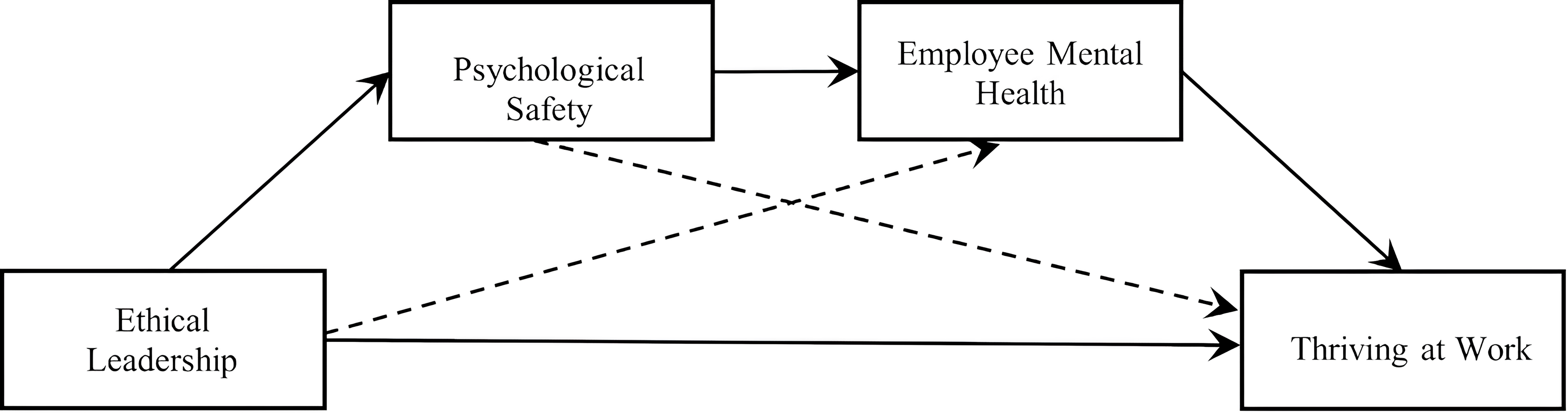 Fig. 1.
Graphical representation of proposed hypothesized theoretical model.
To tie the whole idea: Study aims to contribute to the literature through the following: First, we employed a framework that methodically examines how ethical leadership causes employees’ thriving at work. Secondly, we comprehensively discussed the impact of ethical leadership on employees’ psychological safety. Following a rigorous examination of the indicator’s mediating role, a subsequent strong influence on employees’ mental health is observed. By employing this novel approach, the study addresses a gap in the literature, elucidating the pathway through which ethical leadership fosters employee thriving at work.
The sample of the study consists of the employees of a company operating as an electronic retailer in Turkey in Istanbul. Convenience sampling method was preferred for data collection. Initially, the human resources managers of the company were approached to explain the objectives of the research, and consent was obtained to administer a survey among the employees. Upon securing the required approvals, an on-site survey was administered to the participants. To facilitate transportation considerations, the survey was carried out with employees from six different stores of the same brand. The study collected data from 367 surveys. The responses were reviewed by the researchers, and 12 surveys deemed incomplete or invalid were excluded from the analysis. Consequently, the final dataset comprising of 355 valid survey responses were collated for further analysis.
Among the participants, 174 were female and 181 were male. Regarding marital status, 209 participants were single, while 146 were married. In terms of age distribution, 199 participants were under the age of 30, 120 were between the ages of 30 and 45, and 36 were aged 46 or older. Of the participants, 39 had a high school education or lower, 239 held an associate’s or bachelor’s degree, and 77 had completed postgraduate education. In terms of work experience, 205 participants had 5 years or less, 119 had between 6 and 10 years, and 31 had more than 11 years of professional experience.
Data analysis was performed using AMOS 22.0 and SPSS 27.0 software (IBM Corp., Armonk, NY, USA). In the initial phase of the analysis, the potential presence of Common Method Bias (CMB) was evaluated to assess its possible impact on the study. Subsequently, analyses were conducted to examine the demographic characteristics of the participants and to assess the validity and reliability of the scales employed in the research. Prior to testing the hypotheses, the relationships between the variables were explored, and hypothesis testing was carried out thereafter. The Process Macro (Model 6) was utilized for hypothesis testing (Hayes, 2018). Within the Process Macro framework, analyses were performed using the bootstrap method with 5000 resamples and a 95% confidence interval.
To operationalize the constructs, this study employed scales that have been widely utilized in previous research and have demonstrated established validity and reliability. All scales were rated on a 1 to 5 scale.
Psychological Safety: The scale developed by Edmondson (1999) was used to measure the psychological safety of employees. The five-point Likert-type scale (1 = strongly disagree, 5 = strongly agree) has 7 items. Example items include “Members of this team are able to bring up problems and tough issues” and “It is safe to take a risk on this team”.
Ethical Leadership: The scale developed by Brown et al (2005) was used to measure employees’ perceptions of ethical leadership towards their leaders. The five-point Likert-type scale (1 = strongly disagree, 5 = strongly agree) has 10 items. Example items include “This team leader disciplines employees who violate ethical standards”.
Employee Mental Health: The scale developed by Kashyap and Singh (2017) was used to measure employees’ mental health. The 5-point Likert-type scale (1 = better than usual, 5 = much less than usual) has 12 items. Example items include “I always could not concentrate when I do something” and “I am always very nervous and feel stressed”, “I always feel unhappy or depressed”.
Thriving at Work: The scale developed by Porath et al (2012) was used to measure employees’ thriving at work. The 5-point Likert-type scale has 10 items (1 = not at all, 5 = to agreat extent). Example items include “I find myself learning often” and “I have energy and spirit”.
The fact that the data were collected from a single source in the study is a significant concern for common method bias (CMB) (Sürücü et al, 2023). Therefore, CMB was first checked in the analyses. For this purpose, Harman’s single factor test showed that there was no factor exceeding the 50% threshold (Podsakoff et al, 2003). In addition, the correlation analysis revealed that the correlation coefficient (r) values between both variables were less than 0.90 (Bagozzi et al, 1991). The findings indicate that there is no significant problem related to CMB in this study (Bagozzi et al, 1991; Podsakoff et al, 2003). Additionally, to avoid the potential biases in the data set the following steps were taken. First, participants were assured that their responses would be both confidential and anonymous to avoid social desirability bias. Second, participants were informed that their own opinions were important. Finally, participants were assured that their data would not be shared with third parties and that confidentiality would be maintained. This increased the likelihood that participants would respond honestly (Podsakoff et al, 2003).
In the preliminary analysis, the validity and reliability of the scales were tested and the results are presented in Table 1.
| Variables | Factor loadings | Cronbach’s alpha | CR | AVE |
| Ethical leadership | 0.556–0.803 | 0.907 | 0.908 | 0.501 |
| Psychological safety | 0.569–0.888 | 0.886 | 0.886 | 0.567 |
| Employee mental health | 0.667–0.825 | 0.930 | 0.931 | 0.531 |
| Thriving at work | 0.615–0.851 | 0.909 | 0.909 | 0.503 |
CR, Composite Reliability; AVE, average variance extracted.
The results exhibit that the factor loadings of the items belonging to the scales are higher than 0.5 and that the items have the ability to represent the relevant factor well (Sürücü et al, 2022). The Cronbach’s Alpha coefficient and Composite Reliability (CR) values, both exceeding 0.7, indicate that the scales demonstrate satisfactory reliability. Although the average variance extracted (AVE) values for each construct exceed 0.5, they remain lower than the corresponding composite reliability values. These findings indicate that the constructs have satisfactorily establish the convergent validity. In addition to these results, the fact that the square of the AVE coefficient is smaller than the correlation value between each construct (Table 2) confirms that discriminant validity is established between the factors (Fornell and Larcker, 1981; Hair et al, 2010).
| Variables | Mean | S.D. | 1 | 2 | 3 | 4 |
| Ethical leadership | 3.74 | 0.611 | 0.708a | |||
| Psychological safety | 3.81 | 0.578 | 0.549** | 0.753a | ||
| Employee mental health | 3.89 | 0.544 | 0.478** | 0.609** | 0.729a | |
| Thriving at work | 3.91 | 0.466 | 0.560** | 0.637** | 0.643** | 0.709a |
** p
Finally, we checked the tolerance value and its equivalent variance inflation factor (VIF) to assess multicollinearity problems. The results show that the tolerance value varies between 1.451 and 2.522, and the VIF value is greater than 0.1, indicating that there is no evidence of multicollinearity problems.
Prior to testing the hypothesized model, a correlation analysis was conducted to examine the relationships between the variables. Table 2 presents the means, standard deviations and correlations for all variables.
The results show that there is a positive relationship between the constructs.
Accordingly, ethical leadership has a positive relationship with psychological
safety (r = 0.549, p
Fig. 2 presents the graphical illustration of serial mediation analysis where ethical leadership was considered as the independent variable (X), psychological safety as the first mediator variable (M1), employee mental health as the second mediator variable (M2) and thriving at work as the dependent variable (Y). The analysis was conducted with the PROCESS Model 6 developed by Hayes (2018). The analysis results showing that proposed hypotheses are supported in Fig. 2.
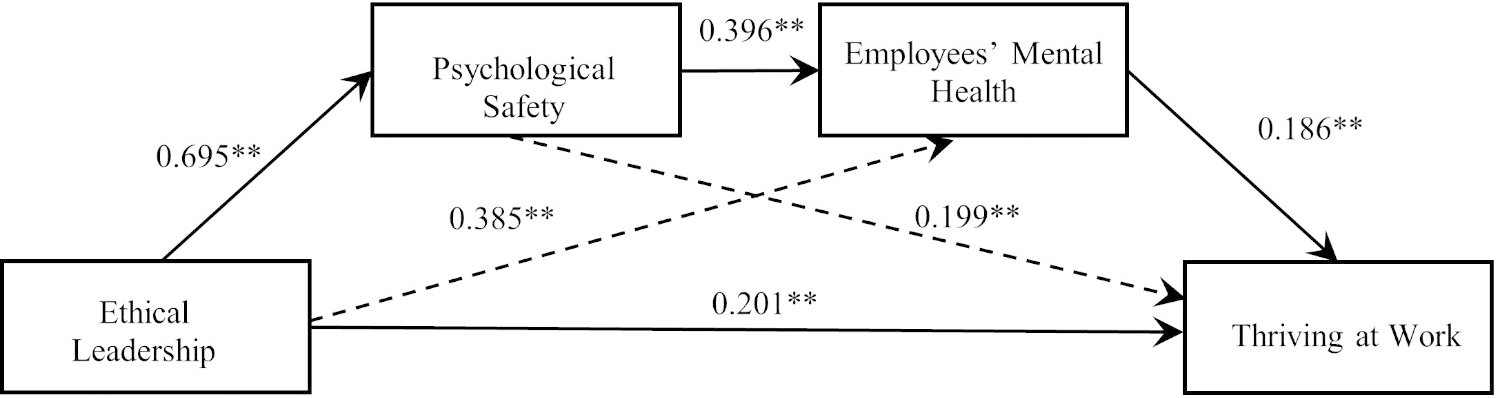 Fig. 2.
Graphical representation of serial mediation model of
psychological safety and employee mental health in the relationship between
ethical leadership and thriving at work. ** p
Table 3 shows the results of the serial mediation model linking ethical
leadership and thriving at work. Within the tested model, it was found that
ethical leadership has a direct effect on thriving at work (
| Estimate | SE | 95% CI | |||
| LLCI | ULCI | ||||
| Direct effect | 0.201 | 0.027 | 0.159 | 0.268 | |
| Indirect effect | |||||
| Total Indirect effect | 0.293 | 0.026 | 0.248 | 0.379 | |
| Indirect effect (EL→PS→TW) | 0.132 | 0.027 | 0.094 | 0.185 | |
| Indirect effect (EL→EMH→TW) | 0.082 | 0.015 | 0.065 | 0.124 | |
| Indirect effect (EL→ PS→EMH→TW) | 0.078 | 0.018 | 0.057 | 0.120 | |
| Total effect | 0.495 | 0.027 | 0.475 | 0.572 | |
EL, Ethical Leadership; PS, Psychological Safety; EMH, Employee Mental Health; TW, Thriving at Work; SE, Standard error; CI, Confidence interval; LLCI, Lower-limit of confidence interval; ULCI, Upper-limit of confidence interval.
This study explored the empirical relationship between ethical leadership, psychological safety, employees’ mental health, and thriving at work, confirming the hypothesized relationship in the theoretical model. Consistent with prior art of knowledge, the findings revealed a positive relationship between psychological safety and ethical leadership (Bartram et al, 2024). This implies that employees are more likely to feel psychologically safe in their workplace if they believe that their leaders are moral beings who uphold the highest standards of justice, integrity, and transparency. This is consistent with an earlier study by Wang and Shi (2021) and Men et al (2020), supporting the notion that ethical leadership creates a safe space where employees can express their opinions without worrying about the consequences. Thus, these findings suggest that fostering open communication and teamwork, which are critical components for organizational success, depends on this kind of psychological safety (Frazier et al, 2017; Li and Peng, 2022).
Furthermore, the findings demonstrated a strong positive relationship between psychological safety and employees’ mental health. This finding implies that employees’ mental health is enhanced when they feel free to express their opinions, thoughts and worries. This relationship supports the findings of Kashyap and Singh (2017), who posited that psychological safety is a pivotal factor in fostering employees’ mental health as it develops a work environment where individuals feel safe to express themselves without fear of humiliation. On the other hand, it emphasizes how crucial ethical leaders foster a psychologically safety environment that promotes employees’ mental health by reducing stress and anxiety, encouraging open communication and job satisfaction, resultantly nurtures a healthy workplace by fostering trust, reciprocity and respect eventually benefitting the employees’ mental health and productivity.
The study states that an employees’ mental health positively impacts their ability to thrive at work. This finding suggests that employees with excellent mental health are more likely to succeed in their positions, as seen by increased engagement, output, and general job satisfaction. This result aligns with De Kock et al (2021) who highlighted that employees’ mental health is considered as a crucial driver that significantly influence employees’ ability to thrive at work by fostering their productivity, engagement, and overall well-being. In addition, findings imply that thriving at workplace enables the employees to perform their best, contribute significantly, and maintain a positive work-life balance.
Moreover, the findings state that the relationship between ethical leadership and thriving at work is significantly mediated by psychological safety and employees’ mental health (Djaya et al, 2024). This shows that ethical leaders create an environment favorable to psychological safety, subsequently increasing employee mental health, eventually leading to higher thriving at work. This finding is consistent with the social exchange theory (Blau, 1964), which holds that influential leaders encourage trust and reciprocation from their subordinates, leading to better outcomes like thriving at work. These findings’ implications underscore the vital role that ethical leadership plays in creating a work climate that fosters employees’ mental and professional growth. Hence, taking together these factors create a positive work environment where employees feel comfortable, secure, and empowered to reach their full potential for thriving at work.
The findings of this study contribute to the literature on ethical leadership by clarifying the chain of events that, via the mediating roles of psychological safety and employees’ mental health, related to ethical leadership to employees’ thriving at work. In order to address the influence of ethical leadership on employees’ outcomes, this research first expands on pre-existing theoretical frameworks by including psychological safety and mental health. Ethical leaders may influence employee behavior by setting a good example; this creates an atmosphere that promotes psychological safety (Ahmad et al, 2023; Sumanth et al, 2024). Secondly, the research highlights the importance of psychological safety as a crucial bridge in the link between ethical leadership and thriving at work. Therefore, it underscores the significance of psychological safety as a construct in organizational behavior by illustrating its impact on employees’ mental health. This finding is consistent with previous research that connected psychological safety to a range of favorable workplace outcomes (Edmondson and Bransby, 2023; Shafaei et al, 2024). It expands the theoretical understanding of leadership impacts within organizational settings by adding to the growing body of research indicating that ethical leadership practices promote both a thriving workforce and improved organizational performance (Ahsan, 2024; Dartey-Baah et al, 2024).
This study has insightful implications for managers and organizational leaders. Organizations should prioritize developing ethical leadership practices as a first step toward improving employees’ performance and organizational positive outcomes. Leaders may be given the tools they need to establish a psychologically secure work environment for their staff by participating in training programs emphasizing justice, ethics, and transparency (Abuzaid et al, 2024; Al Halbusi et al, 2024; Moon and Kang, 2024). Second, the results emphasize how critical it is to promote psychological safety in teams. Establishing programs that promote candid dialogue, constructive criticism, and teamwork may help organizations foster a culture where employees feel comfortable sharing their ideas and worries. This culture may be developed through regular seminars and team-building exercises, which will improve employees’ mental health and overall organizational performance (Gupta et al, 2024; Malik et al, 2024). Finally, in order to guarantee that employees have access to the resources they require to maintain their mental health, organizations should make investments in mental health services and support networks. This might entail providing wellness initiatives, mental health awareness campaigns, and counseling services. Organizations may build a robust workforce with greater resilience and adaptability that can handle the stress and change more proactively, allowing them to navigate challenges and creativity by placing a high priority on employees’ mental health (Ahmad et al, 2023; Bartram et al, 2024; Gupta et al, 2024).
Although this study provides implications, however it should be noted that it is not free from certain limitations. First, the convenience sampling method was used. This could potentially limit the applicability of the results. Second, the data were collected from employees of an electronics manufacturer operating in Turkey. In this respect, we cannot generalize the results of the analysis to all employees. Third, the cross-sectional design of the study makes it more difficult to determine the causal relationships between the variables. Longitudinal research may provide insights into the causal relationships between psychological safety, employee mental health, job success, and ethical leadership. Finally, the study did not take into account relevant external factors such as organizational policies or market conditions that may affect the relationships examined. The following suggestions can be made for future studies: A longitudinal study can be designed. The study can be expanded to include different sectors and different cultural contexts. Investigating possible moderating variables such as employee demographics or organizational climate can shed more light on the interactions between various variables within this framework.
Data is available on request.
WuR and MB designed the research study. MB performed the research. LS analyzed and interpreted the data. SSR and KA contributed to the interpretation of results and critically revised the manuscript. All authors contributed to writing or revising the manuscript, reviewed the final version, and approved it for submission. All authors read and approved the final manuscript. All authors have participated sufficiently in the work and agreed to be accountable for all aspects of the work.
Not applicable.
This research received no external funding.
The authors declare no conflict of interest.
References
Publisher’s Note: IMR Press stays neutral with regard to jurisdictional claims in published maps and institutional affiliations.