
 , Wenli Liu 1, Rui Yan 2, Shanji Yao 1,*
1 School of Economics and Management, Nanjing Tech University, 211800 Nanjing, Jiangsu, China
2 Business School, Hohai University, 211100 Nanjing, Jiangsu, China
Abstract
This study aims to elucidate the relationship between of job embeddedness and salesperson performance and organizational citizenship behavior (OCB). Grounded in theories of person-environment fit and conservation of resources theory, we propose that job embeddedness positively influences employee performance and OCB by alleviating perceived overqualification while verifying the moderating role of psychological empowerment. Utilizing questionnaire data from 419 matched salesperson-supervisor dyads, we employed structural equation modeling to examine variable relationships, performed mediation analysis through the Bootstrap approach, and assessed moderating effects via hierarchical regression analysis. Results demonstrate that job embeddedness significantly and positively predicts OCB and sales performance but negatively correlates with perceived overqualification. Mediation analysis reveals that perceived overqualification partially mediates the impact of job embeddedness on OCB but fully mediates its effect on sales performance. Psychological empowerment significantly moderates the negative impact of perceived overqualification on outcome variables, with its adverse effects mitigated under high empowerment levels. The research confirms that job embeddedness enhances performance by reducing perceived overqualification, while psychological empowerment buffers against its negative consequences. These findings provide theoretical foundations for constructing supportive work environments and optimizing sales team incentive mechanisms. Organizations should strengthen employee-position embeddedness to optimize person-environment fit and implement psychological empowerment interventions to enhance work adaptation perceptions among highly qualified personnel.
Keywords
- job embeddedness
- sales performance
- organizational citizenship behavior
- perceived overqualification
- psychological empowerment
Under the converging development of the digital economy and the knowledge economy, the reconstruction of organization-individual relationships has emerged as a critical proposition in management studies. As a frontier concept in organizational behavior, job embeddedness demonstrates unique explanatory dimensions within the specific context of sales positions. Contemporary Chinese society is undergoing three structural transformations: the talent mismatch stemming from higher education expansion, occupational capability reconstruction driven by digital transformation, and organizational resilience demands in volatile, uncertain, complex, and ambiguous (VUCA) environments. The interplay of these transformations positions sales roles as an exemplary field for observing the modern workplace ecology.
From a human capital allocation perspective, the widening chasm between entry criteria for sales positions (as typical experience-oriented occupations) and practitioners’ educational backgrounds has given rise to pervasive perceived overqualification. When sales professionals’ knowledge reserves and cognitive levels create a qualification-position inversion relative to actual job requirements, traditional competency models face explanatory crises. Compounding this issue, the deep application of AI technologies in customer profiling and demand prediction accelerates the devaluation of fundamental sales skills, transforming practitioners’ competence anxiety from “skill deficiency” to “skill redundancy” thereby creating cognitive fog in career development trajectories. At the organizational management level, the double-edged sword effect of job embeddedness manifests distinctly in sales teams. While highly embedded employees may enhance short-term performance through social network capital, excessive organizational ties risk evolving into a “golden handcuffs” effect. When individuals perceive that their qualifications substantially exceed position requirements, strong organizational embedding fails to stimulate innovative behaviors but instead inhibits organizational citizenship behavior (OCB) through psychological contract violation mechanisms.
This paradox reflects a fundamental conflict between efficiency logic and humanistic logic in modern organizational management: an irreconcilable theoretical fissure exists between quantifiable performance pursued by standardized evaluation systems and self-actualization values inherently sought by knowledge workers. The digital transformation wave intensifies this contradiction. While technological tools like intelligent customer service systems and big-data precision marketing enhance sales efficiency, they simultaneously deconstruct the core value of traditional sales positions. As interpersonal communication skills and emotional labor (“soft competencies”) become algorithmically quantifiable substitutes, structural imbalances emerge in sales professionals’ competence cognition frameworks. This technological unemployment anxiety resonates with perceived overqualification, transforming OCB from spontaneous altruism to a calculative contribution—employees may strategically adjust OCB manifestations as bargaining chips for occupational security.
In the modern business environment, the performance of sales personnel not only directly impacts the economic benefits of enterprises but also plays a crucial role in shaping the overall culture and atmosphere of the organization. As a bridge between the enterprise and its customers, the quality of performance is directly related to customer satisfaction, brand loyalty, and the enhancement of market competitiveness. The rise of higher education has led many highly educated individuals to enter sales roles, where some may inevitably feel overqualified. Perceived overqualification, defined as employees believing that their education and skills exceed job requirements (Zhang et al, 2021), has garnered significant attention in recent research. Green and McIntosh (2007) found that perceived overqualification is most prevalent among salespeople. Employees’ professional cognition significantly affects their attitudes and behaviors. Extensive research suggests that perceived overqualification is a detrimental factor (Erdogan and Bauer, 2009). As a result, empirical research has explored antecedents of perceived overqualification, such as leadership factors (e.g., transformational leadership), individual factors (e.g., age, narcissism) (Liu and Wang, 2012; Maynard et al, 2015), and situational factors (e.g., job characteristics, career adaptability) (Lobene et al, 2015; Yang et al, 2015). However, there has been little research on the impact of job embeddedness on perceived overqualification through the lens of Person-Organization Fit (P-O fit). We propose that job embeddedness, which encompasses P-O fit, reflects the strength of employees’ attachment to their work and organization, potentially mitigating perceived overqualification and positively influencing sales performance and work behavior.
Job embeddedness refers to an individual’s inclination to remain in an organization due to social ties, exit costs, and compatibility with the organizational environment, encompassing three dimensions: interpersonal networks, organizational fit, and opportunity loss. Organizational citizenship behavior (OCB) denotes employees’ voluntary, extra-role altruistic actions that surpass formal job requirements, including non-contractual contributions such as helping behaviors, conscientiousness, and civic virtue. Perceived overqualification is defined as a cognitive discrepancy wherein individuals subjectively assess their knowledge, skills, or experience as substantially exceeding job demands, frequently accompanied by work alienation and career stagnation. The phenomenon of person-position mismatch induced by perceived overqualification has significant negative effects on employee attitudes and behaviors (Harari et al, 2017; Wu and Chi, 2020). Within the person-environment (P-E) fit theoretical framework, person-organization (P-O) fit and person-job (P-J) fit constitute distinct dimensions. Kristof-Brown et al (2005) demonstrate interactive effects between P-O fit and P-J fit in jointly influencing employee performance. Resick et al (2007) reveal that high P-O fit enhances organizational attachment and proactive behaviors. Erdogan et al (2020) identify significant suppression of employee voice behavior by perceived overqualification under conditions of low P-O fit. Wang (2020) further indicates that concurrent high P-O fit and high perceived overqualification significantly elevate work autonomy and positive affect. These findings collectively suggest the moderating role of P-O fit in perceived overqualification effects. In intensified market competition contexts, enhancing sales personnel performance has emerged as a strategic priority (Tabak and Hendy, 2016; Yu et al, 2020). The prevalent phenomenon of perceived overqualification among sales professionals, characterized by subjective assessments of personal capabilities exceeding job requirements, not only reduces job satisfaction and organizational commitment but also adversely affects performance outcomes and organizational citizenship behaviors (Afsar et al, 2018; Kapil and Rastogi, 2018). Frustration stemming from overqualification diminishes work engagement, creating a performance deterioration cycle (Fine and Nevo, 2008; Kalleberg, 2008). While existing research has primarily examined individual characteristics, environmental support, and incentive mechanisms affecting sales performance, it has insufficiently addressed the mechanisms of perceived overqualification, particularly neglecting investigation into mediating pathways of its negative impacts (Jansen and Kristof-Brown, 2006; Kraus et al, 2015; Mitchell et al, 2001). Job embeddedness, as a multidimensional construct encompassing relational networks, fit levels, and sacrifice considerations, influences both retention decisions and performance outcomes. High job embeddedness mitigates perceived overqualification through strengthened organizational belongingness, thereby enhancing sales performance and citizenship behaviors. From the conservation of resources (COR) theory perspective, job embeddedness bolsters resource acquisition capabilities, effectively buffering resource depletion effects caused by overqualification (Li et al, 2019; Simon et al, 2019; Yoo, 2017).
This study contributes theoretically in three aspects: First, it clarifies the mediating role of perceived overqualification, extending the pathway through which job embeddedness influences sales performance and enriching theoretical linkages connecting organizational embeddedness with work outcomes. Second, it innovatively introduces psychological empowerment as a moderator, constructing an integrated “job embeddedness-psychological empowerment-perceived overqualification” model that deepens understanding of boundary condition mechanisms. Third, by integrating P-E fit theory with COR theory, it establishes a dual-theoretical explanatory framework, providing a more systematic analytical perspective for sales performance research. Practically, the findings offer novel approaches for optimizing sales team management, recommending enhanced job embeddedness development to reduce perceived overqualification, thus achieving synergistic improvement in performance and organizational citizenship behaviors. The paper adopts a five-section structure: Section I systematically reviews theoretical foundations and clarifies conceptual relationships among job embeddedness, perceived overqualification, and sales performance. Section II constructs the theoretical model through literature synthesis, proposing hypotheses encompassing main effects, mediation, and moderation effects. Section III details empirical methodologies, including sample selection criteria, scale validation, and data analysis procedures. Section IV presents hierarchical regression results, verifying statistical relationships among variables. Section V discusses theoretical innovations, managerial implications, limitations related to sample scope and the absence of longitudinal research and proposes suggestions for future research directions. This research design systematically deconstructs the transmission mechanism of job embeddedness on sales personnel behavioral outcomes, contributing new insights to organizational behavior research.
Job embeddedness refers to employees’ retention propensity stemming from multidimensional organizational connections, comprising three dimensions: links, fit, and sacrifice (Lee et al, 2004). Links represent the social networks established between employees and colleagues/organizations, reinforcing their sense of belonging; fit denotes the compatibility between employees’ values and organizational culture, directly influencing job satisfaction; sacrifice reflects perceived material and emotional losses from potential job separation, prompting increased organizational commitment (Greene et al, 2018). High job embeddedness enhances employees’ work motivation through strengthened organizational identification, thereby improving performance levels and organizational citizenship behaviors, which are strategically significant for optimizing human resource management in competitive markets. Sales performance represents salespersons’ comprehensive output in achieving sales targets and performance metrics, typically measured through quantitative indicators such as sales volume, market share, and customer satisfaction (Zhang et al, 2019). As a core driver of corporate profitability and market competitiveness, sales performance is influenced by multiple factors, including individual characteristics, work environment, incentive mechanisms, and attitude. Research demonstrates that job embeddedness significantly enhances sales personnel’s work engagement and initiative through enhanced organizational identification and responsibility, ultimately driving sales performance growth. The mechanism operates through three pathways: amplification of resource acquisition capabilities through organizational connections; optimization of role adaptation processes through cultural compatibility; and transformation of the perceived costs of job separation into behavioral incentives for sustained effort.
Organizational Citizenship Behavior (OCB) refers to voluntary behaviors exhibited by employees that transcend formal job responsibilities. These behaviors are not directly incentivized by an organization’s formal reward system, yet they significantly enhance overall organizational efficiency and climate. OCB typically encompasses various forms, including assisting colleagues, actively participating in team activities, safeguarding organizational reputation, and demonstrating support for organizational goals. Such behaviors not only foster team collaboration and improve workplace harmony but also cultivate mutual trust and support among employees, thereby elevating organizational performance (Borman and Motowidlo, 1993). The driving mechanism of job embeddedness on OCB can be deconstructed through the lenses of Conservation of Resources Theory and Social Exchange Theory. Dense social networks (Links) heighten employees’ dependence on the organizational ecosystem, compelling them to sustain relational capital and mitigate social exclusion risks through OCB; individual-organizational value congruence (Fit) strengthens role-breadth self-efficacy, motivating employees to enact citizenship behaviors beyond instrumental rationality; resource sacrifices (Sacrifice) arising from potential turnover amplify perceived opportunity costs, prompting employees to accumulate organizational commitment via OCB to consolidate their current status (Kiazad et al, 2015). The manifestation of OCB also reflects employees’ organizational identification and loyalty, further reinforcing organizational cohesion and centripetal force. In highly competitive market environments, encouraging and nurturing employee OCB has become a pivotal strategy for organizations to enhance competitive advantages. Therefore, we propose:
H1a. Salesperson job embeddedness is positively associated with organizational citizenship behavior.
H1b. Salesperson job embeddedness is positively associated with sales performance.
According to Person-Environment (P-E) fit theory, Person-Organization (P-O) fit consists of two forms: consistency fit, which refers to the alignment between organizational culture, values, and goals with those of employees; and complementary fit, which occurs when the organization provides the rewards and opportunities employees need or when employees meet the organization’s requirements in skills, knowledge, and effort (Mostafa et al, 2023). The “fit” dimension in job embeddedness primarily refers to consistency fit, indicating that employees with high job embeddedness closely align with the organization’s values and goals (Ampofo and Karatepe, 2024). There are various ways to achieve fit in the work environment, but employees may struggle to attain all types of fit. For instance, perceived overqualification represents a mismatch between employees and their work. This raises the question: can P-O fit mitigate employees’ perceived overqualification due to personal job mismatch?
Oh et al (2014) reported a correlation coefficient of 0.54 between P-O fit and P-J fit in their meta-analysis, indicating a strong relationship. Previous research has also demonstrated an interaction between P-O fit and Pearson-Jones (P-J) fit. Kristof-Brown et al (2002) found that high organizational-level fit can compensate for low job-level fit through increased job satisfaction. Jansen and Kristof-Brown (2006) suggested that achieving fit across different levels within the environment can mitigate the cognitive imbalance caused by a mismatch at one level. Supporting this view, Resick et al (2007) found that P-O fit alleviated the negative effects of job mismatch on interns’ job satisfaction and job choice intentions. Erdogan et al (2020) also found that high P-O fit alleviates perceived overqualification, enhancing employees’ motivation to voice their opinions. Given these findings, we propose that job embeddedness, which includes a high degree of P-O fit, should mitigate employees’ perceived overqualification due to personal job mismatch.
High job embeddedness enables sales personnel to establish extensive social networks, thereby acquiring greater resource support to enhance performance and organizational citizenship behavior. Perceived overqualification reflects a psychological imbalance where individuals perceive that their competencies exceed job requirements, potentially triggering professional frustration and motivational decline. Job embeddedness significantly mitigates this phenomenon by reinforcing organizational value congruence: when sales professionals perceive high alignment between their career objectives and organizational strategies, their self-efficacy and professional fulfillment are enhanced, thereby alleviating negative emotions arising from competency-position mismatches (Kraus et al, 2015). Furthermore, strong job embeddedness motivates sales personnel to actively engage in organizational socialization processes and expand career development resource channels, systematically reducing the adverse effects of overqualification perceptions (Mitchell et al, 2001). This virtuous cycle manifests as synergistic effects between organizational support acquisition and effective utilization of professional competencies, ultimately fostering performance optimization and increased altruistic behaviors. In contrast, low job embeddedness weakens organizational commitment and exacerbates the destructive impact of overqualification perceptions—sales personnel risk falling into professional isolation, struggling to activate latent capabilities, resulting in performance decline and deficient organizational citizenship behavior. Therefore, enhancing job embeddedness not only consolidates sales personnel’s organizational loyalty but also effectively suppresses the probability of overqualification perceptions through value identification mechanisms and social support systems, forming a continuously improving virtuous professional ecosystem. Based on these observations, this study proposes:
H2. Salesperson job embeddedness is negatively associated with perceived overqualification.
From the perspective of sales performance metrics, perceived overqualification has a direct negative impact on sales personnel’s work engagement and self-efficacy. When individuals persistently operate under the cognitive state of underutilized competencies, the discrepancy between career development expectations and actual job requirements triggers chronic psychological frustration (Simon et al, 2019). This negative emotional state not only diminishes sales professionals’ recognition of occupational value but also reduces their proactive pursuit of knowledge acquisition. In dynamic market environments, delayed knowledge updating directly compromises client demand responsiveness, consequently impairing sales target achievement rates. Specific manifestations include: the perception of overqualification lowers employees’ concentration on standardized sales processes, resulting in a marginal diminishing trend in energy investment in core operational aspects such as client development and demand analysis.
Through the lens of organizational citizenship behavior, perceived overqualification significantly inhibits the expression of extra-role behaviors. Sales personnel’s asymmetrical cognition regarding their capabilities and job requirements fosters organizational alienation, which directly affects their willingness to participate in team collaboration (Zhang et al, 2016). Specifically, individuals with perceived overqualification tend to adopt “psychological withdrawal” strategies, demonstrating marked passivity in non-compulsory work domains such as knowledge sharing and cross-departmental cooperation. This selective participation pattern not only weakens team knowledge transfer efficiency but may have negative exemplar effects, ultimately undermining organizational operational effectiveness. The mechanism exhibits unique transmission pathways in sales positions: sales professions require continuous high-intensity interpersonal interactions, while cognitive dissonance induced by perceived overqualification substantially reduces emotional investment levels. During client service processes, this psychological state may manifest as formulaic communication patterns, leading to deterioration in client relationships. Concurrently, in internal collaboration scenarios, excessive competence perceptions may provoke professional arrogance, hindering effective coordination within cross-functional teams. Therefore, this study proposes:
H3a. Salesperson perceived overqualification is negatively associated with organizational citizenship behavior.
H3b. Salesperson perceived overqualification is negatively associated with sales performance.
Under the mechanism of job embeddedness, the profound congruence between sales personnel and organizations across value systems, interpersonal networks, and job structure dimensions significantly inhibits the negative emotional mechanisms associated with perceived overqualification. This organizational embeddedness characteristic enhances employees’ role identity, enabling the transformation of excess competence surplus into strategic resource reserves rather than psychological burdens. Specifically, when sales professionals establish robust career anchors, their cognitive discrepancies regarding job requirements undergo recalibration through organizational support systems, thereby sustaining positive self-efficacy evaluations. The mediating effect of perceived overqualification manifests through dual transmission pathways: At the performance level, high job-embeddedness environments provide channels for the transformation of competence overflow, where sales personnel achieve organizational internalization of tacit value through informal knowledge sharing and cross-functional collaboration. This compensatory mechanism effectively circumvents competence depreciation phenomena inherent in traditional performance evaluation systems.
High levels of job embeddedness not only enhance sales personnel’s work engagement but also elevate performance outcomes and proactive behaviors through heightened self-efficacy and organizational belongingness. When sales professionals perceive a competency-job demand mismatch, strong job embeddedness enables them to mitigate deficiencies arising from perceived overqualification by cultivating robust social networks and securing essential support. Under such conditions, sales personnel can optimize the utilization of their knowledge and skills, ultimately augmenting sales performance. In the dimension of organizational citizenship behavior, reciprocal obligations engendered by embedded networks motivate employees to transform surplus qualifications into altruistic actions, maintaining psychological contract equilibrium through the voluntary assumption of extra-role responsibilities. Organizational culture internalization resolves cognitive conflicts resulting from competency misalignment by integrating personal development objectives with organizational strategies; the enhanced density of relational networks provides multiple outlets for competency conversion, reducing frustration from resource underutilization; and flexible job structure design enables work role reshaping, transforming overqualification into innovation triggers. This multidimensional embeddedness collectively facilitates psychological-cognitive reconstruction, ultimately establishing dual improvement pathways for performance enhancement and organizational citizenship behavior reinforcement. Therefore, this study proposes:
H4a. Job embeddedness positively affects organizational citizenship behavior through perceived overqualification, with perceived overqualification serving as a mediator between job embeddedness and organizational citizenship behavior.
H4b. Job embeddedness positively affects sales performance through perceived overqualification, with perceived overqualification serving as a mediator between job embeddedness and sales performance.
In sales work, salespeople frequently make judgment-based decisions, leading organizations to grant them a high level of autonomy. Psychological empowerment, as employees’ perceptions of organizational empowerment, is closely linked to their motivation, enthusiasm, and initiative (Yoo, 2017). Therefore, this study posits that psychological empowerment can supplement employees’ emotional resources, mitigating the emotional resource deficit caused by perceived overqualification and enabling them to regulate their emotions, exhibit positive behavior, and achieve high performance.
Psychological empowerment comprises four aspects: Meaning, which refers to an individual’s perception of work value aligned with personal values; Self-determination, which reflects the individual’s control over their work behavior; Self-efficacy, which reflects confidence in their ability to complete tasks; and Impact, which indicates the extent to which an individual influences organizational operations and goals (Spreitzer, 1995). Previous research on psychological empowerment has shown its positive effects on employees’ attitudes and behaviors. For instance, it enhances emotional commitment (Heron and Bruk-Lee, 2020), improves job satisfaction (Jordan et al, 2017), and promotes innovative behavior (Zia et al, 2024).
For salespeople, perceived overqualification leads to negative perceptions, attitudes, and a lack of emotional resources. Consequently, they may struggle to maintain a positive outlook and work behavior, hindering their performance. Organizational support can reduce the negative work attitudes and behaviors caused by perceived overqualification. Psychological empowerment, as a form of perceived organizational support, can help alleviate employees’ lack of emotional resources, enabling them to work with positive emotions and achieve high performance. Therefore, this study proposes:
H5a. Psychological empowerment negatively moderates the relationship between perceived overqualification and organizational citizenship behavior.
H5b. Psychological empowerment negatively moderates the relationship between perceived overqualification and sales performance.
Based on the above analysis, salesperson job embeddedness alleviates perceived overqualification and enhances job performance and organizational citizenship behavior. High levels of psychological empowerment can further mitigate the negative impact of perceived overqualification on job performance and organizational citizenship behavior. Thus, this study proposes that psychological empowerment may also moderate the mediating effect of perceived overqualification between job embeddedness and sales performance, as well as organizational citizenship behavior.
Specifically, salespeople with high job embeddedness have a strong P-O fit, allowing them to leverage sales opportunities from an expanded job network, fully utilizing their talents and alleviating perceived overqualification. Furthermore, if the organization provides a high level of psychological empowerment, the salesperson will be more likely to adjust their negative work attitudes, take initiative, exhibit expected behaviors, and achieve high performance. Therefore, this study proposes:
H6a. Psychological empowerment moderates the mediating role of perceived overqualification between job embeddedness and organizational citizenship behavior.
H6b. Psychological empowerment moderates the mediating role of perceived overqualification between job embeddedness and sales performance.
The conceptual model of this study is shown in Fig. 1.
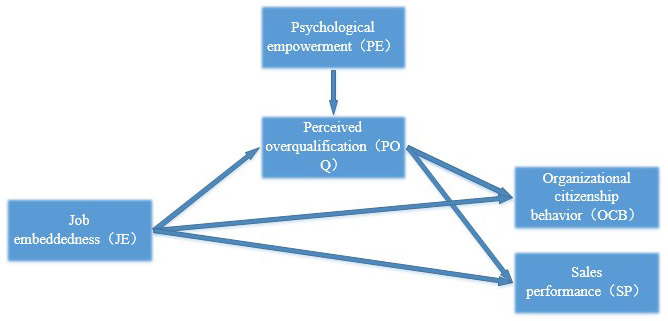 Fig. 1.
Theoretical model.
To obtain effective data, this study utilized a salesperson-manager matching questionnaire, comprising separate questionnaires for salespeople and managers. Salespeople rated their job embeddedness, perceived overqualification, psychological empowerment, and control variables, while managers rated the salespeople’s performance, organizational citizenship behavior, and control variables. Survey samples were drawn primarily from Jiangsu, Guangdong, Anhui, and other regions in China. A total of 100 sales manager questionnaires and 500 salesperson questionnaires were distributed, with each manager evaluating approximately five salespeople. The survey collected 443 paired responses, including 419 valid pairs, resulting in a total response rate of 94.58%.
The participants’ demographic information is as follows: 57% of the respondents were male, and 43% were female. In terms of education, 35.8% had qualifications below junior college, 42.5% were at the junior college level, and 21.7% held a bachelor’s degree or higher. For work experience, 8.1% had one year or less, 33.4% had one to three years, 21% had three to five years, 22.9% had five to ten years, and 14.6% had over ten years. In terms of marital status, 56.1% were married, and 43.9% were unmarried. Regarding age, 10% were under 24 years old, 46.8% were 24–30 years old, 35.8% were 30–45 years old, and 7.4% were over 45 years old. The demographic profile of the sample is shown in Table 1.
| Value | Numbers | Percentage (%) | |
| Gender | Male | 239 | 57.0 |
| Female | 180 | 43.0 | |
| Education | Below junior college | 150 | 35.8 |
| Junior college | 178 | 42.5 | |
| Bachelor degree or above | 91 | 21.7 | |
| Tenure | 1 year and below | 34 | 8.1 |
| 1 to 3 years | 140 | 33.4 | |
| 3 to 5 years | 88 | 21.0 | |
| 5 to 10 years | 96 | 22.9 | |
| 10 years and above | 61 | 14.6 | |
| Marriage | Married | 235 | 56.1 |
| Unmarried | 184 | 43.9 | |
| Age | Under 24 | 42 | 10.0 |
| 24–30 years old | 196 | 46.8 | |
| 30–45 years old | 150 | 35.8 | |
| Over 45 | 31 | 7.4 |
The structure of the questionnaire employed in this study consists of two distinct sections. The first section pertains to the demographic characteristics of the participants, encompassing information such as gender, educational background, work experience, marital status, and age. The second section focuses on the measurement of key variables, including job embeddedness, perceived overqualification, and psychological empowerment. The design of the questions in the first section is based on established scales from existing literature, thereby ensuring the validity and reliability of the measurement instruments. Participants rated their responses using a five-point Likert scale, ranging from 1 (strongly disagree) to 5 (strongly agree), facilitating the quantification of their level of agreement with each statement. The survey was conducted in China, and all questions underwent professional translation to ensure both the accuracy of content and cultural appropriateness. To further enhance the applicability and effectiveness of the questionnaire, two experienced sales professionals were invited to revise certain phrasing and expressions, ensuring that the questionnaire adequately reflects the realities of the sales environment, ultimately resulting in the final version of the questionnaire.
Job embeddedness was measured using the scale developed by Ben-Meir et al (2024), which includes three dimensions: connection, matching, and sacrifice, with a total of 13 items (e.g., “Resignation will have a great effect on my current life”). Cronbach’s alpha for the scale was 0.925. Perceived overqualification was measured using the classic scale by Fine and Nevo (2008), comprising 9 items (e.g., “My education is higher than what is needed for my job”). Cronbach’s alpha for the scale was 0.931. Psychological empowerment was measured using the classical scale by Spreitzer (1995), consisting of 11 items (e.g., “My work is significant to me”). Cronbach’s alpha for these items was 0.902. Sales performance was measured using the seven-item scale developed by Sujan et al (1994) (e.g., “Can sell the company’s new products”). The scale’s Cronbach’s alpha was 0.959. Organizational citizenship behavior was measured using the scale developed by Van Scotter and Motowidlo (1996), comprising 15 items (e.g., “Give support or encouragement to colleagues when they encounter personal difficulties”). The scale’s Cronbach’s alpha was 0.976.
Furthermore, considering that individual characteristics such as gender, marital status, educational background, and work experience may significantly impact the performance of sales personnel and their organizational citizenship behavior, controlling for these variables helps to eliminate external interference. This practice ensures the validity and reliability of the research findings, thereby allowing for a more accurate understanding of the relationship between job embeddedness and both sales performance and organizational citizenship behavior.
Descriptive statistics were employed to calculate fundamental statistical
indicators, including mean, standard deviation, minimum, and maximum values,
which summarize the basic characteristics of the sample. For categorical
variables, frequency and percentage were utilized to provide a visual analysis of
the demographic characteristics of the sample. In conducting the correlation
analysis, the Pearson correlation coefficient was applied to assess the linear
relationships among the variables. The specific calculation method involved
standardizing each pair of variables, subsequently calculating their covariance,
and dividing by the product of their respective standard deviations to obtain the
correlation coefficient. Confirmatory factor analysis (CFA) was employed to
examine the discriminant validity among the variables. This was achieved by
comparing the goodness-of-fit between the single-factor model and the
multi-factor model to evaluate the independence and validity of the variables.
The fundamental principle of this step was to determine the optimal factor
structure by comparing the fit indices of different models (such as
Following the suggestion of Podsakoff et al (2003), this study employs Harman’s single-factor test to assess common method bias. A factor analysis was conducted on all items measuring job embeddedness, perceived overqualification, psychological empowerment, organizational citizenship behavior, and sales performance. The results show that the highest variance explained by a single factor was 32.042%, which is below the 50% threshold. Thus, common method bias in this study is within an acceptable range.
Table 2 presents the descriptive statistics and correlations of the study
variables. Job embeddedness was negatively correlated with perceived
overqualification (r = –0.353, p
| Mean | SD | 1 | 2 | 3 | 4 | 5 | 6 | 7 | 8 | 9 | |
| Gender | 1.430 | 0.496 | |||||||||
| Marriage | 1.440 | 0.497 | –0.039 | ||||||||
| Education | 2.830 | 0.893 | –0.054 | 0.090* | |||||||
| Tenure | 3.020 | 1.214 | 0.134** | –0.466** | –0.120** | ||||||
| JE | 3.731 | 0.707 | 0.018 | –0.117** | –0.173** | 0.105* | 0.792 | ||||
| POQ | 2.731 | 0.843 | 0.008 | –0.042 | 0.188** | 0.026 | –0.353** | 0.797 | |||
| PE | 3.658 | 0.698 | –0.014 | –0.046 | –0.061 | 0.051 | 0.587** | –0.244** | 0.795 | ||
| OCB | 3.595 | 0.707 | 0.005 | –0.033 | –0.100* | 0.083* | 0.446** | –0.290** | 0.229** | 0.809 | |
| SP | 3.592 | 0.682 | 0.032 | –0.004 | –0.023 | 0.020 | 0.458** | –0.266** | 0.229** | 0.514** | 0.814 |
Note. * p
To facilitate the development of the research, this study adopts abbreviations
for the indicators, where JE, POQ, PE, OCB, and SP respectively represent Job
Embeddedness, Perceived Overqualification, Psychological Empowerment,
Organizational Citizenship Behavior, and Sales Performance. To test the
discriminant validity among job embeddedness, perceived overqualification,
psychological empowerment, organizational citizenship behavior, and sales
performance, a series of confirmatory factor analyses were conducted. The
results, shown in Table 3, indicate that compared to the single-factor,
two-factor, three-factor, and four-factor models, the five-factor model (job embeddedness, perceived overqualification, psychological empowerment,
organizational citizenship behavior, and sales performance) exhibited the best data fit (
| CFI | SRMR | TLI | RMSEA | ||
| Five-factor model | 2.248 | 0.918 | 0.0425 | 0.913 | 0.055 |
| Four-factor modela | 4.198 | 0.789 | 0.1153 | 0.776 | 0.087 |
| Three-factor modelb | 6.224 | 0.654 | 0.1421 | 0.634 | 0.112 |
| Two-factor modelc | 7.786 | 0.549 | 0.1516 | 0.525 | 0.127 |
| Single-factor model | 9.312 | 0.447 | 0.1468 | 0.418 | 0.141 |
aPsychological Empowerment and Perceived Overqualification were combined into one factor.
bPsychological Empowerment, Perceived Overqualification and Sales Performance were combined into one factor.
cPsychological Empowerment, Perceived Overqualification, Organizational Citizenship Behavior and Sales Performance were combined into one factor.
DF, Degrees of Freedom; CFI, Comparative Fit Index; SRMR, Standardized Root Mean Square Residual; TLI, Tucker-Lewis Index; RMSER, Root Mean Square Error of Approximation.
This study employs multiple regression analysis to examine the effect of job
embeddedness on organizational citizenship behavior and sales performance. The
results are shown in Table 4. Regarding the direct effects, model 2 and model 8
show that job embeddedness had a significant positive impact on organizational
citizenship behavior (
| OCB | SP | POQ | ||||||||||||
| M 1 | M 2 | M 3 | M 4 | M 5 | M 6 | M 7 | M 8 | M 9 | M 10 | M 11 | M 12 | M 13 | M 14 | |
| Gender | –0.010 | –0.010 | –0.007 | –0.008 | –0.003 | –0.010 | 0.029 | 0.029 | 0.033 | 0.031 | 0.036 | 0.030 | 0.013 | 0.013 |
| Marriage | 0.012 | 0.047 | –0.001 | 0.036 | 0.005 | 0.034 | 0.007 | 0.044 | –0.006 | 0.035 | 0.001 | 0.024 | –0.047 | –0.074 |
| Education | –0.092 | –0.021 | –0.036 | 0.001 | –0.035 | –0.036 | –0.020 | 0.056 | 0.034 | 0.074** | 0.035 | 0.034 | 0.196*** | 0.141** |
| Tenure | 0.079 | 0.057 | 0.086 | 0.064 | 0.080 | 0.082 | 0.017 | –0.006 | 0.024 | –0.001 | 0.017 | 0.019 | 0.026 | 0.043 |
| JE | 0.442*** | 0.390*** | 0.472*** | 0.429*** | –0.342*** | |||||||||
| POQ | –0.286*** | –0.153*** | –0.246*** | –0.299*** | –0.274*** | –0.128** | –0.231*** | –0.274*** | ||||||
| PE | 0.163*** | 0.142** | 0.174*** | 0.158** | ||||||||||
| POQ × PE | 0.262*** | 0.212*** | ||||||||||||
| R2 | 0.015 | 0.203 | 0.094 | 0.223 | 0.119 | 0.183 | 0.002 | 0.216 | 0.074 | 0.229 | 0.102 | 0.144 | 0.040 | 0.151 |
| Adj. R2 | 0.015 | 0.187 | 0.079 | 0.020 | 0.025 | 0.065 | 0.002 | 0.214 | 0.072 | 0.014 | 0.028 | 0.042 | 0.040 | 0.112 |
| F | 1.607 | 21.004*** | 8.551*** | 19.661*** | 9.238*** | 13.192*** | 0.176 | 22.691*** | 6.566*** | 20.43*** | 7.802*** | 9.908*** | 4.265** | 14.742*** |
Note. ** p
Regarding the mediation effect, model 4 shows that when both job embeddedness
and perceived overqualification were entered into the model, the regression
coefficient of job embeddedness decreased compared to model 2 (
Regarding the moderating effect, model 6 shows that the regression coefficient
of the interaction between perceived overqualification and psychological
empowerment on organizational citizenship behavior was significant (
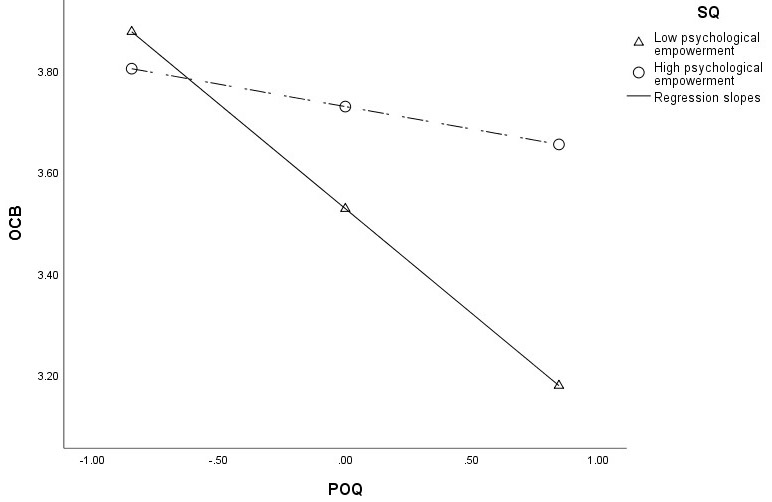 Fig. 2.
Simple slope analysis. SQ, Square.
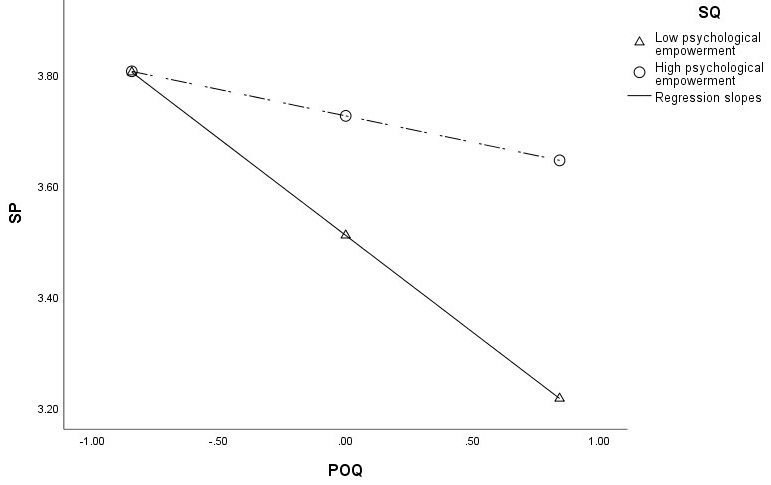 Fig. 3.
Simple slope analysis.
Regarding the moderated-mediation effect, the study used the PROCESS macro to test H6a and H6b. Here, a low level indicates psychological empowerment at one standard deviation below its mean, while a high level refers to one standard deviation above its mean, with control variables included as covariates. As shown in Table 5, when psychological empowerment was low, the indirect effect of job embeddedness on organizational citizenship behavior (Effect = 0.1183, 95% Confidence Interval (CI) = [0.0531, 0.1899]) and sales performance (Effect = 0.0845, 95% CI = [0.0267, 0.1415]) through perceived overqualification was significant and positive. Conversely, when psychological empowerment was high, the indirect effect of job embeddedness on organizational citizenship behavior (Effect = 0.0233, 95% CI = [–0.0168, 0.0649]) and sales performance (Effect = 0.0241, 95% CI = [–0.0137, 0.0662]) through perceived overqualification was insignificant and weaker. As psychological empowerment increased, the conditional indirect effect of perceived overqualification gradually weakened. Thus, H6a and H6b were supported.
| OCB | SP | |||||||
| Effect | SE | LLCL | ULCL | Effect | SE | LLCL | ULCL | |
| Low PE (–1 SD) | 0.1183 | 0.0353 | 0.0531 | 0.1899 | 0.0845 | 0.0294 | 0.0267 | 0.1415 |
| High PE (+1 SD) | 0.0233 | 0.0204 | –0.0168 | 0.0649 | 0.0241 | 0.0201 | –0.0137 | 0.0662 |
| Difference between two groups | –0.0950 | 0.0313 | –0.1587 | –0.0360 | –0.0604 | 0.0299 | –0.1156 | 0.0018 |
SE, Standard Error; LLCL, Lower Control Limit; ULCL, Upper Control Limit.
Based on the Person-Environment Fit Theory and Conservation of Resources Theory, this study constructs a theoretical model to examine the mechanism through which job embeddedness influences organizational citizenship behavior and sales performance via perceived overqualification, with psychological empowerment introduced as a boundary condition. Analysis of paired data from 419 sales personnel and their supervisors revealed that job embeddedness effectively mitigates the negative effects of perceived overqualification, thereby positively influencing organizational citizenship behavior and sales performance. Notably, psychological empowerment demonstrates a negative moderating effect on the relationship between perceived overqualification and outcome variables, while simultaneously strengthening the indirect effect of job embeddedness on organizational citizenship behavior and sales performance. This finding theoretically aligns with Liu et al (2023), whose research confirmed that employees’ cognitive biases regarding their capabilities significantly impact organizational contribution levels, with job embeddedness potentially functioning by reshaping such self-assessment mechanisms.
The current findings receive multidimensional theoretical support within the sales personnel context. Chen and Yang’s (2024) research on the mediating effect of proactive personality elucidates the crucial role of individual traits in work performance, providing essential references for interpreting this study’s mediation mechanisms. Wang’s (2024) proposed chain mediation model of job autonomy and organizational identification corroborates the intrinsic mechanism of job embeddedness from an organizational environment perspective. Regarding moderating mechanisms, Xu and Cheng’s (2022) research on psychological capital alleviating work stress offers empirical support for the moderating effects of psychological empowerment in this study. Simultaneously, Hu et al.’s (2022) empirical findings on leadership humor suggest that organizational contextual factors may moderate job embeddedness pathways by influencing employees’ psychological states, showing inherent consistency with the moderating direction of psychological empowerment in this research. These cross-validations indicate that the sales performance enhancement mechanism results primarily from the interplay of individual traits, organizational environments, and psychological cognition.
The theoretical applicability of the research conclusions within China’s social context is rooted in the profound interaction between multiple cultural genes and institutional circumstances. The high-power distance culture intensifies the mediating pathway through which job embeddedness affects performance via perceived overqualification. In authority-oriented organizational structures, individuals demonstrate significantly higher cognitive sensitivity to position qualification thresholds compared to Western individualistic cultural contexts. The coupling effect of collectivist norms and relationship-based thinking creates a unique moderating mechanism that inhibits organizational citizenship behavior through perceived overqualification. The universal phenomenon of academic credential inflation caused by mass higher education forms a pervasive background, where structural mismatches between organizational position standards and human capital accumulation rates establish perceived overqualification as a crucial mediating variable explaining workplace performance fluctuations in China, with its explanatory efficacy showing significant variations between state-owned and private-sector organizations.
The urban-rural dual segmentation characteristics of China’s labor market add an additional explanatory dimension to the research model. Deviation in human capital pricing, constrained by the household registration system, may alter the formation mechanism of perceived overqualification. Imbalances between educational qualifications and position requirements among non-local sales personnel are more likely to trigger psychological contract breaches, thereby strengthening the negative predictive effect of job embeddedness on organizational citizenship behavior. The tension between Confucian traditions’ symbolic worship of academic credentials and performance-oriented service economy values may transform sales personnel’s perceived overqualification into a mediator for declining professional dignity and organizational identification. This dynamic demonstrates particular theoretical value in explaining turnover intentions among new-generation employees.
The role ambiguity effect induced by digital transformation constitutes a crucial moderating variable. The generational gap between traditional sales position competency requirements and digital skill reserves could amplify the mediating effect of perceived overqualification, while the compression of sales autonomy by e-commerce platform algorithm management may alter the directional relationship between job embeddedness and qualification cognition. Under the new economic normal, the normalization of organizational redundancy and talent overconsumption upgrades perceived overqualification from an individual psychological variable to a structural indicator of organizational efficacy, carrying methodological significance for expanding the ecological validity of work embeddedness theory.
The research model demonstrates unique theoretical potential in interpreting intergenerational shifts in occupational values. Generation Z’s sensitivity to qualification matching might reconstruct the correlation pattern between job embeddedness and performance, while intergenerational differences in authority cognition’s buffering effect on perceived overqualification provide new dimensions for cross-cultural comparative studies. The qualification devaluation effect in urban-rural human capital flow further verifies the boundary-expanding value of perceived overload in organizational behavior studies, offering theoretical foresight for explaining workplace psychological contract imbalances during asymmetric urbanization processes. Under dual transformation contexts of industrial servitization and manufacturing intellectualization, the theoretical explanatory power of perceived overqualification as a mediating variable might dynamically evolve with organizational change speed, presenting paradigm innovation significance for constructing dynamic organizational behavior theory models in Chinese contexts.
This study achieves three key theoretical breakthroughs, pioneering new academic pathways in the investigation of the influence mechanisms of job embeddedness. Through a systematic investigation of the underlying mechanisms driving salesperson performance and organizational citizenship behavior, the research advances existing theoretical frameworks in the following ways:
(1) Constructs an innovative dual-path theoretical model of job embeddedness’ impact on performance. Adopting a dynamic interaction perspective from person-environment fit theory, the study reveals the mediating role of perceived overqualification between job embeddedness and sales performance. The empirical findings show that job embeddedness effectively mitigates the negative effects of overqualification perceptions on extra-role behaviors through enhanced organizational identification and affective commitment. This finding moves beyond the traditional understanding of job embeddedness’ unidimensional effects, providing theoretical support for analyzing the combined impacts of its “links-fit-sacrifice” tridimensional structure in organizational behavior research. The findings not only broaden the application boundaries of job embeddedness theory in sales contexts but also offer new insights for explaining the formation mechanisms of employees’ organizational citizenship behaviors.
(2) Defines the moderating boundaries of psychological empowerment within influence mechanisms. By introducing the conservation of resources theory, the research clarifies the contingent role of psychological empowerment in job embeddedness’ effect chains, revealing heterogeneous characteristics of moderating pathways. Specifically, higher levels of psychological empowerment significantly strengthen the emotional buffering effect of job embeddedness on overqualification perceptions by enhancing self-efficacy and work control perceptions. This moderating mechanism provides theoretical justification for interpreting the interplay between individual psychological resources and organizational embeddedness resources. These findings not only extend the explanatory dimensions of job embeddedness theory but also improve the application framework of psychological empowerment theory in employee behavior management research.
(3) Integrates the theoretical positioning of overqualification perceptions. By constructing an integrative “organizational embeddedness-psychological cognition-behavioral output” framework, the study establishes overqualification perceptions as a crucial mediating variable connecting structural factors with behavioral outcomes. The theoretical model illustrates dual-path transmission chains through which overqualification perceptions influence job satisfaction and organizational commitment. This innovative integration addresses theoretical discontinuities in overqualification research within organizational behavior studies and provides new explanatory logic for applying job embeddedness theory in employee development domains. The model offers critical research paradigms for subsequent investigations of organization-individual interaction effects and offers precise intervention nodes for enterprises to optimize employee embeddedness strategies.
In sales management practice, enhancing sales personnel performance and strengthening organizational citizenship behavior (OCB) constitute crucial pathways for enterprises to achieve strategic objectives. This study reveals the mechanism of job embeddedness in sales force management, particularly its mediating effect in contexts of perceived overqualification circumstances, and provides three operationally significant implications for sales team management:
(1) Construct a multidimensional embeddedness system to strengthen organizational cohesion. Enterprises should systematically enhance sales personnel’s job embeddedness by reinforcing three dimensions: organizational affiliation networks, value consensus systems, and exit cost structures, thereby improving organizational identification. Specific measures include establishing cross-functional collaboration platforms, implementing regular team knowledge-sharing mechanisms, and creating constructive exit barriers through career path planning. Such efforts to develop organizational embeddedness not only effectively buffer the negative impacts of perceived overqualification but also serve as sustainable drivers for enhancing sales performance and improving OCB.
(2) Establish dynamic alignment mechanisms to achieve person-position fit. To address the causes of perceived overqualification, enterprises need to construct dynamic position-competency matching models. Recommended practices include conducting periodic job competency diagnostics, applying talent inventory techniques to identify high-potential personnel, and designing progressive task sequences. Simultaneously, enterprises should develop position-specific training systems through skill gap analysis to create tiered development programs. This precision matching strategy not only addresses cognitive dissonance caused by competency redundancy but also facilitates the conversion of talent value through career path design, thereby enhancing both job satisfaction and organizational commitment.
(3) Implement psychological empowerment engineering to activate intrinsic motivation. Enterprises should establish intrinsic motivation mechanisms centered on psychological empowerment. By implementing a tripartite empowerment framework comprising job meaning reconstruction, decision-making authorization mechanisms, and performance impact feedback, organizations can strengthen sales personnel’s self-efficacy. Complementary psychological capital support systems should be developed, utilizing stress management workshops and cognitive restructuring training to cultivate positive professional mindsets. This empowerment management model not counteracts the negative effects of perceived overqualification but also catalyzes the spontaneous manifestation of OCB, ultimately forming a virtuous cycle of performance enhancement.
This study has several limitations that suggest directions for future research. Firstly, although this study employs the salesperson-manager pairing method to collect data, it does not gather data at different time points, which may introduce common method bias. Future research should employ methods such as experimental designs to improve the accuracy of causal inferences between variables.
Secondly, this study focuses on salespeople. Although this group closely aligns with the research context, it remains unclear whether the findings are applicable to other groups. Future research could extend the sample to employees in different industries or at various organizational levels to enhance the applicability of the findings.
Lastly, future research should explore the various dimensions of job embeddedness and analyze their distinct effects on perceived overqualification in greater detail to offer more precise guidance for practical application.
The raw data supporting the conclusions of this article will be made available by the authors on request.
ZW designed this study. ZW and WL conducted the study. SY provided assistance and suggestions during the experiment. RY analyzed the data. All the authors contributed to the editorial changes of the manuscript. All the authors read and approved the final manuscript. All the authors were fully involved in this work and agreed to be responsible for all aspects of it. All authors have participated sufficiently in the work and agreed to be accountable for all aspects of the work.
Not applicable.
National Natural Science Foundation of China (71772086); Outstanding Teaching Team of Jiangsu Colleges and Universities “Qing Lan Project”; Key Project of National Social Science Foundation of China (22AGL022).
The authors declare no conflict of interest.
References
Publisher’s Note: IMR Press stays neutral with regard to jurisdictional claims in published maps and institutional affiliations.