

 , Ahmet Remzi Uluşan 2, H. Nejat Basım 3
1 Faculty of Economics and Administrative Sciences, Başkent University, 06790 Ankara, Turkey
2 Faculty of Education, Başkent University, 06790 Ankara, Turkey
3 Department of Business Administration, Başkent University, 06790 Ankara, Turkey
Abstract
This study aims to explore the relationship between job passion and job crafting within the frameworks of Job Demands-Resources (JD-R) theory and Self-Determination Theory (SDT). Specifically, the research investigates how harmonious and obsessive forms of job passion influence job crafting behaviours and the moderating role of psychological safety in this dynamic. Data was collected from 320 English language teachers working at various foundation and state universities in Turkey. The findings reveal that while harmonious passion is positively related to job crafting, obsessive passion is negatively associated with job crafting behaviours. In the study, psychological safety is identified as a critical moderator, amplifying the positive effects of harmonious passion while mitigating the negative impacts of obsessive passion. These results offer significant theoretical contributions by expanding the understanding of emotional and cognitive drivers of job crafting within the JD-R and SDT frameworks. Practically, the study underscores the importance for organizations to foster psychologically safe work environments that support employee well-being and harness job passion in constructive ways.
Keywords
- psychological safety
- job passion
- harmonious passion
- obsessive passion
- job crafting
- job demands-resources theory
- self-determination theory
Job crafting, an increasingly significant concept in both organizational practice and academic research, is grounded in the Job Demands-Resources (JD-R) theory. This theory posits that employees can take an active role in shaping their jobs by adjusting the demands they face and the resources they have, thereby enhancing their competencies and extending their professional identities (Rogiers et al, 2021; Tims and Bakker, 2010). Through job crafting, employees engage in behaviours that allow them to better align their work with personal skills, preferences, and goals, which can lead to improved performance, motivation, and job satisfaction (Al-Mansoori and Koç, 2019; Ashford et al, 2018; Tims et al, 2015).
Originally conceptualized by Wrzesniewski and Dutton (2001), job crafting was viewed as a process where employees independently modify aspects of their job to meet their personal needs, desires, and ambitions. This early understanding focused on job crafting as a proactive strategy for enhancing job satisfaction and well-being, positioning it as an antecedent to positive employee outcomes. However, later advancements, particularly the integration of job crafting into the JD-R model by (Tims and Bakker, 2010), have expanded its scope. Job crafting is now seen not only as a precursor to employee outcomes but also as an outcome in itself, influenced by a range of personal and contextual factors (Li et al, 2018; Tims et al, 2012).
Despite the growing body of research on job crafting, much of the literature has focused on individual traits such as proactive personality and the Big Five personality dimensions (Bakker et al, 2012; Teng and Chen, 2019b). However, the emotional and cognitive drivers of job crafting, particularly job passion, remain relatively underexplored. Job passion is a key affective factor that can significantly influence employees’ behaviours at work. Defined as a strong emotional connection to one’s work, job passion can drive individuals to engage deeply with their tasks, influencing how they craft their jobs (Houlfort et al, 2014; Ingersoll, 2001; Vallerand and Houlfort, 2019; Zhou et al, 2023).
According to Vallerand’s (2015) dualistic model of passion, job passion is not a singular construct but rather manifests in two distinct forms: harmonious passion and obsessive passion. Harmonious passion arises when individuals engage in work that they enjoy and find intrinsically rewarding, leading to a balanced and autonomous engagement with their job. These individuals are motivated by internal satisfaction and a sense of personal fulfilment, which encourages them to proactively craft their job roles in ways that enhance both personal and organizational outcomes (Vallerand and Houlfort, 2003a). In contrast, obsessive passion is characterized by a more rigid and uncontrollable attachment to work, often driven by external pressures such as social recognition, status, or financial rewards. This form of passion can lead to over-identification with one’s job, potentially resulting in stress, burnout, and impaired job performance (Forest et al, 2010; Kord and Mahmodi, 2019; Pereira et al, 2022; Slemp et al, 2020).
While harmonious passion tends to promote positive outcomes in the workplace, obsessive passion may result in negative consequences when employees are unable to detach from their work or manage external pressures effectively (Firth et al, 2004; Vallerand and Houlfort, 2019). Understanding how these two forms of passion influence job crafting behaviours is critical, as job passion can be both a motivator for proactive engagement and a potential source of workplace stress. The existing literature has largely overlooked the differential impacts of harmonious and obsessive passion on job crafting, with only a few studies delving into this area (Slemp et al, 2020; Teng, 2019a; Vieira dos Santos et al, 2023). Thus, there is a clear need for further exploration of how job passion influences job crafting behaviours and how this relationship might be shaped by other contextual factors.
One such contextual factor that may moderate the relationship between job passion and job crafting is psychological safety. Psychological safety refers to an individual’s perception of being able to take interpersonal risks at work without fear of negative consequences (Edmondson, 1999). It is characterized by a sense of security and well-being within the workplace, where employees feel supported and valued. Research has shown that psychological safety positively impacts cognitive functioning, health, and interpersonal relationships at work (Zacher and Rudolph, 2021). When employees feel psychologically safe, they are more likely to take initiative, engage in creative problem-solving, and actively seek out opportunities to craft their jobs.
In the context of job passion, psychological safety may play a crucial role in determining whether passion leads to positive or negative job crafting behaviours. For instance, in environments where psychological safety is high, employees with harmonious passion may feel empowered to modify their job roles in ways that enhance both personal and organizational outcomes. Conversely, in environments lacking psychological safety, employees with obsessive passion may struggle to manage their emotional attachment to work, leading to maladaptive job crafting behaviours that contribute to stress and burnout.
Given the dualistic nature of job passion and the potential moderating role of psychological safety, this study aims to explore how these factors interact to influence job crafting behaviours. By examining the moderating effect of psychological safety, this research seeks to provide a more nuanced understanding of the conditions under which job passion leads to positive versus negative outcomes in the workplace.
This study contributes to the literature in several important ways. First, it expands the current understanding of the dualistic model of passion by empirically examining how harmonious and obsessive passion differentially affect job crafting behaviours. Second, by introducing psychological safety as a moderating variable, this study offers new insights into the contextual factors that shape the relationship between job passion and job crafting. This focus on psychological safety not only enhances theoretical models of job crafting but also underscores the importance of creating supportive work environments that can mitigate the potential negative effects of obsessive passion.
In sum, this research addresses a critical gap in the literature by exploring the underexamined relationship between job passion and job crafting, with a particular focus on the moderating role of psychological safety. The findings from this study have important implications for both scholars and practitioners, offering valuable insights into how organizations can create work environments that foster positive job crafting behaviours while managing the potential risks associated with obsessive passion.
Job crafting has emerged as a significant topic in organizational behaviour due to its potential to enhance performance and productivity. It involves employees actively altering their job aspects or taking proactive steps to modify them to better align with their preferences and competencies, which can lead to both positive and negative outcomes in their work behaviours (Bell and Njoli, 2016; Leana et al, 2009; Shin et al, 2018; Tims et al, 2013; Wong et al, 2016). Essentially, job crafting reflects an employee’s initiative to adjust job demands and resources to enhance the meaning, engagement, and satisfaction they derive from their work (Demerouti, 2014).
The concept of job crafting was first introduced by Wrzesniewski and Dutton (2001), who described it as the physical and cognitive changes employees make to their tasks. The theoretical foundation of job crafting is also linked to job design theory, which examines how job characteristics influence employee behaviour and satisfaction (Campion and McClelland, 1993; Hackman and Oldham, 1976). More recently, the Job Demands-Resources (JD-R) model, built upon the broader resource-based behaviour theory, has provided a complementary perspective, suggesting that the social and organizational aspects of jobs can lead to either strain or motivation, depending on how demands and resources are managed (Bakker et al, 2004; Boyd et al, 2011; Hobfoll, 1989; Lee and Eissenstat, 2018; Van Vegchel et al, 2005). Accordingly, job crafting is regarded as employees’ modifications to job demands and resources in pursuit of their goals (Tims et al, 2012). It is driven by employees’ needs for control to avoid negative outcomes, the desire to express a positive self-image, and the need for social connection (Wrzesniewski and Dutton, 2001). This view positions job crafting as a strategy to optimize the alignment between job demands and resources, thereby enhancing their motivation and wellbeing (Demerouti, 2014; Van Wingerden et al, 2017). This alignment involves not only strategies to enhance positive job aspects but also behaviours aimed at minimizing emotional, mental, or physical demands, reducing workload, or balancing work with personal life (Demerouti, 2014), leading to work engagement, satisfaction, and reduced burnout (Bakker et al, 2012; Sánchez-Pujalte et al, 2021; Tims et al, 2013).
Research shows that job crafting is predicted by job characteristics, individuals’ abilities, and traits such as proactive personality, big five factors, job autonomy, social skill, and employee status (Bajaba et al, 2021; Bakker et al, 2012; Sekiguchi et al, 2017; Teng and Chen, 2019b). Another critical factor influencing job crafting may be the level of intrinsic motivation and emotional attachment an individual has toward their job—referred to as job passion. While job crafting can facilitate job passion by allowing employees to adjust job resources and demands (Teng, 2019a), we argue that job passion may also precede and motivate crafting efforts depending on its type.
Job passion involves a powerful motivation to engage with work tasks, often leading individuals to spend more time working, thinking about work, and putting in extra effort beyond what is required (Astakhova and Porter, 2015). According to the dualistic model of passion, job passion manifests in two distinct forms: harmonious passion and obsessive passion (Mageau et al, 2009; Vallerand et al, 2003b). This model provides a framework for understanding these two forms, highlighting that while both are driven by strong motivation, they result in different emotional, affective and behavioural outcomes (Ho and Pollack, 2014; Ho et al, 2018; Mageau et al, 2009; Vallerand, 2015). The key difference lies in how an activity is internalized: harmonious passion is characterized by a voluntary, genuine enjoyment and choice in engaging with the work, whereas obsessive passion is marked by a controlled internalization driven by external or internal pressures (Pollack et al, 2020; Vallerand et al, 2003b).
Harmonious passion is characterized by a constructive alignment with one’s work, wherein strong emotions related to the job are integrated into an individual’s identity without encroaching on other life domains (Vallerand and Houlfort, 2019; Vallerand et al, 2010). This form of passion arises when individuals align their work engagement with their personal values, leading to a sense of fulfillment (Schellenberg et al, 2016). Harmonious passion develops through autonomous internalization, wherein individuals engage with their work out of genuine enjoyment and value rather than external pressures (Vallerand et al, 2003b; Yen et al, 2024). Research suggests that harmonious passion is positively associated with work engagement (Teng et al, 2021), organizational citizenship behaviours toward individuals and the organization (Yen et al, 2024), and overall well-being (Carpentier et al, 2012).
In contrast, obsessive passion may manifest as compulsive work behaviours driven by internal or external pressures rather than genuine satisfaction (Vallerand, 2015). These pressures can stem from external factors related to the activity, such as the desire for social acceptance, self-esteem, or the influence of demanding social environments (Mageau et al, 2009). Individuals with obsessive passion often perceive their work as essential for obtaining external rewards and validation, including group acceptance, promotions, and financial incentives, which can reinforce their self-worth (Astakhova and Porter, 2015). While research indicates that obsessive passion may correlate with positive outcomes such as work engagement and job embeddedness (Teng et al, 2021) and organizational citizenship behaviours directed toward individuals (Yen et al, 2024), it can also lead to maladaptive responses to failure (Schellenberg et al, 2016), decreased well-being (Carpentier et al, 2012), and conflicts between work and family life (Gillet et al, 2022).
SDT posits that when employees experience a high degree of autonomy, competence, and relatedness in their roles—three basic psychological needs identified by Ryan and Deci (2000)—they are more likely to engage in job crafting behaviours that align with their intrinsic motivations and personal values. Therefore, harmonious type of passion is likely to enhance job crafting efforts, as employees are intrinsically motivated to proactively shape their work environment in ways that resonate with their personal values and goals (Gagné and Deci, 2005). In contrast, individuals with obsessive passion feel an internal pressure to engage in their work, often leading to a fixation on certain aspects of the job that can hinder flexibility and creativity (Burke et al, 2015; Perrewé et al, 2014; Vallerand et al, 2007; Wan et al, 2022). This pressure may include a need for social acceptance, self-esteem maintenance, or the uncontrollable excitement and arousal that the activity generates (Vallerand and Houlfort, 2003a). This type of passion can become problematic because it is driven by a sense of obligation or external validation, leading to feelings of pressure and sometimes uncontrollable engagement with the activity (Vieira dos Santos et al, 2023). Therefore, obsessive passion may negatively impact job crafting behaviours because this type of passion often results in a rigid and inflexible approach to work, where the individual becomes fixated on certain aspects of their job, potentially at the expense of broader, more adaptive job crafting strategies. The compulsive nature of obsessive passion can lead to maladaptive behaviours, such as overinvestment in certain tasks or resistance to change (Mohd Rasdi et al, 2023; Schellenberg et al, 2016; Wan et al, 2022; Yen et al, 2024), which undermines the flexibility and creativity required for effective job crafting.
According to Self-Determination Theory (SDT), controlled forms of motivation, like those seen in obsessive passion, may detract from effective performance, especially in tasks requiring creativity and cognitive flexibility (Bilal et al, 2020; Gagné and Deci, 2005; Vansteenkiste et al, 2005; Yadav and Dhar, 2021). This is because the focus is often on meeting external expectations or maintaining self-esteem, rather than on the intrinsic satisfaction derived from the work itself. As a result, employees with obsessive passion may struggle to engage in proactive job crafting behaviours that are necessary for personal and organizational growth.
Given these distinctions, the impact of job passion on job crafting is expected to vary depending on the type of passion. Harmonious passion is likely to positively influence job crafting, encouraging employees to make meaningful and adaptive changes to their work environment that align with their personal values and intrinsic motivations. In contrast, obsessive passion is hypothesized to have a negative impact on job crafting, as it may lead to maladaptive behaviours, such as rigidity, overcommitment, and a narrow focus, all of which can undermine the potential benefits of job crafting and limit the employee’s ability to effectively adapt to changing work demands.
Based on the insights provided by SDT, the following hypotheses are proposed:
Hypothesis 1: Harmonious passion is positively related to job crafting.
Hypothesis 2: Obsessive passion is negatively related to job crafting.
As a sub theory within SDT, Cognitive Evaluation Theory (CET) (Deci and Ryan, 1985), focuses on how social contexts and interpersonal interactions either facilitate or undermine intrinsic motivation (Ryan and Deci, 2000). CET posits that intrinsic motivation—engaging in activities for their inherent enjoyment and satisfaction—is heavily influenced by the degree of autonomy and competence perceived by individuals (Ryan, 2009). When social environments support these needs, intrinsic motivation is enhanced; conversely, when these needs are thwarted, intrinsic motivation can be diminished (Newman et al, 2017; Ryan and Deci, 2000).
In the context of job crafting and job passion, psychological safety may play a critical role as a social context that may either bolster or undermine an employee’s intrinsic motivation to craft their job. Psychological safety refers to a shared belief that the environment is safe for individuals to voice their thoughts and concerns without fear of negative consequences (Edmondson and Lei, 2014; Edmondson, 1999). In such an environment, individuals feel secure in taking interpersonal risks, such as seeking feedback, sharing information, and experimenting with new ideas (Dess and Picken, 2000; Edmondson, 1999; Un, 2010). When psychological safety is present, employees are more likely to openly acknowledge failures and discuss them, which is crucial for learning, growth, and creativity (Carmeli and Gittell, 2009; Greenbaum et al, 2020; Kark and Carmeli, 2009; Kızrak et al, 2024).
CET suggests that when psychological safety is high, it creates an environment that supports the autonomy and competence of employees, thus facilitating intrinsic motivation (Ryan, 2009). In such environments, employees with harmonious passion—who naturally seek out meaningful and fulfilling ways to engage with their work—are more likely to engage in job crafting behaviours. They feel safe to experiment, innovate, and modify their job roles in ways that align with their values and interests, knowing that their contributions will be valued and not penalized. This safe environment enhances the positive effects of harmonious passion on job crafting, allowing employees to fully express their intrinsic motivation through their work (Frazier et al, 2017).
On the other hand, psychological safety can also mitigate the potential negative impacts of obsessive passion, which is characterized by a compulsive drive to engage in work, often leading to rigid and maladaptive job crafting behaviours. CET suggests that environments that undermine autonomy can exacerbate the negative effects of controlled motivations (Ryan, 2009) such as obsessive passion. However, in a psychologically safe environment, even those with obsessive passion might feel less compelled to engage in maladaptive behaviours because they perceive less pressure and more support. This reduces the detrimental effects of obsessive passion on job crafting, allowing for a more balanced and adaptive approach to work.
Therefore, psychological safety, through the lens of Cognitive Evaluation Theory, may act as a moderator in the relationship between job passion and job crafting. By fostering an environment that supports autonomy and competence, psychological safety may enhance the positive effects of harmonious passion and buffers against the negative effects of obsessive passion. This, in turn, promotes a work environment where employees can engage in job crafting. In light of this assumption, the following hypotheses were formed:
Hypothesis 3: Psychological safety moderates the positive relationship between harmonious passion and job crafting, such that the relationship is stronger when psychological safety is high.
Hypothesis 4: Psychological safety moderates the negative relationship between obsessive passion and job crafting, such that the relationship is weaker when psychological safety is high.
This study focused on English language teachers employed at foundation and state universities across Turkey, providing a context-specific examination of the relationship between job passion, job crafting, and psychological safety in the educational sector. A total of 1600 teachers were invited to participate through a questionnaire distributed between November 1, 2023, and January 26, 2024, with 320 valid responses collected. The research employed a quantitative methodology, utilizing a convenience sampling technique to gather data.
By concentrating on this particular academic setting, the study offers significant contributions to the literature on the dynamics of teaching and faculty well-being. The findings emphasize the critical role of psychological safety in enabling educators to channel their job passion into constructive job crafting behaviours. A psychologically safe environment, as the study suggests, fosters the conditions necessary for faculty members to engage in proactive role modification, benefiting both individual well-being and institutional outcomes.
The participants consisted of 42% males and 58% females, with an average age of 35. Most participants had between 5 to 10 years of work experience. In terms of educational background, the majority of the participants held a university degree, with many also having completed a master’s degree. Regarding the types of institutions where the participants are employed, they worked in both foundation and state universities.
Data were analysed using Smart PLS, version 4, GmbH, Oststeinbek, Schleswig-Holstein, Germany and SPSS 26, Corporation, Armonk, New York, USA software packages. The study utilized three scales, all structured on a 5-point Likert scale: The Job Crafting Scale, developed by Tims et al (2012), measures employees’ job crafting levels across 21 items divided into four sub-dimensions. The Job Passion Scale, developed by Vallerand and Houlfort (2003a), assesses job passion and comprises 12 items across two factors. The Psychological Safety Scale, developed by Edmondson (1999), evaluates employees’ perceptions of psychological safety and includes 5 items within a single dimension.
The validity and internal consistency of the scales used in this study were thoroughly analyzed. Notably, no control variable was included in the study. The decision was made to avoid overfitting, a common issue in statistical modelling when too many variables are included relative to the number of observations. Overfitting models may perform well on the current data but generalize poorly to other data sets. To prevent this, simplicity was deliberately chosen. As a result, analyses of Cronbach’s Alpha, factor loadings, data consistency coefficient and convergent validity of the scale items were conducted (Fornell and Larcker, 1981; Henseler et al, 2015). However, it was observed that the average variance coefficient explained by the items in the “increasing social service resources” sub-dimension of the job crafting scale was below 50%. Therefore, item 4 and item 6 were removed from the scale (Table 1).
| Variables | C.A | rho_A | CR | AVE | VIF | SRMR | d_ULS | d_G | NFI | |
| JC | 0.868 | 0.857 | 0.875 | 0.533 | 1.311–2.182 | 0.730 | 2.390 | 1.613 | 0.967 | |
| PS | 0.857 | 0.894 | 0.894 | 0.589 | 1.277–4.169 | |||||
| JC | HP | 0.906 | 0.908 | 0.906 | 0.617 | 1.855–3.438 | ||||
| OP | 0.892 | 0.913 | 0.893 | 0.591 | 1.450–3.474 | |||||
Notes. PS, Psychological Safety; HP, Harmonious Passion; OP, Obsessive Passion; JC, Job Crafting.
As shown in Table 1, validity coefficients were analysed and found to be within acceptable levels according to the literature (Dijkstra and Henseler, 2015; Hair et al, 2017). Following the internal consistency and validity analyses, it was also assessed whether the scales used in the study were well differentiated from other factors. Additionally, the relationships between psychological safety, job passion, and job crafting scales were examined (Table 2).
| Variables | (1) | (2) | (3) | (4) |
| Geometric PS | (0.767) | |||
| Geometric HP | 0.535** | (0.785) | ||
| Geometric OP | –0.560** | –0.570** | (0.779) | |
| Geometric JC | 0.436** | 0.461** | –0.426** | (0.768) |
** Correlation Relationship p
PS, Psychological Safety; HP, Harmonious Passion; OP, Obsessive Passion; JC, Job Crafting.
As seen in Table 2, a comparison of the correlation coefficients and AVE square root coefficients of psychological safety, job passion, and job passion scales indicates that these variables are well differentiated from other variables (Fornell and Larcker, 1981) (PS: 0.767, HP: 0.785, OP: 0.779, JC: 0.768). Table 2 also presents the results of the correlations analysis, examining the relationships between psychological safety, job passion, and job crafting. To conduct this analysis, geometric averages of the variables were first calculated. This approach was taken to accurately reflect the differences across the Likert scale, ranging from 1 (strongly disagree) to 5 (strongly agree). According to the correlation results based on these geometric averages, there is a moderate and significant relationship between job passion and job crafting. There is also a strong and significant relationship between job passion and psychological safety. In addition, a moderate and significant relationship exists between psychological safety and job crafting (Cohen, 1988).
For the analysis of the hypotheses formed within the framework of the study (Hair et al, 2017). The coefficients of the research model were first examined (Table 3).
| Predictor | R2 | f2 | Q2Predict |
| Job Crafting | |||
| Psychological Safety | 0.475 | 0.006 | |
| Harmonious Passion | 0.212 | ||
| Obsessive Passion | –0.005 | ||
| Job Crafting | 0.303 | ||
| Psychological Safety |
0.049 | ||
| Psychological Safety |
0.006 | ||
When the R2 values obtained as a result of the coefficient analysis of the
research model in Table 3 are examined, it is seen that job passion explains
47.9% of job crafting. The effect size value (f2) shows that harmonious job
passion has a strong effect on job crafting. However, it was observed that
harmonious passion affected the job crafting in the same direction, while
obsessive passion affected them in the opposite direction. In addition, again in
Table 3, it is seen that Psychological Safety
Model effect coefficients were examined for the analysis of the hypotheses formed within the scope of the study (Table 4).
| Model | Standard Deviation | T Statistics | p values | |
| Harmonious passion |
0.542 | 0.201 | 9.315 | 0.000 |
| Obsessive passion |
–0.253 | 0.323 | 3.211 | 0.000 |
Table 4 clearly illustrates that harmonious job passion significantly enhances
job crafting (
The study also delves into the moderating role of psychological safety in this dynamic, examining how a supportive and secure work environment can influence the relationship between job passion and job crafting. This analysis provides an important perspective by showing that psychological safety can either amplify or mitigate the effects of job passion on job crafting, depending on the type of passion involved.
Again, within the scope of the study, the analysis of the moderating effect was conducted. In this analysis, the moderating role of psychological safety in the relationship between these two variables in the effect of passion for work on job crafting was analysed (Table 5).
| Moderator Terms | Model | Standard Deviation | T Statistics | p values | |
| Psychological Safety | Harmonious passion |
0.656 | 0.320 | 10.412 | 0.000 |
| Psychological Safety | Obsessive passion |
–0.075 | 0.102 | 1.089 | 0.000 |
As illustrated in Table 5, psychological safety has a positive moderating effect
on the relationship between harmonious passion and job crafting (
Similarly, psychological safety also moderates the relationship between obsessive passion and job crafting. This finding supports the study’s H4. However, this finding suggests that when psychological safety is present, the effect of obsessive passion on job crafting is also affected, but potentially in a more complex or diverse way. This finding highlights the critical importance of psychological safety in the workplace, not only for promoting positive work behaviours but also for shaping how different types of work passion are expressed through role formation. These findings provide a deeper understanding of the complex dynamics between job passion and job crafting, particularly when moderated by psychological safety. The findings highlight how psychological safety uniquely shapes how individuals’ channel both harmonious and obsessive passion into their work. Specifically, they suggest that harmonious passion enhances the positive effect on job crafting, while obsessive passion negatively impacts job crafting in the workplace. The findings obtained as a result of the analysis within the scope of the study are shown as a result of structural factor analysis (Fig. 1).
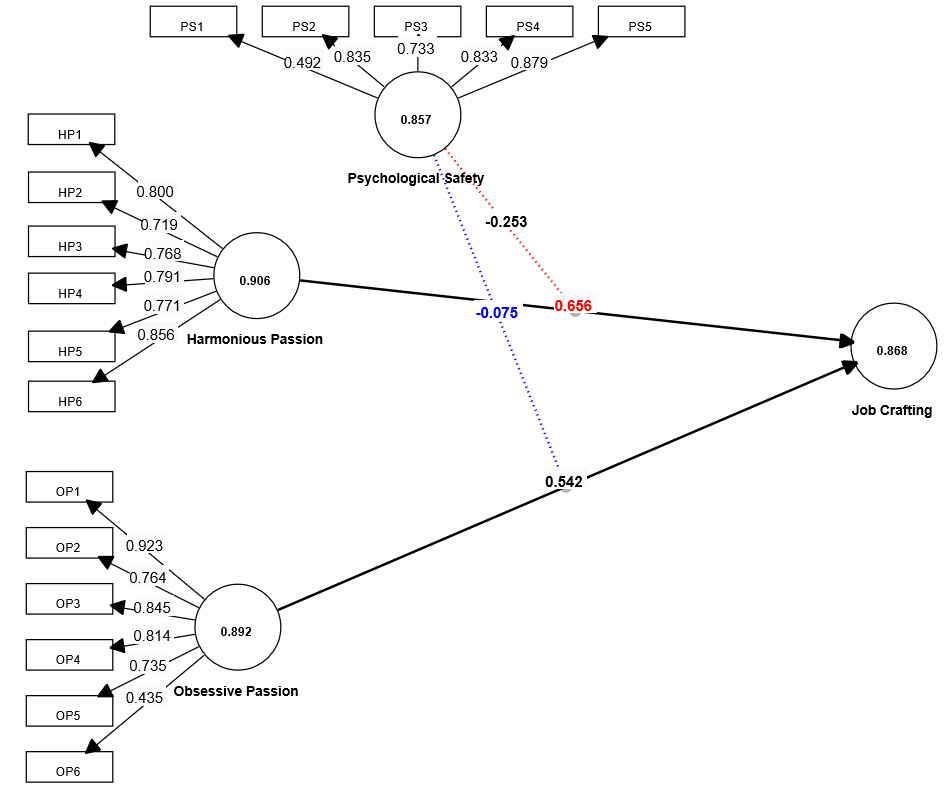 Fig. 1.
Structural factor analysis results of the study.
The key findings of this study point to the distinct roles that harmonious and obsessive job passion play in influencing job crafting behaviours. Harmonious passion, characterized by voluntary and intrinsic enjoyment of work, was found to be positively related to job crafting, encouraging employees to make meaningful and adaptive changes to their work environment in alignment with their intrinsic motivations. In contrast, obsessive passion, driven by internal pressures or external contingencies was negatively related to job crafting. Furthermore, the study highlights the moderating role of psychological safety, which strengthens the positive relationship between harmonious passion and job crafting while buffering the negative effects of obsessive passion.
This study makes significant theoretical contributions by expanding our understanding of the relationship between job passion and job crafting within the framework of the Job Demands-Resources (JD-R) theory and Self-Determination theory. Previous research has predominantly focused on individual traits such as proactive personality, temperament, and the Big Five personality factors as predictors of job crafting (Bakker et al, 2012; Bipp and Demerouti, 2014; Liao, 2023; Sameer and Priyadarshi, 2021; Teng and Chen, 2019b). However, our study shifts the focus to affective and cognitive drivers, particularly job passion, which has been underexplored despite its critical role in motivating job crafting behaviours.
According to JD-R theory, job crafting is a strategic adjustment of job resources and demands (Tims and Bakker, 2010), allowing employees to optimize their work environments to align with their competencies and professional identities (Kovjanic et al, 2012; Rogiers et al, 2021). The theory posits that job crafting can enhance employee performance, motivation, and satisfaction (Ashford et al, 2018; De Beer et al, 2016; Fuller et al, 2019; Li et al, 2023). Our study adds to this literature by demonstrating that job passion—specifically its harmonious and obsessive forms—plays a crucial role in influencing job crafting behaviours.
While previous studies have generally suggested that job passion leads to positive outcomes such as increased job crafting (Vallerand et al, 2007; Wan et al, 2022), our research reveals a more nuanced relationship. Specifically, we found that harmonious passion positively influences job crafting by encouraging employees to make meaningful and adaptive changes to their work environment that align with their intrinsic motivations and personal goals. This aligns with the findings of Lavigne et al (2014), who suggested that harmonious passion leads to positive evaluations of job control, support, and crafting opportunities. Conversely, obsessive passion, driven by external contingencies such as social recognition and financial rewards, may negatively impact job crafting by leading to maladaptive behaviours such as rigidity and overcommitment. This differentiation mirrors Lavigne et al.’s findings (2014) that obsessive passion is associated with excessive workload and low levels of job control, and it echoes the concerns raised by Berg et al (2013) about the potential downsides of passion-aligned job crafting when not properly managed.
Another key theoretical contribution of our study is the integration of psychological safety as a moderating variable in the relationship between job passion and job crafting. Psychological safety has been shown to positively impact cognitive functioning, health, and social relationships at work (Huppert, 2009). In line with Cognitive Evaluation Theory (CET), our study demonstrates that psychological safety can amplify the positive effects of harmonious passion on job crafting.
Moreover, our findings suggest that psychological safety can mitigate the negative effects of obsessive passion. In environments where psychological safety is high, even employees with obsessive passion are less likely to avoid job crafting behaviours, as they perceive less pressure and more support to arrange the work environment. This insight expands upon the work of Nembhard and Edmondson (2006), who suggested that perceptions of psychological safety influence job crafting, by providing empirical evidence that supports this assumption.
Moreover, by incorporating the dualistic model of passion and the moderating role of psychological safety, our study offers a more comprehensive understanding of the emotional and cognitive drivers that influence job crafting within the JD-R framework. This expanded view suggests that job crafting is not only a precursor to positive employee outcomes but also an outcome influenced by the dynamic interplay between job demands, resources, and individual motivations (Tims and Bakker, 2010; Tims and Parker, 2020; Tims et al, 2012; Zhang et al, 2021).
Our findings underscore the importance of considering both harmonious and obsessive passion when examining job crafting behaviours, as well as the role of psychological safety in shaping these behaviours. Integrating SDT into this context underscores the importance of fostering work environments that support psychological needs, thereby enhancing the effectiveness of job crafting behaviours aligned with intrinsic motivations (Gagné and Deci, 2005; Ryan and Deci, 2000).
In conclusion, our study makes a qualified contribution to the literature by empirically studying the effects of job passion on job crafting within the JD-R model and highlighting the critical role of psychological safety as a boundary condition. This integration provides valuable insights into how organizations can better support their employees in crafting their jobs in ways that enhance both individual and organizational outcomes.
The practical implications of this research are significant for organizational leaders and human resource professionals. The study suggests that fostering a psychologically safe work environment is crucial for maximizing the positive effects of harmonious passion on job crafting. Organizations should prioritize creating supportive environments where employees feel secure in experimenting, innovating, and making changes to their job roles, as this can enhance employee motivation and satisfaction. Additionally, the findings highlight the need for organizations to be mindful of the potential risks associated with obsessive passion. By recognizing the signs of obsessive passion and providing appropriate support, organizations can help employees channel their passion in ways that are constructive rather than detrimental. This dual focus on enhancing psychological safety and managing different forms of job passion can lead to improved employee well-being, satisfaction, and overall performance.
While this study provides valuable insights, it is not without limitations. One major limitation is the reliance on self-reported data, which may introduce bias and affect the generalizability of the results (Podsakoff et al, 2003). The assumption that participants answered the questionnaire items sincerely and honestly is another concern that could impact the validity of the findings. Additionally, the AVE values for some scales in the study were close to the acceptable limit, which could further affect the robustness and generalizability of the results. To address these issues, future research should consider employing more objective measures or longitudinal designs to validate these findings.
Moreover, the study was conducted among English language teachers in Turkish universities, which may limit the applicability of the results to other contexts or professions. The specific cultural and occupational context may have influenced the relationship between job passion, psychological safety, and job crafting in ways that are not generalizable to other settings. Future research should therefore explore these relationships in different cultural contexts and occupational groups to enhance the generalizability of the findings.
While psychological safety was identified as a key moderating factor in this study, other potential moderators or mediators, such as organizational culture, leadership style, or individual differences in personality traits, were not examined. These factors could significantly influence the dynamics between job passion and job crafting. Future studies should investigate these additional variables to provide a more comprehensive understanding of the interplay between job passion and job crafting behaviours.
Finally, the study highlights the need for further exploration of how different forms of passion influence job crafting across various job roles and industries. Understanding the long-term effects of these interactions on employee outcomes and organizational success is critical for developing more effective strategies for managing job passion and crafting in diverse work environments.
In conclusion, this study aims to expand our understanding of the relationship between job passion, job crafting, and psychological safety within the frameworks of the Job Demands-Resources (JD-R) theory and Self-Determination Theory (SDT). Our findings underscore the positive influence of harmonious passion on job crafting and reveal the detrimental effects of obsessive passion, particularly in environments lacking psychological safety. By highlighting the critical role of psychological safety as a moderator, our research offers valuable insights for organizations seeking to foster supportive work environments that enhance employee well-being, motivation, and adaptive job behaviours. These findings not only contribute to the theoretical discourse but also offer practical guidance for optimizing workplace dynamics through the strategic management of job passion and psychological safety.
The data and materials used in this study can be accessed through the link below: https://drive.google.com/file/d/1VckFHCfFMSz5VbKZEwtXtaG_cExiawgl/view?usp=sharing.
GGK conceptualized the study, designed the methodology, conducted the main analysis, and wrote the initial draft of the manuscript. ARU and HNB contributed equally to data collection, validation, and critical revisions of the manuscript. All authors reviewed and approved the final version of the paper. All authors contributed to editorial changes in the manuscript. All authors have participated sufficiently in the work to take public responsibility for appropriate portions of the content and agreed to be accountable for all aspects of the work in ensuring that questions related to its accuracy or integrity.
Not applicable.
This research received no external funding.
The authors declare no conflict of interest.
References
Publisher’s Note: IMR Press stays neutral with regard to jurisdictional claims in published maps and institutional affiliations.