

 , Ottó Csíki 1
1 Faculty of Economics and Business Administration, Babeş–Bolyai University, 400591 Cluj–Napoca, Romania
Abstract
The last decade has witnessed an expansion of academic studies on corporate social responsibility (CSR), which includes countries other than the US and Western European countries (e.g., Poland). Our study enriches the CSR literature by exploring the drivers of CSR activities in Romania, an East–Central European country that remains under–researched in international literature. Questionnaires were used to examine perceptions and activities of CSR in micro, small, medium, and large companies in Romania. Binary regression analysis was conducted on data from 140 companies, using company size and economic sector affiliation as control variables. Our findings reveal a noteworthy rise in a firm’s likelihood to engage in CSR activities when ethics and community embeddedness hold significance to the firm. The results underscore the importance of conducting comparative research between Western and Eastern European countries, as it offers valuable insights into the diverse CSR practices within different contexts.
Keywords
- corporate social responsibility
- CSR
- size
- SME
- large enterprise
- Eastern Europe
- Romania
The past decade has witnessed a significant increase in the public domain for holding businesses accountable for ethical issues. There has been a notable rise in the attention paid to companies’ CSR activities. Today, ethical issues affect brand values, result in consumer and employee loyalty, and can lead to the rejection of a company’s products. Concurrently, the European Union (EU) has introduced additional regulations in this area as reflected, for example, in the directive 2014/95/EU on non-financial reporting (Eur-Lex, 2014), the EU timber regulation (Eur-Lex, 2010), the conflict minerals regulation (Eur-Lex, 2017a), the shareholder rights directive (Eur-Lex, 2017b), and the new proposal of the 2022 directive on corporate sustainability due diligence (Eur-Lex, 2022).
Academic research has focused on the social embeddedness of firms, their impact on the environment, and their social responsibility long before the framing of these regulations. The literature on enterprise corporate social responsibility (CSR) has evolved rapidly over the past twenty years, yet “the concept lacks a universally agreed definition” (Colovic et al, 2019). The majority of the relevant international literature has focused on the USA and Western European countries (see, for example, Zhu and Zhang, 2015; Pisani et al, 2017; Dartey-Baah and Amoako, 2021; Khan et al, 2021). Few articles published in the last decade have analysed CSR in developing and transitioning economies. When examining the geographical scope of CSR, we can observe that there has been limited research conducted on Central and Eastern Europe (CEE) or the Balkans and even less on Romania. In their article published in 2021, Doś and Pattarin (2021, pp. 508) note “Central and Eastern European (CEE) countries are still almost unexplored”. Yet Central and Eastern Europe and the Balkans can be a tremendously stimulating field for business ethics research in general (Soulsby et al, 2021). Business ethics is about values and translating values into business practices. The post-1990 period in the CEE countries is about how old values (i.e., communist values) mix with new values (values of democracy and markets), how they are transformed, and how society and companies can or cannot embrace them (Grigore et al, 2021; Stoian and Zaharia, 2012). The elements of business ethics and those related to CSR were introduced in this region primarily from the outside (Koleva and Meadows, 2021). One of the main drivers was multinational enterprises (Stoian and Zaharia, 2012, pp. 380; Koleva and Meadows, 2021). However, there was a significant time lag in implementing CSR standards in Eastern Europe compared to the USA or Western European countries (Koleva et al, 2010).
Varied aspects of CSR have been analysed by scholars, such as the evolution of CSR (Latif and Sajjad, 2018; Mitnick et al, 2021), CSR drivers (Boubakri et al, 2021; Doś and Pattarin, 2021), and CSR practices (Bouslah et al, 2023; Koleva and Meadows, 2021). Few studies have centred on subsidiaries of multinational corporations (Kim et al, 2018; Park et al, 2015). Recently, small and medium-sized enterprises (SMEs) have been scrutinised more closely (Baumann-Pauly et al, 2013; Colovic et al, 2019; Fassin et al, 2015; Jamali et al, 2017; Perrini, 2006; Stoian and Gilman, 2017). Some academic studies have focused on companies within a single industry, while others have used questionnaires to survey companies across multiple industries (Dabic et al, 2016). Additionally, a small number of articles have examined the relationship between ethics and CSR in companies.
Our study contributes to the existing body of research on CSR in two ways. First, we examine the controversial issue of the motivation behind a firm to carry out CSR activities and the impact of the size and economic sector of the firm on CSR activities. Second, the focus of this research is on an East-Central European country, Romania, where research on companies’ CSR activities is lacking. We chose Romania for four main reasons. First of all, Romania stands out among the “Eastern” countries of the European Union for its size, economic potential, and geopolitical importance. Secondly, it joined the EU only in the second wave (2007) after the fall of communism, together with Bulgaria, because of economic issues, like difficulties in adopting a market economy as well as corruption (European Commission, 1999; European Commission, 2003; Commission of the European Communities, 1997; Commission of the European Communities, 2001), and difficulties in implementing an independent judiciary and assuring the protection of minorities (European Commission, 1997). Thirdly, Romania is the country on whose territory one of the well-known Huntington lines (lines that, according to the author, separate the eight identified civilisations) runs “between Transylvania with its Catholic Hungarian population and the rest of the country” (Huntington, 1996, pp. 158). This also means conflicts between different cultures and values. Finally, in the Romanian nation-state, with its significant Hungarian minority, where Western (Catholic, Reformed, Lutheran) religion meets Orthodox religion, different religions also imply different values in the same country.
Hence, this study aims to investigate the drivers of CSR activities in Romania. The companies surveyed in the study had applied for European Union Structural and Cohesion funds and were required to undertake CSR activities for their application to be considered. Our study makes several contributions to the knowledge of CSR activities. Firstly, the analysis focuses on CSR in Romania, where CSR issues have only been introduced due to EU accession. Secondly, we examine the relationship between the ethical system of firms and their CSR activities. Thirdly, we provide insights into the importance of the company size and the sector in which the firm carries out its CSR activities.
The study is organised as follows: the next section focuses on the literature that forms the basis of the current research. Data and methodology are presented next. The subsequent section presents the results and discussions of our research. The final section highlights the findings and concludes the study by identifying avenues for future research.
There is no widely accepted definition of CSR in the constantly evolving literature on the socially responsible company (Colovic et al, 2019; Latif and Sajjad, 2018; Park et al, 2015; Sheehy, 2015). A recent study (Rasche et al, 2023) aims to define CSR as follows: “CSR refers to the integration of an enterprise’s social, environmental, ethical, and philanthropic responsibilities towards society into its operations, processes, and core business strategy in cooperation with relevant stakeholders in a context-specific way” (Rasche et al, 2023, pp. 9). So far, scholars have examined the shareholders’ perspective, and the theory of the firm’s perspective (Colovic et al, 2019; Stoian and Gilman, 2017). This study approaches CSR “as policies and practices” that enterprises “adopt and engage in” (Colovic et al, 2019, pp. 787), thus focusing on “operations, processes, and core business strategy” (Rasche et al, 2023, pp. 9). We believe that such a definition of CSR, functioning as an “umbrella term” for business and society relations (Colovic et al, 2019), allows for a more detailed investigation in a setting like Romania, where we do not have much prior knowledge of the studied issue. We think that this view on CSR is also better suited to a research study using a questionnaire.
A reason for the varied definitions of CSR is that any study is influenced by the environment and context in which it takes place and in which the term is examined (Latif and Sajjad, 2018). According to Latif and Sajad (2018, pp. 1175), “the complexity arises because CSR is influenced by the uniqueness of a particular setting in which it is studied or practised”. Several authors have highlighted the context-dependent nature of CSR (Colovic et al, 2019; Dabic et al, 2016; Su et al, 2020; Szőcs and Schlegelmilch, 2020). Dabic et al. (2016, pp. 251) stress that “by definition, corporate responsibility is highly context-dependent”. In their literature review, Jamali and Karam (2018, pp. 50) emphasised that “CSR are contextualized and locally shaped by multi-level factors”. Others have highlighted the influence of the national context on CSR practices (Aguinis and Glavas, 2012; Colovic et al, 2019; Tilt, 2016). Colovic et al point out that there are factors such as regulations, stakeholder expectations, media, or local pressure groups that “may vary significantly across different national contexts, [and] need to be taken into consideration if we are to understand CSR drivers and conduct” (Colovic et al, 2019, pp. 790). In their analysis of CSR convergence versus divergence, Jamali and Nevill (2011, pp. 618) assert that “contextualized descriptions are often missing”.
Szőcs and Schlegelmilch (2020, pp. 67) identified several factors that determine the diversity of CSR in Europe, including national and regional contexts, socioeconomic factors, a country’s political history, and institutional frameworks. According to the authors, different economic models exist in Europe, such as in the Mediterranean and Transitional Regions.
The size of the company also influences CSR activities (Baumann-Pauly et al, 2013; Boubakri et al, 2021; Colovic et al, 2019; Perrini et al, 2007). Already in 2013, Baumann-Pauly et al. (2013, pp. 694) concluded that “company size generally matters for the implementation approach”. Stoian and Gilman (2017) indicated the use of company size as a control variable. The industry in which the company is involved can also influence the existence of CSR practices (Colovic et al, 2019; Dabic et al, 2016). The importance of firm size, industry, and the firm’s internationalisation are highlighted by Bouslah et al. (2023, pp. 115) who revealed that “firm characteristics (namely, CSR concerns, degree of internationalisation, industry membership, size, and financial slack resources) affect CSR structures”. Consequently, both size and economic sector are included as control variables in our analysis.
Numerous scientific articles that draw upon the stakeholder theory emphasise the significance of stakeholder pressure in the successful implementation of CSR. Helmig et al (2016) identified four stakeholder groups (employees, customers, investors, and the government) that influence the implementation of CSR policies in companies, emphasising the importance of investigating the influence of ethical codes on CSR activities. In a study on CEE countries, Kowalczyk (2020a) points out that companies’ CSR activities are dominantly influenced by stakeholders’ pressure. Therefore, we measure the influence of different types of stakeholders and the company ethics on companies’ CSR activities.
Traditionally, CSR research has focused on developed countries, the USA, and Western Europe (Amos, 2018). Later, research on CSR practices in developing countries also emerged (e.g., Jamali et al, 2017; Amos, 2018), but these excluded Central and Eastern European countries or the Balkan countries such as Romania and Bulgaria, or offered only tangential references to them. It is significant that when examining the CSR practices of countries other than Western European countries and the USA, several terms to designate groups of countries such as developing countries, transitional economies, post-communist countries, and emerging market economies (not necessarily including the same countries) have been used (Amos, 2018; Boubakri et al, 2021; Tilt, 2016).
Already in 2012, Stoian and Zaharia (2012, pp. 381), referring to Koleva et al (2010)’s findings, underlined the existence of a Central and Eastern European specific “hybrid” CSR, “which is the result of the interaction between ‘old’ (internal endogenous CSR) and ‘new’ CSR (external exogenous CSR)”. Nevertheless, scientific research on CSR practices in countries like Poland, Hungary, Romania, and Bulgaria remains scarce, despite its significance being highlighted in previous studies (Maon et al, 2017). Therefore, it is crucial to explore articles published in internationally renowned scientific journals that examine CSR practices in Central and Eastern European countries. To accomplish this goal, we used the search engine of the Université Libre de Bruxelles Library that allowed us to perform simultaneous research in numerous databases that contain more than 15,000 scientific journals (e.g., Ebsco, Science Direct, Scopus, ProQuest Central). These studies are summarised in Table 1.
| Author(s) | Country | Methodology | Sample size | Economic sector |
| Koleva and Meadows (2021) | Bulgaria | Interviews | 34 executives employed by public and private sector organizations | Non-governmental organizations and several other sectors |
| Grigore et al (2021) | Romania | Interviews | 53 CSR practitioners and managers in Non-governmental organizations | Non-governmental organizations and several other sectors |
| Doś and Pattarin (2021) | Poland | Data from databases | 1818 public and private companies | Different sectors |
| Metzker and Streimikis (2020) | Czechia | Questionnaire survey | 429 business owners and managers SME | - |
| Kowalczyk and Kucharska (2020b) | Poland, Germany | Survey | 1674 employees involved in a project | Construction industry |
| Colovic et al (2019) | France, Lithuania | Multi case-study | Six SMEs | Food |
| Sroka and Szántó (2018) | Poland, Hungary | Survey | 48 companies (25 Hungarian, 23 Polish) | Pharmaceutical, tobacco, alcohol |
| Pop (2016) | Romania | Ernst and Young surveys of 2013, 2014, and 2015 | 77–311 from micro to large companies | Industry, banking and finance, trade, energy, construction, telecommunication |
| Crişan-Mitra and Borza (2015) | Romania | Questionnaire survey | 87 questionnaires from large companies | - |
| Dumitru et al (2011) | Romania | Companies’ Internet sites research | 22 listed companies | - |
| Nagypál (2014) | Hungary | Questionnaire survey | 55 SMEs with an ISO14001 certificate | All sectors |
| Obrad et al (2011) | Romania | Survey | 15 companies | - |
| Koleva et al (2010) | Czechia, Slovakia, Romania, Bulgaria | Semi-structured interviews | 19 small, medium, and large companies | Primary, secondary, and tertiary sectors (non-specified industry) |
CSR, corporate social responsibility; CEE, Central and Eastern Europe; SMEs, small and medium-sized enterprises.
The relatively small number of articles on the Central and Eastern European region, including Romania, is partly attributed to the fact that issues on CSR emerged in 1990, after the fall of communism. After 1990, the influx of direct foreign investment resulted in the entry of multinational companies in this region and the accession of Central and Eastern European countries to the European Union, which were the driving forces behind companies’ CSR activities in the Central and Eastern European Region generally (Stoian and Zaharia, 2012), and in Romania specifically (Dumitru et al, 2011; Mandl and Dorr, 2007; Tiron-Tudor and Ivan, 2021). Kowalczyk and Kucharska (2020b) highlighted that differences can be observed between the drivers of CSR in developed and developing countries (Kowalczyk and Kucharska, 2020b). Grigore et al. (2021, pp. 763) underlines that CSR in Central and Eastern European countries is influenced by values from both their communist heritage and Western values, suggesting that “CSR may not, therefore, be fully understood through established theories”. This underscores the importance of local research.
Stoian and Zaharia (2012) underline that although all CEE countries are post-communist, there are significant differences between them. Country-specific research can help firms develop the most appropriate CSR strategies. Among these countries, Romania was one of the strongest communist dictatorships, attracting significant foreign direct investment after 1990 because of its size and geographical location.
Academic research on CSR in Romanian companies emerged in the 2010s with the publication of a thematic issue on CSR (Pop, 2016). In the 2000s, social responsibility became an important issue in the political discourse with the adoption of the “National Strategy for Promoting Social Responsibility 2011–2016” (Tiron-Tudor and Ivan, 2021). According to Tiron-Tudor and Ivan (2021, pp. 322), “CSR in Romania is still at an early stage of development”. They also point out that the implementation of CSR activities intensified after the accession of Romania to the EU in 2007. Grigore et al (2021) asserts that, as a result of the encounter between values and rules adopted from abroad and the local specificities, Romanian CSR “incorporates recent Western ideas, but […] also reflects a morality derived from local cultures, politics, and social institutions” (Grigore et al, 2021, pp. 763). This further reinforces the need to research CSR activities in Romania and the Central and Eastern European regions. Romanian CSR is thus characterized as promotional, bureaucratic, short-term, prone to arbitrary changes, and detached from moral considerations—essentially what could be described as ‘liquid’ (Grigore et al, 2021, pp. 768).
In the previous paragraphs, we have seen how important the “country effect” is in CSR research, such as the national context, and the political and economic system. Other factors influencing CSR activities include company size, industry, and stakeholders. The literature review also shows that only a few studies are based on countries other than the USA or Western Europe. In summary, studying Romanian enterprises’ CSR practices and drivers is an interesting field of research for several reasons. First, little research has been conducted on Romania, a major country in the East-Central European and Balkan region. Second, according to Sucală and Sava (2017, pp. 169), Romania’s case is unique in Central and Eastern Europe owing to its distinct characteristics, such as “the relative backwardness, the economic reliance on natural resources and a lower level of industrialization and urbanization”. Third, Romania is a post-communist country and has been slow in its transition to a market economy and democracy, joining the EU only in 2007. Therefore, the results of this research study will assist in providing useful knowledge on the academic literature and general practice related to CSR activities not only in Romania but in the entire region of post-communist countries.
We started our study in 2020, partly because of the increased theoretical and practical attention given to corporate CSR in Europe, and partly because we teach business ethics and CSR. We identified a significant gap in research on CSR in Romanian companies, which led us to formulate three main research questions. Firstly, we wanted to understand the position of Romanian companies regarding business ethics and CSR. Secondly, we sought to gather information on what factors determine whether a firm will or will not have CSR activities, i.e., we were interested in the drivers of CSR. Thirdly, we also wished to analyse whether the existence of CSR activities had an impact on a firm’s performance. From the point of view of the research methodology, these three questions implied that we needed to address all three possible goals of social science research, namely “exploration, description and explanation” (Babbie, 2008, pp. 97). According to Babbie (2008) and other authors (e.g., Fernandes et al, 2020, pp. 81), these goals can be simultaneously achieved in single research. Our research had three interlinking dimensions. The first one was an exploratory dimension in the sense of Babbie’s definition of the purposes of exploratory studies (Babbie, 2008). The second one was a descriptive dimension (Fernandes et al, 2020). Finally, the third one was an explanatory dimension (Fernandes et al, 2020). Several authors, for example, Babbie (2008), and Fernandes et al (2020), state that the method of using surveys is valid for all three dimensions. Our literature review also shows that authors use questionnaires to investigate similar issues.
In this article, we present only one aspect of the research, the findings related to our second question, examining the drivers of CSR, thus contributing to the scientific literature. The main questions for this part of our questionnaire can be found in Appendix Table 7.
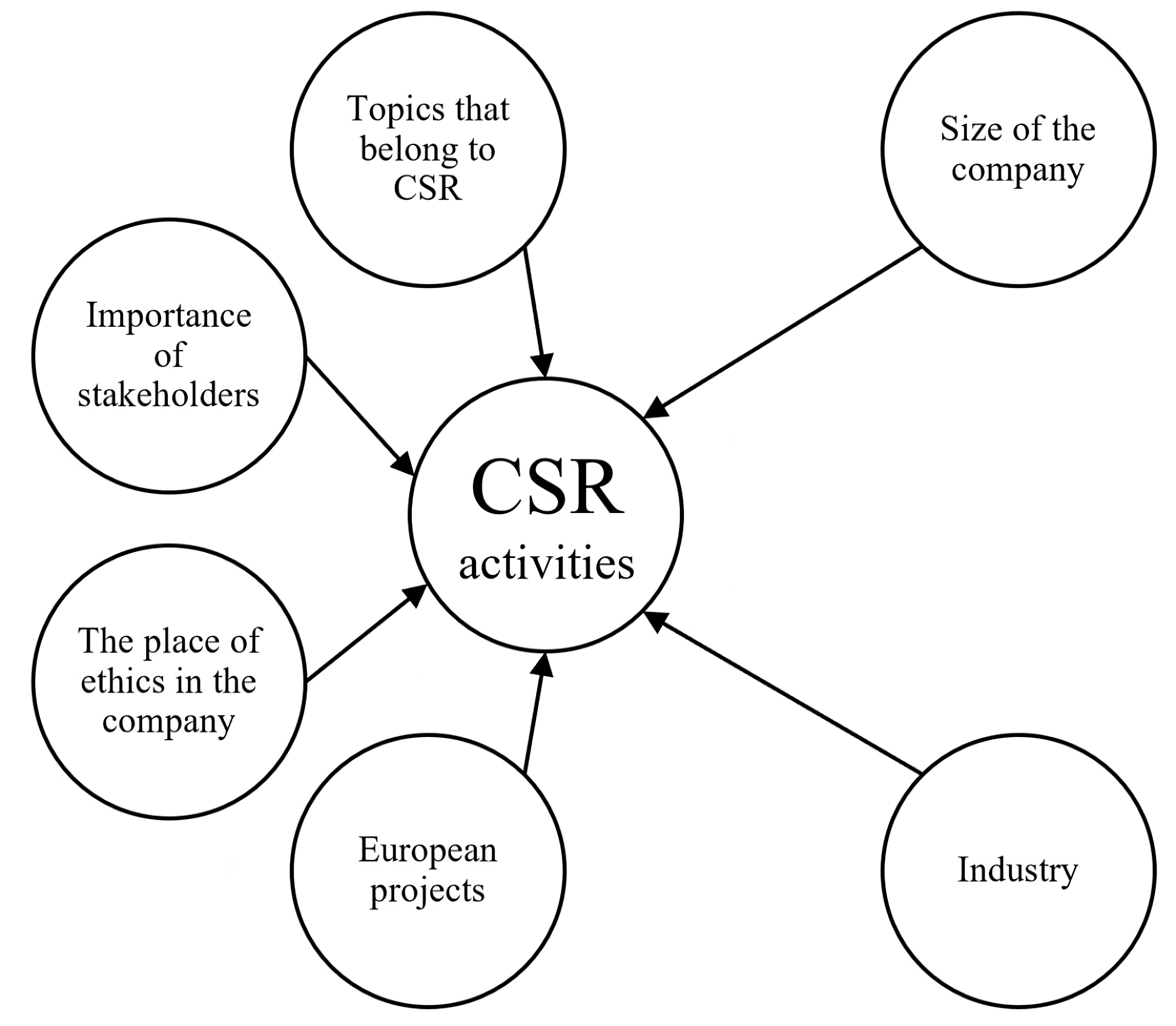
Based on the literature review, we synthesised our research framework into the following model (see Fig. 1).
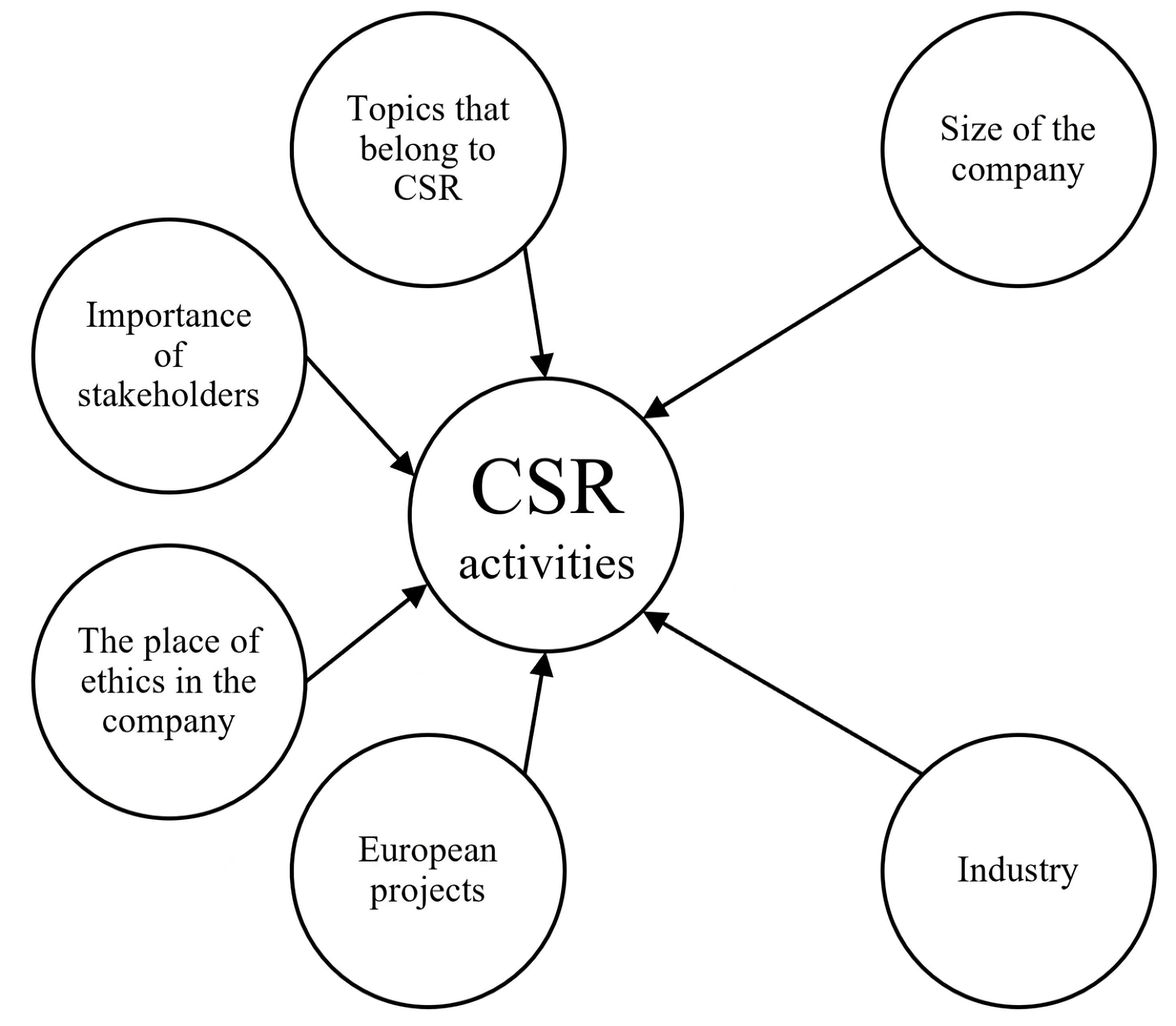 Fig. 1.
Factors influencing the existence of CSR activities (author’s illustration).
We argue that a company’s likelihood of engaging in CSR activities is influenced by how it defines the content of CSR for itself, the importance of stakeholders, the value of ethics in the company, and the number of EU projects allocated to the company. Each factor was examined with the help of several questions. Based on our literature review, we controlled for company size and sector. Our dependent variable, i.e., the likelihood of a company engaging in CSR activities, is binary, similar to most of our explanatory variables. Therefore, we use binary logistic regression to test the hypothesis. The following regression equation is framed:
In constructing our questionnaire, we considered several factors: the Romanian context and the previous research, the definition of CSR as stated above, the factors that appear in the literature as indicated in the previous chapter and that influence the existence of CSR activities. Additionally, we also drew on the work of Aguinis and Glavas (2012). In their ground-breaking literature review, based on more than 500 articles, 100 books, and numerous book chapters, the authors identified the variables that should be acknowledged in CSR research. The predictors, which according to the authors “are antecedents of CSR actions and policies” (Aguinis and Glavas, 2012, pp. 934), are stakeholders, regulations, certification, standards (at the institutional level), values, expected outcomes (at the organizational level), management commitment, personal values, and CSR guidelines (at the individual level).
We developed our questionnaire in line with the literature and pre-tested it with several companies. When the wording of a question seemed ambiguous for our readers, we revised it for clarity. The database we used to find companies that were awarded EU funds from the Structural and Cohesion Funds was obtained from an open database of the Romanian Government. After careful scrutiny, 5121 valid email addresses were obtained from the database. We received 140 complete questionnaires from the enterprises, which means a response rate of approximately 3%. We can see in Appendix Table 8 that the proportion of enterprises in the e-mail and the received answers are very similar.
The questionnaire survey was sent out between January–June 2021 to Romanian
companies that had won EU tenders between 2007 and 2013. The size of the
companies was defined according to EU standards (
The survey consisted of four parts. The first part identified companies’ general data such as the year of registration, the number of employees, where their products are sold, and their economic sector. The second part concerned the firm ethics and CSR activities, such as the goal of the company, the value of ethics in the company, the type of CSR activities, the importance of stakeholders, the content of the CSR, the importance of different CSR actions, CSR certifications, CSR trainings, and the reason behind the company’s CSR actions. The last two aspects focused on the implemented EU projects (number, budget, results) and the company’s performance. The first Appendix contains several questions from the survey.
Multiple binary logistic regressions were performed for each of the four groups of the model to select the variables to be included in the final binary logistic regression. The issues outlined in our model were explored in the questionnaire through a series of inquiries. The variables used in the survey, i.e., the corresponding questions and their measurement scales can be found in Appendix Table 9. The data collected was analysed in three stages. First, more than four variables within a questionnaire were examined using two or three binary regressions. The results of the nine binary logistic regressions are shown in Table 2.
| Variables | Stakeholders – 1. | Stakeholders – 2. | Topics that belong to CSR – 3. | Topics that belong to CSR – 4. | Topics that belong to CSR – 5. | The place of ethics in the company – 6. | The place of ethics in the company – 7. | EU Projects – 8. | EU Projects – 9. |
| Employees | 0.838 | ||||||||
| Consumers | 0.877 | ||||||||
| Local community | 0.725 | ||||||||
| State | 0.361 | ||||||||
| Partners | 0.851 | ||||||||
| Environment | 0.466 | ||||||||
| Owners | 0.197 | ||||||||
| Respect | 0.442 | ||||||||
| Ethics | 0.801 | ||||||||
| Mission, vision, values | 0.237 | ||||||||
| Quality | 0.998 | ||||||||
| Employee health | 0.998 | ||||||||
| Equality between women and men | 0.654 | ||||||||
| Human rights | 0.511 | ||||||||
| Charitable contributions | 0.685 | ||||||||
| Community engagement | 0.006* | ||||||||
| Environmental impact | 0.691 | ||||||||
| There is a person in charge of ethics | 0.089* | ||||||||
| There are written code of ethics | 0.041** | ||||||||
| There are sanctions for employees | 0.205 | ||||||||
| There are sanctions for partners | 0.216 | ||||||||
| Colleagues hired due to the implementation of European projects stayed longer than 3 years | 0.784 | ||||||||
| The company’s actions related to ethics or CSR mentioned in the application for EU funds | 0.017** | ||||||||
| Employment due to the European project included women | 0.618 | ||||||||
| Employment due to the European project included disadvantaged people | 0.014** | ||||||||
| Omnibus Tests of Model Coefficients | 0.153 | 0.472 | 0.613 | 0.001*** | 0.033** | 0.005** | 0.038** | 0.033** | 0.023** |
| Hosmer and Lemeshow Test | 0.489 | 0.156 | 0.809 | 1.000 | 0.934 | 0.972 | 0.924 | 0.889 | 0.870 |
*, **, *** significant at the 10%, 5%, and 1% levels, respectively. Significant values are in bold.
The following variables were found to be significantly associated at p
| Variables | 1. | 2. | 3. |
| There is a person in charge of ethics | 0.045* | 0.073* | |
| There are written ethics | 0.009* | 0.031** | |
| The community engagement belongs to CSR | 0.001** | 0.001*** | |
| The company’s actions related to ethics or CSR were mentioned in the application for EU funds | 0.077* | 0.367 | |
| Employment due to the European project included disadvantaged people | 0.057* | 0.095* | |
| Omnibus Tests of Model Coefficients | 0.001*** | 0.097* | 0.001*** |
| Hosmer and Lemeshow Test | 0.992 | 0.982 | 0.925 |
*, **, *** significant at the 10%, 5%, and 1% levels, respectively. Significant values are in bold.
Table 3 depicts the two variables affecting the dependent variable at p
Table 4 depicts the model as statistically significant for successfully
distinguishing between enterprises with and without CSR activities. Since the
Hosmer and Lemeshow test is insignificant, the model is a good fit for the data.
The model explained between 28.8% and 39.0% of the variance in the dependent
variable and correctly classified 75.7% of cases. At p
| Variables | Significance level | Exp(B) |
| The company has written ethics | 0.004** | 3.776 |
| The community engagement belongs to CSR | 0.001*** | 6.594 |
| Size (Micro companies are the base) | - | - |
| Small companies | 0.001*** | 8.515 |
| Medium companies | 0.090* | 2.701 |
| Large companies | 0.036** | 19.280 |
| Industrial companies | 0.014** | 0.323 |
| Omnibus Tests of Model Coefficients | 0.001*** | |
| Hosmer and Lemeshow Test | 0.235 | |
| Cox & Snell R Square | 0.288 | |
| Nagelkerke R Square | 0.390 | |
*, **, *** significant at the 10%, 5%, and 1% levels, respectively. Significant values are in bold.
The binary logistic regressions reveal four major findings. Firstly, the odds of
an enterprise engaging in CSR activities are 6.594 times more likely when the
manager/owner believes that community involvement is essential to CSR. Secondly,
the odds of an enterprise with a written code of ethics engaging in CSR
activities are 3.776 times higher compared to an enterprise with no written code.
Thirdly, the odds of a large enterprise engaging in CSR activities are 19.280
times that of a microenterprise. It is interesting to note that a small business
is 8.515 times more likely to have CSR activities than a microenterprise. For
medium-sized enterprises, the conclusions drawn at a significance level of
p
To examine the robustness of our results, we re-ran our main binary logistic
regression (see previous section), including variables at p
| Significance level | Exp(B) | |
| The company has written ethics | 0.149 | 2.118 |
| The community engagement belongs to CSR | 0.001*** | 8.186 |
| There is a person in charge of ethics | 0.009** | 4.012 |
| Employment due to the European project included disadvantaged people | 0.069* | 2.485 |
| Size (micro companies are the base) | - | - |
| Small companies | 0.001*** | 10.087 |
| Medium companies | 0.016** | 4.824 |
| Large companies | 0.034** | 17.790 |
| Industrial companies | 0.003** | 0.222 |
| Omnibus Tests of Model Coefficients | 0.001*** | |
| Hosmer and Lemeshow Test | 0.085 | |
| Cox & Snell R Square | 0.343 | |
| Nagelkerke R Square | 0.464 | |
*, **, *** significant at the 10%, 5%, and 1% levels, respectively. Significant values are in bold.
The binary logistic regression analysis shows that if community engagement is
part of a company’s CSR initiatives, the likelihood of that company engaging in
CSR activities is 8.186 times greater than that of an enterprise where community
engagement is not included in its CSR practices. Similar to the main regression,
with respect to the control variables, the size and the economic sector of a
company were observed to be significant at p
Since our results show how important community engagement is regarding the likelihood of a company engaging in CSR activities, the sample was further divided into two categories: companies acting globally and others only focusing on the domestic market. In both samples, we considered the company’s written ethics and community engagement as explanatory variables related to CSR. Additionally, we included size and economic sector as control variables. For both sub-samples, the binary regressions confirm results similar to the main sample, i.e., the likelihood of a company engaging in CSR activities increases if the community engagement is a significant element of their CSR rationale.
Table 6 depicts mixed results because large firms are not present in either sub-sample and the economic sector distributions of firms differ. Considering that larger firms generally sell abroad, this is not surprising.
| Selling abroad first sub-sample | Selling only in Romania second sub-sample | |
| There are written ethics | 0.476 | 0.005** |
| The community engagement belongs to CSR | 0.020** | 0.007** |
| Size (micro companies are the base) | - | - |
| Small companies | 0.004** | 0.006** |
| Medium companies | 0.199 | 0.187 |
| Large companies | 0.008** | Do not appear in the sample |
| Industry | 0.059* | 0.309 |
| Omnibus Tests of Model Coefficients | 0.001*** | 0.001*** |
| Hosmer and Lemeshow Test | 0.893 | 0.157 |
| Cox & Snell R Square | 0.467 | 0.249 |
| Nagelkerke R Square | 0.627 | 0.339 |
*, **, *** significant at the 10%, 5%, and 1% levels, respectively. Significant values are in bold.
Our research focused on Romania, one of the last countries in Central and Eastern Europe with a communist past to join the European Union. We explored the reasons why firms engage in CSR activities to contribute to the strand of literature on the specificities of CSR in Central and Eastern European countries (Grigore et al, 2021; Kowalczyk and Kucharska, 2020b; Puncheva-Michelotti et al, 2010; Stoian and Zaharia, 2012).
We investigated the drivers of CSR activities by performing multiple binary logistic regressions on a database comprising questionnaire results completed by 140 Romanian companies. We analysed a target group of companies that were also recipients of EU funds in a sparsely studied country: Romania. The study revealed that if a company values community engagement and ethics, its likelihood of engaging in CSR activities increases. Thus, our study adds to the literature on the impact of ethics on CSR activities. Further, we found that the size of the company and its economic sector impact the existence of CSR activities. In this respect, our conclusion is in line with that of Doś and Pattarin (2021, pp. 517) who, looking at Poland, conclude that size “positively and strongly influences the probability of a Polish company being socially responsible”. Our study has shown that the size of a company matters. However, there are nuances, as we have seen in the results of the binary logistic regression. Small firms are more likely to have CSR activities than medium firms. Our research also shows that a company from the industry sector is more likely to have CSR activities than those from services or agriculture.
This study partly confirmed several findings in existing academic literature, such as the importance of the local community (Colovic et al, 2019), company size and industry sector (Baumann-Pauly et al, 2013; Colovic et al, 2019; Doś and Pattarin, 2021). Other variables, such as stakeholder pressure (Aguinis and Glavas, 2012), were not confirmed by our data. A possible explanation could be Romania’s late transition to a market economy (the 1990s) but also the weakness of Non-Governmental Organizations and the historical lack of pressure from stakeholders.
Romania was a particular country among the communist countries of East-Central Europe “more autonomous than other Eastern Block countries” (Grigore et al, 2021, pp. 768) as it did not invade Czechoslovakia with the Soviets and other CEE countries in 1968. Still, the end of communism was not achieved by a peaceful transition in 1989. Despite these peculiarities, our study has revealed common points regarding the drivers of CSR activities between Romania and other former CEE and Western European countries.
A novelty for the study of Romania is that in our model, we examined both external factors (such as the state, EU tenders, and partners) and internal factors (ethics, employees, perception of CSR content) that influence the CSR activities of a firm. Of these, two internal factors were found to be relevant: the written code of ethics and the firm’s perception of CSR. These were added to the size and sector of the economy.
Several authors argue that CSR in developing countries is less influenced by the public (Ali et al, 2017) or that the post-communist legacy has made the state responsible for social issues (Stoian and Zaharia, 2012) or, in the context of Romanian society, “neither the Church nor the State have excelled in carrying out social responsibility activities” (Grigore et al, 2021, pp. 769). Concerning these findings, our research has shown that if the company values the local community, this is reflected in the existence of CSR activities.
Future studies on CSR should focus on comparative studies of Central and Eastern European and Western European countries. This would not only contribute to the enrichment of science but would also help to identify possible differences for consideration when drafting EU regulations. EU regulations that consider cultural and economic differences could contribute to the efficient implementation of directives and regulations in achieving the expected outcomes.
Our study provides a starting point in practice for managers, employees and regulators alike. For managers, the existence of a link between a code of ethics and CSR activities can be significant. Employees looking for a socially responsible company should be aware that the manager’s commitment to the community and ethical issues may predict that CSR will be taken seriously. Furthermore, regulators may want to pay particular attention to firms in the services and agriculture sectors.
The limitation of our study is the selection of specific companies and the number of our respondents. We chose firms who won EU tenders; however, we consider it important to conduct future research on a much more diverse choice of companies. The number of respondents allowed us to conduct statistically significant tests. Still, for future research, it would be interesting to conduct a representative survey to generalise our results. We furthermore deem it crucial to investigate the institutional level in more detail. This pertains to the realisation that although CSR has also been introduced in the CEE countries through EU regulations, these regulations do not appear as a key factor in the decision of an enterprise to carry out or not CSR activities.
Following the findings of Stoian and Zaharia (2012, pp. 393) that in transition economies, like those in the CEE countries, we have a “hybrid CSR” and those of Grigore et al (2021) about the “liquid” Romanian CSR, we believe it is important that future questionnaire research on CSR activities should include a section asking about the values of the CSR practitioner and the CEO, thus also examining the extent to which their values influence the drivers of CSR activities. Not least because Stoian and Zaharia (2012) underline that various authors agree that the communist legacy influences the adoption and application of CSR, although not how this is done.
The datasets used and/or analyzed during the current study are available from the corresponding author on reasonable request.
RH designed the research study. RH and OC performed the research and analyzed the data. All authors contributed to editorial changes in the manuscript. All authors read and approved the final manuscript. All authors have participated sufficiently in the work.
The authors are thankful for the reviewers’ suggestions, which helped improve this article.
The publication of this article was supported by the 2024 Development Fund of the Babeș–Bolyai University.
The authors declare no conflict of interest.
| Please specify the CAEN group (Classification of National Economic Activities) to which the company’s main activity belongs. |
| The number of employees is ( |
| Is there a person in your company’s management who is in charge of managing ethical issues? (yes/no answers). |
| Are there written ethical principles in your company? (yes/no answers). |
| Are ethical mistakes of employees sanctioned in your company? (yes/no answers). |
| Does your company penalize ethical mistakes of contract partners? (yes/no answers). |
| The company has activities related to: environment, community, sustainability, employee welfare, equality between men and women, integration of disadvantaged groups (yes/no answers). |
| How important are for the firm: Partners, Consumers, Environment, Owners, Local community, State institutions (Likert scale 5). |
| In your opinion, which of the following topics are part of corporate social responsibility: Employee health and safety; Business ethics, The company’s impact on the environment, Human rights, Quality of products and services, Equal opportunities for women and men, Compliance with all laws and regulations, Charitable contributions, Community involvement (yes/no answers). |
| Does the company have a CSR budget? (yes/no answers). |
| Does the company have a CSR strategy? (yes/no answers). |
| Is the effectiveness of CSR actions measured? (yes/no answers) |
| The company has: Energy reduction program, Pollution Reduction Program, Paper Reduction Program, Certifications related to sustainability, society or the environment, Sustainability training, Ethics training, Anti–harassment training (yes/no answers). |
| Type of enterprises | E-mail database | Received answers database |
|---|---|---|
| Microenterprise | 45.08% | 40.71% |
| Small enterprise | 36.70% | 40.00% |
| Medium enterprise | 14.18% | 15.71% |
| Large enterprise | 4.04% | 3.57% |
| Variables and the question from the survey | Measurement |
| Dependent variable: having or not having CSR activities | Binary |
| Explanatory variables: | |
| Stakeholders | |
| Employees: Which of the following groups are important to your company and to what extent? | Likert scale 1–5 |
| Consumers: Which of the following groups are important to your company and to what extent? | Likert scale 1–5 |
| Local community: Which of the following groups are important to your company and to what extent? | Likert scale 1–5 |
| State: Which of the following groups are important to your company and to what extent? | Likert scale 1–5 |
| Partners: Which of the following groups are important to your company and to what extent? | Likert scale 1–5 |
| Environment: Which of the following groups are important to your company and to what extent? | Likert scale 1–5 |
| Owners: Which of the following groups are important to your company and to what extent? | Likert scale 1–5 |
| Topics that belong to CSR | |
| Respect: According to your opinion, which of the following topics are part of corporate social responsibility? | Binary |
| Ethics: According to your opinion, which of the following topics are part of corporate social responsibility? | Binary |
| Mission, vision, values: According to your opinion, which of the following topics are part of corporate social responsibility? | Binary |
| Quality: According to your opinion, which of the following topics are part of corporate social responsibility? | Binary |
| Employee health: According to your opinion, which of the following topics are part of corporate social responsibility? | Binary |
| Equality between women and men: According to your opinion, which of the following topics are part of corporate social responsibility? | Binary |
| Human rights: According to your opinion, which of the following topics are part of corporate social responsibility? | Binary |
| Charitable contributions: According to your opinion, which of the following topics are part of corporate social responsibility? | Binary |
| Community engagement: According to your opinion, which of the following topics are part of corporate social responsibility? | Binary |
| Environmental impact: According to your opinion, which of the following topics are part of corporate social responsibility? | Binary |
| The place of ethics in the company | |
| There is a person in charge of ethics | Binary |
| There are written ethics | Binary |
| There are sanctions for employees | Binary |
| There are sanctions for partners | Binary |
| EU projects | |
| Colleagues hired due to the implementation of European projects stayed longer than 3 years | Binary |
| The company’s actions related to ethics or CSR mentioned in the application for EU funds | Binary |
| Employment due to the European project included women | Binary |
| Employment due to the European project included disadvantaged people | Binary |
The highlighted words are the variable names, followed by the corresponding questions.
References
Publisher’s Note: IMR Press stays neutral with regard to jurisdictional claims in published maps and institutional affiliations.