
 , Zhiguo Liang 1, Bowei Liu 2, Qiwei Zhou 3,4,5,*
 , Kunyu Yang 1
1 School of Business, Macau University of Science and Technology, 999078 Macau, China
2 Law School, Ocean University of China, 266100 Qingdao, Shandong, China
3 College of Management, Ocean University of China, 266100 Qingdao, Shandong, China
4 Technology and Economics Research Center, Innovation and Entrepreneurship Research Center, Ocean University of China, 266100 Qingdao, Shandong, China
5 Innovation and Entrepreneurship Research Center, Ocean University of China, 266100 Qingdao, Shandong, China
Abstract
Past successful and failed cases are major sources of learning for lawyers. However, prior research emphasizes the importance of learning from failures and has largely neglected learning from success. To fill this gap, this study proposes hypotheses based on Self-Determination Theory (SDT) and conducts a multiple-wave survey of 454 lawyers in China. Empirical results indicate that: job autonomy facilitates learning from success; lawyers’ intrinsic motivation mediates the relationship between job autonomy and learning from success. Further, this paper shows that directive leadership not only strengthens the relationship between intrinsic motivation and learning from success but also moderates the entire mediation effect. These findings provide valuable theoretical and practical implications for promoting lawyers’ learning from success.
Keywords
- learning from success
- job autonomy
- intrinsic motivation
- directive leadership
A research project that conducted longitudinal analyses of case learning patterns across 200 leading global law firms found that top-tier firms allocate 73% of their learning resources to studying successful cases and have established standardized “Winning Case Decoding Frameworks”. This practice enhances case preparation efficiency by 35–40%, demonstrating how systematic learning from success fundamentally distinguishes the operational excellence of elite law firms. In this vein, this study posits that investigating “learning from success” among lawyers is crucial for both individual lawyers and the legal industry at large. Lawyers rely heavily on cumulative case experience, with each case functioning as a distinct project that contributes to their overall expertise and skill set. This reliance emphasizes the importance of learning from successful cases to identify effective strategies and practices (Zagoršek et al., 2009; Milić et al., 2017). Furthermore, legal knowledge management has traditionally focused on post-mortem analyses of unsuccessful cases, often neglecting the valuable insights that can be gleaned from successful outcomes. This oversight limits the potential for growth and improvement within the profession, as best practices often go systematically unrecorded and under-shared. Moreover, because the legal industry is inherently human capital-intensive, its sustainable competitive advantage largely depends on the skills and capabilities of its lawyers (Segal-Horn and Dean, 2011; Krill et al., 2022). In this context, fostering approaches that encourage lawyers to learn from successes is essential for the long-term development and resilience of law firms.
Learning from success refers to the process of consciously and proactively analyzing and reflecting on past successful experiences (or events) to acquire new knowledge and abilities to guide future behaviors and decisions (Zhou et al., 2025). According to this definition, learning from success is one special form of proactive learning that is spontaneous and not required by work. However, unlike proactive learning that focuses on active behavior (Donmez and Carbonell, 2008), learning from success emphasizes what is learned - knowledge and skills obtained from past successful experiences (Zhou et al., 2025).
Research shows that learning from past experience enables individuals to acquire substantial knowledge, reduce the uncertainty of current actions and future decisions, minimize information search costs in unfamiliar contexts and ultimately increase the likelihood of future success (Argote and Miron-Spektor, 2011). However, existing studies mainly focus on how individuals learn lessons from failures (e.g. Argote and Miron-Spektor, 2011; Goodman et al., 2011; Dahlin et al., 2018) while neglecting how they learn from past successful experiences (Chen et al., 2017; Dahlin et al., 2018). One possible reason is that success is a potent catalyst for overconfidence and hubris (Picone et al., 2014). Some studies suggest a strong possibility that long-term success will lead to subsequent failures (Baumard and Starbuck, 2005). This is because success learners may overemphasize and repeatedly apply practices that they believe can contribute to success. The “amplified” successful experience can limit their adaptation to change, leading to inertia or even rigidity. This may weaken the organization’s survival capacity in the long term and eventually lead to failure.
It is worth noting that although individuals with successful experiences may fall into “traps” and “misunderstandings”, such as overconfidence, blind optimism and cognitive biases (Picone et al., 2014), for lawyers, learning from success holds greater strategic value primarily because successful cases provide replicable “best practice portfolios” that systematically enhance legal techniques, judicial persuasion strategies, and client management competencies, whereas failure analyses tend to be confined to risk avoidance. In addition, this positive learning approach fosters a “winner’s mindset”, reducing burnout risk by 37% (Austin, 2017). According to Zhou et al. (2025), learning from success enables individuals to acquire knowledge and develop skills by reflecting, studying and summarizing their own or others’ successful experiences. Successful experiences help lawyers recognize effective workflow and behaviors in the current environment, clarify scope more accurately, and approach future cases with a clearer direction (Audia et al., 2000; Chen et al., 2017). Simultaneously, since past successes often indicate the effectiveness of the organization’s strategy, employees gain confidence in repeating past actions to achieve subsequent success, thereby improving the organization’s efficiency and performance (Kim et al., 2009). Compared with learning from failure, learning from success provides an intact knowledge base for future actions. In contrast, failure-based learning cannot provide such comprehensive knowledge (Deichmann and Ende, 2014).
Given the recognized value of learning from success, researchers have explored how to promote it. Existing studies show that learning from success can be affected by both internal individual characteristics and the external environment. Specifically, internal individual factors such as deliberate reflection (Zollo, 2009), admiration (Lee and Duffy, 2019), and self-efficacy (Zimmerman, 2000) promote learning from success. External factors such as the leader’s value of success (Farson and Keyes, 2002) and leaders’ psychological support (Liu et al., 2014) will affect employees’ subjective feelings and experience, which will influence their attitudes toward and expectations regarding learning. However, investigations on how to promote learning from success from a job design perspective have rarely been conducted. To fill this gap, this paper examines whether high perceived job autonomy from the perspective of job design can promote lawyers’ learning from success. Job autonomy can be traced to the Job Diagnostic Model (Hackman and Oldham, 1975), which identifies five core job design elements, including job autonomy, skill variety, task identity, task significance and feedback. The Job Diagnostic Model emphasizes that these five different job design elements affect individuals’ critical psychological states, e.g., experienced meaningfulness of the work and experienced responsibility for outcomes of the work, which will subsequently influence their job satisfaction (Hackman and Oldham, 1975, p. 161). Researchers have described job autonomy as employees’ freedom, independence and discretion in arranging work schedules, making decisions and choosing work methods (Morgeson and Humphrey, 2006; Clausen et al., 2022). In our study, we posit that lawyers with high levels of job autonomy can determine how their work is arranged and freely acquire resources to develop capabilities (Morgeson et al., 2005) that facilitate learning from success. Furthermore, drawing on Self-Determination Theory (Ryan and Deci, 2017), we propose that intrinsic motivation is an important psychological mechanism linking the relationship between job autonomy and learning from success. Extant studies show that intrinsic motivation predicts employee learning behaviors, such as knowledge sharing (Hung et al., 2011) and knowledge transfer (Martin et al., 2009). However, its mediating role between job autonomy and learning from success remains underexplored. This study establishes this linkage. Specifically, job autonomy allows employees to feel that their actions can be determined by themselves and that they can voluntarily engage in tasks that strengthen their willingness and intrinsic motivation (Deci et al., 2017) to learn from success.
Moreover, in reviewing the literature, we found that leadership styles can influence learning behaviors. For example, transformational leadership strongly predicts learning among employees (Loon et al., 2012; Xie, 2020); shared leadership is positively related to team and individual learning (Liu et al., 2014); and ethical leadership promotes group learning behaviors (Chamtitigul and Li, 2021). However, to our knowledge, how directive leadership influences learning behaviors has not been investigated. To fill this gap, we argue that directive leadership facilitates the relationship between lawyers’ job autonomy and learning from success. Specifically, the leadership literature argues that although directive leadership improves performance, it limits subordinates’ ability to expand job scope and develop autonomy because it emphasizes control and regulation over empowerment (Martin et al., 2013). We argue, however, that overconfidence and hubris fueled by prior successes (Sadler-Smith and Cojuharenco, 2021; Picone et al., 2014) can be remedied by directive leadership. Clear instructions and specific monitoring by leaders can help lawyers assess their own achievements and set goals for further development and progress (Lonati, 2020). This tends to mitigate the potential negative impact of hubris arising from success, enabling intrinsically motivated individuals to fully engage in learning and capitalize on their successful experiences. Therefore, this study suggests that directive leadership enhances the relationship between job autonomy and learning from success.
Taken together, by focusing on the legal profession and building on Self-Determination Theory (SDT), this study examines whether, how, and when lawyers’ job autonomy influences learning from success by introducing the mediating role of intrinsic motivation and the moderating role of directive leadership. Fig. 1 describes the hypothesized relationship. Our contributions are fourfold: (1) we focus on a specific occupation, lawyers, and investigate how job autonomy influences learning from success; (2) we draw on SDT to explore the mediating role of intrinsic motivation in learning from success; (3) to our knowledge, we are among the first to test the moderating role of directive leadership in the relationship between intrinsic motivation and learning from success as well as the overall mediating effect; and (4) we offer theoretical insights for the experiential learning literature and practical recommendations for fostering learning from success in the legal profession.
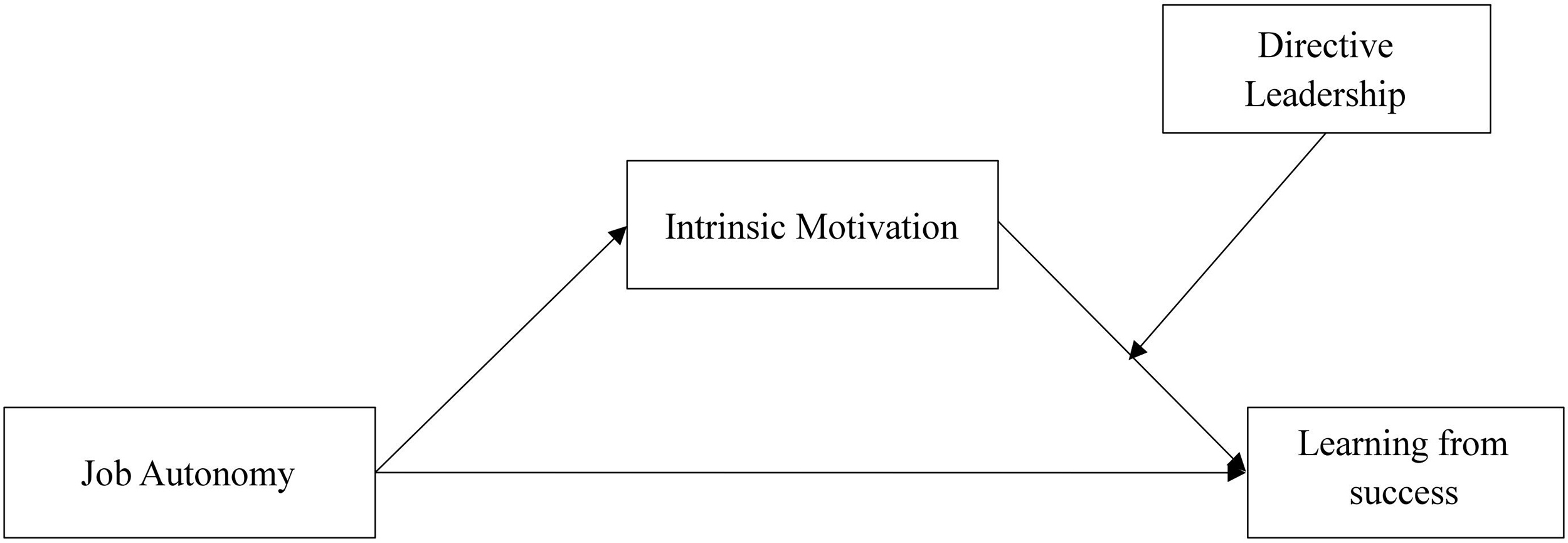 Fig. 1.
The theoretical model.
The tenet of SDT is that when individuals feel that their actions are self-determined or that they can voluntarily engage in work and complete tasks, they will develop high levels of job motivation and willingness (Ryan and Deci, 2017). Through SDT, satisfying three basic psychological needs—autonomy, competency, and relatedness—improves employee job performance and generates positive job attitudes (Deci et al., 2017; Ryan and Deci, 2017). Autonomy refers to individuals’ perceptions that their behaviors are self-determined and controlled by their own will. Competency refers to individuals’ perceptions that their work is effective and enables them to achieve valuable goals in their jobs. Relatedness refers to individuals’ feelings that they are understood by and connected to others while on the job. Satisfying these three psychological needs can effectively improve their psychological well-being, promote positive emotions, and induce better job performance. Overall, SDT explains how strengthening employees’ sense of self-determination improves their motivation and willingness, thereby enhancing workplace performance (Deci et al., 2017).
This study draws on SDT to theoretically explain whether, how, and when lawyers’ job autonomy predicts learning from success. First, we propose that providing lawyers with job autonomy, including discretion over job content and arrangement, satisfies their need for autonomy. Studies have also shown that when individuals feel that their actions are self-determined and they can voluntarily engage in their job, they develop strong motivation (Deci et al., 2017; Ryan and Deci, 2017) to study and learn from success. This provides a theoretical framework for understanding the relationship between lawyers’ job autonomy and learning from success. Second, SDT proposes that the internal pleasure and satisfaction derived from high levels of job autonomy directly determine their intrinsic motivation, which significantly affects their motivation to engage in positive workplace-related behaviors (Deci et al., 2017; Ryan and Deci, 2017) such as learning from success. Therefore, SDT provides a foundation for explaining the psychological mediation mechanism of intrinsic motivation in the relationship between lawyers’ job autonomy and learning from success. Third, we further probe whether, when lawyers have clear job requirements through guidance from leaders, they can set long-term goals, carry out their jobs more smoothly, and perceive a greater likelihood of achieving goals, so that their competence needs can be satisfied. This provides support for the moderating role of directive leadership in the relationship between job autonomy and learning from success.
Job autonomy has been defined as “the extent to which employees have a major say in scheduling their work, selecting the equipment they will use, and deciding on procedures to be followed” (Hackman and Lawler, 1971, p 265). It is regarded as a prominent and important job design feature (Volmer et al., 2012), empowering individuals to determine how their work is arranged, independently control the allocation of time and energy, manage interactions with leaders, colleagues and subordinates, and integrate different aspects of project tasks more effectively. Existing studies show that individuals with high job autonomy are more likely to expand their job scope, develop ideas, improve problem-solving, enhance creativity, and even engage in risk-taking activities (Bhawna et al., 2026; He and Guo, 2025; Tierney and Farmer, 2002). Moreover, job autonomy reinforces organizational commitment, job performance, and job satisfaction (Humphrey et al., 2007) and reduces work-leisure conflict (Wang et al., 2022). Building on the research by Wang and Netemeyer (2002) suggesting that job autonomy positively impacts employees’ workplace learning behavior, this study argues that there is a positive relationship between lawyers’ job autonomy and learning from success.
First, as suggested by the Job Diagnostic Model (Hackman and Oldham, 1975), when individuals perceived high level of job autonomy, they feel a strong sense of responsibility for their work outcomes. This felt responsibility, as a critical antecedent of organizational citizenship behavior (Campbell, 2025; Snape and Redman, 2010), motivates lawyers not only achieve success but to deeply understand and learn from it to ensure the long-term development for themselves. Furthermore, greater independence afforded by job autonomy provides employees with more room for self-determination (Volmer et al., 2012) and creates the opportunity to engage in reflection. This enables proactive behavior (Den Hartog and Belschak, 2012) and learning behavior (Wang and Netemeyer, 2002), allowing lawyers to self-initiate the analysis of past successful experiences that that fosters learning from success (one form of proactive learning). At last, high perceived job autonomy enables lawyers to break out of their routines and seek the best solutions for completing tasks (Shalley and Gilson, 2004), thereby facilitating learning from success, one of the most effective methods of gaining knowledge and developing problem-solving skills (Audia et al., 2000).
Thus, we propose the following hypothesis:
Hypothesis 1: Job autonomy is positively associated with learning from success.
Intrinsic motivation refers to individuals “doing an activity for its own sake because one finds the activity inherently interesting and satisfying” (Tremblay et al., 2009, p. 214). SDT proposes that satisfying individuals’ autonomous needs enables them to perceive that they have control over their jobs and to experience enjoyment at work, both of which play important roles in generating and sustaining intrinsic motivation (Ryan and Deci, 2017). Accordingly, this study argues that intrinsic motivation is an important psychological mediating mechanism for promoting learning from success.
Research shows that in jobs with high autonomy, individuals feel that their actions are self-determined and they can voluntarily engage in work tasks, thereby enhancing intrinsic motivation (Deci et al., 2017; Kovačić et al., 2021). When intrinsically motivated individuals strive to learn new skills and become deeply involved in work tasks, they are more inclined to perceive their work as fun, interesting, satisfying, and even fascinating (Ryan and Deci, 2017). Intrinsic motivation is an important driving factor in work, motivating individuals to achieve goals (Ryan and Deci, 2017). It also generates a strong sense of craftsmanship among employees, encourages their voice behavior (Ouyang et al., 2022) and enhances job performance. According to Morgeson et al. (2005), improving employees’ discretion over their work tasks and increasing opportunities to seek new challenges enhances employees’ intrinsic motivation. Therefore, we suggest that job autonomy facilitates lawyers’ intrinsic motivation.
We further propose that the influence of job autonomy on learning from success is exerted through intrinsic motivation. The core reason for stressing the mediating role of intrinsic motivation is that, although job autonomy provides lawyers with opportunities to try new ideas and challenges and the space to make independent decisions (Morgeson et al., 2005), the extent to which lawyers can take advantage of these opportunities depends on their long-term orientation and underlying level of intrinsic motivation (Amabile et al., 1994). As a result, this study posits that since the influence of job autonomy on learning from success relies on lawyers’ self-determined behaviors and spontaneous efforts, lawyers with a long-term and stable level of intrinsic motivation will be more energetic and proactive in their work with autonomy. When jobs have high levels of autonomy, lawyers perceive their work as meaningful, experience the fun, and become more deeply engaged. They also have more power and willingness to review and reflect on past successful experiences, devote time and energy to learning from and summarizing those experiences, and apply them to future work. Therefore, we propose:
Hypothesis 2: Intrinsic motivation mediates the relationship between job autonomy and learning from success.
Directive leadership is characterized by “behaviors aimed at actively structuring subordinates’ work by providing clear directions and expectations regarding compliance with instructions” (Lorinkova et al., 2013, p. 573). In our research, we proposed that directive leadership enhances the positive effect of lawyers’ intrinsic motivation on their learning from success in two ways.
On one hand, when lawyers with low intrinsic motivation, they may lack the spontaneous and internal drive to engage in the proactive and effortful process of learning from success (Ryan and Deci, 2017). In this context, by clearly specifying goals, outlining procedures for review and assigning specific learning tasks (Li et al., 2018; Valentino et al., 2025), directive leaders can initiate, guide and enable the learning process, which thereby strengthens the influence of intrinsic motivation on learning from success.
On the other hand, directive leadership can “help to enhance process control” (Zheng et al., 2021, p. 353) that also intensifies such effect. In detail, evidence from the literature shows that success is a potent catalyst for overconfidence and hubris. For example, Picone et al. (2014) claimed that “firms’ recent success is the main source of managerial hubris (p. 452)”. Sadler-Smith and Cojuharenco (2021) also declared that “hubris is fueled by prior successes (p. 270)”. According to research by Picone et al. (2014), hubris acquired from successes can lead individuals to overattribute outcomes to their own abilities while neglecting external factors and critical feedback. It thereby impairs further learning (Lockhart et al., 2017). As suggested by Owen et al. (2009) and Petit et al. (2012), controlling is an effective strategy for preventing hubris. We therefore suspect that directive leadership, focused on controlling, monitoring, regulating, and instructing (Krause et al., 2024; Lonati, 2020; Martin et al., 2013), can mitigate hubris, allowing intrinsically motivated individuals to fully engage in learning and capitalize on successful experiences. We therefore propose the following hypothesis:
Hypothesis 3: Directive leadership moderates the relationship between intrinsic motivation and learning from success, such that the relationship is stronger when directive leadership is high rather than low.
The rationale for the mediating role of intrinsic motivation reveals the psychological mechanism and internal logic underlying how job autonomy affects learning from success. Moreover, the moderating role of directive leadership further illustrates the circumstances under which intrinsic motivation exerts a stronger influence on learning from success (i.e., high directive leadership). To explore the role of directive leadership, an integrated moderated mediation model is proposed (see Fig. 1). Specifically, intrinsic motivation mediates the relationship between job autonomy and learning from success, and this relationship is further strengthened under directive leadership. That is, when the level of directive leadership is high, employees receive clear and specific guidance, helping them maintain a calm, objective attitude after success and avoid blind confidence, conformism, or complacency. Thus, the overall positive impact of job autonomy on learning from success is further enhanced. In general, this paper proposes the following hypothesis:
Hypothesis 4: Directive leadership moderates the mediation effect of intrinsic motivation through the relationship between job autonomy and learning from success, such that the mediation is stronger when directive leadership is high rather than low.
Our research utilized a purposive sampling technique to recruit respondents (Creswell, 2009) who were legal professionals with ample knowledge and experience working in law firms. This sampling strategy enabled the targeted selection of respondents who might provide deep insights into our research topic and variables (Babbie and Mouton, 2001). Specifically, online survey invitations were issued directly to participants attending a series of law seminars organized by a well-known university in China. The participants were licensed lawyers from various law firms. With the support of the organizers of these law seminars, we obtained the email addresses of participants and administered our survey to them. To reduce common method variance (Podsakoff et al., 2003), we utilized a two-stage data collection design (i.e., Time 1 and Time 2). The time interval between two stages was two weeks. The rationale for choosing a two-week interval follows the recommendations of Reis and Wheeler (1991), who claimed that two weeks represents a generalizable and stable sample of individuals’ interactions with others. Moreover, this approach is also consistent with many studies in the management literature (e.g., Barnes et al., 2015; Schilpzand et al., 2018). A unique ID was generated by the online survey platform for each participant to match data. At Time 1, we distributed links to 750 participants, and a total of 648 participants completed the questionnaires, yielding a response rate of 86.40%. In the Time 1 survey, participants provided data regarding their perceived job autonomy, intrinsic motivation, and demographic information (i.e., gender, age, educational background, professional rank and tenure). At Time 2 (two weeks after Time 1), we invited the participants to evaluate their perceived level of directive leadership of their project leaders and their own learning from successful experiences. After excluding invalid questionnaires (e.g., too short response time or identical ratings across all items), a total of 454 valid responses were retained.
Among the 454 participating lawyers, 261 were female (57.49%) and their ages ranged primarily from 20 to 30 (24.44%), 31 to 40 (38.19%), 41 to 50 (21.63) and 51 to 60 (15.74%) years of age. As for educational background, 376 got bachelor’s or higher degrees. Regarding professional rank, 31.50% were assistant lawyers, 68.5% were second-grade lawyers, and the average tenure was 3.75 years (standard deviation [SD] tenure = 2.97).
Given that the original measures were in English, we strictly followed back-translation procedures (Brislin, 1986) to translate them into Chinese.
Respondents reported their perceived level of job autonomy using a three-item
scale. This scale included two items from the Job Diagnostic Survey (JDS,
Hackman and Oldham, 1975) and one item from the revised JDS (Idaszak and Drasgow, 1987). An example item was “My job allows me to decide on my own how
to go about doing the work” (1 = strongly disagree to 7 =
strongly agree;
Respondents evaluated their intrinsic motivation using the five-item short
version scale adapted from the Work Preference Inventory (Amabile et al., 1994; Tremblay et al., 2009). An example item was “I enjoy doing work that is so
absorbing that I forget about everything else” (1 = strongly disagree
to 7 = strongly agree;
Respondents rated their leader’s directive leadership using the ten-item scale
of leadership structure from the Leader Behavior Description Questionnaire-Form
XII (LBDQ-XII; e.g., Stogdill, 1974). Sample items included “My direct
leader lets members know what is expected from them” and “My direct leader
maintains definite standards of project performance” (1 = strongly
disagree to 7 = strongly agree;
Following Zhou et al. (2025) approaches, learning from success was assessed using a five-item scale adapted from Carmeli’s (2007) scale of learning from failure.Sample items included statements such as “I always record and
summarize past successful case experiences” (1 = strongly disagree to 7
= strongly agree,
Previous studies have shown that demographic information can influence individuals’ workplace behaviors (e.g., Ng and Feldman, 2010); thus, we included these demographic variables as control variables.
To examine the empirical distinctiveness of the focal constructs, we used Mplus (Muthen and Muthen, Los Angeles, CA, USA)
(Muthén and Muthén, 2012) to perform confirmatory factor analyses
(CFA) with all items as indicators. As the ratio of sample size to item number
for directive leadership (4.5:1) was less than the recommended minimum ratio of
5:1 (Gorsuch, 1983, p. 332), we parceled the ten items of directive leadership into three factors using the item-to-construct-balance approach (Williams et al., 2009).
This approach reduces the model complexity by decreasing the number
of estimated parameters, thereby potentially improving stability and fit in
situations with limited sample sizes (Bandalos and Finney, 2001; Little et al., 2013). It has been widely adopted in previous studies, such as Major et al.
(2006) and Zhang et al. (2024). Specifically, we implemented the
Item-to-Construct Balance in three steps, following Williams et al. (2009):
First, we sorted all items of directive leadership by their factor loadings (from
highest to lowest) based on preliminary CFA results. Then, using a
“high-medium-low” sequential assignment with reverse cycling for three parcels
(e.g., items 1–3 assigned to parcels 1-2-3, items 4–6 assigned to parcels
3-2-1). Finally, we verified parcel equivalence by comparing mean factor loadings
and variance across parcels to ensure consistent representation of the latent
construct. The results in Table 1 show that the hypothesized four-factor model
has an ideal model fit (
| Models | χ2/df | CFI | TLI | RMSEA | SRMR |
| Four-factor model: The hypothesized four-factor model | 2.82 | 0.94 | 0.92 | 0.06 | 0.05 |
| Three-factor model a: Combining job autonomy and intrinsic motivation | 6.04 | 0.82 | 0.79 | 0.11 | 0.07 |
| Three-factor model b: Combining intrinsic motivation and directive leadership | 6.18 | 0.77 | 0.73 | 0.11 | 0.09 |
| Two-factor model: Combining job autonomy and intrinsic motivation, and combing directive leadership and learning from success | 8.89 | 0.64 | 0.58 | 0.13 | 0.10 |
| Single-factor model: Combining all variables | 10.29 | 0.66 | 0.61 | 0.15 | 0.10 |
Notes:
Since all data were self-rated by employees, we tested possible common method
bias (Podsakoff et al., 2003) using Harman’s one-factor test. As shown in
Table 1, the four-factor hypothesized model had better model fit indexes than the
one-factor model (
Moreover, Table 2 shows the factor loadings, average variance extracted (AVE) as well as composite reliability (CR) for the measurement items of our variables. As illustrated in Table 2, all factor loadings are equal to or above 0.5, AVE is larger than 0.5, and CR is larger than 0.7, indicating that the research model has acceptable internal consistency reliability and convergent validity (Bagozzi et al., 1981; Fornell and Larcker, 1981).
| Factor | Item | Factor loadings | AVE | CR |
| Job autonomy | JA1 | 0.81 | 0.82 | 0.86 |
| JA2 | 0.77 | |||
| JA3 | 0.87 | |||
| Intrinsic motivation | IM1 | 0.70 | 0.70 | 0.83 |
| IM2 | 0.74 | |||
| IM3 | 0.79 | |||
| IM4 | 0.60 | |||
| IM5 | 0.65 | |||
| Directive leadership | DL1 | 0.52 | 0.55 | 0.81 |
| DL2 | 0.59 | |||
| DL3 | 0.50 | |||
| DL4 | 0.56 | |||
| DL5 | 0.55 | |||
| DL6 | 0.59 | |||
| DL7 | 0.62 | |||
| DL8 | 0.50 | |||
| DL9 | 0.51 | |||
| DL10 | 0.52 | |||
| Learning from success | LFS1 | 0.60 | 0.57 | 0.71 |
| LFS2 | 0.50 | |||
| LFS3 | 0.51 | |||
| LFS4 | 0.58 | |||
| LFS5 | 0.65 |
Note: AVE, average variance extracted; CR, composite reliability.
Table 3 presents descriptive statistics, including means, SDs, correlations, and
reliabilities of the focal variables. Results in Table 3 show that job autonomy
was positively associated with intrinsic motivation (r = 0.37, p
| Variables | Mean | SD | 1 | 2 | 3 | 4 | 5 | 6 | 7 | 8 | 9 |
| 1. Gender | 0.43 | 0.50 | – | ||||||||
| 2. Age | 3.90 | 1.60 | 0.13** | – | |||||||
| 3. Education level | 3.90 | 0.73 | 0.02 | –0.23** | – | ||||||
| 4. Position level | 2.00 | 0.84 | 0.28** | 0.39** | 0.18** | – | |||||
| 5. Tenure | 3.75 | 2.97 | 0.06 | 0.52** | –0.14** | 0.32** | – | ||||
| 6. Job autonomy (T1) | 4.98 | 1.18 | 0.12* | 0.12** | 0.09 | 0.31** | 0.05 | (0.85) | |||
| 7. Intrinsic motivation (T1) | 4.67 | 0.97 | 0.03 | 0.02 | 0.01 | 0.19** | 0.00 | 0.37** | (0.82) | ||
| 8. Directive leadership (T2) | 5.46 | 0.71 | –0.07 | 0.07 | 0.07 | 0.12* | 0.12** | 0.30** | 0.25** | (0.80) | |
| 9. Learning from success (T2) | 5.28 | 0.82 | 0.04 | 0.00 | 0.08 | 0.16** | –0.02 | 0.25** | 0.33** | 0.33** | (0.70) |
Notes: N = 454, SD, standard deviation. Cronbach’s alpha values for the
variables are shown in italics along the diagonal in the brackets. *p
To test our hypotheses, we conducted a path analysis using Mplus (Muthén and Muthén, 2012) with Maximum Likelihood Robust estimator (Hayes, 2017). Path analysis allows the strength of direct and indirect relationships between variables to be quantified (Stage et al., 2004). It assumes that correlation coefficients between constructs can be decomposed into a sequence of identifiable causal components. These components, or paths of influence, form a clear causal chain and therefore estimate relative effects from independent variables to mediators and subsequently to dependent variables (Brown et al., 2007). Therefore, it is widely used to test and quantify the validity of theoretically derived models in many empirical studies, e.g., Wood et al. (2021), Yin et al. (2023) and Brown et al. (2007). Furthermore, to avoid multicollinearity, intrinsic motivation and directive leadership were centered, following Cohen et al. (2003).
Hypothesis 1 posits a positive association between job autonomy and learning
from success. The results in Table 4 (see Model 2) indicated that job autonomy
was positively related to learning from success (
| Variables | Intrinsic motivation | Learning from success | |||||
| SE | SE | SE | |||||
| Model 1 | Model 2 | Model 3 | |||||
| Intercept | –1.15** | 0.36 | 4.81*** | 0.32 | |||
| Controls | |||||||
| Gender | –0.08 | 0.09 | –0.01 | 0.05 | 0.03 | 0.07 | |
| Age | –0.04 | 0.04 | –0.04 | 0.06 | –0.02 | 0.03 | |
| Education level | –0.09 | 0.07 | 0.03 | 0.05 | 0.03 | 0.06 | |
| Position level | 0.17** | 0.06 | 0.12 | 0.06 | 0.08 | 0.05 | |
| Tenure | –0.01 | 0.02 | –0.05 | 0.05 | –0.02 | 0.02 | |
| Independent variable | |||||||
| Job autonomy | 0.28*** | 0.04 | 0.22*** | 0.05 | 0.06 | 0.05 | |
| Mediator | |||||||
| Intrinsic motivation | 0.18*** | 0.04 | |||||
| Moderator | |||||||
| Directive leadership | 0.29*** | 0.07 | |||||
| Interactions | |||||||
| Intrinsic motivation |
0.12* | 0.06 | |||||
Notes: N = 454. Unstandardized regression coefficients are reported. SE denotes
standard errors. *p
Hypothesis 2 tests the mediating role of intrinsic motivation in the relationship between job autonomy and learning from success. We applied a bootstrapping approach (5000 resamples) to calculate the 95% confidence interval [CI]. Results indicated that the indirect effect of intrinsic motivation in the relationship between job autonomy and learning from success was positive and significant (indirect effect = 0.05, SE = 0.01, 95% CI = [0.03, 0.07], excluding zero). Thus, Hypothesis 2 was supported.
Hypothesis 3 proposes that directive leadership moderates the relationship
between intrinsic motivation and learning from success. Following Cohen and
colleagues’ suggestions (2003), all continuous predictor variables were
centered. The results summarized in Table 4 (see Model 3) showed that the
interaction term between intrinsic motivation and directive leadership was
positively related to learning from success (
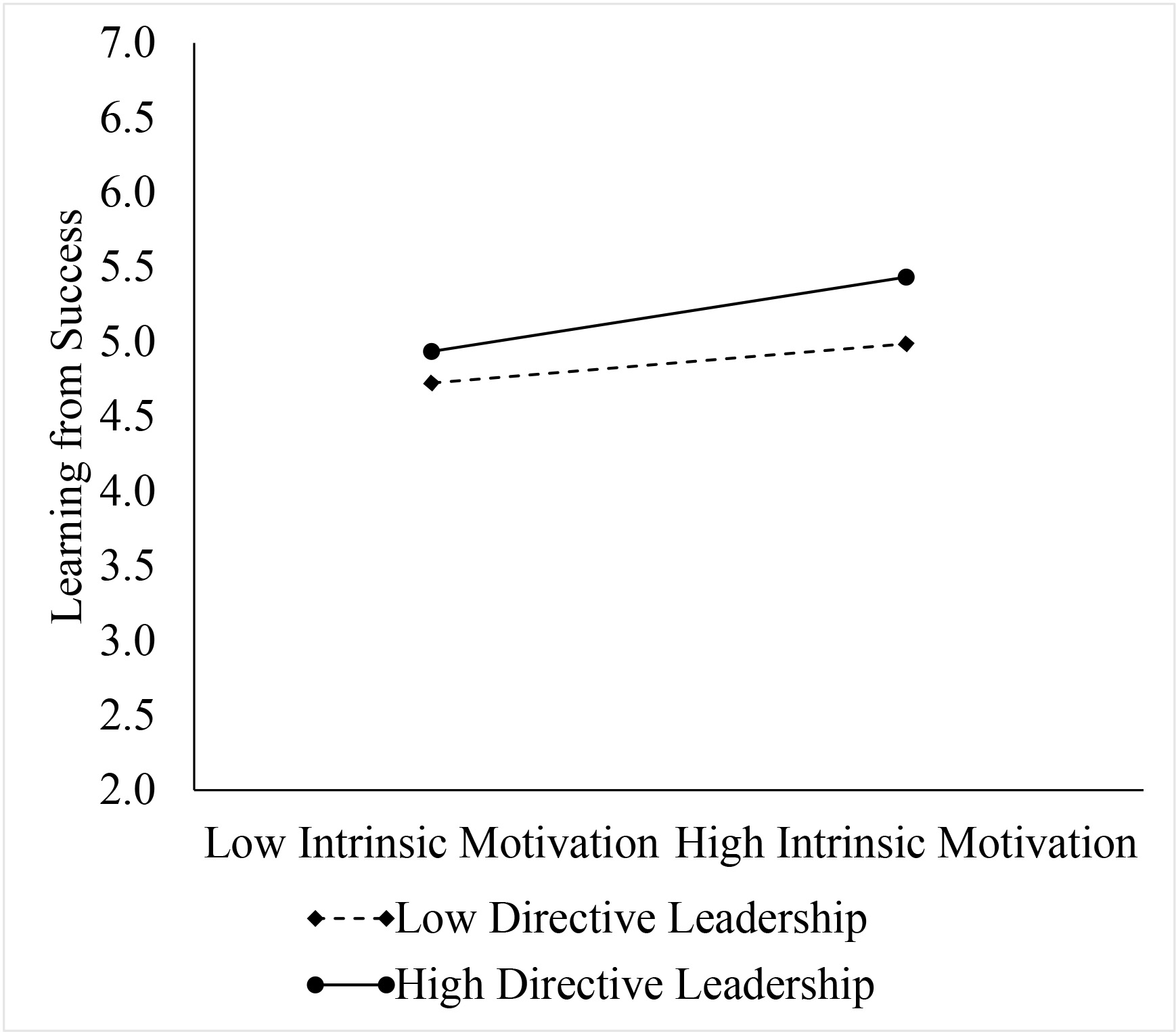 Fig. 2.
The interactive effect of intrinsic motivation and directive leadership on learning from success.
Hypothesis 4 predicts that directive leadership moderates the mediation effect of intrinsic motivation in the relationship between job autonomy and learning from success. The results of the conditional indirect effect test with 5000 bootstrapped samples indicated that when directive leadership was high, the indirect effect of intrinsic motivation in the relationship between job autonomy and learning from success was positive and significant (indirect effect = 0.24, SE = 0.18, 95% CI = [0.10, 0.40], excluding zero); whereas when directive leadership was low, the indirect effect was not significant (indirect effect = –0.13, SE = 0.09, 95% CI = [–0.29, 0.004], including zero). Overall, the difference between the two levels was positive and significant (difference = 0.37, SE = 0.18, 95% CI = [0.10, 0.69], excluding zero). Thus, Hypothesis 4 was supported.
Drawing on SDT, this study explored whether, how, and when lawyers’ job autonomy influences learning from success by examining the mediating role of intrinsic motivation and the moderating role of directive leadership. Results based on two-wave survey data from 454 lawyers in China indicate that job autonomy promotes learning from success; lawyers’ intrinsic motivation mediates the relationship between job autonomy and learning from success; and directive leadership not only strengthens the positive impact of intrinsic motivation on learning from success but also enhances the mediating effect of intrinsic motivation in this relationship. These findings have valuable theoretical and practical implications.
First, our focus on learning from success rejuvenates the pivotal role of past successful experiences in the field of experiential learning. Notably, past successful experiences not only provide a complete set of references for relevant actions but also enhance individual confidence and self-efficacy, thereby ensuring subsequent successes (Wang and Netemeyer, 2002; Audia et al., 2000). However, due to concerns about the potential pitfalls of stressing and reflecting on successes, most of the literature has focused on promoting employees’ learning from failures (e.g. Argote and Miron-Spektor, 2011; Goodman et al., 2011; Dahlin et al., 2018). This emphasis has inadvertently overshadowed the unique mechanisms inherent in learning from success. Therefore, our work directly responds to the growing call for research into the antecedents of learning from success (e.g. Chen et al., 2017; Dahlin et al., 2018) by not only championing its importance but also explicitly theorizing and testing its unique drivers in the legal profession. In this context, learning from successful cases and experiences helps lawyers identify effective strategies and practices for navigating the complexity and uncertainty of the legal profession.
Second, we advance the experiential learning literature by identifying antecedents from a job design perspective. Previous studies have explored the factors influencing learning from past experiences through the lenses of individual characteristics and the external environment (e.g. Lee and Duffy, 2019; Farson and Keyes, 2002; Liu et al., 2014) neglecting job-related factors. To fill this gap, this paper emphasizes the importance of high job autonomy from the perspective of job design to foster lawyers’ learning from success. This finding is consistent with research by Wang and Netemeyer (2002), who proposed that job autonomy exerts a positive impact on employees’ workplace learning behavior. We further extend this positive effect by exploring the mediating mechanism of intrinsic motivation for the influence of job autonomy on learning from success, drawing on SDT. Specifically, job autonomy empowers employees to arrange work schedules, make decisions, independently control the allocation of time and energy and choose work methods (Morgeson and Humphrey, 2006; Clausen et al., 2022). Although individuals cannot completely control jobs regulated by organizational processes, according to SDT, job autonomy enables employees to interpret and approach assigned work tasks with greater discretion, making them feel like they are the decision-makers (Deci et al., 2017; Ryan and Deci, 2017). This promotes individuals’ intrinsic motivation and willingness to review and reflect on past successful experiences, devoting more time and energy to learning and summarizing lessons that can inform future work.
Third, we enrich the experiential learning literature by verifying the amplifying role of directive leadership, which not only deepens the understanding of directive leadership in the research field but also advances the concept of “leader and subordinate” fit in law firms. Typically, leaders’ articulation of clear performance goals and distinct job requirements can make followers feel controlled or restricted (Martin et al., 2013), which can hinder lawyers’ self-development and limit their freedom to pursue their own ideas. However, this paper argues that in the context of learning from past successful experiences, leaders in law firms who directly and explicitly implement their own ideas while delivering their expectations and requirements to employees (Lonati, 2020; Zhou et al., 2025) can alleviate overconfidence and hubris fueled by prior successes (Sadler-Smith and Cojuharenco, 2021; Picone et al., 2014), channeling motivated individuals toward deeper learning from success. This finding encourages further research to enrich the boundary conditions shaping lawyers’ learning from success. For example, learning techniques and learning climates for cultivating learning behaviors warrant further investigation.
Our research also has significant practical implications for legal professionals. First, we confirm that job autonomy promotes lawyers’ intrinsic motivation to learn from success. This offers guidance for managers in law firms seeking to promote lawyers’ learning from successful case experiences through job design optimization. Specifically, enabling lawyers to have a major say in scheduling their casework, selecting the resources they use, and deciding on procedures to be followed fosters their ability to record and summarize work experience, share lessons, and modify work processes. This enhances lawyers’ intrinsic motivation to learn from successful experiences and fosters continuous professional growth in the future.
Second, our findings demonstrate the enhancing role of directive leadership in strengthening the mediating effect of intrinsic motivation in the relationship between job autonomy and learning from success. This finding suggests that managers seeking to promote lawyers’ learning from success should engage in directive behaviors. Leadership training programs should be developed to train leaders in how to display directive behaviors, such as providing clear directions and expectations regarding compliance with instructions, as well as conducting monitoring and regulating practices to encourage employees to learn from success.
There are several limitations to our research that should be addressed by future studies. First, definite causal inference cannot be drawn due to the survey methodology. In addition, since all survey data were collected from the same source (i.e., lawyers), common method biases may exist. To address their potential influence, we conducted a two-wave survey design with a sustainable time interval and randomized the items and variables in the survey. Results showed that our findings were not contaminated by common method biases. Future research should collect multi-source data across multiple waves using diverse methodologies, such as field experiments, to further validate our findings. Second, the value of Cronbach’s alpha for learning from success was 0.7. Although this value is acceptable based on the standard proposed by Nunnally (1978), it was lower than those of other variables in our study. The possible reason may be the limited number of measurement items (with only five items measuring learning from success), as shorter scales often yield lower Cronbach’s alpha values (Tavakol and Dennick, 2011). Another possible explanation is that the measurement items represent broader facets of this variable, leading to slightly lower average inter-item correlations (Tavakol and Dennick, 2011). Therefore, we suggest that future research on learning from success should consider adding parallel items to its scale to enhance its reliability. Third, the utilization of a purposive sampling method, while appropriate for targeting specific expertise (legal professionals), means that our sample may not be representative of the broader population, which is similar to the study of Cheng et al. (2025) and Tang & Hussin (2026). Consequently, the generalizability of our research findings is limited, and our results may not be directly transferable to other industries. We suggest that future research to include a larger and more diverse sample and explore the applicability of these findings. Fourth, this study only examined job autonomy as an antecedent to foster learning from success. Other job-related factors, such as job complexity and job interdependence, deserve further attention. Fifth, we only investigated the moderating role of directive leadership in the relationship between intrinsic motivation and learning from success. Due to the inherent complexity of learning from success and its potential pitfalls, we advocate further research to enrich the boundary conditions by examining the roles of success attribution, learning techniques, and learning climate in cultivating lawyers’ learning behaviors. At last, although we stress the value of lawyers learning from success, we do not address the consequences of learning from success. Future studies should empirically investigate how learning from successful case experiences influences subsequent case outcomes, e.g., performance, efficiency and sustainability.
Despite the increasing recognition of the value of learning from success, we know little about how to promote it. Drawing on SDT, this study examines how job autonomy impacts learning from success. Using a two-wave self-report survey of 454 lawyers, we conclude that job autonomy promotes lawyers’ learning from successful experiences. Such autonomous job design grants lawyers’ discretion, fosters intrinsic motivation, and thereby encourages learning from success behaviors. Furthermore, we validate the enhancing role of directive leadership while highlighting its potential to mitigate learning traps that lawyers may encounter. Our paper contributes to the literature by addressing a gap in experiential learning and administrative management research and providing valuable implications for both theoretical advancement and practical application in legal practice.
All data reported in this paper will be shared by the corresponding author upon reasonable request.
Conceptualization, BL, QW, QZ, ZL and KY; methodology, BL, QW, QZ and KY; writing—original draft preparation, BL, QW, QZ, ZL and KY; funding acquisition, ZL and QZ. All authors read and approved the final manuscript. All authors have participated sufficiently in the work and agreed to be accountable for all aspects of the work.
Not applicable.
This research was funded by the National Natural Science Foundation of China (No. 72202012), Funding of Taishan Young Scholars Project of Shandong Province (No. tsqn202312098), and Shandong Provincial Natural Science Foundation (No. ZR2024QG088).
The authors declare no conflicts of interest.
References
Publisher’s Note: IMR Press stays neutral with regard to jurisdictional claims in published maps and institutional affiliations.