

 , Ei Shu 1
1 School of Economics and Management, North China University of Technology, 100144 Beijing, China
2 Department of Admission and Employment, Jiangxi University of Chinese Medicine, 330004 Nanchang, Jiangxi, China
3 Xiamen Ruiju Medical Technology Co., Ltd., 361000 Xiamen, Fujian, China
4 Graduate Institute of Global Business and Strategy, National Taiwan Normal University, 106 Taipei, Taiwan
5 Hospitality Management, Ming Chuan University, 111 Taipei, Taiwan
Abstract
Drawing on the attention-based view (ABV), this study explores the effects of digital business orientation and digital technology orientation on digital product innovation performance and the mediating roles of organizational beliefs unlearning and organizational routines unlearning, and investigates the moderating effect of the firm network’s digital atmosphere on the relationships between digital business/technology orientations and organizational beliefs/routines unlearning. Using Smart PLS 3.3.9, data collected from 422 effective online survey responses from enterprises undertaking digitalization in China were analyzed. The results show, first, that both digital business orientation and digital technology orientation positively impact organizational beliefs unlearning and organizational routines unlearning, which in turn enhance digital product innovation performance. Moreover, digital technology orientation has greater effects on both types of unlearning than digital business orientation. Second, both organizational beliefs unlearning and organizational routines unlearning partially mediate the relationships between digital business/technology orientations and digital product innovation performance. Third, the firm network’s digital atmosphere positively moderates the relationship between digital business/technology orientations and organizational routines unlearning but does not significantly moderate the relationship between digital business/technology orientations and organizational beliefs unlearning. These findings not only enrich the research on the relationship between digital orientation and organizational unlearning but also offer practical insights for enterprises seeking to foster digital innovation.
Keywords
- digital orientation
- organizational unlearning
- digital product innovation
- the firm network’s digital atmosphere
- attention-based view
Digital product innovation refers to the process of creating or optimizing products or services that are either embodied in digital technology or are enabled by it (Lyytinen et al., 2016; Nassani et al., 2023). As the term suggests, this innovation focused on integrating digital technology with business operations to produce innovative digital products, such as cars equipped with mobile operating systems, frequently asked questions (FAQ) technology, intelligent transportation, intelligent manufacturing. Digital product innovation has been proven in practice to have a disruptive impact on traditional product businesses, is increasingly permeating our daily life and affecting socio-economic development, and has gradually become a vital competitive edge for businesses (Kindermann et al., 2021). For instance, digital currencies and mobile payments are gradually replacing traditional cash and bank cards and forcing brick-and-mortar banks to close, while smartphones are eating into the market share of traditional devices such as feature phones, digital cameras, portable music players and portable game consoles. Moreover, influenced by the latest digital technologies, consumers tend to choose the newest digital products with breakthrough features in the market. Take generative Artificial intelligence (AI) products like ChatGPT and DeepSeek as examples—they have gained popularity due to their powerful functionalities and quick market responsiveness. Many scholars believe that enterprises will increasingly rely on digital product innovation (DPI) to improve their performances (Pesch et al., 2021; Tang et al., 2023). Therefore, with the emergence of new digital technologies, how to effectively carry out digital product innovation is an important approach for enterprises to survive and develop. In addition, digital products possess unique attributes that previous innovation theories have not addressed. For instance, digital products and platforms like WeChat and Facebook demonstrate exponential value growth with increasing user numbers. Conversely, their value plummets when user numbers dwindle. This characteristic was overlooked by traditional innovation diffusion theories (Rogers, 1962). With the continuous evolution and wide application of digital technology, the innovation law of digital products has broken through the traditional innovation theoretical framework, opening up a new perspective and direction for innovation management research. Therefore, in view of the practical significance of digital product innovation and the importance of theoretical exploration, it is necessary to study the antecedent variables of this innovation and their influence mechanism.
Corporate innovation is often not accidental or isolated, but purposeful, and needs to be carried out in accordance with the organizational strategy (Drucker, 1985). Similarly, when advancing digital product innovation, enterprises must adhere to their organizational strategies. Therefore, enterprises need to establish a digitally-enabled strategic orientation, i.e., a digital strategy direction, to drive internal digital innovation, achieve long-term organizational development, and adapt to the rapidly evolving digital technology landscape. Digital orientation refers to the organizational strategic orientation established by enterprises to adapt to the changes caused by digital technology (Kindermann et al., 2021), serving as the core guiding principle for digital transformation implementation (Nasiri et al., 2022). Existing studies have verified the significant impact of digital orientation on corporate innovation capabilities and performance (Wang et al., 2024a; Abdurrahman, 2025). Thus, digital strategic direction plays a crucial role in driving digital product innovation within enterprises.
Moreover, innovation inherently involves the application and creation of knowledge, which is closely tied to organizational learning (Cohen and Levinthal, 1990). However, long-established business philosophies and workflows often conflict with new concepts in a digital environment, sometimes even hindering organizational digital transformation. Therefore, enterprises pursuing digital product innovation must implement organizational unlearning, which is a process that forgets or changes outdated beliefs and routines to make room for new ones (Akgün et al., 2007). In other words, enterprises need to integrate new digital knowledge with existing operational expertise through organizational unlearning to achieve digital product innovation. Moreover, organizational unlearning has been examined to be essential for strategic renewal and can help enterprises promote sustainable digital innovation (Zhao and Yan, 2023). To sum up, digital product innovation in enterprises is not only guided by strategic digital orientation but also influenced by tactical organizational unlearning. Therefore, how an enterprise can establish digital orientation to guide organizational unlearning and enhance digital product innovation performance has become an important issue worth discussing.
In theory, empirical studies have investigated digital orientation, organizational unlearning and digital product innovation. First, the literature has examined the impacts of strategic orientation, executive characteristics, organizational learning and knowledge management activities on digital product innovation (Abdurrahman, 2025; Tang et al., 2023; Meland et al., 2023; Ben Arfi and Hikkerova, 2021), but few have explored how organizational unlearning affects digital product innovation and how this unlearning mediates the relationship between digital orientations and digital product innovation. Second, previous research has verified the direct and indirect impacts of digital orientation on digital innovation (Nassani et al., 2023; Yin et al., 2024; Wang et al., 2024a; Arias-Pérez et al., 2021), paying little attention to the effects of both digital business and technology orientations and the mediating role of organizational unlearning between the two dimensions of digital orientations and digital product innovation. Third, existing studies in digital and nondigital context have investigated the direct impact of organizational unlearning on organizational change and innovation (e.g., Duan et al., 2023; Yinna et al., 2023), and the mediating effects of organizational factors (e.g., Wang et al., 2022; Zhao and Yan, 2023) and knowledge management activities (e.g., Zhang et al., 2022) and the moderating impact of organizational internal and external factors (e.g., Zhang and Zhu, 2021; Lyu et al., 2022; Yeniaras et al., 2021) between them. However, the literature rarely tests how organizational unlearning is influenced by digital orientation when discussing the relationship between this unlearning and digital innovation. Finally, most public and private institutions in China are undergoing digital transformation; thus, digital transformation within enterprises is inevitably influenced by the digital atmosphere within external collaboration network, which we refer to as the firm network’s digital atmosphere. Although literature has explored the impact of knowledge sharing in collaborative networks on digital innovation among network members (Lyytinen et al., 2016; Abdurrahman, 2025), the contingent influence of the firm network’s digital atmosphere on corporate digital transformation remains to be studied.
To address the aforementioned research gaps, this study aims to investigate the following key questions:
(1) How do digital business orientation and digital technology orientation affect organizational beliefs unlearning and organizational routines unlearning, and how do these two types of unlearning further impact digital product innovation performance in enterprises?
(2) What mediating roles do organizational beliefs unlearning and organizational routines unlearning play between digital business and technology orientations and digital product innovation performance?
(3) How does the firm network’s digital atmosphere moderate the relationship between digital business and technology orientations and organizational beliefs and routines unlearning?
Digital orientation serves as the guiding principle for their digital transformation (Kindermann et al., 2021), reflecting executives’ focus on digital transformation strategies and countermeasures. According to the attention-based view (ABV) (Ocasio, 1997), digital orientation can be understood as executives’ attention to digital transformation, which can influence organizational actions and decision-making outcomes by affecting internal resource allocation. Thus, we use ABV to construct the research model to investigate the above questions. 422 valid data samples were collected through online surveys from Chinese enterprises undergoing digitalization by using the credamo platform and distributing the survey link via personal networks and digital related WeChat groups. And Smart PLS (Version 3.3.9, manufactured by Smart PLS GmbH, Monheim am Rhein, Nordrhein-Westfalen, Germany) software and SPSS (Version R26.0.0.0, manufactured by IBM Corporation, Armonk, NY, USA) were used to run these samples to test the research model. The research results are expected to contribute to the literature in three aspects. First, this study can enrich the research on organizational unlearning and digital product innovation by exploring the mediating role of organizational beliefs and routines unlearning between digital business and technology orientations and digital product innovation performance. Second, this study can extend the dimensions of digital orientation by dividing it into digital business orientation and digital technology orientation. Third, the examination of the moderating effect of the firm network’s digital atmosphere on the relationship between digital orientation and organizational unlearning can enrich the research on the contingency factors of digital transformation and organizational unlearning.
ABV elucidates the relationship among the allocation of executives’ attention, organizational actions, and organizational and environmental context. In this theory, attention is defined as the time and effort invested by executives in focusing on, encoding, interpreting, and concentrating on the issues and their available alternatives when responding to environmental changes, and is regarded as the most scarce resource in organizations (Ocasio, 1997). Further, ABV proposes three key principles, that is, focus of attention, structural distribution of attention and situated attention. First, the principle of focus of attention states two points: One is that decision makers will selectively focus on issues and answers at any given time, and the other is that what they do depends on what issues and answers they focus on (Ocasio, 1997). This principle implies that how organizational managers distribute their attention serves as a crucial factor for predicting and explaining organizational actions. Second, the principle of structural distribution of attention states that the economic and social structures of an enterprise create and allocate the decision makers’ attention, which in turn affects the allocation of corporate resources, and these processes lead to organizational actions and decisions (Bower, 1970; Ocasio, 1997). Third, the principle of situated attention indicates that “what decision-makers focus on, and what they do, depend on the particular context they are located in” (Ocasio, 1997, p190), which includes both organizational and environmental context. Taken together, these three principles tell us that managers’ attention affects organizational actions and decisions, and that these processes are influenced by both internal and external environments.
Since executives’ attention is actually a reflection of corporate strategy and can be used to explain organizational actions (Ocasio, 1997), ABV has been widely used to study the related topics on organizational strategy and its implementation, involving innovation, executive factors, strategic orientation, organizational learning, knowledge management, etc. In terms of organizational learning and knowledge management and their effects, based on ABV, Madsen et al. (2024) have followed the attention on learning from failure and examined the relationship among a failure’s complexity, the enterprise’s culpability, and the ongoing use of routines related to those involved in the failure. Cui et al. (2023) have analyzed and verified the relationships among green transformational leadership, exploratory green learning and exploitative green learning, and radical green innovation, and the moderating effects of environmental regulatory pressure. Boynton (2024) has proposed that combining broad types of knowledge during R&D can help to create new technologies, and examined that managerial attention could influence the creation and use of new technologies which further affect the level of firm growth. In the aspects of executive factors and strategic orientation and their impact on innovation, based on ABV, Li et al. (2024) have verified the effect of top management team attention to digital transformation on innovation activities. Andersén (2022) has examined how entrepreneurial orientation, environmental sustainability orientation, and competitive intensity influence green product innovation in enterprises. It can be seen that ABV provides an important theoretical basis for the relevant research of enterprise strategic management. However, how digital orientation influences organizational unlearning and digital product innovation performance based on ABV remains understudied.
Considering the transformative nature of digitalization, we mainly review the quantitative research on the antecedents and its impacts of organizational unlearning on organizational change and innovation, as shown in Table 1. In nondigital context, the existing studies on the impacts of organizational unlearning on enterprise change and innovation mainly focus on three aspects: the direct impact between them (e.g., Duan et al., 2023; Zhang and Zhu, 2021; Lyu et al., 2020; Leal-Rodríguez et al., 2019; Yeniaras et al., 2021), their indirect relationships through the mediating roles of organizational factors such as dynamic capabilities (Wang et al., 2022) and knowledge management activities (e.g., Zhang et al., 2022), and the moderating effects of external factors such as environmental dynamism (e.g., Wang et al., 2022; Zhang and Zhu, 2021) between them. The antecedents of organizational unlearning involve the enterprises’ internal (e.g., Zhang and Zhu, 2021; Lyu et al., 2020; Ortega-Gutiérrez et al., 2022; Leal-Rodríguez et al., 2019) and external (e.g., Lyu et al., 2020; Lyu et al., 2022; Yeniaras et al., 2021) factors. Moreover, the variables moderating these antecedents and organizational unlearning mainly include top management team heterogeneity (Zhang and Zhu, 2021), firm size (Lyu et al., 2022), and so on.
| Independent variables | Mediating variables | Dependent variables | Moderating variables | Reference |
| Organizational unlearning | Service innovation | Knowledge integration | Duan et al. (2023) | |
| Organizational unlearning | Dynamic capabilities | Product innovation performance | Environmental dynamism | Wang et al. (2022) |
| Organizational unlearning | Internal knowledge creation; external information searching | Radical innovation performance | Dysfunctional competition | Zhang et al. (2022) |
| Organizational unlearning | digital transformation | Low-carbon knowledge search | Control-oriented culture | Yinna et al. (2023) |
| Organizational unlearning | Digital process innovation | Enterprise performance | Smart technologies; environmental turbulence | Wang et al. (2023) |
| Organizational unlearning | Strategic flexibility; organizational slack | Sustainable digital innovation | Zhao and Yan (2023) | |
| Social media strategic capability | Organizational unlearning | Disruptive innovation | Top management team heterogeneity; environmental dynamism | Zhang and Zhu (2021) |
| Environmental turbulence; entrepreneurial orientation | Organizational unlearning | Radical innovation | Firm size | Lyu et al. (2020) |
| Competitive intensity | Organizational unlearning | New product development outcomes | Firm size | Lyu et al. (2022) |
| Business ties; political ties | Organizational unlearning; exploratory and exploitative innovation | Firm performance | Yeniaras et al. (2021) | |
| Social media use | Organizational unlearning | Service dominant orientation | Ortega-Gutiérrez et al. (2022) | |
| Organizational culture | Organizational unlearning | Innovation outcomes | Leal-Rodríguez et al. (2019) | |
| Transformational leadership | Organizational unlearning | Building information modeling implementation | Li et al. (2025) |
In the digital context, the studies have examined the direct impacts of organizational unlearning on digital transformation and digital process innovation, and the moderating effects of internal and external factors between them (e.g., Yinna et al., 2023; Wang et al., 2023), the indirect impact of organizational unlearning on digital innovation through the mediating variable of organizational factors (e.g., Zhao and Yan, 2023), the mediating effect of organizational unlearning between organizational factors (such as transformational leadership) and new technology implementation (Li et al., 2025), and so on. In summary, there is a lack of research on how organizational unlearning is influenced by digital orientation and how it affects digital product innovation performance.
According to our research, this paper mainly reviews the factors influencing digital product innovation. Among them, the impacts of strategic orientation, executive characteristics, organizational learning and knowledge management on digital product innovation are one important aspect that has aroused an increasing amount of attention. For example, Abdurrahman’s (2025) has revealed that strategic orientation positively affects digital transformation, which significantly promotes digital product innovation. Tang et al. (2023) have examined the effect of distributed innovation on digital product innovation performance, and discussed the mediating roles of knowledge reorchestration and the moderating roles of intellectual property protection and knowledge exchange activities. Ha et al. (2023), based on social exchange theory, have explored how digital transformation influenced product innovation through the mediating effect of tacit and explicit knowledge sharing, and considered transformational leadership as a moderating variable.
Meland et al. (2023) have found the enterprise’s collaborations with external partners such as suppliers, universities and research institutes, and the manager’s attitudes towards collaboration, exerted positive effects on the likelihood of digital product innovation. They also have confirmed that the knowledge from these partners is important for the enterprise to enhance organizational capacities for digital product innovation. Ben Arfi and Hikkerova (2021) have demonstrated that corporate entrepreneurship boosts product innovation by implementing digital platforms. That’s because, these platforms facilitate enterprises to connect with external suppliers, consumers and other actors, provide opportunities for knowledge transfer from these partners while supporting internal knowledge sharing and learning, thereby enhancing corporate absorptive capacity and ultimately fostering product innovation. As we can see, digital platforms are also a kind of collaborative network. Lyytinen et al. (2016) have discussed and posited that continuous digitization can enhance the digital connectivity and convergence of innovation networks, increase network knowledge heterogeneity, promote knowledge sharing, assimilation and creation, and thus promote enterprise digital product innovation.
It can be seen that existing literature has confirmed the critical role of strategic orientation, knowledge management activities, and organizational learning in driving digital product innovation. But few studies have examined how organizational unlearning impacts this innovation process and how such unlearning moderates the relationship between digital orientation and the innovation outcomes. Furthermore, previous research has explored how collaborative networks facilitate knowledge sharing and integration among members, thereby enhancing knowledge creation and digital product innovation within member enterprises. These studies also have discussed the driving role of digital technologies in these processes. However, there remains an obvious gap in research regarding how the digital atmosphere within collaborative networks influences knowledge management activities and organizational unlearning during digital product innovation.
Since this paper focuses on the dimensions of digital orientation and its effects on digital innovation, we mainly review the relevant research on the two aspects. Several studies have regarded digital orientation as a single-dimensional variable (e.g., Arias-Pérez et al., 2021; Nasiri et al., 2022; Fan et al., 2023; Wang et al., 2024a). And some other literature has divided digital orientation into multiple dimensions, such as entrepreneurial orientation, market orientation, and learning orientation (Quinton et al., 2018) digital technology scope, digital capabilities, digital ecosystem coordination, and digital architecture configuration (Kindermann et al., 2021), green market orientation, digital green technology orientation, and government orientation (Yin et al., 2024). Overall, these dimensions mainly involve two aspects: the orientation toward the application of digital technology in business and the orientation toward the development and innovation of digital technology itself, corresponding to digital business orientation and digital technology orientation, respectively. However, these two aspects are rarely mentioned and studied in the literature.
Previous research has demonstrated empirically the impact of digital orientation on digital innovation behavior, capability, and performance in enterprises. On the one hand, some studies examined the direct impact between them. For example, Nassani et al. (2023) have explored the impact of technology orientation on digital innovation and then on innovation performance in the electronic firms. Yin et al. (2024) have examined the effect of digital green strategic orientation on digital green business model innovation which further influences digital green innovation performance. On the other hand, several other studies have explored the indirect impact of digital orientation on digital innovation by considering the mediating and moderating roles of knowledge related activities. For instance, Wang et al. (2024a) have examined the mediating roles of external knowledge acquisition and internal knowledge creation between digital orientation and exploratory and exploitative innovation in enterprises. Arias-Pérez et al. (2021) have tested the mediating roles of knowledge acquisition and exploitation between digital orientation and service innovation capabilities.
It can be seen that existing literature rarely explicitly divides digital orientation into digital business and technology orientation and studied the impacts of both dimensions on digital innovation in one study. Besides, organizational unlearning is an activity that involves learning new knowledge and forgetting old knowledge, different from knowledge-related activities such as knowledge acquisition and knowledge utilization. But few research on digital orientation and digital innovation focuses on the mediating role of organizational unlearning. Therefore, it is necessary to analyze and verify the impact of both digital business and technology orientations on digital product innovation and the mediating role of organizational learning between them.
According to ABV, managers’ attention reflects the strategic direction of the enterprise and can serve as a predictor for organizational actions and decision outcomes. This perspective holds special significance for understanding strategic choice and assessing whether enterprises can adapt their strategies and capabilities to evolving environments (Ocasio, 1997). As digitalization advances, enterprises need to embrace digital transformation and innovation as vital survival strategies. When prioritizing digital transformation, organizations establish digital-oriented mindsets and strategize resource allocation to drive digital product innovation and its pre-process of organizational unlearning. Therefore, ABV is applicable to explain the intrinsic mechanisms how digital orientation influences organizational unlearning and digital product innovation.
The three principles of ABV provide a solid theoretical foundation for constructing the research model in our study. First, in the digital age, it is undeniable that most corporate executives prioritize digital transformation and innovation to drive business growth. This cognitive focus prompts executives to make certain action choices, such as choosing to establish a clear digital orientation that guides the formulation of digital strategies and the selection of specific digital initiatives. Therefore, according to the principle of focus of attention, digital orientation can be understood as a pattern of attention of digital transformation and innovation by enterprise executives and even the whole enterprise. This orientation determines how enterprises implement digitalization.
Secondly, the principle of structural distribution of attention suggests that digital orientation will influence corporate resource allocation, thereby driving digital-related initiatives. We argue that organizational unlearning and digital product innovation represent two critical digital-related actions that can attract corporate resource support. As previously mentioned, pursuing digital product innovation serves as a vital means for enterprises to adapt to external digital environments, meet customer demands, and gain competitive advantages. During the integration of digital technologies with existing business operations, organizations must break old patterns and replace outdated knowledge, thinking, and models with new digital-related ones. Crucially, innovation fundamentally stems from knowledge creation and is closely tied to organizational learning (Cohen and Levinthal, 1990). Therefore, organizational unlearning emerges as an essential tactical approach for enterprises to achieve digital product innovation. By combining the principles of focus of attention and structural distribution of attention, we deduce that digital orientation will promote organizational unlearning through resource allocation guidance, ultimately driving digital product innovation.
Thirdly, according to the principle of situated attention, digital orientation, as an enterprise’s attention in digital transformation, and the organizational unlearning and digital product innovation, as digital related actions, will be affected by external environments. Among these, the firm network’s digital atmosphere serves as an important external environment closely related to digital transformation, which will affect how enterprises adopt appropriate approaches to promote digital product innovation. Therefore, this paper posits that the firm network’s digital atmosphere will moderate the relationship between digital orientation and organizational unlearning, which constitute important pre-processes for enterprises to improve digital product innovation performance.
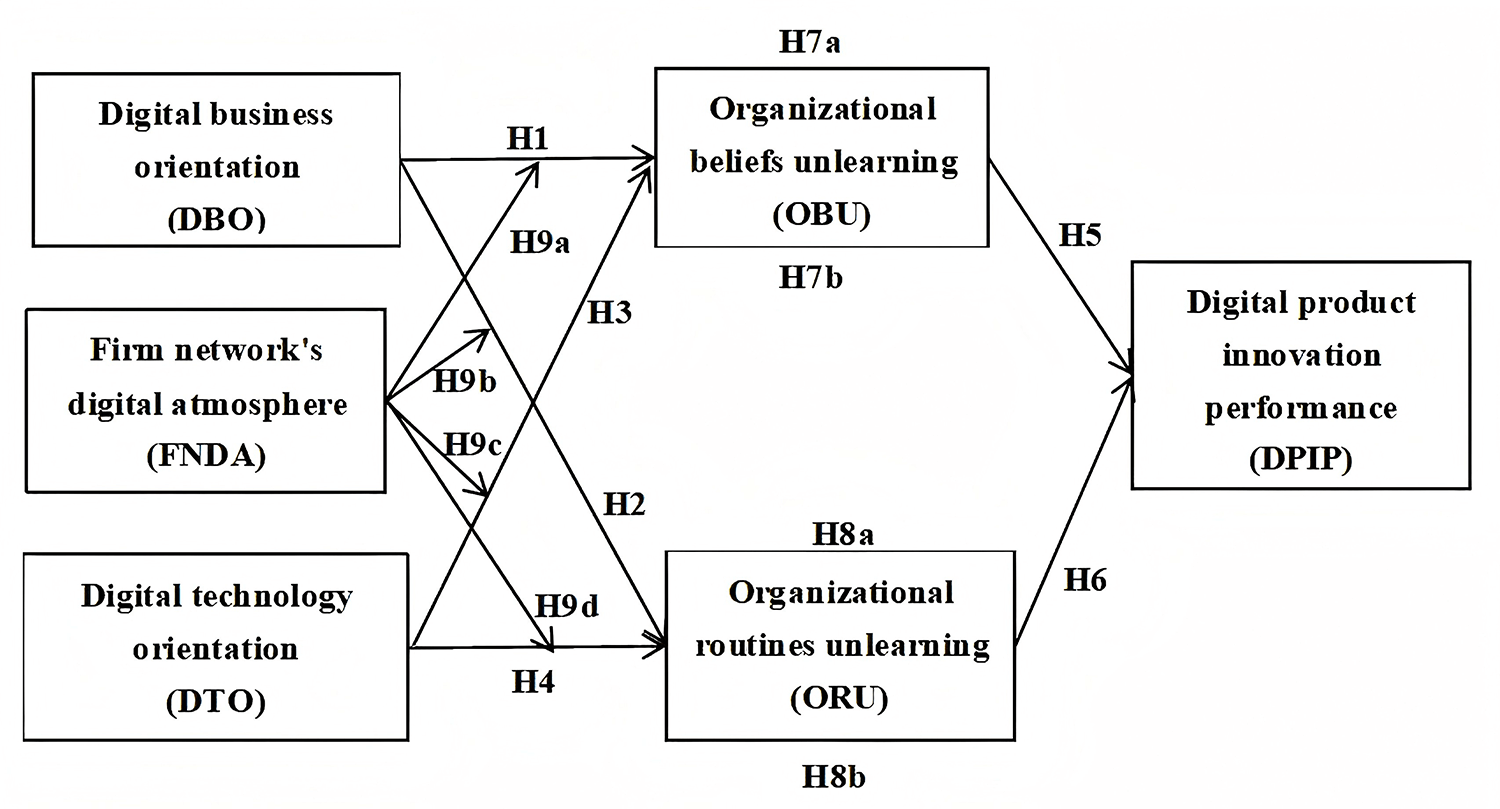
Furthermore, unlike the dimensions of digital orientation in the previous research, we divide it into digital business orientation and digital technology orientation, both of which are in line with our emphasis on the convergence of digital technology and business operations. Following Akgün et al. (2007), we categorize organizational unlearning into organizational beliefs unlearning and organizational routines unlearning. Therefore, based on ABV and the above discussion, this study proposes the research model shown in Fig. 1.
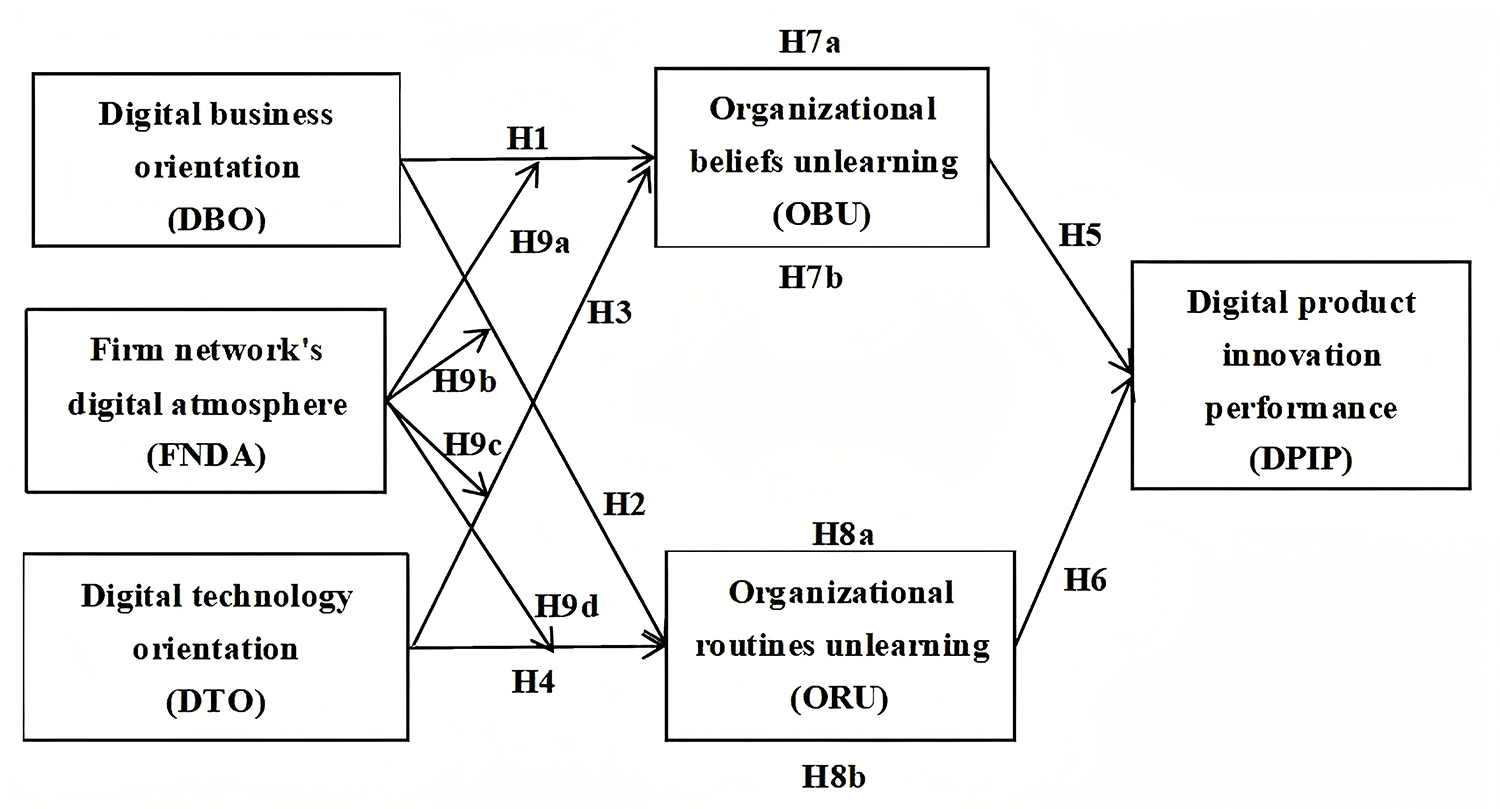 Fig. 1.
Research model.
Drawing on the definition of information technology (IT) business spanning capability (Lu and Ramamurthy, 2011), we argue that digital business orientation refers to a belief that enterprises use digital technology resources to support and enhance business goals. This orientation reflects the extent to which enterprises have developed a clear digital strategic vision to integrated digital technology with business operation and top managers have the willingness to use digital resources to create value (Fan et al., 2023). According to the principle of focus of attention in ABV (Ocasio, 1997), digital business orientation is actually corporate executives’ strategic focus and choices regarding leveraging digital technologies to support business operations and achieve operational objectives, which will prompt executives to take strategic actions to promote digital transformation. Organizational unlearning is one such strategic action. The principle of structural distribution of attention in ABV (Bower, 1970; Ocasio, 1997) indicates that companies pursuing digitalization will optimize resource allocation to advance organizational unlearning, thereby driving digital innovation. Therefore, we can deduce that digital business orientation will affect organizational unlearning.
Specifically, digital business orientation guides enterprises and their employees to integrate digital technologies with existing business operations. And implementing digital technologies within traditional business frameworks requires enterprises and their employees to synthesize digital expertise with domain knowledge. This process involves acquiring new digital technology knowledge, adopting innovative thinking patterns (such as digital thinking), and embracing modern business philosophies (like big data marketing) while phasing out outdated knowledge, conventional mindsets, and obsolete operational beliefs. Such knowledge renewal can bring about a change in the beliefs of both companies and employees about digital transformation, encouraging them to be open to technological change, embrace digital initiatives and be willing to try and experiment error for it (Li et al., 2018). Consequently, in the aspect of cognition, digital business orientation can foster continuous organizational beliefs unlearning.
Digital business orientation can also change organizational routine in enterprises in terms of behavior. As we know, business processes innovation is an important change driven by digitization and can shifted traditional business operation, methods, and procedures towards intelligent and automated digital ones (Wamba-Taguimdje et al., 2020). And digital orientation can provide strategic directions for enterprises to select appropriate digitalization initiatives and implementation solutions (Kindermann et al., 2021). Therefore, guided by digital business orientation, enterprises can learn to leverage digital tools to innovate business processes and change work routines. For instance, enterprises can adopt digital technologies to redesign streamlined workflows (such as flat management structures) to replace outdated and cumbersome procedures, and change information-sharing mechanisms by gradually replacing traditional methods with online meetings, collaborative platforms, and digital memos.
Furthermore, according to goal-setting theory (Locke and Latham, 2002), goals can motivate individuals to commit to achieving these goals and transform the commitment into the willingness to work toward those goals, thereby influencing individuals’ working process and outcomes. Some studies have also demonstrated the importance of commitment from digital orientation for employees to embrace digital initiatives and use digital technology (Verhoef et al., 2021; Ardito et al., 2021). These theoretical studies inspire us that digital business orientation reflects the goal of enterprises to leverage digital technologies to support existing businesses operations for profound and sustained transformation. Such orientation fosters employees’ commitment and willingness to strive for organizational digital transformation goals, thereby motivating them to engage in continuous digital beliefs and routines unlearning to achieve these goals. Based on the above deduction, we propose the following hypotheses:
Hypothesis 1: Digital business orientation positively influences organizational beliefs unlearning.
Hypothesis 2: Digital business orientation positively influences organizational routines unlearning.
Drawing on the definition of IT proactive stance (Lu and Ramamurthy, 2011), this study defines digital technology orientation as a belief that enterprises proactively search for new digital innovation methods or utilize existing digital technologies to respond to and create business opportunities. Based on the principle of focus of attention and structural distribution of attention in ABV (Ocasio, 1997), we regard digital technology orientation as corporate executives’ strategic focus and choices regarding leveraging digital technologies to create business opportunities, and view organizational beliefs and routines unlearning as strategic actions; thus, the former can influence the latter.
To be specific, digital technology orientation regards digital technological innovation as a strategic way to tap into new businesses (Nassani et al., 2023). This orientation enables enterprises to innovate and use digital technologies and tools, which can help enterprises to sense market changes, capture market information and develop business opportunities (Lu and Ramamurthy, 2011; Zhao et al., 2025). This process can lead enterprises and their employees to recognize the importance of digital technology in driving business operations and update their old business beliefs and thinking patterns by learning the new ones embedded in the digital technologies and tools. Moreover, a shift in understanding digital technology development fosters and expands an open mindset towards how technological transformation affects the exploration of business opportunity (Li et al., 2018). Thus, in terms of cognition, digital technology orientation can promote organizational beliefs unlearning.
Moreover, digital technology orientation can facilitate enterprises to implement differentiated digital solutions (Nasiri et al., 2022). This process impels employees to learn, adopt, and use new digital tools to change their working routines in terms of behavior. For instance, digital-oriented companies push their employees to learn and use advanced digital tools, such as scheduling apps and collaborative clouds, to realize real-time information sharing and improve workflow and product development processes. Such process can enable enterprises to improve the lean and agility of their business operations (Lu and Ramamurthy, 2011; Zhao et al., 2025). Thus, digital technology orientation can facilitate organizational routines unlearning.
Furthermore, based on goal-setting theory (Locke and Latham, 2002) and the theoretical research on orientation-enabled digital commitment (Verhoef et al., 2021; Ardito et al., 2021), we argue that digital technology orientation, as a goal of digitization, can promote enterprises and their employees to commit to innovate and use digital technology, thereby motivating them to perform digital beliefs and routines unlearning when they interact with these technologies. Therefore, on the basis of the above deduction, we propose the following hypotheses:
Hypothesis 3: Digital technology orientation positively influences organizational beliefs unlearning.
Hypothesis 4: Digital technology orientation positively influences organizational routines unlearning.
Following Akgün et al. (2007), we define organizational beliefs unlearning as the process of discarding or changing outdated values, thinking patterns, and knowledge structures to make room for the implementation of new ones. On the one hand, organizational beliefs unlearning is beneficial for capturing and absorbing new digital knowledge to promote digital product innovation. That’s because, organizational beliefs unlearning is one kind of cognitive logic, and is regarded as an important driver for innovation (Liao and Xie, 2024). The changes in the beliefs of forgetting and changing past knowledge and working schema can help enterprises to avoid overreliance on previous experiences and increase their flexibility and adaptability, and can foster flexible responses to rapidly changing markets and technologies and (Leal-Rodríguez et al., 2019; Liao and Xie, 2024). In the context of digital transformation, organizational beliefs unlearning can motivate employees to keep learning digital knowledge and generate innovative ideas; thus, it can increase the possibility of digital product innovation (Lyu et al., 2022). On the other hand, organizational beliefs unlearning can reduce cognitive biases, thereby enabling the enterprises and their employees to recognize the importance and necessity of digital product innovation and strive to improve this performance. And the enterprises attaching importance to belief change are usually open to external advanced digital beliefs and practices and have willingness to update their cognitive working logic. And the investment of time and effort in external knowledge search can promote individual innovation (Wang et al., 2024b). Thus, we argue that organizational beliefs unlearning can contribute to digital product innovation in enterprises and further enhance the innovation performance. And organizational learning and innovation theoretical research (Cohen and Levinthal, 1990) can provide support for this argument, positing that organizational learning is a key driver of innovation. Based on the above deduction, we propose the following hypothesis:
Hypothesis 5: Organizational beliefs unlearning positively influences digital product innovation performance.
Following Akgün et al. (2007), we define organizational routines unlearning as the process of learning new organizational routines, such as decision-making activities, operational procedures, and management practices, to replace the old ones. Innovation requires substantial changes to establish new organizational decision-making processes, routines, and activity patterns (Colombo et al., 2017). Organizational routines unlearning can help achieve these changes in the context of digital product innovation. That’s because organizational routines unlearning can redefine or change traditional product development processes and tools and help enterprises overcome their path dependence on existing development strategies such as cost leadership strategy (Yuan and Chen, 2015), thereby promoting their digital product innovation. In addition, organizational routines unlearning can update the enterprises’ information-sharing mechanism to enhance internal knowledge sharing and communication efficiency and enable a fast transfer of external knowledge and market information (Wang et al., 2017), which can undoubtedly provide further support for digital product innovation initiatives. Therefore, we argue that organizational routines unlearning is important for fostering digital product innovation and can exert a positive impact on the innovation performance. The theoretical support for this argument comes from organizational learning and innovation theoretical research (Cohen and Levinthal, 1990), which proposes that organizational learning is a key driver of innovation. Thus, we propose the following hypothesis:
Hypothesis 6: Organizational routines unlearning positively influences digital product innovation performance.
As previously mentioned, digital product innovation in enterprises is not only influenced by strategic digital orientation but also relies on tactical knowledge integration and creation. Digital orientation, as a soft vision and atmosphere, can direct the implementation of specific digitalization strategies and the selection of appropriate digitalization initiatives (Kindermann et al., 2021), often playing an indirect role in driving corporate digital innovation. Yet digital product innovation is a tangible process to bring forth new ideas that requiring enterprises and their employees to discard outdated knowledge while absorbing new and appropriate knowledge, that is, organizational unlearning (Akgün et al., 2007). Thus, organizational unlearning acts as a direct way to support such innovation.
Digital orientation can guide and encourage employees to carry out through learning activities to develop open-mindedness, challenge long-held beliefs and working ways, current norms and conventions, thereby embracing emerging technologies and developing new skills, which further lead to innovations in products, procedures, and other areas (Quinton et al., 2018). The promotion of digital orientation facilitates the exploration and acquisition of new skills, capabilities, and knowledge which further become key resources for developing new products (Nambisan et al., 2020). And the commitment to digital transformation supports access to new forms of knowledge and relational resources that are deemed to improve the likelihood to innovation and favor the combination of previously unrelated product domains into new ones, such as the combination of digital technology and traditional business (Ardito et al., 2021). Existing research also shows that digital strategic orientation enhances corporate innovation and digital performance by influencing knowledge acquisition, utilization, and creation (Arias-Pérez et al., 2021; Wang et al., 2023; Mishra et al., 2023; Pan et al., 2026). Therefore, this study posits that digital business/technology orientations can affect digital product innovation performance through organizational beliefs/routines unlearning, and propose the following hypotheses:
Hypothesis 7a: Organizational beliefs unlearning mediates the relationship between digital business orientation and digital product innovation performance.
Hypothesis 7b: Organizational beliefs unlearning mediates the relationship between digital technology orientation and digital product innovation performance.
Hypothesis 8a: Organizational routines unlearning mediates the relationship between digital business orientation and digital product innovation performance.
Hypothesis 8b: Organizational routines unlearning mediates the relationship between digital technology orientation and digital product innovation performance.
Drawing on the studies of relational embeddedness by Zhou et al. (2022) and digital transformation by Rupeika-Apoga et al. (2022), we define the firm network’s digital atmosphere as the attitude, investment, and level of digital transformation exhibited by other collaborators that have long-term, close, frequent, and in-depth partnerships with the enterprises. After embedding into a network, the enterprises establish an informal and noncontractual relationship with other partners to constrain their behaviors (Wang et al., 2021). This invisible contract also regulates the partners about the application of digital technology. When most other upstream and downstream partners engage in digital transformation, the enterprises would be driven to conduct digital transformation to reduce the risk of being replaced by competitors and lower the communication and coordination costs with other collaborators. This approach would strengthen the inside digital orientation and its impact on organizational unlearning. That’s because, network embeddedness can help enterprises acquire and transfer heterogeneous digital knowledge from other participants (Wang et al., 2024a). Partnerships with fintech the collaborators, including companies, suppliers, technology providers, etc., can facilitate knowledge sharing within collaboration network, which undoubtedly enable enterprises to obtain new knowledge needed for digital product innovation (Abdurrahman, 2025). When the collaborative network, such as digital platform, has a strong digital atmosphere, the enterprises embedded have many opportunities to acquire advanced digital knowledge and would be highly motivated to guide their employees in carrying out these knowledge-acquisition and unlearning activities to update the beliefs and routines (Ben Arfi and Hikkerova, 2021). On the basis of the above statements, we can infer that the stronger the firm network’s digital atmosphere is, the more intense the digital orientation will be, and the more organizational unlearning activities can be promoted. This argument can be supported by the principle of situated attention in ABV, which posits that what decision-makers focus on and what they do would be influenced by external environments (Ocasio, 1997). Thus, we propose the following hypotheses:
Hypothesis 9a: The firm network’s digital atmosphere positively moderates the relationship between digital business orientation and organizational beliefs unlearning.
Hypothesis 9b: The firm network’s digital atmosphere positively moderates the relationship between digital business orientation and organizational routines unlearning.
Hypothesis 9c: The firm network’s digital atmosphere positively moderates the relationship between digital technology orientation and organizational beliefs unlearning.
Hypothesis 9d: The firm network’s digital atmosphere positively moderates the relationship between digital technology orientation and organizational routines unlearning.
The survey items of most constructs were adopted from prior research and modified slightly to the Chinese context, as shown in Table 2. Specifically, the measurement scales of digital business orientation and digital technology orientation were mainly adapted from the study by Lu and Ramamurthy (2011), that of organizational beliefs unlearning and organizational routines unlearning were drawn from Akgün et al. (2007) and Zhang et al. (2022), that of digital product innovation performance were adopted from Huang and Li (2017) and Pesch et al. (2021), and that of the firm network’s digital atmosphere were combined the scales of relational embeddedness (Zhou et al., 2022) and digital transformation (Rupeika-Apoga et al., 2022).
| Variables | Indicator items | Source of literature | |
| Digital business orientation (DBO) | DBO1 | Our company develops a clear vision of how digital technology can enhance business value. | Lu and Ramamurthy (2011) |
| DBO2 | Our company integrates business strategic planning and digital transformation planning. | ||
| DBO3 | Our company enables functional department employees and general managers to understand the business value of digital technology investments. | ||
| Digital technology orientation (DTO) | DTO1 | Our company constantly keeps up with digital technology innovation. | |
| DTO2 | Our company has the capability to continue experimenting with new digital technologies when necessary. | ||
| DTO3 | Our company has an atmosphere that supports trying new approaches to digital technology. | ||
| DTO4 | Our company constantly seeks new methods to enhance the effectiveness of digital technology use. | ||
| Organizational beliefs unlearning (OBU) | OBU1 | In the process of digital transformation, our company promptly discards outdated product development beliefs and adopts the latest ones. | Akgün et al. (2007); Zhang et al. (2022) |
| OBU2 | In the process of digital transformation, our company is always ready to abandon outdated business beliefs (market demands and technological improvements) and adopt the latest business beliefs. | ||
| OBU3 | In the process of digital transformation, our company provides a favorable environment to change those outdated business beliefs. | ||
| Organizational routines unlearning (ORU) | ORU1 | In the process of digital transformation, our company can abandon outdated product development procedures and establish new ones based on the beliefs of digital development. | |
| ORU2 | In the process of digital transformation, our company can discard outdated product development tools and establish new ones based on digital technology. | ||
| ORU3 | In the process of digital transformation, our company can modify the mechanism for information sharing (including electronic memos, collaborative work, and video conferences). | ||
| ORU4 | In the process of digital transformation, our company can timely change the team decision-making process according to the needs of digital transformation. | ||
| Digital product innovation performance (DPIP) | DPIP1 | The revenue achieved by our company’s digital product innovation is higher than the original expectation. | Huang and Li (2017); Pesch et al. (2021) |
| DPIP2 | The profitability achieved by our company’s digital product innovation is better than the original expectation. | ||
| DPIP3 | The success rate achieved by our company’s digital product innovation is higher than the original expectation. | ||
| DPIP4 | The market share achieved by our company’s digital product innovation is higher than the original expectation. | ||
| DPIP5 | The consumer satisfaction achieved by our company’s digital product innovation is higher than the original expectation. | ||
| DPIP6 | Our company’s digital product innovation fulfills the overall executive expectations. | ||
| The firm network’s digital atmosphere (FNDA) | FNDA1 | The partners with which our company is familiar are widely applying digital technology. | Zhou et al. (2022); Rupeika-Apoga et al. (2022) |
| FNDA2 | Companies that have a high frequency of contact with our companies have a high level of digital service. | ||
| FNDA3 | Companies that have long cooperated with our companies are actively undergoing digital transformation. | ||
| FNDA4 | Companies that work closely with our companies are using digital technology to improve their business processes. | ||
First of all, since the items came from English papers, we invited two bilingual teachers to complete back-and-forth translations until the meanings of all items converged in English and Chinese. Then we invited two associate professors and five graduate students focusing on digital transformation to judge and classify independently all the disordered measurement items. In this way, the structural validity of the items and the content validity can be confirmed by checking the consistency of the wording of the items. Furthermore, based on the feedback received from the aforementioned efforts, we have made appropriate modifications to the wording of some items in the questionnaire in light of the study content and context. Finally, the scale was transformed into a questionnaire with two parts. The first part included personal and company characteristics, such as individual education level and position, company nature, scale, and time of digital transformation. The second part contained the measurement items of all variables which were measured by the five-point Likert scale (1 = very dissatisfied, 5 = very satisfied).
We used 5 months to collect the data through online questionnaire surveys from the enterprises undertaking digital transformation. First, we used the professional survey platform credamo.com to collect data randomly from the users. Second, we sent the address link or quick response code to the acquaintances who are actively involved in enterprise digital transformation projects, including IT department head, digital transformation project manager, business department digital facilitator, etc., and the personnel providing digital consulting services and technical services. At the same time, they were encouraged in our questionnaire invitation to forward the questionnaire to their colleagues or peers in order to expand the coverage of the sample. Third, leveraging resources from the university-level research platform, we distributed questionnaire link and Quick Response codes to three carefully selected WeChat groups closely tied to digital transformation initiatives. These groups included the SME digital transformation sharing group with nearly 300 members, university-enterprise cooperation for digital transformation group with 256 members, and digitalization empowering high-quality development of private enterprises group with about 200 members. To increase the credibility and quality of the survey, we coordinated with group administrators and active core members to assist in distributing detailed notices outlining the academic purposes of this survey, estimated completion timeline, privacy policy, and explicit requirement that “only the personnel actively engaged in digital transformation activities is needed to complete the questionnaire”. Finally, we collected 596 questionnaires.
To ensure the validity of the data, we took several preventive measures. We limited each internet IP address to answer only one questionnaire to prevent duplicate responses. We subsequently used several methods for screening effective questionnaires. Firstly, we excluded 36 questionnaires with response times shorter than 150 seconds that was calculated from a small pretest (n = 20, which is different from the population in the formal survey). Secondly, we deleted 19 questionnaires with the answer of “not yet undertaken digital transformation” for one question, indicating that they did not meet the sample requirements. Thirdly, we excluded 98 questionnaires with inconsistent responses to the reverse questions. Finally, we cut off 21 questionnaires with more than 10 consecutive items having the same answer, which indicates that these questionnaires are highly unreliable. In the end, we obtained 422 valid questionnaires. This number is in line with the recommended 5–10 times of the items.
To minimize social desirability bias, all survey respondents were invited to complete the questionnaire anonymously. We used a large bold font on the front page of the questionnaire to emphasize that the questions did not involve personal or enterprise secret information, the survey was used only for research, and there was no correct or wrong answer.
We used the Smart PLS algorithm (default maximum iteration of 300 times) to
assess the measurement model, including testing internal consistency, convergent
validity, discriminant validity and multicollinearity. At first, the results in
Table 3 show that the Cronbach’s alpha (CA) for each variable is greater than 0.7
and the composite reliability (CR) is greater than 0.8. Both of them exceed a
widely accepted threshold (CA
| Variable | Items | Factor loadings | VIF | CA | CR | AVE |
| DBO | DBO1 | 0.843 | 1.620 | 0.769 | 0.867 | 0.684 |
| DBO2 | 0.812 | 1.522 | ||||
| DBO3 | 0.827 | 1.580 | ||||
| DTO | DTO1 | 0.803 | 1.650 | 0.749 | 0.841 | 0.571 |
| DTO2 | 0.735 | 1.425 | ||||
| DTO3 | 0.689 | 1.421 | ||||
| DTO4 | 0.790 | 1.532 | ||||
| OBU | OBU1 | 0.823 | 1.588 | 0.751 | 0.858 | 0.668 |
| OBU2 | 0.794 | 1.401 | ||||
| OBU3 | 0.834 | 1.580 | ||||
| ORU | ORU1 | 0.834 | 1.744 | 0.751 | 0.843 | 0.574 |
| ORU2 | 0.798 | 1.543 | ||||
| ORU3 | 0.699 | 1.364 | ||||
| ORU4 | 0.690 | 1.301 | ||||
| DPIP | DPIP1 | 0.770 | 1.788 | 0.868 | 0.901 | 0.603 |
| DPIP2 | 0.799 | 1.920 | ||||
| DPIP3 | 0.788 | 1.876 | ||||
| DPIP4 | 0.812 | 2.093 | ||||
| DPIP5 | 0.710 | 1.555 | ||||
| DPIP6 | 0.774 | 1.821 | ||||
| FNDA | FNDA1 | 0.823 | 1.829 | 0.814 | 0.877 | 0.641 |
| FNDA2 | 0.778 | 1.544 | ||||
| FNDA3 | 0.785 | 1.644 | ||||
| FNDA4 | 0.817 | 1.717 |
VIF, variance inflation factor; CA, Cronbach’s alpha; CR, composite reliability.
| 1 | 2 | 3 | 4 | 5 | 6 | |
| DBO | 0.827 | |||||
| DTO | 0.654 | 0.756 | ||||
| OBU | 0.524 | 0.672 | 0.817 | |||
| ORU | 0.587 | 0.674 | 0.650 | 0.758 | ||
| DPIP | 0.567 | 0.697 | 0.659 | 0.708 | 0.776 | |
| FNDA | 0.534 | 0.654 | 0.579 | 0.657 | 0.726 | 0.801 |
Considering that we only used on-line questionnaire surveys to collect the data,
we used two methods to test common method bias, namely, Harman’s one-factor test
and unmeasured latent method construct (ULMC) technique. Firstly, we conducted a
Harman’s one-factor test using SPSS 26.0. The results revealed that three factors
explained 53.092% of the emerged total variance, while the largest one accounted
for 43.709% which is below the threshold of 50% (Podsakoff et al., 2003).
Secondly, we conducted a confirmatory factor analysis on the baseline model in
our study using AMOS (AMOS22.0.0, manufactured by IBM Corporation, Armonk, NY, USA) (Root Mean Square Error of Approximation (RMSEA) = 0.047, Standardized
Root Mean square Residual (SRMR) = 0.0351, Comparative Fit Index (CFI) = 0.959,
Ineremental Fit lndex (IFI) = 0.960, Tucker-Lewis Index (TLI) = 0.952) and the
ULMC model that added a method factor to connect all the observed variables
(RMSEA = 0.041, SRMR = 0.0298, CFI = 0.974, IFI = 0.974, TLI = 0.965). We
compared the fit indices of the two models, and the results (
Smart PLS 3.3.9 software was used for structural equation modeling because it is suitable for estimating large and complex models (Chin et al., 2008) and does not require data to follow a normal distribution. First, we conducted the evaluation of the overall model. The R2 values for organizational beliefs unlearning, organizational routines unlearning, and digital product innovation performance, namely, 0.496, 0.486, and 0.667, respectively, exceed the reference standard of 0.25 (Hair et al., 2021). This finding indicates that our research model has a strong explanatory power. Additionally, the f2 values range from 0.028 to 0.375, over the minimum threshold of 0.02 (Hair et al., 2016), suggesting acceptable predictive validity of our research model. The Q2 values for organizational beliefs unlearning, organizational routines unlearning, and digital product innovation performance as endogenous variables were 0.312, 0.273, and 0.398, respectively, all exceeding the threshold of 0.15 (Hair et al., 2021), indicating the good predictive relevance of our research model.
Then, bootstrap sampling (set to 5000 iterations) was performed to test the
direct and mediating effects between variables. The results in Table 5 show the
significant impacts of digital business orientation on organizational beliefs
unlearning (
| Coefficient | SD | t value | p value | LLCI | ULCI | Results | |
| DBO |
0.159 | 0.066 | 2.399 | 0.016 | 0.038 | 0.295 | Supported |
| DBO |
0.247 | 0.061 | 4.074 | 0.000 | 0.142 | 0.377 | Supported |
| DTO |
0.588 | 0.059 | 10.016 | 0.000 | 0.467 | 0.699 | Supported |
| DTO |
0.507 | 0.054 | 9.462 | 0.000 | 0.395 | 0.601 | Supported |
| OBU |
0.250 | 0.053 | 4.691 | 0.000 | 0.148 | 0.360 | Supported |
| ORU |
0.236 | 0.063 | 3.735 | 0.000 | 0.115 | 0.364 | Supported |
SD, standard deviation; LLCI, lower level of confidence interval; ULCI, upper level of confidence interval.
Moreover, we can see that both the coefficients of the relationship between digital business orientation and organizational beliefs unlearning and that between digital business orientation and organizational routines unlearning are smaller than that between digital technology orientation and organizational beliefs unlearning and that between digital technology orientation and organizational routines unlearning. This is an interesting finding, driving us to further reveal the underlying reasons in the future.
We also used Smart PLS 3.3.9 software to conduct Bootstrap sampling (setting to
5000 iterations) to verify the mediating effects of organizational
beliefs/routines unlearning between digital business/technology orientations and
digital product innovation. As shown in Table 6, the t values for all
four mediating paths are greater than 1.96, with the p values being less
than 0.05. Moreover, the confidence intervals do not include 0. Both findings
indicate that the mediating effects were all significant. Thus, H7a, H7b, H8a,
and H8b are supported. Furthermore, the variance accounted for (VAF) for the DBO
| Coefficient | SD | t value | p value | LLCI | ULCI | Results | |
| DBO |
0.040 | 0.019 | 2.151 | 0.032 | 0.009 | 0.081 | Supported |
| DBO |
0.058 | 0.023 | 2.519 | 0.012 | 0.022 | 0.111 | Supported |
| DTO |
0.147 | 0.038 | 3.924 | 0.000 | 0.080 | 0.227 | Supported |
| DTO |
0.120 | 0.035 | 3.402 | 0.001 | 0.055 | 0.192 | Supported |
The PROCESS macro in SPSS 26.0 was utilized to test the moderating effect of the
firm network’s digital atmosphere, and bootstrapping techniques were employed
with 5000 iterations. The results in Table 7 demonstrate that the firm network’s
digital atmosphere significantly moderates the relationship between digital
business orientation and organizational routines unlearning (
| Path | Effect | SE | t value | p value | LLCI | ULCI | |
| DBO |
0.0089 | 0.0497 | 0.1796 | 0.8576 | –0.0887 | 0.1066 | |
| DBO |
0.0905 | 0.0452 | 2.0025 | 0.0459 | 0.0017 | 0.1794 | |
| DTO |
0.0357 | 0.0464 | 0.7969 | 0.4420 | –0.0555 | 0.1270 | |
| DTO |
0.1296 | 0.0444 | 2.9192 | 0.0037 | 0.0423 | 0.2169 | |
| DBO |
–1SD | 0.2659 | 0.0430 | 6.1910 | 0.0000 | 0.1815 | 0.3504 |
| Mean | 0.3186 | 0.0398 | 8.0068 | 0.0000 | 0.2404 | 0.3969 | |
| +1SD | 0.3713 | 0.0520 | 7.1356 | 0.0000 | 0.2690 | 0.4736 | |
| DTO |
–1SD | 0.4363 | 0.0529 | 8.2482 | 0.0000 | 0.3323 | 0.5402 |
| Mean | 0.5118 | 0.0538 | 9.5134 | 0.0000 | 0.4060 | 0.6175 | |
| +1SD | 0.5873 | 0.0658 | 8.9270 | 0.0000 | 0.4580 | 0.7166 |
Note: SD, standard deviation; SE, standard error.
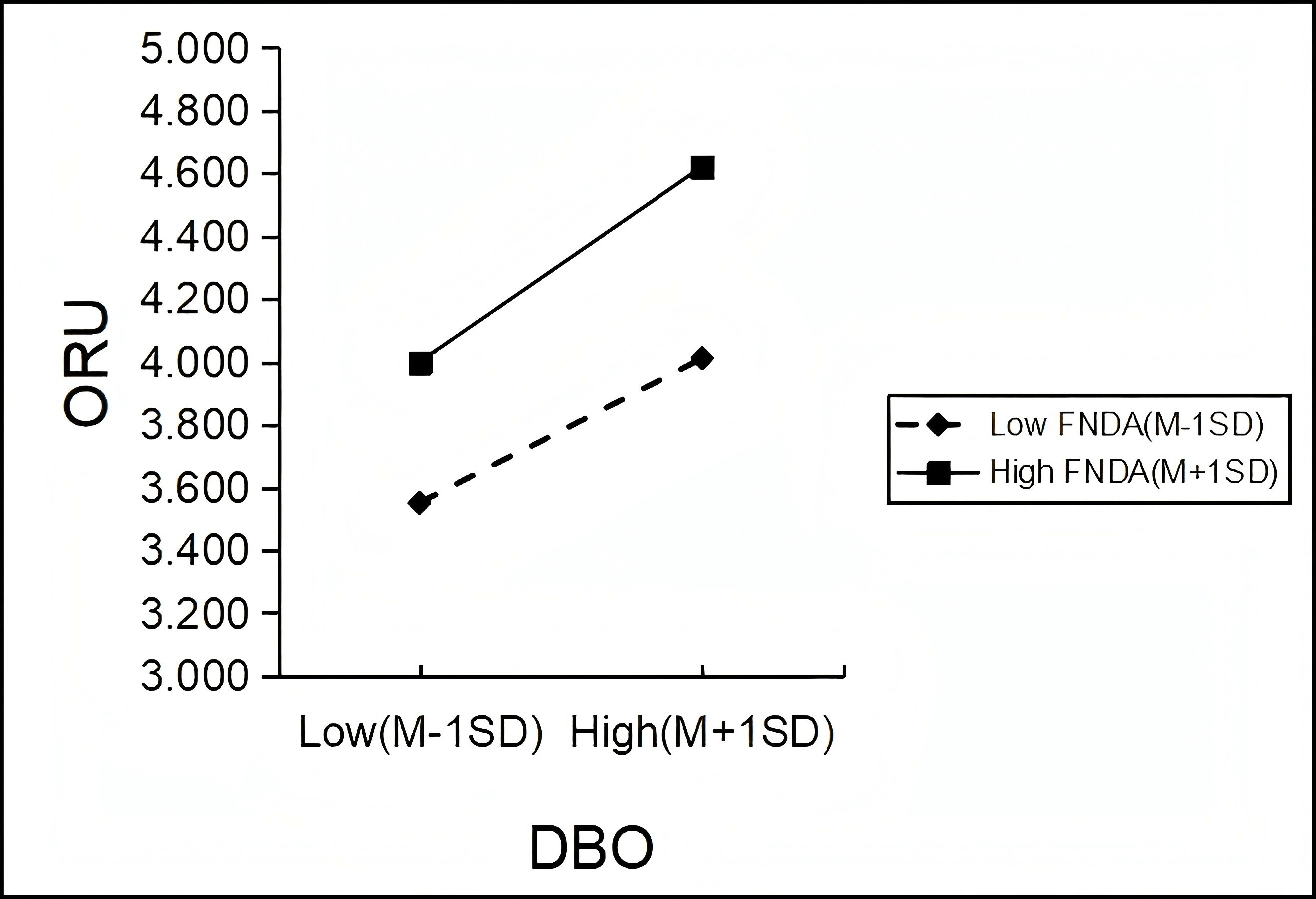
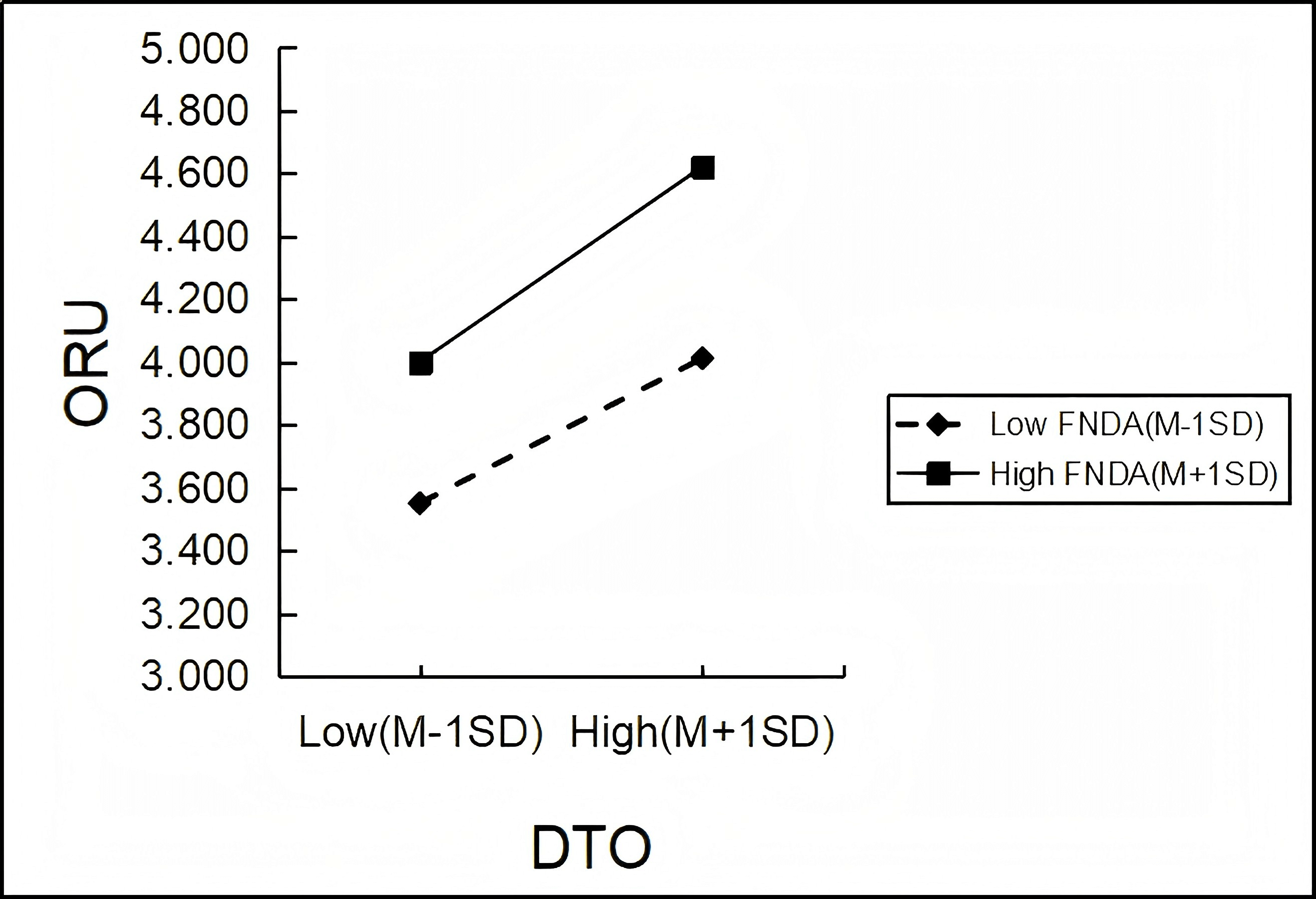
Furthermore, Figs. 2,3 show that the relationship between digital business
orientation and organizational routines unlearning and that between digital
technology orientation and organizational routines unlearning at the high the
firm network’s digital atmosphere level are more pronounced than those at the low
the firm network’s digital atmosphere level. Moreover, from Table 7 we can see
that the relationship between digital business orientation and organizational
routines unlearning and that between digital technology orientation and
organizational routines unlearning are significant when the the firm network’s
digital atmosphere value is one standard deviation (SD) below the mean
(
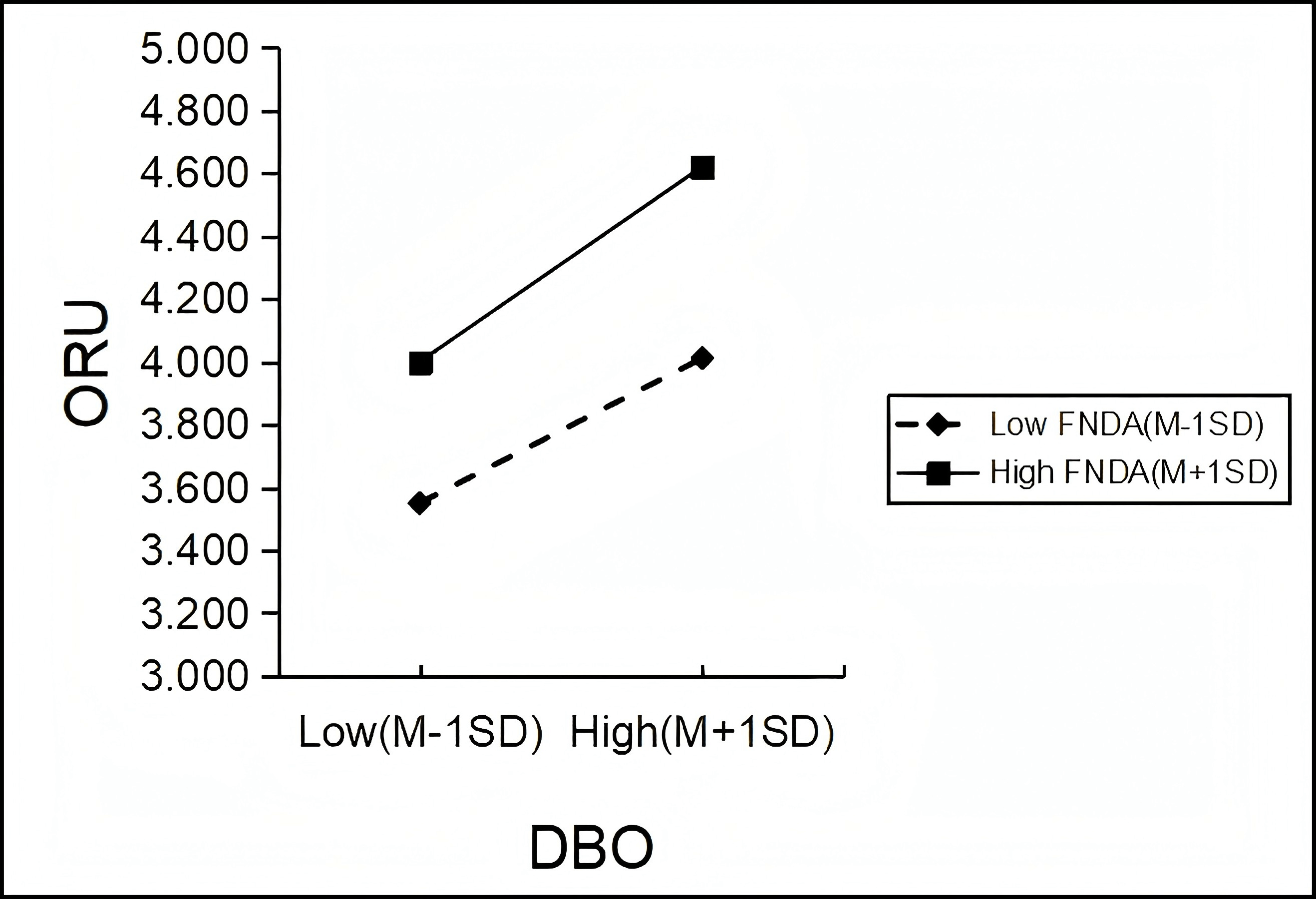 Fig. 2.
Interactive effects of DBO and FNDA on ORU.
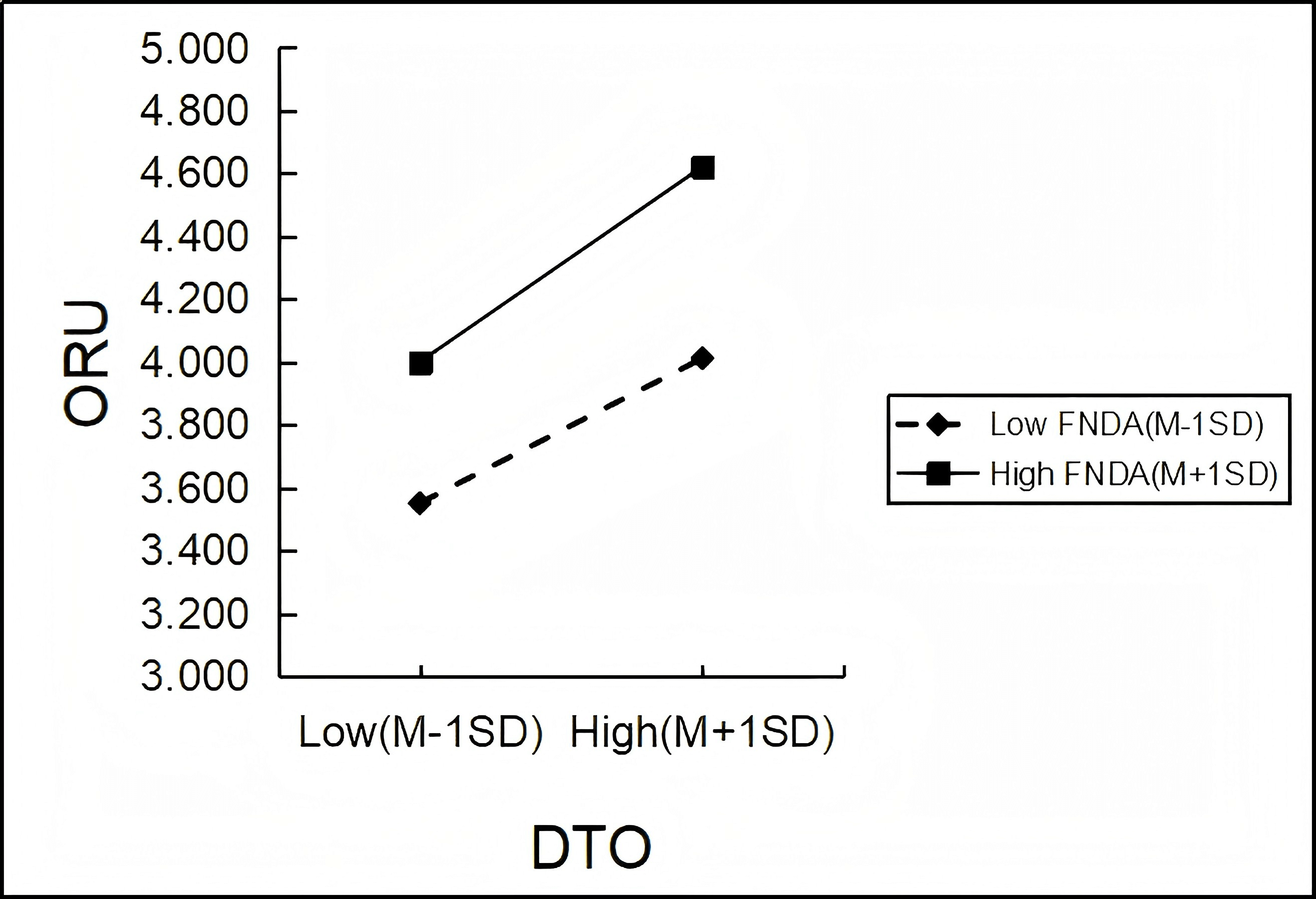 Fig. 3.
Interactive effects of DTO and FNDA on ORU.
Given the importance of digital orientation at the strategic level and organizational learning at the tactical level for digital product innovation, as well as research gaps in this area, our study aims to verify how digital orientation affects organizational learning which then how affects digital product innovation. We build on ABV to hypothesize that digital business/technology orientations can affect organizational beliefs/routines unlearning which further influences digital product innovation performance, and organizational beliefs/routines unlearning mediate the relationship between digital business/technology orientations and digital product innovation performance. We also consider the moderating role of the firm network’s digital atmosphere between the relationship between digital business/technology orientations and organizational beliefs/routines unlearning. Through empirical research based on the samples, we have got the following results. First, both digital business and digital technology orientations exert positive impacts on organizational beliefs and routines unlearning. These findings reconfirm the views of the existing literature that knowledge acquisition and learning are critical drivers for digital innovation (Mishra et al., 2023; Pan et al., 2026). They also validate the principles of focus of attention and structural distribution of attention in ABV (Ocasio, 1997). Moreover, digital technology orientation has greater impacts on organizational beliefs unlearning and organizational routines unlearning than digital business orientation. One possible reason is that digital technology orientation is relatively specific and tactical and can well reflect the tendency for organizational resource investment, while digital business orientation is abstract and strategic and is mainly involved with a digital transformation vision.
Second, organizational beliefs unlearning and organizational routines unlearning positively influence digital product innovation performance. These findings are consistent with the conclusions between organizational unlearning and organizational change and innovation (e.g., Wang et al., 2022; Lyu et al., 2022) and confirm the research results that knowledge management activities are an important driving factor for enterprise digital product innovation (Ha et al., 2023; Tang et al., 2023). These findings also verify the viewpoint in the theoretical research on organizational learning and innovation (Cohen and Levinthal, 1990).
Third, organizational beliefs unlearning and organizational routines unlearning significantly mediate digital business orientation and digital product innovation performance, as well as digital technology orientation and digital product innovation performance. These findings confirm that organizational beliefs and routines unlearning play a vital role in connecting abstract digital business and technology orientations with concrete digital product innovation in enterprises, and show the importance of integrating digital orientation and organizational unlearning to promote digital innovation. These findings are consistent with the conclusions found in previous studies that strategic orientation towards digitalization positively affects knowledge activities and subsequently impacts organizational innovation (Arias-Pérez et al., 2021; Wang et al., 2024a).
Fourth, the firm network’s digital atmosphere exerts positive moderating effects on the relationship between digital business orientation and organizational routines unlearning and that between digital technology orientation and organizational routines unlearning. The results verify the principle of situated attention in ABV. These findings indicate that enterprises that are affected by this atmosphere are effective in formulating and implementing digital orientation to promote organizational routines unlearning, thereby promoting digital product innovation. Thus, these findings align with previous research highlighting the critical role of collaboration and relationship networks in positively influencing digital transformation (Abdurrahman, 2025), and also validate the viewpoints that network embeddedness can facilitate member firms to acquire knowledge from the network to promote digital innovation (Wang et al., 2024a; Ben Arfi and Hikkerova, 2021). However, the firm network’s digital atmosphere does not moderate the relationship between digital business orientation and organizational beliefs unlearning and that between digital technology orientation and organizational beliefs unlearning. There may be two important reasons. One is that organizational routines tend to be specific, whereas organizational beliefs are relatively abstract; both lead to different moderating effects of the firm network’s digital atmosphere between digital orientation and organizational routines unlearning and between digital orientation and organizational beliefs unlearning. The other reason is that the employees’ deep-rooted inherent beliefs are difficult to change; thus, organizational beliefs unlearning becomes less affected by the firm network’s digital atmosphere than organizational routines unlearning.
This study offers several important theoretical contributions. First, this study expands the dimensions of digital orientation by dividing it into digital business orientation and digital technology orientation, which differ from the dimensions in the existing literature. Moreover, unlike most literature considering organizational unlearning as a single-dimensional variable, this paper divides it into two variables, namely, organizational beliefs unlearning and organizational routines unlearning. The theoretical significance of both two-dimensions divisions are validated by the empirical results, that is, digital technology orientation has greater impacts on organizational beliefs unlearning and organizational routines unlearning than digital business orientation, and the firm network’s digital atmosphere significantly moderates the relationships between digital business/technology orientations and organizational routines unlearning but not that between digital business/technology orientations and organizational beliefs unlearning.
Second, this study expands existing research on organizational unlearning by examining its antecedents from the perspective of digital orientation. And the findings that both digital business and technology orientations positively influence organizational beliefs and routines unlearning also expand the application of the principles of focus of attention and structural distribution of attention in ABV.
Third, current research reveals the mediating effects of organizational beliefs/routines unlearning between digital business/technology orientations and digital product innovation performance, providing unique insights into how digital orientation and organizational unlearning can be integrated to promote digital innovation and create value. These findings, thus, complement the emerging research on the antecedent factors of digital product innovation, especially enriching the studies on the indirect impact of strategic orientation on digital product innovation through mediating variables.
Lastly, this study contributes to extending the research on the contingency factors of digital transformation and innovation and organizational unlearning by exploring the moderating effect of the firm network’s digital atmosphere between digital orientation and organizational unlearning. Also, the findings verify the principles of situated attention in ABV.
Our empirical research provides important insights for digital transformation practices. First, given that digital business orientation and digital technology orientation positively affect organizational beliefs unlearning and organizational routines unlearning and that digital technology orientation has greater impacts than digital business orientation, the enterprises should not only pay attention to the promotion of digital technology orientation to organizational unlearning but also strengthen the guiding role of digital business orientation in facilitating organizational unlearning. For example, corporate executives can take the lead in publicizing digital orientation to guide employees in setting up the digital belief and establish effective digital orientation that is accompanied by specific and implementable measures, e.g., specific incentives and assessment systems. In this way, organizational unlearning and digital innovation can be promoted.
Second, given that organizational beliefs unlearning and organizational routines unlearning play mediating roles between digital business orientation and digital product innovation performance and between digital technology orientation and digital product innovation performance, the enterprises undertaking digital transformation should attach importance to digital-related unlearning. For example, the companies can promote unlearning by conducting digital knowledge training sessions, supporting team reflection on digital transformation, forming digital transformation discussion groups, and introducing external experts for training. Moreover, these countermeasures should be supported by favorable conditions, such as incentives and assessment systems.
Finally, given that the firm network’s digital atmosphere has different moderating roles between digital orientation and organizational beliefs unlearning and between digital orientation and organizational routines unlearning, the enterprises can make full use of the spillover effects of the firm network’s digital atmosphere, such as increasing cooperation with the partners with advanced digital transformation in a collaborative network and absorbing useful digital-related knowledge and successful digital transformation experiences from them to promote internal digital transformation. Moreover, since employees’ beliefs are difficult to change, the enterprises can encourage employees to learn from the outside to help update their digital transformation beliefs.
Our research has some limitations. First, our qualitative analysis method can not fully capture the underlying mechanisms among digital orientation, organizational unlearning, and digital product innovation performance. Second, we only focus on the effects of the internal digital orientation and external digital atmosphere on organizational learning during the process of digital transformation in enterprises, without examining the impacts of other internal and external factors. Third, this study was conducted in the context of China, and the results may not apply to the enterprises undertaking digital transformation in other countries.
In the future, our research can be expanded in the following aspects. First, multiple case studies can be further conducted to explore rich details and unearth unique insights into the affecting mechanisms among digital orientation, organizational unlearning, and digital product innovation performance; thus, the results of this study can be enriched. Second, in addition to digital business orientation and digital technology orientation, other internal structures that drive organizational unlearning and digital transformation, such as the factors of business tasks, digital technologies, digital transformation teams, and other external environments, can be explored. Third, organizational unlearning is a collection of individuals’ unlearning. However, research on the antecedents and impacts of individual unlearning and its interaction with organizational unlearning in the digital transformation process remains limited. These topics are worthy of further study.
Digital orientation is one important driving factor for enhancing digital product innovation performance in enterprises. However, research on the relationship between them from the perspective of organizational unlearning is limited. Drawing on ABV, we propose a research model to examine the impact of digital orientation on digital product innovation in enterprises from the perspective of organizational unlearning. Current research addresses key objectives, including verifying how digital business/technology orientations affect organizational beliefs/routines unlearning which further influences digital product innovation performance, how organizational beliefs/routines unlearning mediate the relationship between digital business/technology orientations and digital product innovation performance, and how the firm network’s digital atmosphere moderate the relationship between digital business/technology orientations and organizational beliefs/routines unlearning. We selected the enterprises undertaking digitalization as the research objects for an empirical research based on questionnaire survey, and gain the following conclusions: digital business and technology orientations have positive effects on organizational beliefs and routines unlearning, which further positively influence digital product innovation performance; both organizational beliefs and routines unlearning play a pivotal role in mediating the relationship between digital business orientation and digital product innovation performance, as well as that between digital technology orientation and digital product innovation performance; the firm network’s digital atmosphere positively moderates the relationship between digital business/technology orientations and organizational routines unlearning, but it does not significantly moderate the relationship between digital business/technology orientations and organizational beliefs unlearning. Our research not only enriches the theoretical achievements of digital orientation, organizational unlearning, and digital product innovation, and advance ABV, but also provides practical inspiration for enterprises to implement digital orientation, organizational unlearning, and digital product innovation.
Please see the excel document “Dataset”.
Selecting theoretical foundations, DZ, ES and YJW; constructing research model, DZ, ES and YJW; formulating theoretical hypotheses, DZ, YW and ES; design of the survey questionnaire, DZ, YW, QZ and RZ; assessment of measurement model and structural model, QZ and YW; data sample collection, DZ and RZ; writing—original draft preparation, QZ and YW; writing—review and editing, DZ, ES and YJW; supervision, YJW; funding acquisition, ES. All authors critically revised the manuscript for important intellectual content. All authors have read and approved the final manuscript. All authors have participated sufficiently in the work and agreed to be accountable for all aspects of the work.
We would like to express our gratitude to all those who helped to collect data needed for our study, and all the peer reviewers for kindly providing their opinions and suggestions.
This research is supported by National Social Science Foundation of China (Grant 23BGL068).
The authors declare no conflict of interest. Rongkun Zheng is employed by Xiamen Ruiju Medical Technology Co., Ltd., and this company had no role in the study design, data collection and analysis, decision to publish, or preparation of the manuscript.
Supplementary material associated with this article can be found, in the online version, at https://doi.org/10.31083/JEEMS44619.
References
Publisher’s Note: IMR Press stays neutral with regard to jurisdictional claims in published maps and institutional affiliations.