

 , Elina Kallas 2
1 School of Economics and Business Administration, University of Tartu, 51009 Tartu, Estonia
2 Estonian Unemployment Insurance Fund, 11415 Tallinn, Estonia
Abstract
The paper examines the differences and similarities between entrepreneurs and non-entrepreneurs in their perceptions of the entrepreneurial environment. Based on data from 1483 Estonian respondents and using various analytical techniques (such as factor analysis, t-test, correlation analysis, and hierarchical cluster analysis), we identified ten business environment factors, of which six were perceived differently by entrepreneurs and non-entrepreneurs. The findings reveal that entrepreneurs perceive the overall business environment and legislation more positively. However, they are more skeptical about the availability of financial resources and perceive public attitudes toward entrepreneurs less positively. It follows that existing entrepreneurial intentions and motivations to start a business could be turned into actual actions and venture creation if public attitudes towards entrepreneurs were more favorable, and policies provided stronger support for entrepreneurship education and financing. Finally, the resulting cluster profiles provide policymakers with valuable insights that might help them to design more targeted policies to encourage entrepreneurial activity.
Keywords
- entrepreneurship
- entrepreneurial environment
- perceptions
- Estonia
Entrepreneurship is widely recognized worldwide as an essential factor in economic and social development (Acs and Audretsch , 2010; Neumann, 2021). At the national level, its benefits may occur through new jobs, higher competitiveness and productivity, and more equal income distribution (Bruton et al, 2021). At the individual level, entrepreneurship helps to fight poverty and supports self-realization through unlocking personal potential and fulfilling personal needs (Hitt et al, 2011). Entrepreneurship is about people and their choices when they initiate entrepreneurial activities, such as seeking opportunities, taking risks, and accumulating resources to create value (Carland et al, 1988; Edelman and Yli–Renko, 2010). The question is, how can entrepreneurship be encouraged so that its positive consequences are realized? What is the role of the external environment and policies in this process?
A prominent stream of the entrepreneurship literature suggests that being an entrepreneur is not inherited—instead, entrepreneurial skills and attitudes can be learned (Drucker, 1985; Krueger and Brazeal, 1994; Henry et al, 2005). However, this learning process will be considered by individuals if there are perceived opportunities and if starting a business is perceived as not too complicated. The traditional “discovery” view suggests that entrepreneurial opportunities exist objectively in the environment, and venture creation is determined by the attractiveness of these opportunities (Shane, 2003). Alternatively, “creation theory” views opportunities as being constructed as mental models in an individual’s mind (Alvarez and Barney, 2007). Instead of focusing on the objectively verifiable characteristics of the entrepreneurship environment, this approach highlights the role of potential entrepreneurs’ subjective perceptions and interpretations of the environment (Edelman and Yli–Renko, 2010). It can be assumed that the perceptions of potential entrepreneurs differ from those of experienced entrepreneurs depending on their prior experience and knowledge. Understanding these differences could help to identify the possible bottlenecks in non-entrepreneurs’ minds that hinder their aspirations to become entrepreneurs.
The perceptions of the entrepreneurship environment are also crucial from the managerial perspective, as they influence managerial decisions and organizational performance. For example, entrepreneurs often perceive higher environmental uncertainty levels than managers in established firms. This uncertainty usually hurts firm performance (Aprisma and Sudaryati, 2020) and can thus impact decision-making processes, risk management strategies, and overall business planning (Ghosh et al, 2014). Managers need to adapt their strategies to navigate these uncertainties effectively. From a risk management perspective, entrepreneurs typically face higher risks and must develop robust risk management strategies. These strategies can inform general management practices by highlighting the importance of contingency planning and proactive risk assessment (Hoogendoorn et al, 2019). On the other hand, the dynamic and competitive entrepreneurial environment often demands high levels of innovation and adaptability. Entrepreneurs may be more inclined to pursue innovative ideas if they perceive the market as receptive to new products or services. Managers in established firms can learn from entrepreneurial practices by allocating resources to innovative investments (Simsek et al, 2007) and by fostering an overall culture of innovation (Neumann, 2021). This can lead to a more agile management approach and thus improve overall organizational resilience and competitiveness. In sum, managers can enhance their strategic planning, resource management, and organizational effectiveness by understanding and integrating entrepreneurial perceptions of the external environment.
While there are several studies about perceptions of the entrepreneurship environment, only a few focus on differences between entrepreneurs and other population groups (e.g., Garcia-Cabrera et al, 2018). Our exploratory study fills this gap, aiming to determine the differences and similarities between entrepreneurs and non-entrepreneurs based on their perceptions of the entrepreneurial environment and processes. An additional novelty of our research is that we distinguish more environmental factors than in previous studies. This approach provides a more detailed understanding of which entrepreneurial constraints and enablers dominate in a particular environment. We also create profiles of potential entrepreneurs that could provide policymakers with information to design more targeted policy measures to help overcome environmental barriers to entrepreneurship. Finally, the empirical focus on Estonia is intriguing, as it illustrates how a seemingly free and supportive business environment might not be enough to start a business if potential entrepreneurs perceive it less positively.
The paper is structured as follows. Firstly, we introduce the theoretical background of the role of the entrepreneurship environment and the importance of how potential entrepreneurs perceive it. We develop four research questions based on the literature review for further investigation. Secondly, we describe the methodology and sample. We continue with presenting the main results. Lastly, we discuss and summarize our findings and conclude by highlighting the main implications and ideas for further research.
Entrepreneurship can be defined as a process of identifying potential business opportunities and exploiting them through the recombination of existing resources or the creation of new ones to develop and commercialize new products and services (Hitt et al, 2001) while taking the risk of failure in the hope of reaping the rewards of success (Koontz and Fulmer, 1984). In broader terms, entrepreneurship can be seen as a dynamic process of vision and change, where people apply their energy and passion to design and implement new ideas and solutions (Kuratko, 2016).
The journey of becoming an entrepreneur can be divided into several successive steps. First, there should be an initial intention to start up, defined as a state of mind guiding personal attention, experience, and action toward a specific goal (Bird, 1988; Lee et al, 2015). Intentions are related to the perceived desirability and feasibility of starting a business (Shapero and Sokol, 1982) and noticing profitable business opportunities, which will influence a person’s ability and propensity to enterprise (Gnyawali and Fogel, 1994). Intention studies focus primarily on individual-level explanatory factors like personal characteristics, self-efficacy, risk perception, etc. (Brandstätter, 2011; Kong et al, 2020). In addition, cognitive approaches to entrepreneurship suggest that motivation, attitudes, and competencies are essential to intention (Katz and Shepherd, 2003).
Intentions are followed by preparatory actions when an individual starts to commit time and resources to found a new firm, including writing a business plan, searching for funding opportunities, etc. Such actions are mainly studied in the literature of nascent entrepreneurs (Wagner, 2006). Conditions associated with nascent entrepreneurship are related to a broad spectrum of factors, like personal characteristics and attitudes, the role of non-cognitive skills, socio-cultural background, etc. (Carrizo Moreira and Dantas, 2021). At this stage, special importance is given to personal entrepreneurial competencies—the probability of venture creation will be higher if an individual has skills and capabilities that increase one’s ability to enterprise (Vesper, 1990; Gnyawali and Fogel, 1994).
The last step in the journey of becoming an entrepreneur is moving further to infant entrepreneurship and creating a functioning venture that can make profits or pay salaries to the owner. Wagner (2005) has found that the patterns of variables influencing nascent and infant entrepreneurship are somewhat similar—both are fostered by the amount of experience and the existence of a role model in the family and hindered by risk aversion. However, there is no common understanding of the role of individual characteristics at this stage. For example, while Wagner (2005) has found that these tend to play only a minor role in differentiating between who starts up and who finally gives up, more recent results of Kallas and Parts (2021) suggest that characteristics like age, gender, and education are significant predictors of starting up.
Summing up, little is known about which factors are most important for moving along different stages of the entrepreneurial journey. Although entrepreneurship intention is necessary, not all potential entrepreneurs take actions that could lead to starting a business. And even if some actions are taken, not all nascent entrepreneurs end up with venture creation. To explain these differences, several researchers have suggested that in addition to widely studied personal level traits and cognitive aspects, environmental and contextual factors might influence the realization of entrepreneurial intentions and actions.
The entrepreneurship environment comprises external factors and institutions that are not under the individual’s or company’s control but can affect the company’s operations and various activities related to starting an enterprise (Essel et al, 2020). In their seminal paper, Gnyawali and Fogel (1994) present an integrative model of entrepreneurial environments that distinguishes four dimensions of the environment: government policies and procedures, socio-economic factors, entrepreneurial and business skills, and financial and non-financial assistance. The model links each dimension of the environment to the needs of the entrepreneur throughout the entire venture creation process.
In the later empirical literature, the distinction is made chiefly between economic, political-legal, and socio-cultural environments. The economic environment is characterized by the availability of labor, financial capital, infrastructure, technology, entrepreneurship education, and training (Gnyawali and Fogel, 1994; Shirokova et al, 2016). The political-legal environment reflects the stability and transparency of policies, which directly affects the ease and confidence of doing business. Political aspects include government regulations, tax policies, funding schemes (Fini et al, 2012), and the credibility of the government’s commitment to announced policies (Groşanu et al, 2015). The socio-cultural environment comprises public attitudes towards entrepreneurship, the existence of successful role models and social networks (Gnyawali and Fogel, 1994; Shirokova et al, 2016; Tiago et al, 2014), as well as general cultural and social values associated with independence, risk-taking, and innovation (Kent, 1984).
Political-legal and socio-cultural environments together constitute an institutional environment, which can be further divided into regulative, normative, and cognitive dimensions (Scott, 2005; Wang et al, 2019). The regulative dimension refers to formal constraints or facilities that might affect the startup processes and business activities, e.g., government-established laws, policies, and rules (Bruton et al, 2010). This dimension relates to the legal-political environment in the above classification. The normative dimension consists of shared norms and values defining standards of socially acceptable behaviors in a given society (Scott, 2005), comparable with the socio-cultural environment in the above classification. The cognitive dimension reflects the region’s shared business knowledge and skills (Busenitz et al, 2000). According to Scott (2005), cognitive institutions endow actors with meanings and identities in the constructive process of a shared knowledge and belief system.
Aiming to combine different approaches to the components of the external environment, we propose the first research question:
RQ1: Based on the available data, what is the optimal set of entrepreneurship environment components?
Several studies highlight that the importance of each dimension of the environmental factors varies depending on the stages of the entrepreneurship journey. For example, an integrative model of entrepreneurial environments developed by Gnyawali and Fogel (1994) suggests that intentions are supported by government policies that ensure the functioning of the markets and lower business risks, thus securing profitable business opportunities. The level of entrepreneurial and business skills most influences an individual’s ability to enterprise. In contrast, a propensity to enterprise could be encouraged if society prioritizes entrepreneurial values and behavior. Successful venture creation requires high levels of ability and propensity to enterprise and is more likely if supported by financial and non-financial assistance.
Although different elements of the formal institutional environment might limit or enable entrepreneurial processes, they do not entirely determine the individual’s decision to start up. More recent versions of new institutionalism highlight that individuals can take an active role in the institutional process: they can either comply with the current institutions, adapt to them, attempt to modify them, or ignore them (Battilana et al, 2009). While institutions represent a reality that is objective and external to the individual (North, 1990), different individuals may interpret and respond to the opportunities offered by current institutions in various ways (Garcia-Cabrera et al, 2018). So, there is a solid theoretical basis to distinguish between the objective external reality and the individual’s subjective perception of that reality. In the next section, we define what the perceptions are and what their role is in the process of becoming an entrepreneur.
Individuals’ perceptions, along with other cognitive factors like beliefs, attitudes, and mental models, are seen as part of broader entrepreneurial cognitions, defined by Mitchell et al (2002, pp. 97) as “the knowledge structures that people use to make assessments, judgments, or decisions involving opportunity evaluation, venture creation, and growth”. Remarkable empirical evidence supports the idea that not only the entrepreneurship environment itself but also perceptions about this environment play an important role in entrepreneurial processes. According to Tomski and Wysłocka (2019), how an individual perceives the environment is the factor that informs the environment’s condition and the impact of these conditions on the operation of enterprises. Similarly, Lau and Busenitz (2001) state that individuals’ subjective perceptions of situations are more likely determinants of their willingness to create a startup than objective circumstances. Shinnar et al (2012) argue that the institutional environment might even be a barrier if entrepreneurs perceive insufficient institutional support, regardless of whether the support objectively exists.
Perceptions are widely studied as predictors of individuals’ entrepreneurial intentions and actions. In these studies, their role is seen mainly as mediating the effect of the objective environment. In the analysis of Essel et al (2020), entrepreneurial perception variables showed a strong mediating effect in the relationship between the entrepreneurial environment and entrepreneurial intention. Edelman and Yli–Renko (2010) found that entrepreneurial perception of market opportunity was significantly related to entrepreneurs’ efforts to create a venture and that these efforts, in turn, were significantly associated with venture startups. Wang et al (2019) tested the mediating role of the perceived institutional environment in the gender effect on entrepreneurial growth intention in the Chinese context. Their study showed that Chinese women entrepreneurs have more negative perceptions of the regulative and cognitive institutional environment than males, resulting in lower growth ambition among women. Garcia-Cabrera et al (2018) focused on the individual’s perception of institutional environments and entrepreneurial motivation in developing economies. Their evidence from Cape Verde implies that institutional factors that generate an entrepreneurial motivation that makes individuals desire to become entrepreneurs and factors that cause an entrepreneurial motivation that lead them to entrepreneurial action are not the same. Similarly, the study by Kallas and Parts (2021) on the Estonian sample suggested that factors and perceptions that associate positively with different stages of becoming an entrepreneur are, at least partly, different. Another evidence of the importance of subjective perceptions comes from the study of Dobeš et al (2019), who showed that despite the similarity of the macroeconomic environment in the Czech Republic and Slovakia, entrepreneurs’ perceptions of the business environment in these countries differ in several aspects.
Not only differences in the objective external environment and subjective perceptions of this environment, but also differences between population groups might shed light on why some people become entrepreneurs while others do not. Based on the discovery and creation views as two conflicting theories of entrepreneurship, one can draw two explanations for the differences between entrepreneurs and non-entrepreneurs (Alvarez and Barney, 2007; Edelman and Yli–Renko, 2010). According to the discovery view, entrepreneurs systematically scan the environment for opportunities to exploit these, while non-entrepreneurs take no such actions. According to the creation view, opportunities do not exist exogenously in the environment; the entrepreneurs’ actions and experiences create these opportunities. Especially in the latter case, it is likely that entrepreneurs and non-entrepreneurs view and perceive the external environment and opportunities existing in or provided by this environment differently. A similar argument is given by Palich and Bagby (1995), whose study shows that although entrepreneurs may not think of themselves as being less risk-averse than non-entrepreneurs, they still tend to interpret business situations and opportunities more positively. It follows that if certain aspects of cognition are different for entrepreneurs, non-entrepreneurs can learn these processes through educational programs and training (Palich and Bagby, 1995). Garcia-Cabrera et al (2018) suggest differentiating between potential and actual entrepreneurs to find out which institutions—and perceptions of these institutions—lead the individual to engage in entrepreneurship, compared to institutions that encourage entrepreneurial intentions but not actual actions. Their study showed that normative institutions, which are related to the entrepreneur’s image and social status, could help discover more opportunities for both entrepreneurs and non-entrepreneurs, while cognitive institutions, which are related to business experience, induce more motivation among entrepreneurs. On the contrary, regulative institutions in terms of training and legal incentives contribute more to non-entrepreneurs’ motivation (Garcia-Cabrera et al, 2018). Therefore, comparing entrepreneurs and non-entrepreneurs allows one to figure out what exactly drives one to start. Based on the above, we propose the following research questions:
RQ2: How do entrepreneurs’ and non-entrepreneurs’ perceptions of the various components of the entrepreneurship environment differ?
RQ3: How does the importance of various external environment components differ for entrepreneurs and non-entrepreneurs at different stages of the entrepreneurial journey?
RQ4: What are the common characteristics of respondents clustering into distinctive profiles?
The evolution of Estonia’s entrepreneurship environment reflects a remarkable trajectory from post-Soviet limitations to a modern, tech-driven economy. During the Soviet period, the Estonian economy was characterized by an extremely high degree of centralization and concentration and a small variety of enterprises (Terk and Teder, 1998). However, already in the Soviet era, Estonia acted as the economic laboratory of the Soviet Union, where several experimental reforms were tested since the 1950s (Van Arkadie and Karlsson, 1992). The beginning of legal private entrepreneurship in Estonia goes back to the mid-1980s, when the reforms of perestroika started. These reforms included new laws on self-employment, workers cooperatives, and foreign-owned companies. A more detailed overview of the early small-scale entrepreneurship in Estonia since the 1980s can be found in Lugus et al (1991). At the dawn of perestroika, the concept of Self-Sufficient Estonia (Isemajandav Eesti, shortened to IME—miracle) was conceived in 1987. An initial idea was proposed on how the Estonian Soviet Socialist Republic (Estonian SSR) should achieve economic independence within the Soviet Union. Within a few years, this initially modest idea transformed into restoring Estonia’s full economic and political independence (Isemajandava Eesti ettepanek, n.d.).
The development of the Estonian entrepreneurship environment after regaining independence from the Soviet Union in 1991 can be characterized by several significant phases. In the 1990s, Estonia rapidly transitioned from a centrally planned economy to a market-oriented economy. Liuhto (1996) provides a nice statistical overview of the development of the Estonian enterprise sector in 1991–1995. This period saw the privatization of state-owned enterprises and the establishment of a legal framework conducive to business activities. The introduction of the Estonian kroon in 1992 helped stabilize the economy, while introducing a flat income tax system in 1994 encouraged entrepreneurship and investment (Okropirashvili, 2024). These strategies made Estonia a successful example of making a transition from a command to a market economy despite several challenges, including economic instability, limited access to financing, and a lack of entrepreneurial culture (Gillies et al, 2002).
The early 2000s marked a significant turning point in Estonia’s entrepreneurial landscape, particularly with the emergence of a vibrant technology sector. Estonia became known for its e-government initiatives and digital identity system (E-Governance, n.d.). The accession to the European Union in 2004 further enhanced Estonia’s credibility and access to funding (Pisuke, 1996). During the 2010s, Estonia’s focus shifted towards fostering innovation and technology-driven businesses. The country developed a robust startup ecosystem, supported by initiatives like the Startup Visa and various incubators and accelerators. Starting in 2014, Estonia was the first country to offer e-Residency, which allowed global entrepreneurs to start businesses in Estonia without residing there physically (E-Residency of Estonia, n.d.). Access to venture capital improved, leading to significant investments in various sectors, including fintech and cybersecurity. The education system also began emphasizing entrepreneurship, integrating it into university curricula (Raudsaar and Kaseorg, 2016).
In 2020s, the Estonian entrepreneurial environment has continued to evolve, focusing on sustainability, digital transformation, and resilience in the face of global challenges such as the COVID-19 pandemic or emerging military conflicts like the Ukraine-Russian war. Estonia’s robust digital infrastructure is well-positioned for remote work and international collaboration. The Research and Development, Innovation, and Entrepreneurship Strategy 2021–2035 aims to enhance further the Estonian economy’s productivity and sustainability (Ministry of Education and Research, 2021).
Based on the above, we could suggest that the objective entrepreneurship environment of Estonia should be favorable. Estonia is probably the only country in the world where 99% of the public services are available online 24/7 (E-Governance, n.d.). Starting a business in Estonia is extremely easy, requiring 15 minutes and 265 euros for the registration fee. About 98% of companies are established, tax declarations are filed, and banking transactions are done online (Establishing a company, n.d.). Estonia’s tax system has topped the International Tax Competitiveness Index (ICTI) for more than ten years, 2013–2024 (Mengden, 2024).
A remarkable fact is that Estonia has the most unicorns per capita globally and is ranked number six in Europe and 14th globally for its startup ecosystem in 2023 (The Rise of Estonia’s startup ecosystem, 2024). According to the State of European Tech report (n.d.), Estonia had the highest number of startups in Europe in 2022. However, the overall proportion of entrepreneurs in the total population remains modest, and is similar to closest neighbors: Global Entrepreneurship Monitor (GEM) (2023, pp. 28) states that the average established business ownership over 2015–2021 was 9.0% in Estonia, 8.8% in Latvia, and 10.1% in Finland. The relatively modest share of entrepreneurs in the Estonian population can be attributed to several factors, like the concentration of entrepreneurial efforts within specific hi-tech sectors (Hankewitz, 2017) or in intrapreneurship—developing and implementing new ideas within existing organizations rather than starting their own businesses (World Economic Forum, 2016). In the current study, we focus on the role of subjective perceptions of the entrepreneurship environment in explaining only modest intention and action to start up in an Estonian seemingly supportive objective entrepreneurship environment.
Perception studies focus mainly on a local or regional, rarely national level, and cannot be extended to the cross-national level because of the unique local context (Tomski and Wysłocka, 2019; Dobeš et al, 2019; Essel et al, 2020). We limit our study to the case of Estonia—a small post-communist country whose entrepreneurship environment has been marked by significant transformations since 1990s. The analysis is based on the data collected with the Environment-Readiness Entrepreneurship Intention (EREI) questionnaire developed by Kallas (2019). The EREI model suggests that a higher satisfaction with the external environment and a higher level of entrepreneurship readiness would lead to higher entrepreneurship intention and action. The invitation to participate in the survey was disseminated among the Estonian adult population through mass e-mailing services in March 2017. This data collection method allows a rapid reach to a large and diverse audience, with relatively low costs (EmailBulkSender, 2024). Participants can respond at their convenience, which may increase response rates and the quality of the data collected (Mailsoftly, 2024). On the limitations side is the potential for low response rates, as many recipients may ignore or delete the emails, or emails may be filtered into spam folders. Also, email surveys may not allow for in-depth responses compared to interviews or focus groups, limiting the richness of the data (Leeuw and Desiree, 1992). The scientific generalizability of the study results based on mass emailing surveys is usually challenging because of sample biases and low response rates. That is the limitation of our study.
A total of 236,176 e-mails were dispatched to prospective participants. The e-mail opening rate was 34.5%, and the overall response rate was 0.63%. The valid sample consists of 1483 respondents. 20.6% of them (n = 305) are entrepreneurs and 79.4% (n = 1178) are non-entrepreneurs. Moreover, 27.5% of the non-entrepreneurs considered starting their own business in 1–5 years, 21% planned the same in the distant future, and 14% replied that they would never become entrepreneurs. About 37% of the non-entrepreneurs had no idea about their plans, and they did not answer this question.
We employed exploratory factor analysis to reduce initial survey responses into latent factors of the entrepreneurship environment. This helps to answer RQ1. t-test was used to compare the perceptions of entrepreneurs and non-entrepreneurs and thus to answer RQ2. The relationship between the perceptions of entrepreneurship environment and readiness to start up (RQ3) was addressed by correlation analysis. Finally, cluster analysis was implemented to identify more clear structures within the entrepreneurship environment data (RQ4). Hierarchical cluster analysis and Ward’s method were implemented for external environment factors. Data were analyzed using IBM SPSS Statistics software (Version 27.0; IBM Corp; Armonk, NY, USA).
In addition, we specify differences between entrepreneurs and non-entrepreneurs based on their readiness to start up along the venture creation process. Answers to the questions about entrepreneurship intention, action, and readiness—the latter divided into sub-components of attitudes, motivation, and competencies—were measured on a 6-point Likert scale, and obtained values were further aggregated into composite indicators by calculating the mean values of each group of items. The reliability of the obtained scales was proved by Cronbach Alphas’ values varying between 0.828 and 0.976.
Satisfaction with different aspects of the entrepreneurship environment was asked separately for political-legal, economic, and socio-cultural environments on a scale from 1 (absolutely dissatisfied) to 6 (absolutely satisfied). Questions included satisfaction with several environmental aspects such as political climate, governance practices and policies, legal issues, availability of resources and information, general beliefs, assumptions, and values of the society towards entrepreneurship, and practices supporting entrepreneurship. However, instead of following the above traditional division of environmental factors into three pre-defined subgroups, we intended to detail more specific information about self-reported environmental obstacles to entrepreneurship. For this purpose, answers to the initial 74 survey questions were reduced into fewer latent factors using exploratory factor analysis with Varimax rotation. The analysis resulted in 10 factors explaining cumulatively 64.8% of the variance (Kaiser-Meyer-Olkin (KMO) = 0.977, p = 0.000) (Table of rotated factors can be requested from the authors). The interpretation of the factors obtained and the variance explained is shown in Table 1.
| No | Name of the factor | E, P or S | Variance explained, % | Cumulative variance, % |
| F1 | Public attitude and image of entrepreneurs and entrepreneurship in society | S | 14.36 | 14.36 |
| F2 | General political factors | P | 10.94 | 25.30 |
| F3 | Availability of economic resources (technology, infrastructure, capital, labor, knowledge) | E | 7.62 | 32.91 |
| F4 | Availability of commercial financing | E | 6.74 | 39.65 |
| F5 | Simplicity of enterprise registration and legislation | P | 5.83 | 45.49 |
| F6 | Availability of state support and financing | P | 5.07 | 50.55 |
| F7 | Ease of doing business in the current economic and political environment | E, P | 4.74 | 55.30 |
| F8 | Perception of E, P, and S environment in 5–10 years | E, P, S | 4.06 | 59.35 |
| F9 | Contribution of entrepreneurs to the well-being of citizens, culture, and society as a whole | S | 2.78 | 62.13 |
| F10 | Availability of entrepreneurship education | S | 2.66 | 64.79 |
Note: P, political-legal environment; E, economic environment; S, socio-cultural environment.
The results from the analysis of the composition of the entrepreneurship environment (see Table 1) support the idea that it is reasonable to distinguish between more than three components (political, economic, and socio-cultural), as there are no strict lines between these components. Combined with regulative-normative-cognitive dimensions from institutional theory, our exploratory analysis resulted in ten factors of the external environment. Such a less aggregated approach aligns with the model of the entrepreneurial environments proposed by Gnyawali and Fogel (1994). It provides a more detailed understanding of which restrictions and enablers of entrepreneurship dominate in a specific environment.
It is argued that how individuals perceive the external environment might have a stronger impact on entrepreneurial processes than the objective environment (Lau and Busenitz, 2001; Dobeš et al, 2019). Further, it is suggested that different population groups might perceive the same objective environment differently (Palich and Bagby, 1995; Edelman and Yli–Renko, 2010). To find out whether the perceptions of the external environment components are significantly different for entrepreneurs and non-entrepreneurs, we performed a t-test. The results in Table 2 show that entrepreneurs differ from non-entrepreneurs by a more positive perception of the current business environment, ease of doing business, and simplicity of entrepreneurship-related legislation. On the other hand, entrepreneurs are more skeptical about the availability of financial resources, and they perceive public attitudes and the role of entrepreneurs in society less positively. As entrepreneurs have already been involved in entrepreneurial activities, they have a more realistic overview of the feasibility of financial possibilities based on their experience. In general, it could be concluded that entrepreneurs’ perceptions reflect better the objective environment because they have more substantial exposure to it, while perceptions of non-entrepreneurs are based more on assumptions than experience.
| Factors of the perceived external environment (mean factor scores on a scale from –1 to +1) | Entrepreneurs (n = 305) | Non-entrepreneurs (n = 1178) | Mean difference | Sig. of t-test (2-tailed) | |
| F1 | Public attitude and image of entrepreneurship in society | –0.097 | 0.024 | –0.120 | 0.083 |
| F2 | General political environment | 0.101 | –0.026 | 0.127 | 0.048* |
| F3 | Availability of economic resources | –0.068 | 0.016 | –0.083 | 0.194 |
| F4 | Availability of commercial financing | –0.405 | 0.105 | –0.510 | 0.000** |
| F5 | Simplicity of enterprise registration and legislation | 0.393 | –0.100 | 0.493 | 0.000** |
| F6 | Availability of state support and financing | –0.164 | 0.043 | –0.207 | 0.002** |
| F7 | Ease of doing business in the current environment | 0.409 | –0.107 | 0.516 | 0.000** |
| F8 | Perception of E, P, and S environment in 5–10 years | –0.060 | 0.016 | –0.077 | 0.233 |
| F9 | Contribution of entrepreneurs to the culture and society as a whole | 0.166 | –0.042 | 0.207 | 0.003** |
| F10 | Availability of entrepreneurship education | –0.018 | 0.005 | –0.022 | 0.763 |
Notes: ** Significant at the 0.01 level (2-tailed), * Significant at the 0.05 level (2-tailed).
Regarding entrepreneurship readiness, the t-test results (see Table 3) reveal that entrepreneurs have statistically significantly higher estimates of attitudes, competencies, and actions. The most significant difference between the two groups appeared in the case of actions, indicating that this is the most critical stage in the journey toward venture creation. Entrepreneurs’ motivation did not differ significantly from that of non-entrepreneurs. It is worth investigating why similarly high motivation is sometimes insufficient to initiate entrepreneurial activity.
| Entrepreneurial indicators (Likert scale from 1 to 6) | Entrepreneur | Non-entrepreneur | Mean difference | Sig. of t-test (2-tailed) |
| Attitudes | 4.114 | 3.902 | 0.212 | 0.000** |
| Motivation | 4.717 | 4.749 | –0.032 | 0.420 |
| Competences | 4.144 | 3.714 | 0.430 | 0.000** |
| Actions | 3.585 | 2.695 | 0.890 | 0.000** |
Notes: ** Significant at the 0.01 level (2-tailed).
According to the theoretical EREI model, having a positive attitude toward the external environment and an entrepreneurial mindset will result in a higher likelihood of starting a new business and, ultimately, higher success rates (Kallas, 2019). The results of the correlation analysis (see Table 4) showed that two factors of the external environment—perceptions of future political, economic, and social environment and contribution of entrepreneurs to the society—stand out among others as these are positively related to all components of entrepreneurship readiness and action, both for entrepreneurs and non-entrepreneurs subsamples. Non-entrepreneurs’ readiness to start up is also significantly associated with the perception of the future business environment and the perceived availability of economic resources. While the significant relationships are positive in most cases, there is one hardly interpretable exception—non-entrepreneurs motivation to start up is negatively correlated with the ease of doing business. This discrepancy requires further investigation, probably referring to the psychological effects where people need the challenge to get fully motivated.
| Factor | Sub-sample | Intention | Attitudes | Motivation | Competences | Actions |
| F1 | non-entrepreneurs | 0.027 | 0.158** | 0.143** | 0.048 | 0.007 |
| entrepreneurs | x | 0.021 | 0.196** | 0.014 | –0.035 | |
| F2 | non-entrepreneurs | 0.141** | 0.146** | –0.057 | 0.132** | 0.111** |
| entrepreneurs | x | 0.067 | –0.051 | 0.045 | 0.093 | |
| F3 | non-entrepreneurs | 0.073* | 0.088** | 0.146** | 0.084** | 0.056 |
| entrepreneurs | x | 0.077 | 0.082 | 0.136* | 0.118 | |
| F4 | non-entrepreneurs | –0.022 | 0.045 | –0.056 | 0.065* | 0.130** |
| entrepreneurs | x | 0.026 | –0.033 | –0.058 | –0.078 | |
| F5 | non-entrepreneurs | 0.028 | 0.023 | 0.039 | 0.125** | 0.028 |
| entrepreneurs | x | 0.022 | –0.011 | 0.049 | 0.022 | |
| F6 | non-entrepreneurs | 0.046 | 0.072* | 0.003 | 0.010 | 0.075* |
| entrepreneurs | x | –0.064 | –0.060 | –0.033 | 0.036 | |
| F7 | non-entrepreneurs | 0.037 | 0.028 | –0.080** | 0.039 | 0.029 |
| entrepreneurs | x | 0.117* | –0.102 | 0.100 | 0.112 | |
| F8 | non-entrepreneurs | 0.093** | 0.137** | 0.106** | 0.038 | 0.025 |
| entrepreneurs | x | 0.286** | 0.167** | 0.149* | 0.174** | |
| F9 | non-entrepreneurs | 0.053 | 0.176** | 0.097** | –0.019 | 0.068* |
| entrepreneurs | x | 0.135* | 0.125* | 0.163** | 0.140* | |
| F10 | non-entrepreneurs | –0.055 | –0.003 | 0.033 | 0.082** | –0.001 |
| entrepreneurs | x | 0.156** | 0.013 | 0.049 | 0.007 |
Notes: ** Significant at the 0.01 level (2-tailed), * Significant at the 0.05 level (2-tailed), x—not asked from entrepreneurs.
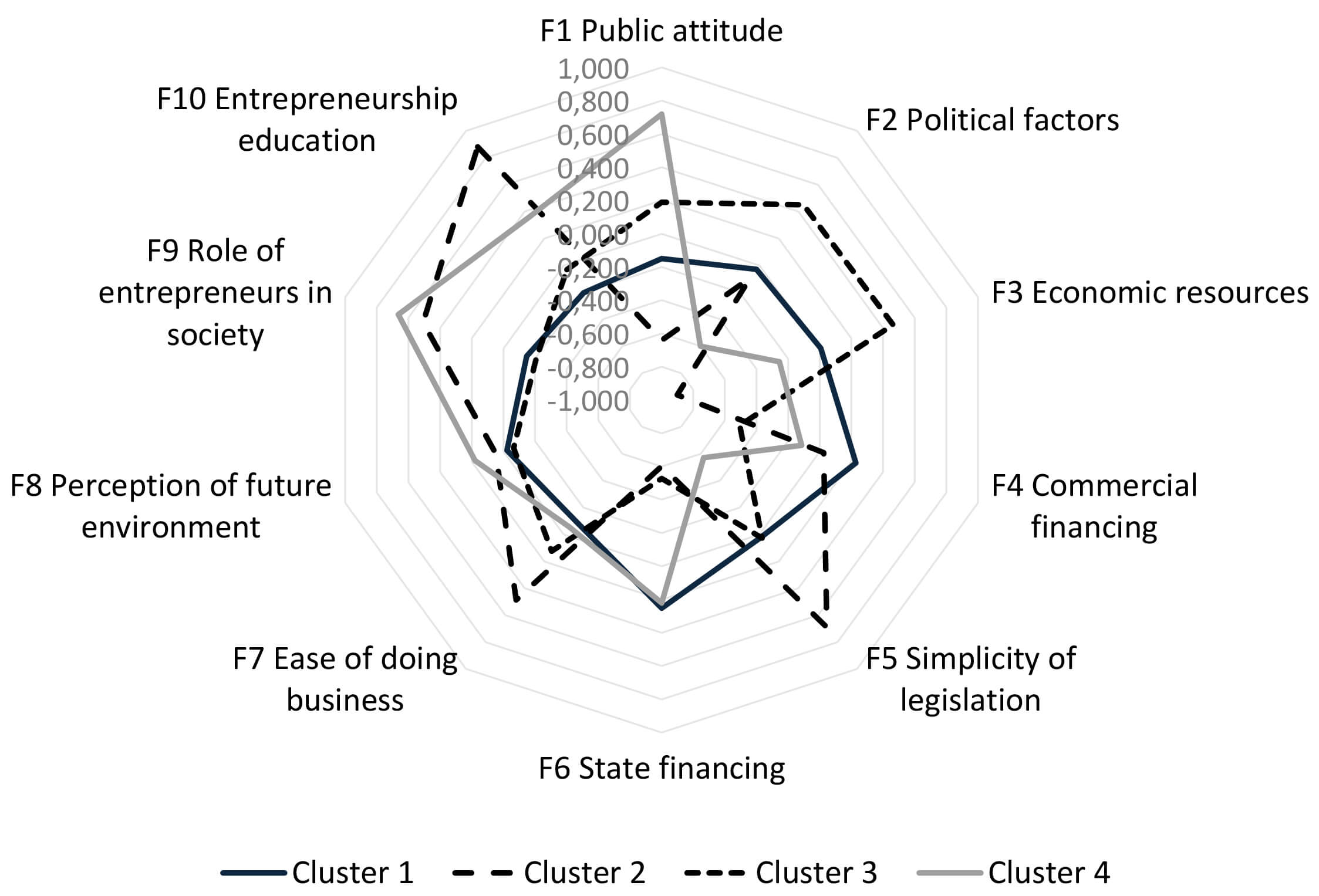
We continued with hierarchical cluster analysis to identify more clear structures within the data of the perceived entrepreneurship environment. Based on the dendrograms and analysis of distances between final cluster centers, it appeared rational to continue with four clusters for the external environment (As the first cluster appeared to be un-proportionally large as compared to the others, we tried also 5-cluster solution. This split the first cluster into two parts which, however, were still relatively similar and thus not analytically interesting. Another alternative with 3-cluster solution merged smallest clusters 2 and 4 together, but the problem was that these merged clusters were initially rather opposite and this variability disappeared. So, we decided to continue with 4-cluster solution despite of the large differences in cluster sizes). The results are presented in Appendix Table 5 and visualized in Fig. 1. The first cluster includes more than half of all cases (56% of all respondents and 41% of entrepreneurs) and is characterized by an equally moderate perception of all aspects of the external environment. The most optimistic attitudes appear towards commercial and state financing. The second cluster (8.3% of all respondents and 15.7% of entrepreneurs) includes cases with extremely high values of availability of entrepreneurial education and simplicity of enterprise registration and legislation. Also, estimates for the general current business environment are higher than average.
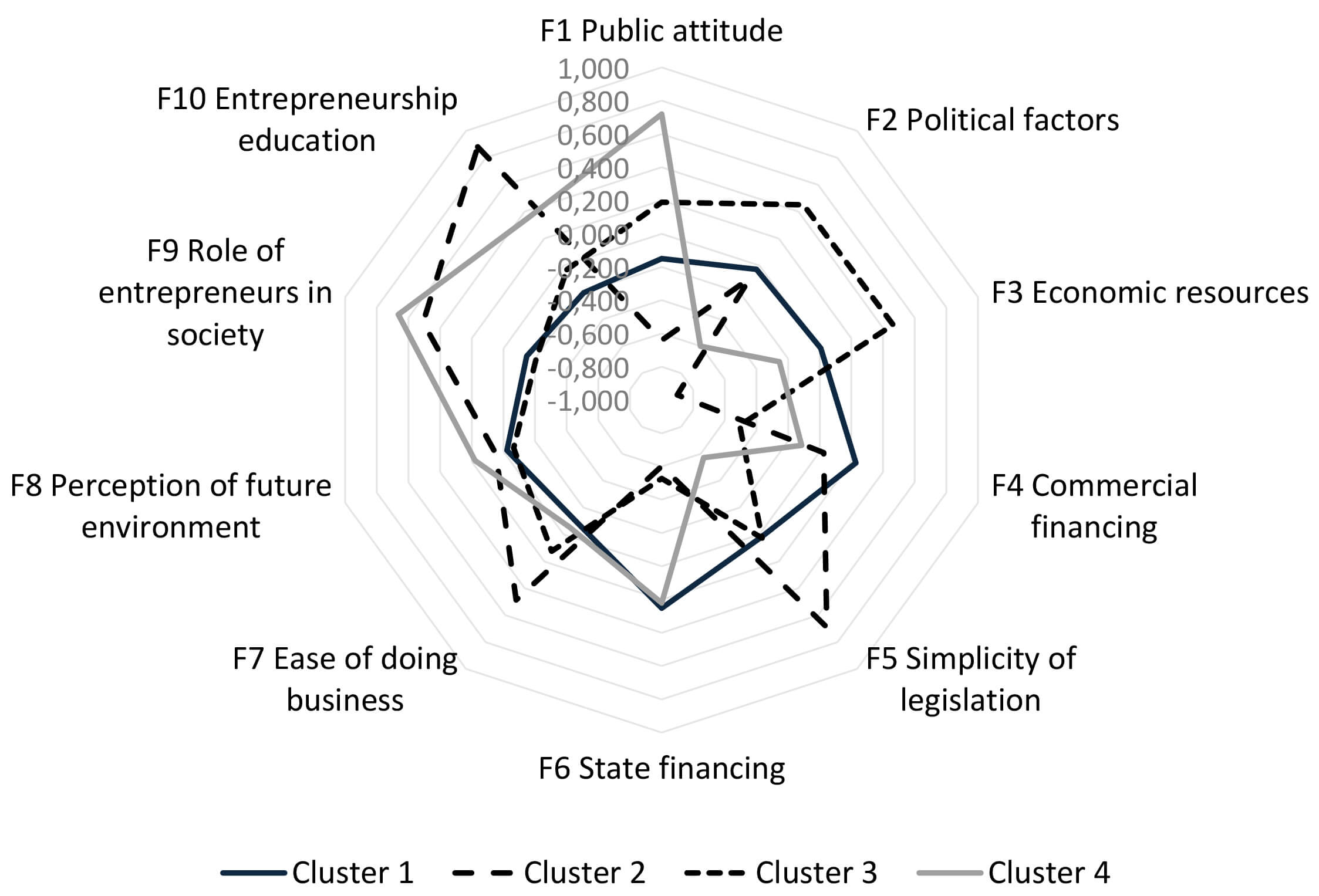 Fig. 1.
Cluster characteristics by the external environment factors (mean values of cluster centres on the scale –1…+1).
On the other hand, Cluster 2 reports extremely low values of public attitudes and availability of economic resources. Regarding financing, the availability of state support is valued much lower than commercial support. The third cluster (22.7% of all respondents and 32.1% of entrepreneurs) is in many aspects opposite to Cluster 2. It reports higher than average values of the general political environment and availability of economic resources, while the lowest ratings are given to both commercial and state financing. The fourth cluster (13.1% of all respondents and 11.1% of entrepreneurs) evaluates highly public attitudes and the positive role of entrepreneurs in society. Compared to Clusters 2 and 3, and similar to Cluster 1, this cluster is more optimistic about financing possibilities, especially regarding state support. According to Cluster 4, the weakest aspects of the external environment are considered to be political factors in general and, more specifically, the rules related to enterprise legislation.
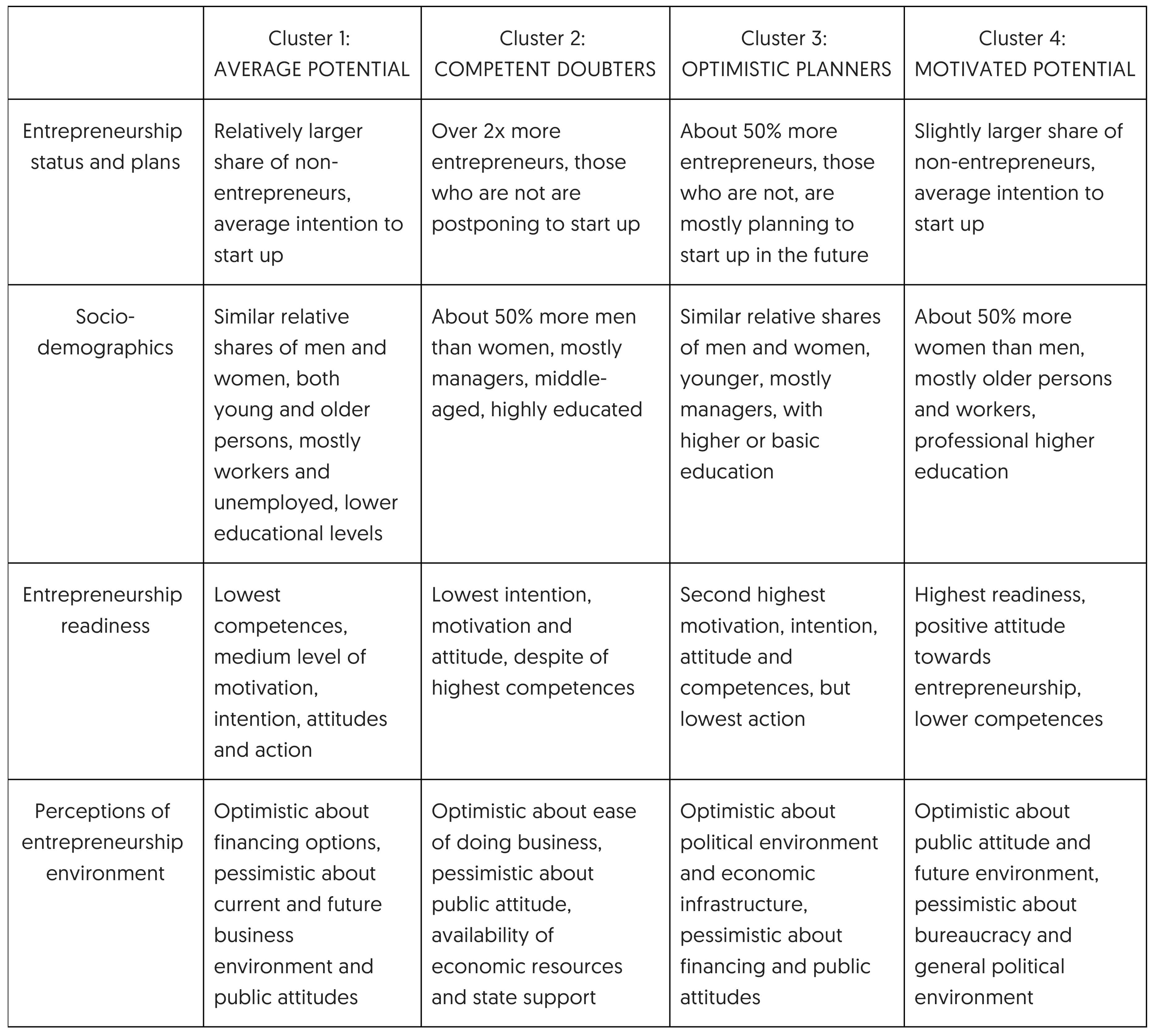
Next, we profiled the obtained clusters based on the socio-demographic characteristics of the respondents. Fig. 2 shows the most distinctive features of each cluster, focusing on a sub-sample of non-entrepreneurs. Regarding their intention to become an entrepreneur in the future, on average, 22–24% of respondents in clusters 1, 2, and 4 never plan to start an enterprise. In Cluster 3—which is dominated by younger people—the share of such persons was only 17%. Cluster 2 distinguishes itself from others by the highest share of those who would rather postpone starting with entrepreneurship into the far future (51.3%) instead of doing this in 1–5 years (25.6%). For comparison, in other clusters, approximately 44–48% of members intend to start their business in 1–5 years, and only 32–33% postpone this into the far future.
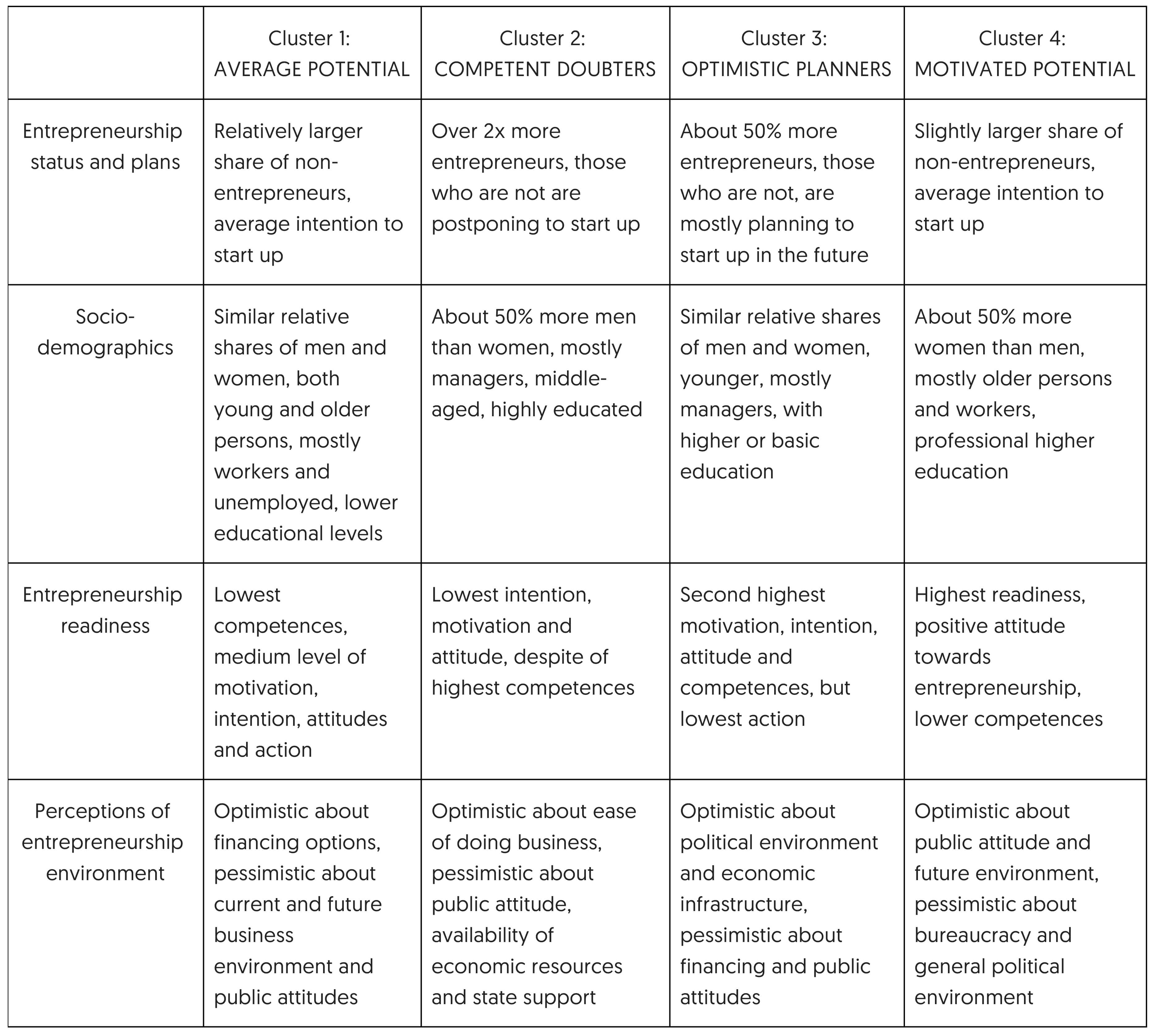 Fig. 2.
Cluster profiles.
When looking at cluster profiles by socio-demographic characteristics, both Clusters 1 and 3 contain similar relative shares of men and women. In contrast, Cluster 2 is dominated by men and Cluster 4, vice versa, by women. Regarding education, the first cluster is characterized by lower educational levels (basic, vocational, and secondary), while respondents with higher education are grouped into the second cluster. Cluster 3 contains relatively more respondents, both with higher and basic education. This could be related to the age structure of Cluster 3, as it includes both very young and older persons. By occupational categories, Clusters 2 and 3 are similar in that they both include a relatively larger share of managers and a small share of workers, while Clusters 1 and 4 show the opposite pattern. Unemployed also belong mainly to Cluster 1.
Profiling clusters by entrepreneurial readiness indicators reveal that most EREI components—intention, attitudes, and motivation—have the highest values in Cluster 4, followed by Clusters 3 and 1. However, Cluster 2 does not fit into the pattern that “the higher the cluster number, the higher the readiness to start a business”, which makes the picture more confusing. Although Cluster 2 has the lowest values in the abovementioned components, it has the highest level of competence and the highest level regarding actions. The explanation may lie in the fact that this cluster is dominated by entrepreneurs and those planning to start an enterprise soon, so high levels of competencies and actions are natural. On the other hand, lower values of attitudes and motivation might refer to necessity entrepreneurship instead of opportunity entrepreneurship—maybe they don’t like being an entrepreneur that much, but they are forced to.
Based on the characteristics of each cluster, we described the following profiles of respondents. Members of Cluster 1 could be described as having “average potential” in most aspects. However, they are not very likely to become entrepreneurs because of low educational levels and low entrepreneurial competencies. Cluster 2 could be named “competent doubters” and Cluster 3 as “optimistic planners”. Although both groups are optimistic about the general business environment, they share pessimistic opinions about public attitudes toward entrepreneurs. Their tendency to delay entrepreneurial intentions could be explained by satisfying alternatives—high educational level has guaranteed many of them managerial positions and thereby self-fulfillment in paid jobs. These clusters differ mainly by gender and age structure. Finally, Cluster 4 could be named “motivated potential”. They are highly motivated and generally positive about entrepreneurship, but a lack of competencies and knowledge about ease of doing business, combined with relatively advanced age, hinders them from starting a business.
This paper aimed to find out how entrepreneurs differ from non-entrepreneurs in their perceptions of the entrepreneurial environment. Our findings make several contributions to the literature. Firstly, our analysis highlights the importance of subjective perceptions of the entrepreneurship environment. Secondly, we derived a larger number of environmental factors and showed that most of these factors are perceived differently by between entrepreneurs and non-entrepreneurs. Thirdly, we showed how perceptions of the external environment are related to entrepreneurship readiness and intention and how these relationships differ in entrepreneurs’ and non-entrepreneurs’ subsamples. Fourthly, we derived cluster profiles of the respondents based on their perceptions of the external environment and described the distinctive characteristics of each profile. Clustering enables us to find patterns in the perception of the business environment, which in turn allows for a more complex evaluation of the hindering and facilitating factors arising from the environment. Knowing these factors might help to design more effective policies to remove the obstacles that will be identified. Last but not least, focusing on Estonia is an interesting case in that although Estonia’s objective business environment is conducive to entrepreneurship, the overall proportion of entrepreneurs in the total population remains modest.
If assuming that institutions can and should support entrepreneurial intentions and activities, then knowing the differences in perceptions of entrepreneurs and non-entrepreneurs helps to identify the possible bottlenecks in non-entrepreneurs attitudes that might hinder their aspirations to become entrepreneurs. On the other hand, this knowledge could help to understand what hinders entrepreneurs the most in the surrounding environment and what aspects of the environment support their activity, even if not acknowledged by non-entrepreneurs. As Palish and Bagby (1995) suggest, cognitive processes—unlike personal traits—can be changed, so the aspects of cognition that are more positive for entrepreneurs can be learned by non-entrepreneurs through educational programs and training. There might be great potential because, according to our results, non-entrepreneurs have a more positive perception of the availability of entrepreneurship training. Environmental interventions that develop the entrepreneurial and business skills of potential entrepreneurs are also suggested by Gnyawali and Fogel (1994), especially if people have high intentions and motivation to start up beforehand.
Our results also indicate that both entrepreneurs and non-entrepreneurs would benefit from better public attitudes toward them. As stated by Gnyawali and Fogel (1994), if people have a high ability to enterprise but this ability is not converted into intention and action, environmental interventions should be oriented towards making the socio-economic conditions conducive for entrepreneurship. Explaining to the public how easy it is to start up in Estonia and how entrepreneurship helps develop the country’s economy might benefit in attracting non-entrepreneurs to start up. Another supporting but not enough visible factor could be better availability of both commercial and state finances. It appeared that most of the entrepreneurs belong to clusters that are characterized by either moderate perception of all environmental aspects or show a more critical attitude towards financing alternatives. While public attitudes are largely shaped by the media, creating diverse and sufficient financing options is more in the hands of politicians.
To sum up, we propose the following policy interventions that could benefit and increase entrepreneurial activity. State policies should focus on providing entrepreneurial training at all educational levels, including unemployed individuals, to introduce them to the career path of entrepreneurship. Entrepreneurship training should be available and easily accessible to the general population regardless of their profile or background. Further, state initiatives should support starting up with pre- and incubation programs and enhance the emergence of these programs around higher-education institutions, high schools, vocational schools, training centers, public employment service institutions, etc. Thus, potential entrepreneurs have access to seed money along with entrepreneurial training. As one problem is related to the perceived availability of financial resources, creating initiatives to attract investors and external resources could have a high impact on developing the entrepreneurial environment. Last but not least is the effort of the state to promote entrepreneurship through public relations campaigns showcasing success stories and setting examples for potential entrepreneurs.
The study’s main limitation is that it is a single-country survey-based study. Survey methodology encounters different biases in responses that may distort the results. Our sample is a convenience sample, and the data reflect the perceptions of “ordinary people” willing to share their opinions about different aspects of entrepreneurship, so the study results are not generalizable in scientific terms. Nevertheless, that was not the goal of our research, and the results can still be considered valid for the context in which they were studied.
Also, we were not able to test our questionnaire in other environmental and cultural settings to fully validate it. A single-country perspective limits the generalization of the results. Another data-related limitation is that our research does not cover many other, e.g., technological or natural environments. However, these environments might have sector-specific effects on perceptions, opening thus new lines for future research. We also limit our analysis to “entrepreneurial environment” instead of “entrepreneurial ecosystem”, the latter being more relevant for studying startups and other firms acting in high-growth settings or financed by venture capital.
Regarding further research, our study dealt only with perceptions, but it would be beneficial to compare them with the objective entrepreneurship environment. The further question is whether and how the objective environment influences subjective perceptions of this environment—or is this a two-way relationship? Also, studying in more detail the type of entrepreneurship (i.e., opportunity versus necessity-driven, high-tech or low-tech, etc.) the respondents wanted to develop might provide interesting insights into the topic. Another line for future research is to implement this survey in another country and compare the results. It will enable us to develop and validate the questionnaire and actually to see how stable perceptions about the entrepreneurship environment are and how correlations with intentions and readiness are sustained in different environments. In terms of methodology, it would be beneficial to triangulate the methods to better interpret survey results. Some options could be in-depth interviews with entrepreneurs and non-entrepreneurs, focus-group interviews, or content analysis of media.
The data are available from the authors upon legitimate request.
EP provided the initial research idea. Both authors designed the details of the research and searched the literature to compile a theoretical overview. EK collected the data. EP designed the methodology and analyzed the data. Both authors drafted the manuscript and contributed to the discussion and conclusions. EP was responsible for the formatting and critical revision of the manuscript during the whole refereeing process. Both authors read and approved the final manuscript. Both authors have participated sufficiently in the work and agreed to be accountable for all aspects of the work.
The authors are thankful to all the peer reviewers for their opinions and suggestions.
This research received no external funding.
The authors declare no conflict of interest.
See Table 5.
| External environment factors | Mean | Cluster 1 (n = 831) | Cluster 2 (n = 123) | Cluster 3 (n = 335) | Cluster 4 (n = 194) | |
| Std.Dev. | ||||||
| F1 | Public attitude towards entrepreneurship | Mean | –0.150 | –0.641 | 0.189 | 0.719 |
| Std.Dev. | 0.822 | 1.349 | 1.043 | 0.868 | ||
| F2 | General political environment | Mean | –0.029 | –0.095 | 0.452 | –0.601 |
| Std.Dev. | 0.967 | 0.953 | 0.965 | 0.838 | ||
| F3 | Availability of economic | Mean | 0.006 | –0.901 | 0.463 | –0.255 |
| Std.Dev. | 0.848 | 1.294 | 0.974 | 0.944 | ||
| F4 | Availability of commercial financing | Mean | 0.228 | 0.024 | –0.506 | –0.115 |
| Std.Dev. | 0.840 | 1.398 | 0.982 | 1.008 | ||
| F5 | Simplicity of enterprise legislation | Mean | 0.020 | 0.690 | 0.027 | –0.570 |
| Std.Dev. | 0.893 | 1.115 | 0.941 | 1.123 | ||
| F6 | Availability of state support and financing | Mean | 0.252 | –0.601 | –0.529 | 0.221 |
| Std.Dev. | 0.783 | 1.026 | 1.073 | 1.142 | ||
| F7 | Ease of doing business | Mean | –0.109 | 0.487 | 0.124 | –0.057 |
| Std.Dev. | 0.837 | 1.265 | 1.160 | 1.024 | ||
| F8 | Perception of future environment | Mean | –0.023 | 0.047 | –0.065 | 0.180 |
| Std.Dev. | 1.067 | 0.853 | 0.874 | 0.961 | ||
| F9 | Contribution of entrepreneurs to the society | Mean | –0.147 | 0.507 | –0.206 | 0.664 |
| Std.Dev. | 0.882 | 1.140 | 0.976 | 1.025 | ||
| F10 | Availability of entrepreneur-ship education | Mean | –0.202 | 0.882 | –0.031 | 0.358 |
| Std.Dev. | 0.792 | 1.256 | 1.185 | 0.840 | ||
References
Publisher’s Note: IMR Press stays neutral with regard to jurisdictional claims in published maps and institutional affiliations.