
 , Jitka Volfová 2,*
 , Agnieszka Brzozowska 2
1 Department of International Business, Faculty of International Relations, Prague University of Economics and Business, 130 67 Prague, Czech Republic
2 Department Strategy and Leadership, Faculty of Management, University of Warsaw, 02-678 Warsaw, Poland
Abstract
Recent crises, including the COVID-19 pandemic, the war in Ukraine, the 2023 active shooter attack at Charles University in Prague, and the 2025 knife attack at the University of Warsaw have significantly influenced preferences regarding the working and teaching environment. This paper outlines emotional responses to telework, coping strategies, and leadership implications in an international academic context. Qualitative primary data were collected through semi-structured interviews with academic staff and students and analysed using content and thematic analysis. A broad spectrum of emotional reactions was observed; verbalisation of emotions is culture-specific. The main stressors identified are a lack of personal contact and a sense of insecurity.
Keywords
- management in academia
- telework
- emotions
- coping strategies
The contemporary world faces turbulent times, which inevitably elicit strong emotional responses. The COVID-19 pandemic, the War in Ukraine, the Gaza-Israel conflict, the active shooter attack at Charles University 2023 in Prague, and the knife attack at the University of Warsaw in 2025, President Trump’s Embargo and Tariffs, and the European Green Deal and its recent developments are among the significant challenges we face. Remote work, changes in the geopolitical system, immigration, war, deadly attacks and changes related to digitalisation, artificial intelligence and other disruptive technologies; all these turbulences affect the functioning of multinational companies, national and work safety, and stability, and eventually have either a profound direct impact on emotional experiences or are indirectly transmitted via mass media.
Such strong and invasively arising emotions are becoming a regular part of both the working and private life. These emotions are not new but arise in new constellations and quantities and elicit new employees’ needs, which require innovative leadership approaches. Leaders need to be aware of stressors and coping strategies in order to be able to support the employees’ resilience and thus create and maintain a functional and resilient working environment. This article aims to find out what emotions they are, how to cope with them and formulate suggestions for leaders.
General issues like the above-mentioned have been emerging, and we have experienced living with them. Forced telework due to the COVID-19 pandemic is one of the extreme situations, and this paper aims to study emotions in this context, and the findings can be applied to other turbulent events. The experience of teleworking is now sufficiently remote in time, allowing for objective study. Known examples of good practice provide a foundation for formulating theoretical concepts and drawing general conclusions. This enables an in-depth analysis of how individuals experience crises, articulate their emotions, identify stressors, and employ coping mechanisms retrospectively.
In connection with international leadership development and its relevance to the business environment, and in line with the project funded by the Strategic Visegrad Grant titled “Supporting Mental Health in Organisations: Developing Future Business Leaders”, the research, which this article is based on, focused on a sample from academia—specifically business students expected to become future leaders. This research aims to study emotional experiences, their verbalisation, stressors, and coping mechanisms in the specific context of forced telework based on a sample from two Visegrad countries and eventually formulate implications applicable to other unforeseen and unwelcome situations.
The paper reacts to current world occurrences and addresses the challenges of maintaining a functional working environment. These issues are serious themselves and become even more critical when an intercultural element is introduced. Thanks to the above-mentioned Visegrad grant, we also had the opportunity to view the problem from an intercultural perspective.
Although change management is well-mapped in literature and scientific articles, we still lack sufficient information on how employees and workers experience changes under these extreme and accumulated circumstances and deal with them. This research fills this gap.
Telework, remote working, home office, and online work from outside the company premises will be considered synonyms for this paper. So far, the existing literature on telework has covered mainly the changes of the workforce working from home (International Labour Organization, 2020), the topic of homeworking in general or in connection with sustainability (Frantikova et al., 2017; Prosser, 2017; Vaishar and Šťastná, 2019; Raišienė et al., 2021), from the point of view of its importance (Mouratidis and Papagiannakis, 2021) and its positive and negative impacts and consequences (Abulibdeh, 2020; Garcia et al., 2022; Gerding et al., 2021; Hlaďo et al., 2020; Jesus et al., 2020; Kawashima et al., 2021; Marica, 2018; Martin et al., 2022; Miglioretti et al., 2023; Schur et al., 2020; Song and Gao, 2019; Windeler et al., 2017; Yüceol et al., 2021), company attitudes before and after COVID-19 (Allen et al., 2015; Chong et al., 2020; Vlčková et al., 2019; Vrchota et al., 2019; Vrchota et al., 2020), aspects influencing the ability to adopt work from home (Pfeifer, 2021), job satisfaction (Müller and Niessen, 2019), employees’ emotions (Abdel Hadi et al., 2021; Lee, 2021) and telework perception (Nguyen, 2021).
In crisis situations, an individual has to develop healthy independence and autonomy as well as healthy belonging to a social unit (such as family, community, coworkers, peers, etc.). Lester and Dench (2011) used for these phenomena classical, holistic Angyal’s terms homonomy (healthy interdependence on community) and autonomy (healthy need of being independent). In their research about the COVID-19 pandemic, Volfová et al. (2023) used Lester and Dench’s (2011) questionnaire items and confirmed that leaders should support both the autonomy and homonomy of employees because they both contribute to work-life balance.
Besides facilitating communication of positive emotions and semi-professional and professional psychological help, it is desirable for leaders to consider supporting the development of social bonds and interpersonal connections (Matysová and Volfová, 2023). The authors realise that the issue of emotions has been under-researched so far. Although numerous studies have examined the effects of teleworking on employee satisfaction, few studies simultaneously examine the influence of emotions, productivity concerns, and social concerns on the intention to continue teleworking (Țuclea et al., 2025).
Brundin et al. (2022) conducted an extensive literature review in which they defined three areas which should be addressed by researchers studying strategic leadership: “(1) scope conditions of emotion research in strategic management; (2) capturing emotion in strategic management; and (3) the ethics, power and politics of emotions in strategic management”. The scope conditions of emotion research relate to different cultural and organisational settings and changes elicited by societal transformations such as the pandemic. Cultural differences in emotional experiencing are well mapped in Hofstede’s cultural dimensions indulgence versus restraint (IVR) and uncertainty avoidance index (UAI) (Hofstede et al., 2010, p. 297, p. 203), and Trompenaars’s culture dimension affective versus neutral (Trompenaars and Hampden-Turner, 1998, pp. 79–80). Members of rather restrained cultures tend to be more pessimistic, and smiling is considered suspicious, while rather indulgent cultures’ members care more about leisure time and fun, expressing happiness and joy, and smiling is the norm. “Very happy people could be found in both high- and low-UAI countries, but very unhappy people existed especially in high-UAI countries” (Hofstede et al., 2010, p. 204). Cultures with high uncertainty avoidance allow venting of aggression and emotions at proper times and places, while in low uncertainty cultures, “aggression and emotions should not be shown” (Hofstede et al., 2010, p. 203). Trompenaars and Hampden-Turner (1998, p. 79) define that affective cultures tend to “reveal thoughts and feelings verbally and non-verbally … emotions flow easily effusively, vehemently and without inhibition”.
The ethics, power and politics of emotions in strategic management (Brundin et al., 2022) deal with the regulation of emotion, which means that managers control and manage their own emotions and the emotions of others, whereas when a strategic manager hides their emotions to protect their professional image, it can be harmful to him. On the other hand, if there is a low appreciation of emotional regulation, the effect of emotional regulation may be negative. A few recent research studies (Volfová et al., 2023; Țuclea et al., 2025) focused on positive emotions and their impact on resilience, intention to withstand difficult situations such as the COVID-19 pandemic, and work-life balance. Based on structural equation modelling, Volfová et al. (2023, p. 59) revealed that leaders should cultivate “positive emotions about telework because they contribute to work-life balance and positively affect the intentions to work from home. Work-life balance is positively related to the positive perception of the social implications of telework”. The impact of regulation and the containment of negative emotions remains a research gap.
Transformational leaders inspire employees with vision and direction. Research findings by Miglioretti et al. (2023) revealed that “employee’s emotional exhaustion and work engagement levels were related to telework quality”, which was expressed by office flexibility, office quality, remote workstation suitability, remote workstation healthiness, role clarity and Bass’s transformational leadership. Transformational leadership should be viewed as the creator of an environment that meets the needs of healthy interdependence (homonomy). Lee (2021, p. 97) related positive and negative emotions during the COVID-19 pandemic to perceived organisational structure: “The findings revealed that emotions such as anxiety, stress, unfairness, inferiority and vulnerability are triggered by perceived inequity and comparison with the decisions or resources of the referent others of higher level such as the management (upward social comparison emotion). On the other hand, the emotions of pride, empathy, shared goals and support are generated by the care, collective interest and comparison of the referent others of lower level such as the subordinate (downward social comparison emotion).” “The employee most dissatisfied with telework appears to be a man of the baby boomers’ generation, holding a university degree, with 20 years or more professional experience, and who started working remotely only during the quarantine.” (Raišiene et al., 2020, p. 19).
Pfeifer (2021) also pointed to differences stemming from hierarchy and knowledge base. Hierarchical position influences the ability to adapt to remote work—managers, regardless of prior telework experience, as well as employees with previous experience, were better able to adjust to working from home. In contrast, employees without telework experience faced greater difficulties in adapting, which may be attributed to differences in their knowledge base and a lower degree of autonomy compared to managers. Lee (2021, p. 97) emphasises the importance of open managerial communication, particularly when control measures are necessary, as control becomes inevitable during crises and periods of organisational change. Empowering employees in decision-making, fostering open dialogue around shared goals, and cultivating trust and reassurance are all critical components in promoting high levels of psychological safety. Leadership approaches characterised by micromanagement and excessive control were generally perceived negatively by employees, whereas autonomy, trust, and empathy were more positively received. This research further supports the notion that autonomy and interdependence are not contradictory but complementary dynamics within effective organisational functioning.
As discussed in recent research (Çoban, 2022; Zhang et al., 2020), the pandemic aggravated the social status of married women, led to the precarization of their careers, and affected partnered and single mothers differently. Çoban (2022, p. 241) has “revealed, that teleworking regulations that have been implemented due to the pandemic have the risk of detaching women from professional work, precarising their labor, and consolidating their roles as traditional housewives.” Zhang et al. (2020, p. 51) drew the conclusion: “that as the most important feature in family-life stages, children play a vital role in telework behavior. It not only increases both work-to-family conflict and family-to-work conflict but also triggers housework re-division within couples and aggravates gender differences.” These findings seem to support the idea that women with children did not benefit from telework in comparison to their male partners. Abulibdeh’s (2020, p. 564) rich literature survey results point out the positive as well as negative impacts of COVID-19 on females, among the positives, e.g., the dropped gender child-care gap in the United Kingdom. Hjálmsdóttir and Bjarnadóttir (2021, p. 268) included in her research 37 mothers in heteronormative relationships from Iceland, representing the country at the top of the gender gap index and revealed that “the division of tasks at home lay on their shoulders, causing them stress and frustration”.
Hyde (2005, p. 584), in her gender meta-analysis, compared, among others, studies related to emotional expression and experience, which yielded mixed results. Gender differences were measured using Cohen’s d. A moderate effect size was found in favour of men for physical aggression and aggression in emotional arousal in some studies. Conversely, a moderate effect size was observed for the variable ‘smiling’ in general, as well as for ‘smiling when the participant was aware of being observed’, both in favour of women. In conclusion, the author postulates the gender similarities hypothesis, which states: “that males and females are alike on most—but not all—psychological variables” (Hyde, p. 590).
Yildirim and Eslen‐Ziya (2021, p. 247) confirm that employees were disproportionally affected, especially women with children, while Graham et al. (2021, pp. 942–943) point out that the “satisfaction with the division of household tasks appears to play a substantial role in alleviating stress, and work-family and family-work conflict …” Bhumika (2020, p. 712) confirms that considering the personal life interference in work, emotional exhaustion was stronger for women.
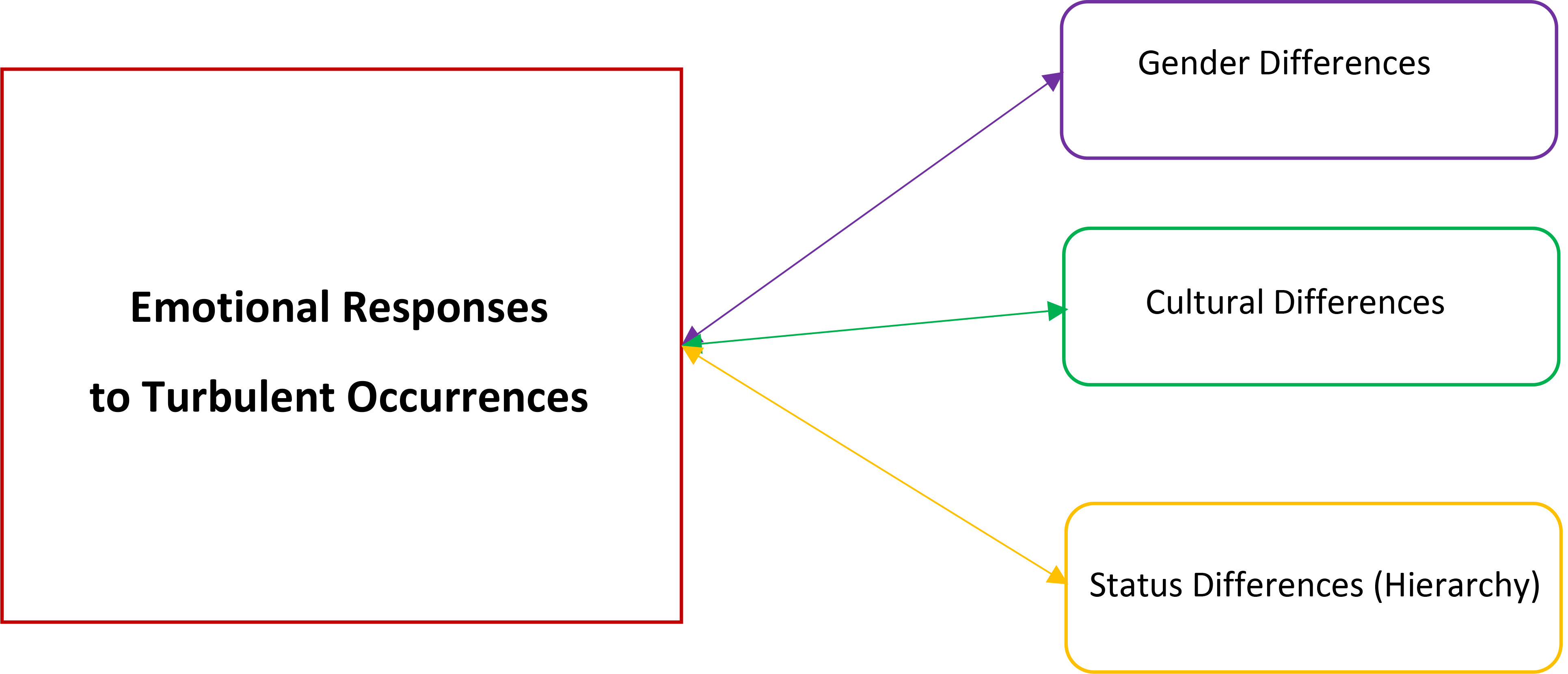
The paper aims to present new findings of primary research conducted by the authors. It is based on both, secondary as well as primary data. First, the general problem, turbulent occurrences of the contemporary world, accompanied by strong emotional responses, was described based on the monitoring of secondary sources. The phenomenon was viewed through the leadership lens, and the turbulences were operationalised via the COVID-19 pandemic. The literature revealed that the perceived leadership need is to understand the role of emotions and understand the leaders’ role in cultivating a healthy work environment. Three main variables were identified as crucial: gender differences, cultural differences, and status differences (hierarchy). The conceptual model is visualised in Fig. 1 below.
 Fig. 1.
Conceptual model. Source: own creation based on literature review.
The specific manifestations and dynamics of emotional responses among employees remain under-researched. This study addresses this gap by exploring the emotional and psychological impacts of forced telework, with the aim of formulating evidence-based recommendations for leadership practices that foster effective support mechanisms in times of turbulence in a working environment. To fill this gap in up-to-date research findings, the following research question was formulated: What are the emotional and psychological impacts of forced telework?
To address the above-mentioned three identified variables, answer the research question and meet the goal of the paper qualitative primary research was conducted on a sample from an academic environment. The sample from academia simulating the business environment is in line with the project funded by the Strategic Visegrad Grant titled “Supporting Mental Health in Organisations: Developing Future Business Leaders”.
The primary data was collected and analysed. The qualitative data were collected by a team of interviewers via semi-structured interviews which took place during October 2022 and June 2023. Each interview took between 30–90 minutes. Interviews were recorded and transcribed using the help of the online Microsoft Word Dictaphone function and the transcribing feature of Microsoft Teams. The sample consists of respondents from the Czech and Polish academic environment. The target group were employees and students of the chosen Czech and Polish universities, the Prague University of Economics and Business and the University of Warsaw, who had experience with working or studying at a distance as a result of the COVID-19 situation. The sample structure was organised in such a way in order to reflect the diversity of the working and study environment of both the Prague University of Economics and Business and the University of Warsaw. Respondents were mainly from the Faculty of International Relations (17) and Faculty of Management (20) and also from the Faculty of Finance and Accounting (2), Faculty of Business Administration (1), Faculty of Informatics and Statistics (1), and Faculty of Economics and Finance (1). The sample included teachers of diverse age cohorts (full professor, assistant professors, associate professors, both with and without organisational function), one administrative employee, and students of the master and the bachelor study programs. One doctoral researcher was also included to reflect the specificity of the Polish academic environment. The majority of respondents from the Prague University of Economics and Business were Czech; however, to reflect the traditional presence of the Slovak minority as the biggest one in the Czech Republic, 2 Slovaks were also included (one teacher and one student).
The final sample size was n = 42, out of which there were 21 respondents from the Czech working and study environment and 21 from the Polish working and study environment, 22 females and 20 males, 22 employees (including one doctoral researcher) and 20 students. Out of the 22 employees, there were five associate professors, 14 assistant professors, one full professor, one doctoral researcher, and one secretary. Ten students were from the bachelor study program, and ten students were from the master study program. Regarding the teaching fields, teachers holding courses with an emphasis on both soft skills and hard skills were included. The structure of the sample is visualised in the Table 1 below.
| CODE | Gender | Status | Faculty | Nationality |
| CA | Female | Administration | Faculty of International Relations | Czech |
| CB | Female | Bachelor Student | Faculty of International Relations | Czech |
| CC | Male | Associate Professor | Faculty of International Relations | Czech |
| CD | Female | Bachelor Student | Faculty of International Relations | Czech |
| CE | Male | Bachelor Student | Faculty of International Relations | Czech |
| CF | Female | Bachelor Student | Faculty of International Relations | Czech |
| CG | Male | Assistant Professor | Faculty of International Relations | Czech |
| CH | Male | Master Students | Faculty of Informatics and Statistics | Czech |
| CI | Male | Assistant Professor | Faculty of International Relations | Czech |
| CJ | Female | Assistant Professor | Faculty of International Relations | Czech |
| CK | Female | Bachelor Student | Faculty of International Relations | Czech |
| CL | Female | Bachelor Student | Faculty of International Relations | Czech |
| CM | Male | Bachelor Student | Faculty of International Relations | Czech |
| CN | Female | Master Students | Faculty of International Relations | Slovak |
| CO | Male | Master Students | Faculty of International Relations | Czech |
| CP | Female | Assistant Professor | Faculty of Business Administration | Slovak |
| CQ | Female | Assistant Professor | Faculty of Finance and Accounting | Czech |
| CR | Female | Assistant Professor | Faculty of International Relations | Czech |
| CS | Male | Assistant Professor | Faculty of International Relations | Czech |
| CT | Female | Associate Professor | Faculty of Finance and Accounting | Czech |
| CU | Female | Assistant Professor | Faculty of International Relations | Czech |
| PA | Female | Assistant Professor | Faculty of Management | Polish |
| PB | Male | Associate Professor | Faculty of Management | Polish |
| PC | Male | Full Professor | Faculty of Management | Polish |
| PD | Female | Doctoral Researcher | Faculty of Management | Polish |
| PE | Female | Assistant Professor | Faculty of Management | Polish |
| PF | Female | Assistant Professor | Faculty of Management | Polish |
| PG | Male | Assistant Professor | Faculty of Management | Polish |
| PH | Female | Associate Professor | Faculty of Economics and Finance | Polish |
| PI | Male | Associate Professor | Faculty of Management | Polish |
| PJ | Male | Assistant Professor | Faculty of Management | Polish |
| PK | Male | Assistant Professor | Faculty of Management | Polish |
| PL | Female | Bachelor Student | Faculty of Management | Polish |
| PM | Female | Master Student | Faculty of Management | Polish |
| PN | Male | Master Student | Faculty of Management | Polish |
| PO | Male | Master Student | Faculty of Management | Polish |
| PP | Female | Master Student | Faculty of Management | Polish |
| PQ | Male | Master Student | Faculty of Management | Polish |
| PR | Female | Master Student | Faculty of Management | Polish |
| PS | Male | Master Student | Faculty of Management | Polish |
| PT | Male | Bachelor Student | Faculty of Management | Polish |
| PU | Male | Bachelor Student | Faculty of Management | Polish |
Source: own research.
Alongside the research purpose, the non-probability sampling technique was used. As a result of careful consideration of the pros and cons of data-collecting methods, taking into account the fact that such a non-standardised method of collecting data can be associated with bias (e.g., the interviewer, interviewee or participation bias), the single data collection technique - semi-structured individual interviews was chosen. It allowed the researchers to create a valuable rapport with respondents. The primary research was designed in harmony with the interpretive philosophy (Saunders et al., 2009, p. 397).
First, the data were analysed via content analysis (Saunders et al., 2009, p. 608–610) using the NVivo (trial version 15.x; Lumivero; Denver, CO, USA) software. Since the interviews were conducted in the Czech and Polish languages for the purpose of usage of the NVivo software, the transcriptions were translated into English, and only the replies of the interviewees were left to be coded. The NVivo software proceeded with sentiment coding using the following codes: very negative, moderately negative, moderately positive, and very positive. The quantitative results of the content analysis were eventually processed by correlation analysis and descriptive statistical methods using Jeffreys’s Amazing Statistics Program (JASP open-source project; JASP 0.16.2; University of Amsterdam, Department of Psychological Methods; Nieuwe Achtergracht 129B, Amsterdam, The Netherlands) software. Additionally, thematic analysis (Saunders et al., 2009, p. 579) was conducted on the Czech part of the sample for deeper exploratory purposes.
In the next chapter, the results of the analyses are presented in tables and graphs in a logical order rather than in a chronological order of the individual research steps. This approach ensures the reader gains a comprehensive and coherently structured understanding of the findings. The text is complemented by exact examples of respondents’ answers (in italics).
As a result of the analysis, a couple of key areas emerged: (1) contexts of people who experienced the COVID-19 pandemic as a happy or a futile period of their lives; (2) experienced happiness or hopelessness in relation to the traditional women’s roles as housewives; (3) the perceived stress factors (connected to the situation of COVID-19 pandemic from the perspective of working and studying online/on distance); (4) the strategies and tools which supported the mental health in order to maintain work-life balance (connected to the situation COVID-19 from the perspective of working and studying online/on distance).
As seen in Fig. 2 (below), the respondents’ emotional experiences associated with the pandemic vary across a fairly diverse range, including both extremely negative and positive cases. Fig. 2 stands for the emotional burden associated with the pandemic analysed with the help of NVivo software, as explained above. Based on sentiment coding, the visualisation portrays the verbalised emotions of the respondents.
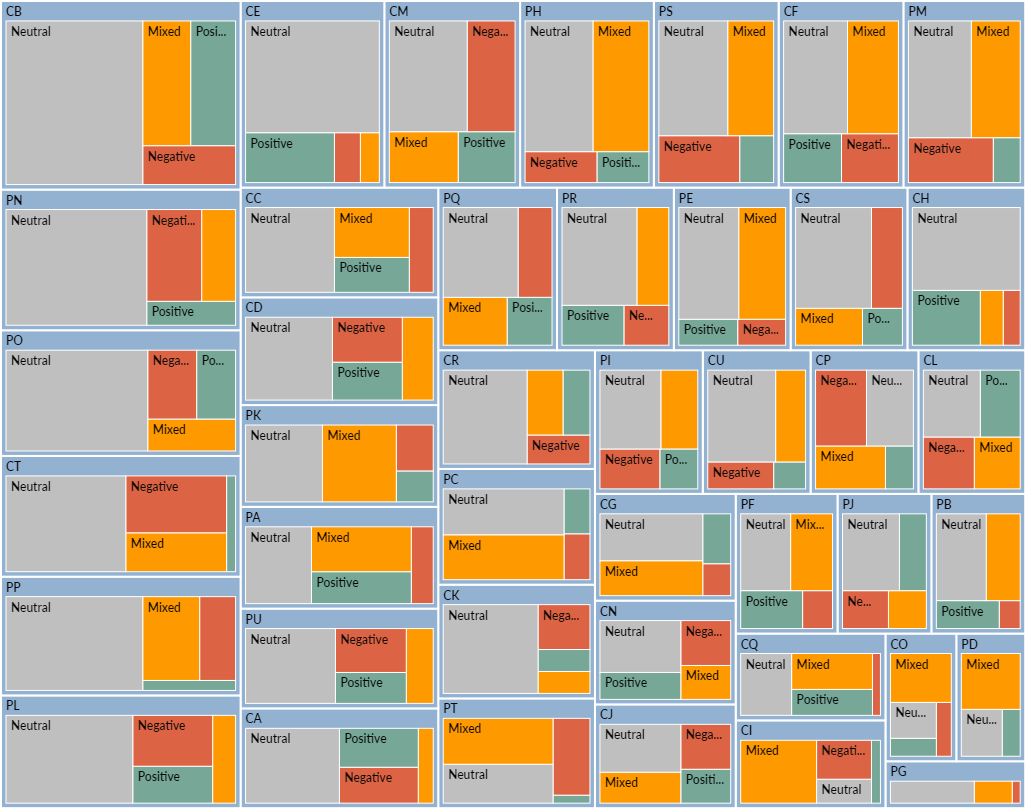 Fig. 2.
Visualisation of emotions of respondents (n = 42). Source: own research in NVivo. Grey stands for Neutral; Orange for Mixed; Green for Positive; Red for Negative.
Considering positive and negative emotions and time-saving, Ipsen’s results (Ipsen et al., 2021, p. 1) about work from home (WFH) revealed (using factor analysis) “that most people had a more positive rather than negative experience of WFH during lockdown. Three factors represent the main advantages of WFH: (i) work-life balance, (ii) improved work efficiency and (iii) greater work control. The main disadvantages were (iv) home office constraints, (v) work uncertainties and (vi) inadequate tools. Comparing gender, number of children at home, age and managers versus employees in relation to these factors provided insights into the differential impact of WFH on people’s lives. The factors help organisations understand where action is most needed to safeguard both performance and well-being.” (WFH means work from home). In contrast, this primary research proved that experiences from telework are complex and various combinations were identified.
Specific absolute frequencies for the above-visualised results are available in the following Table 2. These frequencies were used as input data for correlation analysis, which is presented later in the text.
| CODE | Very negative | Moderately negative | Moderately positive | Very positive |
| CA | 10 | 7 | 11 | 7 |
| CB | 26 | 20 | 20 | 28 |
| CC | 16 | 15 | 20 | 10 |
| CD | 17 | 4 | 10 | 9 |
| CE | 4 | 3 | 14 | 3 |
| CF | 20 | 12 | 15 | 17 |
| CG | 9 | 15 | 18 | 11 |
| CI | 16 | 15 | 10 | 12 |
| CJ | 16 | 16 | 16 | 13 |
| CK | 5 | 13 | 6 | 3 |
| CL | 9 | 14 | 16 | 10 |
| CM | 13 | 20 | 15 | 9 |
| CN | 10 | 9 | 12 | 8 |
| CO | 15 | 11 | 20 | 8 |
| CP | 14 | 7 | 9 | 8 |
| CQ | 6 | 16 | 20 | 6 |
| CR | 5 | 13 | 11 | 4 |
| CS | 16 | 14 | 10 | 5 |
| CT | 30 | 43 | 13 | 8 |
| CU | 12 | 11 | 9 | 6 |
| CH | 5 | 3 | 13 | 8 |
| PA | 22 | 24 | 30 | 15 |
| PB | 10 | 26 | 20 | 16 |
| PC | 21 | 37 | 24 | 17 |
| PD | 18 | 27 | 27 | 20 |
| PE | 27 | 41 | 32 | 12 |
| PF | 19 | 25 | 29 | 12 |
| PG | 23 | 22 | 18 | 6 |
| PH | 29 | 41 | 30 | 20 |
| PI | 9 | 15 | 13 | 6 |
| PJ | 10 | 8 | 13 | 7 |
| PK | 25 | 21 | 27 | 13 |
| PL | 11 | 15 | 17 | 3 |
| PM | 27 | 29 | 22 | 19 |
| PN | 12 | 24 | 15 | 7 |
| PO | 18 | 15 | 19 | 8 |
| PP | 21 | 31 | 25 | 12 |
| PQ | 11 | 14 | 10 | 11 |
| PR | 10 | 24 | 18 | 10 |
| PS | 26 | 18 | 19 | 13 |
| PT | 12 | 17 | 10 | 2 |
| PU | 5 | 20 | 20 | 5 |
Source: own research in NVivo.
The respondent most affected by negative emotions is an academic under the code CT. This respondent’s first emotion associated with the pandemic was described with the following words: Shock because I can’t see the students. The shock of not being able to let it go, that I don’t know exactly what I’m doing, in what environment. The shock of having to redo the lectures because I was writing on the board a lot, and writing on the board in MS Teams is impossible, so I had to position the camera so that I was writing on paper in front of the students. Negative emotional associations of university employees were, for instance, frustration, nonsense, futility, strangeness, unease, uncertainty, insecurity, and loneliness.
Some respondents’ associations with the pandemic were ambiguous; e.g., the respondent under the code CN described it with the following words: I would probably name it as saving time, convenience, and, above all, something unknown for sure. I am … at the beginning, it was something unknown, but because nowadays I am already used to the fact that whether one works purely online at work and so on, it was a big time saver for me, so I think that the whole period like this in retrospect, I would name it as time-saving, flexibility, maybe some convenience in part. Similarly, other positive emotions were mentioned mainly in connection with autonomy, saving time, time planning, and the possibility of studying even when sick and engaging in multiple activities simultaneously, e.g., combining studies at two universities or combining work and household chores. Other students associated the pandemic with uncertainty, anxiety, confusion, fear of rapid change, inability to concentrate online, and quandary.
In the sample, there were students who associated highly positive emotions and happiness with the pandemic. It is weird, but I was quite happy within online teaching, for example. As I’m more of an introvert, it didn’t bother me that much. Online teaching actually suited me quite well, and I also like it, for example, when the records were kept and then we used MS Teams, so they continued to use the modern innovative elements, so I’m actually quite happy as a result, so happiness like, satisfaction, positive emotions. (CL) Happy students explained their condition by introversion, which indicates lay psychology; however, not all introverted respondents were happy. Another happy student explained it by being a profamily type, and the student was also persuaded to be an exception. When solid interpersonal relations were built before the pandemic, they were reflected in moderately positive or very positive emotions during the situation.
The quantitative data results of the content analysis (sentiment codes, see Table 2) were analysed with Pearson’s correlations. Table 3 shows the correlation coefficients and their significances are flagged with explanations under the table.
| Variable | Very negative | Moderately negative | Moderately positive | Very positive | Nationality | Status detailed | Gender | |
| 1. Very negative | Pearson’s r | — | ||||||
| p-value | — | |||||||
| 2. Moderately negative | Pearson’s r | 0.668*** | — | |||||
| p-value | — | |||||||
| 3. Moderately positive | Pearson’s r | 0.559*** | 0.669*** | — | ||||
| p-value | — | |||||||
| 4. Very positive | Pearson’s r | 0.633*** | 0.466** | 0.574*** | — | |||
| p-value | 0.002 | — | ||||||
| 5. Nationality | Pearson’s r | 0.303 | 0.518*** | 0.548*** | 0.181 | — | ||
| p-value | 0.051 | 0.251 | — | |||||
| 6. Status | Pearson’s r | 0.121 | 0.328* | 0.243 | 0.073 | 0.112 | — | |
| p-value | 0.445 | 0.034 | 0.121 | 0.647 | 0.480 | — | ||
| 7. Gender | Pearson’s r | 0.051 | 0.044 | 0.188 | 0.171 | –0.191 | –0.078 | — |
| p-value | 0.748 | 0.782 | 0.233 | 0.279 | 0.226 | 0.624 | — |
Source: own research in JASP.
* p
Very negative, moderately negative, moderately positive and very positive emotions were intercorrelated, showing a moderately strong to strong (statistically significant) correlation. This may be attributed to various factors, such as individual personality traits (for instance, neuroticism). Gender was coded as male and female, with no respondents identifying as non-binary, as seen in the methodical part (Table 1). No significant correlation was found between gender and the frequency of emotional responses, which complies with the gender similarity hypothesis (Hyde, 2005). Status was coded on a scale where 1 represented a bachelor student, two a master student, three a secretary or doctoral researcher, four an assistant professor, five an associate professor, and six a full professor. A statistically significant moderate correlation r = 0.328 (at the 5% significance level) was identified between status and moderately negative emotions.
Furthermore, the correlation analysis revealed a strong correlation between nationality and both moderately negative emotions (r = 0.518) and moderately positive emotions (r = 0.548). On the other hand, no statistically significant correlation was proved between nationality and very positive and very negative emotions. Descriptive statistics were conducted to understand better intercultural differences between the Polish and Czech cultural contexts (see Table 4). Although the sample included two Slovak participants, the data are interpreted within the framework of the Czech cultural environment.
| Very negative | Moderately negative | Moderately positive | Very positive | |||||
| CZ | PL | CZ | PL | CZ | PL | CZ | PL | |
| Valid | 21 | 21 | 21 | 21 | 21 | 21 | 21 | 21 |
| Missing | 0 | 0 | 0 | 0 | 0 | 0 | 0 | 0 |
| Mean | 13.048 | 17.429 | 13.381 | 23.524 | 13.714 | 20.857 | 9.190 | 11.143 |
| Standard Deviation | 6.845 | 7.284 | 8.381 | 8.784 | 4.209 | 6.688 | 5.455 | 5.416 |
| Minimum | 4.000 | 5.000 | 3.000 | 8.000 | 6.000 | 10.000 | 3.000 | 2.000 |
| Maximum | 30.000 | 29.000 | 43.000 | 41.000 | 20.000 | 32.000 | 28.000 | 20.000 |
| 25th percentile | 9.000 | 11.000 | 9.000 | 17.000 | 10.000 | 17.000 | 6.000 | 7.000 |
| 50th percentile | 13.000 | 18.000 | 13.000 | 24.000 | 13.000 | 20.000 | 8.000 | 12.000 |
| 75th percentile | 16.000 | 23.000 | 15.000 | 27.000 | 16.000 | 27.000 | 10.000 | 15.000 |
Source: own research in JASP. CZ, Czechia; PL, Poland.
As is evident from Table 4, Polish respondents verbalised, on average, more emotions related to the COVID-19 pandemic across all four emotional categories. These findings comply partly with intercultural theory. Polish and Czech IVR equals 29 for both countries, which should mean that both cultures express joy and happiness similarly. On the other hand, Trompenaars’s dimension affective versus neutral is Czechia (CZ) = 64 and Poland (PL) = 29, which means that Polish culture is more affective. Regarding UAI, both cultures have a high uncertainty avoidance index (CZ = 74, PL = 93), meaning that in relative comparison, Polish culture is more uncertainty avoidant. That should theoretically imply that Poles experience sadness more than Czechs, which aligns with primary research findings (Hofstede et al., 2010, p. 192–193, 284; Trompenaars Hampden-Turner, n.d.).
Among the stressing factors, the following were mentioned: the uncertainty connected to the future development of the situation, the shortage of labour force due to illness, the lack of personal contact (in general and specifically with elderly relatives), and the lack of non-verbal feedback increasing with the time spent online, the fear to be able to provide the same quality of work online as was provided on-site, lack of informal contact (during the coffee break) not understanding the sense of rules set by the governments/local municipalities.
Especially for students, the functional and pleasant family environment was the basis of satisfaction. One student cited interaction with divorced parents who live separately as the most significant stressor. The problematic relationships with both parents were reflected in the student’s experience during the pandemic and intensified her discomfort. The mother had the idea that her daughter would spend more free time with her and devote herself to her. The father required his daughter to do housework, especially cooking, when she stayed with him. Both parents devalued the student’s burden of online learning and used it to saturate their own needs. In the parents’ view, she was just sitting at home at the computer, and as a result, the girl did not even see the benefits of saving time. I feel that in reality, it took even more time than now when I go to school, although, of course, I have to take the tram, and I don’t know what else to commute and so on. For example, my parents came home and thought that I had cleaned and cooked in the meantime, and I didn’t, and they were angry afterwards, so it was simply impossible to get along with them. This is perhaps one of the examples I can give (CK). She also mentioned the impossibility of establishing peer relationships, limited movement in a small town during the lockdown, and impersonal and undignified online teaching.
Another problematic phenomenon was the so-called cyberloafing, meaning being anything but productive within online lectures. This phenomenon led to the fact that in the later stages of the pandemic, the conditions, rigour, and control in online teaching, and especially during final tests, were tightened. It is evident from both the students’ side: In some subjects, there was really more control after there. The online exams were really not pleasant for me, because in some subjects I had the feeling that I was perceived as someone who cheats, just because it is online. And there was a lot of whole-room screen sharing, some tight-fisted surveillance, scrutiny, etc. (CO); and the teacher’s side: It never occurred to me that something like this could happen. And we found out that we only had the best grades, so I thought to myself, it’s not possible. So, we’re going to want everyone to have a camera switched on. And the students argued - we don’t have a camera - and we protested - you’re going to have a camera. We made it more and more strict, the student always managed to get around it (CT). This problem mainly concerned teachers of exact and hard skills subjects.
However, unease also affected teachers of soft-skills subjects, as seen from the following: The MS Teams had a more limited capacity, so it was usually not recommended that we all have the camera on, or that we were in some deeper interaction, so I often did not see them, often to get some information there, whether it was good or bad for them, if they are there at all, if it’s beneficial for them if it wasn’t always easy to do it this way, and certainly there, when you look at them and perceive the energy that seems to flow there, and I perceive those feelings more, or I can tune into them, so I didn’t do well here, here I was wondering if they were interested, if I should do it this way, or make it a little special (CQ). Some students felt “not pushed enough” to fulfil tasks in case there was no direct check on them. The above-mentioned indicates “vicarious living”, implying the lack of autonomy.
Among the coping strategies, the following aspects influencing the support of mental health were mentioned: Inner justification of the situation (seeing positive results of work/effort, pieces of justification that the person can manage the situation, pieces of partial successes, believing in/understanding that the work gives a sense, is useful); online substitution of free time activities and in-person contacts, relations with peers and friends (online interactive events/shared activities such as basic on-distance contact, watching movies, playing video games).
Adaptation stays, meeting courses, onboarding stays, and get-together stays can be recommended, but it depends on the depth of the interpersonal relationship that the individual needs and these types of stays may not provide satisfactory and/or useful/needed depth. A functional family environment has a positive impact along with the ability to maintain an active “normal life” (adjusting the sports activities).
Taking the pandemic as an opportunity, the strategy of some respondents was to use negative situations during the pandemic as opportunities. These strategies were utilitarian and hedonistic, on the one hand, but respondents also utilised their free time for self-development, work on themselves, and sports, as described by the respondent under the code (CR): Well, the strategy was clearly that, to focus on things for which there was less time before. Like using it, not passively, but actively, taking it as an opportunity. And by taking it as an opportunity and trying to put it in a positive light. In the sense that I took it as an opportunity and tried to put it in a positive light … the strategy was to see those things, turn it into a positive, that I would never have as much time to go jogging as I do now. I will never fly to Malaga for five hundred (CZK) as I can fly now. You know, like taking whatever is found as positive, so the strategy is positivism.
Specific interventions such as psychotherapy, psychological counselling, or medication. Only one respondent said that he used medication and the services of a psychotherapist during the pandemic: And actually, like not being afraid to say it, I have a problem, and I want to solve that problem, and actually like looking for therapeutic help, for example, when I actually went to sessions, and it helped me a lot. It was such a boost for me, but at the same time, of course, most of the psychotherapists were already busy, so I actually only managed to do it for about 3 months (CO). Several students mentioned nonprofessional interventions such as peer-to-peer mentoring as a useful coping tool, but retrospectively, they considered they sometimes relied too much.
The findings from primary research highlight a significant blurring of boundaries between work and private life during forced telework, both spatially and temporally. Participants reported working from bedrooms, using the same digital devices for both professional and personal purposes, and experiencing a constant sense of work availability. These changes were often perceived negatively, prompting coping strategies such as setting strict non-working hours and seeking internal justification for the meaning of work. Additional lifestyle shifts included altered daily routines, reduced physical activity, increased reliance on private transport, and heightened time pressure due to shorter deadlines and increased performance expectations.
In contrast, existing literature presents a more nuanced or even positive perspective on certain aspects of telework. For instance, Staller and Randler (2021) focused their research on circadian rhythm with the following conclusion: “In terms of sleep behaviour and, consequently, sleep health, participants benefited from the transition to home office. They were able to adapt their waking and working hours better to their biological rhythm, which reduced social jetlag.” Concerning separating the private and working lives, “literature uses a variety of concepts to describe the intersection of being well in work and life” (Como et al., 2021, p. 48). To keep employees motivated, companies should address work-life balance. Wolor et al. (2020) and Morganson et al. (2010, p. 568) emphasise the impact of supporting the work-life balance in terms of job satisfaction. Job satisfaction is considered to be an important aspect employers should pay attention to (Irawanto et al., 2021, p. 10).
The findings suggest a complex interplay between the challenges and opportunities of remote work. While the erosion of physical and psychological boundaries can lead to emotional strain, the potential for greater autonomy and alignment with personal rhythms may offer compensatory benefits. This underscores the need for leadership to adopt nuanced, empathetic strategies that support employees in managing these dualities—by fostering clear boundaries, promoting flexibility, and reinforcing the meaningfulness of work.
Solutions suggested to make up for the uneasy situation, in order to evaluate and manage to keep the same quality and extent of work, are the following: short meetings to keep in touch, to know what people are dealing with, to share what works and what does not; to have someone — it can be a secretary/mentor/coach/support who would be more involved in what other people are doing so that such a person could help in case of need. Alternatively, another position should be created or in harmony with the technical development; the lessons learned from the pandemic showed that information technologies and artificial intelligence could substitute certain parts of human work; however, it should not mean precarization of human positions.
Leaders should be aware that for those who take care of someone, the ability to decide to work from home last minute in case of need as a reaction to an unexpected situation is appreciated. In general, the ability to choose at the last minute whether to participate in events online or in person would be appreciated. The online environment should be understood as a modern available extension of opportunities rather than a crisis management tool.
Any tool, advice, or procedure that helps support a healthy working environment is currently difficult to find. Among perceived challenges in general, the border between work and private life melted (space-wise as well as time-wise), the working space merged with the private life (working in the bedroom), using the computer as a working tool as well as for private activities (having “work” available all the time). In case it was perceived as negative, as a possible solution, the following strategies to cope with the situation are at our disposal: to set a time when the body strictly does not work — like evening, etc. and inner justification of the sense of work. Other emerged changes include amended daily routine, travelling more by car, less by public means of transport, lack of physical activity, longer walks as a solution; time-saving and time pressure - shorter deadlines, and higher “time/speed” expectations were noticed.
Among perceived challenges for leaders, the following emerged. Within the forced telework, people lacked the opportunity to talk to each other about how they felt. First, the priority for the leader was set to maintain quality and “normal” productivity and provide the usual “service” to customers — students. Having the capacity to pay attention to employees in the above-mentioned way in the early stages would mean the necessity to cut some other duties, but that was not the case. Leaders face the challenge of prioritising in order to move/push/schedule fewer prior tasks and rather complicated issues for later. Leaders should be supported in developing newly required competencies to cope with the new challenges perceived. One of them is the necessity to create new performance guidelines and evaluation criteria.
The literature suggests that women are disadvantaged compared to men, particularly in turbulent times such as the COVID-19 pandemic and telework situations. However, the analysis did not confirm that women experience emotions more negatively than men. In fact, our findings support the gender similarities hypothesis, indicating that both women and men experience crisis situations with similar levels of emotionality. In individual cases (such as respondent CK), gender-specific expectations worsen the stress experienced.
Additionally, significant differences in emotional responses to turbulent situations based on work status were not found. The only confirmed correlation was the correlation between status and moderately negative emotions.
In contrast with Pfeifer (2021), who claims that employees without telework experience and without managerial status faced lower adaptability, the thematic analysis highlighted that administrative staff, such as secretaries, were able to utilise their potential more effectively. The simplification of processes allowed them to support teaching staff better, plan their work schedules more efficiently, and eliminate downtime, which they viewed positively. Future research should extend the sample to include more administrative employees.
Relatively in line with intercultural management theories, the research revealed that cultural differences play a more significant role in verbalising emotions during turbulent occurrences than gender stereotypes. Cultural cues are more beneficial for leaders than relying on gender-based assumptions. The findings indicate the positive impact of crises (not just disruptive) in creating opportunities and accelerating development. Crises can act as catalysts for taking risks and driving progress. Among the changes perceived as positive or rather positive belong the following: advantage of the technology used, time-saving on logistics, new skills gained faster (especially the fast development of technical skills), saving costs and the “new normal” (e.g., MS Teams for consultations and meetings).
Creative destruction (Schumpeter, 2013, pp. 84–85): “This kind of competition is as much more effective than the other as a bombardment is in comparison with forcing a door, and so much more important that it becomes a matter of comparative indifference whether competition in the ordinary sense functions more or less promptly; the powerful lever that in the long run expands output and brings down prices is in any case made of other stuff.” It is essential to evaluate which tools and practices should be retained in the post-crisis period and which ones are only suitable as a crisis solution for the future. There will be no return to the old normal; instead, a “new normal” will emerge, leading to a redefinition of practices and processes. Uncertainty Avoidance and affective versus neutral cultural dimensions can serve as a good predictor of culture-specific crisis solutions (such as culture-specific emotional coping mechanisms, etc.) and their emotional indicators. For leaders facing an international environment, these cultural dimensions can help one to understand how different cultures deal with crises, adapt to change, and emotionally experience crises.
Limitations of the research could be related to (1) the specificity of the university organisational design (structure and culture): for further research, the findings should be validated for business organisations of various sizes, organisational designs, and industries, and (2) the fact that various turbulent occurrences differ in their features. The results are applicable not only to working in distant environments under difficult background conditions which influence physical as well as psychical health, such as COVID-19, but in general for any distance work since, within the current turbulent times, the current world situation seems to be continuously bringing challenges (e.g., War in Ukraine, increasing diversity, etc.) influencing the psychical and/or physical health of employees. Key findings drawn by the paper bring valuable results for leaders in the Czech Republic and have the potential to be extended for the purposes of leadership development in countries in Eastern Europe (such as Poland, etc.).
IVR, indulgence versus restraint; UAI, uncertainty avoidance index; WFH, work from home.
All data reported in this paper will be shared by the corresponding author upon reasonable request.
KM, JV, and AB designed the research study, KM, JV, and AB performed the research, KM, JV, and AB analysed the data, wrote the manuscript, and contributed to editorial changes. All authors contributed to critical revision of the manuscript for important intellectual content. All authors read and approved the final manuscript. All authors have participated sufficiently in the work in the following proportion: KM 45%, JV 45%, and AB 10% and agreed to be accountable for all aspects of the work.
Not applicable.
The project “Supporting mental health in organisations: developing future business leaders”, No. 22210016., which this research is part of, was co-financed by the Governments of Czechia, Hungary, Poland and Slovakia through Visegrad Grants from International Visegrad Fund. The mission of the fund is to advance ideas for sustain able regional cooperation in Central Europe.
The authors declare no conflict of interest.
During the preparation of this work the authors used Microsoft Copilot in order to check spell, grammar, and academic style. After using this tool, the authors reviewed and edited the content as needed and take full responsibility for the content of the publication.
References
Publisher’s Note: IMR Press stays neutral with regard to jurisdictional claims in published maps and institutional affiliations.