

 , Jelena Lukić Nikolić 2
1 Department of Informatics, Modern Business School, 11100 Belgrade, Serbia
2 Department of Management and Marketing, Modern Business School, 11100 Belgrade, Serbia
Abstract
This paper aims to examine the relationship between organisational climate and employee turnover intentions, with a particular focus on the mediating role of employee engagement. Theoretically situated within Social Exchange Theory, the study explores how a people-oriented organisational climate fosters reciprocal attitudes and behaviours among employees, ultimately reducing their intentions to leave. The empirical research, conducted between October 2023 and February 2024 through an online questionnaire, involved 715 hospitality employees from three Southeastern European countries: Serbia, Montenegro, and Bosnia and Herzegovina. The findings indicate that a people-oriented organisational climate is positively related to employee engagement and negatively related to turnover intentions. Additionally, employee engagement is negatively related to turnover intentions and mediates the relationship between a people-oriented organisational climate and turnover intentions.
Keywords
- organisational climate
- employee engagement
- turnover intentions
- hospitality industry
- Partial Least Squares Structural Equation Modeling
In the contemporary business environment, employing and retaining highly qualified and skilled employees is essential for the success of any organisation, especially in the hospitality industry (Park and Min, 2020; Wen et al, 2020; Ghani et al, 2022; Duarte and Silva, 2023). However, the hospitality industry is characterised by numerous challenging working conditions, including seasonality, long working hours, and the requirement to work on holidays and weekends, all while providing services year-round (Lee, 2017; Fathy and Zidan, 2020). These factors are often accompanied by high levels of work-related pressure, inadequate training, low job stability and security, relatively low salaries, and poor working conditions (Ogbonna and Harris, 2002; Abdou et al, 2022). Consequently, turnover rates in the hospitality industry are frequently higher than in other industries, which presents substantial challenges for leaders and managers (Lee, 2017; Ghani et al, 2022; Yin et al, 2022; Dogru et al, 2023). According to data from the Bureau of Labor Statistics, the employee turnover rate in leisure and hospitality was 79% in 2023, which was the highest rate compared to other industries, but it represented an improvement from 82% in 2022, 85% in 2021, and 131% in 2020 (Hansen, 2024). Some authors have described high turnover rates in the hospitality industry as “one of the biggest evils” facing the profession (Xu et al, 2022). To address this challenge, establishing and nurturing a people-oriented organisational climate is essential (Blomme et al, 2010; Naz et al, 2020; Otoo, 2024). Research indicates that employees’ perceptions of the workplace climate play a significant role in shaping their attitudes and behaviours, including their intentions to remain with the organisation (Karatepe and Karatepe, 2010; Datta and Singh, 2018). Such a climate has been shown to positively impact overall performance, particularly in the hospitality industry, where employee satisfaction and retention are essential for maintaining high service quality (Davidson et al, 2010; Kim and Qu, 2020; Shi and Gordon, 2020). Numerous studies have explored how various factors, such as climate and engagement, influence turnover intentions, shedding light on their complex interdependencies (Otoo, 2024). The results from these studies collectively reinforce the understanding that organisational climate, employee engagement, and various work-related factors are related to turnover intentions in the hospitality industry (Datta, 2020; Hefny, 2021; Santhanam et al, 2024). The mediating role of employee engagement, in particular, has emerged as a critical mechanism through which organisational climate impacts turnover intentions (Srisakun, 2018).
The objective of this study is to examine the relationship between organisational climate, employee engagement, and turnover intentions in the hospitality industry, focusing on the mediating role of employee engagement. The study uses a quantitative research design and employs an online questionnaire to collect data from hospitality employees in three Southeastern European countries (Serbia, Montenegro, and Bosnia and Herzegovina). The data are analysed using the partial least squares method for structural equation modeling (PLS-SEM) using SmartPLS (Version: 4.0; SmartPLS; GmbH, Bönningstedt, Germany) to explore the direct and indirect relationships between people-oriented organisational climate, employee engagement, and turnover intentions.
By exploring how people-oriented organisational climate and employee engagement influence turnover intentions in these countries, this study adds a unique perspective to the current literature, highlighting potential regional and cultural differences in how these factors are perceived and how they affect employee retention. Furthermore, the use of these countries as a sample offers insights into a relatively unexplored market within the European hospitality industry, where turnover intentions may be shaped by different socio-political and economic contexts compared to other regions.
The paper is organised as follows. The first part presents a literature review on organisational climate, employee turnover intentions, and employee engagement, with the aim of proposing research hypotheses. The second part outlines the research methodology, providing a summary of the empirical research conducted, including the questionnaire structure, pilot study findings, data collection process, and statistical techniques used for data analysis. The third part presents the research findings, followed by a discussion of these findings in the fourth part, which also addresses their significance for both the academic community and practice, as well as the limitations of the research and recommendations for future studies. Finally, the conclusion highlights the main findings of the paper.
This study is theoretically situated within Social Exchange Theory (SET), a compelling framework for understanding the relational dynamics that underpin employee attitudes and behaviours in organisational settings. According to SET (Blau, 1964), workplace relationships are based on reciprocal exchanges, where individuals weigh the costs and benefits of their interactions with the organisation. When employees perceive a people-oriented organisational climate—characterised by trust, recognition, and fairness—they are more likely to view the organisation as a valuable exchange partner (Cropanzano and Mitchell, 2005). This perceived reciprocity fosters positive attitudinal outcomes, such as higher engagement and stronger organisational commitment.
In the context of this study, SET provides a meaningful explanation for the mechanisms through which workplace climate influences employee engagement and, ultimately, turnover intentions. A people-oriented climate signals to employees that their contributions are valued, which enhances their willingness to engage with their work roles. In return for the socio-emotional and structural support provided by the organisation, employees reciprocate with greater engagement and a reduced intention to leave. Thus, SET helps explain not only the direct relationship between workplace climate and engagement but also how engagement mediates the effect on turnover intentions. By focusing on perceptions of mutual obligation and relational exchange, SET aligns closely with the core constructs examined in this study and offers a coherent theoretical basis for interpreting the observed relationships within the hospitality industry, where employee retention is a persistent challenge.
Organisational climate refers to a set of factors that characterise an organisation, distinguish it from others, and influence employee behaviour (Forehand and Von Haller, 1964). It encompasses employees’ perceptions of their work environment and overall conditions within the organisation, including factors such as interpersonal relationships, leadership style, trust, fairness, performance expectations, and commitment (Kumar-Bamel et al, 2013; Cygler et al, 2018). Organisational climate reflects the shared perceptions and meanings that employees attach to the processes, policies, and practices they experience in the workplace (Schneider et al, 2013). It provides an image of an organisation’s overall functioning and plays a crucial role in shaping employee behaviours and contributions (Manning et al, 2012; Janiukštis et al, 2024). While many scholars define organisational climate as a subset of organisational culture (Langford, 2009; Schneider et al, 2013; Glisson, 2015), others contend that climate is more dynamic than culture, as employee perceptions can vary depending on the context (Obeng et al, 2021). Organisational climate can be classified into several types, including people-oriented, rule-oriented, goal-oriented, and innovation-oriented (Hussainy, 2022). A rule-oriented climate prioritises structure and adherence to established procedures, a goal-oriented climate emphasises the achievement of specific objectives and performance accountability, while an innovation-oriented climate promotes creativity, risk-taking, and continuous improvement through adaptability and the pursuit of new ideas. This paper focuses on a people-oriented climate that prioritizes employee well-being, fosters positive relationships, offers recognition, and creates a respectful, empathetic work environment. Such a climate humanises work by recognising employees as valuable individuals (Schneider and Barbera, 2014). Support, empathy, fairness, and open communication within a people-oriented climate promote a sense of belonging and psychological safety, which are crucial for sustaining high levels of employee engagement and commitment (Saks, 2006).
Meira and Hancer (2021) found that when hospitality employees perceive strong organisational support, it significantly enhances their sense of empowerment, which in turn fosters higher levels of engagement and organisational citizenship behaviours. Other research indicates that a strong culture positively impacts employees’ job satisfaction, organisational citizenship behaviours, and reduces their intention to leave the organisation (Dawson et al, 2023). This underscores the critical role of workplace culture in enhancing employee engagement and retention within the hospitality industry.
A study conducted by Srisakun (2018) at Dusit International Group in Bangkok explored the connection between organisational climate, job satisfaction, and employee engagement among hotel employees. The research, which surveyed 265 employees, found that a positive organisational climate significantly boosts employee engagement. The findings suggest that fostering a supportive and positive organisational climate, alongside improving job satisfaction, can substantially enhance employee engagement and retention within the hospitality industry. Similarly, Hefny (2021) conducted a study in Alexandria, Egypt, focusing on travel agencies, where 174 employees were surveyed to assess the moderating role of ethical climate on the relationship between job satisfaction, organisational commitment, and turnover intentions. The study concluded that a positive ethical climate strengthens job satisfaction and organisational commitment while simultaneously decreasing turnover intentions. In a different context, Datta (2020) examined how organisational climate influences employee turnover intentions in India’s upscale hotels, surveying 504 employees across 18 hotels. Through factor analysis and structural equation modelling, the study identified key dimensions of organisational climate, including leadership support, cohesion, and job challenge, all of which significantly affect turnover intentions.
Employee turnover refers to the process in which an employee leaves an organisation, either voluntarily (when the employee decides to end their employment) or involuntarily (when the employer terminates the employment) (Lazzari et al, 2022). Employee turnover has a significant detrimental impact on organisations and their performance (Han, 2022), leading to high costs associated with recruiting and training new employees, the loss of tacit knowledge, decreased efficiency, and reduced service quality (Duarte and Silva, 2023). In the hospitality industry, where relationships between employees and clients are extremely important, a high turnover rate has a negative influence on customer satisfaction and experience (Holston-Okae, 2018). Employee turnover intentions are influenced by a number of factors, such as compensation, job stress, well-being, role clarity, autonomy, and support from supervisors and other employees within the organisation (Kim, 2014). In the very demanding hospitality industry, the working environment can be extremely stressful due to inadequate working conditions, heavy workload, and constant pressure to satisfy clients (Chalkiti and Sigala, 2010). Awareness of employee turnover intentions is the first step in planning and implementing retention strategies aimed at preventing talented employees from leaving the organisation. Employee retention should be a deliberate and systematic effort by employers to create a positive working environment and overall organisational climate that encourages employees to stay with the organisation (Lukić Nikolić and Labus, 2024). A people-oriented organisational climate fosters trust and emotional investment in the organisation, leading employees to feel obligated to maintain the employment relationship. According to SET, when employees perceive positive treatment and support from their organisation, they feel compelled to reciprocate by demonstrating loyalty and commitment, which in turn reduces their desire to leave (Blau, 1964). This mutual sense of commitment, supported by both the emotional investment from employees and the resources provided by the organisation, decreases the likelihood of employees seeking alternative job opportunities. Therefore, we hypothesize:
Hypothesis 1: People-oriented organisational climate is negatively related to employee turnover intentions.
Employee engagement can be defined as “immersion” of employees in their work roles (Kahn, 1990). It refers to a continuous, positive, affective-motivational state of employee fulfilment and high satisfaction (Maslach et al, 2001). Employee engagement is characterized by vigour, dedication and absorption (Schaufeli et al, 2002). Vigour signifies a high degree of energy and mental resilience in the workplace, particularly during difficult circumstances, as well as a determination to go beyond what is expected in the job. Dedication is distinguished by a sense of purpose, excitement, inspiration, pride, and challenge, whereas absorption symbolizes a fully engaged and happily engrossed employee who demonstrates focused attention, strong control, and genuine satisfaction (Schaufeli and Bakker, 2004). Engaged employees are full of positive energy and excitement, being extremely involved, committed, and enthusiastically attached to their job (Schaufeli, 2016).
Employee engagement contributes to several beneficial outcomes, including reduced absenteeism and turnover rates, fewer work errors, decreased incidents of fraud and theft, minimised destructive conflicts, lower stress levels, enhanced cooperation and knowledge sharing among employees, a strong work ethic, a positive workplace atmosphere, active employee involvement in organisational changes and projects, and increased levels of satisfaction, motivation, commitment, and loyalty (Harter et al, 2002; Schaufeli and Bakker, 2004; Richman et al, 2008; Turner, 2020; Lukić Nikolić et al, 2024; Thuy and Anh, 2024). Furthermore, research indicates that employee engagement is essential for organisational success and results (Rožman and Štrukelj, 2021; Masharyono et al, 2023).
Employees in the hospitality industry are more satisfied and engaged when they perceive the organisational climate as positive and supportive (Datta, 2020). Several studies have found a positive correlation between organisational climate and employee engagement (Anitha, 2014; Eldor and Harpaz, 2016; Maamari and Majdalani, 2017; Albrecht et al, 2018; Rožman and Štrukelj, 2021). Employee engagement increases when employees perceive a positive climate and believe that the organisation has the potential to treat them with respect and fairness (Bakker et al, 2011; Berberoglu, 2018). A recent study by Santhanam et al (2024) underscores the vital role of human resource practices in fostering employee engagement within the hospitality industry. Drawing on data from 410 frontline employees in India’s four- and five-star hotels, the research revealed that when employees perceive strong support for training and career development, their engagement levels increase—leading to a significant reduction in turnover intentions. SET suggests that when employees receive socio-emotional resources such as support, recognition, and care, they are likely to reciprocate by engaging more deeply with their work. A people-oriented climate enhances employees’ sense of being valued, which increases their psychological availability and motivation - key dimensions of engagement (Kahn, 1990). Accordingly, we propose the following:
Hypothesis 2: People-oriented organisational climate is positively related to employee engagement.
Employees who experience positive working conditions and have favorable attitudes toward their organisation are less likely to consider leaving their jobs and typically hold positive views about their employer (Tsui, 2021). In the hospitality industry, a survey of 150 hotel employees in Jakarta found that creating and maintaining a positive organisational climate is crucial for enhancing overall work conditions and employee satisfaction (Putri and Ariyanto, 2023). Similarly, a study in Egypt involving 413 employees from three- and four-star resorts revealed a strong negative relationship between the hospitality work environment and employees’ turnover intentions, highlighting the critical role of a supportive work environment in reducing the likelihood of turnover (Abdou et al, 2022). These findings highlight the significant role of organisational climate in shaping employee attitudes and behaviours, especially in the hospitality industry.
Furthermore, previous studies have found that low employee engagement is associated with higher employee turnover intentions (Saks, 2006; Lockwood, 2007; Agarwal, 2016; Cao et al, 2020; Kissi et al, 2024). A study conducted among 1312 hotel employees in China found that higher levels of employee engagement were related to lower turnover intentions (Wang et al, 2020). Similarly, research conducted in Pakistan between January and April 2021, involving 408 hotel employees, revealed that engaged employees were less likely to consider leaving their jobs (Naveed et al, 2022). In Serbia, a 2019 study of 312 hotel employees found that both satisfaction and engagement were associated with reduced turnover rates (Cimbaljević et al, 2020). A subsequent study in 2020, which examined 180 hospitality employees from hotels and restaurants in Serbia, confirmed that increased employee engagement significantly reduced their intentions to leave the organisation (Čerović et al, 2020).
These studies provide compelling evidence for the mediating role of employee engagement in the relationship between organisational climate and turnover intentions. Additional research has further highlighted the connection between organisational climate, employees’ long-term intentions to remain with the organisation, and employee engagement (Govaerts et al, 2011; Dwiputri et al, 2022). From a SET perspective, engaged employees perceive a high return on their relationship with the organisation. They are less likely to leave, as doing so would mean ending a valuable, mutually beneficial relationship (Blau, 1964). As a result, engaged employees are more inclined to stay, since the benefits of remaining outweigh the costs of leaving. Thus, we propose:
Hypothesis 3a: Employee engagement is negatively related to employee turnover intentions.
Finally, employee engagement may serve as a key mechanism through which a people-oriented organisational climate affects turnover intentions. In line with SET, a people-oriented climate fosters positive reciprocal attitudes such as engagement, which in turn discourages employees from leaving. Engagement acts as the conduit for the social exchange process, translating perceptions of organisational support into behavioural outcomes like retention. Therefore, we propose:
Hypothesis 3b: Employee engagement has a mediating effect in the relationship between a people-oriented organisational climate and employee turnover intentions.
The empirical research was conducted using a questionnaire designed to investigate the relationship between organisational climate, employee engagement, and turnover intentions among hospitality employees in Serbia, Montenegro, and Bosnia and Herzegovina. The selection of these countries was based on their greater interconnectedness compared to other republics of the former Yugoslavia, resulting from a combination of geographical proximity, shared history, cultural and linguistic similarities, political interests, and economic ties (Lukić Nikolić and Labus, 2025). All three countries rely heavily on tourism, which serves as an important economic driver, but they all face similar labour market constraints, such as youth unemployment, labour migration, and seasonal employee demands (OECD, 2022).
Data analysis was performed using IBM SPSS Statistics software (Version: 21.0; IBM Corporation; Armonk, New York, United States) and SmartPLS (Version: 4.0; SmartPLS; GmbH Bönningstedt, Germany). The proposed hypotheses were evaluated using the partial least squares method for structural equation modelling (PLS-SEM), a key multivariate analysis tool used in business research, organisational research, and human resource management (Ringle et al, 2020), and increasingly applied to various tourism studies (Seočanac, 2024). PLS-SEM enables the simultaneous evaluation of both direct and indirect effects, which is crucial for understanding how employee engagement mediates the relationship between organisational climate and turnover intentions. Furthermore, PLS-SEM is particularly beneficial when working with smaller to medium-sized samples, as it does not require large sample sizes for reliable results (Benitez et al, 2020).
The questionnaire consisted of two parts. The first part contained profile questions to establish respondents’ key characteristics, including gender, age, education, country, and length of working experience. The second part encompassed three measurement scales.
The first scale, Organisational Climate (OC), was based on items adopted from the Short Organisational Climate Scale (Peña-Suárez et al, 2013). Selected statements from this scale put a particular focus on the people-oriented organisational climate, especially regarding workplace pleasantness, relationships with superiors, communication, responsiveness, support, help, atmosphere, recognition, and rewards. To facilitate the interpretation and presentation of results, all statements were formulated in a positive tone. This scale represented the independent variable.
The second scale, Employee Engagement (EE), included eight items from the engagement scale utilised in the cross-national study (Schaufeli et al, 2006). This scale represented the mediating variable.
The third scale, Turnover Intention (TI), included three items from the Michigan Organisational Assessment Questionnaire (Cammann et al, 1983). To facilitate the interpretation and presentation of results, all statements were formulated in a negative tone. This scale represented the dependent variable.
The questionnaire had 18 items, as presented in Appendix: Questionnaire. Respondents answered them by selecting one of the responses on a seven-point Likert scale (1—completely disagree, 7—completely agree). At the end of the questionnaire, an open-ended question invited respondents to reflect on their experience and share their thoughts, feedback, and insights on the subject matter.
The questionnaire was translated into Serbian, Montenegrin, and Bosnian to allow participants to respond in their native language, thereby improving response accuracy and comprehension. To ensure translation equivalence, we used a back-translation method: the survey was first translated from English into the respective languages by professional bilingual translators, and then independently back-translated into English. Discrepancies between the original and the back-translated versions were reviewed and resolved by the research team in consultation with language experts to ensure conceptual and linguistic consistency across all versions.
The questionnaire was completely anonymous, and the average time to complete it was approximately 15 minutes. The pilot study was conducted by observing respondents complete the initial version of the questionnaire. The study comprised 50 respondents who worked in diverse hospitality settings (hotels, restaurants, and cafe bars), with the purpose of analysing the questions’ comprehensibility, clarity, and unambiguity. After some minor stylistic modifications suggested by respondents during the pilot study, the questionnaire was enhanced and completed, demonstrating a high level of reliability of the measurement scales (Cronbach’s alpha coefficient for all three scales was above 0.7).
The research utilised snowball sampling, a non-probabilistic method, to collect data from hospitality employees in the selected countries. Initially, hospitality managers—identified through professional networks or prior contact—were approached via LinkedIn and email, and they were invited to complete the questionnaire and share it with their employees. Snowball sampling offered an effective solution for reaching a geographically dispersed population and ensured that participants were directly relevant to the research topic (Fajgelj, 2020). Additionally, the involvement of well-connected and reputable managers within hospitality organisations helped engage participants and increased the likelihood of obtaining reliable data.
The data gathering period lasted from October 2023 to February 2024. Three follow-up emails were sent to increase the response rate. Finally, out of 1700 employees who received the questionnaire, a total of 715 answered, providing a response rate of 42.06%, which is considered satisfactory in the social sciences (acceptable response rate ranges from 30% to 70%) (De Vaus, 2013).
Furthermore, based on the “ten times” rule, which suggests that the minimum sample size should be ten times the number of items in the most complex regression scale (Barclay et al, 1995), the sample size in this study is more than adequate. For example, the Organisational Climate scale includes 8 items, indicating a minimum required sample size of 80. With 715 respondents participating, the actual sample size far exceeds this threshold.
Table 1 presents the basic information about the respondents. A slightly higher number of women (53.3%) than men (46.7%) participated in this research. More than 60% of respondents (62.1%) were aged 30–50. The research included 24.6% of respondents under the age of 30, and 13.3% of respondents over the age of 50. The majority of respondents finished secondary school (64.4%), followed by those who graduated from college (22.1%), and university (10.6%). The smallest proportion of respondents, 2.9%, finished only primary school. The highest percentage of respondents were employed in hospitality establishments in Serbia (43.4%), followed by Bosnia and Herzegovina (29.5%), and Montenegro (27.1%). In terms of work experience, the highest percentage of respondents had worked in hospitality for more than 10 years (44.7%). Approximately one-fifth of respondents had worked in the hospitality for 5–10 years, and from 1–5 years. Less than 10% of respondents had worked in hospitality for up to 1 year.
| Characteristics | Number | Percentage | |
| Gender | |||
| Male | 334 | 46.7 | |
| Female | 381 | 53.3 | |
| Age | |||
| Under 30 | 176 | 24.6 | |
| 30–50 | 444 | 62.1 | |
| Over 50 | 95 | 13.3 | |
| Education | |||
| Primary | 21 | 2.9 | |
| Secondary | 460 | 64.4 | |
| College | 158 | 22.1 | |
| University | 76 | 10.6 | |
| Country | |||
| Serbia | 310 | 43.4 | |
| Bosnia and Herzegovina | 211 | 29.5 | |
| Montenegro | 194 | 27.1 | |
| Work experience | |||
| Less than 1 year | 68 | 9.5 | |
| 1–5 years | 170 | 23.8 | |
| 5–10 years | 157 | 22.0 | |
| More than 10 years | 320 | 44.7 | |
Table 2 presents descriptive statistics for each scale applied in the research, including mean values (M) and standard deviations (SD). The mean value for the entire OC scale was 5.60 with a standard deviation of 1.990. The item that respondents do not feel that they are treated like a machine, or a programmed object, had the highest mean value (5.80), while the item that respondents’ efforts are adequately rewarded had the lowest mean value (5.23). The mean value for the EE scale was 5.70 with a standard deviation of 1.984. The item ‘I am immersed in my work’ had the highest mean value (5.82), while the item ‘When I get up in the morning, I feel like going to work’ had the lowest mean value (5.52). Finally, the mean value for the TI scale was 2.30, with a standard deviation of 2.058. All values on this scale were below the threshold of 3, indicating that respondents do not intend to leave their jobs. The average values for all items ranged from 2.21 to 2.38.
| Scales | M | SD |
| Organisational Climate (OC) | 5.60 | 1.990 |
| My workplace is pleasant (OC_1) | 5.63 | 2.026 |
| The relationships with my bosses are good (OC_2) | 5.78 | 1.895 |
| My suggestions about the work are listened to (OC_3) | 5.53 | 2.044 |
| It is easy to find help when needed (OC_4) | 5.60 | 2.001 |
| My efforts are adequately rewarded (OC_5) | 5.23 | 2.062 |
| The atmosphere is not impersonal (OC_6) | 5.64 | 1.958 |
| I do not feel as though I am treated like a machine or a programmed object (OC_7) | 5.80 | 1.947 |
| Employee Engagement (EE) | 5.70 | 1.984 |
| At work, I feel full of energy (EE_1) | 5.62 | 1.962 |
| When I get up in the morning, I feel like going to work (EE_2) | 5.52 | 2.042 |
| I find the work that I do full of meaning and purpose (EE_3) | 5.68 | 2.015 |
| My job inspires me (EE_4) | 5.67 | 2.040 |
| I am proud of the work I do (EE_5) | 5.75 | 1.987 |
| Time flies when I am working (EE_6) | 5.76 | 1.972 |
| I feel happy when I am working intensely (EE_7) | 5.77 | 1.941 |
| I am immersed in my work (EE_8) | 5.82 | 1.916 |
| Turnover Intention (TI) | 2.30 | 2.058 |
| I often think of leaving the organisation (TI_1) | 2.21 | 1.991 |
| It is highly likely that I will look for a new job next year (TI_2) | 2.31 | 2.076 |
| If I may choose again, I will not choose to work for the current organisation (TI_3) | 2.38 | 2.108 |
OC, Organisational Climate; EE, Employee Engagement; TI, Turnover Intention.
Table 3 presents the reflective indicator loadings for each of the measurement scales. Reflective indicator loadings for all items on the EE scale ranged from 0.959 to 0.980, while for OC scale, loadings ranged from 0.937 to 0.971. Finally, the TI scale loading ranged from 0.914 to 0.961. All values of the reflective indicator loadings were higher than the threshold value of 0.708, indicating that the reliability criterion was met (Hair et al, 2021).
| EE | OC | TI | |
| EE_1 | 0.964 | ||
| EE_2 | 0.959 | ||
| EE_3 | 0.973 | ||
| EE_4 | 0.980 | ||
| EE_5 | 0.969 | ||
| EE_6 | 0.977 | ||
| EE_7 | 0.978 | ||
| EE_8 | 0.965 | ||
| OC_1 | 0.956 | ||
| OC_2 | 0.956 | ||
| OC_3 | 0.971 | ||
| OC_4 | 0.970 | ||
| OC_5 | 0.937 | ||
| OC_6 | 0.961 | ||
| OC_7 | 0.947 | ||
| TI_1 | 0.961 | ||
| TI_2 | 0.959 | ||
| TI_3 | 0.914 |
Table 4 presents the results of Cronbach’s alpha coefficient, composite reliability (rho a and rho c), and Average Variance Extracted (AVE), which were used to determine indicator and construct reliability and validity. The obtained results indicate scale reliability, as well as construct reliability and validity, since Cronbach’s alpha and composite reliability were greater than 0.7, and AVE was above the threshold value of 0.5 (Fornell and Larcker, 1981).
| Scale | Cronbach’s alpha | rho_a | rho_c | AVE |
| Employee Engagement (EE) | 0.991 | 0.991 | 0.992 | 0.942 |
| Organisational Climate (OC) | 0.985 | 0.985 | 0.987 | 0.916 |
| Turnover Intention (TI) | 0.940 | 0.941 | 0.961 | 0.892 |
AVE, Average Variance Extracted.
Table 5 presents the results of discriminant validity utilising the Heterotrait-Monotrait (HTMT) ratio of correlations. The results ranged from 0.702 to 0.800. Consequently, the values were below the established threshold of 0.85 (Henseler et al, 2015), indicating that discriminant validity utilising the HTMT ratio of correlations was achieved.
| EE | OC | TI | |
| EE | |||
| OC | 0.800 | ||
| TI | 0.757 | 0.702 |
Table 6 provides an overview of the Variance Inflation Factor (VIF) results for the inner model utilised in this research. When determining whether multicollinearity exists between the predictor variables, the VIF values serve as key indicators. Notably, every observed VIF value was below the recommended criterion of 3 proposed by Hair et al (2021). This result implies that the research model did not exhibit multicollinearity, supporting the validity of the calculated correlations between the constructs.
| VIF | |
| EE |
2.666 |
| OC |
1.000 |
| OC |
2.666 |
VIF, Variance Inflation Factor.
Table 7 presents the results of construct-level correlations between the overall constructs of OC, EE, and TI. TI is negatively correlated with both OC (–0.676) and EE (–0.731), indicating that better organisational climate and higher employee engagement are associated with lower turnover intentions. OC and EE are strongly positively correlated (0.790), suggesting that organisational climate is closely related to higher employee engagement. Therefore, all constructs examined are significantly related to each other.
| Construct | TI | OC | EE |
| TI | 1 | –0.676* | –0.731* |
| OC | –0.676* | 1 | 0.790* |
| EE | –0.731* | 0.790* | 1 |
* Correlation is significant at the 0.01 level (2-tailed).
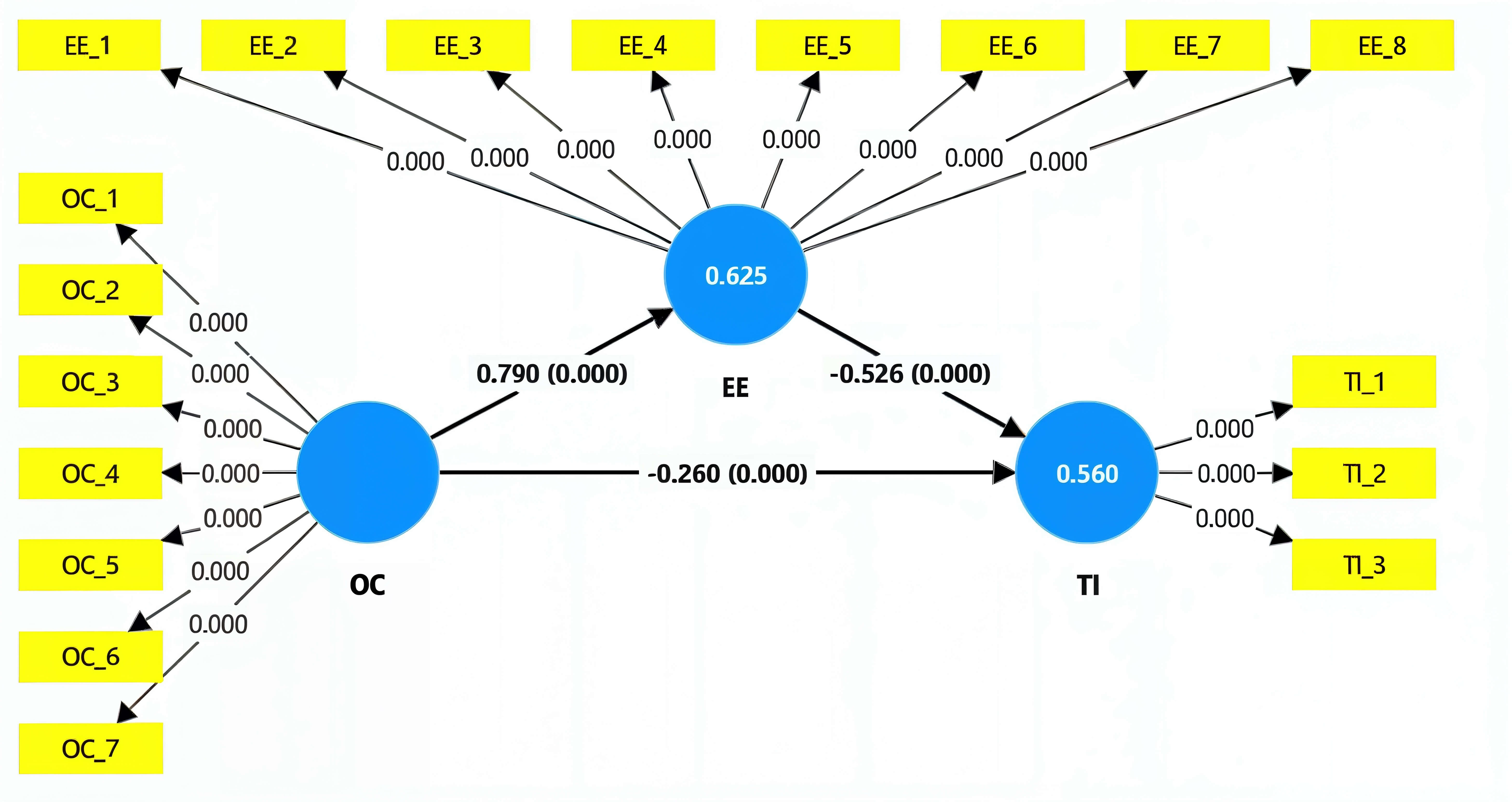
In order to ensure the robustness of the results, a bootstrapping approach was
used to generate 10,000 random subsamples from the original dataset to thoroughly
analyse the structural model. Replacement was enabled during this procedure. The
results of the bootstrapping analysis are presented in Fig. 1, which also
includes the p-values for the calculated path coefficients (
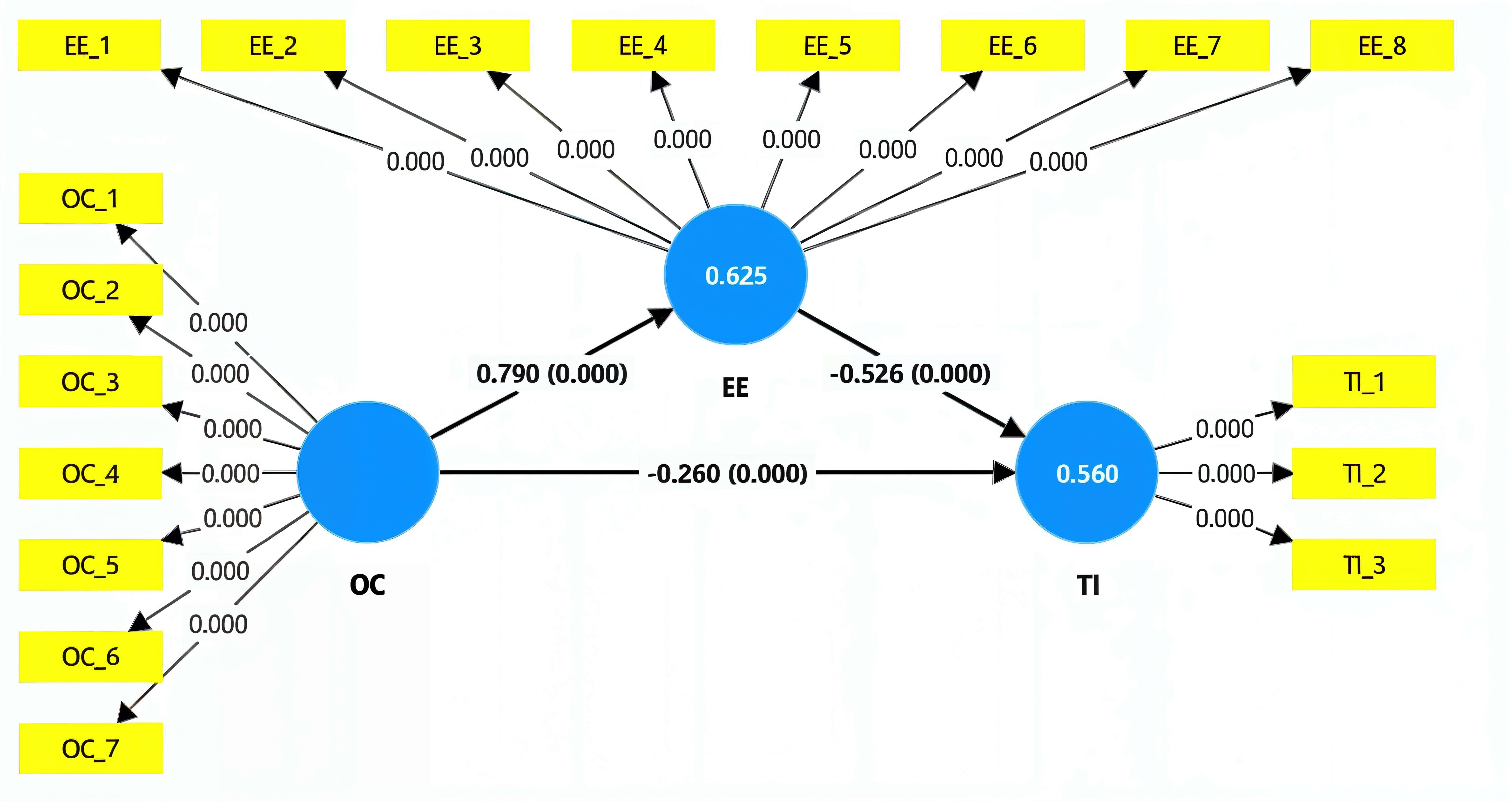 Fig. 1.
The structural model with bootstrapping results.
Table 8 presents the results of PLS-SEM path coefficients and their level of
significance, with the aim of investigating the relationship between variables.
The results revealed that the relationship between organisational climate and
turnover intentions was negative and statistically significant (
| Original sample ( |
T statistics | p values | Hypothesis | |
| OC |
–0.260 | 20.525 | 0.000 | H1: Accepted |
| OC |
0.790 | 28.523 | 0.000 | H2: Accepted |
| EE |
–0.526 | 8.203 | 0.000 | H3a: Accepted |
| OC |
–0.415 | 7.800 | 0.000 | H3b: Accepted |
Table 9 presents the coefficients of determination (R2). The R2 for the EE scale was 0.625. This indicates that 62.5% of the variance in EE was explained by OC, reflecting a moderate predictive relationship. Similarly, the R2 value for the TI scale was 0.560, which indicates that 56% of the variance in TI was explained by OC. This also represents a moderate level of predictive strength, indicating that although employee engagement and turnover intentions are significantly influenced by organisational climate, these outcomes are likely also influenced by other factors.
| R2 | R2 adjusted | Interpretation of values | Criteria (Hair et al, 2011) | |
| EE | 0.625 | 0.626 | Moderate | R2 = 0.25 weak R2 = 0.50 moderate R2 = 0.75 substantial |
| TI | 0.560 | 0.562 | Moderate |
Table 10 presents the results of the effect size (f2). The results indicated a medium effect size of 0.235 for EE on TI, suggesting that increases in employee engagement are associated with a notable reduction in turnover intentions among hospitality employees. Furthermore, the analysis revealed a substantial effect size of 1.666 for the influence of OC on EE, indicating a strong relationship in which organisational climate significantly enhanced employee engagement levels. Conversely, the results demonstrated a small effect size of 0.058 for the relationship between OC and TI, suggesting that while organisational climate has some impact on turnover intentions, this effect is comparatively minor.
| f2 | Effect size | Criteria (Cohen, 1988) | |
| EE |
0.235 | Medium | Above 0.35 large effect |
| OC |
1.666 | Large | 0.15–0.35 medium effect |
| OC |
0.058 | Small | 0.02–0.15 small effect |
To assess the consistency of the findings across Serbia, Montenegro, and Bosnia and Herzegovina, a multi-group analysis was performed using PLS-SEM, accompanied by measurement invariance testing. The results confirmed that the observed patterns held consistently across all three national samples. This indicates that the findings were robust and generalisable across these different country contexts.
The findings of this research align with the SET model. The confirmed negative relationship between a people-oriented organisational climate and employee turnover intentions (Hypothesis 1) underscores the idea that organisational climate plays a significant role in retaining employees. This finding is consistent with SET, which posits that when employees perceive a supportive and positive work environment, they are more likely to reciprocate with loyalty and reduced intentions to leave. A favourable climate fosters psychological attachment by fulfilling employees’ social and professional needs, thereby decreasing the likelihood of turnover. These results align with prior research highlighting the link between organisational climates and reduced turnover intentions (Allen and Meyer, 1996; Karatepe and Karatepe, 2010).
The positive relationship between a people-oriented organisational climate and employee engagement (Hypothesis 2) highlights the role of a supportive work environment in fostering higher levels of employee engagement. Organisational climate—characterized by trust, recognition, and support—encourages employees to invest more fully in their job. This finding aligns with SET (Blau, 1964), which suggests that employees tend to reciprocate favourable treatment with positive organisational behaviours, such as increased engagement. When employees perceive an environment characterised by mutual respect, open communication, and appreciation of their contributions, they are more likely to feel valued and, consequently, exhibit higher engagement. These results are consistent with prior research linking organisational climates with enhanced employee engagement (Saks, 2006).
The negative relationship between employee engagement and turnover intentions (Hypothesis 3a) supports SET (Blau, 1964), which suggests that employees are more likely to remain with an organisation when they perceive the relationship as reciprocal and mutually beneficial. Engaged employees—who feel valued, supported, and recognized—are less inclined to leave, as they experience both tangible and intangible returns from their commitment. These reciprocal dynamics foster loyalty and reduce the likelihood of turnover, consistent with prior findings (Allen and Meyer, 1996; Saks, 2006). Furthermore, the mediating role of employee engagement (Hypothesis 3b) reinforces the theoretical premise of SET by illustrating how engagement translates a people-oriented organisational climate into lower turnover intentions. When employees perceive a climate characterized by trust, recognition, and open communication, they interpret these conditions as meaningful exchanges, increasing their investment in the organisation and diminishing their desire to leave.
The results of this study enhance our understanding of how the SET model operates in the workplace, particularly within the hospitality industry. It underscores the critical importance of fostering an organisational climate that not only boosts employee engagement but also promotes retention.
The practical implications of this study are based on the fact that understanding employee turnover intentions is important for hospitality organisations, their leaders, managers, and human resource professionals. The results clearly show that in order to retain employees in the long term, hospitality management must build and nurture an organisational climate that has a positive impact on employees, as suggested by other studies on this topic (Johnston and Spinks, 2013; Douglas et al, 2017; Malek et al, 2018; Datta, 2020; Lazzari et al, 2022; Xuecheng et al, 2022). Employees’ shared attitudes, beliefs, and opinions about the organisational climate and its core characteristics, which reflect the established norms, values, and processes may have a significant impact on employee behaviour and engagement (Burton et al, 2004). Additionally, based on the qualitative responses to the final open-ended question, several respondents in managerial positions mentioned that completing the questionnaire provided them with valuable insights and ideas for enhancing the organisational climate. Given the large number of participants, it is reasonable to predict that some of the findings from this research will be utilised to reduce employee turnover rates and intentions to leave their jobs and organisations.
This research has several limitations, which, when considered, highlight several potential areas for future research on this topic. Firstly, the conceptual framework included only three variables: people-oriented organisational climate, employee engagement, and employee turnover intentions. Consequently, future studies may adapt this framework to include new variables such as job satisfaction, leadership style, and work-life balance, all of which could have a substantial impact on the relationships between the key constructs. For instance, including job satisfaction could provide useful insights into how employees’ satisfaction with their jobs affects both engagement and turnover intentions. Additionally, leadership style may play a significant role, as research has demonstrated that transformational leadership positively impacts employee engagement (Lai et al, 2020). In the contemporary business environment, work-life balance has a greater impact on employee engagement and turnover intentions (Wood et al, 2020). Secondly, the questionnaire used for data collection consisted mostly of closed-ended questions, limiting respondents’ ability to elaborate on their attitudes, perceptions, and opinions. Therefore, it would be advantageous for future studies to expand the questionnaire by including more open-ended questions, such as “What specific aspects of people-oriented organisational climate contribute to your engagement or disengagement?” or “Can you describe any factors in your work environment that influence your decision to stay or leave?” These open-ended questions would provide more nuanced insights into employees’ personal experiences and allow for richer qualitative data to complement the quantitative results. Thirdly, the Cronbach’s alpha coefficient values exceeded 0.95, suggesting a likelihood of redundancy in the questions (different semantics but similar meanings in some scales), ultimately contributing to a lengthy questionnaire (Seočanac, 2024). In future research, it may be beneficial to eliminate some of the scale questions or refine the measurement items to ensure clearer distinctions between different constructs while maintaining a reliable and concise questionnaire. Fourthly, while the research provides valuable insights into the relationships between people-oriented organisational climate, employee engagement, and turnover intention, it is important to acknowledge a potential limitation regarding common method bias. Since both the independent and dependent variables were measured within the same questionnaire and by the same respondents, future studies could benefit from employing multiple data sources or time points to further reduce the possibility of method-related biases (Kock et al, 2021). Finally, this study uses a combined sample from three countries—Serbia, Montenegro, and Bosnia and Herzegovina. Aggregating data across all three countries may have overlooked important context-specific factors that influence employees’ perceptions of people-oriented organisational climate, engagement, and turnover intentions. Future research could address this limitation by conducting separate analyses for each country or by incorporating national context as a moderating or control variable to better capture cross-cultural differences. Additionally, future studies should encompass a broader range of countries with diverse backgrounds to achieve more generalisable results. For example, similar countries in the region, such as Croatia, North Macedonia, or Albania, could be included in future research. These countries share a similar economic context, cultural heritage, and post-socialist transition experience, making them suitable for comparative studies. Exploring such countries would enhance the generalisability of the findings within the region and allow for a more nuanced understanding of employee turnover intentions across the broader Balkans and Southeastern Europe.
This paper examined and analysed the relationship between a people-oriented organisational climate and employee turnover intentions, as well as the mediating effect of employee engagement in the hospitality industry, drawing on SET as the theoretical framework. Empirical research was conducted using an online questionnaire from October 2023 to February 2024 with 715 participants employed in hospitality. The proposed relationships among people-oriented organisational climate, employee engagement, and turnover intentions were tested using the PLS-SEM method with SmartPLS software (Version: 4.0; SmartPLS; GmbH, Bönningstedt, Germany). The research results confirmed all hypotheses: namely, that people-oriented organisational climate is positively related to employee engagement and negatively related to turnover intentions; that employee engagement is negatively related to turnover intentions; and that employee engagement has a mediating role in the relationship between a people-oriented organisational climate and employee turnover intentions. These findings support the idea that organisational climate fosters reciprocal behaviours, such as engagement and retention, that benefit both employees and the organisation.
Data are available upon request.
PL and JLN conceptualized and designed the study, contributed to the literature review and theoretical framework. PL collected and processed tha data. JLN interpreted the data. PL and JLN resolved reviewers’ comments and revised manuscript. Both authors read and approved the final manuscript. Both authors have participated sufficiently in the work and agreed to be accountable for all aspects of the work.
Not applicable.
This research received no external funding.
The authors declare no conflict of interest.
Questionnaire
The purpose of this questionnaire is to explore employees’ perceptions of the organisational climate, their level of engagement at work, and their intentions regarding staying with their current employer. This survey is completely anonymous—your identity will not be recorded or linked to your responses in any way. All data collected will be used solely for academic research purposes.
Please answer all questions honestly and based on your personal experiences. There are no right or wrong answers - your opinion is valuable.
1. Gender:
◦ Male
◦ Female
2. Age:
◦ Under 30
◦ From 30 to 50
◦ Over 50
3. Education:
◦ Primary School
◦ Secondary School
◦ College
◦ University
4. Country:
◦ Serbia
◦ Bosnia and Herzegovina
◦ Montenegro
5. Length of working experience:
◦ Less than 1 year
◦ From 1 to 5 years
◦ From 5 to 10 years
◦ Above 10 years
6. Please indicate the extent to which you agree with the following statements by selecting a mark from 1 to 7, where: 1 = Strongly Disagree; 2 = Disagree; 3 = Somewhat Disagree; 4 = Neutral; 5 = Somewhat Agree; 6 = Agree; 7 = Strongly Agree
| Scales | Marks |
| People-Oriented Organisational Climate (OC) | |
| My workplace is pleasant (OC_1) | |
| The relationships with my bosses are good (OC_2) | |
| My suggestions about the work are listened to (OC_3) | |
| It is easy to find help when needed (OC_4) | |
| My efforts are adequately rewarded (OC_5) | |
| The atmosphere is not impersonal (OC_6) | |
| I do not feel as though I am treated like a machine or a programmed object (OC_7) | |
| Employee Engagement (EE) | |
| At work, I feel full of energy (EE_1) | |
| When I get up in the morning, I feel like going to work (EE_2) | |
| I find the work that I do full of meaning and purpose (EE_3) | |
| My job inspires me (EE_4) | |
| I am proud of the work I do (EE_5) | |
| Time flies when I am working (EE_6) | |
| I feel happy when I am working intensely (EE_7) | |
| I am immersed in my work (EE_8) | |
| Turnover Intention (TI) | |
| I often think of leaving the organisation (TI_1) | |
| It is highly likely that I will look for a new job next year (TI_2) | |
| If I may choose again, I will not choose to work for the current organisation (TI_3) |
7. We kindly invite you to share any additional comments, reflections, or suggestions regarding your experiences in the workplace, particularly in relation to organisational climate, employee engagement, or turnover intentions. Your feedback regarding this survey is highly valued and will contribute to a more comprehensive understanding of the research topic.
References
Publisher’s Note: IMR Press stays neutral with regard to jurisdictional claims in published maps and institutional affiliations.