

 , Georgiana Oana Stanila 2, Madalina Brutu 1, Carmen Gabriela Secara 3, Violeta Claudia Stanciu Tolea 3
1 Department of Finance, Accounting and Economics, National University of Science and Technology Politehnica Bucharest, 060042 Bucharest, Romania
2 Department of Economic-financial Analysis and Evaluation, Bucharest University of Economic Studies, 52632 Bucharest, Romania
3 Department of Management and Business Administration, National University of Science and Technology Politehnica Bucharest, 060042 Bucharest, Romania
Abstract
This research was conducted to design a framework for the sustainable environmental performance (SEP) of the tourism industry in China. The objective of this study was to investigate the role of green human resource management (GHRM) in improving green innovation (GI). Another aim was to examine the mediating role of GI between GHRM and SEP. Additionally, the current study considered the moderating effect of employee innovative work behavior. The Chinese tourism sector was selected as the unit of analysis. With the help of systematic sampling, we collected data from 481 frontline managers working in the tourism sector. The collected data were analyzed using various statistical techniques, including correlation and structural equation modeling (SEM), and a moderated hierarchical regression approach was applied, yielding several interesting results that support the formulated hypotheses. The findings reveal that GHRM positively predicts GI, which in turn enhances SEP. The findings further establish that GHRM practices and GI are key antecedents of SEP. Finally, we also found that enviropreneurship plays a strengthening role in the relationship between GHRM practices and GI. Given the importance of human well-being and community social concerns, the current study provides valuable insights and recommendations for the improvement of SEP through GHRM and GI.
Keywords
- environmental performance
- green human resources management
- green innovation
- enviropreneurship
- tourism industry
The notion of emerging environmental changes has gained the consideration of management and researchers in the field of environmental management (Kumar and Bhatia, 2021). The increasing concerns over environmental degradation, climate change and resource depletion have compelled the commercial landscape to include ecologically responsible practices for their strategic planning (Doh et al., 2019). In this context, the notion of green human resource management (GHRM) has appeared as a strategic approach that integrates environmental thoughts into traditional HRM practices (Renwick et al., 2013). GHRM practices allow business organizations to create and develop an environmentally committed and conscious workforce to gain sustainable environmental objectives (Lee and Ahn, 2025). During the last few years a trend has been observed that the importance of GHRM has attracted the focus of researchers and firms because of its key role in directing organization towards sustainable environmental performance (SEP) (Rana and Arya, 2024). Similarly, in recent years a large number of organizations incorporated green practices, aiming at the development of an ecological insight and comprehension that helped them to have advantage in SEP over the other competitors in the market (Zhou et al., 2024). Therefore, the main objective of this study was to highlight the role of GHRM practices for the SEP of business organizations.
Business organizations are widely recognizing that apart from environmental performance, sustainability is not a regulatory liability but a source of competitive edge (Lin et al., 2024). Like other business organizations, tourism concerns are also facing challenges of massive competition due to demanding ecological changes (Saviolidis et al., 2021; Li and Liu, 2014). Under these circumstances, SEP cannot be ignored due to its strategic importance for the successful operation and competitive edge of business entities (Elshaer et al., 2021). SEP encompasses minimizing waste, reducing carbon emissions and improving energy in efficient ways, which contribute to the organizational reputation and ecological balance in the long-run (Escrig-Olmedo et al., 2017). Through environmentally focused human resource management practices organizations can develop, promote and encourage organizational members capable of executing and sustaining green innovation (GI) activities (Shah and Soomro, 2023). GI refers to the development of business processes, products and technologies necessary for the minimization of environmental impact and achieving the advantages of environmentally sustainable performance (Azam and Jamil, 2024). However, GI not only focuses on enhancing financial and technological resources but also develops human resources through the improvement of employees’ knowledge, skills, and abilities (Saudi et al., 2019). When organizations embed environmental achievements within their HRM practices, it leads to a workforce that is more motivated to engage in environmental creativity and innovation (Nisar et al., 2021).
It is self-evident that incorporation of GHRM in strategic decision significantly contributes to the adoption of green practices and enhances the GI (Al-Romeedy and Alharethi, 2025; Rong et al., 2025). GHRM practices consist of green recruitment, selection, training, development, and rewards that enable them to develop the workforce intention towards GI (Ojo et al., 2022). Existing literature mostly considered the GI; however, limited deliberation has been made on its causes and effects. Therefore, this research fills this literature gap and proposes that in the current circumstances business organizations can achieve GI with the help of incorporating green HRM strategies that ensure the improvement of environment (Correia et al., 2024). The incorporation of green practices in the business strategic decision becomes the foundational source towards GI (Abedin et al., 2024). An existing study documented that green practices play a key role in the improvement of GI activities (Kuo et al., 2022). Therefore, this study was undertaken to highlight the prediction of GHRM practices for GI.
The current study highlighted the significance of GI for the improvement of natural environment. GHRM practices play a vital role in the implementation of GI activities which are critical for SEP (Aftab et al., 2022). SEP is attained with green business strategies and awareness of business concern about the environmental changes (Awwad Al-Shammari et al., 2022). The green strategic decisions that ensure the GI based on the GHRM practices (Shafaei and Nejati, 2024). Incorporation of green practices in the HRM procedure enables for the achievement of GI that supports the SEP (Nisar et al., 2021). Limited studies deliberated on GHRM practices for the achievement of GI, which is vital for the improvement of overall environmental performance. This study fills the research gap and tries to explain the determinants and outcomes of GI.
Most of the existing studies focused on GHRM, GI and SEP, and examined the direct effect among these constructs (Nisar et al., 2021; Kuo et al., 2022). On the basis of these empirical findings we examined the indirect effect of GI for the connection of GHRM practices and SEP. GHRM practices enable the business firms to build up plans for the improvement of workforce intention towards green environment and GI that significantly contribute to the improvement of SEP. With the help of GHRM business organizations transform traditional human resource practices into green HR practices and create a workforce that is environmentally conscious and committed to green operations that are necessary for GI (Elshaer et al., 2021). Based on the above arguments we considered the mediating role of GI between GHRM practices and SEP.
The aim of this study was to examine the direct effect of GHRM practices on SEP. Existing literature empirically documented that enviropreneurship also promotes the green practices and innovation activities of an organization (Thoo et al., 2014; Jiang et al., 2025). Therefore, in this study we also examined to what extent enviropreneurship strengthens the connection between GHRM practices and GI. Enviropreneurship is concerned with the awareness and knowledge about the environmental issues and various demands of stakeholders towards the protection of natural environment (Nassani et al., 2023). The management stance towards natural environment enables them to incorporate green strategies through which GI can easily promote (Mukonza and Swarts, 2020). Enviropreneurship becomes a pertinent need for initiating green practices in order to respond to environmental changes via GI (Al-Ayed, 2024). On the basis of enviropreneurship, business firms are able to formulate and implement green innovative strategies for the achievement of GHRM and GI (Al-Ghazali and Afsar, 2021).
The conceptual framework of this study is based on the concept of the resource-based view (RBV) of the firm. RBV is concerned with the internal resources such as physical, financial, technology and human resources, which constitute distinctive, extraordinary, valuable and inimitable resources for organizations (Barney, 1991). In line with RBV, it is self-evident that an organization can execute strategic aims with the investment in its HRM systems and resources to enhance the capabilities of its employees (Bowen and Ostroff, 2004). It means that HRM practices enable the creation of inimitability, unique and valuable workforce capabilities through which organizations are able to thrive competitive edge (Bandyopadhyay and Srivastava, 2021). Extending the RBV to the domain of environmental management (Bhandari et al., 2022), documented that interventions to promote employees’ green creativity involve the use of GHRM practices. GHRM practices require green environmental HR practices that facilitate the improvement of employees’ knowledge, abilities and skills (Awwad Al-Shammari et al., 2022). Employees with new knowledge and abilities related to green environment can improve GI. SEP is driven by employees who are directly liable for operational processes. With the help of GHRM, organizations are able to form a platform through which environmental agenda can easily translate into the operational processes (Tang et al., 2018; Haddock-Millar et al., 2016).
The notion of GHRM varies due to its diversified scope and perspective (Al Ketbi and Rice, 2024). GHRM is concerned with various green practices when business entities perform HRM activities (Rana and Arya, 2024). GHRM practices are considered a critical approach to embedding sustainability into various operations and strategies of the business organization (Jabbour and de Sousa Jabbour, 2016). GHRM practices shape employees’ behaviors, skills, and values, which are necessary for supporting organizational green activities and outcomes (Renwick et al., 2013; Jabbour and de Sousa Jabbour, 2016). Based on the review of existing theories and models it is argued that GHRM practices enhance employees’ contribution to the SEP of an organization. These arguments confirm the assumptions of the RBV e.g., and suggest that GHRM practices ensure the development of inimitable and valuable human resources that enable organizations to achieve sustainable objectives. Moreover, GHRM practices support SEP through the efficient use of organization’s existing resources and adoption of circular economy principles (Sahan et al., 2025). GHRM enables organizations to incorporate innovative strategies and develop sustainable green operational processes to respond to environmental change and attain SEP (Shoaib et al., 2025).
GHRM practices can be considered an integral component of strategic decision-making to enhance environmental performance (Correia et al., 2024). GHRM practices promote EP, by integrating green HR practices into operations, thereby facilitating the acquisition of environmental knowledge and the adoption of novel ideas that support SEP (Ojo et al., 2022). According to Nisar et al. (2021) these HRM activities include green hiring, green training, green performance management, and green compensation. Recently, environmental concerns have changed the stakeholders’ views regarding the transformation of traditional HRM activities to GHRM practices (Al-Romeedy and Alharethi, 2025). As a result, new concepts e.g., GHRM have emerged as a planned and strategic approach, mainly concerned with green strategies and business operations that ensure environmental protection (Pooja and Bhavani, 2025). GHRM practices are concerned with the execution of green HR practices that ensure the employees’ participation for the safety of natural resources (Tang et al., 2018).
Hypothesis 1. GHRM practices positively predict SEP.
Due to dynamic environmental challenges, business organizations particularly hospitality and tourism sector cannot ignore the strategic importance of GHRM practices in recent decade (Al-Romeedy and Alharethi, 2025). GHRM practices involve integrating green aspects into HRM processes to improve the natural environment (Mo et al., 2025; Lee and Ahn, 2025). Simply, GHRM practices major concern is to emphasize green and innovative HRM practices that respond to environmental challenges and address stakeholder pressures. Due to stakeholder pressures, emerging polices and environmental laws business organizations are bound to incorporate green strategies as part of their strategic planning (Jiang et al., 2025). Existing literature has significantly recognized the role of GHRM for the execution of green practices that ensure the employees’ stance towards creativity (Ren et al., 2018). Existing literature in the field of innovation management deliberated on the role of GHRM for innovation (Shoaib et al., 2025).
GI refers to practices implemented by organizations to improve the natural environment while achieving the basic objectives and gaining environmental benefits (Al-Ayed, 2024). Existing studies have suggested the role of HRM for the improvement of employees’ creative thinking with acquired knowledge and skills, which promote the innovation process of an organization (Seeck and Diehl, 2017; Zhou et al., 2024). Based on existing literature and theoretical deliberation, we argue that GHRM practices positively influence GI. For instance, green hiring one of the components of GHRM improves the organization’s attractiveness regarding the environmental concerns (Wagner, 2013). Environmental knowledge of employees enables them to create new ideas for the improvement of organizational environmental management, which in turn ensure the GI. GHRM practices like green hiring ensure the active participation of employees in green environmental practices to improve GI (Renwick et al., 2013).
The second component of GHRM i.e., green training and development enables the employees to acquire the knowledge, abilities, and skills necessary for the involvement in creativity and innovation (Chowhan, 2016). Green training provides opportunity to gain insights into the organization’s environmental stance (Longoni et al., 2014), such information and knowledge play an important role in generating novel ideas for green operational processes that enhance the GI (Chen and Chang, 2013). Furthermore, green involvement and development activities promote pro-environmental behavior, ensuring the effective utilization of employees’ green skills and knowledge, thereby improving GI (DuBois and Dubois, 2012). The third GHRM practices i.e., green performance management and rewards ensure the alignment of workforce behavior towards organizational environmental management and goals (Guerci et al., 2016). According to Renwick et al. (2013), green performance management plays an important role in the improvement of employee commitment towards the protection of natural environment, and improves their willingness to participate in GI activities.
Finally, the existing literature on HRM confirms that HRM systems play a positive and significant role in the attainment of innovation activities of an organization (Chowhan, 2016), which suggests that complementary HR practices have a strategic and influential role in the participation of employee’ towards innovation activities of an organization instead of individual HR practices. Therefore, in this study we consider green hiring, training and development, rewards and performance management as three dimensions of GHRM practices as a whole, which in turn facilitate for GI. GHRM practices facilitate for the promotion of workforce motivation, ability and opportunities, thereby improving their unique understanding of GI. Therefore, we formulated that:
Hypothesis 2. GHRM practices positively predicted GI.
Most existing research findings suggest a link between GHRM practices and productivity, competitive performance and innovation of an organization (Lin et al., 2024; Al Ketbi and Rice, 2024), and are regarded as a vital and essential element in the progress of a firm in terms of creativity, performance and getting a competitive edge (Shafaei and Nejati, 2024). Different techniques and technological innovations have played their part in the transformation of traditional way of HRM to GHRM (Shah et al., 2024; Abedin et al., 2024). The development and improvement in GHRM have been significant and contributed significantly towards improvement of the organization’s performance (Correia et al., 2024). However, empirical findings suggest that the competitive edge offered by implementing green practices remains limited and underexplored. One major factor is the lack of understanding at all organizational levels regarding how processes, procedures and operations provide a competitive performance edge and in terms of the procedures by which such investments can be made in GHRM practices. However, one striking fact is that an increasing number of companies are exploring new avenues in green business practices, whereas, research on the fabrication of GHRM in organizations is quite rare and little knowledge is available on which HRM practices of an organization should be strengthened and leveraged to innovate and improve environmental performance (Rana and Arya, 2024). GI is concerned with the practices and operational activities that are novel and beyond the usual processes and supports the safety and sustainability of natural environment (Zhou et al., 2024). In the recent decades, creativity and innovation have played a vital role in the successes of business organizations (Song et al., 2023).
Organizations adopt various GHRM practices that enable the business firms to develop the capabilities of employees for the enhancement of environment and also enhance their green knowledge and abilities that ensure the GI. Existing studies deliberated on the notion of GHRM mechanism of business organizations for the improvement of environmental and GI; however, limited studies explained the indirect effect. Limited studies deliberated on the connection between GHRM practices and EP; however, some researchers e.g., Hameed et al. (2020) and Raza et al. (2022), examined indirect relationship of these constructs. Therefore, the aim of this research was to explain the clear connection between GHRM practices, GI and SEP.
A previous study provided that an organization with continuous and updated green strategic decisions regarding the GHRM increases the formulation of innovation strategies (Song and Yu, 2018). GI mechanism promoted with the implementation of sound green HR activities regarding the green environment. Existing study suggested the role of HRM for the improvement of employees’ creative thinking with acquired knowledge and skills, which promote the innovation process of an organization (Awwad Al-Shammari et al., 2022). GHRM practices are mainly concerned with the improvement of environmental knowledge and sensitivity among organizational members and alignment of existing HR resources to improve the environment and well-being of human beings (Al-Romeedy and Alharethi, 2025). Business organization adopts GHRM practices in order to enhance employee capabilities essential for creativity and GI activities (Zhou et al., 2024).
The existing study in the context of circular economy suggested that GI gains strategic significance for the survival of the organization in today’s dynamic business world (Seman et al., 2019). Reason behind this strategic importance is GHRM practices that ensure the positive contribution of business entities towards the protection of natural resources (Raza and Khan, 2022).
It is obvious that for the achievement of SEP business organization needs GI (Shoaib et al., 2025). The process of GHRM depends on a series of green practices that are necessary for the safety of natural environment (Sahan et al., 2025). Therefore, SEP can be attained with green strategies, i.e., GI, which can be effectively established with the help of GHRM practices (Jiang et al., 2025). With the help of GI organizations are able to enhance the EP (Ojo et al., 2022). GI mechanism is an essential source for the SEP through the execution of GHRM practices (Aftab et al., 2022; Saudi et al., 2019).
Hypothesis 3. GI positively predicted SEP.
Hypothesis 4. GI positively mediated the link between GHRM and SEP.
GI ensures green innovative activities, on the other hand, enviropreneurship is the tendency of top management towards the environmental concerns and social well-being of communities (Thoo et al., 2014). This tendency provides a foundation for the incorporation and execution of innovative green activities (Moghimi and Alambeigi, 2013). Yasir et al. (2020) suggested that management’s environmental stance has a positive role in shaping the green HR strategies in innovative ways. Therefore, enviropreneurship means that management continuously gains updated knowledge regarding the environmental concerns of various stakeholders, which strengthens the GHRM practices and GI link positively (Song et al., 2023). Enviropreneurship is the management capability towards the understanding of various societal and environmental information and awareness (Nassani et al., 2023), which ensures the incorporation of green HR strategies in strategic planning of business concerns (Mukonza and Swarts, 2020). Business entities with enviropreneurship stance are able to participate in GI activities, due to updated information regarding environmental changes. Enviropreneurship ensures the configuration of GHRM practices into GI strategies. Therefore, in this study we assumed that enviropreneurship play a moderating role on the GHRM practices and GI link:
Hypothesis 5: Enviropreneurship positively moderates the link between GHRM practices and GI.
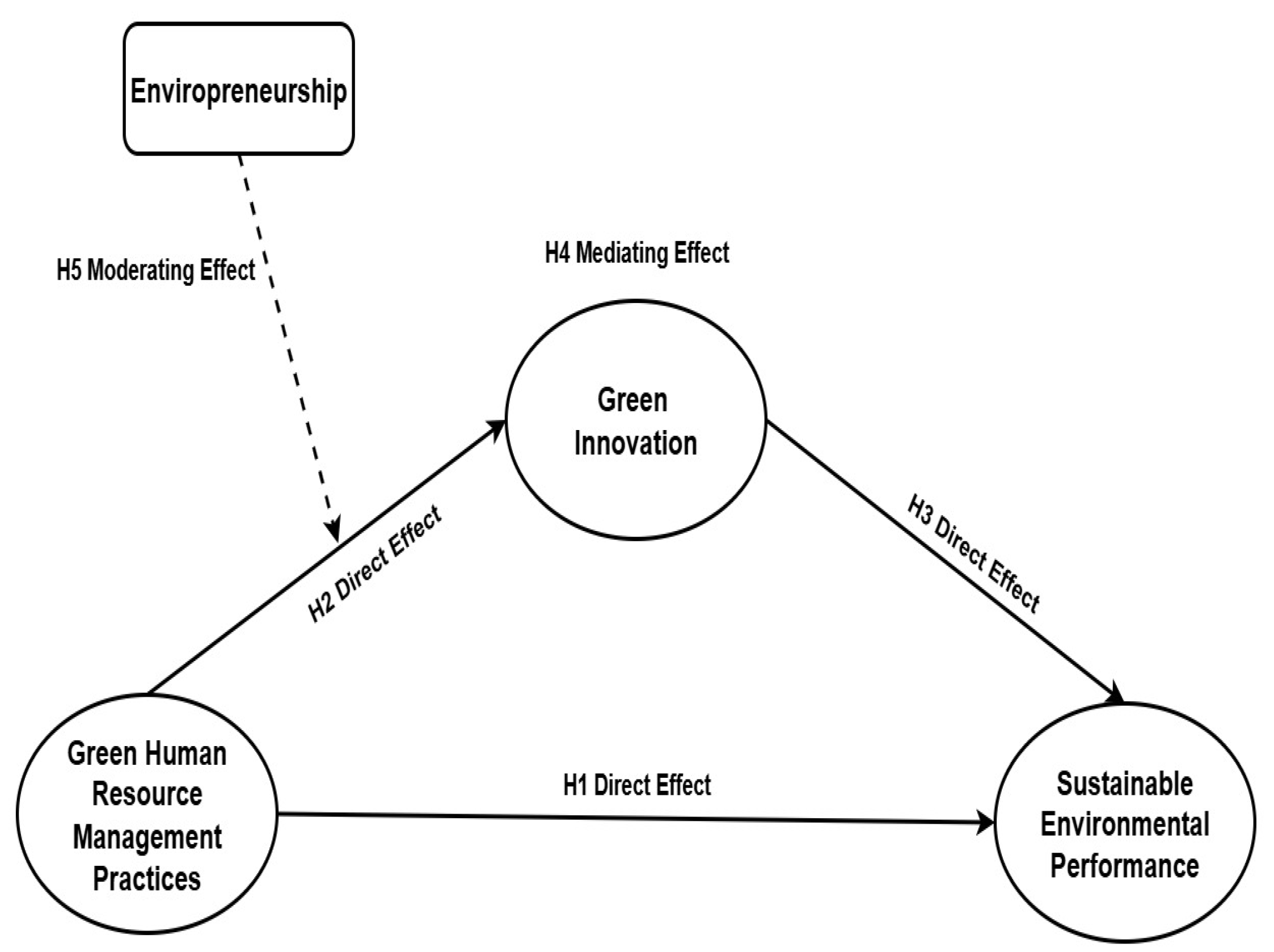
Fig. 1 shows the direct path from GHRM practices to GI and SEP. Also the indirect path from GHRM practices to SEP with mediating role of GI. Furthermore, the moderating role of enviropreneurship is also depicted in Fig. 1.
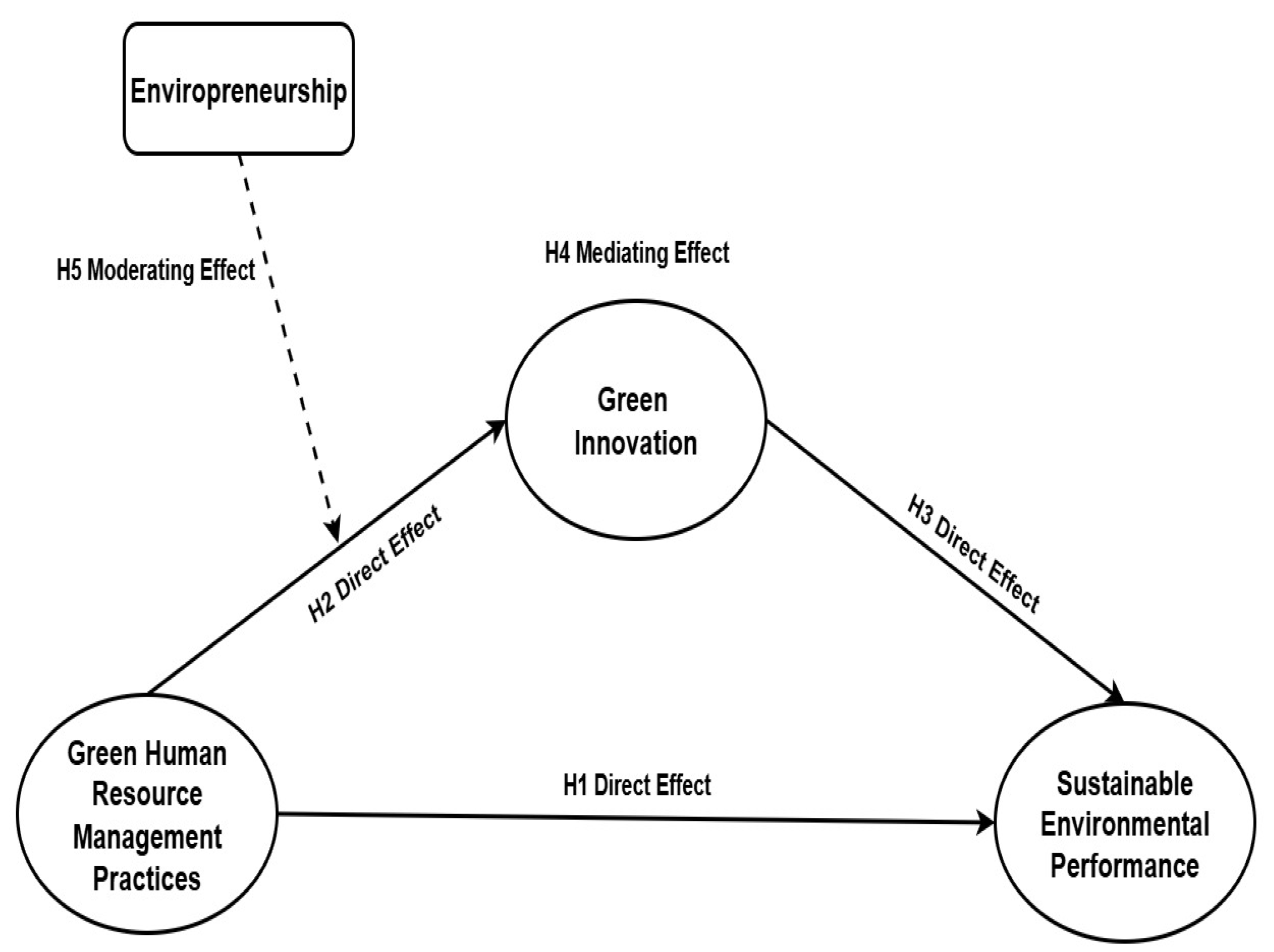 Fig. 1.
Conceptual model and hypotheses of the research.
The current study was quantitative in nature therefore; a cross-sectional approach was applied with a survey method for data collection. Cross-sectional approach enables the researchers to collect data from respondents at a single point. Data was collected with the help of a questionnaire based on the literature of GHRM practices, GI, enviropreneurship and SEP. The target population consists of front-line managers of tourism sector in second tire cities of China. Sampling frame was drawn by contacting the Chinese Ministry of hospitality and tourism established in second tire cities, for the collection of initial information about the target population and study respondents. For data collection the services of 4 research assistants were hired. Initially, 950 respondents were approached during data collection process and received 481 responses from selected respondents with a response rate of 51% of selected sample. Finally, 447 responses completed in all respects were used for analysis. Table 1 shows the respondent characteristics.
| Number | Percentage (%) | ||
| Gender | Male | 392 | 87.70 |
| Female | 55 | 12.30 | |
| Age (in years) | 22–30 | 117 | 26.17 |
| 31–35 | 143 | 31.99 | |
| 36–40 | 86 | 19.23 | |
| 41–50 | 94 | 21.03 | |
| Above 60 | 7 | 1.56 | |
| Qualification in years | 12 | 21 | 4.70 |
| 14 | 76 | 17.00 | |
| 16 | 221 | 49.44 | |
| More than 16 | 129 | 28.86 | |
| Total working experience | 1–9 years | 29 | 6.49 |
| 10–15 | 109 | 24.38 | |
| 16–20 | 212 | 47.43 | |
| 21–25 | 49 | 10.96 | |
| 26–30 | 21 | 4.70 | |
| Above 30 | 27 | 6.04 |
The measurement items were based on previous studies relating to the GHRM practices, GI, enviropreneurship and SEP. All the measures were adopted from the work of previous researchers.
GHRM practices are used as a predictor of GI and SEP. The measurement scale was used to record the responses of frontline managers regarding the formulation and coordination regarding green HR practices. We adopted the measures of GHRM practices based on 18 items with their four dimensions developed by Masri and Jaaron (2017) and Jabbour (2011).
SEP is measured with 03 items formulated by Jabbour and de Sousa Jabbour (2016). Respondents were asked about the EP of the organization.
GI was used as a mediating variable in the current study. GI measure consists of two dimensions, with 07 items scale developed by Chen et al. (2006). The enviropreneurship is used as a moderating variable on the connection between GHRM practices and GI. The construct of enviropreneurship is measured using 05 items scale formulated and used by Menguc and Ozanne (2005) for the measurement of enviropreneurship. Table 2 contains the measurement items for the study constructs.
| Constructs | Dimensions | Items | Loading | AVE | C.R |
| GHRM | Green Training | GT1 Use of environmental training | 0.82 | 0.66 | 0.90 |
| GT2 Considers environmental issues at the time of training analysis | 0.85 | ||||
| GT3 Provides training regarding environmental issues at the time of induction | 0.79 | ||||
| GT4 Reduce paper cost for training | 0.83 | ||||
| GT5 Environmental training is a priority for our hotel | 0.77 | ||||
| Green PM | GPM1 Employees are aware about green goals and responsibilities | 0.91 | 0.73 | 0.94 | |
| GPM2 Performance appraisal contained environmental management | 0.87 | ||||
| GPM3 Employees green outcomes are the part of performance appraisal | 0.81 | ||||
| GPM4 Managers provide feedback on environmental initiatives | 0.82 | ||||
| GPM5 Environmental targets are included in the performance evaluation | 0.86 | ||||
| Green R&S | GRS1 Job specification contained environmental concerns | 0.80 | 0.70 | 0.92 | |
| GRS2 Environmental performance of our hotel attracts qualified staff | 0.89 | ||||
| GRS3 Awareness about environmental issues are the main criterion in selection process | 0.85 | ||||
| GRS4 Recruitment messages include environmental commitment criteria | 0.77 | ||||
| GRS5 Jobs are designed by focusing on the environmental management aspects | 0.84 | ||||
| Green Reward and Compensation | GRC1 Suggestions for environmental initiative are rewarded | 0.89 | 0.72 | 0.88 | |
| GRC2 Environmental achievements are rewarded with non-monetary and monetary rewards | 0.85 | ||||
| GRC3 Environmental accomplishments are publicly recognized | 0.81 | ||||
| GI | Green product innovation | My organization uses materials that… | |||
| GPI1 produce least pollution | 0.80 | 0.65 | 0.88 | ||
| GPI2 consumes less resources and energy | 0.79 | ||||
| GPI3 help to design green product | 0.82 | ||||
| GPI4 are easy to decompose, reuse and recycle | 0.83 | ||||
| Green process innovation | The services process successfully reduces… | ||||
| GPI5 hazardous waste or substance | 0.78 | 0.66 | 0.85 | ||
| GPI6 consumption of water and electricity | 0.85 | ||||
| GPI7 use of raw material | 0.80 | ||||
| SEP | SEP | Our organization… | |||
| SEP1 … has policies in action to support and encourage green practices | 0.89 | 0.74 | 0.89 | ||
| SEP2 … support and motivate ecological behavior | 0.87 | ||||
| SEP3 … assesses environmental responsibility’s efficacy | 0.83 |
AVE, average variance extracted; C.R, composite reliability; GHRM, green human resource management; PM, performance management; R&S, recruitment & selection; GI, green innovation; SEP, sustainable environmental performance.
For testing the formulated study hypotheses, we applied Partial Least Squares Structural Equation Modeling (PLS-SEM) using SmartPLS version 4.0.9.6 (SmartPLS GmbH, Oststeinbek, Germany), a method of SEM and IBM statistical package for social sciences (SPSS) Statistics version 28.0 (IBM Corp., Armonk, NY, USA).
Table 3 presents the results of the CFA model and indicating that it is an
appropriate model of research variables. Our research hypothesis 4-factor model
was best model and showed keys are
| Model detail | Df | RMESA | GFI | CFI | ||
| Hypothesized model | 1056.87 | 485 | 2.179 | 0.05 | 0.92 | 0.93 |
| Three-factor | 1168.25 | 365 | 3.201 | 0.13 | 0.84 | 0.85 |
| Two-factor | 1225.54 | 385 | 3.183 | 0.18 | 0.72 | 0.73 |
| Single-factor | 1385.42 | 365 | 3.796 | 0.22 | 0.64 | 0.65 |
CFA, Confirmatory Factor Analysis; Df, degree of freedom; RMESA, root mean square error of approximation; GFI, goodness of fit index; CFI, comparative fit index.
In the survey-based data collection procedure, common method bias (CMB) becomes a serious issue. Due to self-reported measures in the current study we conducted Harman’s single factor test using SPSS with exploratory factor analysis to calculate the degree of CMB. These outcomes confirmed that CMB and risk of inflated correlation are not a serious issue for the current study.
For the current study we also test the multicollinearity, to ensure that
independent variables are not highly correlated. In the presence of a
multicollinearity problem, it becomes difficult to examine the individual
prediction of each construct. In the current study multicollinearity is not a
serious issue as the coefficients of correlation among independent variables are
less than
| Items | Cronbach’s Alpha | Factor loading | Composite reliability | AVE | |
| GHRM practices | 18 | 0.79 | 0.73–0.91 | 0.82 | 0.68 |
| GI | 08 | 0.79 | 0.73–0.91 | 0.80 | 0.69 |
| SEP | 03 | 0.76 | 0.70–0.88 | 0.80 | 0.71 |
| Enviropreneurship | 05 | 0.81 | 0.72–0.95 | 0.83 | 0.70 |
Table 5 contained the results of correlation among study variables. The findings revealed that GHRM practice has significant direction towards GI (0.43*), enviropreneurship (0.39*), and SEP (0.41*). Moreover, the correlation statistics also confirmed that GI has a positive direction towards SEP (0.45*).
| Constructs | Mean | SD | GHRM practices | GI | Enviropreneurship | SEP |
| GHRM practices | 3.9 | 0.81 | 1 | |||
| GI | 3.3 | 0.87 | 0.43* | 1 | ||
| Enviropreneurship | 3.8 | 0.93 | 0.39* | 0.42* | 1 | |
| SEP | 3.6 | 0.90 | 0.41* | 0.45* | 0.36* | 1 |
Note: * p
Before testing the study hypotheses, we confirmed the research model for reverse
causality or endogeneity. To draw accurate causal inferences of GHRM practices,
we applied a one-period lag of GHRM practices and re-estimated our regression
using lagged values of GHRM as a predictor. The outcomes revealed that GHRM (t-1)
remained substantial and coefficient of GHRM practices remained significant and
positive with a significant value (p
The formulated hypotheses of this study were tested with the help of SEM approach. Table 6 shows the statistics relating to the direct paths of the conceptual framework. Study hypotheses 1 to 3 show the direct association among the study constructs. H1 represents the direct path from GHRM practices to SEP. The path coefficients (0.40**) confirmed that GHRM practices significantly predict SEP, hence we accept the H1. The study H2 presented that GHRM practices positively predicted the GI. The path coefficients (0.42**) confirmed that GHRM practices significantly predict GI, hence we accept the H2. Moreover, H3 represents the direct path from GI to SEP. The path coefficients (0.44**) confirmed that GHRM practices significantly predict SEP, hence we accept the H3.
| Paths | Estimates | Standard error | C.R (t-value) |
| SEP |
0.40 | 0.063 | 6.349** |
| GI |
0.42 | 0.055 | 7.636** |
| SEP |
0.44 | 0.059 | 7.457** |
Note: ** p
Hypothesis 4 represents the mediation effect of GI on the connection between
GHRM practices and SEP. H4 represents that GI positively intervenes between the
connection of GHRM practices and SEP. The coefficient shown in Table 7 confirmed
the mediation effect of GI, i.e., GHRM practices
| Path | Estimate | SE | t-value/C.R | p-value | |
| Standardized direct impact | |||||
| GHRM practices |
0.43** | 0.08 | 5.37 | ||
| GI |
0.40** | 0.06 | 6.67 | ||
| GHRM practices |
0.25* | 0.09 | 2.77 | 0.002 | |
| Indirect effect (Bootstrapped) | |||||
| GHRM practices |
0.22** | Bootstrapped | |||
| Total effect | |||||
| GHRM practices |
0.57** | 0.07 | 8.14 | ||
Note: * p
In order to address potential endogeneity among GHRM practices, GI and SEP, we
applied Durbin-Wu-Hausman (DWH) test. This robustness test outcomes are reported
in Table 8. The statistics of DWH confirmed that GHRM practices are endogenous
(
| Constructs | p-value | Endogeneity | |
| GHRM practices | 6.34 | 0.003 | Endogeneity (OLS not appropriate and IV required) |
| GI | 1.90 | 0.145 | Exogenous (OLS appropriate) |
Note: A significant p-value (
After DWH test for assessing the endogeneity of the study constructs’, which
indicated endogeneity of GHRM practices, we re-estimated the structural model
using IV regression. Regional green policy intensity was selected as an
instrument, as it probably affects the adoption of GHRM practices. The findings
of IV regression confirmed the robustness of base line outcomes generated for
study model. The findings revealed that GHRM practices (
The current study H5 represents the strengthening role of enviropreneurship on
the association between GHRM practices and GI. Table 9 presents the findings of
hierarchical regression that confirm the moderation of enviropreneurship. We
entered control variables in model 1, then added independent and moderating
variables in model 2, and finally entered the interaction term, i.e., GHRM
practices
| Predictor | Model 1 (Control) | Model 2 (Main effect) | Model 3 (Interaction) | |||||||
| SE | t-value | SE | t-value | SE | t-value | |||||
| Control variables | 0.11 | 0.08 | 1.38 | |||||||
| GHRM practices | 0.36** | 0.05 | 7.20 | 0.43** | 0.09 | 4.77 | ||||
| Enviropreneurship | 0.32** | 0.04 | 8.00 | 0.36** | 0.07 | 5.14 | ||||
| GHRM × Enviropreneurship | 0.21* | 0.08 | 2.63 | |||||||
| Model statistics | ||||||||||
| R2 | 0.32 | 0.36 | 0.38 | |||||||
| Adjusted R2 | 0.31 | 0.33 | 0.35 | |||||||
| — | 0.11 | 0.04 | ||||||||
| 283.22** | 51.43** | 19.18** | ||||||||
| p-value | 0.004 | |||||||||
Note: * p
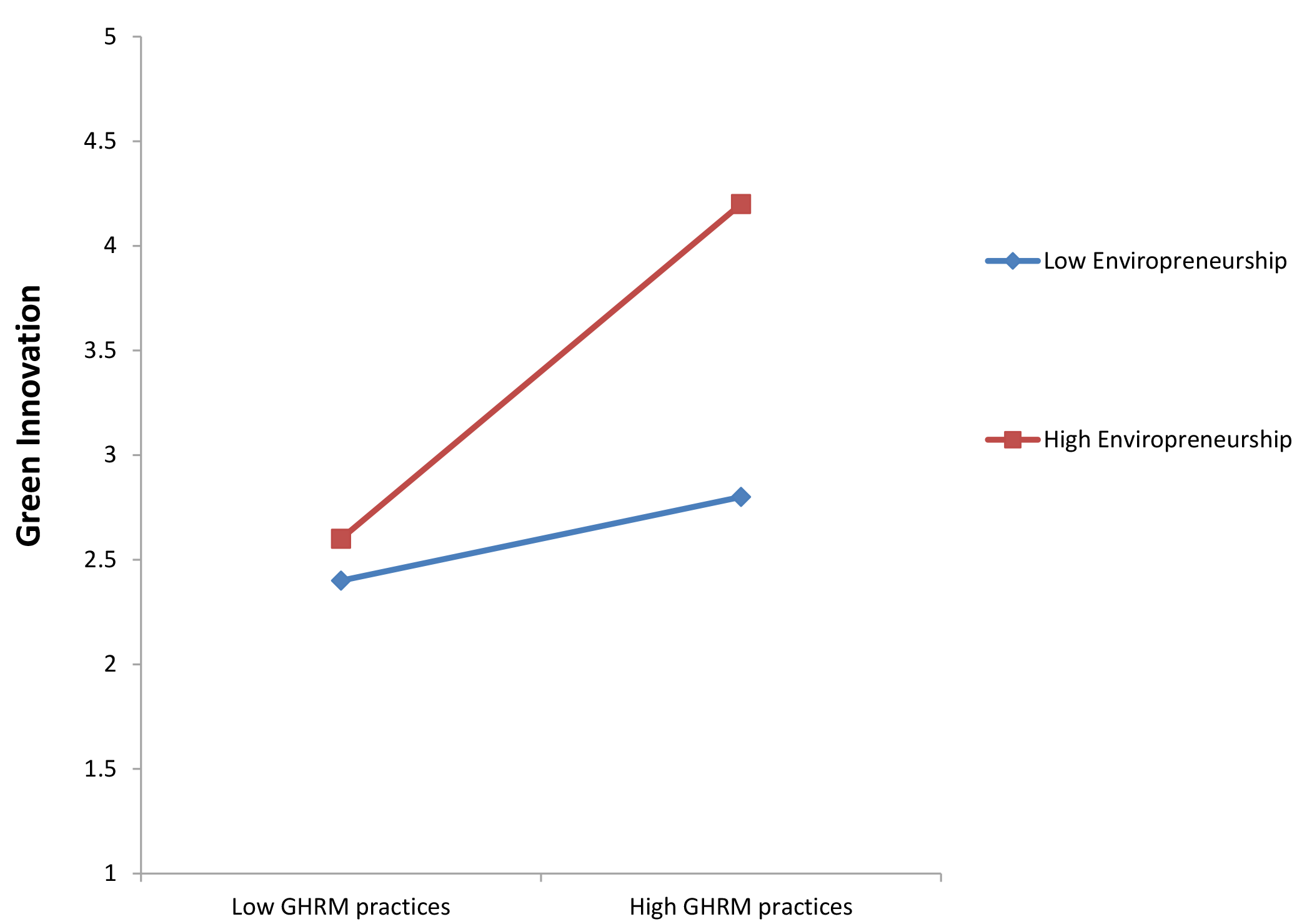
In addition to hierarchical regression we also conducted slope analysis for
testing the moderating effect of enviropreneurship. The outcomes presented in
Fig. 2 that confirmed the significant coefficient for the interaction term, i.e.,
GHRM practices
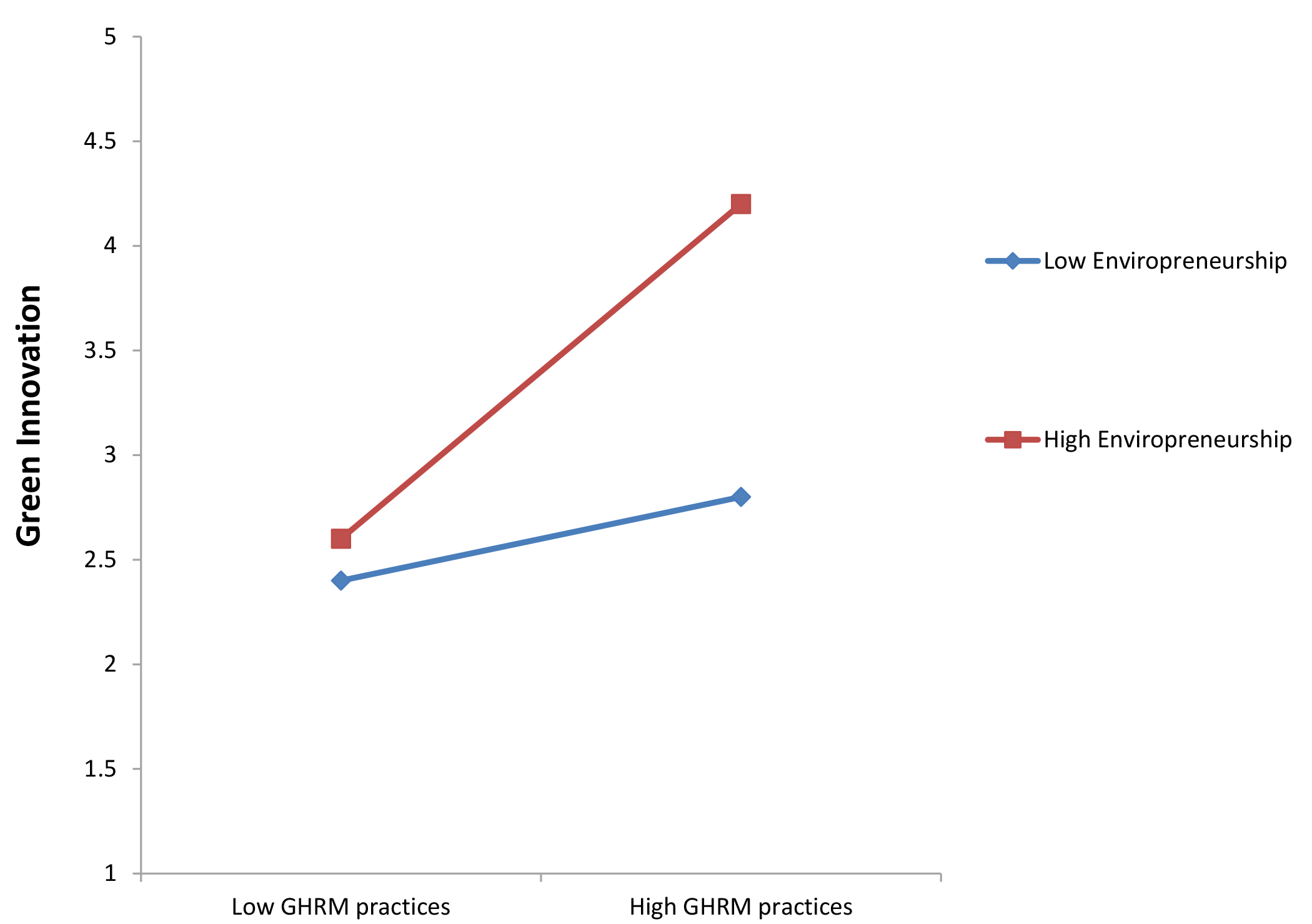 Fig. 2.
Slope analysis for the interaction of GHRM practices and enviropreneurship.
Due to global warming and ecological concerns, GHRM has a significant importance and high preference for achievement of GI and SEP. Therefore, in this study we examined the association among GHRM practices, GI, enviropreneurship and SEP formulating 5 hypotheses. H1 showed the prediction of GHRM practices for SEP. The outcomes of various statistics confirmed that GHRM practices significantly predict SEP. The analysis of hypothesis testing supports and extends the work of Pooja and Bhavani (2025); Ojo et al. (2022). Existing studies in the context of HRM empirically found that GHRM practices contribute positively to the improvement of natural environment via innovation and green HR practices in HRM and operational activities.
The study H2 examined the prediction of GHRM practices for GI. The outcomes
confirmed the prediction of GHRM practices for GI (H2. GHRM practices
The study H3 explained that GI positively predicted the SEP (H4. GI
The H4 was formulated for testing the mediation of GI for GHRM practices and SEP
link. The results confirmed the mediating effect on the association between GHRM
practices and SEP (H4. GHRM practices
Finally, H5 represents the moderating effect of enviropreneurship on the
connection between GHRM practices and GI. The results (H5. GHRM practices
The current study significantly contributes to the existing literature on GHRM, as we adopted a moderated mediation model. Existing studies have only considered direct and linear associations among GHRM practices, GI and SEP. At first glance results that are derived from the research, suggest that if the tourism industry encourages sustainable green practices like GHRM (including green hiring, green training, green performance management and green compensation) it has a great influence on GI and SEP. The main focus of the research is on the GHRM practices, GI, enviropreneurship and SEP. The findings add to the previous works of the research done from the perspective of direct effect of GHRM practices for GI. This study contributes to existing body of knowledge and theory of GHRM, with the insertion of mediation of GI between GHRM practices and SEP.
Moreover, the current study is one of the few to test GHRM-GI-SEP model in the contexts of second tire cities of China. These selected cities represent rapidly developing and unexplored context regarding the efforts for sustainable green and environmental outcomes. The Chinese government made efforts for the development of hospitality sector based on “two-mountain theory” that certifies the green and environmental transformation (Huang et al., 2024). Two-mountain theory planned by Xi Jinping, offers guidelines for the adoption of green practices for the attainment of environmental sustainability in the context of China’s ecological governance. Furthermore, international sustainability frameworks, e.g., United Nations, Sustainable Development Goals (SDGs) and Two Mountains Theory heighten environmental stewardship, but the China’s environmental approach is based on normative governance, centralized formation and integrated with national ideology (Zhang et al., 2021). Existing studies (including the cited works) explored the connection among these constructs contribute to the existing literature as the existing studies such as Azam and Jamil (2024) and Shah and Soomro (2023), focused on manufacturing and SMEs sectors of Middle Eastern and South Asian economies.
The study in hand contributes to the existing body of knowledge as we formulate and test a research model that represents the prediction of GHRM practices for SEP which has enriched the understanding of unexplored consequences of GHRM practices mechanisms from the perspective of Two Mountains Theory. Moreover, the mediation role of GI advances the perception of management to formulate and incorporate green HR activities in their processes to enhance the environmental and innovation performance.
Finally, the findings of this study counterpart the literature on enviropreneurship, as very little work has been done in the past literature. Therefore, this research has projected new ways for enhancing the GHRM practices and GI of tourism industry with the mechanism of GI and enviropreneurship.
The current study suggested various implications for the management of tourism concerns. The findings revealed that management should consider the green HR practices including green hiring, green training, green performance management and green rewards to achieve innovation in green practices and EP. Given value and preferences to these sustainable green practices management should improve SEP. To achieve SEP, management should consider the GHRM practices from the perspective GI and must be made compulsory and environmental-based. Therefore, management of tourism sector must focus on the GHRM practices for developing employees’ understanding regarding the ecological issues.
Management perception and awareness regarding social well-being and protection of natural environment affect the decision making. Management should incorporate necessary green practices adjustments in their strategic HR planning process that is aligned with the improvement of GI. Based on these adjustments management is able to respond to environmental changes and improve SEP. Management should formulate and incorporate eco-friendly practices that ensure the ecological performance as per the demands of various stakeholders in order to promote the green activities that can be made on a high level to derive sustainability in EP.
Although the current study has several contributions to the existing body of knowledge and particularly in the context of tourism concerns, there are some limitations. Previous studies have focused on numerous factors related to SEP, including business networks, organizational learning, and organizational structure. The current study used a single-informant approach, which could mitigate potential problems. However, multiple responses from a single enterprise are essential for the validity of results. In the study, we examined GHRM practices by exploring its four sub-dimensions, which could be further enhanced in the future. The data taken for this study were cross-sectional, and they may be analyzed longitudinally in the future. Additional avenues for future research based on this study include exploring the developmental process of GHRM practices by examining all dimensions. In the future, other outcomes of GHRM practices should be analyzed, such as social responsibility and digital environmental performance. In the digitalization, in fact, exploring and integrating environmental performance and social responsibility are essential for fostering innovation, maintaining competitive advantage, and ensuring sustainable protection of natural environment. Organizations that effectively manage these elements are better positioned to adapt to changes, seize new opportunities, and drive long-term success and SEP. Finally, this study also showed age and sample representativeness limitations. These demographic variations could potentially influence the generalization of the study findings and external validity of the observed associations. Therefore, future studies should consider the diverse demographic characteristics across age groups, gender and industries to ensure validity and broader application of the conclusions.
The current study uses primary data collected from the front-line management of tourism industry to predict the impact of GHRM practices on GI and SEP. In order to test the effect of GHRM practices on GI and SEP, we formulated five hypotheses. First hypothesis shows the prediction of GHRM practices for SEP of tourism sector. The findings confirmed that GHRM practices are a valuable source for the improvement of SEP of tourism industry. Second hypothesis was formulated for the connection between GHRM practices and GI. The findings of the study also confirmed the positive association between GHRM practices and GI. The study hypothesis three was formulated for the prediction of GI for SEP. The findings confirmed that GI is also positively connected with SEP. Moreover, study hypothesis four confirmed the mediation effect of GI on the connection between GHRM practices and SEP. The findings of current study suggested that intervening role of GI between GHRM practices and SEP, contributes to an innovation-oriented view of sustainable development of tourism sector. The direct effect of GHRM practices on GI enriches the RBV, considering intellectual capital as a strategic source of environmental sustainability. Finally, study was formulated five hypotheses for the strengthening role of enviropreneurship on GHRM practices and GI link. The findings confirmed that a stronger enviropreneurship stance in tourism management enhances green creativity and improves the GI activities of the tourism sector.
Data will be available on request from the corresponding author.
MR: Conceptualization, Investigation, Formal analysis; GOS: Methodology, Data curation; MB: Validation, Software, Visualization; CGS: Writing-original draft, Data curation, Conceptualization, Supervision, Investigation; VCST: Conceptualization, Writing-review & editing. All authors contributed to editorial changes in the manuscript. All authors read and approved the final manuscript. All authors have participated sufficiently in the work and agreed to be accountable for all aspects of the work.
We would like to express my gratitude to all those who helped us during the writing of this manuscript.
This research received no external funding.
The authors declare no conflict of interest.
References
Publisher’s Note: IMR Press stays neutral with regard to jurisdictional claims in published maps and institutional affiliations.