

 , Suresh Ramakrishnan 1,3, Hamid Ghazi H Sulimany 4, Saleh F.A. Khatib 1,3, Abdulrahman Atllah Alharbi 4
1 Faculty of Management, Universiti Teknologi Malaysia (UTM), 81310 Johor Bahru, Malaysia
2 Accounting Department, Business Administration College, Shaqra University, 11961 Shaqra, Saudi Arabia
3 Faculty of Business, Sohar University, 311 Sohar, Oman
4 Accounting Department, Business Administration College, Taif University, 21974 Taif, Saudi Arabia
Abstract
This study explores the moderating effect of board financial expertise on the relationship between financial sustainability and firms’ resilience. The research sampled 164 firms from 2017 to 2023 and analysed the data using the fixed effects panel method. It was found that financial sustainability has a positive effect on firms’ resilience, supporting stakeholder and signalling theories. The moderation model reveals that board financial expertise moderates this relationship. The results suggest that firms with strong financial systems are better equipped to manage stock return volatility and other market shocks. Additionally, the findings suggest that board expertise may enhance board monitoring and counsel, enabling firms to effectively manage risks and curtail adversities for long-term value creation. The outcome may equip managers and policymakers with new strategies for enhancing corporate stability and promoting sustainable growth in the face of volatile market conditions. The moderation outcome reinforces the agency and resource dependency views that board financial expertise is a crucial mechanism in firms’ governance. Specifically, the results indicate that strong monitoring and counsel can facilitate long-term value creation, enabling firms to achieve financial sustainability. Consistent with stakeholder and signalling theories, financial sustainability sends a positive signal to corporate stakeholders about a firm’s prospects, raising investors’ confidence, which leads to lower stock return volatility and builds resilience.
Keywords
- corporate governance
- firm resilience
- board expertise
- Saudi Arabia
Organizational resilience is the capacity of a firm to withstand and absorb disruptions and shocks, mitigating potential risks and threats (Croci et al., 2024; Lodorfos et al., 2023). There is compelling evidence that resilient organizations possess the capacity to adapt to shifts in the market, making them more likely to remain relevant and responsive to dynamic market changes (Croci et al., 2024; Lodorfos et al., 2023; Wang et al., 2023). Some organizations exhibit greater resilience in adverse environmental conditions, enduring crises through robust risk management strategies, flexible structures, and adaptive leadership (Croci et al., 2024). The adoption of new operational procedures often arises from dynamic learning processes, organizational agility, and a proactive approach to change (Lu et al., 2022). In essence, these factors underscore the concept of organizational resilience, highlighting how certain entities effectively navigate challenges, adapt to change, and thrive in the face of adversity. Consequently, some scholars have linked resilience to the long-term growth and sustainability of companies.
Investors, rating agencies, and other stakeholders are increasingly concerned about sustainable practices. Although sustainability has different dimensions, several studies have suggested that financial sustainability serves as a pillar supporting other sustainable practices (Alshareef and Sulimany, 2024a; Naciti, 2019). Financial sustainability refers to the ability of organizations to maintain a healthy financial position and ensure long-term viability (Alshareef and Sulimany, 2024b; Rezaee, 2017). It positively impacts corporate image and signals firms’ governance quality to the external environment (Alshareef and Sulimany, 2024a). Drawing from theoretical views, financial sustainability is related to firm resilience. According to stakeholder theory, financial sustainability demonstrates lower risk to stakeholders and enhances competitive advantage, leading to stability (Alshareef, 2024; Kong et al., 2023). Signalling theory argues that sustainable performance conveys signals about a firm’s ability to withstand market disruptions and shocks (Aydoğmuş et al., 2022; Zahid et al., 2022). However, empirical evidence on the relationship between financial sustainability and firm resilience is limited and often yields inconsistent results (See, Cheong, 2021; Croci et al., 2024; Lv et al., 2019). First, the motivation for this research is that there is insufficient empirical evidence on the effect of financial sustainability on firm resilience. This question is crucial because businesses are likely to experience turbulent market conditions, shocks, and other unexpected disruptions that can threaten their long-term survival and continuity.
Second, this study expands the literature by exploiting the lenses of agency and resource dependency theories to analyse the moderating effect of board financial expertise on this relationship (See, Cheong, 2021; Croci et al., 2024; Lv et al., 2019). This approach thus offers further insights into the relationship between financial sustainability and firms’ resilience. Studies have argued that the board of directors’ primary role is to monitor and advise management (Alcaide-Ruiz and Bravo-Urquiza, 2024; Fama and Jensen, 1983; Sani, 2021). The board tends to be more effective when it is composed of financial experts because of their competence and training (Gilani et al., 2021; Minton et al., 2014). These directors may enhance corporate decision quality because of their vast knowledge of risk management strategies and financial reporting processes (Ali et al., 2022; Jeanjean and Stolowy, 2009). Therefore, board oversight and monitoring may be more robust in firms with many accounting and finance specialists on their boards. The resource dependency view suggests that finance experts may utilise their knowledge to effectively guide managers in developing sound decisions that can help manage risk and uncertainty (Alshareef and Sulimany, 2024b; Sarwar et al., 2018). Given the crucial role of board financial expertise in shaping organizational outcomes, the objectives of this study are as follows: first, to examine the relationship between financial sustainability and firms’ resilience; and second, to explore the moderating effect of board financial expertise on the relationship between financial sustainability and firms’ resilience.
This study adds to the literature in many ways. By analysing the relationship between financial sustainability and firms’ resilience, it provides new insights into the literature on how corporate organizations can navigate risk management strategies for long-term value generation. The findings may guide managers on the utilisation of financial sustainability practices to adapt to market conditions, thereby managing risks and shocks to sustain their businesses. The moderation analysis offers new ideas and perspectives on risk management for firms’ resilience. It reveals that board financial expertise may strengthen firms’ financial systems and enable organizations to adapt to risks and uncertainties. The outcome may equip managers and policymakers with new strategies for enhancing economic stability and promoting sustainable growth in the face of volatile market conditions.
The subsequent segments of this article discuss the research context, the literature review, and the methodology. The fifth part discusses the empirical results and robustness checks. A final section contains concluding remarks.
The Saudi stock market possesses several distinctive characteristics compared to other developing economies. In recent years, it has undergone significant regulatory reforms aimed at enhancing corporate governance practices (Alshareef and Sulimany, 2024b). The introduction of the Corporate Governance Code in 2017 and subsequent updates have emphasised transparency, accountability, and the protection of shareholder rights (Albassam, 2015; Rizvi and Hussain, 2021). The country’s attention to sound corporate governance practices stems from its efforts to realise its Vision 2030. The Saudi stock market has been affected by many crises and periods of uncertainty that strongly impacted the market (Al-Matari, 2022). During the 2006 financial crisis, the Saudi market suffered a drop of 25% in value. Several firms failed to withstand this economic shock, resulting in bankruptcy (Albassam and Ntim, 2017; Bazhair and Sulimany, 2023). The recent COVID-19 outbreak is another example of such a crisis. It has been argued that these economic shocks are connected to weak internal control mechanisms and inadequate risk management (Alshareef and Sulimany, 2024a).
Another unique characteristic is the presence of government ownership and influence. The Saudi government has substantial stakes in several major companies, and government-related entities play a significant role in the market (Al-Ghamdi and Rhodes, 2015; Boshnak, 2023). While this can provide stability and support during periods of economic volatility, it can also create challenges in ensuring equal treatment of all shareholders and maintaining independent decision-making. These characteristics of the Saudi market have contributed to high agency costs, potentially impeding various organizational outcomes, including firm resilience. Therefore, research-based frameworks are needed to explore how corporate value can be maximised for sustainable practices to achieve Vision 2030.
Several theories support the relationship between financial sustainability and firm resilience. Stakeholder theory argues that corporations should prioritize the interests of all stakeholders (Barriga and Escandon‐Barbosa, 2024; Freeman, 1994). The stakeholder perspective suggests that firms that invest in financial sustainability strategies demonstrate to their shareholders lower risk, leading to improved investor confidence and less stock price volatility (Adeyemi, 2019; Uche et al., 2016; Wu et al., 2024). Thus, the theory concludes that effective risk management may balance the interests of stakeholders, ensuring stability for consistent growth. Signalling theory posits that organizations engage in certain actions or behaviours to convey credible information to the external environment (Friske et al., 2023; Ross, 1977). The theory suggests that firms engage in specific actions or make certain choices to signal their quality, competence, or prospects to investors, customers, or suppliers (Baek et al., 2016; Ozo and Arun, 2019). These signals can include financial indicators and strategic decisions. Financial sustainability can positively influence firm resilience through the lens of signalling theory because sustainable performance sends positive signals to external stakeholders (Aydoğmuş et al., 2022; Yilmaz et al., 2022). These signals convey the company’s commitment to accountability, ethical behaviour, and long-term sustainability. Investors, creditors, and other stakeholders interpret these signals as indicators of the company’s quality, integrity, and ability to withstand challenges (Nwoke, 2019; Yeung and Lento, 2018). As a result, a company can attract capital, build trust with stakeholders, and establish a reputation for responsible and resilient business practices. These factors may instil confidence and reduce uncertainty, enhancing the company’s ability to navigate disruptions and maintain resilience in the face of adversity. The stakeholder and signalling frameworks support the relationship between financial sustainability and firm resilience. Companies committed to addressing stakeholders’ interests are more likely to have higher goodwill and competitive advantage, enabling them to achieve long-term growth and financial sustainability. This financial sustainability conveys a positive signal to the external environment about a firm’s image, boosting investors’ confidence, lowering stock return volatility and building resilience.
The agency and resource dependency theories provide a foundation for the moderating effect of board financial expertise. According to the agency theory, the separation between ownership and control may lead to agency conflicts in an organization (Jensen and Meckling, 1976; Wu et al., 2024). This theory argues that a board of directors should be constituted to monitor policy decisions. Within this context, it has been emphasised that corporate boards may monitor more effectively when they are composed of many financial experts (Alcaide-Ruiz and Bravo-Urquiza, 2024; Fama and Jensen, 1983; Sani, 2021). These experts have advanced knowledge of financial matters and investment strategies. Therefore, financial policies may be more robust because of their scrutiny, enhancing firms’ financial systems for long-term value creation (Alshareef and Sulimany, 2024a; Sarwar et al., 2018). The resource dependency approach posits that institutions, including boards of directors, are not only essential for monitoring but also serve as a crucial link between the firm and the necessary resources for successful operations (Alsheikh and Alsheikh, 2023; Pfeffer and Salancik, 2003). The board acts as a connector between organizations and external resources, functioning as a mechanism to manage external dependencies and reduce environmental uncertainties that organizations may encounter (Abbas and Frihatni, 2023; Drees and Heugens, 2013). Hence, board expertise serves as a crucial advisory organ that guides an organization in adapting to environmental changes, identifying strategic opportunities, and facilitating firm resilience. These theories emphasise how effective monitoring and sound counsel from board financial expertise can enhance firms’ financial health and resilience.
Financial sustainability for organizations refers to the ability to maintain a healthy financial position and ensure long-term viability (Alshareef and Sulimany, 2024a; Rezaee, 2017). It involves implementing sound financial management practices, optimizing resource allocation, and generating consistent profits and cash flow (Kong et al., 2023). By practising prudent financial decision-making, efficient cost management, and maintaining a strong balance sheet, organizations can withstand economic uncertainties. This ensures effective risk management, drives innovation, fosters stakeholder confidence, and capitalises on growth opportunities (Almulhim and Aljughaiman, 2023; Przychodzen and Przychodzen, 2013). Therefore, financial sustainability provides a solid foundation for long-term resilience, enabling organizations to navigate challenges and sustain their operations and growth trajectories.
However, empirical evidence on how financial sustainability influences firm resilience is limited and shows inconsistent results (See, Cheong, 2021; Croci et al., 2024; Lv et al., 2019). Studies have found that during challenging times, particularly during the COVID-19 crisis, firms with strong financial sustainability were found to be more resilient than those with poor financial sustainability indicators (Boshnak et al., 2023; Musah et al., 2023). In light of the above discussion, the existing evidence from prior studies on the relationship between financial sustainability and firm resilience remains limited and underdeveloped. However, several theories predict a positive association between financial sustainability and firm resilience (stakeholder and signalling theories). Therefore, the current study proposes the following hypothesis:
H1: There is a significant positive relationship between financial sustainability and the resilience of Saudi non-financial listed companies.
Corporate organizations have attached greater importance to recruiting financial experts on their boards to enhance corporate board efficiency (Jeanjean and Stolowy, 2009). Financial expertise involves the acquisition of accounting and finance qualification or work experience in related jobs. These experts are needed because of their specialised training and competence in financial matters (Alcaide-Ruiz and Bravo-Urquiza, 2024; Fama and Jensen, 1983; Sani, 2021). Their expertise may enable them to greatly improve board monitoring and counsel. They can critically evaluate financial statements and identify irregularities, enhancing the accuracy and reliability of financial information (Sarwar et al., 2018). Based on agency and resource dependency views, their expertise may allow them to provide valuable advice and strong monitoring of firms’ policies. They can effectively assess a company’s financial health, identify risks, and recommend appropriate measures to mitigate them (Alshareef and Sulimany, 2024b; Sarwar et al., 2018). This expertise contributes to firm resilience by promoting sound financial governance and effective risk management. Ultimately strengthening the company’s ability to navigate challenges and adapt to changing market conditions. Thus, the study proposes that:
H2: Board financial expertise moderates the relationship between financial sustainability and the resilience of Saudi non-financial listed companies.
The sample comprised 164 companies operating in the Saudi stock market. Following prior studies, financial organizations were excluded because of their peculiarities in terms of regulations and policies (Saidu and Gidado, 2018). Similarly, firms with missing information were removed from the sample. The study period spanned from 2017 to 2023. This period is crucial because Saudi corporate governance codes mandated the disclosure of risk management strategies effective from 2017 (Ebaid, 2022; Sulimany, 2024). This principle suggests that corporate bodies should devise several strategies for resilience against operational and financial risks. The sample size is presented in Fig. 1.
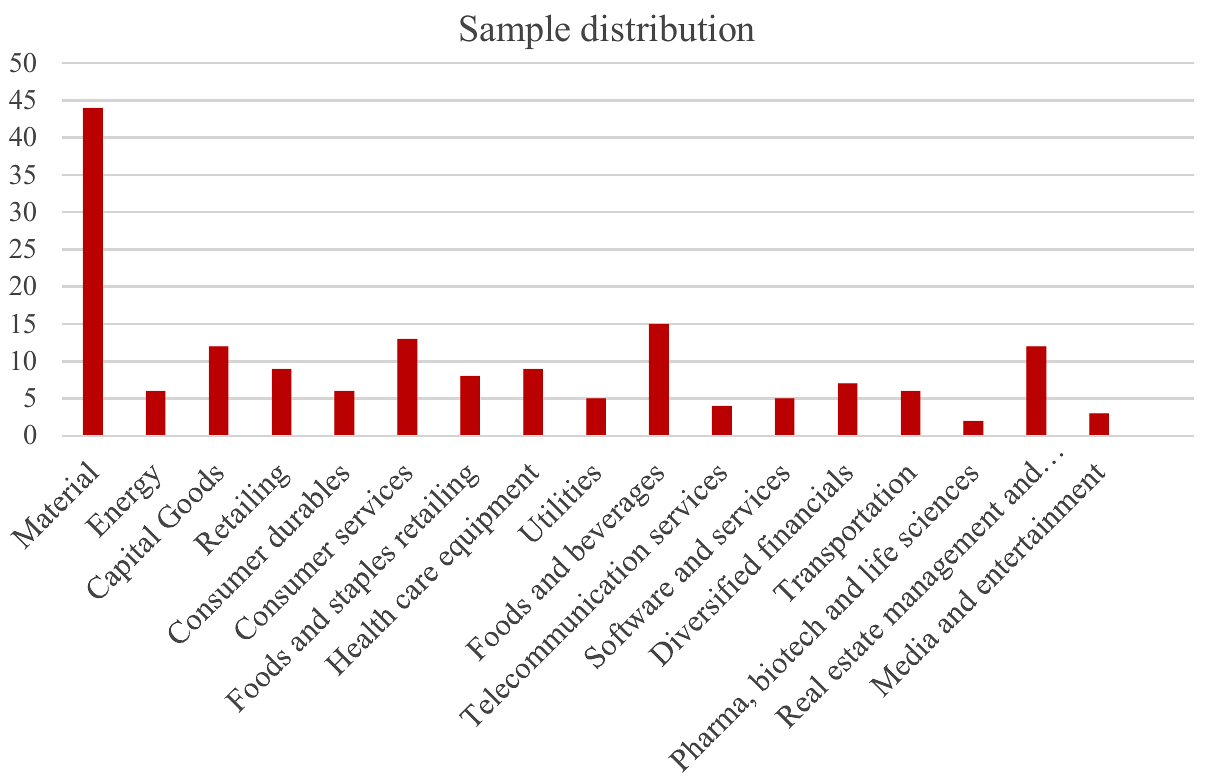 Fig. 1.
Sample distribution across sectors.
The information used is made up of corporate governance indicators and firm-level attributes. Corporate governance information was sourced from the firms’ annual reports published by the Saudi market (Tadawul). The firm-level indicator information was gathered from the Thomas Reuters platform.
The dependent variable is firm resilience, measured using stock return volatility (SRV). SRV measures a firm’s flexibility and reflects the organization’s ability to respond to uncertainties and shocks (Brennan and Xia, 2001; Sila et al., 2016). It is defined as a firm’s monthly standard deviation of its return series. This indicator assesses firms’ resilience and evaluates how a company’s stock return responds to different economic conditions.
The independent variable is financial sustainability (FIS), measured using the Higgins (1977) model shown in Eqn. 1. The model is widely applied because it focuses on achieving sustainable growth and emphasises compatibility between operating policies and growth plans (Alshareef and Sulimany, 2024b; Naciti, 2019). The target is consistent growth that aligns with established financial policies without altering the capital structure. It is given as:
Where:
PM = profit margin (net income after tax / revenue),
AT = assets turnover (revenue / total assets),
FL = financial leverage (total debt / total assets),
ERR = earnings retention rate (retained earnings / net income after tax).
The moderating variable is board financial expertise (BFE). The justification for using this variable as a moderator is based on the propositions of agency and resource dependency theories. These frameworks argue that board financial expertise may provide stringent monitoring and sound advice (Alcaide-Ruiz and Bravo-Urquiza, 2024; Fama and Jensen, 1983; Sani, 2021). This expertise is capable of shaping firms’ financial systems and promoting effective risk management, leading to firm resilience.
This study employed firm size, leverage, profitability, board independence, family ownership, and institutional ownership as control variables. Past studies revealed that larger companies are more diversified and have many sources of income, which may make them more resilient to uncertainties and shocks (DesJardine et al., 2019; Kusi et al., 2018). Similarly, the literature has reported that profitable firms are more likely to invest in innovation and growth initiatives, making them better able to build buffers to absorb disruptions (Bokpin, 2011). Thus, there is a positive relationship between profitability and firm resilience. Regarding leverage, studies have suggested that leverage serves as an additional source of finance for companies and expands their capital base (Cheng et al., 2023; Bokpin, 2011). This enhancement enables firms to generate greater returns, strengthening their capacity to withstand uncertainty and develop resilience (Lu et al., 2022). However, it has been emphasised that leverage exposes firms to financial risk and reduces financial flexibility. These factors may make firms vulnerable to market refinancing risk, disrupting their financial plans (Bokpin, 2011). Therefore, these studies suggest a negative association between leverage and firm resilience.
Moreover, the literature has shown that corporate governance attributes may influence firm resilience. In this context, studies show that board independence may promote decision-making quality and foster risk management oversight (Cheng et al., 2023; Jackling and Johl, 2009; Maier and Yurtoglu, 2022). This effectiveness may enable firms to be better positioned to face challenges and help build resilience. Studies have also revealed that family ownership exerts strong monitoring controls, which may assist companies in navigating challenges and disruptions (Alshareef, 2024; Habbash, 2016). Hence, a higher family shareholding may lead to firm resilience. A stream of literature has emphasised that institutional ownership may positively affect firm resilience. These investors attach much importance to firm value maximisation (Alshareef and Sulimany, 2024a; Munisi et al., 2014; Rajverma et al., 2019). Their presence may compel managers to design sound policies regarding risk management strategies that help firms cushion market shocks and uncertainties. The measurements of the variables mentioned are contained in Table 1.
| Variable | ACRONYM | Measurement | |
| Dependent variable: | |||
| Stock return volatility | SRV | The standard deviation of a firm’s monthly stock returns. | |
| Explanatory variable: | |||
| Financial sustainability | FIS | ||
| Moderator variable: | |||
| Board financial experience | BFE | Number of board members with at least a first degree in accounting or finance over the total audit committee members. | |
| Control variables: | |||
| Firm size | FS | The logarithms of the sampled companies’ total assets. | |
| Profitability | ROA | Operating profits divided by total assets. | |
| Leverage | LEV | Total debts over total assets. | |
| Board independence | BI | Number of outside directors over board size. | |
| Family ownership | FO | The percentage of shares held by families. | |
| Institutional ownership | IO | The number of equity shares held by institutions over the total equity shares. | |
ERR, earnings retention rate.
A regression analysis was used to accomplish the research goal. The sampled data covered a time series from 2017 to 2023 across 164 companies from different sectors. Therefore, the appropriate analytical technique was the panel data method. This method is widely applied by finance and accounting studies because of its numerous benefits. It provides more data points and reduces multicollinearity issues, leading to efficient estimates (Githaiga and Kosgei, 2023; Hsiao, 1985; Pesaran, 2015). The most popular panel data techniques are the ordinary least square (OLS) method, fixed effects models, and random effects models. OLS often yields biased results because it fails to account for firm differences, resulting in inconsistent estimates. Based on recommendations in the literature, this study applied the Hausman specification test to identify the most suitable analytical tool for this research. The test indicated a significant p-value, confirming the fixed effects model as the suitable choice. The fixed effects framework produces consistent estimates because it considers firms’ differences, leading to more reliable regression results (Gujarati, 2003; Pesaran, 2015). Therefore, the following models were specified:
Moreover, Eqn. 2 was specified to measure the moderating effect of board
financial experience on the relationship between financial sustainability and
firm resilience. In this model, the moderator variable (BFE) and the interaction
term (FIS
Table 2 presents summary statistics of the variables used in the models. According to the results, the stock return volatility indicator (SRV) showed an average value of 43.311, with a relatively high standard deviation. This suggests that many of the firms have SRV ratios below the average. The financial sustainability measure (FIS) revealed a maximum index of 1.040, with an average ratio of 0.049 during the period under review. Board financial expertise (BFE) demonstrated an average ratio of 0.675, meaning that 67.5 percent of the board members were financial experts. Firm size (FS) exhibited a mean of 9.491 and a maximum of 12.410 over the period.
| Variable | Mean | Standard deviation | Min. | Max. | Observations |
| SRV | 43.311 | 5.024 | 22.00 | 70.733 | 1148 |
| FIS | 0.049 | 0.131 | –0.621 | 1.040 | 1148 |
| BFE | 0.675 | 0.188 | 0.122 | 0.891 | 1148 |
| FS | 9.491 | 0.727 | 7.280 | 12.410 | 1148 |
| ROA | 0.062 | 0.045 | –0.152 | 0.170 | 1148 |
| LEV | 0.251 | 0.191 | 0.000 | 0.870 | 1148 |
| BI | 0.204 | 0.031 | 0.148 | 0.271 | 1148 |
| FO | 0.538 | 0.242 | 0.000 | 0.890 | 1148 |
| IO | 0.031 | 0.146 | 0.000 | 0.317 | 1148 |
Refer to Table 1 for variables definitions. Std. Div., Standard deviation.
Moreover, the profitability ratio (ROA) showed only slight dispersion among the companies, and its average ratio was 6.2 percent. Leverage (LEV) had a mean of 0.251, indicating that an average of 25.1 percent of the firms’ capital structure was based on debt financing. This evidence implies that companies rely heavily on equity sources to fund their operations. Board independence (BI) revealed that an average of 20.4 percent of the board members were independent directors. Family ownership (FO) suggests an average ratio of 0.538, while institutional ownership (IO) had a mean of 0.031. This implies that family ownership is much more concentrated than institutional shareholding in Saudi Arabia.
Table 3 displays the correlation results. This analysis aimed to examine the degree of association between the study variables and to detect whether multicollinearity exists in the models specified. Based on the results in Table 3, multicollinearity does not appear to be present because all the coefficients are below the 80% limit suggested in the literature (Gujarati, 2003; Pesaran, 2015). Therefore, multicollinearity does not exist in this study. In addition, the Variance Inflation Factor (VIF) values were lower than 10, reinforcing that there is no multicollinearity among the independent variables.
| Variable | SRV | FIS | BFE | FS | ROA | LEV | BI | FO | IO | VIF |
| SRV | 1.000 | |||||||||
| FIN | 0.445*** | 1.000 | 1.09 | |||||||
| BFE | 0.377*** | 0.035 | 1.000 | 1.02 | ||||||
| FS | 0.377*** | 0.250*** | 0.015 | 1.000 | 1.73 | |||||
| ROA | 0.027 | –0.007 | –0.005 | 0.002 | 1.000 | 1.09 | ||||
| LEV | –0.086** | –0.047 | –0.045 | 0.242*** | –0.028 | 1.000 | 2.28 | |||
| BI | 0.109*** | 0.051* | 0.014 | –0.027 | –0.015 | –0.037 | 1.000 | 1.02 | ||
| FO | 0.031 | 0.022 | –0.024 | –0.257*** | 0.052* | –0.472*** | 0.014 | 1.000 | 2.35 | |
| IO | 0.269*** | –0.188*** | –0.032 | 0.347*** | –0.021 | 0.048 | 0.017 | 0.019 | 1.000 | 1.11 |
*, ** and *** show significance level at 1%, 5% and 10%, respectively. VIF, Variance inflation factor.
Refer to Table 1 for variables definitions.
The study used regression analysis to assess the moderating effect of board financial expertise on the relationship between financial sustainability and firms’ resilience. At the initial stage, the research applied the Hausman test to select the suitable analytical tool between random and fixed effects. The test outcome indicated a significant p-value, showing that the fixed effects framework was more appropriate. Diagnostic tests such as serial correlation, heteroscedasticity, and variance inflation factor (VIF) tests were carried out to ensure the appropriateness of the specified models. Accordingly, the regression results are shown in Table 4, which is categorised into two models. The first model (Model 1) is the direct effect estimate. The second model (Model 2) presents the interaction effect analysis. The moderator variable and the interaction term were inserted into this model to examine how their presence might influence the earlier results. The R-squared values of the models indicate that the explanatory variables explained 24.22% and 25.77% of the firms’ resilience variations. Also, the F-statistics were significant, revealing the robustness of the stated models.
| Model 1 | Model 2 | ||
| Variables | Coefficient/stand. error | Coefficient/stand. error | |
| Constant | 25.946 (8.555) *** | 26.302 (8.539) *** | |
| Main explanatory variable: | |||
| FIS | –14.536 (6.019) ** | –7.442 (3.642) ** | |
| Moderator variable: | |||
| BFE | – | –0.652 (0.195) *** | |
| Interaction term: | |||
| FIS×BFE | – | –10.958 (4.338) ** | |
| Control variables: | |||
| FS | –1.925 (0.803) ** | –1.935 (0.902) ** | |
| ROA | –0.379 (0.104) *** | –0.412 (2.028) | |
| LEV | 0.741 (1.226) | 0.846 (0.422) * | |
| BI | 11.189 (3.109) *** | 11.184 (3.103) *** | |
| FO | –1.836 (1.570) * | –1.853 (1.229) | |
| IO | –8.415 (6.946) | –9.253 (6.948) | |
| Industry effects | Yes | Yes | |
| Year dummies | Yes | Yes | |
| R2 | 0.2422 | 0.2577 | |
| F-statistics (p-value) | 0.000 | 0.000 | |
| Hausman test (p-value) | 0.000 | ||
***, ** & * show significance level at 1%, 5% and 10% respectively.
Note: Model 1 is the direct effect analysis, whereas Model 2 presents the moderation effect outcome.
The numbers that appeared in parentheses represent robust standard errors.
See Table 1 for variables definitions.
According to the regression results in the Model 1, financial sustainability has a strong negative influence on stock return volatility as a proxy for firms’ resilience. This indicates higher resilience as financial sustainability increases, confirming H1. This finding supports stakeholder and signalling theories’ arguments that financial sustainability signals high governance quality and boosts investors’ confidence (Barriga and Escandon‐Barbosa, 2024; Freeman, 1994). This positive outlook may enhance competitive advantage, leading to resilience against adversities. The finding implies that financial sustainability strategies demonstrate lower risks to stakeholders, leading to improved investor confidence and less stock return volatility (Adeyemi, 2019; Uche et al., 2016; Wu et al., 2024). The policy implication of the results is that firms can mitigate shocks and uncertainties by prioritising sustainable performance. The finding demonstrates that firms can boost their financial sustainability by mitigating stock return volatility and other adversities.
Regarding the control variables, it was found that leverage and institutional ownership were insignificant in the specified model. However, the coefficient of firm size suggests a strong negative effect on stock return volatility. The evidence implies that larger companies may be associated with lower stock return risk, making them more capable of absorbing shocks (DesJardine et al., 2019; Kusi et al., 2018). The results also suggest a negative and significant relationship between profitability and stock return volatility. This finding supports prior research showing that profitable firms have a greater likelihood of investing in innovation and growth initiatives, helping them build buffers to absorb disruptions (Bokpin, 2011). It was found that board independence exerts a strong influence on firms’ resilience. This aligns with studies indicating that board independence may promote decision-making quality and foster risk management oversight (Cheng et al., 2023; Jackling and Johl, 2009; Maier and Yurtoglu, 2022). This effectiveness may help firms with many independent directors on their boards become better positioned to face challenges and build resilience against shocks. The results also indicate a negative association between family ownership and stock return volatility. This evidence is consistent with studies suggesting that family ownership exerts strong monitoring on managers, which may assist companies in navigating challenges and disruptions (Alshareef, 2024; Habbash, 2016). Hence, higher family shareholding may lead to firm resilience.
The results in Model 2 focus on the moderating effect, where the moderator (BFE)
and the interaction term (FIN
Various econometric models were applied to confirm the moderating effect results
in Model 2 contained in Table 4. This additional analysis in Table 5 re-estimated
the moderation equation (see Eqn. 3) where the moderator (BFE) and interaction
term (FIN
| Model 3 | Model 4 | Model 5 | ||
| Random effects | 2-step difference GMM | 2-step system GMM | ||
| Variables | Coefficient/stand. error | Coefficient/stand. error | Coefficient/stand. error | |
| Constant | 17.887 (4.142) *** | 16.708 (7.593) ** | 7.209 (2.624) ** | |
| SRVi, t-1 | – | 0.144 (0.016) *** | 0.327 (0.110) *** | |
| FIS | –3.831 (1.921) ** | –3.335 (1.688) * | –2.443 (1.197) ** | |
| BFE | –0.498 (0.173) *** | –0.103 (0.047) ** | –0.370 (0.900) * | |
| FIS×BFE | –10.699 (4.346) ** | –6.909 (1.046) *** | –7.786 (1.167) *** | |
| FS | –2.940 (0.424) *** | –2.310 (0.814) *** | –4.146 (0.567) *** | |
| ROA | 2.211 (1.109) ** | 2.022 (0.858) ** | 1.616 (0.774) ** | |
| LEV | –0.549 (2.021) | –0.669 (0.493) | –0.846 (0.422) * | |
| BI | –12.942 (1.098) *** | –16.147 (3.139) *** | –20.230 (8.971) ** | |
| FO | 1.583 (1.078) | 2.874 (2.707) | 2.737 (1.683) | |
| IO | 0.294 (5.281) | 3.815 (4.894) | 6.867 (4.746) | |
| Industry effects | Yes | Yes | Yes | |
| Year dummies | Yes | Yes | Yes | |
| R2 | 0.3175 | – | – | |
| Wald statistics | 181.07 | 509 | 756 | |
| Prob |
0.000 | 0.000 | 0.000 | |
| Hansen | – | 0.254 | 0.114 | |
| Ar1 | – | 0.007 | 0.001 | |
| Ar2 | – | 0.126 | 0.193 | |
***, ** & * show significance level at 1%, 5% and 10% respectively. GMM, Generalised method of moments.
The numbers that appeared in parentheses represent robust standard errors.
See Table 1 for variables definitions.
An alternative proxy for the measurement of a firm’s resilience was employed to confirm the results in Table 4. In particular, the study used long-term sales growth (LGS) as a proxy for firm resilience, which is consistent with prior studies. It is measured as the accumulated net sales growth for 3 years (Lv et al., 2019). Previous studies have used this proxy as a measure of organizational resilience because consistent sales over a long period imply a firm’s capability to endure amid evolving market conditions (DesJardine et al., 2019; Lv et al., 2019). It refers to the ability to adopt and thrive in the face of disruptions and challenges for long-term success. Model 6 presents the results on the direct effect of financial sustainability on firm resilience, while Model 7 captures the moderating effect of board financial expertise on this relationship. It was found that LGS has a positive effect in the specified model. According to the results in Table 6, the coefficient of financial sustainability is positive. Similarly, the interaction term appears significant, demonstrating a positive moderating effect, consistent with the earlier results in Table 4.
| Model 6 | Model 7 | ||
| Variables | Coefficient/stand. error | Coefficient/stand. error | |
| Constant | 0.764 (0.242) *** | 0.768 (0.214) *** | |
| Main explanatory variable: | |||
| FIS | 0.858 (0.375) ** | 0.908 (0.416) ** | |
| Moderator variable: | |||
| BFE | – | 0.059 (0.026) ** | |
| Interaction term: | |||
| FIS×BFE | – | 0.068 (0.022) *** | |
| Control variables: | |||
| FS | 0.189 (0.056) *** | 0.187 (0.056) *** | |
| ROA | 0.187 (0.126) | 0.189 (0.127) | |
| LEV | –0.161 (0.077) ** | –0.163 (0.078) * | |
| BI | 6.798 (1.673) *** | 6.799 (1.675) *** | |
| FO | –1.007 (0.433) ** | –1.015 (0.435)** | |
| IO | 0.106 (0.122) | 0.107 (0.126) | |
| Industry effects | Yes | Yes | |
| Year dummies | Yes | Yes | |
| R2 | 0.3526 | 0.3617 | |
| F-statistics (p-value) | 0.000 | 0.000 | |
| Hausman test (p-value) | 0.000 | ||
***, ** & * show significance level at 1%, 5% and 10% respectively.
Note: Model 6 is the direct effect analysis, whereas Model 7 presents the moderation effect outcome.
The numbers that appeared in parentheses represent robust standard errors.
See Table 1 for variables definitions.
The Saudi corporate sector has witnessed many crises and periods of uncertainty. These shocks may be linked to the country’s institutional structure, corporate governance quality, and ineffective risk management. Several firms have failed to withstand these shocks, resulting in growth disruptions and bankruptcy. This paper assesses the moderating effect of board financial expertise on the relationship between financial sustainability and firms’ resilience. The research sampled 164 non-financial listed firms on the Saudi Stock Exchange from 2017 to 2023 and analysed the data using a fixed effect framework. It was found that financial sustainability has a positive effect on firms’ resilience. In addition, the moderation model reveals that board financial expertise moderates this relationship. The results imply that firms with strong financial systems are more likely to cope with stock return volatility and other market shocks.
These results support the agency, resource dependence, and signalling theories, which predict that financial sustainability might promote monitoring and enhance a company’s ability to navigate disruptions and maintain resilience in the face of adversity. The policy implication of the empirical findings is that firms can improve their ability to withstand and recover from disruptions by constituting boards with more financial experts. Furthermore, policymakers can shape regulatory frameworks that encourage good governance practices through board diversity dynamics. The study provides a broader perspective to guide stakeholders in making informed decisions that strengthen organizational resilience and promote long-term corporate stability.
This research acknowledges some limitations that may prevent the generalisation of its findings. The study focuses on non-financial companies; future research could focus on financial companies from different viewpoints. Moreover, board financial expertise was used as the moderator. Thus, future studies may consider other diversity traits such as age, ethnicity, and academic qualifications for a broader analysis. The work focuses on the Saudi corporate sector, and future studies may use other African countries as a sample for comparison purposes. Finally, this study employed stock return volatility as a measure of firms’ resilience. Therefore, future studies may adopt other proxies for comparison.
The data has been deposited at the Saudi stock (Tadawul) website: https://www.saudiexchange.sa/wps/portal/tadawul/home.
Authors AAAlj and HGHS prepared the original draft. AAAlj and SR contributed to the conceptualization of the study. AAAlj, HGHS, and AAAlh contributed to the data analysis. AAAlj, SR, and SFAK were involved in the editing and review process. SR and SFAK provided supervision. SR, HGHS, and SFAK contributed to the development of the methodology. SFAK and AAAlh participated in writing the revised version. AAAlh contributed to data collection and provided overall guidance. All authors contributed to critical revision of the manuscript for important intellectual content. All authors read and approved the final manuscript. All authors have participated sufficiently in the work and agreed to be accountable for all aspects of the work.
The authors thank Taif University, Saudi Arabia, for supporting this work through project number (TU- DSPP-2024-303).
This research was funded by Taif University, Saudi Arabia, Project No. (TU-DSPP-2024-303).
The authors declare no conflict of interest.
References
Publisher’s Note: IMR Press stays neutral with regard to jurisdictional claims in published maps and institutional affiliations.