
 , Li Xu 1,†, Jiachen Wang 2, Qing Li 3, Jianmin Liu 1,*
1 Zhong’an United Investment Group Co., Ltd. Postdoctoral Research Workstation, 261053 Beijing, China
2 Business School, Beijing Normal University, 100875 Beijing, China
3 Tangshan School of Management Engineering, Tangshan Polytechnic University, 063200 Tangshan, Hebei, China
†These authors contributed equally.
Abstract
This study examines multinational enterprises investing in China’s A-share market from 2015 to 2024 to explore the impact of institutional distance on localization decisions in the global marketing strategy of multinational corporations. It also analyzes the mediating role of managerial cognition and the moderating role of corporate political connections. The findings indicate that institutional distance has a significant positive impact on localization decisions. Specifically, the greater the institutional differences between the home and host countries, the more likely enterprises are to implement deep localization strategies to gain legitimacy and reduce operational risks. Managerial cognition plays a significant mediating role between institutional distance and localization decisions, with both managerial cognitive complexity and managerial cognitive centrality serving as significant mediators between formal institutional distance, informal institutional distance, and localization decisions. Corporate political connections further moderate this relationship. High-level corporate political connections amplify the positive impact of both formal and informal institutional distance on localization decisions, while low-level corporate political connections weaken it. This study develops a theoretical framework of “institutional distance - managerial cognition - localization decisions”, revealing the micro-mechanism by which institutional environments influence strategy through managerial cognition. It provides both a theoretical foundation and management insights for multinational enterprises seeking to optimize localization strategies in complex institutional environments.
Keywords
- localization decisions
- institutional distance
- managerial cognition
- corporate political affiliation
- MNC global marketing strategies
In the competitive landscape of globalization, Multinational Corporations (MNCs) face core challenges stemming from structural differences in institutional environments—i.e., the systematic distance between home and host countries in terms of regulatory frameworks, value norms and cultural perceptions (Modreanu et al, 2024). The multidimensional institutional divide determines the choice of market access strategies and more profoundly constrains the operational effectiveness of organizational resource allocation and the path of obtaining institutional legitimacy (Modreanu et al, 2024). The market and economic ecology of different countries has shaped unique industrial evolution trajectories and given rise to differentiated institutional barriers and technical standards. When expanding overseas markets, multinational enterprises face a dual mission: not only must they pursue market penetration to maximize economic value, but they must also systematically reconstruct their strategic system to fit the institutional characteristics of the host country (Liu et al, 2025). Multinational enterprises must adopt their localization strategies to the institutional structure of the target market, operational characteristics, the consumer value orientations, the heterogeneity of the market operating mechanism and the rigid requirements of the policy regulatory system, all of which shape the institutional boundaries of the business ecology of a foreign country (Correa da Cunha et al, 2023). Multinational entities must build a multi-dimensional response mechanism to implement market penetration strategies. This includes: systematically deconstructing behavioral patterns and cognitive schema of target groups; developing value propositions and operational systems that meet local needs through consumption scene simulation and big data imaging technology; embedding deeply within the host country’s legal norms and regulatory framework; establishing compliance risk early warning systems and forensic auditing processes to ensure the dynamic adaptation of business practices and institutional frameworks; and strategically applying regional policy tools by transforming institutional elements such as tax incentives and industrial support into leverage pivots for resource allocation, thereby realizing synergistic evolution of strategic layout and institutional environment through the flexible organizational structures and modular design of operational processes (Correa da Cunha et al, 2022).
As an important policy resource for enterprises, corporate political affiliation has two sides: it can reduce the innovation efficiency of enterprises due to the “curse effect of political affiliation”; however, it may also help enterprises obtain key resources from the government to support Research and Experimental Development (R&D) and innovation. In the context of corporate overseas investment, institutional distance differences between home and host countries can be positive or negative, and the impact of home country political affiliation on MNCs’ marketing localization decisions varies across different institutional distance scenarios (Purkayastha and Filatotchev, 2023). Therefore, corporate political affiliation is suitable as a moderating variable for examining how it moderates the relationship between institutional distance and MNCs’ marketing localization decisions in different scenarios. With the development of managerial cognitive theory, it provides a theoretical basis for analyzing the interaction between managerial cognition and strategic decision-making in multinational enterprises (Ciszewska-Mlinarič and Trąpczyński, 2019). Managers’ subjective interpretations of the external institutional environment from a unique cognitive perspective influences key cognitive dimensions such as information processing architecture, risk assessment thinking, and decision-making logic, which permeate the entire process of strategy formulation and execution, becoming a key link between the external institutional environment and corporate strategic decisions, with far-reaching effects on the direction and effectiveness of corporate strategic transformation (Mueller et al, 2017). Based on this, this paper chooses managerial cognition as the mediating variable, because managerial cognition affects enterprises’ perception of and response to the institutional environment, which in turn affects their marketing localization decisions based on political affiliation in different institutional distance situations. In addition, this paper selects corporate political affiliation as the moderating variable, aiming to explore its moderating effect on multinational corporations’ marketing localization decisions across different institutional distance contexts. Accordingly, a theoretical framework is constructed with institutional distance as the independent variable, localization decision as the dependent variable, managerial cognition as the mediating variable, and corporate political affiliation as the moderating variable, to deeply analyze the mechanisms through which institutional distance between home and host countries influences localization decisions. The expected contributions of the study are: first, to expand the research perspective of institutional distance theory from one-way constraints to two-way interactions; second, to establish a framework for assessing the institutional efficacy of localized decision-making, providing multinational corporations with a strategic optimization tool; and third, to deepen the application of cognitive theories in the field of strategic management, revealing the microscopic mechanism of the role of managerial cognition in institutional change.
The theory of institutional pluralism emphasizes that enterprises must proactively adjust their marketing strategies in heterogeneous institutional environments to enhance institutional adaptability, thereby gaining legitimacy in the host country market and reducing institutional friction costs. Parietti (2017) confirm that under conditions of significant institutional distance, multinational corporations need to adopt localization strategies to reduce external environmental uncertainty and mitigate operational risks. Li et al (2022) argue that the dual pressure mechanism generated by institutional distance includes compliance pressure stemming from regulatory differences and legitimacy pressure resulting from cultural cognitive differences, forcing enterprises to implement deep localization transformations in dimensions such as product customization, channel reconstruction, and promotion strategy localization. Shin et al (2020) define institutional distance as encompassing both formal and informal dimensions. Formal institutional distance reflects differences between the home country and the host country in written institutions such as legal norms and policy systems, while informal institutional distance characterizes divergences between the two countries in non-written norms such as cultural traditions and moral values, involving socially recognized behavioral norms like values and customs, and exhibiting spontaneous characteristics. Qian and Zhou (2024) analyze the dynamic game relationship between institutional distance and corporate strategic choices from the perspective of resource dependence theory, arguing that a higher level of institutional differences increases the risk of information asymmetry and deepens the dependence of enterprises on the resources of stakeholders in the host country, thereby prompting enterprises to adopt more comprehensive localization strategies to form a strategic buffer mechanism. Based on the above research, institutional distance encompasses both formal and informal dimensions. The former refers to differences in written systems such as legal norms and policy systems, while the latter refers to differences in non-written norms such as cultural traditions and moral values. A higher level of institutional differences increases the risk of information asymmetry, strengthens the dependence of enterprises on the resources of stakeholders in the host country, and further promotes enterprises to adopt more thorough localization strategies to build a strategic buffer mechanism. Based on this, this study proposes the following hypotheses:
H1: Institutional distance between home and host countries is positively related to localization decisions.
H1-a: Formal institutional distance between home and host countries is positively related to localization decisions.
H1-b: Informal institutional distance between home and host countries is positively related to localization decisions.
Based on information processing patterns and thinking characteristics, managerial cognition can be divided into two basic dimensions: centrality and complexity. Centrality is reflected in managers who limit their information processing scope to specific professional fields or fixed thinking frameworks, similar to shooting with a fixed-focus lens, which can only capture limited image content. Complexity refers to managers’ ability to process diverse information and integrate different thinking modes, operating like panoramic photography, which can accommodate multiple image elements. Scholars such as Kubera (2023) point out that the deeper a manager’s understanding of the host country’s institutional environment, the more they can identify the challenges and opportunities brought by institutional distance and thus are more inclined to adopt localization strategies to reduce operational risks. Research by Farías (2021) shows that managers with high cultural cognitive ability can better understand and adapt to cultural differences in the host country and thus make more effective localization adjustments in product and marketing strategies. Lane (1998) proposes that managerial cognitive complexity lies in the ability to analyze heterogeneous institutional signals and integrate contradictory information, thereby enhancing firms’ sensitivity to host country market specificities and facilitating precise adaptation of marketing strategies in dimensions such as product mix, distribution channels, and brand communication. If managers’ thinking is overly focused on a specific field, it is often difficult to fully grasp the diverse needs of the target market. However, the cognitive complexity of managers enhances decision-making comprehensiveness by integrating diverse information to meet local needs, anticipating and responding to risks through multi-angle thinking, innovating localization strategies with cross-disciplinary thinking, coordinating resources from all parties to ensure decision implementation, taking into account long-term development and sustainable factors, and promoting more scientific and effective localization decisions from multiple dimensions. Based on this, this study proposes the following hypotheses:
H2: Managerial cognition is positively related to localization decisions.
H2-a: Managerial cognitive complexity is positively related to localization decisions.
H2-b: Managerial cognitive centralization is positively related to localization decisions.
Institutional distance constitutes an external contextual factor for multinational corporations’ operations, profoundly influencing the formation of managers’ cognition and prompting them to adjust their information focus and processing approaches. Formal institutional distance manifests as differences in laws and regulations, driving managers to prioritize information such as compliance requirements and policy utilization and subsequently adjust their operational strategies to adapt to the institutional environment of the host country. Informal institutional distance primarily manifests in differences in cultural values, compelling managers to emphasize cultural adaptation and consumer psychology. Wu et al (2018) point out that the differences between the institutional systems of the host country and the home country affect strategic decision-making through a dual mechanism: the compliance pressure brought by institutional distance directly drives the localization adjustment of marketing strategies; and institutional differences also trigger managers’ cognitive reconstruction of market characteristics, indirectly shaping the implementation intensity of localization strategies by expanding the depth and breadth of environmental scanning. Nguyen et al (2022) define the boundary conditions of mediation effects from the perspective of dynamic capabilities, arguing that managers with high cognitive complexity can identify strategic opportunities within institutional distance and transform institutional constraints into competitive advantages; whereas cognitive focus affects the efficiency of transforming institutional pressure into strategic action by optimizing attention allocation. The mediation mechanism of managerial cognition between institutional distance and localized decision-making spans three stages: cognitive evaluation, decision-making formation, and strategy adjustment. High cognitive complexity facilitates a comprehensive identification of compliance costs and policy opportunities brought about by institutional differences, while those with low cognitive complexity tend to be limited to local information. In the decision-making stage, managers with high cognitive ability are able to integrate multidimensional information such as legal, cultural, and market factors to form comprehensive strategies, while those with low cognitive capacity tend to adopt single strategies. In strategy adjustment, managers with high cognitive complexity can promptly revise actions based on market feedback, while those with low cognitive ability often lag in response or make insufficient adjustments. Based on this, this study proposes the following hypotheses:
H3: Managerial cognition mediates institutional distance and localization decisions between home and host countries.
H3-a: Managerial cognitive complexity mediates formal institutional distance and localization decisions between home and host countries.
H3-b: Managerial cognitive complexity mediates informal institutional distance and localization decisions between home and host countries.
H3-c: Managerial cognitive centralization mediates the role of Formal institutional distance between home and host countries mediates localization decisions.
H3-d: Managerial cognitive centralization mediates informal institutional distance between home and host countries and localization decisions.
The institutional foundation view proposes that the institutional environment plays a decisive role in corporate strategy, and political affiliation serves as an important link for enterprises to embed themselves in the institutional structure, helping to regulate the relationship between institutional distance and localization strategy. With the expansion of institutional distance, the demand for localization among enterprises increases, while political connections alter the extent and execution of this demand by reducing institutional uncertainty. The resource dependence theory suggests that the degree of dependence of multinational corporations on institutional resources in the host country determines the resource-bridging function of political connections. The larger the institutional distance and the more difficult it is to obtain resources, the more significant the moderating effect of political connections. The cognitive theory of managers argues that political connections affect managers’ risk perceptions and opportunity identification regarding institutional distance, thereby indirectly regulating the influence of cognition on localized decision-making. Low-level political connections mainly provide passive adaptive regulation, while high-level political connections exhibit active shaping regulation. Sun (2012) notes that that resource orchestration theory defines the boundary conditions for such regulation: once the correlation strength surpasses a specific threshold, the efficiency of deploying strategic flexible resources within enterprises improves significantly, and the promotion effect of institutional distance on localization strategy exhibits a marginally increasing trend. The political market integration model proposed by Chen (2023) also indicates that enterprises with high-level political connections can leverage policy lobbying or engage in institutional design to transform institutional differences into competitive advantages. The fundamental difference between the two types of association is that low-level associations, as responders to institutional pressure, alleviate the negative impact of institutional distance through a linear mechanism, whereas high-level associations serve as the builder of the institutional environment, strengthening its positive impact through non-linear mechanisms, reflecting the transformation of political correlation from instrumental resources to strategic resources. The regulatory mechanism has evolved from reducing information asymmetry and providing institutional buffering to actively shaping institutions, and the regulatory effect shifts from linear increase to marginal increase. Based on this, this study proposes the following hypotheses:
H4: Firms’ political affiliation moderates the relationship between institutional distance and localization decisions in home–host country contexts.
H4-a: High levels of political affiliation strengthen the positive impact of formal institutional distance on localization decisions in home–host country contexts.
H4-b: Low levels of political affiliation weaken the positive impact of formal institutional distance on localization decisions in home–host country contexts.
H4-c: High levels of political affiliation strengthen the positive impact of institutional distance on informal institutional distance on localization decisions in home–host country contexts.
H4-d: Low levels political affiliation weaken the positive impact of informal institutional distance on localization decisions in home–host country contexts.
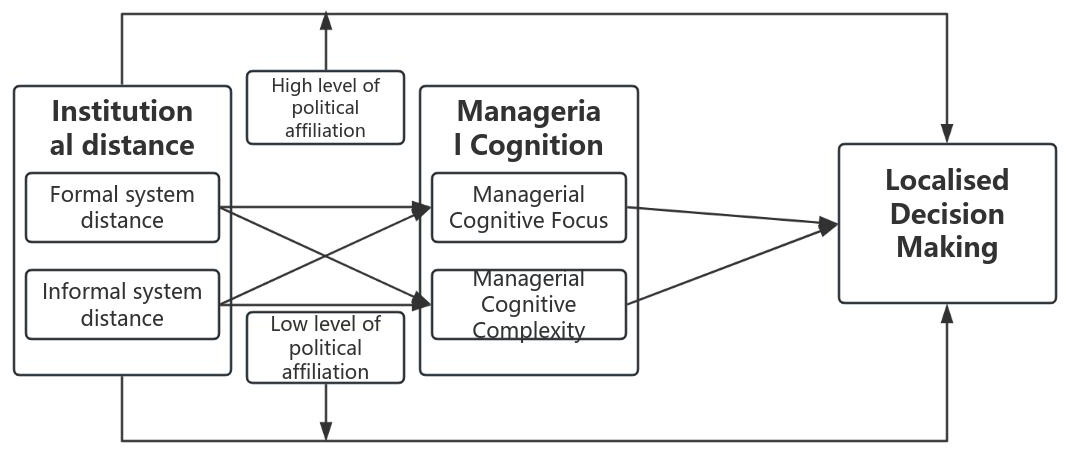
According to the aforementioned theoretical analysis, combined with the research hypotheses proposed, the theoretical model of this study was constructed, as shown in Fig. 1.
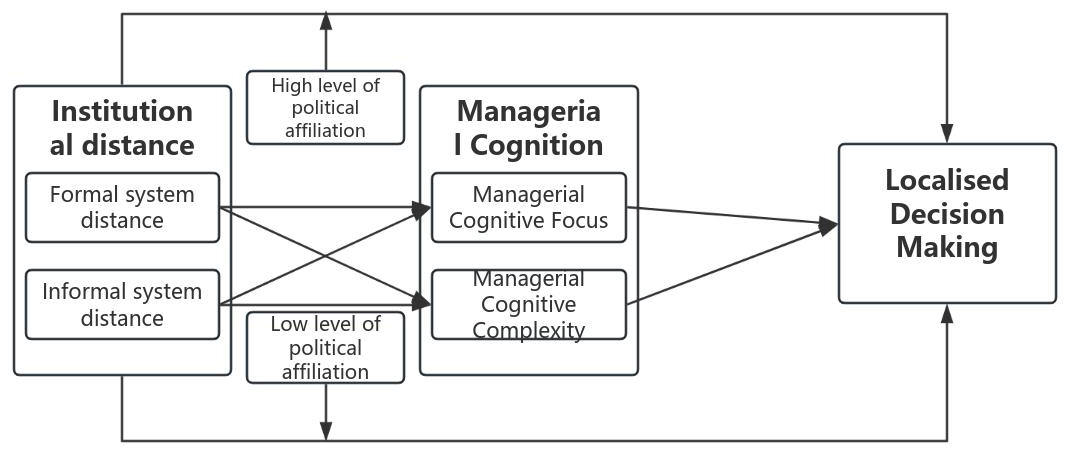 Fig. 1.
Theoretical model.
This study selects enterprises carrying out cross-border investment in China’s A-share market between 2015 and 2024 as the object of analysis, verifies the enterprise directory based on the China Stock Market & Accounting Research Database (CSMAR) Overseas Investment Database, and performs a strict sample screening procedure: it excludes Special Treatmen (ST)-type listed companies with abnormal financial conditions; filters out observations where investment targets are located in tax-avoidance economies (e.g., Hong Kong, China, and the Cayman Islands); prioritizes manufacturing firms with significant embeddedness within the host country’s institutional network (covering 12 sub-industries such as high-end equipment, electronics manufacturing, chemicals, etc.), while controlling for sub-type differences through industry dummy variables in the model. relies on the entry mode classification of CSMAR’s “Overseas Direct Investment” database, retaining only firms implementing overseas expansion through cross-border mergers and acquisitions or greenfield investments, while eliminating cases of mixed strategies. For multiple investments in the same fiscal year, retains the records with the largest registered capital or the earliest transaction chronology to strengthen the identification of systemic distance directionality, and eliminates samples with missing key variables. The screened sample shows that Chinese companies invested 32.7% in Eastern European economies (covering 11 post-socialist countries such as Poland, Hungary, and the Czech Republic), while the rest were mainly in Association of Southeast Asian Nations (ASEAN) (28.1%), Organization for Economic Cooperation and Development (OECD)-developed countries (23.5%), and other regions along the “Belt and Road” route (15.7%). Positive institutional distance in Eastern European markets, due to the uniqueness of institutional transitions (e.g., regulatory disruptions, cultural reconfigurations), places more complex legitimacy pressures on managerial cognition.
The survey data collection focuses on the top decision-making level of the enterprise, and for organizations that do not have a Chief Executive Officer (CEO) position, the chairman or general manager who actually exercises the strategic decision-making function is included as the research target. Through a multi-stage screening process, a research sample of 126 valid observations was finally formed. The measurement tool was designed by integrating established scale frameworks from international mainstream literature and adapting them to the local research context. For the four key constructs—institutional distance, localized decision-making, managerial cognition, and corporate political affiliation—quantitative measures were implemented using a seven-point Likert scale, where 1 represents strong disagreement, 7 represents strong agreement, and the intermediate values capture varying degrees of agreement. The pre-test of the questionnaire showed that the internal consistency coefficients of each scale exceeded 0.85, and the reliability and validity of the measurement tools were rigorously tested, which effectively guaranteed the scientific rigor of data collection and the verifiability of the empirical findings.
Based on the deepening and expanding of the existing research results, the assessment system is structurally refined using the validation factor analysis method, and the intensive reconstruction of the institutional distance measurement framework is achieved by eliminating the observation items with a loading coefficient of less than 0.5. The evaluation indexes are streamlined from the original 19 items to 7 core dimensions with theoretical explanatory power. The retained elements of measurement, identified through a rigorous screening process, include: formal institutional distance—caputring factors such as the efficiency of the host country’s legal system, judicial protection of property and citizens’ rights, procedural justice and transparency in public policy formulation, and fairness in applying financial regulatory standaards; and informal institutional distance—covering the effectiveness of the system of maintenance of social order, equality in the application of international trade rules, and the non-discriminatory treatment of offshore capital access (Sun and Qu, 2025).
The construct of localization decision-making dimension in the research framework mainly examines the degree of integration between multinational enterprises and the host country’s business ecosystem, which is reflected in the logistics service system and the regional distribution network, including the localization of the warehousing layout, the appropriateness of the distribution process, and the closeness of cooperation with local dealers and other practical indicators, as well as evaluating the extent to which the dynamic adjustment mechanism of the marketing strategy was in line with the characteristics of regional consumption. The evaluation system covers two core elements: first, the regional adaptability of marketing strategies specifically related to the improved design of product functions for local needs, the fit of pricing strategies to regional purchasing power, the use of local cultural symbols in promotional content, and the ability to cover the consumption scene through channel choices; and second, consumer engagement, focusing on the brand’s communication campaign’s responsiveness to local social values, how well the user interaction mechanism fits regional consumption habits, and the efficiency of the after-sales service system in responding to local customer needs (Hitotsuyanagi-Hansel et al, 2016; Zheng et al, 2025).
The structured measurement system of managers’ cognitive dimensions consists of two core cognitive characteristic modules. First, the managerial cognitive complexity dimension focuses on the decision-making subject’s ability to integrate and process information elements in a pluralistic institutional environment, reflecting the manager’s sensitivity to recognizing differentiated institutional signals and the ability to construct logical correlations in cross-cultural scenarios; second, the managerial cognitive focus dimension focuses on the decision-making subject’s pattern of attention allocation in the process of information processing, revealing the manager’s cognitive preference for systematically scanning the whole domain of institutional elements or selectively reinforcing specific institutional cues in the face of institutional differences. By accurately quantifying the cognitive characteristics of managers, the study can more accurately reveal the interaction mechanism between institutional distance and managers’ cognition in globalization strategy and provide a scientific basis for enterprises’ localization decision-making in different institutional environments (Cao et al, 2020; Kaosa-Ard, 1992).
Based on the theory of institutional embeddedness, political connections are operationalized as the strength of the network of relationships and access to resources that firms establish in the host country’s institutional arena. High-level corporate political connections include regular meeting mechanisms with top government officials, consultative opportunities to participate in policy formulation, preferential access to major projects, and special policy support such as tax incentives; low-level corporate political connections involve maintaining only basic business registration and compliance contacts, relying on industry associations for indirect communication, lacking personalized channels of policy support, and facing routine regulatory scrutiny (Long et al, 2020; Hu and Wang, 2021).
Based on the relevant literature, the study selects other variables that may affect the localization decision as control variables at both the firm and host country levels. At the firm level, firm age reflects the length of organisational existence and the accumulation of internationalisation experience. According to Gao’s (2022) Uppsala model, the internationalisation process exhibits staged characteristics as firms age, and differences in cognitive ability to perceive the overseas market environments directly influence the choice of localization strategy. Firm size reflects operational volume and resource endowment. Cho’s (2023) The Eclectic Theory of International Production (OLI) theory emphasises that scale advantage is a key foundation for overseas expansion, with larger firms more likely to pursue localization through resource integration. The nature of the firm (e.g., ownership attributes) affects the decision logic, and a study of Chinese firms by Du et al (2024) found that differences in motivations and risk preferences between State-owned enterprise (SOEs) and private firms in overseas investment significantly alter the degree of localization. R&D investment measures technological innovation capability, and Alos-Simo’s (2020) knowledge transfer theory suggests that high R&D-investment firms prefer to adapt their technology locally. Home country government subsidies, as a reflection of the strength of policy support, were confirmed by Feng and Wang (2023) to reduce firms’ overseas operating costs and indirectly affect the aggressiveness of localization decisions. At the host country level, market size reflects the target market capacity. Gross domestic product of the home country reflects the economic base of the home country, and Zhang and Shi (2025) investment development cycle theory points out that the economic strength of the home country indirectly affects the overseas localization layout by influencing the financing capacity of enterprises. The degree of economic development of the host country measures its overall level of development, and the empirical study of Chen et al (2019) shows that the degree of infrastructure improvement and consumption capacity of the host country significantly affects the localization decisions of enterprises’ production and marketing. The inclusion of the above variables can effectively exclude the interference of non-core factors on the research findings and ensure the accurate identification of the impact effects of core explanatory variables.
The data were entered, processed and analyzed using SPSS 22.0 software (Version: 22.0, IBM, Armonk, NY, USA), and the statistical tools adopted included descriptive statistics to outline the basic characteristics of the data, correlation analysis to explore the intrinsic association between variables, and t-tests to verify the significance of differences in means.
To ensure the accuracy of subsequent test results, we first conducted a reliability and validity analysis, and the results are shown in Table 1.
| Variant | Cronbach’alpha coefficient | KMO | SIG |
| Formal institutional distance | 0.776 | 0.791 | 0.000 |
| Informal institutional distance | 0.759 | 0.753 | 0.000 |
| Managerial cognitive concentration | 0.765 | 0.747 | 0.000 |
| Managerial cognitive complexity | 0.732 | 0.809 | 0.000 |
| High levels of political connection | 0.798 | 0.761 | 0.000 |
| Low levels of political connection | 0.756 | 0.783 | 0.000 |
| Localized decision making | 0.779 | 0.813 | 0.000 |
KMO, Kaiser-Meyer-Olkin; SIG, Significance.
Reliability analysis: The Cronbach’s alpha coefficients for each variable ranged from 0.732 to 0.798, with the highest reliability coefficient for “high level of political affiliation” (0.798) and “managerial cognitive complexity” (0.732). All coefficients exceed the critical value of 0.7, indicating that the internal consistency of the measurement items of the variables—including formal institutional distance, informal institutional distance, managerial cognitive centralization, managerial cognitive complexity, high-level political association, low-level political association, and localization decision-making—is good and that the reliability of the scale meets the requirements of the study.
Analysis: The Kaiser-Meyer-Olkin (KMO) values range from 0.747 to 0.813, with
the highest KMO values for “localization decision-making” (0.813) and
“managerial cognitive focus” (0.747), both greater than the standard value of
0.7, indicating a strong correlation between the variables, suitable for factor
analysis. The Significance (SIG) value of Bartlett’s sphericity test is 0.000
(p
In this study, the issue of common method bias was systematically assessed using Harman’s one-factor test, with exploratory factor analyses of all measurement items conducted through principal component analysis without rotation. The testing process followed a strict procedure: first, a complete set of indicators containing the key variables of institutional distance, managerial cognition, and localization decisions was created, the factors were extracted, and the variance explained by the largest single factor was calculated. As seen in Table 2, the variance explained by the first factor extracted (the largest single factor) without rotation is 29.480%, which does not exceed the critical value of 40%, indicating that there is no serious common method bias in this study.
| Ingredient | Initial eigenvalue | Extract the sum of the squares of the loads | ||||
| Total | Percentage of variance | Cumulative % | Total | Percentage of variance | Cumulative % | |
| 1 | 12.386 | 29.480 | 29.480 | 12.386 | 29.480 | 29.480 |
| 2 | 5.983 | 14.012 | 43.492 | 5.983 | 14.012 | 43.492 |
| 3 | 4.521 | 10.590 | 54.082 | 4.521 | 10.590 | 54.082 |
| 4 | 2.435 | 5.703 | 59.785 | 2.435 | 5.703 | 59.785 |
| 5 | 1.723 | 4.035 | 63.820 | 1.723 | 4.035 | 63.820 |
| 6 | 1.185 | 2.784 | 66.604 | 1.185 | 2.784 | 66.604 |
| 7 | 1.024 | 2.401 | 69.005 | 1.024 | 2.401 | 69.005 |
| 8 | 0.952 | 2.230 | 71.235 | - | - | - |
| 9 | 0.921 | 2.157 | 73.392 | - | - | - |
| 10 | 0.897 | 2.101 | 75.493 | - | - | - |
| 11 | 0.856 | 2.005 | 77.498 | - | - | - |
| 12 | 0.832 | 1.948 | 79.446 | - | - | - |
| 13 | 0.721 | 1.712 | 81.158 | - | - | - |
| 14 | 0.684 | 1.602 | 82.760 | - | - | - |
| 15 | 0.645 | 1.511 | 84.271 | - | - | - |
| 16 | 0.582 | 1.363 | 85.634 | - | - | - |
| 17 | 0.527 | 1.234 | 86.868 | - | - | - |
| 18 | 0.489 | 1.145 | 88.013 | - | - | - |
| 19 | 0.456 | 1.068 | 89.081 | - | - | - |
| 20 | 0.428 | 1.002 | 90.083 | - | - | - |
| 21 | 0.398 | 0.932 | 91.015 | - | - | - |
| 22 | 0.377 | 0.883 | 91.898 | - | - | - |
| 23 | 0.348 | 0.815 | 92.713 | - | - | - |
| 24 | 0.329 | 0.769 | 93.482 | - | - | - |
| 25 | 0.322 | 0.754 | 94.236 | - | - | - |
| 26 | 0.297 | 0.696 | 94.932 | - | - | - |
| 27 | 0.268 | 0.628 | 95.560 | - | - | - |
| 28 | 0.237 | 0.555 | 96.115 | - | - | - |
| 29 | 0.156 | 0.365 | 96.480 | - | - | - |
| 30 | 0.142 | 0.333 | 96.813 | - | - | - |
| 31 | 0.119 | 0.279 | 97.092 | - | - | - |
| 32 | 0.105 | 0.246 | 100.000 | - | - | |
As seen in Table 3, the results of the descriptive statistics of the variables show that the distribution of the values of the core research variables is characterised by significant differences. The institutional distance indicator has a mean value of 1.122 units, a standard deviation of 0.534, a minimum value of 0.123, and a maximum value of 3.876, showing significant heterogeneity in the institutional environments faced by the sample firms in different national markets. The intensity of localisation decisions has a mean value of 2.263, a standard deviation of 0.892, and a range of values from 0.345 to 4.123, reflecting a significant divergence in the strategic adaptability of firms in host country markets. The managerial cognitive score has a mean value of 0.287, a standard deviation of 0.145, and a range of values covering –0.456 to 0.987, suggesting directional differences in decision-makers’ ability to interpret institutional environments. Firms’ political affiliation intensity has a mean value of 0.123, a standard deviation of 0.067, and a range of values from 0.012 to 0.345, indicating a hierarchical distribution of political embeddedness among the sample firms.
| Variables | Mean | Sd | Min | Max |
| Localized decision making | 2.263 | 1.734 | 0.000 | 9.354 |
| Institutional distance | 1.122 | 0.782 | –1.765 | 2.314 |
| Managerial cognition | 0.287 | 0.423 | 0.000 | 1.000 |
| Corporate political affiliation | 0.123 | 0.376 | 0.000 | 1.000 |
| Age of the firm | 18.563 | 5.973 | 1.235 | 53.863 |
| Size of the firm | 21.834 | 1.534 | 18.564 | 28.845 |
| Nature of the firm | 0.241 | 0.423 | 0.000 | 1.000 |
| R&D investment of the firm | 18.342 | 1.424 | 12.894 | 24.986 |
| Subsidies from home government | 17.833 | 1.845 | 0.000 | 23.783 |
| Host country market size | 23.634 | 6.213 | 14.543 | 30.533 |
| Home country GDP | 22.933 | 7.943 | 13.964 | 30.745 |
| Degree of economic development of the host country | 10.563 | 3.276 | 6.039 | 14.239 |
R&D, Research and Experimental Development; GDP, gross domestic product; Sd, Standard Deviation.
As seen in Table 4, the results of the correlation coefficient analyses show that different degrees of statistical correlation exist among the study variables. The localisation decision is significantly and positively correlated with firm size (0.273), firm R&D investment (0.367), and home government subsidies (0.243); weakly correlated with institutional distance (0.026); significantly and positively correlated with managerial cognition (0.032) and with political affiliation of the firm (0.065) but with a smaller coefficient; and significantly and negatively correlated with the age of the firm (–0.056). Institutional distance is highly positively correlated with the degree of economic development of the host country (0.875) and significantly negatively correlated with the size of the host market (–0.217). Managerial cognition is significantly and positively related to corporate political affiliation (0.042). Firm political affiliation is significantly and positively related to host country market size (0.352) and host country economic development (0.478). Firm size is significantly and positively related to firm R&D investment (0.773) and host country market size (0.378). Firm R&D investment is highly positively related to firm size (0.773). Home country government subsidies are significantly and positively related to firm size (0.486). Host country market size is highly positively correlated with host country economic development (0.784). Home country gross domestic product (GDP) is significantly and positively related to firm political affiliation (0.436***).
| Variables | 1 | 2 | 3 | 4 | 5 | 6 | 7 | 8 | 9 | 10 | 11 | 12 |
| 1. Localization decision | 1 | |||||||||||
| 2. Institutional distance | 0.026 | 1 | ||||||||||
| 3. Managerial cognition | 0.032** | –0.019 | 1 | |||||||||
| 4. Corporate political affiliation | 0.065*** | 0.071*** | 0.042** | 1 | ||||||||
| 5. Age of the firm | –0.056*** | –0.134*** | –0.069*** | –0.029** | 1 | |||||||
| 6. Size of the firm | 0.273*** | –0.093*** | 0.051*** | 0.016 | 0.183*** | 1 | ||||||
| 7. Nature of the firm | 0.098*** | –0.031** | –0.057*** | –0.021 | 0.264*** | 0.379*** | 1 | |||||
| 8. R&D investment of the firm | 0.367*** | –0.079*** | 0.021 | 0.001 | 0.167*** | 0.773*** | 0.249** | 1 | ||||
| 9. Subsidies from home government | 0.243*** | 0.018 | 0.033*** | –0.025* | 0.043*** | 0.486*** | 0.0198*** | 0.0423** | 1 | |||
| 10. Host country market size | –0.061*** | –0.217*** | 0.193*** | 0.352*** | 0.046*** | 0.378*** | 0.066** | 0.052** | 0.162* | 1 | ||
| 11. Gross domestic product of the home country | 0.047*** | –0.006 | –0.087 | 0.436*** | 0.009 | –0.082*** | –0.034** | 0.002 | 0 | 0.037* | 1 | |
| 12. Degree of economic development of the host country | 0.016 | 0.875*** | 0.057*** | 0.478*** | –0.021 | 0.784*** | –0.053** | –0.036* | 0 | 0.026* | 0.001 | 1 |
Note. * p
As seen in Table 5, according to the analysis of the Variance Inflation Factor
(VIF) values in the table, the VIF values of institutional distance (12.581),
firm size (10.362), firm R&D investment (9.728), and home country GDP (13.284)
in the first test exceeded or were close to 10, which indicates that there was a
serious problem of multicollinearity. Subsequently, these variables were
processed (excluding home country GDP and taking logarithmic values for firm
size), and the second VIF was calculated. The VIFs of the relevant variables
decreased significantly to a safe range (
| Variables | VIF (1) | VIF (2) |
| Localized decision making | 3.274 | 4.158 |
| Institutional distance | 12.581 | 4.336 |
| Managerial cognition | 3.274 | 3.176 |
| Corporate political affiliation | 3.284 | 3.908 |
| Age of the firm | 3.132 | 2.474 |
| Size of the firm | 10.362 | 4.761 |
| Nature of the firm | 2.345 | 2.837 |
| R&D investment of the firm | 9.728 | 4.029 |
| Subsidies from home government | 2.284 | 2.604 |
| Host country market size | 4.298 | 3.696 |
| Home country GDP | 13.284 | - |
| Degree of economic development of the host country | 4.384 | 4.121 |
VIF, Variance Inflation Factor.
As seen in Table 6, the results show that the direct paths of influence between
the variables meet the requirement of statistical significance. The standardized
path coefficient of institutional distance on localization decision is 0.298
(Standard Error (S.E.) = 0.097, Critical Ratio (C.R.) = 3.072, p =
0.002), which indicates that for every one standard deviation increase in
institutional distance between the host country and the home country, the
intensity of the enterprise’s localization decision increases by 0.298 standard
deviations, confirming that there is a significant positive driving effect of
institutional distance on localization decisions. The path coefficient of
managerial cognition on localization decisions is 0.364 (S.E. = 0.139, C.R. =
2.619, p = 0.009), revealing that managerial cognition facilitates such
decisions, and the strength of its influence exceeds the direct effect of
institutional distance. The significance tests of the path coefficients were
confirmed using both the critical ratio (C.R.
| Path | Standardized coefficient | S.E. | C.R. | p | Hypothesis | Significance |
| Institutional distance |
0.298 | 0.097 | 3.072 | 0.002 | H1 | statistically significant |
| Managerial cognition |
0.364 | 0.139 | 2.619 | 0.009 | H2 | statistically significant |
S.E., Standard Error; C.R., Critical Ratio.
As seen in Table 7, the results of the hypothesis testing are as follows: the
standardised coefficient of formal institutional distance on localisation
decisions is 0.178 (t = 2.753, p = 0.043
| Path | Standardization factor | t | Significance | Hypothesis | Whether or not to support |
| Formal system distance |
0.178 | 2.753 | 0.043 | H1-a | be in favor of |
| Informal system distance |
0.295 | 3.937 | 0.001 | H1-b | be in favor of |
| Managerial cognitive complexity |
0.276 | 2.344 | 0.002 | H2-a | be in favor of |
| Managing cognitive centralization |
0.301 | 3.082 | 0.003 | H2-b | be in favor of |
As seen in Table 8, the bootstrap method was used to test the mediating effect
of managerial cognition between institutional distance and localisation decision,
and the results showed that: the mediating effect value of institutional
distance
| Hypothesis | Trails | Efficiency value | S.E. | Bias-corrected 95% CI | Percentile 95% CI | ||
| limit | lower limit | limit | lower limit | ||||
| H3 | Institutional Distance |
1.423 | 0.078 | 0.923 | 1.673 | 0.875 | 1.712 |
| H3-a | Formal Institutional Distance |
0.798 | 0.073 | 0.573 | 0.934 | 0.612 | 1.064 |
| H3-b | Informal Institutional Distance |
0.627 | 0.068 | 0.491 | 0.823 | 0.556 | 0.977 |
| H3-c | Formal Institutional Distance |
0.680 | 0.069 | 0.342 | 0.735 | 0.492 | 0.813 |
| H3-d | Informal Institutional Distance |
0.598 | 0.067 | 0.387 | 0.837 | 0.497 | 0.901 |
CI, Confidence Interval.
As seen in Table 9, the standardised coefficient of “firm’s political
affiliation and institutional distance
| Hypothesis | Path | Standardized coefficient | S.E. | C.R. | p | Significance |
| H4 | Firms Political Affiliation |
0.276 | 0.109 | 2.673 | 0.014 | statistically significant |
| H4-a | High Level Political Affiliation |
0.036 | 0.126 | 0.763 | 0.034 | statistically significant |
| H4-b | Low Level Political Affiliation |
–0.021 | 0.113 | 0.532 | 0.039 | statistically significant |
| H4-c | High Level Political Affiliation |
0.027 | 0.152 | 0.673 | 0.031 | statistically significant |
| H4-d | Low Level Political Affiliation |
–0.019 | 0.101 | 0.513 | 0.029 | statistically significant |
This study selects enterprises engaged in multinational investment in China’s A-share market between 2015 and 2024 as the object of analysis. At the highest decision-making level of the enterprise, the chairman or general manager responsible for strategic decision-making is identified as the target of the research. The study investigates the mechanism by which institutional distance influences multinational corporations’ localization decisions in their global marketing strategies and further analyzes the mediating role of managerial cognition and the moderating role of corporate political affiliation. The following conclusions are drawn: Institutional distance positively drives the intensity of firms’ localization decisions through the dual paths of legitimacy pressure and market ambiguity. As differences between home and host countries’ institutional environments widen, firms tend to implement deep localization in the dimensions of distribution network layout, marketing strategy, and human resource allocation to gain legitimacy in market access and reduce the costs of institutional friction, thereby revealing institutional differences as a dynamic driver of strategic adjustment.
Both cognitive complexity and cognitive focus significantly contribute to the implementation of localization decisions. Managers with high cognitive complexity can accurately identify strategic opportunities in institutional differences by integrating multi-dimensional information, while cognitive focus enhances decision-making efficiency and strategic fit through systematic institutional scanning. Managers’ cognition plays a mediating role between institutional distance and localization decisions. Institutional distance indirectly affects localization decisions by reshaping managers’ cognitive schemas, while institutional differences change managers’ cognitive frameworks through information impact and value conflicts, which in turn trigger strategic adjustment behaviors. The facilitating effect of political affiliation on localization decisions is moderated by institutional distance: A high level of political connections significantly strengthens the positive driving effect of formal and informal institutional distance on localization decisions through the provision of resources and legitimacy support, while a low level of political connections weakens the facilitating effect of both types of institutional distance on localization decisions due to resource constraints and lack of legitimacy. When firms have a high level of political affiliation, the compliance pressure of formal institutional distance (e.g., regulatory differences) is transformed into strategic opportunities, and the adaptation costs of informal institutional distance (e.g., cultural differences) are compensated for, thus increasing localization commitment; on the contrary, firms with a low level of political affiliation face drastically increased compliance costs when confronted with formal institutional distance and have insufficient cultural adaptability when confronting informal institutional distance, resulting in a weakened willingness to localize. In contrast, firms with low-level political connections face sharply higher compliance costs under formal institutional distance and insufficient cultural adaptability under informal institutional distance, resulting in a weaker willingness to localize.
This study makes a threefold theoretical breakthrough in the intersection of institutional distance theory, strategic management theory and cognitive theory, and provides an innovative analytical framework for the study of MNCs’ localization decision-making. The specific theoretical contributions are as follows:
This study breaks through the unidirectional constraint analysis paradigm of traditional institutional distance theory and proposes a two-way interaction model of “institutional distance - cognitive intermediary - strategic response,” which reveals that institutional differences directly drive localization decisions through legitimacy pressure and indirectly through the reconstruction of managers’ cognitive schema, thus shifting the research perspective of institutional distance from static constraints to dynamic interactions. This shift provides a new paradigm for understanding the strategic adaptability of multinational corporations (MNCs) in complex institutional environments.
The study innovatively constructs a three-dimensional evaluation framework comprising “institutional fitness,” “cognitive response efficiency,” and “strategy implementation resilience” to quantify and analyze the efficacy of localization decisions, and deconstructs the boundaries of the effectiveness of localization strategies under different institutional distances through multi-case tracking. An operational decision matrix is provided for strategy optimization, which not only enriches the toolbox of strategic management, but also provides policymakers with a new yardstick for assessing the institutional environment.
The study deepens the Environment-Cognition-Action (ECA) transmission model of the strategic cognition school, and empirically examines the specific paths of managers’ cognitive complexity and cognitive focus in the transformation of institutional pressure. It is found that cognitive complexity enhances strategic innovativeness through information integration ability, and cognitive focus enhances decision-making efficiency through optimal allocation of attention. Together, they constitute the cognitive dynamics of institutional response, providing a micro-foundation for the application of cognitive theories to the management of globalized strategies.
This study is based on the real needs of multinational corporations’ global marketing strategies, combining the heterogeneity of institutional environments with the dynamic interaction of managers’ cognition to provide multidimensional practical guidelines for multinational corporations to optimize their localization decisions:
The study reveals the positive driving effect of institutional distance on localization decisions, suggesting that multinational enterprises should prioritize the suitability of the institutional environment when entering host country markets with large institutional differences. Enterprises need to ensure the dynamic adaptation of business practices to the institutional framework by deeply embedding themselves in the host country’s legal and regulatory network, establishing compliance risk early warning systems and legal auditing processes. Enterprises should make strategic use of regional policy tools to transform institutional elements such as tax incentives and industrial support into leverage pivots for resource allocation and achieve a synergistic evolution of strategic layout and institutional environment through a flexible organizational structure and modular design of operational processes.
The findings suggest that managers’ cognitive complexity and cognitive focus contribute significantly to localization decisions. MNEs should focus on improving the cross-cultural cognitive abilities of their top management teams, especially in information integration and attention allocation. Through systematic cross-cultural training and experience accumulation, managers can better recognize strategic opportunities in institutional differences and implement precise adaptations in product mix, distribution channels and brand communication. Enterprises should encourage managers to conduct systematic institutional scanning during the decision-making process to optimize the allocation of attention resources and enhance decision-making efficiency and strategic adaptation.
The study shows that the facilitating effect of firms’ political connections on localization decisions is moderated by institutional distance. Therefore, MNEs should flexibly adjust their political affiliation strategies according to the differences in institutional environments of host countries. In markets with large institutional distances, firms should pay more attention to participating in policymaking through intermediary organizations such as industry associations and think tanks, enhancing their agenda-setting ability in public issues, and strengthening the heterogeneity of their political networks in order to cope with the challenges posed by institutional complexity.
Although this study has made some progress at the level of theoretical construction and empirical analysis, there are still some limitations that must be addressed in subsequent studies: the research sample focuses on multinational investment enterprises in China’s A-share market and is dominated by the manufacturing industry, and the industry concentration and geographic specificity of the sample may limit the generalizability of the conclusions. There are significant differences in the sensitivity of different industries to institutional distance, and the localization decision-making mechanisms of service-oriented or high-tech enterprises may present different characteristics.
Future research can deepen the theoretical and practical exploration of MNCs’ localization decisions in the following directions: expanding the sample coverage to include MNCs from different industries and geographic regions and comparing the differentiated impact mechanisms of institutional distance on localization decisions. For example, future studies could explore the strategic response patterns of service-oriented firms under high cultural cognitive institutional distance or analyze the localization paths of high-tech firms in markets with significant differences in technological standards. Researchers may also adopt a longitudinal research design to track the long-term localization practices of MNEs in host markets and examine the synergistic evolution of institutional distance and managerial cognition. The focus should be on analyzing the dynamic adjustment process of managers’ cognitive schema and its impact on strategic decision-making in the context of rapid changes in the institutional environment (e.g., drastic policy changes, technological revolutions).
All data reported in this paper will be shared by the corresponding author upon reasonable request.
LX, ZY and JW designed the research study. LX and QL performed the research. JL and ZY analyzed the data. JW, QL and JL wrote the manuscript. All authors contributed to editorial changes in the manuscript. All authors read and approved the final manuscript. All authors have participated sufficiently in the work and agreed to be accountable for all aspects of the work.
Not applicable.
Tangshan City Educational Science Research Project for the 14th Five-Year Plan (2024LX045), “Research on Digital Transformation of Vocational Undergraduate Education Based on Evolutionary Game Theory”.
The authors declare no conflict of interest. Zhong’an United Investment Group Co., Ltd. had no role in the study design, data collection and analysis, decision to publish, or preparation of the manuscript.
References
Publisher’s Note: IMR Press stays neutral with regard to jurisdictional claims in published maps and institutional affiliations.