

 , Olya Harizanova 2, Irena Mladenova 1
1 Faculty of Economics and Business Administration, Sofia University St Kliment Ohridski, 1504 Sofia, Bulgaria
2 Faculty of Philosophy, Sofia University St Kliment Ohridski, 1504 Sofia, Bulgaria
Abstract
This study investigates the significance of strategic orientation for small and medium-sized enterprises (SMEs) digitalisation, focusing on the key role of digital orientation. The study was based on data obtained through a standardised questionnaire from 308 SMEs in Bulgaria. Using Smart PLS 4 it tests a model with the mediating role of digital orientation, management support, and perceived benefits between SMEs’ digital intensity and three other strategic orientations—customer orientation, risk-taking, and employees’ skills—as components of market, entrepreneurial, and learning orientation, respectively. The data show that digital orientation enhances management commitment, perceived benefits, and SMEs’ digital intensity, supported by other strategic orientations, and mediates their positive effects on these variables. The study contributes to the literature by revealing the complementary effects of four strategic orientations on SMEs digitalisation. These results suggest that SMEs managers must develop such orientations to remain competitive in the digital economy.
Keywords
- SMEs
- digitalisation
- strategic orientations
- management support
- perceived benefits
The rapid development of the digital economy has important implications for the survival, competitiveness and development of small and medium-sized enterprises (SMEs) (Salvi et al, 2021). Previous research identifies digitalisation as the main tool for successfully adapting to the new environment and other external shocks (Low et al, 2022; Proksch et al, 2024).
Although digital technologies may lead to many benefits, the share of technology-advanced SMEs is not large (Akpan et al, 2022). Digitalisation in SMEs is more difficult as they have limited financial and human resources (Müller et al, 2021), particularly in some East-European countries. For example, the proportion of SMEs with a basic level of digital intensity ranges from 27% in Romania and 28% in Bulgaria, to 80% in Sweden and 86% in Finland. Similarly, Bulgaria and Romania have the lowest shares of SMEs that have achieved at least basic levels of digital intensity by 2023 compared to other EU countries (European Commission, 2023). Given the key role of SMEs in the Bulgarian economy in terms of their number (98.8% of all enterprises), value added (65.3%), and employment (75.7%), it is important to better understand the strategies that facilitate the adoption of digital technologies (De Mattos et al, 2024).
Understanding how SMEs can succeed in the digital environment requires knowing what strategic orientation they are guided by Quinton et al (2018). Strategic orientations refer to entrepreneurial, market, learning, and technological orientations (Hakala, 2011). Technology orientation represents a firm’s commitment to applying new technology and responsiveness towards technological changes (Gatignon and Xuereb, 1997). In the context of the digital economy, it has expanded to the concept of digital orientation (DO) (Khin and Ho, 2019). As a most recent type of strategic orientation, DO is defined as “an organisation’s guiding principle to pursue digital technology-enabled opportunities to achieve competitive advantage” (Kindermann et al, 2021, p. 649).
If digitisation refers to converting analogue information into digital representation, digitalisation involves the implementation and use of new digital technologies, while digital transformation is about large-scale changes in the entire organisation (Verhoef et al, 2021). Most extant studies examine the relationship between DO and SMEs’ innovation performance and digital transformation (Slimane et al, 2022; Zhang et al, 2024), but only a few studies have focused on SME digitalisation (e.g., Kallmuenzer et al, 2024). At the same time, most enterprises, especially SMEs, are still in the stage of digitalisation, and not in the stage of digital transformation (Pascucci et al, 2023). Considering that the majority of SMEs are resource-constrained, Eller et al (2020) propose first to develop a better understanding of SME digitalisation before investigating their DT. Therefore, this study focuses on the role of DO in SME digitalisation as opposed to SME digital transformation in the Bulgarian context.
Previous research shows that this topic remains understudied in the literature (Dörr et al, 2023). There are still significant gaps in our understanding of the factors that lead to SMEs’ adoption of digital technologies (Omrani et al, 2022). In particular, there are few empirical studies on SME drivers of DO (Bendig et al, 2023). According to Saunila et al (2021) there is a lack of empirical evidence about antecedents and determinants of DO in SMEs.
Based on a literature review, Hakala (2011, p. 209) found that market, technology, learning, and entrepreneurial orientations complement each other on the level of correlation, mediation, or moderating effects. However, He et al (2024) state that it is unclear which strategic orientation guides digital innovation. To fill this gap, this study examines the associations between DO and SMEs’ digital intensity, measured by the use of new digital technologies. Understanding the relationship between DO and digital intensity is critical for both research and practice (Manjunath et al, 2024). Therefore, the main research questions are as follows:
1. How does DO affect the SMEs’ digital intensity?
2. How does DO interact with other strategic orientations (entrepreneurial, market, and learning) regarding the digitalisation of SMEs?
Using Smart PLS 4 (SmartPLS GmbH, Germany), this study tests a model with the mediating role of digital orientation, management support, and perceived benefits between the digital intensity of SMEs and three other strategic orientations. These are customer orientation (as a part of market orientation), risk-taking (as a component of entrepreneurial orientation), and employee skills and training (as a part of learning orientation). The study is based on data from 308 SMEs in Bulgaria collected through a standardised questionnaire.
This study contributes to the extant literature by revealing the key role of DO as a new type of strategic orientation for SME digitalisation. In line with the resource-based view (RBV), it demonstrates the significance of the synergetic effects of the four strategic orientations (market, learning, entrepreneurial, and digital) for the adoption and use of new digital technologies in the SME context. The study shows that DO enhances management support, the perceived benefits of using digital technologies, and SMEs’ digital intensity. It reveals that DO is supported by other strategic orientations, and fully mediates their positive effects on these variables. Considering the call to test a new context for the DO effects (Kindermann et al, 2021; Quinton et al, 2018), this study validates the positive impact of DO on digitalisation in the Bulgarian SME context.
The remainder of this paper is organised as follows. First, the literature review reveals the importance of digital orientation, customer orientation, risk-taking, employees’ digital skills, management support, and perceived benefits for SMEs’ digitalisation. Then, the research methodology, main results, discussion, and conclusions are presented.
Inclusion in the digital economy means to actually use one or more new digital technologies (Stentoft et al, 2020). Today, firms may implement digital technologies such as mobile technologies, big data, Internet of Things, cloud computing, artificial intelligence, blockchain technologies, radio frequency identification (RFIT), social media, and others (Hanelt et al, 2021). Digital intensity refers to a firm’s capacity to manage a greater volume of operations (Nasiri et al, 2022) and can be measured by the degree to which it uses different technologies across organisational processes (De Mattos et al, 2024).
According to the resource-based view of a firm (Barney, 2001), strategic orientations are valuable capabilities that contribute to sustainable competitive advantage. These orientations are represented by entrepreneurial, market, learning, and technological orientations (Hakala, 2011). Entrepreneurial orientation embodies a firm’s capacity for risk-taking, proactiveness, and innovativeness (Covin and Slevin, 1989); market orientation refers to monitoring the behaviour of competitors and customer needs (Slater and Narver, 1995); learning orientation expresses a firm’s commitment to learning and training (Sinkula et al, 1997); and technology orientation reflects a firm’s capacity to implement and use new technologies (Gatignon and Xuereb, 1997).
In the digital world, SMEs’ technological orientation as a DO is represented by market, entrepreneurial, and learning orientations (Quinton et al, 2018). Saunila et al (2021) also view the DO of small businesses as a reflection of market, entrepreneurial, relationship, and technological orientation. Kindermann et al (2021) proposed a new DO concept with four dimensions: digital technology scope, digital capabilities, digital ecosystem coordination, and digital architecture configuration. Digital ecosystem coordination and digital architectural configuration refer mainly to digital products and digital service architecture. As this study focuses on SMEs’ internal resources (strategic orientations) for adopting digital technologies, DO is based on the digital technology scope dimension (e.g., Nasiri et al, 2022). Thus understood, DO is considered an indicator of SMEs’ strategic orientation towards implementing and using advanced technologies. Therefore, a firm with a strong DO is more committed to using digital technologies, which raises the first hypothesis:
Hypothesis 1: Digital orientation leads to greater digital intensity of SMEs.
DO in SMEs is influenced by various environmental (Karina and Astuti, 2022) and organisational factors (Baehr, 2021), whereas the present study analyses only the effects of other strategic orientations on DO. Strategic orientations are regarded as sources of firms’ competitive advantage, which are difficult to imitate (Barney, 1991). Researchers find that firms that combine more orientations achieve better results compared to others that focus on a single orientation (Ho et al, 2016). When firms apply different strategic orientations together, they create synergies that have greater effects than individual strategic orientations (Baker and Sinkula, 2009). Schweiger et al (2019) show that entrepreneurial, market, and learning orientations are highly interrelated and complementary to firm innovativeness. Reyes-Gómez, López, and Rialp (2024) also revealed the advantages of the simultaneous effects of these three interrelated strategic orientations on firm performance through innovation as a mediator.
The complementarity of strategic orientations suggests that DO is related to other types of orientation in the context of SMEs’ digitalisation. For example, Bali and Joshi (2023) examine entrepreneurial, market, technology, and learning orientations as antecedents of DO. Kindermann et al (2021) found that DO is positively correlated with entrepreneurial orientation, especially with its innovation dimension. The study by Frishammar and Åke Hörte (2007) reveals that, depending on the context, only some parts of strategic orientations might be significant. This allows us to examine orientations with not all but only some of their components. Regarding SMEs’ digitalisation, the studies accentuate the importance of customer focus (Nambisan et al, 2019); risk-taking (Wang, 2023), and employees’ digital skills (Zhang et al, 2022) as parts of market, entrepreneurial, and learning orientations, respectively. Therefore, customer orientation, risk-taking, employee digital skills, and DO can be regarded as interrelated and complementary.
The application of digital technologies enables small businesses to understand better consumer needs and respond faster to changes in consumer demand. According to Yu and Moon (2021), customer orientation supports personalised products and data collection regarding customer needs, and improves customer experience. Digitalisation also leads to increased consumer participation in the innovation process and shortens the distance between enterprises and consumers (Liu et al, 2023). Navia et al (2023) argued that customer orientation is the most relevant component of market orientation. Other researchers also agree that changes in customer preferences are the central determinants of the adoption of new technologies (Nadkarni and Prügl, 2021). Based on the complementarity of strategic orientations, the second hypothesis is as follows:
Hypothesis 2: Customer orientation supports the development of SMEs’ digital orientation.
Digitalisation is associated not only with benefits for small firms but also with risks and undesirable outcomes (Vial, 2019). The adoption of advanced technology is risky for SMEs because of the possibility of supply chain disruption, leakage of data, and cyber security issues (Wang, 2023). SMEs are considered more risk-averse, especially regarding the adoption of digital technologies (Barragan and Becker, 2024). Other research shows that SMEs’ difficulties in integrating DO are due to the high risk of innovation (Setkute and Dibb, 2022). Kő et al (2022) reveal that it is worthwhile for SMEs to develop risk-taking capabilities to increase digital maturity. Enterprises with higher risk-taking levels are more likely to invest in higher-risk projects, which is conducive to digitalisation (Lou et al, 2022). The third hypothesis is as follows:
Hypothesis 3: Risk-taking capabilities contribute to the development of SMEs’ digital orientation.
Digitalisation requires new skills and competencies for both employees and executives (Zhang et al, 2022). For example, Slimane et al (2022) show that specific digital technologies, such as Big Data, can only be exploited when employees are able to appropriate them. Low et al (2022) find that SMEs with qualified and capable employees better cope with technological innovation, while SMEs that lack competencies and skills lag behind in the digitalisation path (Dörr et al, 2023). The results of Moeuf et al (2020) indicate that training is the most important factor for the success of Industry 4.0. Therefore, employees’ skills and experiences are prerequisites for SMEs’ digitalisation (Kraft et al, 2022), which leads to the following hypothesis:
Hypothesis 4: Employees’ digital skills support the SMEs’ digital orientation.
The increased global competition is forcing small firms to apply DO and use new digital technologies to survive in the market (Cenamor et al, 2019). Firms with a higher DO in their strategy are more likely to achieve better performance (Bendig et al, 2023). As DO is influenced by other types of orientations, it can mediate their effects on the digital intensity of SMEs. For example, Zhu (2023) demonstrated the mediating role of DO in the relationship between digital ability and enterprise innovation performance. Barba-Sánchez et al (2024) show that DO mediates the relationship between IT capability and digital transformation. Ismail (2022) finds that market, entrepreneurial, and learning orientations are positively related to digitalisation, which mediates their relationship with sustainable competitive advantage. Thus, the following hypothesis is proposed:
Hypothesis 5: DO mediates the effects of other types of orientations on SMEs’ digital intensity.
Many studies have demonstrated the significant role of management support in digitalisation and digital transformation (Luo and Yu, 2022). McCausland (2021) reveals that leadership is even more important than technology, as successful digitalisation requires excellent leadership and a supportive culture. In the context of SMEs, top management support often signifies support from owner-managers. Moeuf et al (2020) demonstrate the role of power centralisation in the hands of SMEs managers as a significant factor in a firm’s development. Ghobakhloo and Iranmanesh (2021) consider that SMEs’ success depends on the strategic vision of the management team to implement digitalisation strategies. Kindermann et al (2021) also underline the importance of strategic orientation as a set of guiding principles that influence managerial decisions. At this strategic level, the DO can strengthen managerial support for digitalisation, which leads to the following hypothesis:
Hypothesis 6: DO contributes to higher management support for using new technologies.
The support of top managers is of utmost importance for the successful adoption of digital technologies (Agostini and Nosella, 2020). This is because the top management creates a conducive atmosphere for digital technology adoption and provides adequate resources for digitalisation in SMEs (Bajpai and Misra, 2024). Other researchers have confirmed that management support is one of the main factors that facilitate the adoption of new technologies (Low et al, 2022; Quinton et al, 2018). Thus, the following hypothesis is proposed:
Hypothesis 7: Management support leads to greater use of new digital technologies.
Digital technologies provide SMEs with new opportunities such as improved access to markets, financing, technologies, better communication and collaboration, product development, improvement of internal processes, cost savings, and higher productivity (Mazzarol, 2015). Fayos et al (2022) find that SMEs that have already embarked on their digital transformation are more competitive. Therefore, digitalisation seems to be the best option for SMEs to innovate and grow (Denicolai et al, 2021). According to Ghobakhloo and Iranmanesh (2021), firms are more likely to digitalise when they consider that the perceived advantages outweigh the costs and risks of adoption. This leads to the eighth hypothesis:
Hypothesis 8: Perceived benefits of digital technologies contribute to the higher use of these technologies.
Kraus et al (2022) claim that DO brings unmatched benefits to SME development. Therefore, SME managers with DO are aware of the potential benefits of digitalisation, such as different types of digital innovations (Zulu et al, 2023). Kallmuenzer et al (2024) demonstrated that firms with DO integrate digital technologies into a variety of processes. Thus, DO can broaden the perceptions of these benefits, which forms the basis of the following hypothesis:
Hypothesis 9: DO enhances the perceptions of the benefits from digitalisation.
The digitalisation of SMEs can be accelerated when the owner/manager perceives the benefits new technologies can bring (Ludin et al, 2022). Low et al (2022) also consider that management can decide to become digital based on the perceived benefits of digitalisation, such as cost savings and increased innovativeness. The involvement of management in digital practices helps them recognise the associated benefits, which in turn favours decisions towards more digitalisation (Zulu et al, 2023). The tenth hypothesis is as follows:
Hypothesis 10: Perceived benefits of new digital technologies positively influence management support for digitalisation.
The adoption of digital technologies in SMEs requires stronger support from senior management (Vial, 2019), as the DO of top managers is crucial for digitalisation (Melo et al, 2023). The key role of senior managers’ strategic orientation was also highlighted by Slimane et al (2022). In this regard, Bendig et al (2023) advise managers to strengthen their DO to achieve greater competitive advantage. Since we assume that DO enhances management support while being influenced by other strategic orientations and that this support results in higher use of digital technologies, the next hypothesis is as follows:
Hypothesis 11: Management support mediates the effects of DO and the other three orientations on digital intensity.
Studies show that firms with higher DO are more likely to realise the benefits of digitalisation by achieving higher performance (Kindermann et al, 2024) and organisational resilience (Liu et al, 2023). However, Barragan and Becker (2024) suggest that SMEs should focus on the long-term benefits of DO as the initial results might be offset, resulting in higher performance over time. As we expect that DO increases the perceived benefits of digitalisation while being influenced by other strategic orientations, and these perceptions contribute to the greater use of technologies, the following hypothesis is proposed:
Hypothesis 12: Perceived benefits mediate the effects of DO and other strategic orientations on digital intensity.
According to De Mattos et al (2024), owner/manager knowledge and perceptions play a central role in decisions regarding technology adoption in SMEs. Other studies also confirm that it is important for owner-manager to believe that the implementation of digital technology will deliver benefits to the firm (Nadkarni and Prügl, 2021; Quinton et al, 2018). Since it is supposed that management support increases the digital intensity of SMEs while being influenced by perceived benefits, the next hypothesis is:
Hypothesis 13: Management support mediates the effects of perceived benefits on digital intensity.
Based on the literature review, a model with the mediating role of digital orientation, management support, and perceived benefits between SMEs’ digital intensity and three other strategic orientations is tested (see Fig. 1 below).
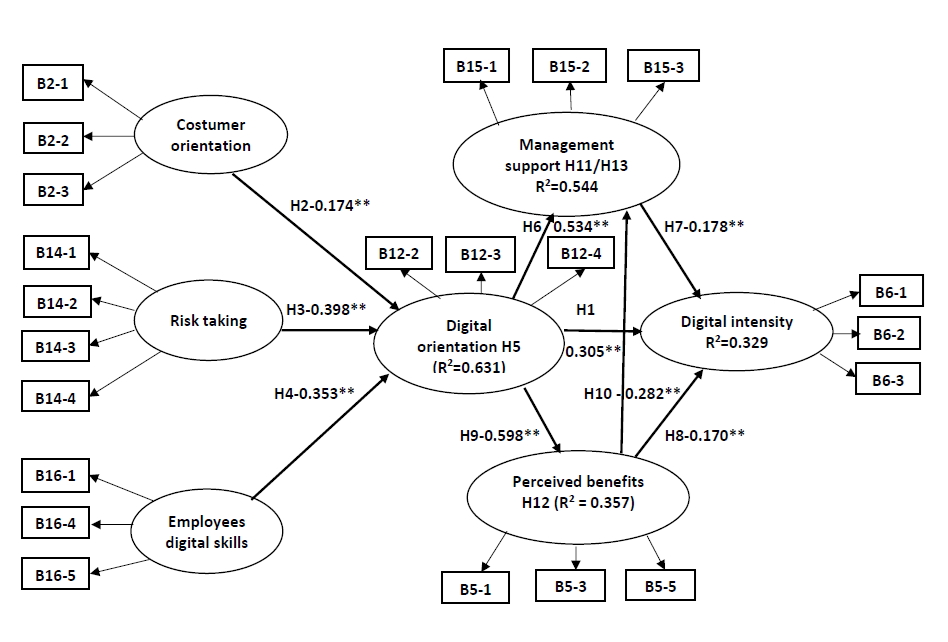 Fig. 1.
Hypotheses tested, standardised regression coefficients, and R-squared (** - significant at 0.05).
This study uses non-probability convenience sampling, which has been adopted by other researchers because of its low cost and accessibility to respondents (Egala et al, 2024). The choice of enterprises is based on the following criteria: to have fewer than 250 full-time employees, to represent different sectors, and to be from the six planning regions in Bulgaria. The data were collected with the assistance of a research agency through computer-assisted personal interviews with 308 SMEs using a standardised questionnaire.
Most SMEs are private (94.5%) and independent (94.5%) firms. About 1/3 were in commerce (32.3%) and services (31.7%), followed by industry (25.7%) and construction (10.2%). Although micro-enterprises account for 92% of all SMEs in Bulgaria (National Statistical Institute (NSI), 2023), in the sample these are 34.4%; small enterprises are 33.4%, and medium-sized—32.1%. This distribution is based on the results of previous studies, which show that micro-firms lag behind in terms of digitalisation (Raimo et al, 2022). SMEs are from different economic sectors because of the multi-construct approach to examining their digitalisation (Proksch et al, 2024). The majority of respondents were owner/partner (29.5%), accountants/chief accountants (27.3%), and managers/executive directors (26.6%). Therefore, most of the respondents have high positions in the firms, which assures competent answers to the questions.
As individual representatives of the SMEs are interviewed, the issue of common method variance (CMV) exists. To address this problem, Harman’s single-factor test was applied (Podsakoff et al, 2003). The results reveal that no single factor accounts for most of the variance, indicating that the CMV is not a major concern for this sample.
The questionnaire items were adapted and modified from previous studies to suit the current research context. Digital orientation is adapted from Gatignon and Xuereb (1997), Nwankpa and Datta (2017), and Kindermann et al (2021); the items of digital intensity are from Warner and Wäger (2019), Stentoft et al (2020), and Hanelt et al (2021); customer orientation is based on Slater and Narver (1995), Berghaus and Back (2016), and Nadkarni and Prügl (2021); risk-taking—on Covin and Slevin (1989), Berghaus and Back (2016), and Wang (2023); employees’ digital skills—on Sinkula et al (1997), Proksch et al (2024), and Ismail (2022); management support is adapted from Berghaus and Back (2016) and Agostini and Nosella (2020); and perceived benefits—from Kraus et al (2022) and Hojnik and Huđek (2023).
All individual variables were measured using a 5-point Likert scale, where 1 means “completely disagree” and 5—“completely agree”. Before running the questionnaire, it was assessed by two experts in the field of digitalisation. After the pre-test with managers from nine firms, some questions were slightly reworded.
Partial least squares structural equation modelling (PLS-SEM) was applied because it makes no assumptions about data distributions. With a minimum path coefficient of 0.15 and a significance level of 5%, the required minimum sample size was 275 cases (Hair et al, 2022, p. 88), while our sample contained 308 cases, and all path coefficients were above 0.15.
As all composite variables are reflective, the model was assessed for indicator
reliability, internal consistency, convergent validity, Average Variance
Extracted (AVE), discriminant validity-Heterotrait-monotrait ratio of
correlations (HTMT), and collinearity. The outer loadings of all indicators were
above 0.7, suggesting sufficient levels of indicator reliability (Additional
results of the analysis are available online at:
https://cloud.nasledstvo.bg/s/KHNR2TK8X7Cf5Cb).
Cronbach’s alpha for all constructs was between 0.785 and 0.895, composite
reliability
The Fornell-Larcker criterion shows that the square root of the AVE values of each construct is higher than the construct’s highest correlation with any other construct. We assume the HTMT threshold value of 0.85 for all construct combinations except for the four types of orientations. For these pairs of constructs, we assume a threshold of 0.90 because they are conceptually close as strategic orientations. All the HTMT values were lower than the suggested threshold of 0.85. The bootstrap confidence intervals show that the HTMT values computed from the 10,000 bootstrap samples are lower than the threshold of 0.85 for all combinations of constructs, and lower than the threshold of 0.90, for two pairs of strategic orientations. Therefore, all constructs of the model are empirically distinct, confirming their discriminant validity. Thus, the model responds to the evaluation criteria, supporting the reliability and validity of the measures (Table 1).
| Convergent validity | Internal consistency reliability | Discriminant validity | ||||||
| Constructs | Indicators | Loadings | Indicator reliability | AVE | Cronbach’s alpha | Reliability |
Composite reliability |
HTMT lower than 0.85 (0.90) |
| 0.60–0.90 | 0.60–0.90 | 0.60–0.90 | ||||||
| Customer orientation | B2_1 | 0.781 | 0.610 | 0.700 | 0.785 | 0.787 | 0.875 | Yes |
| B2_2 | 0.859 | 0.738 | ||||||
| B2_3 | 0.868 | 0.753 | ||||||
| Digital intensity | B6_1 | 0.835 | 0.697 | 0.737 | 0.821 | 0.824 | 0.894 | Yes |
| B6_2 | 0.883 | 0.780 | ||||||
| B6_3 | 0.857 | 0.734 | ||||||
| Digital orientation | B12_2 | 0.903 | 0.815 | 0.826 | 0.895 | 0.895 | 0.934 | Yes |
| B12_3 | 0.913 | 0.834 | ||||||
| B12_4 | 0.910 | 0.828 | ||||||
| Employees digital skills | B16_1 | 0.897 | 0.805 | 0.773 | 0.853 | 0.854 | 0.911 | Yes |
| B16_4 | 0.878 | 0.771 | ||||||
| B16_5 | 0.864 | 0.746 | ||||||
| Perceived benefits | B5_1 | 0.849 | 0.721 | 0.817 | 0.888 | 0.889 | 0.931 | Yes |
| B5_3 | 0.898 | 0.806 | ||||||
| B5_5 | 0.914 | 0.835 | ||||||
| Management support | B15_1 | 0.909 | 0.826 | 0.800 | 0.875 | 0.875 | 0.923 | Yes |
| B15_2 | 0.894 | 0.799 | ||||||
| B15_3 | 0.880 | 0.774 | ||||||
| Risk taking | B14_1 | 0.880 | 0.774 | 0.682 | 0.844 | 0.862 | 0.895 | Yes |
| B14_2 | 0.863 | 0.745 | ||||||
| B14_3 | 0.748 | 0.560 | ||||||
| B14_4 | 0.806 | 0.650 | ||||||
Note: AVE, Average variance extracted; HTMT, Heterotrait-monotrait ratio of correlations.
The variance inflation factor (VIF) values of the predictor constructs are below 3, which suggests that collinearity is not a significant issue in the structural model. The direct effects of the three strategic orientations explain almost 63% of the variance in the DO. The explained variance of management support is approximately 54%, the explained variance of perceived benefits is approximately 35%, and the explained variance of digital intensity is 32% (Table 2). These results demonstrate the model’s relatively good explanatory power.
| Original sample (O) | Sample mean (M) | 2.5% | 97.5% | |
|---|---|---|---|---|
| Digital intensity | 0.322 | 0.329 | 0.256 | 0.406 |
| Digital orientation | 0.627 | 0.632 | 0.557 | 0.700 |
| Perceived benefits | 0.355 | 0.357 | 0.259 | 0.454 |
| Management support | 0.541 | 0.545 | 0.465 | 0.620 |
To assess the predictive power of the model, we set the number of folds to 10, the number of repetitions to 10, and the root mean square error (RMSE) was used (Hair et al, 2022, p. 204). All Q2 prediction values were positive, indicating that the model predictive error was smaller than that of the linear regression model (LM) model (Table 3). The RMSE values of the key endogenous construct indicators (digital intensity and digital orientation) were smaller than the LM RMSE values. As the majority of indicators in PLS-SEM have smaller prediction errors compared to LM, this indicates a medium predictive power (Hair et al, 2022, p. 200–201).
| Q2 predict | PLS-SEM_RMSE | PLS-SEM_MAE | LM_RMSE | LM_MAE | |
| B6_1 | 0.198 | 0.995 | 0.810 | 1.005 | 0.802 |
| B6_2 | 0.214 | 1.156 | 1.001 | 1.161 | 0.976 |
| B6_3 | 0.173 | 1.245 | 1.071 | 1.268 | 1.068 |
| B12_2 | 0.526 | 0.844 | 0.659 | 0.853 | 0.661 |
| B12_3 | 0.495 | 0.816 | 0.642 | 0.831 | 0.650 |
| B12_4 | 0.514 | 0.838 | 0.653 | 0.863 | 0.669 |
| B5_1 | 0.338 | 0.954 | 0.766 | 0.934 | 0.748 |
| B5_3 | 0.374 | 0.890 | 0.723 | 0.864 | 0.694 |
| B5_5 | 0.349 | 0.894 | 0.714 | 0.879 | 0.697 |
| B15_1 | 0.377 | 0.802 | 0.623 | 0.804 | 0.618 |
| B15_2 | 0.408 | 0.830 | 0.650 | 0.832 | 0.639 |
| B15_3 | 0.438 | 0.831 | 0.669 | 0.804 | 0.630 |
Note: PLS, Partial least squares; MV, manifest variable; PLS-SEM_RMSE, Partial least squares structural equation modelling root mean square error; PLS-SEM_MAE, Partial least squares structural equation modelling mean absolute error; LM_RMSE, Linear regression model root mean square error; LM_MAE, Linear regression model mean absolute error.
The data show that DO positively impacts digital intensity (0.305), which supports H1 (Table 4). Based on a review of previous research, Yu and Moon (2021) also find that the main factor influencing digital transformation is digital strategy orientation. The importance of DO and digital capabilities in the process of enterprise digitalisation has also been emphasised by other studies too (Manjunath et al, 2024; Vial, 2019).
| Original sample (O) | Sample mean (M) | Standard deviation (STDEV) | T statistics (|O/STDEV|) | p values | |
| H1. Digital orientation |
0.305 | 0.308 | 0.083 | 3.702 | 0.000 |
| H2. Customer orientation |
0.174 | 0.174 | 0.049 | 3.577 | 0.000 |
| H3. Risk-taking |
0.398 | 0.398 | 0.052 | 7.705 | 0.000 |
| H4. Employees digital skills |
0.353 | 0.353 | 0.046 | 7.587 | 0.000 |
| H6. Digital orientation |
0.534 | 0.534 | 0.048 | 11.178 | 0.000 |
| H7. Management support |
0.178 | 0.176 | 0.061 | 2.923 | 0.003 |
| H8. Perceived benefits |
0.170 | 0.170 | 0.058 | 2.910 | 0.004 |
| H9. Digital orientation |
0.598 | 0.597 | 0.042 | 14.137 | 0.000 |
| H10. Perceived benefits |
0.282 | 0.282 | 0.060 | 4.673 | 0.000 |
The three types of strategic orientation positively and significantly influence DO, supporting H2, H3, and H4. Risk-taking has a larger effect on DO (0.398), followed by employees’ digital skills (0.353), and customer orientation (0.174).
These results are consistent with those of previous research. For example, Gobble (2018) states that digital technologies deliver the most value when supported by a culture that fosters risk-taking. According to Liu et al (2023), risk-taking is a decisive part of enterprise strategic decision-making, including the implementation of new technologies. Other studies reveal that IT adoption, as a key element of digitalisation, requires skilled employees to integrate these systems (Sousa and Rocha Á, 2019). Digital capabilities complement DO, as only SMEs with such skills will be ready to adopt new technologies (Khin and Ho, 2019). With respect to customer orientation, Low et al (2022) consider it a prerequisite for digital maturity.
In turn, digital orientation contributes significantly to higher perceptions of the benefits of using digital technologies (0.598), as well as to greater management support (0.534) for adopting such technologies. These results show that H6 and H9 cannot be rejected. Other researchers have also demonstrated that organisational drivers for SME digitalisation are mainly related to top management’s vision and support (De Mattos et al, 2024). The importance of senior managers’ strategic vision sustains the impact of strategic DO on management support (Melo et al, 2023).
The level of digital intensity also depends directly on management support (0.178) and perceived benefits (0.170), upholding H7 and H8. Additionally, perceived benefits positively impact management support (0.282), which supports H10. Digital knowledge and awareness of leaders are very important, as they directly influence the decisions to use new technologies (Kontić and Vidicki, 2018). According to Cenamor et al (2019), leadership is a key factor in supporting SMEs’ technological innovation. Therefore, SME management requires a digital mindset to introduce new technologies. In some firms, this is the reason for the creation of a new top management position, the Chief Digital Officer (Nadkarni and Prügl, 2021).
Research shows that the higher the perceived benefits of using new digital technologies, the greater the management support for their adoption (De Mattos et al, 2024). Respondents from digitally advanced firms identified their leaders as transformational, while those from less digitally mature firms identified their leaders as cautious (Zulu et al, 2023). Mazzarol (2015) also considers that helping SMEs adopt digital technologies can be facilitated by addressing owner-manager awareness of the benefits of these systems.
The total indirect effects are also significant, which confirms the important role of strategic orientations for higher management support, larger perceptions of benefits, and greater digital intensity (Table 5).
| Original sample (O) | Sample mean (M) | 2.5% | 97.5% | |
| Customer orientation |
0.092 | 0.093 | 0.042 | 0.151 |
| Customer orientation |
0.104 | 0.104 | 0.049 | 0.162 |
| Customer orientation |
0.122 | 0.122 | 0.058 | 0.189 |
| Digital orientation |
0.227 | 0.225 | 0.126 | 0.331 |
| Digital orientation |
0.168 | 0.168 | 0.097 | 0.244 |
| Employees digital skills |
0.188 | 0.188 | 0.130 | 0.249 |
| Employees digital skills |
0.211 | 0.211 | 0.145 | 0.281 |
| Employees digital skills |
0.248 | 0.248 | 0.179 | 0.318 |
| Perceived benefits |
0.050 | 0.050 | 0.015 | 0.093 |
| Risk taking |
0.212 | 0.212 | 0.151 | 0.276 |
| Risk taking |
0.238 | 0.238 | 0.168 | 0.308 |
| Risk taking |
0.279 | 0.280 | 0.200 | 0.359 |
The data show that DO has not only the greatest direct impact on digital intensity but also the highest indirect impact (0.227) through management support and perceived benefits, followed by risk-taking (0.212) and employees’ digital skills (0.188).
All the indirect and direct effects were significant and positive. As there is no direct influence of the three strategic orientations on digital intensity, DO fully mediates their effects, which upholds H5. Similarly, management support and perceived benefits partially mediate the influence of DO and fully mediate the effects of other strategic orientations on digital intensity, while management support partially mediates the impact of perceived benefits on digital intensity. These results support hypotheses H11, H12, and H13.
Specific indirect effects are also significant. The three strategic orientations have a significant indirect impact on perceived benefits and management support through DO as well as on digital intensity through these three mediators.
DO has the largest total effect on digital intensity (0.532), perceived benefits (0.598), and management support (0.702). The total effects of perceived benefits on the target variable are larger (0.220) than the total effects of other factors, except for the effects of digital orientation. Fig. 1 shows the results of the tested hypotheses, standardised regression coefficients, and R-squared.
This study contributes to the extant literature by revealing that DO, as a new type of strategic orientation (Kindermann et al, 2021; Quinton et al, 2018) is a critical antecedent of SMEs’ digital intensity. In this way, it validates the positive impact of DO on digitalisation in the Bulgarian SME context. Based on the RBV the study demonstrates the complementarity effects of four strategic orientations (Schweiger et al, 2019) as important organisational capabilities for the adoption and use of digital technologies in the SME context. This reveals that DO is supported by other strategic orientations while mediating their positive effects on management support, perceived benefits, and SME digital intensity.
The goal of this study is to investigate the significance of strategic orientations on the digital intensity of SMEs with the key role of the DO. The results show that customer orientation (as part of market orientation), risk-taking (as part of entrepreneurial orientation), and employees’ digital skills (as part of learning orientation) significantly support DO. Digital orientation directly impacts digital intensity, management support, and expected benefits, while fully mediating the effects of the other three orientations on these factors. Management support and perceived benefits also have a significant and positive impact on SMEs’ digital intensity.
These results can be useful for SME managers to translate strategic DO into adequate operational actions (Bendig et al, 2023). They need to develop such an orientation to align themselves with the advancement of the digital economy. Due to the limited resources of SMEs, especially from less developed EU countries, adopting a DO is a big challenge for them (Nambisan et al, 2019). Therefore, in line with the strategy “Europe 2021–2027” they need more government support in terms of special programmes for their digitalisation (Stentoft et al, 2020). In addition to financial support, such programs should contribute to raising managers’ awareness of the potential benefits of digitalisation, as well as to higher customer orientation, risk-taking, and investment in employee skills (Kraft et al, 2022). SME owners/managers must be convinced of the benefits of digital technologies to support their implementation (Quinton et al, 2018).
This study has the following limitations. First, it uses only four strategic orientations as internal antecedents of SMEs’ digitalisation, while including environmental and other organisational factors would provide a more comprehensive understanding of this process. Second, it is based on a non-representative sample of SMEs with a greater share of small and medium-sized enterprises compared to their share in the total population. Third, the study uses cross-sectional data, which provides a snapshot of the current state of SMEs’ digitalisation in Bulgaria. Further research with larger samples or longitudinal studies would provide more detailed data on the digital changes in different groups of Bulgarian SMEs.
The datasets used and analyzed during the current study are available from the corresponding author on reasonable request.
ZV, OH, and IM participated equally in the design of the research study, the preparation of literature review, and the conceptual model with the hypotheses. ZV processed the data, while the three authors analysed the results, and made the conclusions. All authors contributed to editorial changes in the manuscript. All authors read and approved the final manuscript. All authors have participated sufficiently in the work and agreed to be accountable for all aspects of the work.
Not applicable.
This study was financed by the European Union-NextGenerationEU through the National Recovery and Resilience Plan of the Republic of Bulgaria, project No. BG-RRP-2.004-0008.
The authors declare no conflict of interest.
References
Publisher’s Note: IMR Press stays neutral with regard to jurisdictional claims in published maps and institutional affiliations.