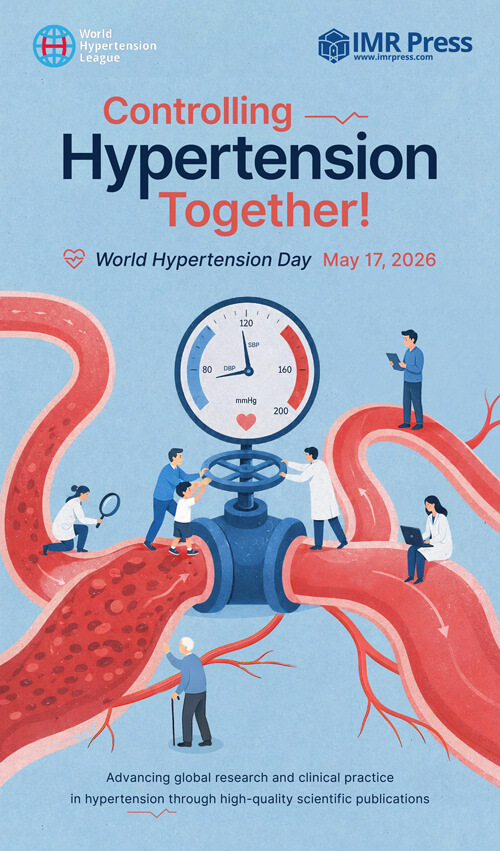
World Hypertension Day Special Feature
—— Controlling Hypertension Together!
Overview
Hypertension is one of the most prevalent chronic diseases worldwide and a major risk factor for cardiovascular diseases, stroke, and kidney disease. Often referred to as the “silent killer” because it often has no obvious symptoms, hypertension continues to pose a significant challenge to global public health.
On the occasion of World Hypertension Day 2026, IMR Press and its related journals present this special feature under the theme “Controlling Hypertension Together!”. Through selected publications and expert perspectives, this feature highlights recent advances in hypertension research, clinical practice, and public health.
Featured Articles
This section features selected publications on hypertension research from IMR Press journals, covering molecular mechanisms, clinical interventions, pharmacological therapies, and long-term disease management.
Differences in Exercise Capacity, Ventilatory Efficiency, and Gas Exchange between Patients with Pulmonary Arterial Hypertension and Chronic Thromboembolic Pulmonary Hypertension Residing at High Altitude
Mauricio Gonzalez-Garcia, Rafael Conde-Camacho, Katherine Díaz, Camilo Rodríguez-Cortes, Emily Rincon-Alvarez
Rev. Cardiovasc. Med. 2024, 25(7), 247; https://doi.org/10.31083/j.rcm2507247
Article Highlights: At high altitude, patients with PH present severe gas exchange alterations during exercise. Although there were no differences in hemodynamics at rest or in exercise capacity between patients with PAH and CTEPH, those with CTEPH had greater dyspnea, ventilatory inefficiency, and alterations in gas exchange during exercise. The CPET allowed the identification of these alterations related to the pathophysiology of the CTEPH that could explain the lower functional class and dyspnea in these patients.
Molecular Mechanisms Underlying Vascular Remodeling in Hypertension
Xinyi Zeng, Yan Yang
Rev. Cardiovasc. Med. 2024, 25(2), 72; https://doi.org/10.31083/j.rcm2502072
Article Highlights: In this review, we summarize the latest research progress of RAS, inflammation, ECM, and stem cells in vascular remodeling. We also discuss the latest research on ion channels found in vascular cells and stem cells. A comprehensive understanding of hypertension and vascular remodeling will undoubtedly fuel more research, leading to the discovery of more effective treatment methods and improved measures for disease prevention and control. Therefore, we hope that this summary of current knowledge will serve as a significant stimulus for future research in the field.
Effects of 12-week Circuit Exercise Intervention on Blood Pressure, Vascular Function, and Inflammatory Cytokines in Obese Older Women with Sarcopenia
Won-Sang Jung, Hana Ahn, Sung-Woo Kim, Hun-Young Park
Rev. Cardiovasc. Med. 2024, 25(5), 185; https://doi.org/10.31083/j.rcm2505185
Article Highlights: In this study, a 12-week circuit training program was investigated for its effects on blood pressure, vascular function, and inflammatory markers in older obese women with sarcopenia. The primary results indicate significant improvements in fat-free mass, fat mass, and body fat percentage in the exercise group. Blood pressure variables such as heart rate and RPP also showed significant improvements in the exercise group. Vascular function, measured by ba-PWV and FMD, improved significantly in the exercise group, and there was a notable decrease in IL-6 as an inflammatory marker. These findings suggest that circuit training can have a positive effect on improving body composition, blood pressure, vascular function, and inflammatory markers in older obese women with sarcopenia. These results imply that regular participation in a circuit training program can significantly enhance health-related variables in obese older adults with sarcopenia.
Development and Implementation of a Dynamically Updated Big Data Intelligence Platform Using Electronic Medical Records for Secondary Hypertension
Nanfang Li, Qing Zhu, Yujie Dang, Yin Zhou, Xintian Cai, Mulalibieke Heizhati, Delian Zhang, Xiaoguang Yao, Qin Luo, Junli Hu, Guoliang Wang, Yingchun Wang, Menghui Wang, Jing Hong
Rev. Cardiovasc. Med. 2024, 25(3), 104; https://doi.org/10.31083/j.rcm2503104
Article Highlights: We developed and implemented a big database of electronic medical records for hypertension that dynamically updates, and offers an important perspective on the future study of secondary hypertension.
Exercise Pulmonary Hypertension in Heart Valve Disease
Alessandra Schiavo, Michele Bellino, Antonella Moreo, Francesca Casadei, Andreina Carbone, Salvatore Rega, Rodolfo Citro, Raffaele Sangiuolo, Antonio Cittadini, Eduardo Bossone, Alberto M. Marra
Rev. Cardiovasc. Med. 2024, 25(4), 131; https://doi.org/10.31083/j.rcm2504131
Article Highlights: This review article aims to provide an overview on the prognostic role of exercise PH in valvulopathies, and its possible role in the diagnostic-therapeutic algorithm for the management of HVD.
Surgical Repair of Giant Dissecting Pulmonary Artery Aneurysm Associated with Atrial Septal Defect and Pulmonary Arterial Hypertension: A Case Report
Wen Xie, Jianrui Ma, Haiyun Yuan, Yong Zhang, Jian Zhuang, Shusheng Wen
Heart Surg. Forum 2024, 27(6), 572–581; https://doi.org/10.59958/hsf.6835
Article Highlights: This case report illustrates the complexity of pulmonary artery aneurysm (PAA) with dissection, emphasizing personalized and holistic approaches to treatment. If the patient’s condition allows, the surgical repair is a feasible and effective option to prevent fetal complications. Traditional medical values, such as a holistic view of health and preventive care, align with the discussed strategies. Moreover, the report reveals the challenges of diagnosis and management, especially in underdeveloped regions, and underscores the importance of early detection and referral. Continuous monitoring, a thorough diagnostic approach, and a call for further research demonstrate a commitment to evidence-based practice and ongoing improvement in managing this rare condition.
Efficacy and Safety of Aprocitentan in the Treatment of Hypertension: A Meta-Analysis of Evidence from Randomized Controlled Trials
Li Zheng, Ming Liu, Xiaotong Gu, Yatong Zhang, Yan Wang
Rev. Cardiovasc. Med. 2025, 26(1), 25909; https://doi.org/10.31083/RCM25909
Article Highlights: The results of this study confirm that aprocitentan can significantly reduce blood pressure, as evidenced by significant effects on msSBP, msDBP, maSBP, and maDBP. Additionally, we did not observe any risks of AEs and SAEs following aprocitentan treatment.
From Pulmonary Embolism to Chronic Thromboembolic Pulmonary Hypertension: A Pathophysiological Approach
Parham Shahidi, Luise Mentzel, Stephan Blazek, Dmitry Sulimov, Holger Thiele, Karl Fengler
Rev. Cardiovasc. Med. 2024, 25(11), 402; https://doi.org/10.31083/j.rcm2511402
Article Highlights: By reviewing the current evidence, we have demonstrated that thrombus non-resolution in CTEPH is due to multiple mechanisms and predisposing factors including: inflammation, small-vessel disease, impaired angiogenesis, platelet dysfunction, coagulopathies, malignancy, impaired fibrinolysis, genetics and many other components. Based on the current evidence, we aimed to explain the pathophysiology CTEPH, PE and the connection between these two important diseases. Furthermore, we highlight the negative hemodynamic effects of CTEPH and PE on the right ventricle and its role in further exacerbation of these patients.
Exercise Prescription in Individuals with Prehypertension and Hypertension: Systematic Review and Meta-Analysis
Yang Xi, Xiaoyun Liu, Yuanyuan Chen
Rev. Cardiovasc. Med. 2024, 25(4), 117; https://doi.org/10.31083/j.rcm2504117
Article Highlights: This systematic review and meta-analysis investigated the antihypertensive effects of various exercise regimens on HNBP and hypertensive populations. The included high-quality articles involving RCTs. This study shows that different exercise regimens have various effects on lowering SBP, DBP and HR as follows. (1) Swimming in heated pools and moderate-intensity cycling are the most effective types of exercise for reducing SBP. (2) Treadmill exercise and IHG training are the most effective exercises for reducing DBP. (3) Cycling is the most effective exercise for reducing HR. Our findings suggest that different types of exercise can effectively reduce the levels of SBP, DBP and HR in individuals with prehypertension or hypertension.
Cancer Therapy-Associated Pulmonary Hypertension and Right Ventricular Dysfunction: Etiologies and Prognostic Implications
Orly Leiva, William Beaty, Steven Soo, Manyoo A. Agarwal, Eric H. Yang
Rev. Cardiovasc. Med. 2024, 25(3), 87; https://doi.org/10.31083/j.rcm2503087
Article Highlights: Cancer therapy-associated PH and RV dysfunction is an underappreciated form of cardiovascular toxicity from conventional and novel cancer therapeutics. Patients with cancer are also at risk of PH from multifactorial etiologies including cancer therapy, thrombosis and cancer-specific pathology. Future studies are needed to better characterize PH in patients with cancer, including investigations involving RHC for better characterization of hemodynamic classification of PH in cancer. Additionally, among patients treated with ICI, response of PH to immunosuppression should be investigated. Patients with cancer being treated with high-risk therapy should be monitored closely for the development of PH. Additionally, novel interventions, including transcatheter devices and pressure sensor monitoring, for PH should be studied in patients with cancer in order to determine their utility in monitoring, preventing and managing cancer therapy-associated PH. Understanding mechanisms of PAH induced by both historical and modern cancer treatment regimens may improve our understanding of other phenotypes of PAH, in addition to yielding insights into potential novel treatment strategies that can be used to treat both traditional forms of PAH and within the cardio-oncology population.
Expert Insights
Leading experts in hypertension and cardiovascular medicine share their perspectives on current challenges, clinical practice, and future directions in hypertension research and management.
Special Issue Spotlight
A special issue on hypertension and related fields has been launched and remains open for submissions. This section provides an overview of its theme, scope, and guest editors—making it easy for researchers to explore and stay informed.
Hypertension and Cardiac Function: Insights from Imaging
Hypertension control remains a long-term global health challenge that requires collaboration across research, clinical practice, and public health. Through this World Hypertension Day special feature, IMR Press hopes to foster academic exchange and knowledge sharing while supporting continued advances in hypertension research and healthcare management.