


1 Institute of Sociology, Friedrich-Alexander-Universität Erlangen-Nürnberg, 90429 Nürnberg, Bavaria, Germany
Abstract
The German automotive industry is undergoing a twin transformation—digitalization and electromobility—reshaping its workforce, particularly engineers, who are central to innovation yet traditionally tied to combustion engines. This study examines how the shift toward battery electric vehicles (BEVs) affects engineers’ organizational and professional identities, comparing those engaged in electromobility (“new” engineers) with those still working on combustion engines (“old” engineers). Using a mixed-methods approach, we analyze qualitative interviews with 37 engineers and two quantitative surveys (n = 4136; n = 710) spanning 2015–2024. Findings reveal substantial internal divisions in engineering, with organizational strategies intensifying this polarization, leading to divergent experiences and dysfunctional outcomes. Quantitative data further explore identity shifts in engineering between 2022 and 2024, focusing on trust in management and works councils, and shifts in future assessments across multiple levels (from specific products to the industry as a whole). The descriptive results question whether traditional theories of engineering identity are valid amid rapid transformation. The study contributes to debates on professional identity in times of disruptive change, highlighting tensions between innovation-driven roles and legacy expertise in the automotive sector.
Keywords
- electromobility
- professional identities
- engineering
- R&D
- ecological transformation
- OEM
- automotive suppliers
The German automotive industry is seen as a particularly relevant example of an ‘old economy’ within the global sector, currently undergoing a twin transformation: digitalization and electromobility are being introduced in the workplace, simultaneously and with significant temporal overlap. While the research identifies a fundamental strategic challenge in transforming from a traditional automotive manufacturer to a modern tech company (Boes and Ziegler, 2021, p. 200), most car manufacturers have already announced this strategic step and are currently in the midst of its implementation. The new, product-related importance of software alone is an immense change in strategy, as the industry previously outsourced as much as 80 per cent of its budget for information technology (Felser, 2021). Within automotive companies the transformative process clashes with what already exists. Although the automotive industry’s ecological transformation is complex and dynamic, making it difficult to understand its impact, the public and scientific debate has largely centered on employment effects.
Especially in the case of electromobility, negative employment effects are primarily associated with the reduction in working hours per vehicle (Bosch, 2022) and/or with a reduction in parts (Spath et al., 2012). The “Employment 2030” study (Bauer et al., 2020) forecasts a reduction in various Volkswagen job profiles, particularly in production but also substantially in engineering.
As engineers, although crucial for ecological transformation innovations, they are traditionally associated with the combustion engine, both in self-description and external attribution (Gispen, 1988). This article therefore focuses on engineers as a group. Engineers’ high reputation is being questioned due to the increasing IT-driven and organizational standardization of Research and Development (R&D) and innovation processes in engineering (Perrolle, 1984; Pfeiffer et al., 2010) as well as outsourcing (Will-Zocholl, 2017), undermining the former status and igniting discussions about their decline (Torstendahl, 2021).
While earlier studies on engineer identities focused on class analysis (Crawford, 1989; Smith, 1987), 1990s studies showed initial evidence of polarization within the engineering profession, with those in R&D having more autonomy and fulfilling tasks. Engineers are innovators as well as “objects of managerial direction” (Meiksins and Smith, 1996, p. 258). Since some years, not only technical induced transformations change the automotive sector dramatically, but also the dynamics in regulation within the global context (Krzywdzinski et al., 2025a). As a study in the American Midwest shows how different stakeholder groups (e.g., auto workers, automotive managers and community members) differ in their views on a just transition towards electric vehicles (Silva et al., 2023), and a German study unveils how an accumulation of transformations (digitalization, decarbonization, de-globalization) especially hit engineers in the automotive sector (Dahm et al., 2023), this article therefore emphasizes the question of how the current transformation dynamics in the industry are affecting one of its most important employee groups.
Although transformation is a process, and does not affect everyone in engineering equally (while some focus exclusively on new technologies, others continue to work on combustion engines), still most vehicle innovations require engineering expertise, regardless of the vehicles’ powertrain. This study examines the possible consequences of these different levels of transformation for employees. Since engineers are historically and objectively of great importance to the automotive sector and their identity formation as a professional group—from academic training (Co and Chen, 2025) to the climate of innovation within the company (Hassi et al., 2025)—plays a central role, this article focuses on the effects of transformation dynamics on the identity of this highly qualified professional group. The empirical findings concentrate on engineers in the German automotive industry, a group of employees with a long history of identity building within an industry of importance on a global scale. Engineers as a professional group are not only particularly affected by the digital transformation, they construct their group identities and status vis-à-vis the increasing importance of software experts (Graf, 2023); as the recent study shows, transformation within the company can trigger adverse group dynamics and jeopardize the organizational change process (ibid.).
The study compares differences between those in automotive engineering who are actively involved in the transformation towards electromobility and those still working on combustion engines. These “new” and “old” engineering groups are compared, using a mixed-methods approach, drawing on qualitative interviews with 37 engineers with two quantitative surveys (n = 4136 and n = 710). The empirical data spans 2015–2024 across three survey waves, enabling analysis of how corporate strategies on electromobility have influenced engineers compared to other employees over nearly a decade.
Section 2 lays the theoretical foundation with a structured discussion of theories on identities and engineering. After presenting the methodology and empirical material (section 3), the qualitative analysis provides insights into the experiences of employees divided into two groups (“new” = BEV for battery electric vehicle, and “old” = non-BEV) as categorized by management (section 4). Further questions arising from the qualitative analysis are explored in section 5, using the quantitative data. Section 6 concludes by discussing the results in terms of their possible theoretical and practical implications.
The extensive database provides a valid view of engineering within the green transition “in the making”, following the overall research question: Does the ecological transformation in the automotive sector—as exemplified by BEV—change the organizational and professional identity of employees in engineering? To situate these observations within a broader theoretical lens, the next section draws on social identity and self-categorization theory to explain how belonging to professional and organizational groups shapes engineers’ self-understanding. This framework clarifies why a firm’s strategic labeling of “new” versus “old” work can reconfigure in-group/out-group boundaries and, in turn, the identities of engineers at the center of the transformation.
Fundamental social theories show how group identities arise from belonging to social groups and thereby shape individuals’ self-concepts over time, emphasizing in-group versus out-group categorization and the pursuit of positive social self-worth. One of the most prominent theories is self-categorization (Turner et al., 1987), which is seen as an extension of social identity theory and explains the process of self-placement in groups and the formation of prototypes. Group identities can, on the one hand, promote cohesion and cooperation within the group, but, through differentiation from other groups, they also risk generating conflict (Tajfel, 1974; Turner, 2010). Moreover, social theory has long examined ethnic, national and cultural group identities (Hall and Du Gay, 1996). In globalized societies, transnational identities appear to partly dissolve traditional ones (Appadurai, 1996). Understanding identities in the work place requires a multidimensional view. Accordingly, this literature review covers literature on organizational and team identities, engineering in the German automotive industry, and professional identities during transformations, beginning with global varieties of the sector transitions.
To assess the transformation experience and its impact on engineering identity in the industry, it is first necessary to note that the twin transformation faces a variety of labour relations and management strategies. The twin transitions require fundamental changes in business models, involving investment in infrastructure, development of new services, and alignment with environmental policies (Llopis-Albert et al., 2021; Philbin et al., 2022). However, few firms have comprehensive strategies, making organizational flexibility essential (Savastano et al., 2019). Strategic responses include decision support systems (Llopis-Albert et al., 2021), integration of mobility management (Gorges and Holz-Rau, 2021), and the mobilization of systemic change agents (Collini and Hausemer, 2024). Integrating digital and green factors into management is considered key to competitive advantage. Change management approaches highlight the importance of proactive strategies, leadership, and capacity building (Collini and Hausemer, 2024; Philbin et al., 2022; Pulignano et al., 2023), though many organizations remain reactive. Evidence on workforce dynamics is limited. Pulignano et al. (2023) show that unions in Germany act proactively, supported by co-determination rights and knowledge regimes, while Belgian unions are more reactive. Professional identities are being reshaped through demands for problem-solving, adaptability, and teamwork, though empirical evidence is scarce. Across studies, the need for new technical and soft skills—including digital literacy, environmental awareness, and interdisciplinary collaboration—is emphasized, with recurring calls for up- and reskilling (Todorovic et al., 2023)
Identity research typically begins by defining organizational identity as a collective self-understanding of an organization (Whetten, 2006). It distinguishes organizational identity (“who we are”) from the “parameters of a defined identity-claim conceptual domain” (what) and associated “phenomenological markers of identity-referencing discourse (how, when, why)” (ibid., p. 219). Organizational identities are developed through processes of socialization, integrating employees into corporate culture and organizational identity—a process that begins not only with onboarding (Farrukh, 2025) but also through employer branding (Ala-Heikkilä and Järvenpää, 2023). The existence and importance of organizational identities often remain opaque until challenged, for example, in mergers and acquisitions (Mühlemann et al., 2022), or when local and global identities collide (Fortwengel, 2021). Caprar et al. (2022) also highlight the “dark sides” of strong organizational identification. While corporate identity has long been discussed as a means of promoting ethical practices (e.g., Sims, 1992), the role of corporate identities in promoting sustainable practices, particularly in sustainability and corporate social responsibility (CSR), has gained more attention (e.g., Bansal and Song, 2017).
Research at the organizational level reveals diverse identities. Team and departmental identities are shaped by specific goals, norms, and practices (Greco et al., 2022). Team identities are particularly challenged within flexible, project-based and dynamic environments like start-ups and agile organizations (Edmondson and Harvey, 2018), or through remote work during the COVID-19 pandemic (Leonardelli, 2022). Group identities within companies fulfill important functions and have several effects: Shared identities strengthen team cohesion and employee motivation (Dutton et al., 1994) but also create the potential for conflicts between departments or teams (Ashforth et al., 2008). Leaders play a crucial role in shaping and communicating group identities (Haslam et al., 2022), especially during periods of organizational change (Ybema et al., 2016), when tensions between individual and organizational identities arise, requiring managerial responses (Pratt and Foreman, 2000).
As international literature on professional and engineering identities refers mostly to students (Fletcher and Shryock, 2024; Morelock, 2017), the concept of occupational identity is more appropriate, as it arises from belonging to certain occupational groups or fields (Ashforth and Mael, 1989). Forming occupational identity as the “conscious awareness of oneself as a worker” can be challenging and stressful, but it contributes to occupational success, social adaptation, and psychological well-being (Skorikov and Vondracek, 2011, p. 693).
Engineers primarily identify with their work tasks, skills, company, and professional community (Brown, 2004). However, research in three countries, including Germany, shows sector-specific differences in identification with either the “output” (e.g., automobile industries) or the “process”. In both cases, engineering identity appears to depend on the perception that the “work is particularly challenging and required specialized skills” (ibid., p. 268). Another study on engineers in telecommunication explores the relationship between technology and occupational identity and reveals how the former physical nature of their technology led them to act as “autonomous custodians of ‘living’ machines”, but this key element of their engineering occupational identity diminished with the rise of digital technology (MacKenzie et al., 2017, p. 732).
Because engineers are both historically characteristic of and crucial to the innovation dynamics in the German automotive sector, this study concentrates on them. Following Oesch (2023), who constructs class not only around social stratification but also around the daily work logic, engineers are technical professionals with tertiary education. We also include the German specific qualification of technicians. These technicians emerge from the system of vocational education and further training (VET) and are classified as belonging to tertiary education according to the European Qualifications Framework (EQF) (Cedefop, 2020, p. 17). According to the German Classification of Occupations 2010 (Paulus and Matthes, 2013), they are largely similar to engineers. Of greater importance than formal equivalence is that both groups can be compared primarily in terms of their identity, for example, how their identities are shaped within their technical education “by a strong emphasis on conformity or adherence to rules” (Pierrakos et al., 2019) and how they shape their own work identity (Brown, 2004). Technicians are therefore also included here. German labor market data report 1.13 million engineering specialists in all areas, two-thirds of whom work in production and manufacturing, including technical research. In the field of automotive engineering, there were approximately 57,000 engineers in 2023 (Bundesagentur für Arbeit, 2024, pp. 57–67). In the same year, the share of engineers and technicians employed in the German automotive sector was 19.2%, or 169,200 individuals (data by Federal Employment Agency, c.f. Krzywdzinski et al., 2025b, p. 90). For the Original Equipment Manufacturer (OEM), in which our large-scale quantitative survey was conducted in 2022, within R&D we find 43.6% technicians and 56.4% engineers. Since the two groups are largely interchangeable, we will refer to them collectively as “engineering” in the following.
With the twin transformation, especially for engineering occupations within the German automotive sector. employment is forecasted to decline (Bauer et al., 2020). As their importance in relation to the new group of IT-heavy tech workers seems to be declining, engineers in the sector are described as an “uncertain elite” (Krzywdzinski et al., 2025b). Despite this, and even though the German industrial union “IG Metall” has made special efforts for years to adress engineers in the sector, their level of unionisation remains lower than that of production workers (Hassel and Schroeder, 2021, p. 112).
Engineers are seen as an “adaptive and productive social force” with cultural attitudes shifting between “revolutionary enthusiasm” and “Bildung [German for formal education] and gentlemanly behaviour” (Torstendahl, 2021, pp. 283–289). They are “innovators” who are “often mediators between labour and capital” and “increasingly the object of innovative practices and technologies” (Meiksins and Smith, 1996, p. 258). They “embody an internally contradictory social relationship. They are workers and extensions of managerial authority […and] increasingly the object of managerial direction” (ibid., p. 259). While Gispen (1988) saw German engineers as “men who occupied the critical positions in [companies] and embodied technological progress” and described the “rise of the German engineering profession, a grand metamorphosis, in which the land of poets and thinkers—and of Junkers, bureaucrats, and mandarins—turned into the world of Siemens, Porsche, Mannesmann, Bosch, Diesel, Daimler-Benz, etc.” (ibid. 550).
Today, the automotive industry faces the question of whether the ecological transformation beyond combustion will be the historical endpoint of this development. “With the turn of the twentieth century, engineers seemed to have arrived in the circle of the elites of bourgeois society […], the boom of the high and late industrial economy had made one of, if not the key figure of contemporary modernity”, but with further industrialization, engineers were “increasingly” associated with the “frictions of industrial modernity” (Sander, 2024, pp. 1–2).
In history, engineering has faced numerous challenges and transitions. IT-driven and organizational standardization of R&D and innovation processes (Perrolle, 1984; Pfeiffer et al., 2010) and the outsourcing of engineering services (Will-Zocholl, 2017) undermined the former status of engineers, sparking recurring discussions of their decline (Torstendahl, 2021). In the automotive sector, decades ago, engineers experienced “enucleation”, the removal of core engineering tasks, loss of autonomy, growing insecurity, and shifts in the materiality of their work (Schmiede and Will-Zocholl, 2011). Historically, losing autonomy is not a new experience for engineers: Before 1900, engineers’ Leitbild (German for guiding principle) was still that of self-employed entrepreneurs, responsible for the whole process–from the first draft to the supervision of the technical realization. After 1900, economic professions increasingly displaced engineers from management positions, while engineers found themselves competing with lower-paid technical drafters (Dienel, 1998, p. 13).
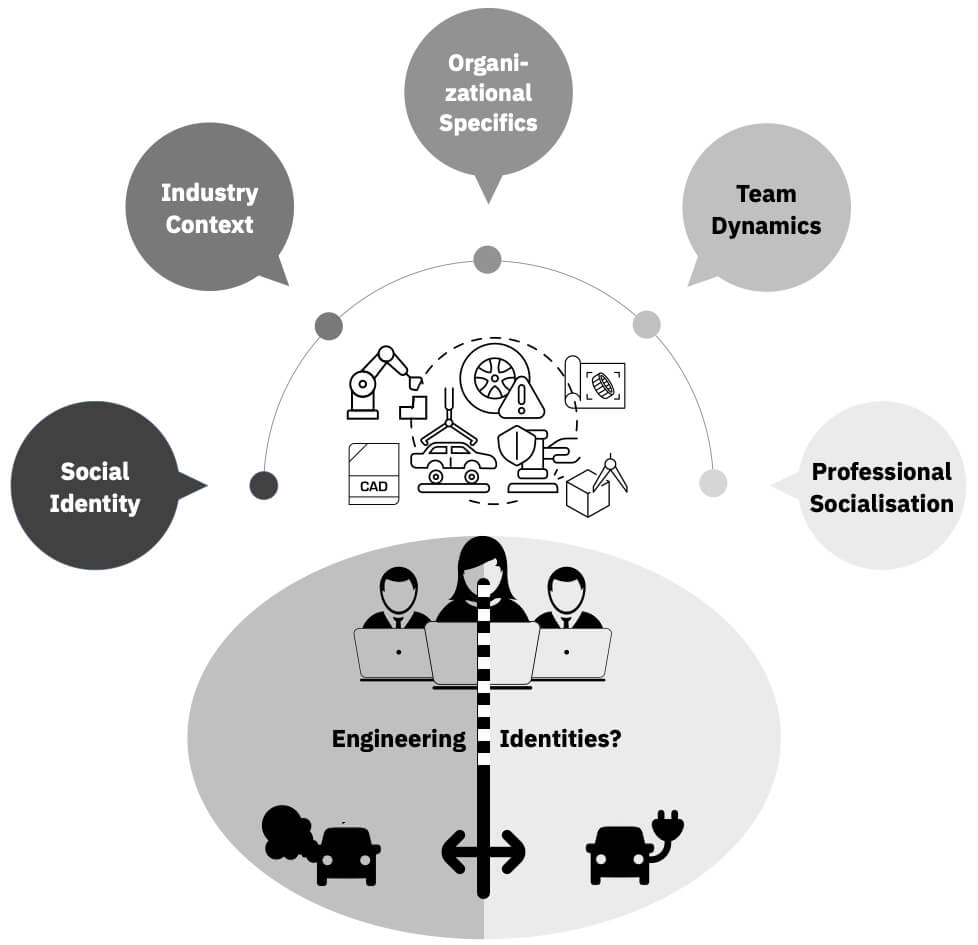
With the twin transformation, engineering currently faces diverse challenges (see Fig. 1): Artificial Intelligence is being increasingly integrated into products and used as an engineering tool (Tihlarik, 2024); after Chaos Engineering (Rosenthal and Jones, 2020) and Crowd Engineering (Hertwig et al., 2020), the emergence of Advanced Systems Engineering is again changing the way engineering processes are organized (Albers, 2023; Madni, 2018), further embedding agile methods into engineering (Pfeiffer et al., 2021; Tihlarik and Sauer, 2021). Market volatility and product variants are increasing, making it difficult to specify production processes fully in advance. Specification and implementation are increasingly intertwined, leading to “immature processes” (c.f. Kronen et al., 2023).
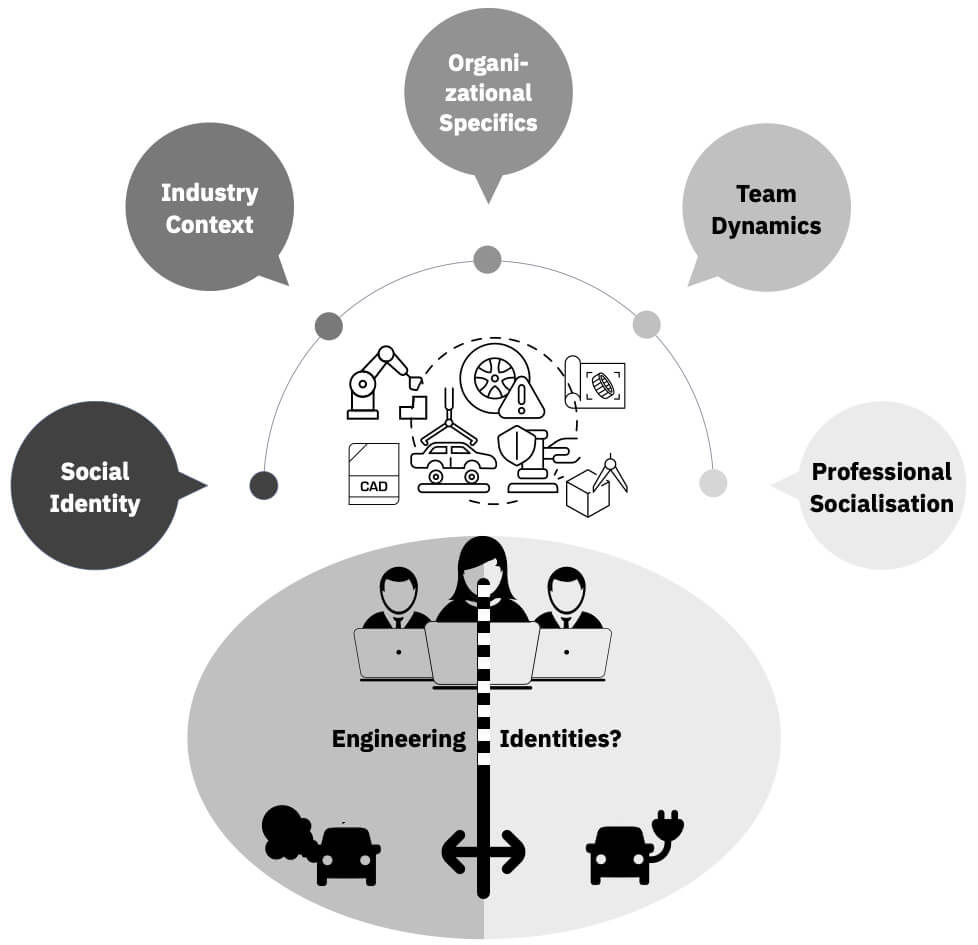 Fig. 1.
Factors shaping engineering identities and dividing technological contexts (ICE = internal combustion engine vs. BEV = battery electric vehicle).
Group identities are flexible and context-dependent (Postmes et al., 2005), influenced—strengthened or weakened—by crises, conflicts, and social change. Narratives, myths, and historical events shape group identities (Humphreys and Brown, 2007), especially through social media and virtual communities (Cornelissen et al., 2021). Kels et al. (2023) show that employees in knowledge-intensive occupations can weave professional transitions into their professional identity, even during critical events. Over the course of their professional practices and socialization, knowledge workers often identify more with their professional identity than with their company (Kels, 2018). When their career paths are affected, employees experience transformations as both crises and burdens, unsettling their personal and social identity but also leading to improved professional situations and job satisfaction (Ibarra, 2023). In a meta-study of over 40 studies, Morelock (2017) found engineering students’ skills, such as mathematical and statistical knowledge and innovative thinking, as well as professional network membership, were significant factors. Surprisingly, no clear characteristics indicating a sense of belonging or a particular habitus emerged.
Overall, the state of research shows that a variety of aspects are important for the formation and change of an engineering identity—from skills and socialisation to narratives and change.
As the e-mobility transformation of the automotive sector is both a transformation narrative and a real-life transformation—we will investigate how employees in engineering experience both “old” engineering (not affected by the transformation) and “new” engineering (directly affected by the transformation). Our overall research question is therefore: Does the BEV transformation in the automotive sector change the organizational and professional identity of employees in engineering?
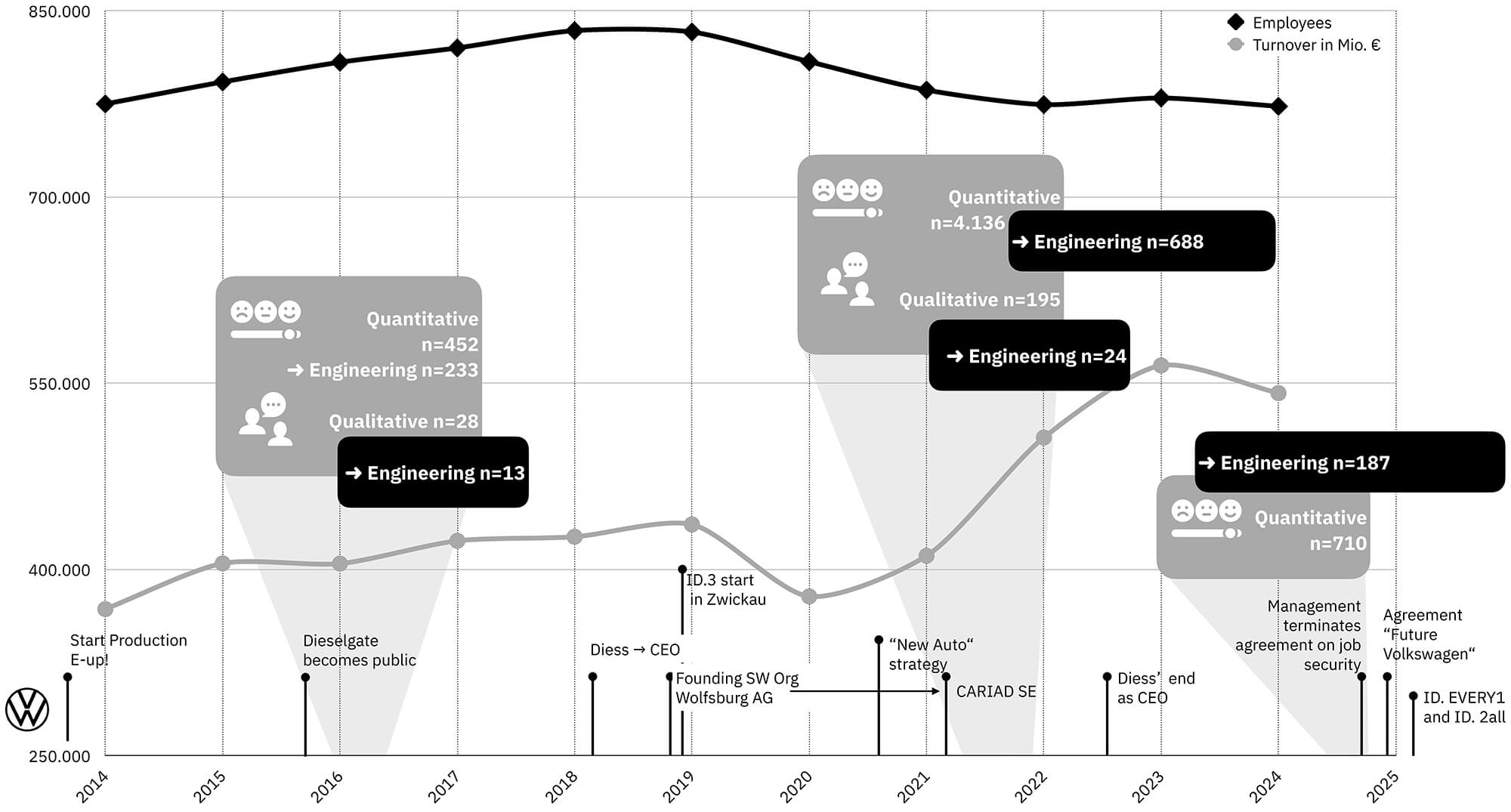
For this study, various primary qualitative and quantitative data sources, collected at different points in time in the automotive industry, are analyzed (see Fig. 2). Both mixed-methods studies were guided by the conviction that systematic integration of different data sources and analytical methods help to provide a better understanding of complex social phenomena (Creamer, 2022, p. 7).
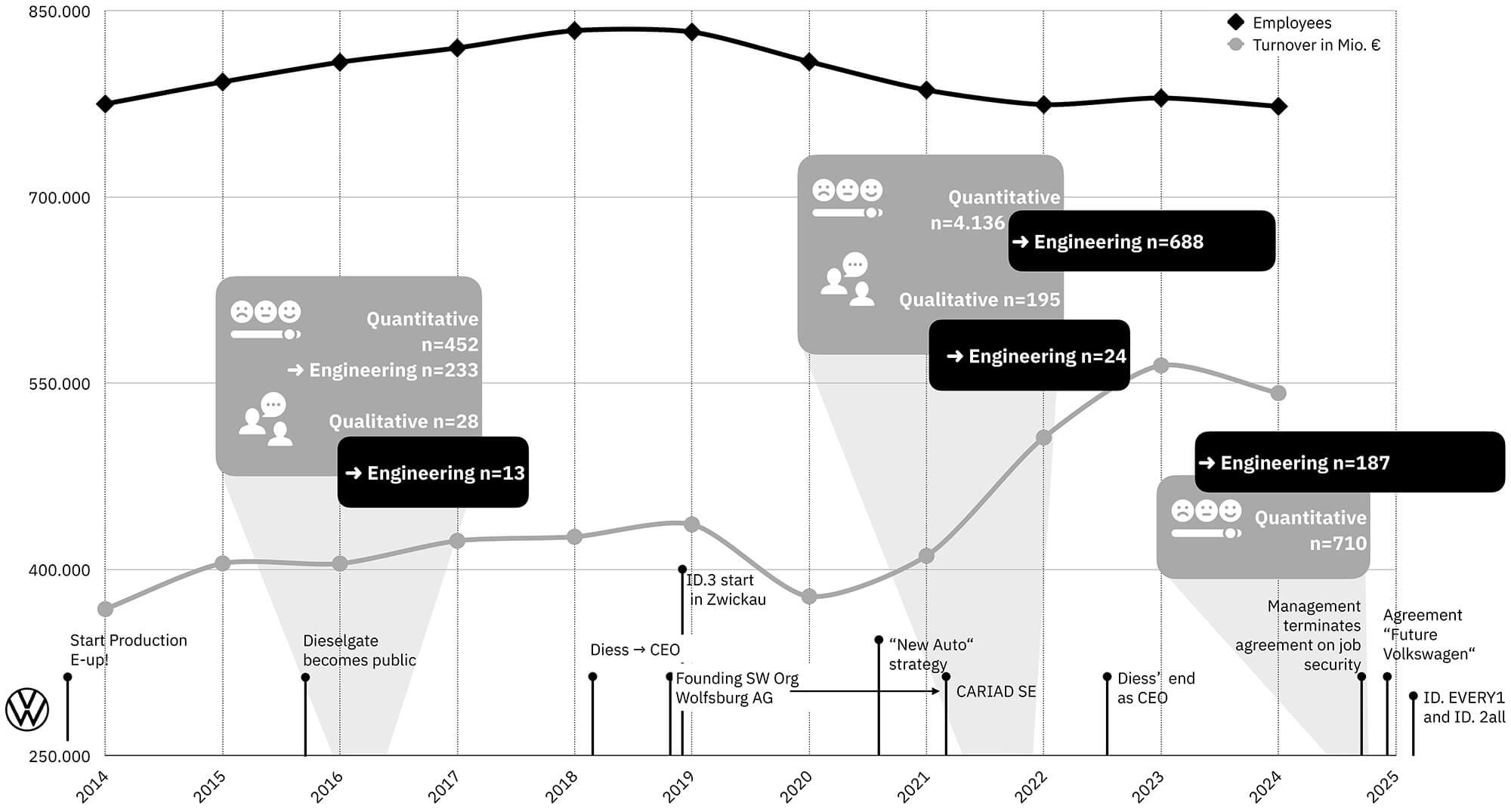 Fig. 2.
This figure presents the survey dates and data sources underlying this article. Data sources that have been re-analyzed in this study are highlighted in black. The two curves symbolize sector data from the German Federal Statistical Office on employees and turnover (OEM and suppliers, as of March 2025). Events plotted at the bottom illustrate the industry’s transformation dynamics, using Volkswagen as an example.
Qualitative methods and content-analytical evaluations of sociological case studies of work and industry (Pflüger et al., 2017) are combined with descriptive analyses of quantitative data. Qualitative case studies conducted in 2015/2016 and 2021/2022 at the same OEM in Germany and two quantitative surveys on the double transformation from 2022 and 2024 serve as the empirical background for this article (Pfeiffer et al., 2019; Pfeiffer and Authors’ Collective, 2023):
• The qualitative survey in 2015 took place well before the strategic shift to electromobility, which the OEMs mostly announced later. For this article, n = 13 qualitative interviews from 2015/2016 and n = 24 from 2021/2022 were used. The loosely structured questionnaire focused on technical and organizational change, professional background, core activities, assessments of management strategies, experiences of transformation with regard to Industry 4.0 (2015), digitalization, and electromobility (2015 and 2021/2022). During the interviews, great importance was attached to generating long narratives in order to bias the answers as little as possible. Participating engineers were selected based on whether they actually performed engineering activities typical of the automotive industry; the sampling strategy contrasted the areas of development and design, product/project management, testing and trials, product data/change management, and technology/innovation management.
• The quantitative surveys in 2022 (n = 4136) depict the employees’ views in the middle of a then seemingly unbroken transformation to electromobility, while the survey at the end of 2024 (n = 710) took place after initial OEM announcements regarding profit declines and job cuts. As representativeness cannot be fully achieved for online surveys, adjustment weights were calculated according to gender, highest professional qualification and age, using the Iterative Proportional Fitting (IPF) algorithm (Gabler and Ganninger, 2010, p. 154); see Table 1.
| n = 4136 | n = 618 | n = 710 | n = 187 | ||||||||
| 2022 Sample | Engineering | Others | 2024 Sample | Engineering | Others | ||||||
| Survey | Weighted* | BEV | noBEV | Survey | Weighted* | BEV | noBEV | ||||
| Gender f/m** | |||||||||||
| Female | 28.95 | 17.40 | 7.71 | 10.66 | 18.45 | 33.35 | 19.27 | 14.24 | 4.57 | 21.82 | |
| Male | 71.05 | 82.60 | 92.29 | 89.34 | 81.55 | 66.65 | 80.73 | 85.76 | 95.43 | 78.18 | |
| Age | |||||||||||
| Up to 25 years | 5.48 | 5.52 | 3.82 | 6.11 | 5.61 | 0.86 | 0.99 | 1.30 | |||
| 26 to 35 years | 24.27 | 20.98 | 27.83 | 26.76 | 20.19 | 17.44 | 16.45 | 23.69 | 11.44 | 15.73 | |
| 36 to 45 years | 29.87 | 27.95 | 31.88 | 27.21 | 27.70 | 29.54 | 28.65 | 29.91 | 31.68 | 28.03 | |
| 46 to 55 years | 28.95 | 31.15 | 21.47 | 25.99 | 32.12 | 25.07 | 27.56 | 25.07 | 27.30 | 28.06 | |
| 56 and older | 11.44 | 14.39 | 15.00 | 13.93 | 14.37 | 27.09 | 26.36 | 21.34 | 29.58 | 26.89 | |
| Qualification*** | |||||||||||
| w/o qualification | 5.95 | 10.25 | 40.30 | 2.39 | 11.18 | 14.42 | |||||
| (further)VET | 45.91 | 66.27 | 32.55 | 31.75 | 41.71 | 70.00 | 68.86 | 41.22 | 55.48 | 75.27 | |
| Academic | 48.14 | 23.48 | 67.45 | 68.25 | 18.00 | 27.61 | 19.97 | 58.78 | 44.52 | 10.31 | |
| Sector | |||||||||||
| Automotive OEM | 89.39 | 86.80 | 72.26 | 76.70 | 88.38 | 29.97 | 25.14 | 37.06 | 16.85 | 23.97 | |
| Automotive TIER-n | 4.93 | 5.98 | 11.37 | 17.47 | 5.00 | 36.94 | 30.49 | 41.76 | 54.10 | 25.81 | |
| Automotive others | 5.68 | 7.22 | 16.37 | 5.83 | 6.62 | 33.09 | 44.37 | 21.18 | 29.05 | 50.22 | |
* Iterative weighting, basis: contemporary German labor market data by gender,
qualification, age (
** In our primary surveys, the category “diverse” was included, though it does not exist in German labour market data.
*** In labor market data, “not specified” was an option, whereas in our survey, data qualification was a required entry.
Abbreviations: BEV, Battery Electric Vehicle; VET, Vocational Education and Training; OEM, Original Equipment Manufacturer; TIER-n, Depending on their distance from the OEM within the supplier pyramid, suppliers are designated as Tier 1, Tier 2, etc. (for “level” or “rank”).
Table 1 provides an overview of the key characteristics of both quantitative samples (before and after weighting). The quantitative study focuses on engineers (n = 688 in 2022, n = 187 in 2024). Two-thirds of the engineers participating in the qualitative surveys were male at both survey dates (2015: 66%, 2022: 67%); the average age was 50.2 in 2021/2022 and 48.3 in 2024. The quantitative and qualitative analyses did not reveal any significant differences in the opinions expressed according to age and gender.
Providing some context, Fig. 2 also shows industry employment and sales figures, the respective survey periods and types and, using Volkswagen as an example, strategy changes over time. These events, plotted along the timeline at the bottom of Fig. 2, illustrate the transformation dynamics in the German automotive sector in recent years, representing a highly condensed excerpt from an ongoing SKAD analysis (Sociology of Knowledge Approach to Discourse; Keller, 2024) that has been continuously conducted by the author since 2015. This background information is needed to understand the extent to which employees in the sector have been confronted with the contradictory ups and downs of management strategies in recent years:
• In 2013, Volkswagen started production of a purely electric small car (the e-Up!), which sold so well in 2020/2021 that order stops were necessary; however, production was discontinued in 2023. In spring 2025, Volkswagen announced the production of another small electric car (ID.EVERY1) for 2027 (Volkswagen, 2025).
• In 2019, Volkswagen decided to significantly increase its own software share and accordingly set up a cross-brand corporate unit which has operated as an independent business unit under the name CARIAD (the name was composed of “CAR, I Am Digital”) since 2020 (Callecchia, 2023, pp. 12–13). However, in 2023, it was announced that around one-third of CARIAD’s workforce would be made redundant (Hochwarth, 2023).
• In 2019, Volkswagen announced e-car production for the ID.3 models. In mid-2021, an increase of the share of e-vehicle sales to 50% by 2023 was envisioned (ecomento, 2021). A few years later, only two-thirds of the expected ID.3s were produced, and 1200 employees on fixed-term contracts were threatened with redundancy (Liebetrau, 2024). The Trinity SUV (sport utility vehicle), announced as a “Tesla killer” for 2026, was postponed by two to three years in 2022 (Murphy and Menzel, 2022), only to be postponed again to 2032 two years later (Backovic, 2024). Contrary to the Group’s statement that Volkswagen will no longer sell combustion vehicles in Europe from 2033, it currently seems possible that they may continue until 2035 (Schönfeld, 2025).
• An employment guarantee in place since 1994 was terminated by management in September 2024. Three months later, after tough negotiations, management and the works council agreed on “Future Volkswagen” (Volkswagen, 2024), which promises secure employment but also calls for a socially responsible reduction of the workforce by 35,000 by 2030.
Rather than a neutral chronology, we treat these milestones as cues that structured how management alternated between expansion and retrenchment—and ask how engineers made sense of their standing within the firm. In our analysis, shifts such as the ramp-up and discontinuation of small BEV models, software reorganization at CARIAD, and the postponement of Trinity are read as exemplary identity-relevant events: they simultaneously redirected resources, conveyed status signals about what counted as “future work”, and produced contradictory expectations. We therefore link each timeline episode to reported experiences of devaluation, trust, and future outlook in engineering teams. Each of these strategic management decisions in Fig. 2 is not only relevant for market success and involves enormous investments, but also entails concrete technical and organizational changes on a large scale. When management decisions are characterised by massive changes in product policy strategy within a few years, this also means that those employees who are primarily responsible for the ever changing technical and organisational implementation are especially affected by constant back-and-forth changes. Given such contradictory transformation dynamics, on the one hand, and the fact that engineers are one of the key workforce groups enabling the transformation, on the other hand, the question arises as to how these developments are experienced by engineers on the ground, and if there are effects on the identity of this special group of employees (Between the two survey dates, changes occurred not only within the industry but also due to macroeconomic and geopolitical factors, such as energy crises, new European Union (EU) regulations, and the pandemic. However, these broader developments played virtually no role in the qualitative interviews; participants’ narratives focused overwhelmingly on their own company.).
In a first step, we provide insight into the qualitative material that outlines the consequences of an organizational divide between engineering teams involved in BEV development and those without BEV relevance. Based on the qualitative material, central research questions are then formulated. These will be explored further using quantitative data in section 5.
Disruption–first missed, then embraced: In the 2015 interviews, electric mobility was hardly an issue; at that time, the company had not yet announced a strategy change in this direction. Instead, the focus of the interviews was on digitization and Industry 4.0. However, privately, engineers with an interest in ecology complained that management was ignoring a necessary strategy change and that politics were also not setting the right course for the expansion of the charging infrastructure. In 2021/2022, the qualitative material shows how the parallel existence of combustion engine and electric drive, on the one hand, and the strategy of an exclusive conversion to electromobility proclaimed by management at the time of the surveys, on the other hand, led to subjective devaluation experiences and new segmentations in engineering. Where the transformation is experienced as a disruptive replacement, this leads to different perceptions: While for some in engineering, the change towards electromobility cannot happen fast enough, for others, the speed is surprising—less in terms of the technical innovation itself than the winding-down of the old: “What is perhaps surprising is how quickly the classic combustion engine world is now being rammed down. In other words, how quickly people are saying: ‘We don’t need this anymore’. And that is perhaps a dimension that has surprised us all here. And still surprises us” (IV36). Others describe how everything related to electric vehicles is labeled as “the future”, while everything else—including other new drive concepts such as hydrogen or e-fuels—is dismissed as “no future” (IV39).
Experienced uncertainty despite job security: Although no one in Engineering had to worry about their job during the survey period, it was uncertain whether they would be able to stay in their current team or department, and this uncertainty was compounded by highly contradictory statements from managers: “The fact is that we have a transformation goal here, let me say. In other words, we are cutting staff here. In other words, we have a real outflow of expertise that I won’t be able to stop at some point. […] It is a real fact that we are shutting down engine families. That we are reducing development and capacity here. I’m experiencing that for real here. And as I said, if we realize in two or three years that we need a little more combustion engine, then I can’t do it anymore. I can’t turn back what’s happening here right now” (IV36). This is because the drive-specific skills cannot be built up again quickly: “It took me my entire degree […] and my entire working life to be able to use the combustion engine”. After more than twenty years of experience with combustion engines, he feels reasonably proficient and knows where the sticking points are. “When I leave, there’s no one who can replace that. […] Anyone who leaves is a real loss of competence” (IV36). In this context, the interviewee expresses less concern about their personal future and more about the innovative capacity of their department.
Devaluation of the “old”–appreciation of the “new”: In the engineering teams, where the experience of an either-or is more prevalent, this is accompanied by an experience of devaluation that is certainly also perceived from the outside—that is, from other areas of the company, but also socially and even familiarly: “I also notice it every day, people say, well, the engine you are developing now is probably the last combustion engine there will be” (IV37). While everything to do with electromobility is seen as “cool” and innovative per se, what in fact continues to be innovative in the combustion engine sector disappears. The Group is also no longer presenting the combustion topic to the outside world; although the division is highly innovative, nothing is being published and no more specialist conferences are being held. The company simply no longer talks publicly about the combustion engine: “We no longer go public. [The combustion engine] is a necessary evil, but the cool guys are doing electromobility. That’s just how I perceive it” (IV36).
Skeptical confidence: Engineers who have worked closely with combustion engines up to now would therefore be expected to view the transformation with a certain degree of resignation, to perceive the transformation as pressure, and to take a critical view of the ecological sustainability of the path that has been chosen. The statements from engineering employees, presented here only in condensed form, show how multi-dimensional the transformation processes are in concrete terms, how strongly structural-resource-related and communicative-cultural aspects influence each other. These dynamics lead to worry and uncertainty, even if existential concerns such as job loss or financial hardship do not pose a company-wide threat to employees. Overall, there is consistent confidence that their own company will ultimately succeed, despite all the transformative challenges. This even applies to those who are fundamentally more skeptical about electromobility and/or who define themselves professionally in terms of the combustion engine. This confidence persists even despite contradictory communications by the management, which is mainly experienced as top-down: On the one hand, managers ask directly in meetings: “See if you can get a job somewhere else, we only need half the people” (IV38), while other managers in the same area reassure employees, saying “Don’t all run away from me, we still need you!” or “We’ll definitely still need you for the next ten years” (IV38).
Polarizing effects beyond the narrative: But the issue goes beyond a perceived and/or purely corporate-cultural devaluation of areas that belong to the supposedly “old”. It is also about structural issues and the associated allocation of resources. In the OEM studied, each engineering team was assigned to either the old (combustion engine) or the new (electric). In fact, however, many teams develop for both drive worlds (after all, many parts of the car remain the same), but are nonetheless primarily assigned to the “old”, even if they are also increasingly developing for electromobility. The employees therefore do not address this primarily as an experience of devaluation but rather as the result of a well-founded lack of understanding of this discursively experienced classification as “old”—precisely because it is clear to them from a technical perspective that combustion technology will continue to play a role for a long time to come and will remain a field of innovative engineering. There are many such assessments in this case study. By abandoning the usual distinctions (petrol or diesel engine), the “only distinction made now is between […] E or non-E […]”. The interviewee describes how it “shocked” and “unsettled” the entire department to be assigned to the “old”, “although we serve everything—completely, all drive types” (IV39). In such cases of an assignment that is perceived as factually incorrect, there are tangible, objective consequences: Although the workload in these engineering teams has increased significantly, as development is carried out for all drive types, the assignment to the “old” led to a creeping reduction in personnel: positions of employees leaving the company are no longer replaced, and certainly not adequately in proportion to the actual rise in workload.
Hard to manage obstacles: The experience of transformation in engineering also includes the fact that opportunities to draw attention to personal or departmental situations on one’s own initiative are perceived as limited. There is a desire to strengthen communication “from below” across hierarchical boundaries, so that information is not “slowed down” (IV30). In some interviews, management communication is described as inadequate: From the employees’ point of view, they often do not receive statements that are sufficiently clear, and there is also sometimes a lack of substantiated development goals for employees in these areas. Accordingly, employees feel left alone with the development of their professional profile and would like more help identifying work areas corresponding to their interests and paths for future development. In other interviews, however, the company’s communication with employees regarding the upcoming transformation was rated as good: recognizable strategies were clearly communicated, relevant areas were newly established, new jobs were advertised, and employees could obtain internal qualifications and apply for them. However, qualifications and expertise take time, which makes it difficult to keep up with the speed of the transformation. Such contrasting voices recur throughout the qualitative material. The experience of transformation is—how could it be otherwise?—individually different, even in the same areas. The next section will examine whether the BEV-inspired transformation experience shows broader trends that point to a change or even a divide of engineering identities across the sector.
The qualitative in-depth analysis in section 4.1 indicates a strong organizational divide between BEV and ICE engineering but also a substantial overlap between both technologies at the task level of engineering. We will examine whether this contradictory divide has empirically measurable consequences for engineering identities based on quantitative data. Following our overall research question (Does the ecological transformation in the automotive sector change the organizational and professional identity of employees in engineering?), and based on the literature review (section 2) and the qualitative material presented in subsection 4.1, four further research questions are developed to explore whether and how the BEV transformation has consequences for engineering identities:
• First we ask, to what extent are engineering employees more directly engaged with battery-electric mobility at work than other employees, and how did this change between the 2022 and 2024 surveys (RQ1)?
• Second, drawing on qualitative findings that point to disappointment and rupture of identity caused by the company’s handling of the transformation, we ask: How much do engineering employees trust the main actors in labor relations within their company—management and works councils regarding (a) economic decisions about BEVs and (b) decisions on job security and training (RQ2)?
• Third, given that the qualitative material reveals not only irritation and uncertainty due to the technological transformation but also relatively stable identities in relation to the company and the industry, we ask: Do engineer’s identity-related future assessments differ when thinking about their own company versus the automotive industry as a whole (RQ3)?
• Fourth, although the interviewed engineers are strongly focused on their “old” product, they also show openness and enthusiasm for new products in the context of electromobility. However, they express concern about having to leave their current department or team—although at the time of the case studies, there was no reason to fear layoffs. Based on the product and work as key sources of professional identity, we ask: Compared with concerns about job security, how do engineers evaluate the future of (a) their product and (b) their work content/requirements amid the technological shift (RQ4)?
In the next section, we address data from the quantitative surveys of 2022 and 2024, using these four research questions.
Before delving into the quantitative data in greater detail, it is essential to acknowledge a potential limitation. While the quantitative data are broadly aligned with labor market data in the German automotive sector due to active quota management and iterative weighting (see section 3), the approach is deliberately limited to descriptive analysis. This decision stems from the inherent variability in engineering tasks within this industry. Consequently, any definitive inferential statistics derived from this sub-sample would be of limitated validity.
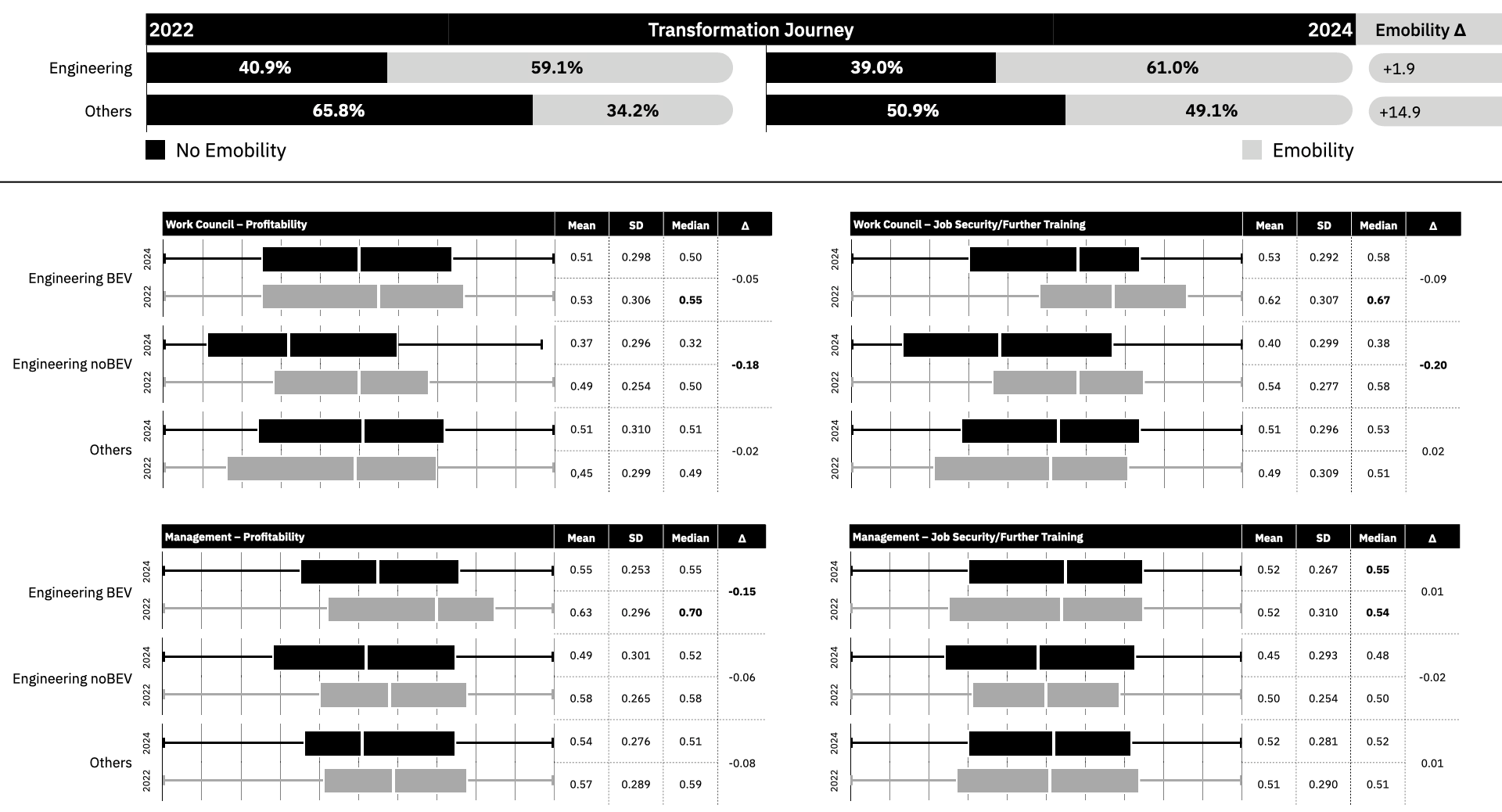
We begin with RQ1, asking whether employees in engineering are more affected by electromobility than other workers. In Fig. 3, the bar charts at the top show all three employee groups for both survey dates and illustrate how far they have progressed in their transformation journey, i.e., how much electric mobility has been adopted in the workplace. There are clear differences between engineering and other employees: In 2022, the proportion of engineers working in the field of electromobility was 59.1%, while for other employees, it was only 34.2%. By 2024, this figure had risen slightly, by 1.9 percentage points to 61.0%, for engineers, but sharply, by 14.9 points to 49.1%, for other employees. Engineering employees have therefore made a strong start in electric mobility, but their progress shows signs of plateauing. However, the strong increase among other employees underscores the growing importance of electric mobility across the sector.
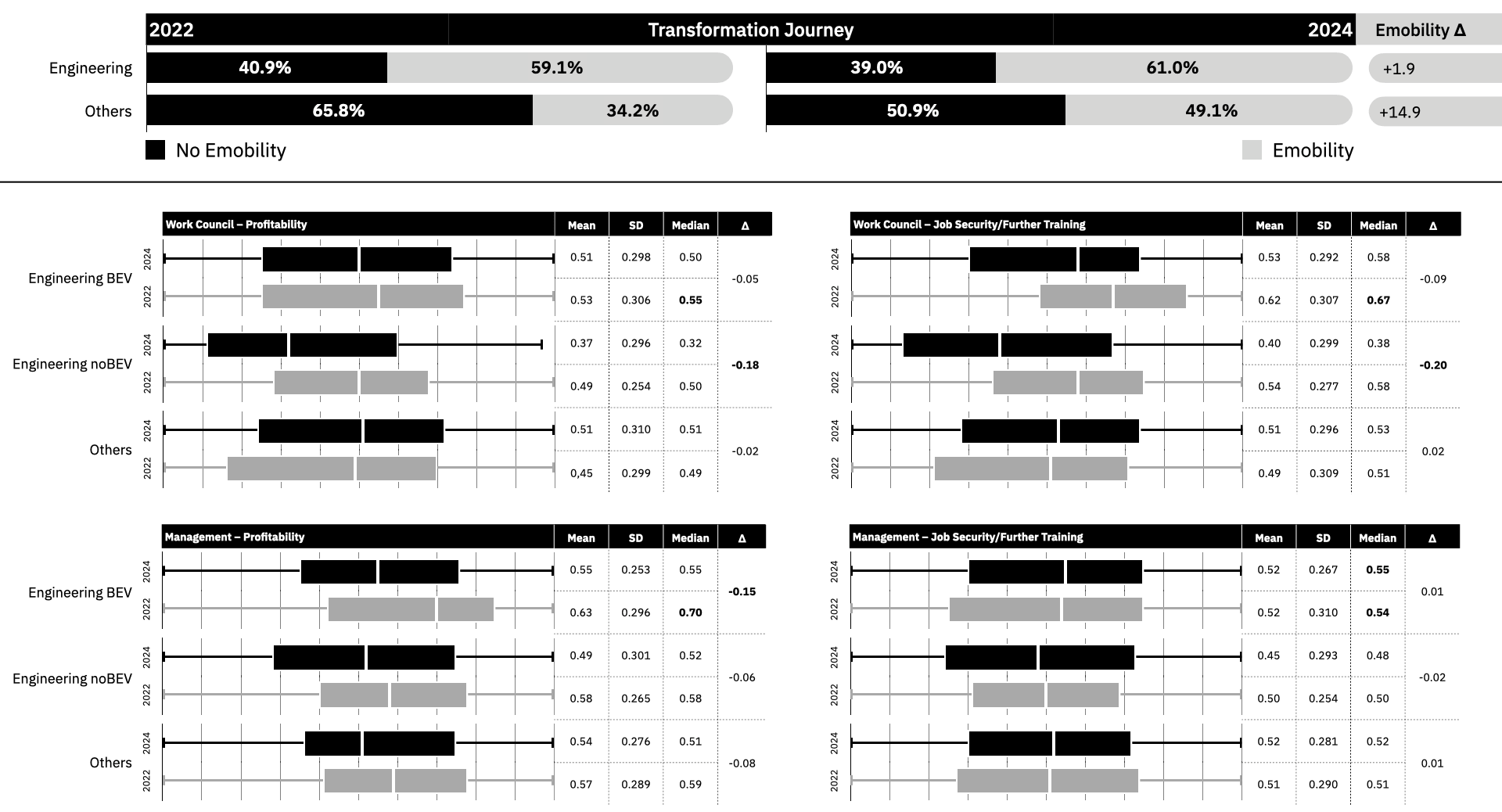 Fig. 3.
The bar charts illustrate the diffusion of BEV technologies at engineering workplaces compared to all other workplaces and how this changed between 2022 (left) and 2024 (right). The boxplots compare trust in management and in the works council with regard to economic decisions (left) and decisions on job security and further training (right) for both survey dates (2022 in gray; 2024 in black).
Also in Fig. 3, gray boxplots represent 2022, while black boxplots represent 2024, allowing comparison across the three employee groups. Four vizualisations are presented: on the left, trust levels in economic decisions regarding electromobility made by (a) the works council (top) and (b) management (bottom); on the right, trust levels in decisions on job security and further training, again distinguishing between the works council (top) and management (bottom). Values for each boxplot (mean, standard deviation, median, and the median delta between 2022 and 2024) are shown to the right of each figure. These boxplots reveal notable developments in employee confidence in decisions on electric mobility (BEV) between 2022 and 2024. In 2022, trust levels in both management and the works council are relatively high for both topics, with the mean values and medians close to 0.5 in each case.
Trust in economic decisions: In 2022, BEV engineers exhibit the highest overall trust in management, with a median of 0.70, and in the works council, with a median of 0.55. Trust in both actors declined among all respondents in 2024 with regard to economic efficiency. The strongest loss of trust is evident among noBEV engineering employees toward the works council, with their value slipping by –0.18 to a median of only 0.32 (and thus the lowest overall trust value across all boxplots). However, BEV engineers also show a substantial loss of trust, of –0.15, the second largest, in management.
Trust in decisions on job security and further training: On this issue, too, all employees in 2022 begin with balanced trust levels in both players. Once again, BEV engineers are the most positive, not only placing the highest overall trust in the works council, with a median of 0.67, but also—although still the best value compared to the other two groups—clearly more trust than in management (median 0.54). On these issues, too, there is a generally modest loss of trust between 2022 and 2024, with trust in management even increasing slightly among BEV engineers and other employees—with one exception: here, too, the trust of noBEV engineers drops sharply toward the works council, declining from a median of 0.58 in 2022 to 0.38 in 2024.
At both survey points, all three employee groups trust management slightly more than the works council regarding economic decisions. However, BEV engineers and other employees trust the works council slightly more than management in matters of job security and training decisions. Even on these social issues, noBEV engineers trust management more than the works council at both survey dates. Standard deviations indicate different perceptions within the groups.
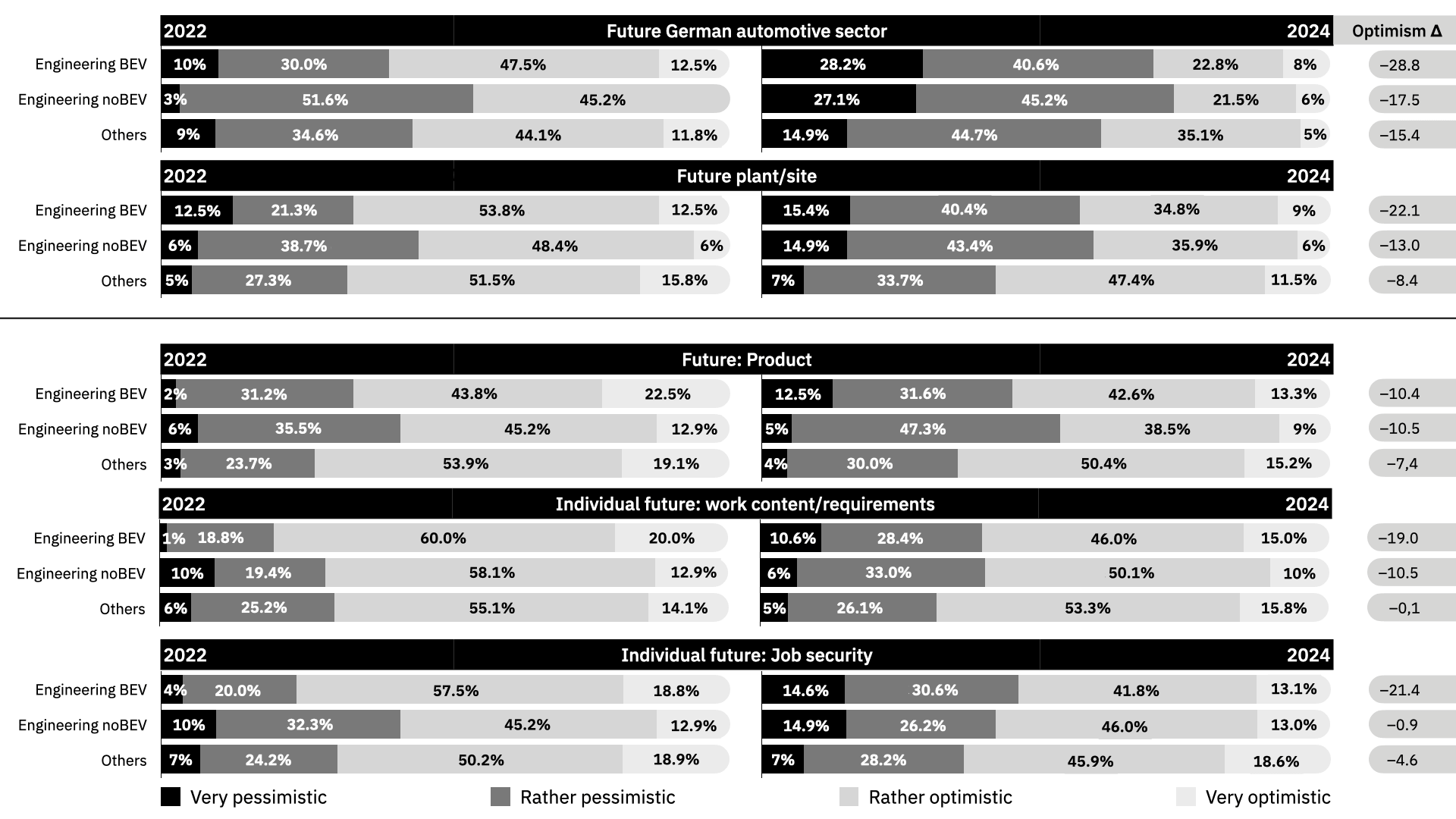
Fig. 4 shows bar charts comparing BEV engineers, noBEV engineers, and all other employees in 2022 (left) and 2024 (right), with a focus is on future assessments. Responses are rated on a 4-point Likert scale ranging from “very pessimistic” to “rather pessimistic” and “rather optimistic” to “very optimistic”. The optimism delta between the two survey dates shows the combined change in optimism values (displayed to the right of the bar charts). For RQ3, we focus on the two bar charts above the line in Fig. 4 on the automotive sector’s future and on the respondents’ own production site.
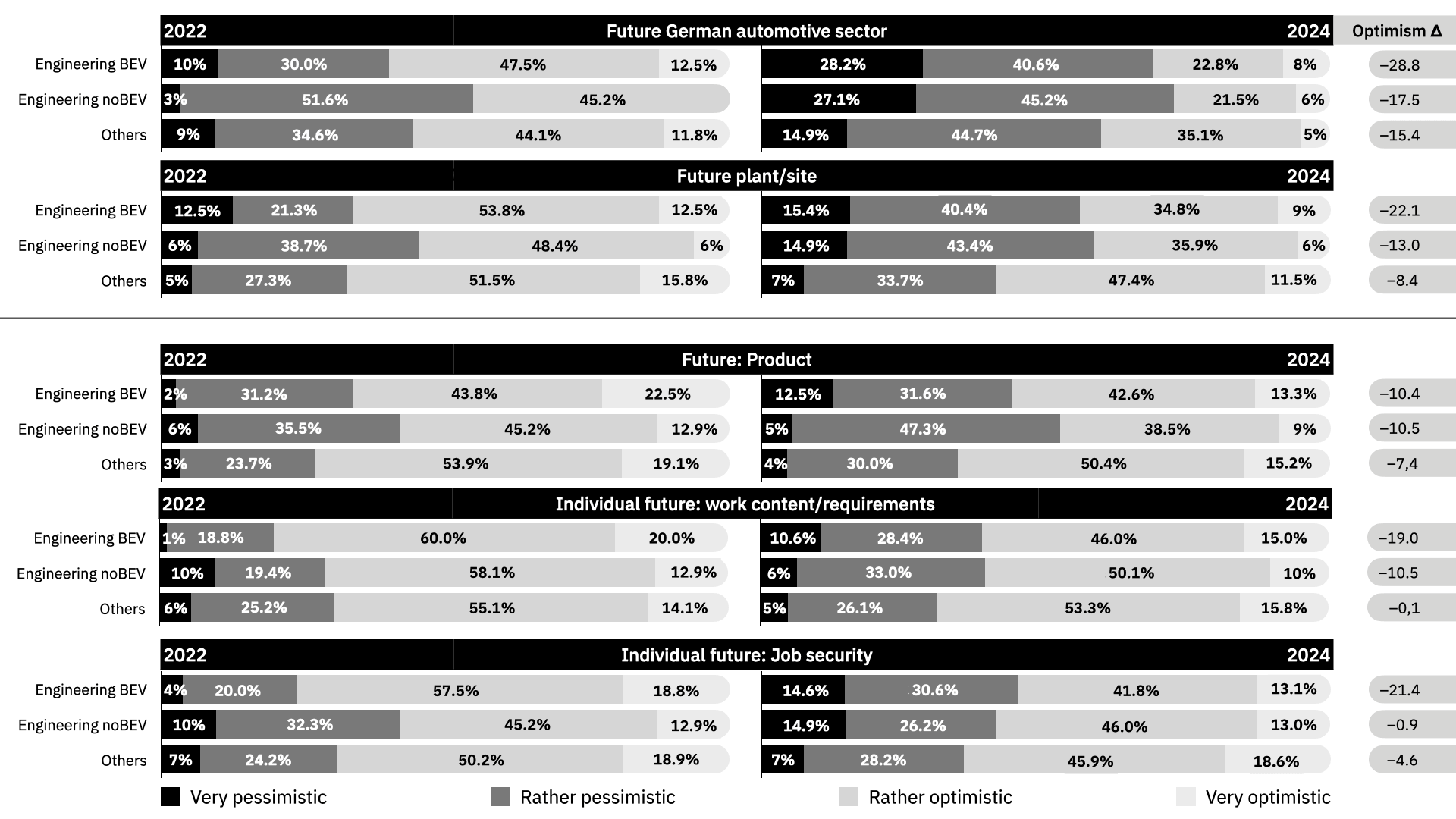 Fig. 4.
Bar charts compare employee attitudes in BEV and noBEV engineering with all others regarding five different future assessments. The 4-point Likert scale ranges from “very pessimistic” to “very optimistic”. The change between 2022 (left) and 2024 (right) is reported.
Future of the automotive sector as a whole: BEV engineers were most optimistic in 2022 (60% optimistic), while noBEV engineers were significantly more skeptical (45.2% somewhat optimistic) and thus also less positive than other employees (55.9% optimistic). By 2024, optimism had declined significantly across the board but most sharply among BEV engineers (delta: –28.8), although it remained higher in absolute terms than among other groups. NoBEV engineers and “others” also showed noticeable declines (delta: –17.5 and –15.4, respectively), but in 2022, all other groups were more pessimistic than the two engineering groups.
Future of their own site: Here, too, BEV engineers show pronounced optimism in 2022, at 66.3% (optimistic), putting them just behind the even more optimistic “others” (67.3%), but ahead of the noBEV engineers, who are still predominantly positive (54.8% optimistic). In terms of location, BEV engineers also suffer the sharpest decline in optimism in 2024, with a score of –22.1 points, while noBEV engineers also lose considerable optimism (delta –13). By contrast, “others” remain the most optimistic group in 2024, with 67.3% (rather/very) optimistic and the smallest decline (delta –8.4).
All comparison groups assess their location’s future more positively than the industry’s at both survey points. BEV engineers were initially more optimistic but experienced the sharpest declines, while noBEV engineers remain consistently skeptical. Growing uncertainty, especially among BEV engineers, suggests initially elevated expectations followed by significant transformation-related challenges.
With regard to RQ4, we also look at Fig. 4 but this time at the lower three bar charts. Here, too, the focus is on future expectations but now in relation to the product, work content, and job security. There are also clear differences in future expectations among employee groups, both across topics and over time.
Let’s first look back at 2022: Here, too, BEV engineers are consistently more optimistic than their noBEV colleagues on all three topics. Both groups view the future in terms of work content/requirements as the most positive: The vast majority of BEV engineers (80%) are rather or very optimistic about the future in 2022, while the noBEV engineers are clearly less optimistic, although the vast majority (71%) are still optimistic (albeit only as optimistic as all other employees, at 69.2%).
While noBEV engineers in 2022 are equally optimistic about their future in terms of the product and their job, at 58.1% each, BEV engineers are significantly more positive about the product, at 66.5%, and even more optimistic about job security, at 76.3%.
The differences between the first and second surveys paint an ambiguous picture: on the one hand, all groups show a negative trend across all three future topics, though with varyng magnitudes. Once again, the biggest negative shifts are found among BEV engineers: Compared to 2022, they show an optimism delta of –21.4 for job security in 2024, closely followed by –19.0 for work requirements. NoBEV engineers, on the other hand, are relatively relaxed about their jobs (their optimism only drops by 0.9 points), but they lose 10.5 points in optimism each about products and job content.
Four research questions were developed based on the literature review (section 2) and qualitative insight into an engineering community presented here, where divisions arise more from management decisions than from technology in the workplace (section 4). The aim of the quantitative evaluations was, on the one hand, to show how engineering is affected by the ecological transformation—exemplified by BEV adoption—in comparison to all other employees. On the other hand, they examined the possible effects of the transformation on the identity of employees in engineering.
For several reasons, this study remained deliberately descriptive: First, the concepts of organizational and professional identity not only overlap in the literature but are not clearly operationalized. Second, it can be assumed that in a highly complex industry such as the automotive sector, engineering tasks are highly differentiated and that the organizational dichotomy arbitrarily imposed by management (see section 4) into “old” (no BEV/ICE) and “new” (BEV) is as inconclusive as it is scientifically flawed for the questions pursued here and can therefore serve only as a first approximation. Third, the state of research on engineering identity as a specific form of professional identity is heavily focused on students. How organizational changes and/or even technological transformations (and especially their possible failure) affect experienced employees who have been working in engineering for a long time is still a largely open field of research.
Although the 2015 data reflect an environment that has since fundamentally changed, this limitation notwithstanding, the comparative perspective across 2015 and 2024 constitutes an important contribution, as it illustrates how engineers’ perceptions shift under conditions of profound industry change. Although the data do not form a true panel (i.e., they do not track exactly the same engineers over time), the rare availability of comparable surveys from the same OEM provides a unique opportunity to capture how engineers’ work is framed before and after a major technological transformation.
Whether the categories of trust and future expectations used here are suitable or even sufficient variables in this context remains an open research question and cannot be answered solely on the basis of the material presented here. However, fundamental studies of the mechanisms linking organizational and professional identity within changing contexts would be necessary to investigate future transformations and their effects more validly. Finally, it should not be underestimated that the constellations in this case study of the German automotive industry can only be generalized to other sectors and/or countries to a limited extent: On the one hand, the German model of co-determination is too specific and perhaps most vividly reflected in the automotive industry. On the other hand, the self-image of German engineering has very specific historical roots, and these distinctive features continue to influence university education and work structures in German engineering to this day, despite globalization.
This study explored how engineers in the automotive industry perceive and negotiate their professional identities in the face of ecological and technological transformation. By comparing survey data from 2015 and 2024, we highlighted how the electrification of mobility, the growing importance of digital technologies, and organizational restructuring shape both engineers’ work and their sense of professional belonging. The mixed methods material presented here shows how engineers in the German automotive sector are confronted with electric mobility earlier and more frequently than other occupational groups. While other groups are still catching up in terms of exposure to electric mobility at work, there are clear differences between BEV and non-BEV engineers: Those involved with novel technology enter the transformation with much greater optimism and also thoroughly trust actors on both sides of labour relations. However, this optimism and trust can be severely shaken in a short period of time by dramatic changes in strategy within the industry, undermining the identity of engineers who see themselves at the forefront of technological and, in this case, ecological transformation. On the other hand, engineering identity is also evident among those who are unable or not permitted to work on the new technology: while initially strong, they are noticeably less optimistic and confident then their BEV colleagues, and they too are negatively affected by upheavals in the industry, though not as strongly as the BEV engineers, whose early optimism may have been excessive. For both groups, the results suggest that engineering identity develops from the bottom up: confidence in the work content and the product one works with is less easily shaken than confidence in management and labor representatives. This could be interpreted as meaning that engineers’ professional identity tends to be stable and their organizational identity more vulnerable. Or to put it another way: precisely because engineers link their identity closely to technological transformation, they are fundamentally more resilient in their identity when the transformation stumbles. However, they clearly have less confidence in management and the works council to get the transformation back on track. The qualitative insights also confirm that, in the case studied, management tends to struggle to develop innovative organizational forms that help fully unleash the potential of this contradictory engineering identity during transformation. Answers to the four main empirical research questions can be summarised as follows:
• RQ1 (exposure to BEV): Engineers were earlier and more intensively exposed to BEV work than other employees in 2022 and remained so in 2024, although the gap narrowed as BEV diffused across other areas.
• RQ2 (trust in actors): Trust declined overall from 2022 to 2024. BEV engineers started from higher trust but showed the sharpest losses—especially toward management on economic issues—while no-BEV engineers lost the most trust in the works council on social issues.
• RQ3 (company vs. industry): Identity-relevant future assessments are consistently more positive for the own site than for the industry. BEV engineers were initially the most optimistic on both but experienced the largest declines by 2024.
• RQ4 (product, work, job security): Confidence in one’s product and work content proved more resilient than confidence in job security. BEV engineers’ initial optimism fell markedly on all three dimensions by 2024; no-BEV engineers were steadier on job security but more skeptical on product and work content.
Based on these empirical insights, the question arises as to the resulting theoretical implications: The findings contribute to theories of professional identity by showing that ecological and technological transitions are not only technical or organizational processes but also identity processes. In particular, they highlight tensions between professional and organizational identities in industries undergoing disruptive change. While established models of identity resilience emphasize continuity, our results suggest that resilience may also take the form of active reinterpretation, especially when professional expertise risks devaluation. Moreover, the study underscores the lack of empirical research on active engineers, as opposed to students or future professionals, and calls for further attention to “green transformation” as a driver of identity reconstruction. By combining qualitative and quantitative approaches, the study demonstrates the value of a mixed-method design for capturing both the distribution of attitudes and the depth of meaning-making processes. Future research should extend this perspective to other industries and cultural contexts, to better understand how different institutional environments mediate identity change.
Furthermore, against the backdrop of the empirical results presented here, also questions of managerial implications arise: For practitioners, the results point to several lessons. First, successful transformation strategies require recognizing the central role of engineers’ expertise and avoiding signals of devaluation. Managers should communicate change not only in terms of technological necessity but also as a project in which engineering knowledge remains valued and indispensable. Second, participation mechanisms—such as co-determination structures, joint learning forums, or new forms of collaborative project work—can help prevent demotivation and identity rupture. Third, organizations should anticipate the risks of fragmented or reactive approaches. Underestimating how engineers perceive shifts in status, autonomy, or meaning may jeopardize motivation and slow adaptation. Instead, sustainable and inclusive transformation strategies should combine investment in new competencies with recognition of existing professional strengths, thereby fostering continuity as well as renewal.
In sum, the study shows that engineers do not passively absorb industry change; rather, they actively interpret and reshape their professional identities in response. Acknowledging these dynamics is essential both for advancing theory on identity resilience and for designing transformation strategies that are socially as well as technologically sustainable.
BEV, battery electric vehicle; EQF, European qualification framework; ICE, internal combustion engine; IV, interview; OEM, original equipment manufacturer; TIER-*, supplier with rank within the supply chain; VET, vocational education and further training.
Precondition for conducting the surveys presented here was a contractual assurance that the raw data would not be made available to others. The correspondence author is happy to provide more detailed information on the original data sources upon reasonable request.
Author is the sole author and is accountable for all aspects of the work: research design, perform of the survey, analyzing the date, draft and all revisions of this article.
I would like to express my sincere gratitude to the OEM who made the qualitative and some of the quantitative surveys for this article possible, and I would especially like to thank all the interviewees who shared their sometimes very emotional experiences of the transformation they have undergone with me. I would also like to thank my entire team at my chair, who always support me so that I am able to pursue my own research.
This article was made possible by the funding by the Deutsche Forschungsgemeinschaft (DFG, German Research Foundation) within the priority program 2267 “Digitalisation of Working Worlds: Conceptualising and capturing a Systemic Transformation” (project number 442171541).
The author declares no conflict of interest.
During the preparation of this work the author used DeepL in order to check spell and grammar. After using this tool, the authors reviewed and edited the content as needed and takes full responsibility for the content of the publication.
References
Publisher’s Note: IMR Press stays neutral with regard to jurisdictional claims in published maps and institutional affiliations.