


1 Institute of Sociology, Friedrich-Alexander-Universität Erlangen-Nürnberg, 90429 Nuremberg, Germany
Abstract
This study explores group dynamics in identity work following a corporate merger, examining how employees navigate their historical corporate identities alongside the new organizational identity proposed by management. Focusing on Telecompany-X, a telecommunications firm in Austria that began implementing its merger one year prior, the study analyzes how employees relate to their former identities and how managerial efforts to impose a unified brand and identity shape their sensemaking. While management sought to foster cohesion through identity regulation, employees’ pre-existing identities and everyday work practices significantly influenced their adaptation. Using a practice-theoretical framework, this interpretative case study investigates both employee narratives and the everyday work practices that shape responses to the merger. The findings challenge the assumption that corporate identity can be fully managed from the top down, instead highlighting the enduring influence of historical identities. The research contributes to merger and identity studies by demonstrating how identity work unfolds in response to managerial regulation, emphasizing the integrative potential of former corporate identities as shared reference points. In doing so, the study offers valuable insights into managing distinct group identities in post-merger organizations.
Keywords
- mergers and acquisitions
- identity work
- identity regulation
- culture
- communication
Mergers and acquisitions (M&A) represent critical instances of organizational transformation, bringing together distinct histories, structures, and practices. In doing so, they challenge employees’ sense of belonging, established routines, and professional self-understanding, thereby constituting a pivotal juncture for organizational identity (Gioia et al., 2000). However, conceptualizing mergers as discrete “moments” risks oversimplifying what are fundamentally extended processes of organizational development. Research demonstrates that mergers unfold over months and even years, as employees gradually adapt to new structures, negotiate conflicting priorities, and reconcile competing identity claims (Edwards et al., 2017; Kira et al., 2012). This temporal dimension highlights that identity transformation in post-merger settings is neither immediate nor linear, but emerges through ongoing processes of sensemaking, resistance, and adaptation embedded in everyday work.
These protracted dynamics create particular challenges for organizational identity, destabilizing previously coherent narratives and generating ambiguity about “who we are” as an organization (Corley and Gioia, 2004). Employees must renegotiate belonging and professional self-understanding, with uncertainty around collective identity becoming a central feature of the post-merger experience. Importantly, these processes are shaped not only by current organizational practices but also by enduring historical legacies. As Schultz and Hernes (2013) show, historical identities remain immanent in the present, that is, continuing to shape member interpretations and responses long after formal integration is complete. In fact, former identities persist through embedded routines, informal networks, spatial arrangements, and tacit practices that carry forward institutional memory and alternative meaning-making resources (Nag et al., 2007). This persistence challenges linear models of identity change that assume new identities simply replace old ones, and it emphasizes the importance of a temporal perspective that recognizes how identity evolves in time in relation to both past and emerging realities.
In this context, post-merger organizations are sites of ongoing tensions between competing group identities and work practices, often intensified by management’s attempts to impose a unified identity through branding, communication campaigns, value redefinitions, and normative expectations. Identity transformation is thus better understood as contested social process, shaped by power, negotiation, and meaning-making (Angwin and Meadows, 2015; Vaara, 2003; Vaara and Tienari, 2011). Employees’ responses are heterogeneous: some resist new identity initiatives, reinforcing attachment to previous organizational homes; others pragmatically adapt the new identity to daily work routines; and still others creatively combine old and new affiliations to form hybrid identity practices.
To examine these dynamics empirically, this paper studies Telecompany-X, formed by the merger of two telecommunications companies. Following the merger, company management launched a comprehensive branding campaign to forge a unified corporate identity. Yet, one year after formal integration, employees continued to navigate tensions between historical affiliations and the newly proposed identity. The case illustrates how post-merger identity work involves managing competing temporal orientations, as employees simultaneously draw on past experiences, present routines, and emerging identity claims.
Theoretically, this case challenges conventional assumptions about post-merger integration as a linear process of cultural alignment or identity replacement. Instead, it demonstrates that historical, emerging, and hybrid identities coexist and compete and that managerial interventions may paradoxically reinforce attachment to prior identities. Building on these insights, the study contributes to understanding how temporal perspectives shape identity work in post-merger contexts, showing that successful integration may not require eliminating historical identities, but rather developing practices that accommodate multiple identity resources while enabling effective collaboration.
Accordingly, the study addresses two guiding questions:
RQ1: How do employees in merged organizations navigate the tension between pre-existing corporate identities and new identities promoted by management?
RQ2: How do employees’ everyday work practices shape processes of identity negotiation and adaptation in post-merger contexts?
Identity work describes how individuals collectively construct and maintain the identities to which they belong, encompassing activities of “forming, repairing, maintaining, strengthening, or revising the constructions that are productive of a sense of coherence and distinctiveness” (Sveningsson and Alvesson, 2003, p. 1165). Through these processes, employees negotiate both personal and social identities, aligning them with self-perceptions and group affiliations. Acts of ‘othering’, such as characterizing colleagues or attributing intentions to peers, serve as mechanisms for establishing group boundaries and membership within organizations (Alvesson and Willmott, 2002; Tajfel and Turner, 2004). As can be seen, identity work is inherently active and socially embedded: employees interpret, negotiate, and enact their membership within the organization in everyday interactions, drawing on historical affiliations, ongoing routines, and peer relationships (Koveshnikov et al., 2016; Langley et al., 2012; Thomas et al., 2011). However, as existing research has shown, identity work tends to intensify when employees encounter tensions, contradictions, or competing demands, prompting more reflexive engagement with their sense of self and belonging (Brown, 2015, p. 25).
Within this process, identity regulation highlights the managerial dimension, referring to deliberate and strategic efforts of organizations to shape employees’ self-perceptions, sense of belonging, and emotional attachment (Alvesson and Willmott, 2002, p. 625). Unlike traditional bureaucratic control, which targets observable behaviors or performance, identity regulation operates at the level of subjectivity, seeking to influence how employees understand who they are, what they value, and the role they occupy within the organization. Yet, identity regulation and identity work are mutually constitutive: while managers attempt to impose particular identity narratives, employees engage reflexively with these efforts – sometimes adopting, sometimes resisting, and often reworking them in light of their own affiliations and experiences (Alvesson and Willmott, 2002, p. 621; Langley et al., 2012, p. 140).
Thus, while managerial discourses and practices shape corporate identities, local workplace cultures, informal interactions and mundane work tasks also play a significant role in configuring how employees navigate and construct their identities. Thus, while identity regulation seeks to align individual and collective identities with organizational goals, employees’ responses are diverse. Some adopt the proposed identity, others resist by emphasizing prior affiliations, and some develop hybrid forms integrating legacy and emergent claims (Langley et al., 2012; Sonenshein, 2010). Framing identity regulation as part of broader identity work emphasizes that managerial influence is interdependent with employee agency, rather than unilateral or deterministic.
Crucially, a focus on identity work and identity regulation necessitates a temporal perspective, since both processes unfold over extended periods, with identities evolving gradually as employees reconcile historical affiliations with emergent demands. Indeed, while Albert and Whetten (1985) initially emphasized the enduring nature of organizational identities, subsequent research has highlighted that identities are dynamic: they change in response to deliberate managerial shaping, organically through everyday practice, or through a combination of both, indicating that identity evolution occurs continuously rather than in discrete moments (Cloutier and Ravasi, 2020). Also, as already said in relation to the work of Schultz and Hernes (2013), historical identities persist through present routines, tacit practices, and informal networks, providing employees with resources for shaping emerging organizational narratives (Bednar et al., 2020).
This dual temporal perspective highlights that identity formation in post-merger organizations is extended, contested, and evolving, rather than linear or immediate. But understanding how identity work unfolds in time requires moving beyond narrative approaches that focus primarily on discourse and communication toward examining the material, spatial, and temporal dimensions of everyday work practices. Everyday practices, ranging from technical procedures and spatial arrangements to informal routines and collaborative relationships, serve as crucial arenas where employees negotiate the meanings of organizational change and their place within newly formed entities (Gherardi, 2009, p. 200; Ybema, 2010). As recent research on organizational identities has shown, these practices and interactions become sites of identity work precisely because they embody both historical organizational logics and emerging operational requirements, creating spaces where multiple identity resources can be combined, contested, or creatively reconfigured (Fachin and Langley, 2024; Oliver and Vough, 2020).
Therefore, the temporal view is complemented by a practice-oriented lens which provides the theoretical foundation to investigate how identity work and regulation unfold in the everyday activities of organizational life. By connecting temporal dynamics with practical enactment, this integrated perspective highlights how post-merger identity processes are extended, socially embedded, and continuously shaped by the interplay of managerial influence and everyday work.
To capture the temporal, material and processual dimension of identity work, this study refers to theories of practice to focus on moments of connection and integration within the organization through everyday work. Practice theory offers a distinctive approach to understanding organizations that moves beyond structural determinism and cultural interpretation toward examining the ongoing accomplishment of organizational life through situated activities (Knorr-Cetina et al., 2001; Reckwitz, 2002b). From a practice-theoretical perspective, practices are understood as a “nexus of doings and sayings” (Schatzki, 1996, p. 89), where the latter is considered part of the former. Moreover, practices are closely tied to the specific context and situation in which they occur, including the physical environments and historical contexts that shape their performance and meaning (Mol, 2002, p. 5–6; Schatzki, 2002).
Within organization studies, practice theory has gained prominence as a way of moving beyond viewing organizations as solely rational and bureaucratic institutions toward recognizing the importance of informal routines, tacit knowledge, and embodied activities in organizational life (Reckwitz, 2002b, p. 258–259; Schatzki, 2006). In fact, knowledge is understood as not solely cognitive or confined to discourses and symbols, but as embedded in the body and shared with artifacts (Reckwitz, 2002b, p. 253–254; Nag et al., 2007, p. 824). Against this backdrop, sociomaterial practices are inherently hybrid and inform social action without dictating a rigid “cultural superstructure” (Reckwitz, 2002a, p. 213).
This perspective offers several crucial advantages for understanding post-merger identity dynamics. First, it emphasizes the embedded, embodied nature of organizational knowledge, recognizing that identity work occurs not just through discourse and narrative but through the material, spatial, and temporal arrangements of everyday work (Reckwitz, 2002b). Identity work becomes visible in how employees arrange their workspaces, collaborate on technical tasks, participate in informal conversations, navigate organizational hierarchies, and adapt to new technological systems — all activities that embody particular understandings of organizational membership and professional identity. With this processual emphasis, the approach I adopt conceptualizes identity as always in the act of becoming, extending the perspective by highlighting how identity work unfolds through the entanglement of discourse and material practices (Dille, 2020).
Second, practice theory highlights how practices can incorporate elements from diverse temporal and spatial contexts, creating hybrid formations that transcend simple organizational boundaries (Reckwitz, 2005; Shove et al., 2012). Rather than being confined to single organizational contexts, practices draw upon translocally available resources – knowledge, technologies, relationships, and cultural orientations—that can be recombined in new organizational settings. This view theorizes Schultz and Hernes’ (2013) temporal understanding of organizational identities and highlights that post-merger practices may creatively integrate elements from multiple organizational histories, creating new configurations that neither simply preserve previous arrangements nor completely replace them (Reckwitz, 2005, p. 101–102; 106–107).
In fact, this approach allows for viewing the merged organization as a composite and hybrid entity, shaped by practices that could possibly integrate features from both of the legacy organizations. In this manner, the study advances M&A research within organizational and management studies by emphasizing, first, that existing work practices may not merely reflect the pre-merger distinctions between the two companies, and second, that successful collaboration in the post-merger organization does not necessarily require the elimination of prior organizational identities—indeed contrary to common assumptions found in identity discourse. Consequently, this study joins recent research that recognizes everyday work practices, and their inherent knowledge, as a key site of identity formation (Fachin and Langley, 2024; Oliver and Vough, 2020). Therefore, practices become potential spaces for integration within the merged company.
Third, the practice-theoretical emphasis on the recursive relationship between individual and collective identity formation provides a dynamic understanding of how organizational identities emerge and evolve (Vogel and Hansen, 2010, p. 16). From this perspective, individual, group, and organizational identities stand in constitutive relationships where each level shapes and is shaped by the others through ongoing practical accomplishments. Organizations emerge as collective actors not through predetermined structures or cultures but through the continuous coordination of member activities that create collective capabilities, shared understandings, and organizational boundaries.
This recursive understanding suggests that post-merger organizational identities cannot be simply designed or imposed by management but must emerge through the ongoing coordination of practices. Successful integration requires developing practices that enable effective collective action while accommodating the diverse identity resources that employees bring from their previous organizational experiences. Rather than eliminating historical differences, integration might involve creating new practices that can incorporate and coordinate diverse organizational elements in productive ways.
As can be seen, the different theoretical concepts and the practice-theoretical lens build on each other. While organizational identity and regulation serve as important conceptual foundations, the practice-theoretical framework provides the necessary theoretical and methodological lens for framing and analyzing the empirical case. That is, the focus on identity work and regulation highlights the interactive nature of employees’ collective negotiations of organizational identity that unfold over time, rather than occurring as discrete events. The practice-theoretical perspective then connects these conceptual insights to everyday work, examining how identities are enacted, contested, and hybridized through material routines and interactions. This approach operationalizes the temporal perspective on organizational identity by theorizing how identities, constituted through the past, extend beyond the present. Together, these elements form a coherent framework for understanding post-merger identity work as an extended, socially and materially embedded process.
To investigate group dynamics in the post-merger company, I employed an interpretative case study approach, enabling an in-depth exploration of the sensemaking processes employees undergo in this context (Charmaz, 2006; Denzin and Lincoln, 2017). This approach, which highlights the contextual, dynamic, and interpretative nature of these processes, provided a nuanced understanding of the complexities of post-merger integration. It allowed me to examine how employees oriented themselves toward their former company identities (the “black” and “green” worlds)—which I understand as their group identity within the post-merger company—and how these orientations shaped their experiences and responses to the merger, particularly in relation to the managerial push for coherence across different departments.
The research on which this article is based was conducted at a telecommunications company in Austria (Schönian, 2022). Fieldwork began a year after the official merger, when Telecompany-X — a pseudonym — had integrated the landline provider “Phone-Y” with the mobile company “Mobile-X”, aiming to offer all telecommunication services jointly. Before the merger, the mobile and landline divisions differed substantially in scale, customer demographics, and revenue streams. The merger was widely perceived as the incorporation of the mobile division into the more established landline enterprise. At the same time, this perception was contested, as members of the former mobile division regarded it as more successful and up to date, with rapidly expanding business. Following the merger, Telecompany-X became the country’s largest telecommunications provider, employing several thousand people.
The two businesses share a common origin, both having emerged from the former state-owned mail and telecommunications corporation. Fig. 1 illustrates this historical development. In 1996, this entity was restructured into a stock company, though it remained under government control. Three years later, it was divided: mail services remained fully state-owned, while the telecommunications branch became a publicly traded company, with the government retaining a one-third stake. Subsequently, the mobile division was spun off as an independent stock company, establishing its own brand and product line. These structural changes created significant disparities in market positioning: Mobile-X operated in a highly competitive environment, whereas Phone-Y maintained a relatively stable and secure position.
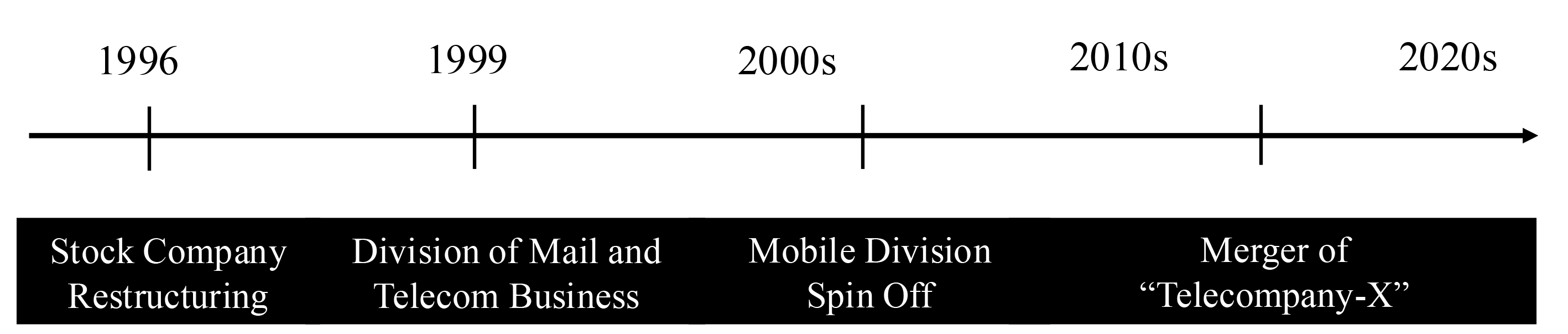 Fig. 1.
Timeline Telecompany-X.
Following the merger, Telecompany-X brought together both civil servants (“Beamten”) and regular employees. The overall process created considerable uncertainty, especially around job security and role stability: many employees did not know whether they would keep their positions, be reassigned, or leave the company. Restructuring primarily affected departments such as Accounting, Internal Communications, HR, Marketing, Sales, and Customer Service, which were consolidated, leading to shifts in responsibilities. By contrast, technology-oriented divisions like mobile and landline operations remained largely untouched, continuing to function separately. As a result, while some employees began collaborating with former counterparts, others saw little change in their daily work.
In this setting, company management launched an internal communications campaign using culture management strategies, especially corporate and internal branding, to erase the “old” company brands and identities. Both companies had previously cultivated distinct identities, each tied to recognizable visual symbols. The mobile company was strongly associated with black, while the landline company was identified with green. These contrasting color schemes shaped their advertising, promotional materials, and public image, and they continued to serve as points of identification after the merger.
The newly implemented intranet played a central role in the campaign and was described by one employee as “the pioneer of the shared world”, presenting the merged company and its new identity to employees. Staff were instructed to dispose of old promotional materials, such as calendars, pens, T-shirts, notebooks, and workplaces were inspected for compliance. The merger was officially celebrated during the launch of the new product brand at a company-wide induction event. All informants recalled this moment: some with enthusiasm, others more critically, calling it a staged performance. At the event, multiple logo versions were showcased, including one created live on stage in graffiti-style by a break-dancer. This “brand introduction campaign” was reportedly extensive, involving multiple steps and staff participation, and coincided with the public advertising launch.
According to accounts from my fieldwork, the redesigned logo was carefully planned. The project manager explained that the new company name deliberately referenced the former mobile division’s brand, while the logo incorporated green from the landline company. The design paired this green with a “refreshing” white to signal, in the manager’s words, a “new and young brand”. The branding process was treated as highly significant and strictly confidential: employees on the design team signed non-disclosure agreements, as the logo was reserved for public release in the upcoming advertising campaign.
Given these considerations, it is not surprising that employees commonly mentioned the merger using terms like “brand re-launch”, “brand implementation”, or “brand changeover”. The activities surrounding the new company brand and the internal implementation campaign highlight managerial strategies aimed at fostering strong employee identification with the new brand. In fact, these efforts align closely with approaches to corporate culture management that seek to normatively control employees’ behavior, attitudes, and emotions towards the company (cf. Alvesson and Willmott, 2002; Kunda, 2006).
I selected Telecompany-X for my research, because it provides a compelling example of how employees navigate identity tensions after a merger under managerial regulation. A key prerequisite was that both previously separate companies had their own established corporate identities, which allowed for an analysis of sensemaking, both in recalling the past during the merger’s implementation and in investigating the current sensemaking one year after it had begun. Another criterion was the opportunity to compare different departments and their varying strategies and work practices. Additionally, the integration of the two companies occurred at different levels—meaning the merger was implemented separately across departments and individual specialist areas—providing further insight into diverse integration processes. These factors made Telecompany-X a valuable case for studying identity work in post-merger group dynamics.
In undertaking this interpretative case study, I employed ethnographic methodologies, including interviews, workplace observations, and document analysis, aligning my approach with recent qualitative, ethnographic fieldwork practices in organizational research (Czarniawska-Joerges, 2007; Knoblauch, 2005; Nicolini, 2012). Over the course of the study, I conducted 13 interviews, nine of which included workplace observations. These visits spanned 10 months and were divided into two phases: the first phase consisted of three interviews and five interviews and workplace observations, primarily in the Operations Support Systems (OSS) department. In addition, I spent a day in the company’s call center to gain broader insight into how call center agents deal with the integration of products and services in the merged company.
The second phase, which began three months later, involved interviews and workplace observations across different departments, focusing mainly on employees in Customer Service and Sales. Each of my interviews and workplace observations lasted between 45 minutes and 1.5 hours. Table 1 gives an overview of the research participants (I will use the IDs in the results section as quotation sources).
| ID | Job role | Department | Type |
| IC 1 | Chief Editor Intranet | Internal Communications (TC) | Interview |
| IC 2 | Project Manager Intranet | Internal Communications (TC) | Interview |
| OSS 1 | Head of Open Support Systems | Open Support Systems (OSS) | Interview and workplace observation |
| OSS 2 | Software Developer | Open Support Systems (OSS) | Interview and workplace observation |
| OSS 3 | Software Developer | Open Support Systems (OSS) | Interview and workplace observation |
| CE 1 | Software Developer | Customer Experience (CE) | Interview |
| SPD 1 | Head of Service Teams | Service Process Design (SPD) | Interview |
| CS 1 | Call Center Agent | Customer Service (CS) | Interview and workplace observation |
| CS 2 | Service Team Manager | Customer Service (CS) | Interview and workplace observation |
| CS 3 | Service Quality Manager | Customer Service (CS) | Interview and workplace observation |
| CS 4 | Information Manager | Customer Service (CS) | Interview and workplace observation |
| RSB 1 | Promotion Manager | Residential & Small Business Sales (RSB) | Interview and workplace observation |
| BS 1 | Accountant | Business Sales (BS) | Interview and workplace observation |
I recorded interviews and took notes during workplace observations, which together formed the core of my investigation and the foundation for my analysis. To enrich my understanding of the data generated through these methods, I also collected various documents, including the company’s internal employee magazine and a business publication aimed at stakeholders and the broader industry. In addition, I reviewed company presentations available online and examined newspaper articles, particularly those addressing the recent merger the company had undergone. The field data consisted of audio recordings from formal interviews, as well as notes from informal conversations and observations of the organizational setting and employees’ work environments. Altogether, the dataset comprised interview transcripts and workplace fieldnotes, which together constitute the primary body of my empirical material.
Existing literature suggests that analyzing qualitative data begins openly, evolving close to the people and situations being studied (Glaser and Strauss, 2009). In contrast to this theoretical perspective, my analysis took place concurrently with data collection. The different stages of my fieldwork allowed me to review some data prior to returning to the field, creating a continuous interplay between analysis and further data gathering. This iterative process helped me refine my questions and shift my focus based on the insights I had gained (Laube, 2016, p. 37; Nag et al., 2007, p. 822; see also Clarke Adele, 2005). Additionally, the analysis was influenced not only by emerging insights but also by theoretical frameworks I brought to the research. This dynamic interaction both shaped and limited my study, ultimately configuring it (Yanow et al., 2009b; Yanow and Schwartz-Shea, 2009a).
Aligning with the practice-analytical framework, my analysis followed the work of Langley and colleagues on identity formation. As they highlight, interviews provided not only insights into employees’ explanations but also served as “sites of identity work” (Langley et al., 2012, p. 143), where identity was performed and negotiated. From this viewpoint, the interview setting is understood as an “empirical situation” (ibid.) that allowed me to observe—whether staged or in situ—how employees negotiated their sense of belonging. Therefore, the narratives should not be understood as mere reflections of pre-existing identities, but as active processes of making sense of the merger through the narration of difference, that is, practices that simultaneously resist and reinforce the managerial push for coherence (Weick, 1993, p. 635).
Data analysis was conducted using an iterative approach inspired by grounded theory principles (Glaser and Strauss, 2009). I began with open coding, developing codes for all potentially relevant topics. Initial descriptive codes included “informal communication practices”, “company philosophy differences”, “hierarchical vs. flat workplace cultures”, “market-driven culture”, “rapid response expectations”, and “informal decision-making”. For example, quotes describing “very dynamic” environments with “five-minute response times” and “informal arrangements” were coded alongside observations about formal address protocols, revealing contrasting organizational cultures. At a later stage, I moved to focused coding, concentrating on the analytical themes and relevant narrative and work practices that had already emerged, and examining whether they recurred in the data (Emerson et al., 1995, p. 150–167). One of the leading codes was the notion of “culture” and “identity”, often linked to the idea of “difference”. This theme became central to understanding internal discourses within the company following the merger and revealed what was perceived as the core organizational issue: the cultural divide within the post-merger company. The coding process was also informed by the practice-theoretical lens, drawing attention to how everyday routines, interactions, and narratives reproduced and contested organizational identities and boundaries.
Through this iterative process, themes emerged and were refined across coding stages. Focused coding grouped initial codes under broader categories like “Cultural Integration Challenges” and “Competing Work Practices” showing how everyday practices become sites where historical organizational identities persist. The analysis then explored connections and patterns between these categories, examining how different cultural tensions manifested in employees’ daily experiences and how they navigated distinct organizational expectations. For instance, themes around informal versus formal communication practices connected to broader patterns of identity attachment and resistance to integration efforts. This progression from descriptive codes through thematic grouping to exploring relationships between themes informed the development of broader analytical categories such as “Identity Work in Everyday Practices”, revealing how employees navigate competing cultural expectations embedded in both social interactions and work processes.
The following narratives offer insights into how employees made sense of the merger through various forms of identity work. Doing so, employees actively participated in shaping their own sense of belonging while defining both their own and the other group’s identity. By drawing on the legacy of the two predecessor companies and their associated brands, these narratives demonstrate how (some) employees continued to identify with what they refer to as the “black” or “green world”. This persistence of past identities presented a challenge for management’s identity regulation efforts, as it complicated employees’ full embrace of the new brand and identity. Those employees who strongly identified with their former company were often seen as problematic, as they were perceived to reinforce organizational divisions.
As previously noted, soon after the merger, the Internal Communications department launched a campaign to promote the new company brand and identity as a unifying reference point, with the intranet serving as its central medium. By focusing on branding and hence identity regulation, management effectively set the stage for employees to make sense of the merger, encouraging them to identify with the newly formed corporate identity. Employees responded in diverse ways to this initiative. For instance, the promotional manager in Residential and Small Business Sales (RSB 1), who had previously been involved in designing company stores, recalled that during the integration period, employees from the former landline division used promotional materials from their previous company to signal their discontent with the merger:
[…] actually, we had employees who for some time wore in defiance Phone-Y-branded clothes and were walking around like this in the company. Or merchandising products, old branded stuff, was hung up on the wall; I still have a pen, too [she reaches across her desk, shows me the pen].
Accordingly, these incidents were an act of defiance against the merger and the directive to unify as a single company, which was understood as coming at the cost of employees’ organizational identity. These actions represented forms of resistance, which becomes even more apparent when considering the company’s deliberate efforts to eliminate all traces of the previously separate businesses:
Yes, well, people went through the company examining old stuff, but in the end, one cannot take away employees’ things […] well, it was called upon and asked that all things which still feature the old brand […] to deliver them somewhere so that they can be destroyed, but many were sentimental and kept things and this was eventually ok because one cannot force people to burn their books – in that kind of way.
As mentioned earlier, employees were asked to remove old advertising and promotional items — calendars, pens, T-shirts, and notebooks—during the merger transition. Additionally, workplaces were inspected to ensure compliance with this directive. The explicit statement about not forcing people to “burn their books” carries strong historical connotations. In this context, the merger appears to have been forcefully implemented from the top down. Retaining and nostalgically celebrating old materials—such as displaying posters and wearing branded T-shirts—became an act of resistance against these managerial directives.
At the time of the merger, maintaining connections to the previous organizational entities and their respective identities was a common practice within the newly merged company, manifesting across various levels. As said, company management had prepared the ground by primarily focusing on promoting a new corporate identity, which was intended to unify the organization under a single vision and, therefore, aimed to remove old advertising materials. Employees actively resisted by wearing and displaying these materials with intent. Also, staff from the former mobile division continued to assert their connection to Mobile-X by contrasting its dynamic, start-up-like environment with what they described as the more bureaucratic and rigid culture of the landline division. Such critiques of bureaucratic work processes are part of a broader discourse in German-speaking contexts, particularly in relation to public sector institutions. Similarly, start-ups are widely perceived as hubs of innovation, attracting motivated, hands-on individuals. Thus, this common narrative framed Phone-Y as the opposite, lacking these desirable traits and reinforcing its image as the ‘other’.
Within this setting, employees from both former companies categorized colleagues as either part of ‘us’ or ‘them’. Factors such as the companies’ distinct market positions, differing ownership structures, and even conflicts over forms of address were used to reinforce these distinctions. This framing also assigned a particular mindset to the ‘other’ group, reinforcing one’s own former identity and sense of belonging to the pre-merger company.
Nevertheless, at the time of my research, employees engaged in identity work in significantly different ways. Fig. 2 below provides an overview of the different narrative strategies employees adopted about a year after the official merger:
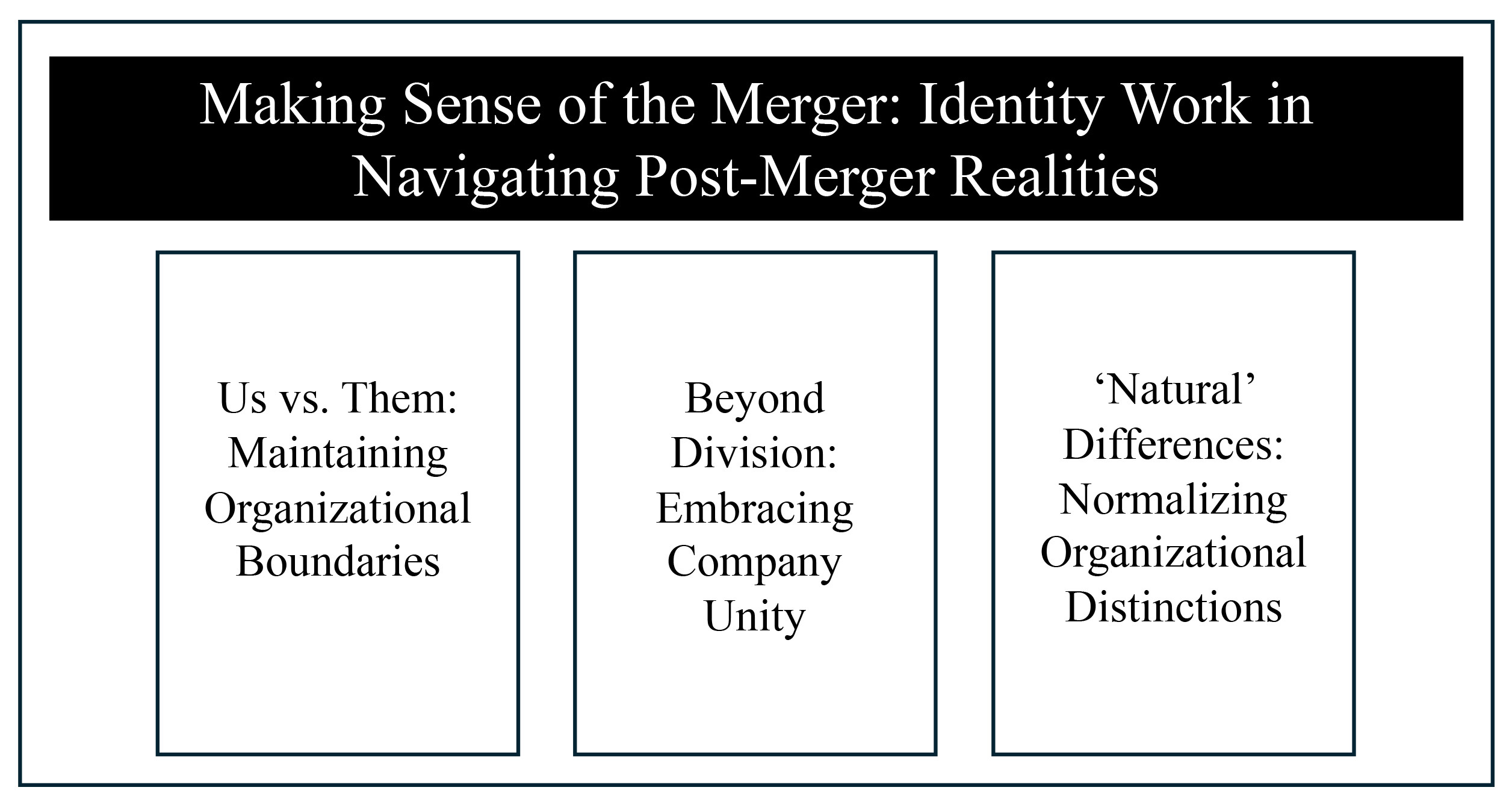 Fig. 2.
Employees’ narrative strategies of making sense of the merger.
As I will outline below, employees mobilized three distinct narrative practices to make sense of the merger. The first, “Us vs. Them”, sustained organizational boundaries by emphasizing distinctions between groups within the company. The second, “Beyond Division”, sought to leave such separations behind by foregrounding company unity and a shared sense of purpose. The third, “Natural Differences”, downplayed earlier division by framing them as ordinary and expected, presenting them as a natural part of organizational transition rather than persistent obstacles.
The merger brought together companies with stark differences in their market positions: Mobile-X operated in a competitive environment, while Phone-Y maintained a stable status often framed as “monopolistic”. Former Mobile-X employees highlighted these contrasts, stating, “Mobile-X had the competition; it was very stressful on the market, very dynamic, we always had to react within five minutes”, thereby underlining a fast-paced, informal work culture driven by constant change, requiring employees to make quick decisions without relying on formal structures. In contrast, Phone-Y, with limited competition, was perceived as rigid and stress-free, as it faced no external threats despite declining landline sales. As the group leader (OSS 1) in the OSS department stated:
[…] not flexible, they did not have any competition, they were market leader, effectively they had a monopoly position, that is, they did not have any stress, they did not face any threat from outside. Certainly, fixed network sales dropped, and they lost turnover, but they did not have anyone attempting to take them over, or to frighten them in any other way.
According to the group leader, the distinct ownership structures shaped employees’ experiences in markedly different ways: while staff in the former landline division were largely insulated from work-related pressures and uncertainties, Mobile-X employees repeatedly invoked external threats and the looming possibility of a takeover. Such references did more than describe market conditions; they also articulated a sense of organizational distinctiveness by framing Mobile-X as adaptive and resilient in the face of uncertainty. In this way, the comparison with the landline division served as an identity-building device, positioning Mobile-X as characterized by flexibility, a hands-on mentality, and a strong work ethic, while simultaneously reinforcing organizational boundaries between the two companies.
These narrative practices also underscore the symbolic value of corporate identity. Mobile-X is portrayed as a dynamic and adaptable company in constant motion, while Phone-Y appears characterized by formal structures and bureaucratic processes. This perceived difference led to various associations among employees. For example, in the former mobile division, an “open door policy” was prominent, indicating positive attributes like transparency and teamwork, whereas at Phone-Y, it was common for office doors to be closed.
However, the distinct ownership structures complicated matters in the post-merger company; the landline division employed civil servants, who enjoyed special pension benefits and had job permanence. These “Beamten” are associated with bureaucratic and highly formal work procedures. Unsurprisingly, bureaucratic procedures differ from the way work was apparently carried out at Mobile-X; as a stock company, Mobile-X did not employ civil servants, only regular employees. Informants noted that the company was primarily staffed by young people and maintained flat hierarchies throughout. It was regarded as a ‘young business’ that experienced rapid growth initially. Describing the differing work procedures, the promotion manager in Residential and Small Business Sales (RSB 1) characterized Phone-Y as “bureaucracy, highly structured”, and added:
[…] when we were integrated, it was an extreme change because here [at Phone-Y] everything works through documents and you won’t get anything, everything that’s leaving the official path, it was impossible, nobody reacts or gets in touch, totally different work attitudes, well, at ours it was somehow ‘not possible is impossible’, over there it was ‘it’s not possible, it has always been like this and we do it like this’, these were totally different worlds clashing […].
This account underscores how formalized operational practices were central to Phone-Y’s organizational structure. Additionally, her phrasing of the merger as “when we were integrated” implies that the mobile company was incorporated into the more established, traditional landline business. Such a framing positioned Phone-Y as the senior partner, a view echoed by other employees who described the landline division as the dominant entity. At the same time, contrasts in everyday practices deepened the sense of division: former Mobile-X employees described preferring email communication and expressed frustration when their messages went unanswered by colleagues in Phone-Y, raising questions about collaboration and challenging established routines. This oppositional framing was reinforced by another employee (OSS 1), who emphasized that Mobile-X staff were regarded as flexible and adaptable, whereas Phone-Y employees were depicted as stable, long-term, and bound to the company until retirement. In these accounts, the merger was thus narrated through a lens of “us versus them”, drawing sharp boundaries between the two organizational identities.
This “us versus them” framing extended beyond organizational practices and operational differences to everyday interactions and conventions. In particular, narratives emphasized a contrast between the flexible, hands-on approach of former Mobile-X employees, often portrayed as more effective or desirable, and the more rigid, rule-bound mentality of the former landline division. One area where this contrast became especially visible was in forms of address. In German, the informal ‘Du’ and the formal ‘Sie’ carry significant social meaning, and hierarchical factors further complicate their use in organizational contexts. Differences in how employees from the two companies addressed one another initially created confusion and highlighted contrasting workplace cultures. When asked about tangible distinctions between the companies, one informant (CS 4) shared the following story:
Well, an example, probably the clearest way to explain it, within Mobile-X we were all on a first name basis, everyone, this was a company philosophy, it doesn’t matter who [emphasis in original] stands in front of you, even B. [surname of the former company CEO], even if it was him, it just didn’t matter. […] this has not really been properly solved, there was the merger and within Phone-Y it was not, well, they had ‘Sie’ or ‘Du’, and then, hm, you often rub somebody the wrong way […]. Well, that’s something, […] there has to be a conversation somewhere, it’s got to be decided from the top down, how it’s going to be now, because it’s a cultural thing.
The term “company philosophy” implies that addressing colleagues on a first name basis was a standard practice enforced across Mobile-X. This informal mode of address appeared to foster a sense of shared company identity among employees. My informant, however, highlighted the contrast with Phone-Y, where it was customary to use the formal ‘Sie’ and refer to colleagues by their last names, reserving first-name usage for those with whom one was more familiar. For some time, employees reported, the rules around forms of address remained unclear, even though the topic was raised in team meetings. Yet middle management hesitated to provide a definitive guideline. One informant described awkward interactions in which one employee addressed another with ‘Du’, only to receive a ‘Sie’ in response, emphasizing that the most uncomfortable aspect was the lack of any clear decision from the management. This apparent absence of managerial direction is noteworthy, especially given the company’s significant investment in a branding campaign aimed at fostering unity. Eventually, but too late according to some employees, middle management decided on a compromise: ‘Sie’ became the default form of address, while ‘Du’ was reserved for closer colleagues.
Despite these efforts to create organizational congruence, employees were still able to identify colleagues from the other company without relying on spoken language. As I was told, clothing differences alone often made it immediately apparent which former organization an employee belonged to, highlighting how social and visual cues continued to reinforce group distinctions. These subtle markers of identity illustrate that the “Us versus Them” dynamic persisted in everyday interactions, even as formal managerial decisions and branding efforts worked to promote company-wide unity. The fieldwork, conducted roughly ten months after the merger, suggested that while such differences were gradually diminishing, they remained a salient part of employees’ everyday experience of organizational boundaries.
In contrast to the employees above, the software developers (also called “technicians”) in the Open Support Systems department (OSS) largely ignored the merger and differences with the former mobile division, instead fostering a sense of company unity. When I asked one of my informants (OSS 2) about his initial division, he noted that, except for the head of OSS, everyone in his team came from the Phone-Y division. Additionally, in his team, the blending of staff primarily occurred at the middle and upper management levels, adding:
You almost can’t say this, but before he was Mobile-X […] I think, a great mix did not happen, well, I’d say, this is always stupid to say ‘mobile part’, ‘Phone-Y-stock’, well, here, at this site, this was a pure Phone-Y location and in this way, it is very Phone-Y-heavy, well, I have the feeling what happened, on the management-level it has been mixed a lot, yes. Using the example of [head of OSS], he was Mobile-X before. Well, a lot more happened there, concerning the mix. […] On working level less so, one has to say.
Apparently, my informant’s team remained largely unchanged. In fact, the head of OSS (OSS 1) reported to me that the entire team joined from a company supplier shortly before the merger. Unlike accounts from the earlier section, OSS 2 did not emphasize the different identities of the two companies. He also avoided discussing differences or distinct work styles, instead emphasizing that referring to the two separate companies is “stupid to say”, thereby normatively reinforcing the idea of company unity. As I observed, his team was located outside the city in one of the former landline division buildings and remained largely insulated from the merger and reorganization processes. As can be seen, by minimizing distinctions and emphasizing unity, this approach exemplifies identity work that actively constructs a cohesive organizational identity, shaping how employees understand their membership within the merged company.
Similarly, another informant from Business Sales (BS 1) avoided in discussing differences between the two companies. Instead, he highlighted collaboration across employee groups, noting that the organization is now “fully mixed, that division doesn’t exist anymore. Yes, very deliberately, it has been jumbled up”. Doing so, he underscores management’s deliberate strategy to integrate employees from the former companies. Together with the self-correction described by OSS 2, this emphasis on a unified company reflects an unspoken normative guideline that foregrounds cohesion and collective identity, while overlooking any lingering distinctions. In this way, these accounts exemplify the “Beyond Division” narrative, showing how employees respond to management’s call for coherence, thereby moving beyond separations and constructing a shared sense of company unity.
Another narrative framed the differences between the companies as natural, portraying the two organizations as inherently distinct. This “downplaying by naturalizing” dismisses such differences as problematic, thereby also supporting management’s broader directive to unify the company. In fact, by minimizing attention to tensions, it reinforces cohesion and appears to disengage from ongoing identity work that foregrounds company boundaries, effectively signaling an end to discussions of differences and related conflicts. For example, the contrasting methods of information dissemination in the two former companies were described as natural, reflecting a pragmatic acceptance of variation. As one participant (CS 2) noted:
[…] whenever a business has gone through a merger, for some time, this is a fact, that’s neither positive nor negative, that’s a fact, a route must be found, because both companies must have handled things differently, and presumably this information provision constitutes the middle ground in relation to how it has been before […].
Her statement suggests that merging companies are inherently different, and due to their distinct work procedures, the post-merger company must develop a new approach. This approach appears to blend both old methods, ‘meeting’ in between. Her repeated phrase “that’s a fact”, suggests an undeniable, ‘natural’ truth about merging companies. Additionally, she downplayed any potential conflict that may arise during the integration by asserting that it should be viewed as neither negative nor positive:
[…] the Phone-Y business exists already longer than Mobile-X, well, and because of this there is already a cultural difference, logically, this is, well, I don’t know, if you put together Apple and Philips, perhaps, since Apple must be considered as the youngster.
This statement reflects a perspective in which an organization’s history is seen as creating inherently distinct cultural differences between companies. By referencing well-known organizations, she downplays potentially contentious aspects of the merger. Her use of “logically” frames these differences as natural and expected, portraying the merger as relatively smooth and emphasizing the absence of disputes over positions compared to other companies. By presenting these distinctions as natural and unproblematic, the narrative contributes to identity work that normalizes organizational boundaries while reducing attention to conflict, reinforcing a shared understanding of the merged company’s cohesion. In fact, as I was told, prior to the merger, teams had interacted through visits in which employees from each organization observed their counterparts’ operational practices, fostering a degree of familiarity between members of the two companies. Following the merger, the Customer Service department included staff from both organizations:
Yes, indeed, the aim is that everyone does it from everywhere, yes, and it works quite well over here, […] even though originally, I stem from the mobile part, I do also landline topics, the only difference, I have to ask more when it comes to landline topics, the logic in the background, the technical procedure is different, it makes a difference if an order is entered into the system via landline or via mobile phone […]. But these are things, everyone had to learn it in the original business, these are in some cases long-term processes, […] well, we have the advantage that we got the information here, the contact person we may ask […].
According to this quote, after the merger, the team handled both landline and mobile services, which required learning new work processes related to the landline business’s products and services. Rather than expressing dissatisfaction, my informant emphasizes the positive aspects of the post-merger situation, particularly that the necessary knowledge and contacts were already available within the company. As can be seen, while previous accounts highlighted conflicts arising from the merger, this narrative downplays differences between the two former companies, framing them as inevitable and manageable. In this way, the account exemplifies the “Natural Differences” narrative, showing how employees normalize organizational distinctions as part of everyday work, contributing to identity work that acknowledges differences without turning them into barriers to cohesion.
While the notion of identity work acknowledges the temporal and emergent nature of organizational identities, only recent studies have applied a practice-theoretical lens to theorize their processual character, thereby emphasizing identities as “continuously crafted” (Dille, 2020, p. 61; see also Ernst and Jensen Schleiter, 2021; Fachin and Langley, 2024; Oliver and Vough, 2020). This perspective provides the foundation for my analysis, which extends this line of work by demonstrating how everyday practices both constrain and enable identity negotiation in a post-merger setting.
By adopting a practice-theoretical framework, the study challenges binary perspectives on M&A, which often depict the merger as a straightforward clash between two distinct companies. Instead, it rethinks the role of identities and identity work by showing that organizational integration involves not only two groups of employees (linked to the former companies), but also departments and work settings that shape how the merger process unfolds. As becomes apparent, local group dynamics, specific work cultures and practices, and the varying orientations of employees toward their former corporate identities emerge as crucial reference points for understanding this organizational transformation.
Building on this framework, my analysis shows how, one year after the merger, employees’ narrative practices simultaneously resisted, mirrored, and embraced managerial efforts at coherence. Despite variations in emphasis, I interpret employees’ narrative practices as forms of identity work that navigate the tension between historical corporate identities and the new identity envisioned by management. This meant that some research participants insisted on the differences of the two former companies (strategy 1), others explicitly corrected references to the prior businesses (strategy 2), and still others emphasized the seamless integration of employees (strategy 3). The latter narrative downplays differences, framing them as natural and self-evident. About a year after the merger’s implementation, all three approaches ultimately aligned with management’s vision—whether through ongoing resistance, adoption, or minimizing the need for unity. Notably, some employees appeared to internalize the managerial approach of identity regulation more than others.
Taken together, these strategies demonstrate how identity work unfolds under conditions of managerial pressure for coherence. Management’s approach effectively reframed the merger as a matter of identity loyalty, positioning the introduction of the new brand as the central unifying force for employees. Such a strategy downplays disagreements and frictions that inevitably arise during a merger, along with the underlying power dynamics between the two companies and between management and staff. By focusing primarily on identity regulation, such an approach risks oversimplifying the complexities of integration and overlooking the lived experiences of employees navigating the transition.
Thus, regarding the role everyday work practices play in shaping their identity negotiation about a year after the merger, they not only provide opportunities for identity work, as existing research has demonstrated (Langley et al., 2012), but also facilitate identity integration. For example, the technicians in the OSS department were less affected by the merger and had fewer possibilities for identity negotiation in their daily routines. Hence, they refrained from emphasizing the two companies’ differences. Also, they originally stemmed from a company supplier before the merger, which apparently positioned them differently within the integration process.
Moreover, employees in Customer Service reported that they now handled both landline and mobile topics and that this transition had been relatively smooth. By contrast, employees such as the promotional manager, who had previously been involved in designing stores in alignment with the company’s organizational identity, were more likely to reference and insist on their former corporate identity. This comparison illustrates that not all employees had the same opportunities for identity work in their everyday routines and that they related differently to their prior corporate identities. These findings suggest that the extent to which employees engage in identity work is shaped by their specific roles, associated work practices, and prior experiences with corporate branding and restructuring. In this respect, the results align with Fachin and Langley’s (2024) discussion of personal involvement in organizational identity work; in my study, the degree to which employees are embedded in particular work activities and practices shapes how they participate in and enact identity work.
Overall, adopting a practice-theoretical lens, the continual mentioning of the two pre-merger companies may also be understood as a means of coordination and orientation within the newly merged organization, helping employees make sense of the integration process, for instance the different email response and communication styles previously described. In fact, from my informants’ perspective, referencing the two former companies was at times a practical way to make sense of the merger within the context of daily work that, as reported, was increasingly integration landline and mobile services. That is, the notion of the “green” and “black worlds” also helped members categorize and understand unfamiliar work practices and processes in the merged company. Old software tools and distinct ways of handling communication still existed, and many employees had to engage with both landline and mobile services, fostering collaboration between the previously separate divisions.
In this manner, the distinction between the green and black worlds served my informants as a shared reference point, helping employees interpret and hence make sense of work processes within the newly ‘mixed’ company—ensuring work could proceed smoothly despite organizational changes. This observation resonates with Fachin and Langley’s (2024) argument that organizational identity work does not necessarily need to culminate in consensus. Instead, multiplicity and divergence can be productive for collaboration, as they provide orientation and shared frameworks without erasing differences. In my case, the references to the “green” and “black worlds” function similarly to what Fachin and Langley identify as “Polyphony”, namely divergent identity constructions that coexist, allowing members to maintain mutually supportive relations and continuity in work practices. Importantly, unlike the “Deadlock” scenario they describe, where divergent identities can stall collaboration, the green/black distinctions did not create persistent conflict; rather, they often enabled employees to navigate differences pragmatically as part of their work. In this light, references to the former “green” and “black” worlds are best understood not as rigid divisions but as a polyphonic resource through which employees articulate and coordinate distinct routines and procedures that persist in the post-merger environment. This extends Fachin and Langley’s insight by demonstrating that multiplicity in identity work can serve as a practical tool for maintaining organizational functioning during integration.
The findings of this study have practical implications for managing post-merger integration processes. Unlike the approach taken by management in Telecompany-X, which sought to erase references to the former companies, this study underscores the continuing significance of historically developed corporate identities in shaping the merged organization. A key insight is that former identities can serve as anchors for employees navigating organizational change, offering opportunities to discuss how work should be done in the merged organization. Importantly, while historically developed and temporal perspectives on organizational identity are well established theoretically (Schultz and Hernes, 2013), this study illustrates how such perspectives manifest concretely in post-merger practices, such as the continual referencing of the “green” and “black” worlds.
Moreover, the study highlights that identity management should not solely be viewed as a top-down process but must account for how identity is negotiated in everyday work. Employees actively interpret, negotiate, and enact identity efforts in their daily routines, and attempts to impose a unified corporate identity too quickly may hinder the development of a shared sense of belonging. In fact, resistance in these instances can be understood as a contribution to organizational change, providing insights into how strategies must adapt to employees’ legitimate concerns. Indeed, research on identity transformation suggests that corporate identities often pass through a period of ambiguity before stabilizing (Corley and Gioia, 2004), while the concept of “transitional identity” emphasizes a temporary, evolving identity shaped through dialogue and negotiation (Clark et al., 2010). Recognizing that identity work varies across roles and settings, and that historical corporate identities continue to influence practices, enables organizations to design more diverse and context-sensitive post-merger strategies.
This study advances the temporal perspective on organizational identity by employing a practice-theoretical framework to examine the complex dynamics of post-merger identity work. It highlights the unintended consequences of managerial efforts to enforce a unified corporate identity, showing that integration is not merely a clash between two distinct cultures, but is also shaped by local workplace cultures and settings. Rather than erasing past identities, organizations may benefit from recognizing and leveraging historical identities as shared reference points that facilitate collaboration and preserve valuable knowledge. The assumption that successful integration requires the complete elimination of prior organizational identities or cultures is questioned, as such an approach can result in the loss of critical local cultures and department-specific expertise. By fostering an environment where employees can navigate transitional identities, companies can more effectively manage integration challenges while maintaining essential elements of their organizational culture.
Nevertheless, this study has limitations regarding the generalizability of its findings, as it focuses on identity work in the context of a merger of a formerly state-owned company. Future research should examine whether similar identity conflicts arise in private-sector mergers and how these might differ from the case studied here. While prior studies have compared state-owned and private-sector mergers, further investigation could clarify how ownership structures shape identity negotiations during organizational integration. Additionally, longitudinal studies could explore how identity work evolves over time, revealing whether initial identity tensions gradually resolve into a unified corporate identity or whether distinctions from previous affiliations persist. Continued research on the long-term effects of identity negotiations and strategies for supporting employees through these transitions will deepen our understanding of post-merger integration processes.
All data reported in this paper will be shared by the corresponding author upon reasonable request.
The single author was responsible for the conception of ideas presented, writing, and the entire preparation of this manuscript.
The author gratefully acknowledges the anonymous company and its employees for their willingness to participate in this study. She also acknowledges the anonymous reviewers for their valuable comments and constructive suggestions.
The analysis presented in this article was carried out as part of the project “Transforming digitally: Digital innovations for the successful realization of organizational change” (KON-21-0000013), funded by the Bavarian Research Institute for Digital Transformation (bidt).
The author declares no conflict of interest.
During the preparation of this work the author used ChatGpt-3.5 and Claude-3.7 in order to check spell and grammar. After using this tool, the author reviewed and edited the content as needed and takes full responsibility for the content of the publication.
References
Publisher’s Note: IMR Press stays neutral with regard to jurisdictional claims in published maps and institutional affiliations.