

 , Paulo Pinheiro 3, Marcia Juliana d’Angelo 4, Florian Kragulj 5
1 Essex Business School, University of Essex, CO4 3SQ Colchester, UK
2 Faculty of Social Sciences and Humanities, Vrije University Amsterdam, 1105, 1081 HV Amsterdam, Netherlands
3 NECE-UBI – Research Centre for Business Sciences, University of Beira Interior, 56, 6200-209 Covilhã, Portugal
4 Business Management, Fucape Business School, 29075-505 Vitória, Brazil
5 Knowledge Management Group, Vienna University of Economics and Business, 1020 Wien, Austria
Abstract
This study develops and validates a scale to measure organizational practical wisdom, addressing a gap in the knowledge-management literature. Using a multi-method approach encompassing (1) a semi-structured literature review of 107 peer-reviewed articles that identified four dimensions of organizational practical wisdom; (2) content analysis of the literature; (3) semi-structured interviews with 14 senior leaders from diverse industries and countries; and (4) a two-round Delphi-based analysis with four academic experts, we developed the Organizational Practical Wisdom scale. The scale-validation process then involved exploratory factor analysis and confirmatory factor analysis using two distinct samples. The resulting unidimensional scale demonstrates strong psychometric properties with high reliability and convergent validity. The measurement-invariance analysis supports the scale’s applicability across Portuguese and English language groups. The study makes valuable contributions: it develops a comprehensive framework for understanding organizational practical wisdom, integrating divergent perspectives. It operationalizes organizational practical wisdom, delineates the dimensions of the construct, and explores their interconnectedness. The scale items address key aspects such as adaptability, ethical considerations, and effective knowledge application. The insights are invaluable for leaders seeking to assess the various dimensions of practical wisdom within their organizations. Understanding and leveraging organizational practical wisdom holds substantial societal implications, particularly for enhancing the creation of shared value, social innovation, the common good, overall performance, and sustainability. This study offers an important step toward addressing the contemporary imperative of fostering organizations that excel economically and ethically, promote sustainable development, and contribute to the greater social good.
Keywords
- practical wisdom
- phronesis
- knowledge management
- learning
- spirituality
In response to contemporary societal demands for organizations to adopt a humanized strategy, promoting social progress while achieving sustainable economic success, scholars are revisiting practical wisdom (Beabout, 2012; Kragulj, 2023; Nonaka et al., 2014; Nonaka and Takeuchi, 2021a; Rocha et al., 2022; Rocha et al., 2024; Sasse-Werhahn et al., 2020; Serenko, 2024). Practical wisdom (phronesis) is “a reasoned and true state of capacity to act about human goods” (Aristotle, 2009, p. 106). It involves making good decisions for the right reason at the right time and applying experiential knowledge to complex situations where there is no straightforward correct answer (Bachmann, et al., 2018a; Bachmann, et al., 2018b). In organizational contexts, practical wisdom is crucial for balancing multiple stakeholder interests and contributing to the common good (Kragulj, 2023; Rocha et al., 2024; Nonaka and Takeuchi, 2021a).
Recent research has developed an assessment for practical wisdom in the workplace (Serenko, 2024), but, despite its increasing appearance in the knowledge management literature (Rocha et al., 2024; Serenko, 2024), organizational practical wisdom has yet to be operationalized to the extent that a measurement instrument could be presented to assess how employees perceive the organizational level of practical wisdom and determine the maturity of a practically wise organization (Rocha et al., 2022; Rowley and Gibbs, 2008). This study, therefore, aims to fill this gap by developing and validating an instrument to measure organizational practical wisdom, and thus has the following research objectives: (I) To categorize the critical dimensions of organizational practical wisdom; (II) To develop and validate a reliable scale for measuring organizational practical wisdom in knowledge management.
We used a multimethod approach, including a literature review, content analysis, and the Delphi technique, to examine and combine the concepts and dimensions of practical wisdom in organizations, specifically in management and knowledge management. We then developed a measurement instrument and validated it using Exploratory Factor and Confirmatory Factor Analyses.
This study makes valuable contributions to both theory and practice. Theoretically, it advances our understanding of organizational practical wisdom by empirically identifying and validating its essential dimensions, thus enriching the conceptual framework of practical wisdom in organizational contexts. By developing and validating an instrument for measuring organizational practical wisdom, we provide researchers with a robust tool for future empirical studies, enabling more rigorous investigations into the role and impact of practical wisdom in organizational processes. This study offers practitioners a validated concrete instrument to assess and cultivate practical wisdom within their organizations, which can be used for organizational diagnostics, employee development, and strategic planning. The insights derived from this study can guide leaders in fostering wisdom-based decision-making and creating organizational cultures that balance economic success with social responsibility. The research advances the academic conversation by bridging the gap between theoretical conceptualizations of organizational practical wisdom and practical applications, providing actionable insights for organizations striving to navigate complex challenges.
Practical wisdom has been in the spotlight of various disciplines over the past decades, e.g., philosophy (Maxwell, 1984), psychology (Darnell et al., 2022; Baltes and Staudinger, 1993) and education (Sternberg, 2001; Jakubik, 2020), and still is an evolving research area (e.g., Jakubik and Müürsepp, 2022; Kragulj, 2023; Kristjánsson and Fowers, 2024; Rocha and Pinheiro, 2021c; Rocha et al., 2022; Rocha et al., 2024; Salovaara Janne, 2024; Peschl et al., 2023; Serenko, 2024). Measuring practical wisdom is complex (Serenko, 2024), even more so through the differing perspectives brought into the discussion by the various disciplines involved (Swartwood, 2020). In this study, we approach it through the lens of organizational learning and knowledge management (Rowley and Gibbs, 2008; Rocha et al., 2022). We will provide an overview of the construct in the next section.
While wisdom (Sophia) relates to the mysteries of existence and the universe, practical wisdom (Phronesis) deals with human affairs that can be deliberated upon (Rocha and Pinheiro, 2021b). Accordingly, Phronesis (practical wisdom), Sophia (wisdom), and Episteme (knowledge) are distinct but overlapping constructs. Thus, practical wisdom is a particular virtue that enables us to alter the state of affairs subject to our agency.
Virtue is the quality that makes something good (Schudt, 2000). Aristotle distinguished intellectual and moral virtues (Moberg, 1999; Rocha and Pinheiro, 2021a), with phronesis “serving an executive function among them” (Moberg, 1999, p. 246). Hence, virtues make us strive for the correct goal, while practical wisdom enables us to employ the proper methods (Audi, 2012; Aristotle, 2009, VI.5, 1144a). Consequently, acting practically wise involves deliberation by considering not just what to do but why, how, and when to do it. It means thinking of a good intention or motivation, the right action, with an appropriate execution, and acting in the opportune moment to achieve the best possible outcome in a specific situation.
We follow Lonergan’s (1993, p. 217) argument that we cannot have direct knowledge about reality but only about appearances. Our processing of a representation of the ‘world’ depends on our cognitive capabilities (Peschl, 2001). In other words, to gain (representational) knowledge about a practically wise organization, we need to recognize and understand the appearance of such an organization. Therefore, we used a multimethod qualitative approach to examine and review concepts and dimensions of organizational practical wisdom in management to develop relevant items for the instrument. Then, we validated the instrument using Exploratory Factor and Confirmatory Factor Analyses and quantitative methods. In the following subsections, we present the procedures and analyze their results.
We conducted a semi-systematic literature review to understand what constitutes practical wisdom at the organizational level and what shapes a practically wise organization (Snyder, 2019). An inductive thematic analysis (Braun and Clarke, 2006) of different conceptualizations of practical wisdom enabled us to identify standard dimensions of organizational practical wisdom.
When engaging with the literature, we realized that organizational wisdom and wise organization were being used as synonyms of organizational practical wisdom (phronesis) and the practically wise (phronetic) organization, i.e., inconsistent and interchangeable use of the terms wisdom and practical wisdom. Thus, we lack a standard definition of practical wisdom (Moberg, 2007). We included all related terms in the literature review to account for this ambiguity in using the terms and broaden the search results.
Our literature search was executed on May 13 and November 12, 2019, using the Web of Science database with a carefully curated approach (Tranfield et al., 2003). We focused exclusively on peer-reviewed journal articles in English (Ankrah and AL-Tabbaa, 2015) within the Management, Business, and Economics domains (Bengtsson and Raza–Ullah, 2016), embracing all impact factors to capture the breadth of this emerging field (Jones et al., 2011). Our search terms, including “phronesis” and various permutations of organizational wisdom, were applied to titles, abstracts, and keywords (“phronesis” OR “organizational wisdom” OR “organisational wisdom” OR “wise organisation” OR “wise organization” OR “managerial wisdom” OR “practical wisdom”; SCI-EXPANDED, SSCI, ESCI). This comprehensive search strategy allowed us to capture a broad range of perspectives on practical wisdom in organizational contexts while ensuring the quality of the literature included, i.e., focusing on peer-reviewed research.
The search resulted in 826 documents, of which only 152 were in the field of study (i.e., Management, business, and Economics). After filtering for the condition of publication (i.e., only scientific double-blind reviewed articles), 137 remained. After an initial analysis of the title, abstract, and keywords to determine whether the article addressed practical wisdom in-depth, we removed 30 articles. Finally, we conducted a thematic analysis of the final 107 articles.
To analyze the 107 articles, we conducted an inductive-semantic thematic analysis (Braun and Clarke, 2006). From our study, we found that most literature stresses the role of individuals in organizational phronesis development. In this respect, the organization can be ascribed the role of context, within the boundaries of which people collaborate and individual phronesis emerges. If widely shared among its members, phronesis becomes embedded in the organization (Nonaka and Takeuchi, 2011). In contrast, the organization can also be understood as a structure where phronesis can be anchored in the long run (c.f. Shipton, 2006). Knowledge management can then be seen as a strategic tool that helps to entrench phronesis in the organization (e.g., decision-making, processes) and to propel its utilization and diffusion (Matthews, 1998). Kragulj (2023, p. 219) refers to this divide as “phronesis-of-organizations” versus “phronesis-in-organizations”. In organizing the literature, we acknowledge both perspectives.
Examining the 25 concepts of practical wisdom identified in the literature, we categorized them into four dimensions of organizational practical wisdom (i.e., themes): (I) learning for decision-making and judgment, (II) values and good results, (III) action orientation, and (IV) leadership (Table 1). We will describe the four dimensions in the following subsections.
| Dimensions | Concepts (highlighted by the authors) | Reference |
| Learning for decision making and judgment | “The judgement, selection and use of specific knowledge for a specific context is what we term organizational wisdom. That is, wisdom relates to the ability to effectively choose and apply the appropriate knowledge in a given situation”. | Bierly et al. (2000, p. 597) and Hamilton (2006, p. 351) |
| “Bierly, Kessler, and Christensen (2000) define the wise organisation as one which collects, transfers and integrates individuals’ wisdom and uses its own institutional and social processes (e.g., structure, culture, routines) to store and then enact this wisdom. Organisational” | Phillips and Hall (2013, p. 122) | |
| “‘Expert knowledge in the fundamental pragmatics of life permitting exceptional insight and judgment involving complex and uncertain matters of the human condition’ (Baltes et al., 1992, p. 136)”. | Limas and Hansson (2004, p. 86) | |
| “Wisdom in this context was defined as the ability to make right use of knowledge, or the capacity to judge rightly in matters relating to life and conduct”. | Ostenfeld (2003, p. 46) | |
| Accumulated knowledge articulated with sound and serene judgment | Mora Cortez and Johnston (2019, p. 3) | |
| “This moral responsibility requires prudence and skill, a form of practical wisdom (phronesis). Practical wisdom is the ability to discern or deliberate about the best decision to make, and to ethically determine the proper means for obtaining expected ends in a given situation (Aristotle, 1934, VI, 12; Melé, 2010). It is the “capacity or aptitude to identify the straight course, the orthos logos, in difficult circumstances” (Ricoeur, 2004, p. 693).” | Bouilloud et al. (2019, p. 10) | |
| “In the Berlin wisdom paradigm, wisdom is defined as expert knowledge (i.e., expertise) and judgment in the “fundamental pragmatics of life” — that is, “the ways and means of planning, managing, and understanding a good life” (Baltes and Staudinger, 2000, p. 124)” | Greaves et al. (2014, p. 337) | |
| “Phronesis understood as a reflection of some deeper engagement with everyday life, highlights the meanings attributed to lived experiences, and engages both cognitions and motions in constructing such meanings.” | Antonacopoulou (2018, p. 11) | |
| “Birren and Fisher (1990) define wisdom as “the integration of the affective, conative, and cognitive aspects of human abilities in response to life’s tasks and problems. Wisdom is the balance between opposing valences of intense emotion and detachment, action and inaction, knowledge and doubts” (p. 326).” | Zaidman and Goldstein-Gidoni (2011, p. 633) | |
| “Wisdom, according to the Merriam-Webster dictionary, is defined as the ‘1 a: Accumulated philosophic or scientific learning-knowledge; b: Ability to discern inner qualities and relationships-insight; c: Good sense-judgment d: Generally accepted belief, challenges what has become accepted wisdom among many historians — Robert Darnton. 2: A wise attitude, belief, or course of action. 3: The teachings of the ancient wise men.’” | Nathan and Ribière (2007, p. 477) | |
| “It is the practical judgements (phronesis) that guide responsible action that enables the ongoing adjustments.” | Antonacopoulou et al. (2019, p. 15) | |
| “We define organizational wisdom as a firm’s competence to use its stock of knowledge gained through people’s judgments, ethics, intuitions, virtues, emotions/feelings, and actions for effective decision-making on organizational issues and events (Kessler and Bailey, 2007)”. (…) “Wisdom is an organizational capability that leads researchers and practitioners to consider it as a dynamic and holistic action/ behavioral concept (Küpers, 2007)”. | Akgün et al. (2019, p. 58) | |
| Values and good results | [Wisdom] “is the application of tacit knowledge as mediated by values toward the achievement of a common good through a balance among (a) intrapersonal, (b) interpersonal, and (c) extrapersonal interests to achieve a balance among (a) adaptation to existing environments, (b) shaping of existing environments, and (c) selection of new environments.” (Sternberg, 2001, p. 231) | Spiller et al. (2011, p. 226) |
| “A disposition toward cleverness in crafting morally excellent responses to, or in anticipation of, challenging particularities” (Moberg, 2007, p. 536). | Beabout (2012, p. 422) | |
| “The wise individual or organisation is one who/which is willing to explore ego-threatening matters and be willing to undergo challenging and honest self-assessment”. | Pope and Burnes (2013, p. 692) | |
| “Phrónêsis (prudence, practical wisdom) involves “knowing the right values and being able to put them into practice in concrete situations” (Tsoukas and Cummings, 1997, p. 666). As phrónêsis is both intellectual excellence and excellence of character, “it is impossible to be practically wise without being good” (Aristotle, 1926, 1144a, 18).” | Bredillet et al. (2015, p. 262) | |
| “Aristotle defined practical wisdom (phrónesis) as the habit which helps one “to deliberate well about what is good and expedient for himself, not in some particular respect, e.g., about what sorts of thing conduce to health or to strength, but about what sorts of thing conduce to the good life in general” (1980, VI, 5).” | Calleja and Melé (2016, p. 101) | |
| Action orientation | “The capacity to put into action the most appropriate behavior, taking into account what is known (knowledge) and what does the most good (ethical and social considerations).” | Rowley (2006, p. 557) |
| “Practical wisdom is a pivotal concept as increasingly individuals, organizations and societies must understand and respond to the moral and ethical expectations presented to them by their various stakeholder groups.” (…) “Practical wisdom, or phronesis, is: a reasoned and true state of capacity to act with regard to human goods.” | Rowley and Gibbs (2008, p. 357) | |
| “North and Pöschl (2003), meanwhile, define organizational wisdom as the ability to resolve problems and to carry out new tasks, efficient in terms of the effectiveness and speed at which the different process components operate and how they functionally link and match up”. | Pinheiro, Raposo, and Hernández (2012, p. 1468) | |
| “Organisational wisdom is a term borrowed from the management literature that refers to the ability to effectively select knowledge for application in a specific context (Bierly et al., 2000)”. | Scott-Kennel and von Batenburg (2012, p. 1684) | |
| “Practical wisdom is the skill to discern the best way to do the right thing.” | Cathcart and Greenspan (2013, p. 966) | |
| “Organizational wisdom is ‘the collection, transference, and integration of individuals’ wisdom and the use of institutional and social processes (e.g., structure, culture, leadership) for strategic action’ (Kessler, 2006, p. 297)”. | Chatterjee et al. (2015, p. 167) | |
| “Wisdom is an attitude taken by persons toward the beliefs, values, knowledge, information, abilities, and skills that are held, a tendency to doubt that these are necessarily true or valid and to doubt that they are an exhaustive set of those things that could be known (Meacham, 1983, as cited in Weick, 2009, p. 641)” | Vasconcelos (2018, p. 115) | |
| Leadership | “Managerial wisdom, as embodied by a manager, includes a substantial base of knowledge and experience, a high level of emotional intelligence integrating reasoning and deliberation and a mentoring perspective with respect to employees.” | Alammar and Pauleen (2015, p. 559) |
From a philosophical perspective, technical and social knowledge is essential for sound judgment (Trnavcevic and Biloslavo, 2017). In the knowledge management literature, however, an additional category of knowledge has recently been brought into play. Nonaka and Takeuchi (2019; 2021b) consider that phronesis allows for making prudent decisions promptly and acting based on ethics, beliefs, and principles. It is connected to critical thinking and sensemaking towards knowledge. Learning and experience are crucial to cultivating phronesis. Practical wisdom results from a reflective learning process that goes beyond creating knowledge and involves “discerning judgments and taking appropriate action” (Bierly et al., 2000, p. 598). Embodying practical wisdom requires experience (Steyl, 2020), and it is neither one linear journey nor one path; it entails transformation through learning and exercising fundamental values (Spiller et al., 2011). Antonacopoulou et al.’s (2019) sensuous learning outlines how a learning organization can become practically wise. This is because, in this process (sensuous learning), organizations apply critical thinking and sense-making, reflect on values and moral rules, and build the capability to distinguish ‘right’ and ‘wrong’, given the particular situation of the organization and its relationship to its environment, all of which are necessary for phronesis.
Likewise, it is necessary to discern the universal moral rules (Steyl, 2020). Individuals need to live challenging experiences — with moral dilemmas and profound questions — to be able to act based on what they have learned and develop phronetic reasoning (Rocha and Pinheiro, 2021a). Time and active reflection on rights and wrongs are where the bond between experience and learning will lean (Bierly et al., 2000). Hence, as a meta faculty that goes beyond knowledge, practical wisdom manifests itself in the “characteristics of reflectiveness (considering events and their grounds and consequences, having foresight, taking the broad view) and judgment (appraising and choosing the appropriate goals, having sound judgment, using knowledge to achieve objectives)” (Bierly et al., 2000, p. 602). In summary, Bierly et al. (2000) recognize three roads to individual wisdom: (I) Experiences resultant from the interaction of the self and its ambiance fuel the capacity for wise actions. (II) Spirituality, as a moral and emotional basis for comprehending our role in the universe, can enhance wisdom by empowering self-reflection and providing courage, faith, and hope, which are crucial for wise behavior. (III) Passion gives the necessary belief in one’s self-efficacy to achieve wise actions against possible obstacles.
Organizations are socially embedded. Their virtue serves both business interests and human welfare. Consequently, fostering organizational virtues can result in long-term profitability while safeguarding individuals, even when profit remains a core motivator (Schudt, 2000). Moreover, organizational wisdom supports organizational outcomes (Dumitrache and Caramihai, 2013) once the practically wise company is, a priori, efficient, and effective in its actions (Pinheiro et al., 2012). This means the organization accomplishes its goals properly, using its resources best. Even more, selecting and applying specific knowledge and knowing how to apply it requires experience and foresight. Therefore, it echoes the organization’s learning (Senge, 1990) and knowing (Cook and Brown, 1999).
Furthermore, it is essential to highlight that organizational phronesis is not just about single organizational values but high-level organizational values supported by moral virtues. To make it effective, scholars and practitioners should understand how to disseminate phronesis (individually and collectively) and build phronetic organizations (McKenna and Biloslavo, 2011; Nonaka and Takeuchi, 2021b; Nonaka and Takeuchi, 2019). It is about virtuous learning organizations (Rowley and Gibbs, 2008) whose strategies focus on society and the future, grounded in values, principles, and morals (Nonaka and Takeuchi, 2021b). This perspective of organizations is based on the ontological assumption that organizations consist of individuals and their reciprocal relationships (Freeman, 2010; Felin and Foss, 2005).
Given our societies’ volatile and uncertain fabric (Antonacopoulou, 2018), learning must not be reduced to reactive adaptation. Instead, it should be considered an active change of the organization towards the social and environmental progress we want to see in society. In this way, the phronetic organization becomes a powerful actor transforming society and individuals for the common good (Bierly et al., 2000; Nonaka and Takeuchi, 2019) and the least harm (Hays, 2007). Although the common good is a prominent ethical theme (Frémeaux, 2020; Moore, 2005; Sison and Fontrodona, 2012; Wiefek and Heinitz, 2018), it is not our goal to discuss it in this study. Therefore, based on an Aristotelian-Thomistic interpretation, we consider it “a set of conditions that favor both the pursuit of a community good and the personal fulfillment of each member of the community” (Frémeaux, 2020, p. 200). It combines objective (production of goods and services) and subjective (personal fulfillment) dimensions (Sison and Fontrodona, 2012).
In summary, phronesis allows for accepting the complexity of organizational reality. It expands the basis for organizations to make decisions and then carry them out (i.e., values, principles, and morals) and aligns them with the common good. This means that the realization through actions is always oriented towards the common good.
Practical wisdom is an action-oriented construct in which knowledge and action become one (Bierly et al., 2000). As a result, organizational phronesis—having organizational spirituality guiding a humanized strategy—embodies high-level values evident in the organization’s actions. Organizational spirituality is the intangible component of organizational practical wisdom driving its actions, i.e., the organization’s practices. Therefore, the organization’s actions are weighted and correspond with its values.
Correspondingly, a wise organization is inevitably a learning organization (Senge, 1990) that demonstrates ethical conduct and meaningful action, contributing positively to its surroundings and the well-being of all parties involved (Rowley and Gibbs, 2008). Such an organization can be distinguished by the seven pillars that accompany Senge’s (1990) idea of a learning organization (i.e., personal mastery, systems thinking, building shared vision, mental models, team learning) with two action-oriented and conative-affective pillars: deliberated praxis and embodied learning. Though deliberated praxis points to the required engagement in action for developing wisdom, embodied learning emphasizes that learning and development are both inputs and outputs of action (Rowley and Gibbs, 2008).
Among the first who studied phronesis in knowledge management are Bierly et al. (2000). Reviewing the assumption that gathering more knowledge leads to more success, they claim that organizational wisdom can be a heuristic for reducing the complexity of knowledge and outline it as the process of making decisions, choosing, and utilizing certain knowledge within a particular setting is essential. It is connected to the ability to make effective decisions and apply suitable knowledge in a specific circumstance (Bierly et al., 2000). Expanding the discussion on organizational wisdom, Rowley (2006) characterizes a wise organization as one which uses knowledge sophistically and sensitively, employing discernment to ponder the concerns of various stakeholders. It considers broader social and ethical factors, demonstrates wise decision-making, and maintains a long-range perspective. All of this points to the action-oriented nature of phronesis. This means phronesis is realized through decisions and actions, distinguishing it from wisdom in general.
Closely linked to the action orientation, i.e., the fact that practical wisdom materializes in action, is the necessary ability to realize those actions over time, often referred to as organizational capabilities. Rowley (2006) argues that practical wisdom is the capacity to implement the most appropriate course of action, considering knowledge as well as ethical and social factors (the most good outcome), is what practical wisdom encompasses. Furthermore, Kessler and Bailey (2007) define organizational wisdom as an organization’s competence to utilize its reservoir of knowledge acquired through individuals’ discernment, ethics, virtues, intuitions, emotions/feelings, and behaviors to make effective decisions on organizational matters and events. Members of such an organization understand the significance of learning and the wise use of knowledge—that is, leveraging knowledge effectively and recognizing what is vital for both corporate and societal success (Bierly et al., 2000).
Leadership (Shotter and Tsoukas, 2014) and knowledge management (Rocha and Pinheiro, 2021a) support both individual (and organizational) learning in building phronesis through learning. Wise leadership is a key mechanism for fostering practical wisdom in employees and further shaping phronetic organizations (Kolodinsky et al., 2008; McKenna and Rooney, 2019; Nonaka and Takeuchi, 2011; Nonaka and Takeuchi, 2019; Nonaka and Takeuchi, 2021b; Rooney and McKenna, 2007). Beyond knowledge, such leadership capitalizes on human faculties such as insight, intuition, ethics, judgment, or creativity. It materializes in certain characteristics of the wise leader: Wise leaders produce conditions for living a virtuous life. Their personality is distinguished by humility, a capacity for transcending one’s egocentric perceptions. They endeavor for personal growth and can tolerate the experiences’ ambiguity. All these dispositions strengthen their adaptability to the environment (McKenna and Rooney, 2019).
More specifically, Nonaka and Takeuchi (2011; 2019) summarize six practical skills that wise leaders ought to have: (I) “Judging goodness” and the leader’s capacity to discern what is morally good, which depends on context, value, and ethics. (II) Wise leaders “grasp the essence”; they can grasp beyond the surface of a context and reflect on the situation’s causes and the future outcomes of possible judgments and actions. (III) “Creating shared contexts” is their ability to make others experience what they have in common and support a shared rationale. (IV) Wise leaders are competent communicators who can get to the heart of the matter and clarify it to all involved. (V) They “exercise their political power” to bring people together and collaborate. (VI) Wise leaders foster practical wisdom in others, spreading it throughout the organization and becoming a characteristic. In summary, leaders are key actors, and leadership is an institutional tool for learning, distributing, and applying phronesis.
Fundamentally, the literature offers several conceptualizations of organizational practical wisdom. Table 1 demonstrates how the literature supports the items on organizational learning and knowledge management, especially Bierly et al. (2000), North and Pöschl (2003), Kessler (2006), Hays (2007), Rooney and McKenna (2007), Rowley and Gibbs (2008), and Nonaka and Takeuchi (2011; 2019). Furthermore, few empirical studies focus on individual practical wisdom, especially on the leader (e.g., McKenna and Rooney, 2019). Other studies address the phenomenon in some way, but some articles do not clearly define the central concept, i.e., phronesis (e.g., Dumitrache and Caramihai, 2013; Liu, 2017; Van Wart, 1995). Moreover, we identified other instruments measuring organizational wisdom (e.g., Pinheiro et al., 2012; Akgün et al., 2019). However, none of the instruments highlight knowledge management and organizational learning’s connection to organizational practical wisdom. Accordingly, supported by the literature review, the most comprehensive perspective of organizational practical wisdom is the organizational proficiency of acting efficiently and effectively based on high-level values and toward its purpose. It leads to superior organizational performance and the common good, envisioning the long run while doing the least harm. It is supported by integrating individual practical wisdom rooted in the workplace and the organization (Rocha et al., 2024).
To complement the literature review and gain practitioner perspectives on organizational practical wisdom, we conducted 14 semi-structured interviews with senior leaders from diverse industries and countries. The participants included five women and nine men, with an average of 15 years of leadership experience (a range of 9–31 years). They represented organizations from Australia, China, Argentina, Brazil, Portugal, Serbia, and Bulgaria across various sectors, including services, oil extraction, and public administration (see (Rocha and Pinheiro, 2021c) for participant details). After providing clarity about a practically wise organization, we asked them (I) How does your organization generate value and social good? and (II) Why do you consider your organization wise? What are the most visible aspects (of practical wisdom) in your organization? These questions were formulated a priori from the theoretical background and the review.
We analyzed the results using content analysis (Bardin, 1977). Data analysis followed an inductive-deductive (Corbin and Strauss, 2008) approach using NVivo (version 12; Alfasoft GmbH; Frankfurt am Main, Hessen, Deutschland) software (O’Kane et al., 2021). Initial coding used categories derived from the literature review dimensions. This was followed by inductive coding to identify emergent themes.
The interviews with leaders from diverse organizations and industries yielded invaluable insights that corroborated and enriched the development of items for the organizational practical wisdom scale. Consistently, leaders emphasized the significance of values, reflection, and adaptability within their organizations, aligning with key dimensions of practical wisdom identified in the literature review. For instance, Interviewee 1 accentuated how their organization fosters “work links that mix all the sectors” through regular dialogues and exchange of experiences, bolstering knowledge sharing and reflection items. Likewise, Interviewee 5 underscored the importance of “prioritizing the creation of knowledge”, which “will be reflected in the creation of the organizational culture”, reinforcing learning and knowledge application items.
Moreover, the interviews strongly focused on stakeholder expectations and social responsibility, substantiating scale items related to moral and ethical considerations. Interviewee 6 stressed that their organization generates value through “individual rules that guide internal decisions and actions” according to laws and stakeholder interests. This aligns with items addressing the understanding of and response to stakeholder expectations. Furthermore, leaders frequently alluded to the importance of efficient and effective actions and adaptability to change, which directly informed items such as “The company’s actions are efficient” and “This company can adapt to changes and instabilities in the environment.” In sum, the interview data provided rich, real-world examples of practical wisdom in organizational settings, validating and refining the scale items derived from the literature review.
Accordingly, we developed an item pool including 23 items (Table 2) addressing characteristics, processes, and outcomes, which was substantiated by the outcomes from the literature review and with complementary support from leaders’ understanding of organizational practical wisdom. The characteristics comprise the idiosyncrasies of a practically wise organization. Likewise, the processes include the ongoing realization of the major activities in a practically wise organization. Furthermore, the outcomes embrace the consequences of such characteristics and processes.
| Items | Major theoretical support |
| 1. In this company, people have attitudes based on their knowledge, skills, competence, and intuition. | (Vasconcelos, 2018) |
| 2. This company can adapt to changes and instabilities in the environment. | (Nonaka and Takeuchi, 2019; Rooney and McKenna, 2007; Rooney and McKenna, 2008) |
| 3. In this company, the leader is wise. | (McKenna and Rooney, 2019; Nonaka and Takeuchi, 2011) |
| 4. There is an understanding of the moral and ethical expectations of stakeholders (members, customers, suppliers, partners, and others). | (Rowley and Gibbs, 2008) |
| 5. In the organization, there is trust among us.* | (Nonaka and Takeuchi, 2019; Nonaka and Toyama, 2007) |
| 6. In this organization, people have a high level of emotional intelligence.* | (Pinheiro et al., 2012) |
| 7. This organization is adaptable to changes and instabilities.* | (Nonaka and Takeuchi, 2019; Rooney and McKenna, 2007; Rooney and McKenna, 2008) |
| 8. There are wise individuals in the organization.* | (Bierly et al., 2000; Nonaka and Takeuchi, 2011; Nonaka and Takeuchi, 2019) |
| 9. People believe that learning is important. | (Bierly et al., 2000; Rowley, 2006) |
| 10. People can effectively choose and apply the appropriate knowledge in a given situation. | (Bierly et al., 2000; Rowley, 2006) |
| 11. People reflect on their actions and mistakes. | (Bierly et al., 2000) |
| 12. People take attitudes based on their beliefs and values. | (Vasconcelos, 2018) |
| 13. The leader of this company follows its values. | (McKenna and Rooney, 2019; Nonaka and Takeuchi, 2011) |
| 14. There is a response to the moral and ethical expectations of stakeholders (members, customers, suppliers, partners, and others). | (Rowley and Gibbs, 2008) |
| 15. In this organization, we learn with our experiences.* | (Bierly et al., 2000; Rowley, 2006) |
| 16. The company’s acting reflects its mission and values. | (Nonaka and Takeuchi, 2019; Nonaka and Toyama, 2007) |
| 17. The company’s actions are weighted. | (Nonaka and Takeuchi, 2019) |
| 18. The company’s actions are efficient. | (Bierly et al., 2000; North and Pöschl, 2003; Pinheiro et al., 2012) |
| 19. The company’s actions are effective. | (Kessler, 2006) |
| 20. The company’s actions are good for society. | (Bierly et al., 2000; Nonaka and Takeuchi, 2019; Rowley, 2006) |
| 21. The leader’s actions cause the least damage. | (Hays, 2007) |
| 22. The organization’s actions do the most good (ethical and social considerations).* | (Bierly et al., 2000; Nonaka and Takeuchi, 2019; Rowley, 2006) |
| 23. The organization’s actions do the least harm.* | (Hays, 2007) |
* Items excluded.
Combining literature review with practitioner interviews, this mixed-method approach enhances the scale’s content validity by incorporating theoretical and practical perspectives on organizational practical wisdom. The resulting items collectively portray organizational practical wisdom as a multifaceted construct. However, it is worth noting that, while contributing to the overall construct, individual items do not fully capture its complexity in isolation. This reflects the intricate nature of practical wisdom and its manifestation through various interconnected outcomes in organizational settings (Hurst, 2012; Kragulj, 2023). The scale items were deliberately designed to be complementary, capturing different facets that, when combined, provide a comprehensive representation of the construct. This approach aligns with the understanding that practical wisdom in organizations emerges from integrating multiple elements, including the practical wisdom of leaders and followers, as well as organizational processes, all grounded in stakeholders’ values, beliefs, knowledge, experiences, and ethical considerations.
Following the guidelines of Hair et al. (2009), the items correspond to the desired behavior of members, leaders, and organizations. Therefore, we avoided using “and” and used it only when both actions were required. Also, we did not use the term “or” in the items to keep them direct and concise.
As a third iteration, we conducted a Delphi procedure and a linguistic validation to evaluate the items. Following the method DeVellis (2017) recommended, four academics reviewed the twenty-three items employing a two-round procedure to evaluate the initial item pool’s content, coherence, clarity, and readability. The objective was to obtain their visions and consensus about the items. Consequently, seven items were excluded due to redundancy and overlapping content, resulting in 16 items (Table 2). Next, we proceeded with linguistic validation utilizing two bilingual speakers from Brazil and the United States to ensure consistency in the English and Portuguese versions.
For the measurement, we applied a 5-point Likert ranging from (1) “I completely disagree” to (5) “I completely agree” (Hair et al., 2019b; Likert, 1932). In addition to the new instrument, we included instruments of related constructs in the same survey to provide construct validity (DeVellis, 2017). We selected these scales by revisiting the articles from our review in search of antecedents and outcomes. For example, after revisiting the article from Bierly et al. (2000), we selected knowledge management (Rocha and Pinheiro, 2021a) and organizational spirituality (Kolodinsky et al., 2008). Finally, we conducted the pretest in both languages (English and Portuguese), and ten respondents gave feedback about their comprehension of the items. Therefore, we adjusted minor wording issues to enhance the survey’s readability.
We submitted the survey to the university’s ethics commission; after their approval, we made both versions available through Google Forms in Portuguese (from November 2020 to March 2021) and English (from January 2021 to March 2021) with demographic questions. In addition, we sent it to several universities, unions, and companies listed in free databases, our networks through social media (e.g., ResearchGate, Facebook, Instagram, and LinkedIn), and mobile messages (WhatsApp and Signal). As a result, we collected two samples (Hair et al., 2019a): 195 answers from Portuguese speakers and 157 from English speakers.
We used the Lusophone sample to conduct the scale’s Exploratory Factor Analysis (EFA), exceeding ten observations per item (Hair et al., 2009). The EFA is an inductive method based on heuristic rules that initiate with the theory building the items pulled and using the data for decision-making. The respondents are 68.8% Brazilian and 30.7% Portuguese. The largest age group is 40–49 (32.7%), with most respondents having higher education degrees. Over half (53.3%) work in companies with more than 250 employees, and a significant portion (27.6%) have been with their company for 1–5 years. The majority (55.3%) work on-site, with the administration department being the most represented (36.2%). Regarding company revenue, 32.7% work for companies with up to 2 million in annual revenue, while 23.6% are in companies earning more than 50 million. The service industry dominates the sample, representing 60.8% of respondents. These data suggest a diverse workforce primarily composed of experienced, well-educated professionals in larger service-oriented companies.
We conducted the EFAs in IBM SPSS Statistics (version 27; IBM United Kingdom
Limited; Winchester, Hampshire, United Kingdom) software to assess the
organizational practical wisdom scale’s relational structure and purify,
excluding unnecessary or poorly performed items. We conducted case
listwise exclusion since our sample is sufficient despite missing values
(Hair et al., 2009). We examined EFA’s validity using
Kaiser-Meyer-Olkin (KMO) criteria (= 0.929) and its significance by the
p-value (
We conducted numerous EFAs before the final analysis to extract items and create a clean scale that academics and practitioners can use. This iterative approach allowed us to refine the item pool, assess different factor structures, and ensure the most robust and interpretable solution. It is recommended to conduct multiple EFAs in scale development to evaluate the stability of the factor structure across different item combinations and identify the optimal set of items that best represent the construct (Worthington and Whittaker, 2006).
In the first EFA, we removed five variables because their communalities value was lower than 0.5 (Hair et al., 2009). We conducted other EFAs, eliminating some variables and returning them to assess their role and the Total Variance Explained. In the final EFA, we used the covariance matrix, the principal components’ method, to extract factors combined with a Varimax rotation. Once there was only one factor, the results were not rotated. We removed items with communality lower than 0.50 (Table 3), as suggested by Hair et al. (2009).
| Communalities | Component matrixa | ||
| Items | Initial | Extraction | Component 1 |
| OPW_2 | 1.000 | 0.714 | 0.845 |
| OPW_3 | 1.000 | 0.627 | 0.792 |
| OPW_4 | 1.000 | 0.692 | 0.832 |
| OPW_5 | 1.000 | 0.585 | 0.765 |
| OPW_6 | 1.000 | 0.628 | 0.793 |
| OPW_7 | 1.000 | 0.639 | 0.799 |
| OPW_8 | 1.000 | 0.635 | 0.797 |
| OPW_9 | 1.000 | 0.582 | 0.763 |
| OPW_10 | 1.000 | 0.687 | 0.829 |
| OPW_11 | 1.000 | 0.593 | 0.770 |
| OPW_15 | 1.000 | 0.705 | 0.840 |
| OPW_16 | 1.000 | 0.731 | 0.855 |
| Extraction Method: | Extraction Method: Principal Component Analysis. | ||
| Principal Component Analysis. | |||
OPW, Organizational Phronesis Wisdom. a. 1 components extracted.
The EFA disclosed a total variance explained (TVE) of 65.158%. Rates above 60%
are appropriate for developing social science scales (Hair et al., 2019b; Hair et al., 2009). We extracted the factors by eigenvalue
standards since, with less than 20 items, it tends to be a conservator extracting
(Hair et al., 2009). Its first eigenvalue extracted is greater than one (=7.819); the second eigenvalue, on the contrary, is less than one (=0.904),
revealing the scale’s unidimensionality (see Fig. 1). Lastly, we conducted the
Cronbach’s Alpha test (C
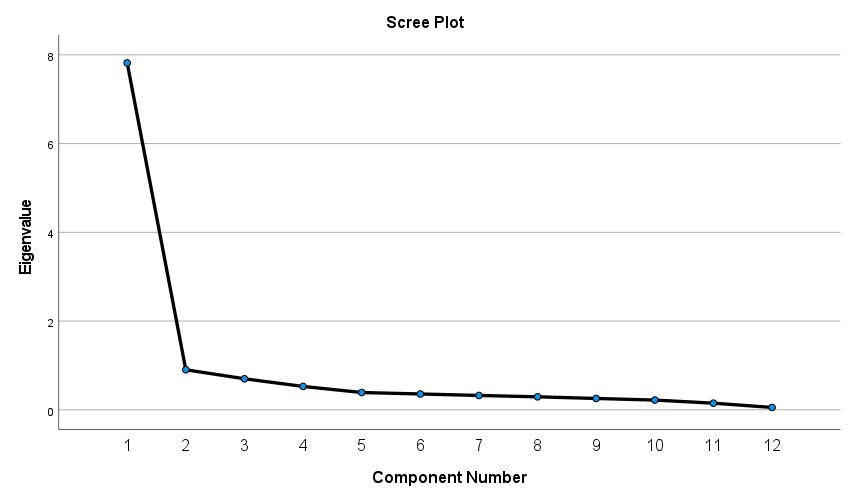 Fig. 1.
Scree plot by IBM SPSS 27.
| Item - Total Statistics | |||||
| Scale Mean if Item Deleted | Scale Variance if Item Deleted | Corrected Item-Total Correlation | Squared Multiple Correlation | C | |
| OPW_2 | 40.80 | 82.315 | 0.810 | 0.699 | 0.945 |
| OPW_3 | 40.67 | 83.724 | 0.747 | 0.642 | 0.947 |
| OPW_4 | 40.92 | 82.853 | 0.794 | 0.774 | 0.946 |
| OPW_5 | 40.98 | 83.610 | 0.716 | 0.693 | 0.948 |
| OPW_6* | 41.03 | 81.367 | 0.750 | 0.607 | 0.947 |
| OPW_7 | 40.91 | 82.094 | 0.759 | 0.632 | 0.947 |
| OPW_8 | 41.04 | 81.760 | 0.756 | 0.651 | 0.947 |
| OPW_9 | 40.56 | 84.561 | 0.717 | 0.608 | 0.948 |
| OPW_10 | 40.78 | 81.265 | 0.790 | 0.659 | 0.946 |
| OPW_11* | 40.61 | 83.472 | 0.723 | 0.577 | 0.948 |
| OPW_15 | 40.95 | 80.014 | 0.804 | 0.893 | 0.945 |
| OPW_16 | 40.97 | 80.161 | 0.824 | 0.907 | 0.945 |
OPW, Organizational Practical Wisdom.
* Items removed after the CFA.
The EFA unfolds a unidimensional scale with 12 items, following the recommendation of Hair et al. (2019a) in regarding of using at least four items. Therefore, following the instrument purification with the Exploratory Factor Analysis, we proceed with a Confirmatory Factor Analysis to examine the scale validity, reliability, and latent structure.
We performed a Confirmatory Factor Analysis (CFA) using Consistent PLS-SEM (via PLSc-SEM) of the 12 items using the SmartPLS (version 4.1.0.6; SmartPLS GmbH; Bonningstedt, Schleswig-Holstein, Germany) software (Ringle et al, 2024), with a sample of 157 answers from English speakers, above the 150 that would fit the criteria (Hair et al., 2009). The CFA adjusts the scale parameters and the factors that emerged from the EFA. PLS-SEM (via PLSc-SEM) estimations of common factor models is a method to confirm the theory and test the model structure (Ringle et al, 2024). We conducted the CFA by repeating the construct Organizational Phronesis Wisdom (OPW), which is OPW_F. Therefore, they are equal. We replaced all the missing values by means of nearby points (Hair et al., 2009).
The respondents are from 39 countries. The majority (50.3%) were between 18–29 years old. Most had higher education, with 29.8% holding a master’s degree. The largest group (31.7%) were Austrian nationals, followed by Malaysians (11.8%). Regarding employment, 62.7% worked in the services industry—55.3% in companies with over 250 employees. Company revenue varied, with the largest group (26.1%) reporting annual revenue of more than 50 million, followed by 18.6% in the 10–50 million range. Notably, 16.8% worked for non-profit organizations. Austria was the most common company location at 44.7%, followed by Indonesia at 8.1%. Regarding work conditions, 42.9% worked on-site, while 31.1% worked from home. The sample represents young and diverse educated professionals across various industries and countries.
We removed OPW 6 and OPW 12 because their outer loadings were below 0.708. Most
of the VIFs values were lower than three, and all were lower than five (see Fig. 2 and Table 5), meeting the criteria (Hair et al., 2019a). The analysis
provided a Composite Reliability (CR – rho_a) of 0.929 and CR_rho_C of 0.928;
Cronbach’s Alpha (C
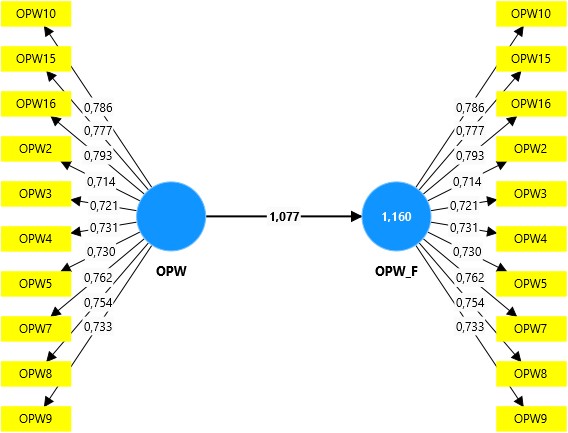 Fig. 2.
Confirmatory Factor Analysis using Consistent PLS-SEM by Smart PLS. OPW, Organizational Practical Wisdom; OPW_F, Organizational Practical Wisdom – Factor. Commas are used as decimal separators (e.g., 0,7986 = 0.7986).
| Constructs and final affirmatives | Outer loadings | VIF | |
| OPW_2 | The company’s actions are weighted. | 0.714 | 2.122 |
| OPW_3 | This company can adapt to changes and instabilities in the environment. | 0.721 | 2.506 |
| OPW_4 | The company’s actions are efficient. | 0.731 | 2.881 |
| OPW_5 | The company’s actions are effective. | 0.730 | 3.052 |
| OPW_6 | In this company the leader is wise. * | 0.650 | 2.266 |
| OPW_7 | People can effectively choose and apply the appropriate knowledge in a given situation. | 0.762 | 2.395 |
| OPW_8 | People reflect on their actions and mistakes. | 0.754 | 2.359 |
| OPW_9 | People believe that learning is important. | 0.733 | 2.297 |
| OPW_10 | The company’s acting reflects its mission and values. | 0.786 | 2.766 |
| OPW_11 | People take attitudes based on their beliefs and values. * | 0.630 | 1.860 |
| OPW_15 | There is an understanding of the moral and ethical expectations of stakeholders (members, customers, suppliers, partners, and others). | 0.777 | 3.498 |
| OPW_16 | There is a response to the moral and ethical expectations of stakeholders (members, customers, suppliers, partners, and others). | 0.793 | 4.048 |
OPW, Organizational Practical Wisdom.
* Excluded variables after the CFA.
| Cronbach’s alpha | Composite reliability (rho_a) | Composite reliability (rho_c) | Average variance extracted (AVE) | |
| OPW | 0.928 | 0.929 | 0.928 | 0.564 |
| OPW_F | 0.928 | 0.929 | 0.928 | 0.564 |
OPW, Organizational Practical Wisdom.
OPW_F, Organizational Practical Wisdom – Factor.
In addition, Table 6 displays the Average Variance Extracted (AVE) of 0.564,
which also meets the guidelines (
To assess the measurement invariance (Table 7) between the two groups of respondents, Portuguese and English speakers, we conducted a Measurement Invariance of Composite Models (MICOM) analysis following the three steps recommended by Henseler et al. (2016). We selected 5000 permutations, maintaining the other settings by default. The first step, configural invariance, automatically fits the quality criteria by SmartPLS using identical indicators, algorithm settings/criteria, and treatment. The second step, compositional invariance, also met the quality criteria once the original correlation was greater than 5% quantile. The third step, (a) equally mean values and (b) variance, likewise complies with quality criteria because the results of the mean original difference and variance original difference are within the 95% confidence interval, and the p-value is above 0.05 (Henseler et al., 2016). Thus, the measurement invariance outcomes offered by MICOM analysis (see Table 7) support the full invariance of the scale between the groups, i.e., Portuguese speakers and English speakers. In other words, there is no significant difference between the two groups. Accordingly, the final instrument in the two languages has ten items (Appendix Table 8).
| MICOM | ||||||
| Original correlation | Correlation permutation mean | 5.0% | Permutation p-value | |||
| Step 2 | OPW | 1.000 | 1.000 | 1.000 | 0.869 | |
| OPW_F | 1.000 | 1.000 | 1.000 | 0.869 | ||
| Original difference | Permutation mean difference | 2.5% | 97.5% | Permutation p-value | ||
| Step 3 (mean) | OPW | 0.002 | 0.002 | –0.207 | 0.209 | 0.989 |
| OPW_F | 0.002 | 0.002 | –0.207 | 0.209 | 0.989 | |
| Step 3 (variance) | OPW | –0.084 | –0.004 | –0.378 | 0.356 | 0.659 |
| OPW_F | –0.084 | –0.004 | –0.378 | 0.356 | 0.659 | |
OPW, Organizational Practical Wisdom.
OPW_F, Organizational Practical Wisdom – Factor.
The Organizational Practical Wisdom Scale (OPWS) developed in this study offers a nuanced lens through which to examine the manifestation of phronesis in organizational settings. The final 10-item scale reflects key aspects of organizational practical wisdom as conceptualized in recent literature while revealing divergences from theoretical expectations.
The scale’s items collectively address the multifaceted nature of practical wisdom, encompassing elements of knowledge application, ethical consideration, and adaptive action. For instance, the item “People can effectively choose and apply the appropriate knowledge in a given situation” aligns with Bierly et al.’s (2000) definition of organizational wisdom as the ability to select and apply specific knowledge in context. This also resonates with Rowley’s (2006) emphasis on the capacity to put appropriate knowledge into action.
The inclusion of items related to understanding and responding to stakeholder expectations (e.g., “There is an understanding of the moral and ethical expectations of stakeholders”) reflects the ethical dimension of practical wisdom emphasized by scholars such as Nonaka and Takeuchi (2021a) and Sasse-Werhahn et al. (2020). This aligns with the view that phronetic organizations must balance multiple stakeholder interests and contribute to the common good.
The scale’s focus on adaptability, as seen in the item “This company can adapt to changes and instabilities in the environment”, echoes recent discussions about the role of practical wisdom in navigating uncertain and complex business environments (Intezari et al., 2018; Rocha et al., 2022). This adaptability aspect links closely with the concept of organizational learning, which is central to many conceptualizations of organizational wisdom (Rowley and Gibbs, 2008).
Interestingly, while the literature strongly emphasizes the role of leadership in fostering organizational practical wisdom (e.g., McKenna and Rooney, 2019; Nonaka and Takeuchi, 2011), leadership-specific items did not emerge as strongly in our empirical analysis. This suggests that employees may perceive practical wisdom as more diffused throughout the organization rather than centralized in leadership, potentially indicating a gap between theoretical conceptualizations and lived organizational experiences.
The items related to the efficiency and effectiveness of organizational actions (e.g., “The company’s actions are efficient”) align with North and Pöschl’s (2003) definition of organizational wisdom, which emphasizes the ability to resolve problems and carry out tasks efficiently and effectively. This practical, action-oriented aspect of the scale grounds the more abstract concepts of wisdom in tangible organizational outcomes.
While perhaps surprising, given the multifaceted nature of practical wisdom described in the literature, the scale’s unidimensional structure suggests that these various aspects may be more tightly integrated in organizational settings than previously theorized. This could reflect Nonaka and Takeuchi’s (2019) view of practical wisdom as a holistic capability integrating knowledge, ethics, and action.
Overall, the OPWS captures many key elements of organizational practical wisdom as conceptualized in recent literature. However, its unidimensional structure and the relative de-emphasis of leadership-specific items suggest that the lived experience of organizational practical wisdom may differ in some ways from theoretical conceptualizations. Thus, this scale provides a valuable tool for assessing practical organizational wisdom and offers insights that may help refine our understanding of how phronesis manifests in organizational contexts.
Our research addresses the recent call for empirical investigations into practical wisdom in organizational contexts (Jakubik and Müürsepp, 2022; Rocha et al., 2022; Kragulj, 2023; Serenko, 2024), moving beyond conceptual discussions to provide a concrete, measurable construct. The findings of this study offer several novel insights into the nature and measurement of organizational practical wisdom, contributing to the ongoing dialogue in the knowledge management literature. The instrument is valuable for monitoring and evaluating one’s perception of organizational change toward a practically wise organization. Leaders will be able to identify what parts of the organization need to adapt to become more practically wise. In addition, it allows for assessing if there is a (long-term) orientation to stakeholder expectations (Nonaka and Takeuchi, 2021a; Sasse-Werhahn et al., 2020).
Our findings resonate with Bratianu and Bejinaru’s (2019a; 2019b) thermodynamics approach to knowledge dynamics. Just as they conceptualize knowledge as a field that can be transformed, our results indicate that practical wisdom involves the dynamic integration and application of different knowledge. The items in our scale that address reflection, learning from experience, and adapting to change support this view of knowledge as dynamic and transformable. This perspective extends beyond traditional knowledge management approaches, often focusing primarily on explicit, codifiable knowledge (Bratianu, 2015).
The emphasis on social sustainability in our scale represents another unique contribution. While previous literature has touched on the ethical dimensions of practical wisdom (Steyl, 2020), our study explicitly links phronesis to broader societal impacts. This connection between organizational wisdom and social responsibility addresses a gap in the literature and responds to calls for more sustainable and responsible management practices (Ding et al., 2019; Basu and Palazzo, 2008; Flammer, 2013). Likewise, the items in our scale that address navigating complex environments and considering multiple perspectives speak to practical wisdom’s context-dependent nature, echoing literature discussions (Intezari et al., 2018).
Including integrative thinking and dealing with complexity in our scale aligns with recent discussions in the literature about the role of practical wisdom in navigating uncertain and ambiguous business environments (Intezari and Pauleen, 2017; Rocha et al., 2022). Moreover, our study goes further by providing an instrument to measure these capabilities within organizations.
Based on a three-stage methodological approach, our research introduces a comprehensive conceptualization of organizational practical wisdom that draws on a knowledge management and organizational learning perspective. The multidimensional conceptualization points to levers for increasing the practical wisdom of organizations, which can have remarkable social implications regarding increasing shared value creation, social innovation, common good, performance, and sustainability.
Moreover, our research pioneers the systematic measurement of one’s perception of organizational phronesis. It provides a validated scale for measuring practical wisdom at the organizational level, which can be used to assess how employees and other stakeholders perceive the practical wisdom of the organization. The proposed Organizational Practical Wisdom Scale (OPWS) is an instrument for this purpose. It fills a gap in organizational wisdom literature under the lens of knowledge management and organizational learning. Accordingly, the study’s main contribution is validating this ten-item bilingual scale of organizational phronesis. Correspondingly, we expect this instrument to support the intensification of experiential research on organizational phronesis and, consequently, the consolidation of this growing field.
This study offers practical contributions because it operationalizes the construct at the organizational level. Thus, it is relevant for transforming companies into practically wise companies, allowing managers to evaluate (I) the aspects that require more awareness and continuous monitoring to support their strategies towards a phronetic company and (II) employees’ perceptions about organizational phronesis. Overall, our scale opens new possibilities for research on organizational phronesis. It points to levers that managers can actively use as instruments to shape their organizations toward sustainable and responsible business practices.
Regardless of the novel contributions of the research for providing a reliable and valid scale of organizational phronesis, it has limitations that may guide further research. First, the OPWS is a cross-cultural self-reported methodology. Accordingly, cultural bias is another front for future research. Second, the OPWS is unable to grasp the temporal characteristics of organizational phronesis. We suggest longitudinal case studies to assess organizational practical wisdom’s temporal features properly. Likewise, future research should test nomological validity. Although academics have researched various constructs related to organizational phronesis, the effect of organizational spirituality remains a gap in the literature. Then, we suggest using related constructs such as knowledge management and organizational spirituality.
Additionally, we propose research on unlearning, psychological traits, and emotions in the workplace as predictors of organizational phronesis. Also, concerning organizational phronesis as a predictor of sustainability, social innovation, and entrepreneurship. These related constructs might create a richer construct network. Moreover, other constructs, such as reflexivity, overlap with phronesis. Thus, further studies should approach and develop a debate regarding reflexive organizations and the social and ecological impacts of values and knowledge. Furthermore, our scale does not cover political theory aspects of phronesis, which should be addressed in future research.
Finally, researchers may further develop our scale by adding other dimensions and items depending on specific and complex research contexts. For example, combining qualitative methods with our scale will enrich the research about organizational phronesis, allowing an understanding of how each feature connects to others in specific environments. Similarly, practitioners can use it in experiments concerning organizational phronesis’s practical effects on different cultures and industries.
All data reported in this paper will be shared by the corresponding author upon reasonable request.
RR: performed and designed the research; PP: supervised and designed the research; MJD: supervised the data analysis and interpretation of data for the work; FK: acquired data and drafted the manuscript. All authors contributed to critical revision of the manuscript for important intellectual content. All authors read and approved the final manuscript. All authors have participated sufficiently in the work and agreed to be accountable for all aspects of the work.
We sincerely thank the two anonymous reviewers for their invaluable feedback and guidance in refining this manuscript.
NECE and this work are supported by FCT - Fundação para a Ciência e Tecnologia, I.P. by project reference UIDB/04630/2020 and DOI identifier 10.54499/UIDP/04630/2020. The first author also received funding from a Santander Totta scholarship.
The authors declare no conflict of interest.
See Table 8.
| Organizational Phronesis Scale | Escala de Sabedoria Prática Organizacional |
| Please answer the survey based on what is the situation in your company. Please be as honest as possible and remember that your answers will remain strictly anonymous. | Por favor, responda ao questionário tendo por base o que sucede na sua empresa. Por favor, seja o mais sincero possível e lembre-se que suas respostas permanecerão estritamente anônimas. |
| 1 - I completely disagree | 1 - Discordo completamente |
| 2 - I disagree | 2 - Discordo |
| 3 - I neither agree nor disagree | 3 - Não concordo nem discordo |
| 4 - I agree | 4 - Concordo |
| 5 - I completely agree | 5 - Concordo completamente |
| The company’s actions are weighted. | As ações da empresa são ponderadas. |
| This company can adapt to changes and instabilities in the environment. | Esta empresa consegue se adaptar a mudanças e instabilidades no ambiente. |
| The company’s actions are efficient. | As ações da empresa são eficientes. |
| The company’s actions are effective. | As ações da empresa são eficazes. |
| People can effectively choose and apply the appropriate knowledge in a given situation. | Nesta empresa, as pessoas conseguem efetivamente escolher e aplicar o conhecimento adequado em uma determinada situação. |
| People reflect on their actions and mistakes. | Nesta empresa, as pessoas refletem sobre suas ações e erros. |
| People believe that learning is important. | Nesta empresa, as pessoas acreditam que a aprendizagem é importante. |
| The company’s acting reflects its mission and values. | Os atos da empresa refletem a sua missão e valores. |
| There is an understanding of the moral and ethical expectations of stakeholders (members, customers, suppliers, partners, and others). | Nesta empresa, há uma compreensão das expectativas morais e éticas que lhes são apresentadas pelas partes interessadas (membros, clientes, fornecedores, parceiros e outros). |
| There is a response to the moral and ethical expectations of stakeholders (members, customers, suppliers, partners, and others). | Nesta empresa, há uma resposta às expectativas morais e éticas que lhes são apresentadas pelas partes interessadas (membros, clientes, fornecedores, parceiros e outros). |
References
Publisher’s Note: IMR Press stays neutral with regard to jurisdictional claims in published maps and institutional affiliations.