


1 Department of Business Administration, Helmut Schmidt University, 22043 Hamburg, Germany
Abstract
This study examines whether subtypes of prosocial motivation can mediate the effects of relational aspects of work design on the willingness to share knowledge. A 3-level model was developed to test whether principlism-based and collectivism-based prosocial motivation act as mediators, and data were collected from three companies. Based on the collected data, a Partial Least Squares (PLS) structural equation model was estimated, and a mediation analysis was conducted. The results show that collectivism-based prosocial motivation mediates the influence of social support and initiated task interdependence on the willingness to share knowledge. Principlism-based prosocial motivation, although not a mediator, also has a significant positive effect on the willingness to share knowledge. These results indicate that workplaces should be designed to emphasize social support and, at least partly, to foster initiated task interdependence. Furthermore, recommendations are provided on how workplaces and organisational culture can be designed to stimulate collectivism-based and principlism-based prosocial motivation, thereby promoting knowledge sharing within organisations. The study contributes to answering the previously unanswered call for research to investigate the influence of relational aspects of work design on motivation and knowledge sharing, considering reciprocity and feelings of obligation. The findings suggest that integrating subtypes of prosocial motivation as mediators between relational aspects of work design and knowledge sharing is a successful approach to addressing this research gap.
Keywords
- knowledge sharing
- work design
- prosocial motivation
- principlism
- collectivism
In recent years, trends such as digitalisation and remote working, accelerated by the COVID-19 pandemic, have changed working life (Knight et al, 2023; Parker and Grote, 2022). Collaboration tools such as Slack and Google Drive (Walker and Lloyd-Walker, 2019), shared data repositories such as SharePoint, Google Drive, and Dropbox (Da Silva and Chaves, 2021), and tools for videoconferencing such as Zoom and Webex (Laybats and Tredinnick, 2019) are increasingly being used in organisations to enable the exchange of knowledge even over long distances. For employees, these changes have led to advantages such as greater flexibility and time savings due to reduced or eliminated commuting (Nakrošienė et al, 2019; Tremblay and Thomsin, 2012), but also to disadvantages such as isolation from colleagues (D’Oliveira and Persico, 2023), which in turn can lead to loneliness (Hawkley and Cacioppo, 2010). The changed working environment also makes it more difficult for employees to share knowledge to the extent they are used to. This is because face-to-face communication has a positive effect on knowledge sharing (Tan, 2016); however, employees have fewer opportunities to communicate face-to-face. Consequently, organisations face disadvantages resulting from a reduced exchange of knowledge, as knowledge sharing is relevant for the intellectual capital (Allameh, 2018), innovative ability (Berraies, 2020; Thompson and Heron, 2006), and financial performance of organisations (Wang and Wang, 2012).
For organisations to remain competitive, it is therefore important for them to know how work can be designed in such a way that good conditions are created for their employees to share knowledge, even in work situations characterised by physical distance. For this reason, the question of how individuals can be motivated to share knowledge challenges organisations and engages researchers (Liang et al, 2008). The results of numerous explored knowledge-sharing models, which include different types of motivation, show that motivation is a key factor in knowledge sharing (Lin and Lo, 2015; Nguyen and Malik, 2020; Stenius et al, 2016).
Prosocial motivation (Hu and Liden, 2015; Kim and Kim, 2021; Liao et al, 2022; Sun et al, 2021) and behaviour (Rodriguez-Montoya et al, 2021; Wan et al, 2021; Xia et al, 2021) have received increasing research attention in recent years. In this context, prosocial motivation is a key influencing factor for prosocial acts, which also include knowledge sharing (Bolino and Grant, 2016). Nevertheless, prosocial motivation has so far been considered in very few knowledge-sharing models (Göhler et al, 2023; Pian et al, 2019; Xia and Yang, 2020).
The increasing number of scientific articles addressing work design published in management and psychology journals (Parker et al, 2017) indicates its increasing relevance in organisations. In recent years, numerous researchers have focussed specifically on relational aspects of work design (Grant, 2007; Grant, 2008a; Grant and Parker, 2009; Knight et al, 2022). According to Grant and Parker (2009), considering relational and proactive aspects can contribute to new insights into the research field of work design. They list literature that indicates that relational aspects such as social support and constructive feedback can generate prosocial motivation. Foss et al. (2009) examine the influence of work design aspects from Hackman and Oldham’s ‘Job Characteristic Model’ (Hackman et al, 2005; Oldham and Hackman, 2005) on selected types of motivation in self-determination theory (Ryan and Deci, 2020) and their impact on knowledge sharing. They call for future research on the influence of relational aspects of work design on motivation and knowledge sharing. They also explicitly point out that reciprocity and feelings of obligation should be considered forms of motivation in this context. However, this has not yet been investigated in the research literature.
According to Batson (2022; 2008) principlism and collectivism are among the four main motives for prosocial behaviour, along with altruism and egoism. Prosocial motivation, in turn, is an important antecedent of prosocial acts, which include knowledge sharing (Bolino and Grant, 2016). This study builds on this line of thought in order to heed the aforementioned call by Foss et al. (2009) to investigate the influence of relational aspects of work design on motivation and knowledge sharing, considering reciprocity and feelings of obligation. To close this research gap and conceptually advance established theories, this study integrates collectivism- and principlism-based subtypes of prosocial motivation into a research model. What these two types of motivation have in common is that they motivate people to take actions that benefit the well-being of others. However, the core motive in collectivism-based prosocial motivation is that a person or group is motivated to perform acts oriented toward reciprocity norms that benefit the collective to which they belong. If, on the other hand, prosocial motivation is based on principlism, the core motive driving prosocial acts is to act obligingly in accordance with internalised values.
As in Foss et al. (2009), the research model comprises three levels: work design, motivational types, and knowledge sharing. However, adhering to the research call, the model differs from that of Foss et al. (2009) in terms of the selection of constructs at the lowest and middle levels. At the lowest level, relational aspects of work design are integrated. To ensure that the selection of the relational aspects is based on a solid foundation, it is oriented toward Morgeson and Humphrey’s (2006) Work Design Questionnaire (WDQ). The constructs social support, initiated task interdependence, contact with beneficiaries of work, and constructive feedback represent the relational aspects of work design and are included at the lowest model level. Collectivism- and principlism-based prosocial motivation serve as mediators at the middle level of the research model, as a link between the lower level of relational aspects of work design and the upper level of knowledge sharing.
The modelling approach chosen to pursue the unanswered research call by Foss et al. (2009) simultaneously allows a research contribution to be made regarding another research question, namely, whether subtypes of prosocial motivation mediate the effects of relational aspects of work design on the willingness to share knowledge. Currently, no model in the literature addresses this question.
The remainder of this paper is organised as follows. The second section presents the theory behind the three levels of the research model. This is followed by the presentation of the study’s hypotheses and methodology. Subsequently, the results of the study are presented and discussed. The research contributions are listed in the ‘Theoretical Contributions’ section. Moreover, in the ‘Managerial Implications’ section, I provide recommendations for acts by organisations for shaping relational aspects at work, as well as for promoting the generation of prosocial motivation and an organisational culture conducive to knowledge sharing. Finally, the limitations of the research and possible future research directions are discussed, and the main contributions of this study are summarised.
Work design is gaining importance due to the digitalisation of work processes and communication, a development accelerated by the COVID-19 pandemic (Knight et al, 2023; Parker and Grote, 2020; Parker and Grote, 2022). According to Parker (2014), research shows that it is possible to design motivating work that has a positive impact on the employees of organisations and the organisations themselves. Understanding work design enables organisations to promote employee well-being and performance, thereby reducing the costs associated with high levels of illness (Knight et al, 2022).
It is therefore worthwhile for organisations to improve work design. According to Knight and Parker (2021), various work redesign interventions offer the opportunity to achieve this; these include job enrichment and enlargement, as well as conducting relational interventions and system-wide changes. A meta-study showed that the majority of work redesign interventions examined either had a direct positive effect on employee performance or an indirect effect via motivation. In this context, they described motivation as a key factor. The meta-analysis also showed that a particularly large number of high-quality studies demonstrated the positive impact of relational interventions pertaining to work design on performance. Knight and Parker (2021) also included contributions to teamwork in employee performance. It is quite conceivable that there could also be a connection between work redesign interventions and knowledge sharing via subtypes of prosocial motivation, as knowledge sharing also contributes to teamwork. There are arguments in the literature in favour of relational aspects of work design having a positive effect on prosocial motivation. For example, Grant and Parker (2009) discuss clues that suggest that social support, interactions outside the organisation, and task interdependence could generate prosocial motivation. Regarding the intersection between relational aspects of work design and subtypes of prosocial motivation in the model described in the Introduction, there are currently no research models in the literature that examine this intersection; only the effects of individual factors similar to relational aspects of work design on prosocial motivation have been investigated (Castanheira et al, 2016; Grant, 2007; Grant, 2008a).
The selection of relational aspects of work design in the research model of this study is based on Morgeson and Humphrey’s (2006) WDQ. In recent years, the development of the WDQ has become one of the most important publications in the field of work design (Parker et al, 2017). The four measurement scales of the social characteristics section of the WDQ are as follows: ‘Social Support’, ‘Interdependence’, ‘Interaction Outside Organisation’, and ‘Feedback from Others’. To measure the hypotheses outlined in the Section Development of Hypotheses in a valid way and integrate the constructs into the 3-level model for examining the research call by Foss et al. (2009), adjustments must be made, as described later in the Section Measures.
Prosocially motivated individuals desire to support others or act out of concern for others (Batson, 1987; Bolino and Grant, 2016; Grant, 2008b). This action costs the self, such as waiting in line or paying fair prices. Because belonging to a group offers many benefits, people often act prosocially despite these costs (Twenge et al, 2007). In the context of work design, prosocial motivation is essential, for example, because of the tendency for greater distances to be overcome between employees as a result of the consequences of digitalisation, such as working from home and teleworking. Employees often must make greater efforts to share their knowledge. Instead of answering questions from a colleague at a neighbouring desk, in the adjacent office, or during a lunch break in person, one must resort to taking a phone call, writing a message, or conducting a video conference. Therefore, prosocial motivation is required to make this additional effort.
In a meta-analysis, Liao et al. (2022) analysed the influence of prosocial motivation on psychological, behavioural, performance, and career-related work outcomes. Their findings suggested that prosocial motivation tends to have a positive impact on employee well-being, prosocial behaviour, performance, and career success. These research findings indicate that the presence of prosocial motivation enables organisations to reap many benefits.
According to Batson (2022; 2008), there are four main motives for prosocial behaviour: altruism, egoism, collectivism, and principlism. If prosocial motivation is based on collectivism, for instance, there is a motivation to act prosocially in favour of a collective to which one belongs and whose members usually support each other reciprocally. If prosocial motivation is based on principlism, for example, there is a motivation to act prosocially to meet internalised values (Batson et al, 2008; Batson et al, 2011). Organisations can use the four motives listed by Batson (2022) (altruism, egoism, collectivism, and principlism) to generate prosocial motivation. According to the empathy-altruism hypothesis, empathising with another person’s situation fosters altruism (Batson, 1987; Batson, 2017; Nakagawa and Kosaka, 2022). Organisations can therefore attempt to shape work design in such a way that employees become aware of their colleagues’ need for support. Organisations can also use the motive of egoism, for example, by making use of reciprocity norms (Göbel et al, 2007; Törrönen, 2018) in designing work processes such that employees can build reciprocity credit with their colleagues through prosocial acts, from which they are highly likely to benefit at a later point in time through reciprocal compensation (Batson et al, 2008; Blau, 2008). The warm glow—that is, the joy experienced in helping (Erlandsson et al, 2016; Ferguson et al, 2012; Lilley and Slonim, 2014)—is another egoistic motive for prosocial behaviour. Organisations can consider this and design work processes in such a way that employees have the opportunity to experience pleasure by observing the positive effects of their social acts.
Regarding the intersection between the two subtypes of prosocial motivation integrated in the research model, on the one hand, and knowledge sharing on the other, there is supporting literature that the two types of prosocial motivation could have a significant positive effect on the willingness to share knowledge. Currently, there are no models in the literature that analyse the effects of prosocial motivation subtypes on knowledge sharing. However, some models consider the effects of prosocial motivation on knowledge sharing or hiding. For instance, prosocial motivation has been found to negatively affect knowledge hiding (Babič et al, 2018; Babič et al, 2019; Cerne et al, 2015). Moreover, early models (Göhler et al, 2023; Pian et al, 2019; Xia and Yang, 2020) have examined the influence of prosocial motivation on knowledge sharing and found a significant positive influence. This suggests that the subtypes of prosocial motivation integrated into the present study’s research model may also positively influence knowledge sharing.
Knowledge is a resource that can be used strategically by organisations (Ferreira et al, 2020) and appears to play a key role in value creation (Del Giudice et al, 2017). Knowledge sharing within organisations creates competitive advantages by reducing redundancy and innovation costs, as well as fostering creativity (Nguyen, 2021). It has also been shown that knowledge sharing between individual organisations is rewarding. For example, knowledge sharing between the management of different organisations leads to new ideas, partnerships, new products, and opportunities through the joint start-up of companies (Steffen et al, 2017).
Organisations can use four types of influencing factors to promote knowledge sharing: individual, social, technological, and organisational (Nguyen, 2021). For example, organisations can make use of individual factors by creating conditions that allow employees to experience enjoyment and self-efficacy (Zhang et al, 2014) as well as an increase in reputation (Safa and Von Solms, 2016) through knowledge sharing. However, there are also social factors that organisations can take advantage of to promote knowledge sharing, for example, by taking measures that increase trust between employees (Hassandoust et al, 2011; Safa and Von Solms, 2016) or by introducing social norms that value knowledge sharing as being especially positive (Hassandoust et al, 2011; Sun et al, 2014). In addition, organisations can use technological measures through the provision of information and communication technology (ICT) to improve communication and coordination in the process of knowledge sharing (Deng et al, 2023; Tohidinia and Mosakhani, 2010) and ensure the high quality of the systems used for knowledge sharing (Lin, 2011; Tan, 2016). This is particularly important in light of the fact that the trend toward digitalisation means there are fewer opportunities for informal exchanges between employees, and work is therefore often coordinated using information technology instead of face-to-face interactions (Raghuram, 2021). Furthermore, organisational factors can be used to foster knowledge sharing. For example, knowledge sharing can be promoted through reward incentives (Lee et al, 2020), management support (Cavaliere and Lombardi, 2015), appropriate work design (Foss et al, 2009; Llopis and Foss, 2016), and the creation of an organisational culture conducive to knowledge sharing (Azeem et al, 2021). In particular, numerous options are available when creating an organisational culture that is beneficial to knowledge sharing. Organisations can provide physical, virtual, or mental spaces for knowledge sharing according to the ‘Ba’ concept (Nonaka and Takeuchi, 2019), be open to new ideas and continuous learning (Schein and Schein, 2017), strive for an open communication culture (Choo, 1996), or promote trust and empathy (Von Krogh et al, 2000).
Through their studies, some researchers have generated preliminary results on how work design affects knowledge sharing (Foss et al, 2009; Gagné et al, 2019; Jafari Navimipour and Charband, 2016; Llopis and Foss, 2016) and knowledge hiding (Gagné et al, 2019), but without considering prosocial motivation in their models. In particular, only the effects of individual relational aspects of work design on knowledge sharing have been investigated, either without considering prosocial motivation as a mediator (Kaffashan Kakhki et al, 2020; Pee and Lee, 2015), or without considering motivation as a mediator in any form (Appel-Meulenbroek et al, 2017; Liu et al, 2010).
This section hypothesises the assumed mediating effects of subtypes of prosocial motivation in relation to the indirect effect of relational aspects of work design on knowledge sharing (see Fig. 1). The segmentation approach is used, in which the mediation hypotheses are based on both the hypotheses linking the independent variables to the mediator variables and the hypotheses linking the mediator variables to the outcome variable (Memon et al, 2018; Rungtusanatham et al, 2014).
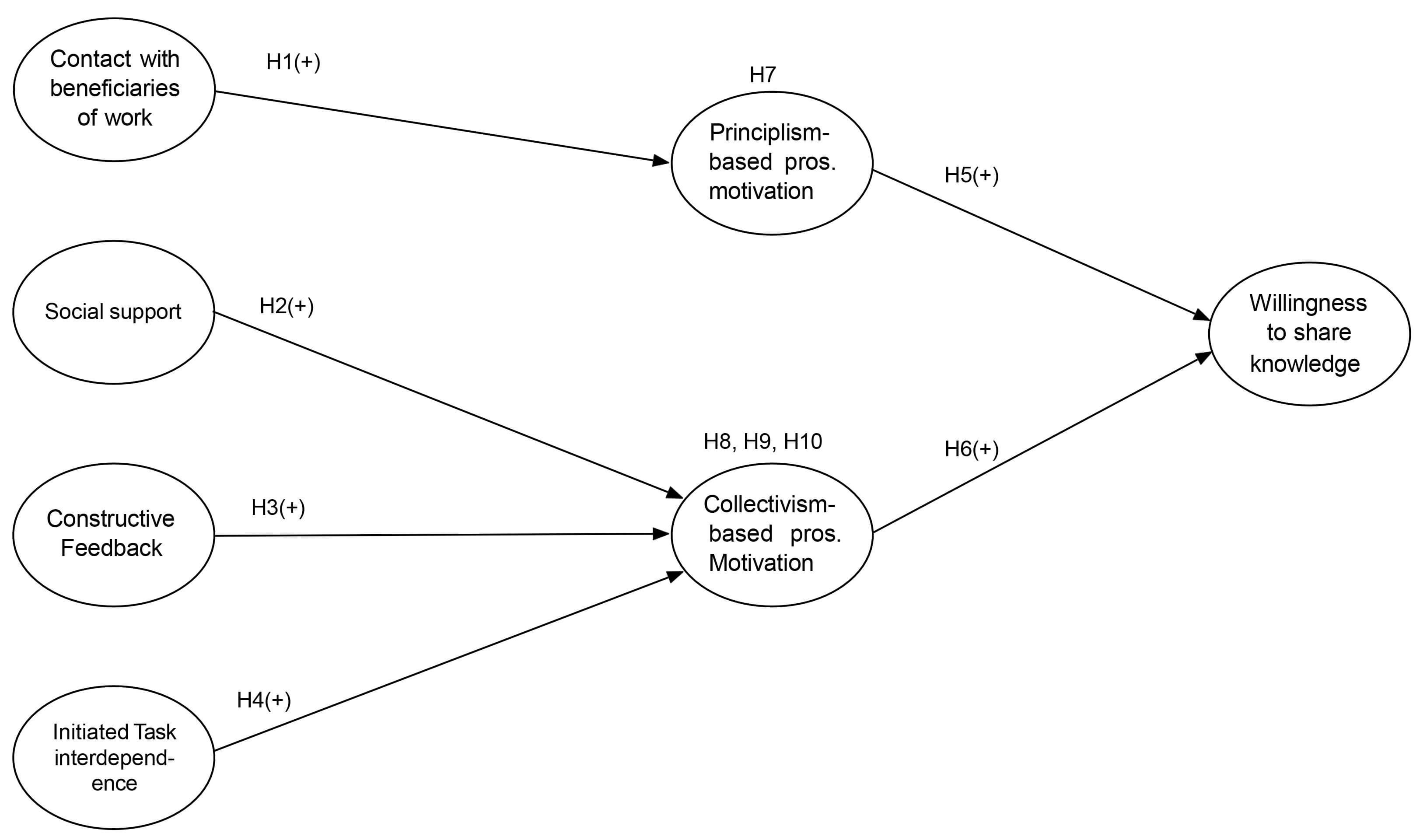 Fig. 1.
Research model.
Contact with the beneficiaries of one’s work improves employees’ persistence and performance (Grant et al, 2007), and allows them to perceive the prosocial effects of their acts (Grant, 2007). According to Turner and Hadas-Halpern (2008), physicians take more time to examine patients’ radiographs when a photograph is included in the patient’s records. They hypothesised that the photos created greater closeness with the patients, which created additional motivation to help. Following this, they considered that the photos had reinforced pre-existing feelings of obligation to help, which are based on internalised norms. Studies also reveal that call centre employees invest more time in conversations to raise funds for students in financially difficult situations if they had previously spent a few minutes talking with students who told them about how the funds they raised had improved their lives (Grant et al, 2007). In addition, research shows that nurses took over 60 per cent more time to pack surgical kits and packed more than twice as many kits when they had contact with beneficiaries of their work (Bellé, 2013; Siciliano and Thompson, 2022). Again, pre-existing feelings of obligation to help may have been reinforced by contact with beneficiaries of work. Direct contact with individuals who benefit from one’s work also increases perceived self-efficacy. An increased perception of the impact of one’s actions is often accompanied by greater responsibility for performing or not performing one’s own actions, and therefore increases the motivation to act prosocially.
H1(+): Contact with beneficiaries of work has a positive effect on principlism-based prosocial motivation.
Social support reflects the extent of opportunities to receive advice and support from colleagues and supervisors in the workplace (Humphrey et al, 2007; Karasek et al, 1982; Morgeson and Humphrey, 2006). Social support acts as a buffer against the harmful effects of work-related stress on employee health, including anxiety and depression (Lu et al, 2023). Research also indicates that it positively affects job satisfaction and performance and reduces the risk of burnout, and role conflict (Humphrey et al, 2007).
According to previous studies, employees are more motivated when they feel that the organisation in which they work cares about their well-being (Imran et al, 2020). As a result of organisational support, employees show a stronger emotional attachment to the organisation, improved performance, a stronger sense of belonging, and fewer withdrawal tendencies (Rhoades and Eisenberger, 2002). Thus, the positive experience of social support from the organisation increases the likelihood that employees will feel more obligated to reciprocate this positive treatment through increased commitment and a stronger sense of belonging. This will likely result in increased helping behaviour among employees within the organisation. This is because increased mutual-helping behaviour among employees also benefits the performance of their respective organisations. It is therefore likely that employees have a self-interest in contributing to the successful survival of their organisation in competition with other organisations through prosocial behaviour such as sharing knowledge. This behaviour contributes to securing the continued existence of the organisation and, thus, of their job, in which they tend to enjoy working because of the social support they receive. Utility-oriented reciprocity norms (Göbel et al, 2007) serve to guide employee behaviour in this context. The type of reciprocity associated with this norm is characterised by the fact that people generally do not want to be indebted to others, but prefer a situation in which others owe them a favour (Blau, 2008). This suggests that when receiving social support in an organisation, people are motivated to act prosocially to avoid being in debt to their colleagues, but at least to create a balance, and thus to be perceived in their social working environment as a prosocial and helpful person. This line of thought is supported by research suggesting that when employees experience perceived organisational support, they are more likely to act in a manner that positively impacts both their organisation and colleagues (Krishnan and Mary, 2012).
H2(+): Social support has a positive effect on collectivism-based prosocial motivation.
Constructive feedback shows ways of identifying gaps in understanding (Fong et al, 2016; Fong et al, 2018) and solving problems (Fong et al, 2018; Hamid and Mahmood, 2010); it has the characteristics of being informative, concrete, reflective, carefully formulated, and supportive (Ovando, 2005). According to Kluger and DeNisi (1996), praise and blame reduce the effectiveness of feedback because they draw the attention of the feedback recipient away from the work task and the learning process, and instead focus it on the self and on processes superior to the work task. By contrast, when feedback is designed to emphasise correct solutions, such as by showing how to eliminate poor solutions, it can improve employee performance (Kluger and DeNisi, 1996) and generate positive feelings, such as hope, for success in completing tasks (Fong et al, 2018). Thus, in this context, constructive feedback helps keep employees’ attention on their tasks while working on them. In turn, this increases the likelihood that the performer consciously values the execution of their tasks. According to Ryan and Deci (2000), consciously valuing an activity generates identified motivation. If an employee identifies with their work tasks, it tends to lead to identification with the organisation, as the organisation provides them with a workplace that enables them to perform these tasks. If there is identification with the organisation, the employee sees themselves as part of a collective. This, in turn, increases the likelihood that the employee will support their colleagues. How a person perceives themselves in relation to a collective identity is a crucial factor in their behaviour towards others (Gaertner et al, 2016). Studies have shown that cooperation and the willingness to share resources within groups are promoted by strong identification and a sense of belonging (Levine et al, 2005; Wakefield et al, 2017). According to Wakefield et al. (2017) “…we tend to provide help and support to members of groups with which we identify, and we tend to receive help and support from them in return…” (p. 786).
H3(+): Constructive feedback has a positive effect on collectivism-based prosocial motivation.
Initiated task interdependence describes the strength of the flow of work from one job to another or to several others, while received task interdependence indicates how a particular job is influenced by one or several other jobs (Berntzen and Wong, 2021; Kiggundu, 1981; Wong and van Gils, 2022). If employees are interdependent in their work processes, they are more likely to consider themselves part of a collective than if their work processes are independent. This increases the likelihood that employees who identify with other employees experiencing similar interdependencies in their work also identify with the organisation, which is characterised, among other things, by its employees and work structure. Therefore, task interdependence could lead employees to identify more strongly with their own organisation. It can be assumed that such identification generates a sense of responsibility toward colleagues, which is associated with collectivism-based prosocial motivation. The research by Levine et al. (2005) and Wakefield et al. (2017), listed in the argumentation chain of H3, is also relevant to the argumentation chain established here for H4. Their research indicates that when people identify with a group, they make their own resources available to a greater extent. According to the chain of reasoning outlined here, task interdependence can lead to greater identification with colleagues and one’s own organisation, which, in turn, can result in more pronounced helping behaviour. For employees whose work processes are characterised by initiated task interdependence, this relationship could be particularly strong, as this form of task interdependence is highly associated with the visibility of others’ dependence on the results of their own work. Research findings suggest that initiated task interdependence increases one’s own work motivation and is associated with feelings of responsibility for the results of the work of others dependent on one’s work, whereas a demotivating effect has been found for received task interdependence (Doerr et al, 2004; Kiggundu, 1981; Taggar and Haines, 2006). These results contribute to the argument that initiated task interdependence generates collectivism-based prosocial motivation.
H4(+): Initiated task interdependence has a positive effect on collectivism-based prosocial motivation.
According to Batson (2022), the main motives for prosocial behaviour are altruism, egoism, principlism, and collectivism, which can exist in parallel or partially in parallel, complement each other, or conflict with each other. There are different viewpoints in the literature as to whether true altruism—that is, acting with the ultimate goal of improving the well-being of another person without deriving any kind of benefit from it oneself—is really possible (Batson, 1987; Batson et al, 2008). According to proponents of altruism, for example, experiencing empathic pleasure in the act of helping is merely an unintended consequence of the act, although not itself the cause of the act (Batson et al, 2011). If prosocial motivation is based on egoism, it will only positively affect the willingness to share knowledge in certain situations. For example, individuals share knowledge to build reciprocity credit or experience pleasant feelings from helping others (Batson et al, 2011). This means that knowledge is shared only when the knowledge provider can expect direct or future benefits from the assistance. However, if prosocial behaviour is based on other motives, the situational dependence of the willingness to share knowledge may be less pronounced than if it is based on egoism (Göhler, 2021).
If helping others is done because it corresponds to acting for ethical reasons or inner beliefs and values, the action is based on principlism (Batson et al, 2008; Grant and Berg, 2011). When prosocial motivation is based on principlism, the situational dependence of a helping act (e.g., sharing knowledge) is likely less pronounced than if egoism is the basis. For example, if a person has internalised the value that helping others is worthwhile, they are more likely to help others or share knowledge in situations in which they do not experience personal benefits from the helping act than is a person whose helping behaviour is based on egoistic motives (Göhler, 2021; Göhler et al, 2023).
H5(+): Principlism-based prosocial motivation has a positive effect on the willingness to share knowledge.
When prosocial motivation is based on collectivism, there is motivation to support the well-being of individuals who belong to the collective to which the helping person belongs (Batson, 2022; Grant and Berg, 2011). In this context, the person being helped belongs to an in-group of the collective. For example, an in-group can represent one’s family (Brewer and Chen, 2007; Triandis et al, 1988), work colleagues (Babič et al, 2019; Brewer and Chen, 2007), an organisation (Alkhadher et al, 2020), or an entire society (Grant and Berg, 2011). If collectivism forms the foundation to help, it is more likely that a person will support another person who is part of the collective without experiencing a direct benefit. This is because the act of helping already serves the goal of contributing to the collective’s well-being. This suggests that, when collectivism-based prosocial motivation is present, there is a more constant, situation-independent willingness to share knowledge than when egoism-based prosocial motivation is present.
H6(+): Collectivism-based prosocial motivation has a positive effect on willingness to share knowledge.
The mediation hypotheses are generated based on the segmentation approach (Rungtusanatham et al, 2014). Here, in the first step, hypotheses directed from the independent variables to the mediator variable are formed. The second step involves forming hypotheses from the mediator variables to the dependent variable in the model. The content of the mediation hypotheses is based on the set of hypotheses formed in the first two steps (Zhou et al, 2011). By applying this approach, the following mediation hypotheses can be created through the combinations of ‘H1 and H5’, ‘H2 and H6’, ‘H3 and H6’, and ‘H4 and H6’:
H7(+): The influence of contact with beneficiaries of work on willingness to share knowledge is mediated by principlism-based prosocial motivation.
H8(+): The influence of social support on willingness to share knowledge is mediated by collectivism-based prosocial motivation.
H9(+): The influence of constructive feedback on willingness to share knowledge is mediated by collectivism-based prosocial motivation.
H10(+): The influence of initiated task interdependence on willingness to share knowledge is mediated by collectivism-based prosocial motivation.
To exclude possible biases that could arise from data collection in a single
organisation, three data collections were conducted to examine the research model
statistically. From 10 May 2019 to 12 June 2019, two surveys were conducted
simultaneously in a consulting company and a recruitment company, both based in
Hamburg. A third data collection was conducted from 26 May 2020 to 3 July 2020 at
the administrative headquarters of a large retail and service company, also based
in Hamburg. Nearly 600 individuals were invited to participate in data collection
via an online link and informed about the research objectives associated with the
survey. No financial compensation was received for participating in the survey. A
total of 103 completed questionnaires were collected. Table 1 presents the
demographic characteristics of the participants. As a maximum of three paths are
directed toward endogenous constructs in the research model (see Fig. 1), a
sample size of at least 10
| Demographic characteristics | Number of persons (Total N = 103) | Percentage | |
| Distribution by age | |||
| 15–25 | 23 | 22.33 | |
| 26–35 | 45 | 43.69 | |
| 36–45 | 23 | 22.33 | |
| 46–55 | 8 | 7.77 | |
| 56–65 | 4 | 3.88 | |
| 66–75 | 0 | 0.00 | |
| 0 | 0.00 | ||
| Distribution by gender | |||
| Female | 57 | 55.34 | |
| Male | 45 | 43.69 | |
| Others | 1 | 0.97 | |
| Distribution by education | |||
| Basic secondary school | 1 | 0.97 | |
| Secondary modern school | 8 | 7.77 | |
| A-levels | 26 | 25.24 | |
| Bachelor’s degree | 27 | 26.21 | |
| Master’s degree | 39 | 37.86 | |
| PhD | 2 | 1.94 | |
| Distribution by staff level | |||
| Employee without leadership position | 80 | 77.67 | |
| Team leader | 12 | 11.65 | |
| Head of department | 3 | 2.91 | |
| Area manager | 4 | 3.88 | |
| Board of management | 4 | 3.88 | |
| Distribution by years at organisation | |||
| 78 | 75.73 | ||
| 5–9 | 9 | 8.74 | |
| 10–14 | 10 | 9.71 | |
| 15–19 | 1 | 0.97 | |
| 20–24 | 1 | 0.97 | |
| 25–29 | 2 | 1.94 | |
| 2 | 1.94 | ||
| Distribution by corporate division | |||
| Case processing | 5 | 4.85 | |
| Marketing | 7 | 6.80 | |
| Sales | 11 | 10.68 | |
| Human Resources | 20 | 19.42 | |
| IT | 22 | 21.36 | |
| Quality assurance | 2 | 1.94 | |
| Customer service | 6 | 5.83 | |
| Finances | 5 | 4.85 | |
| Other division | 25 | 24.27 | |
PhD, philosophiae doctor; IT, information technology.
Smart PLS software (Version: 3.0; SmartPLS GmbH; Bönningstedt, Schleswig-Holstein, Germany) was used to calculate the PLS structural equation model. PLS structural equation models offer numerous advantages such as, among others, that no assumptions must be made about the distribution of the raw data, or a high statistical power, which allows the evaluation of smaller samples, the calculation of complex models, as well as the identification of ‘key driver’ constructs (Hair et al, 2017). Therefore, a PLS structural equation model was an appropriate research tool for testing the mediation hypotheses regarding the subtypes of prosocial motivation integrated into the model.
The inner structural equation model containing the constructs and hypothesised cause-effect relationships is shown in Fig. 1. For the external measurement models associated with the latent variables, this study examined whether each item was reflective or formative. The application of control questions led to the conclusion that the variance of all individual items was generated by the variance of the associated latent variables; therefore, all items and the associated measurement models were reflective. For this reason, evaluation criteria for reflective measurement models were applied. As settings, a maximum number of 300 iterations and a termination criterion of 10-7 were set in ‘Smart PLS 3’, and the path weighting scheme was selected.
The constructs social support and initiated task interdependence developed by Morgeson and Humphrey (2006) were used in a German translated version by Stegmann et al. (2010). For the construct constructive feedback, the items of the construct feedback from others by Morgeson and Humphrey (2006) were adapted to measure only the neutral, solution-orientated, and task-related parts of the feedback, and no feedback components in the form of evaluative praise or rebuke. Instead of the measurement scale interaction outside the organisation from Morgeson and Humphrey (2006), which also comes from the social characteristics section of the WDQ, the scale for the construct contact with beneficiaries of work from Grant (2008b) was chosen in order to be able to validly measure the effect on principlism-based prosocial motivation according to the argumentation of H1. This was done because, according to the argumentation of H1, contact with beneficiaries of work is the essential basis for the generation of principlism-based prosocial motivation, but this aspect is only partially covered by the construct interaction outside the organisation, as it is mingled with the measurement of general contact with other people. Therefore, the items of the scale contact with beneficiaries of work from Grant (2008b) were translated into German. For all translated items, as a check, back-translation was performed by a person whose native language is English, and a comparison was made with the original items. For the constructs principlism-based prosocial motivation and collectivism-based prosocial motivation, the core statements of Grant’s (2008b) items related to improving the well-being of others, or supporting them, were adapted once in the context of a principlism-based cause and once in the context of a collectivism-based cause for prosocial acting. For willingness to share knowledge, items from Bock et al. (2005) were adapted. All constructs were measured using anchored 7-point Likert scales with equidistant intervals, as shown in Table 2.
| Constructs | Source | Number of Items | Items | Identification labels for Items | Factor loading | Cronbach’s alpha | Composite reliability | Average variance extracted (AVE) | |
| Social Support | Morgeson, F. and Humphrey, E. (2006) translated into German by Stegmann, S. et al. (2010) | 4 | I have the opportunity to develop close friendships in my job. | Soc_Supp_1 | 0.512 | 0.720 | 0.824 | 0.546 | |
| My supervisor is concerned about the welfare of the people that work for him/her. | Soc_Supp_1 | 0.752 | |||||||
| People I work with take a personal interest in me. | Soc_Supp_1 | 0.846 | |||||||
| People I work with are friendly. | Soc_Supp_1 | 0.801 | |||||||
| Initiated Task Interdependence | Morgeson, F. and Humphrey, E. (2006) translated into German by Stegmann, S. et al. (2010) | 3 | The job requires me to accomplish my job before others complete their job. | Init_TI_1 | 0.729 | 0.755 | 0.844 | 0.645 | |
| Other jobs depend directly on my job. | Init_TI_2 | 0.874 | |||||||
| Unless my job gets done, other jobs cannot be completed. | Init_TI_3 | 0.800 | |||||||
| Contact with beneficiaries of work | Grant, Adam M. (2008a) translated by Göhler GF | 3 | My job enables me to build close relationships with the people affected by my work. | Cont_Ben_w_1 | 0.937 | 0.913 | 0.939 | 0.837 | |
| My job allows me to form emotional connections with the people who benefit from my work. | Cont_Ben_w_2 | 0.884 | |||||||
| My job gives me the chance to have meaningful communications with the people who benefit from my work. | Cont_Ben_w_3 | 0.922 | |||||||
| Constructive Feedback | Morgeson, F. and Humphrey, E. (2006) adapted by Göhler GF | 3 | My supervisors and coworkers give me information on how to avoid repeating mistakes. | Constr_Feedb_1 | 0.878 | 0.851 | 0.908 | 0.768 | |
| Managers and coworkers give me feedback on how my work performance can be improved. | Constr_Feedb_2 | 0.903 | |||||||
| People from my organisation show me alternative approaches or ways how to master my work tasks. | Constr_Feedb_3 | 0.848 | |||||||
| Principlism-based prosocial motivation | Grant, Adam M. (2008b) adapted by Göhler GF | 3 | I help my coworkers … | … because this corresponds to my inner values. | Principl_b_pm_1 | 0.905 | 0.840 | 0.922 | 0.798 |
| … because coworkers should support each other. | Principl_b_pm_2 | 0.898 | |||||||
| … because it is in line with my principles. | Principl_b_pm_3 | 0.877 | |||||||
| Collectivism-based prosocial motivation | Grant, Adam M. (2008b) adapted by Göhler GF | 4 | I help my coworkers … | … because through improved collaboration the organisation I am working in can better compete with rival organisations. | Coll._b. pM_1 | 0.902 | 0.877 | 0.938 | 0.791 |
| … because this is vital for the success of the work that needs to be done within the organisation. | Coll._b. pM_2 | 0.865 | |||||||
| … to promote the competitiveness of the company where I work. | Coll._b. pM_3 | 0.923 | |||||||
| … so that the work processes within the company run efficiently and smoothly. | Coll._b. pM_4 | 0.867 | |||||||
| Willingness to share knowledge | Bock, G. W. et al. (2005) adapted by Göhler GF | 4 | I am willing to share my knowledge frequently with my coworkers in the future. | Will_KS_1 | 0.937 | 0.933 | 0.953 | 0.835 | |
| Sharing my know-how within the organisation I consider meaningful. | Will_KS_2 | 0.817 | |||||||
| I can well imagine sharing knowledge with my coworkers on a regular basis in the future. | Will_KS_3 | 0.969 | |||||||
| I am ready to share my expertise with other organisational members. | Will_KS_4 | 0.926 | |||||||
To test for common method bias, Harman’s single-factor test (Podsakoff et al, 2003) was performed in the first step. The single-factor solution explained 36.8% of the total variance, which is well below the threshold of 50%. This suggests that the dataset was probably not affected by common method bias. In the second step, a more rigorous full collinearity test, as recommended by Kock (2015), was performed. In none of the calculations did the variance inflation factors exceed 3.3. This result also indicates that the dataset was likely not affected by common method bias.
The Cronbach’s alpha and composite reliability values of all constructs included in the model were greater than 0.7, indicating internal consistency reliability (see Table 2). Except for the item ‘Soc_Supp_1’, all items met the threshold of 0.7 for external loadings required for indicator reliability. The item ‘Soc_Supp_1’ fell below this threshold with a value of 0.512, but was not removed for content validity reasons and because it exceeded the lower threshold of 0.4, as recommended by Hair et al. (2017). All Average Variance Extracted (AVE) values of the constructs were above 0.5; thus, convergent validity was met for all constructs. Discriminant validity was first checked using the Fornell-Larcker criterion (see Table 3). The root of the AVE value of all the constructs was greater than the correlation of the respective constructs with other constructs. Thus, the Fornell-Larcker criterion was fulfilled. In addition, discriminant validity was tested by calculating the heterotrait-monotrait ratio (HTMT). The HTMT values of the 97.5 percentiles of the bootstrapped confidence interval were below the upper limit of 0.9 for all constructs, as required. These results also indicate that discriminant validity was fulfilled for all constructs.
| 1 | 2 | 3 | 4 | 5 | 6 | 7 | |
| Constructive Feedback (1) | 0.876 | ||||||
| Contact with beneficiaries of work (2) | 0.376 | 0.915 | |||||
| Initiated Task Interdepedentence (3) | 0.269 | 0.254 | 0.803 | ||||
| collectivism-based prosocial motivation (4) | 0.298 | 0.339 | 0.280 | 0.889 | |||
| principlism-based prosocial motivation (5) | 0.320 | 0.107 | 0.086 | 0.154 | 0.893 | ||
| Social Support (6) | 0.515 | 0.461 | 0.190 | 0.445 | 0.330 | 0.739 | |
| Willing to share knowledge (7) | 0.350 | 0.203 | 0.162 | 0.255 | 0.305 | 0.454 | 0.914 |
Note. Square root of Average Variance Extracted (AVE) values (in bold) is on the diagonal.
The inner model was verified for possible collinearity. For all path links originating from exogenous constructs, the variance inflation factors (VIF) were not greater than the value 5. This indicates that no collinearity problems were present. Fig. 2 shows the calculated path coefficients and calculated coefficients of determination.
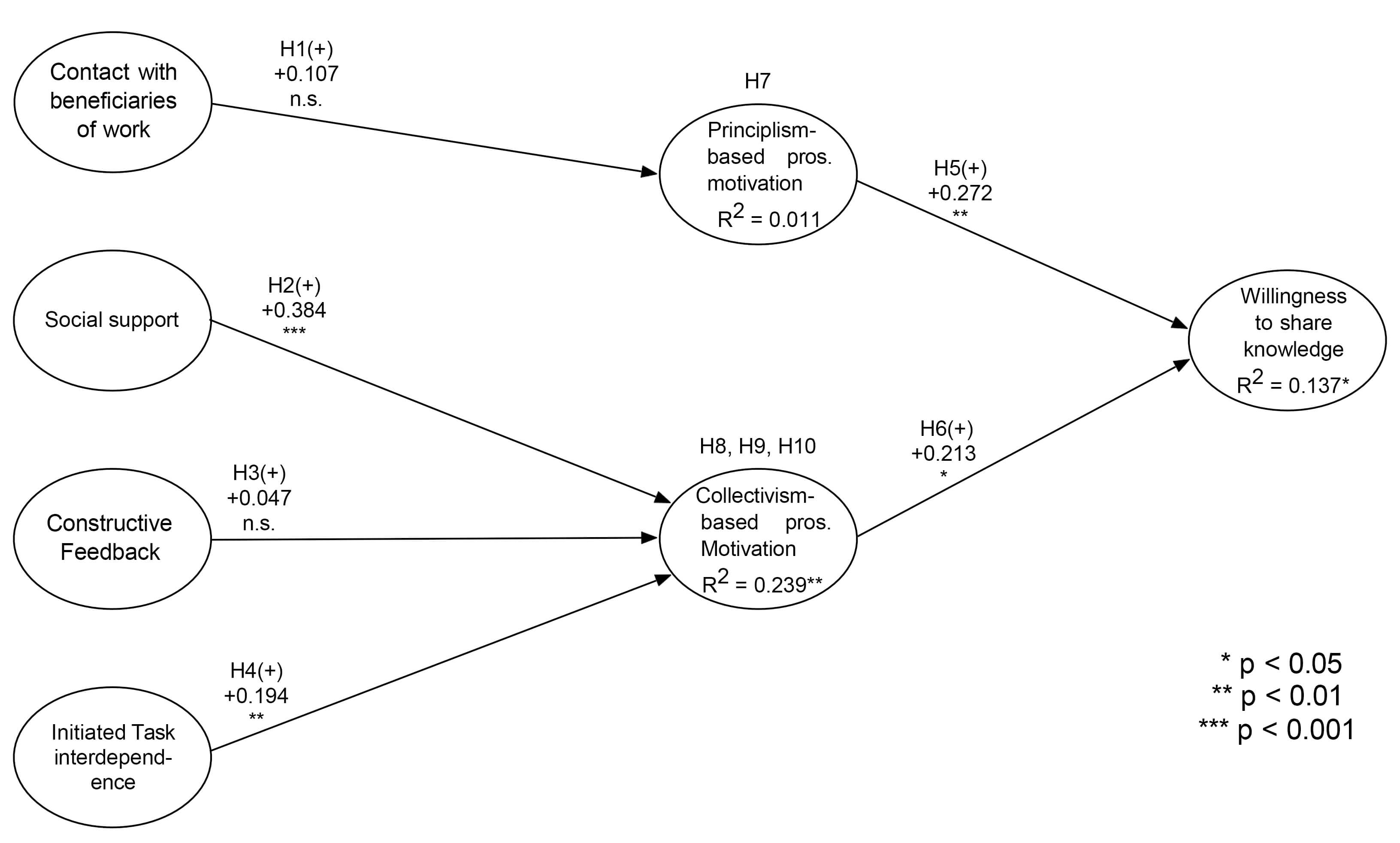 Fig. 2.
Path coefficients and associated significance levels of the research model. n.s., not significant; pros., prosocial.
According to current research, when examining mediation effects, calculating the significance of the indirect effect using bootstrapping is recommended (Hair et al, 2018; Hair et al, 2021; Koschate-Fischer and Schwille, 2022; Preacher and Hayes, 2004; Preacher and Hayes, 2008; Zhao et al, 2010). The calculation results show that the constructs constructive feedback and contact with beneficiaries of work have no significant indirect effect on willingness to share knowledge (see Tables 4,5). Social support had a significant indirect effect via collectivism-based prosocial motivation. This was 0.082 and significant at the 5 per cent level. A significant indirect effect mediated by collectivism-based prosocial motivation was found for initiated task interdependence. It was 0.041 and significant at the 10 per cent level. However, the associated t-value, 1.689, is not far from the t-value of 1.96, which is necessary to meet the 5 per cent level.
| Mediated relationship via collectivism-based prosocial Motivation | Indirect effect | 95% confidence interval of the indirect effect | t value | Significance (p |
Significance (p | |
| Social support |
0.082 | [0.008, 0.169] | 1.989 | Yes | Yes | |
| Constructive Feedback |
0.010 | [–0.025, 0.071] | 0.432 | No | No | |
| Initiated Task interdepend-ence |
0.041 | [0.002, 0.095] | 1.689 | Yes | No | |
| Mediated relationship via principlism-based prosocial Motivation | Indirect Effect | 95% confidence interval of the indirect effect | t value | Significance (p |
Significance (p | |
| Contact with beneficiaries of work |
0.029 | [–0.067, 0.114] | 0.669 | No | No | |
The analysis shows that contact with beneficiaries of work does not have a significant effect on principlism-based prosocial motivation; therefore, H1 is not supported (see Fig. 2). Since research shows that contact with beneficiaries of work leads to prosocial behaviour (Grant et al, 2007; Turner and Hadas-Halpern, 2008), causes other than principlism may play a stronger role in generating prosocial motivation in this context. Contact with the beneficiaries of one’s work could enhance one’s ability to empathically put oneself in the shoes of those dependent on one’s work., Thus, altruism may explain previous findings of increased helping through contact with beneficiaries of work. In addition, egoistic motives could theoretically explain why employees are more motivated to act prosocially if they are in frequent contact with beneficiaries of their work. For example, it is conceivable that many people feel a greater degree of shame when they deny requests for help from those with whom they have frequent contact. Furthermore, if the beneficiaries of one’s work are physically encountered more frequently, refusing requests for help in a personal dialogue can be perceived as an exhausting and stressful situation. Avoiding shame and other negative feelings could therefore be a reason to act prosocially in the case of frequent contact with beneficiaries of one’s own work.
The results also show that two of the three pathways to the construct
collectivism-based prosocial motivation were significant. Social
support had a significant effect of +0.384 (p
Initiated task interdependence had a significant effect of +0.194
(p
Looking at the effects of both subtypes of prosocial motivation integrated into
the model, it was found that principlism-based prosocial motivation had
a significant positive effect of +0.272 (p
It should be noted that, in addition to prosocial motivation, there are other possible variables influencing the willingness to share knowledge. Integrating these factors into the research model tends to increase the coefficient of determination for this variable. Examples of additional influencing factors can be found in the knowledge sharing section of the theory part of this paper. However, to maintain clarity and ensure a parsimonious model, these additional influencing variables were not integrated into the model. The main goal of the model was to investigate the mediation hypotheses regarding the subtypes of prosocial motivation.
The mediation analysis showed that significant results supporting the presence
of mediation are available only for collectivism-based prosocial
motivation (see Tables 4,5). Hypothesis H7 is rejected because the indirect effect
mediated by principlism-based prosocial motivation is not significant.
The aforementioned relationship as a possible cause for the rejection of H1 is
also considered a possible cause for the rejection of H7. Previous findings of
increased helping behaviour through contact with beneficiaries of work
could possibly not be based on principlism, but on altruism, since
empathic helping possibly plays a more important role in this context than the
presence of principles. When interpreting the amount of the indirect effect, it
must be taken into account that these are calculated by multiplying two direct
path coefficients of the model (Hair et al, 2017), and therefore tend to be
considerably smaller than the direct effects. Regarding
collectivism-based prosocial motivation, two of the three mediation
hypotheses are supported by the results. There was a significant indirect effect
of 0.082 (p
The results of this study are particularly relevant against the background of the trends in work design and knowledge sharing listed in the Introduction and Literature Review. The results suggest that work design can be shaped in such a way that collectivism-based prosocial motivation can promote the willingness to share knowledge and thus mitigate or even compensate for the negative effects on knowledge sharing caused by trends such as digitalisation and teleworking. When organisations ensure that employees feel supported by their colleagues, superiors, and organisation, and when workplaces are designed such that they are also characterised by initiated task interdependence, this strengthens collectivism within the organisation and generates collectivism-based prosocial motivation. The results of this study also suggest that collectivism- and principlism-based prosocial motivation foster the willingness to share knowledge and thus represent opportunities to successfully counteract the negative effects on knowledge sharing that result from reduced face-to-face communication due to current trends such as increased home office and teleworking. Strengthening collectivism and principlism in organisations, therefore, appears to be a means of counteracting the challenges arising from the greater physical distance between employees in everyday working life.
By integrating prosocial motivation into the research model to investigate the influence of relational aspects of work design on knowledge sharing, this study contributes to the literature in three ways. First, the results showed that the relational aspects of work design affect one of the two subtypes of prosocial motivation integrated into the model. Thus, both social support and initiated task dependence significantly and positively affected collectivism-based prosocial motivation. Second, both mediators, principlism-based and collectivism-based prosocial motivation, were found to have a significant positive impact on the willingness to share knowledge. Initial research findings in the literature that support the integration of prosocial motivation into knowledge-sharing models (Göhler et al, 2023; Pian et al, 2019; Xia and Yang, 2020) can therefore be complemented by results showing that selected subtypes of prosocial motivation also contribute to explaining the variance in knowledge sharing. Third, integrating subtypes of prosocial motivation allowed the specific testing of mediation hypotheses related to the indirect effects of the relational aspects of work design on the willingness to share knowledge. Here, two hypothesised mediation relationships were confirmed. Mediation analysis via bootstrapping showed that collectivism-based prosocial motivation mediated the influence of both social support and initiated task interdependence on willingness to share knowledge. Thus, the results of the mediation analysis substantially contribute to answering the research question of whether principlism-based and collectivism-based prosocial motivation act as mediators between the levels of work design and knowledge sharing. The findings of this study suggest that collectivism-based prosocial motivation indeed acts as a mediator between the two levels, whereas principlism-based prosocial motivation does not. This indicates that collectivism-based prosocial motivation and the associated consideration of reciprocity in human relationships play a key role in mediating the effects of relational aspects of work design on knowledge sharing. This knowledge can contribute to answering Foss et al.’s (2009) hitherto unexplored research call to investigate the influence of relational aspects of work design on motivation and knowledge sharing, considering reciprocity and feelings of obligation.
This study suggests that collectivism-based prosocial motivation can be generated by promoting social support and initiated task interdependence. Collectivism-based prosocial motivation, in turn, has a significant positive impact on employees’ willingness to share knowledge. Additionally, organisations can support the generation of principlism-based prosocial motivation, as it also has a significant positive impact on the willingness to share knowledge. To build on these findings and promote employees’ willingness to share knowledge in the workplace, organisations have two main tools at their disposal. The first instrument is the design of work processes, and the second is the design of organisational culture.
Regarding the first instrument, the design of work processes, it is recommended that these be designed in such a way that employees experience not only received task interdependence but also initiated task interdependence. This means that work processes for employees should be designed such that employees are not only dependent on the work results of their colleagues but that their own work results are also needed by their colleagues, so that their colleagues are also dependent on them in their own work processes; hence, task interdependence is given. Organisational culture is a second important instrument for shaping the level of work design, such that important foundations are laid to promote the willingness of employees to share knowledge. It should fulfil certain criteria. First, it should be characterised by a climate of mutual support so that employees feel that their workplace is characterised by mutual social support. Second, such an organisational culture should address the intrinsic values and principles of employees so that principlism-based prosocial motivation can emerge. Third, it should facilitate identification with the organisation, as this further promotes the emergence of collectivism-based prosocial motivation. The instrument of designing organisational culture can thus influence the foundations of employees’ willingness to share knowledge on two levels: on the level of work design, by creating a climate of mutual support between employees, and on the level of motivation, by promoting principlism- and collectivism-based prosocial motivation. Both instruments, the design of work processes and that of organisational culture, can be used to foster the willingness to share knowledge of employees. They can help organisations overcome challenges in knowledge sharing that arise from the current trends in work design and knowledge sharing mentioned above, such as greater physical distance and a low frequency of face-to-face communication.
Batson (2008) listed altruism and egoism among the main motives for prosocial behaviour. It would be possible to include altruism- and egoism-based subtypes of prosocial motivation, in addition to principlism- and collectivism-based subtypes, in the model. Although the additional integration of the latter two types of motivation in knowledge sharing models could lead to new insights, they were not included in the model of this study to obtain a parsimonious model aimed at integrating possible mediators that are likely to mediate the effects of individual relational aspects of work design on the willingness to share knowledge at the motivational level.
Another limitation is that the significance level for the indirect effect of initiated task interdependence on the willingness to share knowledge found in the mediation analysis was 10 per cent. However, the associated t-value found in the mediation analysis, with a magnitude of 1.689, was not far from the t-value of 1.96 required to meet the 5 per cent level. Nevertheless, further investigation of the indirect influence of initiated task interdependence via collectivism-based prosocial motivation on the willingness to share knowledge would help assess the importance of initiated task interdependence in the aforementioned context. In this regard, computing models with sample sizes larger than the 103 collected in this study would tend to result in lower significance levels for the observed effects.
Concerning the bottom level of the model (i.e., work design), the results of the study indicate that both social support and initiated task interdependence have, first, a significant direct effect on collectivism-based prosocial motivation and, second, a significant indirect effect on the willingness to share knowledge. In contrast, the other two relational aspects of work design included in the model—contact with beneficiaries of work and constructive feedback—had neither a direct effect on principlism-based nor collectivism-based prosocial motivation, nor a significant indirect effect on willingness to share knowledge. Concerning the middle level of the model (i.e., the motivation types), it was shown that both integrated subtypes of prosocial motivation have a significant direct effect on the willingness to share knowledge. This argues for considering principlism-based and collectivism-based prosocial motivation in knowledge-sharing models in the future. Both types of motivation help explain part of the variance of the construct willingness to share knowledge.
Regarding the research question of whether the two subtypes of prosocial motivation integrated into the model mediate the impact of the relational aspects of work design on willingness to share knowledge, the analysis of this study leads to the following conclusions. Collectivism-based prosocial motivation mediates the impact of social support and initiated task interdependence on willingness to share knowledge. This indicates that this subtype of prosocial motivation, and thus also reciprocity as a motive for prosocial behaviour, represents an important link between workplace design and knowledge exchange. According to the research results, principlism-based prosocial motivation, on the other hand, does not act as a mediator. The findings of this study contribute to addressing Foss et al.’s (2009) call to investigate the influence of relational aspects of work design on motivation and knowledge sharing. They reveal that considering collectivism-based prosocial motivation in knowledge-sharing models represents a way of generating research findings that can explain how relational aspects of work design affect knowledge sharing. Organisations can use the findings from this study to strengthen relevant constructs of the research model with suitable instruments, such as the design of work processes and organisational culture, so that knowledge sharing can be fostered and, as a result, competitive advantages can be achieved.
The raw data supporting the conclusions of this manuscript will be made available by the author, without undue reservation, to any qualified researcher.
The single author was responsible for the entire preparation of this manuscript.
Not applicable.
This research received no external funding.
The author declares no conflict of interest.
References
Publisher’s Note: IMR Press stays neutral with regard to jurisdictional claims in published maps and institutional affiliations.