

 , Lin Mou 2, Mengtong Zhao 2
1 Mechanical and Electrical Engineering College, Beijing Polytechnic College, 100042 Beijing, China
2 School of Mechanical and Material Engineering, North China University of Technology, 100144 Beijing, China
Abstract
Meat freshness is a critical indicator of meat quality and safety. The deterioration in the meat freshness results in both resource waste and poses potential risks to human health. Given the growing public concern about food safety, the development of rapid, non-destructive, and efficient freshness detection technologies is crucial. Recently, spectral techniques, known for their non-invasive nature, fast response, and ability to analyze multiple components, have been widely used in meat freshness detection. Key strategies include near-infrared spectroscopy (NIRS), Raman spectroscopy, and hyperspectral imaging (HSI), which can assess meat freshness by analyzing changes in intrinsic chemical components, such as Total Volatile Basic Nitrogen (TVB-N), water content, and protein content. However, the practical application of spectral techniques faces challenges, including limited model generalizability, complex data processing, and relatively high equipment costs. Thus, the future development of spectral techniques should focus on higher precision, intelligence, portability, and integration with other technologies, such as nanotechnology and machine learning. These advancements will facilitate real-time monitoring and automated detection of meat freshness, thereby providing robust technical support for quality control and food safety assurance in the meat industry.
Keywords
- spectral techniques
- freshness
- non-destructive detection
- near-infrared spectroscopy
- hyperspectral imaging
- TVB-N
Meat is a primary source of protein in people’s daily diet, and its quality and safety directly impact consumers’ health [1, 2]. However, during processing, transportation, storage, and distribution, meat is highly susceptible to the action of microorganisms such as Pseudomonas and lactic acid bacteria, and endogenous enzymes such as proteases and lipases. These factors trigger protein decomposition, leading to the production of harmful metabolites such as Total Volatile Basic Nitrogen (TVB-N) and biogenic amines, thereby compromising freshness. Meat with decreased freshness not only has reduced nutritional value but may also generate harmful substances—such as TVB-N and biogenic amines—that pose potential risks to public health [3, 4, 5]. Therefore, real-time monitoring of meat freshness is of great significance for ensuring food safety and protecting consumers’ health.
Currently, the main methods for detecting meat freshness include sensory evaluation, chemical analysis, and microbiological detection. Sensory evaluation depends on the experience of inspectors, resulting in high subjectivity and the absence of quantitative standards [6]. While chemical analysis, e.g., the detection of TVB-N and hydrogen sulfide, and microbiological detection offer a certain degree of accuracy, they typically require complex sample processing, are time-consuming, and are mostly destructive tests [7]. In addition, traditional methods are not well-suited for on-site rapid detection and real-time monitoring. In contrast, spectroscopy technology leverages the specific interaction between light and matter to rapidly obtain chemical composition information without extensive sample pretreatment, thereby overcoming many limitations of traditional methods. Thus, the development of a new technology that is rapid, non-destructive, and suitable for on-site detection has become an urgent demand in the meat industry and food safety field.
In recent years, driven by the demand for efficient and non-destructive quality control in the meat industry, spectroscopic technology has garnered widespread attention for meat freshness detection. Its core working principle is to track changes in meat freshness by analyzing the correlation between spectral characteristics and variations in chemical components. These technologies directly link spectral signals to freshness indicators such as TVB-N and moisture content, avoiding the limitations of traditional methods that rely on subjective judgment or destructive sampling [8, 9]. Studies have confirmed that, compared to sensory evaluation, chemical analysis, and microbiological detection, spectroscopic technology offers several key advantages: First, it provides rapid response, enabling single-sample detection within 5 minutes. For example, Near-Infrared Spectroscopy (NIRS) requires only 90 seconds to acquire pork spectral data [10], representing a significant improvement over the 2–4 hours typically needed for traditional chemical analysis. Second, it also requires no sample pretreatment, enabling direct collection of spectral information from the meat surface or intact samples. For example, portable Raman spectrometers can detect chilled meat through packaging films without unpacking, which prevents secondary contamination [11]. Third, it is suitable for on-site detection. For instance, miniaturized instruments like handheld NIRS devices weigh less than 1 kg and can achieve a freshness classification accuracy of 92% for on-site pork samples [12].
Future development of spectroscopic technology will focus on four key directions: Higher precision, achievable through integration with nanotechnologies like surface-enhanced Raman scattering (SERS) to lower the detection limit for biogenic amines to the picogram per kilogram (pg/kg) level. It will also prioritize intelligent integration, specific measures involve developing spectral-image fusion models based on Convolutional Neural Network-Long Short-Term Memory (CNN-LSTM) to achieve cross-species freshness prediction. Meanwhile, portability optimization will be a key direction, and this goal will be achieved by miniaturizing core components to reduce the cost of handheld devices to less than 30,000 RMB (around 4281 USD). Additionally, multi-technology synergy will also be emphasized, and the specific approach is to combine spectroscopic technology with blockchain and the Internet of Things (IoT) to realize full-chain monitoring.
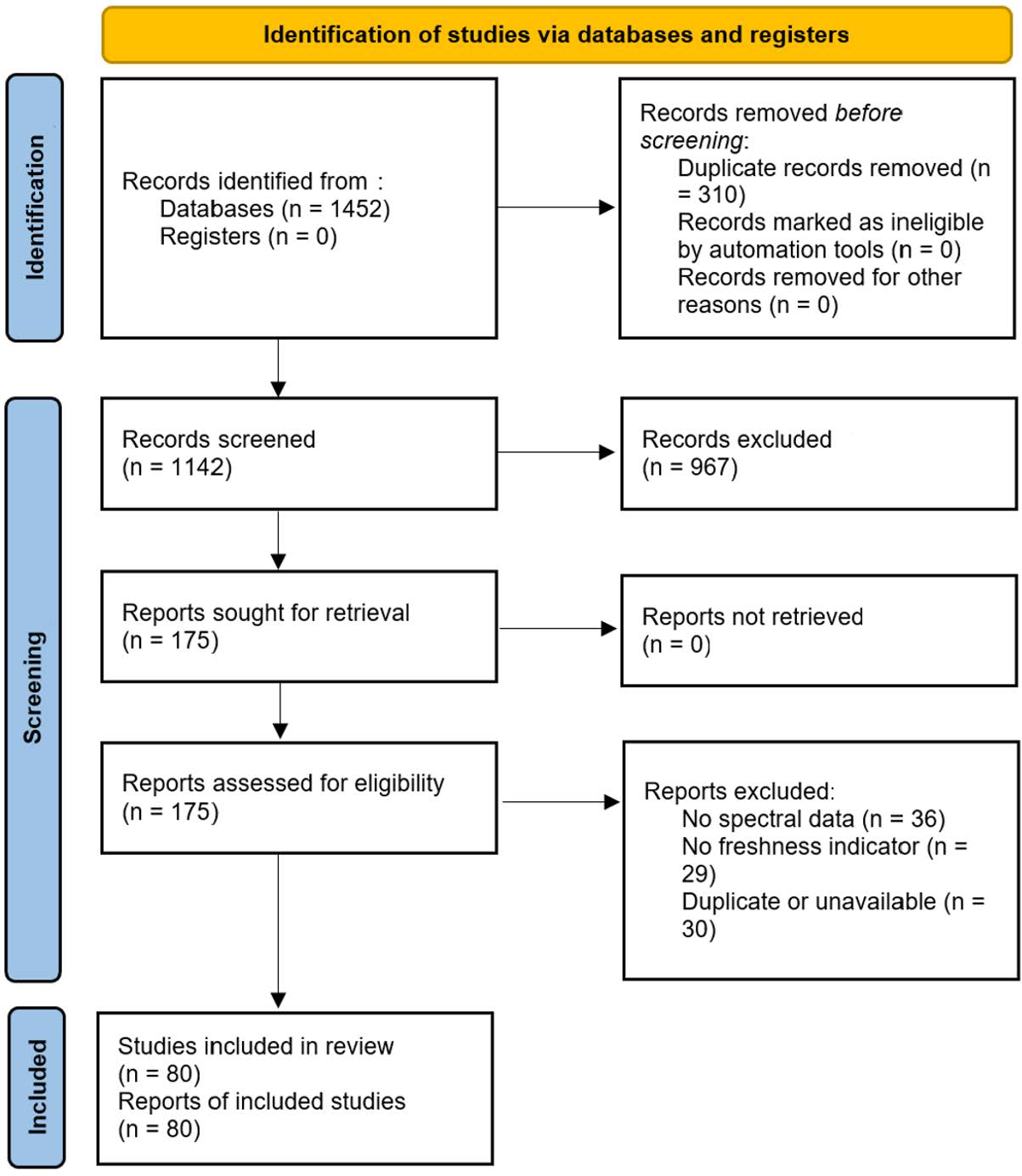
Against this backdrop, this paper systematically reviews the application status of mainstream spectroscopic technologies in meat freshness detection. Such technologies specifically include Near-Infrared Spectroscopy, Raman Spectroscopy, and Hyperspectral Imaging. The paper also analyzes their advantages and challenges, outlines their future development directions, and aims to provide comprehensive technical references for researchers and practitioners in the fields of meat quality control and food safety. In addition, to ensure the authority of the review and the uniqueness of the conclusions, we rigorously conducted literature screening across multiple databases and plotted a Preferred Reporting Items for Systematic Reviews and Meta-Analyses (PRISMA) flow diagram to comprehensively illustrate the screening process (Fig. 1).
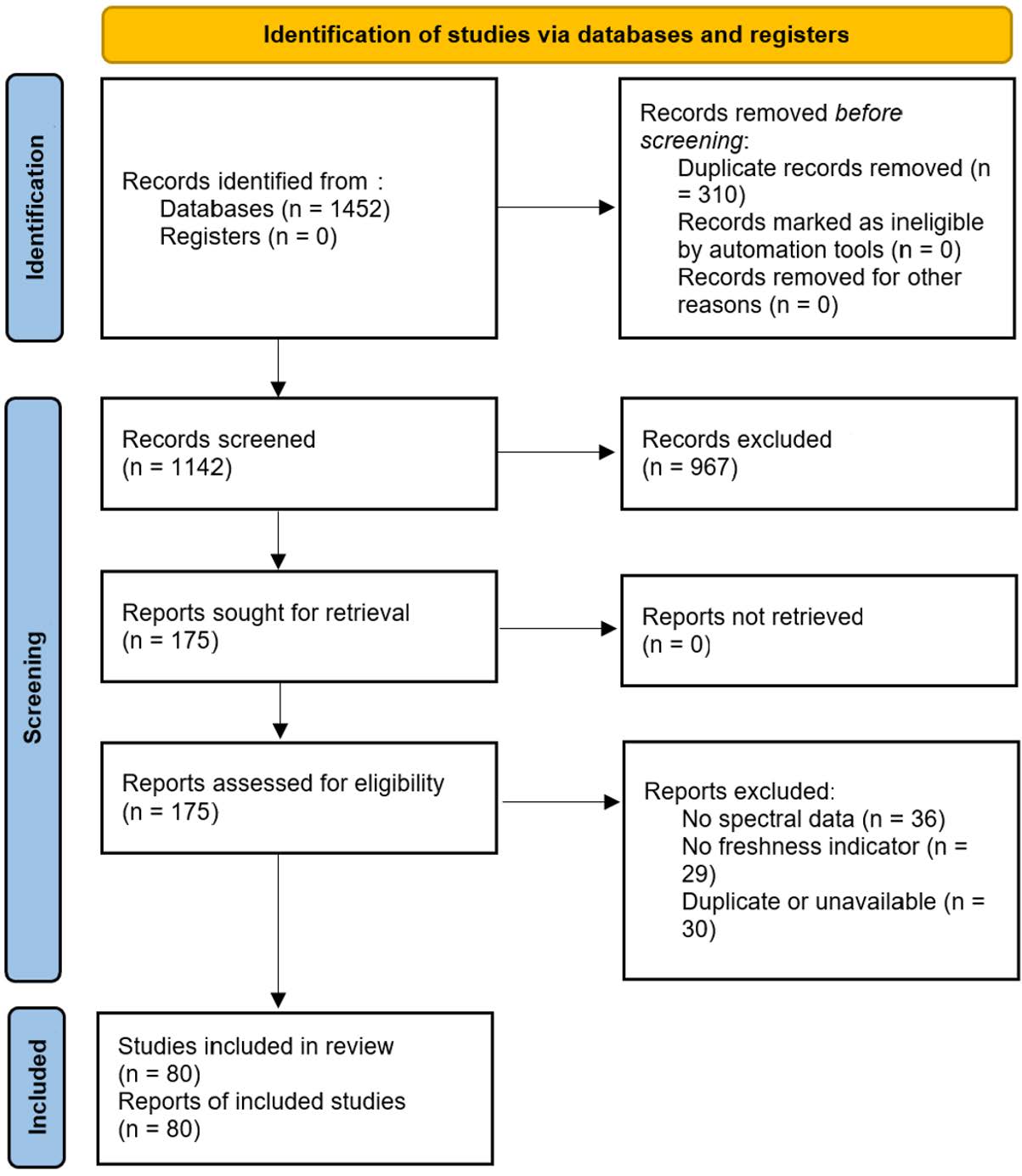 Fig. 1.
A PRISMA flow diagram that provides a holistic visualization of the screening process.
In the field of quality and safety testing for meat products, spectroscopic technology has evolved into a comprehensive analytical system with complementary functions and a clear hierarchical structure [13, 14, 15]. Based on the characteristics and application scenarios of different methods, this technical system has multi-level detection capabilities ranging from rapid screening to accurate identification, providing full-chain technical support for the meat industry chain [16, 17].
As an efficient, rapid, environmentally friendly, non-destructive green technology capable of qualitative and quantitative analysis, NIRS has been widely used in the detection of meat freshness in recent years. By leveraging the vibrational and rotational absorption characteristics of near-infrared light with a wavelength range of 780 nm to 2526 nm and the hydrogen-containing functional groups of organic substances, such as O-H, N-H, and C-H, this technology enables rapid detection of meat chemical components via overtone and combination tone absorption [18, 19, 20]. Relying on this characteristic, this technology can quickly detect the contents of moisture, protein, and fat in meat, with the prediction correlation coefficient Rp reaching 0.971 for moisture, 0.929 for protein, and 0.961 for fat [21]. It is applicable to various meat types, including pork, beef, and aquatic products like grass carp. Furthermore, by combining with chemometric methods such as partial least squares regression (PLSR), it can also realize the quantitative prediction of meat freshness. Its advantages of rapidity, non-destructiveness, and suitability for on-site detection have enabled it to be widely used in fields such as food quality testing, agricultural product analysis and industrial process monitoring [22, 23, 24]. However, its limited sensitivity and the characteristic of relying on a large number of samples to establish a prediction model restrict its application in trace component analysis.
In contrast to near-infrared spectroscopy, mid-infrared spectroscopy (MIRS) can specifically identify molecular structures, a unique ability rooted in its capacity to accurately capture the fundamental frequency vibrations of molecules, such as the characteristic vibrations of C=O and N-H bonds. By comparing the differences in mid-infrared characteristic peaks between pure meat and adulterated components, it can efficiently identify adulteration behaviors. This feature endows it with significant value in fields such as meat adulteration identification and spoilage detection [25]. Although MIRS requires more demanding sample preparation (e.g., homogenization or pellet formation) and is susceptible to moisture interference, it remains indispensable for scenarios requiring accurate compound identification.
Raman spectroscopy is based on the Raman scattering effect arising from light-matter interaction. When light irradiates a substance, molecular vibrations cause inelastic scattering, shifting the frequency of the scattered light and generating a characteristic Raman spectrum. Through the characteristic Raman shifts of molecular vibrations, including the tyrosine double bands at 826 cm⁻1 and 853 cm⁻1, it can reflect changes in protein degradation in meat products, along with changes in volatile components such as amines [26, 27]. This technology is highly sensitive to organic compound structure. For instance, in aquatic samples like fresh shrimp, combining it with surface-enhanced Raman spectroscopy (SERS) can even lower the putrescine detection limit to 0.1 µg/kg [28]. Among its variants, Fourier Transform Raman Spectroscopy (FT-Raman) relies on a near-infrared laser light source. A typical wavelength of this light source is 1064 nm, which allows the technology to reduce the fluorescence interference caused by vitamin B2 in meat by 80% and raise the signal-to-noise ratio of protein characteristic peaks to 15:1. It is particularly suitable for studying deep molecular structure changes such as protein secondary structure variations and fat oxidation levels, thereby providing a powerful tool for analyzing the micro-mechanisms of meat quality [29].
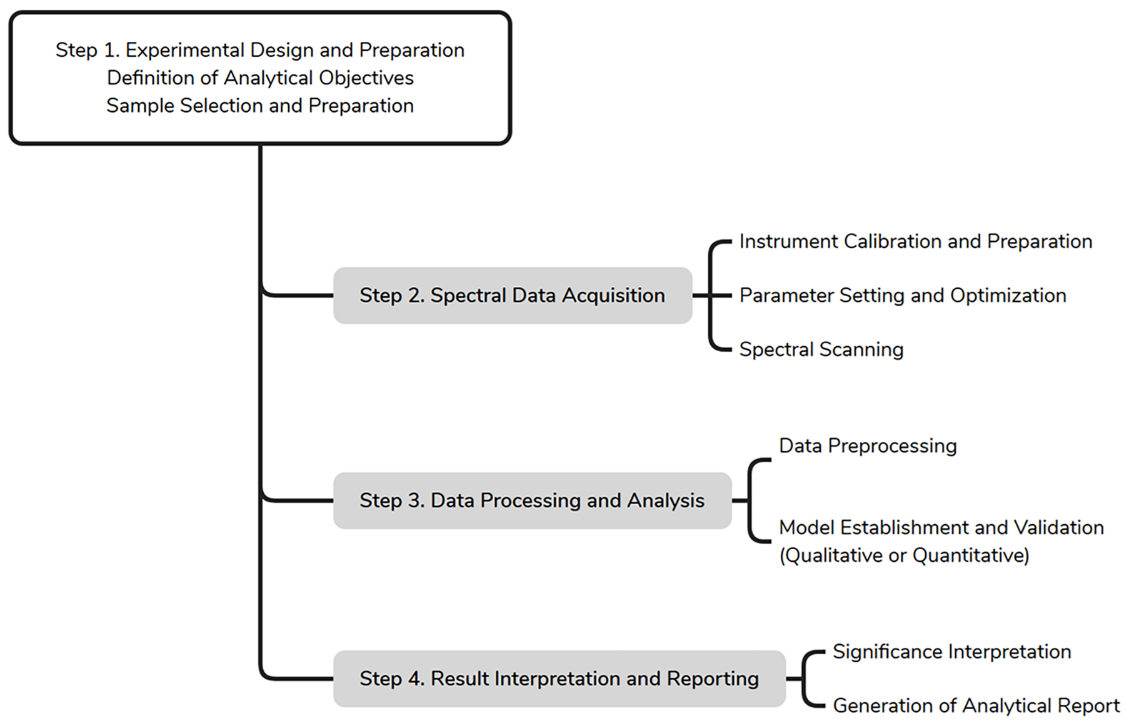
Hyperspectral Imaging (HSI) integrates traditional spectral analysis, imaging technology, advanced optoelectronic technology, and computer processing capabilities. As shown in Fig. 2, its workflow enables the simultaneous acquisition of both image information and spectral information of the measured object, thereby fully reflecting the internal and external quality characteristics of the sample. This technology offers fast detection speed and is non-destructive, preserving sample integrity. Therefore, HSI has been widely applied in the field of food inspection, providing efficient and accurate technical support for food quality control and safety testing [30, 31, 32]. In detection scenarios that require the simultaneous acquisition of spatial information and chemical composition information, HSI demonstrates unique value. It can not only identify foreign substances and defects in meat but also visually display the spatial distribution of components, offering a new dimension for the comprehensive evaluation of meat quality. Although its data processing is relatively complex, its advantages in the comprehensive evaluation of meat quality have become increasingly prominent.
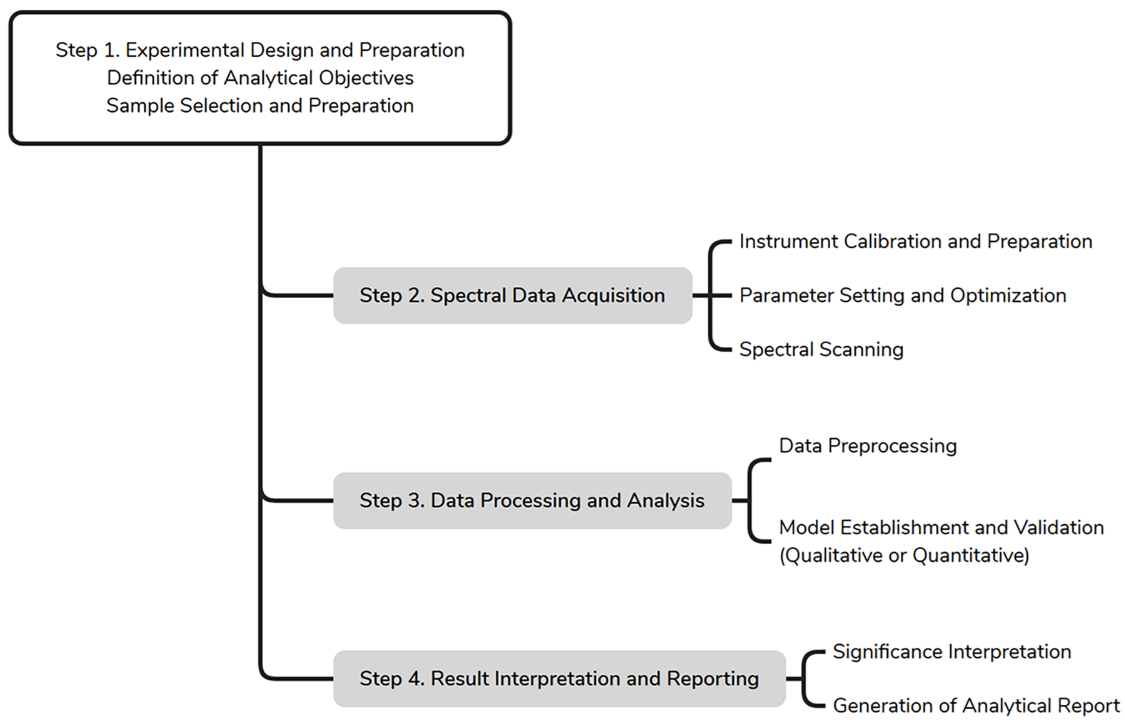 Fig. 2.
Summary of spectroscopic detection processes.
By measuring specific chromophores in meat extracts, ultraviolet-visible (UV-Vis) spectroscopy monitors two key indicators [33], myoglobin status, which is assessed via absorption peaks at 540 nm/576 nm, and lipid oxidation levels, which are tracked through a characteristic peak at 230 nm. Although UV-Vis spectroscopy cannot achieve fully non-destructive detection, and its sample pretreatment, including homogenization and centrifugation, takes around 30 minutes, its detection accuracy in laboratory precision analysis is still surpassing that of portable devices. Specifically, when detecting TVB-N, the root mean square error of prediction (RMSEP) is 0.388 mg/100 g, and this high precision makes the technology irreplaceable.
In addition, fluorescence spectroscopy plays a crucial role in the analysis of vitamin content and detection of contaminants in meat, thanks to its ultra-high sensitivity. It is particularly effective for fluorescent substances produced during meat storage, such as putrescine and malondialdehyde (MDA), enabling sensitive detection at the picogram (pg) level and providing early warning signals for initial quality changes [34, 35, 36].
These spectroscopic technologies, when organically combined, form a comprehensive analytical system that covers everything from rapid screening of major components to accurate detection of trace contaminants. In practical applications, they can either be used independently based on detection requirements or achieve complementary advantages through data fusion strategies. For example, NIRS can be applied for rapid preliminary screening on production lines, while suspect samples can be further subjected to confirmation analysis using MIRS or Raman spectroscopy, the combination of hyperspectral imaging (HSI) and fluorescence spectroscopy, on the other hand, enables simultaneous localization of contaminants and precise quantitative detection. To address the instrument selection needs for spectral detection experiments, we first reviewed academic literature and professional books in the field of spectral detection to summarize theoretical foundations such as instrument performance evaluation criteria and mainstream technical routes. Subsequently, we consulted mainstream sales platforms and corresponding hyperspectral instrument manufacturers, focusing on collecting key technical parameters and product information including instrument calibration methods and scanning accuracy. Based on this, we removed redundant and conflicting data through classified summarization and cross-verification, and finally integrated the information to form Table 1, which provides a comprehensive and reliable reference for subsequent instrument selection. The comparison of the core performance and applicable scenarios of these spectroscopic technologies can be summarized in the table below.
| Spectroscopic technique | Purchase cost (10k RMB) | Single test time (minutes) | Testing method | Sensitivity (Detection limit) | Core advantages | Disadvantages | Typical application scenarios |
| Near-infrared spectroscopy (NIRS) | 10–30 | 1–5 | Non-destructive | mg/kg level | Fast, low cost, no consumables | Weak trace analysis ability | Production line meat component sorting, supermarket freshness spot checks |
| Hyperspectral imaging (HSI) | 30–100 | 5–10 | Non-destructive | mg/kg level | Spatial-spectral information fusion | Complex data processing | Carcass lean meat percentage evaluation, foreign object localization |
| Mid-infrared spectroscopy (MIRS) | 20–50 | 10–30 | Destructive (homogenate/pellet) | µg/kg level | Strong molecular structure specificity | Complex sample pretreatment | Adulteration inspection, ingredient traceability identification |
| Raman spectroscopy (incl. SERS) | 15–100 | 5–60 | Non-destructive/ micro-destructive | 0.1 µg/kg level | High sensitivity, anti-fluorescence interference | High cost of high-end equipment | Aquatic putrescine detection, protein denaturation research |
| UV-visible spectroscopy (UV-Vis) | 1–20 | 20–30 | Destructive (extraction) | µg/kg level | Low cost, simple operation | Unable to perform non-destructive testing | Laboratory routine quality index testing |
| Fluorescence spectroscopy | 15–30 | 10–20 | Destructive (micro-extraction) | pg/kg level | Ultra-high sensitivity, early warning | Dependent on presence of fluorescent substances | Early spoilage warning during cold storage, trace contaminant detection in meat for infant food |
With the increasing demand for meat freshness evaluation, traditional evaluation methods have been widely applied [37], and these methods mainly include sensory evaluation and physicochemical index determination. The latter covers specific indicators like Volatile Basic Nitrogen (VBN), Thiobarbituric Acid Reactive Substances (TBARS), pH value, and total number of microbial colonies. However, these methods have obvious limitations, sensory evaluation is highly subjective, relies on the experience of professional technicians, and is difficult to standardize and quantify [38], physicochemical index determination is usually time-consuming and destructive, which fails to meet the demand for rapid and non-destructive detection in the modern food industry [39]. With the continuous development of new technologies, non-destructive, rapid, and convenient freshness evaluation methods have gradually attracted the attention of researchers. Non-destructive detection technologies such as spectroscopy technology, computer vision technology, and nuclear magnetic resonance technology have all become important technical means for scholars at home and abroad to evaluate the freshness of livestock and poultry meat. Among them, spectroscopy technology stands out due to its unique advantages.
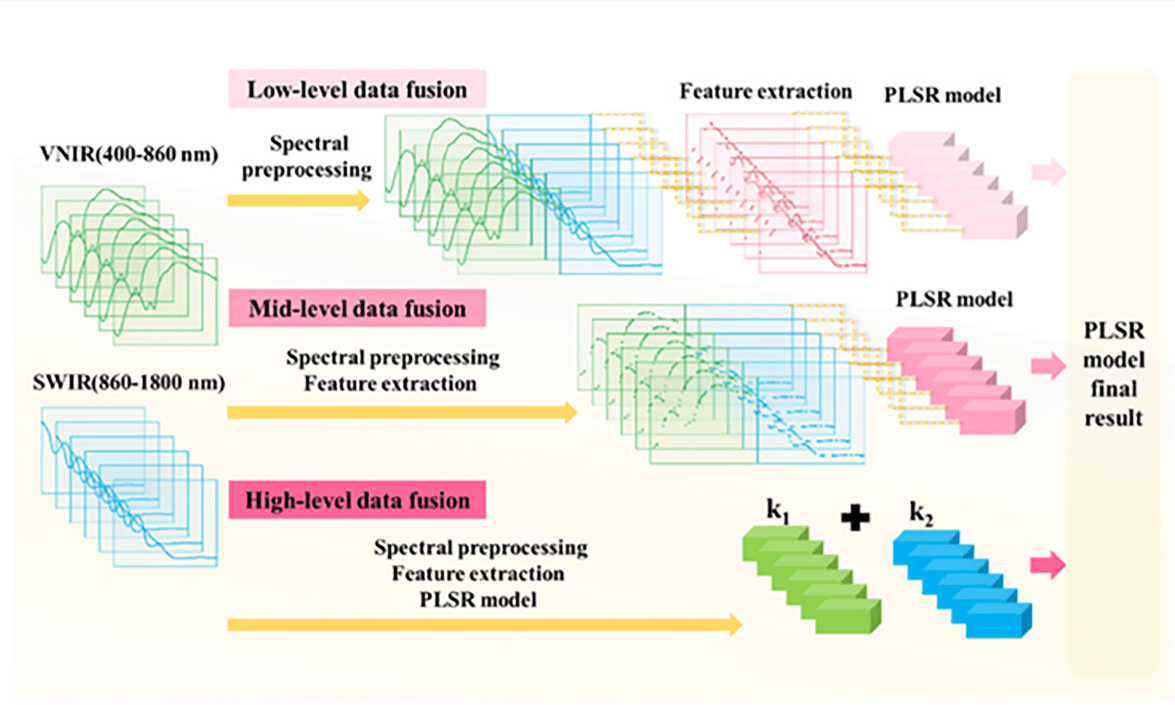
Ren et al. [40] employed visible-near-infrared (VNIR) and short-wave infrared (SWIR) spectroscopy combined with data fusion strategies to conduct rapid non-destructive detection of moisture, fat, and protein contents in fresh pork longissimus dorsi muscle (PLM). Spectral data of 8 batches of samples (240 samples in total, stored at 4 °C and 25 °C, with component determination conducted by sampling every 24 hours within 5 days) were collected. After preprocessing via Standard Normal Variate (SNV), multiplicative scatter correction (MSC), smoothing, Savitzky-Golay 1st derivative (SG-1D), and Savitzky-Golay 2nd derivative (SG-2D), principal component analysis (PCA), competitive adaptive reweighted sampling (CARS), and random forest (RF) were used for feature extraction. Subsequently, three data fusion strategies, low-level data fusion (LLDF), middle-level data fusion (MLDF), and high-level data fusion (HLDF), were adopted to integrate spectral information. Combined with PLSR, quantitative prediction models were established, and their working principle is shown in Fig. 3 (Ref. [40]). According to the results, low-level fusion achieved the best prediction performance for moisture. The specific parameters were Rp of 0.971 and RMSEP of 0.192. For fat and protein prediction, high-level fusion was more superior, the Rp for fat was 0.961 with an RMSEP of 0.770, and for protein, the Rp was 0.929 with an RMSEP of 0.281. Moreover, the ratio of performance to deviation (RPD) values of the fusion models were 1.206, 0.333, and 0.300 higher than those of the single-spectroscopy models, respectively. In addition, this study provided core algorithms for the development of handheld meat analyzers and promoted the industrialization of on-site rapid detection equipment, demonstrating that the VNIR and SWIR spectral data fusion technology has significant advantages and application value in the non-destructive quantitative analysis of main components in meat products.
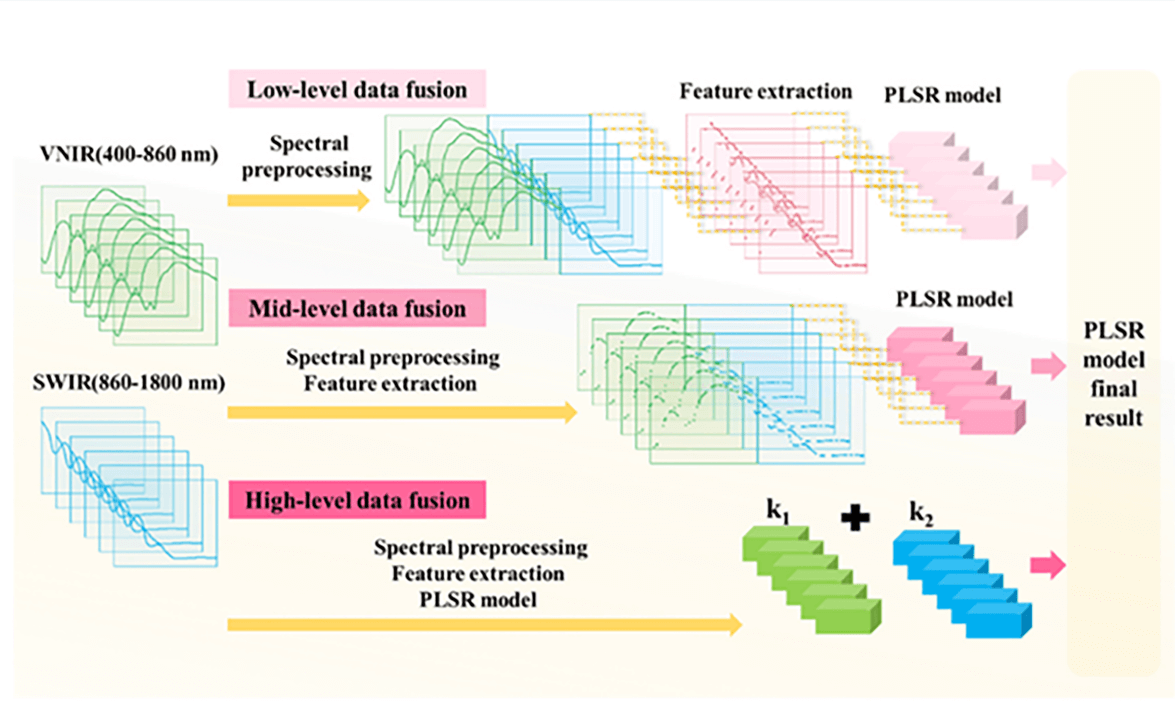 Fig. 3.
Schematic illustration of the working principles of the three data fusion [40]. VNIR, visible near-infrared; SWIR, short-wave infrared; PLSR, partial least squares regression.
Wang and Ren [41] took the TVB-N content as the evaluation index for pork freshness. They acquired spectral data using a spectral acquisition system covering the wavelength range of 400–1000 nm (480 bands in total). The spectra were preprocessed with an SG-SNV filter, which combines Savitzky-Golay (SG) smoothing filtering and SNV transformation. Subsequently, the competitive window adaptive reweighted sampling (WCARS) combined with the iterative successive projections algorithm (ISPA) was used to extract 7 characteristic wavelengths. Finally, a detection model was constructed by integrating the improved beetle antennae search (BAS) algorithm and least squares support vector machine (LSSVM). Specifically, the improved BAS algorithm optimizes the regularization parameter and radial basis function (RBF) kernel function parameters of LSSVM through the Monte Carlo criterion (to avoid falling into local optima) and the pathfinding feedback update strategy (to screen dominant iterative individuals). Through multi-link optimization, this method realizes rapid and non-destructive detection of pork freshness. Since the detection is based on TVB-N, the method not only provides an efficient technical path for meat freshness detection but also highlights the application value of spectroscopy technology combined with optimization algorithms in meat quality evaluation.
NIR is based on Lambert-Beer Law. It can detect components such as moisture, protein, and fat in meat through absorption spectrum analysis, and further evaluate meat freshness [42]. Researchers including Zhang et al. [43] established a beef freshness grading model by combining NIRS technology with Support Vector Machine (SVM). The back-judgment recognition rate and prediction recognition rate of the model reached 96.3% and 100%, respectively, demonstrating the high efficiency and accuracy of NIRS in meat freshness detection. In addition, Zhao et al. [44] developed a prediction model for TVB-N using NIRS. TVB-N refers to alkaline nitrogen-containing substances such as ammonia and amines produced during the spoilage of animal-derived foods under the action of enzymes and bacteria. It is a key indicator for measuring the freshness of meat and aquatic products, and the increase in its content is usually positively correlated with the degree of food spoilage [45]. In their study, they collected NIRS data of pork with different freshness grades and established a quantitative prediction model for TVB-N content using the Partial Least Squares (PLS) model. The results showed that the model had a calibration correlation coefficient (RC) of 0.96, a Root Mean Square Error of Calibration (RMSEC) of 1.47 mg/100 g, a prediction correlation coefficient (RP) of 0.93, and a RMSEP of 1.74 mg/100 g. These results indicate that NIRS technology combined with the PLS model can effectively predict TVB-N content in meat, providing a technical basis for rapid and non-destructive detection of meat freshness.
NIR technology not only enables rapid detection of meat freshness but also supports multi-scenario identification of meat quality. For example, Para Star et al. [46] proposed a rapid non-destructive method for chicken quality detection by integrating handheld near-infrared (NIR) spectroscopy with the Random Subspace Discriminant Ensemble (RSDE) algorithm. Focusing on packaged chicken breast, they collected spectra via three specific modes, direct surface detection, detection through the packaging top, and detection through the packaging bottom. This yielded over 95% accuracy in distinguishing fresh/thawed chicken and classifying growth systems. The whole analysis took only ~20 seconds, highlighting the method’s on-site rapid detection advantages.
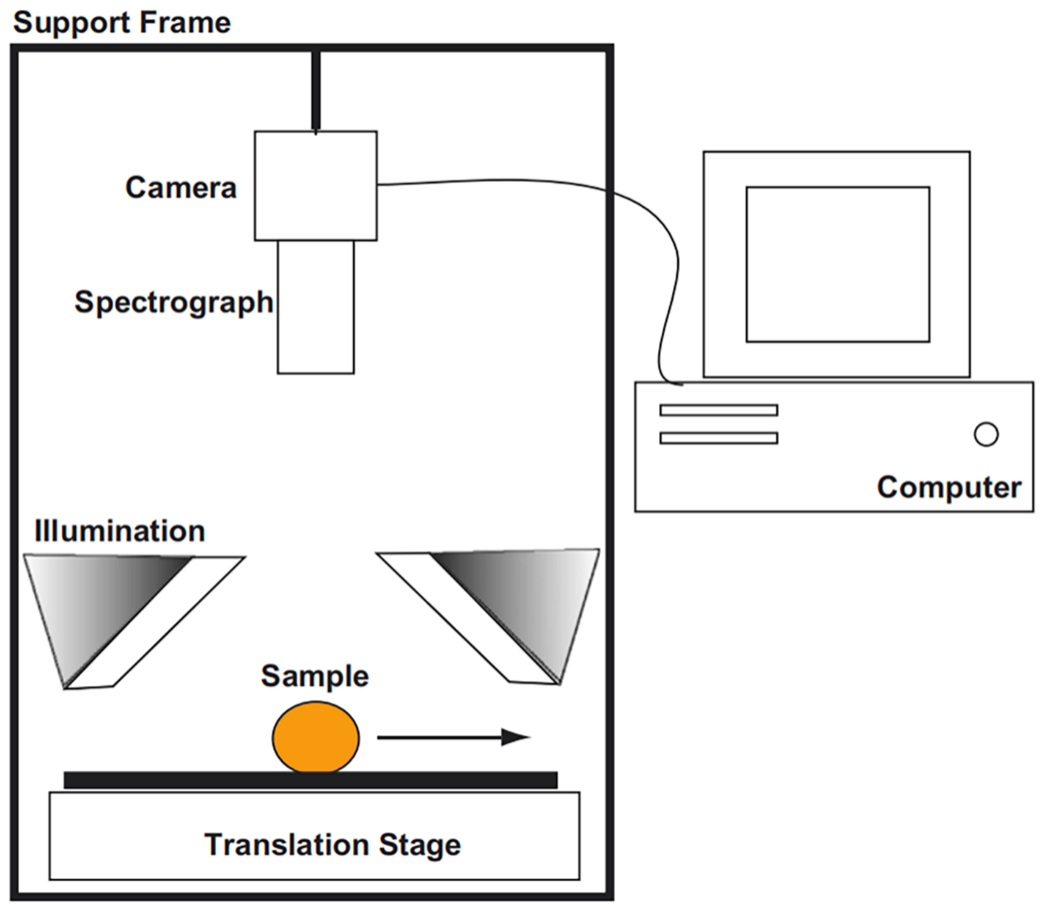
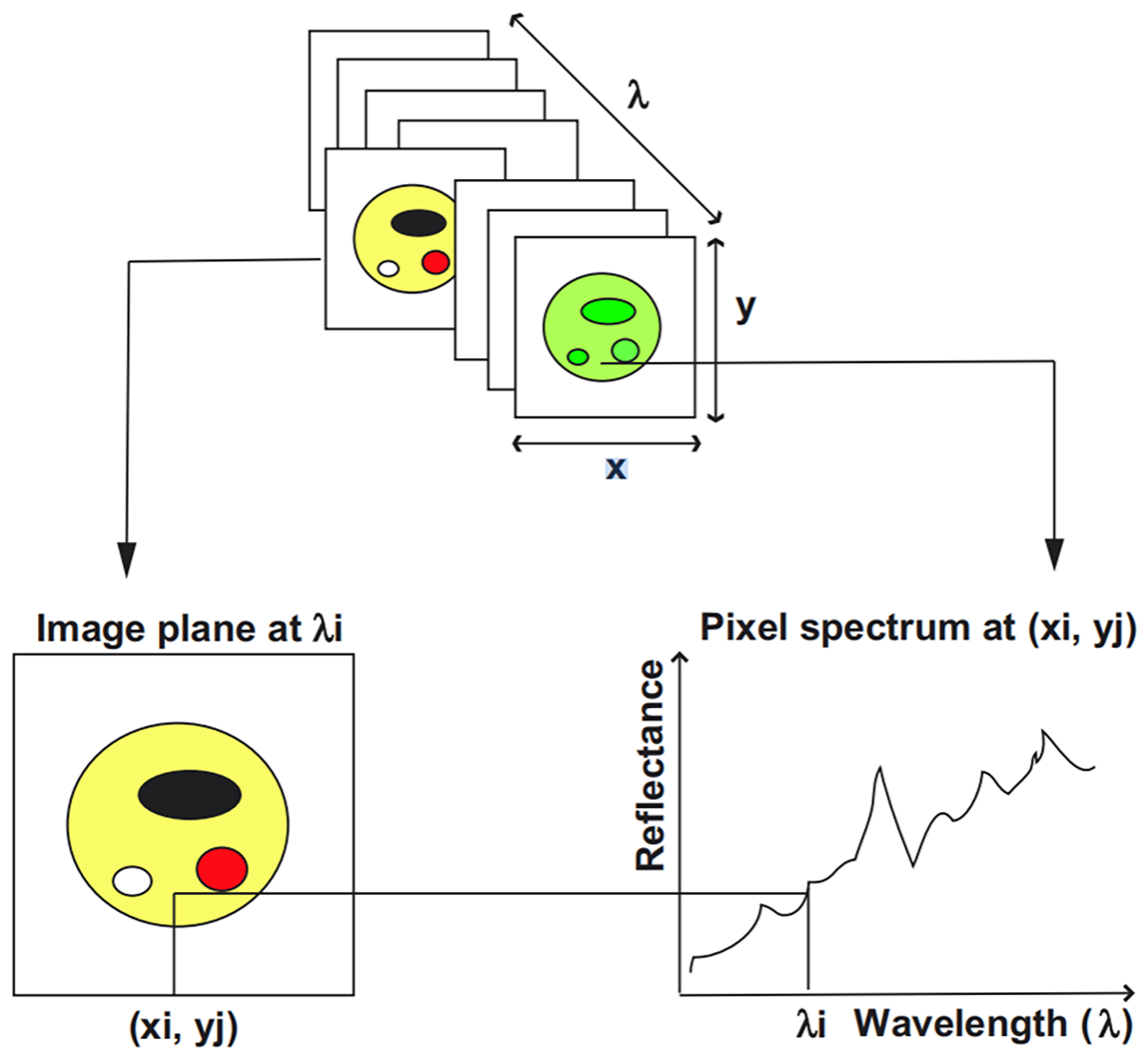
HSI technology emerged in the 1980s. It integrates multi-disciplinary technologies such as optics, optoelectronics, information processing, and computer science, and features continuous multi-band, high spectral resolution, and integration of image and spectrum. It can simultaneously acquire spatial, spectral, and radiometric information of samples, enabling non-destructive and rapid detection, and has shown significant advantages in the quality detection of livestock products [47, 48]. Gowen et al. [49] elaborated in their research on the application progress of hyperspectral imaging (HSI) technology in the field of food quality and safety control, emphasizing its potential as an emerging process analytical tool, with its system composition shown in Fig. 4 (Ref. [49]). By integrating imaging technology and spectral technology, this technique can simultaneously acquire the spectral information and spatial information of samples. The hyperspectral imaging hypercube diagram presented in Fig. 5 (Ref. [49]) intuitively illustrates the correlation between the spectral dimension and the spatial dimension, thereby enabling effective identification of various quality parameters of meat such as color, texture, and chemical composition. In addition, HSI also demonstrates significant application potential in meat freshness detection. By analyzing changes in chemical components on the meat surface, this technology can accurately distinguish fresh meat from spoiled meat. Experimental results show that when combined with the PLSR model, the prediction correlation coefficient of HSI for meat freshness can be as high as over 0.9. This not only verifies its high efficiency in freshness evaluation but also highlights its great value in the field of non-destructive detection.
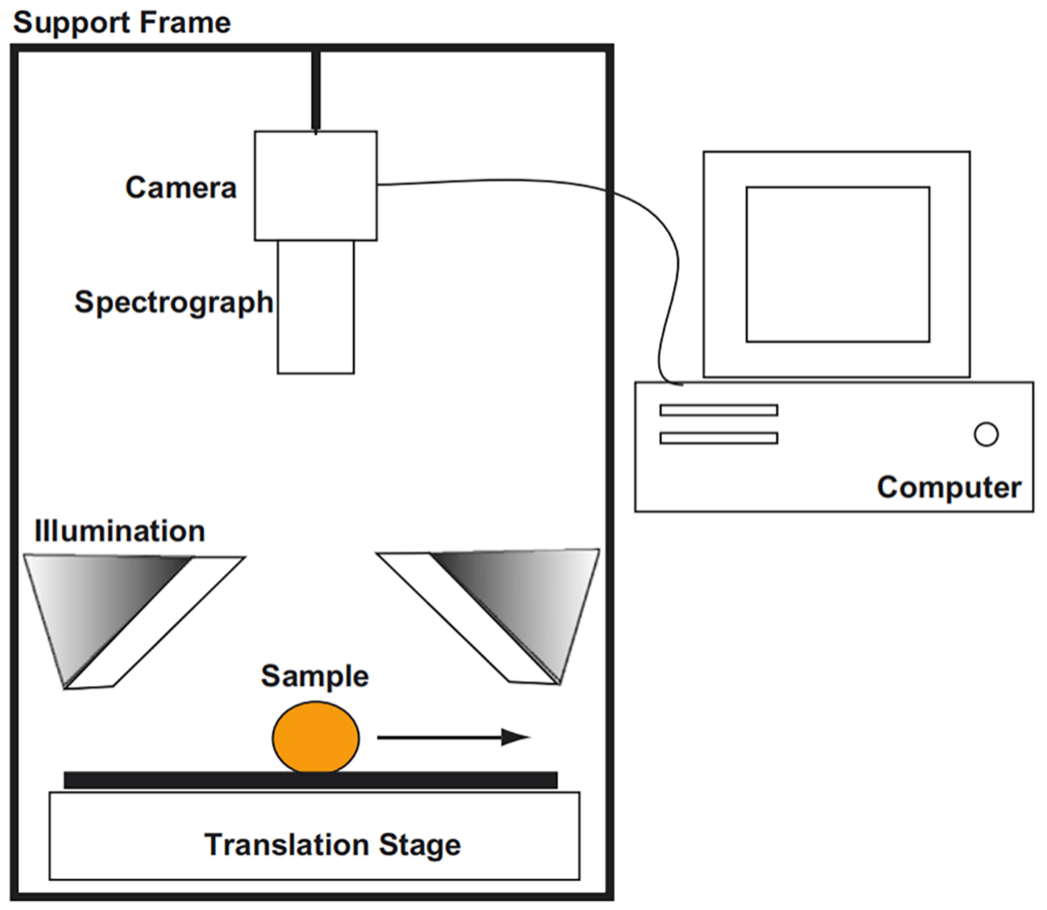
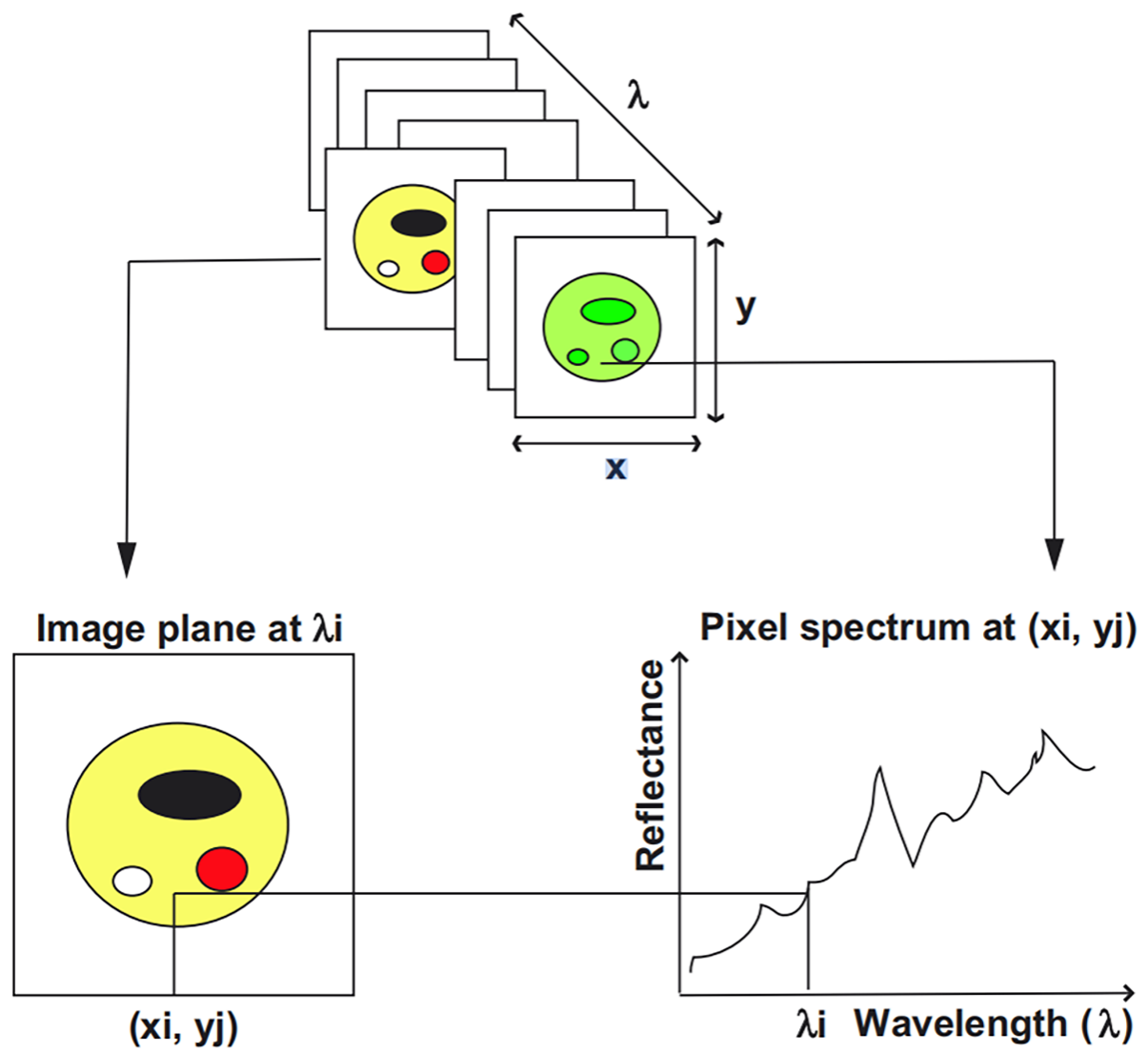 Fig. 5.
Schematic representation of hyperspectral imaging hypercube showing the relationship between spectral and spatial dimensions [49].
Zhang et al. [50] explored the feasibility of non-destructive detection of mutton freshness by combining hyperspectral imaging technology with BPANN and CART algorithms. First, hyperspectral images in the 935–2539 nm band were collected, and the TVB-N content was measured to classify the freshness categories. After SPA selection of 12 characteristic wavelengths, a discrimination model was constructed. Verification shows that the performance of the CART model is superior to that of BPANN—the average classification accuracy of the correction set and the prediction set of the former is 100% and 91.67% respectively, and the recognition rates of the three types of samples are 88.89%, 87.50% and 100% respectively. The latter corresponds to 100%, 83.33% and 88.89%, 75%, 85.71%, confirming that hyperspectral + CART can improve the discrimination accuracy. The advantages of this research lie in focusing on the demands of non-destructive testing, simplifying the SPA model to reduce costs, ensuring reliability with TVB-N as the standard, and clearly identifying the advantages of the CART algorithm. However, this approach has limitations: sample universality is insufficient, as it only covers mutton, it does not explore environmental influences like storage temperature, it lacks comparison with near-infrared and other technologies, and it makes no mention of the conversion path for portable devices. Overall, it provides a feasible solution for non-destructive testing of meat. If the sample range, environmental adaptability and industrialization path are optimized, it is expected to become a tool for meat quality control and promote the upgrading of food testing.
MIR is a technology based on molecular fundamental frequency vibrations, with a wavelength range of 4000–400 cm⁻1. It possesses specific recognition capabilities for the functional groups of adulterated components in meat [51, 52]. Al-Jowder et al. [53] analyzed the mid-infrared spectra of 132 meat samples, including pure beef silverside and beef adulterated with 20% (w/w) of kidney, liver, heart, and tripe, four types of offal. The analysis relied on a Nicolet Magna-IR 550 spectrometer equipped with a zinc selenide ATR crystal. Spectra were collected over 800–4000 cm⁻1 at 4 cm⁻1 resolution, then truncated to the 900–1800 cm⁻1 “fingerprint region” for analysis. They combined principal component analysis PCA and linear discriminant analysis LDA for their research and found that pure beef and adulterated beef could be distinguished within 2 minutes per sample. The key to this distinction was a combination of four characteristic peaks, 3288 cm⁻1 corresponds to the N-H stretching of proteins, 2920 cm⁻1 corresponds to the C-H stretching of fats, 1650 cm⁻1 corresponds to the amide I band of proteins, and 1162 cm⁻1 corresponds to the C-O stretching of glycogen in liver. Notably, even for samples cooked at 60 °C by steaming or 180 °C by roasting, the method maintained high accuracy, its cross-validation success rate reached 95%–97%. Though discrimination between the four offal-adulterated types grew slightly harder with increased cooking intensity, the method still enabled the differentiation of five sample classes: pure beef and four adulterant types. It also showed potential for rapid screening in processed meat industries such as sausage or burger production.
Researchers such as Dong et al. [54] used a portable Raman spectrometer
to conduct rapid non-destructive detection of the freshness of chilled lean pork.
They collected Raman spectra that changed over time, while simultaneously
monitoring TVB-N, pH value, and color indicators (L*, a*, b*). A quantitative
prediction model was established using SNV Transformation and PLSR. The results
showed that the prediction correlation coefficients for TVB-N and pH value were
0.948 and 0.886, respectively, indicating that Raman spectroscopy technology has
significant advantages in rapid and non-destructive detection of meat freshness.
Researchers including Fowler et al. [55, 56] comprehensively evaluated
the tenderness, pH value, and color indicators of mutton by combining Raman
spectroscopy technology with chemometric methods. The study found that Raman
spectroscopy could quickly predict the pH value of mutton in the early
post-mortem stage, with the R2 value of the prediction model being 0.35. In
addition, Raman spectroscopy showed high accuracy in predicting the shear force
of mutton longissimus dorsi muscle, but low accuracy in predicting the shear
force of mutton semimembranosus muscle, this may be related to muscle type and
spectral data processing methods. Fowler also found that meat with high
tenderness had stronger tyrosine double bands at 826 cm⁻1 and 853 cm⁻1,
while meat with low tenderness had a lower content of
Fourier Transform Raman Spectroscopy (FT-Raman) adopts a 1064 nm near-infrared laser light source and suppresses fluorescence interference through Fourier transform technology, demonstrating unique advantages in the study of meat molecular structures. Zając et al. [57] analyzed the Fourier transform Raman (FT-Raman) spectra of 36 minced meat samples (beef-horse meat mixtures with 0%, 10%, 25%, 50%, 75%, and 100% horse meat content) by combining multiple linear regression (MLR). They found that horse meat content can be quantified within 2 minutes using the combination of two characteristic peak ratios, 937/1003 cm⁻1 and 856/1003 cm⁻1. For 937/1003 cm⁻1, 937 cm⁻1 corresponds to valine C-C stretching and 1003 cm⁻1 is the phenylalanine internal standard, for 856/1003 cm⁻1, 856 cm⁻1 corresponds to tyrosine C-H bending. This method also has a prediction coefficient R2 of 0.94 and a limit of detection of 5% w/w.
UV-Vis enables quantitative evaluation of meat freshness by measuring absorbance
changes at specific wavelengths. Through a study on 240 pork samples, Zuo
et al. [58] found that the absorbance ratio of A576 to A540 in the supernatant
had a significant negative correlation with TVB-N. Specifically, A576 stands for
oxymyoglobin, A540 stands for metmyoglobin, and the correlation coefficient Rp
reaches –0.915 with p
ElMasry et al. [61] employed spontaneous fluorescence spectroscopy combined with multivariate analysis of fluorescence excitation-emission matrices, or EEMs for short, to conduct a non-invasive and time-efficient freshness estimation study on intact frozen Japanese horse mackerel, scientifically named Trachurus japonicus. In the experiment, first, fluorescence data under different freshness conditions were preprocessed, masked, and reconstructed to resolve overlapping signals and scattering curves. Subsequently, high-performance liquid chromatography (HPLC) was used to determine the K-value as the authentic freshness indicator. Then, PLS regression was applied to construct a prediction model between fluorescence EEM data and K-values. Additionally, an innovative algorithm was proposed to identify the optimal combination of excitation-emission wavelengths for optimizing prediction variables. The final model achieved a coefficient of determination, or R2, of 0.89 for freshness prediction of frozen Japanese horse mackerel, with a root mean square error of cross-validation, or RMSECV, of 9.66%. This confirms the high potential of this technology in the field of non-invasive sensing for freshness of frozen fish. In terms of research value, its core advantage lies in the precise focus on the practical application scenario of intact frozen fish, avoiding issues of thawing damage and low efficiency. Moreover, the rigorous signal processing workflow and the use of HPLC as a gold standard ensure data reliability. The innovative wavelength combination algorithm also simplifies model complexity, providing a reference for similar studies. However, there is room for improvement, for instance, the study only used Japanese horse mackerel as the research subject, resulting in insufficient sample universality, it did not explore the impact of practical environmental variables such as freezing rate and storage time on detection results, nor did it compare performance with mature technologies like near-infrared spectroscopy or mention the feasibility of transforming the technology into portable devices. These limitations are unfavorable for highlighting the technology’s relative advantages and promoting its industrialization.
Overall, this research provides a valuable technical prototype for non-invasive freshness detection of frozen aquatic products. If further optimizations can be made in terms of sample scope, environmental adaptability, and industrialization pathways, it is expected to become an important tool for quality control in the circulation of frozen aquatic products, driving the upgrading of food quality and safety testing towards non-invasiveness and high efficiency.
Spectral technology, characterized by its rapidity and non-destructiveness, can acquire information on the chemical composition and physical properties of meat products in a short time without destructive treatment of samples. It is particularly suitable for on-site rapid detection, as it not only preserves the integrity of samples but also significantly improves detection efficiency [62, 63, 64]. Traditional chemical analysis takes 2–4 hours, while a single detection using spectral technology can be shortened to within 5 minutes. In addition, this technology has high sensitivity and specific detection capabilities for specific chemical components in meat products, including two typical indicators: TVB-N and Total Viable Count (TVC) [65, 66]. The detection limit for TVB-N can reach 1 mg/100 g, better than that of the traditional Kjeldahl method with a detection limit of 5 mg/100 g. For example, hyperspectral imaging technology combined with chemometric methods can accurately distinguish beef in different storage states [67, 68, 69]. Meanwhile, spectral technology can simultaneously detect multiple freshness indicators of meat products, including color, texture, and chemical composition, providing strong support for the comprehensive evaluation of meat quality.
However, the application of spectral technology also faces some challenges. First, spectral data usually has high dimensionality and complexity, requiring efficient algorithms such as PLSR and PCA, for processing and analysis. For instance, optimizing hyperspectral data processing through Genetic Algorithms (GA) combined with Deep Neural Networks (DNN) has significantly improved the prediction accuracy of the model [70, 71, 72, 73, 74]. Second, meat products of different types and sources have different spectral characteristics, leading to differences in the applicability of the established models to different samples. Furthermore, the spectral characteristics of meat products change under different storage conditions, which further increases the difficulty of achieving model universality [75, 76, 77, 78]. Third, moreover, the equipment cost of spectral technologies such as hyperspectral imaging is relatively high. The unit price of a commercial hyperspectral imaging system is approximately 100,000–300,000 RMB, and the cost of core components including high-resolution gratings accounts for more than 60%. This limits the popularization among small and medium-sized meat enterprises and its wide application in the food industry. In the future, technical improvements and cost reduction are needed to promote its popularization in food production [79].
As a core method in the field of non-destructive testing, spectral technology has demonstrated irreplaceable advantages in the evaluation of meat freshness. The prediction correlation coefficient of NIR for TVB-N reaches 0.93, the prediction accuracy of Raman spectroscopy for pH value is 0.886, and the prediction correlation coefficient of HSI combined with chemometric models for freshness can exceed 0.9. All these verify its technical value of being rapid, accurate, and non-invasive. Through data fusion strategies (such as VNIR and SWIR spectral fusion) and algorithm optimization (such as PLSR) and improved Beetle Antennae Search-Least Squares Support Vector Machine (BAS-LSSVM)), this technology has realized the simultaneous detection of multiple components in meat, including moisture, fat, and protein. Moreover, the performance of the prediction models is significantly better than that of a single technology, laying a foundation for industrial application. Although there are current challenges such as insufficient model universality and high equipment costs, spectral technology has become a key technology to break through the limitations of traditional testing methods in the real-time monitoring of the entire chain of meat processing, storage, transportation, and sales, providing a new solution for food safety assurance.
In the future, its development will further move towards higher precision, intelligence, and portability. On the one hand, by relying on deep learning, spectral-image fusion models (including CNN-LSTM networks) can be developed to enable cross-species prediction of the freshness of different meats (e.g., pork, beef, and mutton), thereby reducing the cost of retraining models for individual species. On the other hand, by integrating with nanotechnology, for instance the surface-enhanced Raman effect of gold nanoparticles, the detection sensitivity will be improved by 10–100 times, enabling rapid identification of trace biogenic amines. These directions not only build on existing technological achievements but also point out the path for the upgrading of quality control technology in the meat industry, demonstrating the continuously expanding application value and development potential of spectral technology in ensuring food safety.
HG designed the research study. HG and CL prepared the manuscript. CL, LM and MZ contributed to sourcing relevant articles. HG and CL provided advice on the study. HG, CL and MZ analyzed the data. HG and LM wrote the manuscript. All authors have contributed to the editorial changes made to the manuscript. All authors read and approved of the final manuscript. All authors have participated sufficiently in the work and agreed to be accountable for all aspects of the work.
Not applicable.
Not applicable.
This research was funded by National Natural Science Foundation of China, grant number 32102055, Research Project of Beijing Institute of Industrial Technology, grant number BGY2025KY-05.
The authors declare no conflict of interest.
Supplementary material associated with this article can be found, in the online version, at https://doi.org/10.31083/JFSFQ45998.
References
Publisher’s Note: IMR Press stays neutral with regard to jurisdictional claims in published maps and institutional affiliations.