
The Association Between Brain Temperature and Neurological Outcome in Out-of-Hospital Cardiac Arrest Patients Who Received Targeted Temperature Management at 33 °C—Graphical Abstract
A research team from Chonnam National University Medical School and Chonnam National University Hospital, including Seok Jin Ryu and colleagues, has published a study titled “The Association Between Brain Temperature and Neurological Outcome in Out-of-Hospital Cardiac Arrest Patients Who Received Targeted Temperature Management at 33 °C” in Reviews in Cardiovascular Medicine (RCM), Volume 26, Issue 11.
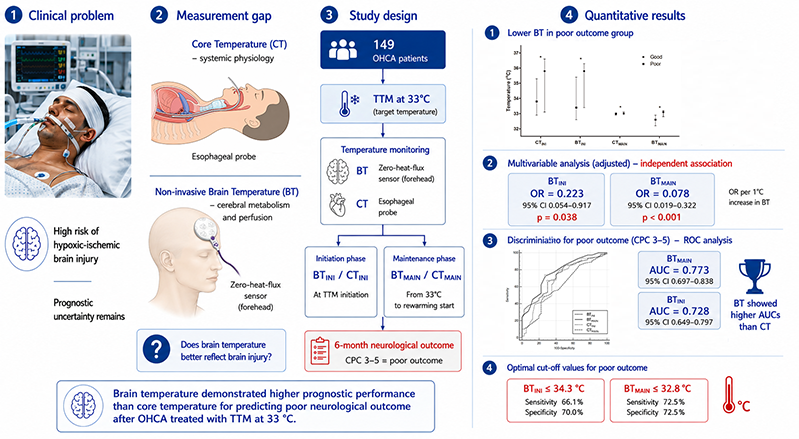
*This graphical abstract was created with assistance from ChatGPT. The authors reviewed and edited the final version and take full responsibility for its content, accuracy, originality, copyright compliance, and integrity.
Background:
- Core Temperature (CT) primarily reflects systemic physiological states.
- Brain Temperature (BT) directly reflects cerebral metabolic activity and regional blood flow.
- The relationship between BT and neurological outcomes in OHCA patients under Targeted Temperature Management (TTM) remains unclear.
Patients & Methods:
- Population: 149 adult OHCA patients treated with TTM at 33 °C.
- Measurements: BT (zero-heat-flux sensor) and CT (esophageal probe) were measured at two phases:
Initiation of TTM (BTINI / CTINI)
Maintenance phase of TTM (BTMAIN / CTMAIN)
- Primary Outcome: Poor neurological outcome (CPC 3-5) at 6 months after ROSC.
Results:
- BTINI and BTMAIN were significantly lower in the poor outcome group.
- Lower BTINI and BTMAIN were independently associated with poor neurological outcomes.
- BT demonstrated better prognostic performance than CT (AUC: BTMAIN 0.773 vs. CTMAIN 0.615).
Conclusion:
- Lower Brain Temperature observed during TTM at 33 °C is associated with poor neurological outcomes.
- BT may serve as a more precise clinical marker of severe hypoxic brain injury following cardiac arrest.
Original Article:
The Association Between Brain Temperature and Neurological Outcome in Out-of-Hospital Cardiac Arrest Patients Who Received Targeted Temperature Management at 33 °C: https://www.imrpress.com/journal/RCM/26/11/10.31083/RCM43855
Related Articles:
Association Between the Duration of Elevated Perfusion Pressure and Neurological Outcomes in Out-of-Hospital Cardiac Arrest Survivors: https://www.imrpress.com/journal/RCM/26/12/10.31083/RCM42733
Association between the Clinical Frailty Scale and Neurological Outcomes in Out-of-Hospital Cardiac Arrest: A Retrospective Study: https://www.imrpress.com/journal/RCM/26/3/10.31083/RCM26333
Advancements in Public First Responder Programs for Out-of-Hospital Cardiac Arrest: An Updated Literature Review: https://www.imrpress.com/journal/RCM/26/1/10.31083/RCM26140