
Pure-Tone Frequency Discrimination and Auditory Functional Connectivity in Developmental Dyslexia—Graphical Abstract
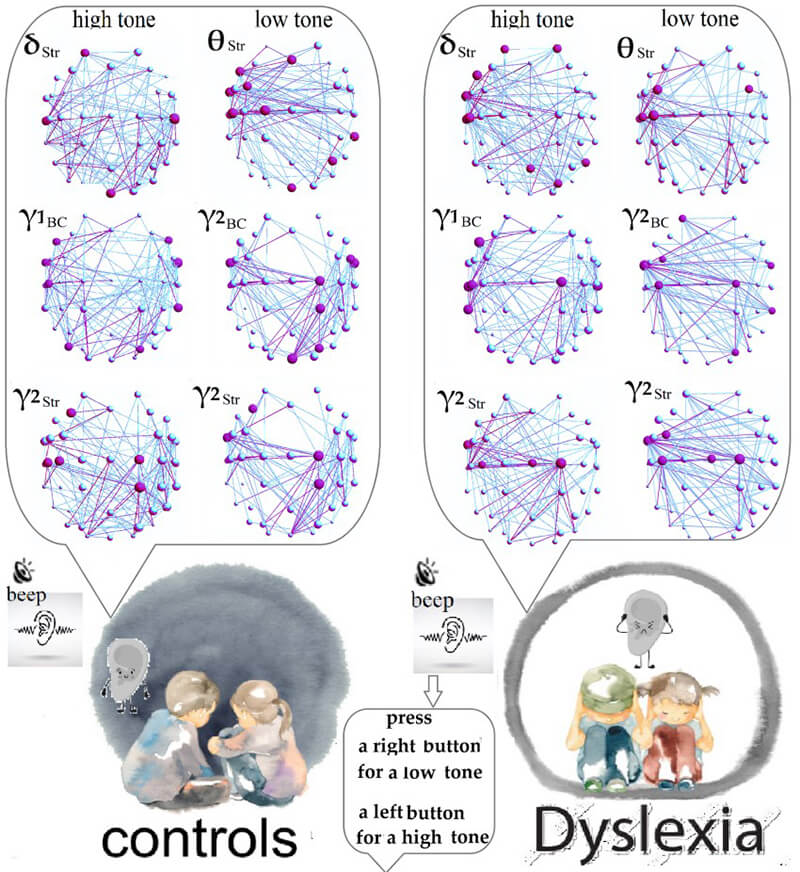
Tihomir Taskov from the Medical University of Sofia and Juliana Dushanova from the Bulgarian Academy of Sciences published an article entitled “Pure-Tone Frequency Discrimination and Auditory Functional Connectivity in Developmental Dyslexia” in Volume 24, Issue 10 of the Journal of Integrative Neuroscience (JIN).
This study compares brain network connectivity during an auditory tone-discrimination task between a control group and individuals with developmental dyslexia.
The experimental task:
Participants must distinguish between high and low "beeps", pressing specific buttons for each. The study uses scalp coordinates to map functional connectivity across three key frequency bands:
Delta (δ: 1.5–4 Hz): Tracks speech "beats" and stress patterns;
Theta (θ: 4–8 Hz): "Chunks" sounds into syllables; essential for phonological processing;
Gamma (γ1: 30–48 Hz; γ2: 52–70 Hz): Processes fine-grained phonemes (e.g., "t" vs. "p").
Key metrics and findings:
The diagrams measure network "health" through two primary measures: Strength (Str), the intensity of communication between brain regions. Betweenness Centrality (BC), the importance of specific regions acting as information "hubs".
Results:
The Control Group displays dense, well-defined connectivity that shifts distinctly between high and low tones. The group with dyslexia exhibits altered connectivity, particularly in δ, θ, and γ sub-bands. This impairment may contribute to impaired auditory discrimination, effectively making the auditory world feel "noisy" or blurred—a struggle symbolized by the overwhelmed children in the illustration.
Read the article:
Pure-Tone Frequency Discrimination and Auditory Functional Connectivity in Developmental Dyslexia: https://www.imrpress.com/journal/JIN/24/10/10.31083/JIN42398
Related article:
Movement Sonification During Haptic Exploration Shifts Emotional Outcome Without Altering Texture Perception: https://www.imrpress.com/journal/JIN/24/10/10.31083/JIN43841
Inactivation of Dorsolateral Prefrontal Cortex During Auditory Working Memory: https://www.imrpress.com/journal/JIN/24/7/10.31083/JIN38877
Evaluation of Auditory Evoked Potentials in Neuromyelitis Optica Spectrum Disorder: https://www.imrpress.com/journal/JIN/24/4/10.31083/JIN27733