
Pathophysiological Divergence Between Vascular and Post-Stroke Dementia: Bridging Human and Experimental Perspectives—Graphical Abstract
Ji Hyeon Ahn, Myoung Cheol Shin, Dae Won Kim, Ki-Yeon Yoo, and Moo-Ho Won published an article entitled “Pathophysiological Divergence Between Vascular and Post-Stroke Dementia: Bridging Human and Experimental Perspectives (https://www.imrpress.com/journal/JIN/24/10/10.31083/JIN45565)” in Volume 24, Issue 10 of the Journal of Integrative Neuroscience (JIN).
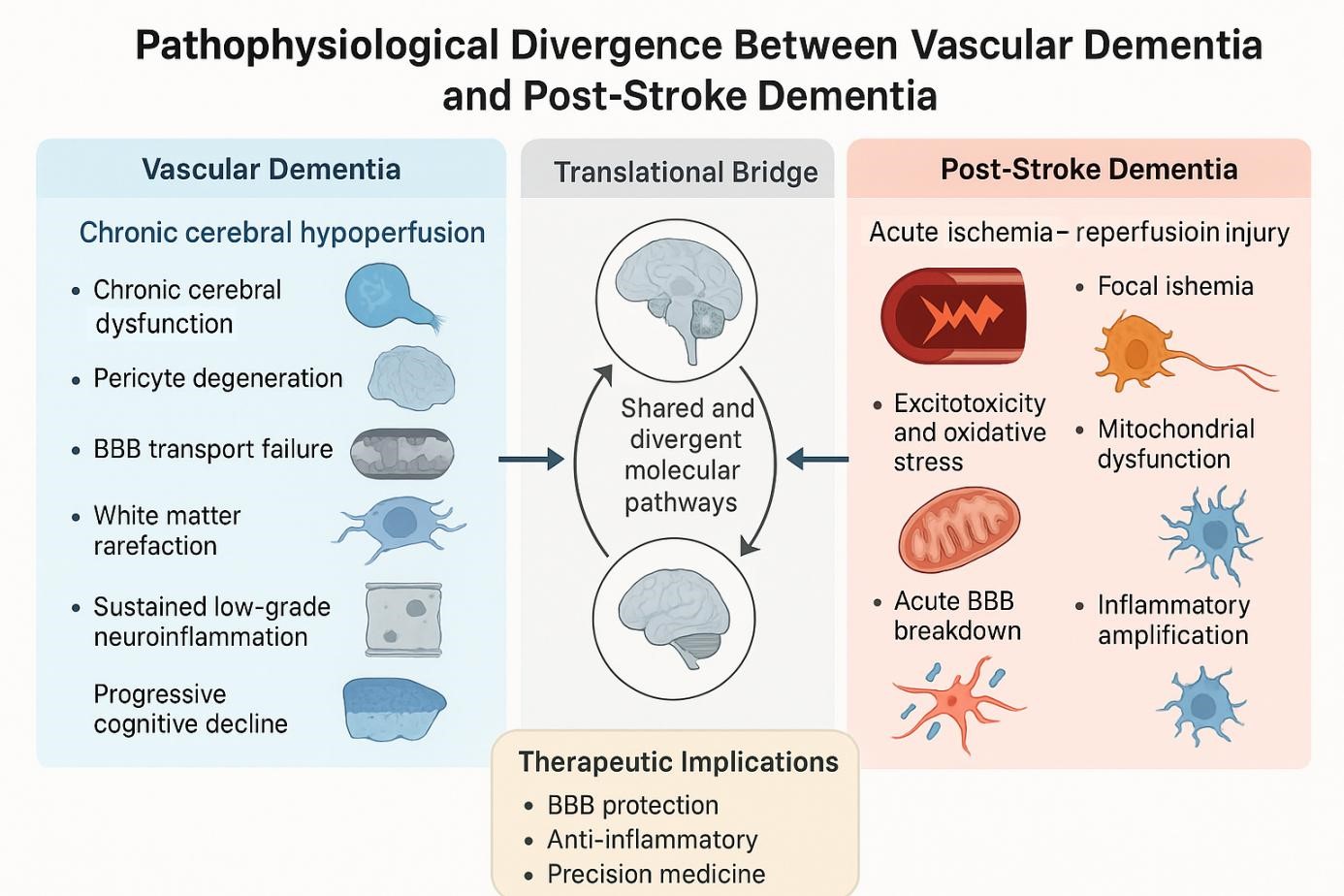
Pathophysiological divergence between vascular dementia and post-stroke dementia. Vascular dementia is primarily driven by chronic cerebral hypoperfusion and long-standing vascular dysfunction, leading to endothelial senescence, pericyte loss, and progressive impairment of blood–brain barrier (BBB) transport functions. These changes preferentially affect white matter integrity and promote sustained, low-grade neuroinflammation, resulting in gradual cognitive decline.
In contrast, post-stroke dementia arises from acute focal ischemia followed by reperfusion, triggering excitotoxic glutamate signaling, oxidative stress bursts, mitochondrial dysfunction, and abrupt BBB breakdown. These mechanisms cause region-specific neuronal death, particularly in the hippocampus and cerebral cortex, and are associated with robust microglial activation and inflammatory amplification.
The central panel highlights the translational bridge between human studies and experimental models, emphasizing convergent and divergent molecular pathways identified through neuroimaging, biomarker analyses, and preclinical ischemia or hypoperfusion paradigms. Understanding these distinct yet overlapping pathophysiological trajectories provides a conceptual framework for targeted therapeutic strategies, including BBB protection, inflammation modulation, and precision medicine approaches tailored to dementia subtype–specific mechanisms.
Read the article:
Pathophysiological Divergence Between Vascular and Post-Stroke Dementia: Bridging Human and Experimental Perspective: https://www.imrpress.com/journal/JIN/24/10/10.31083/JIN45565
Related article:
Neuropeptides as Potential Biomarkers in Vascular Dementia: https://www.imrpress.com/journal/JIN/23/3/10.31083/j.jin2303066
A Preliminary Finding: N-butyl-phthalide Plays a Neuroprotective Role by Blocking the TLR4/HMGB1 Pathway and Improves Mild Cognitive Impairment Induced by Acute Cerebral Infarction: https://www.imrpress.com/journal/JIN/23/8/10.31083/j.jin2308158
Comparative Evaluation of the Montreal Cognitive Assessment Basic Scale Against the Mini-Mental State Examination for Post-Stroke Cognitive Impairment: https://www.imrpress.com/journal/AP/26/2/10.31083/AP39895