

 , Klarissa Lueg 2
1 Bavarian Research Institute for Digital Transformation, 80333 München, Germany
2 Department of Design, Media and Educational Science, University of Southern Denmark, 6400 Sønderborg, Denmark
Abstract
Digital transformation has the potential to fundamentally change organizations, to alter working conditions, and to redefine core employee competencies. Such changes may spark novel dynamics between employee groups. In this study, we focus on engineers as a professional group that is particularly affected by these changes and examine emerging group dynamics in response to digital transformation. Drawing on a qualitative case study, we investigate how engineers construct group identities and status in relation to the increasing importance of software experts. We show that engineers experience digital transformation as an identity threat that leads to a pronounced awareness of their professional habitus and an identity (re)negotiation. If not approached carefully, digital transformation may trigger adverse group dynamics and jeopardize the overall transformation process.
Keywords
- digital transformation
- professional habitus
- group identity
- intergroup relations
- organizational change
The fast and expansive advancement of digital technologies (e.g., artificial intelligence, cloud computing, or the internet of things) is moving entire industries and is changing organizations and workplace conditions alike. On an organizational level, digital technologies enable process innovations but are increasingly also used for production innovations, such as novel digital product features, services, or entirely new business models. This introduces a new level of organizational change. While digital process innovations were always aligned to internal organizational changes, these mostly supported an organization’s core activities. In contrast, using digital technologies for profound innovations in products, business models, or business value affects the organization at its core (Wiesböck and Hess, 2020).
Information system scholars suggest differentiating between two concepts of digital change: IS/IT-enabled organizational transformation (ITOT) focuses on digital process innovation aimed at improving efficiency (Besson and Rowe, 2012), while digital transformation (DT) describes digital technology-induced organizational change that also entails redefining an organization’s value proposition (Carroll et al, 2023; Hess, 2022; Vial, 2021). As a far-reaching organizational change (Vial, 2021), DT can potentially disrupt established social relations and organizational routines, and may call organizational identity into question (Graf et al, 2022; Graf et al, 2023b). It is only consequential when it is argued that DT is “one of the biggest challenges that companies currently face” (Hess et al, 2016, p. 123). Challenges arise from DT being a non-linear and iterative process in which strategic management endeavors are both complemented and sometimes contradicted by bottom-up initiatives and social dynamics (Graf et al, 2023a; Sciuk et al, 2023).
DT does not only pose challenges for organizations as a whole but also significantly impacts members on a group level (Lueg and Jebsen, 2024). Facilitating digital innovations in the course of DT comes with a demand for new skills and is often accompanied by organizational restructuring. New positions, roles, and functions are introduced, while established hierarchies and the distribution of power and legitimacy are called into question (Lueg and Jebsen, 2024).
This inevitably affects employee group identities, impacting how they perceive their standing and value. It is well-documented that organizations need to tread carefully when introducing new groups of professionals (Britto et al, 2018; Nguyen and Vu, 2023; Rasmussen, 2024; Watkins, 2013). While personnel changes often cause tension, hostilities, “fractured” identities (Gilmore and Harding, 2022) as well as dysfunctional team structures and processes, this risk is amplified in times of substantial transformation, as embodied by DT.
Employees are concerned about their identity, about who they are as a group, and tend to cling to the social group in the organization they feel they belong to (Langley et al, 2012; Zaheer et al, 2003). Employees might even fear that their skills lose value for society beyond the organizational context (Abbott, 1988). The transformation and how employee worth is constructed in its wake might cause tension between established employees and employees who are perceived as representing the change. This might jeopardize performance and the overall transformation process. While struggles over power, recognition, and position among employee groups are well-documented (Langley et al, 2012; Wilke, 2018), we lack knowledge about how DT affects employees’ professional sense of self-worth and identity and how employees’ responses affect DT implementation.
This study empirically examines DT-prompted changes on an intra-organizational group level. We concentrate on a specific group that has been and is closely affected by DT in their everyday work and the construction of their profession, namely university-educated German engineers. For centuries, engineers have embodied technical knowledge and expertise, having been regarded as the “technical elite” (Gould, 1966). They are a striking example of employees affected by DT, since their skills and competencies are in the technological domain. While engineers’ academic education increasingly includes digital technologies, their expertise is still primarily in mechanics and electrical engineering. Now they face new challenges due to the demand for digital skills and are confronted with an emerging and growing group of experts specialized in digital technologies (e.g., computer scientists, software engineers, and data analysts). We investigate how experienced engineers deal with organizational change in the course of DT and how they perceive and construct their group identity and position relative to software experts.
The study is guided by the research question: How do engineers respond to an organization’s digital transformation?
To understand how the engineers construct their group identity vis-à-vis the new software experts, we employ theories from sociology and social psychology. We refer to Bourdieusian notions of habitus and field as well as social identity theory (SIT). Our empirical sample consists of mechanical and electrical engineers employed at a German engineering company where they have over time represented the company’s core profession. In 2017, the company introduced a far-reaching DT process that comprised funding a new digital unit that was positioned as being responsible for digital innovation that would be vital to the company’s transformational success.
We observe the emergence of conflict-laden group dynamics accompanied by an awareness process regarding the engineers’ professional habitus as well as a renegotiation of their group identity and status. Understanding these engineers’ response to potentially profession-changing DT provides insight into how professional groups deal with this kind of transformation. It also indicates how such responses can affect DT development and implementation, functioning as a revelatory case study for approaching other groups and settings during change (Yin, 2018).
The study is structured as follows: First, we elaborate on the core ideas of the selected theories (Section 2). In Section 3, we outline the methodology and contextualize our case by reflecting on the professional group of German engineers and the organizational setting (Section 4). Following this, we present the findings (Section 5) and discuss them against the core pillars of the theoretical framework (Section 6). Finally, we reflect on our contribution and this study’s theoretical and practical implications (Section 7).
Our study is situated in the field of organizational behavior studies and is “concerned with the behavior of […] groups in an organizational context” (for an overview of contemporary definitions, see (Smith et al, 2021, p. 2). Our focus is on organizational behavior as the “study of human behavior in organizational settings, the interface between human behavior and the organization, and the organization itself” (Griffin et al, 2017, p. 4), where meso-level studies are practiced regularly. A dominant assumption in organizational behavior studies posits that people in organizations “will often act out of habit and tradition” (Smith et al, 2021, p. 12) and, to a lesser extent, pursue economic rationales (DiMaggio and Powell, 1983; Knights and Willmott, 1999). This perspective is supported by (new) institutional theory, largely inspired by Bourdieusian theory (DiMaggio, 1979; DiMaggio and Powell, 1983; Greenwood et al, 2017; Wang, 2016; for an overview see Lueg, 2018).
We follow Emirbayer and Johnson’s call (2008) that more prominence should be given to the original Bourdieusian theory in organization studies. We therefore employ Bourdieusian concepts of “habitus” and “field” (Bourdieu, 1984; Bourdieu, 1998) to understand the engineers’ response to DT. While the concept of habitus helps unpack engineers’ (pre)conscious dispositions, theorizing organizations as social fields allows us to grasp DT’s complexity by emphasizing intra-organizational group dynamics as a negotiation of identities and interests (Graf, 2025).
From here, we turn to social identity theory to examine intergroup relations in more detail. We use it to investigate the engineers’ identity construction and identity work related to their profession, including parameters such as social status and power (Tomo, 2019). We bring these two concepts together as we propose that DT entails stark consequences for engineers’ professional identity as they challenge the understanding of “who we are”. In consequence, it triggers identity-related responses from groups directed toward other groups. Although several empirical studies consider employees’ identity work, they scarcely focus on profession-based identity constructions in the context of organizational change.
With his concept of habitus, Bourdieu points to a mechanism that guides social practice. It describes an incorporated “scheme of perception, thought, appreciation and action” (Bourdieu, 1977, p. 35) developed in the course of socialization processes. When individuals occupy similar positions in society (e.g., belonging to the same social group) and share contextual experiences, they develop similar habitus (group habitus), leading to similar worldviews and behavior. The group habitus reflects how group members have internalized the implicit and explicit norms, values, and (power) structure of their specific field, which Bourdieu called the rules of the game (Bourdieu, 1984; Bourdieu, 1996).
This line of thinking can be employed when analyzing occupations and professions. Though a definition of professional habitus is lacking, several studies have deployed this notion in reference to Bourdieu to describe behavior that is considered legitimate in a specific field. Fraysse and Mennesson (2016) show that journalists with intense socialization in and commitment to the field of sports journalism perpetuate stereotypical gender norms. Spence and Carter (2014) explore the professional habitus in the field of corporate accounting and analyze what employees perceive to be the necessary characteristics for career success. The notion of professional habitus is used to describe the recognition of group belonging as well as legitimate behavior and hierarchies. We suggest that professional habitus is a practical sense of rules, values, skillsets, demands, and manners in a specific professional field (also see Bourdieu, 1990). However, members of one profession do not necessarily consciously subscribe to the social categorization of habitus. In this study, we read habitus as an academically construed category that can be enacted subconsciously.
Since professional groups such as engineers undergo similar educational trajectories, we assume that they develop a specific professional habitus by internalizing the rules of the game and developing a sense of their group’s social status. This professional habitus frames and guides professional thinking and acting in an organizational context (Bourdieu, 1987).
Referring to Bourdieu’s concept of social fields (Bourdieu and Wacquant, 1992), we follow the suggestion of Emirbayer and Johnson (2008) and conceptualize an organization as a social field (see Graf, 2025) to focus on intergroup power relations and inequalities (Lueg, 2025). In Bourdieu’s understanding, a social field provides the structural frame for social practice (Bourdieu and Wacquant, 1992, p. 97). Field members compete in order to reach or preserve favorable positions. Social behavior in a particular organization/field is therefore shaped by habitus as well as group positioning (Lueg, 2022; Lueg and Lueg, 2015). This perspective on power struggles is similar to other organizational theories, such as the concept of collective action by Crozier and Friedberg (1979). To them, organizations are realms of micropolitics and power struggles arising from the distribution of resources, and from individual strategies and interests. Bourdieu’s concepts however allow a unique consideration of motives and interests rooted in field position and professional habitus. Since our focus is on the (possibly preconscious) group behavior of a distinct professional group, it makes Bourdieusian theory an appropriate match.
The professional habitus is a subtle mechanism that influences how professionals perceive their work and what they deem as valuable, proper, and legitimate behavior. The habitus impacts the group’s identity work (Langley et al, 2012), which is why we turn to group identity and identification as complementary concepts. These notions are central to SIT (Tajfel, 1978; Tajfel and Turner, 1979; Tajfel and Turner, 2004) as well as anthropological considerations of ethnicity and boundary-making (Appiah and Gates, 1996; Eriksen and Jakoubek, 2018; Erikson, 1968; Woodward, 2004). SIT postulates that any sense of self, of group belonging and value, is construed against a group of others—the outgroup. A conceptualization of “the other” as a central reference point is lacking in Bourdieu’s work, which is why we link these two theoretical streams.
While an elevation of self-worth through negative comparison to others (in Bourdieusian works mostly members of lower social status) is discussed as “distinction” (Bourdieu, 1984), we find that the SIT notions of ingroup and outgroup provide sufficient understanding without going into the empirical details of Bourdieusian social structure (meta-)observation.
Since Tajfel and Turner (1979) proposed that identifying with a specific group (the ingroup) inevitably constructs an outgroup of the others, they assume that “[i]ndividuals strive to archive or maintain positive social identity” (Tajfel and Turner, 2004, p. 284), by favorable comparison to the outgroup. According to them, a group that experiences a devaluation of social status by comparison with another group will mainly pursue one of two possible strategies. One is social competition, where members strive to redefine the criteria for group comparison in their favor. The other is social competition, meaning direct devaluation of the outgroup, which can cause social conflict. SIT provides several suggestions to influence intergroup relations positively. One possible way to prevent prejudice and negative assessments is called “recategorization”. It aims to unite distinct group identities into one common, superordinate group identity to foster a common sense of belonging (also referred to as the “common ingroup identity model” Gaertner et al, 1993).
The anthropologist Thomas Hylland Eriksen theorized group identification with a similar outlook, saying that it is rooted in “we-hood” and “us-hood” (Eriksen, 1995). We-hood means that a group develops a sense of belonging because of a common activity (examples could be sports, work tasks, or education). Us-hood describes how a group develops a sense of belonging when contrasting with another group (often negatively). He describes two methods of handling group contrasts: The method of “dichotomization” (Eriksen, 1995, p. 435) fits this contrast, which often results in a confrontational and negative form of us-hood. On the contrary, “complementarization” (Eriksen, 1995, p. 434) is a method for handling group contrasts in a non-conflictual way by emphasizing complementarity instead of threatening traits of “the other”. Although these concepts have been developed with a view to a specific ethnic conflict constellation (boundary-making on Mauritius), we propose that the professional bond of German engineers in a traditional corporate setting is strong enough to employ these anthropological thoughts.
To explore the engineers’ response to DT and the emerging group dynamics empirically, we chose the organizational setting of a German engineering company. Engineering companies have a strong technology focus, but not primarily in the digital domain. Their core competencies are physical-technical, while software and digital technologies so far played a supportive role. In these companies, mechanical and/or electrical engineers hold a key position, as they embody these technical competencies. Resulting from an increased focus on digital value creation and new digital skills being in demand, this social status may change.
We conducted a qualitative case study to examine (mechanical, electrical, mechatronic) engineers’ response to the company’s DT attempt. Case study research design is suitable for capturing organizational change (Yin, 2018) and its impact in detail.
The data was collected from semi-structured interviews with 42 university-educated engineers from different departments, locations, and hierarchy levels at the company. Almost half (n = 18) of them worked in research and development, while others were from other departments, such as sales, aftermarket, or procurement. The interviews were conducted by online conferencing, video recorded, and transcribed verbatim (average length per interview: 69 minutes). The authors translated German quotations. The interviews were randomly numbered to maintain the interviewees’ anonymity (ENG = engineer).
For data analysis, we conducted thematic analysis (Clarke and Braun, 2017; Guest et al, 2012; Wheeler, 2022). In the broadest sense, a theme “captures something important about the data in relation to the research question, and represents some level of patterned response or meaning within the data set” (Braun and Clarke, 2006, p. 82). Thematic analysis is assumed to capture both conscious and tacit information and suits the outlined theoretical perspectives. In this case, themes point at different aspects of the engineers’ (pre)conscious professional habitus that implicitly become apparent in the interviews and conscious expressions of identity and group positioning.
We researched our case through theoretical presuppositions, leaving room for exploration during data collection and analysis (Nair et al, 2023). We coded the interviews deductively, using the research question as a point of departure, and complemented the approach with inductive coding. Codes were grouped into themes whenever a logical cluster could be identified. Table 1 provides selected coding examples for the engineers’ professional habitus and social identity themes.
| Meaning unit | First-order code | Subtheme | Main theme |
|---|---|---|---|
| “A typical engineer, for me, is a problem solver. No matter in which field he is engaged, it is about solving problems with his know-how, so that in the end there will be a practical outcome, something that works.” | Problem solving as practical outcome | Problem solving | Professional mission |
| “… [R]ational and evidence-based thinking …. A good engineer thinks very structured and goes from A to Z to solve problems.” | Problem solving through structured and evidence-based thinking | Analytical mindset | Professional mission |
| “[I]t’s primarily about structural thinking, being able to delve into tasks, this specific working approach.” | Structural thinking as specific working approach | Analytical mindset | Professional mission |
| “[T]his practical thinking is totally my thing. At the same time, it is also this sort of scientific approach. It’s not just trial-and-error, but somehow well-founded trial-and-error.” | Combination of practical thinking and scientific approach | Purposeful tinkering | Professional mission |
| “The ultimate focus is on the solution. There is a problem and a solution needs to be found for it. This ability and this drive to find the solution is strongly pronounced among engineers.” | Problem solving as passion | Problem solving | Professional mission |
| “I’m curious. I’d like to know what’s behind it …. Curiosity to understand how things work, the joy of technology—that’s what it´s all about.” | Curiosity and passion for technology and its functionality | Technology enthusiasm | Professional vocation |
German engineers historically represent a unique group in terms of status and professional identity. They emerged as a professional group in the mid-19th century. In the early stages, the group was heavily influenced by the “engineer-entrepreneur” archetype (“Ingenieur-Unternehmer”) (Hortleder, 1970, pp. 31 ff.). These individual pioneers successfully leveraged scientific and technological discoveries to establish their own companies and cofound entire industrial sectors, such as the chemical, electrical, and automotive industries. They were characterized by their enthusiasm for technology and excelled at transforming these innovations into business models. Back then and still today, they position themselves between the activities of theoretical knowledge generation and practical knowledge application (König, 1999; Paulitz, 2012). Despite primarily identifying themselves with technology matters and the image of the pure technician, they established a strong connection to entrepreneurship from the very beginning.
With the late 19th century’s industrialization, alongside the emergence of large corporations and mass production, engineers’ position and function changed significantly. They were increasingly employed in salaried positions, which signified a lower professional status. Nevertheless, they distinguished themselves from workers and viewed themselves as managerial employees who performed constructive and analytical tasks close to corporate management (Hortleder, 1970, pp. 37 ff.; Siebel, 1962).
In terms of societal status, engineers often felt undervalued because they did not have the status of a full profession (Hortleder, 1970). Their status increased notably after World War II, as engineers played a key role in Germany’s reconstruction. From the 1960s onwards, engineers were granted status as an academic profession. Technical colleges were granted university status (Lundgreen, 1994; Neef, 1982) and since 1965, a law has regulated who is allowed to call themselves an engineer in Germany. To this day, the title ‘engineer’ is reserved for people with a minimum three-year university degree.
In recent decades, the engineering profession gained status and is held in high esteem in German society (Gispen, 2009; Manager Magazin, 2005). In industrial companies, intra-organizational restructuring processes driven by the increasing complexity of products and the organizational environment have however led engineers to experience “a loss of autonomy in work […] due to the standardization of processes and embeddedness in worldwide networks” (Will-Zocholl, 2011, p. 123) and perceived job insecurity. At the same time, engineers are increasingly expected to possess management and soft skills. Will-Zocholl (2011) terms this shift “enucleation”, highlighting the growing relevance of non-technical issues such as communication, coordination, and interdisciplinary cooperation. Nevertheless, Paulitz and Prietl (2017) argue that these elements are still framed as supplementary to technical expertise, which illustrates that the professional identity of the pure technician remains highly relevant even in times of change.
Throughout the 20th century, German engineers as a professional group were characterized by ambivalences in terms of social status and professional identity. Positioned between dependent employees and management as well as between a theoretical/academic and practical orientation, their technical orientation remained the defining characteristic. Against the backdrop of this hybrid positioning, engineering is argued to be a paradigmatic case for analyzing boundary-drawing processes (Downey and Lucena, 1995, p. 167). Recent research however mainly focuses on the dualism of the social versus the technical, or on gender construction in the context of the engineering profession (e.g., Faulkner, 2015; Paulitz, 2012; Prietl, 2016; Zachmann, 2004). To our knowledge, boundary-drawing processes in the profession in response to newly introduced technology have received little attention. Our study therefore focuses on the relationship between “classical” engineers and software experts and how they position themselves in response to digital technology.
Our study took place at a traditional German engineering company, which we call EngineeringCo. It employs about 3000 people and generates an average annual revenue of 600 million euro. The company has a 150-year history, was founded by an engineering pioneer and is a market leader. While the headquarter is in Germany, the company operates globally. EngineeringCo fostered for some years digital product innovations in order to stay competitive.
To reconstruct the company’s DT, we used archival data (e.g., internal communication by management, website, and annual reports) and triangulated it with the interview data (Yin, 2018). The company’s DT process has two distinct phases (For a more detailed analysis of the company’s DT process, see Graf et al, 2023b).
In 2017, a first attempt at DT was made by establishing an internal unit for digital product innovations. A small team was deployed, composed of engineers with an affinity for digital topics who were transferred from other units as well as newly hired team members. This digital unit was to serve as an innovation hub for the company’s DT.
To facilitate digital innovations, the team worked detached from day-to-day business, set off from performance and market pressure, and was encouraged to use new forms of work organization (especially agile project management) comparable to forms of work employed in startups. The overall goal was to shift the product portfolio toward digital and digitally enhanced products and to transform the classic engineering company “into a software company” (ENG-5), as one engineer explains.
This first DT attempt failed due to various reasons, such as conflict between this digital unit and the classical engineers from other departments. After less than two years, the digital unit was dissolved and DT was put on hold, while digital innovation continued scattered over the company in a relatively unstructured manner.
Since 2020, EngineeringCo has been making a second DT attempt, structurally implemented in an integrated manner. To drive DT processes, the position of chief digital officer (CDO) was established in 2020. The new CDO was a mechanical engineer and used to work at the company before gaining experience in managing DT processes elsewhere. His professional background and history with the company were supposed to lead to higher acceptance and commitment.
The CDO used an informal and integrated network approach, which meant that digital topics should become relevant in all areas and at all levels simultaneously. Digital ambassadors were appointed across the company to introduce digital topics and coordinate related processes. To reach the goals associated with DT more strategically, various measures were developed and implemented (e.g., a digital roadmap and strategy).
The company has developed digital features and additional services for some of its products and experiments with digital technologies, such as artificial intelligence, the internet of things, cloud computing, and digital twins. Besides products and services, internal process digitalization are also pushed forward. In this context, hierarchical structures and work practices were also reorganized. Even though this phase is not yet complete, a higher level of acceptance can already be observed compared to the first phase.
Soon after the foundation of the new digital unit (from here: digital-group), the longstanding engineers from other departments (from here: engineer-group) started perceiving digital-group as a fundamental threat to their previous status, using descriptions like “the shiny digital guys versus us” (ENG-14). The engineer-group felt that they were assigned to “the old stuff” vis-à-vis “the new kids, the agile, modern ones” (ENG-35) along with a degradation of their status. They regarded the digital-group as a “guerilla project” (ENG-15) that “creates an atmosphere of rivalry” (ENG-35). An engineer expresses it as follows:
“They got really great young employees, they got a ton of money and a lot of attention. […] [T]hose who have earned money so far and those who also earn money for the digital guys now sit there and say, ‘Hey friends, this cannot be. I have to deal with the old stuff now. And they are in the spotlight with the money that I have earned.’” (ENG-14).
This quote displays the intergroup conflict associated with social competition. The situation caused a strong tendency toward us-hood among the engineer-group, with the digital-group construed as an opposing outgroup. They were perceived as invaders who were “following another mission than the remaining organization, à la ‘we create innovation, but we have nothing to do with the traditional stuff’” (ENG-40). The previous more preconscious habitus increasingly became subject to conscious discourse and the engineers’ sense of belonging strengthened.
The conflict escalated and the engineer-group refused to collaborate. In the end, the DT attempt failed because the engineer-group rejected it as “disruptive” (ENG-35). The conflict led to the digital unit being disbanded after less than two years. The intergroup conflict was resolved through the dissolution of the outgroup and the classical engineers could defend and retain their professional status.
Overall, the first DT attempt led to the construction of a distinct ingroup/outgroup relation and to intergroup conflict. The group dynamics also caused an awareness and reinforcement of the engineer-group’s professional habitus and group identity.
Our data shows that the engineers’ habitus evolved into an explicit subject of discourse. Their shared group identity was strengthened during the company’s DT due to the perceived threat of the growing significance of software experts.
Concerning the established engineer-group’s professional habitus and group identity, our thematic analysis reveals three overarching themes (Fig. 1). The first theme refers to the engineers’ perceived professional vocation, expressing their shared disposition. The second theme points to their professional mission in terms of their mindset and professional acting modes, which are entangled with their professional practice. The last theme addresses their perceived position and status within the company.
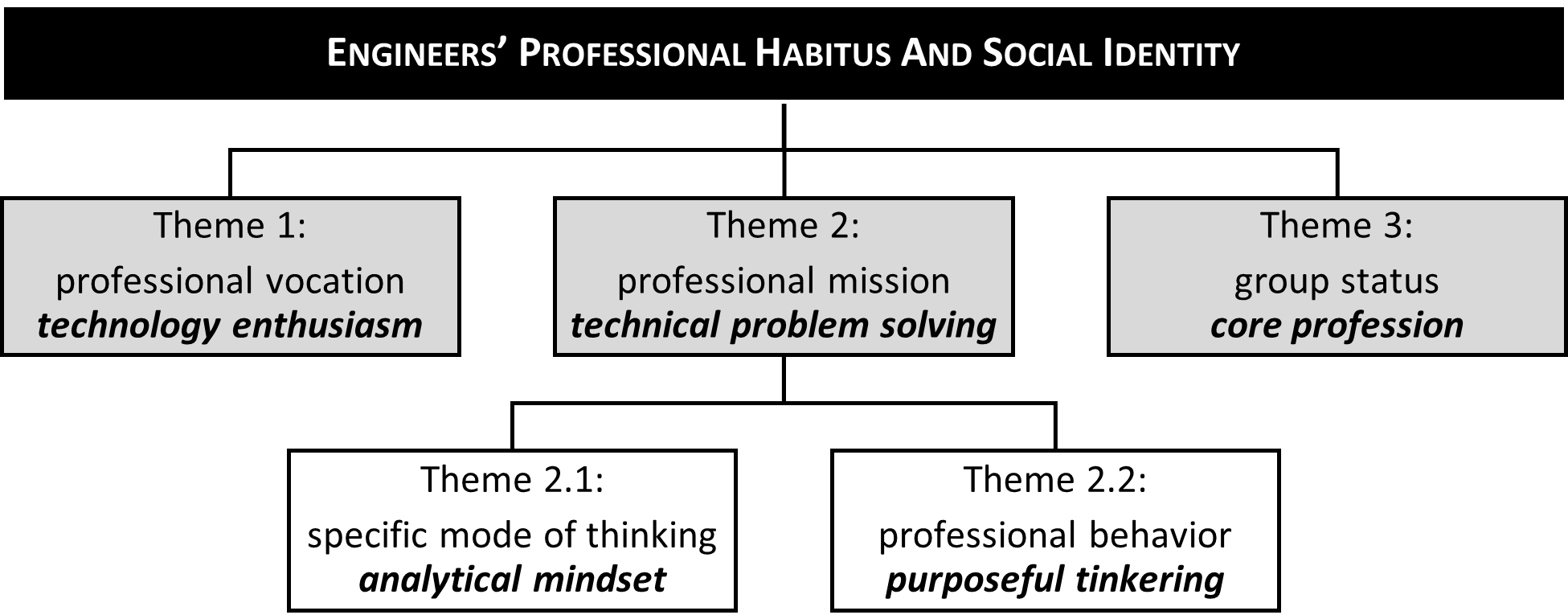 Fig. 1.
 Central themes of the engineers’ professional habitus and group identity.
Regarding the first theme, the interviewees emphasized their professional vocation in the sense of technology enthusiasm. Their general disposition toward their profession, that unites them, is described as a fascination and interest concerning technology. They aspire to a deeper understanding of the technical contexts, the underlying (inter)relations, and functionalities and regard an engineer as an “allrounder” (ENG-5) who is not only an expert on a specific technical issue but rather a professional with expertise and deep knowledge of the entire technical system and process.
Their technology enthusiasm is also reflected in their close connection to and affection for their product—“an engineer is immersed in the product” (ENG-20). The interviewees describe engineers as “hands-on-guys” (ENG-24) who are “close to the factory” (ENG-38) and are not satisfied until the product works or has been improved. One interviewee states: “It is not just about putting my ideas on a drawing board and then having others produce it and looking at the final product. I like to stand in the dirt myself, so to speak, and somehow work out the things” (ENG-6). It is the physical product and its functions that grab their interest. They aim to create something concrete, “something tangible” (ENG-3) that provides value and benefit. Their products should improve clients’ lives by solving their problems or enhancing their utility.
The second theme points to the engineers’ professional mission. They claim to be professional problem solvers and solution providers. As one engineer puts it: “A typical engineer, for me, is a problem solver. No matter in which field he is engaged, it is about solving problems with his know-how, so that in the end there will be a practical outcome, something that works” (ENG-6). Solving problems is regarded as a passion, a personal challenge that is accepted with pleasure.
While problem solving can be regarded as an umbrella theme, two related subthemes could be identified, referring to the professional mindset and behavior. The interviewees frequently emphasized the engineers’ specific mode of thinking, characterized by logical reasoning described as a “structured” (ENG-18) and “rational and evidence-based” (ENG-29) approach. This analytical mindset is connected to both perfectionism and responsibility: “An engineer wants to achieve 120%” (ENG-42); things have to be “completely thought through from A to Z” (ENG-29) and “cognitively planned in advance” (ENG-18) to anticipate consequences, as this quote indicates:
“We want to do things responsibly, not rashly and dangerously. So, while you’re doing all these new and exciting things, always stop and think about the consequences. […] There’s also a high sense of responsibility to do your job well and to do it accurately and check each other’s work.” (ENG-4).
In contrast to their professional mode of thinking, where precision and preplanning are emphasized, the engineers describe their professional behavior as pragmatic and improvisational. We labeled this theme purposeful tinkering. This practical sense and non-random figuring out are seen as defining characteristics. Based on their know-how, it is described as a peculiar “scientific approach—not just trial-and-error, but somehow well-founded trial-and-error” (ENG-6). The focus is on finding new or better ways by referring to explicit as well as tacit knowledge about machines, processes, and functionalities. Moreover, the interviewed engineers emphasized the importance of teamwork and communicative competence as an essential part of their professional behavior to grasp the problem in its full complexity and interrelatedness.
A third theme refers to the engineers’ perception of the company and their status. They regard themselves as the organization’s core profession, associated with a claim of high status and autonomy. One interviewee said: “We’re an engineering-driven company. That means engineering is the centerpiece and all other operations must support it” (ENG-12). The organizational structures are regarded as a structural frame for facilitating their professional work and ambitions. An engineer explains that the company offers him “the opportunity to pursue my passion for tinkering” (ENG-42). The engineers emphasize that they possess a high degree of autonomy regarding their work conditions, for example in terms of flexible working hours, work mode, and management. “We have a lot of freedom. We can decide a lot ourselves, and the responsibility is given to us” (ENG-29). Their status claim is also reflected by their closeness to management. Managerial tasks and project management are considered engineering tasks, and holding a leading position or mentioning a management position as a career goal is considered normal.
These themes express the engineers’ professional habitus as their internalized and incorporated professional position and disposition, which carries many of the issues that have characterized the profession. Theme 1 (professional vocation) is closely linked to the claim of being pure technicians, while theme 2 (professional mission) strongly reflects their positioning between theory and practice, and the connection to the archetype of engineer-entrepreneur who aims to bring technical inventions to life and create value for customers. The reference to teamwork and communicative competencies, on the other hand, points to the new requirements in their work practice. Theme 3 reflects their perception of their social status at the company, which is also found throughout the profession’s history. Despite typically holding employee positions, they perceive themselves as key figures at the organization, maintaining a close connection to the leadership.
While the first DT attempt led to conflict-laden group dynamics between the engineer-group and the digital-group associated with an increasing awareness of the engineers’ professional habitus and an emphasis and reinforcement of a shared group identity, the second transformation phase is more complex. We observe discourses in terms of an open process of sensemaking about the group identity and status of the technical professionals, displaying approaches of categorization and recategorization simultaneously.
The structurally integrated DT approach is lacking a distinct opponent group, sparking a rethinking and renegotiation of the engineers’ group identity in relation to that of the software experts. In our interview material, we identify two opposing stances among engineers when it comes to software experts. The first subgroup distinguishes itself from software experts, while the second integrates them into their own professional group.
The first subgroup emphasizes a clear distinction between engineers and software experts, for example in the statement “They are like fire and water” (ENG-41). Several issues were brought forward as distinctive characteristics in the interviews. These are linked to the engineers’ professional habitus and identity themes and can be interpreted as a kind of boundary work to defend their identity and privileged status. Table 2 summarizes these distinctions.
| Engineers | Software experts |
|---|---|
| Theme 1: Professional vocation | |
| allrounder (entire context) | specialist (isolated problems) |
| hands-on | mental work only |
| relation with the outside world | “nerd” |
| Theme 2: Professional mission | |
| Theme 2.1: Specific mode of thinking | |
| perfection | trial-and-error |
| Theme 2.2: Professional behavior | |
| purposeful tinkering | creativity, go-for-it |
| collaboration | work in isolation |
The main distinctions relate to the professional vocation (Theme 1). While the interviewed engineers understand themselves as “allrounders” with an eye on the entire development process and are interested in the underlying technical mechanisms, they consider software experts to be specialized and only interested in software issues. Software experts are said to work in isolation on their specific problem without a deeper understanding of the context to which the software is applied, which is the machine. Moreover, software experts are accused of lacking practical orientation and a sense for the whole physical product. One interviewee argues: “I think a typical computer scientist is someone who has nothing to do with reality. And he is completely satisfied with it and thinks he is doing great things. But when installing his software, you pull your hair out because you think it can’t possibly work” (ENG-6).
Another distinction is drawn around the professional mission (Theme 2). The competency of technical problem solving is ascribed to engineers and software experts alike. It is emphasized that both aim to solve complex technical problems, but the engineer subgroup highlights differences regarding the software experts’ mode of thinking (Theme 2.1) and professional acting (Theme 2.2). While engineers are said to aim for perfectionism and pay attention to detail, software experts are often described as having a mentality of “trial-and-error” that makes them more agile, but the result may not be perfect. Additionally, while the engineers emphasize purposeful tinkering and collaboration as their core elements of professional behavior, they suggest that software experts tend to work in isolation with a “just go for it” attitude that, while more creative, lacks a sense of responsibility.
The engineers’ ascription to their own group as well as to the software experts carry various normative and evaluative connotations, pointing to attempts to defend their professional status (Theme 3). To distinguish themselves from the software experts, the engineers draw upon specific elements of their historically founded professional habitus and identity. By highlighting differences with respect to the professional mindset and behavior, software experts are accepted as technical experts, but not as full members of the engineering profession in terms of status. While technology enthusiasm and a claim for technical problem solving are attributed to engineers and software experts alike, the emphasis on being allrounders with a strong connection to and responsibility for the whole process and final product points to the engineers’ self-positioning close to corporate management. The engineers’ emphasis on perfectionism and responsibility refers to their positioning between an academic and practical orientation, while they deny the software experts a connection to “real-world” problems.
Contrary to this, the second subgroup of engineers emphasizes the closeness and relatedness between classical engineers and software experts. Both are considered technical professionals due to their know-how and training. Both are said to possess similar modes of thinking and approaches to professional practice. In this context, one interviewee rhetorically asks: “Aren’t computer scientists also engineers?” (ENG-5).
The main difference is the specific knowledge domain and it is often argued that classical engineers and software experts will increasingly draw closer. Despite these similarities, a potential communication problem is assumed, not least due to their different professional languages, which could lead to misunderstandings and conflicts. “Sometimes it’s a bit like siblings. If they are too alike, they get along particularly badly” (ENG-15).
This engineers subgroup generally regards software experts as members of their own profession and does not see any fundamental risk to their own status. By emphasizing their unity, the engineers even seek to secure and elevate their status in response to the increasing significance of digital competencies. While the engineers regard it as evident that more software experts are needed, it is argued simultaneously that digital tasks can increasingly become part of their own responsibility. “This means that an engineer who designs a machine must also ensure that it is a living machine. I am convinced that in the future, mechanical engineers will become able to write program codes as well” (ENG-33). Since digital technologies are primarily viewed as just another type of technology, these are also captured by their own technology enthusiasm and it is just another challenge for them to become familiar with these technologies.
Our analysis reveals that DT is perceived as an identity threat to the established engineers’ group identity and status. The process of DT brings awareness to the previously unquestioned and preconscious professional habitus, leading the engineers to consciously engage with it. Referring to Bourdieu’s ideas, fundamental organizational changes such as DT can be regarded as a crisis (Bourdieu, 1977) that potentially leads to a dissonance between the habitus and the organizational setting, and gives increasing awareness to the previous preconscious habitus (Emirbayer and Johnson, 2008). Bourdieu argues that “breaking the immediate fit between the subjective structures and the objective structure destroys self-evidence” and “brings the undiscussed into discussion, the unformulated into formulation” (Bourdieu, 1977, p. 168). The (supposedly) required new digital competencies prompt the engineers to reflect on their professional beliefs and identity, and necessitate them to position themselves regarding these matters. This fostered we-hood (Eriksen, 1995), as the engineers’ sense of belonging was suddenly a topic of conversation.
With respect to the engineers’ we-hood, we identified three main professional habitus and identity themes, referring to their collective disposition, thinking, and acting approaches as well as their professional status within the company. The engineers regard themselves as technology enthusiasts who strive to gain a holistic understanding of it. Concerning the engineers’ claim to professional practice, they describe their professional mission as solving technical problems, by referring to their analytical mindset and their use of purposeful tinkering. It became obvious that the engineers see themselves as the company’s core profession holding an outstanding status within the company. This is reflected in their claim for responsibility and autonomy, as well as in their perception of the company as primarily as formal structure that enables their professional practice.
These themes reflect longstanding (somehow ambivalent) issues that shaped the development of the engineers’ professional group. This reveals the engineers’ internalized habitus, ingrained in their professional history. On the one hand, they perceive themselves as pure technicians interested in technical issues only; on the other hand, they emphasize their positioning between theory and practice. Their historical status struggle is also reflected, as they regard themselves as holding an outstanding status at the company, with a strong connection to the corporate management and claiming autonomy and responsibility. The themes function as a resource for negotiating their position vis-à-vis software experts, through selective emphasis on similarities or differences. Interestingly, this selective use itself reflects their ambivalent self-conception.
Our case study shows that DT poses a threat to the engineers’ claimed group status by disrupting the intra-organizational order, which leads to struggles over power, group status and position.
During the first DT phase, the company established a separate digital unit, consisting of employees possessing the newly required digital skills. This constellation led to the formation of distinct groups: the engineer-group and the digital-group. As the digital-group was supposed to serve as a trailblazer for the company’s future, this new department and its members were perceived as a status threat by the engineer-group. The digital-group was construed as the adversarial outgroup, and there was “social competition” associated with elevating the status of the own ingroup and devaluating the status of the outgroup (Tajfel and Turner, 2004).
As the digital-group was given a privileged position by management, this caused insecurity, anger, and resistance among the engineer-group. The digital-group was perceived as an external threat, leading to us-hood (Eriksen, 1995) among the engineer-group who were interested in defending their status within the organization. In this case, DT was initiated primarily top-down, resulting in a deliberately separated group structure, and without considering the impact of these changes on the engineer-group. This led to intergroup conflicts and ultimately to the abolishment of the digital-group. This indicates that intergroup dynamics emerging in the course of DT can lead to the failure of the whole transformation process.
The company’s second DT attempt leaned more toward a participatory, integrative approach. Group dynamics arose again, but not as conflict-ridden as before. We observe a vibrant discourse among the engineers trying to position themselves vis-à-vis software experts with respect to their professional identity and status. In this discourse, the identified professional habitus and identity themes function as a structuring framework and point of orientation for the group’s positioning.
Our analysis demonstrates two distinct ways in which engineers approach this situation of change: The first subgroup of engineers continues to maintain the opposing differentiation between themselves (ingroup) and the software experts (outgroup). By highlighting differences with respect to professional disposition, mindset, and behavior, software experts are accepted as subordinated technical experts for specific tasks but not as equal members of the profession. In this case, we also see forms of depreciation and denigration (Tajfel and Turner, 2004). The boundaries of the professional identity are drawn more tightly and the software experts are seen more as (subordinated) assistants for certain tasks, but not as fully reaching the engineers’ professional status. Here, a (most likely subconscious) strategy of “dichotomization” (Eriksen, 1995) is being pursued: Engineers cling to their status by upholding a negative comparison between their group and the others.
In contrast, the second subgroup of engineers regards software experts as a different type of engineer possessing equal status. By acknowledging them as engineers, they expand their professional identity boundaries and integrate software experts into their professional group. We interpret this process as a form of “compartmentalization”, following Eriksen’s idea that comparison is a constructive means of handling group differences by highlighting complementary instead of threatening issues (Eriksen, 1995). In this case, the ingroup/outgroup relation decreases and loses salience.
We observe a tendency towards “recategorization” (Gaertner et al, 1993), since both groups are integrated into one superordinate group of “future engineers” comprising competencies in non-digital as well as digital technologies. The new shared group identity is however still subject to discourse and negotiation. In contrast to the company’s first DT attempt, it seems that us-hood increasingly turns into we-hood, as DT is regarded as a necessary endeavor for the company to stay competitive. Thus, it is a challenge that must be addressed commonly by all technical professionals. DT functions as a shared experience or activity that according to Eriksen (1995) is essential for the formation of we-hood, where social cohesion is achieved in a group.
The current intergroup dynamics are characterized by tension between dichotomization and recategorization. Both reactions can be interpreted as strategies to defend the engineer-groups’ power position and status. Depending on the development of the group dynamics among engineer-group and digital-group, it is expected that the new superordinate group of engineers and software experts will develop a common professional group identity that will help them to maintain a high social status for the technical profession. Alternatively, if the engineers keep distancing themselves from the software experts, it depends on the company’s future strategic orientation if the classical engineers will (again) be able to defend their position and relegate the software experts to second place.
DT induces far-reaching changes on an organizational level. As shown in this case study, such changes also result in novel group dynamics. As a technical profession, engineers are particularly affected by these changes. Our study explored the question of how the engineers respond to organizational changes during DT. More precisely, we investigate how engineers negotiate their status vis-à-vis the increasing importance of digital and software competencies. By analyzing professional habitus and identity as guiding new group dynamics, we identify the emergence of group constellations among engineers and software experts oscillating between an ingroup and outgroup, or we-hood and us-hood. These group dynamics can endanger social peace, and jeopardize the complex DT process.
Our study contributes to research on DT as well as professional habitus, group dynamics, and social identity in an organizational context. The empirical analysis provides a deeper understanding of DT’s sometimes neglected social dimension. The case study reveals that DT poses a threat to the engineers’ group identity and status. This perceived threat leads to an awareness of their professional habitus—their common dispositions, beliefs, and behavioral patterns. Based on the empirical data, we show that DT sets in motion group dynamics, as it shakes the established order and perceptions of which values and skills are legitimate. Social identities and status of inner-organizational groups are called into question and renegotiated.
Our data also indicates that the managerial approach towards DT has an immediate impact on how the various professional groups behave and fare. In phase 1, the management approach structurally kept the engineer-group separated from the digital-group. In this phase, management also granted privileges to the digital-group. This led to irreconcilable group conflict. In phase 2, management employed a more participative and integrative approach. This sparked group dynamics that were less conflict-laden but held potential for the formation of a cohesive and more inclusive group. Together, these observations indicate that the success of DT hinges on avoiding serious group conflict and on careful management of group dynamics. This is of special importance when managing groups of highly educated professionals whose social status is to a large extent derived from their professional habitus and work ethos.
Combining Bourdieu’s habitus and field theory with SIT is a promising approach to investigating group dynamics in organizations and phases of organizational change. The notion of habitus not only considers preconscious dispositions but allows taking power structures into account when examining group dynamics. We also suggest that in transformative circumstances where identity boundaries are eroding and renegotiated, theoretical constructs as well as empirical observations from the discipline of anthropology may be transferred to organizational contexts.
With a view to organizational practice, our study highlights the importance of considering group dynamics and group conflict for successfully governing DT or other fundamental organizational changes. The configuration and design of a DT process affect which kind of group dynamics and intergroup relations emerge, and become relevant. Since DT is regarded as crucial for corporate competitiveness, it is necessary to pay closer attention to the social implications of DT processes. SIT provides various approaches to handle intergroup relations and decrease intergroup conflict. Contact hypothesis, for example, states that direct contact between ingroup and outgroup members can reduce prejudice and promote collaboration (Allport, 1954; Pettigrew, 1998). Creating cross-professional teams during the DT process can therefore be advantageous. One promising way of impeding social intergroup conflict is to allow for group distinction on equal grounds to foster a superordinate group identity.
Our investigation also has limitations, which simultaneously provide avenues for future research. First, we solely focus on the professional group of engineers vis-à-vis the increasingly important group of software experts. While the impact of DT on these groups seems obvious, we suppose that DT will also spark group dynamics and potential intergroup conflict across other occupational groups because DT fundamentally challenges the established organizational order. Comparative case studies can explore the impact of DT on group dynamics and vice versa.
Second, since our case study takes place at a traditional and technology-centric engineering company, the generalization of the findings is limited. Further case studies in organizations from other organizational and professional fields can provide a broader understanding of the mechanisms between DT, group dynamics, and identity.
Third, we pay attention to the group level. We do not consider the entire organization or individual responses to group erosion, as described by Tajfel and Turner (2004). Recent research has increasingly focused on the interrelation between DT and organizational identity (Graf et al, 2022; Graf et al, 2023b; Keilbach et al, 2023; Wessel et al, 2021). It will be promising to integrate these perspectives into a multilevel approach.
Our study offers initial empirical insights on the impact of DT on an organizational group level. It contributes to the discourse about the social dimensions of organizational DT in particular, and fundamental organizational changes in general. By investigating engineers’ response to DT processes at a German engineering company, we show that DT triggers novel group dynamics that can potentially spark social conflict and jeopardize an intended DT process.
The datasets analyzed during the current study are not publicly available due to confidentiality and privacy agreements with the interviewees, but may be available from the corresponding author on reasonable request, e.g., for research collaboration.
AG designed the research study, collected and analyzed the data. Theoretical framing, conceptual synthesis, and data interpretation was carried out jointly by AG and KL. AG and KL drafted the manuscript together. Both authors contributed to critical revision of the manuscript for important intellectual content. Both authors read and approved the final manuscript. Both authors have participated sufficiently in the work and agreed to be accountable for all aspects of the work.
Not applicable.
This research received no external funding.
The authors declare no conflict of interest.
References
Publisher’s Note: IMR Press stays neutral with regard to jurisdictional claims in published maps and institutional affiliations.