


 , Sophia Mayrhofer 1, Raysa G. Rocha 2,3, Marcia Juliana d’Angelo 4
1 Knowledge Management Group, Vienna University of Economics and Business, 1020 Wien, Austria
2 Essex Business School, University of Essex, CO4 3SQ Colchester, UK
3 Faculty of Social Sciences and Humanities, Vrije University Amsterdam, 1105, 1081 HV Amsterdam, Netherlands
4 Fucape Business School, 29075-505 Vitória, Brazil
Abstract
This study provides empirical evidence that the practical wisdom of an organisation (organisational phronesis) promotes socially responsible practices in businesses. Specifically, it highlights how organisational phronesis enhances performance while contributing to the larger societal good. We examined the correlation between organisational practical wisdom, learning strategy, and corporate social responsibility (CSR) by analysing self-reported perceptions of employees in Austrian for-profit organisations, using multiple regression models in STATA. The findings show a noteworthy and favourable association between the constructs. Results reveal that an organisation’s learning strategy positively affects the presence of phronesis within an organisation, implying that a deliberate focus on learning can contribute to developing and cultivating phronesis. Furthermore, organisational phronesis is positively associated with CSR, reflecting a greater commitment to ethical and sustainable practices that benefit both society and the environment. This paper offers novel insights into how organisational phronesis fosters future-oriented, socially responsible behaviour, thereby contributing to long-term organisational success.
Keywords
- phronesis
- practical wisdom
- learning strategy
- corporate social responsibility, CSR
- sustainability
Societal challenges such as social injustice, political instability, and climate change require organisations to balance social, ecological, and economic objectives (Ghobadian et al, 2015; Rocha and d’Angelo, 2023; Shahzad et al, 2020). In response to this need, research is turning to the ancient idea of phronesis, which dates to Aristotle and emphasises the practical wisdom necessary for ethical decision-making (Bierly et al, 2000; Kaiser, 2017; Kragulj, 2023; Nonaka et al, 2000; Rocha and Pinheiro, 2021b; Roos, 2017; Rowley and Gibbs, 2008). Organisations can better navigate today’s complex and dynamic challenges by incorporating this wisdom. According to Aristotle (2009, p. 106), phronesis is “a reasoned and true state of capacity to act with regard to human goods”. Phronesis is action-oriented knowledge that serves practical purposes and strives for the common good (Nonaka and Takeuchi, 2019). Rowley (2006) stated that it is “the capacity to put into action the most appropriate behaviour, taking into account what is known (knowledge) and what does the best (ethical and societal considerations)” (Rowley, 2006, p. 1250). As a distinct type of knowledge, it can help individuals, organisations, and societies to understand and respond to the moral expectations placed on them by various stakeholders (Rowley and Gibbs, 2008), thereby serving the sustainability agenda (Giannini et al, 2017). Considering this increasing need for organisations to balance social, ecological, and economic objectives while navigating complex societal challenges, this study aims to examine the relationship between organisational phronesis, learning strategy, and social responsibility performance. Consequently, the research question reads: What effect do organisational phronesis and the learning strategy have on corporate social responsibility (CSR) performance? Answering this question contributes to the theoretical understanding of how phronesis can enhance an organisation’s ability to navigate complex societal challenges while achieving economic goals. The findings provide practical insights into how organisations can cultivate phronesis as a key driver of sustainable business practices, benefiting both organisations and the wider society.
While there is considerable conceptual research about phronesis in the field of knowledge management (Bierly et al, 2000; Kodama, 2021; Kragulj, 2023; Nonaka and Takeuchi, 2019; Nonaka and Toyama, 2007; Rocha and Pinheiro, 2021b; Rowley and Gibbs, 2008), there is little research that had been done on its effectiveness, and no empirical evidence has emerged of its impact on the sustainability performance of organisations. Consequently, measuring phronesis remains an emerging area of research (Serenko, 2024; Swartwood, 2020). Given the increasing need for organisations to balance social, ecological, and economic objectives while navigating complex societal challenges, we aim to investigate the relationship between organisational phronesis, an organisation’s learning strategy, and their performance in corporate social responsibility. We contribute to the theoretical understanding of how phronesis can facilitate responsible and sustainable business practices. The findings provide practical insights into how organisations can cultivate phronesis as a critical driver of sustainable business practices, benefiting the organisations and the environment in which they are embedded.
The call for sustainable and responsible business practices emerged more than half a century ago (Ghobadian et al, 2015). However, they only recently made it to the top of the political agenda (Ban, 2016), and are considered essential parts of global business operations (Durst, 2024). Both constructs provide the context for CSR research (Jonker, 2006). CSR is a framework that structures the responsible handling of corporate power and social commitment (Turker, 2009), combining economic, social, and environmental goals (Jonker, 2006).
Carroll (1999) identifies four avenues of CSR: (I) economic responsibility, which considers profit as the main factor in the creation of the company; (II) legal responsibility, which sees complying with the law as a prerequisite; (III) ethical responsibility, which focuses on the expectation society has towards the organisation; and (IV) philanthropic responsibility, which is desired by society, but not necessary for the organisation’s survival. It is a voluntary service attitude to society to increase the communities’ well-being (Crane et al, 2008).
Over the past few decades, CSR has evolved from a philanthropic to a mandatory endeavour (Crane et al, 2008). It can be a successful business model that offers a comparative advantage (Porter and Kramer, 2011) and promotes sustainable development (Ye et al, 2020). CSR can be seen as a strategic opportunity that can be seized (Lubin and Esty, 2010). Further research on the layers of CSR has led to a more ethical foundation for a corporation’s sustainable behaviour. Meynhardt and Gomez (2019) propose a sustainable behaviour hierarchy, with the “do no harm” imperative as its foundation. Departing from this, organisations should consider political and social interests and, only then, achieve sustainable economic profits while exhibiting moral judgment. Furthermore, Turker (2009) understands CSR as a form of corporate behaviour that seeks to impact stakeholders positively and extends beyond mere economic motivations. This view stresses the importance of CSR in terms of companies’ positive effects on their stakeholders. In this way, CSR treats business and society as elements that are interwoven and not contradictory. Business is embedded in the organisation’s social and natural environment. It can only act successfully if it tends, rather than exploits, the patch in which it wants to flourish in the long run (Porter and Kramer, 2011).
In empirical terms, however, this sustainability triad of economic, social, and ecological goals (i.e., the triple bottom line) (Elkington, 2018) comes with inherent tensions (Haffar and Searcy, 2017). The dominance of an instrumental logic that we see in business practice gives priority to financial over social and ecological goals, which leads to trade-offs (Ivory and Brooks, 2018). Only when these contradictions are acknowledged (Gao and Bansal, 2013) and the resulting paradoxes intentionally addressed, can sustainable value can be achieved (i.e., “integrative view on corporate sustainability”) (Hahn et al, 2015, p. 299). Knowledge is vital in strategically aligning the organisation with the sustainability agenda and the CSR framework (Durst, 2024). Organisations require new types of knowledge that combine know-what, know-how, and know-why, and must emphasize the importance of ethical values to achieve this end. Therefore, organisational knowledge practice fosters CSR scope from the organisational to the societal level (Nonaka and Takeuchi, 2019).
Given the knowledge-based view of the firm, phronesis (practical wisdom) is considered a promising knowledge source for strategically enacting the sustainability agenda in business practices. Though not new to knowledge management (e.g., Bierly et al, 2000; Nonaka and Takeuchi, 2011; Nonaka et al, 2014; Rowley and Gibbs, 2008), it recently gained momentum in knowledge management research (Cegarra-Navarro et al, 2023; Cegarra-Sánchez et al, 2023; Chin et al, 2025; Kragulj, 2023; Nonaka and Takeuchi, 2019; Nonaka and Takeuchi, 2021; Rocha and Pinheiro, 2021c; Rocha et al, 2022; Serenko, 2024). The concept of phronesis originates with Aristotle and was recently defined as “experiential knowledge that enables us to make prudent judgements in a timely fashion and to take actions guided by values, principles and morals” (Nonaka and Takeuchi, 2021, p. 2). Phronesis is grounded on knowledge, reasoning, and action (Rocha and Pinheiro, 2021a). Mainly, a person’s knowledge and reasoning depend on their life experience, and involves employing appropriate methods to attain favourable results (Rocha and Pinheiro, 2021b). It motivates individuals to think deeply about the ‘good’ and what is necessary to lead a good life (Bierly et al, 2000). Since the perceived ‘good’ must be realised through means appropriate to the situation, phronesis emphasises practices in specific contexts (Nonaka and Toyama, 2007). In this context, phronesis does not only help individuals to reach the ‘good’ for themselves, but to judge what goodness is for the whole (Nonaka and Toyama, 2007). Phronesis complements the well-known duo of episteme, i.e., universal scientific knowledge, and techne, i.e., technique, technology, and art, requiring technical know-how. Both can be interpreted as objective intellectual virtues. In contrast, phronesis includes values and judgement. It thus entails an ethical dimension and allows for considering the ends and not only the means. Whereas episteme is about the ‘know-why’ and techne is the ‘know-how’, phronesis is about “knowing what should be done” (Nonaka and Takeuchi, 2019). Phronesis provides an orientation for the ends of doing business (i.e., the common good) and gives knowledge management a clear normative direction (Nonaka and Takeuchi, 2021). It draws a link between normative business ethics and knowledge management that is currently being (re)discovered (Baird and Calvard, 2019; Bornemann, 2023; Evans and Mckinley, 2010; Serenko, 2024). At the organisational level, phronesis allows companies to identify what is good in given situations and to take the most appropriate actions for the common good (Nonaka and Takeuchi, 2019).
Organisational practical wisdom enables organisations to survive and do good for society (Kessler, 2006; Rocha and Pinheiro, 2021b). It encourages organisations to understand and respond to the moral expectations of various stakeholders (Rowley and Gibbs, 2008). Therefore, organisations understand and can act on the complexity within their environment (Rowley and Gibbs, 2008). A phronetic organisation embodies virtuous qualities and a commitment to continuous learning (Rowley and Gibbs, 2008), profoundly shaped by experiential growth (Rocha and Pinheiro, 2021b). It can be considered a conceptual advancement of Senge’s learning organisation (Senge, 1990). To arrive at a phronetic organisation, members must ensure that their mental models include an understanding of an organisation’s impact beyond economic importance (Rowley and Gibbs, 2008). Hence, a wise organisation must comprehend all stakeholders’ interdependence and the intricacy of connections. Collaboration across boundaries and borders is necessary to cope with society’s bigger problems yet to come (Rowley and Gibbs, 2008).
Although Aristotle’s (2009) definition of phronesis may seem precise, different interpretations have developed among authors regarding the definition of ‘common goodness’ (Sluga, 2014), which is considered central to organisational phronesis. For instance, Erden et al (2008) and Nonaka and Toyama (2007) consider the common good as a supra-individual variable that is socially constructed and depends on the specific group context rather than derived from an ethical principle. Similarly, Beabout (2012, p. 420) interprets the common good as targeting “a good life, both for oneself and for one’s community”, suggesting a utilitarian perspective. In contrast, Ardelt and Harma (2021, p. 4) consider the main goal of a wise organisation is to “make the world a better place”. Similarly, Zacher and Kunzmann (2019, p. 261) characterise “the maximization of a common good, rather than individual well-being” as the endpoint of practical wisdom. Both emphasise its individual-transcending and universal claim inherent to human nature. There remains a tension between the specific circumstances of doing business and the level of universality of the common good. The narrower (i.e., natural and non-natural systems targeted, social scope, and time frame) the common good is considered, the more the concept loses its universality and thus its ethical strength. In a recent empirical account of the concept, Wheeler et al (2024, p. 13) empirically investigated folk theories of the common good, leading to the definition as “achieving the best possible outcome for the largest number of people, which is underpinned by decision-making that is ethically and morally sound and varies by the context in which the decisions are made”.
While we position our research in the Aristotelian tradition of phronesis, we account for the empirical ambiguity of its core normative pillar (i.e., the common good) and define organisational phronesis as “organizational proficiency of acting efficiently and effectively toward its purpose and values leading to high performance and the common good, doing the least harm, and envisioning the long term” (Rocha et al, 2024).
Organisational learning is vital for knowledge processes and organisational adaptation (Shipton, 2006). It can be seen as a process that creates, generates, administrates and processes individual knowledge into organisational knowledge, thereby shaping the character of the organisation (i.e., its structures, strategies, processes, capabilities, and culture) (Valdez-Juárez et al, 2019). Knowledge, collaboration, a vision, and a shared context are essential to this process (Rocha and Pinheiro, 2021b).
To make organisational learning effective, key factors such as a learning strategy are essential (Baker and Sinkula, 1999). A learning strategy refers to a learner’s attitudes and actions while learning. While the primary goal of a learning strategy is to trigger the learner’s motivation, it can also impact how the learner chooses, grasps, organises, and unifies new knowledge (Weinstein and Mayer, 1983). Learning strategies of organisations can be seen as “systematic approaches to learning and creating contexts to facilitate organizational learning” by “emphasizing knowledge acquisition, distribution, and interpretation”, which ensure “continuous learning, improvement, and adjustment” at the organisational level (Douglas and Haley, 2024, p. 13). An organisation’s performance and long-term success improve when it can learn and adjust accordingly (Kragulj, 2016). The argument that competitive advantage arises from organisational learning has elevated this topic to a fundamental element within competitive strategy and organisational behaviour (Curado, 2006).
Our theoretical framework (Fig. 1) depicts the theoretical constructs and their relationships. From this, it is evident that the constructs and their relationships are well grounded in theory but have not yet been empirically tested. To this end, we develop a conceptual model to empirically examine an organisation’s learning strategy and organisational phronesis affecting CSR.
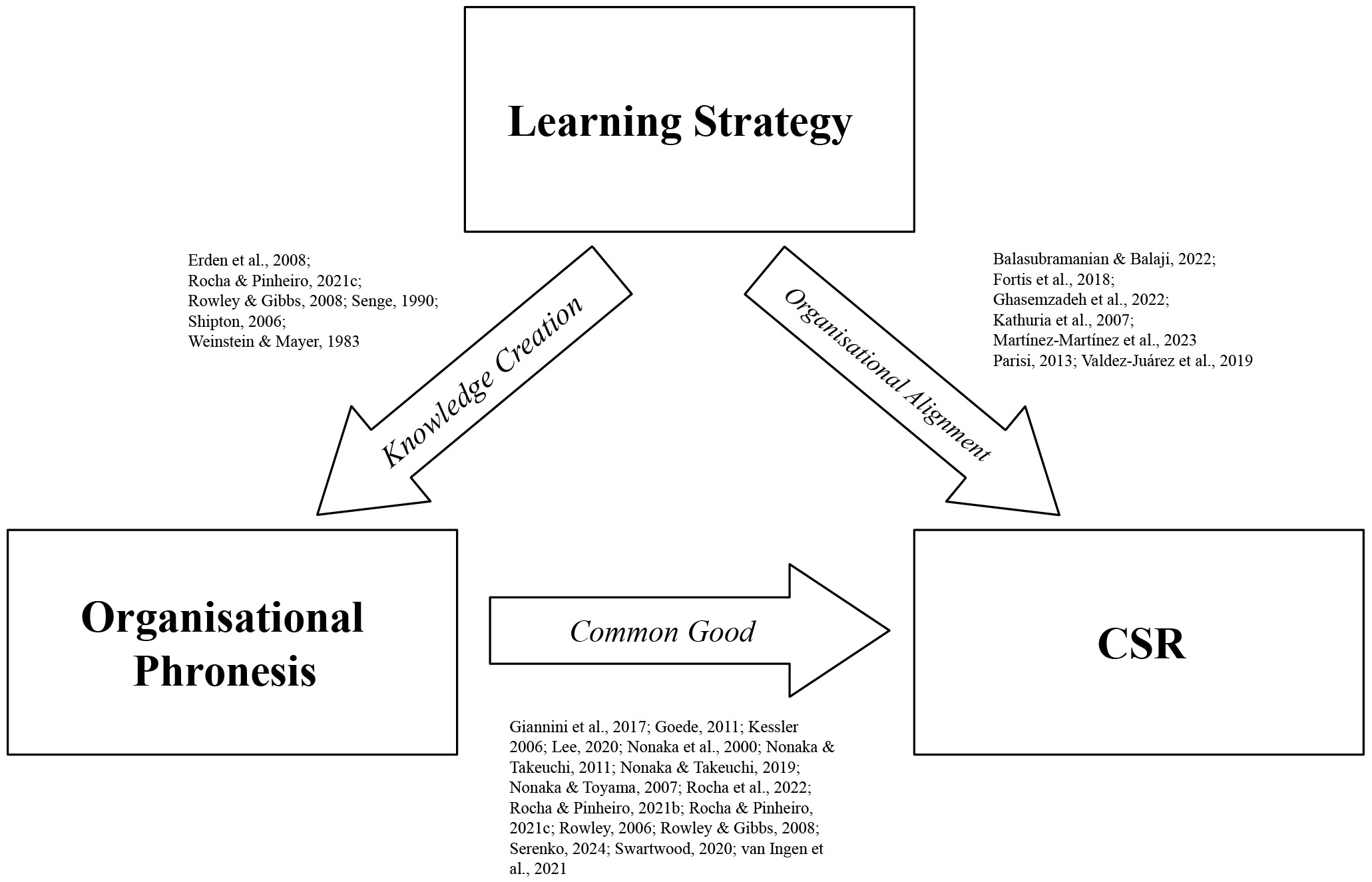 Fig. 1.
Theoretical framework. CSR, corporate social responsibility. Source: Authors’ creation.
Experience and actions are the essences of organisational learning (Erden et al, 2008). An organisational learning strategy affects how the learner selects, acquires, organises or integrates new knowledge (Weinstein and Mayer, 1983). The organisation’s learning strategy can promote the creation of organisational phronesis, which can be seen as high-quality tacit knowledge that allows organisational members to make mindful decisions and take appropriate actions towards the common good based on shared values, cultural norms, and commonly set goals as a team (Erden et al, 2008). Thereby, the organisational culture and values, as well as the beliefs of organisational members, defines the outcome of organisational learning (Rocha and Pinheiro, 2021b). Integrating phronesis in organisations can explain the practical, subjective, and forward-looking elements of knowledge-based organisations’ dynamic strategy creation and implementation process (Nonaka and Toyama, 2007).
To guarantee a connection and learning among individuals, a ba, that is, a shared context, must be created where phronesis is integrated and the knowledge of everyone is shared, utilised, and learned (Rocha and Pinheiro, 2021b). These learning-oriented interactions in a shared context are necessary to spread individual phronesis among team members and develop collective phronesis (Rocha and Pinheiro, 2021c). A shared context allows organisational members to be understood and see beyond their limited perspectives (Nonaka and Takeuchi, 2011). Consequently, we propose the following:
Hypothesis (H1). An organisation’s learning strategy positively affects organisational phronesis.
Organisational learning strategies can facilitate the organisation’s focus on sustainability and responsible business conduct (Martínez-Martínez et al, 2023). In this way, organisational learning can be considered the process of aligning the organisation with CSR goals (Fortis et al, 2018; Parisi, 2013). Organisational alignment involves adapting various organisational elements such as its structures, strategies, processes, capabilities, and culture to foster its CSR performance (Kathuria et al, 2007). The involved knowledge can increasingly be considered one of the crucial resources for organisations to flourish in the current socio-economic climate (Martínez-Martínez et al, 2023). Therefore, organisational learning is instrumental in adopting and executing CSR (Ghasemzadeh et al, 2022). Likewise, businesses must maintain their competitiveness and profitability, but accountability is also essential for business activities’ ecological and social impact (Ghasemzadeh et al, 2022).
Companies are under increasing pressure to act ethically to satisfy the expectations of various stakeholders (Ghasemzadeh et al, 2022; Ghobadian et al, 2015). More and more organisations are trying to adopt and implement new learning strategies to improve their social responsibility processes (Valdez-Juárez et al, 2019). Organisational learning can be seen as a process that realises that changing an organisation’s knowledge base and organisational behaviour is an essential element that highlights the ability of companies to integrate and face up to the expectations of CSR (Fortis et al, 2018). The act of organisational learning can be viewed as a necessary condition for modifying the attitudes and incentives of workers, resulting in a rise in their dedication to improving CSR efforts (Ghasemzadeh et al, 2022). A learning organisation can build up, develop, and pass on knowledge. The behaviour of individual members can be changed to show new knowledge and understanding (Martínez-Martínez et al, 2023). Similarly, to enact suitable performance behaviour, learning other skills and knowledge is necessary to change and adapt to the context (Jundt and Shoss, 2023). Therefore, we hypothesise the following:
Hypothesis (H2a). An organisation’s learning strategy positively affects employee-related sustainability.
Hypothesis (H2b). An organisation’s learning strategy positively affects public-related sustainability.
Moreover, by integrating new learning strategies, organisations care about their members’ well-being and customer satisfaction. However, while acting, they also always consider what is good for the environment. A learning orientation promotes sustainable innovations, which leads to responsible behaviour in organisations (Valdez-Juárez et al, 2019). For instance, practices such as using electric cars, building zero-emissions buildings, and the increased operation of trains are being promoted as measures to increase sustainability (Banerjee and Duflo, 2020). An ecological perspective enables people to see how a destructive/creative process works. Destruction creates spaces in an ecosystem that can allow small-scale innovation without disruption due to a lack of resources (Hurst, 2013). Furthermore, “environmental learning” consists of processes that acquire, disseminate, and use knowledge about the natural environment to improve sustainability performance (Martínez-Martínez et al, 2023). Accordingly, we propose the following:
Hypothesis (H2c). An organisation’s learning strategy positively affects environmental management sustainability.
Hypothesis (H2d). An organisation’s learning strategy positively affects pollution control measures.
Companies that prioritise organisational learning witness increased market opportunities, innovation, and economic outcomes (Valdez-Juárez et al, 2019). Organisational learning enables new ideas, products, processes, and technologies (Martínez-Martínez et al, 2023). Furthermore, a good organisational learning strategy is crucial for gaining a competitive advantage (Ghasemzadeh et al, 2022). The better individuals and organisations are at learning, the greater their opportunities to understand and seize trends in the business environment (Ghasemzadeh et al, 2022). We propose the following:
Hypothesis (H2e). An organisation’s learning strategy positively affects financial sustainability.
Hypothesis (H2f). An organisation’s learning strategy positively affects governance sustainability.
As phronesis ultimately targets the common good, the practical wisdom of the organisation is expected to have an impact on their CSR, where values and ethical behaviour are important (Ghobadian et al, 2015; Zwetsloot, 2003). Organisations can shape their business environment by incorporating phronesis and working towards a future that unites social, ecological, and economic goals (Rocha et al, 2022). Goede (2011) argues that a phronetic organisation is an environmentally conscious one that effectively handles the triple bottom line, encompassing the well-being of individuals, the well-being of the environment, and financial prosperity, thus serving the common good.
Phronesis enables organisations to take wise actions, with social well-being as its outcome (Rocha et al, 2022). It can be viewed as a construct that may be one pathway to reconnecting businesses with society (Rocha and Pinheiro, 2021c). Wise organisations can survive if they deliver sustainable performance, serving the interests of society and various stakeholders (Rocha and Pinheiro, 2021b; Rocha and Pinheiro, 2021c). Phronesis as knowledge practice extends the social science’s agenda by focusing on improving the human condition (Nonaka and Takeuchi, 2019).
Organisational scandals, inequality, and climate change scream for the importance of improving social well-being for all (Rocha and Pinheiro, 2021a). Having a shared purpose that puts commitment to the common good first helps organisations unite (van Ingen et al, 2021). It thus encourages them to accept the common goal or plan, giving them a reason for action (Rocha and Pinheiro, 2021c). We propose the following:
Hypothesis (H3a). Organisational phronesis positively affects employee-related sustainability.
Hypothesis (H3b). Organisational phronesis positively affects public-related sustainability.
Furthermore, phronesis strives for interaction among colleagues, customers, business rivals, and the environment, and helps move companies, communities, and society in a sustainable direction (Nonaka and Takeuchi, 2019). The depletion of natural resources and the repercussions of environmental decline have emerged as crucial concerns. Climate change threatens the survival and stability of modern societies (Rosário et al, 2022). As phronesis is an action-oriented construct, it can be integrated into the Sustainable Development Goals (SDGs) goals, which draw attention to the fact that sustainability must become an imperative for organisations all around the world (Hurst, 2013; Rocha et al, 2022).
A transformative process necessitates a practical pursuit of knowledge, encompassing ethical perspectives through sustainable actions and rationality (Gillberg, 1999). Ecological rationality helps individuals to understand that destruction occurs swiftly, while progress, prosperity, and growth require a significantly longer duration (Hurst, 2013). Surpassing certain temperatures could initiate sudden, unpredictable, and potentially irreversible transformations that can cause significant environmental disruptions (Klein, 2015).
The common good can be linked to the natural environmental good since a healthy environment is a prerequisite for living well (Wiefek and Heinitz, 2018). Over the past few decades, scientists have identified connections between the natural environment and humans’ physical and mental health (Biedenweg et al, 2017). Specifically, living in a healthy natural environment positively affects an individual’s stress level (Irvine et al, 2013; Ulrich et al, 1991), emotional well-being (Bratman et al, 2015), and cognitive performance (Keniger et al, 2013). For reaching the natural environmental good, phronesis is required, as it helps organisations realise that thoughtful actions towards sustainability and the environment necessitate immediate action in the present while holding a clear vision for the future (Lee, 2020; Nonaka and Takeuchi, 2019). Accordingly, the fourth hypothesis reads as follows:
Hypothesis (H3c). Organisational phronesis positively affects environmental management sustainability.
Hypothesis (H3d). Organisational phronesis positively affects pollution control measures.
To maintain a competitive advantage, focusing on organisational performance is necessary for any for-profit organisation (Rhodes et al, 2008). To achieve long-term success, shared value is essential, as it generates economic value for society by catering to its demands and difficulties. Thus, as shared value is a new path that leads to economic success, leaders and managers should evolve new knowledge (Porter and Kramer, 2011). Phronesis can be seen as such knowledge that strives for the common good and economic growth (Rocha et al, 2022). As a practically wise organisation achieves longevity due to greatly sustainable performance, its outcomes have social and economic value, referred to as shared value (Rocha and Pinheiro, 2021a). Shared value pushes the boundaries of capitalism, since better networking in favour of organisational success and social improvement opens many opportunities to serve new needs, gain efficiencies, create differentiation, and expand markets (Porter and Kramer, 2011).
In addition, continuous innovation and optimal resource utilisation contribute to the growth of economic value (Rocha and Pinheiro, 2021a). Phronesis as knowledge practice can also be seen as an approach that fosters continuous open innovation and performance (Nonaka and Takeuchi, 2019). As Bierly et al (2000) argue, the ability to address issues and perform tasks that have an impact on an organisation’s efficiency and effectiveness is facilitated by phronesis. Organisations can choose to use the most efficient knowledge for a given situation while causing minimal harm (Rocha and Pinheiro, 2021c). Thus, we suggest the following:
Hypothesis (H3e). Organisational phronesis positively affects financial sustainability.
Hypothesis (H3f). Organisational phronesis positively affects governance sustainability.
We performed a power analysis to determine the appropriate sample size (Sarstedt et al, 2022) using G*Power software version 3.1.9.7 (Düsseldorf, Germany) (Faul et al, 2009). The input parameters were an f2 value of 0.15, a confidence level of 95% (error of 0.05), and two predictors, following the structural mensuration model of Faul et al (2009). Consequently, based on the power analysis results, a sample of 107 was identified as appropriate. We collected data through an online survey from employees in Austria who work in for-profit companies. The actual sample size is 250, characterised by accessibility (Hair et al, 2019b). The role and perception of employees about CSR are crucial as they can be seen as legitimate stakeholders at the heart of an organisation. They need to be integrated into business activities and practices that lead to organisational change. Therefore, it is crucial to comprehend the employees’ perception of their organisation.
The survey used a five-point Likert scale—from ‘strongly agree’ (1) to ‘strongly disagree’ (5)—and considered three factors. The survey items were selected based on scales previously validated on organisational phronesis (Rocha and d’Angelo, 2023), learning strategy (Rhodes et al, 2008), and corporate social responsibility—organisational sustainability (Balasubramanian and Balaji, 2022).
Organisational Phronesis: The items were selected from the Organisational Phronesis Scale (Rocha and d’Angelo, 2023). Using the Organisational Phronesis Scale from learning lenses can be helpful in underlining the validity of the effectiveness of the introduction of organisational phronesis management.
Learning Strategy: The items were adopted from the study by Rhodes et al (2008) on knowledge transfer and originated from the Learning Trend Survey by Baker and Sinkula (1999). Differently from scales, that focus on individual learning strategies in organisational contexts (e.g., Raemdonck et al, 2017; Martins et al, 2018), Learning Trend Survey is an efficient instrument that combines the individual and organisational aspects of learning, as it sheds light on the organisational facilitation of individual learning.
CSR: To measure CSR, the items were selected from the Organisational Sustainability Scale by Balasubramanian and Balaji (2022). In line with the intention of this study, this recent measurement instrument allows for assessing an internal perspective on CSR, i.e., the employees’ assessment of the sustainability performance of their company. Different to other instruments (e.g., Lechuga Sancho et al, 2021), it exclusively focuses on the employees’ perception of CSR performance while covering all three domains of corporate sustainability (i.e., economic, social, and ecological). The scale consists of six factors, two for each CSR dimension (i.e., social, ecological, and economic).
To test the model, we applied multiple linear regression modelling using STATA software version 17 (StataCorp LLC, TX, USA) (StataCorp, 2021), applying the summed scores calculated by the latent variable’s items average. Regression analysis is a statistical technique used to examine and construct a model for the correlation between variables (Montgomery et al, 2021, p. 1). It is the most widely used technique for dependency testing and applies to research questions that involve either prediction or explanation (Hair et al, 2019a). Multiple regression analysis is a statistical technique within the general linear regression model, analysing the relationship between single dependent and multiple independent variables (Hair et al, 2019a). As our research goal is to understand the relationship between complex theoretical models, multiple linear regression is suitable.
Table 1 presents the characteristics of the sample. Most participants were females (59.60%) and between 20 and 39 (46.80%) years old. Most were employed in the private sector (69.60%), in a small (30%) or large (32.40%) company. Additionally, most respondents had worked in the company for a period between less than one year to five years (66.40%).
| Characteristics | Freq. | % | |
| Gender | Female | 149 | 59.60 |
| Male | 100 | 40.00 | |
| Other | 1 | 0.40 | |
| Total | 250 | 100.00 | |
| Age | 20–29 years | 117 | 46.80 |
| 30–39 years | 65 | 26.00 | |
| 40–49 years | 28 | 11.20 | |
| 50–59 years | 38 | 15.20 | |
| 60–69 years | 2 | 0.80 | |
| Total | 250 | 100.00 | |
| Time in the company | Up to 1 year | 74 | 29.60 |
| 1–5 years | 92 | 36.80 | |
| 5–10 years | 40 | 16.00 | |
| 10–15 years | 20 | 8.00 | |
| 15–20 years | 14 | 5.60 | |
| More than 20 years | 10 | 4.00 | |
| Total | 250 | 100.00 | |
| Sector | Private | 174 | 69.60 |
| Public | 76 | 30.40 | |
| Total | 250 | 100.00 | |
| Size of the company | Micro company ( |
56 | 22.40 |
| Small company ( |
75 | 30.00 | |
| Medium company ( |
38 | 15.20 | |
| Large company ( |
81 | 32.40 | |
| Total | 250 | 100.00 | |
Table 2 illustrates the descriptive statistics and correlations.
| L | OPW | ERS | PRS | EMS | PCM | FS | GS | |
| L | 1.000 | |||||||
| OPW | 0.474 | 1.000 | ||||||
| 0.000 | ||||||||
| ERS | 0.270 | 0.342 | 1.000 | |||||
| 0.000 | 0.000 | |||||||
| PRS | 0.282 | 0.470 | 0.355 | 1.000 | ||||
| 0.000 | 0.000 | 0.000 | ||||||
| EMS | 0.310 | 0.474 | 0.419 | 0.413 | 1.000 | |||
| 0.000 | 0.000 | 0.000 | 0.000 | |||||
| PCM | 0.283 | 0.410 | 0.345 | 0.400 | 0.665 | 1.000 | ||
| 0.000 | 0.000 | 0.000 | 0.000 | 0.000 | ||||
| FS | 0.110 | 0.210 | 0.432 | 0.239 | 0.336 | 0.264 | 1.000 | |
| 0.083 | 0.001 | 0.000 | 0.000 | 0.000 | 0.000 | |||
| GS | 0.435 | 0.583 | 0.387 | 0.490 | 0.567 | 0.508 | 0.324 | 1.000 |
| 0.000 | 0.000 | 0.000 | 0.000 | 0.000 | 0.000 | 0.000 | ||
| Mean | 4.128 | 4.047 | 0.399 | 4.010 | 3.560 | 3.614 | 3.921 | 4.007 |
| SD | 0.570 | 0.377 | 0.493 | 0.460 | 0.624 | 0.701 | 0.575 | 0.546 |
| Min | 2.00 | 2.30 | 2.25 | 2.60 | 1.20 | 1.50 | 2.25 | 1.75 |
| Max | 5 | 5 | 5 | 5 | 5 | 5 | 5 | 5 |
L, Learning Strategy; OPW, Organisational Practical Wisdom; ERS, Employee-related Sustainability; PRS, Public-related Sustainability; EMS, Environmental Management Sustainability; PCM, Pollution Control Measures; FS, Financial Sustainability; GS, Governance Sustainability.
In general, Environmental Management Sustainability (µ = 3.560) and Pollution Control Measures (µ = 3.614) have the lowest averages, while Learning Strategy (µ = 4.128), Governance Sustainability (µ = 4.007) and Organisational Practical Wisdom (µ = 4.047) have the highest averages.
The average mean of Organisational Practical Wisdom (OPW) is µ = 4.047. Most of the employees believe learning is important (µ = 4.404), they can effectively choose and apply the appropriate knowledge in a given situation (µ = 4.148), and they are convinced that employees reflect on their actions and mistakes (µ = 4.132), In addition, they tend to agree that their company’s actions are weighted (µ = 3.792), efficient (µ = 3.920), and effective (µ = 3.948), and that there is an understanding of the moral and ethical expectations of stakeholders (members, customers, suppliers, partners, and others) (µ = 3.968) (Rocha and d’Angelo, 2023).
The mean of Learning Strategy (L) (µ = 4.128) suggests that the employees help each other with learning (µ = 4.280), and that the company encourages employee discussion and team learning (µ = 4.128). In addition, the employees tend to agree that the company offers a good learning environment to help innovation development (µ = 3.976) (Baker and Sinkula, 1999).
The Employee-related Sustainability (ERS) mean (µ = 3.990) indicates that the employees tend to agree with the company focus on social actions. Particularly, they agree that the company supports the training and development of staff (µ = 4.140). In addition, they tend to agree that the company provides optimal job security to its employees (µ = 3.980), provides safety norms and training for safety to its employees (µ = 3.976), and that employees can enjoy an optimal work-life balance while serving their company (µ = 3.864) (Balasubramanian and Balaji, 2022).
The Public-related Sustainability (PRS) mean (µ = 4.010) indicates that the employees agree that the company supports gender equality (µ = 4.248), and the company helps to protect human rights in the maximum possible ways (µ = 4.108). In addition, they tend to agree the company supports the local economy (µ = 3.976), public safety and security (µ = 3.904), and the local culture (µ = 3.812) (Balasubramanian and Balaji, 2022).
The average mean of Environmental Management Sustainability (EMS) (µ = 3.560) indicates that the employees are neutral regarding such actions. For instance, sustainable development in maximum possible ways (µ = 3.864), encouragement of cycling, walking, or using public transport to keep the air clean (µ = 3.720), providing optimal air quality assurance (µ = 3.572) or adequate ventilation (µ = 3.512) and an appropriate water recycling system (µ = 3.132) (Balasubramanian and Balaji, 2022).
The average mean of Pollution Control Measures (PCM) (µ = 3.614) also indicates that the employees are neutral whether the company is not polluting nature (µ = 3.560) or has a proper electronic waste management system (µ = 3.332). However, they tend to agree and report if the company has an appropriate recycling system for paper, plastic glass, and other solid waste (µ = 3.920) as well as a proper solid waste management system (µ = 3.644) (Balasubramanian and Balaji, 2022).
The Financial Sustainability (FS) mean (µ = 3.921) indicates that the employees tend to agree with the financial aspects, such as the company has the intention to reinvest its profits for its growth (µ = 3.976) and is financially strong enough to withstand economic uncertainties (µ = 3.968) (Balasubramanian and Balaji, 2022).
The Governance Sustainability (GS) mean (µ = 4.007) shows that the employees tend to agree the company has a clear alignment with its policies and vision (µ = 4.052), supports creativity and innovation (µ = 4.032), and has opinions and views for improvement from all levels of employees (µ = 4.032). They tend to agree on whether the company is investing in the right policies for future growth (µ = 3.912) (Balasubramanian and Balaji, 2022).
Table 2 also illustrates the Pearson Correlation, whose coefficients above zero suggest a positive correlation between variables (Taylor, 1990). The p-value for all correlations is 0.000, indicating statistical significance among the latent variables, except for L and FS (p-value = 0.083). The strength and direction of the relationship between the variables range from 0.210 (OPW and FS) to 0.567 (EMS and GS), indicating a weak correlation but defined and moderated, respectively.
The following tables display the testing results of all the variables under
study. Overall, the regression analysis indicates that the p-value of
the regression model is suitable and significant (p
| Number of observations | 250 | ||||||||
| F (2, 247) | 14.48 | ||||||||
| Prob |
0.000 | ||||||||
| R-squared | 0.132 | ||||||||
| Root MSE | 0.461 | ||||||||
| OPW | Coefficient | Robust standard err | t-value | p-value | [95% confidence interval] | VIF | 1/VIF | ||
| H1 | L | 0.314 | 0.046 | 6.85 | 0.000 | 0.224 | 0.404 | 1.000 | 1.000 |
| _cons | 2.751 | 0.190 | 14.46 | 0.000 | 2.376 | 3.125 | |||
MSE, Mean Squared Error; VIF, Variance Inflation Factor; err, Error; cons, constant term.
Table 3 reports the results for H1, with a p-value of
In Table 4, the p-value is
| Number of observations | 250 | ||||||||
| F (2, 247) | 14.48 | ||||||||
| Prob |
0.0000 | ||||||||
| R-squared | 0.1320 | ||||||||
| Root MSE | 0.4610 | ||||||||
| ERS | Coefficient | Robust standard err | t-value | p-value | [95% conf. interval] | VIF | 1/VIF | ||
| H2a | L | 0.121 | 0.073 | 1.66 | 0.099 | 0.023 | 0.265 | 1.29 | 0.775 |
| H3a | OPW | 0.360 | 0.099 | 3.64 | 0.000 | 0.165 | 0.555 | 1.29 | 0.775 |
| _cons | 2.033 | 0.362 | 5.62 | 0.000 | 1.320 | 2.746 | |||
Table 5 shows that the effect of OPW on PRS is significant, as indicated by a
p-value
| Number of observations | 250 | ||||||||
| F (2, 247) | 35.64 | ||||||||
| Prob |
0.0000 | ||||||||
| R-squared | 0.2250 | ||||||||
| Root MSE | 0.4063 | ||||||||
| PRS | Coefficient | Robust standard err | t-value | p-value | [95% conf. interval] | VIF | 1/VIF | ||
| H2b | L | 0.061 | 0.065 | 0.94 | 0.350 | –0.068 | 0.190 | 1.29 | 0.775 |
| H3b | OPW | 0.529 | 0.077 | 6.88 | 0.000 | 0.377 | 0.680 | 1.29 | 0.775 |
| _cons | 1.618 | 0.301 | 5.37 | 0.000 | 1.024 | 2.211 | |||
Since the p-value in Table 6 is
| Number of observations | 250 | ||||||||
| F (2, 247) | 32.39 | ||||||||
| Prob |
0.0000 | ||||||||
| R-squared | 0.2343 | ||||||||
| Root MSE | 0.5485 | ||||||||
| EMS | Coefficient | Robust standard err | t-value | p-value | [95% conf. interval] | VIF | 1/VIF | ||
| H2c | L | 0.120 | 0.081 | 1.48 | 0.140 | –0.040 | 0.279 | 1.29 | 0.775 |
| H3c | OPW | 0.700 | 0.124 | 5.65 | 0.000 | 0.456 | 0.944 | 1.29 | 0.775 |
| _cons | 0.234 | 0.416 | 0.56 | 0.573 | –0.584 | 1.053 | |||
Table 7 confirms a significant effect of OPW on PCM, as the p-value is
| Number of observations | 250 | ||||||||
| F (2, 247) | 0.2794 | ||||||||
| Prob |
0.0000 | ||||||||
| R-squared | 0.1782 | ||||||||
| Root MSE | 0.6381 | ||||||||
| PCM | Coefficient | Robust standard err | t-value | p-value | [95% conf. interval] | VIF | 1/VIF | ||
| H2d | L | 0.140 | 0.086 | 1.64 | 0.103 | –0.029 | 0.308 | 1.29 | 0.775 |
| H3d | OPW | 0.662 | 0.116 | 5.70 | 0.000 | 0.433 | 0.891 | 1.29 | 0.775 |
| _cons | 0.357 | 0.435 | 0.82 | 0.413 | –0.500 | 1.214 | |||
Since the p-value in Table 8 is
| Number of observations | 250 | ||||||||
| F (2, 247) | 3.90 | ||||||||
| Prob |
0.0214 | ||||||||
| R-squared | 0.0442 | ||||||||
| Root MSE | 0.5642 | ||||||||
| FS | Coefficient | Robust standard err | t-value | p-value | [95% conf. interval] | VIF | 1/VIF | ||
| H2e | L | 0.013 | 0.070 | 0.19 | 0.851 | –0.126 | 0.152 | 1.29 | 0.775 |
| H3e | OPW | 0.310 | 0.121 | 2.56 | 0.011 | 0.072 | 0.549 | 1.29 | 0.775 |
| _cons | 2.610 | 0.475 | 5.49 | 0.000 | 1.674 | 3.546 | |||
The significance level of the p-value
| Number of observations | 250 | ||||||||
| F (2, 247) | 54.29 | ||||||||
| Prob |
0.0000 | ||||||||
| R-squared | 0.3727 | ||||||||
| Root MSE | 0.4340 | ||||||||
| GS | Coefficient | Robust standard err | t-value | p-value | [95% conf. interval] | VIF | 1/VIF | ||
| H2f | L | 0.196 | 0.097 | 2.02 | 0.044 | 0.005 | 0.387 | 1.29 | 0.775 |
| H3f | OPW | 0.704 | 0.117 | 6.02 | 0.000 | 0.474 | 0.934 | 1.29 | 0.775 |
| _cons | 0.349 | 0.362 | 0.96 | 0.336 | –0.364 | 1.063 | |||
To summarise, the research found that an organisation’s learning strategy positively affects organisational phronesis. This, in turn, positively influences social, ecological, and economic CSR outcomes (Table 10). Specifically, organisational phronesis positively affects employee-related sustainability, public-related sustainability, environmental management sustainability, pollution control measures, financial sustainability and governance sustainability. Moreover, an organisation’s learning strategy significantly influences only governance sustainability.
| Hypothesis | Result |
|---|---|
| H1. An organisation’s learning strategy positively affects OPW. | Supported |
| H2a. An organisation’s learning strategy positively affects ERS. | Not Supported |
| H2b. An organisation’s learning strategy positively affects PRS. | Not Supported |
| H2c. An organisation’s learning strategy positively affects EMS. | Not Supported |
| H2d. An organisation’s learning strategy positively affects PCM. | Not Supported |
| H2e. An organisation’s learning strategy positively affects FS. | Not Supported |
| H2f. An organisation’s learning strategy positively affects GS. | Supported |
| H3a. OPW positively affects ERS. | Supported |
| H3b. OPW positively affects PRS. | Supported |
| H3c. OPW positively affects EMS. | Supported |
| H3d. OPW positively affects PCM. | Supported |
| H3e. OPW positively affects FS. | Supported |
| H3f. OPW positively affects GS. | Supported |
The findings underscore the importance of fostering an organisational culture that values a continual organisational learning strategy and practical wisdom, as this can lead to enhanced overall performance and encourage ethical and sustainable practices. It can help organisations adapt to changing circumstances and navigate complex challenges with greater agility and resilience.
This study provides empirical evidence for the positive impact of learning strategies on organisational practical wisdom and its impacts on CSR performance. Our findings support and extend the literature by demonstrating the significant relationships between these constructs (Nonaka and Toyama, 2007; Rocha and Pinheiro, 2021b; Rocha et al, 2022). Thus, the results highlight the value of cultivating phronesis to promote socially responsible practices and contribute to sustainable development.
Previous literature has argued that an organisation’s learning strategy strengthens organisational phronesis and that both are crucial for being sustainable in general and for corporate social responsibility performance, in particular (Erden et al, 2008; Goede, 2011; Nonaka and Toyama, 2007; Rocha et al, 2022; Zwetsloot, 2003). Our study provides the earliest empirical evidence that organisational phronesis positively affects CSR performance. By confirming the claimed connection of these concepts (Nonaka and Takeuchi, 2021; Rocha et al, 2021) through empirical analysis, this study strengthens the theoretical foundation of phronesis and its implications for CSR practices in organisations, which are detailed below.
The results further substantiate that higher levels of organisational phronesis positively affect social, ecological, and economic CSR outcomes. Thus, it is verified that phronesis is an ethical resource to help organisations act responsibly and sustainably, benefiting society and the environment (Rocha et al, 2022). The outcomes demonstrate that organisational phronesis has a beneficial impact on both employee- and pubic- related sustainability. Phronesis is viewed as a means to initiate the reintegration of business with society by expanding social science’s focus to prioritise advancing human well-being. This underscores the importance of incorporating practical wisdom into business practices, as it can serve as a tool to promote ethical and sustainable behaviours that benefit the organisation and society at large (Nonaka and Takeuchi, 2019; Rocha and d’Angelo, 2023). As phronesis emphasises the importance of understanding and responding to the ethical and moral expectations of stakeholders, it leads to positive effects on providing optimal job security to employees but also on supporting the wider public, such as through supporting the local economy (Balasubramanian and Balaji, 2022).
The results show that organisational phronesis positively influences environmental management sustainability and pollution control measures. The common good of phronesis can be linked to the natural environmental good, as a thriving environment is essential for a good quality of life (Biedenweg et al, 2017). This research affirms that phronesis is necessary to address the natural environment, as a phronetic organisation can effectively choose and apply the appropriate knowledge in a given situation (Rocha and d’Angelo, 2023). Thus, it encourages environmental management sustainability by advocating for practices like cycling, walking, or utilising public transportation to reduce air pollution, but also supports pollution control measures, such as implementing an effective recycling system for solid waste materials like paper, plastic, and glass (Balasubramanian and Balaji, 2022).
The findings demonstrate that organisational phronesis positively affects financial sustainability and governance sustainability. Utilising phronesis allows organisations to address issues and accomplish tasks that directly impact the productivity and success of an organisation (Rocha and Pinheiro, 2021b). As phronesis helps organisations adapt to changes and instabilities in the environment (Rocha and d’Angelo, 2023), it helps organisations to be financially strong enough to withstand economic uncertainties (Balasubramanian and Balaji, 2022). In addition, a phronetic organisation also emphasises effectiveness and efficiency (Rocha and d’Angelo, 2023), which positively impacts innovation and an organisation’s future growth (Balasubramanian and Balaji, 2022).
Overall, the high correlations between organisational phronesis and CSR suggest that organisations prioritising phronesis are more likely to achieve socially responsible outcomes. The statistically significant relationships between these variables provide empirical evidence that increases in organisational phronesis are linked to corresponding increases in an organisation’s CSR’s social, ecological, and economic dimensions (Taylor, 1990). Thus, organisations are better positioned to positively influence society (Nonaka and Takeuchi, 2021; Rocha et al, 2022). Conversely, an organisation’s learning strategy does not significantly influence most of the CSR dimensions in the Austrian context. These findings are unexpected as the features of a learning strategy should also result in broader societal transformations for the wider public (Balasubramanian and Balaji, 2022).
Moreover, organisation’s learning strategy positively influences organisational phronesis. They corroborate that learning interactions that prioritise acquiring knowledge and skills within a collaborative context are crucial in disseminating individual phronesis among team members and facilitating the development of collective phronesis (Rocha and Pinheiro, 2021c). So, when employees engage in collaborative learning, promote dialogue, and participate in team-based learning (Baker and Sinkula, 1999), they believe that learning is important—a characteristic of a practically wise organisation (Rocha and d’Angelo, 2023).
The results confirm that an organisation’s learning strategy positively affects governance sustainability. So, suppose an organisation implements a learning strategy in an organisation. In that case, a good learning environment supports innovation development (Baker and Sinkula, 1999), which supports creativity and innovation in an organisation (Balasubramanian and Balaji, 2022). Conversely, an organisation’s learning does not significantly impact financial sustainability. Financial outcomes of CSR, such as if the company has optimal plans for constant revenue generation over a foreseeable number of years or has a scope of making a profit for the next five years, are not significantly affected by an organisation’s learning strategy (Balasubramanian and Balaji, 2022). These results are surprising, since the literature sufficiently confirms that a learning strategy positively influences an organisation’s economic performance (Ghasemzadeh et al, 2022; Martínez-Martínez et al, 2023; Torkkeli and Durst, 2022).
Our study makes numerous theoretical contributions to the literature on phronesis, learning strategies, and CSR. First, we empirically validate the conceptual link between phronesis and CSR performance (Rocha et al, 2022), proving that phronesis is a valuable ethical resource for organisations striving to balance social, ecological, and economic objectives. Second, we extend the understanding of learning strategies by showing their positive influence on organisational phronesis. Third, our findings indicate pioneering evidence of the role of phronesis in the relationship between learning strategies and CSR performance, suggesting that phronesis could be a key mechanism through which learning strategies contribute to responsible business practices.
Accordingly, this study advances our theoretical understanding, as it complements and strengthens existing literature by providing empirical evidence for the theoretical link between organisational phronesis, organisational learning strategy, and CSR outcomes. The findings confirm that organisational phronesis significantly impacts key CSR outcomes and can be considered an ethical resource for organisations to act responsibly and sustainably. Organisational phronesis contributes to internal, i.e., organisation-focused sustainability, and external CSR, i.e., beyond-organisation sustainability.
Our findings offer valuable insights for managers and organisations seeking to enhance their CSR performance. To cultivate organisational phronesis, managers should foster a culture of continuous learning, encourage ethical decision-making, and align organisational values with sustainability goals (Nonaka and Takeuchi, 2019). This can be achieved by providing training programs that emphasise ethical reasoning, promoting open dialogue and reflection on moral dilemmas, and rewarding responsible behaviour. Additionally, organisations should invest in developing future-oriented learning strategies that prioritise the common good and address societal challenges (Rowley and Gibbs, 2008). This may involve collaborating with stakeholders, engaging in scenario planning, and promoting cross-functional learning. For instance, they can anticipate and understand the changed expectations and needs that Generation Z claims from their future employer. By employing phronesis, managers can then prepare their organisation accordingly. Therefore, managers need to provide and facilitate physical and temporal space to reflect on the action, which is a key enabler for organisational phronesis and thus leads to sustainable performance.
Our study also has implications for business education. Business schools should incorporate phronesis and future-oriented learning strategies into their curricula to prepare students for responsible leadership roles (Rocha and d’Angelo, 2023). This can be done by integrating ethics and sustainability topics across courses, providing experiential learning opportunities that expose students to real-world sustainability challenges, and encouraging critical thinking and moral reasoning skills.
In conclusion, our study underscores the vital role of organisational phronesis in promoting CSR performance and of learning strategies in promoting organisational phronesis. By cultivating practical wisdom, organisations can navigate complex societal challenges while achieving economic goals and contributing to the greater good. We hope our findings inspire further research and practical applications that advance responsible and sustainable business practices.
While our study makes important contributions to understanding the relationships between organisational phronesis, learning strategies, and CSR performance, it is not without limitations. First, our sample was limited to Austrian employees, which may restrict the generalizability of our results to other geographical and cultural contexts. Future investigations should replicate our study in diverse settings to enhance the external validity of the findings and provide a more comprehensive understanding of how these constructs interact across different backgrounds. Second, although our results demonstrated significant associations between organisational phronesis, learning strategies, and CSR performance, we cannot establish the direction of causality; the cross-sectional nature of our data precludes us from making causal inferences about the relationships. Future research should address the causal relationships between organisational phronesis, learning strategies, and CSR performance, among others.
As we have empirical evidence that there is a relationship between organisational phronesis and CSR, there is a need for future research to investigate the characteristics and dimensions of a practically wise workplace. This could involve interviews with managers and employees to gather qualitative data on their workplace experiences. Also, case studies of companies known for embodying practical wisdom could be conducted to gain a broader understanding of how the characteristics and dimensions of a practically wise organisation play out in real-world settings.
Future studies should employ longitudinal or experimental designs to examine the temporal dynamics and causal linkages between these constructs, providing more robust evidence for the impact of phronesis and learning strategies on CSR outcomes. While our study offers valuable insights into the interplay between learning strategies and CSR, further research is needed to confirm our findings and explore the boundary conditions and mechanisms underlying these relationships. Investigating potential moderators, such as organisational culture or industry characteristics, and mediating processes, such as employee engagement or stakeholder collaboration, would deepen our understanding of how learning strategies and phronesis contribute to CSR performance. Additionally, conducting qualitative studies in order to explore the lived experiences and perceptions of organisational members regarding phronesis and learning strategies could provide rich, contextualised insights that complement our quantitative findings. Moreover, to advance our understanding of the relationship between phronesis and CSR, future research should investigate how a phronetic-based culture can be established and sustained within an organisation through CSR practices. Key practices and characteristics must be identified to create a phronetic-based culture. Phronesis in business education needs to be explored further to identify the most effective training programs to promote it. Research can also investigate the role of business education in developing phronesis among aspiring entrepreneurs, and the impact of phronesis on sustainable entrepreneurship. Additionally, the role of leadership in promoting organisational phronesis and CSR should be studied. By addressing the above-mentioned limitations and pursuing these research directions, future research can build upon our work and advance knowledge on the role of practical wisdom and learning in promoting socially responsible and sustainable business practices.
The datasets used in this study are available from the corresponding authors upon request.
FK, RGR, and SM designed the research study. FK and RGR supervised SM. MJD analyzed the data. All authors contributed to the writing, revisions, and editorial changes in the manuscript. All authors read and approved the final manuscript. All authors have participated sufficiently in the work and agreed to be accountable for all aspects of the work.
The authors express their sincere gratitude to the anonymous reviewers for their constructive guidance throughout the review process. Their thoughtful critiques and suggestions have been instrumental in refining the manuscript.
Funded by the European Union. Views and opinions expressed are however those of the authors only and do not necessarily reflect those of the European Union or OeAD-GmbH. Neither the European Union nor the granting authority can be held responsible for them. This research was funded by the Wise up to Succeed: Learning Spaces for Sustainable and Responsible Decision-Making project (https://www.wiseup2succeed.eu/) funded by the Erasmus+ Program, under the number 2023-1-AT01-KA220-VET-000166057.
The authors declare no conflict of interest.
References
Publisher’s Note: IMR Press stays neutral with regard to jurisdictional claims in published maps and institutional affiliations.