
The Mediation Role of Resilience and Psychological Inflexibility in the Relationship Between Attachment and Well-Being — Graphical Abstract
Sofía Sagüés de la Maza, Bernardo Moreno-Jiménez, Luis Manuel Blanco-Donoso published an article entitled “The Mediation Role of Resilience and Psychological Inflexibility in the Relationship Between Attachment and Well-Being” in Volume 34, Issue 1 of the Behavioral Psychology/Psicología Conductual (BP)
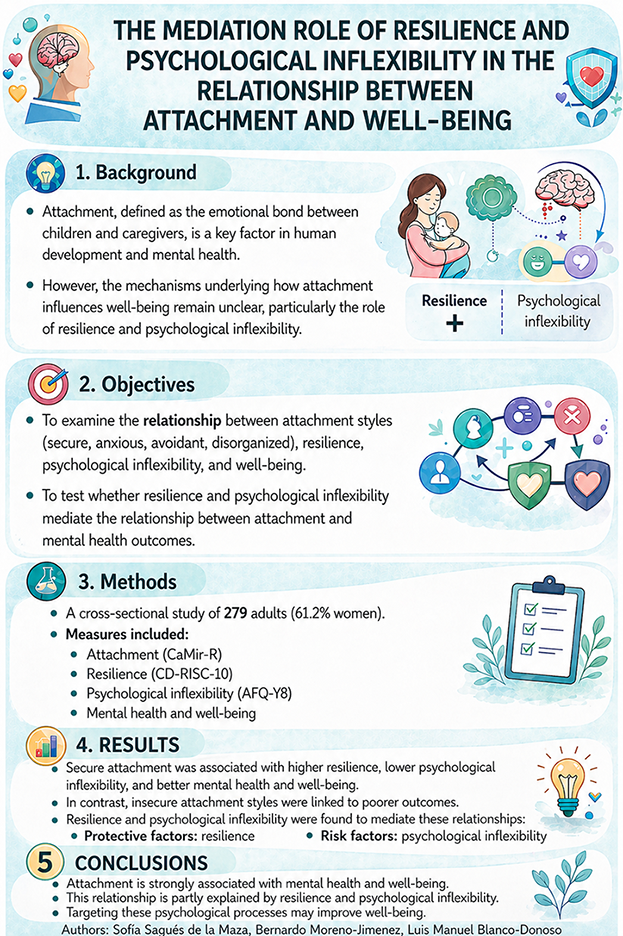
This study examined the relationship between attachment styles (secure, anxious, avoidant, and disorganized) and well-being, as well as the mediating role of resilience and psychological inflexibility. A cross-sectional sample of 279 adults completed validated measures of attachment, resilience, psychological inflexibility, mental health, and well-being.
Results showed that secure attachment was associated with higher resilience, lower psychological inflexibility, and better mental health and well-being. In contrast, insecure attachment styles were linked to poorer outcomes. Mediation analyses revealed that resilience and psychological inflexibility significantly explained the relationship between attachment and well-being. Specifically, resilience functioned as a protective factor, whereas psychological inflexibility acted as a risk factor.
These findings suggest that although attachment plays a central role in psychological functioning, interventions targeting resilience and psychological flexibility may improve mental health and well-being, even among individuals with insecure attachment styles.
Read the article:
The Mediation Role of Resilience and Psychological Inflexibility in the Relationship Between Attachment and Well-Being
https://www.imrpress.com/journal/BP/34/1/10.31083/BP50638
Related Article:
Linking Exercise Adherence to Meaning in Life Through Resilience and Cognitive Reappraisal: A Sequential Mediation Model Among Chinese University Students
https://www.imrpress.com/journal/BP/33/3/10.31083/BP44067
Subtypes of mental health difficulties and levels of resilience in Spanish adolescents
https://www.imrpress.com/journal/BP/32/3/10.51668/bp.8324301n