



1 School of Economics, Management, Humanities and Law, Shandong Institute of Petroleum and Chemical Technology, 257061 Dongying, Shandong, China
2 Faculty of Education, Qufu Normal University, 273165 Qufu, Shandong, China
3 Faculty of Education, Southwest University, 400715 Chongqing, China
Abstract
The meaning in life among Chinese university students is a growing concern. Therefore, the current study aims to investigate the structural associations between exercise adherence, resilience, cognitive reappraisal, and meaning in life in this population.
This study adopted a structural equation model (SEM) method and included 818 university students recruited from two universities in Shandong Province, China.
The findings indicated that exercise adherence not only directly and positively influences meaning in life but also indirectly improves it through the mediation of resilience, as well as the sequential mediation of both resilience and cognitive reappraisal. Furthermore, the multiple-group analysis revealed a series of gender discrepancies, indicating that exercise adherence and cognitive reappraisal exert a significantly stronger impact on meaning in life for females, whereas resilience has a significantly stronger effect on meaning in life for males.
This study concluded that exercise adherence is an effective way to improve resilience, which in turn improves cognitive reappraisal, ultimately leading to increased meaning in life among Chinese university students.
Keywords
- exercise adherence
- resilience
- cognitive reappraisal
- meaning in life
- university students
In the field of psychology research, meaning in life has long occupied a paramount role in positive psychology. It not only serves as a pivotal indicator of individual happiness (Marco et al., 2022; Ryff, 1989), but also functions as a vital driver of adaptive coping strategies in response to adversity (Park and Folkman, 1997; Yıldırım et al., 2020). Furthermore, meaning in life is a hallmark of therapeutic growth, signifying an individual’s restoration and progress following psychological distress (Crumbaugh and Maholick, 1964; Martela and Steger, 2016; Macías et al., 2014). Specifically, meaning in life refers to an individual’s psychological state of actively seeking harmony between their internal self and the external environment, while establishing and persistently pursuing personal life goals (Steger et al., 2008). Such a state pertains to an individual’s cognition of self-worth, and constitutes a fundamental cornerstone for mental health, psychological development, and personal growth (King and Hicks, 2021).
However, the current state of meaning in life is concerning among Chinese university students, with research indicating that over 50% of this population lacks such a sense (Fu et al., 2023). They commonly grapple with the absence of life goals, lacking sufficient motivation to pursue meaningful experiences (Zhang et al., 2016). This deficiency undermines their self-control and risks plunging their lives into disarray, gradually eroding the impetus for personal growth (Schnell and Krampe, 2020). Consequently, negative life attitudes emerge, not only exacerbating psychological issues such as depression and anxiety (Yang et al., 2023), but also potentially fostering suicidal ideation or antisocial behaviors (Lew et al., 2020). Therefore, exploring the mechanisms that influence meaning in life among Chinese university students is crucial. This contributes to a deeper understanding and perception of life among Chinese university students, provides a solid psychological support for their holistic development, and offers great value for educators in implementing targeted mental health interventions.
Previous studies have unequivocally demonstrated the potential of physical exercise in fostering meaning in life, enhancing physical and mental well-being, as well as optimizing cognitive and non-cognitive factors (Takkinen et al., 2001; Chekroud et al., 2018; Yuan et al., 2022; Jin et al., 2024). Nevertheless, despite the well-documented benefits of physical activity, few individuals maintain regular exercise and consistently experience its advantages. An empirical analysis encompassing 200 countries and territories globally revealed that 80% of adolescents engage in insufficient physical activity (Rodriguez-Martinez et al., 2020). This phenomenon underscores the urgency of investigating exercise adherence, a psychological trait manifested in individuals’ persistent efforts, ability to overcome obstacles, and long-term, voluntary, and regular participation in physical activities toward their exercise goals (Buckworth and Dishman, 2007). While the direct link between exercise adherence and meaning in life has garnered attention, the underlying mechanisms remain elusive. Research has suggested that exercise may instill a sense of achievement, strengthen social connections, and serve as a medium for self-reflection, thereby enriching and deepening an individual’s meaning in life (Ströhle, 2009). Nonetheless, a comprehensive understanding of how exercise adherence potentially influences meaning in life through multiple pathways necessitates further exploration.
Additionally, resilience, defined as the ability to adapt and thrive amidst adversity and which can be improved by exercise adherence, has been demonstrated to positively correlate with meaning in life (Bonanno, 2005; Feng et al., 2024). Concurrently, cognitive reappraisal, an emotional regulation strategy, holds a paramount role in reframing the significance of emotional events, mitigating the impact of negative emotions, and eliciting the emergence of positive emotions (Gross, 2002). This process deepens individuals’ comprehension and acceptance of life’s challenges, thereby enriching their meaning in life. Despite these established pairwise associations, the intertwined mechanism among exercise adherence, resilience, cognitive reappraisal, and meaning in life remains largely underexplored in existing literature, especially for Chinese university students, a population facing notable deficits in meaning in life. To address this critical gap, the present study aims to construct a sequential mediation model to delineate the structural relationships among these variables. Two key innovations distinguish this work from prior research. First, rather than focusing solely on direct associations or single mediating pathways, this research examines the serial mediating role of resilience and cognitive reappraisal, offering a more nuanced and holistic understanding of how exercise adherence contributes to enhanced meaning in life. Second, by centering on Chinese university students, the study generates context-specific insights that address the demographic limitations inherent in previous work, which has often relied on Western or more heterogeneous samples.
Exercise adherence, characterized by long-term, regular, and consistent exercise habits (Huberty et al., 2008), refers to an individual’s conscious and sustained participation in physical exercise, encompassing implicit manifestations like emotional experiences and effort, as well as explicit behaviors, such as habits and patterns (Buckworth and Dishman, 2007). Exercise adherence has played a crucial role in promoting the mental health and holistic development of university students. While meaning in life involves a psychological state where individuals actively seek harmony between their internal self and the external environment, as well as establishing and relentlessly pursuing personal life goals (Steger et al., 2008), this stands as a fundamental pillar supporting mental health and well-being in university students. Meaning in life encompasses three distinct facets: firstly, coherence, which pertains to the comprehensibility and significance attributed to one’s life; secondly, purpose, a sense of core objectives, goals, and directions that guide one’s existence; and, thirdly, meaning, a profound feeling that life possesses inherent value and is worth living (Martela and Steger, 2016). These dimensions collectively contribute to a nuanced understanding of how individuals derive meaning from their lives.
Numerous studies have underscored the significant enhancement of mental health among university students who regularly participate in physical activities. These benefits cover reductions in depressive and anxiety symptoms, as well as enhancements in self-esteem and emotional stability (Ekkekakis, 2009; Sallis et al., 2000). Notably, these positive mental health changes, stemming directly from exercise adherence, foster an exploration and understanding of meaning in life among these individuals. When individuals experience physical and psychological vitality, they are more likely to appraise their lives positively, perceiving them as purposeful and valuable (Steger et al., 2006). Furthermore, direct investigations into the relationship between exercise adherence and meaning in life have affirmed their positive correlation. For instance, the self-determination theory highlights that engaging in self-chosen activities with intrinsic satisfaction, such as regular exercise, develops a sense of autonomy and self-actualization, which are central components of meaning in life (Ryan and Frederick, 1997). Among university students, exercise adherence serves as a pathway to self-actualization, significantly improving overall life satisfaction and meaning in life (Guo et al., 2023). Conversely, the lack of exercise adherence is associated with reduced levels of meaning in life. Research has also demonstrated that sedentary behavior and physical inactivity correlate with increased boredom, depression, and a lack of purpose (Trost et al., 2003), emphasizing the importance of identifying and addressing barriers to exercise adherence, as they may inadvertently diminish meaning in life and satisfaction.
Clearly, there has been a close association between exercise adherence and meaning in life among university students. Sustained and regular exercise can improve university students’ mental health, reduce symptoms of depression and anxiety, and enhance self-esteem and emotional stability. These positive changes motivate them to explore and understand the meaning of life, enabling them to adopt a more positive outlook and a stronger sense of life’s value. Furthermore, exercise adherence, as a self-chosen activity, can foster a sense of autonomy and self-actualization, thereby significantly enhancing university students’ life satisfaction and sense of meaning in life. In contrast, insufficient exercise adherence is associated with a reduced sense of meaning in life. Therefore, addressing barriers to exercise adherence is of great importance for maintaining a sense of meaning in life.
Resilience, a complex and multidimensional psychological construct, exerts profound influences on human mental health, well-being, and overall quality of life (Wu et al., 2013). Defined as the ability to recover and adapt from negative emotions and adapt to dynamic and stressful environments (Block and Kremen, 1996), resilience is considered a stable personality trait that shapes individuals’ coping strategies and flexibility when facing life’s adversities (Gao et al., 2025a). Notably, resilience plays a pivotal protective role in preventing psychological distress, depression, and anxiety symptoms (Gao et al., 2025b; Sefidan et al., 2021). Extensive research underscored the intricate correlations between resilience and other psychological variables, further establishing resilience as a crucial predictor of individual life satisfaction and overall quality of life (Guillén et al., 2021). Recent research has examined the role of resilience in fostering individuals’ pursuit and exploration of meaning in life. Among university students, those with high resilience are more adept at actively discovering and pursuing meaning in life and goals during times of adversity (Çolak et al., 2021; Yıldırım et al., 2020). This revelation underscores the value of resilience as a psychological resource, facilitating the construction of more positive, fulfilling, and purposeful lives.
Regular engagement in physical exercise has been widely acknowledged for its ability to significantly alleviate stress, enhance emotional well-being, and boost cognitive functioning (Ekkekakis, 2009; Sallis et al., 2000). For university students, physical exercise serves as a vital outlet for mitigating academic and personal life pressures. Importantly, the physical and psychological benefits derived from exercise may indirectly contribute to the enhancement of resilience. Current research highlighted a significant positive correlation between exercise adherence and resilience (Feng et al., 2024). Specifically, university students who consistently engage in regular physical activity exhibit higher levels of self-efficacy, more positive emotional expressions, and lower levels of anxiety and depression—all tangible manifestations of resilience enhancement (Guthold et al., 2020; Joseph et al., 2014; Skrove et al., 2013). Moreover, the discipline and commitment required to maintain an exercise routine cultivate crucial qualities such as perseverance and self-control, further fortifying the foundation of resilience (Briki, 2016).
Resilience holds significant importance for university students’ mental health and their exploration of meaning in life, and it particularly plays a crucial mediating role in the association between physical exercise and meaning in life. On the one hand, physical exercise supports the development of resilience through the aforementioned physical and psychological benefits, such as alleviating academic stress and improving emotional well-being. On the other hand, university students with higher levels of resilience, when confronted with challenges including academic difficulties and interpersonal conflicts, are better able to regulate negative emotions, maintain a positive mindset, and recognize the positive value in adversities. This enables them to clarify their goals and needs, and to more effectively identify and pursue life meanings and goals that align with their personal values. Overall, evidence confirmed that exercise adherence indirectly promotes university students’ deeper exploration and positive experience of meaning in life by enhancing their resilience (Jin and Dong, 2023).
Gross (1998) proposed that cognitive reappraisal and expressive suppression are two fundamental and frequently employed emotion regulation strategies. Cognitive reappraisal, in particular, focuses on modulating emotional responses by altering an individual’s interpretation of the meaning or self-relevance of a situation (Gross, 1998). Specifically, cognitive reappraisal is defined as reinterpreting emotionally evocative situations in ways that alter their emotional impact (Gross and John, 2003). This strategy can be further divided into two forms: evaluation neglect, a reductive strategy characterized by disregarding, avoiding, or minimizing the evaluation of negative emotional stimuli to reduce emotional burden and divert attention; and evaluation emphasis, which encourages a more positive reassessment of emotional events, uncovering their underlying positive aspects (Gross, 2002). Drawing on Fredrickson’s broaden-and-build theory, positive emotions expand cognitive and behavioral repertoires, thereby facilitating the development of enduring biopsychosocial resources that support coping and thriving mental health (Garland et al., 2010). As a proactive emotion regulation technique, habitual utilization of cognitive reappraisal is significantly associated with improved interpersonal functioning, enhanced mental health, and reduced depressive symptoms among healthy individuals (Doménech et al., 2025; Gross and John, 2003). For instance, individuals who frequently employ cognitive reappraisal tend to exhibit reduced negative emotions and attenuated physiological responses, accompanied by heightened parasympathetic nervous system activation (Cheng et al., 2009).
Previous studies have emphasized a positive correlation between cognitive reappraisal and the sense meaning in life among university students (Cunha et al., 2022; Folkman and Moskowitz, 2000). By harnessing internal psychological resources, university students who employ cognitive reappraisal can reconstruct negative experiences and cultivate a more optimistic perspective, thereby enhancing personal life satisfaction and mental health (Garland et al., 2010; Krafft et al., 2019). This positive reappraisal not only mitigates the deleterious effects of stress but also fosters a deeper appreciation for life experiences, ultimately strengthening the overall meaning in life (Cunha et al., 2022; Steger et al., 2008). Physical activity has been shown to attenuate neurophysiological markers of emotional reactivity, such as amygdala activation, and to enhance prefrontal cortical activity, a brain region associated with cognitive control and emotion regulation (Etnier et al., 2006). Research suggested that physical exercise effectively reduces the incidence of depression and anxiety among university students, continually optimizing their emotional experiences and facilitating more effective cognitive reappraisal of adverse emotional events (Giles et al., 2017; Bernstein and McNally, 2017; Gross, 2002). However, these studies have primarily concentrated on the relationship between physical exercise and cognitive reappraisal among university students, neglecting an analysis of the impact of exercise adherence on cognitive reappraisal. Therefore, the present study aims to examine whether cognitive reappraisal mediates the relationship between exercise adherence and meaning in life among university students.
In summary, cognitive reappraisal helps university students to reframe negative experiences, cultivate an optimistic mindset, and deepen their understanding of life events, thereby enhancing their sense of meaning in life. Physical activity supports cognitive reappraisal by reducing markers of emotional reactivity, strengthening activity in brain regions related to emotional control, and alleviating depression and anxiety among university students. This, in turn, improves their emotional experiences and reappraisal abilities. However, most of these studies have focused on the relationship between physical exercise and cognitive reappraisal in university students, while neglecting an analysis of the impact of exercise adherence on cognitive reappraisal. Therefore, examining whether cognitive reappraisal mediates role in the relationship between exercise adherence and meaning in life among university students, is valuable.
Numerous studies have affirmed the positive contribution of resilience to cognitive reappraisal (Riepenhausen et al., 2022; Stover et al., 2024; Zarotti et al., 2020). Individuals with higher resilience demonstrate superior performance in the application of cognitive reappraisal, and this association is particularly prominent in stressful situations (Riepenhausen et al., 2022). This finding provides important evidence for exploring how exercise adherence influences university students’ sense of meaning in life through these two factors, while also highlighting the key role of psychological factors, such as resilience in driving the development of cognitive reappraisal. Research showed that university students with high resilience are more inclined to adopt cognitive reappraisal as a coping strategy when facing stress. By virtue of this strategy, they can quickly recover from negative emotions, effectively manage their emotional states, and maintain emotional stability (Liu et al., 2021). Based on the established connection between resilience and cognitive reappraisal, this study investigates whether a sequential pathway exists among university students: Enhanced exercise adherence promotes the development of their resilience, which in turn improves their cognitive reappraisal ability, and ultimately enhances their sense of meaning in life. This proposed sequential pathway draws rational support from the research link between the two psychological constructs. Specifically, if exercise adherence can first strengthen the individuals resilience, it may further optimize their cognitive reappraisal capacity by leveraging resilience’s facilitative effect on cognitive reappraisal, ultimately helping them perceive and enhance their sense of meaning in life more profoundly.
Gender exerts a notable influence on exercise adherence among university students. Multiple studies have demonstrated that male university students tend to engage in physical activities more frequently and vigorously compared to their female counterparts (Buizza et al., 2022; Kilpatrick et al., 2005; Tong et al., 2022). This disparity is often attributed to multiple factors, including societal norms that reinforce gender role stereotypes, varying degrees of concern about body image, and individual differences in confidence when overcoming barriers to physical activity (Craft et al., 2014; Trost et al., 1996). Nevertheless, contrasting findings have also been reported, with studies showing a higher prevalence of habitual physical activity among women in daily life, including walking to and from classes, physical housework in dormitories and homes, and short-distance cycling (Meyer et al., 2004). These discrepancies make the relationship between gender and exercise adherence complex. The present study will focus on exploring the potential gender-specific associations between exercise adherence and other psychological variables, including resilience, cognitive reappraisal, and meaning in life. Currently, there are relatively few studies that systematically examine the associations between exercise adherence and the psychological variables across different gender groups. Hence, opportunities remain to expand both the depth and breadth of research in this relevant field.
Previous research indicated that there exists a complex interplay between exercise adherence, resilience, cognitive reappraisal, and meaning in life. Although existing literature has extensively covered these four variables, studies that concurrently explore the relationships among them remain limited. Therefore, this study aims to explore the potential mediating roles of resilience and cognitive reappraisal in the relationship between exercise adherence and meaning in life among university students, potentially addressing gaps in the existing literature and deepening the understanding of the complex interplay between individual mental health, behavioral patterns, and meaning in life.
Based on the existing literature, the following hypotheses were proposed:
H1: Exercise adherence is positively related to resilience (a), cognitive reappraisal (b), and meaning in life (c).
H2: Resilience has a positive effect on cognitive reappraisal (a) and meaning in life (b).
H3: Cognitive reappraisal has a positive effect on meaning in life.
H4: The effect of exercise adherence on meaning in life can be mediated by resilience (a) and cognitive reappraisal (b), both individually, and by the sequential mediating role of resilience and cognitive reappraisal (c).
H5: Gender will have some moderating effects on relationships between exercise adherence and resilience (a), exercise adherence and cognitive reappraisal (b), exercise adherence and meaning in life (c), resilience and cognitive reappraisal (d), resilience and meaning in life (e), and cognitive reappraisal and meaning in life (f).
The research model is shown in Fig. 1.
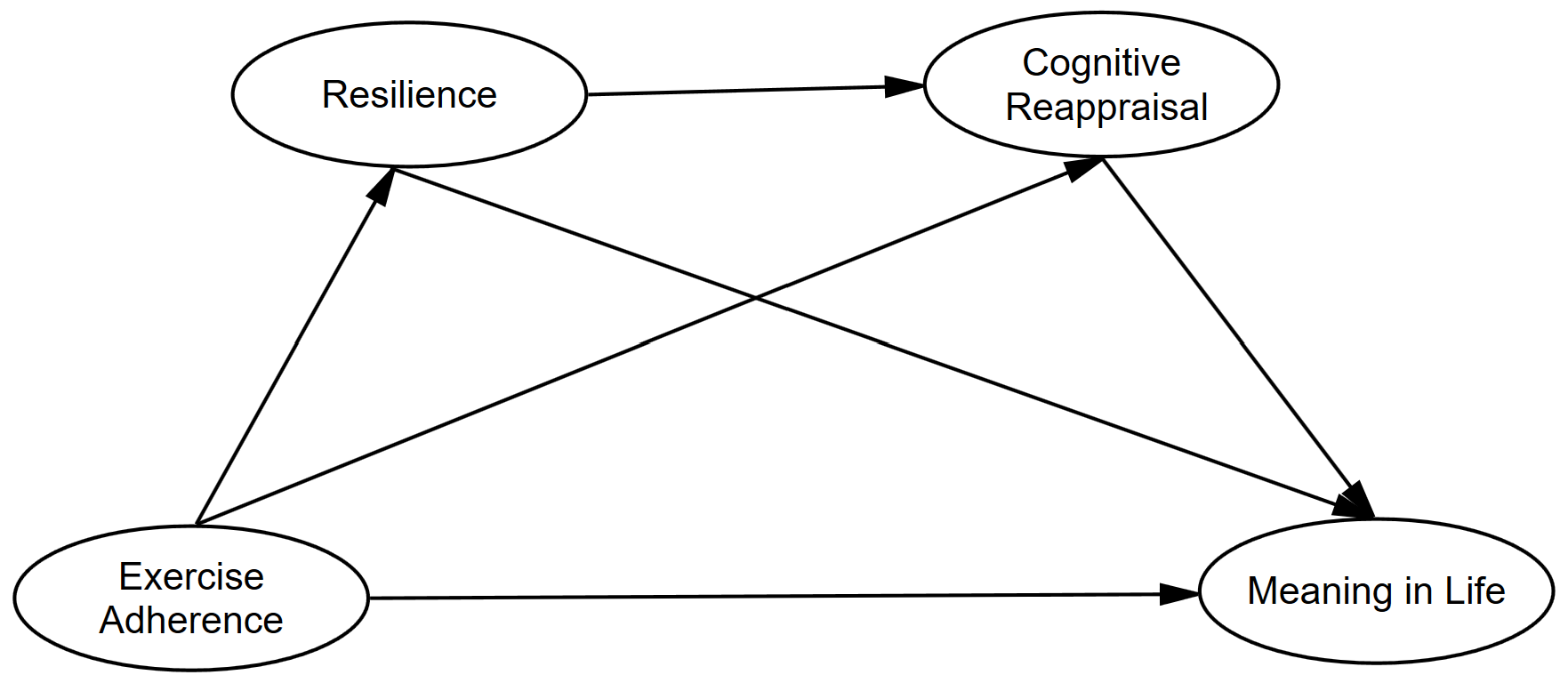 Fig. 1.
Research model.
The participants in this study were recruited from two universities in Shandong Province, China, one specializing in natural science and the other in humanities and social sciences. A cluster sampling method was utilized to select the participants, specifically targeting freshmen, sophomores, juniors, and seniors of undergraduate studies. The recruitment process occurred from May 2024 to June 2024, during the second semester of the 2023–2024 academic year. Requests for assistance in recruiting students from their respective classes were sent to the class counselors of potential participant classes. The composition of the participant pool included 12 classes of freshmen, 9 classes of sophomores, 7 classes of juniors, and 2 classes of seniors, reflecting the common practice of senior students pursuing off-campus internships. All participants were recruited voluntarily and were fully informed of the study objectives, data confidentiality measures, and their right to withdraw from the study at any point. The time for completion of the questionnaire took approximately 8 to 10 minutes per participant. A total of 909 undergraduate students expressed their willingness to participate in the study, and 864 completed questionnaires, yielding a response rate of 95.05%. Following the exclusion of missing data and outliers, the final sample for data analysis comprised 818 respondents (N = 273 for males and N = 545 for females; N = 306 for freshmen, N = 265 for sophomores, N = 211 for juniors, and N = 36 for seniors).
The present study employed the Exercise Adherence Scale (EAS) developed by Wang
et al. (2016a) to comprehensively assess exercise adherence among university
students. This scale comprises 14 items across three subdimensions: Behavioral
indicators (e.g., “I engage in physical activities for at least 1 hour each
time”), effortful engagement (e.g., “I strive to improve myself by practicing
new skills”), and emotional experience (e.g., “I enjoy the feelings brought
about by physical exercise”). A 5-point Likert scale ranging from 1 (strongly
disagree) to 5 (strongly agree) was utilized for scoring, with higher scores
displaying stronger exercise adherence. In this study, the overall Cronbach’s
To assess resilience among university students, this study employed the Chinese
version of the Connor-Davidson Resilience Scale (CD-RISC), which was originally
developed by Connor and Davidson (2003) and subsequently translated and
adapted by Yu and Zhang (2007). This scale encompasses 25 items across three
subdimensions: Tenacity (e.g., “not easily discouraged by failure”), strength
(e.g., “past success gives confidence for new challenge”), and optimism (e.g.,
“see the humorous side of things”). Each item is rated on a Likert 5-point
scale, ranging from 1 (not at all true) to 5 (true nearly all of the time), with
higher scores showing greater resilience. In this study, the overall Cronbach’s
The Chinese-translated and revised version of the Emotion Regulation
Questionnaire (ERQ) developed by Gross and John (2003) and translated by Wang
et al. (2007) comprises two subdimensions: cognitive reappraisal and
expressive suppression. For this study, only the dimension of cognitive
reappraisal (e.g., “I control my emotions by changing the way I think about the
situation I’m in”) was used as the measurement instrument. The scale is
single-dimensional and consists of 6 items, each item was rated on a 7-point
scale, ranging from 1 (strongly disagree) to 7 (strongly agree), with higher
scores indicating a stronger tendency towards cognitive reappraisal. In this
study, the internal consistency coefficient Cronbach’s
The Meaning in Life Questionnaire (MLQ), originally developed by Steger et al.
(2006) and revised into a Chinese version by Wang et al. (2016b), was
employed in this study to assess the meaning in life among university students.
The MLQ consists of two subdimensions: search for meaning (e.g., “I am looking
for something that makes my life feel meaningful”) and presence of meaning
(e.g., “I understand my life’s meaning”), totaling 10 items. A 7-point Likert
scale ranging from 1 (absolutely untrue) to 7 (absolutely true) was used for
scoring, with higher scores demonstrating a stronger level of meaning in life. In
this study, the overall Cronbach’s
In this study, the data were analyzed by constructing the structural equation modeling (SEM) to investigate potential direct and indirect effects among exercise adherence, resilience, cognitive reappraisal, and meaning in life with Mplus 8.3 software (Muthén & MuthénLos, Angeles, CA, USA). maximum likelihood (ML) estimation was used as an estimation technique for the present analysis. Firstly, descriptive statistics and bivariate correlations were provided to export some basic information about the aforementioned variables. Secondly, convergent and discriminant validity were established for all latent variables to assess the measurement model. Thirdly, the direct paths were evaluated by the structural model, and the bootstrapping bias-corrected confidence interval (CI) procedure was employed to examine mediation effects by utilizing 5000 bootstrap samples (Hayes, 2017). Finally, the statistical differences between males and females across direct and indirect paths were tested by using the multiple-group analysis. Following the recommendations of Hooper et al. (2008) and Kline (2016), the acceptable standards for goodness-of-fit indices were as follows: root mean square error of approximation (RMSEA) and standardized root mean square residual (SRMR) with values below 0.08, as well as comparative fit index (CFI) and Tucker-Lewis index (TLI) with values greater than 0.90.
Generally, skewness and kurtosis indices were utilized to evaluate the univariate normality in statistical analysis. As recommended by Kline (2016; 2020), the skewness should be less than the absolute value of 3, and the kurtosis should be less than the absolute value of 7 or 10. In this study, the skewness and the kurtosis indices ranged from –0.677 to –0.002 and –0.522 to 0.027, respectively, falling between –1 and 1, and therefore revealing that the data can be reasonably regarded as normal and acceptable for subsequent analyses, with a robust estimate (Kline, 2016; Lei and Lomax, 2005; Muthén and Kaplan, 1985). Table 1 displays the results of descriptive statistics and Pearson correlations for all constructs. The mean values of exercise adherence, resilience, cognitive reappraisal, and meaning in life were 3.634, 3.952, 5.600, and 5.304, respectively. Pearson correlations demonstrated that the strongest correlation occurred between resilience and cognitive reappraisal, whereas the weakest correlation was observed between exercise adherence and cognitive reappraisal. Additionally, the correlations among all latent variables were positively significant at the alpha level of 0.001 with coefficients ranging from 0.586 to 0.847, which was lower than the acceptable criterion of 0.850, and demonstrated that a subsequent analysis should be performed (Kline, 2016).
| Constructs | M | SD | 1 | 2 | 3 | 4 |
| Exercise adherence | 3.634 | 0.801 | 1.000 | |||
| Resilience | 3.952 | 0.587 | 0.670*** | 1.000 | ||
| Cognitive reappraisal | 5.600 | 0.957 | 0.586*** | 0.847*** | 1.000 | |
| Meaning in life | 5.304 | 0.927 | 0.719*** | 0.814*** | 0.751*** | 1.000 |
***p
The goodness-of-fit indices for the measurement model were as follows:
| Constructs | Convergent validity | Discriminant validity | ||||
| Composite reliability | AVE | A | B | C | D | |
| Exercise adherence | 0.945 | 0.852 | 0.923 | |||
| Resilience | 0.955 | 0.876 | 0.670*** | 0.936 | ||
| Cognitive reappraisal | 0.963 | 0.812 | 0.586*** | 0.847*** | 0.901 | |
| Meaning in life | 0.857 | 0.750 | 0.719*** | 0.814*** | 0.751*** | 0.866 |
AVE, average variance extracted. Bold diagonal values represent the square root
of AVE. ***p
The goodness-of-fit indices of the structural model were as follows:
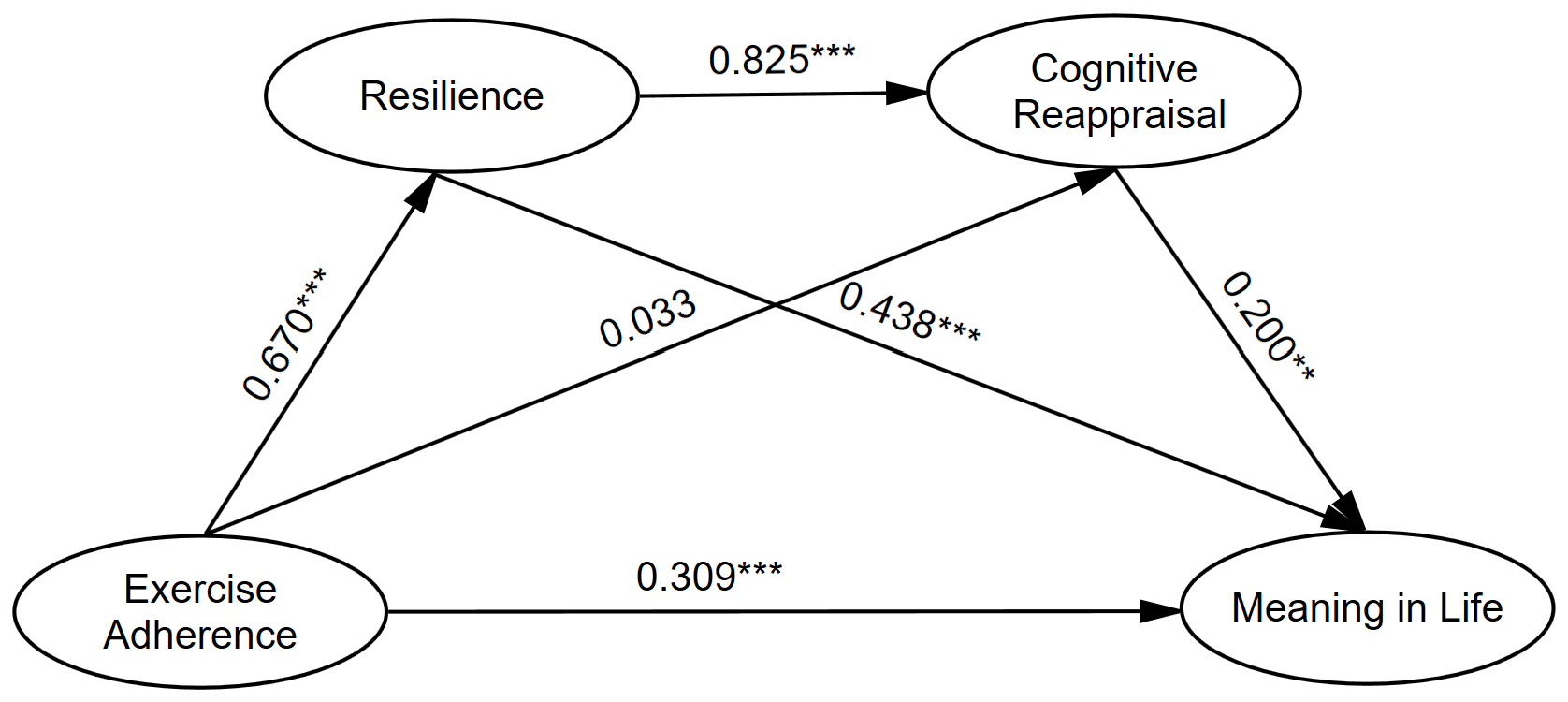 Fig. 2.
Structural equation model (**p
| Parameter estimates | SE | Bias-corrected CI (95%) | |||
| Lower | Upper | ||||
| Direct effects | |||||
| Exercise adherence→Meaning in life | 0.309*** | 0.042 | 0.224 | 0.388 | |
| Resilience→Meaning in life | 0.438*** | 0.062 | 0.314 | 0.560 | |
| Cognitive reappraisal→Meaning in life | 0.200** | 0.059 | 0.085 | 0.315 | |
| Exercise adherence→Cognitive reappraisal | 0.033 | 0.032 | –0.026 | 0.100 | |
| Resilience→Cognitive reappraisal | 0.825*** | 0.028 | 0.766 | 0.876 | |
| Exercise adherence→Resilience | 0.670*** | 0.024 | 0.619 | 0.714 | |
| Indirect effects | |||||
| Exercise adherence→Resilience→Meaning in life | 0.293*** | 0.043 | 0.210 | 0.379 | |
| Exercise adherence→Cognitive reappraisal→Meaning in life | 0.007 | 0.007 | –0.004 | 0.026 | |
| Exercise adherence→Resilience→Cognitive reappraisal→Meaning in life | 0.110** | 0.033 | 0.047 | 0.176 | |
CI, confidence interval. **p
As recommended by Hayes (2017), the indirect effect is significant when zero
is not contained between the lower and upper boundaries in the 95%
bias-corrected CI. The results of the mediation model analysis are presented in
Fig. 2 and Table 3. The effect of exercise adherence on meaning in life was
significantly and positively mediated by resilience (
Finally, this study analyzed the statistical differences in the impact of
exercise adherence on meaning in life via resilience and cognitive reappraisal
between male and female students (see Table 4). The results indicated that the
direct effects of exercise adherence on meaning in life
(
| Parameter estimates | ||||
| Direct effects | ||||
| Exercise adherence→Meaning in life | 0.384*** | 0.154* | 0.230** | |
| Resilience→Meaning in life | 0.272*** | 0.756*** | –0.484*** | |
| Cognitive reappraisal→Meaning in life | 0.302*** | 0.014 | 0.288* | |
| Exercise adherence→Cognitive reappraisal | 0.069 | –0.039 | 0.108 | |
| Resilience→Cognitive reappraisal | 0.802*** | 0.873*** | –0.071 | |
| Exercise adherence→Resilience | 0.655*** | 0.695*** | –0.040 | |
| Indirect effects | ||||
| Exercise adherence→Resilience→Meaning in life | 0.178*** | 0.525*** | –0.347*** | |
| Exercise adherence→Cognitive reappraisal→Meaning in life | 0.021 | –0.001 | 0.022 | |
| Exercise adherence→Resilience→Cognitive reappraisal→Meaning in life | 0.159*** | 0.008 | 0.151* | |
*p
This study utilized an SEM to explore the structural relationships between exercise adherence, resilience, cognitive reappraisal, and meaning in life in Chinese university students. The findings revealed that exercise adherence is positively associated with resilience and meaning in life, but not significantly related to cognitive reappraisal, providing partial support for H1. Resilience has a positive effect on cognitive reappraisal and meaning in life, and cognitive reappraisal is positively associated with meaning in life, with H2 and H3 fully supported. Also, the results demonstrated that exercise adherence positively influences meaning in life through the mediation of resilience, as well as the sequential mediation of both resilience and cognitive reappraisal, whereas the indirect effect via cognitive reappraisal alone was not significant, with partial support for H4 . Regarding gender differences, the findings indicated that resilience has a stronger impact on males’ meaning in life, whereas exercise adherence and cognitive reappraisal exert a stronger effect on females’ meaning in life, with H5 partially supported. The findings are discussed below.
This study inspected the direct effect of exercise adherence on meaning in life among Chinese university students and revealed a significant and positive association between the two variables, partially supporting H1. Such a finding aligns with prior research (Guo et al., 2023). The underlying mechanisms can be unraveled from the following several aspects. Firstly, physical exercise can elicit the release of neurochemicals like endorphins, conferring a sense of pleasure, vitality, and contentment, thereby enhancing the perception of meaning in life (Ding and Fan, 2002). Secondly, consistent physical activity, in addition to bolstering physical health, also refines neural processing efficiency, enhances brain functionality, and improves psychological experiences, thereby fostering a deeper understanding and appreciation of the sense of meaning in life (Evers et al., 2011). Finally, individuals with high exercise adherence are more likely to succeed in achieving exercise goals, a process that, according to positive psychology, markedly augments the sense of life purpose, constituting a vital aspect of experiencing meaning in life (Herbert et al., 2020).
The study further confirmed the mediating role of resilience in linking exercise adherence to meaning in life, fully supporting H2 and partially supporting H4. Such a finding is consistent with a previous study conducted by Jin and Dong (2023). From a biological perspective, regular engagement in physical activity is generally recognized as a pivotal strategy for strengthening resilience and potentially mitigating the burden of neurological disorders, as articulated by Arida and Teixeira-Machado (2021). Active physical engagement, therefore, can foster favorable conditions for the development of resilience among university students (Perchtold-Stefan et al., 2020). Additionally, resilience emerges as a crucial factor in reducing mental health risks and enhancing overall well-being. Research has shown that individuals with high resilience traits can effectively counteract psychological challenges such as depression, anxiety, and stress through self-improvement and optimism (Bonanno, 2005). Such an advantage not only elevates individuals’ quality of life but also promotes harmony and flourishing in their personal lives (Yıldırım et al., 2020). Therefore, through perseverance in physical exercise, Chinese university students can develop resilience, which in turn sustains a more positive and enthusiastic approach towards their emotions and life, ultimately inspiring a deeper exploration and active pursuit of meaning in life (Rasheed et al., 2022).
The findings also empirically demonstrated that the relationship between exercise adherence and meaning in life can be sequentially mediated by resilience and cognitive reappraisal, fully supporting H2 and partially supporting H4. In fact, the ability to adapt, recover, and grow in the face of stress, challenges, or adversity collectively constitutes the core of individual resilience. By integrating internal traits with external support resources, individuals can effectively navigate challenges and even transform adversity into opportunities for personal growth (Bonanno, 2005; Southwick et al., 2014). In a continuously evolving growth environment, university students with heightened resilience are more likely to employ cognitive reappraisal, a positive emotion regulation strategy, to rationalize emotionally evocative events, thereby mitigating the adverse effects of emotional responses under stress (Mouatsou and Koutra, 2023). The cognitive reappraisal strategy encourages university students to view life problems with a positive and open mindset, broadening their cognitive horizons, enriching psychological resources, and ultimately enhancing their pursuit and embodiment of meaning in life through cognitive transformation (Folkman and Moskowitz, 2000). Consequently, through exercise adherence, Chinese university students can not only improve their physical health but also deepen their appreciation of meaning in life by strengthening resilience and applying cognitive reappraisal strategies.
In this study, although cognitive reappraisal exerts a significantly positive effect on meaning in life, the direct impact of exercise adherence on cognitive reappraisal and the indirect effect of exercise adherence on meaning in life mediated by cognitive reappraisal are not statistically significant, fully supporting H3 and partially supporting H1 and H4. This observation contrasts interestingly with previous research (e.g., Perchtold-Stefan et al., 2020), which highlights that university students who frequently engage in physical activities are more inclined to employ cognitive reappraisal strategies in response to stressful events in life and academics. However, this does not imply that exercise adherence directly enhances cognitive reappraisal capabilities. It is crucial to note that exercise adherence encompasses not only frequency but also consistency and regularity, requiring individuals to possess heightened self-management and self-discipline abilities (Buckworth and Dishman, 2007; Jin et al., 2024). According to the “minimal effective dose” principle, even when exercise adherence ensures the continuation of exercise behavior, the psychological benefits may remain inconspicuous if the minimal dose or intensity required to elicit psychological effects is not achieved (Barton and Pretty, 2010). In contrast to diversity and richness, physical activities are more likely to ignite university students’ interest and engagement (Jin et al., 2024), thereby increasing the likelihood of achieving an effective dose that promotes emotional regulation and cognitive reappraisal capabilities. Moreover, individuals with strong exercise adherence typically exhibit high self-discipline and behavioral consistency, and their cognitive patterns tend to emphasize adherence to established rules and the maintenance of stable execution. To ensure the continuous progression of their exercise plans, such individuals often need to reduce flexible changes at the cognitive level to avoid the impact of decisional fluctuations on behavioral adherence (Berman et al., 2019). Therefore, this tendency may, to some extent, restrict the mental flexibility required for cognitive reappraisal, making it difficult for individuals to quickly shift from rule-following to cognitive restructuring.
With regard to gender differences, the findings revealed that exercise adherence and cognitive reappraisal exert a significantly stronger impact on meaning in life for females, whereas resilience has a significantly stronger effect on meaning in life for males, thus H5 was partially supported. This phenomenon may stem from females’ tendency to develop and adhere to more detailed exercise routines, thereby enhancing their exercise adherence (Hankonen et al., 2010). As well, female advantage in cognitive reappraisal, such as superior self-reflection skills, enables them to respond to challenges with positive strategies and adjust their mindset (Csank and Conway, 2004). Research also indicated that females tend to score higher on meaning in life and other mental health predictors than males (García-Alandete et al., 2013), which may explain why exercise adherence and cognitive reappraisal have a more pronounced impact on female’s meaning in life. Conversely, when confronted with challenges, males are more likely to engage in emotion regulation and habitually adopt direct problem-solving approaches (Gross and John, 2003; Matud, 2004), which strengthen their resilience and, in turn, elevate their sense of meaning in life. In fact, beyond the aforementioned individual-level mechanisms, sociocultural factors in the Chinese cultural context also merit exploration. From a practical perspective, traditional Chinese cultural norms typically assign more social responsibilities to males, such as long-term family financial support, career development obligations, as well as the expectation to take the lead in responding to critical situations (Song and Liang, 2019). This social role allocation encourages males to develop stronger stress tolerance when facing life events, which in turn enhances their resilience during practical problem-solving processes (Yeung et al., 2015). From a theoretical perspective, mainstream social ideologies have long positioned males as the dominant group, and females as the disadvantaged group in certain domains, and this cognitive framework shapes the perception and expression of resilience (Prentice and Carranza, 2002). Consequently, males tend to exhibit outward, action-oriented resilience including sustained problem-solving and reduced emotional expression to align with societal expectations of strength (Matud, 2004), while females tend to lean toward inward, emotion-oriented psychological adjustment capabilities, such as seeking social support and engaging in emotional adjustment (Csank and Conway, 2004; Tamres et al., 2002). Overall, these findings offer novel insights into gender differences in the field of mental health education.
The present study has several limitations that need to be addressed in future research. Firstly, exercise adherence, resilience, cognitive reappraisal, and meaning in life were all self-reported by the students. Therefore, future studies could incorporate information from teachers, peers, and parents to reduce potential social approval bias. Secondly, the present study employed a quantitative approach by using SEM analysis. Future research could incorporate qualitative approaches, such as interviews or observational data, to more comprehensively evaluate the impact of exercise adherence on meaning in life. Thirdly, the employment of a cross-sectional analysis in this study prevents direct inference of causal associations among these variables. Therefore, future studies could adopt longitudinal research to examine how exercise adherence dynamically affects meaning in life, with a specific focus on the underlying structural relationships. For example, given the nonsignificant association between exercise adherence and cognitive reappraisal in the current cross-sectional study, future longitudinal research could determine whether exercise adherence must reach a certain threshold before it can effectively facilitate cognitive reappraisal.
The current study investigated the structural relationships between exercise adherence, resilience, cognitive reappraisal, and meaning in life in Chinese university students utilizing an SEM. The present findings indicate that exercise adherence not only directly and positively influences meaning in life but also indirectly improves it through the mediation of resilience, as well as through the sequential multiple mediation of both resilience and cognitive reappraisal. Therefore, Chinese university students are encouraged to improve their exercise adherence, which is beneficial to increasing resilience and subsequently improving cognitive reappraisal, thereby contributing to the development of meaning in life. This study also has several limitations, including reliance on student self-reports for measurement, the lack of qualitative data to further capture the impact of exercise adherence on meaning in life, and its cross-sectional design, which prevents direct inferences about causal associations between variables. Therefore, future research could incorporate data from teachers, peers and parents to reduce bias, integrate qualitative approaches like interviews or observations with quantitative methods for a more comprehensive evaluation, and adopt longitudinal designs to examine how exercise adherence dynamically influences the mechanisms underlying meaning in life.
The data used during the current study are available from the corresponding author upon reasonable request.
XW and JN: conceptualization, methodology, software, supervision, validation, writing-original draft, and writing-reviewing and editing. Both authors read and approved the final manuscript. Both authors have participated sufficiently in the work and agreed to be accountable for all aspects of the work.
All study procedures involving human participants followed institutional and national research committee ethical standards and the 1964 Helsinki declaration and its later amendments or comparable ethical standards. As this study used anonymous questionnaires, formal ethical approval was not required, in accordance with the relevant Chinese regulation: https://www.gov.cn/zhengce/zhengceku/2023-02/28/content_5743658.htm . Individual participants received in-depth information about this study and provided their informed consent upon participation. All methods were performed according to the relevant guidelines and regulations.
The authors thank all study participants.
This research received no external funding.
The authors declare no conflict of interest.
References
Publisher’s Note: IMR Press stays neutral with regard to jurisdictional claims in published maps and institutional affiliations.