
Editorial Process
A summary of the Editorial Process is given in the flowchart below.
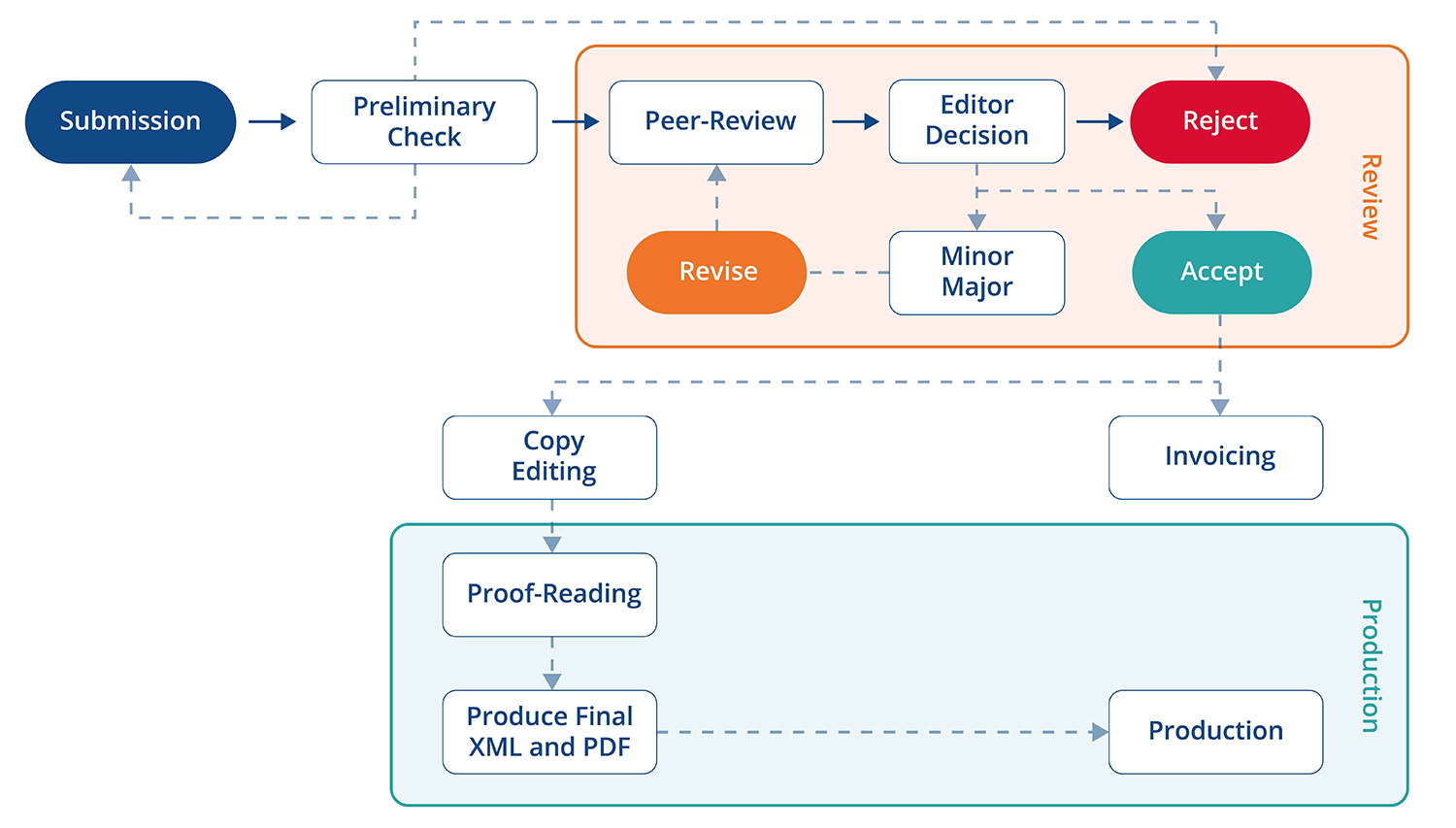 British Journal of Hospital Medicine Editorial Process
The following provides notes on each step.
1. Submission
The author will receive a tracking number (Ms. No.) following a submission.
2. Preliminary Check
All submitted manuscripts will be checked by the journal's Editorial Office for compliance with the Instructions for Authors.
The academic editor, i.e., the Editor-in-Chief in the case of submissions, or an Editorial Board member in case of a conflict of interest, and of regular submissions if the Editor-in-Chief allows, will be notified of the submission and invited to perform a check and recommend reviewers. Academic editors can decide to continue with the peer-review process, reject a manuscript, or request revisions before peer review.
BJHM requires that editorial staff or editors not be involved in processing their own academic work. The Editor or members of the Editorial Board may occasionally submit their own manuscripts for possible publication in the journal. In these cases, the peer review process will be managed by alternative members of the Board. Submissions will be assigned to at least two reviewers. The submitting Editor/Board member will have no involvement in the decision-making process. Decisions will be made by other Editorial Board Members who do not have a conflict of interest with the author.
3. Peer-review
BJHM adopts a double-blind peer review process. Following initial editorial checks, manuscripts classified as article, review, systematic review, education and training, doctors in training, quality improvement, or case report, as well as letters that include original data or analytical content, are sent for peer review and assigned to at least two independent reviewers. BJHM editors will make sure there are no conflicts of interest before contacting reviewers and will not consider those with potential conflicts. Reviewers are asked to declare any potential conflicts of interest before reviewing any submitted manuscript, and to recuse if a conflict might prevent them, or reasonably be perceived to prevent them, from objectively assessing the manuscript. For more information, see our Peer Review policy.
4. Author Revision
In cases where Minor revisions/Major revisions are recommended, the author is usually requested to revise the paper before referring to the academic editors for the next round of review. Articles may or may not be sent to reviewers after minor revision, which depends on whether the reviewers requested to see the revised version or not. The revised manuscript after major revision will be sent back to reviewers again. Normally (In general), we will allow no more than two rounds of major revision for each manuscript. Any further revision needed will follow the decision of the academic editors.
All reviewer comments should be responded to point-by-point. Where the authors disagree with a reviewer, they must provide a clear response or rebuttal.
5. Editor Decision
The acceptance of the manuscript will depend on the revisions made to the manuscript. Authors should provide a point-by-point response or a rebuttal if some of the issues reviewers comment on cannot be revised. The acceptance or rejection decision will be made by academic editors after peer review. The academic editors can select from the following options: Accept in current form, accept with minor revisions, or reject.
6. Author Appeals
BJHM adheres to COPE guidelines regarding appeals to editorial decisions and complaints. The appeal must provide a detailed justification, including point-by-point responses to the reviewers' and/or Editor's comments.
The Managing Editor of the journal will forward the manuscript and related information (including the identities of the reviewers) to the Editor-in-Chief, Associate Editor, or another relevant Editorial Board member for consultation. The consulted editor will then be asked to provide an advisory recommendation on the manuscript, which may include recommending acceptance, inviting a resubmission, sending it to another reviewer for further peer review, or upholding the original rejection decision. The Editor-in-Chief will make the final decision. A rejection decision at this stage is final and cannot be reversed. For more information, see our Appeals and Complaints policy.
7. Production
BJHM carries out production on all manuscripts, including copy editing, layout and conversion to XML. Language editing is carried out by professional English editors. We recommend that authors use YodaEdit's English editing service prior to publication or during revisions. If you have used an alternative service, please provide a copy certificate to the Editorial Office.
The submitted, accepted and published dates will be shown in the PDF and XML/HTML files of the published articles, a digital object identifier (DOI) number will also be assigned for each published article. The submitted date is the date on which the editors received the original (or if previously rejected, the resubmitted) manuscript. The revised date is the date on which the editors received the final revision of manuscript. The accepted date is when the editor sends the acceptance letter. The published date is the earliest date that the final version-of-record is made available on the publisher's website.
8. Process for Post-Publication Discussions and Corrections
Post-Publication Survey: We welcome every scholar who has published an article in BJHM to use survey questionnaire to provide suggestions for help optimizing our current shortcomings, enhancing communication with scholars, and improving the author experience.
Correspondence: We welcome readers to submit ‘correspondences’ to BJHM, providing a platform for constructive feedback, criticism, and discussion on published articles. The Editor-in-Chief will review these correspondences, and those approved along with important comments will be published of the journal, ensuring valuable insights are shared with the broader readership.
Online Comments: Although we do not monitor the internet or social media, we do pay attention to and follow up on clearly documented concerns that are directly brought to our attention from other platforms (by authors or relevant readers, whether named or anonymous).
Contact the Journal: In addition to the above methods, you can also provide feedback and complaints directly through the contact page of the journal.
When our team members receive feedback, we further communicate with the relevant parties to seek verification. If an issue is identified, our editorial staff follows COPE's procedures for handling it, seeking resolution advice from the Editor-in-Chief, Associate Editor, or another relevant Editorial Board member. The Editor-in-Chief will make the final decision. Necessary measures and policy improvements are made based on the specific circumstances, and training on guidelines is provided. We prioritize achieving the most beneficial outcomes for the scientific community over the quickest results. BJHM strives to provide a better experience for every scholar and continuously optimize our current processes and technical facilities.
9. Publishing Standards and Report Guidelines
Submission of a manuscript to BJHM implies that all authors have read and agreed to its content and that the manuscript conforms to the journal’s policies.
See more details about our journal’s guidelines and standards.
10. Ethical Standards
BJHM follows the guidelines of the Committee on Publication Ethics (COPE) and the International Committee of Medical Journal Editors (ICMJE) Recommendations for the Conduct, Reporting, Editing and Publication of Scholarly Work in Medical Journals.
Our journals follow COPE’s procedures for dealing with potentially unethical behavior by authors, reviewers or editors. BJHM editorial staff are trained in how to detect and respond to potential ethical problems.
For more information, see our Publishing Ethics policy.
11. Editorial Independence
Editorial independence dictates that the decision to accept or reject a manuscript is based on the scientific merit of the article, but not on any other relations, for example, pressure from the publisher on the journal editor. This means that Editor is independent in his/her decision and will not be under pressure from any influential body or organization.
Our editorial policy is consistent with the principles of editorial independence presented by the World Association of Medical Editors (WAME).
Updated on 11 February 2026