
Special Interview with Prof. John Elefteriades: RCM Journal Editorial Board Member and World's Top 0.05% Scholars
11 July 2025
We are honoured to have an exclusive interview with Professor John Elefteriades, a member of the RCM's Editorial Board, which will focus on current research progress in the discipline, practical experience in scholarly publishing, and the development of young researchers. We hope to draw on Professor John's expertise and perspectives to inspire more of our peers.
Profile of Professor John Elefteriades:
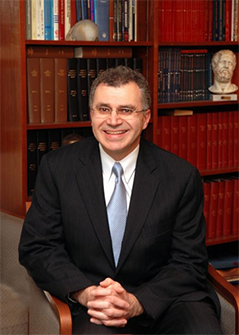
John Elefteriades, MD, is one of the leading heart surgeons in the United States. He has performed all types of adult cardiac surgeries, including coronary artery bypass grafting and artificial heart implantation. He is the founding director (Emeritus) of the Aortic Institute at Yale New Haven Hospital.
Prof. Elefteriades is a pioneer in the use of extreme cooling, or hypothermia, which allows surgeons to temporarily stop a patient's heart long enough to carry out cardiac surgery. Once the procedure is complete, the patient is warmed and the heart restarted.
He is a strong advocate of general screening to discover if people have aortic aneurysms, or bulges in the main artery connected to the heart. Left untreated, aortic aneurysms can lead to ruptures that cause death. “With aneurysm disease, the first symptom is death. Most people feel no pain. So, it would be a great advance to have a general screening test”, Prof. Elefteriades says.
At the Aortic Institute, one of the nation's largest facilities for treatment and study of the aorta, Prof. Elefteriades’ team has developed an “RNA Signature” blood test to detect aneurysm disease. This work is a step along the path to developing a general screening technique that’s affordable and accurate enough for widespread use.
Working with other researchers at Yale, he has also assembled a database of aneurysm disease cases, which enables researchers to find patterns in patient populations. They have already discovered links between weightlifting and aneurysms. They also gathered evidence that allows physicians to decide when (that is, at what aneurysm size) it is necessary to perform surgery in order to prevent a cataclysmic event in patients with an aneurysm.
In addition to his work with aneurysms, prof. Elefteriades is the author of a medical mystery/ethics fiction thriller called “Transplant”, which was a finalist in the Next Generation Indie Book Awards as a best first novel. He also published a collection of inspirational patient stories entitled “Extraordinary Hearts: A Journey of Cardiac Medicine and the Human Spirit”. As well, he has published many medical textbooks and over 500 scientific articles and chapters. He has lectured and/or operated in 33 countries.
Prof. Elefteriades has been named among the Best Doctors in America consistently for two decades. He is a professor of cardiothoracic surgery at Yale School of Medicine. In 2018, Prof. Elefteriades was granted an Honorary PhD by the University of Liege (Belgium) for his contributions to scientific understanding and clinical care of thoracic aortic aneurysms. In 2020, he was named by Expertscape as the leading aneurysm expert in the world.
Q1. Could you share with us your research areas?
Prof. Elefteriades:
I've had a 39-year career, so I've done research in many different areas. My first focus when I began my surgical career was on coronary bypass surgery for blockages, patients with blocked arteries feeding the heart. My first important project had to do with patients whose hearts very weak, and it was felt at that time that they couldn't be operated on, that the risk of operation was too high. But I had experience with those patients, and little by little, we built a big series and we found that we could operate very well and safely, even if the ejection fraction was less than 30%. And I think that was the first important contribution from our team that we were able to make was to show that those patients could be operated on safely despite the weak heart, and that they would do very well and actually improve their heart strength once we provided more blood flow to the heart muscle. So that was my first area. And then I've continued that throughout my career, of the coronary bypass, and then also heart transplantation was a big part of my career. It wasn't that well established when I began my career 39 years ago. And so we learned a lot as we were doing it, but it became very important to me and some of the patients I operated on years ago. I see them in the hallway now. They're still alive after a heart transplant.
And then I worked a lot with artificial hearts of many different types, and those were very dangerous operations in that era. Some of the artificial hearts were so big that you could barely fit them into the chest.
And then, of course, the last 20 years or so, most of my attention has been on aortic aneurysms, enlargements of the main artery of the body. And that's where we've done a lot of work. We have an aortic aneurysm research team with always 8 or 9 or 10 members. We have two research directors who work under my supervision, and we're very, very active in that area of aortic aneurysms.
Q2. You have witnessed decades of development in the field of cardiovascular surgery. Then, in your opinion, what is the most revolutionary technology or concept in this field in the past decade? How has it changed clinical practice?
Prof. Elefteriades:
I think that one of the biggest advances in medicine that also affects my field in thoracic aortic disease has been the mapping of the human genome. It was first mapped in 1999, all 3.2 billion letters of the human genome were first mapped in 1999. There was a competition between a consortium of universities, about 10 or 12 universities, and one private company called Celera. And Craig Venter, the president of Celera, was the first human being ever to have his genome mapped.
(Note: 1999 was an important point when scientists decoded the complete human chromosome 22 for the first time, and the complete genome containing all of the approximately 3.2 billion base pairs without deletions was not officially mapped until 2022.)
And that is a landmark in human development and human accomplishment, to be able to read the secret code that determines how our bodies will be built and that affects every aspect of medicine, every aspect for us who specialize in aortic aneurysms. The knowledge has grown that the genes are very important. And I can tell you a little story, if you want, about how we learned the importance of heredity. Would you like me to tell you a little story?
So this was about 25 years ago, we were making rounds, and my team and I saw a patient we had operated on two days ago for aortic dissection. You probably don't even know what that is, but that's a splitting up part of the layers of the aorta, the main artery of the body. It's the worst thing that can happen to a human being, the first native medical, the worst native medical condition that can happen.
So we did an emergency operation for her, and this was post-op day 2. We were rounding on her with my team, and I don't know why, but I asked her if she had any family members who had had the same problem, and she said, Doctor, don't you remember 15 years ago you operated on my mother for the same problem? So that was very interesting to us. We didn't know this was an inherited disease. And then this is the very important part. And then I said, Ma'am, has anyone else in your family been affected? And that's when she started to cry and we could not stop her tears. Finally, after about 5 minutes, our nurse comforted her, and I said, Ma'am, what is it? What are you trying to tell me? And she said, Doctor, I don't know my little girl. They said it was her heart. And we looked in the records, and her 12-year-old daughter was the youngest individual ever to die at Yale University with the same thing, aortic dissection. So there we had three generations in one family, our patient, her mother, and her daughter. And that's how we realized that this is a hereditary condition. That was an important moment for us.
Yes, at the same time, Dr. Diana Milewicz's team in Texas had made a similar recognition, and we both published papers that were essentially identical with the same findings of inheritance of aneurysm and dissection.
Then, you know, when the first genome was mapped which I told you in 1999, it cost \$3 billion. Now it's \$500. So during that time, genetic analysis of our aneurysm patients has proliferated. And now we're realizing that this is a genetic disease and all it requires is a change in one letter out of the 3.2 billion, if you have one wrong letter out of 3.2 billion, you develop a thoracic aortic aneurysm, and it will take your life. Isn't that amazing? It's like if you, if you think of the whole sea coaster, seacoast of the United States, and one grain of sand is enough to disturb the whole seacoast, one letter out of 3.2 billion in our genes is enough to cause a thoracic aortic aneurysm.
Q3. In the research of new technologies for heart transplantation, what do you think is the biggest technical bottleneck at present? In what areas are breakthroughs expected in the future to benefit more patients?
Prof. Elefteriades:
That's a wonderful question because there are new developments that have changed the field already in favor of our patients at the beginning of our team at Yale. I was a junior member on the team, and we did the first heart transplant in New England, in the northeast part of the United States. So I was involved from the very beginning. I'll tell you another little story. I was the junior person on the team when we did that first transplant operation, so they sent me to get the heart, and I had to go about 60 miles on the highway to get the heart. I got the heart, I put it in the cooler, and we were profiving back, and the ambulance Profiver said, DOC, what do you have in the cooler? And I said, well, I have a human heart in there, you have to get me back as quickly as possible before the heart gets warm and weak, and so he hit the gas pedal and the engine went as fast as it could go. About five miles later, the engine blew. He pushed it so hard that the engine blew, and the ambulance stopped right on the highway.
I have this heart in the cooler, and I have no way to get it to the hospital, and every minute is counting, so I got out of the car and I put my thumb out. I don't know if this works in the rest of the world, but this means I need a ride and the next car to come by was a policeman said, what are you doing in the middle of the highway with a cooler in your hand?
I said, sir, I have a heart in there. I'm a surgeon and I have to go transplant this heart. And he looked at me, and he didn't believe me. And I said, sir, it's really true, I have a heart in here, can you help me get to the hospital? Every minute counts. And so he made me show him the heart, he saw the heart, and then he put me in his car. And, you know, those police cars can go very fast. And he got me to the heart, to the hospital, very quickly.
But now in transplantation, the heart transplantation, the limiting factor has always been the lack of available donors. We've always been limited; we've had many recipients on the list, but not enough donor hearts to take care of all those needy patients.
Now, in the last few years, things have changed, and there have been two important changes. One is that we've learned that we can take the heart after a patient dies. We never knew that we had to keep the patient alive by whatever means we needed and take the heart out when it was still beating. Now we've learned that if we get to the patient pretty promptly after he dies, we can still take that heart and use it. We never knew that before. So we have more donors available. We have no more hearts that we can use.
The second thing is the following. We never knew how to protect the heart during the two to 3 hours that it takes to take it out and get it back to the receiving center. So we would put it in a bucket of ice. When you make any organ cold, its metabolism falls very low. It's not using up energy like a refrigerator. A refrigerator, it keeps food from spoiling because it slows down the metabolism. So that's what we used to do. But now there's a new technique. We did it in the laboratory 40 years ago, but we didn't know we could do it for transplantation, but we have, we have devices now like a bassinet with a glass cover. And we put the heart on a little pump. Wow, and the pump is delivering blood and oxygen all the time. And the heart is beating all the way while it's being cooled.
So the heart arrives in good shape, it's been receiving blood, receiving oxygen, and pumping all the time with no load. When it's in the bassinet, there's no load on the heart. It's not delivering blood to the body, which is energy requiring effort. So those are two big changes in heart transplantation that are making it safer and available to more patients.
The other thing is that there are now companies that harvest the heart, they put it in the transport device, and they bring it right into the operating room for us. Before, I used to have to travel wherever it was. It could be 1000 miles to go get the heart, and then I'd have to bring it back on the airplane, no sleep for 24 hours, and I would have to put that heart in. Now it's much better because the heart is delivered by a commercial team in perfect condition, and they hand it over to us. So there have been amazing new developments in heart transplantation.
Q4. How do you envision the future of your research field in the next 5–10 years? What trends or challenges do you foresee in the future of academia?
Prof. Elefteriades:
I think academia is doing very well. When I was training, the main focus was on how to do operations, when to do them, and how to bring the patient through safely. And cardiac surgery was still relatively new. It had started about 15 or 18 years before I started training, but it was still in its infancy, and our focus was on keeping the patient alive, doing the operation safely. We didn't have too much time to think about the science behind valve disease, coronary disease, atherosclerosis, and aneurysm disease. Then, as the operations became safer and more standardized, we started thinking about the science behind our diseases. Now, the operations they're still challenging, and we have to train our residents very well. But most patients come through the operations extremely safely. So now we have more time to think about the science. And I feel good about the future because all of our trainees are now raised in a very scientific environment. I want them to always think about what's going on, not just how to do the operation, but what caused the disease. How does it hurt the patient? When should an operation be done? And how do we keep the patient safe for the long term? So I have a good outlook for our future. The one area where I don't have a good outlook is the following. More and more of our operations are being done, closed, that is, without opening the body cavity. Every time you do that, you give away a little something. I know the robot is great. It can make very fine movements, but my fear is that our young trainees in five or 10 years, as you were asking Carol, in five or 10 years, they may lose the skill.
There will be many cases when an open operation has to be done, when a patient comes in with a torn aorta, you don't have time to bring the robot and set it up, and so on. You have to open the chest, get in there, and fix the problem. And I see already for the most challenging aneurysms, the ones that go from the chest through the diaphragm all the way down into the abdomen, they're probably the most challenging operations in any field of surgery. Our residents don't get the exposure anymore because all the operations are done noninvasively with a catheter and a stent. So that's happened already. Carol, I think our graduating residents, except for a very few programs in the country, don't have the skills anymore to do the big aortic operations. That's one of my fears.
Q5. In your opinion, what are the essential characteristics of a successful academic journal? What do you believe are the main challenges facing academic publishing today?
Prof. Elefteriades:
I know a little bit about that because about 25 years ago, I started a journal myself, and I think that there's a lot to be proud of in medical publishing throughout the world. So much to be proud of. I think every journal requires honesty. They look for very good papers, they have fair and impartial referees and reviewers, they usually have wonderful editorial boards, and I think you can be very proud of being involved in medical publishing and very proud of your journal.
The essential characteristics. Well, I think practically the journal has to turn the review around in a reasonable amount of time. You know, even after, you know, my whole career, I've published 650 papers or something like that, I submitted a paper yesterday that I'm very proud of. And even with all of my experience, I'll be very anxious to find out what the reviewers think and what the journal thinks. But I think a quick turnaround time is very important. I think a really good editor and editorial team is very important, a very good publishing team, you know, that looks at the grammar, looks at the punctuation, checks for accuracy between the figures and the text, does all those important publishing functions. I think that's very important. The editorial board, those people who love medicine so much that they spend hours and hours every week reading new articles. My experience is that they're generally very fair and impartial.
In the beginning years ago, cardiac surgeons were very competitive. And I think maybe there were some cases where competition kept the reviewers from being honest. I haven't seen any evidence of that for a long time. Now things have changed a lot. It used to be that a journal had to have a really good paper, really good print, and feel good in your hands. That doesn't happen anymore because everything has gone to online. We don't have that, the pleasure of seeing the physical journal.
Q6. As an editorial board member, what aspects of submitted manuscripts do you value the most (e.g., innovation, data quality, writing quality)?
Prof. Elefteriades:
To tell you the truth, the English usage doesn't bother me too much. It doesn't bother me too much, you know? I'm amazed that people from other countries can do as well as they do with English usage. And I was brought up bilingual, and I've studied languages a lot, so that doesn't bother me. I can usually understand what the author is trying to convey. That doesn't bother me too much. I think that, you know, I wrote a paper many years ago about 10 tips on how to write a scientific paper.
I wrote 10 tips I won't be able to remember, remember them all for you. Now this was for junior people starting out, but one figure always has one wonderful figure that nobody will ever forget. I think that's very important. We live in a visual world. Surgeons, especially, are totally visual, so I think having one really good figure, keep your paper short and to the point. Nobody has time to read, you know, a 20-page paper.
Yes, be very clear with the. With the abstract and the messages that you want to deliver, have some clear messages. And be sure to write about the deficiencies in your paper. There's no study that doesn't have deficiencies. Be sure to write about those as you conclude your paper. Those are some of the tips.
Q7. How do you balance your research, clinical work, and journal editorial work? What are your interests and hobbies outside of your academic work?
Prof. Elefteriades:
You know, balancing clinical work, which has been the biggest part of my life, somebody estimated I've done 10000 operations now, and I don't know, 375 heart transplants or something like that. That's been the focus of my work. And, you know, in our work, oftentimes you end up going back to the hospital when the patient needs you, even at night and on the weekends. Transplantation is usually done, very well done, during the day. So my clinical work has been the main focus of my career. But education, of course, has been a big focus in surgical fields. Much of the education is done in the operating room, and that's where you teach the resident little by little how to do the easy steps and the harder until the resident can do the whole operation.
But the research I've been able to make time for. And of course, you have to steal that time from somewhere. You steal it a little bit from your sleep, and you steal it a little bit from your family. And you know, I was so busy when my children were growing up, but I spent quality time with them. It wasn't as much as other fathers. And they always knew and still know how much I love them. But sometimes an academic career and clinical practice do take attention away from your family.
I have two hobbies. When I was in school, I was a wrestler and that was very important to me, and I tried to maintain physical fitness throughout my life, including my current stage. So I exercise almost every day. You know, when you're brought up with a demanding sport like wrestling, I don't think it ever leaves you, so that's one of my hobbies. And then my father, he's still alive. My father was a car mechanic, and from the age of six years old, I was with him whenever he was working on cars, and I learned how to work on cars and I was not a bad mechanic, I was pretty good, and so I continue, my main interest is cars, I love cars, I love sports cars, I love engines, and that's my main hobby outside of my work.
And you know, when you think about it, when your engine stops running, you have to do a process of diagnosis, right? You have to figure out what the problem is, and you have clues that you use, and then you have to go to the problem area and you have to fix it. And once you fix it, you put everything back together again. And it's very similar to doing an operation. It's the same process of diagnosis, repair, and closure.
Q8. What practical advice would you offer to early-career researchers facing challenges at the start of their academic journey?
Prof. Elefteriades:
The most important recommendation I have is to listen carefully to your patients. I don't mean just their words, their physical findings, what you see in the operating room, pay attention to every little thing, and your patients will teach you new concepts and new advances. Virtually everything I've I've ever done academically or scientifically has originated from an observation in the operating room or in the clinical wards. So I recommend to young doctors, young surgeons, pay attention to everything that you see, and new ideas, new concepts will come into your mind.
Q9. Could you offer a message to your peers?
Prof. Elefteriades:
To my peers, I would say, boy, are we lucky to be in the field that we're in, surgery in general medicine, especially heart surgery. Boy, are we lucky that people let us do what we do. It's the most challenging, interesting career anybody could think of.
In this interview, Professor John Elefteriades, with his clinical wisdom and scientific insight spanning nearly four decades, outlines the past, present, and future of cardiovascular surgery, and testifies to the infinite possibilities of cardiovascular surgery. His exploration of the nature of disease, breakthroughs in the boundaries of life in surgery, and his advice to young scholars to ‘keep watching and respect life’ have fuelled the field.
IMR Press would like to take this opportunity to salute all those who have pushed the boundaries of medicine with science and compassion. We look forward to continuing to work with researchers around the world to write more chapters of ‘rebooting life’ in the future!
Related Papers:
Chronic Total Occlusion Revascularization Strategies: A Comparative Study of Percutaneous Coronary Intervention and Coronary Artery Bypass Grafting: https://doi.org/10.31083/RCM27226
Use of Indocyanine Green (ICG) to Assess Myocardial Perfusion and Territorial Distribution of Vein Grafts Implanted on Coronary Arteries in an Ex-vivo Porcine Model. A Potential Adjunct to Assist Revascularization Strategies and Training in Coronary Artery Bypass Grafting: https://doi.org/10.31083/RCM25778
Valvulopathies and Genetics: Where are We? https://doi.org/10.31083/j.rcm2502040
Metformin and Risks of Aortic Aneurysm and Aortic Dissection: A Mendelian Randomization Study: https://doi.org/10.31083/RCM27734