
 , Xian Xie 2, Zening Jin 1, Jing Nan 1, Jing Han 1,*
 , Li Yin 2,*
1 Department of Cardiology and Macrovascular Disease, Beijing Tiantan Hospital, Capital Medical University, 100070 Beijing, China
2 Hunan Provincial Center for Disease Control and Prevention, 410153 Changsha, Hunan, China
Abstract
Current evidence characterizing the association between relative fat mass (RFM) and cardiometabolic disease (CMD) remains limited, with critical gaps persisting in the understanding of age-dependent heterogeneity. Thus, this study aimed to assess the association between RFM and CMD risk across age groups.
This study utilized data from the China Health Evaluation And Risk Reduction Through Nationwide Teamwork (ChinaHEART), and enrolled 93,801 community-dwelling adults. CMD was defined as a composite diagnosis that included diabetes mellitus, myocardial infarction, and stroke. Meanwhile, RFM was derived from height, waist circumference, and sex. Participants were stratified into groups of young and middle-aged adults (35–59 years) and older adults (≥60 years). Multivariable logistic regression models were employed to estimate odds ratios (ORs) and 95% confidence intervals (CIs), and to test for interaction effects. Restricted cubic spline models were applied to examine dose–response relationships.
Among the 93,801 participants, 18,473 (19.69%) had CMD. In the fully adjusted models, each unit increase in RFM was associated with a 9% increase in CMD risk (OR = 1.09, 95% CI: 1.08–1.09). Compared to the lowest RFM quartile (Q1), higher risks were observed in the Q2 (1.68, 1.59–1.77), Q3 (2.56, 2.34–2.80), and Q4 (4.02, 3.68–4.39) groups (p for trend <0.001). A significant RFM–age interaction was identified (p for interaction = 0.001). Restricted cubic splines confirmed significant non-linear dose–response relationships (both p for overall association <0.001; p for non-linear <0.05), with distinct age-specific patterns. Older adults exhibited higher overall CMD risk compared to young and middle-aged adults. The lower RFM inflection point corresponds to an OR of 1 (30 vs. 34), highlighting the greater vulnerability of this age group and informing the future development of age-specific RFM thresholds.
RFM demonstrates a significant positive association with CMD risk, exhibiting age-dependent heterogeneity, and emphasizing age-tailored interventions for CMD prevention strategies.
Keywords
- relative fat mass
- cardiometabolic disease
- young and middle-aged adults
- older adults
- dose-response relationship
Cardiometabolic diseases (CMD), including diabetes, myocardial infarction, and stroke, pose a growing public health threat due to their increasing prevalence [1, 2, 3]. These conditions share pathophysiologies such as metabolic inflammation and ectopic lipid deposition, and often presenting with overlapping therapeutic targets [4, 5, 6]. With CMD prevalence rising with age [7, 8] and against the backdrop of global population aging, there is a pressing need for simple, accurate indicators to predict the risk of CMD and guide interventions. Traditional anthropometric measures like body mass index (BMI) and waist circumference, while associated with CMD risk, fail to distinguish fat from lean mass [9]. Advanced techniques such as dual-energy X-ray absorptiometry (DXA) and bioelectrical impedance analysis (BIA) have limitations in clinical practice due to cost and complexity.
Relative fat mass (RFM), a novel anthropometric metric derived from height, waist circumference, and sex, serves as a validated indicator of adiposity with strong correlations to DXA- and BIA-measured body fat percentage [9, 10]. Prior studies have linked RFM to increased risks of coronary heart disease [11], stroke [12], type 2 diabetes [13, 14, 15], metabolic syndrome [16], and heart failure [17]. RFM may be superior to BMI in predicting the risk of diabetes [13, 14, 15] and the metabolic syndrome [16]. However, evidence on the association between RFM and CMD remains scarce, particularly regarding dose-response relationships and age-specific variations. Aging-driven mechanisms—including ectopic fat redistribution [18], chronic inflammation [19], and multifaceted insulin resistance [20]—suggest potential heterogeneity in the association between RFM and CMD across age groups, however, stratified analyses are currently lacking.
We analyzed the data from China Health Evaluation And Risk Reduction Through Nationwide Teamwork (ChinaHEART), a large scale, population-based study covering all 31 provinces in mainland China, to investigate the relationship between RFM and CMD and evaluate its variation across age groups (young and middle-aged vs. older adults).

The ChinaHEART, a nationwide public health project, served as the data source. Detailed protocols have been published previously [21]. From 2016 to 2023, we enrolled 190,317 community-dwelling adults aged 35–75 years across 20 sites in Hunan Province, China. Participants completed standardized questionnaires (demographics, lifestyle, medical history, ect.) and underwent physical/laboratory examinations. After excluding individuals with missing key variables (anthropometrics, CMD status, socioeconomic factors, lifestyle characteristics, ect.), 93,801 participants were retained for analysis (Fig. 1).
 Fig. 1.
Study enrollment flowchart.
Ethical approval was granted by Fuwai Hospital’s Institutional Review Board (No. 2014-574). All participants provided written informed consent.
Trained staff collected data using standardized protocols: (1) Questionnaires:
Demographics, socioeconomic status (annual household income:
CMD was defined as
Baseline characteristics were described for the total study population, young
and middle-aged group (35–59 years), and older adult group (
Multivariable logistic regression models were used to calculate odds ratios (ORs) and 95% confidence intervals (CIs) for the association between RFM and CMD risk. RFM was analyzed as a continuous variable to calculate ORs and 95% CIs. Then, participants were divided into quartiles (Q1–Q4) based on RFM values, with Q1 as the reference group, to calculate ORs and 95% CIs for Q2, Q3, and Q4 groups. The logistic regression models were adjusted as follows: Model 1 adjusted for age and sex; the full model additionally adjusted for annual household income, education level, smoking status, alcohol consumption, physical activity level, diet, hypertension, and dyslipidemia.
The interaction between RFM and age group (
All statistical analyses were performed using SAS 9.4 (SAS Institute Inc., Cary,
NC, USA) and R 4.4.3 software (R Foundation for Statistical Computing, Vienna,
Austria). Two-tailed tests were used, with p
This study enrolled a total of 93,801 participants (Table 1), with a median age of 59 years (interquartile range [IQR]: 52, 67). The cohort comprised 47,004 (50.11%) middle-aged and young participants and 46,797 (48.89%) older participants. No significant difference was observed in RFM distribution between the two age groups (p = 0.739), with median [IQR] values of 34.44 [27.26, 38.75] and 34.06 [26.12, 39.78], respectively.
| Overall | p value | ||||
| Number of participants | 93,801 | 46,797 (48.89%) | 47,004 (50.11%) | ||
| Age (years) | 59.00 [52.00, 67.00] | 67.00 [63.00, 70.00] | 52.00 [47.00, 55.00] | p | |
| RFM | 34.33 [26.67, 39.25] | 34.06 [26.12, 39.78] | 34.44 [27.26, 38.75] | p = 0.739 | |
| Sociodemographic characteristics | |||||
| Gender (female) | 56,601 (60.34%) | 26,433 (56.48%) | 30,168 (64.18%) | p | |
| Income | p | ||||
| 9685 (10.33%) | 7272 (15.54%) | 2413 (5.13%) | |||
| 81,391 (86.77%) | 38,054 (81.32%) | 43,337 (92.20%) | |||
| Unknown | 2725 (2.91%) | 1471 (3.14%) | 1254 (2.67%) | ||
| Education | p | ||||
| Middle school and above | 41,338 (44.07%) | 12,965 (27.70%) | 28,373 (60.36%) | ||
| Primary school and below | 52,410 (55.87%) | 33,804 (72.24%) | 18,606 (39.58%) | ||
| Unknown | 53 (0.06%) | 28 (0.06%) | 25 (0.05%) | ||
| Lifestyle characteristics | |||||
| Insufficient physical activity | 72,001 (76.76%) | 35,621 (76.12%) | 36,380 (77.40%) | p | |
| Unhealthy diet | 87,701 (93.50%) | 43,944 (93.90%) | 43,757 (93.09%) | p | |
| Alcohol consumption | 6730 (7.17%) | 4311 (9.21%) | 2419 (5.15%) | p | |
| Current smoking | 22,188 (23.65%) | 11,472 (24.51%) | 10,716 (22.80%) | p | |
| Metabolic risk factors | |||||
| Hypertension | 53,283 (56.80%) | 31,696 (67.73 %) | 21,587 (45.93%) | p | |
| Dyslipidemia | 17,381 (18.53%) | 9253 (19.77%) | 8128 (17.29%) | p | |
Age and Relative Fat Mass (RFM) are presented as median (interquartile range,
IQR) due to non-normal distributions. Categorical variables are expressed as n
(%). “Unknown” indicate participants who “declined to respond” or “were
unaware of the answer”. ¥10,000
Compared with the older group, the middle-aged and young group demonstrated
significantly higher proportions of female participants (64.18% vs. 56.48%),
annual household income
In the total population, RFM demonstrated significant associations with
increased CMD risk (Table 2). In the unadjusted model, a 1-unit increase in RFM
was associated with a 3% higher risk of CMD (p
| Unadjusted model | Adjusted for age and gender | Multivariable–adjusted | |||||
| OR (95% CI) | p | OR (95% CI) | p | OR (95% CI) | p | ||
| RFM | 1.03 (1.02–1.03) | 1.10 (1.10–1.11) | 1.09 (1.08–1.09) | ||||
| RFM Group | |||||||
| Q1 | 1.00 | 1.00 | 1.00 | ||||
| Q2 | 1.29 (1.24–1.36) | 1.90 (1.80–1.99) | 1.68 (1.59–1.77) | ||||
| Q3 | 0.98 (0.94–1.03) | 0.518 | 3.06 (2.80–3.34) | 2.56 (2.34–2.80) | |||
| Q4 | 1.80 (1.72–1.89) | 5.15 (4.72–5.62) | 4.02 (3.68–4.39) | ||||
| p for trend | |||||||
Abbreviations: CI, confidence interval; CMD, cardiometabolic disease; OR, odds ratio; RFM, relative fat mass; Q1–Q4, quartile groups stratified by RFM interquartile ranges. The multivariable-adjusted model included age, sex, annual household income, educational attainment, alcohol consumption, smoking status, physical activity, diet, hypertension, and dyslipidemia.
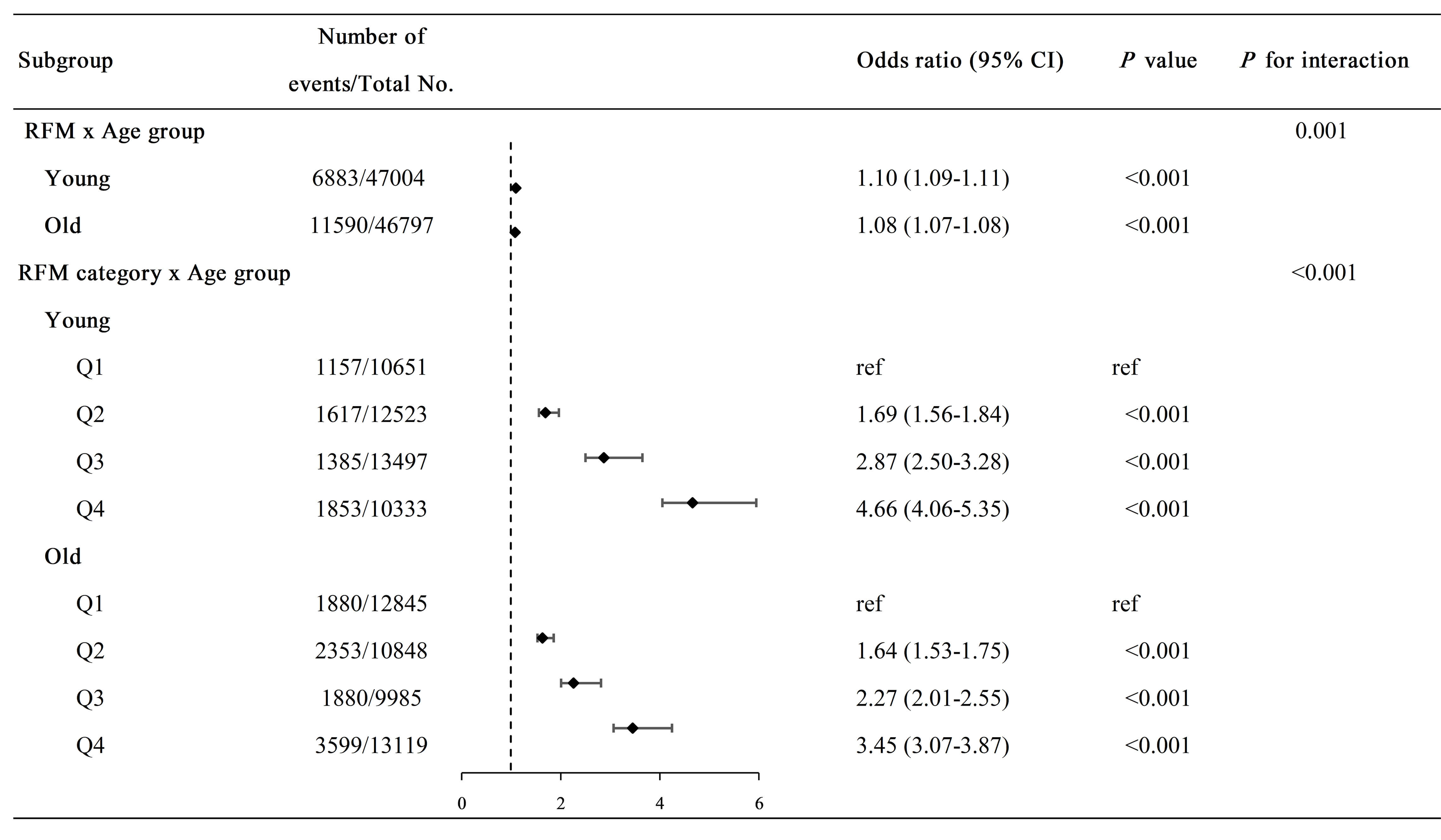
Significant interaction effects were observed between RFM (p = 0.001)
and RFM quartiles (p
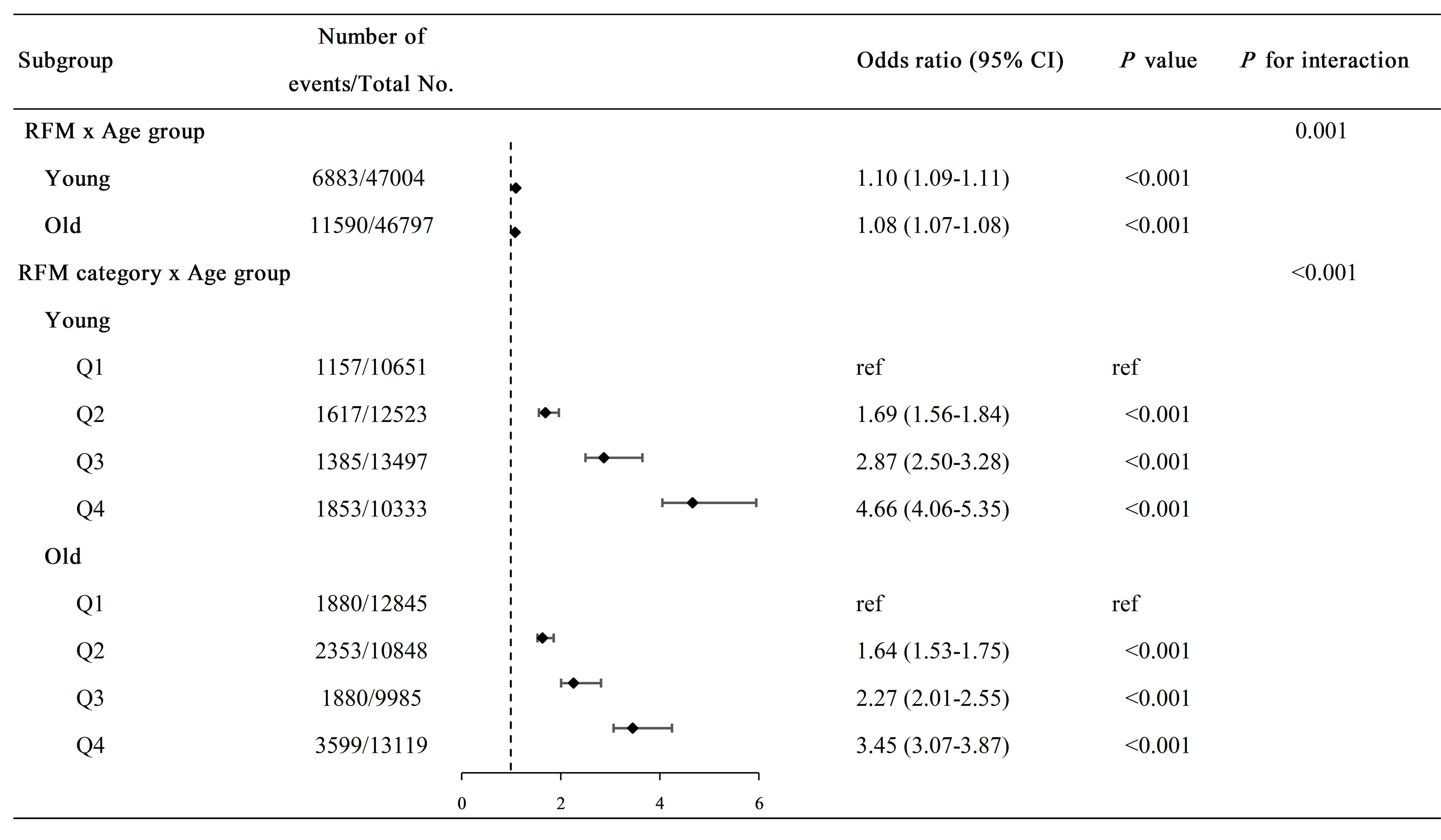 Fig. 2.
Forest plot of subgroup analysis for the association between
relative fat mass and cardiometabolic disease risk. Young: age
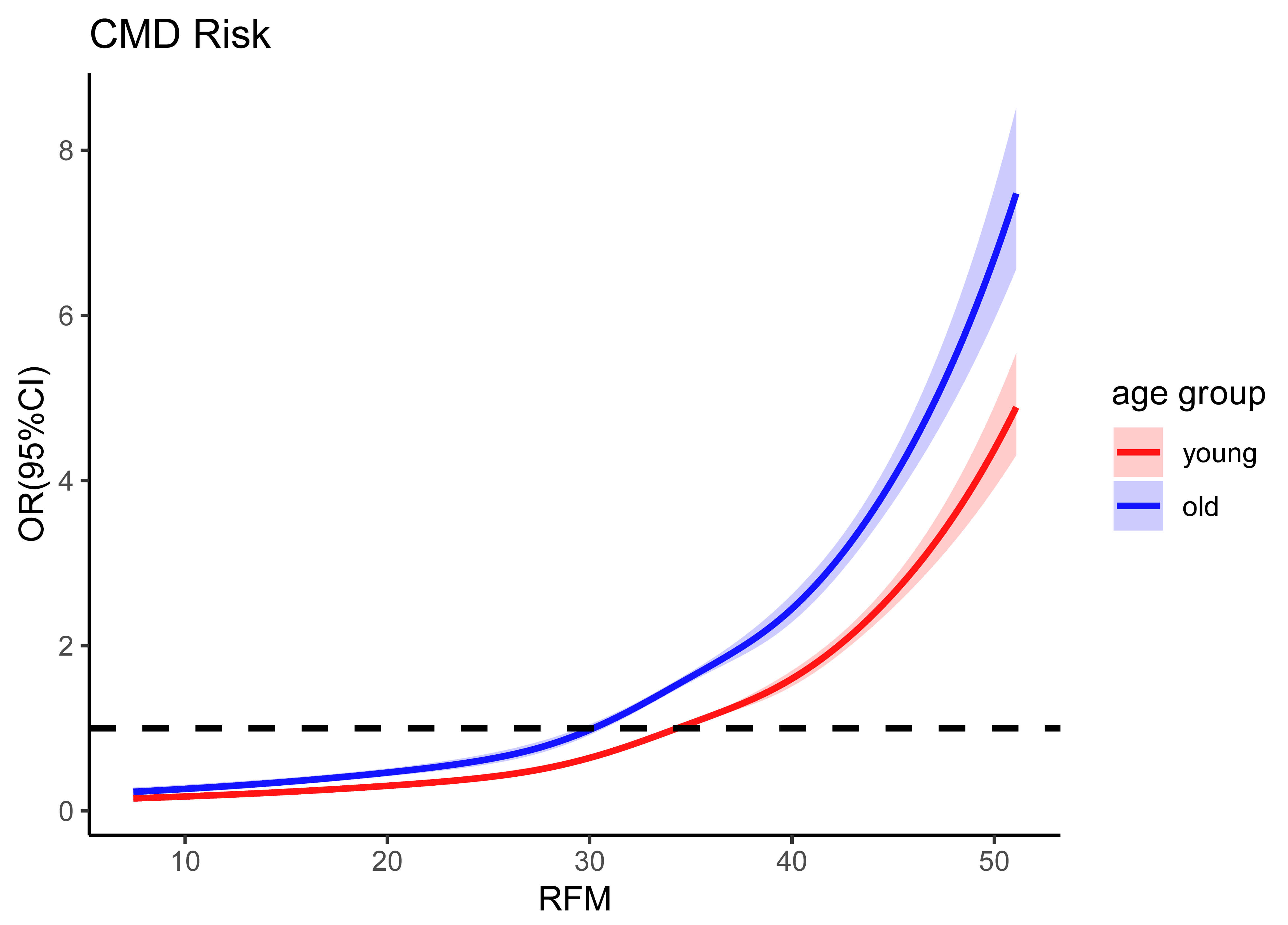
Restricted cubic spline analyses adjusted for age, sex, household income,
education, smoking, alcohol use, physical activity, diet, hypertension and dyslipidemia revealed distinct patterns
across populations (Fig. 3). In the total population, RFM exhibited a J-shaped
association with CMD risk (p for overall
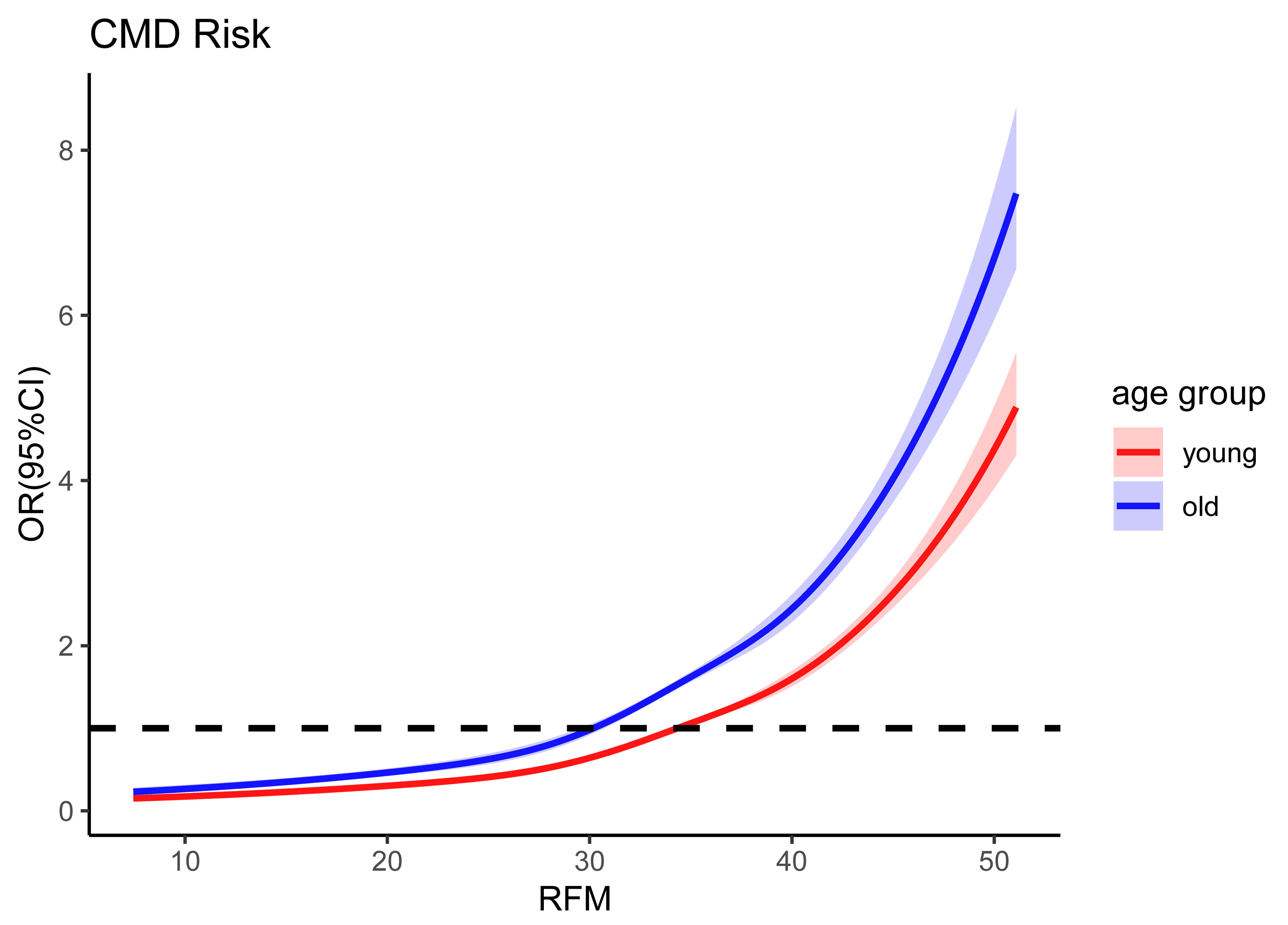 Fig. 3.
Dose-response relationship between relative fat mass and
cardiometabolic disease risk. Young: age
Our study revealed a significant association between RFM and CMD risk, with elevated RFM levels correlating with an increased risk for CMD. More importantly, we identified pronounced age-related disparities in this relationship. Although both young and middle-aged and older adults exhibited non-linear, J-shaped associations between RFM and CMD risk, older adults demonstrated a distinctly elevated vulnerability. Specifically, the older group showed not only a higher overall CMD risk but also a lower inflection point for RFM-associated risk elevation, and steeper increases in CMD risk per unit rise in RFM compared to the young and middle-aged group. These results identify RFM as a clinically relevant biomarker for CMD risk assessment and highlight that the different associations observed in young and middle-aged and older adults, and may inform the development of more stringent RFM control targets and earlier interventional strategies for older adults.
This study is the first to report the association between RFM and CMD risk in
Chinese adults, demonstrating a significant positive correlation. Previous
studies have linked RFM to risks of coronary heart disease [11], stroke [12],
diabetes [13, 14, 15], and metabolic syndrome [16], however, evidence on its
association with CMD as a composite outcome remains scarce. CMD includes diseases
with shared pathophysiological mechanisms and therapeutic targets, often
presenting as comorbidities. For instance, metabolic inflammation serves as a
central mechanism linking obesity, insulin resistance, and cardiovascular
diseases. Adipose tissue—particularly visceral fat—secretes inflammatory
cytokines (e.g., IL-6, TNF-
Previous investigations into the associations between RFM and CMD with diabetes, coronary heart disease, and stroke primarily focused on Western populations. This study fills a gap in Chinese evidence while accounting for potential confounders such as physical activity. Zwartkruis et al. [11] identified RFM as superior to BMI and waist circumference in predicting the risk of coronary heart disease in a Norwegian cohort of 95,000 adults. Zheng et al. [12] reported a positive association between RFM and stroke risk in the U.S. NHANES population, with the highest RFM quartile exhibiting a 44% increased stroke risk (OR = 1.44, 95% CI: 1.09–1.90) compared to the lowest quartile. However, their analysis lacked adjustment for physical activity, a known modifier of cardiometabolic risk [33, 34, 35, 36, 37], potentially influencing outcomes. Cacciatore et al. [15] demonstrated RFM’s superior predictive value over BMI for diabetes risk in 1900 older Italian adults. Similarly, Cichosz et al. [13] and Suthahar et al. [14] found RFM outperformed BMI, waist circumference, and waist-to-hip ratio in predicting diabetes risk in U.S. NHANES and Dutch cohorts, respectively. The present study extends these previous findings by providing robust evidence from a large Chinese population, systematically accounting for physical activity and other potential confounders, thereby offering more generalizable and refined insights into the RFM–CMD relationship.
This study identified significant age-related differences in the RFM-CMD risk
association between young and middle-aged and older adults, addressing a critical
gap in prior research that lacked comparative analyses across age groups.
Although Suthahar et al. [14] reported stronger associations between RFM
and the risk of type 2 diabetes in younger populations (based on higher hazard
ratios in the
Although the effect sizes for RFM increments were numerically similar between age groups, the significant interaction term, coupled with the different dose-response relationship and inflection points, indicates that the nature of the RFM-CMD association is fundamentally age-dependent. Combined with the higher baseline CMD risk in older adults, even a marginally greater OR per unit increase in RFM can translate into a more substantial increase in absolute risk at higher RFM levels. Therefore, the statistical interaction highlights a critical vulnerability in the elderly: their risk begins to escalate earlier and may compound more rapidly, underscoring the potential value of earlier and more vigilant RFM monitoring in this demographic.
The observed disparities may be partly explained by age-related physiological
changes. Aging is associated with ectopic fat deposition in organs such as the
liver and muscles, which may exert greater metabolic impact than visceral adipose
tissue [18]. Older adults also tend to exhibit elevated baseline inflammatory
markers (e.g., IL-6, CRP) [19] and distinct diabetes pathophysiology—primarily
driven by
This study provides novel insights into the non-linear dose-response relationship between RFM and CMD risk across multiple age groups, a previously underexplored area. Prior investigations primarily focused on ROC curve analyses comparing RFM’s predictive value against BMI for diabetes [15] and coronary heart disease [13]. While Zheng et al. [12] identified non-linear RFM-stroke risk associations using smoothing curve fitting, they did not employ restricted cubic spline analyses for formal dose-response characterization. Through restricted cubic spline modeling, this study revealed significant non-linear associations between RFM and CMD risk in both age groups. These findings advance our understanding of age-specific RFM-CMD risk dynamics, demonstrating distinct inflection points and risk gradients between young and middle-aged and older populations. These results highlight the potential value of establishing age-specific RFM thresholds for risk stratification and suggest that such thresholds may be warranted; however, future validation studies are needed to define clinically applicable cut-offs. This methodology overcomes the limitations of previous approaches by quantifying non-linear relationships while adjusting for confounders, establishing a robust framework for future investigations.
This study provides scientific evidence for the association between RFM and the risk of CMD, including age-specific patterns, offering a precise, simple, and usable metric for CMD risk assessment while providing age-stratified personalized intervention strategies. RFM, calculated using height, waist circumference, and sex, has demonstrated strong correlations with body fat percentage measured by DXA and BIA [38]. Its cost-effectiveness and ease of implementation compared to DXA/BIA make it a practical tool for evaluation of adiposity. Furthermore, RFM has been shown to outperform traditional anthropometric indices (e.g., BMI, waist circumference) in predicting cardiovascular risk factors [15, 16], cardiometabolic diseases [14, 39], and cardiovascular mortality [40]. The observed age-specific differences in RFM-CMD risk associations underscore the need for age-adapted intervention thresholds, suggesting stricter RFM control targets and intensified CMD risk management for older adults with elevated RFM. These findings provide a scientific foundation for precision prevention and control strategies for CMD.
This study has several limitations. First, a key limitation is the reliance on self-reported CMD without independent clinical validation, which may introduce misclassification bias. This potential bias may be more pronounced in older adults, who are more susceptible to under-reporting due to factors such as decreased awareness of asymptomatic conditions or barriers to healthcare access. If present, such non-differential misclassification would likely lead to an underestimation of the true association between RFM and CMD, meaning our observed significant associations are likely conservative estimates of the actual effects. It is important to note that several factors enhance the reliability of our data: the use of trained staff, standardized data collection procedures, and the fact that self-reported medical information was based on prior physician diagnosis. Additionally, the large sample size helps to mitigate the impact of random error. Second, as a cross-sectional study, our design precludes causal inference, and the observed associations should be interpreted as correlations rather than causal effects. Residual confounding may persist despite multivariable adjustments. Third, the absence of inflammatory markers and fat deposition data limits mechanistic exploration. Future research should prioritize incorporating such measures—for instance, using medical imaging to quantify ectopic fat or assays to profile inflammatory cytokines—to validate the proposed hypotheses and elucidate the biological pathways linking adiposity to CMD risk across the lifespan. Future validation studies are needed to define and evaluate age-specific RFM thresholds before they can be considered for clinical implementation. Furthermore, well-designed prospective cohorts, randomized controlled trials, and molecular-level studies are warranted to confirm these associations and elucidate underlying mechanisms and therapeutic targets.
This large-scale cross-sectional analysis of nearly 100,000 community-dwelling adults in Hunan Province, China, revealed a positive association between RFM and the risk of CMD, characterized by distinct age-specific patterns. Our findings reveal that while both age groups exhibited non-linear, J-shaped dose-response associations between RFM and CMD risk, older adults demonstrated a distinctly elevated vulnerability. These findings enhance the understanding of CMD risk stratification and provide a basis for future research into age-specific RFM thresholds. However, given the cross-sectional design, these results demonstrate association rather than causation. Future prospective studies are needed to establish temporal sequence, validate the potential thresholds, clarify any potential causal relationships, and elucidate underlying biological pathways.
BIA, Bioelectrical impedance analysis; BMI, Body mass index; ChinaHEART, China Health Evaluation And Risk Reduction Through Nationwide Teamwork; CI, Confidence interval; CMD, Cardiometabolic disease; DXA, Dual-energy X-ray absorptiometry; OR, Odds ratio; RCS, Restricted cubic spline; RFM, Relative fat mass.
The datasets used and analyzed during the current study are available from the corresponding author on reasonable request.
TL, JH, and LY jointly conceptualized and designed the study. TL drafted the initial manuscript. JH, LY, JN, XX, and ZJ contributed to subsequent revisions. TL performed the statistical analyses. All authors participated in data interpretation, manuscript review, and final approval of the submitted version. All authors agree to be accountable for all aspects of the work in ensuring that questions related to the accuracy or integrity of any part of the work are appropriately investigated and resolved. All authors contributed to editorial changes in the manuscript. All authors read and approved the final manuscript.
The study was carried out in accordance with the guidelines of the Declaration of Helsinki. The project protocol was approved by the central ethics committee at Fuwai Hospital, Beijing, China (Approval No. 2014-574), and is registered with ClinicalTrials.gov (NCT02536456). The authors confirm that patient consent forms have been obtained for this article. Written informed consent was obtained from all enrolled participants.
We appreciate the multiple contributions made by study teams at the National Center for Cardiovascular Diseases, and the local sites in the collaborative network in the realms of study design and operations.
The study was carried out in accordance with the guidelines of the Declaration of Helsinki and was supported by the National Natural Science Foundation of China (NSFC) General Program (No. 52275517); Healthcare Quality (Evidence-Based) Management Research Project, Institute of Hospital Administration, National Health Commission (No. YLZLX24G075); National Key Research and Development Program of China: Key Special Project on “Active Health and Technological Responses to Population Aging”, Integrated Prevention and Control Model and Technological Research for Geriatric Vascular Diseases (No. 2022YFC3602500); China Health Evaluation And Risk Reduction Through Nationwide Teamwork, ChinaHEART. The funder of the study had no role in study design, data collection, data analysis, data interpretation, writing, or the decision to submit the manuscript for publication.
The authors declare no conflict of interest.
During the preparation of this work the authors used DeepSeek in order to improve language. After using this tool, the authors reviewed and edited the content as needed and take full responsibility for the content of the publication.
References
Publisher’s Note: IMR Press stays neutral with regard to jurisdictional claims in published maps and institutional affiliations.