
 , Sven-Oliver Spieß 1, Marcus Wagner 1,2,*
 , Yuan Jiang 3
1 Faculty of Business Administration and Management, University of Augsburg, 86159 Augsburg, Germany
2 Bureau of Theoretical and Applied Economics (BETA), 67000 Strasbourg, France
3 Department of Organisational Behaviour and Human Resource Management (OBHRM), China Europe International Business School (CEIBS) Shanghai, 201203 Shanghai, China
Abstract
Research on employee green behavior (EGB) has garnered increasing attention as scholars seek to understand how employees can contribute to organizational greening. Despite considerable interest in the antecedents of EGB, the challenges and tensions that emerge as individuals engage in voluntary EGB remain underexplored. Drawing on survey data from 388 respondents across 74 teams, the results indicate that voluntary EGB is a major driver of tension salience within teams. Furthermore, we find that this relationship is moderated by the extent to which team colleagues encourage one another to engage in green behavior. These findings highlight the critical role of teams as the social context in which voluntary EGB occurs and suggest a task-conflict nature of sustainability-related tensions within teams. The pertinent question thus appears to be no longer whether employees are willing to engage but rather which green activities they should prioritize as they face resource constraints while striving toward a common goal.
Keywords
- employee green behavior
- paradox
- sustainability
- tensions
- team
In the context of grand challenges like combating climate change, organizations’ efforts to alleviate consequences and contribute to a sustainable future are often subsumed within the term corporate sustainability which refers to “a set of systematically interconnected and interdependent economic, environmental and social concerns at different levels that firms are expected to address simultaneously” (Hahn et al., 2015, p. 299). With organizations being a major driver of climate change, their involvement is essential for tackling its extensive consequences (Howard-Grenville et al., 2014). Yet, studies have highlighted the lack of urgency and action organizations displayed in response to climate change issues (Slawinski et al., 2017), prompting increased significance to the role of individuals (Anderson and Bateman, 2000), particularly voluntary employee green behavior (EGB), in greening organizations (Boiral et al., 2019; Boiral et al., 2015; Ones and Dilchert, 2012). Voluntary EGB denotes all “discretionary acts by employees within the organization not rewarded or required that are directed toward environmental improvement” (Daily et al., 2009, p. 246) and materializes in various forms, including recycling initiatives, advocating green behavior among colleagues, or raising awareness of the business’s impact on the environment (Boiral et al., 2015; Ones and Dilchert, 2012; Unsworth et al., 2013).
However, voluntary EGB inevitably carries the potential to create new conflict lines within the organization in at least two ways. First, voluntary EGB allows for a multitude of different actions, each prioritized differently by individuals and potentially displaying different levels of commitment. Second, it requires employees to accommodate voluntary EGB and in-role demands, resulting in competition for employees’ time and resources (Ramus and Killmer, 2007). Tensions arise between different levels of commitment or approaches to dealing with these competing demands. For instance, conflicts may arise when some team members want to shut off the printer instead of leaving it in standby mode when not in use, while others feel they can make better use of their time than manually switching the printer on again. In team settings, where individuals are constantly confronted with coworkers’ behavior, these discrepancies can lead to tensions as logics are interpreted and enacted differently (Kok et al., 2019), which becomes even more pronounced in shared office environments, where employees are directly confronted with each other’s behaviors. These tensions often lead to situations where “opposite concepts or behaviors push and pull against one another” (Putnam et al., 2014, p. 416). This may comprise a generative potential for innovation and progress (Smith and Lewis, 2011). However, it can also affect the relationship between employees and impact team satisfaction and performance (De Dreu and Weingart, 2003), thereby impacting the success of corporate sustainability initiatives.
While antecedents of EGB, such as individual traits (Boiral et al., 2015; Kim et al., 2017) or the role of leaders (Robertson and Barling, 2013), have received considerable attention in research, little is known about outcomes of EGB, particularly at the team level (Norton et al., 2015). To the contrary, tensions within teams have long sparked interest in paradox research (Murnighan and Conlon, 1991; Smith and Berg, 1987), with acknowledgement of the team’s role in navigating tensions and, simultaneously, serving as a source of tensions (Kok et al., 2019; Deeds Pamphile, 2022). Yet, the ways through which these tensions become salient remain debated (Hahn and Knight, 2021), with studies pointing to socio-discursive aspects like emotions (Jarzabkowski and Lê, 2017), rhetoric (Bednarek et al., 2017) or interaction (Tuckermann, 2019) playing an important role in rendering tensions salient.
Voluntary EGB, as a visible expression of green values and attitudes (Boiral and Paillé, 2012), may create awareness of latent tensions (Hahn and Knight, 2021) that stem from different levels of commitment or approaches to accommodating competing demands among team members. For example, when a team member engaged in voluntary EGB by switching off the printer to save energy or encourages colleagues to commute by bike, it may be viewed as picky or annoying by his or her coworker, in turn potentially triggering tensions.
A better understanding of how EGB can lead to the emergence of tensions will not only enrich the literature on EGB, which has called for research on its outcomes (Norton et al., 2015), but also contribute to a better understanding of how behavior can make tensions salient (Hahn and Knight, 2021; Tuckermann, 2019). Therefore, we address the research question of how EGB impacts the experience of sustainability-related tensions linked to the team level?
Given that green behavior takes place at different levels (Norton et al., 2015), recent research on EGB has started to examine social dynamics at the group level (Jiang et al., 2022; Kim et al., 2017; Peng et al., 2021). The salience of paradoxical tensions is determined not only by discursive elements like interaction between individuals (Tuckermann, 2019) but also by the socio-material context in which behavior takes place (Hahn and Knight, 2021). Hence, it is essential to acknowledge the role of factors like advocacy for environmental concerns among team members. Kim et al. (2017) modeled advocacy with the construct of Work Group Green Advocacy (WGGA) which gauges “a work group’s collective influence behavior that encourages individual members to conform to environmental responsibility” (p. 1336).
Examining purposeful workplace behavior, Barrick et al. (2013) argued that “personality serves as a driving force of individual behavior while the situation serves as a moderator” (p. 132), referring to the situation as comprising job characteristics and the social context. For example, when team members encourage each other to engage in green behavior, despite a common interest in improving corporate sustainability, there may be disagreement about the most effective approach. For instance, some avoid disposable coffee cups in the cafeteria, while others seek to reduce energy consumption or emissions by commuting to work by bike. As the team discusses different measures, visibility of different approaches will increase, potentially also leading to (increasing) tensions as objectives compete. Accordingly, we examine how WGGA as a contextual aspect moderates the relationship between EGB and sustainability-related tensions in teams.
The theoretical contribution of this study lies firstly in our response to calls in the literature to go beyond research on the antecedents of EGB. While prior organizational behavior literature has primarily examined the manifold antecedents of EGB (Boiral and Paillé, 2012; Kim et al., 2017; Norton et al., 2015), our study focuses on outcomes at the team level, thereby contributing to the limited research on “contextual factors at the institutional, organizational, leader, and team levels of analyses that moderate, mediate, and are outcomes of EGB” (Norton et al., 2015, p. 114).
Second, through conducting cross-field research, we straddle the research fields of EGB and paradox theory, drawing on Hahn and Knight’s (2021) approach to paradox to unpack “the apparatus of the enactment of salient paradoxes” (p. 28). This involves examining individual-level (personality-related) factors (EGB) alongside team-level (contextual) factors (WGGA).
Third, we offer a quantitative approach to the assessment of sustainability-related tensions. Paradox research in the context of sustainability research has hitherto relied mainly on theoretical considerations (e.g., Hahn et al., 2015) and qualitative analyses (e.g., Hengst et al., 2020; Joseph et al., 2020). We add to the state of research here also by providing novel quantitative means to assess paradoxical tensions, building on initial work by Miron-Spektor et al. (2018) and in doing so extend quantitative paradox research to the context of corporate sustainability.
Finally, we acknowledge that addressing grand challenges requires “sustained effort from multiple and diverse stakeholders” (George et al., 2016, p. 1881). Sustainability-related tensions result from competing stakeholder demands, which need to be accounted for in their complexity across different levels. We further elaborate on this and prior findings from paradox research, which have highlighted how paradoxes emerge at different levels (Gilbert et al., 2018; Jarzabkowski et al., 2013), by conducting an empirical study of paradoxes experienced at the individual level that relate to conflicts at the team level.
These contributions provide a more differentiated, multi-level perspective on the specific factors influencing how sustainability-related paradoxical tensions become salient within teams.
A growing awareness of sustainability concerns, particularly regarding the role of global business players and their responsibility in this debate, has sparked scientific interest in employees’ behaviors in the workplace aimed at mitigating organizations’ impact on the environment (Ones and Dilchert, 2012; Paillé and Boiral, 2013; Ramus and Killmer, 2007). Prior research has underlined the difference that EGB, such as recycling, reducing energy consumption, or suggesting environmentally-friendly initiatives, can make for the overall organizational sustainability performance (Boiral et al., 2015; Dumont et al., 2017; Unsworth et al., 2013). The term EGB subsumes all “scalable actions and behaviors that employees engage in that are linked with and contribute to or detract from environmental sustainability” (Ones and Dilchert, 2012, p. 87). It is useful to differentiate between voluntary EGB, which entails employees’ individual voluntary initiatives or organizational citizenship behavior for the environment (OCBE) (Boiral and Paillé, 2012; Daily et al., 2009), and required behavior, which involves complying with the employer’s internal sustainability guidelines and employees’ professional responsibilities (Ones and Dilchert, 2012). Voluntary EGB denotes intrinsic, spontaneous “social behaviors that are not explicitly recognized by the formal reward system and that contribute to a more effective environmental management by organizations” (p. 223). Boiral and Paillé (2012) developed a scale measuring OCBE, which asks whether employees volunteer in, stay informed about, support, and encourage their colleagues to engage in environmental initiatives within the organization.
Determinants and antecedents of EGB have received some scholarly attention in the past and have been found to reside at multiple levels of analysis (Norton et al., 2015; Yuriev et al., 2018). These factors include (but are not limited to) commitment, attitudes, affect, and personality traits at the individual level (e.g., Bissing‐Olson et al., 2013), support and advocacy for green behavior at the team level (e.g., Kim et al., 2017), organizational climate and green human resource management (HRM) practices at the organizational level (Dumont et al., 2017; Norton et al., 2017).
However, a significantly smaller proportion of studies focus on the outcomes and consequences of EGB as their variable of interest (Norton et al., 2015). These studies primarily focus on the organizational level, particularly on organizational environmental performance (e.g., Boiral et al., 2015), competitive advantage (Del Brío et al., 2007), institutional effects, or cost-savings (e.g., Chen, 2002). In addition, while there is increasing understanding about how leaders’ green behavior impacts their subordinates’ green behavior (Jiang et al., 2022; Kim et al., 2017; Peng et al., 2021; Robertson and Barling, 2013), it remains unclear which challenges and tensions individuals and the teams they are working in face as they engage in EGB.
Compared to so-called in-role EGB, voluntary EGB often competes for the time and resources that employees have to allocate to their required performance goals (Ramus and Killmer, 2007). As employees deliberately engage in activities to protect the environment in the workplace, they reveal tensions. For instance, choosing a longer and costlier train ride over a flight to reduce carbon dioxide emissions may clash with organizational requirements to travel efficiently in terms of cost and time.
When individuals are confronted with competing logics, they experience tensions that manifest as “stress, anxiety, discomfort, or tightness in making choices, responding to, and moving forward in organizational situations” (Putnam et al., 2016, p. 69). Yet, tensions do not only emerge from competing objectives; they also stem from differing sustainability agendas at the individual or organizational level, varying perspectives on achieving sustainable corporate development, and differing temporal perspectives on addressing challenges within the organization (Hahn et al., 2015; Slawinski and Bansal, 2012).
Thus, as employees grapple with finding a balance between accommodating competing extra and in-role job demands, they may adopt different approaches to solve this challenge. The literature on tensions and paradoxes in this respect distinguishes different types of tensions. Specifically, four types of tensions are identified, that can become paradoxical under certain conditions (Lewis, 2000; Smith and Lewis, 2011; Lüscher and Lewis, 2008): To start, tension of learning can emerge when efforts for change and be innovative create the need to build on existing knowledge and at the same time move away from it. Secondly, when different stakeholders approach organizations with differing goals tension of performance can emerge, as for example when firms are asked to simultaneously improve their economic and environmental performance. Thirdly, tension of belonging can emerge when employees identify with specific organizational units and their goals, but at the same time are also responsible for achieving the goals of the entire organization (for example in the case of employees working in the sustainability unit of a firm). Finally, tension of organizing can emerge, when organizational structures require competition and control as well as cooperation and trust.
As already illustrated, these different types of tensions have implications for organizations and their contributions to sustainability. Specifically, tensions can become paradoxical when competing elements are simultaneously contradictory yet interrelated and persistent over time (Smith and Lewis, 2011), in which case firms can find it challenging to impossible to achieve ultimate sustainability. This can result in ongoing phenomena such as greenwashing, that are frequently observed in practice (Montgomery et al., 2024).
Yet, the ontology of paradoxical tensions remains a topic of debate. Hahn and Knight (2021) argued that “while organizational systems predispose the possibility space for different configurations of interwoven tensions, their actual enactment depends on the specific socio-material context” (p. 42). This shifts the focus to the contextual situatedness of tensions, which determines whether tensions become salient. In this situatedness, the individual plays a major role in contributing to organizational situations that can enact salient tensions (Hahn and Knight, 2021).
As employees engage in voluntary EGB, they not only highlight tensions between competing voluntary environmental and required job-related objectives to their coworkers but also expose different levels of commitment and approaches to accommodating these competing demands within teams. These tensions remain latent and invisible until individuals make them salient through their own behavior (such as initiating a recycling project, discussing emission reduction, or asking colleagues to avoid one-way cups) or through the context in which they are embedded (e.g., colleagues in a team promoting green initiatives, discourse in the organization, or national regulations). Yet, while sustainability-related tensions have been examined at the level of the organization (Gao and Bansal, 2013; Hengst et al., 2020; Slawinski and Bansal, 2012) and in the context of leadership (Joseph et al., 2020), there is a dearth of research examining their impact in teams.
Considered separately, both fields -research on paradox and research on EGB- have received mounting awareness in recent years (Berti et al., 2021; Norton et al., 2015). However, to the best of our knowledge, they have not been combined to understand how findings synergize and may enhance our understanding of EGB as well as the emergence of respective tensions within the application context of sustainability.
Following Hahn and Knight (2021), it is assumed that sustainability-related tensions inherently exist in organizations where individuals strive to improve corporate sustainability as they engage in voluntary EGB. In a team context, where individuals collaborate regularly, these inherent tensions remain latent until the green behaviors of an individual or the team make them salient. As individuals express their green values through discretionary actions that go beyond what is expected in their workplace role (Boiral and Paillé, 2012), such as taking less comfortable, early train rides instead of using the company taxi service to get to the airport and take a flight—coworkers are confronted with their own level of commitment or approach to reconciling competing demands when it comes to voluntary EGB.
In alignment with prior research, it can be assumed that tensions emerge when team members’ commitment and engagement in voluntary EGB diverge (Kok et al., 2019), thus, when some team members are less willing than others to shift resources, time, or effort into accepting a longer train ride or commute to reduce emissions. However, even if team members agree on the importance of tackling environmental concerns, they may prioritize different aspects of voluntary EGB as they need to reconcile in-role demands with voluntary EGB. They may find it annoying to renounce their disposable coffee cup but may be willing to take the bike to work. Therefore, we argue that the more employees engage in voluntary EGB, the more conflicting objectives in the team are uncovered and, in turn, the more likely it is for tensions to become salient.
Hypothesis 1: Individual-level OCBE increases the salience of sustainability-related tensions in teams.
Individuals in workplace settings act and behave in their social roles as team members. Thus, examining the isolated impact of voluntary EGB on the experience of sustainability-related tensions neglects the important role of the socio-material context in understanding how tensions become salient (Hahn and Knight, 2021). The team, as a contextual factor, can be a source of tensions when approaches and commitment differ due to underlying logics regarding environmental concerns (Kok et al., 2019).
Similar to green behavior being understood as a form of visibly acting according to green values and attitudes (Boiral and Paillé, 2012), WGGA may be seen as a way of signaling what is normal green behavior within the team. The theory of normative conduct sees behavior according to social norms, which can be either injunctive or descriptive (Cialdini et al., 1990). Injunctive norms inform individuals about “what most others approve or disapprove”, while descriptive norms represent “what most others do” (Cialdini et al., 1990, p. 1015). The influence of social norms on green behavior has been proven in several sustainability contexts, such as sustainability marketing (Rettie et al., 2012), guest behavior in hotels (Goldstein et al., 2008), and energy conservation behavior (Nolan et al., 2008).
Interestingly, research has shown that injunctive norms, reflecting perceptions of organizational green values, are related to in-role EGB, while descriptive norms, indicating typical green practices among coworkers, positively impact voluntary EGB (Norton et al., 2014). Thus, workgroup peers who encourage their colleagues to engage in voluntary EGB may serve as indicators of the social norms prevalent in the team. By establishing the social norm of accepted or expected green behavior within the team, WGGA naturally exposes divergent levels of commitment and approaches to accommodating competing objectives between voluntary EGB and in-role demands.
Hypothesis 2: Team-level WGGA increases the salience of sustainability-related tensions in teams.
The alignment of injunctive and descriptive norms is crucial for exerting significant impact on intentions to engage in green behavior (Smith et al., 2012). Consequently, we assume that when individuals engage in voluntary EGB, which displays descriptive norms within the team, team-level advocacy for environmental concerns (representing injunctive norms) will further reinforce the commitment to green behaviors among coworkers. This interaction is expected to intensify the reflection of individual commitment levels and approaches to accommodating competing demands, further increasing the salience of tensions (Kim et al., 2017). For example, in a sales team, coworkers encouraging each other to reduce emissions by refraining from in-person customer visits may prompt discussions on alternative methods to maintain customer relationships while meeting performance goals. Generalizing this illustrative example, we hypothesize:
Hypothesis 3: WGGA positively moderates the relationship between OCBE and the salience of sustainability-related tensions in teams.
Studying environmental issues is a multi-level phenomenon (Norton et al., 2015; Ren et al., 2018), involving “individual-level processes […] as well as more macro processes” (Marquis et al., 2015, pp. 433–434). Therefore, theoretical considerations advocate for a multi-level approach, and prior empirical studies have also supported its appropriateness in understanding corporate sustainability (Kim et al., 2017). Contextual factors of EGB can be analyzed across different levels, including institutional, organizational, leader, team, and employee levels (Norton et al., 2015). However, empirical work in this area has so far focused predominantly on individual or organizational predictors without exploring a comprehensive multi-level perspective, despite the need to unravel the interwoven effects between different levels (Ren et al., 2018; Xiao et al., 2020).
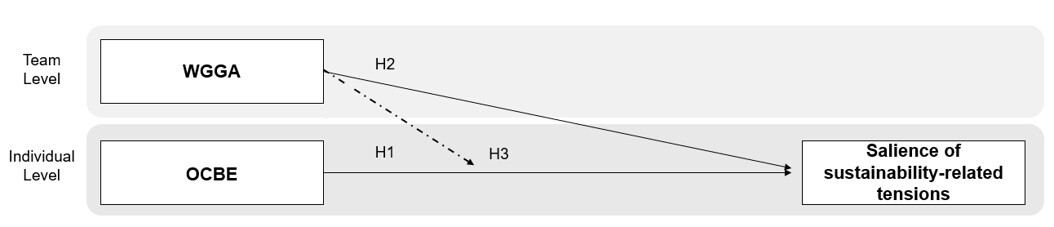
Linking the assumptions and findings of paradox and EGB research from a multi-level perspective yields an integrated model (see Fig. 1) that can be empirically tested to examine sustainability-related tensions in teams. The proposed model includes individual-level OCBE (as a measure of voluntary EGB) and team-level WGGA as antecedents of sustainability-related tensions, with WGGA being also a moderator variable, since OCBE and WGGA are hypothesized to positively interact in affecting sustainability-related tensions.
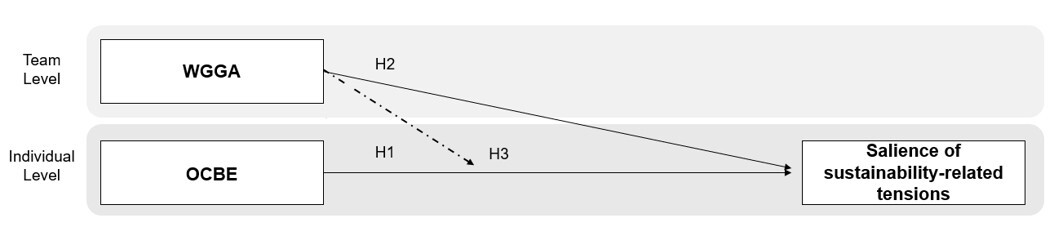 Fig. 1.
Conceptual model. Note. WGGA, work group green advocacy; OCBE, organizational citizenship behavior for the environment.
To examine our research question, we conducted employee surveys in two multinational firms in the business-to-business service sector. Due to their disposable resources and global reach, multinational companies play a crucial role in the sustainability realm. Although this approach may limit the variability of organizations, it holds some aspects constant across respondents and organizations. Given our specific interest in the salience of sustainability-related tensions within the social environment of work teams, the study retained respondents’ team membership. Excluding teams with fewer than three respondents resulted in a sample of 388 participants distributed across 74 teams (230 in Company 1 and 158 in Company 2) in four countries (Germany, China, the United States, and Singapore). Table 1 presents the descriptive statistics and correlations of all variables involved in the analysis. On average, teams had 5.42 members and were in typical corporate functions, such as accounting, customer services, engineering or marketing/sales. The teams were culturally relatively homogenous with on average only about 8 percent of the respondents in each team not responding in the language of the country in which the survey was carried out. No teams with direct responsibilities related to corporate sustainability were included in order to ensure comparability across all teams.
| Mean | SDb | 1. | 2. | 3. | 4. | 5. | 6. | 7. | |
| 1. Salience sust. tensions | 2.51 | 0.85 | 1.00 | ||||||
| 2. OCBE | 2.89 | 0.84 | 0.47*** | 1.00 | |||||
| 3. WGGAa | 3.50 | 0.94 | 0.35*** | 0.51*** | 1.00 | ||||
| 4. Person-group fit | 3.46 | 0.64 | –0.05 | 0.24*** | 0.22*** | 1.00 | |||
| 5. Age | 41.41 | 10.40 | –0.13** | –0.08 | –0.25*** | –0.04 | 1.00 | ||
| 6. Female | 0.51 | 0.50 | –0.05 | –0.05 | 0.05 | –0.05 | –0.05 | 1.00 | |
| 7. Company 2 dummy | 0.41 | 0.49 | –0.26*** | –0.22*** | –0.46*** | –0.08 | 0.29*** | –0.001 | 1.00 |
Note. N = 388 (74 teams). Salience sust. Tensions, salience of sustainability-related tensions; OCBE, organizational citizenship behavior for the environment; WGGA, work group green advocacy.
a Team mean, b Standard deviation.
Significance levels: **p
The salience of sustainability-related tensions was evaluated with four items
explicitly focused on the team, which related to the experience, perceived
negative effect and degree of response with regard to tensions. The team focus
allowed to maintain tractability in the analysis, even though it has to be
acknowledged, that salience of sustainability-related tensions at the
organizational level could be affected differently. All items were measured on a
five-point Likert-type scale (see the Appendix for details). The Cronbach
To ensure the validity of this novel measure, we carried out a separate survey of working adults in the U.S., China, and Germany using the Prolific and Credamo platforms, which yielded 1078 responses that were equally distributed across the three countries.
Confirmatory factor analysis based on a six-factor model, which included the novel four-item scale and existing scales for experiencing tensions, for tensions of performing, learning and belonging, as well as for paradox mindset (Miron-Spektor et al., 2018), further ascertained the scale’s usability (RMSEA = 0.06, CFI = 0.90, TLI = 0.89, and SRMR = 0.06).
Additionally, correlational analysis confirmed its nomological validity, with
the scale having significant positive correlations with relevant scales
(Kuckertz and Wagner, 2010; Miron-Spektor et al., 2018) measuring the
experience of tensions (r = 0.35, p
OCBE was measured using the 10-item scale of Boiral and Paillé (2012).
This scale contains items related to participation in company eco-initiatives,
personal eco-civic engagement, and interpersonal helping behaviors. As the OCBE
scale refers explicitly to voluntary, discretionary behaviors contributing to
environmental sustainability, it fits adequately with measuring voluntary EGB
within our model. The overall 10-item measure demonstrated high internal
consistency with a Cronbach’s
WGGA was measured with the three-item scale developed by Kim et al. (2017).
To compensate for potential perception biases and to better contrast individual
behaviors with group attributes, WGGA scores were averaged across members of the
same team for our subsequent analyses. The measure exhibited high internal
consistency with a Cronbach’s
Control variables were included to address potential confounding factors within
the analysis. These variables included demographic information, such as age and
gender, along with a three-item measure of self-rated person-group fit
(Greguras and Diefendorff, 2009). The Cronbach’s
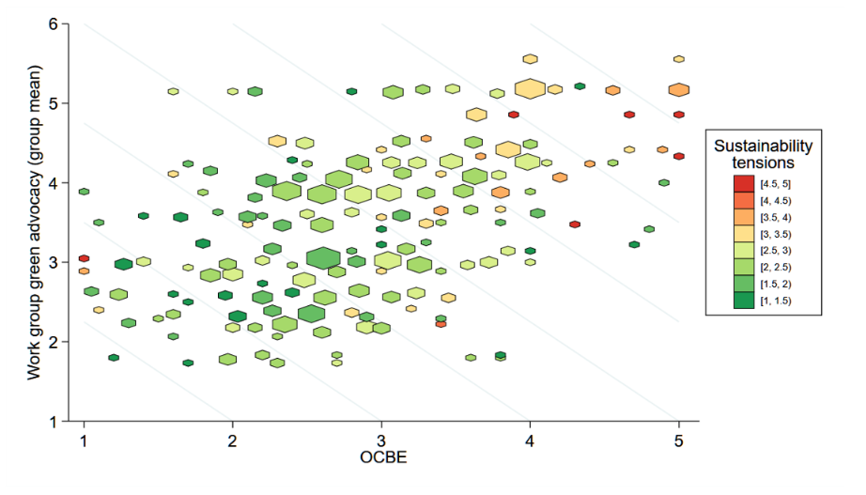
As mentioned, participants were organized within teams, and the measure of sustainability-related tensions also referred to employees’ respective teams. Fig. 2 illustrates that most participants’ OCBE was congruent with their team’s average WGGA, suggesting that individual behaviors were congruent with the social norms guiding environmental within their teams. In addition, the salience of sustainability-related tensions appeared to increase with higher levels of OCBE and WGGA. These descriptive findings support our hypotheses. To statistically test the hypotheses, the study estimated a series of regression models. Due to the clustered nature of the data, we involved hierarchical linear modelling (HLM) with full maximum-likelihood estimates and robust standard errors. All predictor variables in the models were grand-mean centered.
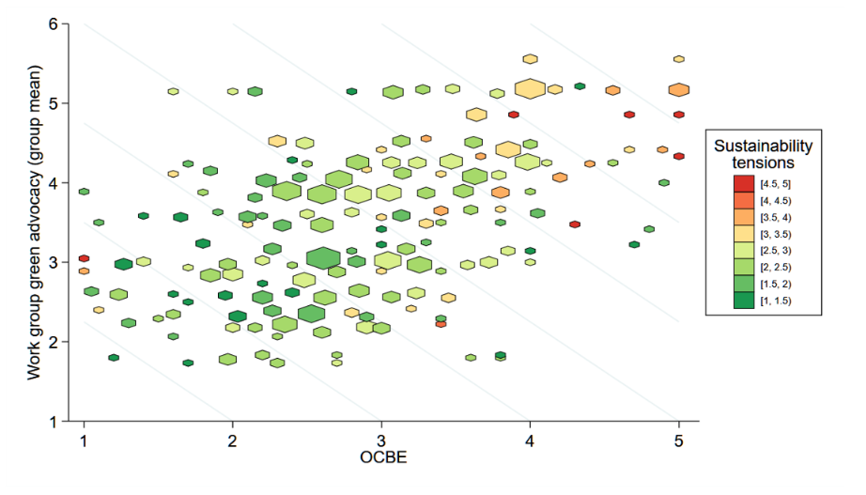 Fig. 2.
Hexagon plot of WGGA over OCBE with hexagons colored by salience of sustainability-related tensions (hexagon size corresponds to size of respective team). Note. WGGA, work group green advocacy; OCBE, organizational citizenship behavior for the environment.
First, we computed a null model to assess the nesting structure of the data and
determine the appropriateness of the analysis framework. A likelihood-ratio test
based on this revealed that HLM is more appropriate than OLS estimation
(
Subsequently, we estimated a series of models to test our hypotheses. As can be
seen in Models 2 and 3 in Table 2, as hypothesized, OCBE and WGGA predict
salience of sustainability-related tensions. Specifically, OCBE increases the
salience of sustainability-related tensions by 0.44 points for every unit
increase (p
| (1) | (2) | (3) | (4) | ||
| Control variables | H1: OCBE | H2: WGGA | H3: Interaction | ||
| Fixed effects | |||||
| Constant | 2.68*** | 2.46*** | 2.62*** | 2.56*** | |
| Person-group fit | –0.14* | –0.24*** | –0.17* | –0.26*** | |
| Age | 0.0004 | –0.004 | 0.001 | –0.002 | |
| Female | 0.02 | –0.04 | –0.02 | –0.02 | |
| Company 2 dummy | –0.47*** | –0.29** | –0.23* | –0.21* | |
| OCBE | 0.44*** | 0.39*** | |||
| WGGAa | 0.29*** | 0.10* | |||
| OCBE |
0.13* | ||||
| Random effects | |||||
| Team variance | 0.17*** | 0.06*** | 0.11*** | 0.05*** | |
| Individual variance | 0.50*** | 0.46*** | 0.49*** | 0.45*** | |
Note. N = 388 (74 teams). Full maximum-likelihood estimates, robust standard errors. Predictors grand-mean centered.
HLM, hierarchical linear modelling; OCBE, organizational citizenship behavior toward the environment; WGGA, work group green advocacy.
a Team mean.
Significance levels: *p
In sum, these results provide evidence that team-level WGGA influences the effect of individual-level OCBE on the salience of sustainability-related tensions in teams, as confirmed by the positive moderation effect: stronger WGGA leads to even more tensions with higher OCBE.
Organizational scholars and practitioners have become increasingly interested in explaining what motivates or hinders EGB (Norton et al., 2015; Yuriev et al., 2018). However, the outcomes of EGB are still relatively poorly understood. This research aims to address this gap in the literature by investigating how individual-level voluntary EGB and team-level WGGA affect the salience of sustainability-related tensions within teams. In addition, to acknowledge the social context in which tensions arise, we investigate the moderating effect of WGGA as a contextual factor on the relationship between voluntary EGB and sustainability-related tensions.
Results from multi-level regression models show that both individual-level voluntary EGB and team-level WGGA significantly increase the experience of sustainability-related tensions within employees’ teams, confirming H1 and H2. That is, tensions underlying the sustainability paradox are tangible phenomena and the more employees displayed voluntary green behaviors or teams advocated for green behavior, the more tensions were reported. These findings accord with recent insights from paradox research, demonstrating that social contextualization can make tensions more salient (Tuckermann, 2019). As employees engage in green behaviors like recycling or reducing waste, they send normative messages, creating descriptive norms (Cialdini et al., 1990) that other coworkers become aware of in shared workspaces. Team members will either align with or oppose these behaviors, leading to the emergence of tensions. We suggest two sources for these tensions, which may be interrelated: differences in levels of commitment to environmental concerns and different approaches to accommodating in-role demands and voluntary EGB, competing for employees’ resources and attention (Ramus and Killmer, 2007). Fig. 2 shows that sustainability-related tensions are strongest when OCBE and WGGA levels are high. This suggests that tensions do not exclusively result from varying levels of commitment but also from differences in perspectives on how to effectively address environmental concerns. For instance, while there may be agreement on the importance of addressing climate change, disagreements may arise on measures to address these concerns. Our findings thus suggest the possibility of a task-conflict nature of sustainability-related tensions, that is “rooted in the substance of the task which the group is undertaking” (Guetzkow and Gyr, 1954, p. 369). In this situation, individuals do not argue due to conflicting sustainability attitudes. Instead, they focus on the precise content of the common objective of achieving sustainability.
Conflict can serve as a means for exploring perspectives and finding creative paths for to deal with opposing positions (Fong, 2006; Jehn, 1995). This aligns with the principles of paradox theory, which highlights the importance of acknowledging conflicting demands as a precondition for generative outcomes (Smith and Lewis, 2011). More specifically, research has demonstrated that different types of conflicts have varying effects on group outcomes. In a meta-analysis, De Wit et al. (2012, p. 372) found that “task conflict has a less negative (and under certain conditions, a positive) relationship with group outcomes than process and relationship conflict”. Particularly “in groups performing nonroutine tasks, disagreements about the task did not have a detrimental effect and, in some cases, were actually beneficial” (Jehn, 1995, p. 256).
Voluntary EGB in the workplace can be understood as such a nonroutine task, comprising behaviors beyond an individual’s job description and formal rewards within the organization. While task-related conflicts can reduce team satisfaction, they lack the strong emotional component prevalent in relationship conflicts (Kouzakova et al., 2012), allowing room for constructive discussions and better performance (see e.g., Jehn and Bendersky, 2003). Thus, as individuals engage in voluntary EGB, they not only make tensions salient but enable a process allowing the group to discuss measures that can lead to more sustainable outcomes.
These findings imply that while voluntary EGB may reveal tensions in teams, these tensions can be constructive and beneficial for achieving organizational sustainability goals. The challenge for management is to leverage both the commitment and the diversity of ideas and opinions stemming from these tensions to transform them into constructive actions. Team leaders, who have been shown to play an important role in influencing subordinates’ green behavior (Jiang et al., 2022; Kim et al., 2017; Robertson and Barling, 2013), should orchestrate this process.
The study’s findings suggest the importance of taking a closer look at the types of tensions or conflicts experienced within a team context, as this implies different anchor points for tension management strategies. Organizations, particularly managers, must ensure that sustainability-related tensions and conflicts do not escalate into emotional or personal disputes, as this could impede constructive outcomes and encourage individuals to withdraw from the team (Jehn, 1995).
In addition, we found evidence supporting H3, which suggests that WGGA moderates the relationship between individual-level voluntary EGB and sustainability-related tensions within teams. This means that the effect of OCBE on individual’s experience of tensions in teams is intensified if teams advocate stronger for green behavior. When team members encourage each other to reduce waste or shut off monitors after work, they create injunctive norms that define expected behaviors within the group (Cialdini et al., 1990). The study’s finding that WGGA moderates the impact of an individual’s behavior on tension emergence is consistent with literature arguing that congruent injunctive and descriptive social norms exert the strongest effect on pro-environmental intentions (Smith et al., 2012).
Finally, findings by Sharpe et al. (2022) suggest that a firm’s corporate environmental responsibility likely increases EGB and equally supports injunctive norms (which at the team level are partly reflected by WGGA) in that firm. This could decrease the possibility of task conflicts given a clear commitment to sustainability at the corporate level. Whilst no rating exists that directly compares the two firms (and therefore we cannot assume differences in corporate environmental responsibility as a given), Company 2 is publicly evaluated in reputed ratings such as those of institutional shareholder services and Asset4, whereas Company 1 is not. This would suggest that corporate commitment to sustainability is also signaled stronger to employees in Company 2. This contextual factor can reduce debate and disagreement in teams, and in line with this we find a significant negative effect of Company 2 on the saliency of tensions as our dependent variable.
Based on our empirical findings, we expand on existing literature by showing that this effect may extend beyond behavioral intentions to encompass tensions experienced within teams. Confronted with norms that are aligned at both individual and team levels, team members need to reflect on their own behavior. For example, a colleague who consistently takes a taxi service for business trips while others in the team prefer the train may find themselves encouraged to adjust their behavior. These findings not only encourage organizational practitioners to ensure that employees have opportunities and resources to engage in voluntary EGB but also create awareness for the critical role of team dynamics that allow coworkers to become aware of and reflect upon each other’s behavior, potentially leading to adjustments that benefit overall organizational performance.
This research contributes to both EGB literature and the paradox literature in several ways. First, understanding the outcomes of EGB within organizations is crucial, especially given the urgency of addressing climate change and the vital role organizations play in this. Environmental performance at the organizational level ultimately depends on individual actions at the employee level (Ones and Dilchert, 2012). This study contributes to research on EGB by providing evidence that, in specific situations, tensions can emerge as an outcome of EGB. It further shows how EGB is embedded in contextual factors at the team level, thereby responding to calls to examine multi-level effects in this respect (Ehnert and Harry, 2012; Norton et al., 2015; Ren et al., 2018). Specifically, the study shows that EGB is not solely shaped by individual-level antecedents, as identified in prior research (see e.g., Kim et al., 2017; Norton et al., 2015; Paillé and Meija-Morelos, 2019), but also by cross-level moderating factors that determine the context within which individuals engage in green actions.
Second, the study provides important insights into the factors that explain the emergence of tensions within an organizational context. We show that, in face of competing demands and scarce resources, EGB may be understood as a discursive element that accentuates tensions, given that individuals’ behavior is embedded within their social context. This, contributes to developing paradox research on the salience of tensions (Hahn and Knight, 2021) by suggesting that EGB creates awareness of paradoxes surrounding sustainability (Gao and Bansal, 2013) and the multitude of ways and approaches to deal with corresponding concerns. The resulting salient tensions can be considered an opportunity to instigate attitudinal and behavioral changes within teams, as well as a source of creativity and novel ideas leading toward more sustainability within organizations.
Third, in line with previous assertions (Ehnert and Harry, 2012; Norton et al., 2015; Ren et al., 2018) our results confirm the importance of multi-level analyses when examining EGB within social and HRM contexts. The findings show how behavior at the individual level can accentuate tensions at higher levels, such as within a team. This elaborates findings from the paradox literature, which has pointed at how paradoxes emerge at and interact across different levels (Gilbert et al., 2018; Jarzabkowski et al., 2013; Smith and Lewis, 2011). Thus, it is not only paradoxical tensions at different levels impacting one another, but also interactions occurring at one level that impact the experience of tensions on another level.
Fourth, the current research provides a novel measurement approach to sustainability-related tensions that can target specific levels, that can also be extended beyond the team. We show how the interaction between individuals and their socio-material context renders tensions that may exist latently within the organization. Compared to research that either derives paradoxical tensions based on theoretical considerations or infers them from narrative material, this study’s approach of measuring perceived sustainability-related tensions enables a larger-scale quantitative assessment of tensions faced by employees when trying to foster sustainability in their workplace (Boiral et al., 2015; Dumont et al., 2017; Ones and Dilchert, 2012; Unsworth et al., 2013). This approach responds to calls within the paradox literature to examine the “[a]mple opportunities for quantitative research” (Schad et al., 2016, p. 112) necessary for advancing this nascent field.
Overall, our results show the need to consider various theoretical concepts and levels of analysis to harness the generative potential stemming from the experience of sustainability-related tensions. Drawing on the combined insights from research on paradox and EGB opens important pathways for future research also in this respect.
To conclude, our findings suggest that management aiming to encourage voluntary EGB should be aware that individuals demonstrating high levels of voluntary EGB within teams with strong WGGA are likely to perceive considerable tensions. At the same time, with low sustainability performance increasingly posing financial and legal risks, companies must activate their employees to act more sustainably within their designated roles and in voluntary areas. However, as this research shows, the inherently paradoxical nature of sustainable business means that employees and teams engaged in this regard typically experience substantial tensions. To avoid friction losses when appealing for voluntary EGB, management should implement supporting policies and human resource activities to facilitate voluntary EGB within the organization, especially as these are intensified by new work concepts such as remote and hybrid work, agile structures, and increased workplace flexibility.
Specifically, even though our measurement of tensions reveals that different types of tensions contribute jointly at the team level (at least as concerns tensions of performing, learning and belonging), different types of tensions may be used differentially in organizations to enable the generative potential of sustainability-related tensions. For example, it has been suggested for organizations to approach competing goals with a “both-and-thinking” rather than “either-or-thinking” approach (Lewis, 2000). This implies that achieving an ideal balance that “resolves” the paradox is of lesser relevance than consciously accepting a contradiction in order to enable ongoing interaction (Lüscher and Lewis, 2008).
In this respect, as our analysis shows, the overall experience of tensions has the highest association with the perceived salience of tensions, indicating that specific types of tensions contribute heterogeneously at the individual level. Team leaders or managers can therefore attempt to unearth such heterogeneity in order to enable EGB to contribute as much as possible to address tensions in a generative manner. For example, by providing more detailed information on the efficiency of activities that can be carried out at the team level, managers can help to objectify debates and in doing so can help to productively clarify norms and generate even more effective and efficient solution approaches from this exchange. This can for example be based on specific response strategies (Smith and Lewis, 2011), as has been illustrated in the context of flexible HRM (Kozica and Kaiser, 2012).
Our research also indicates several interesting directions for future research. Due to the importance of multinational corporations in global value creation networks and, therefore, corporate sustainability, and considering the complex empirical research process of multi-level data collection, this research had to focus on few multinational corporations. This somewhat limits the generalizability of our results. Nonetheless, the fact that we confirmed our hypothesized model across the corporations involved in this study instills confidence that our findings hold more broadly. To extend the generalizability and deepen the understanding of organizational contexts, future studies that sample other companies and more companies at the same time would be desirable to corroborate our findings more broadly.
Furthermore, whilst our study takes a multi-level approach, its focus on the salience of sustainability-related tensions as an antecedent of sustainability and sustainable development at large can be expanded on. Specifically, this antecedent may have differing effects on sustainable development at different levels and equally, contextual factors related to EGB may affect not only the team-level. Both of these aspects denote potentially important areas that should be addressed more in future research.
Finally, based on the novel approach for quantifying individual sustainability-related tensions that this study developed and applied, additional research avenues concerning the nature of individuals’ experiences depending on whether tensions are rooted in task-related conflicts or stem from emotional or goal divergences can be suggested. Similarly, future research could empirically examine the conditions under which tensions lead to creativity in finding effective solutions to environmental issues, ultimately leading to enhanced environmental or social performance. Based on the new instruments now available, future research should also investigate in more depth the impact of alignment (organizational initiative versus individual motivation) on perceived tension to clarify how individuals’ contributions to greening organizations can best support sustainability improvements at the macro level.
The data and materials used in this research cannot be made available due to legal requirements, since otherwise participant confidentiality runs risk to be compromised.
MW, JL, SS and JM designed the research study. JL, JM, SS, MW and YJ performed the research. JL, JM, SS, MW and YJ analyzed the data and wrote/edited the manuscript. All authors read and approved the final manuscript. All authors have participated sufficiently in the work and agreed to be accountable for all aspects of the work.
We are grateful for feedback from participants at conferences and workshops in the context the “Comparative Green HRM” project (co-funded by the Austrian Science Fund (FWF) and the DFG) and beyond (including EGOS 2021 and GRONEN 2022). We particularly thank Susan Jackson and Michael Müller-Camen for valuable suggestions. We equally thank two anonymous reviewers for their feedback and comments which much helped to improve our manuscript.
The research underlying this publication was supported by the German Research Foundation (DFG) under grant WA 2562/5-1.
The authors declare no conflict of interest.
Items of the scale for the dependent variable (salience of sustainability-related tensions)
1. I perceive tensions/conflicts between my own interests and those of the majority of my team in terms of sustainability.
2. The tensions/conflicts between my own interests and those of the majority of my team in terms of sustainability are adversely affecting my daily work.
3. I actively seek to influence the tensions/conflicts between my own interests and those of the majority of my team in terms of sustainability, with the aim of solving these tensions.
4. I take the tensions/conflicts between my own interests and those of the majority of my team in terms of sustainability as a given and endure them.
All items are gauged on a 5-point Likert scale with the labels strongly disagree, disagree, neither agree nor disagree, agree, strongly agree.
References
Publisher’s Note: IMR Press stays neutral with regard to jurisdictional claims in published maps and institutional affiliations.