


1 Department of Design, Media and Educational Science, University of Southern Denmark, 6400 Sønderborg, Denmark
Abstract
This study employs small story positioning analysis to illustrate how highly qualified migrants experience subtle workplace discrimination, particularly when such experiences are reported through corporate whistleblowing mechanisms. Drawing on Gerald W. Sue and coauthors’ conceptualization of microaggressions and reporting dilemmas, the article examines a single narrative from a former employee of a Danish company. Combining content and positioning analysis, the study investigates how the employee constructs her identity and positions other organizational actors in her account of repeated microaggressions and the subsequent escalation following her whistleblowing. The analysis reveals that reporting microaggressions carries severe psychological and professional consequences. The former employee experienced four reporting dilemmas: invisibility, clash of realities, perceived minimal harm, and the reporting trap. Notably, the whistleblowing function—intended as a protective mechanism—exacerbated her marginalization, resulting in what we term double victimization. The findings show that corporate whistleblowing measures are largely symbolic and fail to foster structural change. The study contributes a theoretical approach to identity-oriented organizational research by demonstrating how everyday communication performs exclusionary boundary work and how individual discrimination can escalate into institutional discrimination. It also contributes to practice by emphasizing the need to improve organizational whistleblowing processes and enhance employee training on recognizing discrimination.
Keywords
- positioning analysis
- small story
- narrative analysis
- migrants
- whistleblowing
- human resources
- diverse workforce
- victimization
Although legal safeguards and corporate investments in anti-discrimination measures and diversity management have become increasingly widespread (Richard et al, 2013), members of socially marginalized groups continue to encounter discrimination in the workplace (Dipboye and Colella, 2013; Binggeli et al, 2013; Vassilopoulou et al, 2019). Conceptually, discrimination refers to the unequal treatment of individuals based on their membership in a particular social group (Allport et al, 1954; Pager and Shepherd, 2008; Dovidio et al, 2010), and it may manifest in both explicit and covert forms, thereby challenging organizational efforts to promote equity and inclusion. Expressions of bias against marginalized groups in workplaces (Lueg, 2025) have become subtler over time, and their handling remains an everyday challenge for the lived experiences of employees. Employees who experience such forms of discrimination may resort to whistleblowing channels to seek redress. Partly due to legal governance via EU laws, whistleblowing has emerged as a mechanism for employees to report organizational and interpersonal misconduct. Yet employees’ narratives can be met with resistance or even retaliation (Miceli et al, 2009; Near and Miceli, 1995; Arszuowicz and Gasparski, 2011), an issue that is not fully understood and has not yet been addressed in practice. The efficacy of whistleblowing is often compromised by organizational power dynamics, implicit biases, and the fear of reprisal (Culiberg and Mihelič, 2017). We argue that this challenge is amplified when employees wish to report discrimination practices that are rather subtle “micro aggressions” (Sue et al, 2007), in everyday work life. Including microaggressions within whistleblowing discourse is particularly relevant, as these subtle forms of discrimination are frequently dismissed or trivialized, making it difficult for employees to substantiate their claims.
This study employs an integrated content and positioning analysis of a small story (Bamberg and Georgakopoulou, 2008; Watson, 2007) to examine the lived experience of a former employee of a Danish company who reported perceived workplace discrimination through the whistleblowing function. Small stories are discursively constructed, individual accounts of identity making (Barkhuizen, 2010). In this study, we analyzed how an employee positioned herself vis-a-vis other agents in her organization after she was subjected to repeated microaggressive remarks from colleagues that targeted her cultural heritage and ethnicity. We used content analysis to identify the “social dilemmas” (Sue et al, 2007) faced by people who report microaggressions. The interviewee was a highly qualified migrant whose experience of microaggression had escalated from the individual level (remarks and snubs) to the institutionalized level (whistleblowing and subsequent investigation by the human resource department).
Taking this as our point of departure, we pursue the research question: How does the process of reporting microaggressive discrimination develop when an employee makes use of the organizational whistleblowing mechanism?
In this way, the article addresses two current organizational–societal challenges: first, highly qualified migrants (henceforth: HQMs) are an overlooked sample when in relation to understanding the problems faced by this group in the workplace. As HQMs most often have legal access to the labor market and are often socioeconomically well-off and stable, they are sometimes constructed as welcome or desirable migrants in political and media discourse in terms of economic parameters. At the same time, HQMs still experience discrimination, particularly individual speech acts of ostracism. A study in a German setting describes how lack of language proficiency is used by domestic employees to devalue opinions or input by highly qualified migrant women in scientific and technical professions (Grigoleit-Richter, 2017). Other examples include studies of successful migrants in Switzerland and Norway who were subjected to incivilities and verbal attacks (Krings et al, 2014; Yilmaz Sener, 2022). Such attacks, often in the form of microaggressions, can be so subtle that HQMs encounter denial or obliviousness from management, coworkers, and bystanders. These experiences can lead to psychological withdrawal and repatriation, and although experiences of discrimination by various migrant groups have received broad scholarly attention, the issue of the subtle, covert exclusion of HQMs still seems to have been overlooked.
Second, we address the issue of insufficient implementation and follow-up procedures for whistleblowing and provide a step-by-step analysis of how reporting an issue can escalate into a detrimental situation for the victim. We employ the methodological framework of positioning analysis of small stories, which focuses on the fragmented and context-specific narratives individuals construct in everyday interactions (Georgakopoulou, 2006; Georgakopoulou, 2007; Bamberg and Georgakopoulou, 2008). This micro-approach allows the examination of how one individual employee’s whistleblowing experience represents broader issues regarding the understanding of microaggressions as well as the implementation of secure and reliable whistleblowing processes.
The findings of this study have implications for both theory and practice. From a theoretical perspective, this research bridges the fields of organizational behavior, critical management studies, and discourse analysis to provide insights into the intersection of power, language, and institutional responses to discrimination. For organizational practice, understanding the challenges whistleblowers face when reporting microaggressions can inform policy recommendations to foster a more supportive and responsive workplace environment.
This article proceeds as follows: we provide background information about the status of highly qualified migrants and whistleblowing regulations in Denmark. We then explain our theoretical concepts of microaggressions and the dilemmas involved in addressing these, before we explain our study design. We follow this by presenting our data, a small story of whistleblowing, and our integrated content and positioning analysis. We then present our results at the three analytical levels of positioning analysis. Level three of positioning analysis serves as a discussion of this study’s contributions, and we end with a conclusion and an outlook for future studies.
International research on highly skilled migrants is peaking (instead of others: Jendrissek, 2016; Koskela, 2021; Jaskulowski and Pawlak, 2020; Popescu and Pudelko, 2024; Stahl et al, 2022; DolińskA, 2020). In the Danish context, numerous studies have recently researched challenges faced by various (national) migrant groups (Stevnhøj, 2023; Juul, 2014; Rytter, 2017). Although Denmark’s approach to skilled migration has been characterized by attempts to attract and integrate highly qualified professionals, this group remains underexplored. Research so far has focused on other groups of migrants than on highly qualified migrants that have settled in the labor market, for example young Muslim refugees and asylum seekers (Valentine et al, 2009), refugees (Larsen, 2013; Jacobsen, 2023), and refugee families (Bregnbæk, 2022). Further work has been published on particularly vulnerable migrant groups, such as undocumented migrants (Knudtzen et al, 2022), construction workers (Overgaard et al, 2023), and elderly Muslim patients (Rytter and Sparre, 2022). The findings have revealed both opportunities and barriers faced by these groups. Denmark is considered one of the most successful countries in terms of its capacity to attract the skilled employees that its organizations need (Aragones and Salgado, 2016). However, in Danish state policy and public discourse a sharp distinction is made between welcome migrants and less welcome migrant groups (Andreassen, 2013; Jensen et al, 2017; Danbolt, 2017; O’brien, 2022). In Denmark, public discourse is notable for the employability paradigm of assessing the value of migration, which has long dominated political debates and policies (Simola, 2022). The Danish Government’s emphasis on active participation in the labor market as a pathway to integration reflects this. An analysis of integration policies in Denmark highlights that employment is considered a key indicator of successful integration, with policies designed to encourage labor market participation among migrants (Schultz and Klausen, 2019). In recent years, Denmark has implemented targeted initiatives to attract highly qualified professionals, particularly in sectors experiencing labor shortages. These initiatives include streamlined visa processes and collaboration with industries to identify and address skill gaps. The country’s focus on creating favorable conditions for skilled migrants aligns with broader European efforts to enhance competitiveness through talent attraction (Schultz and Klausen, 2019). However, there is little research on how HQMs, who are generally embraced in public discourse (Hedetoft, 2006), actually experience their situation, especially when facing acts of exclusion at work. Liversage (2009) focuses on highly skilled migrants in Denmark but retraces their experiences with the labor market rather than interpersonal experiences of exclusion in their workplaces.
Establishing whistleblowing instruments and procedures has been a challenging task for Human Resource (HR) practitioners in recent years (Cooper, 2022; Miceli et al, 2009). Organizational handling and governance of discrimination, particularly the effectiveness of the whistleblowing function, has been called into question (Mecca et al, 2014), and some scholars have drawn attention to ramifications for those actually employing the whistleblowing function (Mecca et al, 2014; Mcintosh et al, 2019; Wilson, 2023). That is, the whistleblowing function remains an instrument for organizational control, but it may fail as a vehicle for victim support and social peace in the organization. The details of how the whistleblowing function fails are not well researched, and there is no research on how experiences of microaggressions play out when victims report misconduct by means of whistleblowing. In Denmark, the legal framework governing whistleblowing has evolved in response to European directives and domestic labor law considerations. The legal landscape for whistleblowing in Denmark is primarily shaped by the Danish Whistleblower Protection Act (Justitsministeriet, 2021), which transposes the European Union’s Directive 2019/1937 on the protection of persons who report breaches of Union law. This directive mandates that organizations with 50 or more employees establish internal whistleblowing channels to facilitate the confidential reporting of misconduct (European Parliament, 2019). The Danish Whistleblower Protection Act ensures that employees who report wrongdoing are shielded from retaliation, including dismissal, discrimination, and harassment (Justitsministeriet, 2021). The act stipulates that Danish companies must implement secure and anonymous reporting mechanisms, and their policies must clearly outline whistleblowing procedures, including which authorities are responsible for handling reports and measures to protect whistleblowers. Public institutions and private entities exceeding 50 employees are legally required to comply with these provisions. Further, digital whistleblowing platforms have been adopted by various organizations to provide secure and anonymous reporting options. Despite these legal requirements, Danish research on how whistleblowing functions has raised concerns about its efficacy, which is also in line with international research (Trygstad, 2024). Several high-profile cases have further drawn attention to whistleblowing processes for holding authorities accountable in Denmark, for instance, the case of Bitten Vivi Jensen, a municipal employee who faced retaliation after exposing the municipality’s denial of welfare payments to eligible citizens. This incident prompted Danish parliamentarians to amend the existing laws to better protect individuals acting in the public interest (Whistleblower, 2022).
Conceptually, the study is based on the notion of discrimination in form of microaggressions as well as on Sue et al’s (2007) classification of four types of dilemmas experienced by victims responding to microaggressions.
The umbrella term “discrimination” refers to the detrimental treatment of humans based on prejudices, that is, assumed categories of their social belonging (e.g., race, age, sex, social class or disability). The discrimination manifests through actions, policies, and attitudes that create inequalities among individuals and groups (Allport et al, 1954). Three forms of discrimination can be distinguished: Individual discrimination refers to discriminatory actions taken by individuals, whether consciously or unconsciously, against others based on their group membership (Feagin and Eckberg, 1980; Pincus, 1996). This form of discrimination often manifests in rather subtle interpersonal encounters, such as biased hiring decisions or derogatory speech acts. It may appear in form of “culturalism” that treats cultures as stable and unchanging entities and reduces people to stereotypes of a constructed culture (Baumann, 2002; Grossberg, 2011). In contrast, institutional discrimination is embedded within the formal policies and practices of organizations and institutions that systematically disadvantage certain groups, independently of how individuals within those systems view these policies (Hamilton and Ture, 1992; Reskin, 2000). Structural discrimination refers to the cumulative, interrelated effects of policies, practices, and social dynamics that reproduce social inequalities over time (Bonilla-Silva, 1997). In this study, individual and institutional discrimination are foregrounded as intertwined forms of “victimization” (Campbell and Raja, 1999, p. 261) and “betrayal” (Smith and Freyd, 2014, p. 575) and we argue that individual discrimination in organizations does not remain isolated but escalates into institutional discrimination, even when protective measures have been installed. As discrimination has become delegalized, it has become subtler (Yilmaz Sener, 2022) and can take forms that are challenging to detect and verbalize. In terms of scholarly analysis, measuring such acts of discrimination is equally challenging, which is why this study addresses microaggressions as “perceived discrimination” (Neto, 2006), that is, as recounted and perceived from a HQM’s subjective perspective. The phenomenon of microaggressions is located within discriminatory practices. Microagressions take place casually or in passing and can be embedded in positive rhetoric. Microaggressions were first described by Pierce (1970), to describe subtle, often unintentional, yet pervasive forms of discrimination that Black Americans experience in their daily lives. Targets of microaggressions often hear the same disparaging remarks repeatedly. This repetition makes the impact stronger, since the remarks are not seen as single incidents but as part of a continuing pattern. Sue et al (2007) distinguish between microinsults and microinvalidations. The authors define microinsults as representing “subtle snubs, frequently unknown to the perpetrator, but clearly convey a hidden insulting message to the recipient of color” (p. 274). “Microinvalidation” means “communications that exclude, negate, or nullify the psychological thoughts, feelings, or experiential reality of a person of color” (p. 274). Pierce’s and Sue’s original work on microaggression focused primarily on the experiences of Black Americans and People of Color, but the concept has since been expanded to include various groups that experience exclusion. Microaggressions are acts of direct, face-to-face discrimination that can have a detrimental psychological impact on the recipient (Nadal et al, 2014; Auguste et al, 2021) and can turn into institutional discrimination when not properly handled by the organization.
The difficulty victims face in sharing their experiences of discrimination becomes evident in the dilemmas they experience when reporting such abuse (Sue et al, 2007). Victims of subtle discrimination often find that their accounts are met with skepticism or are trivialized. This applies both in private spaces and in professional contexts. Existing research indicates that employees from marginalized backgrounds are acutely aware of the risks associated with speaking up. The dilemma of voicing concern in hierarchical settings, particularly at the intersection of imbalances of power, sex, and ethnicity/race, has been well articulated (Sue et al, 2007). A recent study demonstrates a lack of trust in organizational protection systems, particularly among sexual and gender minorities and other minority employees (Sussek, 2023). The fear of retaliation has been acknowledged as a general deterrent to whistleblowing (Bocchiaro et al, 2012), but this fear appears to be amplified for minority employees, who anticipate facing additional scrutiny when they expose wrongdoing (Wilson, 2023; Dey, 2024). This study will focus on understanding how the reporting of microaggressive discrimination unfolds in a professional, workplace setting where a legally mandated whistleblowing function is utilized. For this purpose, we draw on the conceptual work of Sue et al (2007), who classified the potential dilemmas that may arise during and after the disclosure of exclusion and microaggressions. Sue et al (2007) described four dilemmas faced by victims of micro aggressive behavior: (1) Clash of realities (the perpetrator does not experience what the victim experiences); (2) Invisibility (the aggression goes unnoticed by bystanders); (3) Perceived minimal harm (the victim is asked to be the bigger person or to simply “let it go”); (4) Reporting trap (situation for the victim worsens after reporting the incident).
We conducted one in-depth narrative interview with one HQM (pseudonym: Dalia) who was dismissed from a Danish company. Initially, Dalia volunteered to be an interviewee and part of a larger study on how highly qualified migrants in Denmark experience belonging and not belonging. Dalia is a highly qualified migrant with several academic degrees who has worked as a specialist in a Danish company. During the narrative interviewing it became clear that Dalia centered her experiences as a migrant in Denmark around what Bamberg calls a “core story” (Bamberg, 2020, p. 246)—the central narrative content or main point around which she organized her account and to which she constantly related back in her overall narrative about her well-being and identity in Denmark. The experiences represented in this story are the anchor point for how she views her position in Denmark and for constructing her identity in both positive and negative ways. We extracted this core story to demonstrate how the impact of this organizational event goes far beyond a single interpersonal experience at work.
Storytelling is an apt instrument for emic, interpretative qualitative work, and is applied in this study to understand the suffering of one HQM. This is done by analyzing how in one selected small story Dalia constructs and positions herself and “the others” when recounting the events that led to her leaving the company. Dalia’s narrative was recorded as an audio file. She was interrupted as little as possible. The complete account was then transcribed. Small story positioning analysis allows space for imperfect and not fully linear storytelling. Consequently, during the transcription process original expressions were not altered to enhance readability, as the aim was to preserve as much of Dalia’s own expression and voice as possible. In small story positioning analysis, authenticity is valued over polishing the transcript in order to preserve the original speaker’s voice (Bamberg, 2020). Line-by-line small story transcripts have been completed (see Figs. 1,2).
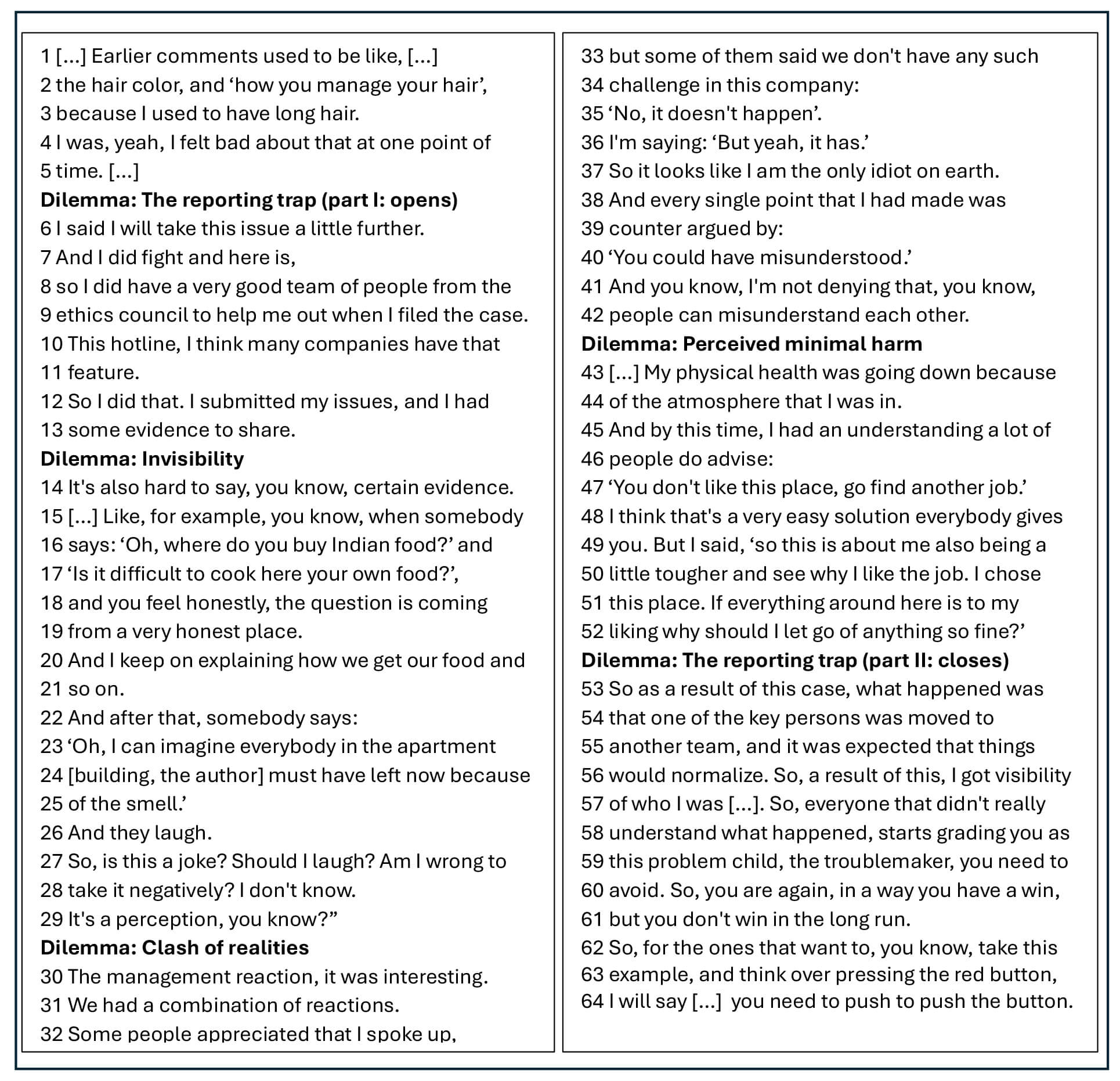 Fig. 1.
Dilemmas in a highly qualified migrant’s story about whistleblowing regarding microaggressions at work.
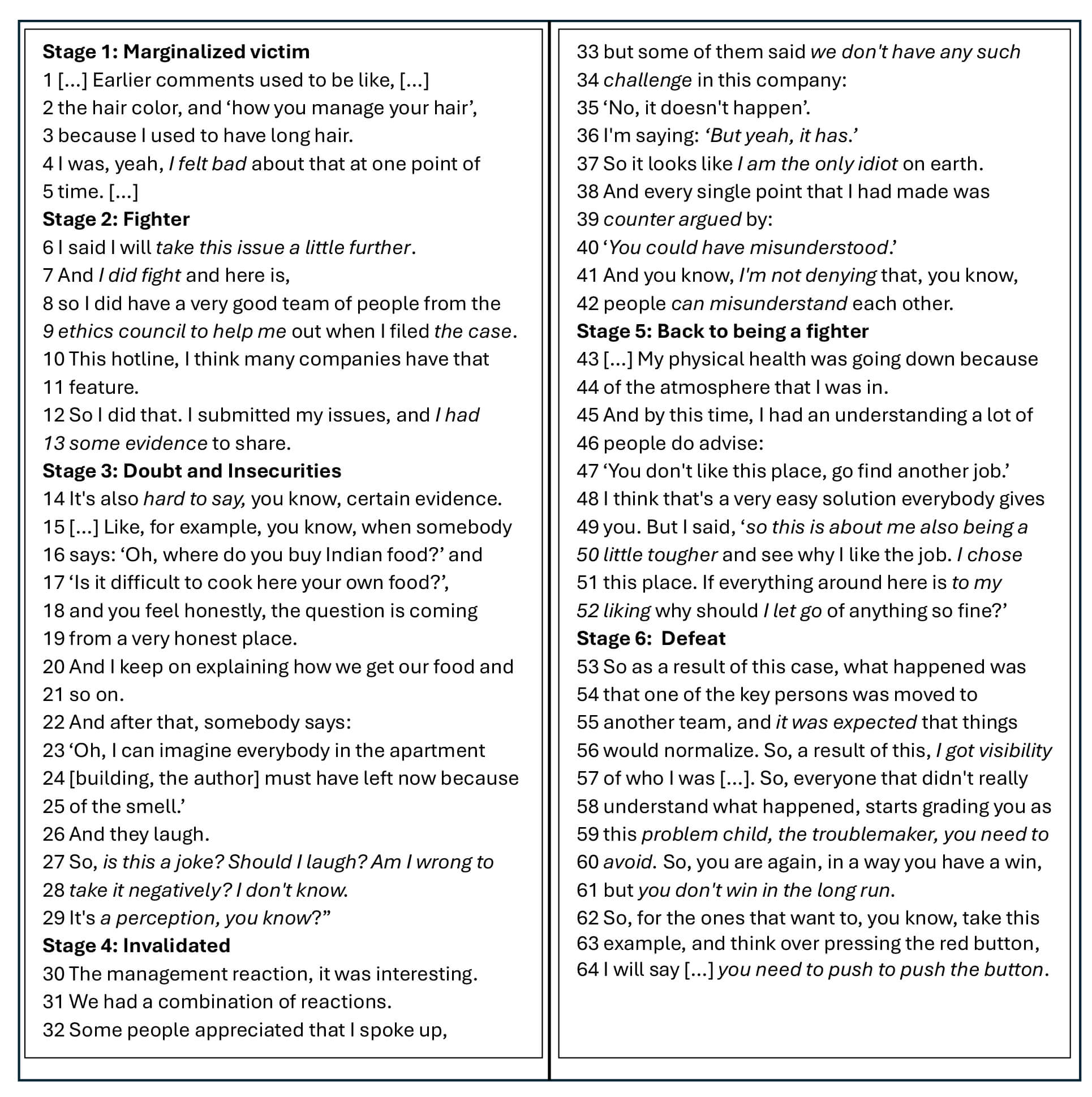 Fig. 2.
Stages of self-positioning by a highly qualified migrant during a corporate whistleblowing process.
The interviewee, Dalia, was involved in every major step in the production of this manuscript. Dalia has suggested some minor corrections and one major correction, from spelling errors to the fact that she was dismissed and not, as the authors had initially understood, bullied out of the company. All corrections have been fully included. Dalia’s real name is not stored on the authors’ computers or in any printed files. Dalia has given her full consent for this document to be published. No information about her will be released by the authors to any third party.
First, in a deductive process, we coded the small story using content analysis by applying the four dilemmas as described by Sue et al (2007): (1) Clash of realities; (2) Invisibility; (3) Perceived minimal harm; and (4) Reporting trap. Qualitative, structured content analysis (Mayring, 2019) is a systematic method for analyzing textual data and is particularly suitable for working with deductive codes or categories. This approach allowed us to test existing theories by applying predefined coding schemes, in this case, the four dilemma descriptions, to textual material (Krippendorff, 2019). Theoretical frameworks can be empirically strengthened through such empirical analysis (Braun and Clarke, 2006). We ensured the intersubjective transparency (Flick, 2023) of these four codes (the four dilemmas) and how they were applied by presenting our coding process at two internal research group meetings and one specialized international conference on human resource management. The appropriateness of the theoretical constructs as applied to the text passages (see Fig. 1) was confirmed by participants of the meetings and the conferences. When combined with small story data, this method provides deeper insights into how individuals construct meaning in specific contexts, particularly in professional settings. We analyzed one selected small story from the interviewee’s narrative interview transcript and subjected it to categorization according to the four content codes. Second, we applied positioning analysis to the same small story. As personal stories are an important means of identity work (Loseke, 2007), they can be used to understand how individuals connect to other individuals or groups. Small story techniques (Oostendorp and Jones, 2015) are well suited to learning about the social experiences of an interviewee. Equally, positioning analysis sheds light on the perceived social positions of the interviewee and other agents in the story and with whom or what the interviewee identifies (Anthias, 2002, p. 498). The analysis thus depicts “the claims and attributions that individuals make about their position in the social order of things, their views of where and to what they belong (and to what they do not belong) as well as an understanding of the broader social relations that constitute and are constituted in this process” (Anthias, 2002, p. 491). Small stories of individual experiences can reflect institutional policy and organizational practices and thus reveal not only interpersonal but institutional boundary making (Lamont and Molnar, 2002). This study understands the interviewee’s account as performatively constructing identity (De Fina, 2006; Bamberg, 2011; Anthias, 2002; Robinson, 2024; Fævelen et al, 2024) whereby interviewees position themselves and their identity (De Fina and Georgakopoulou, 2008), as well as their colleagues and other agents. We follow Bamberg’s 3-level analytical model. First, we ask “How are the characters positioned in relation to one another within the reported events?” (Bamberg, 1997). In this respect, we focus on the content and the protagonists of the story (What is the story about? Who is part of the story? How do agents relate to each other?). Answering these questions typically involves a line-by-line analysis of how characters are introduced, described, and how they relate to each other. It is here, at level 1 of small story analysis, that we integrate our content analysis of the four dilemmas of discrimination reporting. Level 2 of positioning analysis focuses on how the speaker is positioned by other story agents and how they position themselves. At level 3, conclusions can be drawn regarding “the bigger story” or the societal discourse and implications for how the small story “self” is of relevance in other contexts (Bamberg, 2004). The analysis thus moves beyond the small story content towards “the broader ideological context” that pertains to the story (Watson, 2007).
We identify all four dilemmas (see Fig. 1) as described by Sue et al (2007) in Dalia’s small story. We describe and specify these dilemmas as our content analysis results in section 6.1. We describe the results of our small story positioning analysis in section 6.2. In section 6.2.1, we identify six characters in Dalia’s story, including herself (see Fig. 2). We demonstrate how Dalia is self-positioning in section 6.2.2. We discuss the greater implications and the small story’s connection to societal discourse in section 6.2.3.
Dalia experiences all four dilemmas (see Fig. 1) as conceptualized by Sue et al (2007). The first dilemma is the “clash of realities” (Sue et al, 2007, p. 277): Dalia and the ethics council report the abuse to management, but Dalia is ultimately dismissed completely. The clash of realities pertains to the differing perceptions between the management and Dalia as a recipient of microaggressions. The management seems to view the actions of the offending coworkers as harmless or insignificant, whereas Dalia perceives them as offensive and harmful. Sue et al (2007) note that these differing perspectives can hinder effective communication and understanding between groups, thus perpetuating the cycle of microaggressions. This is exactly what has happened in this small story, as it is only at this point that Dalia starts to be shunned and avoided by other coworkers as well. The second dilemma is “Invisibility” (Sue et al, 2007, p. 278) , which is similar to, and may cause, the “clash of realities”: microaggressions are often so subtle and ambiguous, that even in the presence of well-meaning bystanders, the microaggressions may be challenging to identify and articulate. Consequently, when individuals attempt to report such incidents, they may encounter skepticism or dismissal, which Dalia’s reporting of repeated comments about her hairstyle and hair may have prompted. The subtle nature of such comments, together with the idea that they are regular, culturally neutral, and “color-blind” (Bonilla-Silva, 2021) conversation elements, contributes to the dilemma of invisibility, as perpetrators may be unaware of their actions, and observers may perceive the incidents as trivial or non-existent. This lack of acknowledgment exacerbates the psychological impact on victims and reinforces their sense of invisibility within societal and institutional contexts. Addressing this dilemma requires increased awareness and validation of the experiences of those subjected to microaggressions, thereby fostering environments where such concerns are taken seriously and addressed appropriately. Dalia is well aware of this, as, after recounting the “joke” about the odor of her food, she asks the interviewer:
27 “So, is this a joke? Should I laugh? Am I wrong to
28 take it negatively? I don’t know.
29 It’s a perception, you know?”
Dalia’s being trapped between two realities, of which one—hers—is invisible, becomes clear in this section of the story, where she positions herself vis-à-vis management. She emphasizes how the lack of understanding makes her look like an “idiot”, and she is made out to be the one who “misunderstood” the reality (see Fig. 1).
Dalia encounters the third dilemma, which we refer to here as the reporting trap. Originally, this predicament is called the “the Catch-22 of responding to microaggressions” (Sue et al, 2007, p. 279). This trap opens as soon as Dalia contacts the people she actually portrays as helpful and who seem to deserve some agency in her story, the “ethics council”. However, as they do not seem to be helpful in a sustainable way and cannot protect Dalia from the ramifications, they become, if unwillingly, accomplices in the reporting trap. In this story, the reporting trap closes when Dalia admits defeat and is shunned by a newly agitated group of hitherto seemingly neutral group of coworkers in the aftermath of how the whistleblowing was managed. Another dilemma of reporting is initiated in line 43, namely the dilemma of “perceived minimal harm” (Sue et al, 2007, p. 278). Uninvolved and unsympathetic bystanders propose a rather reductive solution to Dalia’s problem: that she finds another job. They thus suggest that her reporting action is an overreaction and disregard how impactful the situation is for her.
45 And by this time, I had an understanding a lot of
46 people do advise:
47 ‘You don’t like this place, go find another job.’
48 I think that’s a very easy solution everybody gives
49 you.
Dalia conveys that she suffered psychological issues in response to cultural discrimination and culturalist microaggressions, a well-documented health consequence in victims of discriminatory speech acts (Sue et al, 2007, p. 279; Voglino et al, 2022) Hence, the situation cannot simply be solved by a pragmatic job change. As Sue et al (2019) elaborate, social groups who are not suffering similar situations cannot imagine their grave impact, might downplay the abuse (Horisk, 2024), or fear consequences if intervening on behalf of the victim (Yu, 2024).
There are six agents in Dalia’s story: the offending coworkers, management, the ethics council, bystanders, a newly arising group of offending coworkers, and the self. Fig. 1 shows a line-by-line breakdown of the story.
Agents 1 and 2. Offending Coworkers and Management
Dalia starts her small story with a rather passive introduction of “the other”, that is, her offending coworkers. They are not introduced as persons, but by means of their “comments”, which foregrounds the strained relationship and makes clear that offensive speech acts are central to this experience. However, “the others” are not a clearly named group of offenders. This becomes clear in this quote:
1 […] Earlier comments used to be like, […]
2 the hair color, and ‘how you manage your hair’ […].
Dalia avoids calling her offending coworkers by their work functions or naming them more precisely. In her narrative, the agents attacking her are referred to as “somebody” or “they”. This opaque group seems powerful and impactful.
15 […] Like, for example, you know, when somebody
16 says: ‘Oh, where do you buy Indian food?’ and
17 ‘Is it difficult to cook here your own food?’,
18 and you feel honestly, the question is coming
19 from a very honest place.
20 And I keep on explaining how we get our food and
21 so on.
22 And after that, somebody says:
23 ‘Oh, I can imagine everybody in the apartment
24 [building, the authors] must have left now because
25 of the smell.’
26 And they laugh.
What Dalia recounts are forms of microaggressions that qualify as “microinvalidation” and “microinsults” (Sue et al, 2007), as they both devaluate and dismiss her perception of these experiences. Later in the interview, Dalia again mentions that Danish people repeatedly comment on the length of her hair and her hairstyle, which positions the repeated comments about her hair as a microinvalidation; although no insult is intended, the recurrence of the comments may have compounded Dalia’s experience of being made to feel that she is “the other” (Hall, 2015). Attributing the reason for tenants moving quarters to the smell of Dalia’s food to is a barely concealed “culturalist” insult (Grossberg, 2011; Baumann, 2002). Hence, it is microaggressions that trigger the chain of events in Dalia’s story. Dalia only returns to naming an agent when she mentions how one person was reprimanded and internally relocated by management, perhaps in an attempt to emphasize how little was done to help her situation, inasmuch as it concerns only “one of the key persons”. Dalia does not mention this specific person previously nor subsequently, which is why we consider the person to be one part of the rather abstract bloc of coworkers who demean her.
53 So as a result of this case, what happened was
54 that one of the key persons was moved to
55 another team, and it was expected that things
56 would normalize.
In line 30, she introduces a second agent, the “management”, which she subsequently names as “some people” (those in management that supported her) and “some of them” (those who invalidate her claims). “Some people” in management do not seem to have any power or much agency and vanish in her report from here. Thus, we do not label them as an agent in their own right.
30 The management reaction, it was interesting.
31 We had a combination of reactions.
32 Some people appreciated that I spoke up,
33 but some of them said we don’t have any such
34 challenge in this company:
35 ‘No, it doesn’t happen’.
Here, too, microaggressions are the most appropriate term to use to describe how Dalia experienced management’s behavior. Denial of a lived reality or experience qualifies as a microinvalidation: the offenders often do not realize that they are committing a culturalist, discriminatory act. As members of the majority culture, the offenders have simply never experienced such offensive speech acts and hence cannot relate these events to their lived experience. Instead of choosing to believe Dalia’s report, they dismiss her reality. From this point, Dalia discusses both coworkers and management mainly in terms of their (speech) acts, for example by introducing a quote and using passive verbs that omit the agent. In other parts of the text, she refers to the result of the coworkers’ actions (“the atmosphere I was in”) rather than naming them. Perhaps because of the severe impact Dalia experiences, she depicts her colleagues and the part of management that was treating her unfavorably as very powerful and inapproachable.
38 And every single point that I had made was
39 counter argued by:
40 ‘You could have misunderstood.’
[…]
43 […] My physical health was going down because
44 of the atmosphere that I was in.
Agent 3. The “Ethics Council”/Human Resources
In line 8, Dalia introduces a third agent group, which she clearly depicts positively and names as an active agent. This is the “ethics council” to whom she submitted her report. She names the whistleblowing function “this hotline”, to which we assume the “ethics council” is connected.
8 so I did have a very good team of people from the
9 ethics council to help me out when I filed the case.
10 This hotline, I think many companies have that
11 feature.
12 So I did that. I submitted my issues, and I had
13 some evidence to share.
Agent 4. Bystanders
In line 45, Dalia introduces a fourth agent, that is, people who advised her or commented on her conflict with coworkers and management. These people are depicted as bystanders, who by their nonchalant stance seemed to minimize her suffering, misinterpreted the power relations that Dalia sees, and thereby provided discursive support for the offenders. Although the initial offenders were coworkers, they were backed by management, and both the offenders and management were backed by bystanders. It is unclear whether the bystanders were from Dalia’s private life or if they were yet another group of coworkers, but her use of “everybody” (line 48) indicates that they were both. This group, in line with the other two groups that Dalia clearly has negative feelings about, is named “a lot of people” or “everybody”. By dismissing Dalia’s situation as easy to solve and placing the responsibility to solve the conflict on Dalia, the bystanders convey microinvalidations.
45 And by this time, I had an understanding a lot of
46 people do advise:
47 ‘You don’t like this place, go find another job.’
48 I think that’s a very easy solution everybody gives
49 you.
Agent 5. New Offending Coworkers
At the end of her story, Dalia introduces a fifth agent, namely a new group of offenders. This group was different from the initial group of offending coworkers. Dalia explains and contextualizes the offensive behavior of these agents. In contrast, she did not provide an explanation for the initial offensive behavior, the culturalist microaggressions of the offending coworkers. The new offending coworkers did not seem to be actively offending Dalia by their speech acts and by demeaning her cultural practices. Rather, they “avoided” Dalia in response to the reputation she gained within the organization. These agents are not directly named but introduced in passing when Dalia explains what happened to herself (“I got visibility”). Only later are they introduced as “everyone that didn’t really understand what happened” and as people who “avoid” her. This group would not have been formed were it not for Dalia’s reporting and the following (poor) conflict management, including rumors and gossip (see Fig. 1).
56 […] So, a result of this, I got visibility
57 of who I was […]. So, everyone that didn’t really
58 understand what happened, starts grading you as
59 this problem child, the troublemaker, you need to
60 avoid. So, you are again, in a way you have a win,
61 but you don’t win in the long run.
Dalia positions these new offenders as equally powerful as the initial offenders, as immediately after this text sequence she concludes that she did not win in the long run. She explains afterwards that she had to leave the company because she was let go. All these agents, the offending coworkers, management, bystanders, and new offending coworkers, seem to be one powerful force that together dominates Dalia’s possible options in this conflict and at the same time determines the form of the offensive behavior and manifests this in what is said to Dalia, which emphasizes her inferior position. Except for the ethics council, which appears to have limited impact, there is no agent to whom Dalia can turn.
Agent 6. The Self
During her story, Dalia positions herself in various ways (see Fig. 2).
Dalia only introduces herself in line 3 and immediately connects herself to an emotional state in response to the group of offending coworkers. Throughout her story, Dalia leads the interviewer through six stages of positioning. The first stage is that of the marginalized victim. Dalia leads with the microaggression and immediately introduces how she felt about herself in response to this (“I was, yeah, I felt bad about that at one point of time”, line 4). Thus, Dalia positions herself as the responder to an attack, in a rather passive position. In the second stage, this changes to Dalia positioning herself as a fighter: in this second stage she cites an ally, the “very good team of people from the ethics council to help me out” (lines 8–9). She uses the corporate steps available to her and closes this stage by pointing to the “evidence” of discrimination she submitted. This is the only stage in Dalia’s story where she positions herself as powerful and strong, and, for a moment, in a position of undeniable righteousness. Notably, the use of the notion “evidence” stops in stage 3, doubt and insecurities, where she questions her own righteousness and the legitimacy of her case. What has been called “evidence” in the previous stage, is now “hard to say” (line 14) and becomes “perception” (line 29). This is fully in line with Dalia being trapped in the invisibility dilemma (see Fig. 1), whereby marginalized individuals are aware that their case might not even be perceivable to members of more privileged groups (Sue et al, 2007). In this stage, Dalia is unsure how she should interpret a microaggressive remark and whether she should understand it as a “joke”. Stage 4, invalidated, starts from line 30. Here, Dalia experiences her case being denied and dismissed by management who, due to the “clash of realities” dilemma, do not understand her situation. Dalia, now, is losing all power. Her recounting of the absolute denial of any argument from her side and the notion of her being made to look like an “idiot” who could have “misunderstood” corresponds to descriptions of psychological “gaslighting” (Sweet, 2019, p. 851). Gaslighting is defined as “psychological abuse aimed at making victims seem or feel ‘crazy’, creating a ‘surreal’ interpersonal environment” (Sweet, 2019, p. 851). Gaslighting is effective when it is rooted in social inequality (Sweet, 2019, p. 852) which is the case in this stage of relations, where Dalia realizes that the power asymmetry is to her detriment despite the support of her allies, the “ethics council”, whom she introduced earlier. Somewhat surprisingly, in the subsequent stage, stage five, Dalia reverts back to being a fighter. Although she recounts that her health was affected by the discriminatory acts and the invalidation of her claims, and despite even more people (agent 4: the bystanders) failing to see her reality, reflects on her agency (“I chose this place”, line 50–51; “to my liking”, line 51–52). Dalia empowers herself by emphasizing that she has now opted to “also [be] a bit tougher” (line 50). This is a lonely process: in the first “fighter” stage, Dalia had an ally, whereas now, at this point in her story, she is a lone agent in her fight, with the number of people failing to understand her predicament becoming greater. At this point, three agents are positioned against her, and her only ally, the ethics council/HR, has seemingly vanished. Stage 6 is the stage of defeat and concludes Dalia’s story. That this stage demarcates defeat can only be understood with the help of the contextual information: Dalia is dismissed “one year after the closure of the case” (Dalia, written comment to the author). The reason provided to her was that the organization was to undergo restructuring. No reference was made to the case. In her small story, Dalia refers to this by saying “So, you are again, in a way you have a win, but you don’t win in the long run” (line 61). Thus, “in the long run”, all agents but Dalia win. While concluding her story, Dalia insists that her use of the whistleblowing function was justified and thus positions herself, as at the beginning of the story, as righteous. She foregrounds this in relation to the fact that she was dismissed from the company and was not able to use the function to her actual advantage. That the system failed her is alluded to by “it was expected things would normalize” (line 55). Immediately after expressing this expectation, Dalia refers to agent 5, the new offending coworkers, who started avoiding her. She details how she has no protection against this development. Dalia ends by positioning herself as having the moral high ground but remaining as the underdog and the losing party in the corporate process.
Level 2 of positioning analysis focuses on the performance aspect of the story (Bamberg, 2004, p. 137). Dalia’s small story is an extract from a narrative interview, and the role of the interviewer is almost restricted to prompting the story from Dalia. Dalia dominates this interaction by means of her narratives. The interviewer supports Dalia in keeping the story going by nodding and paying attention to the story’s progress. Dalia repeatedly engages with the interviewer during her story (“You know”, line 29, line 41), but does so mainly when she asks the questions that function as a recounting of her inner monologue in response to the discrimination (“So, is this a joke? Should I laugh? Am I wrong to take it negatively?”, line 28) and when she seems to search for validation and understanding by the interviewer. It is noteworthy that at the end of the story, where Dalia admits defeat but still claims the morally right position, she addresses an imagined audience—she mentions “the ones that want to, you know, take this example, and think over pressing the red button” (line 63)—and ends her story with advice for “those […] that want to take this example” (line 62–63). She also addresses this imagined audience directly (“you need to…”, line 64). In this moment, the interviewee is positioned as a vehicle to another audience, that is, people who are in a similar situation as Dalia and whom she would like to advise. This moment of position-taking can be interpreted as a moment of empowerment: Dalia claims “narrative power” (Plummer, 2020, p. 46), as she now “owns” the moral of the story. As Plummer (2020) describes, stories are embedded in “hierarchies of credibility and capable of being told only in certain times and spaces” (p. 48). It seems that the narrative interview and the opportunity to tell her story has given Dalia “story ownership” (De Fina and Georgakopoulou, 2011), which had previously been taken from her through the organizational processes. Storytelling is deeply connected to power and “narrative capital” (Lueg, 2023): the recognition of ideas and stories is contingent on how convincing they sound in their respective power contexts and hierarchies. Dalia employs her marginalized position in order to bring forward—to an imagined audience—a “counter-narrative” (Lueg et al, 2021) which resists the formerly stronger, hegemonial narrative of those that have made her “the other” at her workplace.
Level 3 of small story analysis zooms in on how the narrator positions themselves by asking “Who am I vis-à-vis what society says I should be?” (Watson, 2007, p. 380). In this context, for Dalia, this seems to pertain to two intersecting dimensions of identity: “As a migrant, who am I and who should I be?” and “As an employee with employee rights, who am I and who should I be?” At this level of analysis, claims are generated that can be transferred to similar situations (Watson, 2007) and to similar agents, that is, to discriminatory events happening to other migrants in similar settings, and to how whistleblowing and misconduct reporting is handled in other organizations. Dalia’s identity construction is embedded in a discourse which positions migrants as disadvantaged in a number of respects, including in the workplace (Jensen et al, 2017; Andreassen, 2013; Danbolt, 2017). Dalia’s story is recognizable and believable because it resonates with a broader discourse on the marginalization of employees, specifically those who occupy marginalized positions in society but who are often portrayed as particularly well-integrated minorities (Lee and Molina, 2023). Dalia’s challenge is the subtlety of the discrimination to which she is subjected and her high level of qualification in a highly internationalized context where management categorically denies that any discrimination has taken place. Hence, her story is closely entangled with understandings of microaggressions, particularly against Asian HQMs, in seemingly safe, cosmopolitan settings (Sue et al, 2009; Nadal et al, 2022). Dalia makes the discrimination experience a part of her identity and thus re-appropriates her losses. She does so by conveying “a moral of the story” for other persons concerned, as she explicitly addresses an imagined audience at the end of her story. This reappropriation of her own story makes her the expert of a potentially common discrimination experience. With a view to both identity dimensions and migrant and employee identity, Dalia constructs herself as being morally justified regarding her right and obligation to employ the whistleblowing function. At the same time, she constructs a position of full defeat and inferiority by positioning the other agents in her story as blind to her struggles, uncooperative, and powerful. Her victory is purely a moral one, and it is of little consequence that she issues a warning to the imagined audience: whoever wants to use the whistleblowing function, should “push the button” (l. 64) but “proceed with caution” (written comment to the authors). The analysis of agents, positioning, and dilemmas in this story shows that for victims of microaggressions, the offensive act itself, its opaqueness, and the risks connected with using the whistleblowing tool intersect in particularly harmful ways.
With a view to the “bigger story” of organizational management, Dalia’s account is also embedded in a context of organizational mismanagement. This pertains to management and HR, to allies and bystanders of microaggression in this story, and to an impactful and efficient whistleblowing process design in general. Throughout the transcript, Dalia can be observed “doing” identity work (Essers et al, 2013) by constructing her position as alternating between victimized, empowered, and defeated in relation to the claims and actions taken against her. At the same time, she is constructing the identity of the management, bystanders, and coworkers. Her story renders clear that her only ally, HR or the “ethics council”, was powerless except for initiating the complaint process. This can be directly connected to Sue et al’s (2019) conceptualization of “allies” as those who help to mitigate the harmful effects of microaggressions in workplaces and in broader social contexts. Allies are bystanders who actively intervene, for instance, by educating others about the impact of their words and actions (Casey and Ohler, 2012). Organizations in which allyship is institutionalized and embodied by HR can provide training and awareness programs and hence contribute to a culture where microaggressions are less likely to be tolerated and overlooked. However, in this story, HR fails to be such an ally. The intervention ends with HR barely initiating the process and then leaving the situation to be handled by a seemingly uninterested management. This makes the actions of HR part of the dilemma of the “reporting trap”. In this way, Dalia’s small story about her whistleblowing experience accords with conceptual considerations from critical race studies about reporting dilemmas (Bond and Haynes‐Baratz, 2022; Houshmand and Spanierman, 2021) and general criticism about the effectiveness of the organizational tool of whistleblowing (Arszuowicz and Gasparski, 2011; Yeung, 2020; Mecca et al, 2014). In Dalia’s account, the role of bystanders is equally interesting: Dalia struggles with the advice given by bystanders to simply find a different job. In consequence, yet another agent group becomes unreliable to Dalia and blends in with the other, more actively offensive agents, management, and coworkers. Research has documented that bystander responses can include intervention, passive inaction, and also the reinforcement of discrimination (Bowes-Sperry and O’Leary-Kelly, 2005), which seems to be the case here. Again, one organizational solution for educating potential bystanders could be institutional initiatives, such as workplace intervention training (Paluck and Green, 2009). However, factors such as implicit bias and fear of retaliation may still hinder intervention (Collins et al, 2021). Understanding the roles of two agents that failed Dalia—bystanders and allies—is crucial for understanding recurring patterns of marginalization, deskilling, and why these often do not have consequences (Ricci et al, 2021; Hasday, 2025; Rennstam, 2023). Missed opportunities for allyship and active bystandership can allow organizational processes to further escalate.
In sum, Dalia’s story is that of a double victimization: after walking into the “reporting trap” (Sue et al, 2007), she is worse off than she would have been had she not reported the incident. Double victimization describes the process of a victim of abuse being subjected to escalating victimization by the same (slightly expanded circle) of people in the same setting in which the offensive act was reported. Dalia is victimized by her coworkers and then by the implicit accompliceship or obliviousness of other agents in the same organization. The victimization escalates when Dalia makes use of the whistleblowing function. Double victimization is different from what is known as “secondary victimization” (Campbell and Raja, 1999), whereby, for example, victims of crimes experience a second traumatizing experience caused by different agents in different institutions or systems (e.g., first by a criminal offender, second by the justice system that overly aggressively questions crime victims, especially women) (Maier, 2008; Orth, 2002). In contrast, double victimization happens in a closed institutional environment, in this case, a company, in which the power to make decisions is not transferred to a second or third party. Decision-making in processes of institutional double victimization is closed, opaque, and incestuous, in that both the control of the processes as well as the process standards remain with the people who had power and who were in charge during the reported incidents. In sum, double victimization refers to the experience of being harmed twice within the same institution: first, through the initial misconduct and second through the institution’s response when the misconduct is reported. Finally, as a conceptual notion, double victimization describes the experience and status of the victim. This status is contingent on organizational negligence and a form of biased, avoidant, or actively harmful leadership that has become known as “organizational betrayal” or “institutional betrayal”, whereby trusted organizations fail to protect individuals who are dependent on that organization (Smith and Freyd, 2014). Double victimization is an active form of organizational betrayal, whereby all incidents happen in the same organization.
At the end of her story, Dalia appeals to an imagined audience (“the ones that want to, you know, take this example”), which indicates that she knows her story has a broader implication than just individual damage. Although Dalia positions herself as an individual in her story, the moral of the story is more global: minorities are encouraged to fight and to make use of legally mandated tools but have a high chance of experiencing the same hardships as Dalia. Ultimately, whistleblowing measures are introduced in Dalia’s story as little more than window dressing. The performative character of the whistleblowing tool only serves to reaffirm the perpetrators’ power positions but has no positive consequences for the reporting parties.
This study introduces the analytical notion of organizational double victimization of employees through failed whistleblowing and equity and diversity management. Double victimization describes the harm employees experience within the same organization: first, through the initial misconduct (e.g., bullying, discrimination, sexual harassment) and second through the institution’s response when the misconduct is reported. We investigated two interconnected challenges within organizational and societal contexts: the insufficient institutional response to whistleblowing and the often-overlooked discrimination faced by highly qualified migrants (HQMs) in the workplace. Although discrimination against migrants has been widely studied, this study has focused on the subtle, insidious exclusion of HQMs, which has thus far been overlooked in research. Despite being categorized as “desirable” due to their socioeconomic stability and legal access to employment, HQMs frequently encounter discrimination, particularly in the form of microaggressions embedded in everyday communication (Krings et al, 2014; Grigoleit-Richter, 2017; Yilmaz Sener, 2022). As seen in Dalia’s case, such subtle forms of exclusion are commonly framed as misunderstandings or overreactions by the victim and remain largely unaddressed by employers, coworkers, and onlookers. Moreover, institutional mechanisms intended to protect whistleblowers often fail in practice, thus exacerbating rather than alleviating workplace discrimination. In the case presented here, the use of the whistleblowing tool triggered a subsequent wave of negative experiences and discrimination. We illustrated that Dalia experienced the four dilemmas of responding to microaggressions that were conceptualized by Sue et al (2007), and that these dilemmas are applicable to reporting verbal discrimination in the workplace, too: Dalia goes through the stages of “invisibility”; the “clash of realities”, where bystanders and coworkers observe a different reality and deny hers; “perceived minimal harm”, where she is met with a lack of understanding of the grave impact of the discriminatory speech acts on her health; and finally she experiences the “reporting trap” that, despite the institutionalized frameworks for victims to receive help, worsens her situation. It is likely that, although still difficult, Dalia’s situation would have been less severe without the use of the instrument that is intended to protect whistleblowers. Instead, its use led to further ostracization by coworkers and superiors. The initial situation was one of Dalia experiencing isolated, individual discrimination (Feagin and Eckberg, 1980; Pincus, 1996) with a culturalist tone (Baumann, 2002), but it escalated to institutional discrimination by reinforcing the initial power asymmetries. Hence, it was only after Dalia’s reporting of discrimination that the organization was rendered complicit in the exclusion of a marginalized worker. Taken together, these findings point to a troubling pattern in corporate whistleblowing management and diversity and equity management practice, in which both employee protection and diversity measures seem to be nothing more than a “ceremonial” (Trittin-Ulbrich, 2023), symbolic organizational exercise. This represents a special type of “corporate hypocrisy” (Brunsson, 2002) in which the complicit organization has put whistleblowing tools and, ostensibly, HR resources in place. However, the performative “talk” (Brunsson, 2002) following Dalia’s reporting of the misconduct is destructive rather than conflict solving for Dalia. In consequence, the whistleblowing tool serves as a ceremonial practice to achieve organizational “legitimacy” (Dowling and Pfeffer, 1975; Deephouse et al, 2017) rather than being a mechanism for structural change, whereby an illusion of equity management is created without challenging underlying power structures. As a result, discrimination is allowed to persist in everyday workplace interactions, operating through micro-level exclusionary speech acts that remain unaddressed within corporate policies. Similar performative organizational behavior has been observed in the professional arena of Diversity, Equity, and Inclusion (DEI) initiatives in which diversity work is frequently reduced to institutional self-declaration. Organizations say they support diversity and display it in public relations materials but fail to transform underlying power relations, a structural problem that is interrelated with the phenomenon of ceremonial whistleblowing tools (Ahmed, 2012). Seemingly, both internal reporting/whistleblowing measures and DEI initiatives are being implemented in response to isomorphic coercive pressure, whereby organizations aim to maintain good relations with external stakeholders (politicians, the media) or to avoid liability rather than to improve the experiences of marginalized employees. The underlying lack of interest in improving, or even understanding, the situation of marginalized employees is revealed in the current study. As described by Brunsson’s (2002) concept of hypocrisy, the case organization upholds contradictory demands by separating talk, decisions, and actions. In the case presented here, the whistleblowing function, ostensibly a channel for reporting discrimination, serves to reinforce exclusion when the organization’s response lacks follow-through.
This illustrates organizational hypocrisy as a form of institutional maintenance, in which symbolic mechanisms help organizations to appear progressive while perpetuating harm. The concept of double victimization, as introduced in this article, captures the consequences of this disjunction for marginalized employees who are first harmed by microaggressions, then harmed again by the very organization that is meant to protect them.
Despite a lack of research on precisely how whistleblowing mechanisms malfunction—a gap which this micro study intends to close—other research strongly points to the awareness of minority employees about the possible repercussions of whistleblowing. Recent research on misconduct reporting and whistleblowing shows that trust in organizational protection mechanisms is rather low: for instance, whistleblowing activities by racialized employees and by employees with diverse sexual orientations and gender identities increases during Pride Month, potentially indicating that during this time the reporting parties feel more protected and visible to and in society (Sussek, 2023). Although fear of retaliation for whistleblowing seems to be widespread (Bocchiaro et al, 2012) (e.g., in the health sector), this fear is shown to be intensified for potential reporters from “Black, Asian and minority ethnic groups” (Wilson, 2023). Equally, intersectionality plays a role, particularly where sex and ethnicity intersect, for example when Asian women experience sexual harassment but refrain from reporting it due to fearing the organizational and personal costs (Dey, 2024).
Based on these insights and conclusions, this study makes three key contributions to organizational research. First, we emphasize the importance of positioning analysis and small story analysis in relation to understanding the fine-grained mechanism of workplace discrimination. Analyzing small stories and how interviewees position themselves within a greater discourse, in this case on inequality and workplace discrimination, provides insights for theorizing about organizational practice. As we can show that Dalia had to leave the organization after the failed whistleblowing management process, we demonstrate how communication actively constructs and maintains organizational boundaries. Although previous research has explored exclusion through organizational structures and policies, the role of everyday communication in shaping inclusion and exclusion deserves considerably more attention (Mumby and Kuhn, 2018). This study extends this perspective by analyzing how subtle speech acts, such as microaggressions, position HQMs first as outsiders in their own workplaces and then as actual outsiders after they withdraw from the company. The notion of double victimization has been developed through small story positioning analysis and by following Dalia’s own account of identity work vis-à-vis the actions of the agents she faced throughout her reporting process.
Second, we contribute insights into communicative boundary work in organizations. Speech acts not only communicate discrimination but actively produce and reinforce workplace boundaries, which escalates into institutional discrimination (Reskin, 2000). We detail the mechanisms through which HQM employees are positioned as the cultural “other” (Baumann, 2002), thus offering empirical insights into how microaggressions are performed, interpreted, and sustained within workplace interactions. Based on the findings of this study, it can be argued that microaggressions are not isolated incidents but rather organizational practices that shape workplace hierarchies and cultures (Cooren et al, 2011). This is particularly important in light of the vast amount of literature documenting the malfunction of organizational whistleblowing and protection measures (Krügel and Uhl, 2023; Mcintosh et al, 2019; Vie, 2020). However, despite these studies, the precise mechanism of how reporters of misconduct become “the other” and how they are vilified and further victimized has remained underexplored. This study emphasizes how crucial single speech acts are for sidelining employees and for starting, or contributing to, a trajectory of organizational injustice and exclusion. By understanding the impact that cumulative speech acts can have, we open possibilities for investigating how training and counter-speech (e.g., “microinterventions” as conceptualised by Sue et al, 2019), in parallel with the sharpened supervision of reporting processes, can help prevent escalation.
Third, we contribute to organizational practice by emphasizing the need for organizations to reframe microaggressions as systemic issues rather than isolated misunderstandings. Current diversity measures fail to address the performative nature of workplace communication (Austin, 1962) in which informal conversations between coworkers can serve as sites for offensive speech acts. Within the framework of organising theory (Dobusch and Schoeneborn, 2015) and speech act theory (Cooren, 2000; Austin, 1962) it can be argued that microaggressions are among the practices that create, stabilize, change, and represent companies and organizations (Cooren et al, 2011). Hence, seemingly isolated acts of communication can negatively shape the image of corporations. This study advocates for communication training about discrimination, bias, microaggressions, and microinterventions (Bond and Haynes‐Baratz, 2022) as an anti-discrimination strategy. Such training can increase awareness of subtle discriminatory practices, highlight the importance of bystander intervention, and foster a corporate culture that actively mitigates workplace exclusion.
Although we cannot claim any statistical generalizability, we contribute to theoretical and analytical generalizability (Carminati, 2018). Small story research (Georgakopoulou, 2007; Bamberg, 2020; Bamberg and Georgakopoulou, 2008) has been developed to make visible how subjective, unstructured, fleeting experiences on a micro level are contingent on the moral, normative, and institutional orders within which they are told. The analysis of Dalia’s small story, which reflects on an organizational discursive practice, would likely have been missed in a more general, survey-based, or large-N study. The study in itself is interpretivist and hence prioritizes the understanding of human behavior over the generalization of cause and effect (Carminati, 2018). However, the analytical concept of double victimization, particularly when applied to vulnerable groups in organizations, can serve to inform other studies and therefore has a theoretical reach beyond this study. Conversely, the case speaks to analytical generalizability, as it relates to the concept of dilemmas caused by whistleblowing and reporting, particularly regarding the reporting of microaggressions (Sue et al, 2007). It draws attention to how this concept can frequently be identified in cases and hence gains in theoretical robustness beyond the initial case study setting (Eisenhardt and Graebner, 2007). The theoretical and methodological design of the current case may inspire other studies that are interested in understanding how exclusion operates in organizations that have seemingly well-functioning quality management tools in place, such as a whistleblowing system.
The full transcript of the small story is included in the material and published as a part of the manuscript.
KL conceptualized and designed the study. She also gathered, analyzed and interpreted the data. KL was responsible for drafting the manuscript and revising it critically for important intellectual content. The author approved the final version of the manuscript to be published and agrees to be accountable for all aspects of the work, ensuring that any questions related to the accuracy or integrity of any part of the work are appropriately investigated and resolved.
I thank the peer reviewers for their constructive suggestions and comments. I also thank my interviewee Dalia for her commitment to the interviewing process, and her dedication to be involved in several feedback-rounds on the manuscript to accurately represent her position.
This research received no external funding.
Given her role as a guest editor of the journal, KL had no involvement in the peer-review of this article. She had no access to information regarding peer-review. Full responsibility for the editorial process for this article was delegated to editor KR.
References
Publisher’s Note: IMR Press stays neutral with regard to jurisdictional claims in published maps and institutional affiliations.