

 , Janine Hagen 2, Thomas Hess 1,2
1 Bavarian Research Institute for Digital Transformation – bidt, 80333 Munich, Germany
2 LMU Munich School of Management, University of Munich (LMU), 80539 Munich, Germany
Abstract
The adoption of digital technologies transforms not only technical infrastructures but also social interaction and, in particular, collaboration within organizations. This study explores group dynamics during digital technology adoption, using a Big Data Analytics (BDA) adoption project as its empirical setting. While prior research has emphasized the role of BDA in organizational change, it has largely overlooked the group level, where BDA’s potential unfolds through interdisciplinary and cross-functional collaboration between business experts and data science experts. Based on an interpretative case study conducted at an international manufacturing and retail company, we examine how cross-functional teams composed of business experts and data science experts interact throughout a BDA project. Drawing on social identity theory and Bourdieu’s theory of practice, we not only identify observable group practices but also unpack the underlying dispositions and power relations that drive these dynamics. We identify a set of recurring group practices that emerge both between the two subgroups and within the team as a whole. While the subgroups maintain symbolic distance through mutual stereotyping, gatekeeping, and avoidance of responsibility, external organizational pressures trigger temporary alignment in the form of joint practices aimed at deflecting criticism. Our data further reveal that these practices are shaped by underlying group habitus and symbolic power positioning. The study contributes to a more nuanced understanding of group dynamics in digital innovation contexts by demonstrating how latent dispositions and symbolic power asymmetries shape collaboration in cross-functional teams. It also illustrates how in-group cohesion and out-group demarcation can both impede and stabilize project trajectories. Finally, the findings offer practical insights for organizations seeking to strengthen interdisciplinary and cross-functional collaboration during digital technology adoption.
Keywords
- big data analytics
- group dynamics
- experts
- collaboration
- theory of practice
- habitus
The opportunities associated with new and ever-faster developing digital technologies provide companies not only with manifold avenues to digital innovations (Barthel et al, 2020) but also urge them to engage with these technologies to keep up with the times and stay competitive (Hess, 2022). One core issue in this context is the exploration and exploitation of data for business purposes. In today’s digital age, the volume, velocity, and variety of data generated by businesses and individuals have grown exponentially. Traditional data processing tools are often insufficient to handle this influx of data. Big data analytics (BDA) addresses this challenge by enabling organizations to process vast amounts of data swiftly and accurately. It refers to the complex process of examining large and varied data sets—often called ‘big data’—to uncover hidden patterns, unknown correlations, market trends, customer preferences, and other useful business information. BDA, not least, serves as a foundation for intelligent processing and utilizing data in the context of artificial intelligence.
Organizations adopt BDA to support their decision-making (Newell and Marabelli, 2015; Sharma et al, 2014) and to improve internal processes and external offerings (Grover et al, 2018). Thus, BDA increasingly transforms business by enhancing agility, innovation, and competitive performance (Günther et al, 2017; Loebbecke and Picot, 2015; Mikalef et al, 2020). However, while promising great business value, it also entails several challenges for organizations, not only regarding the technical dimension (Sivarajah et al, 2017) but also with respect to the organization’s social dimension. BDA can be considered a form of organizational change that breaks up existing routines and leads to insecurity (Collins, 2002; Dawson, 2003). Furthermore, as BDA becomes central to decision-making processes, power dynamics within the organization can shift. It holds the potential for changing established organizational hierarchies and power relations (Pfeffer, 2010), as new digital-oriented experts, i.e., data scientists or data analysts, gain increasing importance within the organization (Graf and Lueg, 2025).
Moreover, and related to that, the adoption of BDA within organizations sparks significant challenges with respect to the formation of new group configurations and emerging group dynamics. In fact, the group level is the ‘place’ where BDA projects are driven. The potential of BDA unfolds only through collaboration that bridges both functional boundaries and disciplinary logics. Thus, inter-group collaboration is a key factor for BDA. However, while this interdisciplinary and cross-functional collaboration fosters innovation, it can also encounter friction, not least due to the distinct organizational roles, disciplinary backgrounds, and power positions of the involved groups. Teamwork at the group level is therefore prone to conflicts, as members bring divergent knowledge traditions, expectations, and communication styles to the table. Prior research indicates that the working relationship between business-oriented and technically-oriented actors is far from guaranteed to succeed (Michalczyk et al, 2021). While research on BDA so far has primarily focused on either the organizational level of BDA adoption (Dremel et al, 2017; Gunasekaran et al, 2017; Obal, 2017) or the individual level (Boldosova, 2019; Verma et al, 2018), incidents on the group level have received little attention. The few existing exceptions provide initial indications that the relationship between business experts and data science experts can be troubled, which may impede collaboration and, thus, BDA adoption at the organizational level (Barbour et al, 2018; Hagen and Hess, 2021; Troilo et al, 2017). Since BDA is “not just a faddish rehashing of already existing technical competencies in organizations, but the emergence of a new function” (Barbour et al, 2018, p. 258), business managers who want to use BDA have to establish new relationships with data science experts (Barbour et al, 2018). For example, tension can arise around the question of the decision authority. Consequently, the tensioned group relationship between business experts and data science experts has been introduced as a reason BDA projects still frequently fail (Hagen and Hess, 2021).
Thus, the following research question (RQ) guides our study:
Which group dynamics emerge during the adoption of big data analytics in organizations, and how can these group dynamics be understood?
To answer our research question, we conducted an interpretive, in-depth case study of an international tool retailer and manufacturer. The company (pseudonym ‘ToolCo’ used in the following) is specialized in offering high-quality industry tools and workplace equipment for industry customers, selling premium tool brands as well as offering its own in-house developed tools and expert consulting services. ToolCo is a fitting case study given its ongoing adoption of BDA in internal operations. Using an ethnographical approach, we accompanied a BDA adoption project over a period of 18 months to study emerging group dynamics in depth. The project aimed at developing a machine learning tool to accelerate content onboarding in ToolCo’s online shop in terms of automating the integration of product data, such as descriptions, specifications, images, and categorization, into the company’s e-commerce platform.
Theoretically, we combine social identity theory (SIT) and Bourdieu’s theory of practice, which allows us to investigate observable group practices as well as latent underlying dispositions. We not only bring the observable group dynamics during BDA adoption to light, but also provide explanations for these dynamics by unpacking underlying habitual dispositions and power structures. Our findings show how symbolic boundaries between business and data science subgroups manifest in everyday group practices, and how these are shaped by deeper structures, namely group-specific habitual dispositions and symbolic power positioning. This comprehensive perspective enables us to explain why certain dysfunctional collaboration patterns persist despite shared goals and project alignment.
With our study, we respond to the calls for a stronger consideration of social processes, stakeholders, power relations, and the human factor in the context of BDA (Barbour et al, 2018; Jones, 2019; Markus, 2017; Mikalef et al, 2020). Our findings contribute to a deeper understanding of group construction and group dynamics in the course of digital technology-induced organizational change, explicitly considering the role of the newly emerging group of digital technology experts. Precisely, we contribute to ongoing research on data-driven organizational transformation and organizational group dynamics in two ways: First, we empirically uncover how cross-functional collaboration unfolds in practice, highlighting latent habitual dispositions and power dynamics that have often been overlooked in the literature. Second, we combine insights from SIT and Bourdieu’s practice theory to conceptualize the interplay of symbolic boundaries and habitualized group behavior.
The paper is structured as follows: First, we outline our theoretical framework, drawing on SIT and Bourdieu’s theory of practice (section 2). Subsequently, we delineate our research design and method (section 3). Section 4 presents our empirical findings, outlining key patterns of interaction and identified dispositions in the BDA project studied. Thereafter, we discuss and reflect on our results against our theoretical framework. Finally, we summarize and conclude by depicting the limitations of our contribution and highlighting its potential impact on a theoretical and practical level.
BDA is defined as “the application of statistical, processing, and analytics techniques to big data for advancing business” (Grover et al, 2018, p. 390), whereby big data can be delimited from ‘normal’ data by its volume, velocity, variety, and veracity (Abbasi et al, 2016). It is widely recognized as a cornerstone of contemporary digital transformation efforts of organizations and viewed as a key enabler and catalyst that allows companies to become more data-driven and agile in responding to market dynamics. BDA promises the effective use of the vast and ever-growing amount of data within organizations by detecting and recovering hidden patterns, trends, or customer preferences that inform strategic decisions. Companies implement BDA to enhance decision-making, optimize business processes, improve products and customer experiences, and ultimately drive business value (Côrte-Real et al, 2019; Grover et al, 2018; Günther et al, 2017; Mikalef et al, 2020; Newell and Marabelli, 2015; Sharma et al, 2014). For example, retail giants like Amazon use BDA to analyze customer behavior, optimize inventory management, and provide personalized product recommendations in real-time. Not least in the age of artificial intelligence, BDA frequently leverages machine learning and other AI algorithms to process data and generate predictive or prescriptive insights (Susanto et al, 2024).
The term ‘adoption’ already indicates the early stage of integrating these technologies within the organizational context (Cooper and Zmud, 1990), which initiates massive transformation efforts throughout the entire organization (Dremel et al, 2017). While the potential benefits of BDA are compelling, previous research has identified several challenges organizations face when implementing this technology, comprising both technical and organizational aspects. While on the technical side, issues such as data privacy and security concerns, data quality and integration issues, and infrastructure and scalability are highlighted, potential hurdles on the organizational level, such as talent and skills gaps or organizational culture, are also addressed (Sivarajah et al, 2017; Susanto et al, 2024). Previous research referring to organizational aspects has studied BDA adoption mainly concerning the overarching organizational level as well as the individual level (Sidorova et al, 2008). On the organizational level, scholars have explored the antecedents of organizational BDA adoption intention (Caesarius and Hohenthal, 2018), starting points for BDA adoption (Bremser, 2018), and drivers of postadoption usage (Obal, 2017). Furthermore, scholars have also explored the impact of BDA adoption on firm performance (Gunasekaran et al, 2017) and digital transformation (Dremel et al, 2017). In addition, on the individual level, challenges have been identified that impede individual adoption (Beath et al, 2012; Clarke, 2016; Sivarajah et al, 2017). Moreover, scholars have explored factors underlying individual adoption of BDA (Boldosova, 2019; Verma et al, 2018).
While these studies provide valuable insights into BDA adoption at both macro and micro levels in the organizational context, the group level—as the essential level for developing and delivering BDA applications (Carton and Cummings, 2012)—remains largely underexplored. The development of BDA solutions within organizations requires close collaboration within an interdisciplinary and cross-functional work setting. Usually, a BDA work team consists of business experts and data science experts (Boldosova, 2019; Gupta and George, 2016). Business experts (from here: BE) are managers from diverse business units, such as marketing or sales, who aim to use BDA to improve their operations and decision-making. However, their role is not limited to the use of the final application; rather, they are deeply involved in the conceptual development and functional design, providing requirements and feedback around the respective use cases. Data science experts (from here: DS) are, for example, data scientists and data engineers who contribute their analytical and technical understanding to extract knowledge from data (Michalczyk et al, 2021). Thus, their role is mainly the technical development and realization of the application in close exchange and collaboration with BE. Research suggests that the collaboration between BE and DS is uneasy (Barbour et al, 2018; Hagen and Hess, 2021). On the one hand, this tension arises from the different expertise domains and understandings, leading to different languages, incongruent mindsets, and unrealistic expectations (Hagen and Hess, 2021). For example, BE often aims for quick returns on investments, whereas DS aims for accurate results (Yamada and Peran, 2017). On the other hand, tension arises from the shaken power structure during BDA adoption. For example, BE may tend to hoard their data to maintain their influence in the organization, fearing that algorithms make their judgment obsolete (Barbour et al, 2018).
The relationship between BE and DS bears similarities to the cooperation and coordination between business departments and information technology (IT) department members as functionally distinct groups. This issue has kept scholars on tenterhooks for several decades, revealing challenging group dynamics due to different perspectives and interests (Chan, 2008; Van den Hooff and De Winter, 2011). However, while the constellation between business and IT might be similar, it is not equal to the context of BDA adoption. In the former constellation, IT clearly assumes a supportive role, constituting an asymmetrical group constellation. IT’s primary focus is on providing and maintaining the technical infrastructure and ensuring the smooth operation of systems for business. In contrast, in the case of BDA adoption, DS, as a new professional group within the organization, play a pivotal role. Therefore, we propose that this relationship reflects a qualitatively different constellation, akin to the widely accepted distinction between IT-enabled organizational transformation and digital transformation (Besson and Rowe, 2012; Vial, 2019; Wessel et al, 2021), and thus warrants dedicated scholarly attention. The development of BDA applications and the leverage of the full potential of BDA calls for close and intensive interdisciplinary collaboration of DS and BE in a cross-functional work team, as the expertise and competencies of both expert groups are necessary. Unlike people in IT departments, data scientists are more actively engaged in the core business by leveraging data to drive strategic decisions, optimize processes, and foster innovation. Their work goes beyond mere support and service for business, as their task is to analyze complex datasets to uncover insights that directly influence business outcomes, product development, and customer strategies to enhance overall organizational performance. Close collaboration on eye level between BE and data scientists is essential for a deeper understanding of relevant data sources, ensuring the quality of data, and facilitating the successful implementation of insights into business operations. By working together, both groups jointly develop and iteratively refine models that ensure their applicability in real-world settings. To this end, a functioning BDA work team is the foundation to ensure that BDA solutions align with the company’s strategic goals and address practical needs. Thus, in contrast to the business-IT relationship, a more symmetric group constellation can be assumed in the case of BDA adoption.
These insights suggest that adopting BDA needs to be examined at the group level. Shedding light on social group practices between BE and DS and revealing underlying drivers for these practices contributes to a deeper understanding of emerging group dynamics in the light of digital technology-induced organizational change and the associated increasing role of DS, and thus provides indications for the success or failure of digital transformation initiatives.
To theoretically grasp group dynamics during BDA adoption, we combine SIT (Tajfel, 1978; Tajfel and Turner, 1979; Tajfel and Turner, 2004) with a practice theoretical perspective (Bourdieu, 1977; Giddens, 1984). While SIT serves as a theoretical lens for closely examining group dynamics in terms of a ‘middle-range theory’ (Merton, 1968), we refer to practice theory as an epistemological encompassing theoretical frame, understanding the group level in organizations as a mutual interplay between the social structures (organizational level) and social practice (individual level). The organizational group level, thus, displays the meso level, where the complex and mutual interdependence between social structure and social practice takes place. In general, social practices from this perspective are understood as patterns of human behavior or activity that are organized around collective understandings. Groups serve as the primary context within which social practices are developed, maintained, and transmitted. Through group interactions, individuals negotiate meanings, establish norms, and reinforce behaviors that constitute specific practices and, thus, social structures.
SIT draws our attention to the relationship within and between groups, focusing on inter- and intra-group practices based on group construction and identity, helping to trace group dynamics and group constructions. Whereas the practice theoretical lens enables us to unpack underlying collectively shared understandings and explicitly consider organizational structures. Within the broad approach of practice theory, we particularly refer to Bourdieu’s idea that social practice is neither purely individual nor wholly determined by social structures (Bourdieu, 1977; Bourdieu, 1990). Rather, it emerges from the interplay between habitual dispositions and the positioning within power relations. In particular, we utilize Bourdieu’s concepts of habitus and field to better understand why group dynamics emerge the way they do in the context of BDA adoption. Even though Bourdieu himself did not directly address group practices in the organizational context, following Emirbayer and Johnson (2008) as well as Sieweke (2014), we suggest that this perspective provides a suitable and promising theoretical lens to study organizational phenomena.
Taking a social psychological perspective, SIT, introduced by Tajfel and Turner (Tajfel, 1978; Tajfel, 1981; Tajfel and Turner, 1979; Tajfel and Turner, 2004), focuses on intergroup relations and group dynamics by centering the concept of social identity. Social identity in this context is defined as “part of an individual’s self-concept which derives from his knowledge of his [sic!] membership in a social group (or groups) together with the value and emotional significance attached to that group membership” (Tajfel, 1981, p. 255). SIT proposes that people categorize themselves and others into groups, forming in-groups and out-groups (social categorization). Within organizations, employees often identify with their occupational group, departments, teams, or divisions, fostering group-based identities (Haslam, 2012). This categorization leads to establishing group cohesion, but it may also amplify demarcation between organizational subgroups. Through comparison, individuals evaluate their group against out-groups and mainly tend to view their in-group more favorably than out-groups as a way to enhance self-esteem (Tajfel and Turner, 1979). The identification with the own group (in-group) leads to group cohesion and commitment, but can also result in an ‘us-versus-them’ mentality, creating silos and competitiveness (Ashforth and Mael, 1989; Sidanius, 1999).
In the organizational contexts, SIT provides insight into how strong in-group identities can enhance collaboration within teams while potentially hindering intergroup collaboration. Studies indicate that cohesive in-groups foster trust, support, and shared goals, contributing to higher performance (e.g., van Knippenberg, 2000). However, the emphasis on in-group identity may also lead to competitive or even adversarial relations with out-groups, resulting in intergroup conflict, reduced cooperation, and communication barriers (Bartel, 2001). Such dynamics are obvious in cross-departmental projects or matrix organizations where collaboration across diverse teams is essential. SIT also provides insights into understanding group dynamics during organizational change processes. Change initiatives frequently disrupt established group structures and challenge group identities, potentially leading to resistance, uncertainty, and stress among employees (van Knippenberg, 2000). The desire to maintain stability within one’s in-group can foster resistance to changes perceived as a threat to group norms or status (Haslam, 2012). SIT, therefore, serves as a suitable theoretical framework for analyzing group construction and group dynamics in the course of BDA adoption.
While SIT provides sophisticated insights from a social psychology perspective, focusing on individuals as group members, it neglects the organization as a structural setting and power structure shaping group constellations as well as group dynamics, on the one hand, and the individuals’ disposition deriving from the socialization processes beyond the group, on the other. Thus, we turn to Bourdieu’s theory of social practice (Bourdieu, 1977; Bourdieu, 1990) to go beyond the group level and bridge the more macro (organization) and micro (individual) levels within the organizational context. It allows us to focus on the group practices as an interplay between the micro and macro levels. We argue that both aspects, the individual disposition and the organizational structure, are relevant to deeply understanding group dynamics during BDA projects. Especially in the context of cross-functional collaboration, this framework makes it possible to analyze how seemingly mundane practices reflect deeper habitual dispositions and symbolic power struggles. Sieweke (2014) emphasizes that Bourdieusian theory is particularly fruitful for interpretative research, as it bridges the often-separated domains of meaning-making and structural analysis. Thus, we assume it to be a suitable theoretical lens to reveal underlying habitual dispositions and to derive the positioning in the organizational power relations as a root cause of the emerging social dynamics, accounting for the relationship between BE and DS.
In particular, we refer to two central concepts from Bourdieu’s theory, namely habitus and field. Habitus describes “a system of lasting and transposable dispositions which, integrating past experiences, functions at every moment as a matrix of perceptions, appreciations and actions and makes possible the achievement of infinitely diversified tasks” (Bourdieu and Wacquant, 1992, p. 18). On its part, it creates specific practices, which are routinized types of behavior (Reckwitz, 2002) but not necessarily conscious. The habitual scheme delimits the individual’s (reasonable) options for action, however, not in a deterministic manner. Even though habitual schemes emerge through an individual’s experiences, social groups develop similar habitual dispositions when socialized under similar conditions and encounter similar experiences, referred to as group habitus (Bourdieu, 1991). In the context of organizations, organizational membership sets the ground for shared common dispositions (organizational habitus; Janning, 2004). However, within the organization, various subgroup constellations (e.g., functional, professional, hierarchical) serve as an additional fundamental basis for socialization processes and experiences, leading to similar perceptions, appreciations, and practices.
Habitus-driven social practice takes place within social fields (Bourdieu and Wacquant, 1992) that are organized around a common interest and constitute the structural frame for practice. Fields provide the ‘rules for the game’ by setting common conventions, norms, and beliefs. However, social fields have also to be considered as fields of struggle where field members compete for power and position (Bourdieu and Wacquant, 1992). Depending on their (power) position within the field, individuals and groups have different opportunities for action. Thus, social practice is not only shaped by habitus but also by the individual’s or group’s position within the field. They act ‘strategically’, even though pre-consciously, to persist or improve their (power) position within the organization. Besides the struggle over position and power, habitual dissonances hold the potential for social conflict. In this light, organizations can be regarded as particular social fields (Emirbayer and Johnson, 2008; Graf, 2025) where specific ‘rules of the game’ prevail, and individuals and groups compete for position and power. Since the concepts of habitus and field are interdependent and mutually constitutive, both concepts have to be considered when analyzing group dynamics during BDA adoption.
The concepts of social identity and group habitus obviously share similarities. Both refer to commonly shared beliefs, values, presuppositions, and affective dispositions among group members and provide explanations for group dynamics. However, two slight differences in focus and conceptualization are to be considered: On the one hand, social identity is primarily related to an individual’s self-categorization and thus implies a stronger focus on consciousness, whereas the concept of habitus emphasizes the pre-consciousness of dispositions, becoming internalized in the course of processes of socialization and experience. On the other hand, as Carter and Spence argue, SIT “tell[s] us much about the ‘here and now’ but are far less sensitized to the historical development of identity or of the context that sustains an identity” (Carter and Spence, 2020, p. 272). In this vein, we suggest that both theoretical approaches can cross-fertilize each other. While the SIT perspective helps to trace inter- and intra-group practices during the BDA project, shedding light on in- and out-group constructions, the Bourdieusian perspective enriches this analysis by pointing to the underlying habitual dispositions that constitute the group’s social identity, on the one hand, and by integrating the organizational context and considering broader field dynamics and power relations, on the other, in order to gain deeper understanding of the driving forces for the observed group practices.
For our study, we, therefore, regard the company as a social field. The adoption of BDA initiates a digital technology-induced organizational change, potentially leading to shifts within the field structure. Since, in the course of BDA adoption, DS gain importance as a new organizational group, the established field order might be questioned and become subject to re-negotiation. BDA adoption is realized through BDA projects, where BE and DS are unified into a BDA work team, constituting a new interdisciplinary group within the organization. We expect that within the BDA work team, emerging group dynamics are anchored in different group identities and habitus, as well as in their respective position within the organization as a field. Thus, to gain a comprehensive understanding of emerging group dynamics, group construction, and identity, as well as underlying group habitus and group positioning, must be taken into consideration.
We used interpretive in-depth case study research (Walsham, 1995) to study group dynamics during BDA adoption. This method appears appropriate because it acknowledges the importance of social issues (Walsham, 1995) and helps researchers understand human thought and action in social and organizational settings (Klein and Myers, 1999). With this interpretive perspective, we assume that reality is shaped by social constructions such as language and shared meanings (Klein and Myers, 1999). Moreover, interpretive in-depth case study research resonates well with the character of group identity and habitus, which must be decoded through interpretation (Bourdieu, 1988; Lamaison and Bourdieu, 1986).
We selected ToolCo for our study, as it fitted our selection criteria. These were (1) the organization must adopt BDA, (2) the organization has at least one BDA project in the backlog that we can accompany throughout its entire lifecycle, and (3) the project requires collaboration between BE and DS. ToolCo is an international retailer and manufacturer specializing in precision tools and workplace equipment for various industries (e.g., drills, cutting tools, measuring and testing equipment, personal protection equipment). They offer a combination of premium tool brands, their own house brands, and expert consulting services. The company is headquartered in Europe, has almost 4000 employees across 50 global locations, and generates annual revenue of more than 1 billion Euros. ToolCo integrates e-commerce, catalogue sales, and personalized customer service. In the course of its history, the sales department was the powerhouse of ToolCo, with a strong position within the organization. About three years ago, since several executives recognized the potential of BDA, a centrally anchored data science team was built, aiming at delivering case-based BDA prototypes for the business units, for example, for sales forecasting. The members of the data science team are not assigned to the IT department but belong to the core business department.
We selected a project called “content automation tool” (CAT), which is a standard BDA process improvement project (Grover et al, 2018). The project goal is the development of a supervised machine learning tool to accelerate the onboarding of supplier content in ToolCo’s online shop. The content onboarding process comprises, e.g., the integration of product data, including descriptions, specifications, images, and categorization, into the company’s e-commerce platform. The project goal is driven by the business problem that the onboarding of supplier content into ToolCo’s structure systems (e.g., product information management system) goes along with a high manual classification effort. Classification is necessary to position the supplier’s products within ToolCo’s portfolio and to properly market them online. Prior to CAT, an editor needed 3.9 minutes to classify one article. Given that ToolCo’s product portfolio includes more than 300,000 articles, this process requires a considerable amount of time and should be automated via machine learning.
For CAT, two relevant use cases have been created: Use case 1 includes articles with labeled supplier data, which have been classified before. Here, CAT is supposed to identify new data based on historical data and classify it accordingly. The second use case includes the classification of unlabeled supplier data based on patterns. This distinction of labeled versus unlabeled data turned out to play a key role in the project (see results). CAT followed the typical phases of analytics projects in large parts (Mariscal et al, 2010; Phillips-Wren et al, 2015), as shown in Table 1. However, throughout the project, group dynamics within the BDA work team emerged that impeded collaboration and recurring misunderstandings, which resulted in suboptimal project progress. While the primary objective was to implement both use cases, by the end of the project period, the project stood behind its expectations, and only the first use case was realized and implemented.
| Time | Phase(s) | Milestone |
| Q1 2020 | Project initiation | Project started |
| Q2 2020 | Requirements, data identification, collection, storage | Data available |
| Q3 2020 | Model development | Final model selected |
| Q4 2020–Q1 2021 | Testing and improvement, model deployment | Frontend usable |
| Q2 2021–Q3 2021 | Application usage (use case 1) | Use case 1 delivered |
To investigate the group dynamics during the BDA project, a combination of ethnographic research methods was used (Ybema et al, 2009). This approach is particularly suitable for understanding group dynamics and practices from the perspective of participants, as it enables the tracing of observable as well as informal aspects of group dynamics. For data collection, one of the authors accompanied the BDA work team as a non-participatory observer throughout the entire project trajectory. One exception to the non-participatory observer role was the moderation of the group discussions, as outlined afterward. throughout the entire project trajectory. Data collection took place over 18 months (March 2020 until August 2021). Data analysis and interpretation were conducted by the whole research team, consisting of three researchers in total. The research objective was thus investigated from both the inside and outside (Evered and Louis, 1981). The two major subgroups involved in CAT were employees from the content management team, representing BE, and the DS team. Table 2 gives an overview of the BDA work team and the interaction frequency during data collection. The identification codes in Table 2 are used as quotation sources in the Results section.
| ID | Role | Responsibility in project | Contacts |
| Business Experts Subgroup | |||
| B1 | Director | Project initiator; responsible for content management | 21 |
| B2 | Team lead | BE; leads technical content team | 10 |
| B3 | Content editor 1 | Key user; serves as counterpart for technical/data-related requests from DS team (joined during data identification) | 23 |
| B4 | Content editor 2 | BE; manages technical content | 5 |
| B5 | Other editors | Extended BE circle (only involved in testing) | 2 |
| B6 | Vice president tools | Member of steering committee; promotor of BDA at ToolCo | 2 |
| B7 | Vice president digital services | Member of steering committee; promotor of BDA at ToolCo | 1 |
| B8 | Digital platform manager | None; visited DS demo presentation and is involved in digital transformation at ToolCo | 4 |
| Data Science Experts Subgroup | |||
| D1 | Director | Leads the DS team; pushes BDA at ToolCo | 28 |
| D2 | Product owner | Communicates with business users, manages requirements; owns all data science solutions at ToolCo | 23 |
| D3 | Data engineer | Collected and prepared data, designed and implemented infrastructure and models | 7 |
| D4 | Data scientist | Prepared data, researched modeling approaches, implemented models, communicated with business users | 4 |
| D5 | Scrum master | External consultant; translated between business and data science (left project in Q2 2020) | 5 |
BDA, big data analytics; BE, business experts; DS, data science experts.
The data used to study the group dynamics were obtained from diverse sources listed in Table 3 below. Primary sources were formal and informal conversations and meeting observations (Myers and Newman, 2007). To triangulate this data and to stimulate group discussion, the BDA work team members additionally answered a standardized satisfaction survey three times during the project (see Appendix Table 7). The results were discussed in group meetings, which enabled the observation of group dynamics beyond the daily project business. Since the BDA work team mainly worked remotely and ToolCo’s operations took place virtually via Microsoft Teams, the authors had the chance to observe the meetings online. The research interactions were recorded and transcribed verbatim, except for three informal conversations, which were reported from memory in terms of field notes. Data was generated from all stakeholders listed in Table 2, but, depending on their role, at different frequencies and depths. Furthermore, the field researcher had access to the Confluence tool (an integral digital workspace and collaboration platform for communication, document sharing, and collaboration) and CAT. Moreover, press releases were studied to establish a broader understanding of ToolCo as an organization. For data triangulation and insights regarding secondary socialization, social media profiles (LinkedIn) of the work team were analyzed.
| Data type | Amount | Duration (hrs.) | Documented words |
| Primary data | |||
| Conversations | 27 | 17 | 102,861 |
| Observations | 16 | 10 | 84,955 |
| Group discussions | 3 | 1.6 | 15,447 |
| Satisfaction surveys (free text fields) | 3 | N/A | 1415 |
| Secondary data | |||
| Software data (Confluence and CAT) | 2 | N/A | N/A |
| Internal project documents | 8 | N/A | 4400 |
| Social media profiles | 6 | N/A | 1854 |
| Press releases | 29 | N/A | 9172 |
| Total | 94 | 28.6 | 220,104 |
CAT, content automation tool.
We used thematic analysis to analyze our data (Braun and Clarke, 2021; Guest et al, 2012). Thematic analysis both mirrors reality and unravels the surface of reality. This resonates well with our objective to identify group dynamics in terms of observable practices as well as latent, more preconscious patterns of perception, thought, and appreciation. As an approach for analyzing “both implicit and explicit ideas within the data” (Guest et al, 2012, p. 9), Thematic analysis has been widely used to study group identities and habitus (e.g., Kerr and Macaskill, 2020). In our analysis, themes pinpoint repeated patterns of observable practices and (pre)conscious dispositions of the subgroups. For this, we differentiated between semantic themes and latent themes (Boyatzis, 1998). Semantic themes tie to the observable practices (“what”), representing the “explicit or surface meanings of the data” (Braun and Clarke, 2006, p. 84). Latent themes tie to the dispositional patterns (“why”) and require interpretation to go beyond what a participant has said. The coding of recurrent themes was first done deductively, using our research question as a start. However, since we searched for practices and dispositional patterns as grounded in the data, we mainly employed inductive coding. Axial coding was employed to systematically develop themes and subthemes and to organize them according to relationships between codes. To ensure stability and intercoder reliability, the researchers did the coding procedure individually (Krippendorff, 2013). During data analysis, we adhered to the fundamental concept of the hermeneutic cycle (Klein and Myers, 1999), constantly iterating between the interpretation of sequences and the situation as a whole. We developed a thematic map based on 210 quotes (Braun and Clarke, 2006), including the observable practices (semantic themes) and the habitual dispositions (latent themes). Table 4 provides coding examples.
| Data extract | Theme type | Coded for theme | Coded for sub-theme |
| “It repeats itself over and over again; they [DS] lack an understanding of our problem” (B3) | Semantic | Work team practice | Subgroups relucted bridging knowledge gaps |
| “We are silos, that means data science is data science and they just have very few contact persons on the business side who are really interested in their work; they just want to see results” (B8) | Semanitic | Work team practice | Subgroups maintain their professional silos |
| “The time we save can be put on content optimization, troubleshooting, to educate the suppliers” (B3) | Latent | Value orientation (habitus) | Business impact |
| “I would say that our way of working is cutting edge – the methods behind it, especially semantic analysis” (D2) | Latent | Value orientation (habitus) | ‘Art’ of data science |
The case material illustrates how distinct forms of interaction and identity work shaped the collaboration between BE and DS in the course of the BDA project. Our analysis is structured along two complementary dimensions: observable group practices and latent group dispositions.
The presentation of the results is structured in three steps. First, to grasp the overall trajectory of the CAT project and its critical junctions, Table 5 provides a compiled chronological overview of the key activities involving BE and DS. The reconstruction of the project flow already indicates frictions, coordinating challenges, and a tense working relationship between BE and DS. Second, we detail recurring observable group practices that emerge in moments of negotiation and withdrawal, dominance and retreat (section 4.1). We differentiate between group practices that emerge between the two subgroups, BE and DS (inter-subgroup practices), as well as within the BDA team as a whole (intra-workgroup practices). Third, in section 4.2, we reconstruct the underlying latent group dispositions that shaped these observable practices. Together, these findings reveal patterns of coordination, conflict, and symbolic positioning that reflect deeper social dynamics within the BDA project.
| Phase | Activities Business | Activities Data Science | Results |
| Project initiation | |||
| Requirement definition | |||
| Data identification and collection | |||
| Data storage/preparation | |||
| Model development | |||
| Testing and improvement | |||
| Model deployment | |||
| Application usage | |||
| Follow up | Head of data science utilized project experience to promote change of organizational structure on board level from centralized to hybrid anchorage of data science | ||
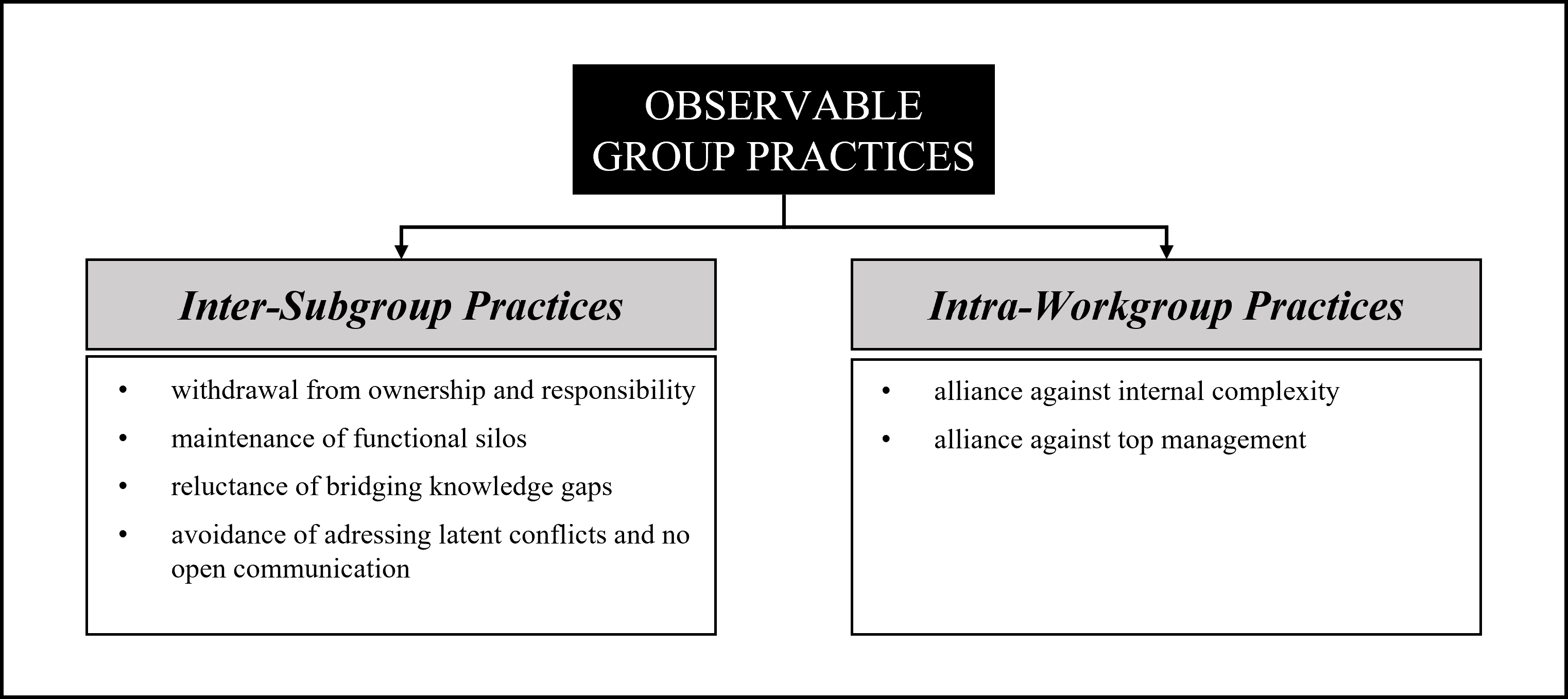
To analyze group dynamics more closely, in the first step, we traced observable group practices. We reconstruct group practices that appeared between the two subgroups (BE and DS), referred to as intra-subgroup practices, as well as practices that emerged within the BDA work team as a whole, labeled intra-workgroup practices. Fig. 1 provides an overview of the identified group practices.
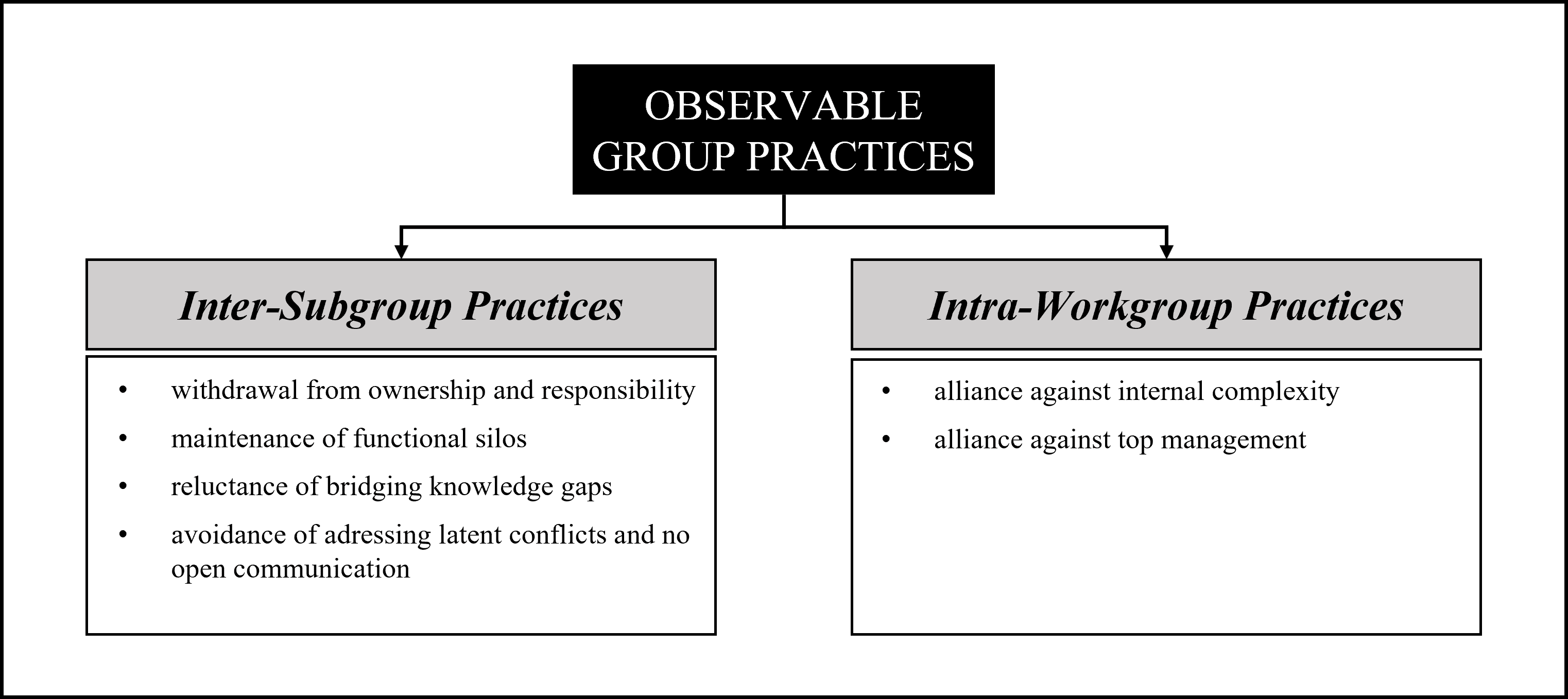 Fig. 1.
Identified group practices.
With respect to inter-subgroup practices, we categorized four distinct practices that appeared throughout the whole project period, which displayed group dynamics between BE and DS that turned out to be an obstacle to the project’s progress: (1) both subgroups refused the responsibility and ownership for the project. Each subgroup held the other responsible. (2) The subgroups were not able or not willing to really constitute a team, but stuck to their functional silos. (3) While both subgroups recognized a mutual lack of knowledge, they did not mitigate it properly. Instead of providing the other subgroup with explanations and information, both complained about the poor understanding of the other subgroup. (4) We frequently could observe that the subgroups talk past each other during their meetings. Instead of addressing latent conflicts such as their mutual unfamiliarity, they avoid discussing them openly. This, not least, led to a massive misunderstanding regarding the use case and development goal for almost 8 months.
These identified inter-subgroup practices obviously showcase distinctive practices occurring between both subgroups. Interestingly, we also found two practices towards unification and alliance formation at the work team level (intra-workgroup practices). This is, on the one hand, their alliance against internal organizational complexity. The work team members aligned to justify a lack of project contribution and progress by referring to complexity, either in terms of the complex organizational structures and processes or in terms of the complex data structure. On the other hand, they alliance against requirements from top management. For example, they stood together when it came to defending against the changing priorities or misplaced expectations of management.
Subsequently, we detail the observed practices. The described practices in subsections 4.1.1 to 4.1.4 refer to inter-subgroup practices between BE and DS, while the subsections 4.1.5 and 4.1.6 detail intra-workgroup practices at the BDA work team level.
BDA adoption responsibility was refused by both subgroups. BE saw DS as being in charge and vice versa, and both pushed the responsibility onto the others. BE argues that BDA is a ‘delivery obligation’ from DS: “Data science cuts across all departments. It’s the duty of data science to show each department how they can work with data science” (D5). During the BDA project, BE complained that DS did not take the lead to help them understand their work: “It would have been desirable that data science went more into detail concerning the techniques they used instead of saying ‘yes, we have tested that and here is the output’” (B3). Conversely, DS viewed BDA as a ‘collecting obligation’ from BE, as reflected, for example, in this statement: “The business users sometimes don’t ask, and then they just say ‘ah, and why didn’t we know?’” (D2). DS assumed that offering the opportunity to ask questions would disentangle them from any further steering responsibility. However, in the light of insufficient DS knowledge among BE, this did not work out.
This attitude led to both subgroups lacking ownership during the BDA project—BE with regard to functional ownership and DS with regard to process ownership. BE thus missed an opportunity to define proper project objectives. In March 2020, the intention was to onboard 30 suppliers to CAT by the end of 2020. This KPI changed several times during the project and was still unspecified in December 2020. Furthermore, the expected benefit of CAT was not quantified in the beginning (i.e., time savings) and was still not clear during the testing phase. Moreover, the designated future CAT users changed during the project. B3 asked in August 2020: “In general, who is supposed to use this tool?” (B3). In the beginning, the content onboarding team was supposed to be the primary user of the tool. Eventually, in Q4 2020, the technical editors were selected to utilize CAT. Furthermore, BE did not know “where CAT is supposed to be integrated into the overall system landscape” (B1). B1 criticized: “A vision here wouldn’t be bad – I’m looking at you.” (B1). BE was aware of its lack of ownership and described itself as “target-seeking” (B2).
Conversely, DS did not take over process ownership and did not guide BE through the project. “Is it our business as a data science team to know who decides what, when, and how?” D2 asked. This would, however, have been expected of BE: “I think in a four-hour workshop we would have saved months of work by really taking care of how they [DS] think they can go about it” (B3).
Neither subgroup categorized themselves as being members of one project team, but rather remained in their functional silos by referring to their respective subgroups. For example, DS explicitly excluded BE from selected project phases by referring to their expertise. With respect to the model development, BE claimed that this is “something which we completely do on our own” (P5). They only exchanged information punctually without utilizing the same organizational or technical collaboration standards. B8 confirmed: “We are silos, that means data science is data science and they just have very few contact persons on the business side who are really interested in their work; they just want to see results” (B8). This stance was emphasized by both subgroups working according to Scrum agile project management method; however, they did not harmonize their Scrum planning. B3 complained: “It’s about the fundamentals. We’re used to planning our work before we do it; both teams follow Scrum. When we work together, we don’t do this planning together because both sides think it will work out anyway.” (B3). Moreover, DS used Confluence (a digital collaboration tool) for their internal exchange but did not invite BE to join the CAT-related working space: “We have a data science Confluence space, not a CAT space” (D2).
Both subgroups recognized their mutual lack of knowledge in the other field, but did not try to mitigate it properly. This became obvious, for example, during the data identification phase. B3 stated: “Our data model was not well known [by DS]. The answer to my question as to which data is needed was ‘ideally everything’. I had to take a glance into the crystal ball, which data might be useful” (B3). However, B3 did not take proper action to jointly identify the right data with the DS team members. The same is true for the lack of understanding of the BE problem among DS (“It repeats itself over and over again; they [DS] lack an understanding of our problem” (B3)), which was, however, not properly clarified despite the knowledge of the problem. B6 admitted having a poor understanding of DS methods and compares the random forest model, which was used as a classification algorithm, to “a rainforest in which everybody got lost” (B6). DS frequently offered to answer questions; BE, however, was not able to pose the right questions, which DS interpreted as ignorance by DS. This became apparent in almost all bi-weekly meetings, which were established in August 2020 to enhance transparency. D2, moderating these meetings, explained that he felt like a “solo entertainer” (D2).
During the bi-weekly update meetings, both subgroups avoided addressing latent conflicts themselves, such as their mutual unfamiliarity. An open discourse about latent tensions or disputes could only be stimulated during the group discussions that the field researcher led after one of the satisfaction surveys. “It’s nice when everyone speaks openly, but sometimes I had the feeling that people don’t speak so openly in other meetings” (D2). As a result, in November 2020, it turned out that there had been a massive misunderstanding between the subgroups for the past eight months. During testing, where BE had access to CAT for the first time, it became clear to them that DS built models and algorithms to foster only use case 1 (labeled data). However, BE realized that their major interest would have been the implementation of use case 2, that is, the matching of unlabeled data, which was supposed to deliver more business value. D1 stated: “When they [BE] saw the first results in the front end, they said ‘no, we want to see unlabeled data’, and that, from our perspective, is completely different” (D1). This incident led to huge dissatisfaction, especially among BE, which came to light in the second satisfaction survey panel. However, among the BDA work group members, nobody was able to provide a clear explanation for this confusion. “I think it was a misunderstanding. But it could also be that too little was agreed on the use cases …” (B1). Simply put, the two subgroups did not assign the same value to the syllable ‘un’, which differentiates the two use cases of classifying either labeled or unlabeled data. Due to the lack of communication and knowledge, this misunderstanding could not be uncovered in a timely manner. D1 assumes that “maybe they understood that if I do this [labeled data], the other thing [unlabeled data] is automatically done or something … I don’t know”. Moreover, since BE “had nothing to do with the models” (B3), the lack of involvement in this phase also fueled this misunderstanding.
Even though the four described inter-subgroup practices point to distinctive subgroup practices, we could also identify two group practices that indicate the constitution of a superordinate group. Both subgroups allied against external factors on the organizational level.
Referring to demands from the organization’s side, both subgroups jointly excuse the lack of project contribution and progress by referring to organizational complexity aspects. The mentioned complexity refers to ToolCo’s complex structures and processes, strongly associated with and mirrored by the complex process and data structures. D2, for example, expresses: “ToolCo is a very complex company, especially the structures – how they organize catalogs and such, that’s quite complicated. […] This is why I think it is important to take some time to work through it and figure things out”. D4 adds that “Our data is a huge problem, it is really complex, and so are the data relations”. This perspective is also shared by BE. B4 argues that “it’ s not quite as transparent as one might expect”. A short conversation in a team meeting between a member of BE and DS aptly reflects this alliance: B4 stats that “the moment it will be fixed, I’ll light a candle” and D4 responds to it with “Haha okay, then we’ll through a party”. Throughout the project conversations, it becomes obvious that both subgroups unite in the assessment that interdisciplinary collaboration is hampered by the structural complexity, and the lack of model accuracy is traced back to these complex data structures instead of reflecting on other factors that may have led to unsatisfying project progress.
Another external factor against which both subgroups united was the demands and expectations from ToolCo’s top management. This practice emerged in three ways: First, both subgroups complained about changing strategic priorities that led to an insecure project environment: “If they [top management] say next quarter ‘thank you for your time, let’s stop here’, we will stop it [CAT]” (D5). Second, both subgroups criticized false expectations on the board level: “That is our biggest problem. I think we know exactly what is realistic, but the level above … they imagine it to be easier” (B1). Third, both subgroups did not mention their tense collaboration in the presence of board members, but sold their joint project as successful. D2 stated at the official handover: “It was a great collaboration between the data science and the content team” (D2).
Having outlined the observable group practices we could reveal during the BDA adoption project at ToolCo, in a second step, we trace our empirical material for more subtle themes that could help explain these group practices. Thus, this section focuses on underlying dispositions, providing potential indications and explanations for the described group practices. It became evident that both subgroups ascribe fundamental differences to each other, as aptly expressed in this statement: “We’re just two worlds colliding. It is inevitable that there are different views” (B3). Throughout the material, we could reveal four latent themes, with each subgroup displaying distinct, to some extent, opposing dispositions. These (pre)conscious themes relate to (1) value orientation, (2) understanding of teamwork, (3) working focus, and (4) mode of thought and expression. We interpret these latent themes as specific subgroup identities and habitual schemes that underlie and guide the observable group practices. In addition to these habitual dispositions toward identity and boundary work, we also revealed differences in symbolic positioning that reflected latent power asymmetries. These asymmetries were not formally assigned, but enacted through the ways each subgroup framed expertise, justified decisions, and claimed legitimacy during moments of conflict or ambiguity (see subsection 4.2.5).
The value orientation concerns the subgroups’ understanding of why BDA should be conducted. We found indications that BE was mainly driven by business impact, whereas DS primarily focused on the ‘art’ of their profession. B1 summarized the business need behind CAT: “We have to become faster and have to save internal resources. With CAT, we will manage to access data faster, easier, better, and more validly.” (B1). In line with this, B3 criticized the lack of business orientation of DS: “I missed that, to show what came out of it, a real product demo, use cases, what is the added business value” (B3). B5 explained the necessity of business value in general: “There are some [business] teams who need to collaborate, so the data science input will make them successful. If you don’t have a KPI [Key Performance Indicator] in your department, which is going to make you successful because of working together with data science, you have no motivation to deliver” (B5).
In contrast to this clearly business impact-driven stance, DS does not have business objectives in mind in the first place, but is primarily oriented toward the scientific value of their work. D2 states: “Our way of working is cutting edge – the methods behind it, especially semantic analysis” (D2). Making a distinction, D5 emphasized that BE does not value scientifically sophisticated data science: “In the business world, when the teams need results, they’re not interested in academic data science” (D5).
As for the understanding of teamwork, it revealed that both subgroups have different subgroup-specific understandings and assumptions. While BE has a rather collaborative understanding of teamwork, DS refers to a more cooperative approach to interaction within the BDA work team. Working collaboratively is characterized as a “relationship with a common vision to create a common project organization with a commonly defined structure and a new and jointly developed project culture, based on trust and transparency; with the goal to jointly maximize the value […] by solving problems mutually through interactive processes, which are planned together, and by sharing responsibilities, risk, and rewards” (Schöttle et al, 2014, p. 1275). Conversely, cooperation is characterized by a separate project organization with independent structures, a control-based culture, and independently solved problems (Schöttle et al, 2014).
We found several indicators pointing toward the collaborative approach of BE. For example, B8 emphasized the need for a common vision: “We must create acceptance [for BDA] together, also in a bigger organizational context” (B9). Furthermore, BE installed a key user role specifically for CAT to establish a well-functioning project organization. B1 stated: “The fact that we have created our own role as a bridgehead shows how important the topic is to us and how important we also consider communication and collaboration” (B1). Moreover, transparency was highly valued among BE: “Transparency is really important to me – what is done by whom and when” (B3). In line with this claim for cooperation, BE opted for a bi-weekly update to secure regular exchange. Lastly, BE asked for a higher degree of joint work, and B1 articulated it as follows: “What could be intensified is that we actually do more together” (B1).
In contrast, DS’s independence with regard to structures and problem-solving became obvious at several points during the project. D5 clarifies the effort estimation process: “We tell them [BE] that they don’t estimate, our team estimates. You can tell us what you want, but don’t tell us how much time it’ll take.” (D5). Furthermore, DS preferred their own isolated collaboration tools (see inter-subgroup practice 2 “Maintaining Functional Silos”). In contrast to the BE’s request for regular exchange and transparency, DS preferred ad hoc exchanges to clarify primarily technical issues. “Questions only come ad hoc. The scientist sits there, does that, and then has a question” (D2). In this vein, the key user’s availability led to satisfaction: “I am happy. Whenever I have a question, he always tries to clarify, he always tries to be prompt” (D3). Lastly, highlighting the controlled-based culture, DS planned to monitor the utilization of CAT via Google Analytics, something the BE side was not informed about: “We are going to set up usage analytics for CAT. Why? When new requirements come up, this gives us a basis to go ‘okay, we don’t see any usage of that … so it does not make sense to invest more effort and money into it’” (D1).
The third latent disposition refers to the working focus. It concerns the subgroups’ primary center of reference during their work. We could extract that BE is more solution-focused, whereas DS is more problem-focused. BE’s solution focus, for example, was expressed through the quest for a pragmatic solution that can be applied quickly. The conversation between BE and DS during the handover meeting to top management exemplifies the different stances. DS frequently emphasized the remaining challenges in the CAT project due to ToolCo’s internal data structure: “I think that came out a couple of times: There are real challenges here, and these are due to the data – we just want to show that again” (D2). B6 responded: “Solution-focused communication versus problem-focused communication: We have to communicate in a solution-oriented manner, highlighting what really works” (B6).
The subgroups’ modes of thought and expression refer to characteristics of intellectual and verbal appearances. We found that BE is characterized by a rather complexity-reducing, and DS by a more precise mode of thought and expression. BE’s orientation toward simplification and complexity-reducing was manifested, on the one hand, in the desire for intelligible, summarizing, and application-oriented explanations from DS (“Let’s not go into depth here” (B7)). On the other hand, simplicity in terms of ease of use of CAT was also a major concern: “I just hope that you simply throw the data in the tool and the right things come out” (B5).
In contrast, DS tends to utilize a rather fact-oriented, detailed, and accurate attitude: “We will not use an ensemble model but will refer to either a LogReg or a Random Forest” (D2). BE frequently criticized this use of language: “My point of criticism: There was a technical deep dive about data sources, how they were merged, statistical models, logarithmic regressions, normal distribution” (B8). Even though DS acknowledged that “sometimes it is hard to explain” (D2), BE complains that “at some point, data scientists turned off and led us into the rainforest where we couldn’t understand anything” (B1).
Summarizing, we can distinguish different, almost contradictory patterns of perception, thought, and appreciation, pointing to different group habitus that drive group practices. They mirror different ways of perceiving the world. Nevertheless, when these “two worlds collide” (B3), troubles and misunderstandings may arise. Table 6 compiles our findings regarding the subgroups’ habitual dispositions.
| Dimension | Manifestation BE | Manifestation DS |
| 1. Value orientation | Business impact | ‘Art’ of DS |
| What is the subgroup’s primary understanding of why BDA should be conducted? | (Quantifiable) business value | Quality of data science applications (i.e., scientific approach) |
| 2. Perception of BDA adoption responsibility | Push from DS | Pull from BE |
| Who is perceived to be in charge of BDA adoption within the organization? | BDA as debt to be brought into the organization by data science | BDA as debt to be collected from BE |
| 3. Understanding of teamwork | Collaborative | Cooperative |
| What is the subgroup’s favored form of teamwork? | Common vision and project organization, project culture based on trust, joint value maximization, joint problem solving | Separated project organization, independent structures, project culture based on control, independent work to maximize value |
| 4. Working orientation | Solutions | Problems |
| What is the subgroup’s primary center of reference during their work? | Pragmatic solutions, Pareto principle, quick application | Full-fledged solution, focus on the last 20 percent |
| 5. Mode of thought and expression | Simplicity | Precision |
| What characterizes the subgroups’ intellectual and verbal appearances? | Intelligible, summarizing, application-oriented | Fact-oriented, detailed, accurate |
Besides the subgroups’ distinct habitual dispositions, we could uncover differences in symbolic positioning that reflected latent power asymmetries. Power positioning was enacted through the ways each subgroup framed expertise, justified decisions, and claimed legitimacy during moments of conflict or ambiguity. In general, we found that ToolCo is characterized by a strong power position of the business function, especially the sales department that elevates the position of BE. B8 stated: “Everyone says that the sales department is our first customer. You have to speak to them first. I think that the company is scared of its own sales reps” (B8). The sales department has been the powerhouse for decades and was responsible for ToolCo’s success via personal, non-digital sales. The sales department, therefore, had certain reservations regarding BDA, in particular with respect to potentially losing autonomy and supremacy. Regarding their value orientation, they refer to the general business impact and, in line with that, advocate a collaborative mode of teamwork. In fact, this understanding and claim of collaborative teamwork imply BE’s perceived superior position, as this collaboration should be subordinated to the goal of business impact that they embody. In contrast, DS so far held an inferior power position. They are not only a newly established group within the organizational structure but also quite homogeneous in their composition since all members have similar educational and professional backgrounds. Throughout the BDA project, we identified DS’ tendency to group closure and identity protection, for example, by using scientific language, which BE could only partially understand. Moreover, DS was gatekeeping of important information and explicitly excluded BE from selected project phases. These attitudes and behaviors reflect the ongoing (more or less conscious) power struggles implied in the BDA adoption process.
Our study reveals group dynamics during a BDA project that impeded successful collaboration within the BDA work team and ultimately led to a project outcome that stands behind expectations. Referring to SIT, we could trace observable group practices pointing to in-group – out-group identity constellations that impact group dynamics and the overall performance of the working team. The Bourdieusian theoretical lens provides explanatory approaches for these group dynamics by drawing our attention to more subtle and underlying dispositions (group habitus) as well as to the groups’ positioning within the organizational power relations.
Our observation clearly revealed that within the BDA work team, both BE and DS exhibit group practices that suggest they perceive and identify themselves as distinct subgroups. Moreover, these subgroup practices led to an in-group – out-group constellation within the BDA work team, as described, e.g., by Ashforth and Meal (1989). These dynamics, not least, impeded successful collaboration in the BDA project. The BDA work team members stuck to their subgroup by maintaining their functional silos and mutual gatekeeping of information (see subsections 4.1.1 and 4.1.2). Instead of constituting the BDA working team as one superordinate group by jointly taking over responsibility for BDA adoption in general and the CAT project in particular, a rather competitive relationship emerged, leading to an ‘us-versus-them’ mentality (Ashforth and Mael, 1989; Sidanius, 1999). Both subgroups frequently complain about the deficiencies and ignorance of the others, thereby implicitly devaluing the respective out-group. This behavioral pattern is, for example, reflected in their mutual blaming rather than addressing knowledge gaps or fostering a commonly shared understanding (see subsections 4.1.3 and 4.1.4).
Interestingly, this in-group – out-group relationship is carried out mainly within the BDA work team level. When the BDA work team is confronted with organizational pressure in terms of demands and expectations, the subgroups unite symbolically into one superordinate group. This pattern became visible when the BDA project team as a whole was confronted with top management demands. In such situations, the subgroups aligned symbolically and temporarily merged into a superordinate identity (see subsections 4.1.5 and 4.1.6). This reflects what Turner describes as contextual identity salience (Turner et al, 1987), where the level of self-definition shifts in response to situational cues. From a SIT perspective, such identity realignment can be interpreted as a functional response to external threat, in line with the “common ingroup identity model” (Gaertner et al, 1993), which suggests that intergroup boundaries may soften when a shared group identity becomes more salient.
The observed intra-workgroup practices can be interpreted as impeding practices with regard to the project, as these practices mainly aim at excusing and concealing a lack in the project’s progress. To a certain degree, the subgroups’ allied practices, i.e., allying against the top management and ToolCo’s internal complexity, are aimed at covering up the lack of project advancement and safeguarding against criticism. Although these practices cannot be described as supportive in the sense of project success, they indicate that there is a common denominator between the subgroups that becomes particularly salient in moments of group-external pressure.
Referring to Bourdieu’s concepts of group habitus and field, we can uncover potential driving forces that provide explanatory avenues to a deeper understanding of why the observable group practices emerge in the way they do. Our findings suggest that BE and DS show different social practices driven by distinct subgroup habitual dispositions. We suppose that these different attitudes, described in section 4.2, are rooted in past work-related experiences and their current organizational position. During education and work experiences, context-specific taken-for-granted assumptions become increasingly internalized and thus part of the group habitus and identity. Specifically, we presume that value orientation, working focus, and mode of thought and expression (see section 4.2) are considerably shaped by socialization processes within the respective work domains. In the case of DS, we suppose that their similar educational background has a strong imprinting effect on their habitual disposition. In contrast, while BE members have different educational backgrounds, we assume that their habitus is strongly affected by the organizational identity in general, due to their strong position within the company. This could explain why BE is more impact-oriented and often utilizes an instrumental focus, while DS has a more scientific orientation and is, therefore, more focused on methodical rigor.
To this end, the identified group practices are also expressions of the (sub)groups’ position within the organizational hierarchy, emphasizing the power dimension and the reciprocal relationship between the individual and organizational levels. As described in subsection 4.2.5, BE claim a strong power position within the company. Consequently, BE tried to defend its power position during ToolCo’s effort to transform into a data-driven organization. Their positioning is not least inscribed in BE’s dispositions that are tightly linked to a comprehensive business-centered attitude. Thereby, BE implicitly claims its perspective as the legitimate overarching perspective and thereby also subordinates DS under its interpretive predominance. Conversely, DS, as a newly established expert group within the company, held an inferior power position thus far. During the BDA project, they acted (pre-)consciously driven by their group habitus, which was, to a certain extent, more pronounced than that of the BE subgroup. However, their group practices can also be interpreted as an attempt to secure and enhance their own position and to gain legitimacy within the organization. To protect themselves against potential denials and appropriations from BE (e.g., lacking acceptance of their solutions and not recognizing them as equal partners), they built a kind of a ‘social cocoon’ (Anand et al, 2004; Ashforth and Anand, 2003; Greil and Rudy, 1984; Pratt, 2000) around their subgroup (even though not that severe or ideologically loaded as described in the literature). This ‘cocooning’ strategy by DS can be interpreted as an attempt to defend their group identity and increase the subgroups’ own power position. Our findings reveal that everyday practices such as cocooning or the assertion of interpretive authority can be understood as expressions of group-level dispositions and symbolic power struggles. These practices are not merely strategic or rationalized, but reflect deeper, habituated orientations shaped by organizational positioning. As Sieweke (2014) points out, this type of latent dispositions becomes empirically visible through patterned practices that reveal how actors navigate symbolic boundaries and legitimacy claims. In line with his interpretation, our study shows how symbolic struggles unfold through routinized interactional moves rather than explicit conflict. For instance, technical gatekeeping or withdrawal from negotiation can be read as practical enactments of group habitus and field-specific positioning. The respective group practices reflecting different (more or less conscious) strategies in the ongoing power struggles implied in the BDA adoption process, not least, led to unsatisfying alignment and collaboration during the CAT project. Consequently, both subgroups were only partially able to converge, living in two different worlds, unable to really understand the other group’s perception and approach. As such, both subgroups remained in their functional silos during their interaction. Rather than viewing group tensions as mere communication breakdowns or conflicting work styles, we derive that the structural positioning within the organizational hierarchy influences group dynamics. BE as the established group, seeks to maintain its dominance while the emerging group of DS employs legitimizing and protective strategies, such as information gatekeeping or functional siloing, to navigate their precarious status.
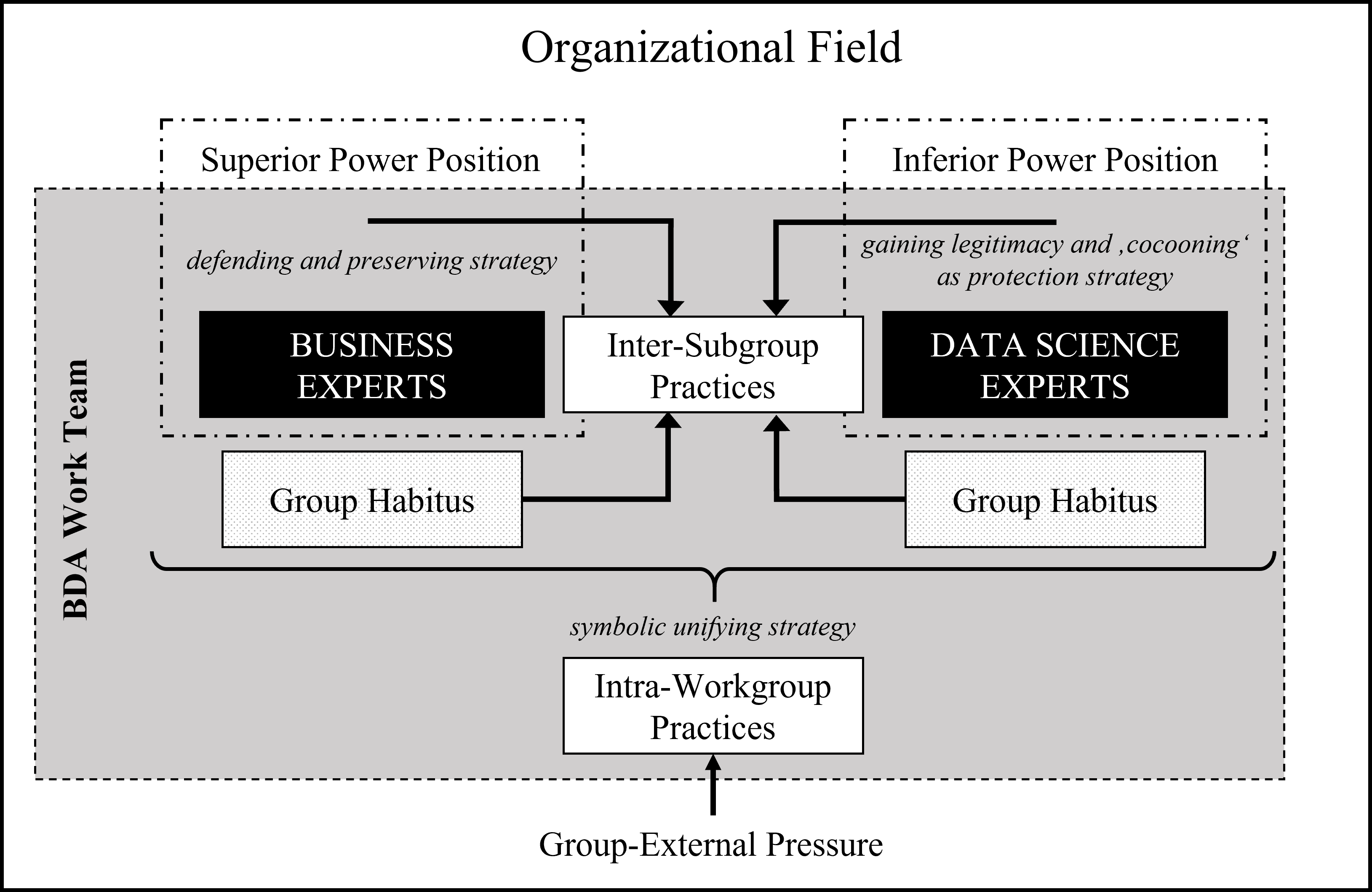
Fig. 2 illustrates our compiled findings on group dynamics during the BDA project, by visualizing the relationship between latent group dispositions, power positions, and observed group practices (upper part of the figure). Inter-subgroup practices can be understood as emerging from two underlying forces: the respective group habitus and the symbolic power positions of BE and DS within the organization. While the subgroups’ power position is associated with different strategies—BE aims at defending and preserving its power position, while DS aims at gaining legitimacy and relies on ‘social cocooning’ as a protection strategy—the divergent group habitus shape the concrete practices between both subgroups. At the same time, external pressure, particularly from top management and organizational complexity, triggers a symbolic unification (lower part of the figure). Both subgroups temporarily ally, exhibiting joint intra-workgroup practices to deflect criticism or conceal insufficient project progress. Together, these group dynamics illustrate how data-driven collaboration is shaped not only by functional differentiation but also by deeply ingrained dispositions and symbolic asymmetries, making group habitus and power relations key drivers of group dynamics in the BDA adoption setting.
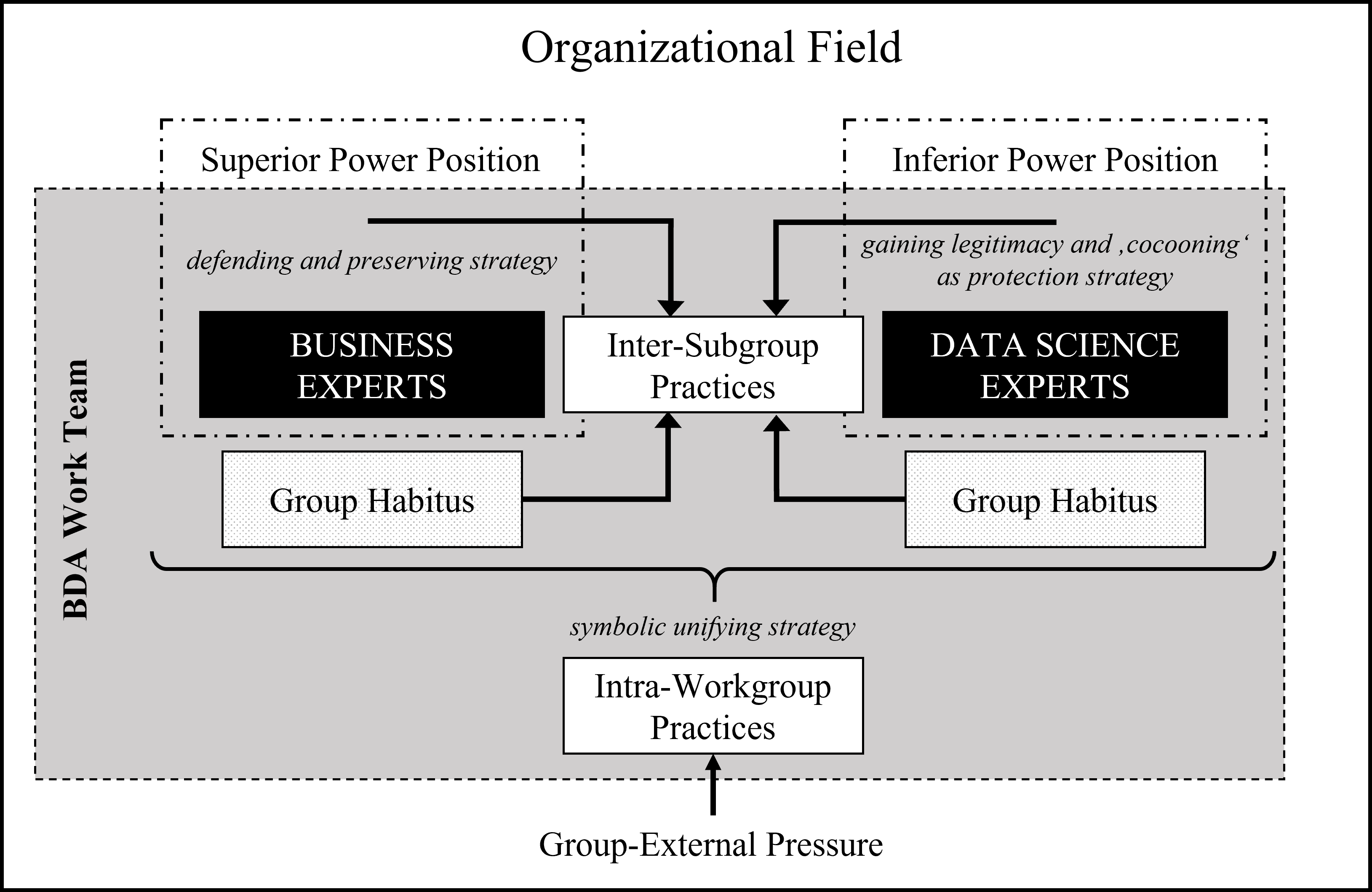 Fig. 2.
Group dynamics during the BDA project.
In an era where digital technologies are evolving at an unprecedented pace, organizations must continuously adapt to remain competitive. BDA has emerged as a key driver of digital transformation, enabling businesses to process vast amounts of data and leverage advanced analytics for strategic decision-making. While the adoption of BDA offers substantial opportunities for innovation and efficiency, it also presents significant challenges, particularly at the organizational group level. Beyond technical implementation, BDA adoption requires intensive interdisciplinary and cross-functional collaboration, especially between BE and DS. Both groups are supposed to claim equal relevance for BDA adoption and are actively engaged in co-developing BDA solutions that align with business objectives, making their cooperation a crucial success factor. However, despite its importance, the social dynamics within such cross-functional teams remain underexplored, and existing research primarily focuses either on the organizational or individual level of BDA adoption.
To address this gap, our study investigates the group dynamics that emerge during a BDA project and provides explanatory avenues for these group dynamics. We conducted an interpretive in-depth case study of an international manufacturing and retail company. Focusing on a BDA project aimed at developing a machine learning tool for content automation, we closely examined the interplay between BE and DS at both a conscious and preconscious level. By analyzing project flow, identifying group practices, revealing habitual dispositions, and uncovering underlying power relations, we aimed to contribute to a deeper understanding of emerging group dynamics within organizations in the context of digital transformation.
Our findings reveal two key dimensions of group dynamics: observable group practices and latent underlying habitual dispositions and power relations. One major point of friction in the project arose from misunderstandings about the classification of labeled versus unlabeled data, which became a central manifestation of deeper social conflicts. Within the BDA work team, subgroups formed a distinct in-group – out-group dynamic, characterized by a lack of ownership, functional siloing, reluctance to bridge knowledge gaps, and avoidance of latent conflicts. However, despite these inter-subgroup practices, the work team as a whole developed a united front against external organizational demands, collectively insulating itself from broader influences. Our analysis highlights deeper structures of group habitus and power dynamics that provide explanations for the observed group practices. The subgroups exhibited almost opposing schemes in perceptions, thought processes, and value orientations, and how they defined BDA responsibilities, teamwork, and communication styles. These differences led to persistent tensions that shaped collaboration within the team. However, the way both subgroups behave and interact also reflects their positioning in the power relations and points to a symbolic power struggle. The established BE subgroup sought to maintain its dominant position, while the DS subgroup, as a new organizational actor, occupied a precarious position and aimed for legitimacy. In response, the DS subgroup adopted a defensive strategy, which we conceptualize as ‘social cocooning’—a protective strategy to shield themselves from external pressures and power imbalances.
By integrating both explicit group practices as well as underlying habitual dispositions and power structures, our study provides a nuanced understanding of group dynamics in the context of BDA projects. The findings illustrate how habitual dispositions, group identities, and organizational hierarchies collectively shape group dynamics, influencing both collaboration and conflict. These insights contribute to a deeper comprehension of the challenges organizations face when integrating BDA in particular and implementing digital transformation in general, emphasizing the need to consider not only technical implementation but also the social and structural dynamics that shape digital technology-induced transformation processes at the group level, not least playing a pivotal role in determining success.
This study contributes to research on group dynamics in organizations by shedding light on the intricate interplay between group identities, habitual dispositions, and power relations within interdisciplinary and cross-functional teams. While prior research has explored group dynamics primarily in the context of leadership (Barnett and Weidenfeller, 2016; Hoyt et al, 2006; Wolman, 1956), team performance (Kozlowski and Ilgen, 2006; Oyefusi, 2022; Priesemuth et al, 2013), and interdepartmental collaboration (Aime et al, 2014; Holland et al, 2000; Vad Baunsgaard and Clegg, 2013), our study extends this discourse by emphasizing the role of group habitus and power struggles in shaping intra-organizational relationships.
By integrating SIT and Bourdieu’s theory of practice, we offer a comprehensive perspective that captures both the conscious dimension of group dynamics with respect to group construction and group practices and the latent dimension of the group’s habitual dispositions. Our findings demonstrate that organizational subgroups exhibit distinctive group habitus, which not only informs their perception of tasks and responsibilities but also influences their interaction patterns and willingness to collaborate. These habitual dispositions shape how groups communicate, align their objectives, and negotiate their positions within the organization.
Furthermore, our study highlights how power dynamics within organizations manifest at the group level. By identifying habitual distinctions and power struggles as key determinants of group behavior, this study advances our theoretical understanding of how group dynamics contribute to (or impede) organizational change and innovation. This perspective not only enhances existing theories of group dynamics but also provides a socio-structural lens to understand interdisciplinary and cross-functional collaboration in complex organizational environments (Sieweke, 2014).
Moreover, with our study, we contribute to research on BDA adoption in particular (Boldosova, 2019; Dremel et al, 2020; Gunasekaran et al, 2017) by revealing social occurrences within the BDA work team that may impede BDA adoption and thus business value. We extend our understanding of how organizations, from a social perspective, should proceed/not proceed to extract value from BDA (Côrte-Real et al, 2019), thus addressing related calls for a stronger consideration of social aspects (Jones, 2019; Markus, 2017; Mikalef et al, 2020). Moreover, we suggest that the social occurrences must be considered in light of the organizational surroundings (Galbraith, 2014), as the above-mentioned power relations and the organizational structure are catalysts for habitus-driven practices. Our study indicates that the organizational setting reinforces the group habitus of DS as new organizational actors and, thus, the distinguishing practices between the subgroups. In our case, this organizational setting built an additional trench and fueled the DS’ cocooning tendency. We, therefore, put recommendations regarding a central anchorage of data science teams (Dremel et al, 2017; Schüritz et al, 2017) to the test. Hybrid approaches (Grossman and Siegel, 2014) where coordination is done within a central unit and business-related data science activities within the business units, promise to diminish the distinction, at least from a structural perspective.
We are convinced that our insights are helpful for organizations that adopt BDA, as our insights provide direct points of contact for strategic and operational interventions. Transferring our findings from the group level to practice, it becomes obvious that interdisciplinary and cross-functional groups need to be moderated carefully to diminish dysfunctional practices with respect to the success of BDA adoption projects. Therefore, it is important to consider the respective power positions of the subgroups within the organization to downsize struggles for power and position. One possible way would be to place emphasis on the uniting organizational identity that strengthens similarities and reduces differences between the subgroups. The organizational identity may serve as a shared basis for interpretation and sensemaking, and misunderstandings can be diminished. As to concrete measures, a change management program is needed that not only considers the different profiles of the groups but also addresses their individual needs and concerns. Specifically, enabling interventions may help foster mutual understanding. One way forward is mutual competency acquisition: Basic data science competencies can be developed by business through training (i.e., which questions can be answered, what are typical applications, methodological requirements, limits, etc.), and DS need to be enabled toward business, including deeper knowledge regarding operational processes and value drivers, for example, via job shadowing. Moreover, collaboration structures, such as joint processes and collaboration tools, must be provided by the organization and not left to chance.
We acknowledge that our data is derived from only one case, which limits the generalizability of our findings. Especially, in contrast to companies facing the challenge of digital transformation (Vial, 2019; Wessel et al, 2021) we expect different practices within born-digital organizations, where a higher level of data-related competencies can be expected, making business and data science less distinct. Here, a deduction of best practices would be fruitful. Furthermore, incorporating the effects of different organizational settings on the practices may be promising. Moreover, by mainly focusing our analyses on potentially challenging group practices, we may have paid little attention to supporting practices that may occur during BDA adoption. Finally, while focusing on group habitus, individual differences in personality and behavior, and intra-subgroup dynamics are potentially underestimated influences. Consequently, we encourage future studies that deal with the social aspects of digital transformation and technology adoption.
In closing, we found that BDA adoption appears as a complex interplay between subgroups’ habitual dispositions and their position within the organization’s power relations, which potentially sparks conflict-laden group dynamics. To derive value from BDA, organizations must address not only data-related, procedural, or management challenges during adoption but also social aspects. That is, the distinctive group identities and habitual dispositions of DS and BE, and the potentially resulting tension-laden interaction practices, have to be addressed. Furthermore, those involved must anticipate that change-induced renegotiations of established organizational hierarchies and power relations might occur. Moreover, organizations must understand how their organizational arrangement interrelates with these social aspects, which may act as a catalyst for social conflicts.
The datasets generated and analyzed during the current study are not publicly available due to confidentiality agreements (NDA), data protection regulations, and the need to preserve participant anonymity, but are available from the corresponding author on reasonable request and subject to appropriate legal and ethical approvals.
JH designed the research study and collected the data. JH and AG analyzed the data. Theoretical framing, conceptual synthesis, and data interpretation were carried out jointly by JH, AG, and TH. All authors contributed to the drafting of the manuscript and to its critical revision for important intellectual content. All authors read and approved the final manuscript. All authors have participated sufficiently in the work and agreed to be accountable for all aspects of the work.
Not applicable.
This research received no external funding.
The authors declare no conflict of interest. As Guest Editor for this special issue, AG had no involvement in the peer review of this article and no access to information regarding its peer review. IMR Press ensured that full responsibility for the editorial process was delegated to the chief editor SJ.
During the preparation of this work the authors used ChatGpt-4.0 in order to check spell and grammar. After using this tool, the authors reviewed and edited the content as needed and took full responsibility for the content of the publication.
See Table 7.
| BE Subgroup | DS Subgroup | |||||
| Survey No. | 1 | 2 | 3 | 1 | 2 | 3 |
| 08/2020, N = 6 | 12/2020, N = 8 | 04/2021, N = 7 | 08/2020, N = 6 | 04/2021, N = 8 | 04/2021, N = 7 | |
| How satisfied are you with the collaboration during CAT? (5 = fully satisfied, 1 = fully unsatisfied) | ||||||
| In your opinion, what has improved since the prior survey, and what do you attribute that to? | N/A | More exchange. | Improved communication due to product owner. | N/A | Understanding of problems improved a lot on both sides. | Transparency on data quality. |
| More transparency due to new product owner role. | More transparency due to first results on user front end. | The scope of the product became clearer. | Understanding of the problem and the related complexity. | |||
| The open discussion of expectations and the current status certainly helped make improvements possible. | Alignment of expectations/developments due to new product owner role. | More interaction with product owner and (key) users. | ||||
| By expressing problems openly, expectations are clear and can be approached. | ||||||
| Which aspects of the collaboration should be further improved in the future? | Common vision. | It feels like data science does not accept our help. Our resources should be accessed more. | Communication in the form of regular reviews (at the end of the sprint). | Let our team spend less time on collecting and classifying data. We would like to spend more time analyzing and taking decisions. | More proactivity from the business side (contact directly via product owner). | Ownership of the problem. |
| Better understanding of data. | Mutual understanding | Further expand coordination at the operational level. | Clear role description for both teams. | User validation and feedback. | ||
| More transparency. | Status updates. | Even clearer and more open into the future. | Product vision. | Active usage of CAT. | ||
| Feedback. | ||||||
| Stabilization of project team. | ||||||
Note: To be considered as flanking data source only, primarily intended to stimulate discourse among the subgroups in the follow-up group discussion.
References
Publisher’s Note: IMR Press stays neutral with regard to jurisdictional claims in published maps and institutional affiliations.