


1 Faculty of Business, Economics and Social Sciences, Helmut-Schmidt-University/University of the Federal Armed Forces Hamburg, 22043 Hamburg, Germany
2 District Office Berlin-Mitte, 13351 Berlin, Germany
3 Faculty of Business, Economics and Social Sciences, University of Hamburg, 20146 Hamburg, Germany
Abstract
New career concepts, such as the Boundaryless Career, have been discussed for decades. In this context, an increasing role for secondary employment or multiple job holding can be expected. This might include some sideline activities or dual employment arrangements as well. The relevant state of research regarding dual employment remains very limited. By means of qualitative research, the structure and dynamics of dual employment careers can be understood and conceptually captured. Quantitative analyses using the German Socio-Economic Panel (GSOEP) for the years 1992 to 2020 provide an overview of some characteristics of dual employment and sideline activities over time. Furthermore, there is potential to identify a coherent pattern of dual employment in the German labour market via sequence pattern analysis. As a result, despite an increase in the number of cases, dual employment careers do not represent a relevant alternative to a professional trajectory oriented towards a main occupation. Dual employment is also unstable over time. However, there is a small cluster that exhibits a stable dual employment pattern. However, income compensation appears to play an important role.
Keywords
- dual employment
- multiple jobs holding
- German Socio-Economic Panel
- career research
- sequence analysis
Individual career paths have changed in recent decades. A development from the classic, traditional career path determined by the company to a self-determined shaping of one’s own career path can be observed (Chudzikowski, 2012; Mirvis and Hall, 1994; Sargent and Domberger, 2007). In addition to the traditional hierarchical upward career steps, sideways (Chudzikowski, 2012: 304; De Vos et al, 2008: 170) and downward steps (Lücke, 2013) as well as interruptions in the career path (Sullivan and Mainiero, 2008) can also be observed. These changes are often initiated by the individual itself (De Vos et al, 2008: 170) and are no longer rare in today’s individual career paths. Furthermore, it can be seen that employed persons increasingly have two or more jobs at the same time (Brenke, 2009; Klinger and Weber, 2017).
The changes and developments of individual career paths are not only reflected in career research and labour market statistics but are also present in media coverage. These changes in the conception of careers are summarized in career research under the phenomenon of the new career and concretized by various new career concepts. Subjective career success is of primary and increasing importance for the analysis of these new career concepts (Arthur, 1996; Arthur et al, 2005; Gunz and Heslin, 2005; Eby et al, 2003; Shen et al, 2015; Verbruggen, 2012). What the new career concepts have in common is that they distance themselves from the idea of the traditional career and do not see the company but the individual itself as their own career manager. In addition to the dominant concepts in career research (cf. Briscoe and Finkelstein, 2009: 243; Sullivan and Baruch, 2009: 1544) of the boundaryless career, the protean career and the kaleidoscope career model (Mainiero and Sullivan, 2006), concepts such as the post-corporate career or the portfolio career (Handy, 1995) contribute to a deeper understanding of individually designed careers. Overall, we can speak of an increasing complexity of careers or career opportunities (cf. Strunk, 2009), which also makes it more difficult to predict careers. It is therefore helpful to look at different career paths or concepts.
In this context, secondary employment or multiple job holding (MJH) respectively deserves attention, which to a certain extent and for a certain duration can form part of careers. There is a certain state of research on secondary employment (see Graf et al, 2019), which is considered to be rather limited (Campion et al, 2020; Campion and Csillag, 2022; Conen and Stein, 2021). Recently, Bhayana et al (2024) have systematically reviewed and identified the range of factors that affect MJH at the individual, occupational, organizational, and environmental levels.
In Germany an increase is generally observed as a trend (Klinger and Weber, 2017). Low hourly wages, part-time work as well as social and tax law thus favour secondary employment (Klinger and Weber, 2017; Grabka and Schröder, 2019). Secondary employment is predominantly interpreted as a facet of the erosion of normal employment relationships in the sense of a “working poor” (Brenke, 2009). In any case, the exercise of a secondary activity in addition to a main activity increases the probability of conflicts between work and family (Webster et al, 2019). Dual employment, which can be a component of modern career paths, is a special case (Schleicher, 2019).
This contribution aims to describe the development of dual employment and sideline work in Germany. A job up to 8 hours weekly is called a sideline job in this analysis. A sideline job of eight or more hours per week is considered to be dual employment. Constellations of more than two jobs simultaneously are not part of the analysis, there are only a few cases observable in Germany.
Here, an increase would be expected over time. Furthermore, is there career pattern of dual employment? The qualitative findings suggest the existence of such a kind of attractive pattern with a certain stability over time, and primarily in younger years of employment.
In the field of career research, there is little evidence (e.g., Olos, 2011; Azevedo, 2014) of why individuals perform two jobs without explicit need. A study by Schleicher (2019) looks at a sample of flight attendants in order to reveal a very specific group of people in the context of career research. While the activity as a flight attendant is a semi-skilled activity, the second job often involves a highly qualified activity. The Self Determination Theory proves to be a suitable framework for this purpose (Deci and Ryan, 2008; Ryan and Deci, 2017). In order to meet different needs, two workplaces are combined with each other, which can satisfy different needs in their combination, if necessary.
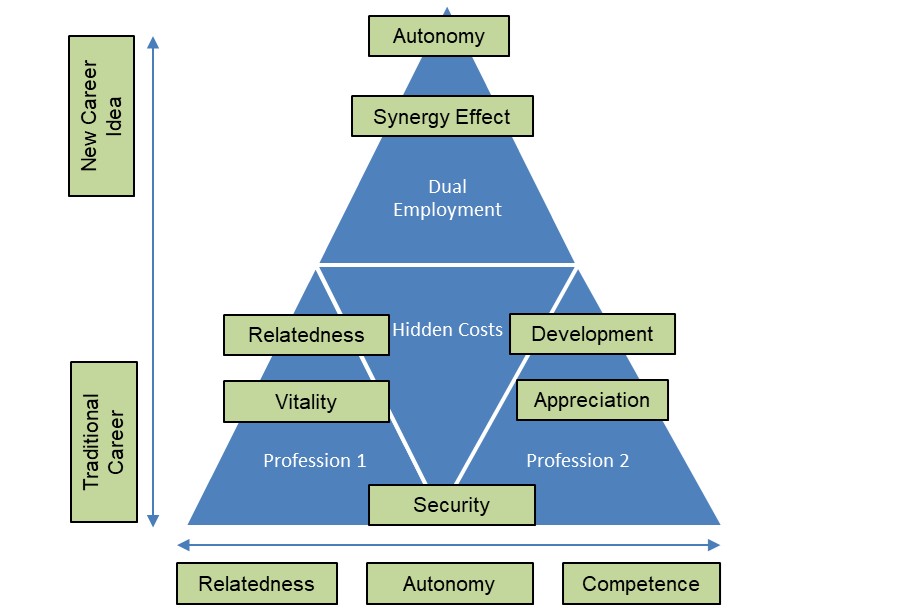
The respective occupation enables both a compensatory and a complementary function in the careers of the interviewees. While the job of a cabin attendant is mainly used to satisfy emotional needs, the lack of opportunities in this job is compensated by the professional second job. Through this combination of very divergent jobs, the interviewees experience a synergy effect, which through working in one profession always provides motivation in the other profession and an experience of autonomy. The perceived independence is particularly explained by the aspect that the interviewees shape and control their own career and are not dependent on a company and the career opportunities there. In addition, both the job as a flight attendant and the further professional activity in their connection to the dual occupation trigger a feeling of security among the interviewees. This perceived security is primarily generated by the feeling of having created a safety net with the second profession. The impression is created that the interviewees choose the best of two different worlds of work and have created a game leg in addition to a firm foothold.
Even if dual employment allows for a high degree of satisfaction of different needs, it has its price. In addition to the existing negative aspects in each of the occupations, the interviewees repeatedly experience the need to justify their particular career choice. By combining them, they also renounce a career in the traditional sense in one of the two professions due to the dual employment. Nevertheless, the positively perceived aspects of the respective jobs as well as the advantages experienced from dual employment, in particular autonomy, outweigh the disadvantages.
The illustration of the career pattern of dual employment by the pyramid (Fig. 1) illustrates the dynamics of employment and motives. For example, a person who is only employed as a flight attendant at a certain time is in a triangle (bottom left). The lack of satisfaction of needs for development etc. leads to the integration of a professional job (a second triangle) into the career. This leads to the double employment with its costs. In everyday life, dual-activity workers also experience the different triangles of the pyramid. The fluctuation of the interviewees between two professional orientations corresponds to a wandering back and forth between the two triangles that represent the respective occupations.
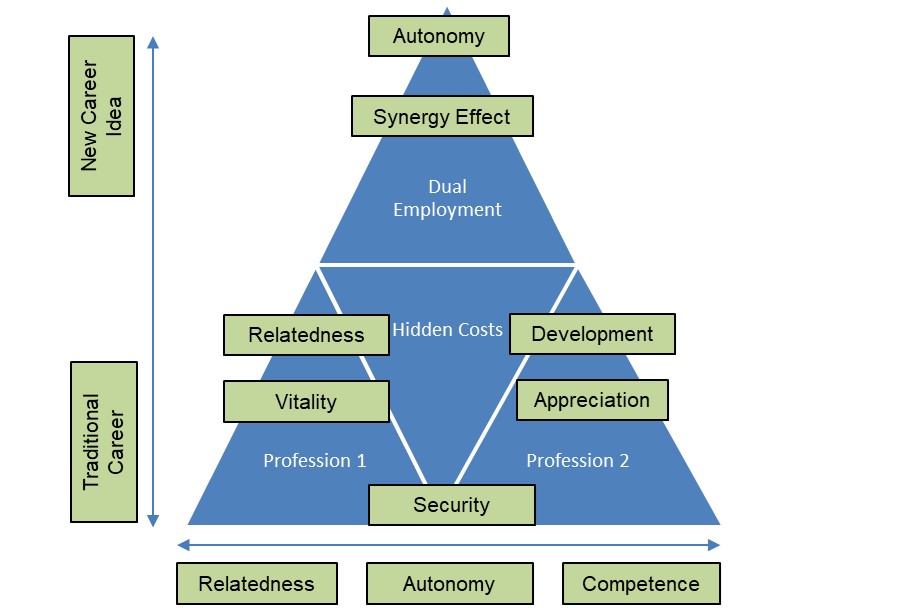 Fig. 1.
The career pattern of dual employment. Own representation based on: Schleicher, 2019, p. 199.
The qualitative findings provide a coherent picture. With the available quantitative surveys, variables such as the underlying motivations and their interaction can hardly be determined. In their study, Campion and Csillag (2022) demonstrate a correlation between motivations and experiences. However, the SOEP offers starting points for discussing central aspects of the career pattern of dual employment.
(1) How has dual employment or sideline work developed? Here, an increase would be expected over time.
(2) Can dual employment be identified as a career pattern? The qualitative findings suggest the existence of such a pattern with a certain stability over time, and primarily in younger years of employment.
German Socio-Economic Panel (GSOEP): The GSOEP is one of the largest and longest-running multidisciplinary household surveys worldwide. Every year, approximately 30,000 people in 15,000 households are interviewed (Goebel et al, 2019). GSOEP is based at German Institute for Economic Research (DIW Berlin) and is funded by the Federal Ministry of Education and Research and the federal states as part of the research infrastructure in Germany under the umbrella of the Leibniz Association (DIW Berlin, 2024). With the help of the GSOEP data1 (1 German Socio-Economic Panel (GSOEP), data for the years 1984–2020, (SOEP-Core, v37, EU Edition), https://www.diw.de/sixcms/detail.php?id=838674, survey period: 1984–2020, publication date: 08.04.2022.), the respondents are attributed statuses over the period 1992 to 2020, which form the basis for the creation of sequence patterns that can be analyzed and clustered, whereby the respondents can be attributed further socio-economic characteristics after clusters in order to characterize the clusters and relate them to certain life situations.
The basic population is defined as those who are full-time employees or part-time employees in their first job, excluding those in marginal employment in their first job. A contrast group is formed by those in employment without a secondary job (Table 1). In the case of a second job, this can be differentiated according to its scope. A job up to 8 hours weekly is called a sideline job. The empirical limit is eight working hours per week. A sideline job of eight or more hours per week is considered to be dual employment. Assisting family members and unpaid voluntary work are not considered.
| First job | Secondary job | No secondary job |
| Working (full time, part time, training) | 1 | 3 |
| Not working (unemployed, student, etc.) | 2 | 4 |
(cf. Hellberger and Schwarze, 1986, 275).
The distinction between a sideline job and dual employment is based primarily on the number of hours worked, but this measure alone may not fully capture the differences between the two. For instance, the eight-hour weekly threshold might not always be appropriate; a sideline job, such as a 10-hour night shift at an elderly care home, could exceed this limit. Similarly, dual employment may be indicated when someone combines regular employment with self-employment to the extent that they qualify for Value added tax (VAT) registration. Given the limited number of observations in our analysis, we opt to use the eight-hour weekly threshold to differentiate between sideline jobs and dual employment.
Sequence Pattern Analysis: In a sequence analysis using the program Stata, the entire event sequence is viewed holistically compared to an event analysis (cf. Jäckle, 2017; Sackmann, 2007). This makes it possible to depict the entire complexity of the path of employment (Czaplicki, 2020). Sequence pattern analysis therefore has the advantage that it is an explorative procedure with which patterns can be uncovered from the existing data material using the socio-economic characteristics mentioned above. There are two ways of studying employment biographies, which are represented by sequence patterns. On the one hand, the sequence patterns can be clustered. The clusters can then be characterized in more detail with the help of socio-economic characteristics. On the other hand, it is possible to group the course of employment according to key characteristics, for example all employment biographies that contain at least one specific characteristic such as full-time employment or unemployment. The corresponding sequence patterns can then be compared in terms of their complexity and characterized or clustered again with the help of socio-economic characteristics.
In the empirical analysis, we proceed as follows: The sample is defined, and the data is processed for sequence pattern analysis. The sample includes the subjects who have responded in each year within the period studied (1992 to 2020) so that a condition can be identified for each measuring point.
The sequences are identified as patterns that allow assignment to comparable groups (clusters). This is done by the Needleman-Wunsch-Algorithm, using the command sqom, full, k (2) (Chao et al, 2022; Brzinsky-Fay et al, 2006).
This calculates the optimal similarity score. The similarity score is a measure of the similarity of two sequences; the higher the score, the more similar the sequences are under the applied scoring model. The algorithm optimizes the score of the alignment. An alignment is a sequence of editing steps to transfer the first sequence into the second. For two sequences, there are many alignments—an optimal alignment has a maximum similarity score.
For cluster analysis, including determining the optimal number of clusters (Henry et al, 2005), the Ward-linkage method is used. Linkage methods check which clusters are the least distant from each other. These clusters are then merged into a new cluster. The Ward method is a variance-based method. The clusters that have the smallest increase in total variance are merged.
The Calinski-Harabasz-Index (CH-Index) can be used to evaluate the resulting model. The CH-Index (ratio of variance criterion) is a measure of how similar an object is to its own cluster (cohesion) compared to other clusters (separation). Here, cohesion is estimated based on the distances from the data points in a cluster to its cluster focus, and the separation is based on the distance of the cluster focal points from the global focus (Khandare and Pawar, 2022).
The clusters are qualitatively characterized. The assignment of the clusters can be used to characterize the members of the clusters according to socio-economic characteristics. In addition, sequence patterns can be represented and discussed that contain a certain state at least once per subject. This makes it intuitively understandable that the complexity and focus of a social situation depend on the existence of these conditions (Papastefanou, 2016): Variability (episode change rate, variance of episode duration), variety (entropy, number of distinct successive subsequences), regularity (number of distinct successive subsequences). Papastefanou (2016) points out the problem that the measures of complexity are correlated differently under otherwise equal conditions of exogenous variables (socio-economic characteristics).
The sequence analysis is used to analyze the secondary employment in the period from 2004 to 2016. Due to an increasing number of missing observations, the length of the analyzed period has to be limited. The analysis includes those cases that have consistently provided information during this period and were also involved in sideline or dual employment at least at one point in time (882 cases). The age group from 20 to 59 years is used in the sequence pattern analyses.
The following characteristics are possible in each year.
If these are arranged in chronological order (2004 to 2016) in relation to the interviewees, the sequence represents a sequence (per person) that represents aspects of the occupational biography. Sequences of identical states within the sequence are called episodes; sequence patterns are sequences of episodes. Sequence patterns can be ordered according to different criteria. Sequence patterns or the distribution of episodes and elements vary according to the characteristics of their carriers. The carriers can be assigned to statistical groups according to sequence patterns, thus clusters are formed. The elements of the clusters differ according to typical sequence patterns.
Sequence analysis is a relatively rarely used method to examine longitudinal data. It considers the life course in its complexity as an ordered sequence of states and enables the holistic processing of various questions. However, this type of analysis of longitudinal data is not without controversy (cf. Levine, 2000; Wu, 2000; Abbott and Tsay, 2000).
The best-known method of sequence analysis is the optimal matching technique (Aisenbrey, 2000: 32), in which sequence patterns are compared on the basis of their similarity. The basic logic behind this method can be described metaphorically with the question, how much modification or manipulation is required to match the sequences of two people (Stegmann et al, 2013: 16).
The cluster analysis reveals structures and relationships between the elements in the data. Like sequence analysis, it belongs to the structure-discovering procedures (Backhaus et al, 2016: 20 ff.). In connection with the optimal matching analysis, hierarchical agglomerative cluster analysis is usually used. Based on Backhaus et al (2016: 457 ff.), the following steps of this cluster analysis can be distinguished: (1) determination of the distances; (2) selection of the fusion algorithm and (3) determination of the number of clusters. The Ward method (1963) became generally accepted as fusion algorithm in the Optimal matching analysis (OMA). This method is considered to be the most suitable instrument for cluster analysis of sequence data (Aisenbrey and Fasang, 2010: 431; Brüderl and Scherer, 2006: 335; Dlouhy and Biemann, 2015: 171). The next task is to find out which group number best reflects the data.
Although the optimal-matching method is criticized, many publications point out that its results can be classified as robust (e.g., Aisenbrey and Fasang, 2010; Biemann and Datta, 2014; Dlouhy and Biemann, 2015). In this context, the Ward method also delivers good results (see ibid.). For these reasons, the present study will rely on the classical methods of sequence analysis: The optimal-matching technique is used to determine the distances between the sequences and the Ward method is used for the subsequent clustering. The empirical results are presented in the following.
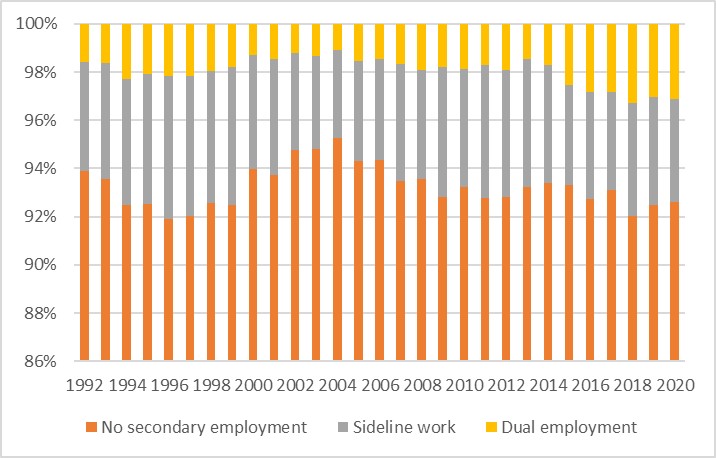
The SOEP has a long period of time available for the development of secondary employment. Throughout this period, sideline work (less than 8 hours weekly) or dual employment (8 and more hours) is a rather rare phenomenon. The number of employees who pursue a secondary job varies between one and two million. After a decline in the 1990s, the number of employees with a side-line job has been growing steadily since 2000. In comparison, dual employment is less common, with significantly less than one million employees actually having two jobs, although a moderate increase seems to have taken place in recent years.
The considerable fluctuations may be attributed to a certain extent to the labour market situation. At least in recent years, the increase in sideline work (less than 8 hours weekly) and dual employment corresponds to the increase in employment opportunities in the German labour market. The conclusion that this expansion is based on a stable trend seems to be obvious (compare, e.g., Schleicher, 2019). However, it is largely based on the selected period of time because a higher and lower level can be observed even before the increase in sideline work and dual employment (Fig. 2). Caution is therefore advisable, even though the development of recent years may indicate an actual increase in this form of employment.
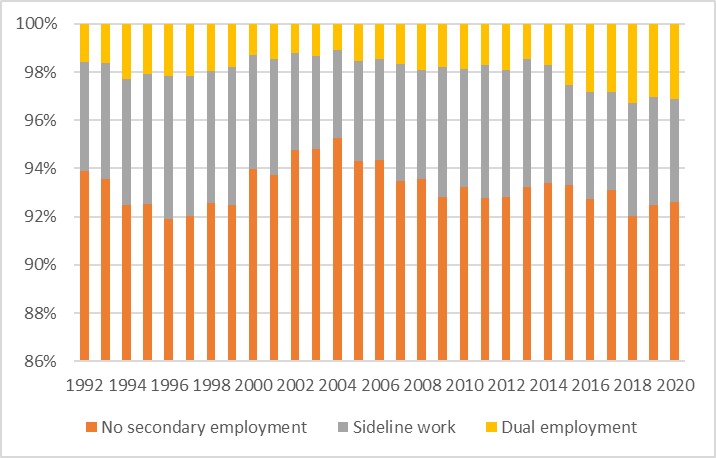 Fig. 2.
Development of multiple job holding by employment type over time from 1992 to 2020. Source: GSOEP, according to own calculations (extrapolated). GSOEP, German Socio-Economic Panel.
According to our calculations, the amount of time spent in secondary employment is quite small. The vast majority of people have only a few hours a week of sideline work. In 2016, 4.6% of employees (full-time or part-time, aged 20–59 years, excluding trainees, excluding marginally employed persons) will be working up to eight hours a week extra. Dual employment (with eight or more hours a week) is rare and usually remote from a more comprehensive working time such as 20 hours a week. Only 2.6% of those concerned are in dual employment. Working hours that do not significantly exceed eight hours per week are also predominate.
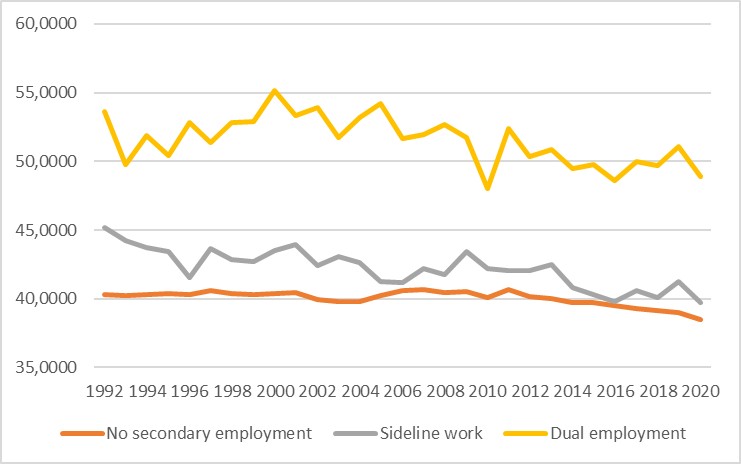
The reported working hours of dual employment are around 50 hours per week over the entire period under review, although they appear to have decreased slightly over the last ten years (Fig. 3). In comparison, the number of employees without a second job differs significantly with about 40 hours per week, which has also fallen slightly during the last ten years. As expected, employees with a sideline activity are in between, although the total working hours here also tend to decrease slightly. As a result, dual employment differs considerably from the other employment types.
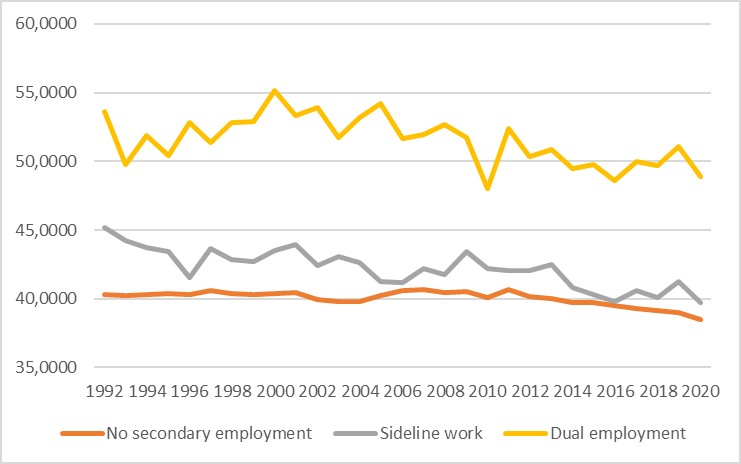 Fig. 3.
Development of real weekly working hours of multiple job holding by employment type over time from 1992 to 2020. Working hours: Sum of the respective actual weekly working hours. Source: GSOEP, according to own calculations (extrapolated).
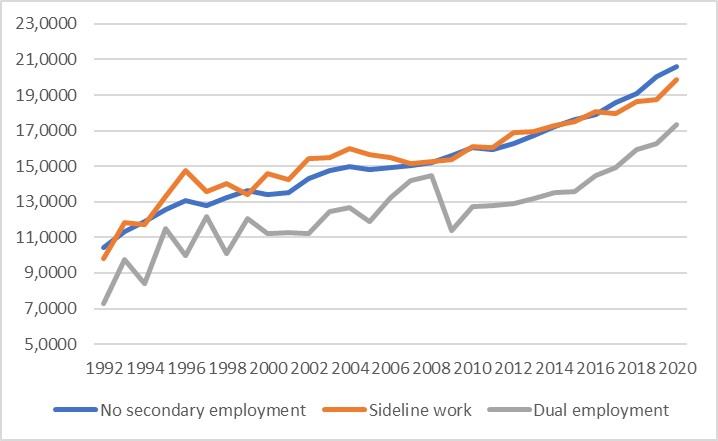
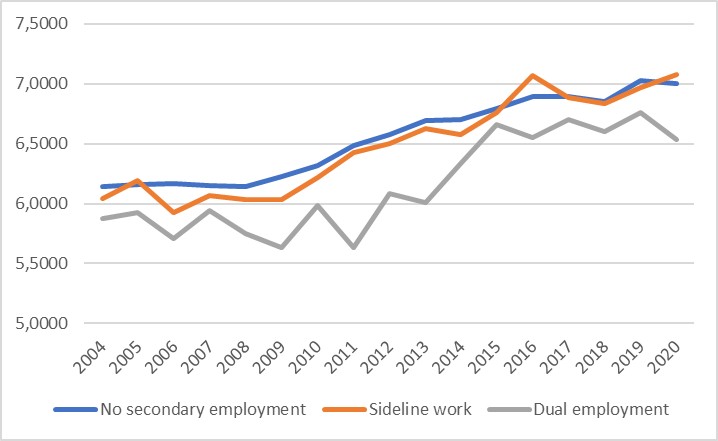
This difference is also evident in income, which is measured by the gross hourly wage calculated. Over the entire period, there was an increase in nominal wages for all three subgroups, which was significantly lower when inflation was taken into account. Dual workers have a lower hourly wage over the entire period (Fig. 4). Consequently, satisfaction with income during the available period under review (2004–2020) is also slightly lower than in the comparison groups (Fig. 5). The effect on job satisfaction, which is not shown here, is negligible (Appendix Fig. 8).
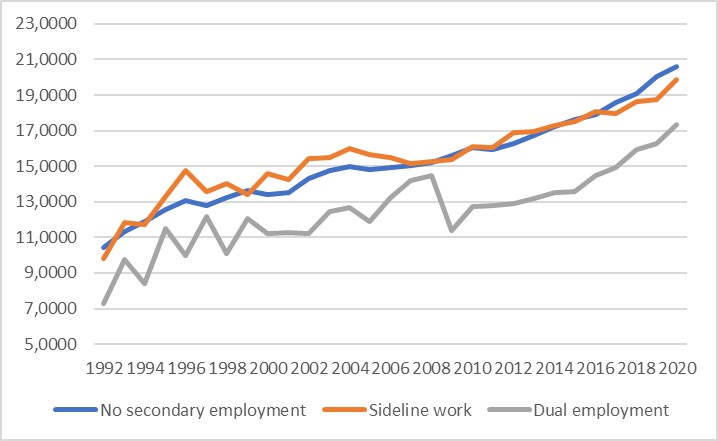 Fig. 4.
Development of hourly wage of multiple job holding by employment type over time from 1992 to 2020. Hourly Wage: Gross wage from main job plus average weekly pay divided by weekly working hours. Source: GSOEP, according to own calculations (extrapolated).
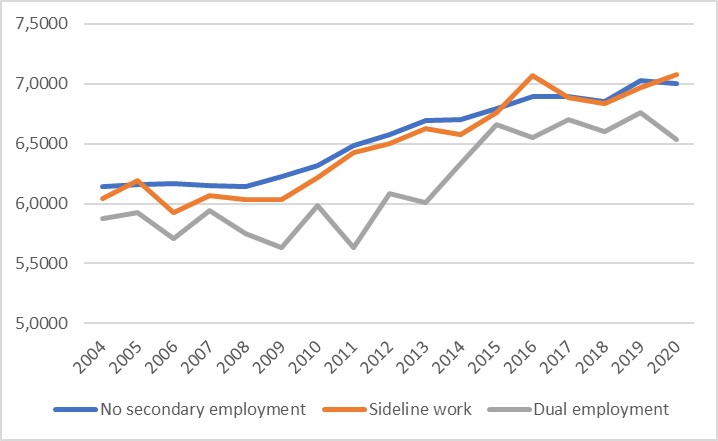 Fig. 5.
Development of satisfaction with personal income of multiple job holding by employment type over time from 1992 to 2020 (0 = Completely dis-satisfied, 10 = Completely satisfied). Source: GSOEP, according to own calculations (extrapolated).
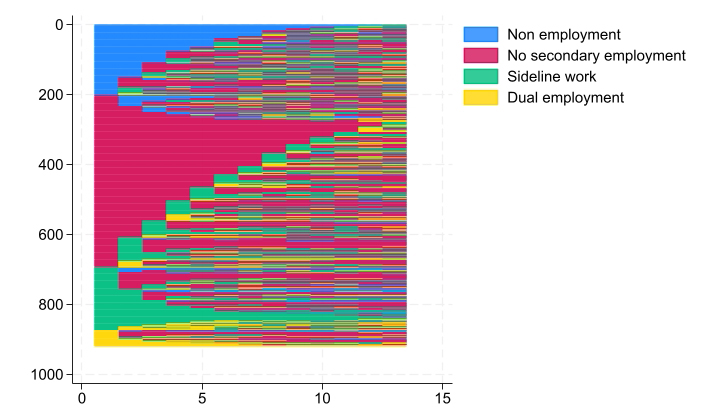
Although the phenomenon under consideration is rare, dual employment could be identified as a career pattern. Sequence analysis has been used to identify 882 cases, providing information valid for the whole observation period (2004–2016), with at least one instance of dual or secondary employment (Fig. 6).
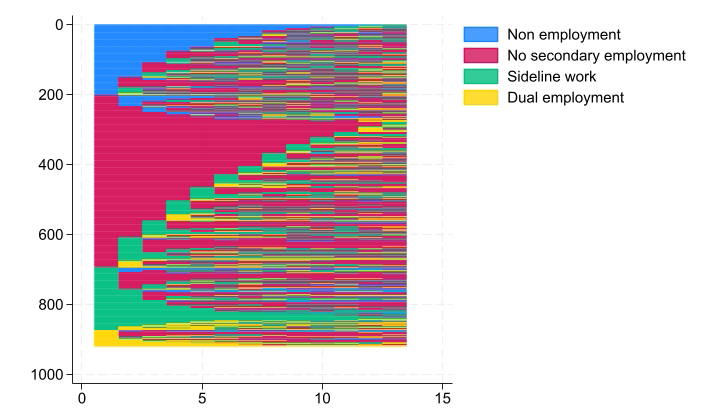 Fig. 6.
Multiple job holding over time from 2004 to 2016 (919 cases, not weighted) 919 cases (not weighted), who made a statement every time in the period and were at least once in dual employment or part-time employment. Source: GSOEP, according to own calculations (not weighted).
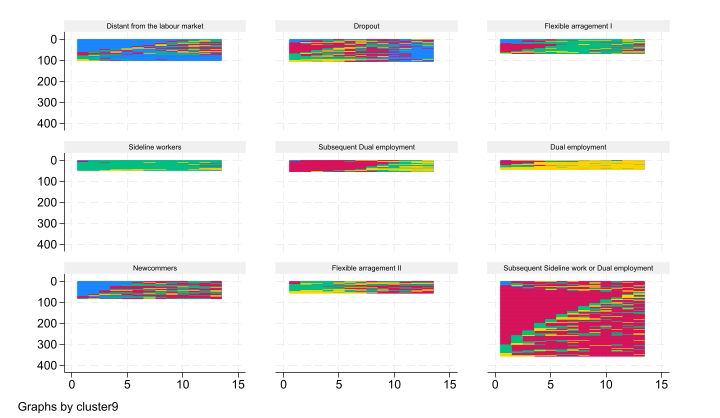
The sequence pattern analysis (Needleman-Wunsch-Algorithm, Ward-linkage, Calinski-Harabasz-Index applied) result in a solution with nine clusters, of which selected clusters with dual employment are described below (Fig. 7). In particular, a cluster emerges in which dual employment is predominantly carried out on a permanent basis (dual employment with a length of 6.57 years; Table 2). This cluster includes only about 50 cases in which dual employment is actually a stable employment pattern. Cases of temporary dual employment can also be found in the other eight clusters. Worth mentioning here is the equally small cluster of subsequent dual employment, in which full-time employment is followed by dual employment for a short period of time during the observation period (2004–2016). The same applies to the large cluster Subsequent Sideline Work or Dual Employment, which combines cases in which a short period of dual employment combined with secondary employment is followed by full-time employment. Similar patterns can be found in the case of secondary employment. A small core group can be also identified here that has a stable secondary job in addition to a main occupation during the observation period. There is also a cluster in which the secondary activity is additionally taken up over time (flexible arrangement 1; Fig. 7; Appendix Table 3). Finally, the large cluster Subsequent Sideline Work or Dual Employment includes a number of cases of unstable secondary employment (Fig. 7). Fig. 7 suggests that there is a pattern where, after a single main activity, a secondary activity is first taken up, which then expands into a second main activity (dual employment; red, then green, then orange).
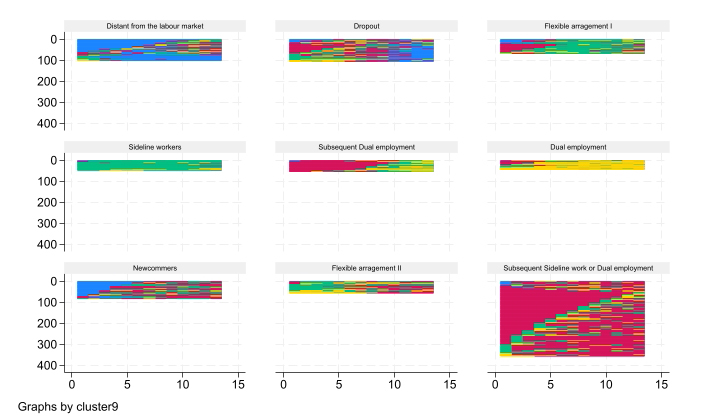 Fig. 7.
Patterns of Dual Employment and Sideline Work (Cluster, not working: blue, working: red, sideline activities: green, dual employed: orange). 919 cases (not weighted), who made a statement every time in the period and were at least once in dual employment or part-time employment. Source: GSOEP, according to own calculations (extrapolated).
| Length of episodes of unemployment | Length of episodes of sole employment | Length of episodes of secondary job | Length of episodes of dual employment | |
| Distant from the labour market | 9.40 | 1.90 | 1.34 | 0.37 |
| Dropout | 5.35 | 5.04 | 1.84 | 0.77 |
| Flexible arrangement I | 1.19 | 5.64 | 5.59 | 0.58 |
| Sideline workers | 0.75 | 1.15 | 10.63 | 0.48 |
| Subsequent Dual employment | 0.29 | 8.31 | 3.04 | 1.36 |
| Dual employment | 0.59 | 2.93 | 2.91 | 6.57 |
| Newcomers | 3.61 | 7.24 | 1.85 | 0.31 |
| Flexible arrangement II | 0.48 | 6.50 | 4.41 | 1.61 |
| Subsequent Sideline work or Dual employment | 0.54 | 10.67 | 1.24 | 0.54 |
| Total | 2.39 | 7.10 | 2.57 | 0.93 |
919 cases (not weighted), who made a statement every time in the period and were at least once in dual employment or part-time employment.
Source: GSOEP, according to own calculations (extrapolated).
Dual employment deserves attention as a possible facet of new careers, especially because it touches on the current understanding of careers concerning diverse perceptions of career und life concepts. The ongoing and lively discussion about new forms of careers suggests a potential for dual-employment careers. This is confirmed by the qualitative research presented here, in which dual careers open up opportunities for satisfying individual needs. Restricted to a very specific sample and not with the intention of generalization, a coherent picture of dual employment as a career pattern as an expression of a new understanding of career is presented.
The empirical analysis via sequence pattern analysis, which refers to dual employment and sideline work allows assessments that are less fed by anecdotal evidence. Within its analytical limits, it provides the following indications: Firstly, the observation of a long period weakens the assumption of a uniform trend of sideline work and dual employment. Secondly, the number of hours of sideline work is relatively small. Thirdly, secondary activities are quite unstable over time. Fourthly, the phenomenon of dual employment is demonstrable but small, although there can be observed an increasement for the last years. The sequence pattern analysis shows different types of sideline work and dual employment. More extensive dual employment careers exist from time to time, but it is really an exception, that they represent a relevant alternative concept to a professional biography oriented towards a main job. Several indications suggest that dual employment is relatively unattractive compared to secondary employment. All in all, it appears that a more representative, quantitatively oriented analysis suggests a cautious assessment of changes in career paths, which are discussed on a qualitative basis.
The chosen method of combining qualitative and quantitative research proves its worth. The qualitative research yields a coherent picture of dual careers, whereby in particular the analysis of the basic motifs that are satisfied in the various working environments provide a convincing picture. However, due to the small number of cases and the extremely selective selection of respondents, a generalization of the main findings is questionable. Even if not all aspects were accessible to the representative review, it becomes clear that the phenomenon of dual careers exists and has gained in importance in the recent past. In contrast to qualitative research, however, dual careers prove to be extremely unstable, they are usually short episodes that usually last only a few years. Both findings are not mutually exclusive, since even in sequence pattern analysis some cases can be found that are dual employed over a longer period of time.
Dual careers are also more critical in terms of career success than qualitative research suggests. Income and income satisfaction are less favourable than in the relevant comparison groups. With regard to job satisfaction, this disadvantage disappears. Whether this is due to the fact that too many other influencing factors are at work here or whether non-material aspects play a role in subjective career success (cf. Gunz and Heslin, 2005) cannot be examined with the available data. Azevedo (2014) is more likely to assume a positive effect on job satisfaction. Schleicher (2019) points out that the subjective success criteria play a very high role in her analysis and that job satisfaction does not fully capture this subjective side.
The phenomenon of the multiple job holding can be classified in the discussion about the development of employment relationships. Atypical employment relationships are usually distinguished from the standard employment relationship here. Atypical forms include part-time employment, fixed-term employment and temporary agency work. In the case of part-time employment in Germany, minor employment (up to around 10 Hours weekly) should also be mentioned in particular. Possibly, also the self-employment is included. Precisely because these are multiple occupations, it is difficult to classify them in this scheme, although MJH is certainly an atypical arrangement.
In the last decades, the German labour market has been characterised by an increase in atypical employment relationships, which is also referred to as the erosion of standards. The development of the MJH in recent years is also interpreted in this way (cf. Klinger and Weber, 2017), so that overall a coherent overall picture emerges. However, on the one hand, the long period of our analysis shows that in addition to the phase of growth of MJH, there had already been a decline in such employment relationships. On the other hand, the development of the German labour market in recent years also reveals opposing tendencies. In particular, the number of marginal employees is declining sharply since 2011. The development of dual careers and qualitative analysis suggest that these activities are certainly atypical forms, which seem to be gaining in importance in the context of a more flexible working world, while the sideliners can also be part of a world of standard working scheme. Previous research focused on part-time work and its disadvantages, for example. A former part-time job can make it more difficult to get a full-time job (Dütschke and Boerner, 2009). It would be useful to take a closer look at the dual career phenomenon in order to analyze its position on the labor market.
The conception of career as a series of work-related experiences that have a direct or indirect influence on the respective individual career (Sullivan and Baruch, 2009: 1543) should be extended by the understanding of simultaneity. Individual careers contain a diverse sequence of events of a professional and non-professional nature, which are collected sequentially or simultaneously.
When discussing the results, various limitations should be mentioned. In some cases, these are determined by the data set, in other cases (especially in sequence pattern analysis), settings have been selected for analysis.
The following limitations should be mentioned in the evaluation of the GSOEP data set. (1) The definitional distinction between sideline work and dual employment is not clear-cut. This conceptual limitation arises from the working time definition of dual employment, where the limit has been set at 8 hours per job. It can be expected that the phenomenon of dual employment will be less visible in the data if the minimum working hours per job are increased. This raises the question of a fundamental conceptualization and differentiation between dual employment and sideline work. Qualitative findings that capture the level of meaning of the jobs and careers would be useful here. (2) Motives etc. are not directly surveyed in the analysis. We conclude indirectly via framework conditions. Specific results on the motive require a different research design (e.g., Campion and Csillag, 2022). (3) In sequence pattern analysis, the following limitations should also be mentioned. (3.1) The data obtained from a disproportionate sample are not weighted and extrapolated. (3.2) Sequence pattern analysis requires a large number of settings that can affect the results of the analysis. The analysis is based on a specific setting: The distance measurement of career paths, the process of forming clusters as well as the determination of the number of clusters chosen to the best of one’s knowledge and belief. Other settings might show different results and suggest other interpretations. (3.3) Only cases are included that have provided information in each year of the analysis. This reduces the data set, there is a trade off between sample size and length of observed time period. For this reason, the observation period is limited to 13 years. The time period selected for the sequence pattern analysis is selective. The analysis could only take into account data up to 2019, as the survey concept regarding secondary employment was changed after that. We are aware that a selection bias may exist and recommend that methods to avoid this bias be considered in the future (cf. Sakshaug, 2022). (3.4) However, while the generalizability of the findings for the analysis of the SOEP Data Set is given, we refrain from analysing the inferential statistics due to the lack of weighting and the low number of cases in the individual clusters in the sequence pattern analysis.
Even if this quantitative-explorative method does not lend itself to causal conclusions, it does provide a useful starting point for further questions on aspects that can explain the different employment constellations over time.
Dual employment deserves attention as a possible facet of new careers, especially because it touches on the current understanding of careers with regard to diverse career and life concepts. The ongoing and lively discussion about new forms of careers suggests a potential for dual-employment careers. This is confirmed by the qualitative research presented here, in which dual careers open up opportunities for satisfying individual needs. Restricted to a very specific sample and not with the intention of generalization, a coherent picture of dual employment as a career pattern and expression of a new understanding of career is presented (Schleicher, 2019).
Our empirical analysis, which refers to dual employment and sideline work allows assessments that are less fed by anecdotal evidence. Within its secondary analytical limits, it provides the following indications: Firstly, the observation of a nearly 30-year period weakens the assumption of a uniform trend of sideline work and dual employment. Secondly, the number of hours of sideline work is relatively small. Thirdly, secondary activities are quite unstable over time. Fourthly, the phenomenon of dual employment exists but seldom. The sequence pattern analysis shows different types of secondary employment, but a tiny cluster of stable dual employment. Dual employment careers are an exception, they do not currently represent an alternative concept to a professional biography oriented towards a main job. Several indications suggest that dual employment is relatively unattractive compared to sideline work. This also calls for further research into the motivation and reasons for dual employment. All in all, it appears that a more representative, quantitatively oriented analysis suggests a cautious assessment of changes in career paths.
What do these findings regarding Multiple Job Holding (Campion et al, 2020; Bhayana et al, 2024) mean for career research? Firstly, the theoretical understanding of careers as a one-dimensional sequence of positions over time has to be discussed (e.g., Gunz and Mayrhofer, 2017). Dual employment in conjunction with its subjective criteria for success requires a broad understanding of careers. Secondly, new career forms in the context of dual employment and sideline work are empirically not very widespread (at least on the German labour market). Thirdly a consideration of the life course might be useful. Looking at the results of Tomlinson et al (2018), a life course framework or life span theory (cf. Zacher et al, 2019) that takes into account key transitions and stages of life should be included even more closely in the future, so that, for example, the analysis and prediction of organizational careers is systematically successful in the face of increasingly flexible careers. Fourthly, some questions remain to be answered regarding the role of dual employment careers, for example, why dual employment is chosen as a career path. In the case of dual employment, there are also double relationships between employers and employees. In this respect, for example, a double commitment or a double Organizational Citizenship Behavior must also be taken into account (Webster et al, 2019). The authors are convinced that the combination of the extremely rich data available for career research, such as the GSOEP, with the results of qualitatively oriented research and intermediary analytical procedures, such as sequence pattern analysis, is a worthwhile approach. Future contributions could benefit from a more detailed discussion on the implications of dual employment for policy and individual career planning, especially in view of flexible career models and increasing remote work.
The data are freely available. For further information please use: https://www.diw.de/sixcms/detail.php?id=838674.
NS had the idea for this topic and designed the research study. All authors performed the research. MS and FS analyzed the data. FS and NS drafted the manuscript. All authors contributed to critical revision of the manuscript for important intellectual content. All authors read and approved the final manuscript. All authors have participated sufficiently in the work and agreed to be accountable for all aspects of the work.
Not applicable.
This research received no external funding.
Given his role as the Guest Editor/Editorial Board member of the journal, Florian Schramm had no involvement in the peer-review of this article and has no access to information regarding its peer review. Full responsibility for the editorial process for this article was delegated to Simon Jebsen.
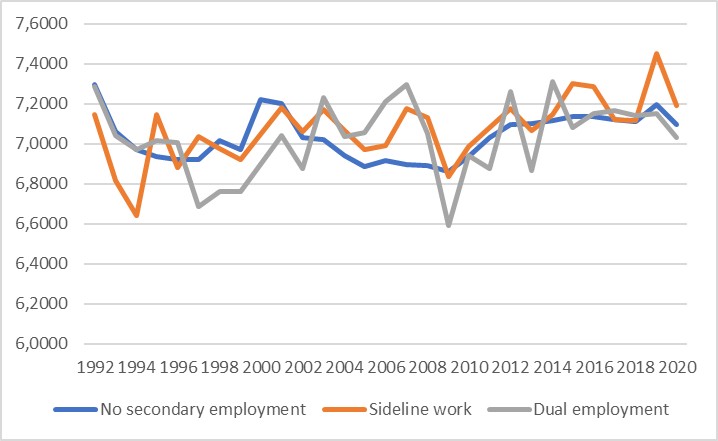 Fig. 8.
 Development of Work Satisfaction of multiple job holding by employment type over time from 1992 to 2020 (0 = Completely dissatisfied, 10 = Completely satisfied). Source: GSOEP, according to own calculations (extrapolated).
| Distant from the labour market | Dropout | Flexible arragement I | Sideline workers | Subsequent Dual employment | Dual employment | Newcomers | Flexible arragement II | Subsequent Sideline work or Dual employment | Altogether | |
| Average | ||||||||||
| Length of episodes of Non employment | 9.40 | 5.35 | 1.19 | 0.75 | 0.29 | 0.59 | 3.61 | 0.48 | 0.54 | 2.39 |
| Length of episodes of No secondary employment | 1.90 | 5.04 | 5.64 | 1.15 | 8.31 | 2.93 | 7.24 | 6.50 | 10.67 | 7.10 |
| Length of episodes of Sideline work | 1.34 | 1.84 | 5.59 | 10.63 | 3.04 | 2.91 | 1.85 | 4.41 | 1.24 | 2.57 |
| Length of episodes of Dual employment | 0.37 | 0.77 | 0.58 | 0.48 | 1.36 | 6.57 | 0.31 | 1.61 | 0.54 | 0.93 |
| Shares of employment | ||||||||||
| Non employment | 81.6% | 19.2% | 2.5% | 1.1% | 8.0% | 4.0% | 3.0% | 3.4% | 9.2% | |
| No secondary employment | 15.8% | 55.8% | 26.9% | 6.8% | 90.7% | 6.5% | 69.7% | 70.1% | 78.3% | 59.4% |
| Sideline work | 1.1% | 12.5% | 67.9% | 88.8% | 6.8% | 25.0% | 18.3% | 3.9% | 11.3% | 21.0% |
| Dual employment | 1.5% | 12.4% | 2.8% | 3.3% | 2.5% | 60.6% | 7.9% | 23.0% | 6.9% | 10.3% |
| Total | 100.0% | 100.0% | 100.0% | 100.0% | 100.0% | 100.0% | 100.0% | 100.0% | 100.0% | 100.0% |
| Sex | ||||||||||
| Male | 42.6% | 18.4% | 64.9% | 56.1% | 43.5% | 65.7% | 37.8% | 38.1% | 52.2% | 47.5% |
| Female | 57.4% | 81.6% | 35.1% | 43.9% | 56.5% | 34.3% | 62.2% | 61.9% | 47.8% | 52.5% |
| Total | 100.0% | 100.0% | 100.0% | 100.0% | 100.0% | 100.0% | 100.0% | 100.0% | 100.0% | 100.0% |
| Ages | ||||||||||
| 20 to 29 | 43.8% | 18.9% | 18.2% | 25.0% | 0.2% | 10.0% | 45.5% | 9.0% | 3.5% | 14.6% |
| 30 to 39 | 22.2% | 31.6% | 31.2% | 19.6% | 14.8% | 32.1% | 28.5% | 16.8% | 18.5% | 22.5% |
| 40 to 49 | 11.7% | 5.1% | 27.4% | 34.8% | 46.2% | 31.8% | 18.2% | 35.2% | 45.0% | 33.1% |
| 50 to 59 | 22.4% | 44.4% | 23.3% | 20.6% | 38.7% | 26.1% | 7.8% | 38.9% | 33.0% | 29.8% |
| Total | 100.0% | 100.0% | 100.0% | 100.0% | 100.0% | 100.0% | 100.0% | 100.0% | 100.0% | 100.0% |
| CASMIN Classification | ||||||||||
| (1a) inadequately completed | 0.1% | 0.9% | 17.8% | 0.0% | 1.0% | |||||
| (1b) general elementary school | 1.9% | 7.2% | 1.1% | 0.5% | 5.7% | 2.8% | 2.6% | |||
| (1c) basic vocational qualification | 18.3% | 43.0% | 20.3% | 12.6% | 25.2% | 25.8% | 11.3% | 24.9% | 27.5% | 24.9% |
| (2b) intermediate general qualification | 2.4% | 3.5% | 1.3% | 7.4% | 7.6% | 0.8% | 0.3% | 1.8% | ||
| (2a) intermediate vocational | 22.3% | 23.4% | 12.8% | 35.6% | 32.3% | 19.7% | 21.7% | 25.5% | 32.9% | 27.3% |
| (2c_gen) general maturity certificate | 22.4% | 2.8% | 10.9% | 6.9% | 12.5% | 1.3% | 4.7% | |||
| (2c_voc) vocational maturity certificate | 13.4% | 7.8% | 8.2% | 36.2% | 1.6% | 2.9% | 5.2% | 14.3% | 11.9% | 11.1% |
| (3a) lower tertiary education | 3.1% | 1.5% | 14.0% | 5.3% | 5.6% | 5.4% | 18.3% | 5.9% | 11.7% | 9.5% |
| (3b) higher tertiary education | 16.0% | 9.7% | 32.7% | 10.4% | 27.1% | 21.1% | 22.8% | 22.9% | 11.5% | 17.0% |
| Total | 100.0% | 100.0% | 100.0% | 100.0% | 100.0% | 100.0% | 100.0% | 100.0% | 100.0% | 100.0% |
| Average | ||||||||||
| Satisfaction with personal income | 4.18 | 5.24 | 6.76 | 6.86 | 5.65 | 6.34 | 5.90 | 6.84 | 6.33 | 6.13 |
| Satisfaction with work | 6.50 | 6.02 | 7.21 | 6.74 | 5.93 | 7.03 | 6.87 | 6.77 | 6.87 | 6.75 |
| Total weekly working hours | 25.28 | 36.39 | 41.38 | 44.46 | 40.79 | 49.72 | 38.70 | 37.96 | 42.45 | 40.91 |
| Total remuneration in EUR | 10.17 | 11.99 | 16.62 | 17.68 | 17.13 | 13.09 | 10.48 | 17.82 | 15.07 | 14.77 |
Source: GSOEP, according to own calculations (extrapolated); CASMIN Classification, Comparative Analysis of Social Mobility in Industrial Nations.
References
Publisher’s Note: IMR Press stays neutral with regard to jurisdictional claims in published maps and institutional affiliations.