
 , Yayu Chen 2,3, Rong-Quan He 1, Gang Chen 4,*
 , Daniel Xin Zhang 2,3,*
1 Department of Medical Oncology, First Affiliated Hospital of Guangxi Medical University, 530021 Nanning, Guangxi, China
2 Department of Health Sciences, Hong Kong Metropolitan University, Hong Kong, China
3 School of Nursing and Health Sciences, Hong Kong Metropolitan University, Hong Kong, China
4 Department of Pathology, First Affiliated Hospital of Guangxi Medical University, 530021 Nanning, Guangxi, China
Breast cancer is a common malignancy and remains a leading cause of cancer-related mortality in women worldwide. Accounting for 15–20% of breast cancer, triple-negative breast cancer (TNBC), distinguished by the deficiency of estrogen or progesterone receptors plus the lack of overexpression of human epidermal growth factor receptor 2, is an aggressive breast cancer subtype that has fewer treatment options [1, 2]. Thus, it carries a much poorer prognosis in comparison to other breast cancer subtypes [1]. To make things worse, TNBC is associated with considerable treatment-related psychological and financial burdens [2]. Additionally, the racial disparities of TNBC should not be neglected: in the United States, Black women have a much higher rate of TNBC in comparison to non-Hispanic White women, which represents the greatest racial disparities contrasted with other breast cancer subtypes [2].
The bright side is that early TNBC outcomes have been appreciably improved due to the recent advancement in therapies, including better chemotherapy regimens and the emergence of immunotherapy [1]. Growing evidence also suggests that TNBC, among various breast cancer subtypes, harbors potentially the highest immunogenicity, which in conjunction with other factors makes TNBC more likely to respond to immunotherapy [3]. Despite this, more efforts are warranted to discover targetable aberrations, hinder invasion and metastasis, and enhance social and financial support [1].
Tumor-infiltrating lymphocytes (TILs) are defined as lymphocytes that move away from the bloodstream to infiltrate the tumor [4]. They usually oppose or surround cancer cells, and have been long considered crucial in anti-cancer immunity [4]. In the recent decade, TILs have demonstrated prognostic and predictive values as well as exhibiting therapeutic potential in TNBC [4]. From the perspective of prognostic use of TILs, the morphological assessment of TILs in breast cancer is gathering steam [4, 5]. Aggregating evidence has suggested that the degree of lymphocytic infiltration can be evaluated as a key parameter in breast cancer tissue by hematoxylin and eosin staining [5]. And the International TILs Working Group recommended harmonizing TILs evaluation practice [5]. A pooled analysis of over 3000 patients treated with neoadjuvant combination chemotherapy has shown that high counts of TILs are predictive of the response to neoadjuvant chemotherapy across all breast cancer subtypes [6]. In TNBC, elevated TIL concentrations are linked to a pathological complete response and also longer survivals [6].
Recent research suggests that the abundance of TILs in breast cancer tissue could be an
independent favorable prognostic factor for early-stage TNBC patients treated
with or without chemotherapy. Stromal TILs (sTILs) played a strong prognostic
role in early-stage TNBC and patients with high sTILs after adjuvant chemotherapy
demonstrated extended survival [7]. The pooled analysis of over 2000 patients
found that higher TILs and no lymph node metastasis indicated better prognosis in
early TNBC patients undergoing chemotherapy [7]. In addition, lower sTILs were
significantly associated with increased age, larger tumors, enhanced nodal
involvement, and lower histologic grade [7]. For early-stage TNBC patients who
did not receive chemotherapy, an earlier small-scale pooled analysis involving
over 400 patients highlighted the prognostic relevance of sTILs in systemically
untreated early-stage TNBC patients [8]. Higher percentages of sTILs are related
to improved invasive disease-free survival, distant disease-free survival, and
overall survival [8]. It is noteworthy that stage I TNBC patients with sTILs
greater than 30% showed excellent survival outcomes, e.g., a 98% five-year
overall survival, without adjuvant chemotherapy [8]. Later, an international
study involving 1966 patients was conducted to evaluate the relationship between
the abundance of TILs in breast cancer tissues and the survival status of
early-stage TNBC patients who did not receive adjuvant or neoadjuvant
chemotherapy [9]. The results demonstrated that higher levels of TILs were
indicative of better survival among early-stage TNBC patients without
chemotherapy. In detail, the arm of patients with high TILs (
In sooth, the above studies have manifested the prognostic capacity of TILs in early-stage TNBC patients treated both with and without chemotherapy [6, 7, 8, 9]. Furthermore, the reproducibility and ease of TIL assessment in routine clinical settings support its broader application in TNBC prognostic evaluation [6, 7, 8, 9]. The accumulating evidence could lead to the recommendation of TILs routine reporting in TNBC as a prognostic factor to facilitate therapy selection. As this practice did not induce excessive costs additionally, it could be beneficial to help with the financial toxicity observed in TNBC [2].
These results are encouraging. Still, there are some aspects to consider in clinical practice to accurately and consistently evaluate TILs, such as assessment methods, type and location of tissue sections, different subtypes of breast cancer, and other technical factors [10].
With the advent of immune checkpoint inhibitors (ICIs) in contemporary precision
oncology, researchers are exploring the prognostic utility and the immunological
properties of TILs in the immunotherapy of TNBC. Clinical evidence has
demonstrated that programmed death-ligand 1 (PD-L1) testing benefits immunotherapy selection in advanced TNBC
[11], while TILs were shown to be associated with higher levels of programmed death-1 (PD-1) and PD-L1
in early-stage TNBC [12]. A Phase 2 study, whose randomization was stratified by
the levels of sTILs [low (
In summary, emerging evidence establishes the pivotal prognostic role of TILs in TNBC to guide clinical practice (Fig. 1). Future directions may include evaluating the additional prognostic relevance of the location and spatial organization of TILs in TNBC tissues [18]. Beyond prognostication, TILs also show huge potential as an anti-cancer therapeutic modality [19]. Recently, lifileucel, an autologous TIL therapy, has obtained landmark approval from the U.S. Food and Drug Administration to treat advanced melanoma, which was the first approved cell therapy for solid tumor [20]. The approval was based on the demonstrated safety and durable efficacy from the C-144-01 study, particularly in advanced melanoma patients who were refractory to immune checkpoint inhibitors [21, 22, 23]. Our analysis showed that relevant trials are still in the early phases (phases I and II) (Supplementary File 1), but without doubt future advances in the realm of TILs for treating advanced breast cancer are something to look forward to.
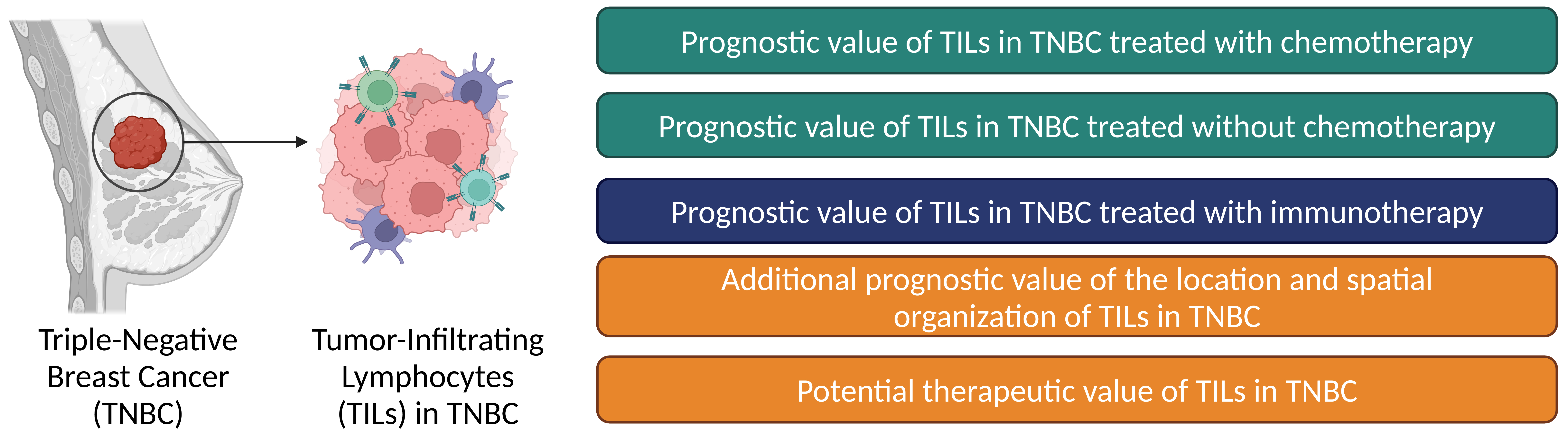 Fig. 1.
Tumor-Infiltrating Lymphocytes in Triple-Negative Breast Cancer. Created with BioRender.com.
WP (Formal analysis, Investigation, Writing—original draft); YC (Formal analysis, Investigation, Writing—review & editing), RQH (Formal analysis, Investigation, Writing—review & editing), GC (Formal analysis, Investigation, Resources, Supervision, Writing—original draft, Writing—review & editing); DXZ (Conceptualization, Formal analysis, Investigation, Resources, Supervision, Writing—original draft, Writing—review & editing). All authors read and approved the final manuscript. All authors have participated sufficiently in the work and agreed to be accountable for all aspects of the work.
Not applicable.
The figure was created using BioRender with a paid license to publish.
This research received no external funding.
The authors declare no conflict of interest.
Supplementary material associated with this article can be found, in the online version, at https://doi.org/10.31083/j.fbl2911385.
References
Publisher’s Note: IMR Press stays neutral with regard to jurisdictional claims in published maps and institutional affiliations.