

 , Anichka Hovsepyan 1,*
 , Lusine Saghatelyan 1, Haykanush Koloyan 1, Olga Chizhik 2, Susanna Hovhannisyan 1, Marina Paronyan 1
1 Laboratory of Protein Technologies, Scientific and Production Center (SPC) “Armbiotechnology” NAS RA, 0056 Yerevan, Republic of Armenia
2 SSI “Central Botanical Garden of the NAS of Belarus”, 220012 Minsk, Republic of Belarus
Abstract
Background: A pivotal objective in crop production and plant protection lies in developing environmentally friendly insecticidal preparations and biostimulants. Methods: We employed Bacillus thuringiensis strains with varied insecticidal spectra and engineered melanogenic mutants. Results: We demonstrated a significant increase in insecticidal activity in the isolated mutants. Meanwhile, there was no observable impact of the enhanced synthesis of water-soluble melanin on the nature and abundance of spore and crystal formation. This heightened efficacy can be attributed to the photoprotective qualities of the synthesized pigment, shielding spores and crystals against the detrimental effects of UV radiation and insolation. We demonstrated the high biological activity of water-soluble bacterial melanin through in vivo experiments involving multiple plant species. Conclusions: Our findings indicate that bacterial melanin is a potent phytostimulant. This preparation accelerates and amplifies plant growth and development processes, leading to a substantial increase in crop yield by 20–40%. The simultaneous synthesis of two biologically active substance, melanin and insecticidal toxins, ensures an elevated level of effectiveness in utilizing melaninogenic strains.
Keywords
- Bacillus thuringiensis
- melanogenic strains
- bacterial melanin
- insecticidal preparations
- phytostimulator
The widespread use of mineral fertilizers and pesticides in agriculture has increased, leading to dangerous and alarming environmental pollution. In response to this concern, there is a current trend in agriculture to curtail traditional fertilizers and chemicals, instead favoring the adoption of biological products derived from natural sources. At the forefront of agricultural development, prioritizing research on environmentally friendly and highly effective biological insecticidal formulations specifically designed for targeted pest control is crucial. Concurrently, a concerted effort exists to explore plant growth stimulants that align with sustainable agricultural practices. Bacterial preparations derived from the Gram-positive spore-forming bacterium Bacillus thuringiensis (B. thuringiensis) are preferred in integrated pest management since their selective action distinguishes them from traditional pesticides and ensures the safety of humans, warm-blooded animals, fish, and beneficial entomofauna [1, 2].
Although B. thuringiensis preparations have emerged as the most successful bioinsecticides worldwide, their widespread use is hindered by certain drawbacks. In particular, they exhibit sensitivity to various environmental factors, such as sunlight, rainfall, dew, soil pH, and temperature [3]. Among these, ultraviolet rays of sunlight are particularly detrimental, causing protein crystal degradation and diminishing insecticidal effectiveness [4]. Consequently, repeated spraying becomes necessary [5], escalating preparation costs. Thus, developing UV-resistant preparations of B. thuringiensis with heightened insecticidal activity may address this challenge.
Melanin protects against UV radiation, extending the lifespan of spores and toxins in insecticidal B. thuringiensis strains, causing melanogenic B. thuringiensis strains to exhibit heightened insecticidal effectiveness [5, 6, 7].
The widespread use of well-known melanins is constrained by their water insolubility and high production costs. Due to the expensive starting materials and intricate technological processes, synthetic melanins are also economically burdensome. Moreover, isolating and purifying natural melanins from protein impurities constitutes a complex and costly endeavor [8, 9, 10]. Furthermore, most synthetic and natural melanins are water-insoluble, which presents significant challenges in formulating and applying medications based on them [11]. The acquisition of natural melanin that is cost-effective and water-soluble presents a substantial expansion of its potential applications. Subsequently, we have obtained a large collection of melanin-synthesizing mutant strains from various B. thuringiensis subspecies (maintained at the Microbial Depository Center of the Institute of Scientific and Production Center “Armbiotechnology” of National Academy of Sciences (NAS), Republic of Armenia (RA)). From this collection, we isolated strains with the highest water-soluble bacterial melanin (BM) synthesis, which remarkably retained insecticidal activity [12].
Based on these strains, a sustainable and profitable production process can be established, where the biologically active substance, BM, isolated from the culture liquid (CL), acts as a plant growth stimulant. Concurrently, the biomass forms the basis for an insecticidal preparation, generating two valuable biological products through a single fermentation process. Comprehensive technology has been developed for producing BM in fermenters and its subsequent isolation and purification from methods in previous studies [13, 14]. Likewise, the environmental biosafety of BM and melaninogenic strains of B. thuringiensis has previously been shown [15]. The study also highlighted the efficient assimilation of water-soluble BM by soil microorganisms under aerobic and anaerobic conditions when introduced into the soil. This finding is significant as it prevents the accumulation of melanin in groundwater.
This research aims to investigate the biological activity of BM and bioinsecticides within the highly active melaninogenic strains of B. thuringiensis obtained by us. Additionally, it seeks to explore the potential applications of these products in agriculture.
We used 85 strains from the collection of museum cultures of Scientific and Production Center (SPC) “Armbiotechnology”.
Chemical mutagenesis of cultures was conducted according to the method described by Miller [16].
To assess spore–crystal formation, the obtained Cultural Liquids (CLs) were studied by microscopy using a light phase-contrast microscope (LOMO, MIKMED 6, Petersburg, Russia). The spore titer was counted in Goryaev’s counting chamber.
Fermentation was performed in a “Biostat-S” laboratory fermenter with a 7.0 L
working capacity (“Brawn”, Sartorius Company, Goettingen, Germany).
Fermentation was carried out at the oxygen dissolution rate of 2.5–3.0 g O
Cell suspension grown on meat peptone agar (MPA) at 30 °C for 48 hours was used as an inoculum.
The level of synthesized melanin was determined on a Perkin Elmer 550S UV-VIS
spectrophotometer (Kenilworth, NJ, USA) at a wavelength (
To determine the Infrared (IR) spectra of bacterial melanin, we used a Nexus Nicolet FTIR
spectrometer (Catalog number: 912A0760, Thermo Fisher Scientific, Waltham, MA,
USA). ZnSe Prism (4000–650 cm
The biomass obtained after centrifugation (5000 rpm) was used as an insecticidal preparation, and the supernatant was used to obtain water-soluble melanin.
Melanin was sorbted from the supernatant under dynamic conditions at a linear
flow rate of 0.034 cm/s on an IA-1r anion exchanger (Waterhim, Moscow, Russia). Melanin was eluted
from the resin with a 3.5% ammonia solution at an eluent flow rate of 0.026
cm
The biological activity of BM was investigated across various plants. Optimal concentrations of BM were identified for treating the seeds of experimental plants and subsequently irrigating the soil.
Plants were treated with BM in various ways: By immersing the roots of seedlings and the bases of cuttings in melanin solutions of different concentrations, watering the soil after planting, soaking the seeds, and combining both methods. The optimal concentrations and processing modes of BM were selected for each species.
The qualitative reactions were conducted using the isolated melanins [8, 17].
Qualitative reactions with oxidizing agents (H
The following solutions were added to the melanin:
10% H
0.5 M KMnO
1% FeCl
Anatomical studies of plants, dry matter content, and the determination of the amount of protein were performed according to the methods described by Tretyakov [18].
The amino acid composition of the hydrolyzate was evaluated using a Shimadzu NexeraX2 analyzer (SHIMADZU CORPORATION, Kyoto, Japan).
The High-performance liquid chromatography (HPLC) method (Waters Alliance e2695 separation module, HPLC, Water Corporation, Milford, MA, USA) was used to determine the amount of vitamin C and flavonoids in the treated plants, and the number of essential oils was determined using a gas chromatograph (GC) (thermoscopic lane 1300, Catalog number: CL2GAS000001, Thermo Scientific™ TRACE™, Waltham, MA, USA).
The insecticidal activity of the studied strains was determined in laboratory conditions on silkworm caterpillars (Bombyx mori) of various ages. Mulberry leaves treated with the cultural liquid obtained after fermentation of the studied strains were fed to the caterpillars. Then, the number of living and dead caterpillars was recorded for 3–12 days. The dead caterpillars were examined according to the methods described by Minaeva and Pantene [19, 20]. The insecticidal activity of the studied strains was also tested on golden-tail (Euproctis chrysorrhoea) caterpillars at various developmental stages. The biological effectiveness was assessed based on the number of deceased caterpillars, with counts conducted on the 5th and 8th days following treatment with bacterial preparation.
Insecticidal activity was assessed by semi-lethal concentration (LD
Silkworm (Bombyx mori) caterpillars in the third instar and golden-tail
caterpillars in the third and fourth instars were employed as test subjects. The
LD
The selected melaninogenic strains were also tested in the field on golden-tail
caterpillars, with a working suspension titer of 4.0–5.3
Based on the laboratory results, field tests were carried out on the gypsy moth (Liparis dispar), II–III instar grape moth (Tortrix viridana), and goldenrod (Euproctis chrysorrhoea) caterpillars.
To obtain a working suspension with an approximate titer of 4.0–5.0
Statistical parameters (mean, standard deviation) used in the experiments were calculated using analysis of variance (ANOVA).
To obtain melanin-synthesizing strains that retain insecticidal activity, 85 strains of B. thuringiensis with different spectra of insecticidal action were studied.
Initially, 21 strains of B. thuringiensis were selected based on their optimal efficiency in sporulation and crystal formation, where the number of free spores ranged from 80 to 90%, and sporulating vegetative cells with crystals constituted 10–20%. Subsequently, nine strains were further selected from this group as representatives of different subspecies based on their superior efficiency in spore and crystal formation. These included representatives from the ssp kurstaki (1), ssp sotto (1), ssp darmstadiensis (1), ssp caucasicus (2), ssp israelensis (2), and ssp berliner (2) subspecies.
Culture liquid (CL) from new melaninogenic strains of B. thuringiensis was tested on golden-tail caterpillars at various developmental stages. The biological effectiveness was assessed based on the number of deceased caterpillars, with counts conducted on the 5th and 8th days following treatment with the preparation (Table 1).
| B. thuringiensis strains | Titre, spores/mL | Entomocidal activity, LD | |||||
| Silkworm (Bombyx mori) caterpillars of age III | Golden-tail (Euproctis chrysorrhoea) caterpillars of age III–IV | ||||||
| Counting by day | |||||||
| 1 | 2 | 3 | 3 | 6 | 8 | ||
| ssp caucasicus 837 | 5.1 × 10 |
1.0 × 10 |
2.0 × 10 |
3.2 × 10 |
1.4 × 10 |
5.7 × 10 |
2.6 × 10 |
| ssp kurstaki 1224 | 5.5 × 10 |
8.7 × 10 |
2.4 × 10 |
3.2 × 10 |
6.2 × 10 |
1.7 × 10 |
3.0 × 10 |
| ssp berliner S1 | 5.1 × 10 |
5.9 × 10 |
8.7 × 10 |
2.8 × 10 |
2.3 × 10 |
4.0 × 10 |
2.6 × 10 |
The LD
Chemical mutagenesis was performed on the selected insecticidal strains, resulting in B. thuringiensis mutants that synthesized extracellular water-soluble melanin. This facilitated subsequent isolation and purification processes of melanin. Importantly, these mutants retained their insecticidal activity. The morphology of colonies and cells and the degree of sporulation and crystal formation remained consistent with the original strains. By refining the melanin biosynthesis technology, which included adjustments to the fermentation medium composition and optimization of fermentation conditions, the newly obtained melanin-synthesizing mutants of B. thuringiensis produced up to 11 g/L of melanin (while ensuring a high level of aeration). Based on these test results, mutant strains of B. thuringiensis ssp. kurstaki 1224 (BTKAS1), ssp. caucasicus 837 (BTCc1), and B. thuringiensis S1 ssp. berliner–BTC1 were selected for further research and development.
The identification of the resulting pigment as melanin was confirmed through
qualitative reactions with oxidizing agents (H
The analysis to determine the IR spectrum BM revealed the presence of bands characteristic of melanins [22].
The presence of paramagnetic centers in the BM was demonstrated using the electron paramagnetic resonance (EPR) method [13]. The paramagnetism of natural melanins significantly influences various important properties, including electrical conductivity, exchange capacity, chemical reactivity, antioxidant properties, biological activity, etc. [23, 24].
One of the characteristic features of melanin is its photoprotective activity, which protects spores and crystals of insecticide strains from the damaging effect of UV radiation and insolation. This increases the insecticidal activity of melaninogenic B. thuringiensis strains.
Compared to the original strains, the insecticidal activity of melanogenic mutants (pig+) against golden-tail caterpillars increased noticeably, with an increment of more than 10% (Table 2).
| B. thuringiensis strain | Titer of the working suspension, | Pest death, day of the count, % | ||||
|---|---|---|---|---|---|---|
| spores/mL | 3 | 7 | 10 | 12 | ||
| ssp caucasicus 837 | initial | 5.0 × 10 |
33.2 | 52.4 | 71.3 | 77.9 |
| BTCc1 (pig+) | 5.2 × 10 |
39.4 | 62.2 | 81.0 | 88.5 | |
| ssp kurstaki 1224 | initial | 5.1 × 10 |
34.7 | 55.4 | 72.6 | 77.1 |
| BTKAS1 (pig+) | 5.3 × 10 |
40.1 | 63.4 | 81.5 | 88.0 | |
| ssp berliner S1 | initial | 5.0 × 10 |
34.4 | 55.2 | 71.6 | 78.0 |
| BTC1 (pig+) | 5.1 × 10 |
39.7 | 63.9 | 81.8 | 88.5 | |
| ssp caucasicus 844 | initial | 5.0 × 10 |
33.4 | 51.2 | 71.0 | 77.6 |
| BTCc2 (pig+) | 5.1 × 10 |
38.5 | 61.0 | 79.6 | 87.0 | |
| ssp israelensis 743 | initial | 5.1 × 10 |
32.6 | 51.6 | 71.1 | 77.2 |
| BTIs1 (pig+) | 5.2 × 10 |
37.8 | 60.5 | 78.3 | 86.5 | |
| ssp israelensis 2291 | initial | 5.0 × 10 |
31.8 | 50.8 | 70.8 | 75.9 |
| BTIs2 (pig+) | 5.1 × 10 |
36.4 | 58.3 | 76.7 | 84.9 | |
When utilizing B. thuringiensis preparations in the field, the primary concern is the potential harm caused by UV radiation and sunlight, which may adversely affect the spores and crystals, leading to a loss of their insecticidal activity. Melanins, being natural photoprotectors, play a crucial role in shielding spores and crystals from UV damage and the deleterious effects of sunlight [5, 6, 7]. This inherent property of melanins contributes to the prolonged insecticidal activity of melaninogenic B. thuringiensis strains.
A BM with high biological activity was obtained using melaninogenic strains of B. thuringiensis, and demonstrated on different plants. Experimental findings underscore the necessity of selecting the optimal BM concentration tailored to each plant species.
The findings from studies conducted on various vegetables, fodder, fruit, and ornamental plants have demonstrated a pronounced stimulating effect of BM. In terms of biometric indicators for vegetable crops such as potatoes, tomatoes, beans, chickpeas, peppers, beets, small-fruited carrots, etc. (Fig. 1), the positive impact of the BM solution was evident at low concentrations ranging from 0.03% to 0.08%. Treated plants exhibited accelerated seed germination, robust growth, increased stem branching, a shift towards intensive and prolonged fruit formation, and the ripening of large, fleshy fruits with many large seeds. These effects collectively contributed to a substantial enhancement in plant productivity, estimated at approximately 20–40%.
 Fig. 1.
Influence of Bacterial Melanin (BM) on potatotubers soaking and tomato yield. (A) Influence of BM on potato tubers soaking. 1, control; 2, soil watering by BM (0.03%); 3, seedling watering by BM (0.06%). (B) Influence of BM on tomato yield. 1, control; 2: treated with 0.03% BM.
In bush beans treated with a 0.03% BM solution, growth in the leaf blade was observable, attributed to marginal meristem activation. Across all experiments, a consistent stimulation of growth and development was observed, with an increased number of beans being established. Furthermore, the number and size of seeds in the treated group significantly exceeded those in the control group (Table 3).
| Bush beans | Stem height, cm | Weight, g | ||
| Above ground part | Beans | Seeds (1000) | ||
| Control options | 39.4 |
88.5 |
57.4 |
343.2 |
| Treated by BM | 48.7 |
107.2 |
99.2 |
422.4 |
High efficiency of BM was observed in unstratified peach seeds and indoor flower crops (Reo, Saxifraga), conifers (Silver spruce), and tree species (Albizia).
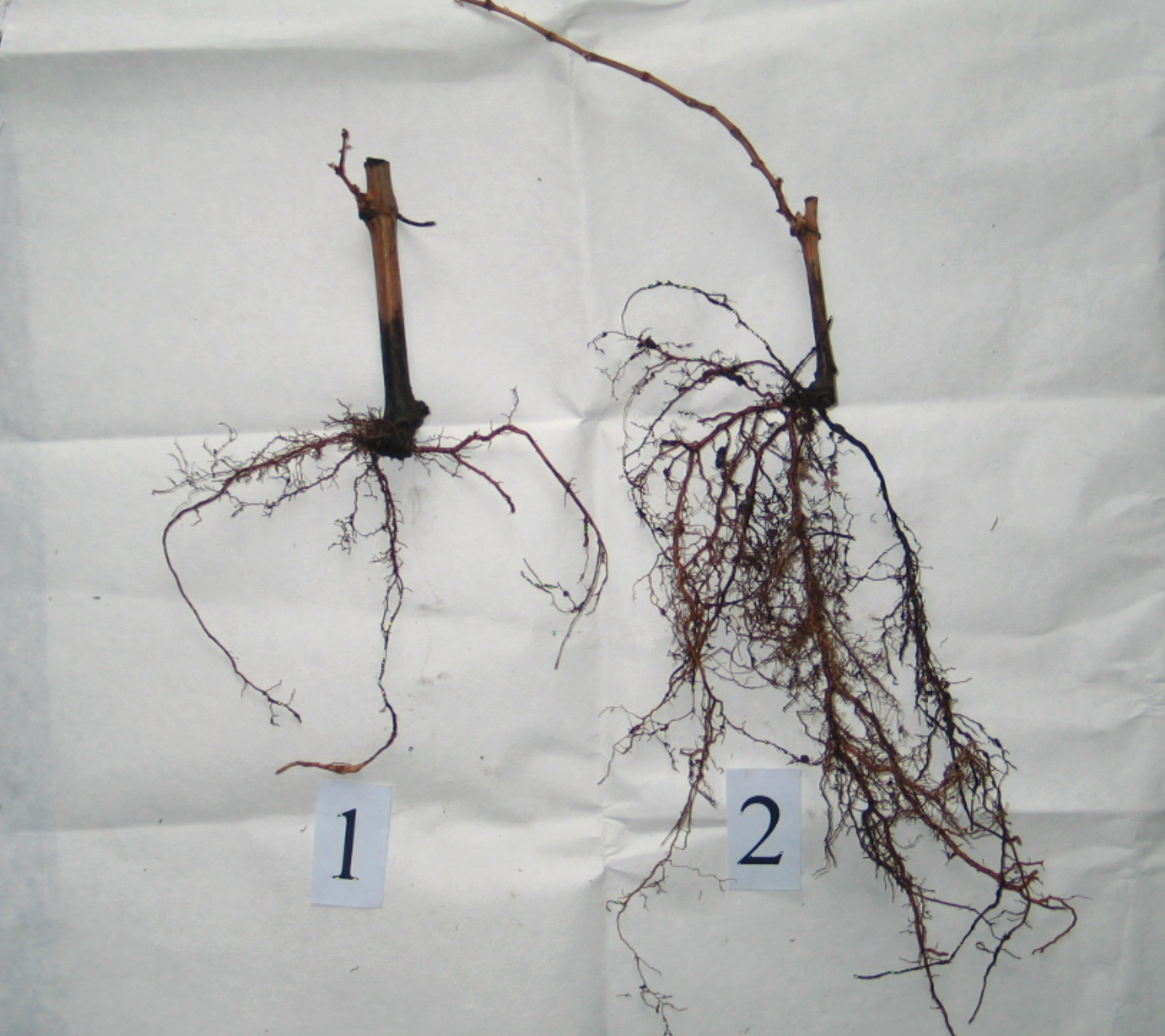
Grapes hold significant agricultural importance, particularly in the food industry, mainly in winemaking. An essential consideration lies in the production and application of biostimulants for grape growth. It was demonstrated that shortened grape cuttings (16 varieties), when treated with a 0.1–0.2% BM solution after 6–7 months, developed a powerful root system, facilitating the growth of the aboveground mass and the ripening of internal tissues. This ultimately ensured a high survival rate of seedlings and resistance to unfavorable abiotic factors and stimulated the growth and ripening of shoots. These favorable outcomes, shown in Fig. 2, highlight the efficacy of pre-soaking seeds in promoting a high survival rate of grape seedlings.
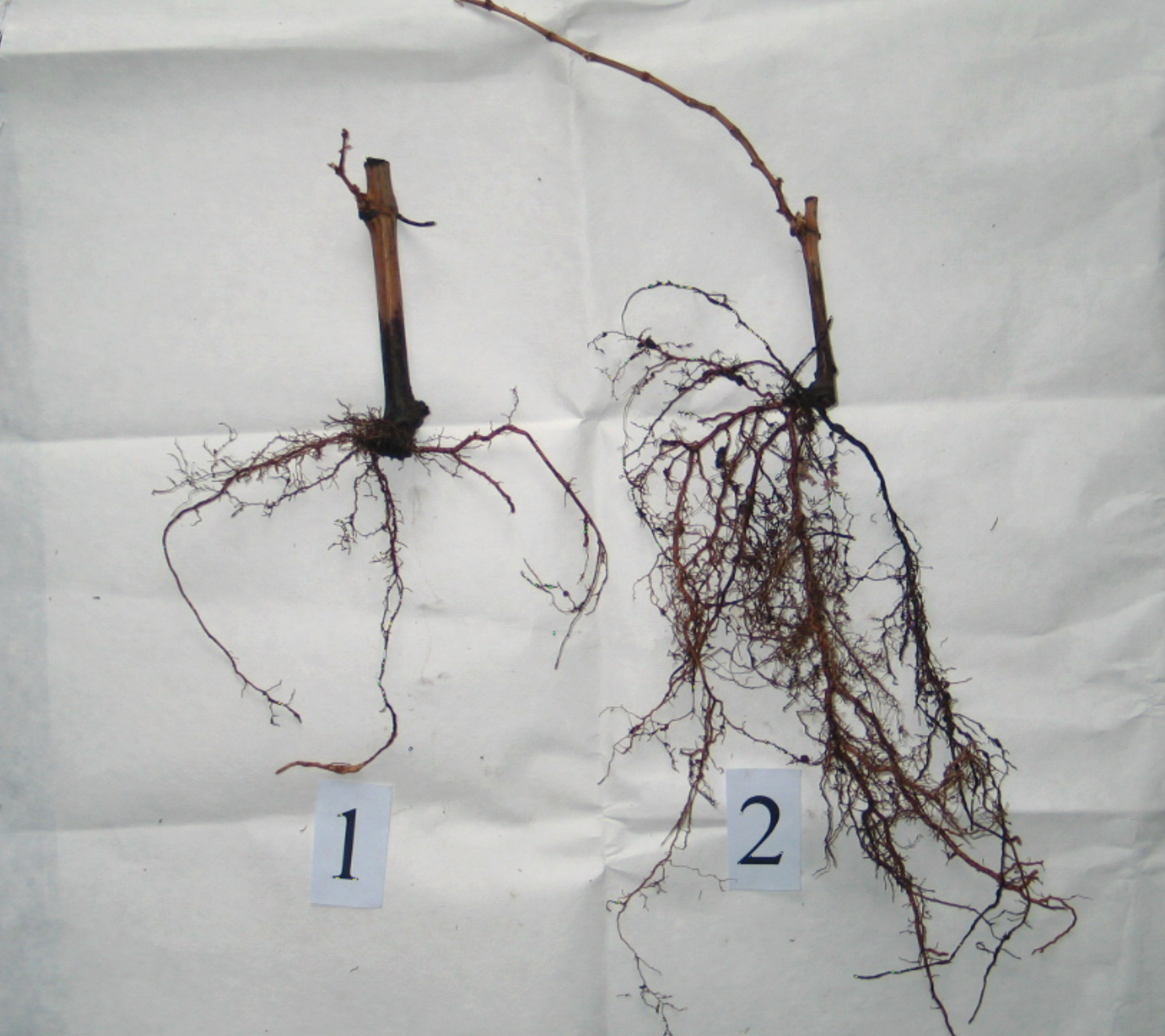 Fig. 2.
Effect of BM on the development of the root system of young grape cuttings. Root systems of young vine plants: 1, without treatment of cuttings with BM; 2, after treatment of cuttings by the immersion of their bases in BM solution (0.20%).
The effect of 0.08–0.12% BM solution is shown on grain and fodder crops such as wheat, sorghum, and sunflower. This effect was achieved through pre-sowing seed soaking and soil watering methods. The treated crops intensified root system growth, providing enhanced access to water and mineral elements. This, in turn, contributed to the plant’s rapid growth in height and thickness and the development of a significant number of elongated leaves (57–63%) characterized by a vibrant bright green. All treated plants exhibited increased growth in the above-ground portion (32–35%) and the root system.
In cultivated plants, longitudinal growth is especially activated through the stimulation of the apical meristem, while the thickening and branching of stems result from the activation of the cambium.
Cambial activity stimulation was evident in the intensified formation of xylem vessels with wider diameters and greater quantities. The diameter of these vessels exceeded that of the control by 29%, leading to a 63.6% increase in xylem square within a vessel bundle compared to the control. Additionally, the overall width of the xylem and cambium zones in the stems of experimental plants surpassed that of the control by 34%, indicating a notable enhancement in cambial activity (Table 4). These changes ultimately resulted in the distinct thickening of the stalk.
| Parameter | ||||
| Xylem diameter in the vessel bunch, mm | Xylem diameter in the vessel, µm | Phloem layer thickness, µm | Number of large xylem vessels in the bunch | |
| Control | 0.742 |
46.4 |
38.7 |
12.6 |
| 0.08% BM | 1.164 |
60.0 |
51.8 |
20.3 |
Similar to previous crops, corn seeds exhibited rapid and robust germination under the influence of BM treatment, subsequently surpassing the control in all measured parameters.
BM facilitated an increase in the number and size of leaves and other indicators, such as stem height, stem weight, and average leaf and ear count. The increase in biomass can be attributed to the growth of all studied parameters. Unlike other growth stimulants, stem elongation, in this case, results from the emergence of new leaves rather than internode elongation. An increase in the number and size of leaves, coupled with increased green growth, also contributed to an increase in the number of seeds due to enhanced photosynthesis, evident in the intensified green color of leaves. Consequently, both seed productivity and feed mass growth increased. The enlargement of plant habitus was simultaneous with the enhanced development of lateral roots to those found in sorghum. These roots are crucial in preventing lodging in up to 2-meter tall plants. It has also been demonstrated that a 0.08% BM solution stimulates the growth and development of medicinal plants, such as Matricaria chamomilla, Rhamnus, Crataegus, Thymus, calendula, Panax ginseng, etc. To produce medicines, it is important to monitor biochemical indicators such as vitamin C, flavonoids, and essential oils, the content of which is positively influenced by BM.
Plants treated with BM exhibited increased resistance to abiotic environmental factors.
The results of studies conducted on various plants have indicated that BM has a biostimulating effect.
Melanin synthesis by the studied melaninogenic B. thuringiensis strains noticeably increased their virulence without impacting the nature and level of spore and crystal formation. These findings align with existing literature data, indicating that the pigment shields spores and crystals from the destructive effects of sunlight, thereby prolonging their insecticidal activity [5, 6, 7]. The increased insecticidal activity of melaninogenic B. thuringiensis strains makes them valuable for controlling various agricultural pests.
Summarizing the data obtained from studying the impact of BM on the growth, development, and fruiting of agricultural, ornamental, and medicinal plants, it can be concluded that it exerts a significant stimulating effect. The preparation demonstrates an auxin-like effect on plants, particularly evident in the pronounced stimulation of meristematic activity. This leads to increased stem growth in both length and width, as well as the overgrowth of the leaf blade. The intensification of the growth of the aboveground parts of plants is associated with the formation of a powerful root system.
BM surpasses other known phytostimulants due to their solubility in water, rapid decomposition in soil, effectiveness at low concentrations, and low cost. These properties enable melaninogenic strains to replace chemical insecticidal preparations with environmentally friendly, highly effective alternatives with a broad range of actions. A biostimulant preparation containing BM contributes to developing new plant cultivation methods.
Using minerals, especially nitrogen-containing fertilizers, as growth stimulants can lead to the accumulation of nitrates in plant foods and environmental pollution. Therefore, replacing them with environmentally friendly bacterial melanin in various crop production sectors will significantly reduce the use of chemicals.
An evident advantage of the highly active obtained melanin-synthesizing insecticidal strains is that they can serve as a basis for profitable waste-free production. The biomass from the fermentation of these strains can form the foundation for an environmentally friendly insecticidal preparation to combat various agricultural pests. At the same time, the culture medium can be a source for isolating the biologically active BM. Ultimately, the environmental safety and affordable price of these preparations broaden their applications in agriculture.
Bioinsecticidal preparations and BM have been obtained based on melaninogenic strains of B. thuringiensis. The inherent photoprotective property of melanins plays a crucial role in protecting the spores and crystals from UV damage and the harmful effects of sunlight, which contributes to the long-term insecticidal activity of these strains. This will make it possible to replace chemical insecticides with environmentally friendly, highly effective drugs. BM is a natural effective phytostimulant. The use of environmentally friendly water-soluble BM in various sectors of crop production will significantly reduce the use of mineral and especially nitrogen-containing fertilizers, which can lead to the accumulation of nitrates in plant foods and environmental pollution.
All data points generated or analyzed during this study are included in this article, and no further underlying data is necessary to reproduce the results.
AH and SA designed the research study. MP, LS, and SH performed the research and provided help to write the manuscript. MP, HK, and OC analyzed the data. AH and SA wrote the manuscript. All authors have participated sufficiently in the work to take public responsibility for appropriate portions of the content and agreed to be accountable for all aspects of the work in ensuring that questions related to its accuracy or integrity. All authors contributed to editorial changes in the manuscript. All authors read and approved the final manuscript.
Tomato and Potato plants were used in this study. White-violet-flowered Tomato seeds (Solánum lycopérsicum ‘Liya’) and White-flowered Potato seeds (Solanum tuberosum ‘Epicure’) cultivars selected and kindly provided from ‘Green lane’ by Dr. Nune Sarukhanyan (Green lane Company, 24 Heratsi str., Yerevan, RA)
Not applicable.
This research was funded by the RA Ministry of Education, Science, Culture and Sports, Higher Education and Science Committee project number 21SC-BRFFR-4D032 and International Science and Technology Center (ISTC) project number PR-132.1.3.
The authors declare no conflict of interest.
References
Publisher’s Note: IMR Press stays neutral with regard to jurisdictional claims in published maps and institutional affiliations.