
 , Elena Rojo 3, Manuel Muñoz 3, Dolores Ochoa 3, Concepción Pérez 3, José Vivancos 1, Ana Beatriz Gago-Veiga 1,2,*
1 Unidad de Cefaleas, Servicio de Neurología, Hospital Universitario de la Princesa Instituto de Investigación Sanitaria, Princesa (IIS-Princesa), 28006 Madrid, España
2 Departamento de Medicina, Universidad Autónoma de Madrid, 28029 Madrid, España
3 Unidad del Dolor, Hospital Universitario de la Princesa Instituto de Investigación Sanitaria, Princesa (IIS-Princesa), 28006 Madrid, España
Abstract
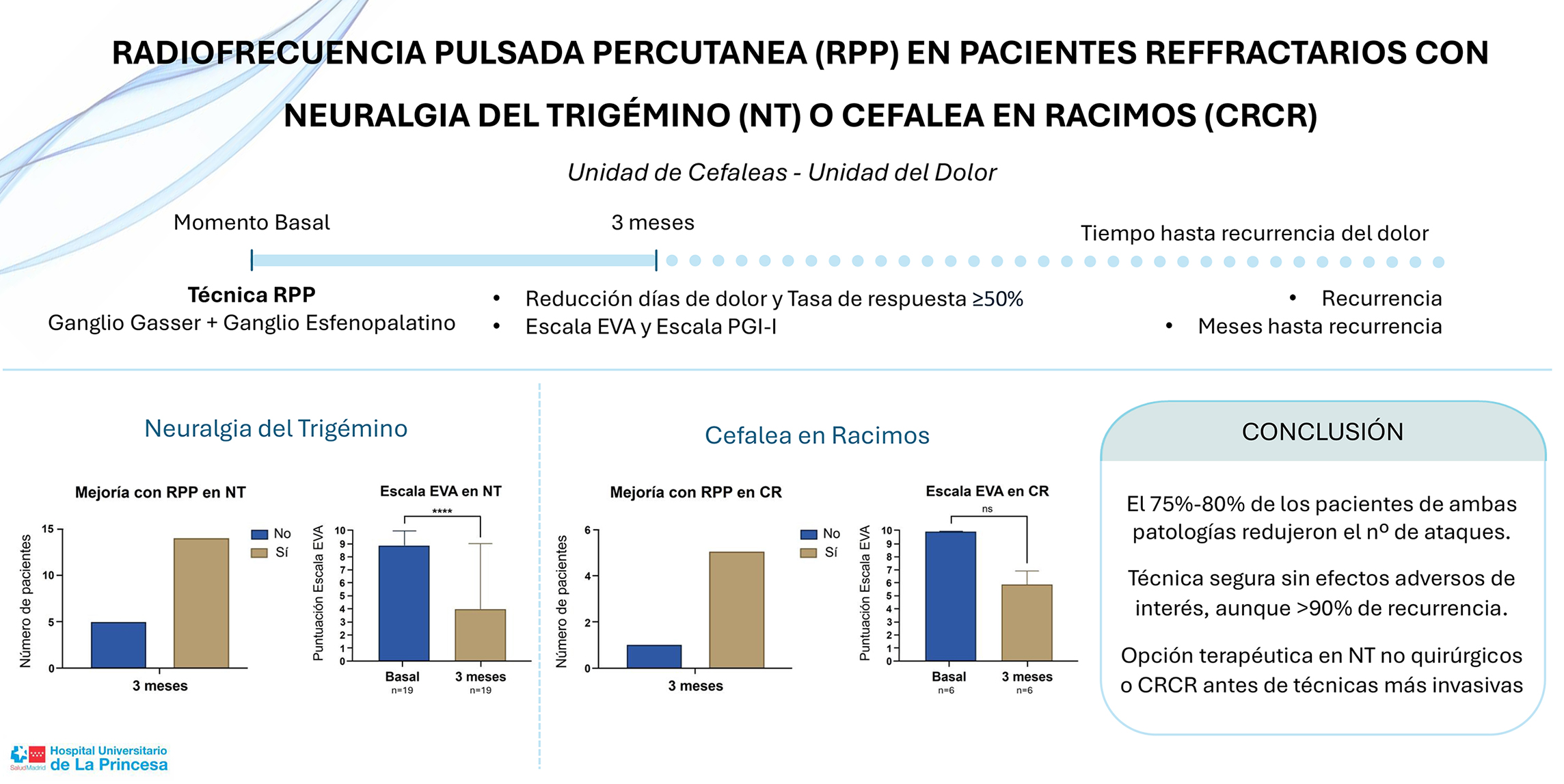
Percutaneous pulsed radiofrequency (PPRF) is a minimally invasive neuromodulation technique used in chronic pain management. Our aim was to evaluate its effectiveness and safety in refractory cases of trigeminal neuralgia (TN) and chronic cluster headache (CH).
We conducted
a retrospective study of patients with TN and CH diagnosed according to the
International Classification of Headache Disorders, 3rd edition (ICHD-3) criteria and treated with PPRF (Gasserian ganglion for TN and
sphenopalatine ganglion for CH) over an 8-year period. Effectiveness at 3 months
was assessed by evaluating reduction in the number of pain days in TN and number
of attacks in CH,
Twenty-five patients met the inclusion criteria, including 19 with TN
and 6 with CH, with a mean age of 76 and 52 years, respectively. Clinical
improvement was observed in 14/19 (73.6%) patients with TN and 5/6 (83.3%) patients
with CH. A
In our series, PPRF appears to be an effective and safe treatment for refractory TN and CH. Although the study is retrospective and the sample size is limited, particularly in CH, these findings should be considered preliminary but clinically relevant. Despite the high recurrence rate, given its low complication profile, it may represent a treatment option for patients who are not candidates for surgical procedures.
Graphical Abstract
Keywords
- percutaneous pulsed radiofrequency
- trigeminal neuralgia
- cluster headache
- refractory
- recurrence
References
Publisher’s Note: IMR Press stays neutral with regard to jurisdictional claims in published maps and institutional affiliations.