

 , Tong Wei 1,2,*
 , Xinan Li 1, Zhengyang Qian 1
1 Department of Information Management, Peking University, 100871 Beijing, China
2 Research Center for Digital Humanities, Peking University, 100871 Beijing, China
Abstract
This study constructs an ontology that supports both morphological analysis and historical contextualization of bronze weapons from the Shang and Zhou Dynasties, providing semantic support for the development of ancient Chinese military knowledge bases and advancing the structured organization of cultural heritage knowledge. The ontology is developed using a “term–concept–characteristic” methodology and integrates a “weapon–actor–event” semantic chain, enabling the representation of both structural characteristics and contextual relations. To ensure semantic interoperability and scalability, we reused standard ontology vocabularies from International Committee for Documentation Conceptual Reference Model (CIDOC CRM) and Simple Knowledge Organization System (SKOS), and formally represented the ontology in Web Ontology Language 2 Description Logic (OWL 2 DL). The resulting Bronze Weapon Ontology encompasses physical characteristics, functional attributes, manufacturing processes, and historical contexts of bronze weapons, achieving fine-grained semantic modeling across multiple dimensions. Evaluation through structural metrics and SPARQL Protocol and Resource Description Framework (RDF) Query Language (SPARQL)-based competency queries confirms the ontology’s logical consistency, semantic expressiveness, and potential for supporting complex reasoning tasks. By providing a unified framework for weapon classification, morphological analysis, and contextual modeling, this ontology offers a robust methodological foundation for the semantic representation of cultural artifacts. It also contributes to broader applications in intelligent cultural heritage services, digital archaeology, and knowledge graph construction for ancient warfare studies.
Keywords
- bronze weapons
- ontology building
- semantic chain
- historical context
- digital heritage
In ancient China, the saying “the great affairs of a state lie in ritual and warfare” reflects the dual significance of weaponry—not only as crucial tools of war but also as comprehensive embodiments of social institutions, technological development, and artistic culture (Yang, 1985). During the Shang-Zhou period (ca. 1600–256 Before Common Era (BCE)), bronze weapons reached a peak in technological and stylistic development. Their structural forms, functional uses, inscriptions, and decorative styles exhibit distinct temporal characteristics (Shen, 2015). These artifacts hold not only a vital position in military history but also provide material evidence for the study of ancient metallurgy, craft organization, cultural exchange, and political systems.
In parallel, the rise of digital scholarship in the humanities has created a demand for knowledge resources that are not only digitized but also semantically structured and interoperable. Data-driven methods and semantic technologies increasingly underpin research in digital humanities, enabling large-scale retrieval, cross-collection integration, and computational analysis (Bi et al., 2019). Knowledge organization is thus a foundational task for digital heritage development (Wei et al., 2016), directly affecting the depth and breadth of cultural heritage protection, research, and dissemination. As Hjørland (2016) notes, effective knowledge organization requires conceptually coherent and semantically controlled representations rather than ad hoc arrangements of information, highlighting the need for explicit conceptual modeling in heritage systems.
A recent study on museum Knowledge Organization Systems (KOS) further shows a shift from traditional, collection-centered cataloging toward semantically enriched, ontology-driven infrastructures that emphasize interoperability, contextual linkage, and machine-readable structures (Pan and Shi, 2025). Complementing this, the Knowledge Organization Ecosystem (KOE) framework conceptualizes Knowledge Organization (KO) as an evolving socio-technical ecosystem in which standards, vocabularies, tools, communities, and governance mechanisms must operate in a coordinated and interoperable manner (Bagchi, 2021a). This perspective underscores the importance of constructing domain ontologies that can integrate heterogeneous terminologies, align conceptual boundaries, and support sustainable semantic evolution across collections. For complex artifact categories such as bronze weapons, traditional archaeological typology alone can no longer meet the needs of intelligent retrieval or interdisciplinary studies. In particular, three interrelated gaps limit current practice:
(1) a lack of fine-grained, machine-readable semantic models capable of representing component-level relations (e.g., yuan/main blade, nei/inner part, side guard, Hu, holes),
(2) fragmentation of terminologies and codified descriptors across projects that impedes data integration, and
(3) limited reuse of Semantic Web vocabularies in domain-specific, high-granularity modeling.
Ontology, as a core methodology of semantic web technologies, enables the formal, structured, and logically consistent representation of domain knowledge, supporting knowledge sharing across systems, languages, and domains (Hyvönen, 2012). In the study of cultural artifacts, constructing comprehensive, structurally clear, and semantically interoperable ontology models has become crucial for advancing domain knowledge sharing and cross-platform interoperability (Vakulenko, 2014; Wei et al., 2023). International ontologies such as International Committee for Documentation Conceptual Reference Model (CIDOC CRM) (CIDOC, 2024) and the Europeana Data Model (EDM) (Europeana, 2024) provide essential frameworks for standardized cultural heritage representation. However, their granularity often falls short for artifact-specific tasks that require component-level distinctions or functionally grounded relations. Consequently, there is a need for a domain ontology that mediates between authoritative heritage standards and the detailed morphological and contextual information used by archaeologists.
This paper presents the Bronze Weapon Ontology (BWO), a domain ontology focused on Shang–Zhou bronze weapons. The BWO is built following a term–concept–characteristic methodology (Wei and Chen, 2023a) and explicitly integrates a weapon–actor–event semantic chain to link artifacts with users and historical events. The ontology is modeled in Web Ontology Language 2 Description Logic (OWL 2 DL), reuses Simple Knowledge Organization System (SKOS) for terminological management and CIDOC CRM for event- and actor-level alignment, and is designed in accordance with International Organization for Standardization (ISO) 1087 (Terminology Work and Terminology Science — Vocabulary) and ISO 704 (Terminology Work — Principles and Methods) terminological principles. Specifically, this work aims to (i) provide a fine-grained, multilingual terminology system for bronze weapon components and categories; (ii) formalize component- and instance-level definitions as Description Logic axioms to support consistent semantic representation; and (iii) demonstrate how artifact-level models can be integrated with spatiotemporal knowledge to facilitate large-scale, heterogeneous data analysis in cultural heritage and ancient military studies.
The principal contributions of this study are: (i) a reusable, multilingual ontology for Shang–Zhou bronze weapons that balances domain specificity with semantic interoperability; (ii) a methodological framework—combining term–concept–characteristic modeling with weapon–actor–event linking—that enables cross-level semantic organization and integration; and (iii) empirical validation that the ontology supports structured querying and scalable semantic organization, providing a foundation for digital heritage management, large-scale morphological analysis, and research on ancient warfare and material culture. Section 2 introduces the research background and dataset; Section 3 reviews related work; Section 4 details ontology design and implementation; Section 5 reports ontology evaluation; Section 6 demonstrates ontology-based morphological analysis; and Section 7 concludes with future directions.
The Shang–Zhou period, spanning approximately from 1600 BCE to 256 BCE, represents a crucial developmental stage of China’s bronze civilization. It encompasses the following phases:
(1) the Shang dynasty (ca. 1600–1046 BCE);
(2) the Western Zhou (1046–771 BCE);
(3) the Spring and Autumn (770–476 BCE) and Warring States periods (475–256 BCE).
The core dataset of this study is The Compendium of Ancient Chinese Weapons, compiled by Shen Rong and published in two volumes by Shanghai Lexicographical Publishing House in 2015. The work adopts an annotated-entry format, comprising 14 sections, over 4200 entries, and nearly 1.5 million characters. It is a comprehensive reference work on ancient Chinese weaponry.
The compendium explicates the basic terms, entities, and related concepts of Chinese weapons spanning millennia, systematically presenting the development of China’s ancient military equipment system. It documents morphological characteristics, functional uses, and historical contexts in detail, integrating extensive historical texts, archaeological data, and weapon studies. Each entry cites references in a standardized format, ensuring data diversity and reliability. This compendium thus provides a rich terminological and data foundation for the ontology construction of Chinese bronze weapons.
In addition to this core resource, a wide range of archaeological excavation reports and specialized research literature on bronze weapons were also consulted to enhance data coverage, reliability, and comprehensiveness.
This section reviews prior research from two perspectives—traditional humanities scholarship and cultural heritage knowledge representation—in order to highlight both the state of research on Shang–Zhou bronze weapons and the necessity of ontology-based modeling.
The classification and naming of bronze weapons have generally followed two approaches:
(1) Functionalist systems, grounded in terminology and descriptive conventions from epigraphy and antiquarian studies. These systems typically divide weapons into offensive and defensive categories. For instance, Ma Chengyuan’s seminal work (1982; 1988) treats all weapons as a distinct class, further splitting them into close‑combat and ranged types. Du Naisong (1984) proposed a broader twelve-category scheme, listing Ge, swords, and crossbows as major types. Similar functional schemas were adopted by international scholars such as Umehara (1940), Lin (1972), and Karlgren (1930), who emphasized sharpness, form, and technological attributes.
(2) Morphology-based systems, emerging alongside modern archaeological excavations, emphasize formal characteristics—such as main blade shape, inner type, and hafting method—over textual references. Li Ji’s (1952) classification in Report on Bronze Artifacts Unearthed from Xiaotun identifies four main types: pointed, end-blade, side-blade, and double-edged weapons, with subtypes including hooked, piercing, and long-bladed forms. Although this morphological taxonomy was not widely institutionalized, it provides a valuable reference for formal structure modeling in ontological frameworks.
The development of functionalist and morphology-based classification systems has established an essential descriptive framework for bronze weapon studies. However, the absence of explicit, standardized definitions for categories and terms has led to semantic ambiguity, while the coexistence of divergent typological schemes across scholars and sites has hindered data harmonization. These limitations underscore the need for a unified, formalized terminology system that can reconcile historical classification traditions with the precision required for computational analysis.
The rise of Semantic Web technologies has introduced formal ontology languages—Web Ontology Language (OWL) /Resource Description Framework (RDF) —to cultural heritage. Foundational models such as SKOS (Miles and Bechhofer, 2009), CIDOC CRM (Doerr, 2005), and Europeana EDM (Doerr et al., 2010) provide broad frameworks for describing events, places, and terminology. In Chinese heritage, ontologies have been successfully applied to ceramics (Wei et al., 2022) and ritual bronzes (Wei and Chen, 2023b). However, no formal ontology has yet been developed to semantically represent bronze weaponry.
Recent research has extended ontology modeling to military history. Notable examples include the WarSampo project, which extends CIDOC CRM with event ontologies to model battles, participants, locations, weapons, and timelines in a semantically searchable knowledge graph (Hyvönen et al., 2016). In Chinese contexts, semantic modeling remains exploratory: existing projects primarily focus on military terminology or campaign chronologies, with limited attention to weapons themselves (Lu et al., 2024). Bronze Age armaments in particular remain underrepresented, and few ontologies bridge weapon entities with combat events, actors, and functional roles.
Beyond domain-specific applications, developments in Knowledge Organization (KO) offer important epistemological and methodological resources for cultural heritage ontology work. Hjørland (2013) argues that all knowledge organization systems embody implicit epistemic and ontological commitments; applied to artifact studies, this implies that classificatory choices—whether morphological, functional, or historical—reflect specific scholarly perspectives that should be made explicit in formal models. Mazzocchi (2018) further observes that formal ontologies, despite their logical rigor, inevitably encode cultural assumptions, reinforcing the importance of documenting the provenance, scope, and perspective of domain concepts. Incorporating these insights encourages heritage ontologies to represent not only canonical hierarchies but also the plurality of viewpoints that underpin archaeological typologies.
Methodologically, KO’s domain-analytic tradition stresses the importance of examining disciplinary discourse before concept formalization. This stance resonates with Bagchi’s (2021b) knowledge-intensive modeling pipeline, which emphasizes iterative refinement, conceptual transparency, and evidence-based category construction. Likewise, the problem of overlapping classificatory criteria highlighted in KO research parallels Bagchi and Das’s (2022) call for conceptual disentanglement in classificatory ontologies. Emerging research also indicates that human–LLM collaboration can support early-stage metadata modeling by producing candidate conceptual structures for expert review (Bagchi, 2025), pointing toward new methodological possibilities for complex heritage domains.
Thus, while Semantic Web technologies provide powerful means of knowledge representation, their application to bronze weapons remains relatively underexplored and limited in scope and granularity. Current cultural heritage ontologies either adopt coarse levels of granularity that obscure morphological distinctions or focus narrowly on events and terminology without modeling the internal complexity of weapons. This gap prevents effective linkage between morphological data and broader historical contexts. Therefore, constructing a fine-grained ontology of Shang–Zhou bronze weapons—prioritizing structural representation and standardized terminology—constitutes a critical step in extending the ontology lineage of cultural heritage. Such a framework can provide semantic foundations for future integration with event- and actor-based models, and ultimately support large-scale, heterogeneous data analysis in military and cultural heritage studies.
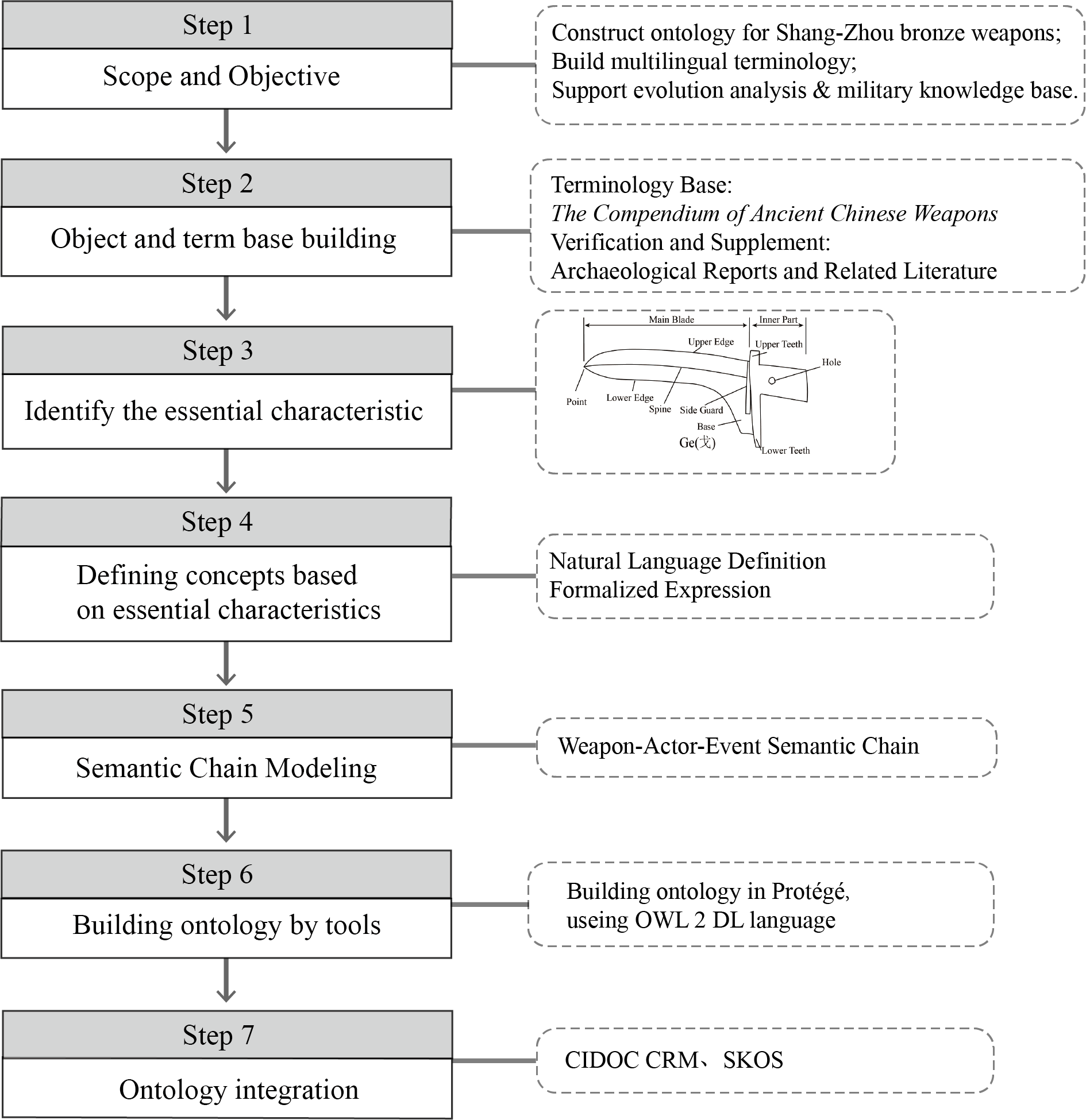
This study proposes an ontology construction framework that integrates semantic modeling of artifacts with the representation of historical contexts. Following the methodology of “term–concept–characteristic” and introducing the semantic chain of “weapon–actor–event”, the framework enables structured knowledge modeling and contextual knowledge organization of Shang–Zhou bronze weapons. The ontology adheres to the terminology standards ISO 1087 (ISO, 2019) and ISO 704 (ISO, 2009) as well as the OWL 2 DL modeling specification, and covers essential characteristic identification, terminology system construction, semantic structure design, and ontology integration. It supports fine-grained, computable modeling of weapon knowledge, ensuring semantic interoperability and ontology integration. The theoretical basis and operational workflow are illustrated in Fig. 1.
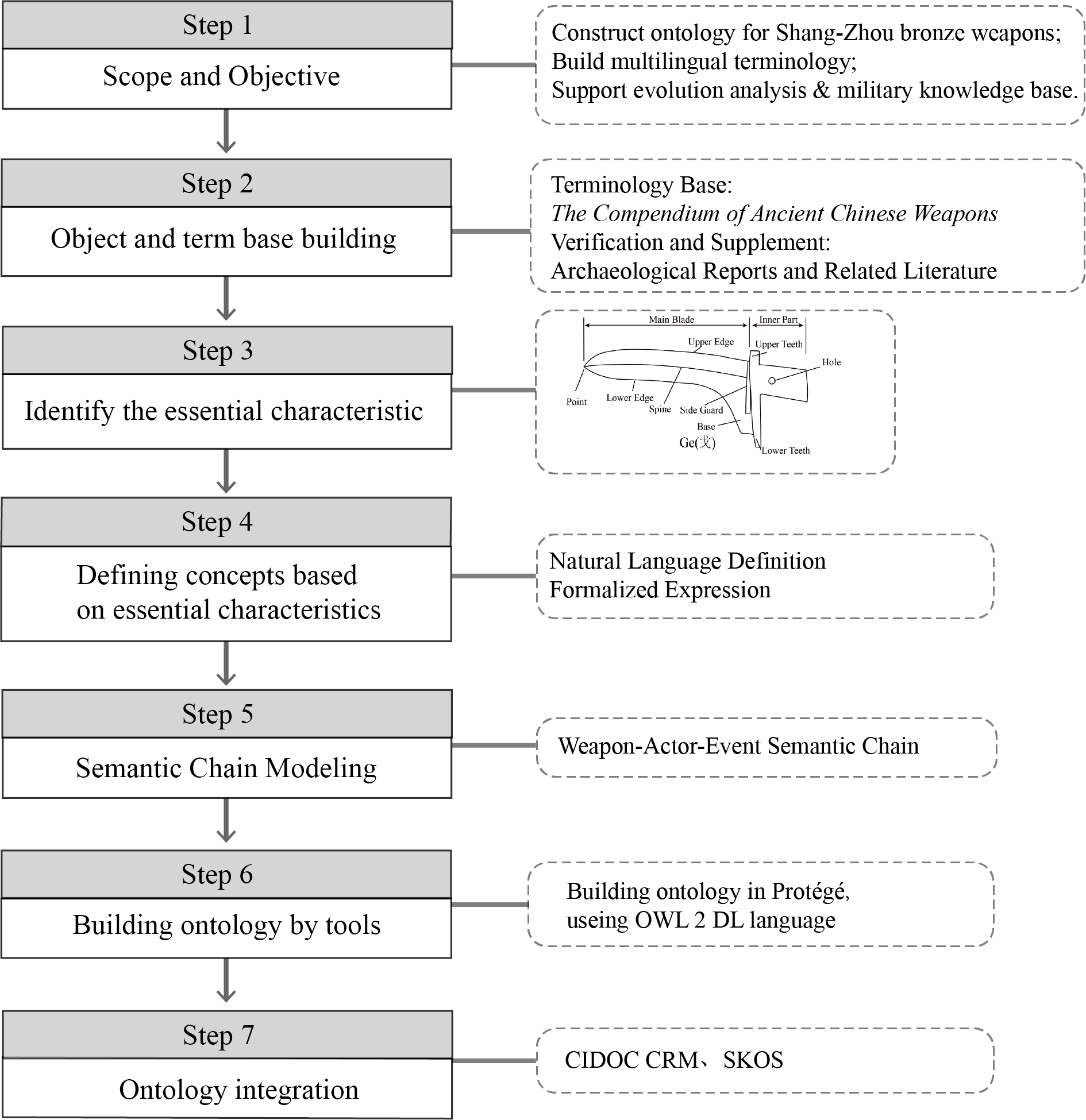 Fig. 1.
Ontology construction workflow for Shang–Zhou bronze weapons. The workflow includes seven steps: (1) scope and objective; (2) object and term base building; (3) essential characteristic identification; (4) defining concepts based on essential characteristics; (5) semantic chain modeling; (6) building ontology on Protégé; (7) ontology integration. CIDOC CRM, International Committee for Documentation Conceptual Reference Model; SKOS, Simple Knowledge Organization System.
This study focuses on Shang–Zhou bronze weapons. The objectives of ontology construction include:
(1) To develop an ontology capable of representing the morphological, functional, and material characteristics of Shang–Zhou bronze weapons with fine granularity, enabling structured, machine-readable description of their form and structure;
(2) To establish a cross-lingual terminology system covering weapon components, structural characteristics, and classification terms, enhancing linguistic adaptability and cross-cultural interoperability;
(3) To normalize the semantic structure of bronze weapons, providing modeling support for morphological evolution and classification inference;
(4) To explore the potential of linking ontology with semantic modeling of military events, building a “weapon–actor–event” chain that connects weapon entities, user roles, and historical events, thereby offering an interface for constructing a military knowledge base and extending the application boundaries of the ontology.
To ensure logical completeness and semantic operability, the ontology was validated against a set of competency questions (Table 1).
| Index | Content |
| CQ1 | What subclasses exist under a given weapon category (e.g., ranged weapons)? |
| CQ2 | What are the Chinese and English terms for subclasses of a given weapon category? |
| CQ3 | To which historical period does a given weapon belong? |
| CQ4 | What decorative motifs are present on instances of a given weapon category? |
| CQ5 | What structural components are included in a given weapon category? |
| CQ6 | What is the weight of a specific weapon? |
| CQ7 | What is the height of a specific weapon? |
| CQ8 | In which warfare events was a specific weapon used? |
The terminology base of this study is constructed primarily from The Compendium of Ancient Chinese Weapons (two volumes), supplemented with archaeological reports, typological catalogues, and historical texts. Although archaeology has established a preliminary consensus on terminological systems, semantic ambiguity arises due to the inherent arbitrariness of language (Yu, 1989). In the terminology extraction process, the following principles were observed: (1) semantic stability: preference was given to academically recognized terms with clear meanings and well-defined structures; (2) domain specificity: terms were strictly limited to the Shang–Zhou bronze weapon domain to avoid semantic ambiguity; (3) multi-source validation: terms were cross-checked across multiple sources to ensure semantic accuracy. For example, the term Ge (dagger-axe) illustrates how conflicting definitions were reconciled. In archaeological typologies, Ge refers to a transverse-bladed weapon mounted on a shaft, while historical texts use alternative names such as goubing, qu, or kui. Morphological variations—such as willow-leaf, long-strip, or sword-shaped forms—have also caused inconsistent naming. To ensure conceptual consistency, this study follows the standardized archaeological definition and records variant historical names as skos:altLabel. During construction, Chinese and English terminology was developed in parallel. In line with SKOS standards (skos:prefLabel, skos:altLabel, skos:definition), the system supports semantic expansion and multilingual compatibility.
A locally closed-world assumption was adopted for characteristic identification: only expert-validated core structural attributes were considered, while contingent or unstable properties (e.g., color) were excluded to maintain logical rigor and class distinguishability. By analyzing essential differences between weapon classes, instances, and parts, this study extracted the essentialcharacteristics at each hierarchical level and identified key attribute dimensions. Classification criteria included functional, structural, and morphological dimensions.
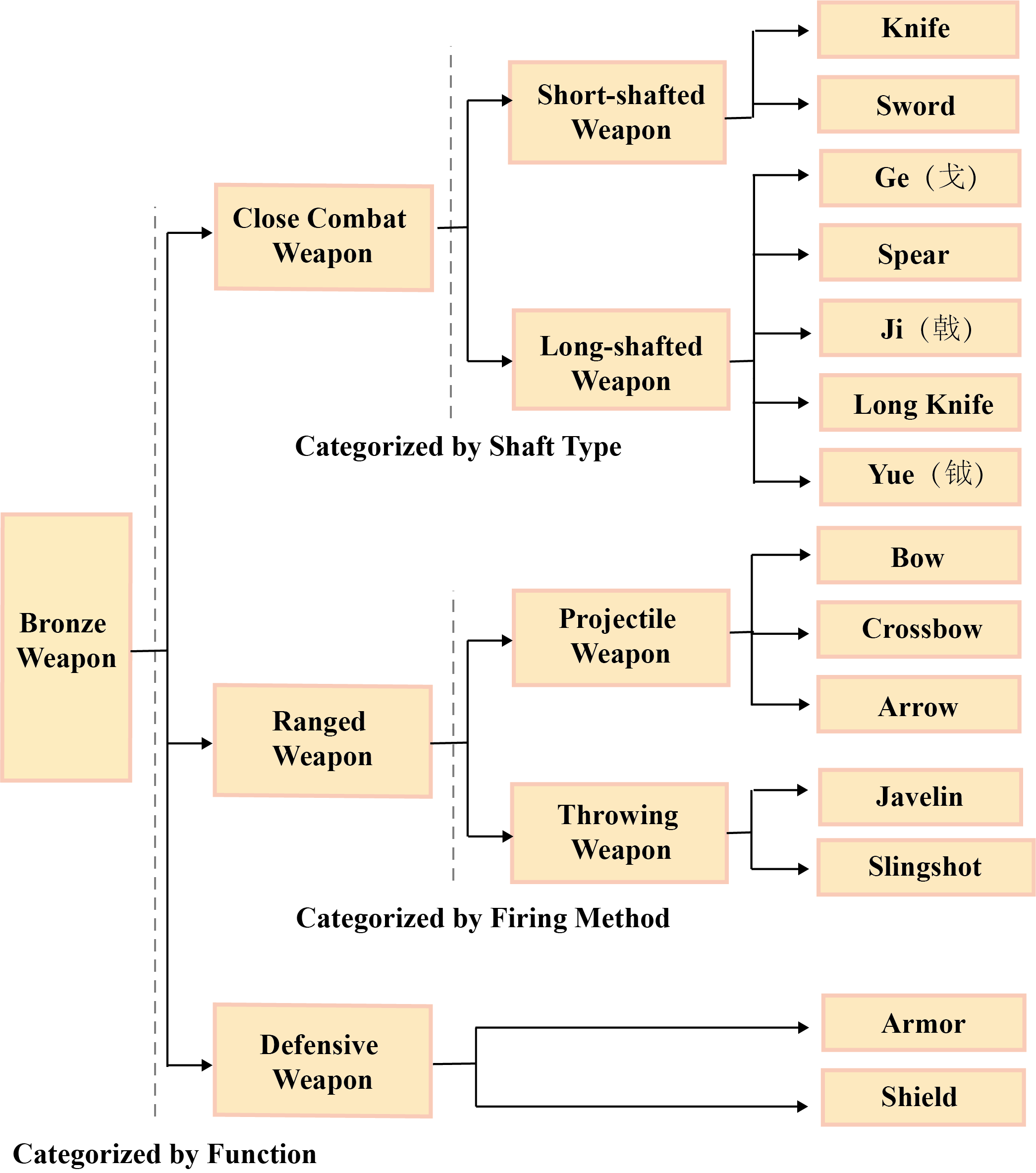
Functional classification — commonly used in archaeology — partitions bronze weapons into: (1) close-combat weapons (e.g., Ge, spear, knife, sword); (2) ranged weapons (e.g., bow, crossbow, arrow); and (3) defensive equipment (e.g., armor, shield). Close combat weapons are subdivided into short-handled (knife, sword) and long-handled (ge, spear, long-knife). Ranged weapons are divided into projectile (bow, crossbow, arrow) and throwing types (javelin, slingshot). Defensive weapons are divided into armor and shields (Fig. 2).
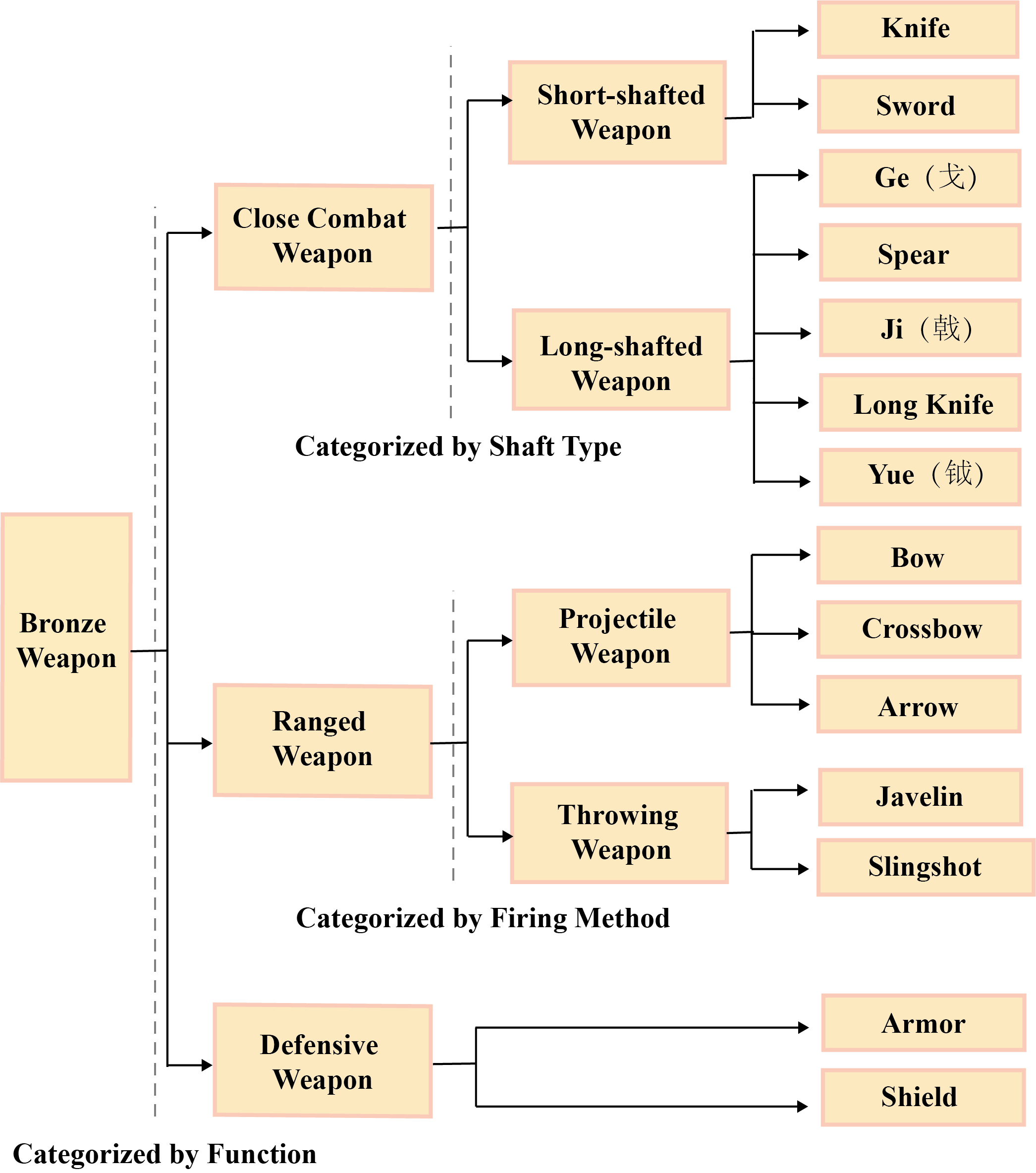 Fig. 2.
Core class hierarchy of Shang–Zhou bronze weapons. The tree shows the functional–structural partition adopted under a locally closed-world assumption: top-level distinctions into close-combat, ranged and defensive classes are successively refined down to shaft type and firing method, respectively.
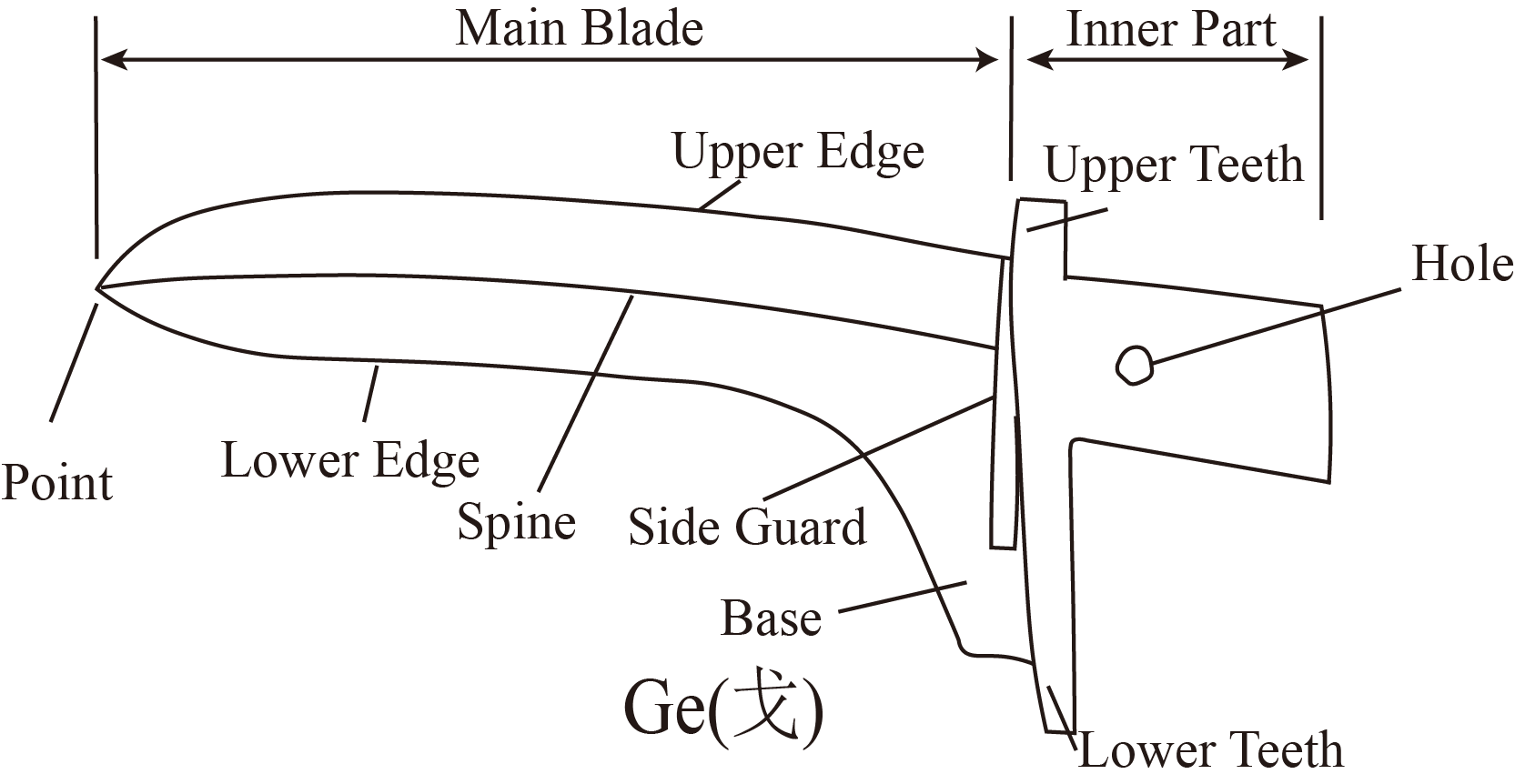
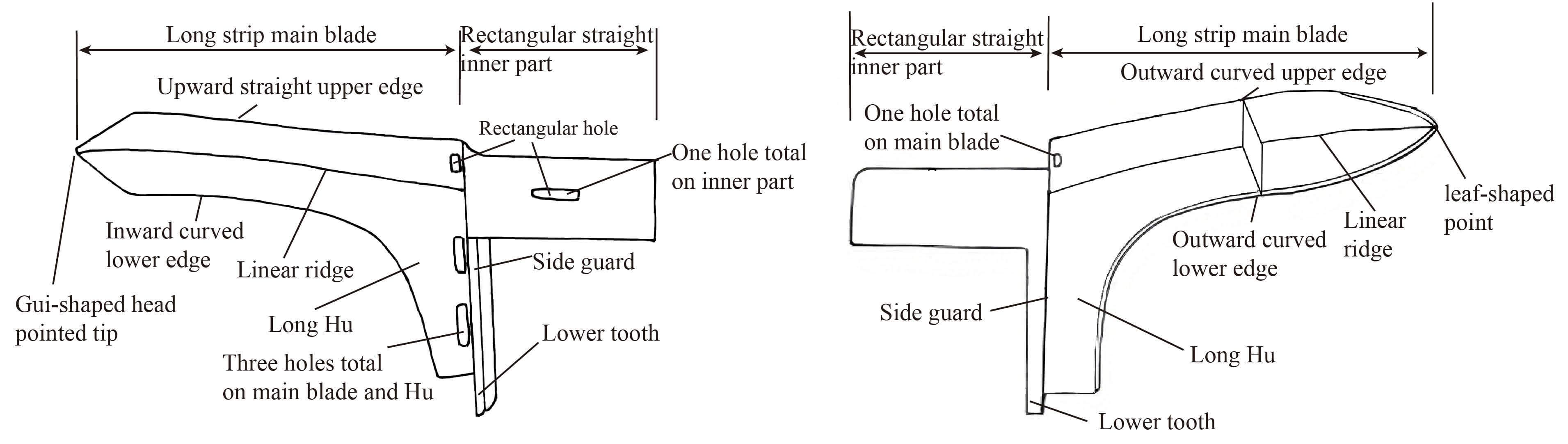
On the basis of this core classification, weapon parts were further identified and categorized through detailed analysis of functional and structural differences within each weapon type. For example, the key parts of a bronze Ge include main blade (yuan), inner part (nei), Hu, hole (chuan), side guard, upper and lower teeth, blade–inner junction, and haft. The main blade itself can be subdivided into main body, edge, tip, and spine (Fig. 3). Based on these parts, different morphological types of Ge can be defined—for example, horizontally extended main blade, triangular main Blade; rectangular straight inner part, or rounded curved inner part (Fig. 4). This approach was extended to other weapon categories, distinguishing unique and shared structural parts. For instance, close combat weapons commonly include edge, tip, haft, spine, and hole. Beyond components, decorative motifs and materials were also modeled as core classes.
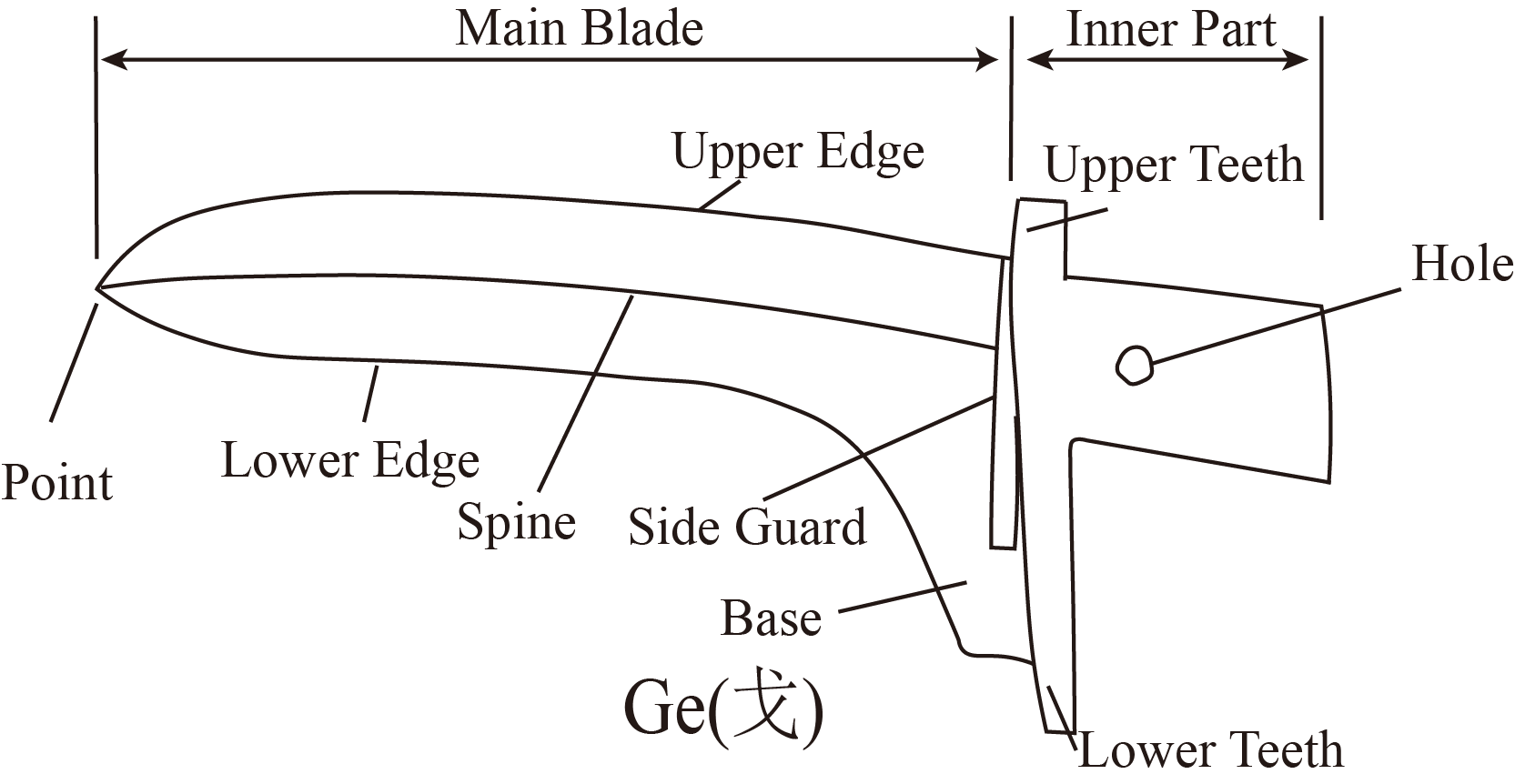 Fig. 3.
Identification of the key parts of a Ge. This figure shows the key parts identification of Ge, including main blade, inner part, side guard, base, upper teeth, lower teeth and hole. The main blade is further divided into upper edge, lower edge, point and spine.
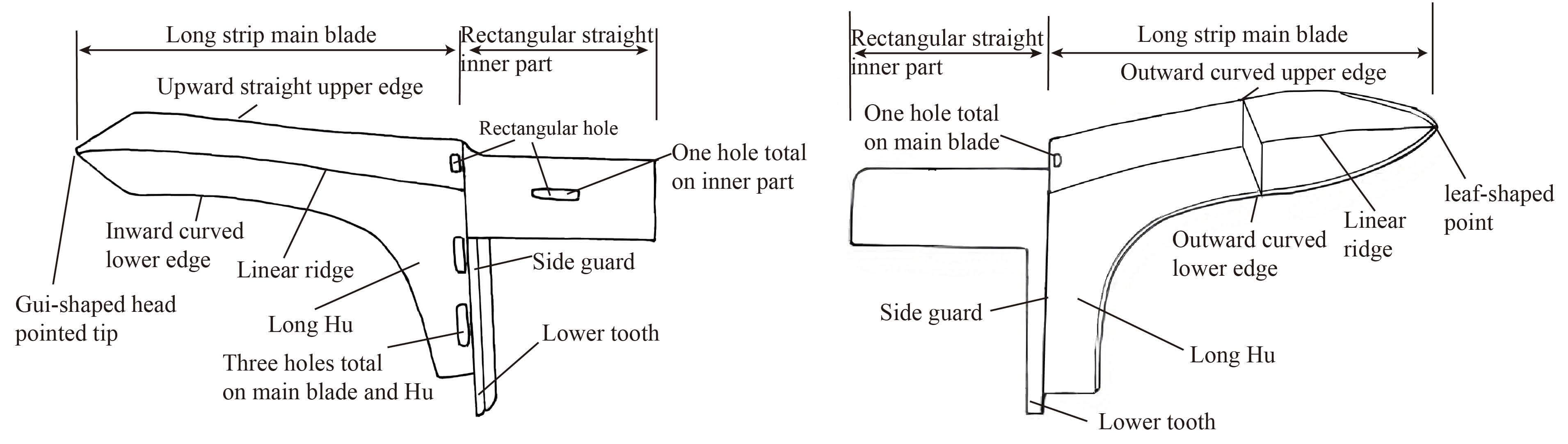 Fig. 4.
Sample characteristic Identification of Ge Instances. This figure shows the distinguishing characteristics of two Ge examples.
The identified structural characteristics were combined into concepts, forming hierarchical models of weapon components. The process included: (1) terminology normalization: assigning unique and unambiguous terms to each component and characteristic; (2) essential characteristic identification: selecting defining characteristics in accordance with ISO 704 and ISO 1087 standards; (3) formalization: translating essential characteristics into DL (Description Logic) axioms to produce inferable class definitions; (4) annotation: recording non-essential but common characteristics as annotations for expert reference without logical entailment.
For example, the concept ChangHuSanChuanGuiYuan Ge (long Hu, three-holes Ge with Gui-shaped blade) is formally defined by the following characteristics:
ChangHuSanChuanGuiYuanGe =
{
hasPart some Long Strip Main Blade,
hasPart some Rectangular Straight Inner Part,
hasPart some Long Hu,
hasPart some Clamped-tang Haft,
hasPart some Side Guard of Ge,
hasPart some Lower Teeth of Ge,
hasPart some Upward Straight Upper Edge,
hasPart some Inward Curved Lower Edge,
hasPart some Gui Head Tip,
hasPart some Long Shaft,
hasPart some Linear Spine,
hasPart exactly 3 (
Hole
and (hasHoleShape value Rectangle Hole)
and (hasHolePosition value Long Strip Main Blade))
}
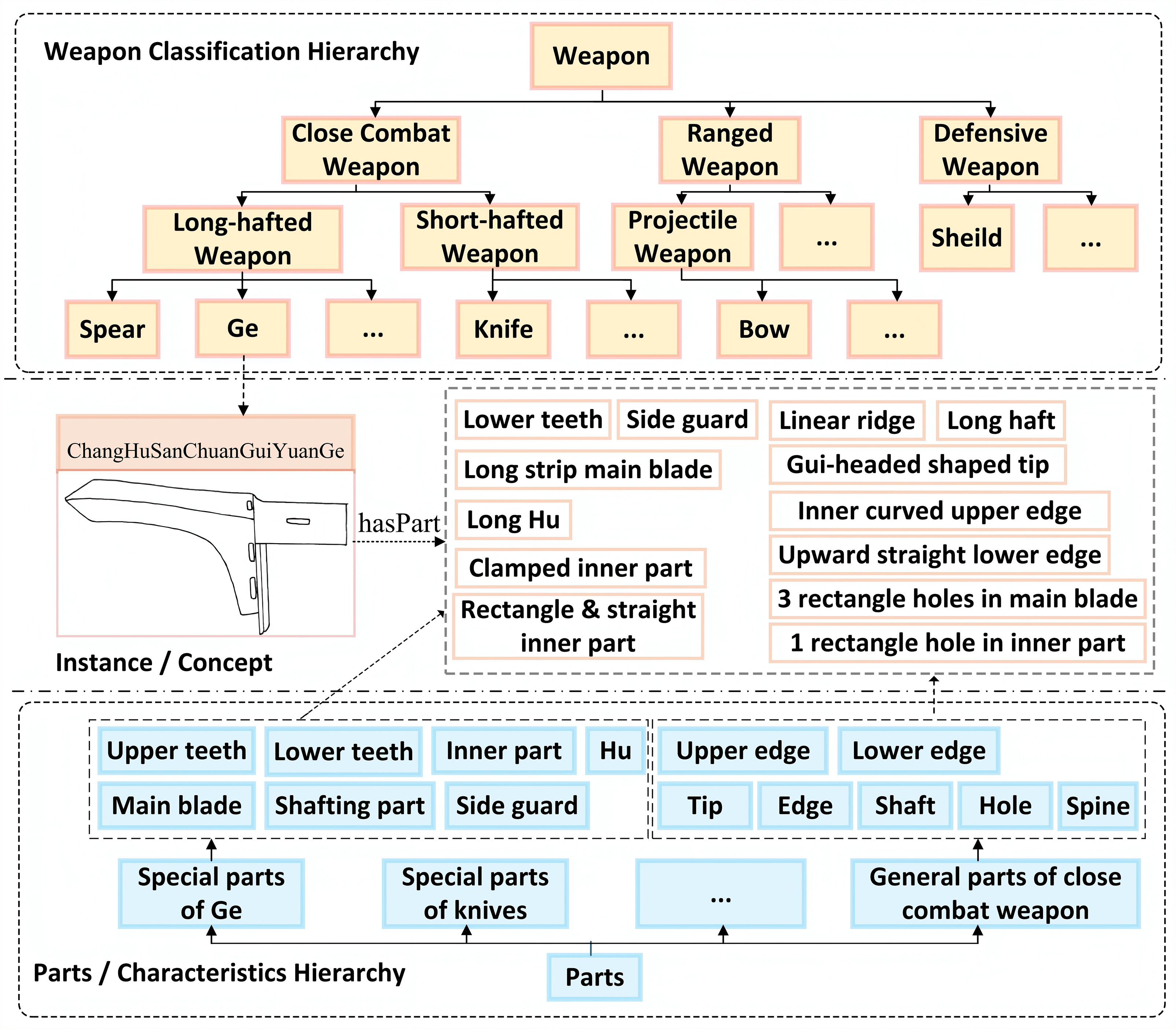
The formal composition of this concept, integrating the weapon classification hierarchy and the parts/characteristics hierarchy, is illustrated in Fig. 5.
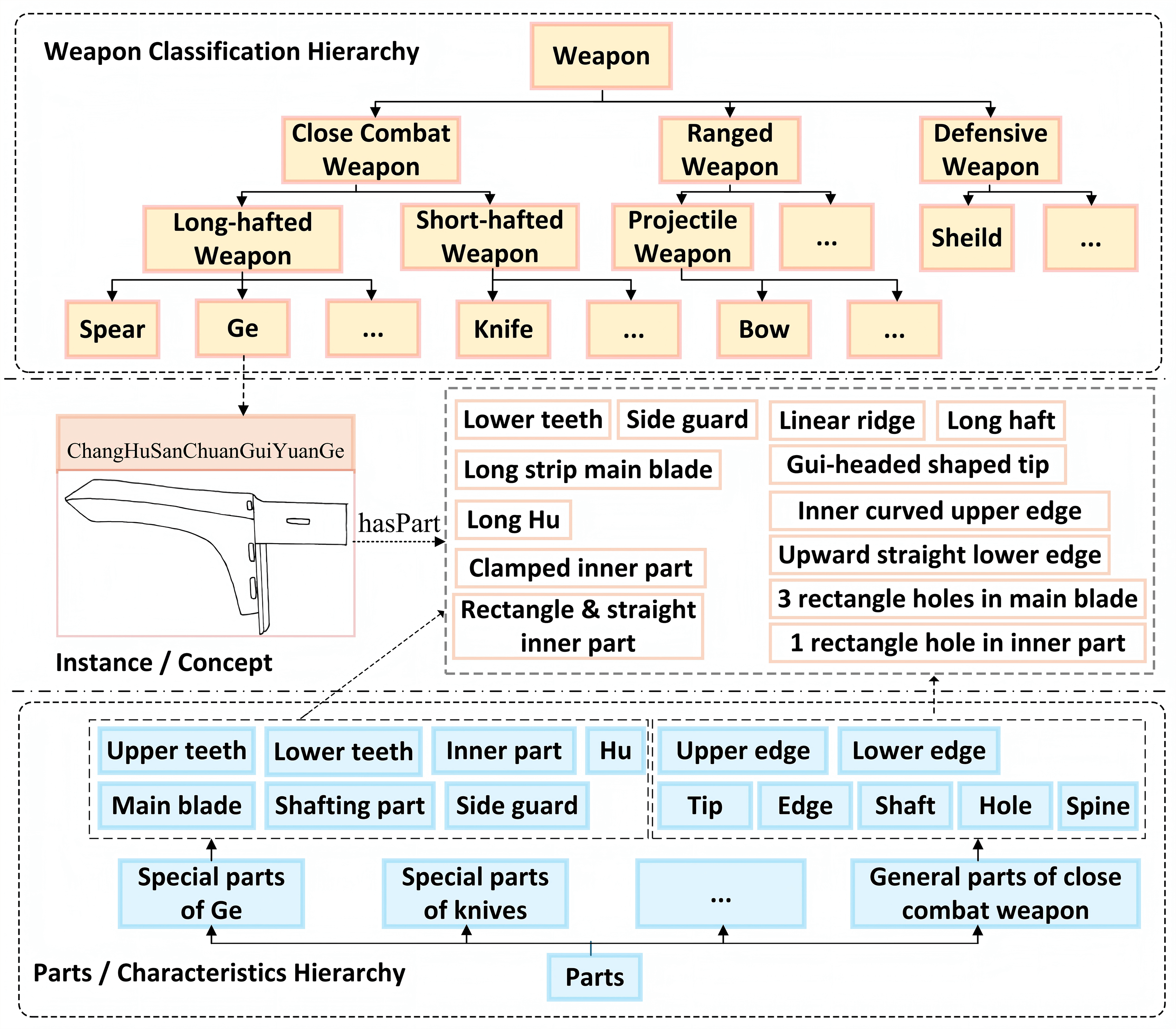 Fig. 5.
Concept composition of the ChangHuSanChuanGuiYuan Ge based on essential characteristics. The concept is defined by the two core hierarchies of bronze weapons: parts/characteristics hierarchy (blue) and weapon classification hierarchy (yellow).
In natural language, this weapon can be described as:
A Ge with an long strip main blade bearing three rectangular holes and a Gui-shaped tip; a long Hu; a rectangular straight inner part connected by clamped inner part to a long shaft; an upward straight upper edge and inward curved lower edge; a main blade with linear ridge, side guard and lower teeth.
This illustrates the “term–concept–characteristic” framework and its formalization method. The framework is extensible: new weapon types (e.g., other forms of ge or spears) can be added simply by supplying their essential characteristic sets and instances, without altering the core class structure.
To enhance the semantic linkage and historical context representation capabilities of the ontology, this study introduces a “Weapon—Actor—Event” semantic chain modeling structure. This chain constructs multi-dimensional semantic pathways through object properties, facilitating a structured transition from static artifact characteristics to dynamic historical contexts. By introducing the dimensions of actors and events, weapons are expanded from “static objects” to “contextual participants”, revealing their semantic relationships within military operations, institutional evolution, and cultural contexts.
The modeling path is as follows:
After identifying concepts and properties, the ontology of weapons is formalized using the Protégé tool in OWL 2 DL/RDFS languages. The terminology system is based on SKOS, where skos:prefLabel and skos:altLabel are used to define preferred and alternative terms, supporting multilingual term management. Concepts are represented as named classes in Protégé, and specific weapons are modeled as individuals.
Since essential characteristics correspond to rigid predicates that cannot be directly expressed in description logic, they are represented as classes, and their semantic connections are realized through object property constraints (e.g., hasPart, hasFunction). Specifically, in the ontology, the expression of essential characteristics is embedded within the component structure system. Essential characteristics of weapons include two types:
(1) The existence of specific parts, such as “upper teeth”, “lower teeth”, and “side guards”, which are essential components of the bronze ge concept or instances;
(2) Structural morphological differences in core parts, such as the shapes of yuan (main blade), including long strip and triangular variations.
Therefore, the ontology establishes a “Parts” class through the hasPart relationship, with detailed characteristics as its subclasses, creating a conceptual definition path with differentiation ability. This modeling approach ensures the linkage between structural models and morphological characteristics, enabling semantic reasoning based on structural differences within the description logic framework.
Descriptive characteristics represent attributes that describe the current state of an object, supporting detailed expression for specific instances. If the value is a data literal, it is translated as a data property; if the value is an individual, it is translated as an object property and class. For instance, “total length”, “blade length”, and “weight” are defined as data properties, while “manufacturing time” is associated with the time ontology via an object property. Relations (e.g., “hasFunction”, “decorationBy”, “madeOf”) are expressed as object properties, with object properties like “decorationBy” having domains and ranges, such as the artifact class and the decoration class.
To improve the semantic interoperability and cross-platform reusability of the weapon ontology, this study incorporates and reuses international standard ontologies such as CIDOC CRM and SKOS, extending the semantic structure of the ontology and unifying the expression of the terminology system.
(1) Integration and Mapping of CIDOC CRM
CIDOC CRM (Conceptual Reference Model) is a general-purpose cultural heritage information model developed by the International Council of Museums (ICOM-CIDOC), widely used to describe fundamental entities such as events (E5_Event), actors (E39_Actor), places (E53_Place), time spans (E52_Time-Span), and their causal and participatory relationships.
In the weapon ontology, the reuse of CIDOC CRM is reflected in the following aspects (Table 2).
| CIDOC CRM Concept | Corresponding Weapon Ontology Concept | Description |
| E5_Event | WarEvent, CombatAction | Modeling historical events involving weapons |
| E39_Actor | Person, Group | Representing the user of the weapon |
| E52_Time-Span | Dynasty | Period information related to weapons or events |
| E53_Place | Location, Site | Location or site of the weapon or event |
| P14_carried_out_by | actor–Event Relationship | / |
| P7_took_place_at | Event–Place Relationship | / |
| P4_has_time-span | Event–Time Relationship | / |
CIDOC CRM, International Committee for Documentation Conceptual Reference Model.
(2) Reuse of SKOS Terminology System
To support terminology management in multilingual environments and build hierarchical structures, the ontology incorporates the World Wide Web Consortium (W3C)-recommended SKOS, used to express preferred labels (skos:prefLabel), alternative labels (skos:altLabel), definitions (skos:definition), and examples (skos:example) for domain terms. By reusing the SKOS terminology system, multilingual labels for Chinese (zh), English (en), French (fr), Russian (ru), and Japanese (ja) are supported, enhancing cross-linguistic interoperability of the terminology system. The rdfs:comment property is used to provide detailed annotations for concepts. This strategy not only aids in terminology standardization but also provides a foundation for building ontology-driven visual navigation systems and multilingual intelligent retrieval systems.
(3) Ontology Interfacing and Interoperability Assurance
To achieve seamless integration of CIDOC CRM and SKOS, the following strategies were employed:
Unified namespaces were assigned for the weapon ontology, CIDOC CRM, and SKOS, with independent namespace prefixes;
To avoid semantic overlap, semantic links were established through rdfs:seeAlso and rdfs:subClassOf;
Interface classes were created to implement intermediary semantic bridges (e.g., the ontology’s “CombatAction” and “WarEvent” as subclasses of CIDOC’s E5_Event, and “dynasty” as a subclass of CIDOC’s E52_Time-Span);
To maintain logical consistency and inference capabilities, all extended classes adhere to the OWL 2 DL description logic specifications.
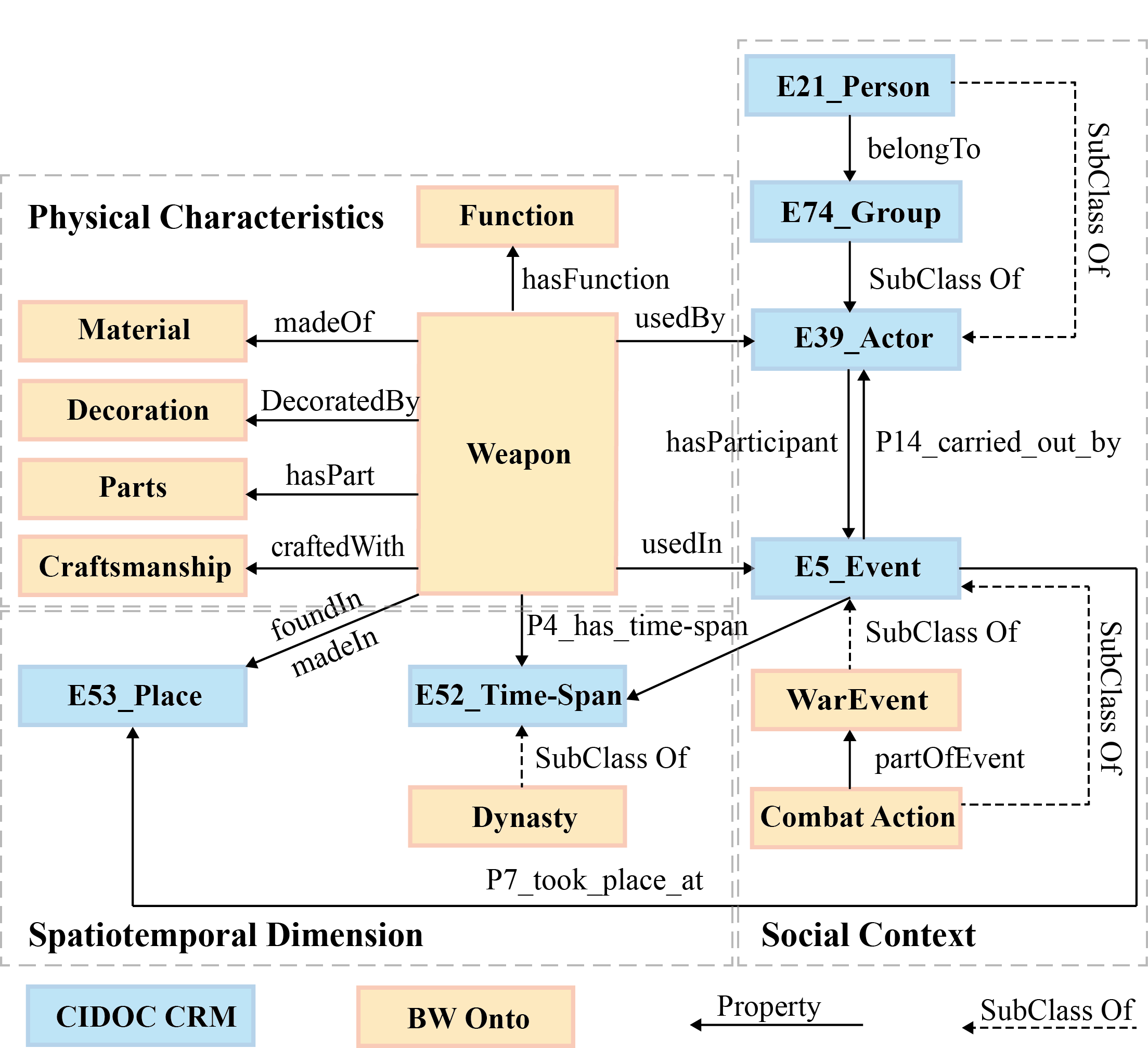
To meet the demands of semantic modeling, form expression, and cross-domain reuse of Shang–Zhou bronze weapons within the context of cultural heritage digitization, this study constructs a formal, hierarchical bronze weapon ontology. The ontology supports modeling at multiple granularities, covering the full semantic pathway from morphological description to semantic chain modeling, and is applicable to subsequent form analysis and knowledge graph construction. The ontology is constructed using the OWL 2 DL language and complies with formal modeling specifications under the Description Logic framework. The ontology includes 442 classes, 18 object properties, 12 data properties, and 4405 axioms. The core classes and properties are shown in Fig. 6.
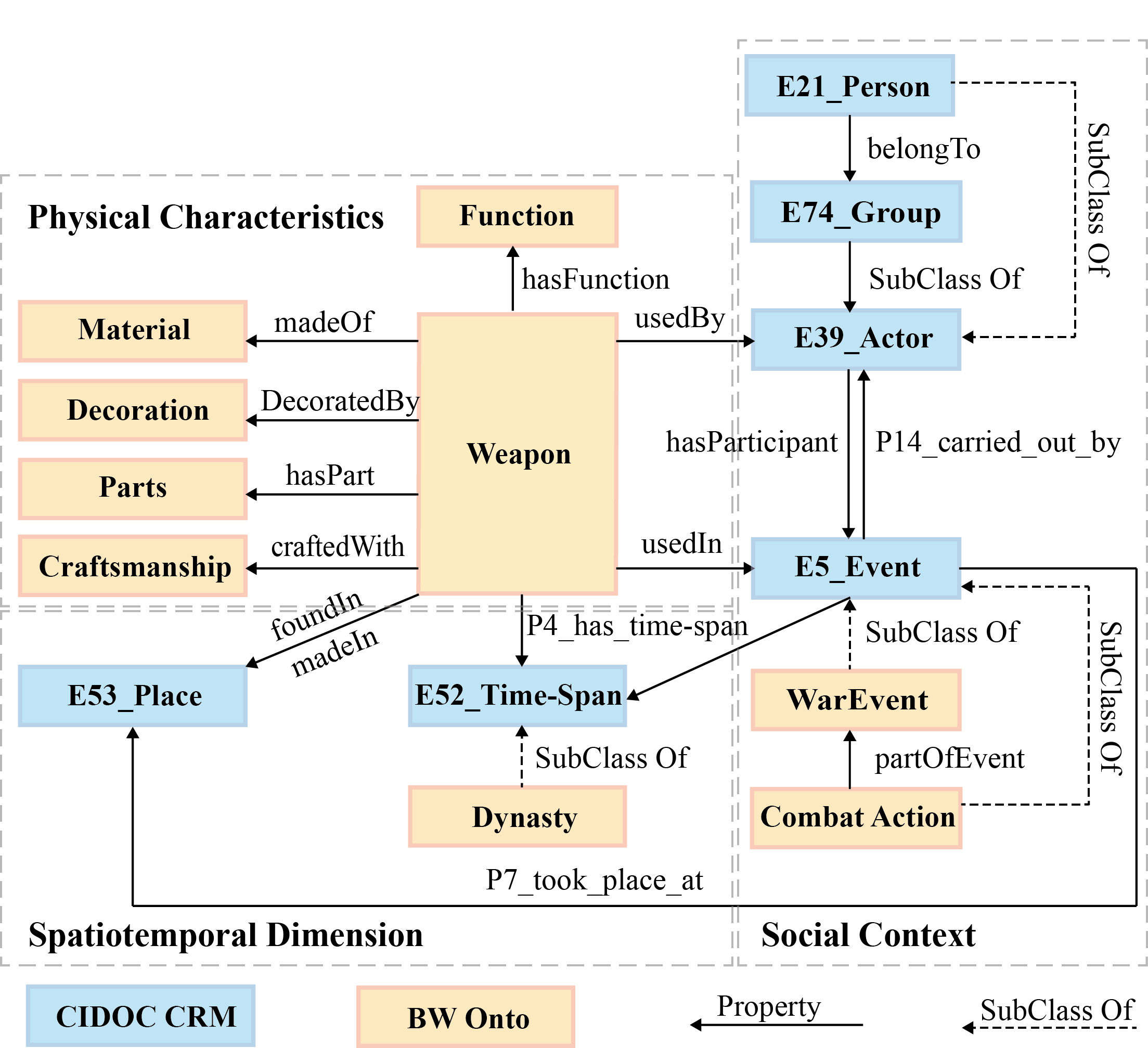 Fig. 6.
Core classes and object properties in the ontology. Rectangles represent classes: blue rectangles indicate classes reused from CIDOC CRM, yellow rectangles indicate bronze-weapon ontology classes; arrows denote object properties.
The ontology construction is centered around two core modeling objectives:
(1) Modeling the morphology of bronze weapons;
(2) Expressing the “Weapon—Actor—Event” semantic chain.
The ontology forms a three-dimensional model consisting of Physical Characteristics, Spatiotemporal Context, and Social Context, with the core class structures of each dimension outlined as follows (Tables 3,4,5).
| Core class | Subclasses | Description |
| Weapon | Close Combat Weapons/Ranged Weapons/Defensive Weapons | The main framework of the ontology, defining the classification and naming of bronze weapons. |
| Part | General Parts of Close Combat Weapons/Specific Parts of Knives/Specific Parts of Swords/Specific Parts of Ge/Specific Parts of Halberd/Specific Parts of Pikes | Includes general and specific parts. The mapping between the bronze weapon class and the part class reflects the morphological characteristics of different entities, supporting detailed descriptions of weapon forms. |
| Material | Animal Tendons/Wood/Jade/Leather Straps/Bamboo/Bronze | Represents the materials used in the construction of weapons. |
| Decoration | Geometric Patterns/Realistic Animal Patterns/Characters and Symbols/Plant-based Decorative Patterns/Mythological and Religious Patterns | Represents surface decorative elements of the weapon. |
| Craftsmanship | Casting/Forging/Inlay/Carving/Polychrome Painting/Lacquer Art | Represents the methods and technical paths of weapon production. |
| Core class | Subclasses | Description |
| E52_TimeSpan | Dynasty | Supports fine-grained temporal reasoning. |
| E53_Place | / | Linked to archaeological sites, casting locations, etc. |
| Core class | Subclasses | Description |
| E39_Actor | E21_Person/E74_Group | Roles of weapon users, manufacturers, etc. |
| E5_Event | WarEvent/CombatAction | Events involving the weapon. |
| Function | Offensive/Defensive/Ceremonial | Represents the function of the weapon (e.g., attack, defense, ceremonial). |
The bronze weapon ontology includes the following object properties (Table 6).
| Objectproperties | Domains | Ranges |
| hasParticipant | E5_Event | E39_Actor |
| P14_carried_out_by | E39_Actor | E5_Event |
| belongTo | E39_Actor | E74_Group |
| partOfEvent | CombatAction | WarEvent |
| P7_took_place_at | E5_Event | E53_Place |
| usedBy | Weapon | E39_Actor |
| usedIn | Weapon | E5_Event |
| P4_has_time-span | Weapon | E52_Time-Span |
| P4_has_time-span | E5_Event | E52_Time-Span |
| foundIn | Weapon | E53_Place |
| madeIn | Weapon | E53_Place |
| madeOf | Weapon | Material |
| hasFunction | Weapon | Function |
| hasPart | Weapon | Part |
| craftedWith | Weapon | Craftsmanship |
| decoratedBy | Weapon | Decoration |
| hasHolePosition | Hole | Part |
| hasHoleShape | Hole | Shape of Hole |
These object properties define the semantic links among weapons, actors, events, time, and place. Together they provide the formal basis for connecting morphological descriptions with social and historical contexts, supporting subsequent knowledge graph construction and semantic analysis.
The ontology includes the following data properties (Table 7).
| Data properties | Domains | Ranges |
| bladeLength | Weapon | xsd:decimal |
| bladeHeight | Weapon | xsd:decimal |
| bladeWidth | Weapon | xsd:decimal |
| innerHeight | Weapon | xsd:decimal |
| innerLength | Weapon | xsd:decimal |
| innerWidth | Weapon | xsd:decimal |
| overallLength | Weapon | xsd:decimal |
| weight | Weapon | xsd:decimal |
| hasOutcome | E5_Event | xsd:string |
| hasHoleCount | Hole | xsd:nonNegativeInteger |
| hasApicalProjectionCount | Apically-Projected Inner | xsd:nonNegativeInteger |
| hasDenticleCount | Denticulated Inner | xsd:nonNegativeInteger |
To enhance interpretability and linguistic interoperability, all classes and properties in the weapon ontology are provided with bilingual annotations:
skos:prefLabel provides the preferred term labels (including both zh and en);
skos:altLabel describes term variants;
skos:definition provides definitions of terms;
skos:example gives examples of terms;
rdfs:comment provides additional semantic explanations;
rdfs:seeAlso links to external ontologies;
dc:creator, dc:license specify copyright information.
These annotations improve the readability and interpretability of the ontology, enabling it to serve as a solid foundation for intelligent retrieval, semantic visualization, and knowledge integration applications.
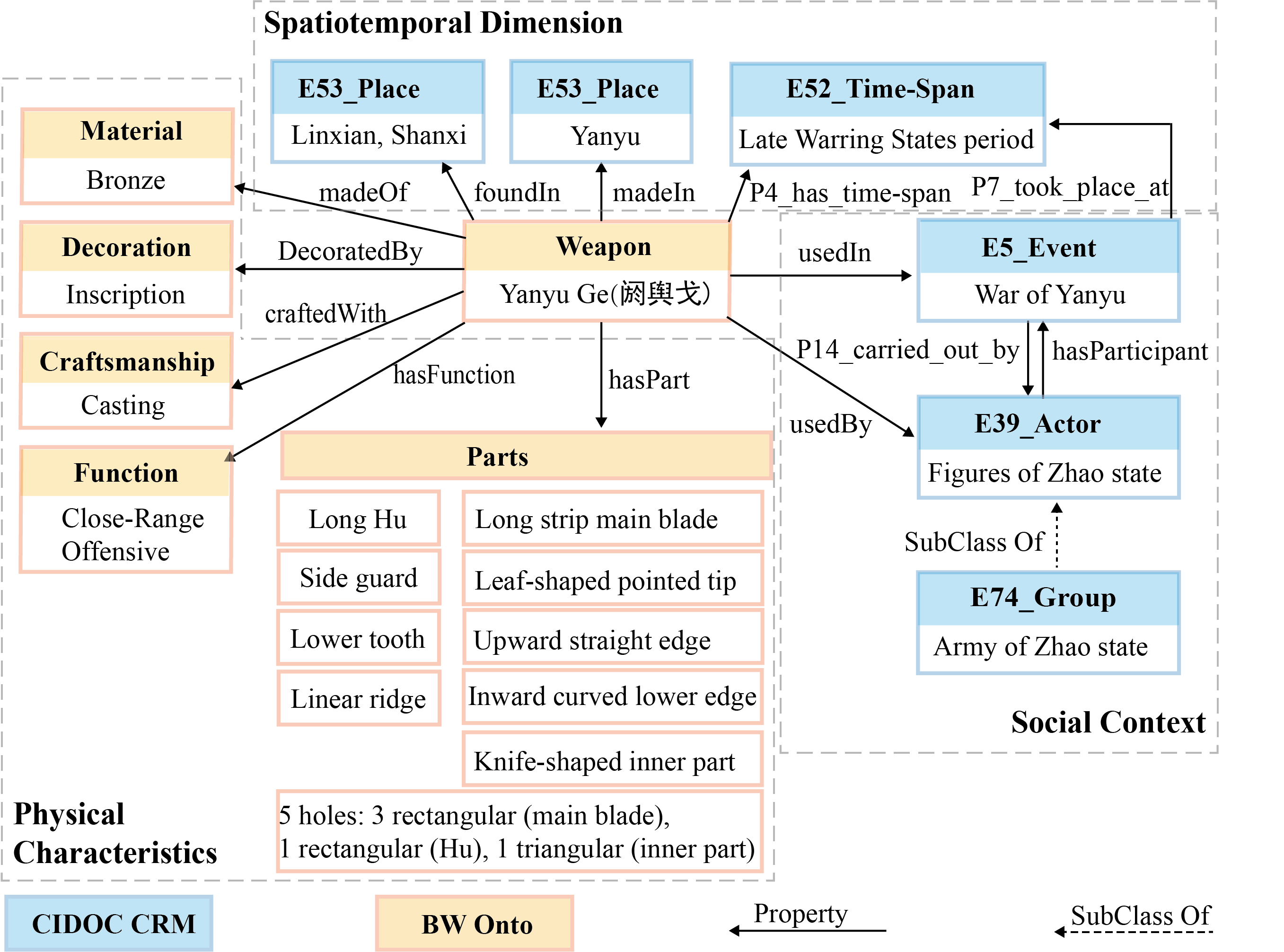
To validate the modeling capacity and adaptability of the ontology, the bronze weapon Yanyu Ge from the late Warring States period of Zhao was selected as a representative example. An instance knowledge graph was constructed focusing on both morphological characteristics and historical context (see Fig. 7). This graph integrates the weapon’s physical characteristics, spatiotemporal information, and contextual attributes, specifically including:
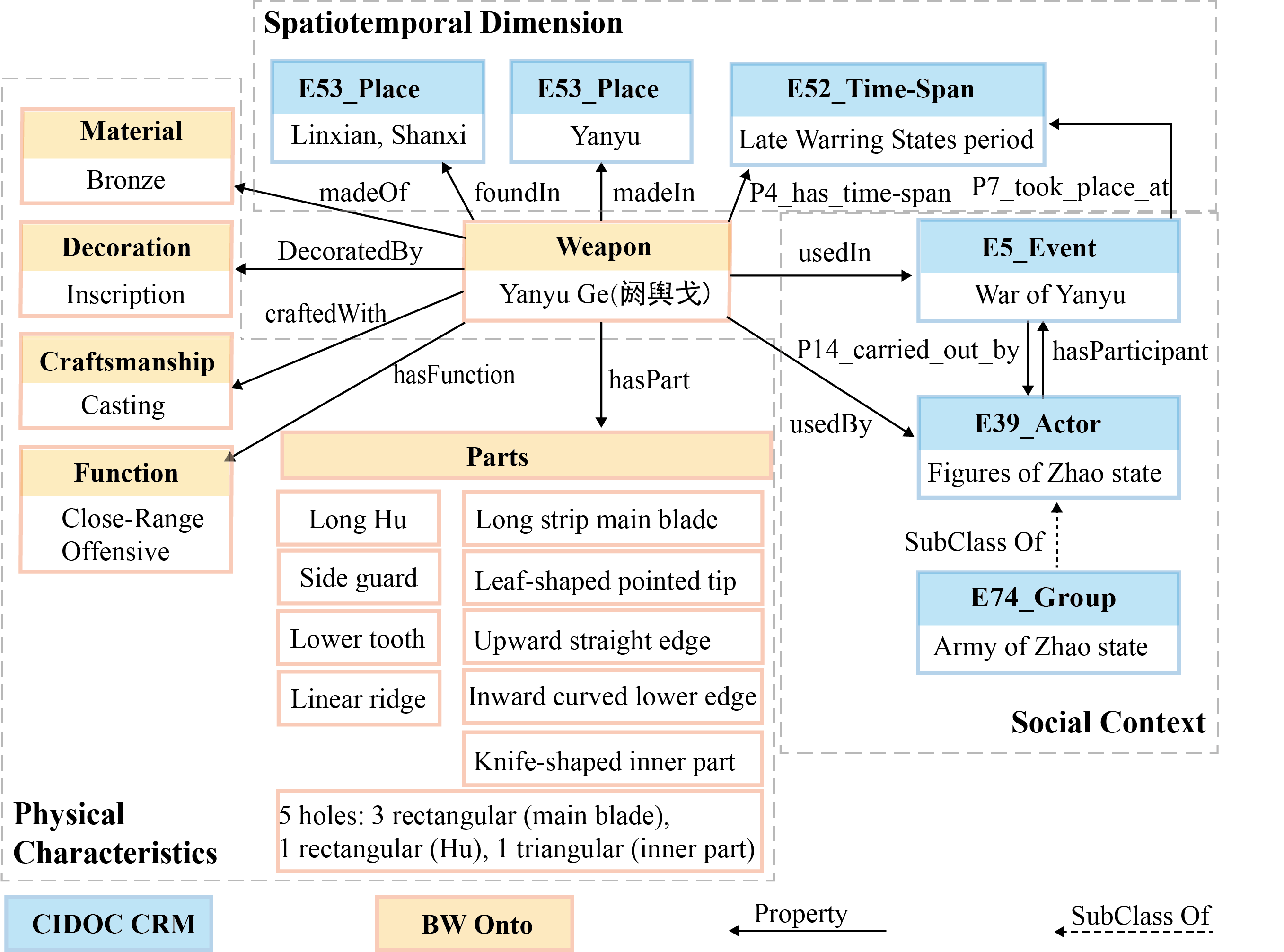 Fig. 7.
Instance knowledge graph of the Yanyu Ge. This figure illustrates the ontology’s capacity to integrate morphological, material, spatiotemporal and event data for a single weapon.
This example demonstrates the ontology’s semantic adaptability in modeling typical bronze weapons. It verifies the ontology’s effectiveness in integrating morphological, spatiotemporal, and contextual information, thereby showing its potential for artifact knowledge extraction, historical event association, and multi-source data integration. The case also provides a practical paradigm and instance foundation for subsequent knowledge graph construction.
To assess the quality and structure of the Bronze Weapon Ontology, two evaluation approaches were employed: structural metrics and competency questions.
Structural completeness and complexity control were assessed using the OntoMetrics online platform. Six commonly adopted ontology structural metrics were applied—Attribute Richness, Inheritance Richness, Relationship Richness, Class/Relation Ratio, Average Population, and Class Richness—to quantitatively analyze the ontology (Table 8).
| Metric | Value |
| Attribute richness | 0.027 |
| Inheritance richness | 1.149 |
| Relationship richness | 0.441 |
| Class/relation ratio | 0.485 |
| Average population | 1.054 |
| Class richness | 0.604 |
The results reveal three key observations:
(1) Low attribute richness and average population indicate that individual classes contain relatively few attributes and instances. This reflects that the ontology is designed primarily as a structured classification framework rather than a fully populated dataset. Low attribute richness helps maintain simplicity and avoids excessive maintenance costs.
(2) Moderate inheritance and relationship richness show that each class has, on average, about 1.15 subclasses, and approximately 44.2% of the relations are non-hierarchical. This suggests that the ontology combines hierarchical depth with cross-class semantic links, balancing structural clarity with expressiveness.
(3) High class/relation ratio and class richness indicate strong connectivity, with most classes participating in relational structures. A class richness of 0.604 shows that over 60% of classes are instantiated, providing a solid foundation for applications. However, since instance population is not the ontology’s primary focus, some classes remain unused and may be populated in future work.
Overall, the six metrics confirm that the ontology achieves a balance between structural control, semantic expressiveness, and scalability.
To evaluate the practical semantic retrieval capacity of the ontology, competency questions (Table 1) were used as test cases. These questions were designed to assess the ontology’s effectiveness in terms of classification, terminology, and contextual modeling. Two representative competency questions are presented here (CQ1 and CQ4).
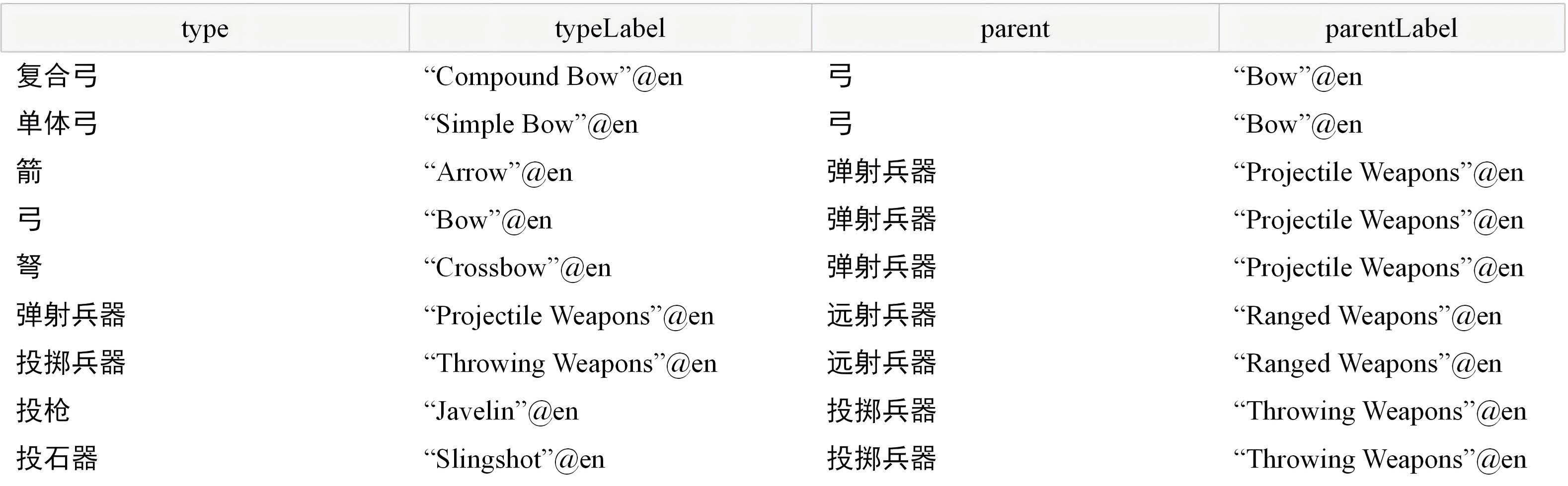
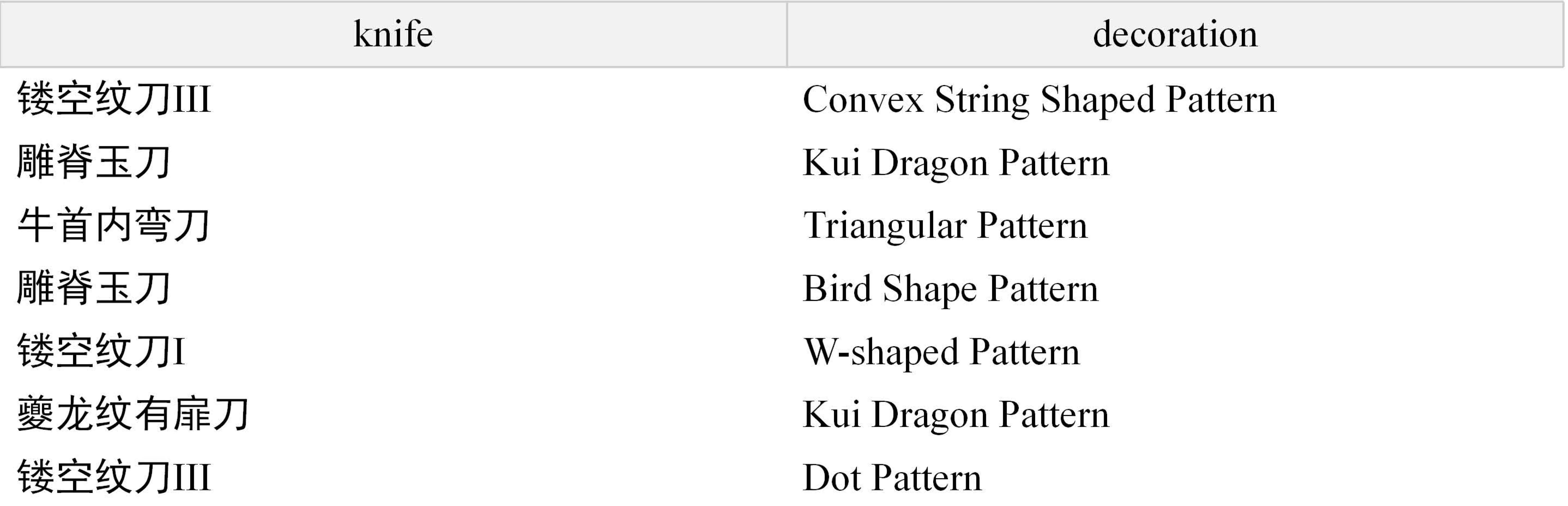
The corresponding queries and results are shown in the following resources: Table 9 (SPARQL prefixes), Table 10 (CQ1 query), Fig. 8 (CQ1 results), Table 11 (CQ4 query), and Fig. 9 (CQ4 results).
| SPARQL Prefix Declarations: |
| PREFIX rdf: |
| PREFIX owl: |
| PREFIX rdfs: |
| PREFIX skos: |
| PREFIX bwo: |
SPARQL, SPARQL Protocol and Resource Description Framework (RDF) Query Language.
| CQ1 SPARQL Query – Types of Ranged Weapons: |
| SELECT DISTINCT ?type ?typeLabel ?parent ?parentLabel |
| WHERE { |
| ?type rdfs:subClassOf+ bwo:Ranged_Weapons . |
| ?type rdfs:subClassOf ?parent . |
| ?type rdf:type ?classType . |
| ?parent rdf:type ?classType . |
| FILTER (?classType = owl:Class —— ?classType = rdfs:Class) |
| OPTIONAL { ?type skos:prefLabel ?typeLabel . FILTER (LANG(?typeLabel) = “en”) } |
| OPTIONAL { ?parent skos:prefLabel ?parentLabel . FILTER (LANG(?parentLabel) = “en”) } |
| } |
| ORDER BY ?parentLabel ?typeLabel |
| CQ4 SPARQL Query – Decorations on Knife Instances: |
| SELECT DISTINCT ?knife ?decoration |
| WHERE { |
| ?knife rdf:type owl:NamedIndividual . |
| ?knife rdf:type ?class . |
| ?class rdfs:subClassOf* bwo:Knife . |
| OPTIONAL { ?knife skos:prefLabel ?knifeLabel } |
| ?knife bwo:decoratedBy ?decoration . |
| } |
| ORDER BY ?knifeLabel |
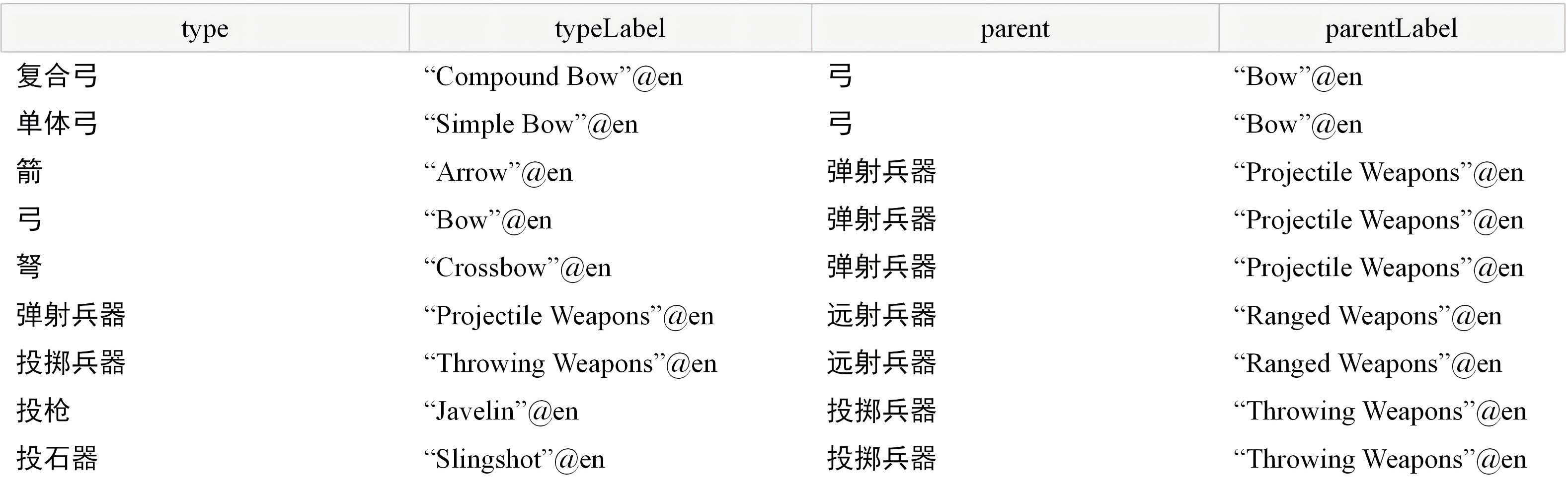 Fig. 8.
The results of CQ1. The Chinese text in the figure is Types of Ranged Weapons, corresponding to the type-level query focus of CQ1 (query details in Table 10).
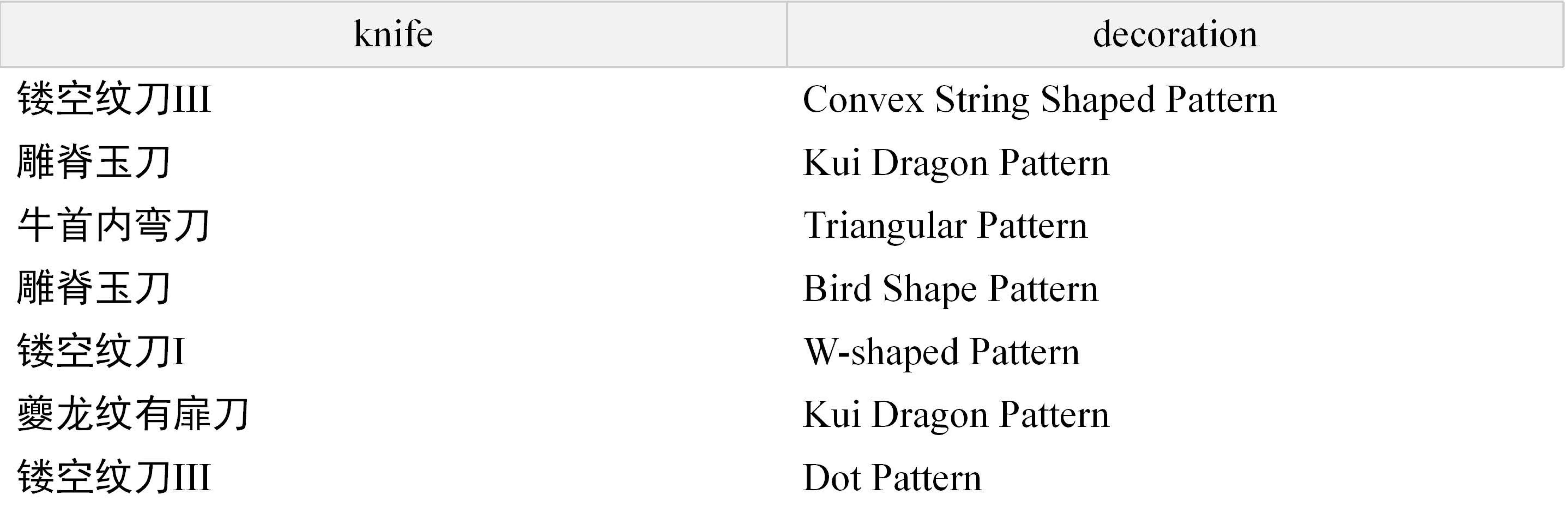 Fig. 9.
The results of CQ4. The Chinese text in the figure refers to knife names, which aligns with the attribute relation examined by CQ4 (query details in Table 11).
(1) Types of Ranged Weapons
(2) Decorations on Knife Instances
In addition to the two representative capability questions, all other queries also returned clear semantic responses, demonstrating the ontology’s strong abilities in type-level recognition, attribute-property association, and hierarchical reasoning. This capability evaluation confirms that the ontology performs well in archaeological knowledge organization, artifact attribute association, and semantic retrieval scenarios. It shows significant potential for supporting cultural heritage digital analysis and the construction of a Bronze Weapon Knowledge Graph.
Traditional artifact studies are often limited by inconsistent terminology and subjective typology, making large-scale, repeatable morphological computation difficult. Ontology-based semantic modeling provides a unified vocabulary and fine-grained annotation for weapon instances, ensuring objectivity and reusability in data analysis. This enables large-scale computational studies across different periods and regions. Using the Compendium of Ancient Chinese Weapons dataset, 160 bronze sword instances (Shang to Warring States) were collected. Fifteen structural characteristics (e.g., blade shape, tang shape, guard presence) were annotated and one-hot encoded, forming the dataset for analysis.
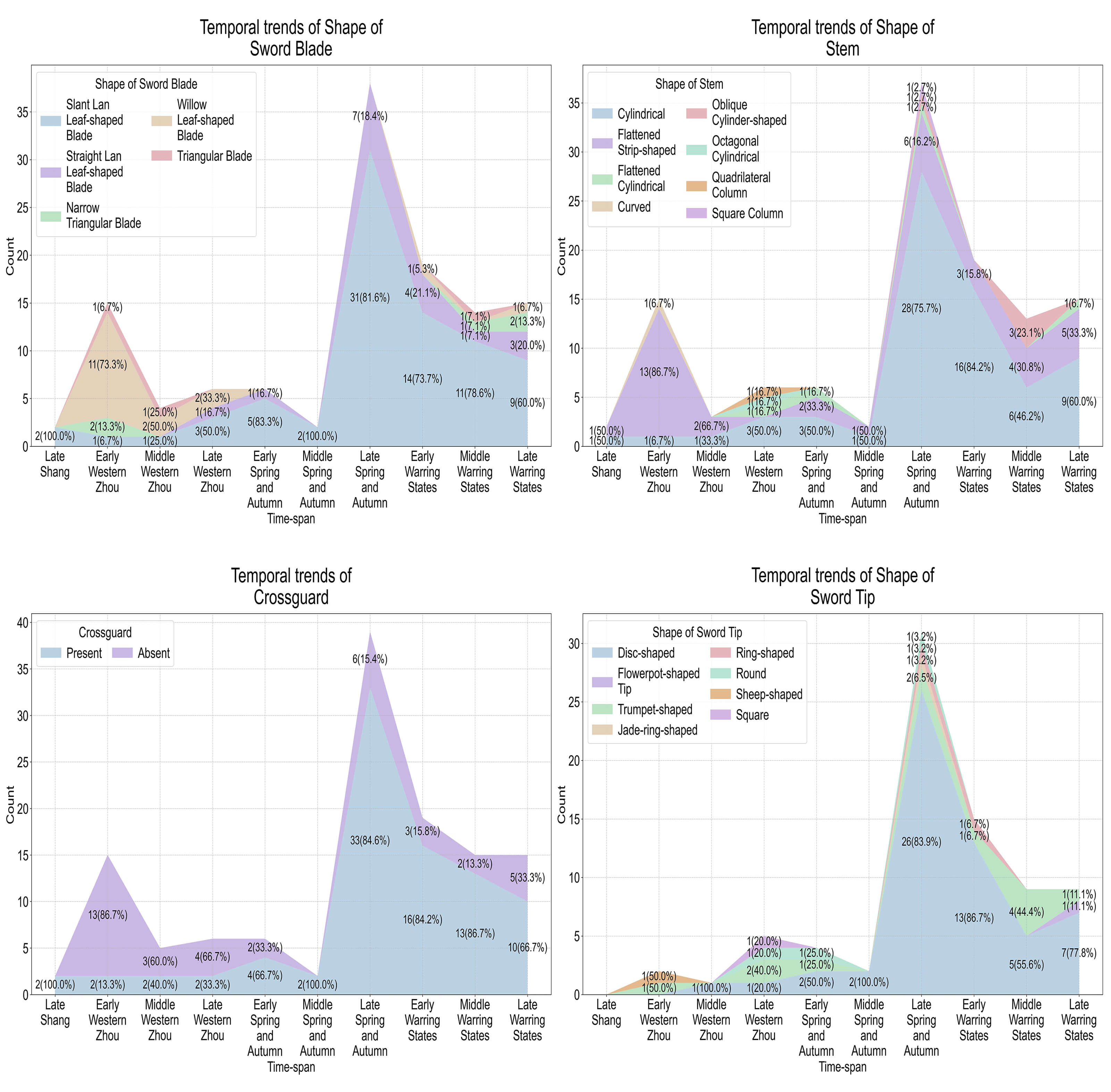
Bronze sword characteristics were statistically analyzed across nine chronological phases (early/middle/late Shang, Zhou, Spring and Autumn, Warring States). Frequency and proportion of features were calculated, and trend charts were drawn (Fig. 10).
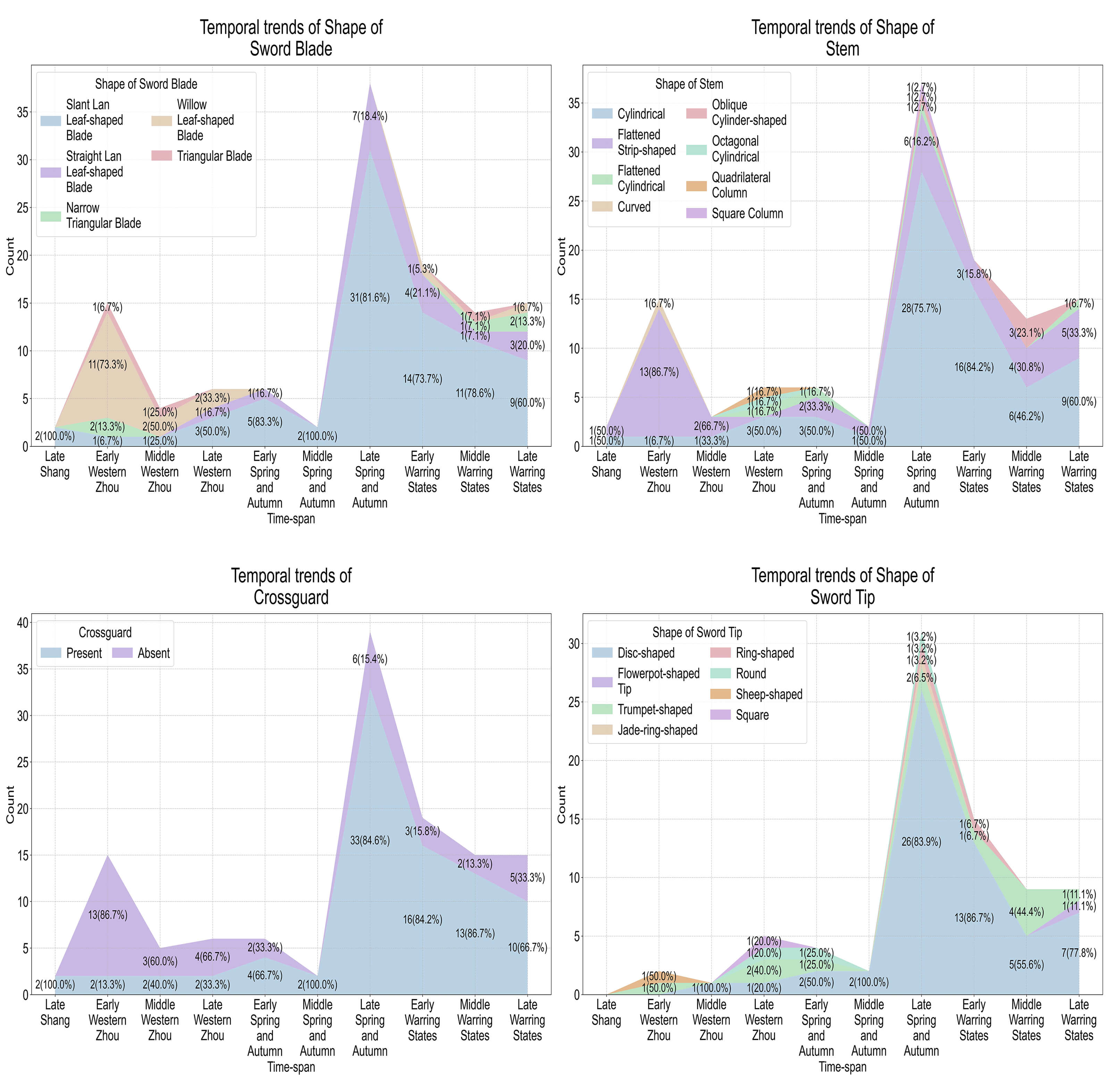 Fig. 10.
Example of morphological evolution of bronze sword parts (only four dimensions are shown here).
The figure shows the following conclusions at the sample level:
(1) Late Spring and Autumn Period: The number of samples significantly increased, and the Warring States period still had a large number of samples. Historically, from the early Western Zhou to the mid-Spring and Autumn periods, chariot warfare was the primary method of combat, with long-handled weapons like the Ge (polearm) and Spear being commonly used in chariot combat. By the late Spring and Autumn period, the focus shifted from chariot warfare to infantry/cavalry warfare, creating conditions for the spread of swords as personal hand-held close-combat weapons. In the Warring States period, large-scale wars and a mature military system broadened the use of swords.
(2) Morphological Changes: The turning point for morphological change occurred in the mid-Spring and Autumn period, where significant differences were found between the mainstream characteristics of the periods before and after. For example, after the mid-Spring and Autumn period, the proportion of swords with a guard increased significantly, with noticeable regional differences. Even earlier, there were examples of swords with a guard. From a craftsmanship perspective, the Spring and Autumn period saw the peak of bronze sword craftsmanship, with casting techniques (including composite casting) becoming more refined. Sword dimensions and forms changed significantly.
(3) Morphological Evolution Rate: The rate of morphological evolution showed significant phase differences. Before the mid-Spring and Autumn period, the proportion of various morphological characteristics fluctuated greatly, but after the mid-Spring and Autumn period until the Warring States period, the mainstream morphological characteristics became more stable. For example, the leaf-shaped short sword was common in the early Western Zhou period but quickly declined; after the mid-Spring and Autumn period, the orchid leaf-shaped sword dominated; and before the mid-Spring and Autumn period, the blade tip shapes were diverse, but after the mid-Spring and Autumn period, the disc-shaped tip became the dominant form. Overall, the characteristics showed a trend of “diversification leading to standardization”.
These patterns suggest (a) early immaturity of craftsmanship before standardized techniques were established, and (b) accelerated unification of forms after the mid-Spring and Autumn due to intensified warfare and trade networks.
Based on the annotated data guided by the bronze weapon ontology, this section further explores artifact clustering methods, with the goal of performing large-scale machine computations to cluster the morphological similarity of artifacts. To make the clustering results more significant, we reduce the influence of incidental factors on the clustering effect through several preprocessing steps. The clustering steps are as follows:
(1) Representative Artifacts: Duplicate types were reduced to one earliest instance to avoid overrepresentation.
(2) Similarity Matrix: Weapon characteristics were encoded as vectors, and cosine similarity was computed to form the similarity matrix.
(3) Network construction: Only strongest links were retained; similarity scores were used as edge weights, and data were imported into Gephi.
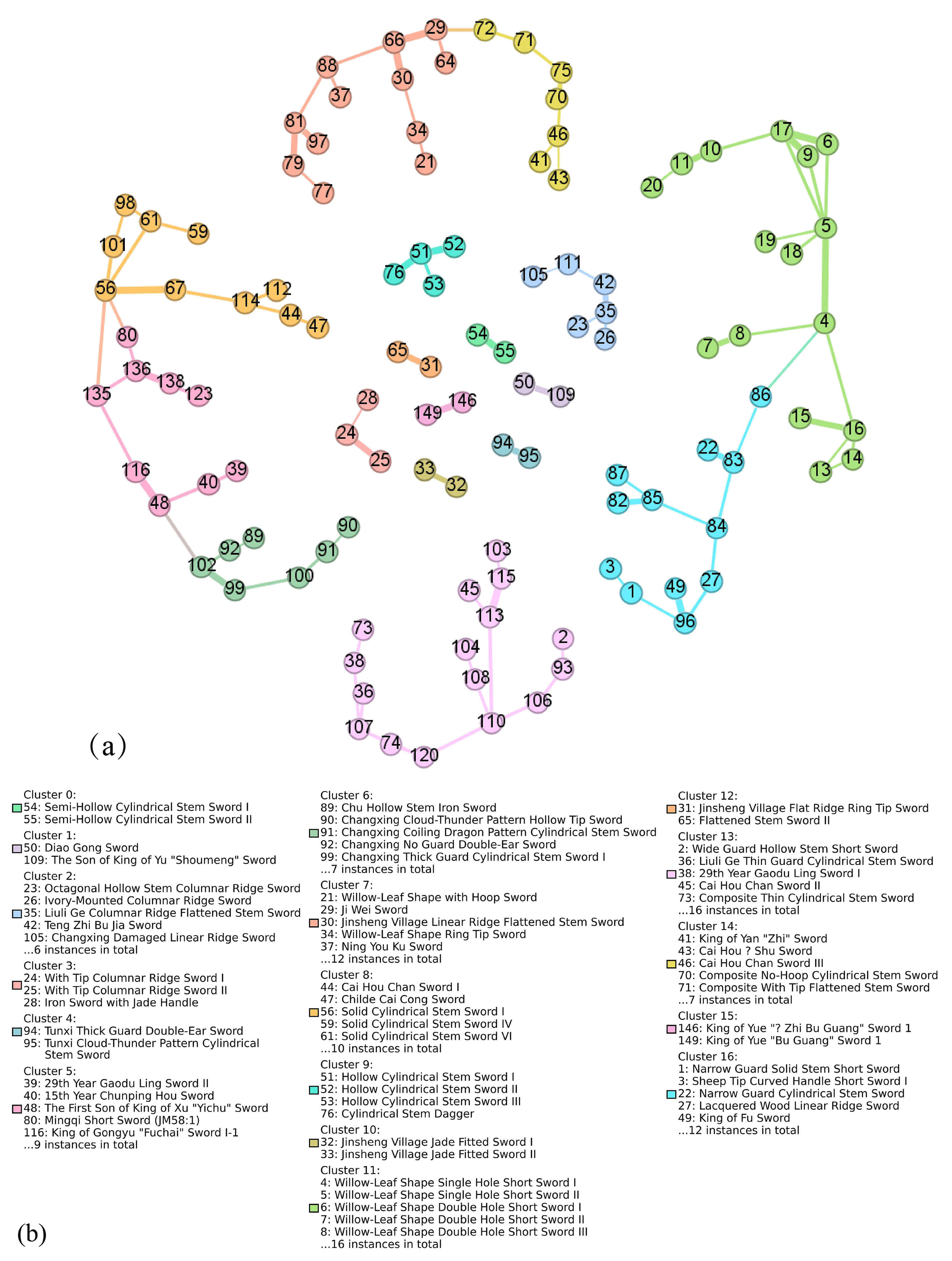
(4) Community detection: The Louvain algorithm was applied to group similar weapons (Fig. 11).
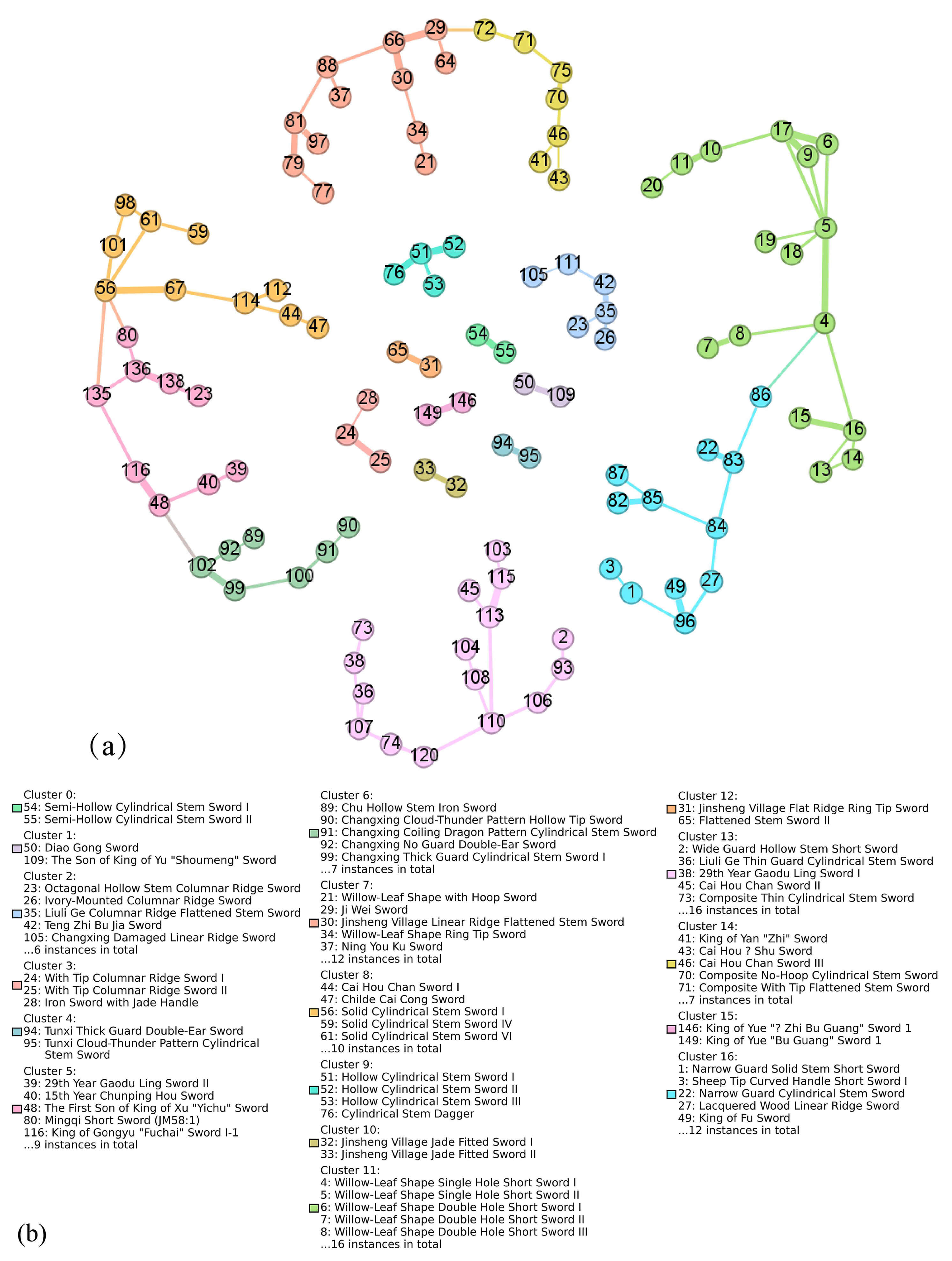 Fig. 11.
Similarity Clustering of Bronze Swords and Corresponding Legend. (a) Similarity clustering results for bronze swords. (b) Legend. The figure displays 17 clusters of bronze swords, with each cluster labeled by a numerical identifier corresponding to the English name listed in the legend. Representative examples include Willow-Leaf Shape Ring Tip Sword and King of Yan “Zhi” Sword. All terminology follows standardized English translations to ensure clarity for an international readership.
The clustering results yielded 17 clusters, with the largest cluster containing 16 instances and the smallest having 2. The modularity score was 0.863, indicating strong community cohesion. Traditional typology in ancient weaponry classification usually relies on the researcher’s experience, with mainstream views categorizing swords based on differences in characteristics such as blade, stem, ridge, guard, and tip. From the clustering results in this study, it is clear that swords with similar names are grouped into the same class. For example, swords named after their morphology (e.g., Cluster 11 Willow-Leaf Shape Single/Double Hole Short Swords) and those named after their origins (e.g., swords prefixed with “King of Yue” or “Changxing”) were automatically aggregated. This indicates that the clustering method implicitly contains the core logic of traditional classification while also revealing potential time and regional groupings, providing a reference for studying the evolution and spread of weapons.
Compared to traditional archaeological methods, the innovation of this study lies in using the ontology to specify the required characteristic types, encoding and computing fine-grained characteristics using universal numerical methods, thereby reducing the impact of subjective weighting on results. This offers an additional tool for traditional classification from a global, comprehensive perspective, enabling the division of large-scale artifacts into groups.
In summary, the ontology-driven bronze sword morphological computation method can reveal both macro-level evolutionary characteristics (e.g., turning points in the Spring and Autumn period) and micro-level similarity groupings between artifacts. Its advantages include reproducibility and cross-regional comparability, though its explanatory power remains limited by sample representativeness, characteristic encoding, and clustering algorithm selection. Future research could integrate traditional archaeology typology and metallurgy studies to form more robust conclusions.
This paper focuses on the semantic modeling and knowledge organization of bronze weapons from the Shang and Zhou Dynasties, addressing the needs of cultural heritage digitization, ancient warfare research, and intelligent semantic services. A Bronze Weapon Ontology (BWO) was constructed with fine-grained modeling capacity and contextual expressiveness. The ontology adopts a “Term–Concept–Characteristic” approach and integrates a “Weapon–Actor–Event” semantic chain, systematically formalizing the physical features, functions, manufacturing techniques, and historical contexts of bronze weapons. This results in a multidimensional modeling framework that moves from static physical attributes to dynamic contextual relationships. Implemented in OWL 2 DL, the model ensures logical consistency and comprises 442 classes, 18 object properties, 12 data properties, and 4405 axioms, supporting complex semantic reasoning and cross-category associations.
For semantic interoperability and scalability, international standard ontologies such as CIDOC CRM and SKOS were reused. Based on Protégé, a cultural heritage ontology model with extensibility, integration capacity, and cross-lingual interoperability was developed. The adaptability of the ontology to complex structural and contextual representations was demonstrated using the Yanyu Ge as a case study. Structural evaluation via OntoMetrics and competency validation via SPARQL confirmed that the ontology maintains clarity, balanced inheritance, and appropriate relation distribution, while exhibiting strong semantic expressiveness and organizational potential. The standardized ontology enables fine-grained annotation of Shang–Zhou bronze weapons and supports morphological statistics and computation, providing new perspectives for analyzing weapon form evolution.
In summary, the Bronze Weapon Ontology provides a unified framework for weapon classification, morphological analysis, and historical context modeling, while also establishing a data foundation for constructing a warfare knowledge graph. The proposed semantic-chain modeling method bridges structural artifact modeling and contextual expression, offering significant potential for intelligent retrieval and knowledge services in cultural heritage. Future work may expand the ontology to support cross-modal semantic integration and digital storytelling through the incorporation of archaeological images, historical texts, and museum datasets.
All data reported in this paper will be shared by the corresponding author upon reasonable request.
TW and XY designed the research study. XY and XL conducted ontology modeling experiments. XL provided critical methodological advice on ontology evaluation and drafted the ontology evaluation analysis section. ZQ analyzed the data and drafted the data analysis section. XY wrote the manuscript. TW and XY contributed to manuscript revisions. All authors read and approved the final version of the manuscript. All authors have participated sufficiently in the work and agreed to be accountable for all aspects of the work.
The authors gratefully acknowledge the administrative and technical support provided by colleagues from the Department of Information Management, Peking University. We would like to express our gratitude to all those who provided assistance during the preparation of this manuscript. We thank the peer reviewers for their valuable comments and suggestions.
This research was funded by the National Natural Science Foundation of China (grant number 72204011) and the Central University World-Class University (Discipline) Construction and Characteristic Development Guidance Special Fund of China—Digital Humanities Special Project (grant number 7101303987).
The authors declare no conflict of interest.
References
Publisher’s Note: IMR Press stays neutral with regard to jurisdictional claims in published maps and institutional affiliations.