

 , Seyed Mahdi Taheri 1,*
 , Mehdi Alipour-Hafezi 1, Mitra Samiei 1
1 Department of Knowledge & Information Science, Allameh Tabataba’i University, 14896-84511 Tehran, Iran
2 Department of Knowledge & Information Science, Tarbiat Modares University, 14115-111 Tehran, Iran
Abstract
This study investigates the interoperability between Schema.org and Resource Description and Access (RDA) as complementary standards for describing bibliographic entities. The research problem arises from Schema.org’s limitation in supporting context-dependent value assignment. RDA, as a content standard, is a promising candidate for bridging this gap, especially within the bibliographic context. Integrating these standards presents an opportunity to enhance bibliographic descriptions by combining the web discoverability of Schema.org with the contextual depth offered by RDA. However, realizing this opportunity requires investigating the alignment between specific components of these standards. Adopting an applied approach, this study employed qualitative content analysis to examine potential alignments of Schema.org properties with RDA guidelines, instructions, and vocabulary encoding schemes (VESs) for describing bibliographic entities. The analytical procedures primarily involved mapping samples of these components based on their predefined semantic specifications. The results delineate specific points of interface between the standards, offering key insights into their interoperability in the context of bibliographic entity description. Additionally, prototype implementations are presented to demonstrate practical methods for integrating these standards within real-world metadata management workflows.
Keywords
- interoperability
- Schema.org
- Resource Description and Access (RDA)
- bibliographic entities
- content standard
- metadata standard
Describing data entities may involve integrating various standards, necessitating attention to their interoperability. Standards’ interoperability, as defined by Hodge (2008), is a condition under which dissimilar standards can be interfaced. In the context of data entity description, this interfacing ability is particularly significant when integrating metadata and content standards, as they typically serve distinct yet complementary functions. These functions become evident when constructing property statements, where metadata standards specify what properties of a data entity are being described, and content standards provide the means to express (assign values to) those properties (Haynes, 2018). Therefore, integrating these standards necessitates ensuring their interoperability, which can be defined explicitly as their ability to be interfaced when constructing property statements. Interoperability thus becomes a critical criterion in adopting metadata and content standards for describing data entities, especially when there is a need to complement one standard’s functionality with another.
Such is the case with Schema.org, a metadata standard that might require a complementary content standard to meet specific contextual requirements. While Schema.org provides a set of property specifications for describing diverse Web data entities, it also offers vocabularies and instructions for assigning values to some of its properties. However, Schema.org appears to lack the granularity and specificity required for supporting value assignment to its properties in specific contexts, such as libraries, where detailed components and information are essential for creating high-quality, consistent metadata. For example, the specified details for Schema.org’s title-related properties do not capture the formulation and sourcing practices applied by catalogers for distinct title types. Such limitations of Schema.org, nonetheless, may be mitigated by integrating a content standard tailored to specific contextual practices.
A promising candidate to complement Schema.org in the context of cultural heritage organizations, especially libraries, is RDA: Resource Description and Access. As a content standard, RDA offers granular guidelines, instructions, and vocabulary encoding schemes (VESs) developed through extensive expertise to address the evolving needs of the library context (Bianchini and Guerrini, 2016; Oliver, 2021; Possemato, 2018; Schreur, 2018; Tillett, 2013; Tillett, 2016). Furthermore, RDA’s operational ontology, rooted in bibliographic conceptual models (Dunsire, 2021b; RDA Board, 2019), makes it especially proficient at describing data entities of the bibliographic universe, often referred to as bibliographic entities (Cossham, 2017). Therefore, given Schema.org’s role in enhancing the presence of library resources on the Web through the major search engines (Fons, 2016; Fons et al., 2012; Godby, 2014; Wallis, 2018; Wallis, 2022), integrating RDA with Schema.org in describing bibliographic entities presents an opportunity to leverage their respective strengths and pave the way for Schema.org into library metadata.
However, realizing this opportunity relies on investigating the interoperability between these standards. According to Hodge (2008, p. 26), the goal associated with such interoperability is “to connect the standards with a minimum of loss at the points of interface”. Consistent with this view, libraries seeking to benefit from integrating RDA as a content standard with Schema.org need first to ensure that RDA can effectively support value assignment to at least the essential properties they choose to adopt from Schema.org. Although such assurance ultimately depends on local choices and requirements, investigating the interoperability between these standards can yield actionable insights into potential alignments at their interfacing points. These insights may aid libraries in determining how to integrate these standards within their descriptions. While two prior studies by Senior (2018) and Fardehosseini (2019) have shed light on specific aspects of interoperability between these standards, their potential to function as complementary metadata and content standards appears to remain unexplored.
In light of these considerations, this study aims to elaborate on the interoperability between Schema.org and RDA by treating them as complementary metadata and content standards for describing bibliographic entities. The key determinant of this interoperability is the alignment between the standards’ interfacing components. In particular, this alignment signifies the capacity of the RDA guidelines, instructions, and VESs to support assigning values to Schema.org properties. Accordingly, this study specifically addresses the following research question: How is the alignment of Schema.org properties with RDA guidelines, instructions, and VESs for describing bibliographic entities?
The relevant literature for this study can be divided into three primary groups, each reviewed in a dedicated section. These groups encompass investigations that share key subject themes with the present study.
The first group comprises the most relevant studies, which have already illuminated specific aspects of interoperability between Schema.org and RDA. Senior (2018) examined possible alignments between key elements likely to be adopted for serial description from emerging metadata standards, including Schema.org and the RDA Registry1. By mapping specific classes and elements, this study revealed that while interoperability exists in the mapping of identifiers and chronology, significant challenges persist due to conceptual differences, Schema.org’s multiple-class inheritance hierarchy, and its relatively limited granularity in serial description. Similarly, Fardehosseini (2019), as part of her doctoral research, conducted a qualitative content analysis to map Schema.org properties to RDA elements. The study concluded that although Schema.org properties can generally be mapped to RDA elements, RDA offers more comprehensive elements for describing bibliographic entities. Notably, neither of the studies incorporated RDA guidelines, instructions, or VESs into their analyses, thereby leaving the question of RDA’s potential to serve as Schema.org’s complementary content standard entirely open for future investigation.
In a less relevant study of this group, Park and Kipp (2019) examined the mapping of elements adopted by diverse libraries from different metadata standards, including Schema.org and RDA. Their findings highlighted that interoperability issues stem from differences in underlying data models—a challenge also present in the case of Schema.org and RDA, as elucidated by Senior (2018) and Fardehosseini (2019).
This particular challenge suggests the ineffectiveness of using RDA elements as intermediary components for examining the alignment inquired in the present study. Consequently, it would also complicate the analysis of the Official post-3R RDA2 due to its element-based presentation of value-assignment components. This study used the Original RDA Toolkit3 instead to avoid this complication. This methodological adjustment also provided the study with a stable baseline—consistent with current metadata creation practices—and ensured comparability with existing metadata profiles, given the ongoing reliance of institutions on the Original RDA4. However, future research should investigate the implications of the official version to support institutions in navigating the forthcoming shift.
Similarly, although considering alignments between the entity types of the standards could have benefited the study, the absence of an official mapping undermined its applicability. Developing an alignment tailored to the present study, although an option, was unlikely to yield a conclusive outcome due to the fundamentally distinct bibliographic entity typologies of Schema.org and RDA. One pertinent example is the opposition of RDA’s WEMI (Work, Expression, Manifestation, Item) approach to Schema.org’s creative works typology, which is based on bibliographic content types and carrier types (Fardehosseini, 2019; Senior, 2018).
The second group includes studies that, similar to the present study and the previous group, contribute to the usability of Schema.org for describing bibliographic entities. The most relevant studies in this group are those concerning the association between Schema.org and other bibliographic standards, models, or ontologies. Apparent as the earliest study of this type, Godby (2013) investigated the relationship between BIBFRAME and OCLC’s linked data model of bibliographic description derived from Schema.org. Expanding on this, Godby and Denenberge (2015a) analyzed the compatibilities between the linked data models of the Library of Congress and OCLC. In other research, Nurmikko-Fuller et al. (2016) and Jett et al. (2016) compared various bibliographic metadata ontologies, including Schema.org, for specific contextual purposes. A more relevant study by Fardehosseini et al. (2020) employed qualitative content analysis to improve the functionality of Schema.org properties by representing them in the Library Reference Model (LRM). They highlighted the ontological differences between Schema.org and LRM, highlighting Schema.org’s limitations in representing relationships between bibliographic entities. They concluded this study by underscoring the role of LRM-based standards, such as RDA, in improving Schema.org’s bibliographic functionality. Further contributions to this domain are provided by Fardehosseini et al. (2021), who examined the correspondence between Schema.org’s entity types and MARC’s genre terms, Wu et al. (2023), who analyzed crosswalks from fourteen research data schemas to Schema.org, and Mohammadi Ostani et al. (2024), who investigated the enrichment of Schema.org “Thesis” properties using specific cultural heritage metadata standards.
The second group may also be supplemented by studies that contribute to the same topic but do not focus on its association with other standards, ontologies, or models. As highly relevant contributions of this type, Han et al. (2015) examined Schema.org’s effectiveness in describing library holding data, with attention to the Schema Bib Extend Community Group’s (2016) recommendation; Mohammadi Ostani et al. (2021) investigated the localization of Schema.org for manuscript description in the Iranian-Islamic information context through documentary and qualitative content analysis; and, Taheri et al. (2022) studied the Search Engine’s responses to authority data properties embedded into Schema.org-based metadata on the Microdata syntax.
Despite the valuable efforts made by the studies of this group to pave the way for Schema.org into bibliographic metadata, its compatibility with bibliographic metadata content appears to remain unaddressed by prior research. The present study seeks to respond to this gap by examining RDA’s potential to enhance the compatibility of Schema.org with bibliographic metadata content.
The third group consists of studies that have focused on RDA’s association with metadata standards, metadata ontologies, or metadata models other than Schema.org. Among the most relevant studies of this group that have investigated the interoperability of RDA with one or multiple metadata standards (Patrício et al., 2025; Taniguchi, 2023; Taniguchi, 2025; Wacker et al., 2011; Zapounidou, 2020; Zapounidou et al., 2019), only Wacker et al. (2011) focused on RDA’s content standard functionality. To address research gaps concerning RDA’s interoperability with non-MARC metadata standards, Wacker et al. (2011) reported on tests conducted by three institutions that applied RDA as a content standard to their Dublin Core, Metadata Object Description Schema (MODS), or Encoded Archival Description (EAD) metadata. They concluded that the lack of established frameworks and applications specifically designed to support the integration of RDA as a content standard for non-MARC metadata limited both the scope of the tests and the ability to fully realize and apply RDA’s benefits. The present study, in contrast, adopts an a priori approach to address a similar research gap, given that Schema.org–RDA integration remains unestablished. However, future research may benefit from a posteriori approaches once this integration is fully realized and implemented by relevant institutions.
Additional contributions include Baker et al. (2014) and Seikel and Steele (2020), who comparatively analyzed multiple bibliographic models, including RDA. It is also noteworthy that in a pertinent non-research document, Dunsire (2009) discussed the application of RDA as a content standard for UNIMARC metadata, emphasizing the standards that facilitate their interoperability. Taking advantage of such emphasis seems to be ineffective in the present case, given the current contextual distance between Schema.org and RDA. LRM potentially serves as an effective harmonization medium for RDA (Dunsire, 2023; Oliver, 2021; Oury et al., 2018), but it is likely to prove less effective in the case of its interoperability with Schema.org, which follows a different ontological approach.
Beyond the three groups reviewed thus far, additional works also offer insights into semantic interoperability between metadata standards and content standards. For instance, Nilsson et al. (2006) presented a conceptual framework that distinguishes between element vocabularies and value vocabularies, suggesting the possibility of alignment between vocabularies from both standard types. A particularly relevant study by Chan and Zeng (2006) offered a detailed methodological analysis of schema-level interoperability, with implications for aligning metadata and content standards. Their emphasis on crosswalks that map not only element names but also cardinality, repeatability, and value formats informs how one might align components between metadata and content standards. By explicitly separating property semantics from value constraints, they further showed how application profiles can be constructed to “snap together” (Duval et al., 2002) chosen properties with their corresponding value-assignment components. Furthermore, their recommendation to register both structural schemas and content rule sets in a central registry suggests a way to maintain and publish the mappings as a machine-readable profile, ensuring consistency and enabling automated validation in metadata management applications. More recently, Hendrawan et al. (2024) mapped metadata content from International Standard Archival Description (ISAD) and Cataloging Cultural Objects (CCO) into Dublin Core, showcasing how content standards from different contexts (archives, museums, and libraries) can be semantically aligned through a shared metadata standard. The study highlighted that effective retrieval depends on harmonized content standards and descriptive conventions, and without compatible value structures and terminology, even well-mapped metadata may fall short in supporting cross-domain discovery.
It emerges that the existing relevant literature predominantly focuses on interoperability among metadata standards and models. The present study appears to be among the very few that examine interoperability between specific metadata and content standards (Hendrawan et al., 2024; Wacker et al., 2011). The reviewed literature underscores “mapping” as a well-established technique for both examining and achieving semantic interoperability, which may also apply to the interoperability under investigation.
Using an applied research approach, this study employed qualitative content analysis to examine the potential alignments between specific Schema.org and RDA components. The content units of this analysis included Schema.org properties and RDA guidelines, instructions, and VESs, from which purposive and census samples were drawn to form the registration units. The analytical procedures primarily involved mapping the registration units according to their predefined semantic specifications, including their associated names, entity types, and definitions—the meaning units. The following subsections provide a detailed outline of the data collection, analytical procedures, and validations employed to address the research question.
Given the breadth of the Schema.org bibliographic entities and the extensiveness of their properties, purposive sampling was employed to enhance the feasibility and depth of the analysis. Regarding the objective of the present study and its applied approach, sampling decisions were guided by relevance to the description of diverse bibliographic entities. In line with this sampling strategy, properties were selected based on three levels of entity type granularity enabled by Schema.org’s property-inheritance mechanism. Thanks to this mechanism, selecting properties from top-level entity types also included fundamental properties from their subtypes, thereby facilitating the generalizability of the analysis without the need to include all properties from lower levels of the entity type hierarchy.
The first level focused on properties shared across diverse bibliographic entities—that is, properties applicable to any entity relevant to the bibliographic universe, including content objects, agents, and places. Accordingly, this level incorporated all properties defined under Schema.org’s “Thing” class, which are inherited by all other Schema.org entity types. This inclusion thereby contributed to the generalizability of the analysis across different types of bibliographic entities.
The second level involved properties shared across diverse creative works—including both their concrete and abstract instances—as entities highly relevant to the bibliographic universe. Theoretically, this high relevance is evident in various definitions and descriptions of the bibliographic universe, evaluated by Cossham (2017) in the second chapter of her PhD dissertation (pp. 14–36). Accordingly, the samples for this level were selected based on the type-specific properties5 of “CreativeWork”, whose practical relevance to the bibliographic universe has been recognized by Godby (2014), Godby and Deneberg (2015a), and Fardehosseini et al. (2020). Regarding the study’s scope, the properties “schemaVersion”, “sdDatePublished”, “sdLicense”, and “sdPublisher” were purposively excluded, as they apply to the description of entity descriptions (i.e., meta-metadata) rather than the entities themselves. Additionally, given the inapplicability of the type-specific properties of “CreativeWork” to item-level descriptions (Godby et al., 2015b), this level also included five “Offer” properties recommended by the Schema Bib Extend Community Group (2016) for library holding data. This level further enhanced the generalizability of the analysis across Functional Requirements for Bibliographic Records (FRBR) Group 1 entities (i.e., works, expressions, manifestations, and items), which are also incorporated into LRM and adopted by both the original and the official version of RDA (Croissant, 2012; RDA Board, 2019; Riva et al., 2018).
The third level considered properties specific to a common type of creative work. This additional level was considered solely to better reflect real-world bibliographic description practices where distinct profiles are often developed for different types of content objects (Dunsire, 2021a; Gavili Kilaneh et al., 2019). This level included the six type-specific properties of Schema.org “Book” as a well-recognized type of content object and a widely used subclass of Schema.org “CreativeWork” on the Web, according to data published by Web Data Commons (2024).
Ultimately, the sampling resulted in the selection of 12, 105, 6, and 5 properties, respectively, from Schema.org’s “Thing”, “CreativeWork”, “Book”, and “Offer” types. Due to Schema.org’s inheritance mechanism, these properties simultaneously encompass 12 properties across all Schema.org entity types, in addition to the 105 properties shared by every “CreativeWork” subclass—including “Article”, “Dataset”, “Thesis”, etc.—thereby ensuring consistent coverage across diverse types of bibliographic entities. All selected properties can be found in the tables in the Results section. The data collection described is consistent with Schema.org’s V29.3 release6.
To align the scope of RDA components with the research aim, purposive sampling was employed to exclude RDA guidelines and instructions not directly relevant to the description of bibliographic entities. This exclusion comprised meta-metadata components, such as those associated with “Status of Identification”, “Source Consulted”, and “Cataloger’s Notes”. Furthermore, in order to align these components with the scope of the selected properties, the exclusion was extended to specific manifestation-level guidelines and instructions that did not apply to book descriptions, as well as to guidelines with very broad applicability. This sampling yielded 12 guidelines and 266 instructions, available in Supplementary Table 1 and Supplementary Table 2.
The guidelines and instructions were systematically collected according to their hierarchical position in the Original RDA Toolkit. To facilitate their analysis, presentation, and identification, the selected scopes of instructions were cataloged using the numerical format: “[SectionNo].[ChapterNo].[MainHeadingNo]”; while guidelines, as broader components, were cataloged using the format: “[SectionNo].[ChapterNo]”. Subsequently, they were cataloged under their associated RDA Entities7. This association was double-checked for ambiguous cases by identifying the Entities associated with their respective properties in the RDA Registry. This clarification further revealed that the accessibility content instructions (7.14.1) were later considered for describing manifestations despite their initial reference to expressions. It should be acknowledged that the instructions applicable to the description of representative expressions were listed only under the “Expression” Entity in order to distinguish them from other instructions associated with “Work”. Ultimately, the selected guidelines and instructions were cataloged under one or more of the following RDA Entities: “Work”, “Expression”, “Manifestation”, “Item”, “Person”, “Family”, “Corporate Body”, and “Place”. The RDA Entities associated with each scope of the RDA guidelines and instructions are illustrated in Supplementary Table 1 and Supplementary Table 2.
On the other hand, RDA VESs were selected through census sampling. The primary VESs encompassed RDA and ROF—abbreviation for RDA/ONIX (Online Information Exchange) Framework—value vocabularies collected from the RDA Registry. Although ROF value vocabularies are designed for the publishing context, they were included because of their potential usability in the bibliographic context. The collected value vocabularies are consistent with the v5.3.1 release of the RDA Registry8.
The study also took a step further by including RDA relationship designators, which further support RDA’s content standard functionality by providing vocabularies to refine property expressions. The inclusion of these vocabularies was motivated by their potential to enhance Schema.org’s functionality in the context of bibliographic description, where relationship designators are utilized to provide descriptive depth while avoiding excessive property proliferation.
Building upon the data collection phase, one-to-many mappings were developed from the selected Schema.org properties to the selected RDA components. The objective was to identify components that potentially align with one another based on their predefined semantic specifications, including their respective names, definitions, domain entity types, expected value types, and usage examples. The critical criterion for this mapping was the applicability of RDA components in supporting value assignment for each property. One-to-many mappings were deemed sufficient, as value-assignment components are typically applied to a preselected set of properties in real-world practices.
The mappings were developed with respect to the RDA Entities associated with the components to enhance precision. Specifically, the guidelines and instructions under “Work”, “Expression”, and “Manifestation” were considered valid options for the type-specific properties of “CreativeWork” and “Book”, while those under RDA “Item” were considered for the selected “Offer” properties. On the other hand, due to their broad bibliographic entity coverage, the “Thing” properties were open to all RDA components. The mapping also acknowledged that properties whose associated RDA Entities are apparent should only accept RDA components from those Entities. For example, “publisher” as a manifestation property should only accept components applicable to the description of manifestations.
Another procedure analyzed the alignment between Schema.org properties and RDA relationship designators. First, those properties that could accept RDA relationship designators were identified from the selected properties. Subsequently, the other relevant properties were mapped to relationship designators that could apply to the initially identified properties. The primary source for these designators was the Original RDA Toolkit’s Appendices I to M. However, they were also compared against the RDA Registry vocabularies to ensure their currency.
To ensure the validity of the mappings, three complementary validation methods were employed with respect to the study’s qualitative, applied aim: (1) cross-checking with authoritative reference materials, (2) expert review, and (3) practitioner feedback.
First, the identified RDA components that potentially corresponded to the target properties were cross-checked against authoritative reference materials: RIMMF3 (Fritz and Fritz, 2019) and resources from the Program for Cooperative Cataloging (2024). Although these materials focused on RDA as a content standard for non-Schema.org metadata standards, they provided useful models and patterns for selecting appropriate value-assignment components for analogous properties.
Second, the proposed mappings were reviewed by five purposively selected knowledge organization (KO) experts who were familiar with both RDA and Schema.org. The experts were chosen to provide complementary perspectives from the relevant subfield, including (1) library metadata management & cataloging, (2) Semantic Web & Linked Data, and (3) knowledge organization standards and systems. No new conceptual issues arose after the fifth expert review, which was interpreted as evidence of conceptual saturation within the scope of the mappings.
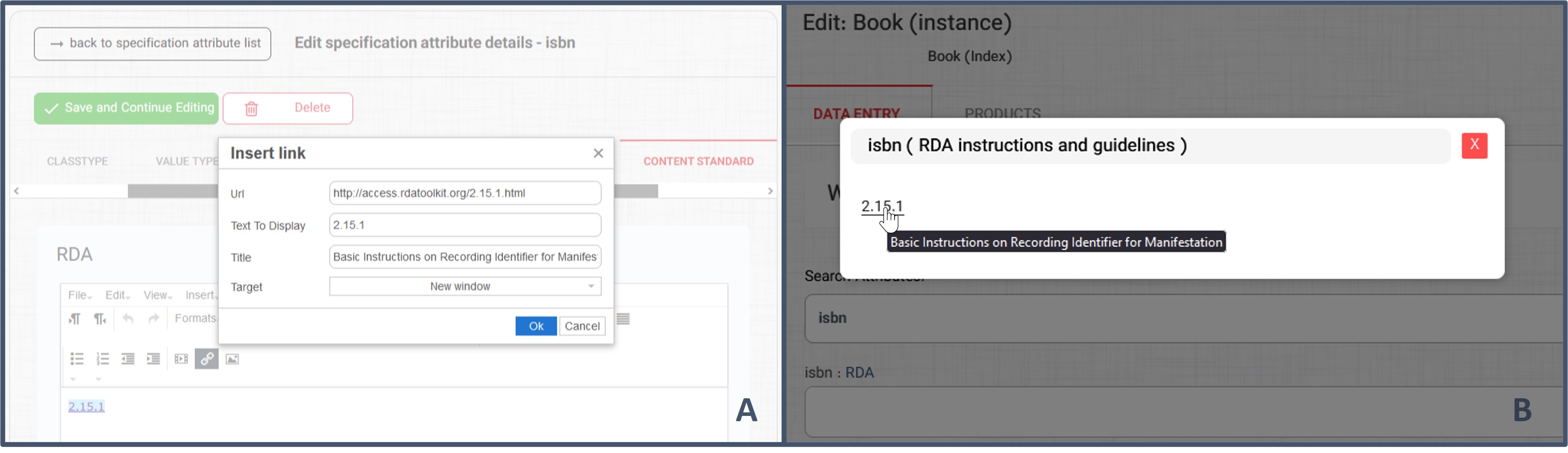
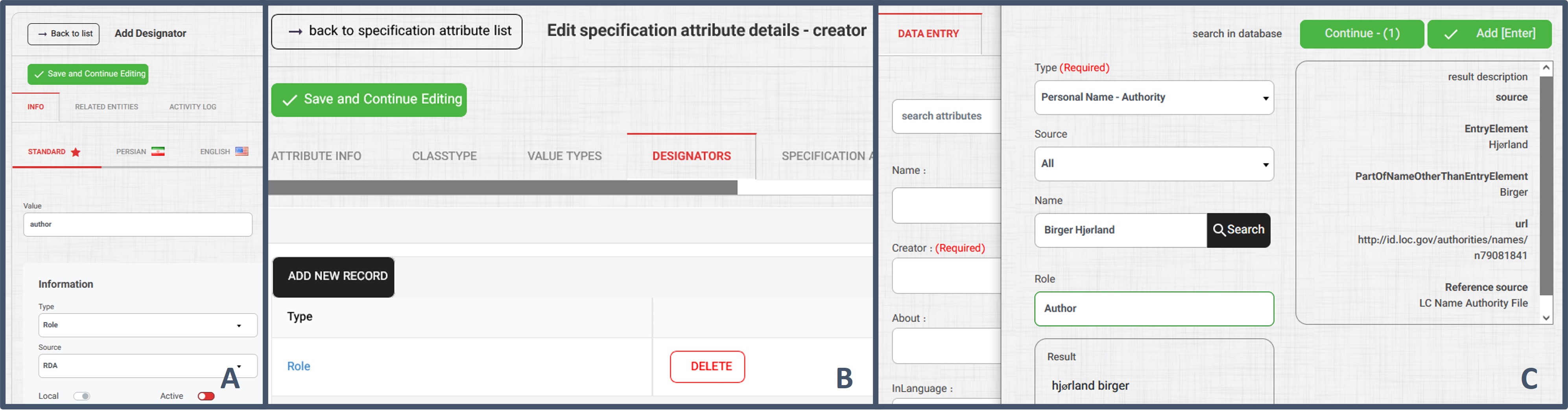
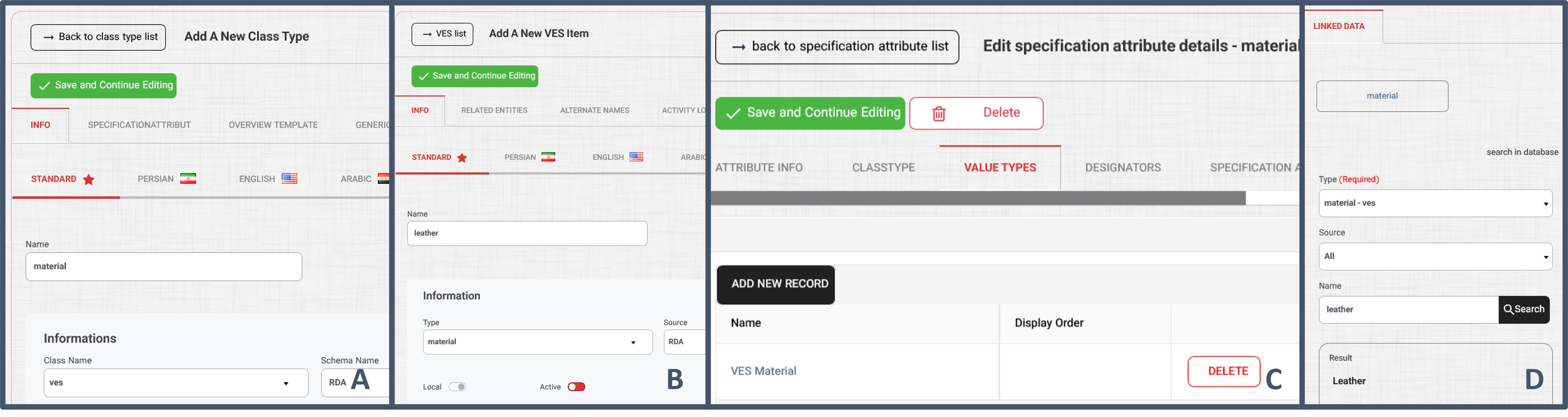
Finally, the mappings were implemented in a real-world metadata management environment—presented later as prototypes (see Figs. 1,2,3)—used by various organizations, and feedback was solicited from five purposively selected catalogers from different institutional contexts (small/medium/large, special/academic libraries) and experience levels (2–12 years) regarding the appropriateness and practical utility of the mappings for their cataloging workflows. Despite the modest numbers, the high level of satisfaction and the diversity of feedback across these groups support the practical acceptability of the proposed mappings.
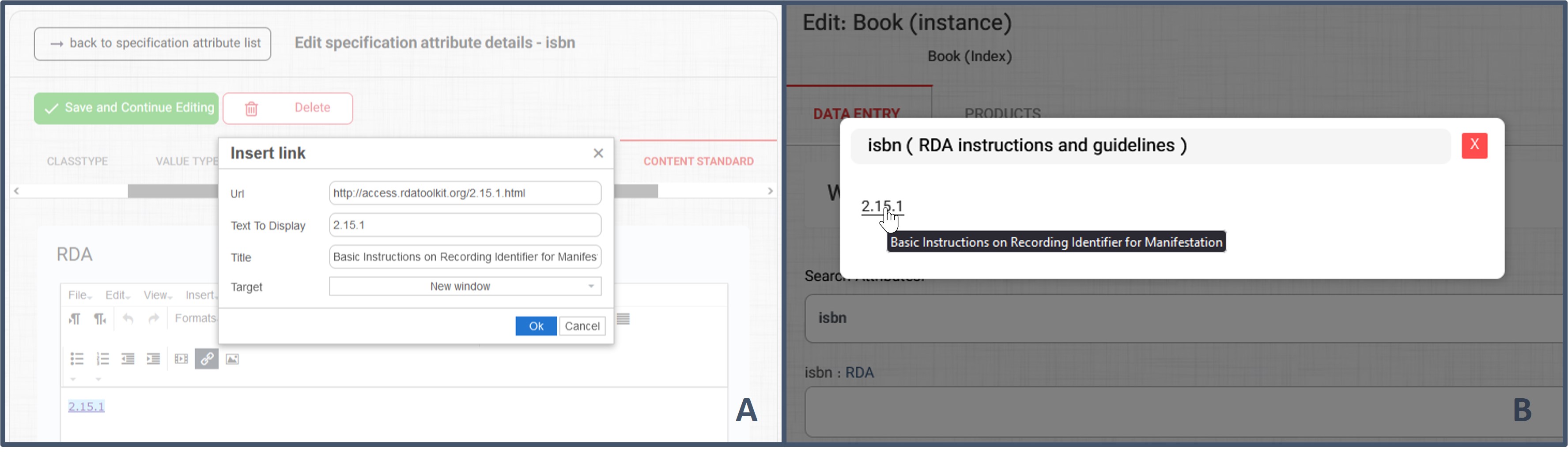 Fig. 1.
Application of specific RDA instructions to a Schema.org property in KDR. (A) Assigning Instructions 2.15.1 as a hyperlink to the “isbn” property. (B) Viewing the instructions assigned to the “isbn” property during metadata creation. KDR, Knowledge Discovery and Representation.
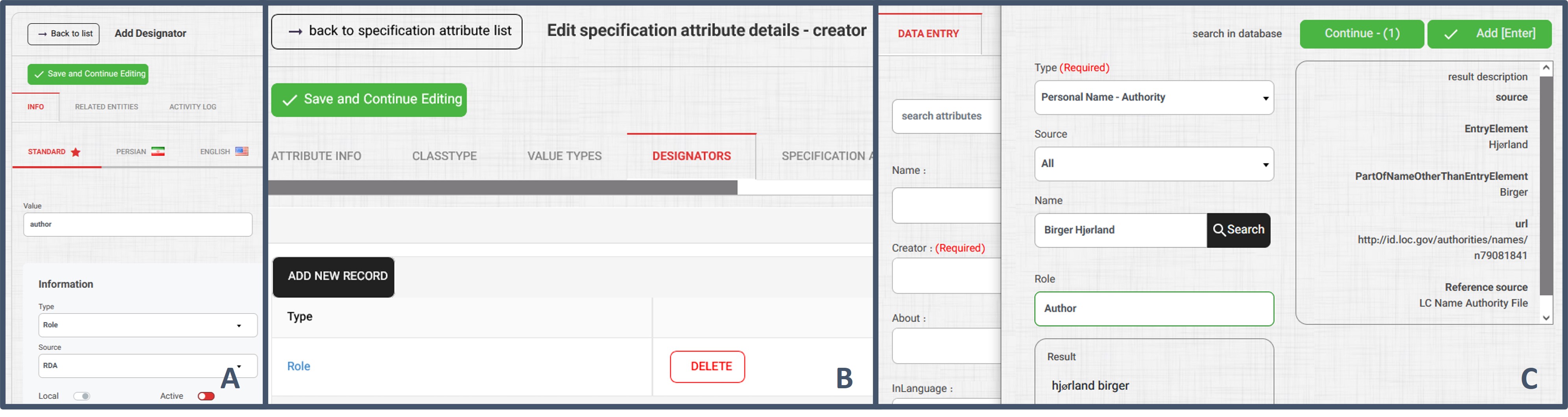 Fig. 2.
Application of an RDA relationship designator to a Schema.org property in KDR. (A) Adding a new role designator named “author”. (B) Allowing the Schema.org “creator” property to accept roles as its relationship designators. (C) Assigning “author” as the role of a creator agent.
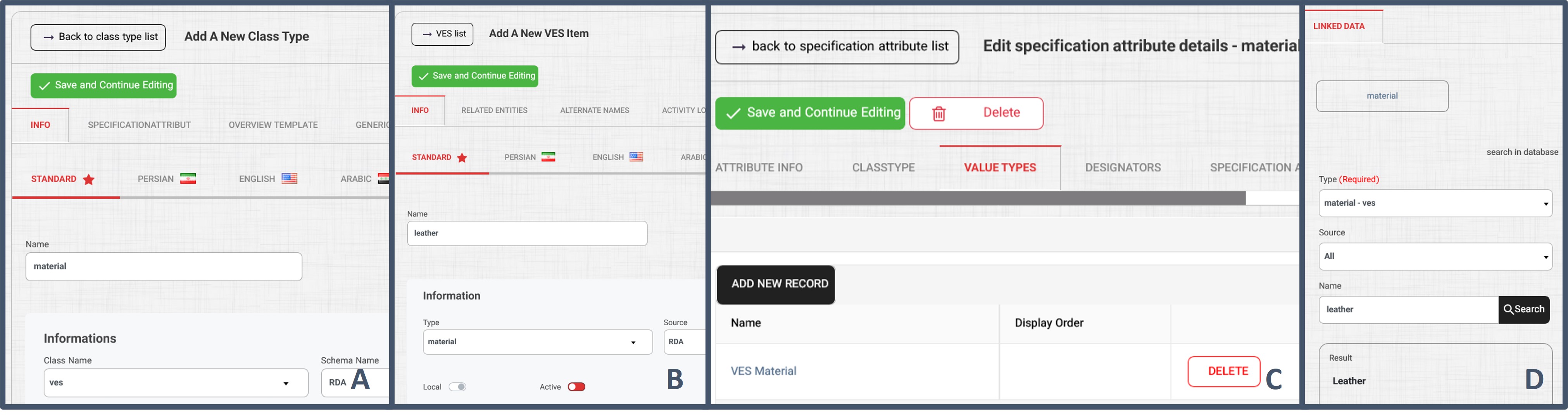 Fig. 3.
Application of an RDA value vocabulary to a Schema.org property in KDR. (A) Adding a new RDA VES named “material”. (B) Adding the RDA “leather” term to the “material” VES. (C) Allowing the Schema.org “material” property to accept terms from the “material” VES as values. (D) Assigning “leather” as a value to the “material” property.
Taken together, these three validation methods formed a triangulated validation package, thereby reducing reliance on any single method and enhancing the overall robustness of the validation.
The study resulted in multiple mapping tables, the polished versions of which are presented in the current section.
Table 1 presents the guidelines and instructions that may be used to determine the values of the “Thing” properties for describing instances of various RDA Entities. Among these properties, no proper RDA guideline or instruction could be found for “potentialAction” and “subjectOf”. Instructions 23.4.1, although relevant, cannot apply to “subjectOf” because they focus on recording the subjects rather than the works associated with them. With the exception of these properties, the others may accept RDA guidelines or instructions for describing instances of at least one of the Entities. The “description” property, specifically at the “Manifestation” level, appears to accept a broad range of instructions, even exceeding those listed in the table. Furthermore, sub-instructions 2.3.1.3–7 and 6.2.4–9 provide basic instructions for recording titles that may become useful for the properties “name” and “alternate name” at the “Work” and “Manifestation” levels.
| Schema.org property | RDA guidelines/Instructions per RDA entity | |||||||
| Work | Expression | Manifestation | Item | Person | Family | Corporate Body | Place | |
| additionalType | 6.3.1 | 6.9.1 | 3.2.1 | 9.6.1 | 10.3.1 | 11.7.1 | ||
| 3.3.1 | ||||||||
| 3.19.2 | ||||||||
| alternateName | 6.2.3 | 2.3.3–10 | 8.4–5 | 8.4–5 | 8.4–5 | 16.2.3 | ||
| 6.14.3 | 9.2.3 | 10.2.3 | 11.2.3 | |||||
| 6.19.3 | ||||||||
| 6.23.3 | ||||||||
| 6.26.2 | ||||||||
| description | 1.10 | 1.10 | 1.10 | 1.10 | 1.10 | 1.10 | 1.10 | 1.10 |
| 6.7.1 | 7.29.1–2 | 2.17.1–4 | 2.21.1 | |||||
| 7.2.1 | 2.17.6–11 | |||||||
| 2.17.13–14 | ||||||||
| 3.21.2–3 | ||||||||
| disambiguatingDescription | 6.6.1 | 6.12.1 | 1.10 | 1.10 | ||||
| 6.21.1 | 6.18.1 | 3.21.4 | 3.22.1–3 | |||||
| 6.25.1 | ||||||||
| identifier | 6.8.1 | 6.13.1 | 2.15.1 | 2.20.1 | 9.18.1 | 10.10.1 | 11.12.1 | 16.3.1 |
| image | 24.4 | 24.4 | 24.4 | 24.4 | ||||
| mainEntityOfPage | 24.4 | 24.4 | 24.4 | 24.4 | ||||
| name | 6.2.2 | 2.3.2 | 8.4–5 | 8.4–5 | 8.4–5 | 16.2.2 | ||
| 6.14.2 | 9.2.2 | 10.2.2 | 11.2.2 | |||||
| 6.19.2 | ||||||||
| 6.23.2 | ||||||||
| 6.26.2 | ||||||||
| potentialAction | ||||||||
| sameAs | 24.4 | 24.4 | 24.4 | 24.4 | 29.4 | 29.4 | 29.4 | |
| 25.1.1 | 26.1.1 | 27.1.1 | 28.1.1 | 30.1.1 | 31.1.1 | 32.1.1 | ||
| subjectOf | ||||||||
| url | 4.6.1 | |||||||
The symbol “–” is used to indicate sequential instructions. RDA, Resource Description and Access.
Table 2 illustrates the mapping from 111 “Book” and “CreativeWork” type-specific properties, of which 87 could accept at least one of the selected RDA guidelines or instructions. Naturally, the type-specific properties of “Book” are only mappable to broader guidelines or instructions. A limited number of properties (such as accessibility-related ones) are accompanied by more detailed content specifications in Schema.org than those offered by RDA.
| No. | Schema.org property | RDA guidelines/Instructions |
| 1 | abridged | |
| 2 | bookEdition | 2.5.1–3 |
| 3 | bookFormat | |
| 4 | illustrator | 18.4 |
| 20.1 | ||
| 20.2.1 | ||
| 5 | isbn | 2.15.1 |
| 6 | numberOfPages | 3.4.1 |
| 7 | about | 23.4.1 |
| 8 | abstract | 7.10.1 |
| 9 | accessMode | |
| 10 | accessModeSufficient | |
| 11 | accessibilityAPI | |
| 12 | accessibilityControl | |
| 13 | accessibilityFeature | 7.14.1 |
| 14 | accessibilityHazard | |
| 15 | accessibilitySummary | 7.14.1 |
| 16 | accountablePerson | 18.4 |
| 19.1 | ||
| 19.3.1 | ||
| 17 | acquireLicensePage | 4.3.1 |
| 18 | aggregateRating | |
| 19 | alternativeHeadline | 2.3.6 |
| 20 | archivedAt | 4.3.1 |
| 4.6.1 | ||
| 21 | assesses | 23.4.1 |
| 22 | associatedMedia | 24.4 |
| 23 | encoding | |
| 24 | audience | 7.7.1 |
| 25 | audio | 24.4 |
| 26 | author | 18.4 |
| 19.1 | ||
| 19.2.1 | ||
| 27 | award | 7.28.1 |
| 28 | character | 23.4.1 |
| 29 | citation | 24.4 |
| 30 | comment | 24.4 |
| 31 | commentCount | |
| 32 | conditionsOfAccess | 4.4.1 |
| 33 | contentLocation | 23.4.1 |
| 34 | contentRating | 7.7.1 |
| 35 | contentReferenceTime | 23.4.1 |
| 36 | contributor | 18.4 |
| 20.1 | ||
| 20.2.1 | ||
| 37 | copyrightHolder | 18.4 |
| 19.1 | ||
| 19.3.1 | ||
| 38 | copyrightNotice | 4.5.1 |
| 39 | copyrightYear | 1.9 |
| 2.11.1 | ||
| 40 | correction | 2.5.6–9 |
| 24.4 | ||
| 41 | countryOfOrigin | 6.5.1 |
| 42 | creativeWorkStatus | 2.5.2 |
| 43 | creator | 18.4 |
| 19.1 | ||
| 19.2.1 | ||
| 44 | creditText | |
| 45 | dateCreated | 1.9 |
| 6.4.1 | ||
| 6.10.1 | ||
| 6.20.1–3 | ||
| 6.24.1 | ||
| 46 | dateModified | 1.9 |
| 47 | datePublished | 1.9 |
| 2.8.6 | ||
| 48 | digitalSourceType | |
| 49 | discussionUrl | |
| 50 | editEIDR | 6.13.1 |
| 51 | editor | 18.1 |
| 20.1 | ||
| 20.2.1 | ||
| 52 | educationalAlignment | |
| 53 | educationalLevel | 7.7.1 |
| 54 | educationalUse | |
| 55 | encodingFormat | 3.19.1–3 |
| 56 | exampleOfWork | 17.4 |
| 17.8.1 | ||
| 17.10.1 | ||
| 57 | expires | |
| 58 | funder | 18.4 |
| 19.1 | ||
| 19.3.1 | ||
| 21.1 | ||
| 59 | sponsor | 21.6.1 |
| 60 | funding | |
| 61 | genre | 6.3.1 |
| 62 | hasPart | 24.4 |
| 25.1.1 | ||
| 25.2.1 | ||
| 26.1.1 | ||
| 26.2.1 | ||
| 63 | isPartOf | 27.1.1 |
| 64 | headline | 2.3.2 |
| 65 | inLanguage | 6.11.1 |
| 7.12.1 | ||
| 66 | interactionStatistic | |
| 67 | interactivityType | |
| 68 | interpretedAsClaim | |
| 69 | isAccessibleForFree | 4.2.1 |
| 70 | isBasedOn | 24.4 |
| 25.1.1 | ||
| 25.2.1 | ||
| 26.1.1 | ||
| 26.2.1 | ||
| 71 | isFamilyFriendly | 7.7.1 |
| 72 | keywords | 23.4.1.2.3 |
| 73 | learningResourceType | |
| 74 | license | 24.4 |
| 75 | locationCreated | 2.7.2 |
| 6.5.1 | ||
| 76 | mainEntity | 23.4.1 |
| 77 | maintainer | 18.4 |
| 19.1 | ||
| 19.3.1 | ||
| 21.1 | ||
| 21.6.1 | ||
| 78 | material | 3.6.1 |
| 3.7.1 | ||
| 3.8.1 | ||
| 79 | materialExtent | 3.4.1 |
| 3.5.1 | ||
| 3.21.2–3 | ||
| 80 | mentions | 23.4.1 |
| 81 | offers | 17.4 |
| 17.11.1 | ||
| 82 | pattern | 2.17.1 |
| 83 | position | 2.12.9 |
| 84 | producer | 18.4 |
| 21.1 | ||
| 21.2.1 | ||
| 85 | provider | 18.4 |
| 21.1 | ||
| 21.4.1 | ||
| 86 | publication | 2.8.1–6 |
| 87 | publisher | 18.4 |
| 21.1 | ||
| 21.3.1 | ||
| 88 | publisherImprint | 18.4 |
| 21.1 | ||
| 21.5.1 | ||
| 89 | publishingPrinciples | 24.4 |
| 90 | recordedAt | 7.11.1–3 |
| 91 | releasedEvent | 2.9.1–6 |
| 92 | review | 24.4 |
| 93 | size | 3.4.1 |
| 3.19.4 | ||
| 94 | sourceOrganization | 18.4 |
| 19.1 | ||
| 19.3.1 | ||
| 95 | spatial | |
| 96 | spatialCoverage | 7.3.1 |
| 97 | temporalCoverage | 23.4.1 |
| 98 | teaches | 23.4.1 |
| 99 | temporal | 1.9 |
| 100 | text | |
| 101 | thumbnailUrl | |
| 102 | timeRequired | 7.22.1 |
| 103 | translationOfWork | 24.4 |
| 26.1.1 | ||
| 104 | workTranslation | 26.2.1 |
| 105 | translator | 18.4 |
| 21.1 | ||
| 20.2.1 | ||
| 106 | typicalAgeRange | 7.7.1 |
| 107 | usageInfo | 3.20.1 |
| 4.5.1 | ||
| 24.4 | ||
| 108 | version | 2.5.1–2 |
| 109 | video | 24.4 |
| 110 | wordCount | |
| 111 | workExample | 17.4 |
| 17.7.1 | ||
| 17.9.1 |
Table 3 presents the mapping from the five “Offer” properties recommended by the Schema Bib Extend Community Group (2016), of which only one could not be mapped to the selected RDA guidelines or instructions.
| No. | Schema.org property | RDA guidelines/Instructions |
| 1 | offeredBy | 18.4 |
| 22.1 | ||
| 22.2.1 | ||
| 22.3.1 | ||
| 2 | sku | 2.20.1 |
| 3 | serialNumber | 2.20.1 |
| 4 | availableAtOrFrom | 4.3.1 |
| 5 | availability |
The properties that may accept RDA value vocabulary are listed in Table 4 alongside their corresponding value vocabularies. Although RDA offers a rich set of value vocabularies for bibliographic description, few seem to correspond to the selected properties. However, depending on local choices, numerous RDA value vocabularies can be applied to properties with a broad semantic scope, such as “description”. Additionally, “additionalType” might accept RDA Entity vocabulary to designate that a described entity is also an instance of a particular RDA Entity.
| No. | Schema.org property | RDA value vocabularies |
| 1 | accessMode | ROF Sensory Mode |
| 2 | accessModeSufficient | ROF Sensory Mode |
| 3 | encodingFormat | RDA File Type |
| 4 | genre | ROF Form/Genre for RDA |
| 5 | interactivityType | RDA Interactivity Mode |
| 6 | material | RDA Material |
| 7 | timeRequired | RDA Unit of Time |
| 8 | additionalType | RDA Carrier Type |
| RDA Content Type | ||
| RDA File Type | ||
| RDA Media Type |
ROF, RDA/ONIX Framework.
Lastly, analyzing the selected Schema.org properties with RDA relationship designators resulted in the identification of properties that align with specific subsets of designators and those with direct equivalents. According to this analysis, the properties “creator”, “contributor”, and “publisher” are capable of accepting relationship designators from RDA Appendices I.2.1, I.3.1, and I.4.2. Naturally, the guidelines and instructions associated with these properties are supplemented by 18.5.1 and I.1. The analysis further indicates that the properties “illustrator”, “editor”, and “translator” can be replaced by their equivalent “Contributor” relationship designators. The same applies to the equivalent “Creator” relationship designator of “author”. Additionally, depending on local application choices, RDA subject relationship designators (M.2.2–8) seem applicable to refine the properties “about” and “subjectOf”, as well as RDA whole-part relationship designators (J.2.4, J.3.4, & J.4.4) to refine the properties “hasPart” and “isPartOf”. In this case, the supplementary guidelines and instructions would be 23.5.1 and M.1 for the former and 18.5.1 and J.1 for the latter.
The results offer several key insights regarding the alignment of Schema.org properties and RDA guidelines, instructions, and VESs for describing bibliographic entities. Despite some loosely mapped and unmappable components, the overall degree of alignment can be considered high thanks to the multiplicity of closely and richly mapped components. In the case of closely mapped components, this multiplicity enables context-specific precision, which in practice leads to the recurrence of alignments across a broad range of bibliographic descriptions. Furthermore, some properties with broader semantics (e.g., “description”) benefit from accepting a wider range of RDA components, thereby allowing greater flexibility in local alignment of the components. The findings expand upon Senior (2018), Fardehosseini (2019), and Park and Kipp (2019) by identifying concrete points of interface between Schema.org and RDA as complementary metadata and content standards. Furthermore, by explicitly delineating Schema.org properties that are capable or incapable of accepting RDA value-assignment components, the results indicate properties that are possibly more suitable for bibliographic description, thereby refining studies focusing on the usability of Schema.org properties within the same context, such as Wu et al. (2023) and Han et al. (2015).
While the results suggest a high level of potential interoperability, it may not yet be achievable for rich descriptions. According to Senior (2018), Fardehosseini (2019), and Park and Kipp (2019), this challenge appears to have its roots in the contextual generality of Schema.org and its ontological differences from RDA. Specifically, the absence of an official alignment between their components, together with the contextual semantic generality of certain Schema.org properties, impedes the derivation of more definitive mappings between their interfacing components. In practice, this may result in inconsistent metadata content choices across profiles, thereby giving rise to subtle interoperability challenges. One promising solution to mitigate this issue is to refine general Schema.org properties using narrower elements from other vocabularies. For example, using narrower title properties from the RDA Registry as subproperties of “name” or “alternateName” might improve their alignment with RDA instructions for recording various titles. Such usage necessitates a particular form of property mappings between Schema.org and relevant vocabularies, which may be established by future research.
Organizations should evaluate—and, if necessary, adjust or replace—their metadata management platforms to effectively adopt RDA and Schema.org as complementary standards. To support this evaluation, prototype implementations are presented to demonstrate practical methods for integrating Schema.org and RDA within a real-world metadata management application. The chosen application platform for these prototypes was the Knowledge Discovery and Representation (KDR) software, as it had already incorporated Schema.org properties within a bibliographic setup while featuring per-property declaration of value-assignment components. Fig. 1 showcases how RDA guidelines and instructions might be applied to a property (Fig. 1A) and then displayed during value assignment to that property (Fig. 1B). Figs. 2,3 demonstrate examples of how RDA relationship designators and value vocabularies can be declared (Fig. 2A & Fig. 3A,B), then applied to their respective properties (Fig. 2B & Fig. 3C), and ultimately accessed during value assignment (Fig. 2C & Fig. 3D). Nevertheless, the declaration of RDA vocabularies can also be performed using a bulk-selective import tool. These prototypes offer minimum criteria for platform evaluation and suggest that successful practical interoperability relies on a software’s capability to support the declaration and linkage of interfacing components.
According to the findings, RDA guidelines, instructions, and value vocabularies can help improve the consistency of Schema.org-based bibliographic metadata content, thereby enhancing interoperability between Schema.org and non-Schema.org bibliographic metadata. This may further aid institutions that choose to continue using their non-Schema.org profiles while representing them as Schema.org markups on webpages to enhance Web discoverability. In both scenarios, it is essential not only to ensure that certain properties correspond but also that corresponding properties can share the same values. On the other hand, existing Schema.org adopters are strongly encouraged to leverage RDA as their content standard, as RDA offers components that can enhance value assignment for at least some of their chosen properties. With these in mind, the proposed mappings can be leveraged by relevant institutions either to develop application profiles or to translate RDA-compliant metadata between Schema.org and other metadata standards. Nonetheless, it is essential to note that this study offers alignment patterns rather than one-size-fits-all mappings.
As both standards continue to evolve, sustaining these mappings will require ongoing monitoring and revision, ideally through the establishment of community-driven, version-aware mappings. Although minor adjustments may result from vocabulary updates, a major revision will be necessary due to the forthcoming shift to the Official RDA. Given the emphasis of this version on Linked Data (RDA Steering Committee, 2021), most changes are likely to affect Schema.org’s object properties9, which require URIs as values in the Linked Data context. Due to their element-based structure, incorporating the Official RDA instructions into the mappings will demand additional efforts, which may include: (1) bridging the ontological gaps between Schema.org and RDA, at least at the class level; (2) mapping Schema.org properties to their corresponding RDA elements; and (3) verifying whether the instructions of the corresponding elements align with the properties. Nonetheless, an ad hoc solution—particularly for future implementers—would be to transform existing RDA-compliant values into those compliant with the official version by following authoritative guidelines such as Resource Description & Access (RDA) Metadata Guidance Documentation (Library of Congress, 2025).
To conclude, by examining the alignment of Schema.org properties with RDA guidelines, instructions, and VES, this study suggests that Schema.org and RDA hold considerable potential to interoperate as complementary metadata and content standards for bibliographic entity description. Such potential is primarily due to the multiplicity of closely and richly mappable components that address Schema.org’s value-assignment limitations, and secondly, due to the alignment capability between specific Schema.org properties and RDA relationship designators, which offers an alternative enrichment mechanism for Schema.org in the context of bibliographic description. In addition to the recommendations offered throughout the text, future research may expand the present investigation by targeting broader or different types of data entities or communities within the scope of cultural heritage and the Web, as the synergy between Schema.org and RDA may extend beyond the bibliographic context.
The processed data and materials underlying this study are available either through the main content or the supplementary materials. Any other data referenced in this manuscript can be accessed through the original repositories cited, or are available upon reasonable request from the corresponding author.
SMT conceptualized the research. ER, SMT, and MAH designed the research. ER performed the collection and analysis and reported the research. MS, MAH, and SMT reviewed the reports and provided critical feedback and corrections on various aspects of the work, including the analysis and interpretation of the data. SMT and ER performed the validation of the mappings. All authors contributed to the interpretation of the results and to the editorial revisions of the manuscript. All authors read and approved the final manuscript. All authors have participated sufficiently in the work and agreed to be accountable for all aspects of the work.
Not applicable.
This research received no external funding.
The authors declare no conflict of interest.
During the writing process, Grammarly, Copilot, and ChatGPT-4 were used in order to check spelling, grammar, and fluency. AI assistance was applied only to originally written pieces of the text, and all suggested changes were carefully reviewed and edited afterward.
Supplementary material associated with this article can be found, in the online version, at https://doi.org/10.31083/KO43984.
1The RDA Registry offers linked data and Semantic Web representations of RDA Entities, elements, and terminologies (see https://rdaregistry.info).
2The Official RDA, also referred to as the post-3R RDA, replaces the original version in order to align RDA with Library Reference Model (LRM) and improve the RDA Toolkit’s functionality (see RDA Steering Committee, 2021).
3 https://original.rdatoolkit.org
4As a representative pioneer, the Program for Cooperative Cataloging (PCC) is planning to have a rolling implementation of the Official RDA until April 30, 2027 (Chou, 2023; Program for Cooperative Cataloging, n.d).
5“Type-specific properties” refers to properties of a Schema.org entity type that are not inherited from its supertypes.
6 https://github.com/schemaorg/schemaorg/releases/tag/v29.3-release
7In this article, the term “Entities” (Capitalized) refers exclusively to RDA entity types, while “entities” (lowercase) refers to instances of any entity type. This distinction is maintained throughout the text.
8 https://github.com/RDARegistry/RDA-Vocabularies/releases/tag/v5.3.1
9“Object properties”, also known as “relationship properties” (as opposed to data/attribute properties), are properties that establish links between objects (also referred to as entities, instances, and individuals) rather than linking objects to data-type instances (such as text, number, or Boolean value). In the context of Schema.org, “objects” correspond to instances of “Thing” and its subclasses, while “data-type instances” are classified under a separate superclass, named “DataType”.
References
Publisher’s Note: IMR Press stays neutral with regard to jurisdictional claims in published maps and institutional affiliations.