


 , Evgeny Isaev 1, Seyed Masoud Ghoreishi Mokri 1, Peter Prodius 1,2, Irina Mukhina 1
1 Department of Normal Physiology named after N.Y. Belenkov, Privolzhsky Research Medical University, 603005 Nizhny Novgorod, Russia
2 Department of Physiology and Anatomy, Institute of Biology and Biomedicine, National Research Lobachevsky State University of Nizhny Novgorod, 603950 Nizhny Novgorod, Russia
Abstract
The objective identification of potential neurophysiological markers of schizotypal personality traits represents a major step toward improving early diagnostic strategies in psychiatry. In this study, we investigated the influence of schizotypal personality traits on the neural mechanisms underlying literal and figurative language comprehension, aiming to contribute to the development of neurophysiological markers of schizophrenia spectrum pathology.
A total of 121 university students were assessed using the Schizotypal Personality Questionnaire (SPQ) and categorized into three groups: low-SPQ (scores <21; n = 60), intermediate-SPQ (scores 21–40; n = 44), and high-SPQ (scores ≥41; n = 16). Participants evaluated 60 literal, 60 idiomatic, and 60 semantically incongruent phrases for meaningfulness, while event-related potentials (ERPs)—specifically N400 and post-N400 Positivity (PNP)—were recorded.
The low-SPQ group showed clear N400 differentiation between idiomatic expressions and both incongruent and literal conditions, whereas intermediate-SPQ and high-SPQ groups demonstrated reduced N400 distinctions in the frontal area. At central and parietal sites, participants with increased SPQ scores retained partial differentiation between idiomatic and incongruent phrases, but they failed to differentiate between idiomatic and literal ones. Moreover, participants with intermediate SPQ scores exhibited larger frontal PNP differences between incongruent and idiomatic conditions relative to the low-SPQ group.
These findings indicate that schizotypal traits are associated with poorly regulated semantic processing at the N400 stage, which is accompanied by compensatory activity at later stages of stimulus processing. These findings highlight ERP markers that may support early detection of vulnerability to schizophrenia spectrum disorders.
Keywords
- event-related potentials
- N400
- PNP
- word combinations
- semantic categorization
- idioms
- incongruent stimuli
- schizotypy
- schizotypal personality traits
- SPQ
Difficulties in the comprehension of figurative expressions, particularly idioms, have been observed in individuals with schizophrenia [1]. Idioms are defined as fixed linguistic expressions whose intended meaning cannot be directly inferred from the literal meaning of their constituent words [1]. Unlike literal phrases, which can be interpreted at face value, figurative expressions necessitate a more elaborate interpretive process that integrates semantic, contextual, and pragmatic information [2, 3]. Previous research indicates that idiom comprehension is associated with working memory, inhibitory control, and crystallized verbal intelligence [4]. Idioms constitute an essential component of everyday communication, serving to convey abstract concepts in a concise manner, to enrich discourse with vividness or nuance, and to stimulate the imagination. Successful idiom comprehension requires recognition of literal meaning, suppression of competing interpretations, and integration with contextual cues. These cognitive processes are known to be impaired in schizophrenia [1].
Thought disorder, a hallmark feature of schizophrenia, has been closely linked to abnormalities in semantic processing [5]. It was shown that individuals with schizophrenia perform significantly worse than healthy controls on a range of figurative language tasks, including the comprehension of metaphors, proverbs, irony, and idioms [1, 6, 7, 8, 9]. These deficits seem to result from impairments in executive control, semantic memory, and contextual integration [1]. Neuroimaging abnormalities in figurative language comprehension have been related to dysfunction of the dorsolateral prefrontal cortex [10], a brain region implicated in cognitive impairments in schizophrenia [11]. This region is associated with executive control functions and is engaged in language processing that exceeds basic lexical–semantic mechanisms, particularly in the interpretation of nonliteral meanings [12].
Event-related potential (ERP) studies have provided important insights into the temporal dynamics of idiom comprehension. Research on idiom processing has primarily focused on the N400 component, a negative-going brain potential peaking approximately 400 ms after the stimulus onset. The N400 is elicited by semantically meaningful stimuli and shows greater amplitude in response to incongruent word contexts [13]. In healthy adults, idiomatic expressions generally elicit attenuated N400 amplitudes relative to literal or incongruent phrases, reflecting facilitated semantic access driven by strong lexical associations and contextual predictability [2, 14, 15, 16, 17]. By contrast, individuals with schizophrenia exhibit reduced or absent N400 differentiation across idiomatic, literal, and incongruent expressions, suggesting that they are less able to benefit from contextual information [14]. Beyond the N400, subsequent ERP positivity has been interpreted as reflecting diverse processes, including lexical reanalysis [18], pragmatic adjustment [19], and pragmatic interpretation [20]. Frontal post-N400 Positivity (PNP) effects, in particular, may indicate reanalysis of word meanings [2, 21] or the inhibitory processes necessary to suppress the preactivation of the most expected sentence completion [22], with idiomatic contexts eliciting more positive voltages than literal conditions [2]. The Late Positive Component (LPC) and P600 effects, most pronounced over parietal regions, have been described for irony [20, 23, 24] and metaphor comprehension, reflecting pragmatic interpretative processes [19, 25]. The literature indicates abnormalities in the LPC component effects during figurative language processing in patients with schizophrenia [26]. In sum, ERP studies have demonstrated some changes in the neural processing of figurative language among individuals with schizophrenia spectrum pathologies. However, there are no validated diagnostic tools based on distinctions between figurative, literal, and incongruent speech comprehension in psychiatry. The development of such approaches could contribute to a more precise assessment of early cognitive markers of psychosis risk.
Beyond clinical schizophrenia, schizotypy represents a subclinical personality organization characterized by attenuated but qualitatively similar cognitive, affective, and behavioral features [27]. Schizotypy is thus a valuable construct for identifying vulnerability markers of psychosis and for clarifying mechanisms underlying progression from subclinical traits to clinical disorder [28]. Disorganized thought processes are considered a defining feature of both schizophrenia and schizotypy [29, 30]. However, there is a gap in knowledge regarding the dynamics of thought disturbances across the continuum from personality pathology up to clinically diagnosed schizophrenia. The literature provides some information on abnormalities in the processing of irony [6], but not metaphors [31, 32], in individuals with schizotypal personality traits. However, the processing of idiomatic phrases is not sufficiently covered in the literature on healthy people with schizotypal personality traits. From this perspective, investigating idiom comprehension in schizotypal individuals provides an opportunity to examine whether there are any impairments in the brain’s processing of idioms in the early stages of the schizotypal continuum and identify potential markers for the development of the schizophrenia spectrum disorders.
The present study was designed to investigate the impact of schizotypal
personality traits on the neural mechanisms underlying figurative and literal
language comprehension in a non-clinical sample with varying levels of
schizotypal traits determined by the Schizotypal Personality Questionnaire (SPQ).
Based on prior evidence linking schizotypy to alterations in semantic
integration, we hypothesized that the N400 amplitude would show the smallest
differences between idiomatic, literal, and incongruent stimuli in the group with
the most pronounced schizotypal traits (the high-SPQ group), the group with
intermediate questionnaire scores (the intermediate-SPQ group) is expected to
show slightly greater differences between stimulus types, whereas the group with
the lowest scores (the low-SPQ group) is expected to exhibit the most pronounced
differences in N400 amplitude across stimuli: idiomatic
A total of 121 university students participated in the study. The sample had a mean age of 20.43 years (standard deviation (SD) = 2.40; range: 18–34). Participants with neurological or medical conditions known to compromise brain function and participants who used medication were excluded.
All participants were assessed using the SPQ, which is a self-report questionnaire with 74 forced choice items based on the Diagnostic and Statistical Manual of Mental Disorders, Third Edition, Revised (DSM-III-R) criteria for schizotypal personality disorder [33].
Based on SPQ total scores, the sample was divided into three groups: the low-SPQ
group (scores below the median (
| Parameter | Low-SPQ group | Intermediate-SPQ group | High-SPQ group | Statistics |
| n = 60 | n = 44 | n = 16 | ||
| SPQ total score | 11.14 (4.90) | 31.06 (5.10) | 48.50 (6.07) | F = 411.01 (p |
| SPQ cognitive perceptual factor | 3.50 (1.87–5.50) | 11.36 (4.03) | 18.00 (14.87–19.62) | |
| SPQ interpersonal factor | 6.75 (3.87–9.50) | 16.17 (4.32) | 24.22 (3.34) | |
| SPQ disorganized factor | 2.00 (1.00–4.00) | 6.70 (2.84) | 11.53 (2.04) | |
| Age | 19.00 (19.00–21.00) | 19.00 (19.00–21.25) | 20.00 (19.00–22.25) | H = 1.4 (p = 0.495) |
| Sex | Male: 17 | Male: 13 | Male: 2 | |
| Female: 43 | Female: 31 | Female: 14 |
Data are presented as mean (SD) for normally distributed variables, and as
median (interquartile range) for variables with non-normal distribution.
Statistically significant results are indicated in bold. F, F-statistic (ANOVA);
H, Kruskal–Wallis H test;
Age and sex did not differ significantly between groups. As ANOVA revealed
significant between-group differences in SPQ total scores, post-hoc comparisons
were performed. These analyses showed that all three groups differed
significantly from each other (p
The experimental stimulus set comprised 180 Russian word pairs consisting of nouns and their corresponding attributes. Stimuli were distributed across three categories: 60 literal phrases, which were semantically congruent and had a direct meaning (e.g., Grey jacket); 60 idiomatic phrases, which conveyed figurative meaning (e.g., Indian summer); and 60 semantically incongruent word combinations without semantic meaning (e.g., Birch parrot). To ensure comparability across conditions, attributes, and nouns were matched for average length. The mean length of attributes was 6.85 letters (SD = 1.13) in the literal phrases, 7.27 letters (SD = 1.22) in the idiomatic phrases, and 7.18 letters (SD = 0.96) in the incongruent phrases. The mean length of nouns was 5.62 letters (SD = 1.45) in the literal condition, 5.73 letters (SD = 1.02) in the idiomatic condition, and 5.63 letters (SD = 0.78) in the incongruent condition.
Participants were seated comfortably in a slightly lit room at a viewing distance of approximately 1 m from a computer screen. Stimuli were presented using PsychoPy (v1.83.01, Open Science Tools Ltd., Nottingham, UK) as word pairs displayed sequentially at the center of the screen in white, lowercase letters against a gray background.
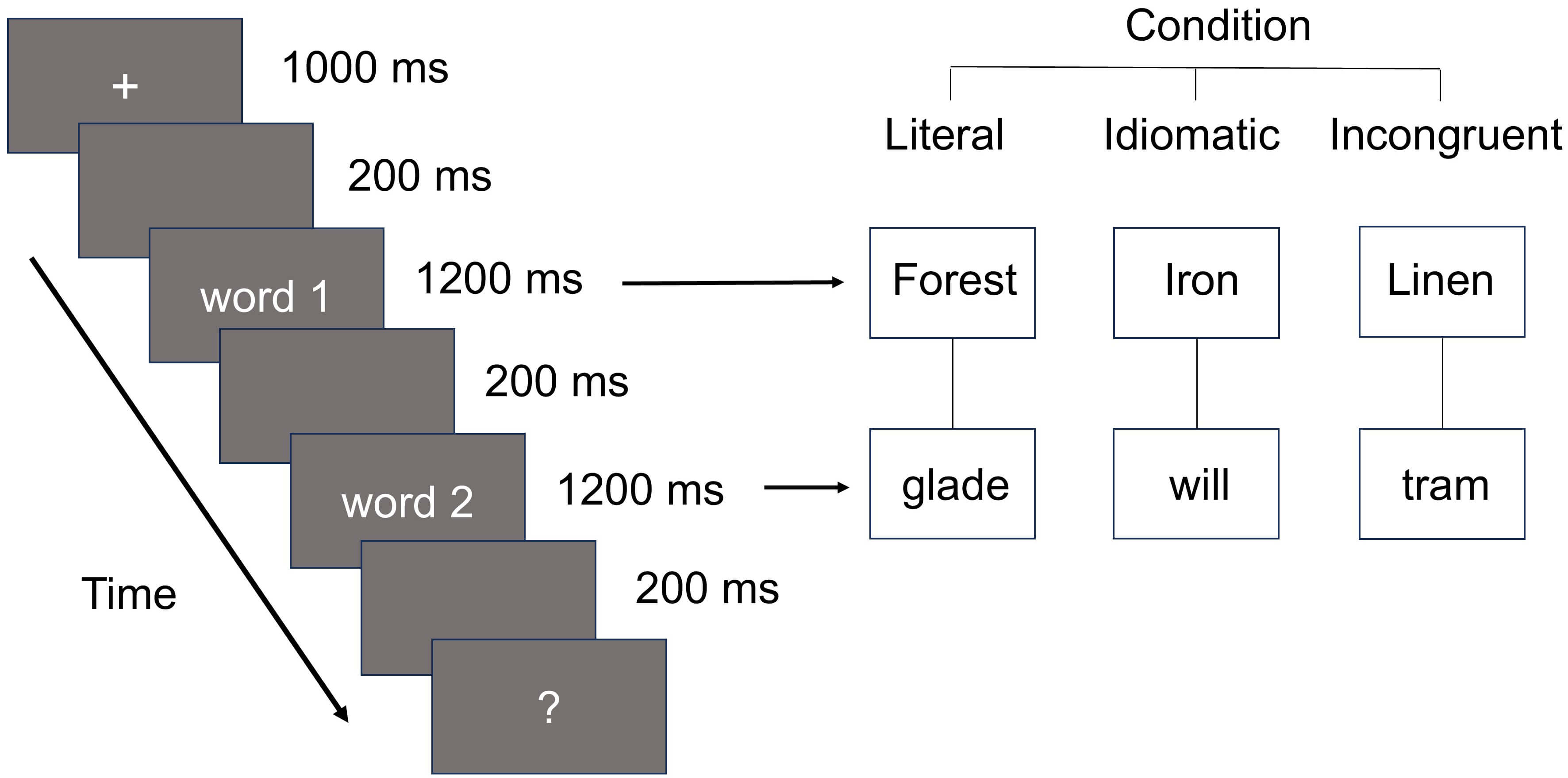
Each trial commenced with a fixation cross displayed for 1000 ms, followed by a blank screen for 200 ms. The first word of the pair was then presented for 1200 ms, followed by another 200 ms blank interval before the second word appeared, resulting in a stimulus onset asynchrony (SOA) of 1400 ms. The second word remained on the screen for 1200 ms, followed by a 200 ms gray screen, which was then replaced by a question mark prompting a response. The overall experimental procedure is illustrated in Fig. 1.
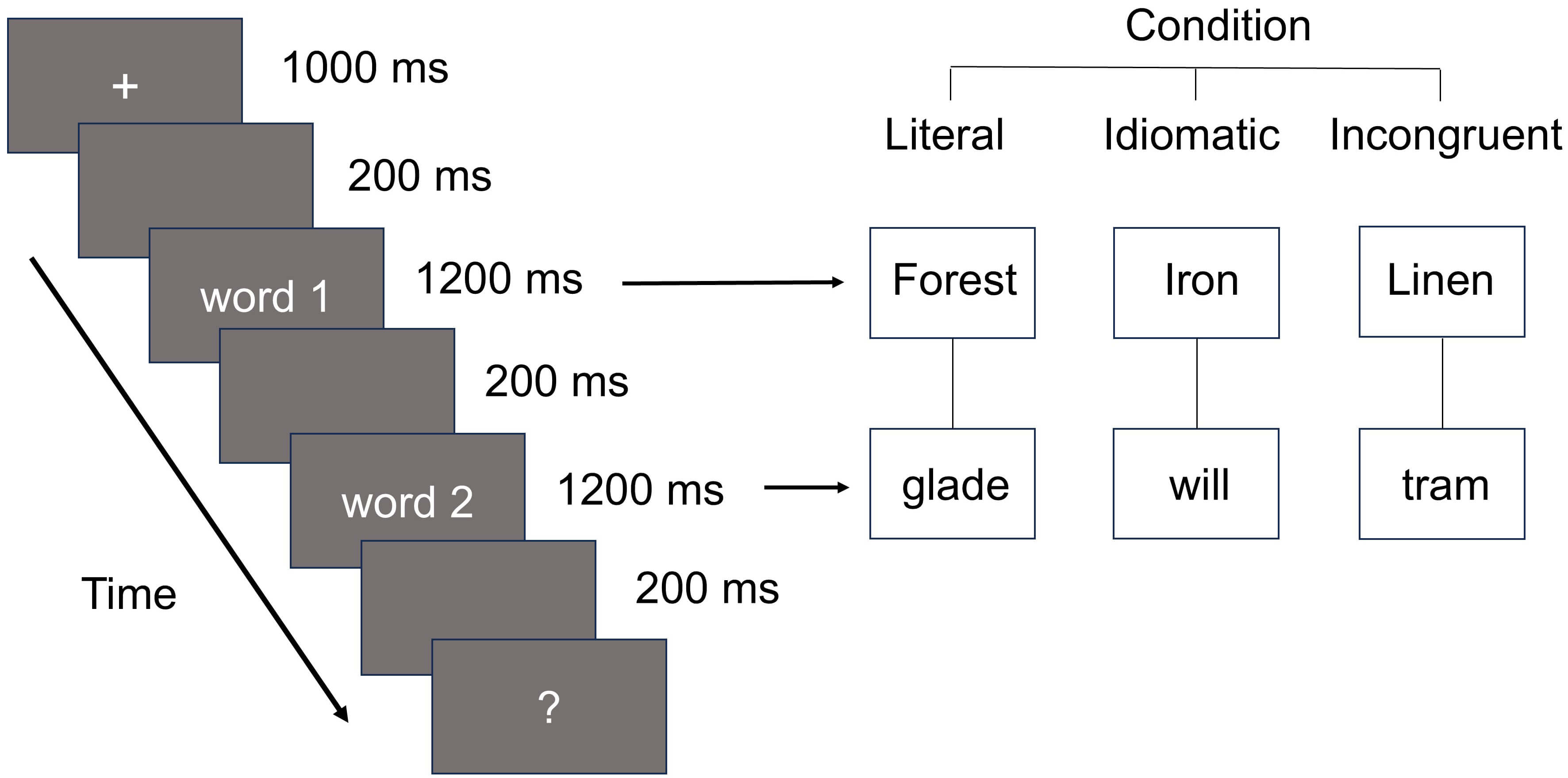 Fig. 1.
The experimental procedure. “+” is a fixation cross, “?” is the question mark. The horizontal arrows indicate examples of the first word (word 1) and the second word (word 2) in the word pairs.
Participants were instructed to withhold responses until the question mark appeared. The question was whether the phrase that appeared on the screen made sense (literal or figurative) or not. Responses were made via the keyboard, with the right button indicating that the phrase was meaningful (“yes”) and the left button indicating that the phrase was meaningless (“no”). Presses of both the right and left buttons on the remote control were performed with the right hand. The question mark remained on the screen until a response was registered.
The experimental stimuli were presented in a randomized order for each participant and for each condition. The task comprised a total of 180 trials, with a short break provided at the midpoint of the experiment.
Electroencephalographic (EEG) activity was recorded using a
Neuron-Spectrum-4/EPM analog amplifier with 16-bit ADC
(№0494КТ; Neurosoft, Ivanovo,
Russia) with 21 Ag/AgCl electrodes mounted in an elastic cap (MCScap 10–20, 205
19; Medical Computer Systems, Moscow, Russia) according to the extended
international 10–20 system. Signals were referenced to the left and right
ipsilateral mastoids, and a cephalic electrode positioned between the midline
frontopolar (FPz) and midline frontal electrodes (Fz) served as ground electrode (GND).
Electrode impedances were maintained below 10 k
Offline preprocessing included band-pass filtering between 0.1–30 Hz. Ocular
and movement artifacts were detected and removed using Independent Component
Analysis (ICA), and bad channels were manually identified and interpolated.
Epochs exceeding
The Shapiro–Wilk test and Q–Q plots were used to check for normality. Based on the results, parametric tests (repeated measures ANOVA) were used for normally distributed data, whereas nonparametric tests (the Kruskal–Wallis test and Spearman’s correlation coefficients) were used for non-normally distributed data.
Mean N400 and PNP amplitudes for correct responses were analyzed using repeated
measures ANOVA, with Group (low-SPQ, intermediate-SPQ, high-SPQ) as a
between-subjects factor and Condition (idiomatic, literal, incongruent) as a
within-subjects factor, conducted separately for the Fz, midline central electrode (Cz),
and midline parietal electrode (Pz). Violations of sphericity were corrected
using the Greenhouse–Geisser adjustment, original degrees of freedom reported.
Significant main effects and interactions were followed by pairwise comparisons
corrected using Holm’s method. Statistical significance was set at p
To assess the N400 effect among the three groups, we calculated the amplitude differences between the conditions for each group (N400 amplitudes under literal condition minus N400 amplitudes under incongruent condition, N400 amplitudes under literal condition minus N400 amplitudes under idiomatic condition, and N400 amplitudes under incongruent condition minus N400 amplitudes under idiomatic condition). After that, we assessed these differences in ERP amplitudes between groups using the Kruskal–Wallis H test due to the non-normal distribution of the data. For significant effects, post-hoc pairwise comparisons were conducted with Holm’s correction. The same analysis for the PNP effect was performed.
Finally, correlation analyses were performed to explore the relationship between
schizotypal traits and ERP amplitudes. Spearman’s correlation coefficients
(
A Kruskal–Wallis H test revealed no significant differences in the accuracy of semantic judgments across groups (Table 2).
| Condition | Low-SPQ group | Intermediate-SPQ group | High-SPQ group | Statistics |
| Literal | 96.67 (93.33–98.33) | 96.67 (94.58–98.33) | 96.67 (95.00–98.33) | H = 0.591 (p = 0.744) |
| Incongruent | 98.33 (96.67–100.00) | 98.33 (95.00–98.75) | 98.33 (96.67–98.33) | H = 4.863 (p = 0.089) |
| Idiomatic | 75.00 (68.33–83.33) | 76.67 (70.00–83.33) | 78.33 (66.25–84.17) | H = 0.529 (p = 0.768) |
Accuracy of semantic judgments is expressed in percent. Data are presented as median (interquartile range).
A Kruskal–Wallis H test revealed no significant differences in reaction time across groups (Table 3).
| Condition | Low-SPQ group | Intermediate-SPQ group | High-SPQ group | Statistics |
| Literal | 1.70 (1.57–1.89) | 1.71 (1.61–2.00) | 1.68 (1.53–1.75) | H = 2.074 (p = 0.3546) |
| Incongruent | 1.69 (1.54–1.94) | 1.70 (1.60–1.98) | 1.62 (1.53–1.79) | H = 3.174 (p = 0.2046) |
| Idiomatic | 1.72 (1.55–1.89) | 1.75 (1.62–1.98) | 1.69 (1.56–1.89) | H = 1.918 (p = 0.3832) |
Reaction time is expressed in seconds. Data are presented as median (interquartile range).
In the N400 time window, a three-way repeated measures ANOVA revealed a
significant main effect of Condition at Fz (F(2) = 11.294, p
Mean N400 amplitudes at Fz across conditions and groups are illustrated in Table 4.
| Condition | Group | Mean N400 amplitude in Fz | Mean N400 amplitude in Cz | Mean N400 amplitude in Pz | |||
| Mean | SD | Mean | SD | Mean | SD | ||
| Idiomatic | High-SPQ | –0.577 | 1.531 | –0.128c | 1.856 | 0.271 | 1.448 |
| Intermediate-SPQ | –1.034 | 2.182 | –0.737d | 1.774 | 0.479g | 1.810 | |
| Low-SPQ | –1.229ab | 2.124 | –0.327ef | 2.137 | 0.740hi | 2.010 | |
| Incongruent | High-SPQ | –0.956 | 1.616 | –1.524c | 1.527 | –0.370 | 1.299 |
| Intermediate-SPQ | –1.478 | 2.306 | –1.557d | 1.651 | –0.412g | 1.816 | |
| Low-SPQ | –2.494a | 1.938 | –1.891e | 1.982 | –0.785h | 1.798 | |
| Literal | High-SPQ | –0.672 | 2.576 | –0.533 | 2.389 | 0.371 | 2.404 |
| Intermediate-SPQ | –1.548 | 2.111 | –1.401 | 1.711 | –0.204 | 2.057 | |
| Low-SPQ | –2.237b | 1.954 | –1.501f | 2.340 | –0.351i | 2.237 | |
Superscript letters above the values indicate statistically significant differences between the values followed by the same letters based on post-hoc comparisons. Specific levels of significance were as follows: p
In the N400 time window at Cz, the three-way repeated measures ANOVA revealed a
significant main effect of Condition (F(2) = 34.550, p
At Pz, the three-way repeated measures ANOVA demonstrated a significant main
effect of Condition (F(2) = 20.704, p
In the PNP time window at Fz, the three-way repeated measures ANOVA revealed a
significant main effect of Condition (F(2) = 5.271, p = 0.007,
| Condition | Group | Mean PNP amplitude in Fz | Mean PNP amplitude in Cz | Mean PNP amplitude in Pz | |||
| Mean | SD | Mean | SD | Mean | SD | ||
| Idiomatic | High-SPQ | –0.085 | 1.531 | 0.836 | 1.579 | 0.790 | 1.340 |
| Intermediate-SPQ | 0.552a | 1.335 | 1.381 | 1.337 | 1.266 | 1.283 | |
| Low-SPQ | 0.386 | 1.289 | 1.357 | 1.230 | 1.435 | 1.198 | |
| Incongruent | High-SPQ | 0.569 | 1.712 | 1.687 | 1.468 | 2.136 | 1.732 |
| Intermediate-SPQ | 1.256abс | 1.361 | 1.834 | 1.525 | 1.891 | 1.479 | |
| Low-SPQ | 0.252b | 1.548 | 1.650 | 1.631 | 1.860 | 1.528 | |
| Literal | High-SPQ | 0.199 | 1.715 | 1.409 | 1.843 | 1.681 | 1.893 |
| Intermediate-SPQ | 0.643с | 1.537 | 1.219 | 1.731 | 1.254 | 1.716 | |
| Low-SPQ | 0.225 | 1.547 | 1.404 | 1.600 | 1.471 | 1.526 | |
Superscript letters above the values indicate statistically significant differences between the values followed by the same letters based on post-hoc comparisons. Specific levels of significance were as follows: p = 0.010 for the values marked by letter a, p = 0.025 for the values marked by letter b, and p = 0.048 for the values marked by letter c. A value followed by a single letter differs significantly from the other value with the same superscript letter. A value followed by three letters (e.g., abc) is significantly different from the variables labeled with one of those letters (a, b or c) within the same table. PNP, post-N400 Positivity.
In the PNP time window at Cz, ANOVA revealed a significant main effect of
Condition (F(2) = 8.428, p
In the PNP time window at Pz, the main effect of Condition was significant (F(2)
= 16.257, p
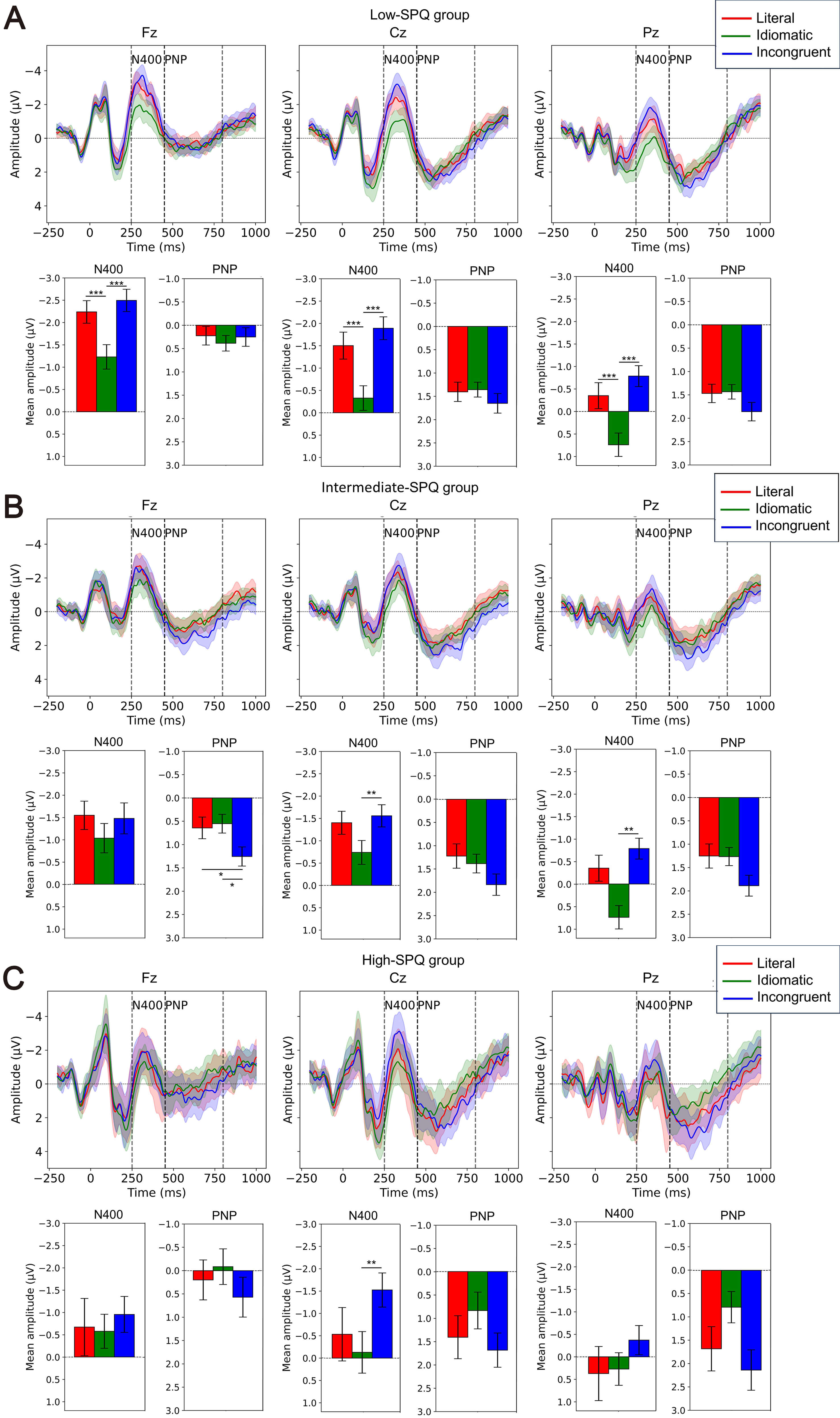
Grand-averaged ERPs in the three experimental conditions in the low-SPQ, intermediate-SPQ, and high-SPQ groups are presented in Fig. 2.
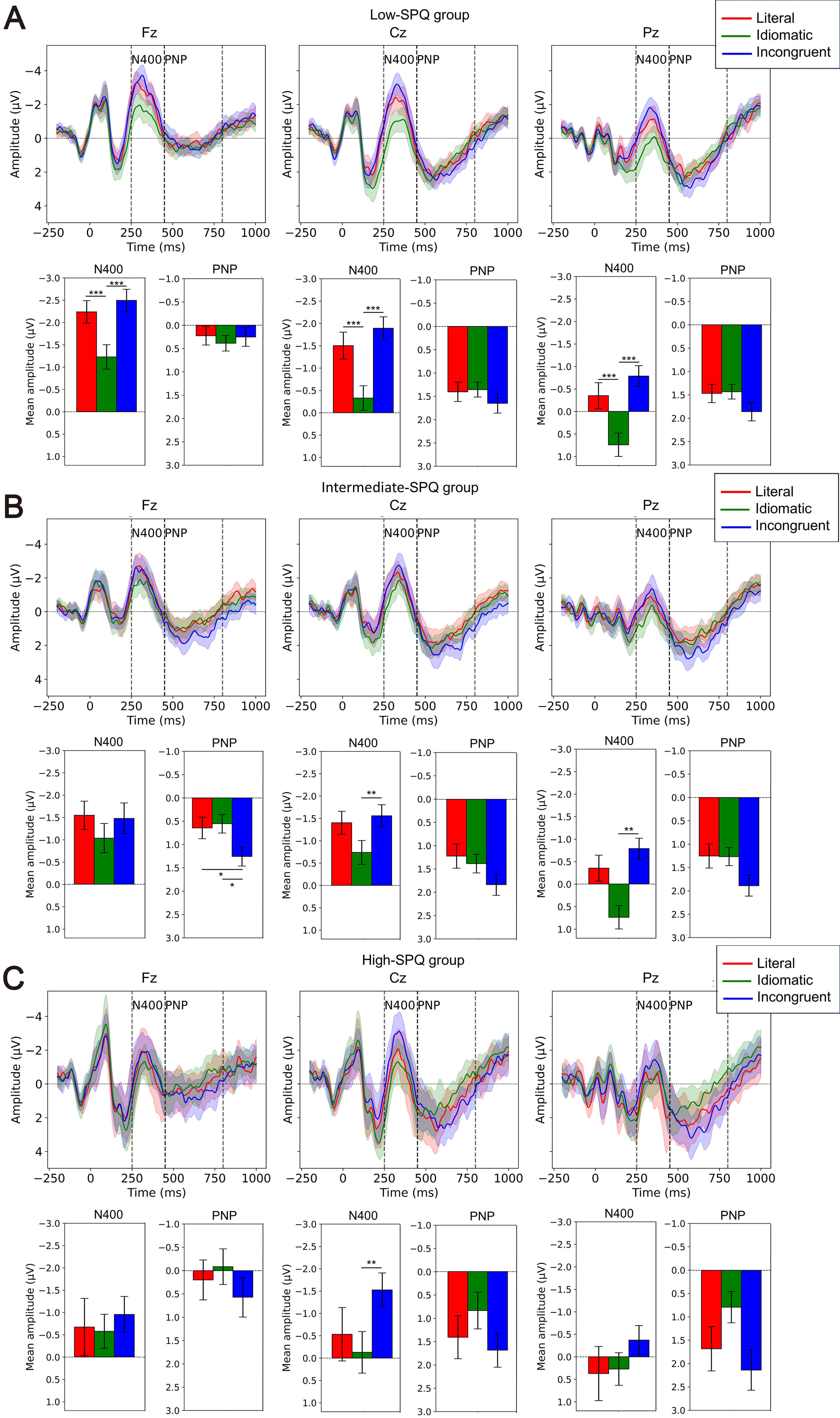 Fig. 2.
Grand-averaged ERPs for the second word in the three
experimental conditions in (A) the low-SPQ group, (B) the intermediate-SPQ group,
and (C) the high-SPQ group. Waveforms time-locked to the second word onset
plotted at three electrode sites (Fz, Cz, Pz) under the literal condition (red
line), the idiomatic condition (green line) and the incongruent condition (blue
line). Diagrams under each plot reflect mean amplitudes of N400 and PNP at the
corresponding electrodes. Colors of the stimuli types in the plots and diagrams
are matched. The error bar denotes the standard error of the mean (SEM),
*p
N400 amplitude differences between conditions across groups (low-SPQ, intermediate-SPQ, high-SPQ) were examined using Kruskal–Wallis H tests:
• Literal condition - Incongruent condition: no significant differences were observed at Fz (H(2) = 0.786, p = 0.675), Cz (H(2) = 2.799, p = 0.247), or Pz (H(2) = 1.117, p = 0.572).
• Literal condition - Idiomatic condition: no significant differences were found at Fz (H(2) = 3.476, p = 0.176) or Cz (H(2) = 5.943, p = 0.051). A marginal effect was observed at Pz (H(2) = 6.054, p = 0.049), though post-hoc comparisons with Holm correction were not significant.
• Incongruent condition - Idiomatic condition: significant effects were found at Fz (H(2) = 8.776, p = 0.012) and Cz (H(2) = 6.246, p = 0.044). Post-hoc tests revealed that low-SPQ participants showed significantly larger differences than intermediate-SPQ participants at Fz (p = 0.022). No significant differences were observed at Pz (H(2) = 5.588, p = 0.06).
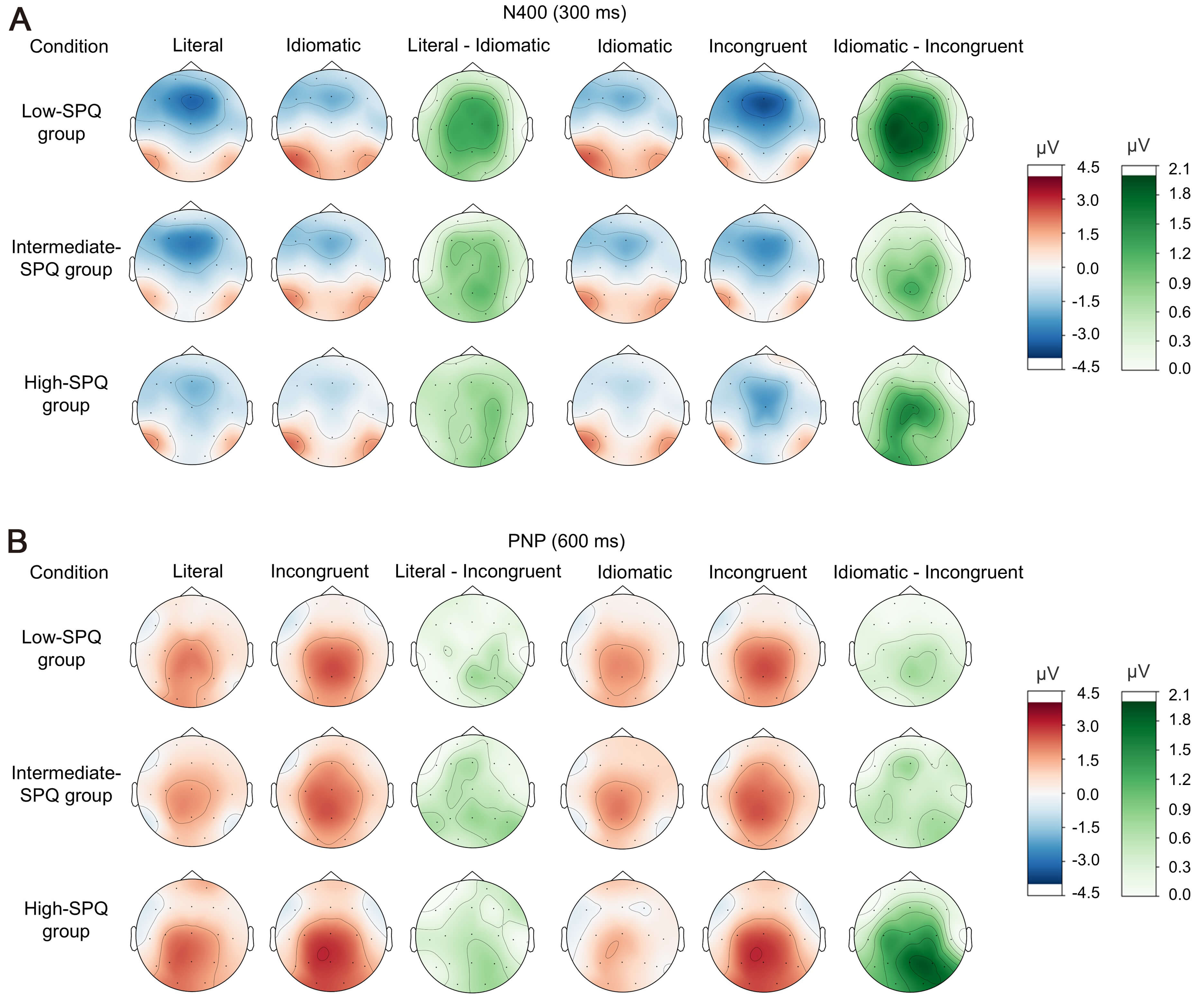
Topographic distributions of the N400 differences between literal phrases and idioms, and between idioms and incongruent stimuli are presented in Fig. 3A.
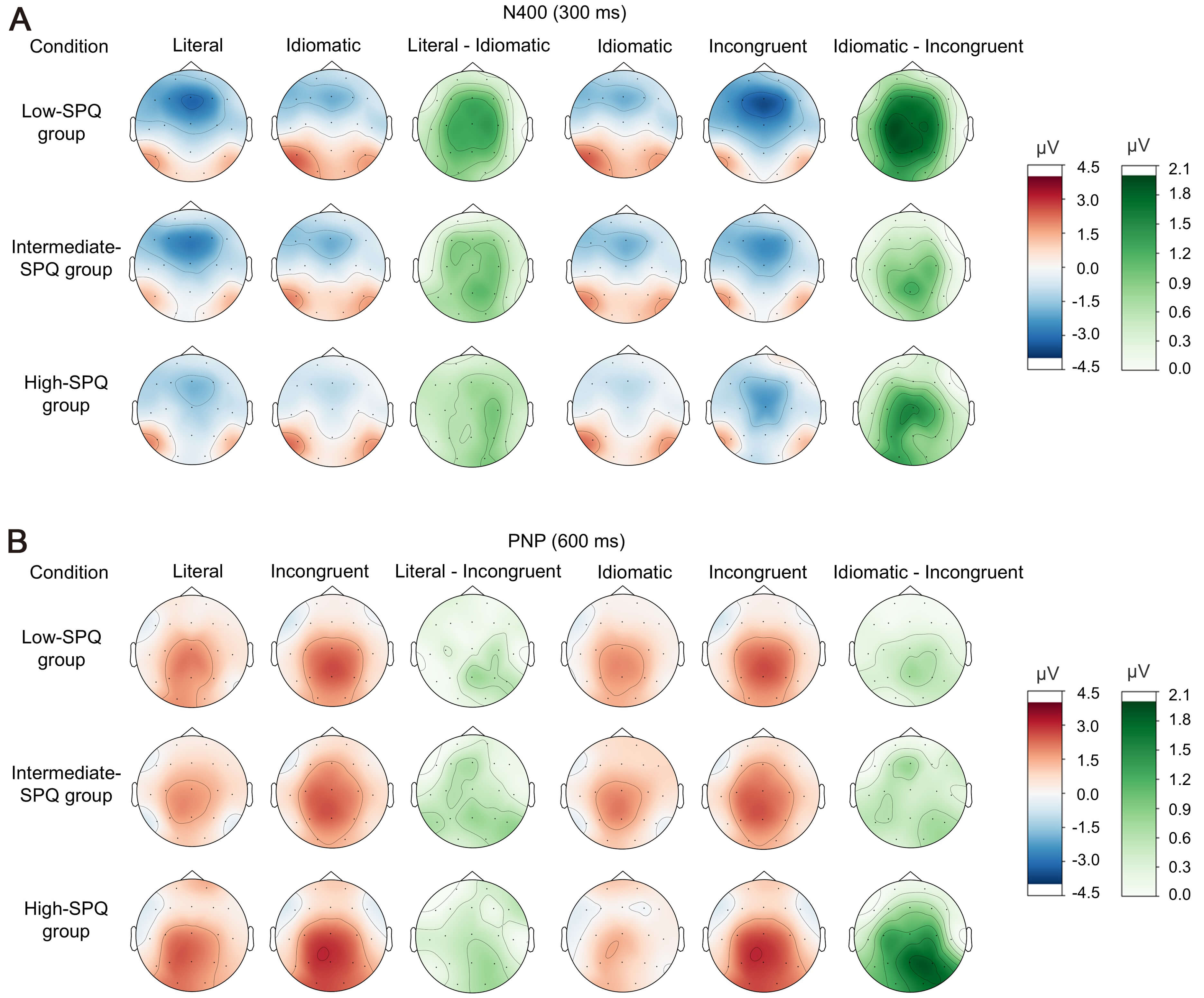 Fig. 3.
Topographic distributions of (A) the N400 differences and (B) PNP differences between types of stimuli.
PNP amplitude differences between conditions across groups were also examined with Kruskal–Wallis tests:
• Literal condition - Incongruent condition: no significant differences were observed at Fz (H(2) = 3.260, p = 0.196), Cz (H(2) = 2.102, p = 0.350), or Pz (H(2) = 0.658, p = 0.72).
• Literal condition - Idiomatic condition: no significant differences were observed at Fz (H(2) = 2.177, p = 0.337) or Cz (H(2) = 4.554, p = 0.103). A significant effect was observed at Pz (H(2) = 6.031, p = 0.049), though post-hoc comparisons were not significant.
• Incongruent condition - Idiomatic condition: significant effects were observed at Fz (H(2) = 12.665, p = 0.002), with post-hoc tests showing low-SPQ participants had smaller PNP differences than intermediate-SPQ (p = 0.003) and high-SPQ participants (p = 0.04). No significant differences were found at Cz (H(2) = 3.748, p = 0.154). At Pz, a significant effect was observed (H(2) = 6.568, p = 0.04), with high-SPQ participants showing larger PNP differences than low-SPQ participants (p = 0.032).
Topographic distributions of the PNP differences between literal and incongruent conditions, and between idioms and incongruent stimuli are presented in Fig. 3B.
Spearman’s correlation analysis revealed a significant positive association
between total SPQ scores and PNP amplitude differences between idiomatic and
incongruent conditions at Fz (r = 0.29, p
The present study examined the neural correlates of figurative and literal language processing in individuals with varying levels of schizotypal personality traits, as assessed by the SPQ. Specifically, we investigated N400 and PNP amplitudes elicited by literal, idiomatic, and incongruent word pairs across low-, intermediate-, and high-SPQ groups. Behavioral data were additionally evaluated but showed no group effects. During the study, participants completed a semantic judgment task. All participants were instructed to respond only upon the appearance of a question mark. This provided each subject with a substantial time window (1200 ms) to process the meaning of the phrase, which could account for the absence of significant group differences in behavioral reaction times. The absence of differences in the accuracy of responses may be attributed to compensatory processes characterizing the non-clinical sample with increased scores on the psychometric test. These mechanisms, despite the presence of neuronal changes, enable participants to maintain a good performance level. Thus, there were no behavioral changes in the groups with intermediate and high SPQ scores.
Consistent with prior literature, idiomatic expressions elicited less negative N400 amplitudes than both literal and incongruent word pairs, reflecting facilitated semantic access for familiar figurative expressions. At the frontal site, only the low-SPQ group exhibited clear differentiation between idiomatic expressions and both incongruent and literal conditions. In contrast, intermediate-SPQ and high-SPQ groups failed to show significant N400 distinctions between idioms and literal expressions, suggesting reduced sensitivity to figurative meaning during early stages of semantic processing in individuals with increased schizotypal traits. Moreover, participants from intermediate-SPQ and high-SPQ groups did not show differences between idioms and incongruent expressions in frontal area. It is known that frontal N400 is associated with familiarity, and the recruitment of executive resources during language comprehension [35, 36]. So, insensitivity of the frontal N400 to differences between stimuli in individuals with higher questionnaire scores may indicate impaired executive control during the processing of idioms and incongruent phrases, possibly due to a failure to inhibit irrelevant information, which is one of the characteristics of schizotypy [37, 38]. The absence of the N400 effect in the frontal region is consistent with a previous study, which also reported no differences in N400 amplitude between literal, figurative, and incongruent phrases specifically in the frontal area in schizophrenia patients that was accompanied by a general reduction in cerebral activation within the left and right inferior frontal cortex [39]. It is known that the inferior frontal gyrus (IFG) is connected to the semantic control networks, and also to regions important for lower order semantic processing and integration [40]. Abnormalities of IFG functioning in schizophrenia patients are widely reported in literature [41, 42, 43].
At central and parietal sites, participants with higher SPQ scores demonstrated preserved differentiation between idioms and incongruent phrases, indicating that the processing of highly associative idiomatic words relative to incongruent stimuli remains intact. However, unlike low-SPQ participants, these individuals did not show facilitation of idioms relative to literal phrases. These results are consistent with findings from studies on idiom processing in patients with schizophrenia and may suggest that elevated schizotypal traits are associated with diminished automatic processing of figurative language [14]. At the parietal site, the high-SPQ group failed to distinguish between literal and idiomatic expressions, as well as between idioms and incongruent phrases, which may reflect more profound context processing deficit associated with schizotypy [6, 44]. However, this result should be interpreted with caution due to the small number of participants in the high-SPQ group.
The PNP revealed pronounced group differences in frontal and parietal areas. The intermediate-SPQ participants exhibited larger frontal PNP differences between incongruent and idiomatic conditions, whereas the low-SPQ participants did not show any differences between conditions at the late stage of words processing. Visual inspection demonstrated that late positivity is not expressed in the frontal area in the low-SPQ group and statistical analysis showed that the frontal positivity amplitude in the incongruent condition was larger in the intermediate-SPQ participants than in the low-SPQ group. Correlation analysis further supports these findings. Total SPQ scores and the interpersonal subscale positively correlated with PNP differences between idiomatic and incongruent conditions at Fz, indicating that greater schizotypal traits, particularly interpersonal dysfunction, are associated with enhanced late-stage differentiation of figurative versus anomalous stimuli. It can be assumed that correlation with the interpersonal subscale can provide a reflection of the sensitivity of the late positivities to interpersonal communication difficulties [6] or even to emotional load [24], which accompany the interaction with people. The role of the frontal PNP remains a matter of debate: while some research groups associate it with reanalysis processes [2], others link it to the inhibition of preactivated, highly probable sentence completions, emphasizing that the frontal PNP is specifically related to plausible but unexpected endings, whereas the parietal PNP is associated with anomalous ones [22]. It can be assumed that the increased PNP at later stages may reflect compensatory processes for incongruent information processing in the intermediate-score group, since these processes appeared to be attenuated at the N400 stage in this group of participants. This may reflect processes of semantic reanalysis or the suppression of excessively activated representations, which are required for successful information processing in the group with increased questionnaire scores. Differences in PNP amplitude in the central and parietal leads should be discussed as trends or exploratory comparisons, since the interaction has not reached statistical significance. In view of this, it should be noted that in the high-SPQ group, there was a tendency in the parietal leads to differences between incongruent phrases and idioms. Based on this, we hypothesize that in the group with pronounced schizotypal traits, the compensatory process may be shifted to the parietal region. Comparisons of PNP amplitude differences between conditions further support these findings, as it was revealed that at Pz electrode, the group with the highest questionnaire scores exhibited more pronounced differences between incongruent and idiomatic conditions.
In our study, we did not observe an increase in frontal PNP amplitude during idiom processing, which is inconsistent with Canal’s findings [2]. This may be due to the fact that, in our study, the idioms did not have an additional literal meaning and were not embedded in the sentence context, as they were in Canal et al’s study [2]; therefore, active reanalysis processes at later stages of word processing were not required. So, differences in stimulus material may have contributed to these competing results.
In accordance with the aim of the study, we analyzed the key stages of semantic processing of figurative, literal, and incongruent phrases, as well as the influence of schizotypal personality traits on the neural mechanisms underlying these processes. In the neurotypical sample, we observed facilitated processing of idioms, which can be explained by their status as stable and highly associated word combinations. Typically, a pronounced N400 potential was elicited during the processing of incongruent words, illustrating the classical N400 effect, which indicates increased difficulty in the semantic integration of incongruent stimuli. At later stages, neural resources appeared to be allocated roughly equally across all stimulus types processing.
Among individuals with higher questionnaire scores, the processing of figurative, literal, and incongruent stimuli, as reflected in the frontal N400 component, did not differ significantly. Abnormal modulations of the frontal N400 in groups with elevated scores can be explained as abnormalities in semantic control network. Analyses of the central and parietal N400 components suggest that idiom processing was not facilitated relative to literal phrases, although a typical enhancement of the response to incongruent stimuli was still observed. Such abnormalities in semantic processing at the N400 stage in individuals with increased SPQ scores may lead to more resource-intensive processes, involving semantic reanalysis or suppression of excessively activated representations, which are reflected in PNP differences compared to the normotypical sample.
It is important to emphasize that the present study investigates psychometrically defined levels of schizotypal personality traits and it did not take into account the clinical aspects, therefore, the obtained findings primarily reflect neural-cognitive differences at the level of personality traits but not clinical differences.
Overall, it can be concluded that our hypothesis was only partially confirmed: while we obtained the expected results for the N400 component, we observed unexpected effects for the late positivity. This may be due to the fact that the PNP component has been scarcely investigated in studies on idiom processing and has not been reported in research on schizophrenia and schizophrenia-spectrum disorders. So, the PNP response observed during the processing of idioms and incongruent word pairs in individuals with schizotypal traits was a novel and unexpected finding. This evoked response requires further investigation and may represent a potential neurophysiological marker that could contribute to the general ERP pattern characterizing schizotypy.
Several limitations of the present study should be acknowledged. First, the small sample size of the high-SPQ group leads to limited statistical power, which may influence the stability of some effects, so findings in this group should be interpreted with caution. Additionally, some of the findings relied on exploratory post-hoc comparisons, which should be interpreted with caution, particularly in cases where overall interactions did not reach significance.
Second, the groups with schizotypal personality traits were defined on the basis of psychometric scores rather than clinical diagnostic criteria, therefore this limits the interpretation of the results in terms of clinical prediction.
Third, the stimulus paradigm encompassed only a restricted subset of figurative language phenomena (idioms). Also, the specific nature of the stimuli (Russian word pairs) and potential cultural or linguistic influences should be mentioned.
Finally, longitudinal studies with clinical evidence are needed to determine whether the observed patterns represent stable cognitive characteristics of schizotypy or potential markers of psychosis vulnerability.
The processing of literal, idiomatic, and incongruent expressions differs at the N400 stage and does not require subsequent compensatory mechanisms in the low-SPQ group. In contrast, in groups with higher scores, the processing of different stimulus types appears to be poorly regulated at the N400 stage, which is accompanied by compensatory activity at later stages of stimulus processing. The revealed pattern of changes may serve as a potential neurophysiological marker of schizotypy and emphasize the importance of examining late-stage semantic reanalysis processes in individuals with schizotypal personality traits. These findings may enrich our knowledge regarding the neurocognitive basis of figurative language processing in persons with schizotypal traits.
DSM-III-R, Diagnostic and Statistical Manual of Mental Disorders, Third Edition, Revised; EEG, electroencephalographic; ERPs, event-related potentials; GND, ground electrode; ICA, Independent Component Analysis; IFG, inferior frontal gyrus; LPC, Late Positive Component; PNP, post-N400 Positivity; SOA, stimulus onset asynchrony; SPQ, Schizotypal Personality Questionnaire; Fz, midline frontal electrode; FPz, midline frontopolar electrode; Cz, midline central electrode; Pz, midline parietal electrode; SD, standard deviation.
The data that support the finding of this study are available from the corresponding author on reasonable request.
Conceptualization, PP, IM; methodology, PP and NN; software, EI; data analysis, EI and NN; data acquisition, NN and SMGM; data curation, EI and NN; writing the manuscript, NN and SMGM; visualization, NN and EI; supervision, IM and PP; resources, IM; project administration, NN. All authors contributed to editorial changes in the manuscript. All authors read and approved the final manuscript. All authors have participated sufficiently in the work and agreed to be accountable for all aspects of the work.
The study was conducted in accordance with the Declaration of Helsinki. The research protocol was approved by the Ethics Committee of the Privolzhsky Research Medical University (protocol No 8, 2019), and all of the participants provided signed informed consent.
The authors express gratitude to all participants of the study, namely, students of Privolzhsky Research Medical University and National Research Lobachevsky State University of Nizhny Novgorod.
This research received no external funding.
The authors declare no conflict of interest.
References
Publisher’s Note: IMR Press stays neutral with regard to jurisdictional claims in published maps and institutional affiliations.