

 , Fabio Petrelli 1
1 School of Pharmacy, Experimental Medicine and “Stefania Scuri” Public Health Department, 62032 Camerino, Italy
Abstract
Heatwaves, intensified by climate change, pose a growing threat to public health, especially for vulnerable populations with impaired thermoregulation or chronic conditions. Thermal stress, dehydration, and metabolic dysregulation increase morbidity and mortality. Nutrition plays a central role in both prevention and therapy by supporting hydration, electrolyte balance, antioxidant defense, and metabolic resilience. Evidence shows that tailored dietary strategies mitigate heat-related risks. Effective heatwave management requires multidisciplinary, multi-level interventions integrating nutrition, clinical care, public health policies, and One Health approaches might reduce adverse outcomes, and strengthen the resilience of the healthcare systems, including low- and middle-income countries, according to available resources.
Keywords
- heatwaves
- nutrition strategy
- public health
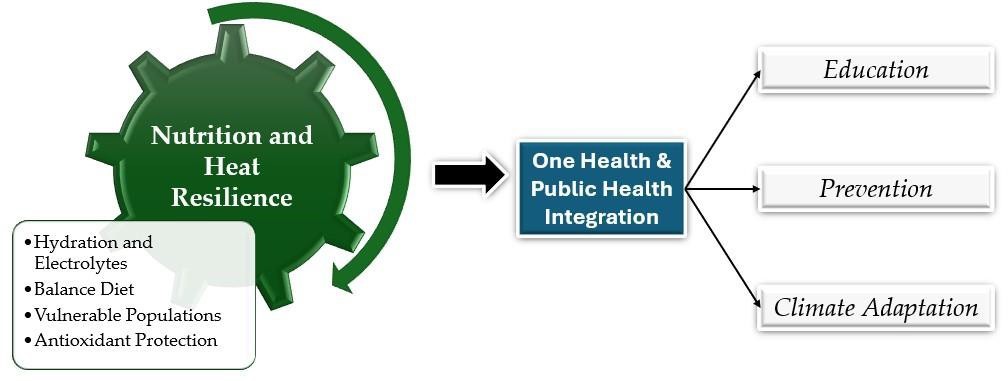
Climate change is a major global public health challenge of the twenty-first century. Rising temperatures, more frequent extreme weather events, and sea-level rise are altering ecosystems and affecting human health [1]. Heatwaves, in particular, are increasing in frequency and intensity, posing significant risks worldwide [2]. Vulnerable populations—including the elderly, children, individuals with chronic conditions, and socioeconomically disadvantaged groups—face greater exposure to heat-related risks, such as dehydration, metabolic dysfunction, and cardiovascular complications [3]. Nutrition plays a key role in mitigating these risks. Proper hydration, intake of essential micronutrients, and balanced dietary patterns, combined with physical activity and healthy social behaviors, support metabolic resilience and reduce adverse health outcomes [4]. Results suggest that heat stress and reproductive status may have a greater impact on hydration status than water insecurity across diverse ecological contexts. Integrating nutrition within multidisciplinary approaches enhances both preventive and clinical management strategies [5]. In this opinion paper, we focus on hydration strategies during heatwaves, given their key role in supporting metabolic resilience and reducing heat-related health risks. Furthermore, understanding the interactions between climate, nutrition, and public health underscores the value of a One Health perspective, which links human health to ecosystem and environmental dynamics [6]. Improvements of clinical parameters through healthy behaviors and lifestyles have a strong protective effect during heat waves, especially for frail and multimorbid populations [6]. Effective health and nutrition policies should address extreme heat by combining nutritional education, access to water, and community awareness programs, thereby reducing vulnerability and strengthening the Healthcare system’s resilience of the healthcare system against increasingly frequent extreme climate events [7]. According Guo et al. [7], this approach comprises six essential steps for quality intervention development: individual adaptation strategy, interpersonal adaptation strategy, community adaptation strategy, institutional adaptation strategy, environmental adaptation strategy, and public policy adaptation strategy, which are interrelated and can reinforce each other. Furthermore, heatwaves are not isolated phenomenona but indicators of the broader impact of climate change on the general public’s health. Prevention and management of the associated risks, therefore, require a combination of scientifically validated interventions, adaptation policies, and cross-disciplinary collaboration, with the primary objective of protecting the most vulnerable populations and ensuring the sustainability of healthcare systems [3, 4, 5, 6, 7]. Fig. 1 summarizes the main nutrition strategies discussed here, providing a concise overview applicable across different contexts and populations.
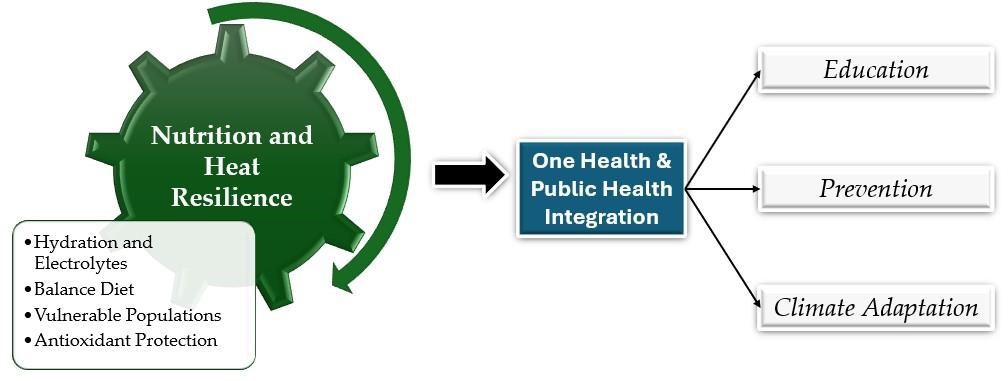 Fig. 1.
Nutrition strategies during heatwaves in one and public health view.
Heatwaves trigger complex physiological responses to maintain thermal homeostasis. Vulnerable populations, especially individuals with chronic conditions, are at higher risk due to impaired thermoregulation and metabolic stress [8].
Dehydration is a primary concern during heatwaves. Increased sweating leads to significant fluid loss, impairing renal function, reducing plasma volume, and increasing hematocrit, which predisposes to thrombosis and organ failure. Adequate fluid intake is crucial for maintaining thermoregulation, supporting cardiovascular function, and preventing heat-related complications. An increase of 1 °C in high temperatures—which significantly affects hydration levels, especially in elderly and frail patients—is associated with a rise in cardiovascular and respiratory complications, with an increase in mortality risk of 2.1% and 4.1%, respectively. This aspect is particularly relevant for individuals affected by multimorbidity, and it also relates to care management within a One Health and public health perspective [9].
Disturbances in sodium, potassium, magnesium, and calcium levels can cause cardiac arrhythmias, muscle weakness, and cramps. Dehydration increases blood viscosity and peripheral vascular resistance, further compromising thermoregulation, with systemic repercussions on cardiac function, renal perfusion, neurohormonal balance, and the functional integrity of the brain and other vital organs. Monitoring and managing electrolyte balance is essential, particularly in individuals taking medications such as diuretics or antidepressants, and affected by chronic diseases in general [9, 10, 11].
Heat stress increases energy expenditure and oxygen demand, potentially exacerbating pre-existing conditions such as cardiovascular disease. Chronic diseases can impair thermoregulation and thirst perception, increasing susceptibility to dehydration and metabolic imbalance. Effective management requires a holistic approach integrating hydration, electrolyte monitoring, and support for metabolic function. From this perspective, healthcare organizations at both global and national levels must be able to address the vulnerabilities of the most at-risk populations through appropriate, targeted responses, while preventing inequalities and inequities. This approach is essential for the overall protection of public health and the entire health process, not only in terms of the effectiveness and efficiency of interventions, but also—and above all—with regard to their overall sustainability, encompassing economic, social, and environmental dimensions [12, 13].
Nutrition is a key strategy for enhancing resilience during heatwaves, both as a preventive measure and in mitigating acute thermal stress. Targeted interventions support hydration, electrolyte balance, antioxidant defense, and metabolic function, particularly in vulnerable populations. As summarized in Table 1 (Ref. [1, 2, 4, 6, 7, 8, 12, 13, 14]), key nutrition and multi- disciplinary strategies for vulnerable populations during heatwaves include meal education and composition, targeted micronutrients supplementations, hydration management and consideration for physical activities in resilience framework view.
| Strategies | Target populations | Key components | Practical application/Outcome | Applied evidence |
| Hydration & Electrolytes | Older adults, children, and individual with chronic diseases | Adequate fluids, sodium, potassium, magnesium, calcium | Maintains plasma volume and reduce the risk of dehydration-related complications, as demonstrated in studies involving subjects exposed to heat stress [7] | Six main adaptive steps: individual, interpersonal, community, institutional, environmental, and public policy adaptation strategies. |
| Micronutrients & Antioxidants | Older adults, children, and individual with chronic diseases | Vitamins C & E, polyphenols | Reduce oxidative stress and support metabolic resilience, as demonstrated in studies involving subjects exposed to extreme heat or adverse metabolic conditions [14] | Numerous clinical trials show that micronutrient support in clinical practice promotes an overall improvement in the care of frail and multimorbid patients. |
| Balance Dietary Patterns | General at-risk populations | Water, Fruits, vegetables, whole grains, legumes, fish, unsaturated fats | Supports hydration and supplies essential antioxidants and micronutrients, helping to modulate the inflammatory response under physiological stress conditions [4] | Results suggest that heat stress and reproductive status may have a greater impact on hydration status than water insecurity across diverse ecological contexts. |
| Community Programs | Vulnerable communities | Nutritional education, access to hydrating foods, clinical monitoring | Increases heat tolerance and is associated with reduced morbidity and mortality, as evidenced by epidemiological studies in populations exposed to heat stress [1, 2] | Multi-disciplinary, multi-level approach to managing care during extreme heat events is suggested from both a clinical and organizational point of view. |
| Multidisciplinary Approaches | All vulnerable populations | Coordination of medicine, nutrition, climatology, urban planning, public health | Supports an integrated response through predictive models and operational guidelines, potentially contributing to optimized healthcare costs [12] | Multi-disciplinary approach to managing care during extreme heat events is suggested from both a clinical and organizational perspectives mainly in chronic care and vulnerable population. |
| Public Awareness & Prevention Campaigns | Vulnerable communities | Education on hydration, food choices, activity adaptation | Helps modulate physiological responses to heat stress, thereby attenuating the negative health effects heatwave [6] | Healthy behaviors strongly protect frail, multimorbid patients during heat waves. |
| Cooling Centers/Helplines/Heat Alerts | At-risk populations | Infrastructure and digital alert systems | Supports timely and targeted interventions through rapid communication strategies and operational coordination [1, 8, 13] | Health technology assessment, artificial intelligence, and all possible digital and informational devices supporting care from both a predictive and preventive perspective. |
Adequate fluid intake is crucial for maintaining plasma volume, supporting renal function, and preventing dehydration-related complications, including cardiac arrhythmias, muscle cramps, and thrombotic events [15]. Electrolytes—namely, sodium, potassium, magnesium, and calcium—play crucial roles in nerve conduction, muscle function, and cardiovascular health. Supplementation or dietary adjustments may be necessary for vulnerable individuals or patients taking medications that affect fluid and electrolyte balance [15, 16].
Vitamins C and E, polyphenols, and other antioxidants help mitigate heat-induced oxidative stress, protect endothelial cells, and reduce systemic inflammation. According to the guidelines of the European Society for Clinical Nutrition and Metabolism (ESPEN) on micronutrient implementation, the assessment and targeted correction of micronutrient deficiencies are essential to support immune function, including vaccine responsiveness, and to improve clinical outcomes in aging and chronic conditions [16]. Adequate micronutrient intake supports metabolic resilience and enhances physiological responses to thermal stress, especially in older adults and those with chronic conditions [14].
Balanced dietary patterns rich in fruits, vegetables, whole grains, legumes, fish, and unsaturated fats provide hydration, antioxidants, and essential micronutrients, while limiting sugars and saturated fats reduces inflammation [17]. Light, frequent meals support thermoregulation and overall hydration. Community programs integrating nutritional education, access to hydrating foods and beverages, and clinical monitoring enhance heat tolerance and reduce morbidity and mortality in at-risk populations [18, 19]. In this context, community programs that combine nutritional education, access to hydrating foods and beverages, and clinical monitoring not only improve heat tolerance and reduce morbidity and mortality, but also contribute to environmental sustainability through resilient, low-impact dietary choices [19].
Effective management of heatwaves requires a multidisciplinary approach that integrates expertise from multiple specialties and a public health view [20]. Only through coordinated strategies and multi-level interventions vulnerable populations can be protected, mortality reduced, and the sustainability of healthcare systems enhanced during critical events such as heatwaves. Public health policies must recognize the central role of nutrition in preventing and managing the effects of high temperatures. Specific guidelines on hydration, electrolyte intake, and adherence to balanced diets could be incorporated into heatwave emergency plans [21]. Large-scale educational programs, awareness campaigns, and informational materials targeted at vulnerable communities can help translate scientific recommendations into everyday practices [20, 21]. In this opinion paper, we focus on hydration strategies as a central component of nutritional interventions during heatwaves, given their critical role in supporting health and metabolic resilience.
The integration of nutritional indicators into health surveillance systems would enable the timely identification of individuals at risk and the activation of targeted interventions. Coordination among diverse disciplines is essential for effective heatwave management. Medicine provides clinical guidance for managing at-risk patients; nutrition supports preventive and metabolic recovery strategies; climatology enables the prediction of extreme events; urban planning contributes to the design of spaces that reduce heat exposure; and public health ensures the planning and implementation of preventive policies [22]. Interdisciplinary collaboration enables the development of predictive models, operational guidelines, and shared protocols, thereby increasing the effectiveness of interventions and reducing healthcare costs associated with extreme events. Awareness and prevention campaigns are key tools for mitigating risk in vulnerable communities. Educational programs that emphasize the importance of hydration, making informed food choices, and adapting daily activities to environmental conditions can significantly mitigate the adverse effects of heatwaves [23]. The use of cooling centers, dedicated helplines, and digital heat alert systems enables rapid outreach to at-risk populations, facilitating timely, targeted interventions. In this context, and following a One Health and public health approach, heatwave management strategies should combine nutrition, health education, water resource management, and urban adaptation [24]. Multidimensional intervention models—integrating local policies, clinical protocols, community programs, and meteorological alert systems—have demonstrated increased resilience among vulnerable populations, resulting in reduced hospitalizations and heat-related mortality. Implementing One and Public Health approaches also allows the creation of sustainable, scalable, and adaptable systems that can be applied to future climate-related emergencies [25].
In addition to reactive interventions during heatwaves, proactive preventive strategies at the community level are essential. Early implementation of public awareness campaigns, community hydration programs, nutritional education, and heat-adapted urban planning can reduce the vulnerability of at-risk populations before heat events heatwaves occur. These preventive measures complement reactive interventions and strengthen overall community resilience [23, 24, 25].
Despite the practical and scientific relevance of the proposed nutritional strategies, several limitations should be considered. The effectiveness of these interventions is influenced by disparities in healthcare infrastructure and community resources, which can vary significantly across geographic and socio-economic contexts. Access to healthy foods rich in micronutrients and vitamins, as well as dietary supplements, may be constrained by economic, logistical, or seasonal factors, which limit the uniform implementation of these recommendations. Cultural determinants and local dietary habits also play a crucial role, as beliefs, preferences, and food practices may affect adherence and acceptability of the proposed strategies. Individual-level factors, such as personal motivation and risk perception, can further influence the adoption of preventive behaviors, particularly among vulnerable populations. In addition, baseline nutritional status should be considered, as it can affect the response to dietary interventions and overall resilience to heat-related health risks. Finally, the strategies presented in this article are necessarily general and conceptual, reflecting the nature of an opinion piece; they are intended as a guiding framework rather than prescriptive clinical guidelines and do not replace localized studies or controlled interventions. The scalability and long-term sustainability of these approaches required further evaluation to ensure feasibility and replicability, particularly in low- and middle-income countries.
Heatwaves represent a growing public health challenge, with potentially disproportionate effects on vulnerable populations such as older adults, children, and individuals with chronic diseases, particularly in socioeconomically disadvantaged or resource-limited settings. In these contexts, exposure to extreme heat may increase the risk of dehydration, metabolic imbalance, cardiovascular stress, and heat-related morbidity and mortality due to limited access to healthcare, water, and adequate cooling resources. In this framework, nutrition could play a relevant role in enhancing resilience to heat stress, especially through adequate hydration, electrolyte balance, and dietary choices that may support thermoregulation. At the individual level, simple and low-cost preventive measures—such as adapting daily activities, increasing fluid intake, and limiting exposure during peak heat hours—could help reduce heat-related health risks, even in less favorable settings. From a broader perspective, integrated strategies inspired by One Health and Public Health approaches, combined with education, early warning systems, and community-based interventions adapted to local and regional contexts, would be desirable to mitigate the health impact of heatwaves.
In this scenario, healthcare systems, according to their structural and organizational capacities, should be encouraged to develop context-appropriate responses to heatwaves, aiming to protect vulnerable populations and reduce avoidable health burdens and costs.
Not applicable.
GC and FP were responsible for the conception of ideas presented, writing, and the entire preparation of this manuscript. The both author read and approved the final manuscript. They have participated sufficiently in the work and agreed to be accountable for all aspects of the work.
Not applicable.
Not applicable.
This research received no external funding.
The authors declare no conflicts of interest.
During the preparation of this work, the authors used ChatGPT-3.5 to check spelling and grammar. After using this tool, the author reviewed and edited the content as needed and takes full responsibility for the content of the publication.
References
Publisher’s Note: IMR Press stays neutral with regard to jurisdictional claims in published maps and institutional affiliations.