
 , Feifei Chen 2,†, Jingjing Guan 3, Qinglian Zhang 3, Abdullah Al Mamun 3, Quan Zhou 3, Peiwu Geng 3, Shuanghu Wang 3,*
 , Yunfang Zhou 3,*
1 Department of Cardiology, Lishui Hospital of Wenzhou Medical University, The First Affiliated Hospital of Lishui University, Lishui People's Hospital, 323000 Lishui, Zhejiang, China
2 Department of Pharmacy, Ningbo First Hospital, 315010 Ningbo, Zhejiang, China
3 Central Laboratory of Lishui Hospital of Wenzhou Medical University, The First Affiliated Hospital of Lishui University, Lishui People's Hospital, 323000 Lishui, Zhejiang, China
†These authors contributed equally.
Abstract
Danshensu and atorvastatin are employed in the management of cardiovascular diseases (CVDs) to lower blood lipid levels and dilate blood vessels. Therefore, this study aimed to examine the potential pharmacokinetic interaction between danshensu and atorvastatin in rats.
Chromatography was performed using a CORTECST UPLC C18 column (2.1 × 1.5 mm, 1.6 μm) at a temperature of 40 °C. Acetonitrile and water were combined in the mobile phase at a rate of 0.4 mL/min via gradient elution. The methodology was validated under the guidance of the FDA and EMA literature. A total of 12 Sprague-Dawley (SD) rats were randomly assigned into two groups: the experimental group (treated with 150 mg/kg/day danshensu) and the control group (treated with 0.5% CMC-Na). Atorvastatin 10 mg/kg was administered after two weeks. The proposed method meets all the standards of bioanalysis technology verification.
Compared to the control group, the experimental group exhibited significant differences in the area under the curve (AUC), t1/2, CLz/F, and Cmax (p < 0.05). The AUC, Cmax, and t1/2 of the experimental group were higher, yet the clearance rate was significantly slowed.
This technique was effectively utilized to investigate the pharmacokinetic interaction between danshensu and atorvastatin in rats, which may be of significant clinical importance and contribute to the rationalization of clinical medicine, ultimately facilitating individualized administration.
Keywords
- danshensu
- atorvastatin
- drug-drug interaction
- pharmacokinetics
- cardiovascular diseases
The incidence of cardiovascular diseases (CVDs) such as atherosclerosis, hypertension, hyperlipidemia and stroke is increasing year by year, which is the main cause of death in the world today and its mortality rate is much higher than other types of diseases [1]. CVD has become a predominant cause of mortality among people in recent years, which has sparked a nationwide search for effective treatment [2]. To prevent CVD, it is imperative to lower low-density lipoprotein cholesterol (LDL-C) levels. Moreover, statins reduce the importance of LDL-C in preventing CVD, indicating that clinical use may reduce the risk of cardiovascular disease by using these drugs [3, 4, 5].
Atorvastatin is a statin that contains a penta-substituted pyrrole with extremely wide clinical applications [6, 7, 8, 9]. The most common disease treated with statins is CVD, which reduces morbidity and mortality of the disease by lowering the concentration of cholesterol in the blood [10, 11, 12]. Cholesterol is widely distributed in the cell membrane, and its main synthetic site is in the liver [13]. When CVD occurs, it is an extremely important indicator of whether blood lipids are normal. Therefore, atorvastatin regulates cholesterol biosynthesis by competitive inhibition of 3-hydroxy-3-methylglutaryl coenzyme A reductase (HMG CoA reductase) [14]. At present, statins are well tolerated in clinic, and there is no contraindication to atorvastatin. A large amount of literature proves the safety of atorvastatin in the treatment of CVD population, and its clinical tolerance is well tolerated, so it is widely used in the treatment of cardiovascular diseases worldwide [15, 16]. The combination of statins may cause various types of myopathy and hemorrhagic stroke (outpatient trends), so the dosage should be limited [17]. Atorvastatin is a lipophilic drug that will prevent cardiovascular disease by reducing plasma endothelin-1 and asymmetric dimethylarginine [18, 19]. Furthermore, atorvastatin is a substrate for CYP3A4, a P-glycoprotein (P-gp) and organic anion transporter 1B1 (OATP1B1) [20, 21]. The main metabolites of atorvastatin were O-hydroxy atorvastatin and the p-hydroxy atorvastatin, which account for 70% of the HMG CoA reductase activity [3].
Danshensu is derived from the dried roots of Savia miltiorrhiza and is the important pharmacological component of traditional Chinese medicine Danshen, which can dilate blood vessels, increase the circulation of blood and reduce the congestion of small pieces [22]. It plays an important role in mediating beneficial antioxidant and anti-apoptotic effects through activating nuclear factor-erythrocyte 2-related factor 2 (Nrf2)/HO-1 signaling [23, 24]. Numerous studies have confirmed that danshensu can treat CVDs including atherosclerosis, coronary heart disease and angina pectoris, etc. It has unique biological activity on the cardiovascular system and can play a protective role [25, 26, 27]. The clinical applications of danshensu were investigated in recent years [28, 29]. The interaction between danshensu and other conventional drugs has been reported clinically. The combination of rhubarb and danshensu is a drug interaction prescription that treats chronic kidney disease and inhibits oxidative stress [30].
Danshensu has been reported to modulate the activity of cytochrome P450 enzymes, particularly CYP2C9, and to inhibit drug transporters such as OATP1B1, leading to clinically relevant drug-drug interactions (DDIs) [21, 31, 32]. Furthermore, atorvastatin is a substrate for CYP3A4, a P-gp and OATP1B1 [20, 21]. Both DDIs and herbal–drug interactions (HDIs) can alter the pharmacokinetics and therapeutic outcomes of co-administered drugs [33, 34]. Compared with DDIs, HDIs are more complex to investigate due to the multicomponent nature of herbal medicines and their diverse pharmacological effects [35]. Moreover, patients with chronic diseases often take multiple medications including herbal products, increasing the potential for clinically significant interactions [36]. The combination of atorvastatin and danshensu is expected to have the effect of dilation of the blood vessels. In this study, a sensitive and reproducible UPLC-MS/MS method was developed for the determination of atorvastatin in rat plasma. This study developed a sensitive and reproducible UPLC-MS/MS method for the quantification of atorvastatin in rat plasma. This work aimed to assess the pharmacokinetic interactions between danshensu and atorvastatin in vivo in rats, providing an experimental foundation for their safe clinical application.
Atorvastatin (purity
The determination of atorvastatin was performed by an Acquity UPLC Xevo TQD
triple quadrupole mass spectrometer (Waters Co., Milford, MA, USA).
Chromatography was carried out using a CORTECST UPLC C18 column (2.1
The settings for the multi-reaction monitoring (MRM) scan mode were 150
°C for the source, 500 °C for desolvation, 40 V for the cone
voltage, and 20 V and 10 V for collision energy for atorvastatin and IS,
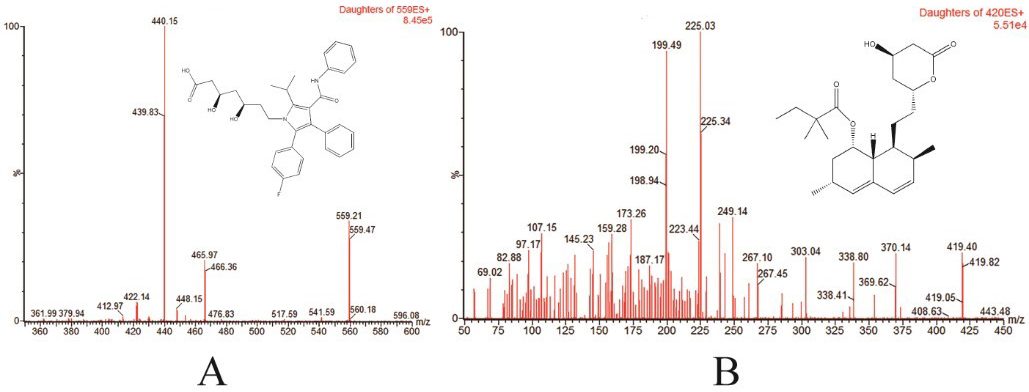
respectively. The production for MRM detection was m/z
559.25
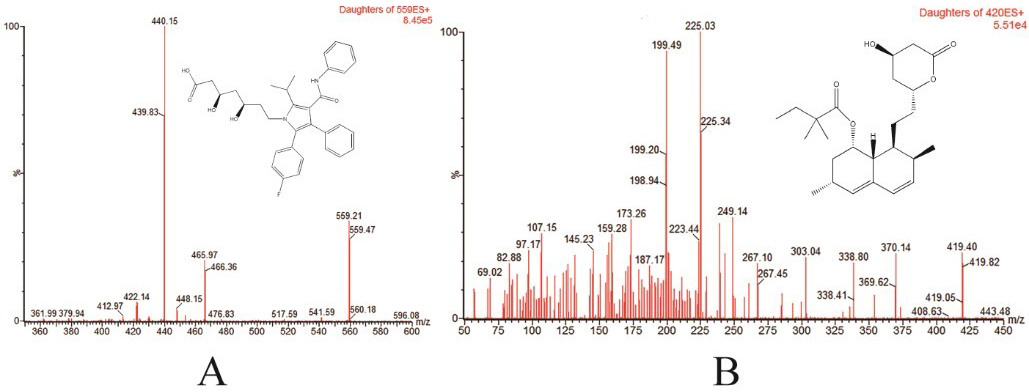 Fig. 1.
Mass spectra of atorvastatin (A) and simvastatin (IS) (B).
The stock solution of atorvastatin (1 mg/mL) was formulated in methanol. A set of standard working solutions was prepared by diluting the atorvastatin stock solution with methanol. Similarly, the stock solution of simvastatin was prepared in the same way and finally diluted to 2 µg/mL before use. The calibration standard samples for atorvastatin (100, 50, 25, 10, 5, 2.5, 1 ng/mL) were generated by adding 20 µL of the working standard solution to 100 µL of blank rat plasma. Low quality control (LQC) (2 ng/mL), middle quality control (MQC) (8 ng/mL), and higher quality control (HQC) (80 ng/mL) samples were prepared in the same manner. All solutions and samples were stored in a refrigerator at 4 °C until use.
A 10 µL aliquot of IS solution (500 ng/mL simvastatin) and 100 µL of acetonitrile was added to 50 µL plasma sample. The mixture was vortex-mixed for 30 sec, and centrifuged at 13,000 rpm for 5 min. Then 2 µL aliquot of the supernatant was injected into the UPLC-MS/MS system for analysis.
Methodological validation was performed under the guidance of the FDA and EMA literature [37, 38], including selectivity, linearity and the lower limit of quantification (LLOQ), linearity, accuracy, precision, matrix effect, extraction recovery and stability. Each set of validations need to be determined for three consecutive days including five sets of four different concentrations of QC samples (LLOQ, LQC, MQC, HQC).
To evaluate the specificity, we analyzed five blank biological samples, five biological samples spiked with atorvastatin and IS, and five biological samples following administration of atorvastatin orally or intravenously.
The standard curve for atorvastatin was within 1 to 100 ng/mL for plasma samples. The reciprocal of concentration (1/X) was used as the weighting factor to evaluate calibration curves using linear regression analysis. LLOQ was defined as the lowest concentration quantified on the scale of calibration curves, where relative standard deviation (RSD) for precision and RE for accuracy were less than 20%.
Five replicate samples at four concentrations (LLOQ, LQC, MQC, HQC) of 1, 2, 8,
and 80 ng/mL, respectively, were determined on one day to calculate accuracy and
precision. The validation procedure was carried out over three consecutive days.
RSD and relative error (RE) were employed for evaluating precision and accuracy,
respectively. Intra-day and inter-day precision were verified by measuring
concentration changes over the same day and for three consecutive days. Accuracy was achieved by comparing the results to the prepared concentration,
with a lower than 15% error and a variation within
The recovery rate is the ratio of the response value of the test substance recovered from the sample to the response value of the standard substance. Four different concentrations of LLOQ, LQC, MQC, HQC (1, 2, 8, 80 ng/mL, respectively) were prepared according to the method of the sample preparation, and each concentration was made in five parallel groups and the corresponding peak area of atorvastatin was measured as A1. 500 µL of blank plasma and 1 mL of acetonitrile were added to a 2 mL centrifuge tube, vortexed for 30 s, and centrifuged for 5 min (13,000 rpm). Unextracted atorvastatin samples were prepared from 145 µL of supernatant, IS and atorvastatin standard solutions to obtain the average A2 of the corresponding peak area of atorvastatin and calculated the recovery rate by A1/A2.
Significant interferences frequently occur throughout the analyte analysis procedure, impacting the accuracy of the results. These influences and disturbances are referred to as matrix effects. The standard solution and IS were added to 45 µL aliquots of methanol to make four different concentrations of atorvastatin solution (1, 2, 8, 80 ng/mL, respectively). The matrix effect was calculated as A2/A3 based on the average value of the area A3.
Long-term stability and short-term stability indicate the reliability and reproducibility of results. Five sets of parallel experiments were carried out for each of the four sample concentrations of LLOQ, LQC, MQC and HQC (1, 2, 8, 80 ng/mL, respectively).
Sprague-Dawley (SD) male rats (280
Twelve SD rats were randomly allocated into two groups: the experimental group (Group A, n = 6, receiving a dosage of 150 mg/kg/day of danshensu for two weeks) and the control group (Group B, n = 6, administered 0.5% CMC-Na). Subsequent to the last administration of danshensu or 0.5% CMC-Na (control group), both cohorts were administered a single oral dosage of atorvastatin at 10 mg/kg. The rats underwent a 12-hour fasting period before to injection. The 100 µL blood samples were obtained by the tail vein at intervals of 0.083, 0.25, 0.5, 1, 1.5, 2, 3, 4, 6, 8, and 12 hours into a 1.5 mL centrifuge tube. The samples underwent centrifugation at 4000 rpm for 10 minutes and were promptly separated. The plasma samples were subsequently transferred to a different centrifuge tube and frozen at –80 °C until analysis, following the removal of the supernatant.
Electrospray ionization (ESI) was the most common method, which enhanced the
sensitivities and reproducibility of UPLC-MS/MS. The second impact of the
analysis results was to take into account the type of column and the choice of
mobile phase. The CORTECST UPLC C18 column (2.1
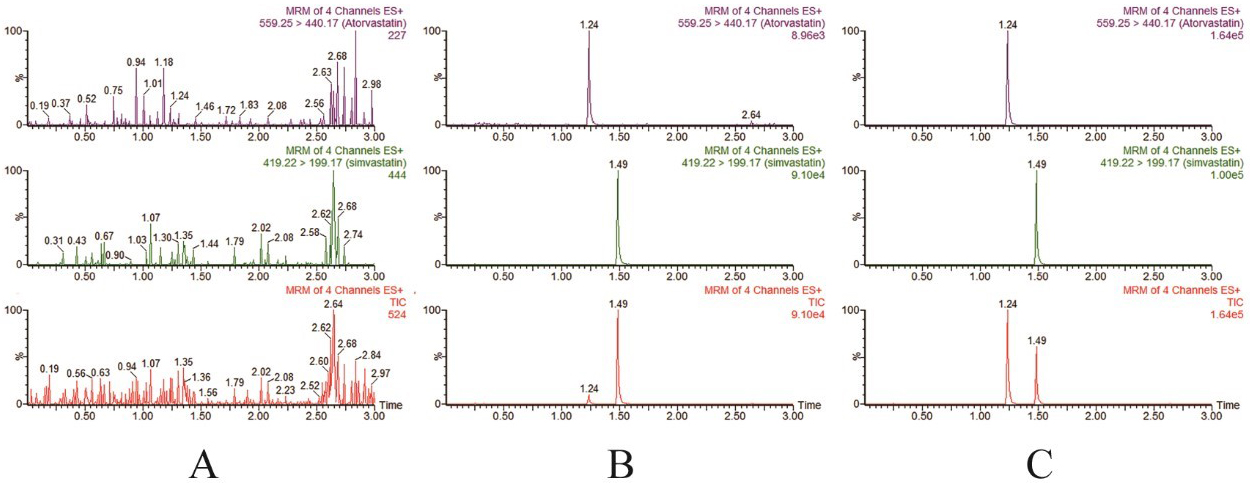
Standard chromatograms for blanks, pooled samples, and individual biological samples are shown in Fig. 2. The outcomes demonstrated that atorvastatin and IS were not hampered by any endogenous molecules.
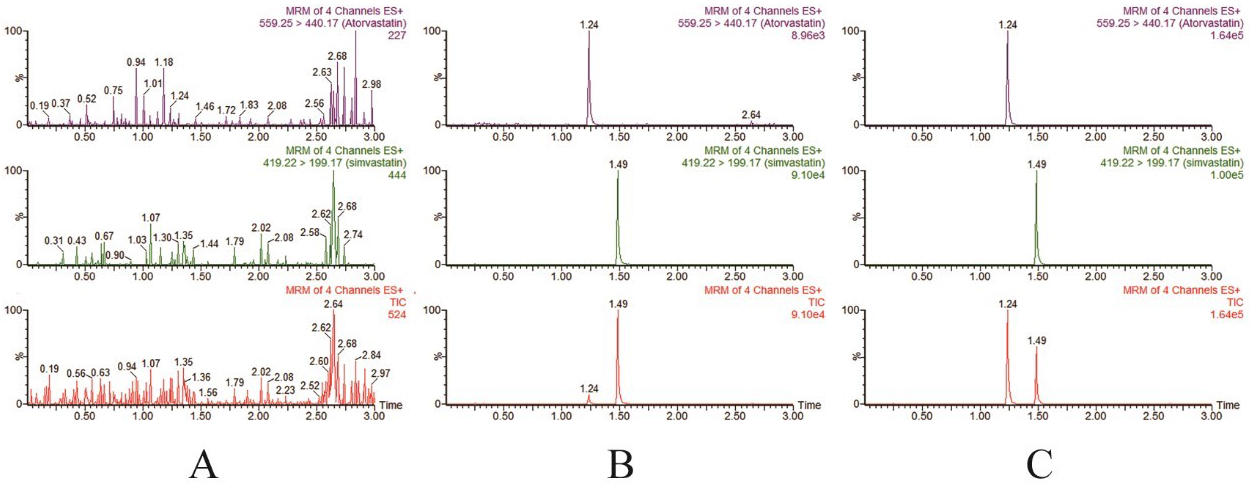 Fig. 2.
Typical ultra performance liquid chromatography tandem mass spectrometry (UPLC-MS/MS) chromatograms of atorvastatin and simvastatin (IS) include: (A) blank plasma; (B) blank plasma spiked with IS (2 µg/mL) and atorvastatin (1 ng/mL); and (C) rat plasma samples obtained orally two hours after receiving a dosage of 10 mg/kg atorvastatin.
The standard curve of atorvastatin in rat plasma had good linearity, ranging
from 1–100 ng/mL, with the linear regression equation of y = 0.0370389
Table 1 shows the results of precision, accuracy, extraction recovery, and matrix effects of atorvastatin in rat plasma. The results showed that the precision and accuracy were within 15% as required by the FDA biological sample analysis method. The extraction recovery rate ranged from 85.28% to 95.36%, and the matrix effect ranged from 87.06% to 91.87%. The analytical results meet the requirements. The results of the matrix effect also indicated that plasma has no significant impact on the matrix. Fig. 2 illustrates the representative chromatograms of a blank plasma sample, a plasma sample spiked with atorvastatin and internal standard, and a plasma sample collected 2 hours post-oral administration of 10 mg/kg atorvastatin.
| Concentration (ng/mL) | RSD | Accuracy | Recovery (%) | Matrix effect (%) | ||
| Intra-day (%) | Inter-day (%) | Intra-day (%) | Inter-day (%) | |||
| 1.00 | 10.93 | 13.31 | 12.84 | 9.67 | 95.36 | 89.58 |
| 2.00 | 7.43 | 2.35 | 6.95 | 7.46 | 92.46 | 90.47 |
| 8.00 | 5.81 | 5.27 | 5.86 | 3.20 | 85.32 | 91.87 |
| 80.00 | 4.58 | 2.27 | 5.98 | 7.04 | 85.28 | 87.06 |
QC, Quality Control; RSD, relative standard deviation.
The results of Table 2 indicated the stability of atorvastatin LLOQ, LQC, MQC and HQC (1, 2, 8, 80 ng/mL, respectively) in rat plasma. There was no difference in stability between samples, whether they were stored at room temperature for 24 hours in a refrigerator at 4 °C for 6 hours or at –20 °C for repeated freeze-thaw cycles three times.
| Conditions | Concentration (ng/mL) | RSD (%) | Accuracy (%) |
| Room temperature, 24 h | 1 | 10.77 | 5.44 |
| 2 | 10.19 | 4.84 | |
| 8 | 4.75 | 1.18 | |
| 80 | 5.08 | 6.96 | |
| Freeze-thaw | 1 | 5.91 | 12.9 |
| 2 | 9.29 | 7.78 | |
| 8 | 4.45 | 5.23 | |
| 80 | 6.4 | 11.28 | |
| 4 °C, 6 h | 1 | 9.91 | 7.52 |
| 2 | 10.82 | –2.32 | |
| 8 | 7.6 | 3.38 | |
| 80 | 5.09 | 3.92 | |
| –20 °C, 2 weeks | 1 | 10.04 | 14.72 |
| 2 | 6.74 | 8.57 | |
| 8 | 9.05 | 8.04 | |
| 80 | 5.66 | 7.35 |
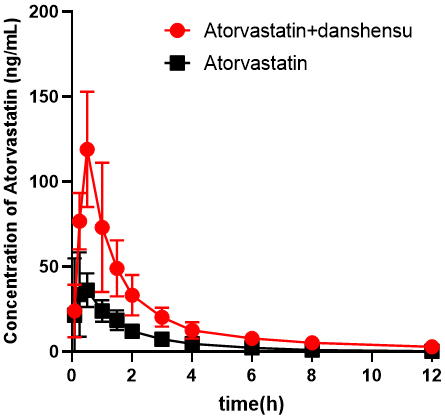
The pharmacokinetic character of atorvastatin in combination with danshensu (150
mg/kg) were profiled by DAS software (Version 3.2.8, The People’s Hospital of
Lishui, China) and the statistical results were shown in Table 3. When the two
drugs were administered simultaneously, it may significantly affect the
atorvastatin pharmacokinetic parameters including AUC, Cmax, t1/2 and
CLz/F (p
| Parameters | Atorvastatin+danshensu | Atorvastatin |
| AUC(0–t) (µg/L·h) | 225.71 |
76.12 |
| AUC(0-∞) (µg/L·h) | 248.49 |
76.91 |
| MRT(0–t) (h) | 2.52 |
2.16 |
| MRT(0-∞) (h) | 3.91 |
2.29 |
| t1/2z (h) | 4.45 |
1.89 |
| Tmax (h) | 0.58 |
0.35 |
| Vz/F (L/kg) | 267.17 |
369.45 |
| CLz/F (L/h/kg) | 43.58 |
136.84 |
| Cmax (µg/L) | 122.62 |
52.06 |
Notes: *p
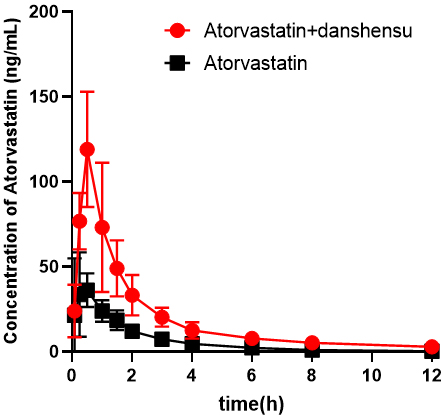 Fig. 3.
Mean plasma concentration-time curve of atorvastatin in
rats (n = 6, mean
Danshensu has been reported to act as a competitive inhibitor of CYP2C9, while it does not significantly affect CYP3A4-mediated metabolism [31]. Atorvastatin is metabolized primarily by CYP3A4, while P-gp and OATP1B1 modulate its hepatic uptake and excretion [20, 22]. Danshensu has also been reported to inhibit OATP1B1-mediated transport of rosuvastatin, providing a mechanistic basis for the pharmacokinetic interactions observed in vivo [39]. Therefore, the in vivo increase in atorvastatin exposure observed in the presence of danshensu may result from reduced efflux via P-gp and/or altered hepatic uptake via OATP1B1, rather than altered CYP3A4 metabolism. Understanding these transporter-mediated interactions is important for predicting potential herb–drug interactions and optimizing individualized therapy. Both danshensu and atorvastatin are used for the regulation of blood lipids and the treatment of cardiovascular diseases. In this study, a sensitive and reproducible UPLC-MS/MS method was developed to simultaneously quantify danshensu and atorvastatin in rat plasma. The findings provide a foundation for future studies to evaluate the efficacy and safety of the combined use of these two drugs in cardiovascular therapy.
In this study, a highly sensitive and selective UPLC-MS/MS method was successfully established for the quantification of atorvastatin in rat plasma, and the pharmacokinetic interaction between atorvastatin and danshensu was systematically investigated. The co-administration of danshensu significantly altered the pharmacokinetic parameters of atorvastatin, suggesting the occurrence of a potential herb-drug interaction. Based on previous studies, danshensu has been reported to inhibit OATP1B1-mediated hepatic uptake, suggesting that the pharmacokinetic interaction observed with atorvastatin is more likely transporter-mediated rather than metabolism-mediated. These findings highlight the importance of considering transporter systems when evaluating the pharmacokinetic interactions between herbal components and conventional drugs. Further in vitro and clinical studies are needed to elucidate the precise mechanisms underlying the interaction between danshensu and atorvastatin and to ensure their safe and rational co-administration in clinical practice.
The data generated in this study can be requested from the corresponding author.
YM, FC and JG conceived the study, performed the experiments, wrote the manuscript, and designed the research. QZ, QLZ, PG and AAM performed data acquisition, analysis and interpretation. SW, YZ conceptualized, funded, supervised and confirmed the authenticity of all the raw data. All authors contributed to editorial changes in the manuscript. All authors read and approved the final manuscript. All authors have participated sufficiently in the work and agreed to be accountable for all aspects of the work.
All experimental procedures were approved by the Institutional Animal Ethics Committee of Wenzhou Medical University and conducted in accordance with the Guidelines for the Care and Use of Laboratory Animals (ID No: xmsq2021-0408).
Not applicable.
This work was supported by grants provided by the Public Welfare Technology Research Funding Project of Zhejiang (LTGY24H100002), the Natural Science Fund of Ningbo (2022J214), City-level Public Welfare Technology Application Research Project of Lishui (2024GYX71) and Traditional Chinese Medicine Science and Technology Plan Project of Zhejiang Province (2025ZL151).
The authors declare no conflict of interest.
References
Publisher’s Note: IMR Press stays neutral with regard to jurisdictional claims in published maps and institutional affiliations.