Academic Editor

Article Metrics

  • Fig. 1.

    View in Article
    Full Image
  • Fig. 2.

    View in Article
    Full Image
  • Fig. 3.

    View in Article
    Full Image
  • Information

  • Download

  • Contents

Abstract

Background:

Approximately one-third of patients with locally advanced cervical cancer (LACC) experience treatment failure with concurrent chemoradiotherapy (CCRT), underscoring the need for reliable predictive biomarkers. This study aimed to elucidate the clinical value of serum inflammatory factors, including tumor necrosis factor-alpha (TNF-α), interleukin-6 (IL-6), and C-reactive protein (CRP) in predicting the short-term efficacy of CCRT in patients with LACC.

Methods:

Patients with LACC treated with CCRT were categorized into remission and non-remission groups based on their short-term treatment response. Pre-treatment serum levels of TNF-α, IL-6, and CRP were measured, and their predictive value for treatment efficacy was assessed. Multivariate analyses were performed to identify independent factors associated with short-term treatment outcomes.

Results:

The non-remission group (nRG) showed significantly raised serum levels of TNF-α, IL-6, and CRP compared to the remission group (RG). Receiver operating characteristic (ROC) curve analysis confirmed that these serum levels could predict the short-term efficacy of CCRT. Furthermore, lymph node metastasis (LNM), maximum tumor diameter, and elevated serum levels of TNF-α, IL-6, and CRP were identified as independent risk factors for poor short-term treatment efficacy. Consequently, patients with LACC with elevated serum levels of TNF-α, IL-6, and CRP following CCRT showed a significantly lower 12-month progression-free survival rate.

Conclusions:

Serum levels of TNF-α, IL-6, and CRP serve as valuable predictors of the short-term efficacy of CCRT in LACC patients. Maximum tumor diameter, LNM, and elevated serum levels of TNF-α, IL-6, and CRP are independent risk factors influencing treatment outcome.

1. Introduction

Cervical cancer (CC) remains a major global health burden and ranks among the most common gynecological malignancies worldwide [1], representing the 4th leading cause of cancer incidence and mortality globally and the 2nd in developing countries [2, 3]. A substantial proportion of patients present with locally advanced CC (LACC, International Federation of Gynecology and Obstetrics (FIGO) cervical Cancer Clinical Staging System, Stages IB through IVA) at diagnosis [4], whom concurrent chemoradiotherapy (CCRT) is the standard treatment modality [5, 6]. However, approximately one-third of patients experience treatment failure, resulting in unsatisfactory locoregional control and compromised prognosis [7], identifying reliable biomarkers that predict the therapeutic response to CCRT is therefore crucial for optimizing individualized treatment strategies.

Inflammation has been recognized as an important contributor to tumor progression, including CC [8, 9]. Several inflammatory mediators such as tumor necrosis factor-alpha (TNF-α), interleukin-6 (IL-6), and C-reactive protein (CRP) play functional roles in tumor development and have been explored as potential therapeutic or prognostic indicators [10]. TNF-α is elevated in CC and is associated with disease progression and treatment responsiveness [11, 12] and polymorphisms in TNF-α genes have been linked to CC susceptibility and human papillomavirus (HPV) infection [13, 14]. IL-6 is a key cytokine in the tumor microenvironment that promotes carcinogenesis, metastasis, and therapeutic resistance [15], with genetic variants also associated with CC risk [16, 17]. CRP, one of the most widely studied systemic inflammatory markers, has demonstrated prognostic relevance for survival outcomes in CC [18, 19, 20].

Despite these observations, the predictive value of pre-treatment inflammatory markers for short-term CCRT efficacy in LACC remains insufficiently investigated. Therefore, this study aimed to evaluate whether baseline serum levels of TNF-α, IL-6, and CRP could serve as predictors of short-term treatment response in patients with LACC undergoing CCRT, thereby supporting more individualized therapeutic decision-making.

2. Materials and Methods
2.1 Ethical Approval

This study was conducted in accordance with the principles of the Declaration of Helsinki and complied with all relevant ethical guidelines and regulations. Ethical approval was obtained from the Ethics Review Committee of Yantai Mountain Hospital(YTS2005001), and written informed consent was signed by the patients themselves or their guardians. This study was undertaken before the requirement for prospective registration of cohort studies. To minimize potential confounding factors that could influence systemic inflammatory status, treatment tolerance, or clinical outcomes, strict exclusion criteria were applied. Patients with autoimmune diseases, chronic inflammatory conditions, or active infections were excluded to avoid non-tumor-related inflammatory activation that might bias biomarker assessment. Patients with a history of prior malignancy, defined as any previous diagnosis of malignant tumors other than CC regardless of disease-free interval or treatment outcome, were also excluded to reduce heterogeneity related to cancer-associated inflammatory responses. In addition, individuals with severe hepatic, renal, or hematologic dysfunction were excluded because such conditions may alter cytokine metabolism, compromise treatment safety, or interfere with the delivery of CCRT. Furthermore, patients who had received prior pelvic radiotherapy or chemotherapy were excluded to ensure a treatment-naïve cohort, as previous anticancer therapies may modify baseline inflammatory profiles and treatment responsiveness. Collectively, these eligibility criteria were implemented to enhance cohort homogeneity and improve the internal validity of the biomarker-based prognostic analyses.

2.2 Study Subjects

A total of 227 patients with LACC were prospectively enrolled at Yantai Mountain Hospital between June 2020 and June 2022. All patients were admitted for and treated with CCRT.

Patients were eligible for inclusion if they met all of the following criteria:

(1) Histopathologically confirmed CC, including squamous cell carcinoma and non-squamous cell carcinoma (primarily adenocarcinoma and adenosquamous carcinoma);

(2) Diagnosed with LACC at FIGO stage IIB–IVA according to the 2018 FIGO classification;

(3) Availability of baseline imaging data, including magnetic resonance imaging (MRI), pelvic examination findings, positron emission tomography/computed tomography (PET/CT), and/or CT, for assessment of primary tumor extent and lymph node status;

(4) Planned to receive and completed platinum-based CCRT as initial definitive treatment;

(5) Availability of complete clinical, laboratory, treatment, and follow-up data.

Patients were excluded if they met any of the following conditions:

(1) History of prior malignancy, defined as any previous diagnosis of malignant tumors other than CC, regardless of disease-free interval or treatment outcome;

(2) Presence of autoimmune diseases, chronic inflammatory disorders, or active infections at baseline;

(3) Severe hepatic, renal, or hematologic dysfunction, or other serious systemic diseases that could affect treatment tolerance or inflammatory marker levels;

(4) Prior pelvic radiotherapy, chemotherapy, or surgical treatment for CC;

(5) Receipt of neoadjuvant chemotherapy, targeted therapy, or planned surgical intervention after admission;

(6) Inability to complete the full course of radiotherapy or concurrent chemotherapy;

(7) Acute infectious conditions within 2 weeks before or after treatment, or use of antimicrobial or anti-tuberculosis drugs during the peri-treatment period;

(8) Known allergy or intolerance to chemotherapeutic agents used in the study;

(9) Pregnancy or lactation;

(10) Incomplete follow-up data or loss to follow-up.

2.3 Estimation Method of Sample Size

The sample size estimation was performed using a statistical efficiency-based approach by the G*Power 3.0.10 software (University of Düsseldorf, Nordrhein-Westfalen, Germany). Firstly, the statistical parameters were set to two-tailed test, α = 0.05, 1-β = 0.90, and the predicted effect size was moderate. Effect size d = 0.5, sample size N1 / N2 = 3, N1 indicated the remission group (RG), and N2 indicated the non-remission group (nRG). The estimated results were N1 = 57, N2 = 171, and the total sample size was N = 228. Given a sample size attrition rate of approximately 10%, the initial sample size included was 228 + 23 = 251 cases, and since 24 cases dropped out halfway through the study, 227 patients were eventually enrolled. It should be noted that although the initial power calculation assumed an allocation ratio of approximately 3:1 between the RG and the nRG, the final enrolled cohort demonstrated a slightly lower ratio of approximately 2.5:1 (162 vs. 65). This discrepancy primarily reflects differences between the expected response rates derived from prior literature and the actual treatment response observed in the present cohort. Specifically, previous studies of LACC treated with CCRT have reported short-term remission rates of approximately 70–75%, corresponding to an expected RG:nRG ratio close to 3:1. In contrast, the observed remission rate in our study was 71.4%, resulting in a modestly higher proportion of non-remission cases than initially anticipated and thus a slightly reduced group ratio. Importantly, despite this deviation, the achieved sample sizes in both the RG (n = 162) and nRG (n = 65) exceeded the minimum numbers required by the a priori power analysis. Therefore, the statistical power of the study remained adequate, and the reliability and robustness of the subsequent analyses were not materially affected by this minor deviation in group allocation.

The sample size estimation was conducted using G*Power 3.0.10 based on Cohen’s established framework for detecting group differences in biomedical research. A medium effect size (d = 0.5) was selected for two main reasons. First, previous clinical studies investigating inflammatory biomarkers in CC have consistently reported moderate differences in baseline cytokine levels between responder and non-responder groups, supporting the appropriateness of a medium effect size assumption. Second, because no pilot data were available prior to study initiation, adopting Cohen’s conventional benchmark for a medium effect size provided a conservative and methodologically sound basis for sample size determination, avoiding overly optimistic or excessively restrictive assumptions. This approach is widely recommended in prospective clinical research when empirical estimates are limited. Furthermore, the final enrolled sample size exceeded the minimum requirement derived from the power analysis, ensuring that the study maintained adequate statistical power.

2.4 Treatment Protocols

After carefully ruling out contraindications to radiotherapy and chemotherapy, all patients received standardized platinum-based CCRT according to institutional protocols. Radiotherapy consisted of external beam radiotherapy (EBRT) followed by intracavitary or combined intracavitary/interstitial brachytherapy. EBRT was delivered primarily using image-guided intensity-modulated radiotherapy (IMRT); three-dimensional conformal radiotherapy (3D-CRT) was applied when clinically indicated. Patients were positioned supine and immobilized with a thermoplastic mask. Simulation was performed using contrast-enhanced computed tomography with a slice thickness of 5 mm, extending from approximately 10 cm below the ischial tuberosities to the superior border of the tenth thoracic vertebra. The clinical target volume (CTV) included the primary cervical tumor and relevant adjacent structures (uterine cervix, uterine corpus, parametria, and partial or complete vagina), as well as regional lymphatic drainage areas (obturator, internal iliac, external iliac, common iliac, and presacral lymph nodes). Para-aortic or inguinal lymph node regions were included when clinically indicated. The planning target volume (PTV) was generated by adding a 3–5 mm margin to the CTV. EBRT was delivered using a 6 MV photon beam generated by a Varian Clinac IX linear accelerator (Varian Medical Systems, Inc., Palo Alto, CA, USA), with a total pelvic dose of 45.0–50.4 Gy administered in 25–27 fractions (1.8–2.0 Gy per fraction), five days per week. For patients with parametrial involvement, a simultaneous integrated boost was delivered to a total dose of 58–62 Gy over the same fractionation schedule. After completion of EBRT or when the primary tumor diameter was reduced to less than 3 cm, high-dose-rate (HDR) brachytherapy was performed using a Nucletron MicroSelectron-HDR Ir-192 remote afterloading system (Nucletron B.V. Eindhoven, Noord-Brabant, Netherlands). Brachytherapy was delivered under CT or MRI guidance, using intracavitary applicators or combined intracavitary/interstitial techniques as appropriate based on tumor extent and anatomical considerations. A total brachytherapy dose of 24–26 Gy was administered in 4–5 fractions (2 fractions per week), corresponding to an equivalent dose in 2 Gy fractions (EQD2) of approximately 82–88 Gy when combined with EBRT. Concurrent chemotherapy was administered weekly throughout the course of radiotherapy. The preferred regimen was cisplatin at a dose of 30–40 mg/m2 administered intravenously once per week for 5–6 cycles. In patients with intolerance to cisplatin, carboplatin was used as an alternative. In selected cases, a combination regimen of weekly cisplatin (Guangdong Lingnan Pharmaceutical Co., Ltd., Shaoguan, Guangdong, China) (25–30 mg/m2) plus paclitaxel (Harbin Pharmaceutical Group Bioengineering Co., Ltd., Harbin, Heilongjiang, China) (60–80 mg/m2) was administered on days 1, 8, 15, 22, 29, and 36 of radiotherapy. Chemotherapy doses were adjusted according to treatment-related toxicities, with the overall principle of maintaining uninterrupted radiotherapy whenever possible.

2.5 Criteria and Grouping for Result Determination

Short-term efficacy: all patients were subjected to post-CCRT routine monitoring. Three months after the end of treatment, subjects were evaluated for short-term efficacy in accordance with the Response Evaluation Criteria in Solid Tumors Version 1.1 (RECIST 1.1) [21] based on the findings of MRI, CT, or PET-CT before and following treatment. Recent outcomes were classified as complete remission (CR), with complete disappearance of target lesions; partial remission (PR), with at least a 30% reduction in the sum of target lesion diameters from baseline levels; stable disease (SD), between PR and CR; progression disease (PD), with more than a 20% increase in the sum of lesion diameters from baseline levels and one or more additional lesions occuring. Overall remission rate = CR + PR/total number of patients × 100%. Patients with CR + PR and patients with SD + PD were included in the RG and nRG, respectively.

Long-term efficacy: patients underwent routine telephone check-up and medical examinations every 3–6 months post treatment. Follow-up visits consisted of whether patients had local recurrence or distant metastasis of the tumor, the diagnosis time of recurrence or metastasis, patient survival and adverse reactions [22]. All subjects were followed up for at least 12 months. Following CCRT, patients were recorded for 12-month progression-free survival (PFS) (the period from the start of treatment to observed disease progression or the occurrence of death because of any reason in subjects with tumor diseases).

2.6 Data Collection and Indicators Observation

General and clinical information were collected from all patients including age, body mass index (BMI), maximum tumor diameter, smoking history, pathological staging, FIGO stage, and lymph node metastasis (LNM). Before three to seven days of treatment, 10 mL of fasting elbow venous blood was gathered from patients, and centrifuged at 4 °C and 1000 ×g for 10 min, with the supernatant collected and stored at –80 °C for further use. The levels of serum inflammatory markers TNF-α (the sensitivity of the kit was 0.16 pg/mL, with the detection range of 1.56 pg/mL–100 pg/mL, the intra-plate coefficient of variation of 4.1%–4.8%, and the inter-plate coefficient of variation of 5.4%–7.0%), IL-6 (the sensitivity of the kit was 0.37 pg/mL, with the detection range of 1.56 pg/mL–100 pg/mL, the intra-plate coefficient of variation of 2.5%–5.0%, and the inter-plate coefficient of variation of 1.9%–4.6%), and CRP (the sensitivity of the kit was 0.44 pg/mL, with the detection range of 62.5 pg/mL–4000 pg/mL, the intra-plate coefficient of variation of 2.9%–5.5%, and the inter-plate coefficient of variation of 3.0%–5.8%) in frozen serum samples were measured by enzyme-linked immunosorbent assay (ELISA) as per the instructions of the ELISA kits [EK182HS, EK106, EK194; MultiSciences (LiankeBio), Hangzhou, Zhejiang, China].

2.7 Statistical Analysis

Statistical analyses and data visualization were performed using SPSS version 22.0 (IBM Corp., Armonk, NY, USA) and GraphPad Prism version 8.0 (GraphPad Software Inc., San Diego, CA, USA). The Shapiro-Wilk test was used to assess the normality of continuous variables. Normally distributed continuous data were expressed as mean ± standard deviation and compared between two groups using the independent-samples t test. Categorical variables were summarized as numbers (n) and percentages (%).

Nominal categorical variables were compared between groups using the Chi-square test. Tumor grade, as an ordinal variable, was analyzed using statistical methods appropriate for ordered data. The Mann-Whitney U test was applied to compare overall distributional differences in tumor grade between the remission group and the nRG, while the Cochran-Armitage trend test was considered as an alternative approach for assessing ordinal trends when appropriate.

The predictive performance of serum TNF-α, IL-6, and CRP for short-term treatment response was evaluated using receiver operating characteristic (ROC) curve analysis, and optimal cut-off values were determined based on the Youden index. Patients were subsequently stratified into high- and low-level groups according to these cut-off values, and remission rates between groups were compared using the Chi-square test.

Variables with a p value < 0.10 in univariate analyses were entered into a multivariate logistic regression model to identify independent factors associated with short-term efficacy of CCRT in patients with LACC. Results were expressed as odds ratios (ORs) with corresponding 95% confidence intervals (CIs).

PFS was analyzed using the Kaplan-Meier method, and differences between groups were assessed using the log-rank test. All statistical tests were two-sided, and a p value < 0.05 was considered statistically significant.

For survival analysis, patients were stratified into high- and low-level groups based on the median values of TNF-α, IL-6, and CRP. Median-based grouping was adopted to provide a distribution-independent and conservative stratification for prognostic evaluation, which is commonly used in survival analyses when predefined prognostic cut-off values are not established.

3. Results
3.1 Comparisons of Clinical Baseline Characteristics of LACC Patients

We analyzed 227 LACC patients who received CCRT. The mean age of the patients was 52.1 ± 9.9 years, and the mean BMI was 23.2 ± 3.3 kg/m2, with the mean maximum tumor diameter of 4.6 ± 1.2 cm and the smoking rate of 11.9%. There were 182 patients with squamous CC and 45 patients with non-squamous CC; 130 patients at IIB–IIIB FIGO stage (2018 version) and 97 patients at IIIC–IVA stage; and 65 patients with LNM (Table 1). Depending on the criteria for evaluating the efficacy of solid tumors, all patients were assigned into the RG (n = 162) and nRG (n = 65), and the overall remission rate of CCRT was 71.4%. The baseline data and clinical indicators of patients in the two groups were compared, with the outcomes indicating that RG and nRG patients had no significant differences on age, BMI, smoking history, pathological staging, and the degree of tumor differentiation (all p > 0.05), while had remarkable differences in terms of maximum tumor diameter (p < 0.001), FIGO stage (p = 0.006), and LNM (p = 0.006) (Table 1).

Table 1. Comparisons of clinical baseline characteristics of patients with LACC.
Parameters Patients RG nRG p value
Case [n (%)] 227 162 (71.4) 65 (28.6) -
Age (years) 52.1 ± 9.9 51.7 ± 9.7 52.9 ± 10.3 0.409
BMI (kg/m2) 23.2 ± 3.3 23.0 ± 3.2 23.7 ± 3.4 0.145
Maximum tumor diameter (cm) 4.6 ± 1.2 4.3 ± 1.0 5.2 ± 1.3 <0.001
Smoking history [n (%)] 0.215
Yes 27 (11.9%) 22 (13.6%) 5 (7.7%)
No 200 (88.1%) 140 (86.4%) 60 (92.3%)
Pathological type [n (%)] 0.251
Squamous cell carcinoma 182 (80.2%) 133 (82.1%) 49 (75.4%)
Non-squamous cell carcinoma 45 (19.8%) 29 (17.9%) 16 (24.6%)
FIGO stage [n (%)] 0.006
IIB-IIIB 130 (57.3%) 102 (62.9%) 28 (43.1%)
IIIC-IVA 97 (42.7%) 60 (37.1%) 37 (56.9%)
Lymph node metastasis [n (%)] 0.006
Yes 65 (28.6%) 38 (23.5%) 27 (41.5%)
No 162 (71.4%) 124 (76.5%) 38 (58.5%)
Tumor grade [n (%)] 0.173
G1 37 (16.30) 30 (18.52) 7 (10.77)
G2 81 (35.68) 60 (37.04) 21 (32.31)
G3 109 (48.02) 72 (44.44) 37 (56.92)

Note: LACC, locally advanced cervical cancer; RG, remission group; nRG, non-remission group; BMI, body mass index; FIGO, the International Federation of Gynecology and Obstetrics. Normally-distributed measurement data were expressed as mean ± standard deviation, and the independent samples t-test was employed for comparison between two groups. Enumeration data were expressed as number of cases (n) and percentages (%), and the Chi-square test was implemented for comparison between the two groups.

3.2 Comparisons of Levels of Serum Inflammatory Indices TNF-α, IL-6, and CRP Before Treatment Between Two Groups of Patients

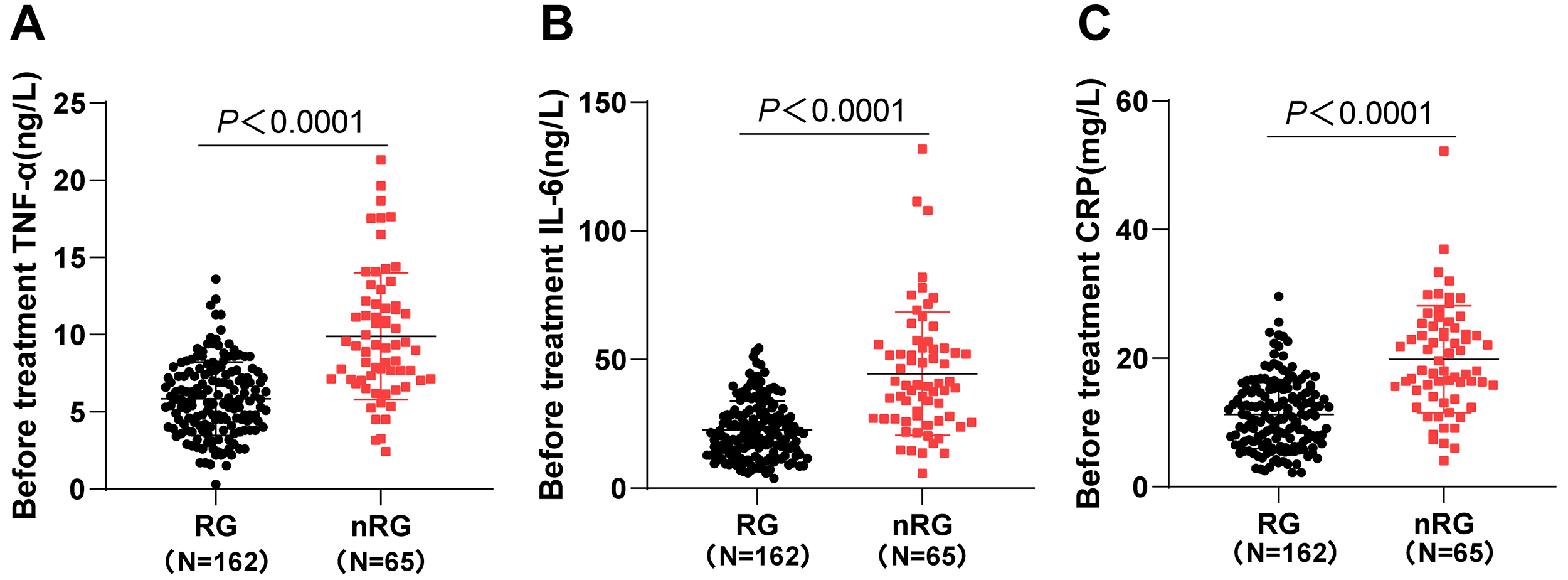
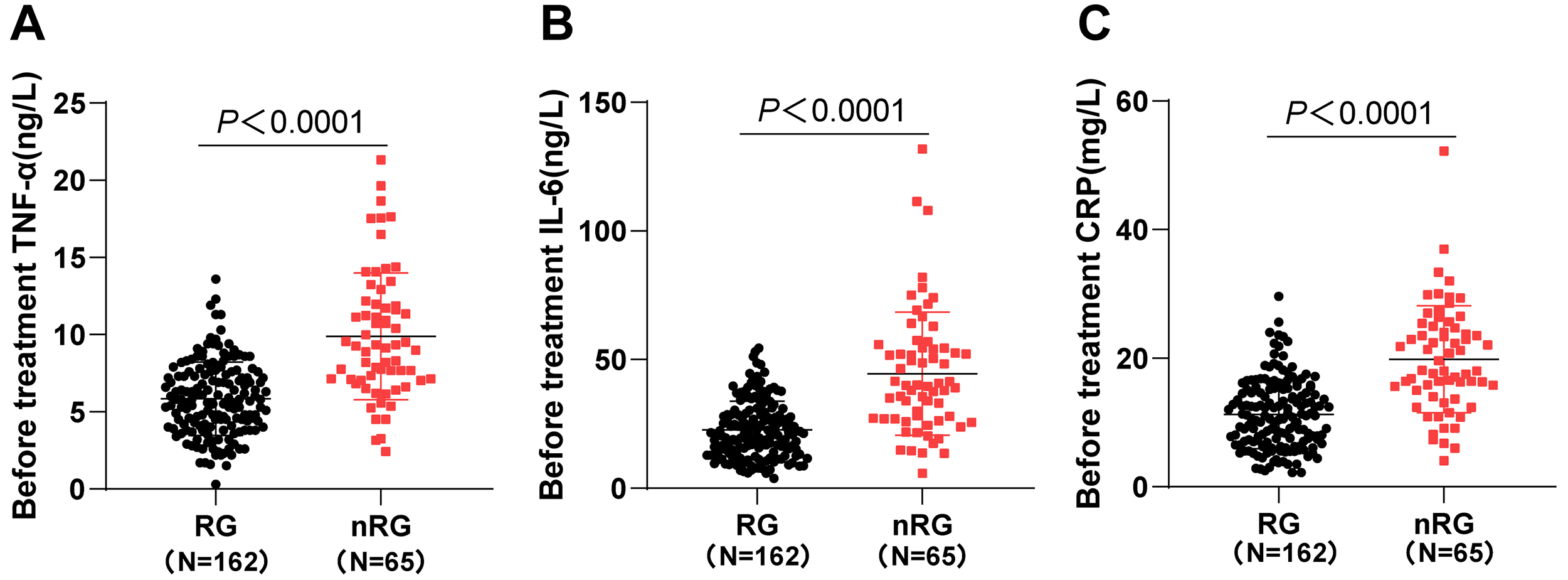
To explore the clinical significance of serum inflammatory indicators TNF-α, IL-6, and CRP in patients with LACC, we measured the serum levels of TNF-α, IL-6, and CRP in RG and nRG patients by ELISA. The outcomes manifested that the mean levels of TNF-α, IL-6, and CRP in RG patients were 5.85 ± 2.37 ng/L, 22.67 ± 11.19 ng/L, and 11.30 ± 5.38 mg/L, separately, and those in nRG patients were 9.89 ± 4.11 ng/L, 44.46 ± 23.96 ng/L, and 19.85 ± 8.31 mg/L, separately. In comparison to RG patients, serum levels of TNF-α, IL-6 and CRP were elevated in nRG patients (Fig. 1A–C, all p < 0.001).

Fig. 1.

Comparisons of serum TNF-α, IL-6, and CRP levels in RG and nRG patients. TNF-α, tumor necrosis factor-α; IL-6, interleukin-6; CRP, C-reactive protein. (A–C) Serum levels of TNF-α, IL-6, and CRP in RG and nRG patients were measured by enzyme-linked immunosorbent assay (ELISA). Normally-distributed measurement data were expressed as mean ± standard deviation, and the independent samples t-test was employed for comparisons between two groups.

3.3 Serum TNF-α, IL-6, and CRP Levels Have Certain Predictive Value for the Short-Term Outcomes of LACC Patients

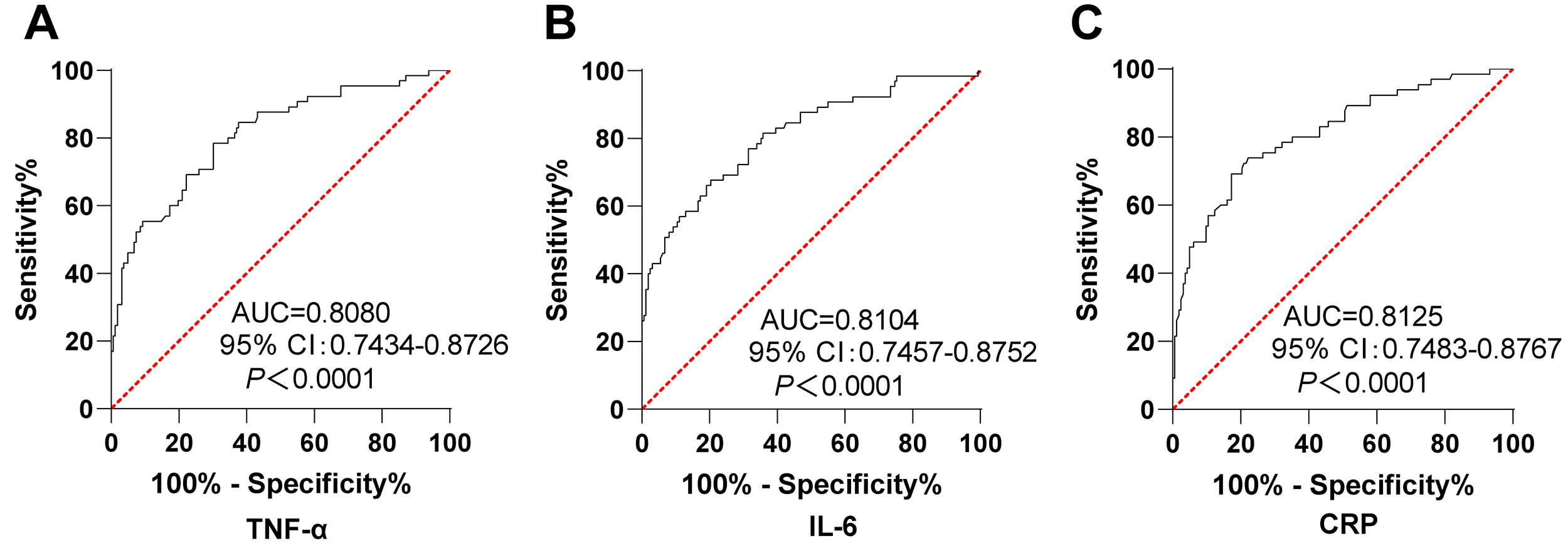
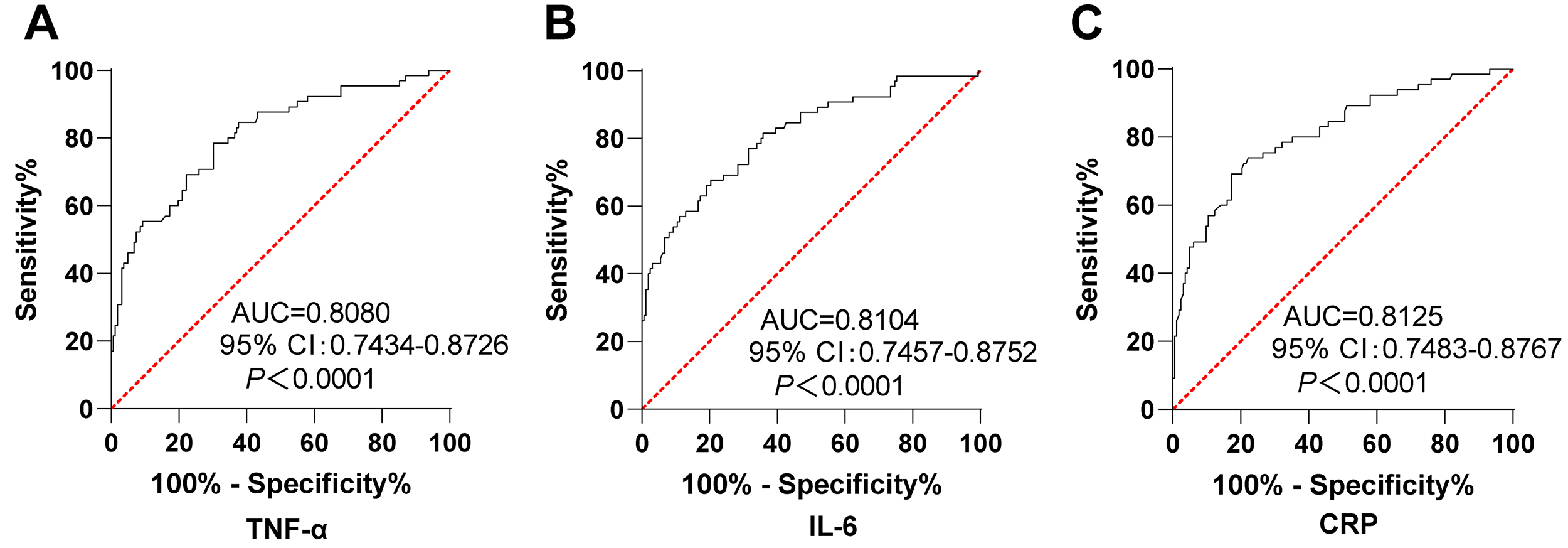
Moreover, we used ROC curves to assess the predictive value of serum levels of TNF-α, IL-6, and CRP on the short-term outcomes (remission or non-remission) of LACC patients (Fig. 2A–C). The results uncovered that the area under the curve (AUC) of TNF-α was 0.8080 (a sensitivity of 78.46%, a specificity of 69.75%, and a cut-off value of more than 7.015 ng/L) (p < 0.001), the AUC of IL-6 was 0.8104 (a sensitivity of 67.69%, a specificity of 79.63%, and a cut-off value of more than 32.70 ng/L) (p < 0.001), the AUC of CRP was 0.8125 (a sensitivity of 69.23%, a specificity of 82.72%, and a cut-off value more than 16.31 mg/L) (p < 0.001). The above suggests that serum levels of TNF-α, IL-6, and CRP all have some predictive value for the recent outcomes of individuals with LACC. In addition to the individual ROC analyses, we further evaluated the combined predictive performance of TNF-α, IL-6, and CRP by constructing a multivariable logistic regression model incorporating all three inflammatory markers. The predicted probability derived from this combined model was used to assess overall discriminative ability. The combined model yielded an area under the ROC curve (AUC) of [AUC_combined], which was higher than that of TNF-α (AUC = 0.8080), IL-6 (AUC = 0.8104), or CRP (AUC = 0.8125) alone, indicating improved predictive performance when these inflammatory indicators were jointly considered. This result suggests that TNF-α, IL-6, and CRP provide complementary information in predicting short-term treatment response.

Fig. 2.

Serum TNF-α, IL-6, and CRP levels have certain predictive value for the short-term outcome of LACC patients. AUC, area under the curve; CI, confidence interval. (A–C) The predictive value of serum levels of TNF-α (A), IL-6 (B), and CRP (C) on the short-term outcome (remission or non-remission) of LACC patients were analyzed by receiver operating characteristic (ROC) curves.

3.4 LACC Patients With High Levels of Serum TNF-α, IL-6 and CRP Have Lower Treatment Remission Rates

We divided 227 LACC patients into High-TNF-α/Low-TNF-α groups, High-TNF-α/Low-TNF-α groups, and High-TNF-α/Low-TNF-α groups, respectively, with the cut-off values of TNF-α (>7.015), IL-6 (>32.70), and CRP (>16.31) serving as the dividing line. The recent treatment remission rates (CR + PR) of different groups were statistically analyzed, revealing a notable abatement in the short-term remission rate in the High-TNF-α group compared to the Low-TNF-α group (49.0% vs. 89.0%, p < 0.001), a prominent decline in the short-term remission rate in the High-IL-6 group in contrast to the Low-IL-6 group (42.9% vs. 86.0%, p < 0.001), and a marked decrease in the short-term remission rate in the High-CRP group versus the Low-CRP group (38.4% vs. 87.0%, p < 0.001) (Table 2). The findings imply that increased serum levels of TNF-α, IL-6, and CRP may reduce the treatment remission rate in individuals with LACC.

Table 2. High and low levels of serum TNF-α, IL-6, and CRP and the treatment remission rate of patients.
Group Remission rate p value
Low-TNF-α group 113/127 (89.0%) <0.001
High-TNF-α group 49/100 (49.0%)
Low-IL-6 group 129/150 (86.0%) <0.001
High-IL-6 group 33/77 (42.9%)
Low-CRP group 134/154 (87.0%) <0.001
High-CRP group 28/73 (38.4%)

Note: Enumeration data were expressed as number of cases (n) and percentages (%), and the Chi-square test was implemented for comparison between the two groups.

3.5 Maximum Tumor Diameter, LNM, and Serum Levels of TNF-α, IL-6, and CRP are Independent Risk Factors for the Early Efficacy of CCRT

To evaluate the independent risk factors influencing the short-term efficacy of CCRT in LACC patients, variables with p < 0.1 in the univariate analysis (including FIGO stage, maximum tumor diameter, LNM, and serum levels of TNF-α, IL-6, and CRP) were incorporated into a multivariate logistic regression model. The results demonstrated that maximum tumor diameter (OR = 1.979, 95% CI: 1.063–3.687, p = 0.031), LNM (OR = 3.512, 95% CI: 1.041–11.843, p = 0.043), serum TNF-α level (OR = 1.245, 95% CI: 1.022–1.518, p = 0.030), IL-6 level (OR = 1.041, 95% CI: 1.003–1.080, p = 0.036), and CRP level (OR = 1.101, 95% CI: 1.011–1.198, p = 0.026) were independent risk factors associated with poor short-term efficacy of CCRT in LACC patients (Table 3).

Table 3. Multivariate logistic regression analysis affecting the short-term efficacy of CCRT in patients with LACC.
Variable OR 95% CI p value
Maximum tumor diameter 1.979 1.063–3.687 0.031
FIGO stage 2.333 0.748–7.278 0.144
Lymph node metastasis 3.512 1.041–11.843 0.043
TNF-α 1.245 1.022–1.518 0.030
IL-6 1.041 1.003–1.080 0.036
CRP 1.101 1.011–1.198 0.026

Note: CI, confidence interval.

3.6 LACC Patients With Augmented Serum TNF-α, IL-6 and CRP Have Prominently Dampened Post-CCRT 12-Month PFS

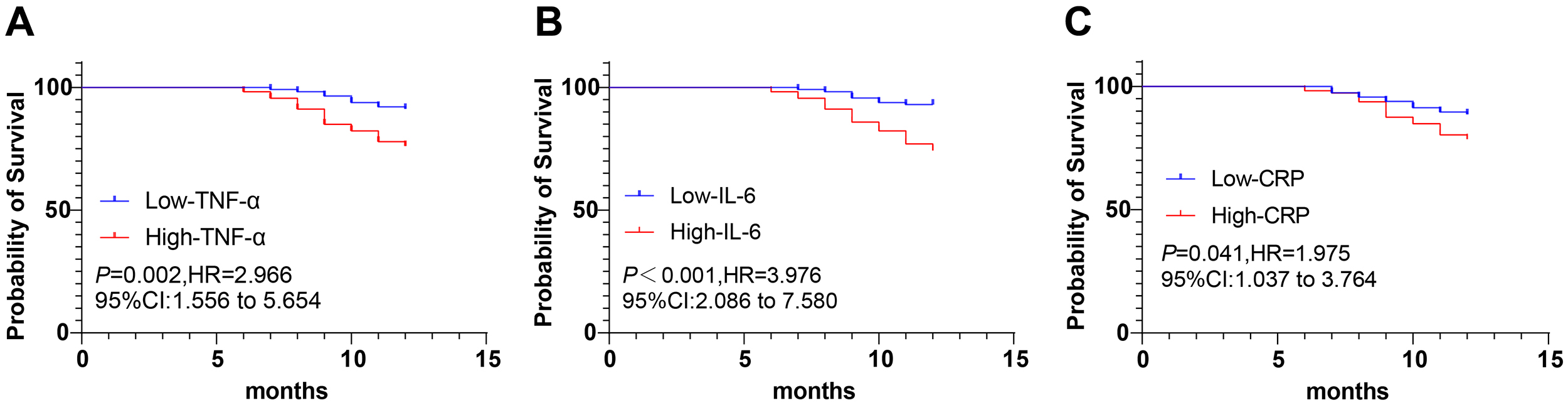
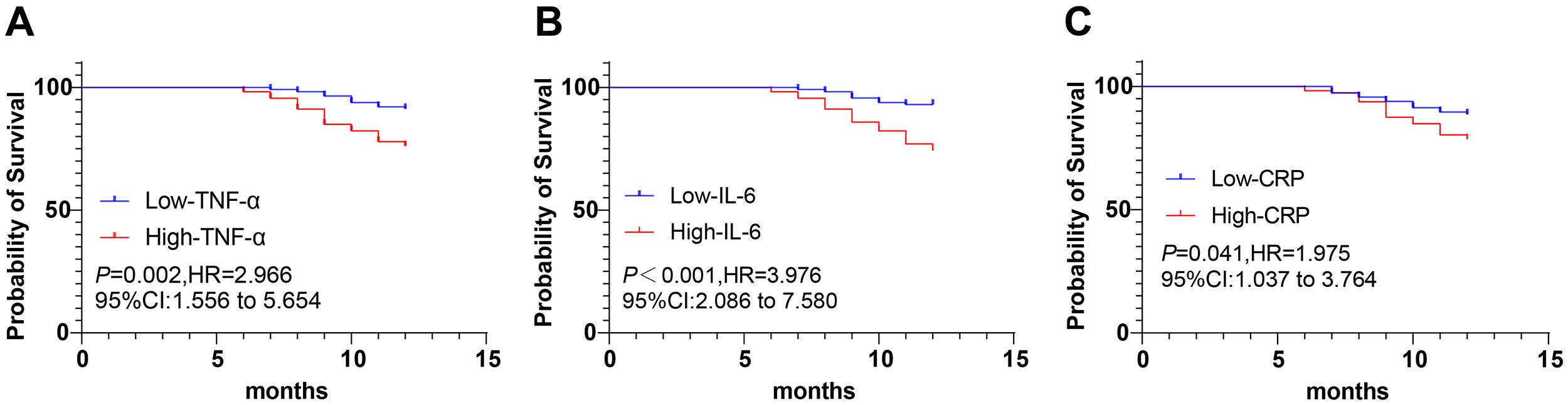
We further investigated the association between baseline serum inflammatory markers and 12-month PFS in patients with LACC following CCRT. Patients were stratified into high and low groups for TNF-α, IL-6, and CRP according to the median values of each marker. Kaplan-Meier survival analysis demonstrated that patients in the high TNF-α, high IL-6, and high CRP groups had significantly shorter 12-month PFS compared with their corresponding low-level groups (Fig. 3A–C, all p < 0.001). These results indicate that elevated pre-treatment systemic inflammatory status is associated with an increased risk of disease progression within one year after CCRT. Notably, this median-based stratification was applied specifically for prognostic assessment, whereas ROC-derived cut-off values were used in earlier analyses aimed at predicting short-term treatment response.

Fig. 3.

Kaplan–Meier analysis of progression-free survival (PFS) according to pre‑treatment serum levels of TNF‑α, IL‑6, and CRP in LACC patients treated with CCRT. (A) TNF‑α, (B) IL‑6, and (C) CRP, showing progression‑free survival stratified by high and low levels of each respective inflammatory marker. Patients were stratified into high- and low-level groups based on median values of each inflammatory marker. Log-rank test was used for comparison between groups.

4. Discussion

Early identification of patients who are unlikely to respond adequately to CCRT remains a major challenge in the management of LACC. Although CCRT is the standard of care, treatment resistance still contributes to poor survival outcomes [23, 24]. In this context, our study provides new evidence that pre-treatment systemic inflammatory status, reflected by serum TNF-α, IL-6, and CRP levels, is closely associated with short-term therapeutic response in LACC. Notably, these inflammatory markers demonstrated significantly higher levels in non-remission patients compared with those achieving remission, supporting the concept that systemic inflammation may influence tumor radiosensitivity and chemoresponsiveness. This finding aligns with previous reports showing that cytokine gene variants and dysregulated inflammatory pathways contribute to tumor progression and differential treatment response in CC [25]. Importantly, our study extends existing knowledge by demonstrating that these cytokines are not merely associated with disease burden but function as independent predictors of short-term CCRT efficacy when analyzed alongside tumor diameter and LNM [11, 15, 19]. Beyond statistical significance, these results have biological plausibility. TNF-α and IL-6 are known modulators of tumor microenvironment remodeling, immune suppression, angiogenesis, and DNA repair signaling. Elevated CRP reflects systemic inflammatory activation that may further impair treatment sensitivity. Therefore, heightened inflammatory profiles before treatment may indicate an aggressive tumor phenotype or a host milieu less capable of mounting an adequate radiosensitizing response, which could explain the reduced remission rates and poorer 12-month PFS observed in our high-inflammation subgroup. Our ROC analyses reinforce this perspective, demonstrating that each of the three inflammatory markers possesses measurable predictive value for short-term outcomes. When considered together with anatomical factors such as maximum tumor diameter and LNM, these biomarkers help construct a more comprehensive clinical-biological model for predicting early treatment response.

Another emerging area that warrants consideration is the relationship between systemic inflammatory biomarkers and functional imaging parameters, particularly the metabolic response assessed by 18F-FDG PET/CT. PET-based markers such as SUVmax, metabolic tumor volume, and total lesion glycolysis have shown prognostic relevance in LACC after definitive chemoradiotherapy, reflecting tumor viability, hypoxia, and microenvironmental alterations. Given that cytokines including TNF-α, IL-6, and CRP play key roles in modulating tumor metabolism, angiogenesis, and immune infiltration, it is plausible that elevated inflammatory serum levels may correlate with poorer metabolic response on PET/CT. Such a link could provide a biologically meaningful interpretation of why patients with heightened systemic inflammation are more likely to exhibit treatment resistance. Future studies integrating inflammatory markers with PET-derived metabolic response criteria may help refine early prognostic assessment and support the development of combined biomarker-imaging risk models to guide post-CCRT management.

Beyond demonstrating that TNF-α, IL-6, and CRP are independent risk factors for poor short-term efficacy, it is clinically meaningful to consider how these serological indicators may complement established clinical variables such as maximum tumor diameter and LNM. Tumor burden and metastatic spread largely reflect the anatomical and pathological extent of disease, whereas inflammatory biomarkers represent the host’s systemic response, tumor microenvironment activity, and treatment sensitivity. Integrating both dimensions tumor characteristics and systemic inflammatory status may therefore enhance the precision of prognostic assessment. A combined risk model incorporating these inflammatory markers together with tumor diameter and LNM has the potential to improve early identification of patients unlikely to respond adequately to CCRT. Such a model could support individualized treatment strategies, including intensified therapy, closer surveillance, or early incorporation of consolidation treatments. Future studies should explore the development and validation of a multi-parameter risk prediction score that leverages both clinical and inflammatory indicators to guide tailored clinical decision-making.

In a previous animal study, TNF-α levels have been confirmed to be augmented in the buccal mucosa of hamsters receiving chemotherapy and radiotherapy [26]. Moreover, Sha et al. [27] have proposed that serum TNF-α levels in CC patients are enhanced noticeably, which will gradually become normal following surgical treatment, implying serum TNF-α level determination as a promising method for early diagnosis and possible therapy of CC. Importantly, serum levels of inflammatory factors such as TNF-α, interferon-β, IL-1β, and IL-6 are observed to be heightened obviously in CC patients [11], which is generally consistent with the results of this study. As for IL-6, it may serve as a promising predictor of prognosis in individuals with CC [28]. Additionally, it has been reported that IL-6 levels are higher in CC tissues versus those in adjacent non-tumor tissues, and links to FIGO grade and tumor size, along with tumor differentiation [29]. Cai et al. [30] have demonstrated that serum IL-6 levels are related to the smoking status, HPV infection, tumor size, FIGO stage, as well as treatment methods, with the univariate and multivariate analysis uncovering that FIGO stage IIB–IIIC, LNM, and promoted serum IL-6 levels have a negative relevance to overall survival and disease-free survival in patients with CC. IL-6 demonstrates clinical value in the prognosis and diagnosis of CC, whose level in pretreatment serum possesses a moderate diagnostic ability in individuals with stage IA–IIIC CC and the ability to help predict postoperative survival rate in CC individuals [30]. Furthermore, IL-6 level can serve as a prognostic marker in CC patients infected with HPV [31]. Polterauer et al. [32] have stated that CC individuals with high CRP levels before treatment represent worse prognosis than those with low CRP levels. Recently, it has been demonstrated that high serum CRP levels are independently linked with overall survival and impaired disease-free in CC patients [33]. Taken together, serum inflammatory markers post-treatment may be used as potential markers for the measurement of the short-term efficacy of CCRT in LACC patients.

Another important aspect worth considering is the growing role of imaging guidance during brachytherapy procedures. Recent frameworks, such as the COMIRI (COMplexity Index of interventional Radiotherapy Implants), have highlighted how procedural complexity in image-guided brachytherapy may influence treatment delivery and tissue response. The COMIRI classification provides a standardized approach to quantify implant complexity based on technical, anatomical, and organizational factors, thereby facilitating objective comparison across different interventional radiotherapy procedures and institutions. The COMIRI index provides a structured and standardized method to quantify brachytherapy complexity based on implant type, imaging modality, equipment requirements, and multidisciplinary team involvement, thereby enabling objective comparison across different institutions and procedures. By accounting for these procedural factors, COMIRI offers an important perspective on how technical and organizational aspects of brachytherapy may interact with biological responses, including treatment-related inflammation. In this context, incorporating COMIRI-based assessments may help clarify whether variations in procedural complexity contribute to heterogeneity in inflammatory activation and treatment outcomes in patients undergoing CCRT.

Recent advances in CC management have also highlighted the potential value of integrating immunotherapy with chemoradiotherapy. Immune checkpoint inhibitors, particularly those targeting PD-1/PD-L1 pathways, have shown promising activity in recurrent and metastatic CC, leading to growing interest in their incorporation into definitive treatment for LACC. Early-phase studies evaluating agents such as pembrolizumab, nivolumab, and camrelizumab combined with concurrent CRT have demonstrated encouraging signals of enhanced tumor regression and sustained immune activation, suggesting that modulation of the immune microenvironment may sensitize tumors to radiation and chemotherapy. Given that systemic inflammatory cytokines such as TNF-α, IL-6, and CRP reflect both baseline immune status and treatment-related immune dynamics, it is plausible that these biomarkers may also help identify patients who are more likely to benefit from immuno-CRT combinations. Future prospective trials are warranted to evaluate whether inflammatory markers can serve as predictive or stratification tools in the context of immunotherapy-augmented CRT, enabling personalized treatment selection during this emerging paradigm shift.

There were strengths in our article, we found that that serum levels of inflammatory parameters TNF-α, IL-6, and CRP could predict the short-term outcomes of LACC patients undergoing CCRT, and patients with high serum levels of TNF-α, IL-6 and CRP exhibited decreased short-term remission rate. In addition, the maximum tumor diameter, LNM, as well as serum levels of TNF-α, IL-6, and CRP were independent risk factors influencing the short-term outcome of CCRT. This paper provided a novel theoretical reference for finding reliable biomarkers for predicting short-term treatment response to CCRT in LACC patients. As we increasingly consider consolidation treatment for LACC patients who have no response to treatment, it may be valuable to designate patients for intensive therapy via a simple prediction test. However, in the current study, the efficacy of CCRT for CC was mainly assessed as per the RECIST 1.1 criteria, but the information from the molecular imaging PET/CT was not included in the judging criteria. In contrast to the RECIST 1.1 criteria, the PERCIST 1.0 criteria, based on tumor uptake rate of 18F-FDG and with liver 18F-FDG as a reference, may be more accurate in evaluating the different treatment responses of CC to CCRT. Moreover, relevant studies have previously declared that the PET-CT and MRI combination plays a more precise role in assessing the efficacy of LACC patients after CCRT, and this multi-modal test is expected to be a valuable clinical indicator during follow-up, which potentially assists in stratifying patient follow-up in the coming years [34]. As a consequence, subsequent studies should focus on this point. Secondly, the application value of the combination of serum TNF-α, IL-6 and CRP is still worth exploring, and we will deeply investigate the application value of the combination of the three tests in LACC patients in the future. Additionally, considering the inherently dynamic nature of these biomarkers, the identification of the the most appropriate cut-off point may be impeded by unmanageable and remarkable fluctuations in the biomarkers tested during and post treatment [35]. Future multicenter prospective studies must be conducted to expand the sample size and investigate the prognostic value of some other serum inflammatory markers in LACC patients treated with CCRT. Meanwhile, we should further increase the follow-up time to explore the impact of serum inflammatory markers on overall survival of LACC patients with CCRT, and construct a column chart model for post-CCRT recurrence in LACC patients.

Limitations

This study has several limitations. First, it was conducted at a single center with a relatively limited sample size, which may restrict the generalizability of the findings. Multicenter prospective studies with larger cohorts are needed to validate the predictive value of serum TNF-α, IL-6, and CRP for treatment response in LACC. Second, although RECIST 1.1 criteria were used to evaluate therapeutic efficacy, functional imaging indicators such as metabolic response on PET/CT were not incorporated. The integration of PERCIST criteria may provide more comprehensive treatment assessment. Third, inflammatory biomarkers are inherently dynamic, and only pre-treatment levels were analyzed. Serial monitoring during and after CCRT may provide additional insight into temporal changes and their prognostic significance. Fourth, potential confounding factors affecting systemic inflammation including subclinical infections, metabolic conditions, or concurrent medications could not be completely excluded despite strict enrollment criteria. Finally, only three inflammatory markers were evaluated; additional cytokines, immune checkpoints, and tumor microenvironment-related biomarkers may further enhance predictive models and should be investigated in future research.

In addition to the limitations previously noted, several methodological issues warrant further consideration. First, this was a single-center study, which may limit the generalizability of the findings due to institutional differences in patient characteristics, treatment protocols, and imaging practices. External validation in multicenter cohorts is essential to confirm the reproducibility and stability of the predictive value of TNF-α, IL-6, and CRP. Second, although we performed multivariate logistic regression, potential multicollinearity among inflammatory biomarkers and tumor-related variables cannot be entirely excluded, as these parameters may be biologically correlated. Future models should incorporate variance inflation factor (VIF) testing or penalized regression techniques to quantify and mitigate multicollinearity. Third, although we adjusted for several clinical factors, residual confounding remains possible. In particular, tumor burden reflected by both tumor diameter and metabolic activity may influence systemic inflammatory responses, thereby partially mediating the relationship between cytokine levels and treatment efficacy. More comprehensive tumor characterizations, including volumetric and functional imaging parameters, may improve adjustment for disease burden in future research. Finally, the absence of external or temporal validation limits the robustness of the predictive implications of the biomarkers identified. Larger, prospective, and geographically diverse cohorts are required to establish stable cut-off values, validate predictive models, and assess the long-term prognostic significance of these inflammatory markers.

5. Conclusions

In conclusion, this study demonstrates that pre-treatment systemic inflammatory status, reflected by serum TNF-α, IL-6, and CRP levels, is independently associated with short-term treatment response in patients with LACC undergoing CCRT. These inflammatory markers provide clinically meaningful information beyond conventional anatomical factors such as tumor size and LNM, reflecting tumor–host interactions and treatment sensitivity.

Importantly, integrating inflammatory biomarkers with routine clinical parameters may facilitate early risk stratification and identification of patients at higher risk of poor response to CCRT. Such information could support more individualized clinical management, including closer surveillance and timely consideration of treatment optimization strategies. Overall, these findings highlight the potential application value of simple and accessible serum inflammatory markers as adjunctive tools for early efficacy assessment in LACC.

Availability of Data and Materials

The data that support the findings of this study are available from the corresponding author upon reasonable request.

Author Contributions

YL contributed to the study concepts, study design; YL contributed to the literature research; YL and XW contributed to the experimental studies and data acquisition; YL and XW contributed to the data analysis and statistical analysis; YL revised the manuscript, and XW contributed to editing and review. Both authors read and approved the final manuscript. Both authors have participated sufficiently in the work and agreed to be accountable for all aspects of the work.

Ethics Approval and Consent to Participate

The research was conducted in accordance with the Declaration of Helsinki, and all methods were performed following relevant guidelines and regulations. The research was approved by the Ethics Review Committee of Yantai Mountain Hospital (YTS2005001), and written informed consent was signed by the patients themselves or their guardians.

Acknowledgment

Not applicable.

Funding

This research received no external funding.

Conflict of Interest

The authors declare no conflict of interest.

References

Publisher’s Note: IMR Press stays neutral with regard to jurisdictional claims in published maps and institutional affiliations.