
 , Yuehan Zhao 3,†, Jiani Wu 4, Diya Zhou 4, Jingyuan Wang 5, Xiantong Yang 6,*
 , Jia Zhou 7
1 College of Music, Hebei Normal University, 050024 Shijiazhuang, Hebei, China
2 Postdoctoral Research Workstation of Chinese History, Hebei Normal University, 050024 Shijiazhuang, Hebei, China
3 Faculty of Education, University of Cambridge, CB2 1TN Cambridge, UK
4 Department of Music Education, Shanghai Conservatory of Music, 200031 Shanghai, China
5 Department of Music, Soochow University, 215123 Suzhou, Jiangsu, China
6 School of Psychology, Fujian Normal University, 350007 Fuzhou, Fujian, China
7 Department of Physical Education, Health and Art Education, Tangshan Municipal Education Bureau, 063005 Tangshan, Hebei, China
†These authors contributed equally.
Abstract
Teacher burnout is a critical concern in education, with music educators particularly vulnerable due to subject marginalization, heavy workloads, and limited institutional support. This study examined how personal and social resources are associated with burnout through stress processes.
Using Conservation of Resources (COR) theory, this study explored the mediating role of multidimensional stress in the relationship between resources and burnout among 446 Chinese primary and secondary music teachers. Self-efficacy represented an individual resource, and perceived organizational support (POS) a social resource. Structural equation modeling was used to test direct and indirect associations.
Both self-efficacy and POS were negatively associated with burnout. Job, role, and interpersonal stress significantly mediated these relationships: higher levels of resources were associated with lower stress, which, in turn, was associated with lower rates of burnout. When stress was included in the model, it exerted a suppression effect on the direct relationships between resources and burnout, suggesting that abundant resources may heighten sensitivity to stress when work demands are poorly managed or role expectations are unclear.
The findings underscore the importance of managing multidimensional stress to alleviate burnout among music teachers. Enhancing self-efficacy and POS, while addressing role ambiguity and resource scarcity, may be critical to mitigate burnout risk. This study extends COR theory by clarifying how specific stress dimensions shape the resource-burnout link within marginalized teaching contexts.
Keywords
- Chinese music teachers
- conservation of resources theory
- job burnout
- multidimensional stress
- perceived organizational support
- self-efficacy
The uncertainty of the global economy and the acceleration of the digital wave have further exacerbated long-standing mental health and well-being issues, making the phenomenon of job burnout among the teaching population increasingly prominent (Agyapong et al., 2024; Zhong et al., 2025). “Burnout” describes the emotional and behavioral exhaustion that individuals experience under sustained occupational stress (Freudenberger, 1974). Teacher burnout refers to the emotional and behavioral exhaustion that teachers experience due to the long hours and high-intensity demands of daily teaching and is widely regarded as a serious problem in school environments (Blandford, 2000; Wu et al., 2016). Research has indicated that job burnout is not only negatively correlated with teachers’ mental and physical health (Schonfeld and Bianchi, 2016) and job satisfaction (Robinson et al., 2019), but that these negative effects may also be correlated with teacher absenteeism, turnover, and a decline in work quality (Oberle and Schonert-Reichl, 2016), consequently affecting students’ academic performance and adaptability (Saloviita and Pakarinen, 2021; Herman et al., 2018). Therefore, teacher burnout has become an issue that cannot be ignored in teacher-education research. The causes of teacher burnout are complex and varied, among which stress is considered one of the key influencing factors (Prilleltensky et al., 2016; Zhao et al., 2022). Research has shown that the stressors teachers face come from multiple sources, and include workload, role stressors, interpersonal conflicts, inadequacy of professional support, school reform, policy changes, and, in the case of music teachers, discrimination against marginalized teaching areas (Montgomery and Rupp, 2005; Ghasemi, 2025).
Conservation of Resource (COR) theory provides a powerful analytical framework for understanding the complex issue of how teacher stress leads to burnout (Hobfoll, 1989). According to COR, when individuals face environmental stress, they strive to obtain, maintain, and protect their own resources (such as psychological energy, social support, and time), and the loss or insufficient replenishment of resources leads to increased stress, ultimately resulting in negative psychological consequences, including job burnout (Hobfoll, 1989). Within the COR framework, self-efficacy is conceptualized as a key personal resource reflecting the individual’s belief in their capacity to manage demands, whereas perceived organizational support (POS) is regarded as an important social or conditional resource embedded in the work environment (Hobfoll, 2002). In the context of teaching, self-efficacy refers to a teacher’s belief in their ability to successfully accomplish teaching-related tasks, whereas POS captures the extent to which teachers feel respected, valued, and supported by school leadership and colleagues. Research has found that both self-efficacy and POS can effectively alleviate teacher occupational stress and reduce the risk of job burnout (Zee and Koomen, 2016; Xu and Yang, 2021; Masoom, 2021). Therefore, that research suggested that teacher stress may play a mediating role in the association between self-efficacy and POS and burnout.
However, most research treats teacher stress as a unidimensional construct, neglecting its internal multidimensional structure. The Job Demands-Resources (JD-R) model conceptualizes stress as multidimensional, typically distinguishing among job stress, role stress, and interpersonal stress (Demerouti et al., 2001). From the perspective of COR theory, these three types of stress represent distinct pathways of resource depletion. To date, few studies have examined the mediating roles of job, role, and interpersonal stress in the relationships between self-efficacy, POS, and teacher burnout. By integrating COR theory with the JD-R perspective, and conceptualizing stress as a multidimensional construct, the present study addressed this gap and offered a more nuanced understanding of how self-efficacy and POS are related to burnout through specific stress structures.
Job burnout among music teachers warrants particular attention. Previous research has suggested that music teachers may be more vulnerable to burnout than teachers of other subjects, possibly due to subject marginalization, limited resource allocation, and lower professional status (Hanson, 2021; Öztürk and Öztürk, 2020). In addition, recent educational reforms in China have been associated with increasing work pressure and burnout among primary and secondary school teachers (He et al., 2025; Zhong et al., 2025). Despite this, there are but a few empirical studies focusing specifically on burnout among Chinese primary and secondary school music teachers.
Accordingly, the present study focused on Chinese primary and secondary school music teachers and adopted the COR theory to examine how self-efficacy and POS are related to job burnout through job, role, and interpersonal stress, in order to clarify the resource-stress-burnout mechanism in this underexamined group.
Job burnout is commonly understood as a work-related psychological condition that develops over time in response to sustained interpersonal and emotional demands, and is typically characterized by emotional exhaustion, depersonalization, and a diminished sense of personal accomplishment (Maslach and Leiter, 2016). Teacher burnout can be defined as the emotional and behavioral exhaustion caused by the long hours and high-intensity nature of the daily teaching process (Cherniss, 1992). Research has suggested the negative effects of teacher burnout. On one hand, it related to teachers’ individual mental health, job satisfaction, and well-being (Capone and Petrillo, 2020; Madigan et al., 2023); on the other hand, at the organizational level, it leads to increased turnover intention among teachers, resulting in the loss of human resources for schools (Madigan and Kim, 2021b). Furthermore, once teachers experience job burnout, they often hold a negative attitude towards professional development (Zhang et al., 2025b; Özer and Beycioglu, 2010), which not only reduces their teaching enthusiasm but also weakens classroom effectiveness, thereby indirectly affecting students’ learning motivation and academic achievement (Madigan and Kim, 2021a; Saloviita and Pakarinen, 2021). Therefore, the issue of teacher burnout is not only related to the professional well-being of educators themselves but also poses a challenge to the sustainability of the entire education system.
Existing research suggests that subject teachers tend to report higher burnout than head teachers or special education teachers, possibly due to limited resources, task-specific demands, and subject-related professional challenges (Saloviita and Pakarinen, 2021). Teachers’ decision authority has also been found to be related to burnout (Prova, 2025). Within this context, music teachers appear to be particularly vulnerable to burnout, facing challenges such as subject marginalization, lower priority in resource allocation, and insufficient professional recognition (Hanson, 2021; Öztürk and Öztürk, 2020). In Chinese primary and secondary schools, where teacher workload has generally increased, burnout among music teachers warrants particular attention (Wang, 2025; Zhong et al., 2025). Accordingly, this study focuses on burnout among Chinese primary and secondary school music teachers.
COR theory is widely used in burnout research to explain how stress and strain arise from individuals’ access to, threat of, and loss of valued resources. Rather than treating stress in isolation, COR theory emphasizes the dynamic interaction between individuals and their environments, proposing that stress occurs when resources are threatened, depleted, or fail to increase despite sustained investment (Hobfoll, 2001). In occupational contexts, prolonged resource imbalance—where resource loss exceeds opportunities for recovery—can accumulate over time and result in exhaustion and burnout (Hobfoll and Freedy, 1993; Holmgreen et al., 2017). Teacher burnout thus reflects a state of emotional, attitudinal, and behavioral exhaustion associated with prolonged stress exposure (Hu et al., 2025; Wu et al., 2003). Within COR theory, resources are broadly defined and include personal characteristics, social conditions, and energies that help individuals attain and protect valued goals (Hobfoll, 2002). These resources are commonly grouped into individual resources (e.g., self-efficacy, optimism, mental health) and social resources (e.g., social support, spousal health, and perceived organizational support), both of which play a critical role in buffering stress and reducing burnout risk (Hobfoll and Freedy, 1993; Hobfoll, 2002; McMillan, 1997; Sun, 2019).
In educational settings, self-efficacy and POS are widely regarded as key psychological resources. As a core personal resource, self-efficacy refers to teachers’ confidence in their ability to effectively perform teaching-related tasks (Bandura, 1997) and serves as an important form of internal psychological capital when coping with work stress. POS, as a social resource within school organizations, encompasses recognition from school leadership, fairness in resource allocation, and supportive collegial relationships, all of which provide critical external support and are associated with lower levels of stress and burnout (Halbesleben, 2006). From a Conservation of Resources perspective, both self-efficacy and POS may help mitigate teacher stress through resource acquisition and preservation, thereby reducing burnout risk. Guided by COR theory, this study examines the relationships among resources (self-efficacy and POS), stress, and burnout among Chinese primary and secondary school music teachers.
POS refers to employees’ perceptions of the extent to which their organization values their contributions and cares about their well-being (Eisenberger et al., 1986; Guo et al., 2024). Within COR theory, POS is conceptualized as a key social resource closely associated with work stress and burnout (Halbesleben, 2006). A substantial body of research has shown that higher POS is associated with lower levels of emotional exhaustion, reduced personal accomplishment, and overall burnout among teachers (Kurtessis et al., 2017; Zhang et al., 2025a). POS refers to employees’ perceptions of the extent to which their organization values their contributions and cares about their well-being (Eisenberger et al., 1986; Guo et al., 2024). Within COR theory, POS is conceptualized as a key social resource closely associated with work stress and burnout (Halbesleben, 2006). Despite growing evidence linking POS to teacher burnout, few studies have systematically examined this relationship among Chinese primary and secondary school music teachers. Addressing this gap, the present study investigates the predictive role of POS in music teachers’ job burnout and proposes the following hypothesis.
Self-efficacy refers to the overall belief in one’s competence to cope with a wide range of stressful or challenging situations (Luszczynska et al., 2005). In the context of occupational stress, it manifests as employees’ confidence in their ability to use necessary skills to handle job tasks and cope with work-related stress and its consequences (Shoji et al., 2016). According to COR theory, self-efficacy, as an important psychological resource, can help individuals reduce the consumption of internal resources when facing external stress, thereby alleviating burnout (Daniilidou et al., 2020). Existing research has shown that teachers’ self-efficacy significantly affects burnout levels (Saloviita and Pakarinen, 2021; Ghanizadeh and Jahedizadeh, 2015). More specifically, teacher self-efficacy and teacher burnout are negatively correlated (Fathi et al., 2021; Li, 2023). For music teachers, as educators with the dual attributes of educator and performer, self-efficacy is more strongly associated with burnout. They view performing music (or seeing themselves as musicians) as a core element for measuring teacher success (Ballantyne and Grootenboer, 2012; Ballantyne and Zhukov, 2017). Ballantyne (2020) found that the higher the self-efficacy of music teachers, the lower their job burnout. However, no study has yet explored the relationship between teacher self-efficacy and job burnout in the context of Chinese primary and secondary schools. In summary, this study proposes the second hypothesis.
Stress is the general, patterned, unconscious mobilization of the body’s natural energy resources in response to stressors (Quick and Quick, 1984). COR theory provides an explanatory framework for the stressor-stress response relationship. It is a situation-oriented stress response theory that emphasizes that stress originates from the actual gain or loss of objective resources, viewing coping with stress as an ongoing process of resource exchange between the individual and the situation (Bliese et al., 2017; Hobfoll, 1989; Hobfoll, 2002; Liao et al., 2022). In other words, stress arises when teachers feel that the abilities and resources required for teaching tasks exceed what they can mobilize. Multiple studies have proven a significant association between comprehensive stress in the school environment and teacher burnout (Hakanen et al., 2006; Betoret, 2009). Teacher burnout is often seen as the product of accumulated long-term occupational stress (Maslach et al., 1996).
Previous literature has generally discussed the relationship between resources and teacher burnout from the perspective of teacher stress or job stress, treated as a single-dimensional construct. For example, Schwarzer and Hallum (2008) proposed that job stress mediates the relationship between teacher self-efficacy and job burnout, such that lower teacher self-efficacy is associated with higher job stress, which in turn relates to increased burnout. Meanwhile, existing research has shown that self-efficacy and POS, as resources, are negatively associated with teacher stress (Bisschop et al., 2004; Schönfeld et al., 2017). However, focusing exclusively on teacher or job stress may overlook the multidimensional nature of teacher occupational stress. According to the JD-R model (Demerouti et al., 2001), stress is caused by specific job demands of different jobs. There are multiple forms of stress associated with the teaching profession, including job stress (e.g., task overload, time pressure, and task complexity related to teaching responsibilities and performance expectations) (Zhao et al., 2022), role stress (e.g., role ambiguity and role conflict arising from unclear or incompatible expectations) (Saloviita and Pakarinen, 2021), and interpersonal stress (e.g., tensions in relationships with students, colleagues, school leaders, or parents that affect teachers’ daily functioning and emotional well-being) (Ghasemi, 2025; Van Der Want et al., 2019). By integrating COR theory with the JD-R framework, the present study conceptualizes teacher stress as comprising job, role, and interpersonal stress, and aims to address this gap by providing a multidimensional perspective for unpacking the relationships among different types of stress, resources, and teacher burnout.
Existing research indicates that teacher stress plays a central role in linking both self-efficacy and POS to job burnout, although stress dimensions are often examined in isolation. Higher self-efficacy has been consistently associated with lower job stress and, in turn, lower burnout across cultural contexts (Schwarzer and Hallum, 2008; Zhao et al., 2022), and has also been linked to reduced role stress—particularly role conflict and role ambiguity—which contribute to burnout through teachers’ appraisal of work demands (Doménech-Betoret et al., 2015; Schwab and Iwanicki, 1982). Interpersonal stress, including strained relationships with parents, colleagues, or administrators, has likewise been associated with lower self-efficacy and higher burnout (Cetin and Dede, 2018; Latif et al., 2023). Similarly, POS is associated with lower job stress (Asad and Khan, 2003), buffers the stress–burnout relationship (Zhang et al., 2024), and mitigates the negative effects of role and interpersonal stress on burnout (Stamper and Johlke, 2003; Xu, 2019; Becker et al., 1996). However, few studies have simultaneously integrated job, role, and interpersonal stress to examine their mediating roles between teacher resources and burnout. Addressing this gap, the present study investigates how self-efficacy and POS are related to burnout through distinct stress dimensions.
Research focusing on Chinese primary and secondary school music teachers has shown a positive association between job stress and burnout (Yang, 2020), yet the roles of other key variables have remained underexplored. Music teachers experience subject-specific stress and have been found to face higher stress and burnout than do teachers of other subjects (Hodge et al., 1994; Carson, 2006; Scheib, 2004). In addition to workload and interpersonal pressures, music teachers often encounter professional isolation, role conflict, and role overload (Shaw, 2016). Addressing these gaps and the distinctive professional context of music teachers, the present study examined how personal and organizational resources (self-efficacy and POS) related to job burnout through multidimensional stress (job, role, and interpersonal stress) among Chinese primary and secondary school music teachers. By simultaneously testing the mediating roles of these three stress dimensions, this study addressed an important gap. We have proposed the following experimental hypotheses:
H1: Perceived organizational support is negatively correlated with music teacher burnout.
H2: Self-efficacy negatively correlated with music teacher burnout.
H3: Stress (job/role/interpersonal stress) mediates the relationship between self-efficacy and music teacher burnout.
H4: Stress (job/role/interpersonal stress) mediates the relationship between perceived organizational support and music teacher burnout.
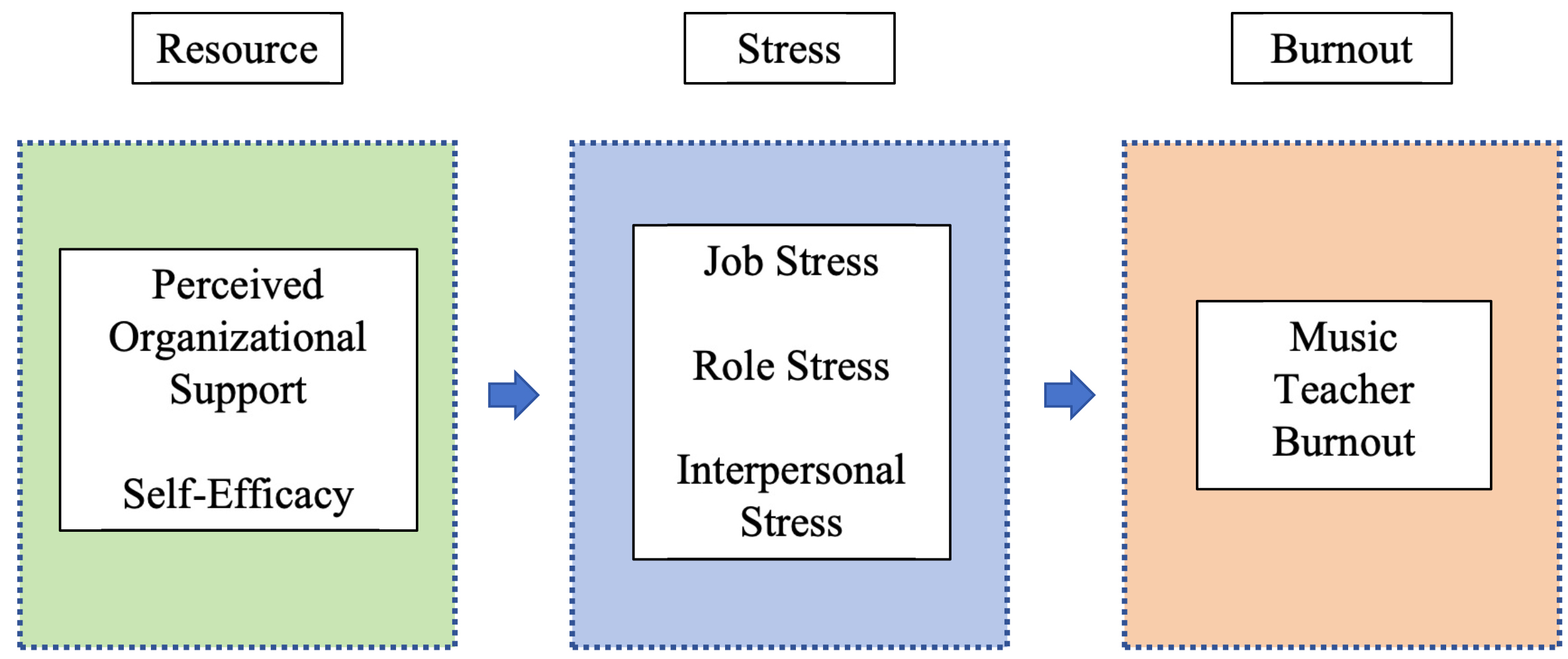
In summary, this study based, on COR Theory, constructed and tested a hypothetical model (as shown in Fig. 1) to explain the association between self-efficacy and POS as resources and teacher burnout in the context of Chinese primary and secondary school music teachers, and also attempted to confirm the mediating mechanisms of stress (job stress/role stress/interpersonal stress) between resources (self-efficacy/POS) and teacher burnout. It is worth noting that existing research has shown a positive association between POS and teachers’ self-efficacy (Jiao et al., 2022; Li et al., 2025), but the present study did not focus on the direct relationship between the two.
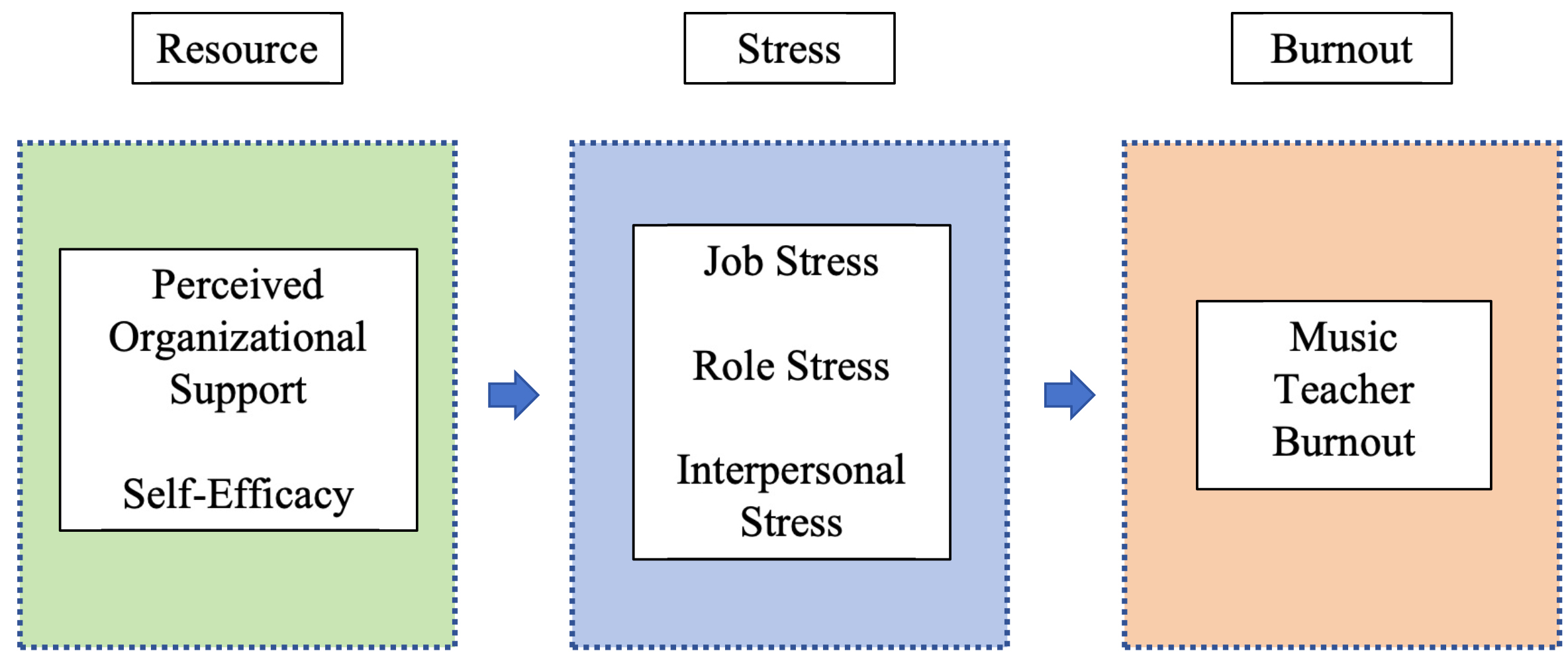 Fig. 1.
Mediation model of stress between resource support and burnout.
This study used purposive sampling to collect data from Chinese primary and secondary school music teachers through an online questionnaire distributed via the Wenjuanxing survey tool (https://www.wjx.cn/) between April and June 2025. Participation was entirely voluntary, and all respondents were informed of the study’s purpose, significance, and procedures for data confidentiality and use before completing the questionnaire. Participants were geographically diverse, with IP addresses distributed across 14 provinces and municipalities in China, including Hebei, Zhejiang, Shanghai, Shaanxi, Tianjin, Hubei, Guangdong, Anhui, Fujian, Chongqing, Guangxi, Sichuan, Henan, and Jiangxi. A total of 467 questionnaires were received; after excluding 5 responses that failed attention-check items, 12 with completion times under 240 s, and 4 with missing values, 446 valid responses remained for analysis. We referred to Memon et al. (2020) for guidelines on structural equation modeling, in which a sample size of at least 200 is required in order to achieve reliable and valid results. Thus, our sample size of 446 was considered acceptable for the analyses conducted in this study. Missing data were handled using listwise deletion. Among the valid participants, 79 were male (17.7%) and 367 were female (82.3%), with an overall mean age of 30 years.
This survey instrument was based on the Chinese Primary and Secondary School
Teachers’ Job Burnout Questionnaire compiled by Maslach et al. (2001) and
revised by Wu et al. (2016). To tailor it to the specific context of this
study, we made appropriate adjustments to some expressions in the questionnaire,
such as changing the subject to “music teachers”, and specifying general
teaching activities as music-teaching activities, thus forming the Questionnaire
of Music Teachers’ Burnout used in this study. The questionnaire consists of 22
items divided into three dimensions: Emotional Exhaustion (e.g., “After a day’s
work, I feel exhausted”), Personal Accomplishment (e.g., “I can effectively
handle students’ problems”), and Depersonalization (e.g., “I am very harsh
towards students”). Responses were recorded on a 5-point Likert scale ranging
from “Strongly Disagree = 1” to “Strongly Agree = 5”. Higher scores indicate
a higher degree of teacher burnout. The scale showed good reliability and
validity: Cronbach’s
The Perceived Organizational Support Scale, originally developed by Eisenberger
(1986), was used to measure teachers’ perceived organizational support. The
scale consists of 8 items, and responses were recorded on a 5-point Likert scale
ranging from “Strongly Agree = 1” to “Strongly Disagree = 5”. After reverse
scoring the negatively worded items, the scores of all items were summed to
obtain a total score. Higher scores indicated a higher level of perceived
organizational support. Zhang (2009) showed that the scale has good
reliability and validity: Cronbach’s
The General Self-Efficacy Scale (GSES), compiled by Schwarzer and Jerusalem
(1995), was used to measure the self-efficacy of primary and secondary school
music teachers. The scale consists of 10 items, and responses were recorded on a
5-point Likert scale ranging from “Strongly Disagree = 1” to “Strongly Agree =
5”. Higher scores indicate higher self-efficacy. Zhou and Han (2014) showed
that the scale has good reliability and validity: Cronbach’s
The interpersonal dimension subscale from the University Teachers’ Work Stress
Scale, compiled by Li (2005), was used to measure teachers’ interpersonal
stress. The scale consists of 4 items, and responses were recorded on a 4-point
Likert scale ranging from “No Stress = 1” to “Severe Stress = 4”. Higher
scores indicate higher interpersonal stress. A previous study applied this scale
to measure stress among primary and secondary school teachers, demonstrating good
reliability: Cronbach’s
The Job Stress Scale, compiled by Parker and DeCotiis (1983) and revised by
Jamal and Baba (1992), was used to measure teachers’ job stress. The scale
consists of 9 items, and responses were recorded on a 5-point Likert scale
ranging from “Strongly Disagree = 1” to “Strongly Agree = 5”. Higher scores
indicate higher job stress. The present study showed that the scale had good
reliability and validity: Cronbach’s
The Role Stress Scale, compiled by Peterson et al. (1995) and revised by Li
and Zhang (2009), was used to measure teachers’ role stress. The scale
consists of 13 items divided into three dimensions: Role Conflict (e.g., “I
often have to face situations with conflicting demands”), Role Ambiguity (e.g.,
“I am very clear about how much responsibility I bear”), and Role Overload
(e.g., “At work, I feel overburdened”). Responses were recorded on a 5-point
Likert scale ranging from “Strongly Agree = 1” to “Strongly Disagree = 5”.
After reverse scoring the negatively worded items, the scores of all items were
summed to obtain a total score. Higher scores indicate higher role stress. Li and
Zhang (2009) showed that the scale has good reliability and validity:
Cronbach’s
We conducted descriptive and inferential statistics using Jamovi software (version 2.6.44; jamovi; The jamovi project, Sydney, Australia; https://www.jamovi.org). Structural equation modeling (SEM) was performed to examine the mediation model, with estimation carried out using the lavaan package 0.6.18 (Rosseel, 2012) in R 4.4 (R Core Team, Vienna, Austria, https://cran.r-project.org). To maintain the integrity of the original measurement instruments, no rescaling was performed. Given that the dataset included ordered categorical variables with fewer than five response categories, the diagonally weighted least squares (DWLS) estimator was applied, as recommended for modeling ordinal variables with mixed scale lengths (Baghdarnia et al., 2014). This approach allowed for accurate estimation without violating assumptions related to response formatting.
The data were collected via self-report questionnaires at a single time point, so there was a risk that common-method variance (CMV) may have interfered with the relationships among the variables.
First, we conducted Harman’s single-factor test. This method for testing common method bias is widely used in music education empirical research (Zhang et al., 2022; Zhang et al., 2024). Based on the standard of a characteristic root greater than one, eight factors in the present results were extracted from unrotated factor analysis. Furthermore, the variation of maximum factor variance interpretation was 28.66%, less than the critical standard of 40% (Zhou and Long, 2004), indicating that the single factor did not dominate most of the variation and initially ruled out the risk of significant common-method bias. However, Harman’s single-factor test has been criticized for its low sensitivity and inability to statistically control for method effects (Podsakoff et al., 2003). Specifically, Harmans’ single-factor test assumes that any common variance is attributable to a single method factor affecting all items equally—an assumption often not tenable in practice. Thus, although Harman’s single-factor test provided a preliminary indication, it did not offer a rigorous test of common-method bias.
Furthermore, to enhance the robustness of CMV detection, we followed the
unmeasured latent method construct (ULMC) technique recommended by Williams and
McGonagle (2016). According to this test, we added a CMV factor to the
baseline model and compared the fit indices of the two models. The results showed
that after the introduction of the CMV factor, the degradation of the key fit
indices was significant (
Prior to the main analysis, the normality of the distribution for all continuous
variables was assessed. The Shapiro–Wilk test was significant (p
Pearson’s product-moment correlation was used to analyze the bivariate
relationships between variables. All variables showed the expected significant
correlations (Table 1). Among them, perceived organizational support was
significantly negatively correlated with stress (job/role/interpersonal stress)
(
| Variables | M | SD | Perceived organizational support | Self-efficacy | Job stress | Role stress | Interpersonal stress | Burnout |
| Perceived organizational support | 3.61 | 0.85 | 1 | |||||
| Self-efficacy | 3.85 | 0.65 | 0.411*** | 1 | ||||
| Job stress | 2.26 | 0.90 | –0.408*** | –0.309*** | 1 | |||
| Role stress | 2.57 | 0.66 | –0.544*** | –0.362*** | 0.670*** | 1 | ||
| Interpersonal stress | 1.82 | 0.72 | –0.423*** | –0.255*** | 0.556*** | 0.469*** | 1 | |
| Burnout | 1.87 | 0.61 | –0.475*** | –0.421*** | 0.698*** | 0.620*** | 0.449*** | 1 |
Note. *** p
We examined the direct predictive effects of self-efficacy and perceived
organizational support on teacher burnout, as well as the indirect effects with
stress as the mediating variable. We used linear regression analysis to test the
direct predictive effects of self-efficacy and perceived organizational support
on teacher burnout. To facilitate the comparison of the relative strengths of
different path coefficients, we reported and mainly explained the standardized
coefficients (
We used structural equation modeling (SEM) to examine the mediation model with
stress as the mediating variable. The stress involved in this study included job
stress, role stress, and interpersonal stress. First, the SEM constructed with
self-efficacy as the independent variable demonstrated good fit: CFI = 0.913; TLI
= 0.909; RNI = 0.913; NFI = 0.909; RFI = 0.904. The results showed that stress
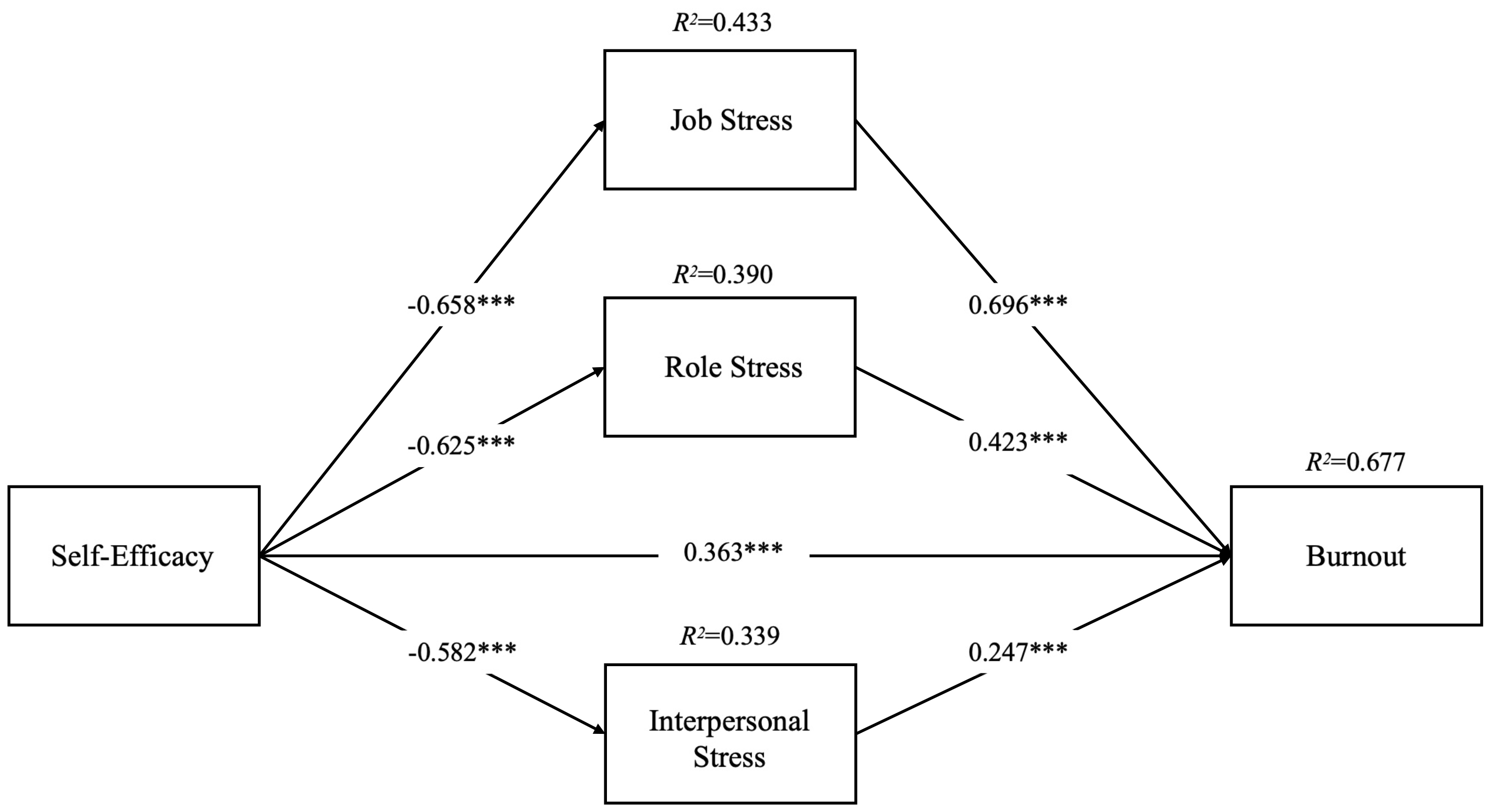
played a significant mediating role between self-efficacy and teacher burnout
(Fig. 2), which supported H3. Furthermore, as shown in Table 2, self-efficacy
significantly and negatively predicted job stress (
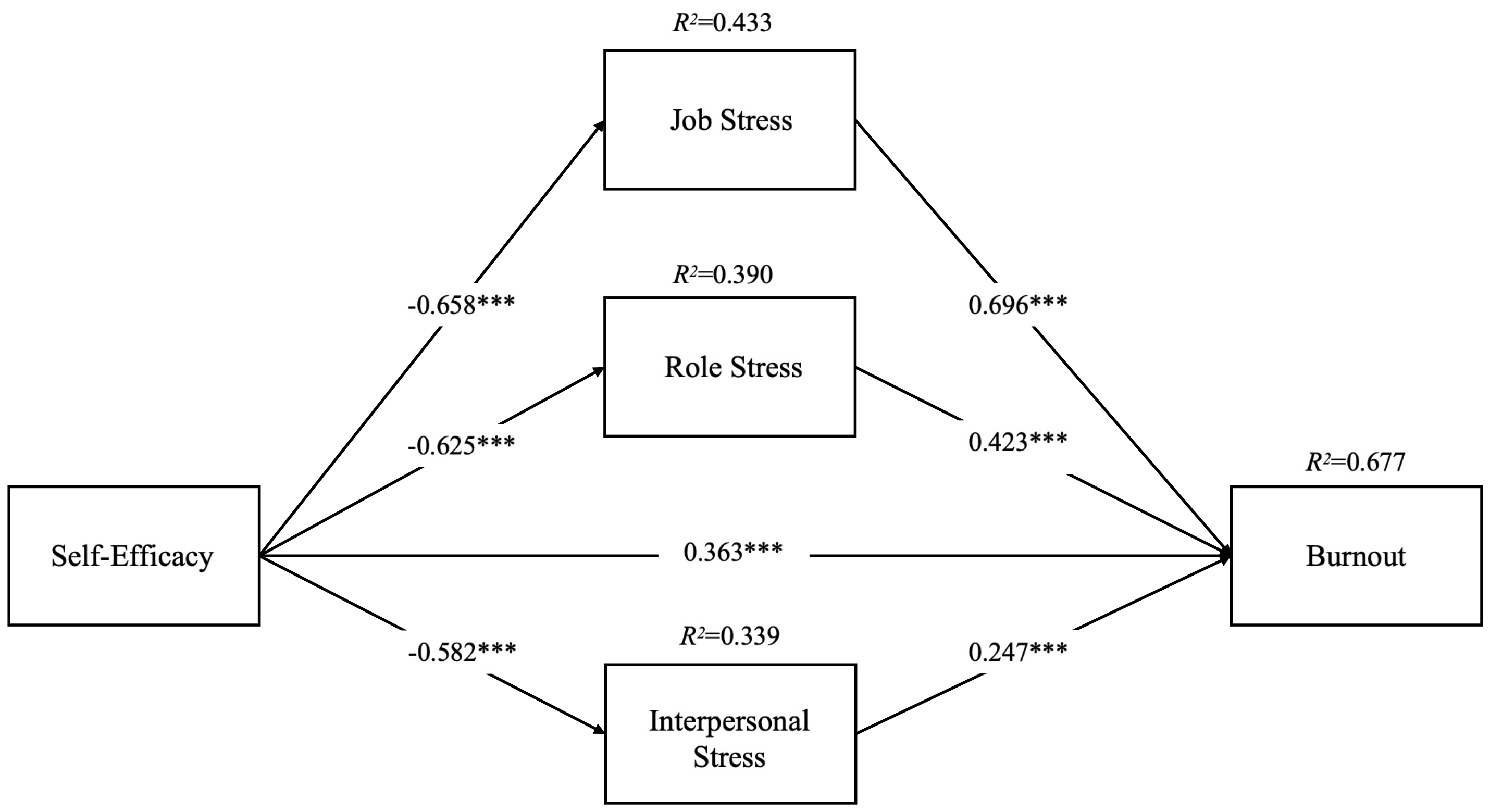 Fig. 2.
Mediation model of stress between self-efficacy and
burnout. Note. All path coefficients shown are standardized beta
coefficients (
| Dep | Pred | Estimate | Standard Error (SE) | z | p | |||
| Lower | Upper | |||||||
| Burnout | Self-Efficacy | 0.394 | 0.021 | 0.363 | 0.325 | 0.400 | 18.5 | |
| Burnout | Job Stress | 0.636 | 0.014 | 0.696 | 0.673 | 0.719 | 46.2 | |
| Burnout | Role Stress | 0.512 | 0.015 | 0.423 | 0.405 | 0.441 | 34.4 | |
| Burnout | Interpersonal Stress | 0.246 | 0.015 | 0.247 | 0.220 | 0.274 | 16.6 | |
| Job stress | Self-Efficacy | –0.782 | 0.012 | –0.658 | –0.670 | –0.646 | –64.5 | |
| Role stress | Self-Efficacy | –0.560 | 0.011 | –0.625 | –0.635 | –0.614 | –51.2 | |
| Interpersonal stress | Self-Efficacy | –0.635 | 0.014 | –0.582 | –0.599 | –0.565 | –44.4 | |
Note. Estimates are unstandardized coefficients,
Second, the structural equation model constructed with perceived organizational
support as the independent variable demonstrated good fit: CFI = 0.919; TLI =
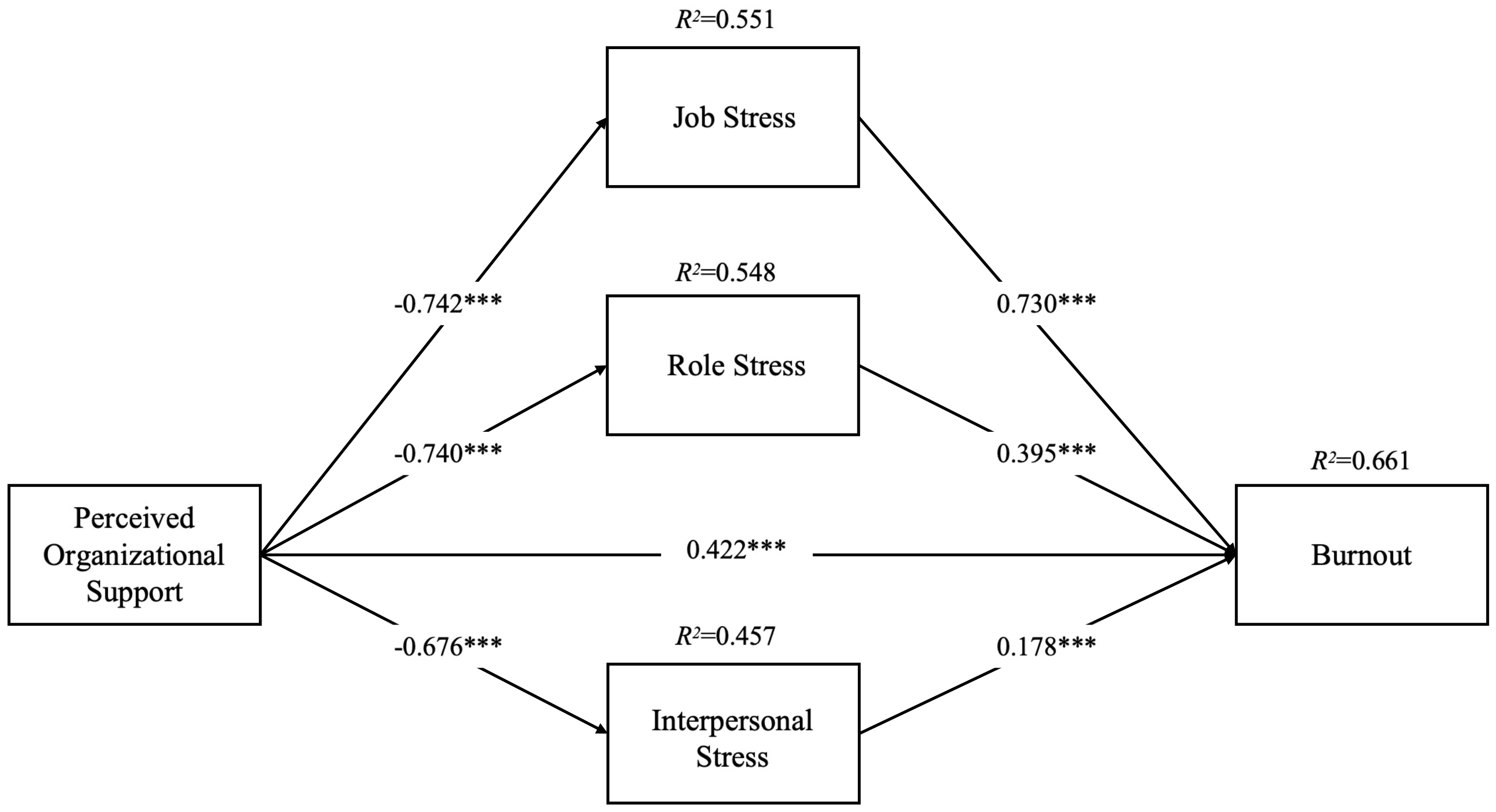
0.916; RNI = 0.919; NFI = 0.915; RFI = 0.911. The results showed that stress
played a significant mediating role between perceived organizational support and
teacher burnout (Fig. 3), which supported H4. Furthermore, as shown in Table 3,
perceived organizational support significantly and negatively predicted job
stress (
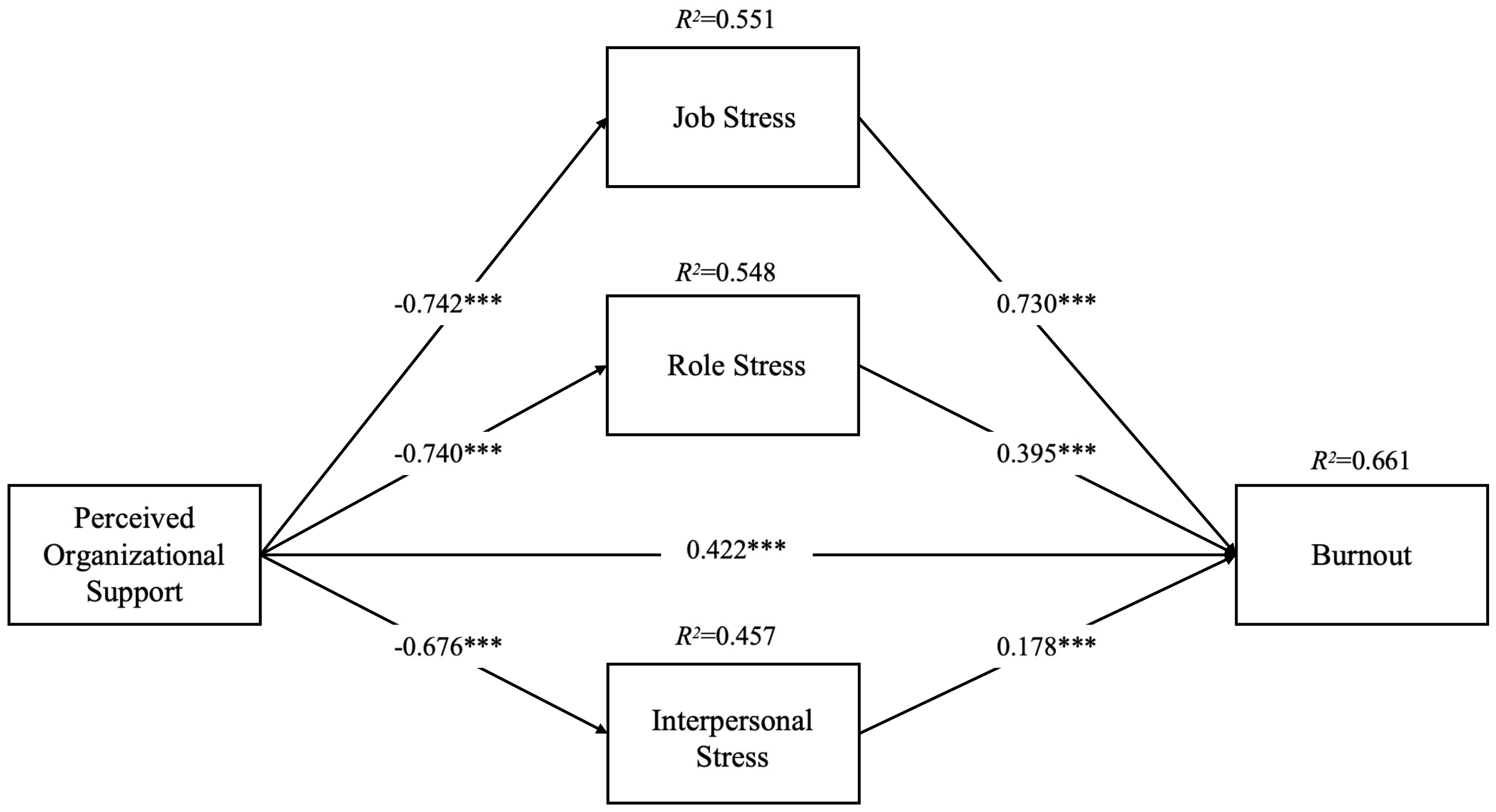 Fig. 3.
Mediation model of stress between perceived organizational
support and burnout. Note. All path coefficients shown are standardized beta
coefficients (
| Dep | Pred | Estimate | SE | z | p | |||
| Lower | Upper | |||||||
| Burnout | Perceived organizational support | 0.392 | 0.029 | 0.422 | 0.362 | 0.482 | 13.76 | |
| Burnout | Job Stress | 0.685 | 0.018 | 0.730 | 0.697 | 0.763 | 37.15 | |
| Burnout | Role Stress | 0.476 | 0.019 | 0.395 | 0.368 | 0.423 | 24.76 | |
| Burnout | Interpersonal Stress | 0.178 | 0.018 | 0.178 | 0.144 | 0.212 | 9.93 | |
| Job stress | Perceived organizational support | –0.736 | 0.010 | –0.742 | –0.755 | –0.730 | –71.07 | |
| Role stress | Perceived organizational support | –0.572 | 0.010 | –0.740 | –0.752 | –0.729 | –56.37 | |
| Interpersonal stress | Perceived organizational support | –0.626 | 0.012 | –0.676 | –0.694 | –0.658 | –50.37 | |
Note. Estimates are unstandardized coefficients,
However, the mediating variable, stress, exhibited a suppressor effect. A suppressor effect occurs when introducing mediators weakens or reverses the direct relationship between the independent and dependent variables (MacKinnon et al., 2000). The results showed that without introducing the mediating variables, both self-efficacy and perceived organizational support significantly and negatively predicted teacher burnout. However, after including stress (job/role/interpersonal stress) as mediating variables, the predictive coefficients of both on teacher burnout turned positive, indicating that stress partially suppressed the effects of self-efficacy and perceived organizational support on teacher burnout.
To determine whether this effect represented a genuine psychological mechanism or a statistical artifact (e.g., multicollinearity), we conducted variance inflation factor (VIF) analyses (Table 4). All VIF values ranged from 1.25 to 2.19, well below the threshold of 5, effectively ruling out multicollinearity as a confounding factor. This statistical evidence strengthened the interpretation that the observed suppressor effect reflected a substantive, rather than spurious, relationship within our theoretical model.
| Predictor variables | Variance Inflation Factor (VIF) | Tolerance |
| Perceived organizational support | 1.61 | 0.623 |
| Self-efficacy | 1.25 | 0.798 |
| Interpersonal stress | 1.56 | 0.642 |
| Job stress | 2.11 | 0.474 |
| Role stress | 2.19 | 0.458 |
In summary, all hypotheses proposed in this study were supported. First, in terms of direct effects, both self-efficacy (H1) and perceived organizational support (H2) significantly and negatively predicted teacher burnout. Second, regarding mediation effects, stress (job/role/interpersonal stress) played mediating roles both between self-efficacy and teacher burnout (H3), as well as perceived organizational support and teacher burnout (H4). Specifically, both self-efficacy and perceived organizational support significantly and negatively predicted stress (job/role/interpersonal stress), whereas stress (job/role/interpersonal stress) significantly and positively predicted teacher burnout.
Grounded in COR theory (Hobfoll, 1989), this study examined how self-efficacy and POS are related to job burnout among Chinese primary and secondary school music teachers, and, for the first time, tested the mediating effects of job, role, and interpersonal stress. Overall, the findings supported all four proposed hypotheses.
We found that both self-efficacy and POS were negatively related to job burnout among primary and secondary school music teachers, which is consistent with previous research findings. First, self-efficacy significantly and negatively predicted job burnout among primary and secondary school music teachers. Although the countries, subjects, and educational levels focused on differ from those in past studies, this finding remained consistent with previous research (Kim and Burić, 2020; Fathi et al., 2021; Bing et al., 2022; Li, 2023). In addition, for music teachers with the dual identity of educator and performer, this may have been because music teachers with higher self-efficacy can more effectively complete various tasks during music classroom teaching and music performance group rehearsals, thereby reducing job burnout levels; however, music teachers with lower self-efficacy often fall into emotions of self-doubt and fear, increasing the possibility of job burnout (Ballantyne and Zhukov, 2017).
This study also showed that POS negatively predicted job burnout among primary and secondary school music teachers, which was consistent with previous research indicating a negative correlation between POS and teacher burnout (Zhang et al., 2025a; Kurtessis et al., 2017; Saloviita and Pakarinen, 2021; Ghanizadeh and Jahedizadeh, 2015). In organizational environments, high levels of organizational help and support can reduce job burnout among primary and secondary school music teachers. Teachers working in supportive environments generally experience a lower rate of job burnout. For music teachers, POS may be particularly salient given the marginal positioning of music as a non-examination subject in many school systems. Research has shown that music teachers often depend on administrative recognition and institutional support to sustain their professional roles and teaching practices (Scheib, 2003). In the Chinese context, insufficient POS has been associated with heightened role ambiguity and interpersonal strain, especially when music-related work such as rehearsals, performances, and school cultural activities is inadequately recognized within formal evaluation systems (Song and Lin, 2011; Guo, 2020).
The findings further indicated that self-efficacy and POS are indirectly related to music teacher burnout through job, role, and interpersonal stress, supporting stress as a key resource-depletion pathway within COR theory (Hobfoll et al., 2018). This pattern was consistent with previous research on general teacher populations. Specifically, job stress, role stress (including role conflict and ambiguity), and interpersonal stress have been identified as mediators linking self-efficacy to burnout (Schwarzer and Hallum, 2008; Doménech-Betoret et al., 2015; Cetin and Dede, 2018; Latif et al., 2023). Similarly, existing studies show that job, role, and interpersonal stress mediate the relationship between POS and teacher burnout (Stamper and Johlke, 2003; Becker et al., 1996; Xu, 2019; Zhang et al., 2024). Although these mediating mechanisms align with findings from general teacher samples, the sources and manifestations of stress among music teachers remain distinct and warrant focused examination. For music teachers, these stress dimensions are embedded in subject-specific working conditions shaped by the marginal positioning of music education and the performance-oriented nature of their work. Job stress is often associated with non-standardized workloads—such as rehearsals, performances, competitions, and school-wide cultural activities—that extend beyond regular teaching hours and blur work–time boundaries, contributing to elevated occupational stress and emotional exhaustion (Song and Lin, 2011). Role stress is likewise linked to the non-examination status of music, which is frequently accompanied by unclear role expectations, role overload, and misalignment between professional effort and formal evaluation criteria (Scheib, 2003; Guo, 2020). Interpersonal stress commonly arises in examination-oriented school contexts where music education is undervalued, limiting recognition and access to resources and straining professional relationships (Hanson, 2021; Shi, 2021). Taken together, these findings suggest that self-efficacy and POS are related to lower burnout among music teachers primarily through their associations with job, role, and interpersonal stress, which correspond to variations in emotional exhaustion, reduced personal accomplishment, and depersonalization (Vargas Rubilar and Oros, 2021).
Notably, when stress was included in the model, the direct associations between self-efficacy, POS, and burnout shifted from negative to positive, indicating a suppressor effect. From a COR perspective, this pattern reflected resource investment risk, whereby greater resource investment may increase vulnerability when demands are poorly structured or managed (Hobfoll et al., 2018). COR theory further posits that resources operate in resource caravans, in which protective value depends on supportive resource caravan passageways within the organizational context (Hobfoll, 2012; Hobfoll et al., 2018). When such passageways are weak—due to ambiguous role expectations or insufficient recognition—resources may fail to buffer stress and instead heighten stress sensitivity, accelerating burnout even among resource-rich teachers. This interpretation is consistent with social cognitive and social exchange perspectives. High self-efficacy may raise performance standards and work engagement, leading teachers to invest more effort and assume greater responsibilities, which can increase stress exposure when boundaries are unclear (Bandura, 1997; Luthans et al., 2007; Skaalvik and Skaalvik, 2017; Wu and Ho, 2023). Similarly, although POS often functions as a stress buffer, it may also evoke reciprocal obligation, prompting teachers to internalize higher expectations and voluntarily take on additional duties, thereby increasing role overload (Eisenberger et al., 1986; Kurtessis et al., 2017). Under poorly managed stress conditions, these dynamics may undermine the protective function of resources and exacerbate burnout (Wang et al., 2015).
Overall, this study focused on music teacher burnout and found that although the strength of associations differed across the three dimensions of stress (job, role, and interpersonal stress) and the two resource dimensions (self-efficacy and POS), they exhibited a consistent relational pattern with burnout. This finding further supported the mediating role of stress as an overarching mechanism linking self-efficacy and POS with job burnout (Schönfeld et al., 2017; Yang, 2020). Moreover, the observed suppressor effect suggested that for music teachers, personal and organizational resources may alleviate burnout only when stress is adequately managed; otherwise, heightened expectations and increased sensitivity to stress may undermine their protective function (Hobfoll et al., 2018; Wu and Ho, 2023; Wang et al., 2015).
Despite the meaningful findings, several limitations should be noted. First, the cross-sectional design precluded causal inference among self-efficacy, POS, stress, and burnout (Cole and Maxwell, 2003). Although the model was theoretically grounded in COR theory and tested using SEM, the findings reflected model-based associations rather than confirmed causal processes. Future research is therefore encouraged to use longitudinal or cross-lagged designs to strengthen causal interpretation (Little et al., 2007). Second, reliance on self-report measures may have introduced subjective bias and inflated associations, particularly for perceptual constructs such as stress, POS, and burnout (Podsakoff et al., 2003). Although common-method bias was not severe, future studies could enhance validity by incorporating multi-source data, such as leadership evaluations or peer reports (McMurray et al., 2004). Finally, as the sample was limited to Chinese primary and secondary school music teachers, future research should test the model across different subject areas, cultural contexts, and professional ranks to examine its broader applicability.
Drawing on Conservation of Resources theory, this study examined the associations between self-efficacy, perceived organizational support, multidimensional stress (job, role, and interpersonal stress), and job burnout among Chinese primary and secondary school music teachers. By focusing on an underexamined teacher population, the findings provide evidence for a resource–stress–burnout process in music teaching contexts. The findings indicate that personal and organizational resources are not uniformly or linearly associated with lower burnout. Although self-efficacy and organizational support generally function as protective resources, their effects are conditional and shaped by stress-related processes. Stress serves as a central pathway through which resources influence burnout, and under certain stress conditions, heightened expectations and increased sensitivity to demands may weaken or counteract their protective potential. Conceptualising teacher stress as multidimensional further highlights that job, role, and interpersonal stress represent distinct pathways through which resources may be strained. These findings suggest that reducing music teacher burnout requires attention not only to strengthening individual and organisational resources, but also to managing role expectations, workload boundaries, and interpersonal demands within school systems. At the individual, school, and policy levels, efforts to support realistic self-expectations, clarify roles and workload norms, improve coordination, and recognise the full scope of music teachers’ work may help better align resources with actual demands and promote more sustainable professional well-being.
The corresponding author can be contacted to request the data used in this study. Due to privacy considerations of the participants, the data is not accessible to the public.
YZhang: data curation, formal analysis, funding acquisition, investigation, methodology, project administration, resources, visualization, writing – original draft. JWang & JZ: investigation, writing – original draft. JWu: conceptualization, data curation, formal analysis, methodology, writing – original draft. XY: conceptualization, supervision, validation, visualization, writing – review & editing. YZhao: conceptualization, project administration, supervision, validation, writing – original draft. DZ: conceptualization, data curation, formal analysis, methodology, writing – original draft. All authors read and approved the final manuscript. All authors have participated sufficiently in the work and agreed to be accountable for all aspects of the work.
The study was conducted in accordance with the Declaration of Helsinki. The research protocol was approved by the Ethics Committee of Hebei Normal University (Ethic Approval Number: 2025GJJG135), and all of the participants provided signed informed consent.
Thank you to all the participants for your contributions to this study.
This work was supported by the Humanities and Social Sciences Research Fund Project of Hebei Normal University (S23B025); Research and Practice Project on Teaching Reform in Higher Education of Hebei Province (2025GJJG135); Postdoctoral Research Daily Funding Project of Hebei Normal University (13104007).
The authors declare no conflicts of interest.
References
Publisher’s Note: IMR Press stays neutral with regard to jurisdictional claims in published maps and institutional affiliations.