

 , Ana Goterris-Estrada 3
1 Psychology Department, Universidad Europea de Canarias, 38300 La Orotava, Spain
2 Department of Basic Psychology, Clinic and Psychobiology, Jaume I University, 12071 Castellon, Spain
3 Clínica GEA, 12001 Castellón de la Plana, Spain
Abstract
Peer exclusion is a common social stressor in emerging adulthood and can provoke strong negative emotional responses. However, individual differences in these responses remain poorly understood. The present study examined whether trait perceived injustice, a stable tendency to interpret experiences as unfair, moderates the effect of social exclusion on anger, a proximal risk factor for reactive aggression.
A total of 131 young adults (mean [M] = 21.22 years, standard deviation [SD] = 2.97; 81.7% women) participated in the Cyberball paradigm and were randomly assigned to either social inclusion or exclusion conditions.
Results indicated that trait perceived injustice significantly moderated the effect of exclusion on post-task anger. Individuals with average to high levels of trait perceived injustice exhibited greater anger in response to exclusion, whereas those with low levels did not show a significant effect. Pre-task anger significantly predicted post-task anger. These findings suggest that sensitivity to unfairness amplifies emotional reactivity to social exclusion.
Implications are discussed in terms of identifying youth at risk for negative affective responses and targeting fairness appraisals and anger regulation in preventive interventions.
Keywords
- anger
- peer exclusion
- Cyberball paradigm
- aggression risk
- trait perceived injustice
Emerging adulthood is a developmental period characterized by heightened sensitivity to peer evaluation and social relationships. Experiences of social exclusion and rejection during this stage, as in adolescence, are not only distressing but can also contribute to maladaptive outcomes, including reactive aggression (Webster et al., 2004). Youth violence, defined by the World Health Organization as violence occurring among individuals aged 10–29 years (World Health Organization, 2024), spans this developmental period, underscoring the importance of understanding how peer-related stressors affect emotional and behavioral vulnerability. Related developmental research highlights that lower empathy and stronger approval of aggressive responses to conflict are associated with greater involvement in school violence (Martos Martínez et al., 2021), suggesting that social interactions perceived as hostile or unfair may heighten emotional reactivity and escalate conflict.
Ostracism, defined as being ignored or excluded by others, is a well-established social stressor in laboratory research (Williams, 2007). According to the temporal need–threat model, ostracism initially triggers reflexive distress responses that are relatively universal, followed by a reflective phase in which appraisal and self-regulation determine the resulting emotional trajectory (Poppelaars et al., 2019). During this reflective phase, individuals differ markedly in their responses, with anger serving as a central reaction that may act as a proximal precursor to reactive aggression (Romero-Martínez et al., 2022; Smith et al., 2016).
Prior research suggests that broad personality traits, such as neuroticism or general self-esteem, do not consistently moderate the effects of ostracism (McDonald and Donnellan, 2012; Hartgerink et al., 2015). More recent work highlights fairness-related traits that more directly shape anger responses, such as justice sensitivity—the tendency to detect and react strongly to unfair treatment (Akber et al., 2024). These traits are theoretically linked to appraisals of goal obstruction and inequity, which are primary elicitors of anger according to appraisal theories of emotion (Batson et al., 2007).
We focus on trait perceived injustice, a dispositional tendency to interpret personally relevant experiences as unfair (Yakobov et al., 2019). Although conceptually related to justice sensitivity, trait perceived injustice emphasizes a generalized expectation of being treated unfairly. In contrast, justice sensitivity captures broader concerns about fairness in general, including the treatment of others. The Trait Injustice Experience Questionnaire (T-IEQ) is uniquely well-suited for studies of anger reactivity because it specifically measures enduring appraisals of personal unfairness, which are theorized to amplify emotional responses to social exclusion. This stable appraisal bias has been associated with heightened anger and difficulties in emotion regulation (Wang et al., 2024), suggesting it may amplify the negative emotional impact of ostracism.
From a person–environment fit perspective (van Vianen, 2018), negative outcomes are most likely when individual predispositions (e.g., heightened unfairness appraisals) interact with adverse social environments (e.g., ostracism). This mechanism is particularly relevant during youth and emerging adulthood, when concerns about peer belonging are highly salient and social conflicts may escalate into aggression (Molero Jurado et al., 2020; Villatte et al., 2022).
However, the moderating role of trait perceived injustice in ostracism-induced anger has not yet been empirically tested. To address this gap, the present study employed the Cyberball paradigm to examine whether individuals higher in perceived injustice exhibit stronger anger responses following ostracism compared to those lower in this trait. We hypothesized that ostracism would elicit greater post-task anger among participants with moderate to high levels of trait perceived injustice, reflecting greater emotional vulnerability to peer-related threats to fairness and belonging.
Participants were 131 undergraduate students from Jaume I University (Spain) recruited via campus posters and social media advertisements (mean [M] = 21.22 years, standard deviation [SD] = 2.97; range = 18–33; 81.7% female).
Participants were tested individually in laboratory rooms equipped with desktop computers. They were randomly assigned to an inclusion (exclusion = 1; 48.1%) or exclusion (inclusion = 0; 51.9%) condition using the Cyberball paradigm (Cyberball 5.5.0.2; Empirisoft Corporation, New York, NY, USA; programmed by Williams and Jarvis, 2006). Both participants and experimenters were blind to the condition. Participants were informed that they would play an online ball-tossing game with two same-age students participating from other rooms; in reality, the other players were computer-controlled.
A standardized instruction script informed participants that the task measured visualization ability and social coordination. After the Cyberball game, participants completed manipulation checks and post-task measures, followed by a full debriefing.
A post hoc sensitivity analysis using G*Power 3.1.9.7 (Heinrich Heine University Düsseldorf, Düsseldorf, Germany) (Faul et al., 2007)
indicated that the final sample (N = 131) provided 83.1% power to detect a
small-to-moderate interaction effect (f2 = 0.062) at
All questionnaires were completed on the same computer before and after the experimental manipulation. Higher scores reflect greater levels of the construct assessed, unless stated otherwise.
Trait perceived injustice was assessed using the T-IEQ (Yakobov et al., 2019), a trait adaptation of the original Injustice Experience Questionnaire
(IEQ; Sullivan et al., 2008). Following the T-IEQ procedure, we used the
Spanish validated version of the IEQ (Rodero et al., 2012) and adapted the
instructions to encourage responses based on enduring appraisals of unfairness
rather than temporary or situation-specific reactions. The scale includes 12
items, rated on a 5-point Likert scale ranging from 0 = never to 4 = all the
time. Example items include “Most people don’t understand how difficult
my life is” and “I feel that I have been denied opportunities more
often than others”. Higher scores indicate greater perceived trait
injustice. Internal consistency in this sample was
The State Anger subscale of the State-Trait Anger Expression Inventory-2
(STAXI-2; Tibubos et al., 2020; adapted to Spanish by Spielberger, 2001) consists of 15 items rated on a 4-point scale (1 = not at all to
4 = very much). Reliability in this sample was
The state version of the State-Trait Anxiety Inventory (STAI-S; Spielberg et al., 1983; adapted to Spanish by Guillén-Riquelme and Buela-Casal, 2015) includes
20 items rated on a 4-point scale (0 = nothing to 3 = very
much). Reliability in this sample was
Participants rated how excluded they felt and how often they received the ball on a 7-point scale (1 = not at all to 7 = very much).
The Cyberball game consisted of 60 throws over approximately 3 minutes (Hartgerink et al., 2015).
⚫ Inclusion condition (0): approximately 20 passes to the participant, with an equal distribution.
⚫ Exclusion condition (1): approximately 10 passes to the participant early in the game, followed by continued omission.
To enhance ecological validity and the perceived stakes of inclusion,
participants were informed that they would receive €5 for
participation, plus an additional €2 bonus if they received
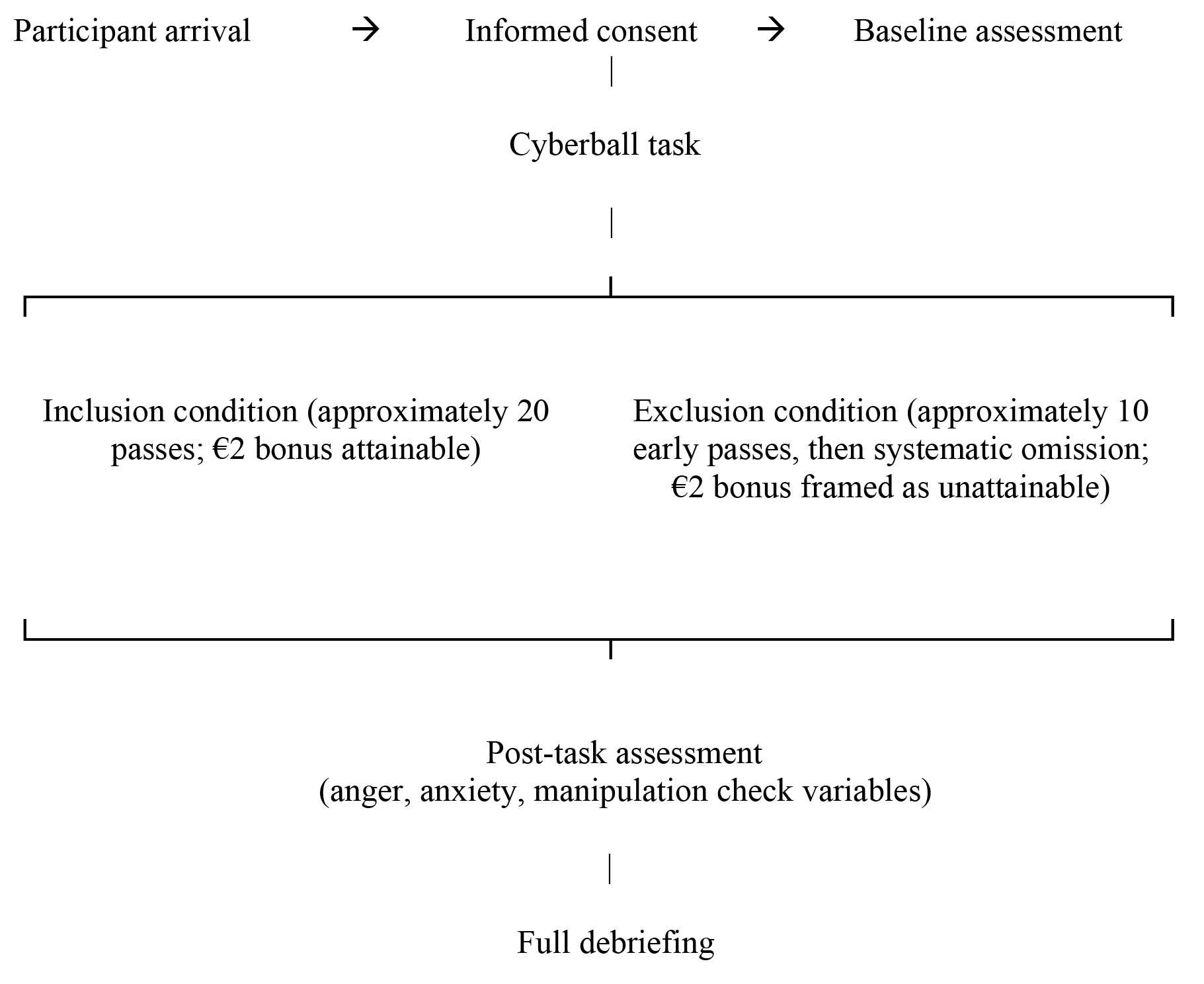
This hybrid manipulation, combining ostracism with distributive unfairness, was designed to heighten participants’ appraisals of personal injustice—a strength for testing the current moderation hypothesis but a limitation for isolating “pure” exclusion effects (see Discussion for implications). An experimental flowchart of the study is shown in Fig. 1.
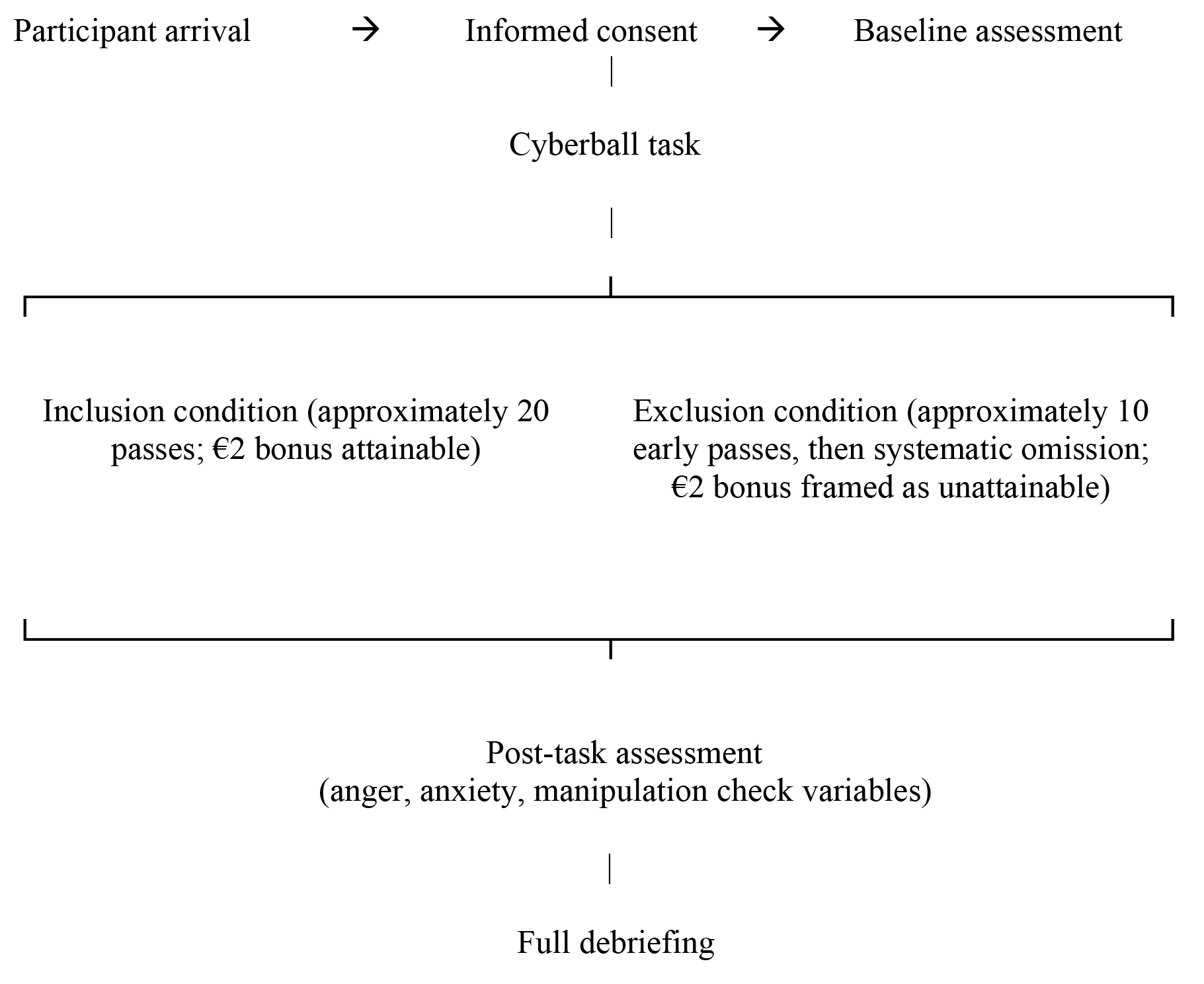 Fig. 1.
Experimental flowchart of the cyberball ostracism paradigm study.
Analyses were conducted in SPSS 29.0 (IBM Corp., Armonk, NY, USA) using the PROCESS macro version 4.2 (Hayes, 2022). We tested a moderation model (PROCESS Model 1) predicting post-task anger with the following predictors:
⚫ Experimental condition (1 = exclusion; 0 = inclusion).
⚫ M-centered trait perceived injustice.
⚫ The interaction between condition and trait perceived injustice.
⚫ Covariates: baseline anger and baseline anxiety.
Significant interactions were probed at -1 SD (low), the M, and +1 SD (high) levels of trait perceived injustice. All effects were reported with unstandardized coefficients, standardized betas, 95% confidence intervals (CIs), and exact p-values. Assumptions were checked prior to analysis.
Ms, SDs, and zero-order correlations are presented in Table 1. All variables demonstrated acceptable skewness (–0.72 to 0.84) and kurtosis (–0.65 to 1.02). As shown in Table 1, post-Cyberball anger levels were positively associated with trait perceived injustice, baseline anger, and baseline anxiety, supporting expected convergent patterns.
| Variable | M (SD) | 1 | 2 | 3 | 4 | 5 |
| 1. Trait injustice | 27.0 (7.7) | - | –0.01 | 0.46*** | –0.05 | 0.24** |
| 2. Pre-task anxiety | 44.2 (9.7) | - | –0.03 | 0.77*** | 0.20* | |
| 3. Pre-task anger | 19.1 (2.8) | - | –0.14 | 0.31*** | ||
| 4. Post-task anxiety | 46.2 (5.1) | - | 0.06 | |||
| 5. Post-task anger | 19.0 (4.9) | - |
Note. M = mean; SD = standard deviation.
* p
A moderation analysis tested whether trait perceived injustice (T-IEQ) moderated
the effect of ostracism (1 = exclusion, 0 = inclusion) on post-task anger,
controlling for pre-task anger and anxiety (PROCESS Model 1; Hayes, 2022).
The model accounted for 26.3% of the variance in post-task anger,
R2 = 0.26, F(5,125) = 8.92, p
The interaction between ostracism and trait perceived injustice was significant,
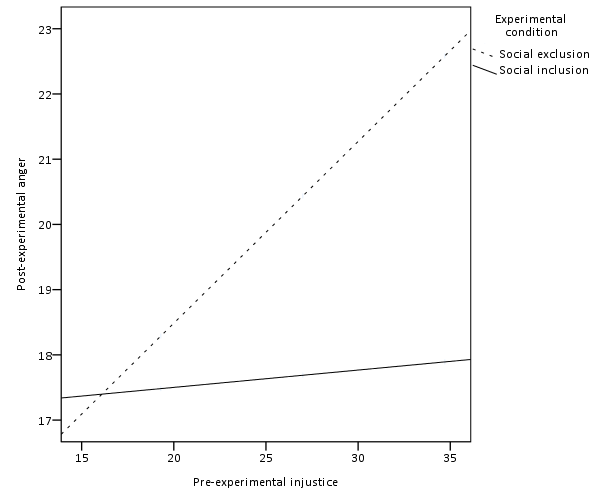
Although the main effect of ostracism appears negative, this reflects M-centering of predictors in the moderation model. Simple slope decomposition clarified the conditional effects:
⚫ Low trait perceived injustice (16th percentile, T-IEQ = 20):
Exclusion (vs. inclusion) did not significantly affect anger,
⚫ Average trait perceived injustice (50th percentile, T-IEQ = 25):
Exclusion significantly increased anger,
⚫ High trait perceived injustice (84th percentile, T-IEQ = 33):
Exclusion showed the strongest effect on anger,
These results indicate that individuals with higher trait perceived injustice exhibit significantly greater anger responses when excluded, supporting the hypothesis that sensitivity to unfairness amplifies emotional reactivity (see Fig. 2).
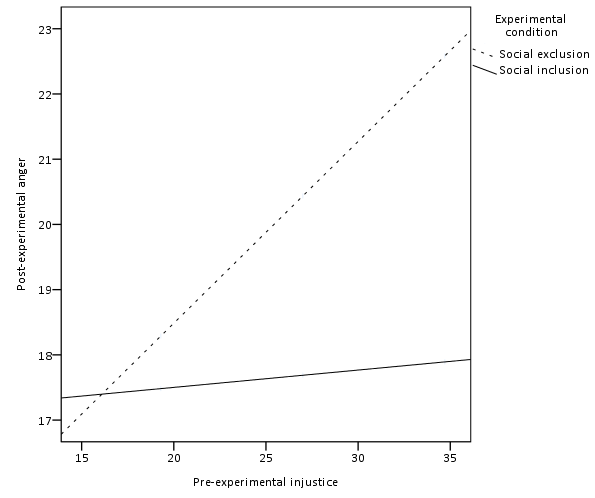 Fig. 2.
Moderating effect of trait perceived injustice on the relationship between ostracism and anger.
A secondary moderation analysis tested whether trait perceived injustice (T-IEQ)
moderated the effect of ostracism (1 = exclusion, 0 = inclusion) on post-task
anxiety, controlling for pre-task anxiety and pre-task anger. The model explained
a significant proportion of variance in post-task anxiety, R2 = 0.61,
F(5,125) = 39.62, p
Neither the main effect of ostracism,
Overall, trait perceived injustice did not moderate anxiety responses to ostracism, indicating that the observed effects of T-IEQ in this study are specific to anger rather than generalized to negative affect.
The Cyberball task successfully induced social exclusion. Participants in the
ostracism condition reported receiving significantly fewer ball tosses (15.34%
vs. 35.54%) and feeling more excluded and rejected than those in the inclusion
condition, all p
The present experiment examined whether trait perceived injustice moderates anger responses to ostracism during emerging adulthood. Results supported our hypothesis: ostracized individuals with higher levels of perceived injustice reported significantly greater anger reactivity, whereas those lower in this disposition showed minimal change. These findings suggest that anger may represent one pathway through which social stressors increase emotional vulnerability in youth.
First, these findings extend Williams’ (2007) temporal need–threat model by demonstrating that dispositional fairness concerns shape the reflective stage of the ostracism response. Although reflexive distress is widespread, reflective appraisal processes allow personal predispositions—such as heightened expectations of unfair treatment—to amplify negative affect (Poppelaars et al., 2019). This helps explain why not all young people respond uniformly to exclusion (Lynn Mulvey et al., 2017).
Second, our results provide further evidence that fairness-related traits may serve as more proximal predictors of anger than broader affective dispositions, such as neuroticism (McDonald and Donnellan, 2012). Although conceptually related to justice sensitivity, trait perceived injustice captures a generalized tendency to appraise personally relevant situations as unfair (Yakobov et al., 2019), reflecting a stable cognitive-emotional bias rather than a situational state. This aligns with developmental findings showing that empathy deficits and endorsement of aggressive responses to conflict are associated with involvement in school violence (Martos Martínez et al., 2021).
Third, grounded in a person–environment fit perspective (van Vianen, 2018), these results illustrate how susceptibility factors and peer adversity interact. Ostracism is a common social stressor in adolescence and emerging adulthood. When experienced by individuals who strongly interpret experiences as unjust, it may trigger heightened anger, a proximal precursor to conflict escalation.
Although aggression was not measured directly, anger is a well-established proximal risk factor for reactive aggression (Smith et al., 2016). Thus, trait-perceived injustice may help identify individuals who are emotionally vulnerable when exposed to exclusionary behavior, bullying, or relational conflict. Brief, evidence-based strategies could reduce this risk, including:
(1) Cognitive interventions targeting negative appraisals of unfairness and enhancing reappraisal skills (Bissell et al., 2018).
(2) School-based programs promoting empathy, perspective-taking, and nonviolent conflict resolution (Park-Higgerson et al., 2008).
Such approaches may be particularly valuable during developmental periods when concerns about peer belonging are especially prominent.
Interpretation of the present results should consider several limitations. In the hybrid fairness manipulation, the monetary contingency introduced distributive unfairness in addition to social exclusion. Consequently, anger responses may reflect the combined experience of being ostracized and receiving fewer rewards. Future work should isolate interpersonal exclusion from economic unfairness to clarify their independent and interactive effects. Regarding sample characteristics, participants were predominantly female undergraduates, which limits generalizability to populations at higher risk for behavioral aggression (Ashton et al., 2014; Malhi et al., 2020). Although emerging adults share developmental vulnerabilities with adolescents, especially regarding sensitivity to peer rejection and its association with conflict behaviors (Watson and Nesdale, 2012), replication in gender-balanced, school-based samples is needed. Another limitation concerns the focus on a single emotional outcome: anger. Although anger is theoretically central to reactive aggression pathways (Smith et al., 2016), ostracism also affects anxiety, sadness, prosocial repair behaviors, and physiological responses. A broader assessment would clarify whether perceived injustice reflects a general vulnerability to emotion dysregulation or a mechanism specific to anger. Additionally, longitudinal and behavioral studies are required to determine whether individuals high in perceived injustice show greater escalation from exclusion-induced anger to observable aggression, particularly in real-world peer contexts. Future research could also extend this approach to at-risk clinical populations (e.g., youth with depression, eating disorders, or borderline traits), in which rejection sensitivity and fairness concerns may contribute to affective dysregulation.
This study provides novel evidence that trait perceived injustice amplifies anger reactivity to ostracism in emerging adulthood. By positioning unfairness-related dispositions within the reflective stage of the ostracism response, the findings help explain why some young people exhibit stronger negative reactions to peer exclusion. These results underscore the value of assessing fairness-based appraisal tendencies in prevention and early intervention efforts aimed at reducing emotional vulnerability in socially stressful contexts. Future research should replicate these effects in younger and more diverse samples, disentangle social from distributive exclusion, and examine whether modifying perceived injustice can reduce anger reactivity in response to peer adversity.
Anonymized data will be shared upon request to the corresponding author.
CS-R: conceptualization, methodology, formal analysis, writing – original draft, writing – review & editing, supervision. AG-E: data curation, investigation, writing – review & editing. Both authors read and approved the final manuscript. Both authors have participated sufficiently in the work and agreed to be accountable for all aspects of the work.
The study was approved by the ethics committee of the Jaume I University (CD/11/2020) and followed the recommendations of the World Medical Association Declaration of Helsinki. Written informed consent was obtained for all participants.
We thank the participants for their time and valuable contribution to this research.
This research received no external funding.
The authors declare no conflicts of interest.
ChatGPT 5.3 was used to assist in the language editing of this manuscript only. The authors reviewed and approved all content generated or revised with AI assistance and take full responsibility for the integrity and accuracy of the final text.
References
Publisher’s Note: IMR Press stays neutral with regard to jurisdictional claims in published maps and institutional affiliations.