
 , Francisco González-Sala 2, Laura Lacomba-Trejo 2,*
1 Department of Developmental Psychology and Education, Faculty of Health Science, Catholic University of Uruguay, 11600 Montevideo, Uruguay
2 Department of Developmental and Educational Psychology, Faculty of Psychology and Speech Therapy, Universitat de València, 46010 Valencia, Spain
Abstract
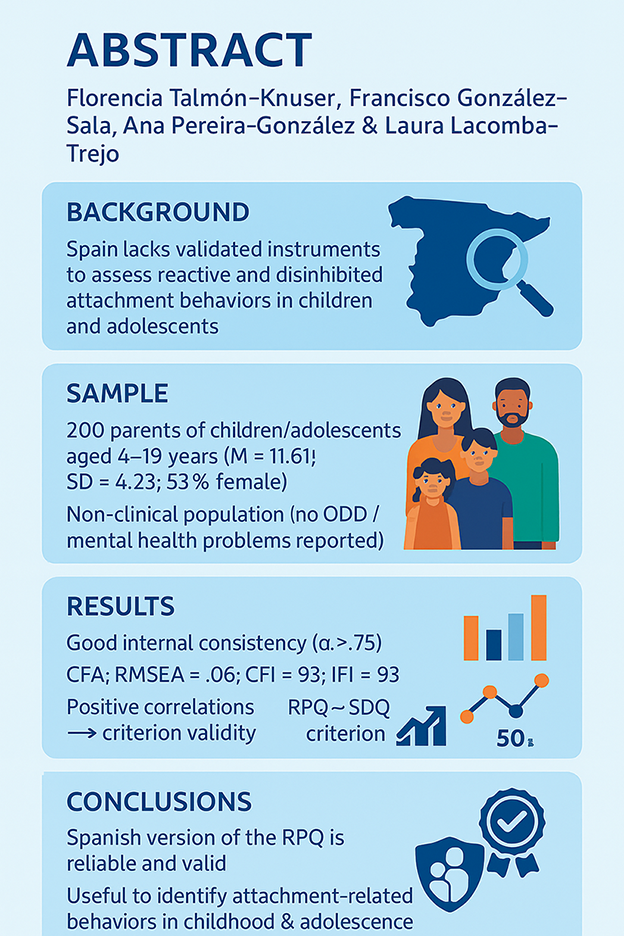
Spain lacks standardized and validated instruments for assessing reactive attachment disorder (RAD) in children and adolescents. This study examines the psychometric properties of the relationship problems questionnaire (RPQ) in a Spanish sample of parents of minors aged 4–19 (mean [M] = 11.61; standard deviation [SD] = 4.23; 53% female). Participants were drawn from nonclinical populations, with no reported neurodevelopmental disorders or mental health conditions. The RPQ assesses inhibited and disinhibited behaviors associated to attachment difficulties.
Following a rigorous back-translation process, the RPQ was administered to 200 participants (84% female), along with the strengths and difficulties questionnaire (SDQ) to test convergent validity in relation to emotional and behavioral problems.
Internal consistency proved adequate across RPQ subscales. Confirmatory factor analysis (CFA) supported an acceptable model fit (root mean square error of approximation [RMSEA] = 0.06; comparative fit index [CFI] = 0.93; incremental fit index [IFI] = 0.93). Significant positive correlations between RPQ and SDQ scores provided evidence of convergent validity. Percentile norms were developed and women reported significantly higher scores than men.
The Spanish RPQ shows good reliability and validity, providing a valuable tool for identifying attachment-related behaviors in children and adolescents.
Graphical Abstract
Keywords
- relationship problems questionnaire
- reactive attachment disorder
- children
- adolescents
- psychometric properties
Childhood and adolescence represent critical developmental stages during which emotional, social, and behavioral competencies are established, shaping long-term psychological adjustment and well-being (Papalia and Martorell , 2024). The nature of the emotional bonds developed with primary caregivers plays a central role in this process, conditioning the development of attachment and emotional regulation capacities (Bowlby, 1969; Bowlby, 1988).
The disorders classified in the Diagnostic and Statistical Manual of Mental Disorders, Fifth Edition, Text Revision (DSM-5-TR) (APA, 2022) as reactive attachment disorder (RAD) and disinhibited social engagement disorder (DSED), which were previously considered subtypes of RAD in earlier classifications, rank among the most severe disruptions of the attachment system. These disorders are strongly associated with early experiences of neglect, maltreatment, institutional care, or repeated changes in caregivers, conditions that hinder the development of secure attachment relationships (Humphreys et al., 2017). RAD is characterized by a limited ability to seek or accept comfort, emotional withdrawal, hypervigilance, and selective attachment behaviors, whereas DSED manifests as indiscriminate sociability and a lack of boundary recognition with both familiar and unfamiliar individuals (Zilberstein, 2006; APA, 2022).
Empirical evidence shows that these disorders are linked to a range of difficulties, including emotional dysregulation, internalizing and externalizing problems, attentional disorders such as attention-deficit hyperactivity disorder (ADHD), and various behavioral disturbances (Elovainio et al., 2015; Lehmann et al., 2020; Seim et al., 2021; Talmón-Knuser et al., 2023). They also adversely affect social functioning as well as cognitive and physical health outcomes (Boullier and Blair, 2018).
Despite growing awareness of the impact of early relational trauma on development, a significant lack of standardized, psychometrically validated instruments exists in Spain for assessing RADs in children and adolescents (Palma Ruíz et al., 2002). This limitation hampers clinical detection, research, and the design of early interventions tailored to the child’s developmental needs and caregiving context.
Several instruments have been developed internationally to assess RAD, including the Disturbance Attachment Interview (DAI; Smyke and Zeanah, 1999), the reactive attachment disorder assessment (RADA; Lehmann et al., 2020), and the RAD section of the Development and Well-Being Assessment RAD/DSED (DAWBA) (Rutter et al., 2009). However, many of these tools require trained professionals and are not easily applicable for large-scale screening or use in educational settings.
In contrast, the relationship problems questionnaire (RPQ; Minnis et al., 2002; Minnis et al., 2007) offers a brief, accessible, and psychometrically robust alternative, designed to assess symptoms of RAD and DSED through caregiver reports. Previous studies in diverse populations have shown good internal consistency, a clear factorial structure, and significant associations with behavioral problems, supporting the RPQ as a reliable screening tool for RAD and DSED (Vervoort et al., 2013; Talmón-Knuser et al., 2024).
For example, the RPQ exists in an 18-item version (Minnis et al., 2002) and a 10-item version (Minnis et al., 2007). The latter has been translated and validated in the German population (Schröder et al., 2019), specifically in children from both the general population and high-risk groups, including children in foster care, hospitalized children, and outpatients. This study reported good internal consistency with a Cronbach’s alpha of 0.82. It has also been validated in schoolchildren with emotional and behavioral disorders in Belgium (Vervoort et al., 2013), confirming its factorial validity. Internal consistencies ranged from acceptable to good, with a Cronbach’s alpha of 0.63 for the Inhibited subscale and 0.77 for the Disinhibited subscale.
Its simplicity, brevity, and cost-effectiveness make the RPQ particularly valuable for use in clinical, educational, and social care settings. These features makes it more suitable than other instruments, as it serves as a brief and practical questionnaire that is relevant for screening and supporting the differential diagnosis of attachment disorders, and can be easily applied in both clinical and general populations (Schröder et al., 2019; Vervoort et al., 2013). Compared to other questionnaires, the RPQ provides detailed information on relational dynamics, as it aims to understand how children and adolescents interact with their immediate environment, facilitating the early detection of problematic relational symptoms (Minnis et al., 2002; Schröder et al., 2019; Vervoort et al., 2013).
However, the RPQ has not yet been adapted or psychometrically validated for Spanish-speaking populations, limiting its potential for application in Spain. Addressing this gap is essential to support the early identification of RAD and DSED and to guide appropriate intervention efforts. This study aims to examine the psychometric properties of the RPQ in a Spanish sample of parents of children and adolescents aged 4 to 19, drawn from nonclinical populations with no reported neurodevelopmental disorders or mental health conditions. In addition, the study examines the relationship between RPQ scores and behavioral and emotional difficulties, measured using the strengths and difficulties questionnaire (SDQ, Goodman, 2001), to assess convergent validity.
Initially, 619 responses were recorded in LimeSurvey, a secure online platform. Of these, 328 were incomplete and were therefore discarded, leaving 291 complete responses for review. Strict inclusion and exclusion criteria were applied to obtain a homogenous sample aligned with the objectives of this study. Inclusion criteria required participants to be biological mothers or fathers of Spanish nationality, with children aged 4 to 19 years, and without diagnosed developmental disorders or mental health conditions. Exclusion criteria included non-Spanish respondents (n = 42), adoptive or foster caregivers and professionals working in foster care (n = 23), and parents who reported that their children had neurodevelopmental disorders (n = 15), mental health problems (n = 10), or high abilities (n = 2). Exclusion reasons were not mutually exclusive; when more than one exclusion criterion applied, the case was counted once in the total number of exclusions (n = 91) but was included under each relevant reason. Specifically, cases excluded for neurodevelopmental problems included ADD/ADHD (n = 9), autism spectrum disorder (n = 5), and intellectual disability (n = 2). Further exclusions were made for children with anxiety or comorbid conditions (n = 9), dyslexia (n = 1), selective mutism (n = 1), and conduct disorder (n = 1).
Therefore, the final sample comprised 200 Spanish parents of children and adolescents aged 4–19 (mean [M] = 11.61; standard deviation [SD] = 4.23) from the general population. Among the children and adolescents, 53% were female (n = 106). Among the children and adolescents assessed, 12.5% (n = 25) were in early childhood education (ages 4–5), 32.0% (n = 64) were in primary school, 34.5% (n = 69) were in compulsory secondary education (ESO, ages 12–16), and 21.0% (n = 42) were enrolled in upper secondary education (Baccalaureate or vocational training).
Parents’ ages ranged from 25 to 62 years (M = 45.66; SD = 6.60). Regarding responding parents, 84% were mothers/females (n = 168) and 16% were fathers/males (n = 32). Regarding educational level, 54% (n = 108) held a university degree, 26.5% (n = 53) had completed upper secondary education (Baccalaureate or vocational training), 17% (n = 34) had finished compulsory secondary education, and 2.5% (n = 5) had not completed mandatory schooling.
The sample size was determined by calculating the number of cases required for each dimension to analyze the multivariate model of the associations among the items comprising each subscale. A 95% confidence level was achieved, and De Moivre’s theorem was satisfied, which requires an estimated frequency greater than 10 to provide stable estimates (Hazewinkel, 2001). In addition, specific guidelines for confirmatory factor analysis (CFA) were followed: for models with five or fewer constructs, a minimum of 100 cases is recommended (Kline, 2016), and at least 10 participants per estimated parameter or per item are advisable (Boomsma, 1982; MacCallum et al., 1999). Given that the RPQ comprises 10 items, a sample of 200 participants meets and exceeds these conventional criteria, supporting the adequacy of our sample size for CFA.
Ad hoc questionnaires were developed to collect sociodemographic and clinical information from both parents and children or adolescents. These questionnaires captured key data, including the caregiver’s country of residence, nationality, age, gender (male, female, or other), relationship to the child or adolescents (e.g., mother, father, or legal guardian), and highest level of education completed. Parents provided information on the children’s and adolescent’s age, gender, nationality, current educational level, mental or neurodevelopmental health conditions (such as anxiety, depression, ADHD, intellectual disability, or autism spectrum disorder), physical health conditions (e.g., asthma, migraines, or allergies), medications taken for physical or psychological health, and recognized disability status. For children or adolescents reported to have been placed in foster care, information was collected on the duration of time spent in the social protection system and the reasons for the protective measures (e.g., abuse, neglect, abandonment or parental relinquishment).
This study used the English version of the RPQ, a tool for screening symptoms related to attachment disorders, completed by parents and teachers (Minnis et al., 2002). The instrument is available in both an 18-item version and a 10-item version. Given the strong psychometric properties demonstrated in previous studies (Minnis et al., 2007; Minnis et al., 2009; Schröder et al., 2019; Vervoort et al., 2013), the higher response rate associated with reduced fatigue, (Kling et al., 2019) the chance to cover large populations (Urzúa and Navarrete, 2013), and the opportunity to include several instruments in a single survey (Rammstedt and Beierlein, 2014), the 10-item version was used in the present study.
The RPQ is based on the diagnostic criteria for attachment disorders outlined in the DSM-IV (APA, 1994) and has been used in both general and clinical populations, as reported by Minnis et al. (2007) and Vervoort et al. (2013), respectively.
The RPQ has a two-factor structure, as supported by findings from several studies (Minnis et al., 2002; Minnis et al., 2007; Minnis et al., 2009; Schröder et al., 2019). The disinhibited subscale comprises four items (1, 2, 3, and 6) (e.g., “Gets too physically close to strangers”), while the inhibited scale comprises six items (4, 5, 7, 8, 9, and 10) (e.g., “There is a false quality to the affection they gives”). Each item is rated on a four-point scale: “Not at all like”, “A bit like”, “Like”, and “Exactly like”, scored 0, 1, 2, and 3, respectively. The total score is obtained by summing the scores of items 1–10.
The RPQ demonstrates strong psychometric properties. It has good internal consistency, with Cronbach’s alpha values ranging from 0.75 to 0.85 for both the inhibited and the disinhibited subscales. Its two-factor structure has been validated through factor analysis, proving its reliability in distinguishing these behaviors. Measurement invariance tests confirmed its consistency across multiple informants, such as parents and teachers. The RPQ correlates well with other established RAD assessment tools and shows adequate sensitivity and specificity for identifying attachment disorders (Vervoort et al., 2013; Schröder et al., 2019). Different adaptations of the questionnaire have adequate psychometric properties, such as the Persian version (Heshmati et al., 2018) with a Cronbach’s alpha of 0.79 and a construct validity of .50, or the German version with a Cronbach’s alpha of 0.82 (Schröder et al., 2019).
Regarding translation, the Spanish version of the RPQ was developed through a rigorous cross-cultural adaptation process, following established international guidelines (Beaton et al., 2000; World Health Organization, 2016). Two bilingual psychologists independently translated the original English version into Spanish. The translations were synthesized into a single version through consensus, balancing linguistic accuracy and cultural relevance. This version was then back-translated into English by two native English-speaking professionals who were unfamiliar with the original instrument. The back-translations were compared with the original version to identify and resolve any semantic or conceptual inconsistencies. A panel of experts reviewed the final adapted version to ensure equivalence and validity before its application.
Behavioral and emotional problems were evaluated using the SDQ (Goodman, 2001), in its Spanish version adapted by Ortuño-Sierra et al. (2015). The SDQ is a screening questionnaire commonly used for assessing various emotional and behavioral issues related to mental health in children and adolescents. In the present study, the parent-completed version was used. The SDQ consists of 25 items divided into five subscales: Emotional Symptoms (e.g., “Many worries”), Conduct Problems (e.g., “Often has temper tantrums or hot tempers”), Hyperactivity (e.g., “Easily distracted, concentration wanders”), Peer Problems (e.g., “Rather solitary, tends to play alone”), and Prosocial Behavior (e.g., “Considerate of other people’s feelings”). Each item is rated on a 3-point Likert scale, with each subscale scoring between 0 and 10 points. ‘Somewhat True’ is consistently scored as 1, while ‘Not True’ and ‘Certainly True’ vary with each item.
The total difficulties score is calculated by summing the scores from all subscales except for the prosocial scale, resulting in a total score ranging from 0 to 40. If any of the four items comprising a subscale is missing, the Total Difficulties score is also recorded as missing. The externalizing score, which ranges from 0 to 20, is calculated by summing the conduct problems and hyperactivity scales. Similarly, the internalizing score, also ranging from 0 to 20, is calculated by adding the emotional symptoms and peer problems subscales. The classification of scores in the SDQ is based on cutoff points that categorize results into different groups (‘close to average’, ‘slightly raised’, ‘high’, or ‘very high’ groups), providing an understanding of how the child’s behavior compares with the general population in Spain (Barriuso-Lapresa et al., 2014).
The SDQ has demonstrated solid psychometric properties (Goodman, 2001; Stone et al., 2010), including good internal consistency, with Cronbach’s alpha generally above 0.70 across most subscales, although the Peer Problems and Conduct Problems subscales occasionally show lower values. Its five-factor structure—emotional symptoms, conduct problems, hyperactivity, peer problems, and prosocial behavior—has been widely replicated. Additionally, the SDQ has demonstrated robust validity, supporting its reliability for assessing emotional and behavioral difficulties in children and adolescents in Spain (Ortuño-Sierra et al., 2016; García et al., 2000).
This study employed a cross-sectional design, using anonymous self-report questionnaires completed by parents of children and adolescents. Participants were recruited through internet platforms and social networks using a non-probabilistic snowball sampling method. All respondents were informed about the study’s purpose, the voluntary nature of their participation, the anonymity of their responses, and the confidentiality of the data collected prior to participation. Participants were also assured that no personally identifying information—either theirs or the child’s—would be recorded and that they could withdraw from the study at any time without any consequences.
Participants provided informed consent before accessing the questionnaire. Data collection was conducted online via LimeSurvey, which was accessible from any internet-enabled device (e.g., smartphone, tablet, or computer). The surveys were distributed through the authors’ Instagram and LinkedIn accounts. The survey was available between December 19, 2023, and December 1, 2024, and took approximately 10 minutes to complete. The study was approved by the Ethics Committee of the University of Valencia (reference code: 2023-MAG-2735572). All data were anonymized and securely stored on a computer belonging to the institution. Response patterns were examined (e.g., uniform responses across all items, inconsistencies between reverse-coded items and regular items), and no cases of careless or invalid responding were detected. These procedures ensured that the final sample was robust and aligned with the study’s aim of validating the RPQ in typical Spanish family contexts.
Before full data collection, a pilot survey was administered to a small group of
Spanish-speaking parents (n
The RPQ was selected based on its strong psychometric performance in prior studies, including its use in clinical populations with suspected RAD. It has demonstrated robust internal consistency, factorial validity, and clinical utility in identifying RAD and DSED in children and adolescents (Talmón-Knuser et al., 2024; Vervoort et al., 2013).
Data analysis was conducted using several tools. SPSS software (Version 29; IBM
Corporation, Armonk, NY, USA) was used for descriptive analyses and calculation
of internal consistency, while EQS (version 6.3; Multivariate Software, Inc.,
Encino, CA, USA) was used for CFA and average variance extracted (AVE). Microsoft
Excel was used to calculate composite reliability. CFA was validated with the
Satorra-Bentler index and maximum likelihood estimation. At the same time,
goodness-of-fit was evaluated using the comparative fit index (CFI), incremental
fit index (IFI), and root mean square error of approximation (RMSEA). Values
below 0.08 were considered acceptable. Sample size adequacy for the CFA was
determined a priori using common guidelines (
The RPQ consisted of 10 items distributed across two dimensions. Item analysis indicated that both dimensions demonstrated adequate reliability (α for the disinhibited subscale = 0.89; α for the inhibited subscale = 0.82). Moreover, the results indicated that removing any item would not improve the reliability indices (Table 1).
| M | SD | r𝑗𝑥 | α-x | A | K | ||
| Disinhibited | 1 | 0.21 | 0.60 | 0.82 | 0.84 | 3.02 | 8.69 |
| 2 | 0.19 | 0.59 | 0.81 | 0.85 | 3.60 | 13.02 | |
| 3 | 0.34 | 0.68 | 0.68 | 0.90 | 2.15 | 4.18 | |
| 6 | 0.27 | 0.58 | 0.77 | 0.86 | 2.55 | 7.20 | |
| Inhibited | 4 | 0.23 | 0.61 | 0.60 | 0.79 | 3.13 | 9.90 |
| 5 | 0.23 | 0.63 | 0.53 | 0.81 | 3.16 | 9.96 | |
| 7 | 0.29 | 0.67 | 0.57 | 0.80 | 2.56 | 6.25 | |
| 8 | 0.33 | 0.71 | 0.59 | 0.79 | 2.41 | 5.50 | |
| 9 | 0.10 | 0.44 | 0.70 | 0.78 | 5.26 | 29.78 | |
| 10 | 0.24 | 0.57 | 0.60 | 0.79 | 2.82 | 8.69 |
Note: M, mean; SD, standard deviation; rjx, item-total correlation;
After analyzing the psychometric properties of the items, the internal validity
of the RPQ was evaluated using CFA. Since the RPQ does not yield a total score
and consists of independent subscales, the suitability of the data was assessed
separately for each subscale through the Kaiser-Meyer-Olkin (KMO) test and
Bartlett’s test of sphericity. Results indicated that the data were suitable for
factorial analysis. For the Disinhibited subscale, the KMO index was 0.800, and
Bartlett’s test was statistically significant (
An EFA was not performed since the factorial structure has been previously theoretically established. Instead, CFA was performed to test whether the proposed structure adequately fit the data.
Due to the non-normality of the data, the Robust Maximum Likelihood method with
Satorra-Bentler correction was used to evaluate model fit. The model demonstrated
an adequate fit according to conventional cutoffs (
| Factor | Content (Spanish version – original English woording in italics) | Loading ( |
R2 |
| Disinhibited | Se acerca demasiado físicamente a personas desconocidas (Item 1) | 0.87 | 0.76 |
| Gets too physically close to strangers | |||
| Muestra afecto excesivo a personas que no conoce bien (Item 2) | 0.91 | 0.84 | |
| Is too cuddly with people they doesn’t know well | |||
| Hace preguntas muy personales con frecuencia, aunque no lo haga con la intención de tener mala educación (Item 3) | 0.70 | 0.49 | |
| Often asks very personal questions even though they does not mean to be rude | |||
| Es excesivamente amigable con personas extrañas (Item 6) | 0.83 | 0.68 | |
| Is too friendly with strangers | |||
| Inhibited | Puede mostrar agresividad hacia sí misma o mismo, por ejemplo, utilizando un lenguaje ofensivo para describirse, golpeándose en la cabeza, autolesionándose, etc. (Item 4) | 0.70 | 0.49 |
| Can be aggressive towards him/herself e.g., using bad language about him/herself, headbanging, cutting etc. | |||
| No tiene conciencia (Item 5) | 0.62 | 0.38 | |
| Has no conscience | |||
| A veces parece paralizarse por miedo sin motivo aparente (Item 7) | 0.61 | 0.37 | |
| Sometimes looks frozen with fear, without an obvious reason | |||
| Si alguien se aproxima, tiende a huir o se niega a que se le acerquen (Item 8) | 0.62 | 0.38 | |
| If you approach him/her, he/she often runs away or refuses to be approached | |||
| Sus muestras de afecto parecen falsas o engañosas (Item 9) | 0.81 | 0.66 | |
| There is a false quality to the affection they gives | |||
| Al acercarse a él o ella, no se sabe si será amigable o no (Item 10) | 0.69 | 0.47 | |
| If you approach him/her, you never know whether they will be friendly or unfriendly | |||
| Factor | Content (Spanish version) | Loading ( |
R2 |
Note: RPQ, relationship problems questionnaire.
Additionally, based on the modification indices (MIs) from the CFA, item 7, and to a lesser extent, items 5 and 8, emerged as potential candidates for removal. However, eliminating these items did not yield a substantial improvement in model fit, and reliability (Cronbach’s alpha) decreased when item 7 was excluded. Given that the overall fit indices remained within acceptable ranges and the RPQ’s theoretical structure was preserved, the full 10-item version of the scale was retained.
The convergent validity of the RPQ was established by examining its relationship
with other constructs identified in the literature. Pearson correlation
coefficients were calculated between the RPQ dimensions and the corresponding SDQ
dimensions (Table 3). The correlation coefficients were positive, moderate, and
statistically significant (p
| 1 | 2 | 3 | 4 | 5 | 6 | 7 | |
| Disinhibited | 1 | ||||||
| Inhibited | 0.56** | 1 | |||||
| Emotional symptoms | 0.15* | 0.29** | 1 | ||||
| Conduct problems | 0.17* | 0.15* | 0.36** | 1 | |||
| Hyperactivity | 0.15* | 0.12 | 0.33** | 0.60** | 1 | ||
| Peer problems | 0.14* | 0.11 | 0.01 | –0.21** | –0.24** | 1 | |
| Total | 0.21** | 0.23** | 0.71** | 0.77** | 0.81** | –0.19** | 1 |
Note: **p
Finally, once the psychometric analysis of the RPQ was completed, a reference table with percentiles was developed to facilitate score interpretation. Women scored significantly higher than men on both the Disinhibition (t = –1.678, p = 0.048, d = 2.12) and Inhibition (t = 2.067, p = 0.020, d = 2.64) subscales, both showing large effect sizes. On the other hand, no statistically significant associations were found between age and the Inhibition (rx = –0.06, p = 0.432) or Disinhibition (rx = –0.03, p = 0.636) factors. Consequently, percentiles are presented separated by biological sex, while age is not considered a relevant variable for score interpretation (Table 4). It should be noted that the values presented correspond to normative cutoff scores at each percentile and do not represent the number of participants. These reference scores are intended to support future research and practical application of the instrument.
| Centile | Disinhibited | Inhibited | ||||
| Total | Men | Women | Total | Men | Women | |
| 10 | 0.00 | 0.00 | 0.00 | 0.00 | 0.00 | 0.00 |
| 20 | 0.00 | 0.00 | 0.00 | 0.00 | 0.00 | 0.00 |
| 30 | 0.00 | 0.00 | 0.00 | 0.00 | 0.00 | 0.00 |
| 40 | 0.00 | 0.00 | 0.00 | 0.00 | 0.00 | 0.00 |
| 50 | 0.00 | 0.00 | 0.00 | 0.00 | 0.00 | 0.00 |
| 60 | 0.00 | 0.00 | 0.00 | 1.00 | 1.00 | 1.00 |
| 70 | 1.00 | 0.00 | 1.00 | 1.00 | 1.00 | 2.00 |
| 80 | 2.00 | 2.00 | 2.00 | 2.00 | 2.00 | 3.00 |
| 90 | 3.00 | 3.00 | 4.00 | 4.00 | 3.00 | 5.00 |
Table 2 shows the final Spanish version of RPQ, which retained all 10 original items, to facilitate its use in future research and clinical applications.
This study aimed to examine the psychometric properties of the Spanish version of the RPQ in a sample of parents of children and adolescents aged 4 to 19. Specifically, it sought to evaluate internal consistency, factorial structure through CFA, and convergent validity based on the relationship with emotional and behavioral problems assessed by the SDQ. In addition, normative reference percentiles were developed based on the scores obtained. Importantly, these findings pertain to a nonclinical community sample; therefore, generalization to clinical populations should be made with caution.
The results support the suitability of the RPQ for use in Spanish-speaking populations without comorbid neurodevelopmental disorders or mental health conditions. Both subscales—Inhibition and Disinhibition—showed good internal consistency and preserved the original factorial structure. The CFA demonstrated acceptable fit indices, supporting the construct validity of the instrument. Furthermore, moderate and statistically significant associations between RPQ and SDQ dimensions provided evidence of convergent validity, indicating that higher levels of attachment-related problems corresponded to greater emotional and behavioral difficulties. Sex-based differences were also observed, with women reporting significantly higher scores than men on both RPQ subscales; however, age did not appear to be a relevant variable for score interpretation.
The internal consistency analysis indicated adequate reliability coefficients for both the Inhibition and Disinhibition scales of the RPQ. Item analysis showed that removing any item would not significantly improve reliability, supporting the scale’s internal coherence. CFA further confirmed the factorial validity of the instrument, with acceptable fit indices. Consequently, the full original scale was conserved, preserving its theoretical structure and measurement integrity.
In addition, significant positive correlations were found between RPQ subscales and SDQ scores, which supports the convergent validity of the RPQ. These findings are consistent with previous research suggesting that children and adolescents with higher levels of attachment-related difficulties often exhibit increased internalizing and externalizing symptoms, including difficulties associated with ADHD (APA, 2022; Elovainio et al., 2015; Shimada et al., 2015; Talmón-Knuser et al., 2023), behavioral dysregulation (Lehmann et al., 2020; Markota et al., 2018; Seim et al., 2022), and impaired self-regulation (Seim et al., 2021). These results support the theoretical link between early attachment disturbances and broader emotional and behavioral functioning in minors, reinforcing the clinical relevance of the RPQ as a screening tool.
In turn, inhibited and disinhibited behaviors, as assessed by the RPQ were significantly higher in females than in males. This difference may relate to structural and functional brain differences (Zugman et al., 2023), as women show greater activation of the anterior cingulate cortex and thalamus, brain regions involved in emotion, cognition, as well as impulse control, during inhibitory tasks (Weafer, 2020). Alternatively, this pattern may reflect sex differences in exposure to traumatic events (Wamser-Nanney and Cherry, 2018). Based on this evidence, symptom patterns in boys and girls after exposure to traumatic events has been examined, with girls showing higher rates of depression, dissociation, and post-traumatic stress disorder than boys (Yazawa et al., 2022; Wamser-Nanney and Cherry, 2018).
Although this study makes an important contribution to the Spanish-speaking context by adapting and examining the psychometric properties of the RPQ, several limitations warrant consideration. First, although online data collection allowed access to a larger population in a shorter time frame and facilitated participant responses at a time and place of their choosing (Chuey et al., 2021), the nonprobabilistic nature of the sample and its limited size restrict the generalizability of the findings to the broader population. For the same reason, the percentile reference table included in the manuscript should be interpreted with caution. Our intention was not to provide definitive normative data, but rather to offer preliminary reference values that may serve as a guide for researchers and clinicians until larger normative studies become available. Although the child sample was evenly split by sex, the informants were predominantly mothers. This participation pattern is common in parent-report studies (Valero-Moreno et al., 2021) and may limit the generalizability of the findings to fathers and other male caregivers.
Additionally, the age range of the sample did not include children under 4 years of age, even though symptoms related to RAD typically emerge between 9 months and 5 years of age (APA, 2022). Future studies may address this limitation by including younger participants and exploring age-specific differences in symptom presentation. Although the sample size (N = 200) met conventional adequacy criteria for CFA (approximately 10 participants per item), it was insufficient to test measurement invariance across subgroups with adequate power. This remains a goal for future research.
Second, this study was conducted in a nonclinical community sample and was not intended for diagnostic decision-making. Although the RPQ demonstrated adequate psychometric properties, further research using clinical samples is essential to assess its diagnostic utility. Specifically, establishing clinically meaningful cutoff points and conducting ROC curve analyses would require the comparison with gold-standard diagnostic tools, whereas the present study was limited to a normative sample. Therefore, this study does not aim to establish diagnostic thresholds but rather to provide preliminary evidence of the RPQ’s reliability and validity in the Spanish context. Future research should also examine the RPQ in populations with neurodevelopmental disorders, as attachment difficulties often co-occur with conditions such as ADHD or autism spectrum disorder (Talmón-Knuser et al., 2023). This approach could provide valuable information about the RPQ’s sensitivity and applicability in more complex clinical presentations. Additionally, future longitudinal studies would be important to assess test–retest reliability and further strengthen the psychometric evidence of the instrument.
Finally, although atypical response patterns were checked and no invalid cases were identified, future research should incorporate formal infrequency measures, such as the Oviedo Infrequency Scale, to further strengthen data quality control. Furthermore, only limited sociodemographic information (e.g., parents’ gender, age, and educational level) was collected, restricting a more detailed characterization of the sample. Future research should also examine the convergent validity of the RPQ using multiple informants (e.g., teachers, clinicians) or complementary observational methods to better understand the expression and development of attachment-related symptoms across different environments. Additionally, validating the instrument in other cultural contexts would be valuable for examining potential cross-cultural variability in symptom patterns and caregiver perceptions.
Ultimately, the availability of standardized tools such as the RPQ can facilitate the early detection of attachment-related difficulties and guide intervention planning. Given the key role of early attachment in children’s emotional and behavioral adjustment (Navas-Martínez and Cano-Lozano, 2023), the development and validation of instruments with robust psychometric properties remain a priority. The present findings support the RPQ as a reliable tool in normative family contexts; however, further research including clinical populations is needed to confirm its applicability across diverse groups. In this regard, the RPQ appears to be a promising instrument for both research and applied settings. Furthermore, although the RPQ was initially developed based on DSM-IV criteria and reflects the inhibited and disinhibited subtypes of RAD, the two-factor structure identified in this study and in previous studies align closely with the current DSM-5-TR classification, which distinguishes RAD and DSED as separate diagnoses. This suggests that the RPQ remains a clinically useful tool for assessing attachment-related difficulties, despite the change in diagnostic terminology.
In conclusion, the Spanish version of the RPQ shows good psychometric performance and appears to be a valid and valuable tool for assessing RAD and DSED. Although the RPQ is not intended for diagnostic purposes, its application can support informed decision-making in educational, clinical, and child protection settings, particularly in identifying children and adolescents who may benefit from further assessment or intervention. Therefore, the use of the RPQ in a clinical context, as part of a broader assessment, can be a valuable tool for detecting symptoms of inhibition and disinhibition related to attachment disorders at an early age, facilitating the planning of interventions aimed at preventing psychosocial problems later in life (Talmón-Knuser et al., 2024; Vervoort et al., 2013). Instruments that assess RAD in school settings make a highly relevant contribution, enabling educational institutions and teachers to recognize the interpersonal needs of children or adolescents, provide tools for regulation and stress management in the classroom, and promote the educational potential of these students (Bosmans et al., 2020).
The datasets generated and analyzed during the current study are available from the corresponding author (LL-T) on reasonable request.
FG-S and LL-T designed the study and coordinated the project. FG-S and FT-K performed the research and were responsible for data collection. LL-T analyzed the data and managed the dataset. FT-K and LL-T drafted the initial version of the manuscript. FG-S and LL-T led the critical revision and editorial review of the manuscript. All authors contributed to subsequent revisions for important intellectual content. All authors reviewed and approved the final version of the manuscript for submission/publication. All authors have participated sufficiently in the work and agree to be accountable for all aspects of the work, including the accuracy and integrity of any part of the study.
This study was approved by the Ethics Committee of the Universitat de València (reference code: 2023-MAG-2735572). Although the study involved information about minors, no data were collected directly from children; instead, parents or legal guardians reported on their children. All participants were informed about the objectives of the research and provided their written informed consent prior to participation, in accordance with the Declaration of Helsinki.
We thank the families who participated in the study. We are also grateful to Dr. Helen Minnis for authorizing the adaptation of the original relationship problems questionnaire (RPQ), and for kindly reading a near-final draft of this manuscript. Dr. Minnis did not contribute to the design or findings of the study. We also thank Dr. Alicia Tamarit for her careful review of the final Spanish adaptation of the RPQ to ensure inclusive and gender-sensitive language. We would also like to thank Ana Pereira González, an undergraduate student, for her contribution during the initial stage of drafting the introduction of the manuscript.
This research received no external funding.
The authors declare no conflict of interest. Laura Lacomba-Trejo and Francisco González-Sala are serving as one of the Guest Editors of this journal. We declare that Laura Lacomba-Trejo and Francisco González-Sala had no involvement in the peer review of this article and had no access to information regarding its peer review. Full responsibility for the editorial process for this article was delegated to Chung-Ying Lin.
During the preparation of this manuscript, the authors used OpenAI’s ChatGPT (model: GPT-4o) to assist with language editing and presentation (e.g., grammar, spelling, clarity, and overall structure). The tool was not used to generate, analyze, or interpret data, nor to produce original scientific content, results, or conclusions. All AI-assisted text was subsequently reviewed, verified, and edited by the authors. In addition, the manuscript underwent professional English-language editing by an independent editor. The authors take full responsibility for the content of the publication.
References
Publisher’s Note: IMR Press stays neutral with regard to jurisdictional claims in published maps and institutional affiliations.