
 , Baozhang Huang 2,*
 , Jie Yang 3
1 School of Marxism, Huaiyin Institute of Technology, 223003 Huai’an, Jiangsu, China
2 School of Marxism, Beibu Gulf University, 535011 Qinzhou, Guangxi Zhuang Autonomous Region, China
3 College of Philosophy, Law & Political Science, Shanghai Normal University, 200234 Shanghai, China
Abstract
The transition to university presents multiple challenges for freshmen. Mobile phone addiction (MPA) has been identified as a risk factor for school adjustment; however, its longitudinal effects and underlying mechanisms remain insufficiently understood.
This study employed a four-month longitudinal design involving 502 first-year students (51.6% male; Mage = 18.78) from a public university in China. The associations among MPA, self-control (impulse and control systems), and school adjustment were examined.
MPA was negatively associated with school adjustment. Structural equation modeling (SEM) revealed that both the impulse and control systems served as parallel mediators. Multi-group SEM further indicated that the mediation model was invariant across gender.
The findings provide longitudinal evidence that MPA may impair school adjustment via dual self-control pathways. Interventions targeting MPA reduction and self-control enhancement may support smoother transition to university life for freshmen.
Keywords
- mobile phone addiction
- self-control
- school adjustment
- college freshmen
The transition from high school to higher education presents considerable challenges in both academic and social domains (Willoughby et al., 2020; Hang and Guo, 2025). University students’ school adjustment primarily manifests across several domains, including interpersonal adaptation, academic adjustment, emotional regulation, and a sense of identification with the institution (Ouyang, 2012). These dimensions reflect a student’s capacity to cope with academic demands in the new environment. They also capture the student’s ability to achieve social and psychological integration into university life (van Rooij et al., 2018). Empirical studies have consistently shown that first-year students are particularly vulnerable to adjustment difficulties (Willems et al., 2022; Mulaudzi, 2023), especially within the initial three months following university entry (Ma, 2017). During this transition phase, students may encounter challenges such as loneliness (Zahedi et al., 2022), homesickness (English et al., 2017), academic pressure (Maymon and Hall, 2021), social isolation (Belay Ababu et al., 2018), and emotional distress (Ou et al., 2025).
An expanding corpus of research indicates that students’ success in higher education is significantly shaped by their experiences during the first year (van Rooij et al., 2018; Hang and Guo, 2025). The quality of school adjustment in this early stage has far-reaching consequences. It affects academic performance, engagement, and retention. Additionally, it plays a vital role in shaping students’ mental health, emotional well-being, and satisfaction with university life (Chen and Fan, 2014; Chen and Liu, 2017; van Rooij et al., 2018; Luo, 2025). Moreover, longitudinal studies suggest that early adjustment patterns may extend beyond the university context, influencing career readiness, employability, and overall life satisfaction in adulthood (Bruffaerts et al., 2018; Bowman et al., 2018; Wang et al., 2021).
Given its profound impact, the school adjustment of first-year university students warrants sustained scholarly and practical attention (Hung et al., 2018). It is therefore essential to explore not only the observable outcomes of adjustment, but also the contextual and psychological factors that shape it. A deeper understanding of the antecedents and mechanisms of school adjustment can inform the development of targeted support programs. This, in turn, can foster student success and long-term well-being (Murray et al., 2024).
According to media dependency theory (Ball-Rokeach and DeFleur, 1976), as people increasingly turn to media devices to meet their informational, social, and emotional demands, their susceptibility to media influence grows proportionally. With the widespread adoption of smartphones among university students, moderate use can enrich their academic and personal lives (Tang et al., 2025). However, excessive use could elevate vulnerability to mobile phone addiction (MPA), which contributes to various mental and behavioral problems (Lin et al., 2022; Mei et al., 2023). MPA is defined as a form of behavioral addiction characterized by excessive smartphone use that results in impairments in physiological, psychological, and social functioning (Li and Yang, 2024).
Recent evidence underscores the severity of this issue in China. A multinational survey found that Chinese users ranked highest globally in terms of mobile phone usage intensity (Olson et al., 2022). Moreover, a cross-temporal meta-analysis revealed a marked increase in MPA tendencies among Chinese university students over the past decade (Peng et al., 2022). Random survey data indicate a 36.6% MPA rate among Chinese undergraduates (sample size = 1000) (Mei et al., 2023). Growing concerns have emerged about the potential adverse impact of MPA on school adjustment. For example, a cross-sectional study among South Korean high school students found that MPA negatively predicted school adjustment (Heo and Lee, 2018). However, despite the accumulating evidence, the existing literature has several limitations. First, most studies have adopted cross-sectional designs, offering limited insights into the longitudinal relationship between MPA and school adjustment (Cao et al., 2023), and few have explored the underlying mediating mechanisms. Second, previous studies have often treated school adjustment as a unidimensional construct. In fact, however, it encompasses multiple dimensions, including academic adjustment, interpersonal adaptation, and sense of school belonging (Chen and Liu, 2017; Heo and Lee, 2018; Zhang et al., 2020). These components warrant separate investigation in order to yield more differentiated findings that can inform targeted intervention strategies. Third, few studies have systematically investigated potential sex-specific variations in the MPA–school adjustment linkage. The mechanisms through which these effects operate remain largely unexplored.
To address these gaps, this current study first employed a longitudinal research design to overcome the limitations of cross-sectional studies. Second, it introduced the dual-system model of self-control as a mediating variable. This model includes an impulse system and a control system. Then, multi-group structural equation modeling (SEM) was used. This method examined whether the relationships among variables were equivalent between male and female college students. Prior research suggests that examining self-control from the dual-systems perspective of impulsivity and control traits provides a more comprehensive understanding of its function (Gillebaart and de Ridder, 2018). In line with this view, the current study adopted the Dual-Systems Model of Self-Control (Hofmann et al., 2009), which conceptualizes self-control as comprising two distinct but interacting systems: the impulse system and the control system. The impulse system refers to individuals’ tendencies to act on temptation or immediate gratification (Milyavskaya et al., 2015), whereas the control system reflects their capacity to inhibit such impulses and regulate behavior in pursuit of long-term goals (De Ridder and Gillebaart, 2017). On the one hand, existing studies have shown that MPA has been linked to both impulse system and control system (Ding et al., 2022; Gao et al., 2021; Kim et al., 2024). On the other hand, as posited by the theory that self-control relies on limited mental resources (Baumeister et al., 2007). When these resources are depleted, individuals become more prone to self-regulatory failure (Evans et al., 2016). This theoretical framework proposes a mechanism. It suggests that MPA can impair school adjustment. This occurs by depleting self-control resources. It also weakens the individual’s ability to manage temptations. Furthermore, it reduces their capacity to handle academic demands.
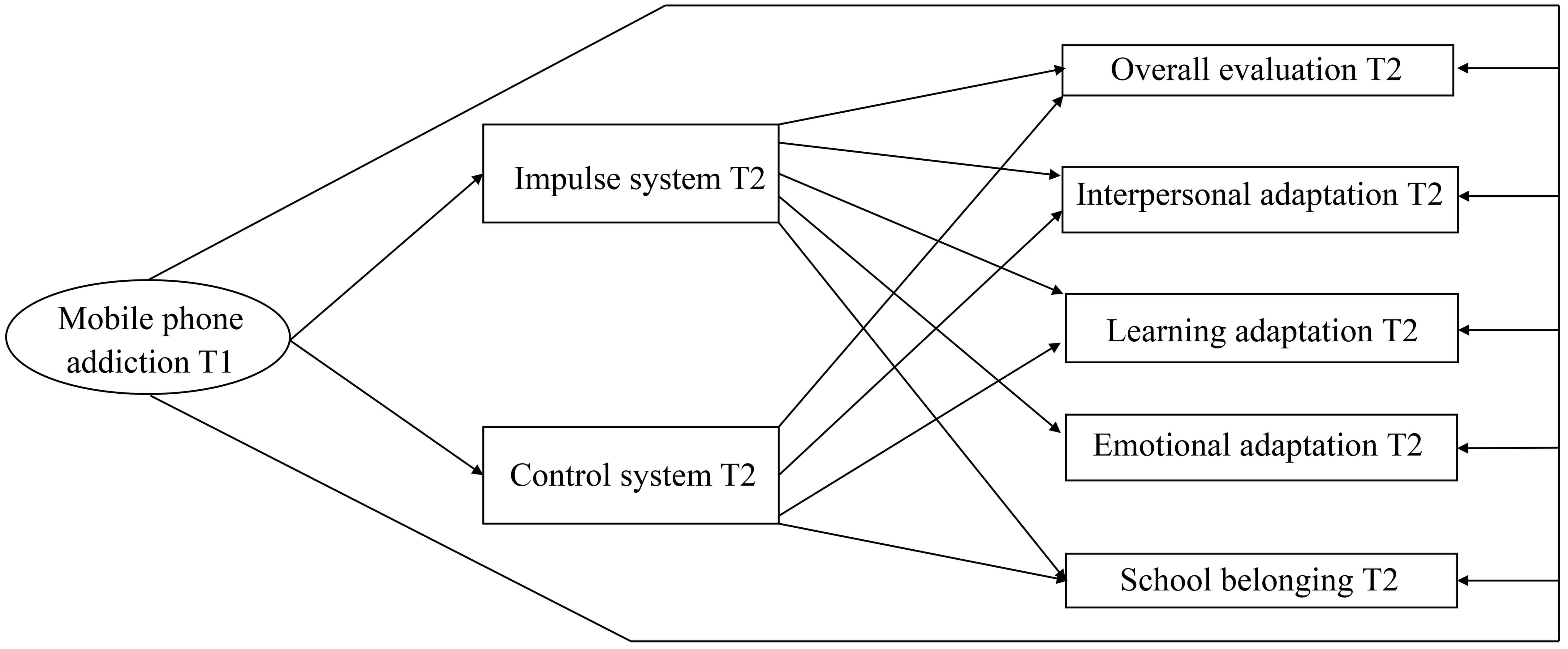
In sum, grounded in media dependency theory and the dual systems framework of self-control (Ball-Rokeach and DeFleur, 1976; Hofmann et al., 2009), this current research employed a two-wave longitudinal design to construct and test a hypothesized model (see Fig. 1). This model aimed to elucidate the longitudinal impact of MPA on school adjustment, the mediating role of self-control systems, and potential gender differences in these pathways. Accordingly, we proposed the following hypotheses:
Hypothesis 1: MPA will be negatively associated with the five dimensions of school adjustment.
Hypothesis 2: The impulse system will mediate the relationship between MPA and the five dimensions of school adjustment.
Hypothesis 3: The control system will mediate the relationship between MPA and the five dimensions of school adjustment.
Hypothesis 4: The direct and indirect effects of MPA on the five dimensions of school adjustment will differ by gender.
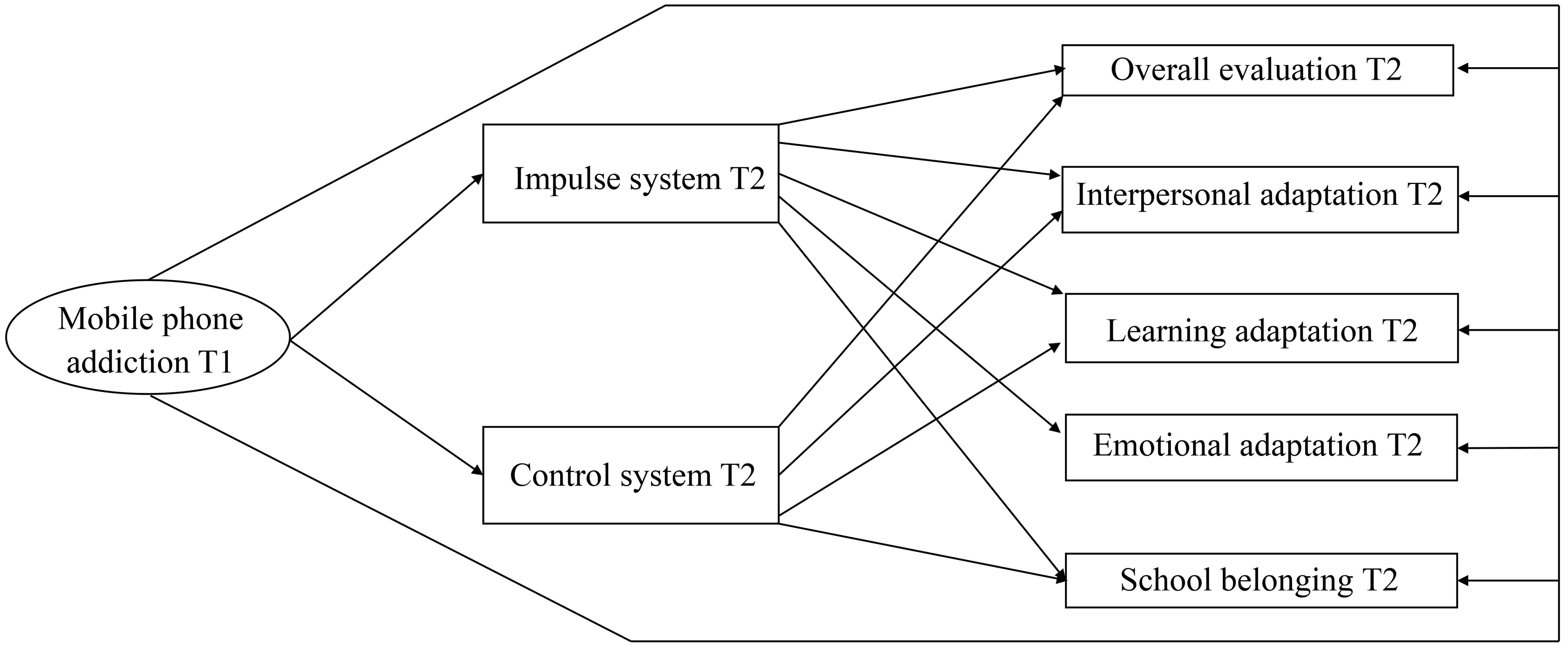 Fig. 1.
The proposed model.
Participants were recruited using a convenience sampling method from a publicly funded university in China. Inclusion criteria were full-time enrollment in the first year of university and regular mobile phone use, while students with diagnosed severe psychiatric disorders or cognitive impairments were excluded. Data were collected at two time points during the 2023–2024 academic year: baseline (Wave 1, October 2023) and follow-up (Wave 2, February 2024), with an interval of approximately four months between waves. At Wave 1, a total of 502 college students completed an online survey assessing MPA and demographic information. Among them, 259 (51.6%) were male and 243 (48.4%) were female, with a mean age of 18.78 years (SD = 1.11). Participants reported an average daily mobile phone use time of 8.65 hours (SD = 3.27). By Wave 2, due to possible attrition related to absence or academic transfers, 391 valid participants remained and completed questionnaires assessing self-control and school adjustment. This follow-up sample included 215 male students (54.99%), with a mean age of 18.51 years (SD = 1.02). Additional demographic information was collected to enhance sample transparency, including participants’ place of residence (69% from rural areas) and academic major distribution (74% enrolled in technical or vocational programs).
The primary investigator of this study was the school’s mental health teacher, who collected data during students’ extracurricular time using the online survey platform Wenjuanxing. Prior to data collection, participants were provided with detailed instructions, the purpose of the study, and important considerations, including voluntary participation and the right to withdraw at any time. The surveys were administered collectively by class. To ensure confidentiality, all responses were anonymized, and data were securely stored in password-protected files accessible only to the research team. Participants did not receive monetary compensation but were offered feedback on general study findings as an incentive for participation. Both waves of the questionnaire were reviewed and approved by the ethics committee of the Shanghai Normal University (Number: SHNU-IRB-2023026).
The MPA Tendency Scale developed by Xiong et al. (2012) was employed to
measure participants’ tendencies toward MPA. The scale includes 16 items across
four dimensions: withdrawal symptoms, salience behavior, social comfort, and mood
change. Responses are rated on a 5-point Likert scale (1 = completely
inapplicable, 5 = completely applicable), with increasing scores corresponding to
heightened MPA risk. In the current study, the Cronbach’s
The Dual-System of Self-Control Scale revised by Xie et al. (2014) was used
to assess participants’ self-control. The scale contains 21 items and includes
two subscales: the control system and the impulse system. Each item is rated on a
5-point Likert scale (1 = completely inapplicable, 5 = completely applicable).
Higher scores on the control system indicate stronger self-control abilities,
whereas higher scores on the impulse system indicate stronger impulsivity. The
instrument demonstrates good reliability and validity among Chinese college
students (Jiang et al., 2025). In this study, Cronbach’s
The School Adjustment Scale developed by Ouyang (2012) was used to assess
participants’ school adjustment. The scale consists of 36 items and encompasses
five dimensions: interpersonal adaptation, emotional adaptation, academic
adaptation, school belonging, and overall evaluation. Each item is rated on a
5-point Likert scale (1 = completely inapplicable, 5 = completely applicable),
with higher scores indicating better school adjustment. This instrument has been
shown to possess satisfactory reliability and validity in samples of Chinese
university students (Ding and Liao, 2024). In the present study, the
Cronbach’s
Data management and analysis were performed in SPSS (Version 26.0, IBM Corp., Armonk, NY, USA) and Mplus (Version 8.3, Muthén & Muthén, Los Angeles, CA, USA). Normality of all the continuous variables was examined using skewness and kurtosis indices, and the results indicated that all variables approximately followed a normal distribution. We also included control variables in our analyses, such as participants’ gender, academic major, and screen time (Hussain et al., 2015; Algule et al., 2024). As all data in the present study were obtained from self-reports by college students, Harman’s single-factor test was employed to examine potential common method bias. Given the longitudinal design of the study, the test was conducted separately for the two waves of data collection. The results showed that 16 and 15 factors had eigenvalues greater than 1 in Wave 1 and Wave 2, respectively. Both waves showed similar unrotated first factor variances (20.76%, 20.73%), below the 40% cutoff, suggesting minimal common method bias. Missing data were managed utilizing the full information maximum likelihood (FIML) approach (Lim and Cheung, 2022).
As shown in Table 1, MPA measured at T1 showed a significant positive association with the impulse system and significant negative associations with the control system and all dimensions of school adjustment measured at T2. The impulse system was negatively related to both the control system and various school adjustment indicators at T2, while the control system showed consistent positive associations with all facets of school adjustment at T2. Accordingly, Hypothesis 1 was supported.
| 1 | 2 | 3 | 4 | 5 | 6 | 7 | 8 | 9 | |
| 1.MPA T1 | 1 | ||||||||
| 2.Impulse system T2 | 0.42** | 1 | |||||||
| 3.Control system T1 | –0.23** | –0.35** | 1 | ||||||
| 4.Overall evaluation T2 | –0.13** | –0.24** | 0.30** | 1 | |||||
| 5.Interpersonal adaptation T2 | –0.27** | –0.46** | 0.31** | 0.50** | 1 | ||||
| 6.Learning adaptation T2 | –0.31** | –0.35** | 0.36** | 0.56** | 0.46 | 1 | |||
| 7.Emotional adaptation T2 | –0.32** | –0.50** | 0.24** | 0.32** | 0.53** | 0.43** | 1 | ||
| 8.School belonging T2 | –0.25** | –0.41** | 0.29** | 0.70** | 0.65** | 0.51** | 0.56** | 1 | |
| 9.School adjustment T2 | –0.33** | –0.50** | 0.38** | 0.78** | 0.79** | 0.75** | 0.74** | 0.86** | 1 |
| M | 2.34 | 2.26 | 3.54 | 3.50 | 4.05 | 3.32 | 3.33 | 3.81 | 3.60 |
| SD | 0.70 | 0.67 | 0.62 | 0.70 | 0.61 | 0.67 | 0.75 | 0.64 | 0.53 |
Note: MPA, mobile phone addiction; M, mean. ** p
Mediation analysis was conducted using latent variable SEM in Mplus8.3. To
streamline the model structure, item parcels were created based on the
subdimensions of MPA, which were then used as indicators for the corresponding
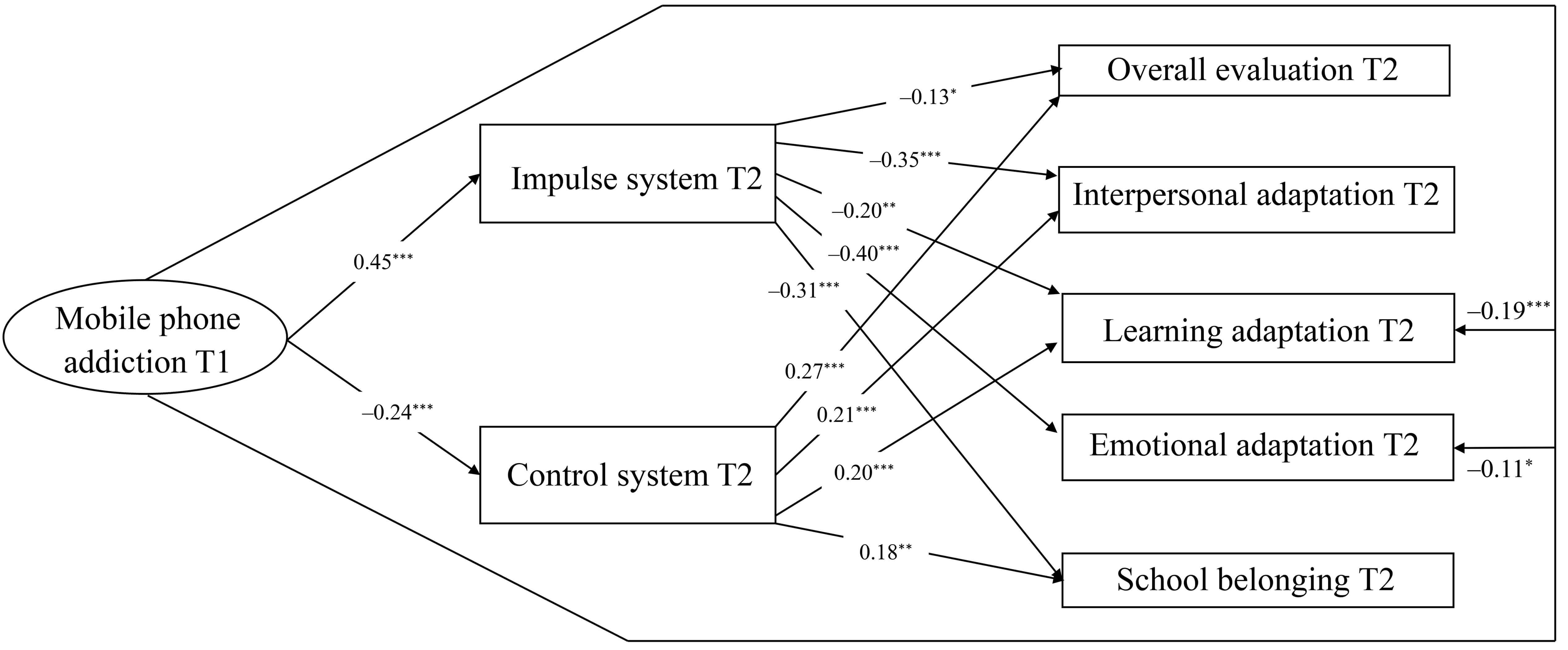
latent variables. As shown in Fig. 2, the model demonstrated acceptable fit to
the data [
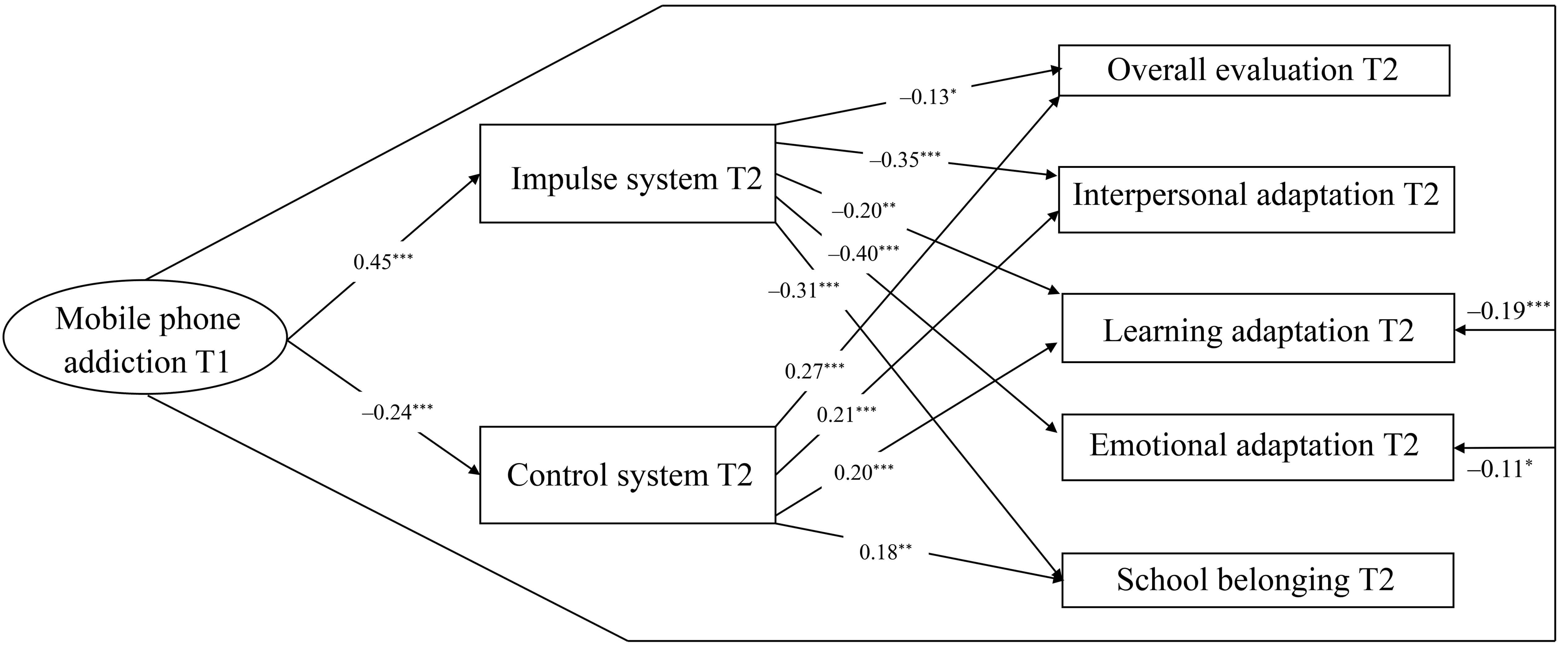 Fig. 2.
Mediation model of the effect of MPA on school adjustment. Note: Non-significant paths were omitted from the figure for clarity. * p
Bootstrap analysis (see Table 2) revealed significant mediation effects, with all 95% CIs for indirect effects not spanning zero. The results demonstrated that both the impulse system and the control system functioned as parallel mediators in the relationship between MPA and school adjustment. For learning adaptation, the total indirect effect was –0.139, accounting for approximately 42% of the total effect. For emotional adaptation, the total indirect effect was –0.204, representing about 65% of the total effect. Thus, Hypotheses 2 and 3 were supported.
| Model path | Effect value | SE | Bootstrap (95% CI) |
| MPA |
–0.058 | 0.027 | [–0.115, –0.010] |
| MPA |
–0.158 | 0.030 | [–0.199, –0.090] |
| MPA |
–0.089 | 0.029 | [–0.147, –0.035] |
| MPA |
–0.177 | 0.034 | [–0.276, –0.125] |
| MPA |
–0.140 | 0.030 | [–0.195, –0.082] |
| MPA |
–0.067 | 0.024 | [–0.127, –0.028] |
| MPA |
–0.052 | 0.018 | [–0.087, –0.019] |
| MPA |
–0.050 | 0.020 | [–0.092, –0.016] |
| MPA |
–0.027 | 0.018 | [–0.075, 0.000] |
| MPA |
–0.045 | 0.021 | [–0.092, –0.012] |
Note: SE, standard error.
Table 3 presents the results of the multi-group mediation analysis. The baseline
model (Model 1) tested for configural invariance across gender. In Model 2,
equality constraints were imposed on the path coefficients across gender groups.
Although the difference between Model 1 and Model 2 was not statistically
significant (
| Model | df | CFI | TLI | RMSEA | SRMR | Model Comparison (M1 VS. M2) | ||||
| Δ |
ΔCFI | ΔTLI | ΔRMSEA | |||||||
| Model 1 | 144.58 | 74 | 0.961 | 0.920 | 0.070 | 0.053 | 26.03 | –0.003 | 0.010 | –0.005 |
| Model 2 | 170.61 | 93 | 0.958 | 0.930 | 0.065 | 0.060 | ||||
Note: Model 1 = Baseline model, Model 2 = path coefficients invariance.
CFI, comparative fit index; TLI, Tucker-Lewis index; RMSEA, root mean square error of approximation; SRMR, standardized root mean square residual; SEM, structural equation modeling; df, degrees of freedom.
In summary, this study offers several noteworthy contributions to the literature on school adjustment. First, it extends the applicability of the media dependency theory (Ball-Rokeach and DeFleur, 1976) and the dual systems framework of self-control (Hofmann et al., 2009) by employing it to interpret the influencing factors of school adjustment. Second, a short-term longitudinal design was utilized to examine the temporal association between MPA and school adjustment. Third, the study identified potential mediating mechanisms and gender-based differences underlying this relationship through multi-group SEM.
Correlation analyses revealed a negative association between MPA and school adjustment, consistent with previous findings (Heo and Lee, 2018; Zhang et al., 2020). This finding lends further empirical support to media dependency theory (Ball-Rokeach and DeFleur, 1976), suggesting that overreliance on mobile devices may undermine students’ adaptation to the university environment. Higher levels of engagement with mobile phone–related activities over time were associated with reduced interpersonal communication (DiDomenico et al., 2020), student engagement (Meng et al., 2025), and academic achievement (Seo et al., 2016), which in turn were linked to poorer school adjustment. Moreover, the SEM results confirmed the mediating roles of impulse and control systems in the link between MPA and school adjustment. Specifically, MPA was not only directly associated with lower levels of on first-year university students’ learning adaptation and emotional adaptation, but also indirectly related to their overall school adjustment through its influence on two core psychological mechanisms: the impulse system and the control system. These findings suggest that individuals exhibiting elevated levels of MPA tend to exhibit poorer academic engagement and emotional regulation (Zhen et al., 2020; Gökçearslan et al., 2023), which may be connected to heightened impulsivity and reduced self-regulatory capacity (Chou et al., 2024). The dual-pathway mechanism highlights the importance of both reactive (impulse-related) and deliberative (control-related) processes in understanding how MPA is linked to students’ ability to adapt to the demands of university life. Clinically, the results suggest that interventions aimed at improving self-regulatory skills and managing impulsive tendencies could mitigate the negative associations of MPA, supporting targeted strategies for promoting student well-being and academic success during the critical transition to university life.
Notably, the direct associations of MPA on students’ overall evaluation of their university experience, interpersonal adaptation, and sense of school belonging were not statistically significant. This suggests that while MPA shows stronger links with intrapersonal domains of adjustment (such as learning and emotion), its relations with social integration and global institutional appraisal appear more nuanced and may be explained by other intervening factors. For instance, students may still maintain positive peer relationships or institutional identification despite experiencing internal struggles that are associated with excessive mobile phone use (Chen et al., 2023). Alternatively, the buffering effects of social support or institutional resources may mitigate the negative consequences of MPA in these domains (Yang et al., 2023; Zhou et al., 2021). This result aligns with the strength model of self-control (Baumeister et al., 2007), which posits that self-control relies on a limited pool of cognitive and psychological resources. Mobile phones, often used for information seeking, impression management, and social interaction, can deplete these resources in various ways (Gao et al., 2021), ultimately impairing students’ capacity for self-regulation and adaptation (Chou et al., 2024). Importantly, multi-group analyses indicated that these relationships were invariant across gender, suggesting the generalizability of the proposed mechanisms for both male and female students.
Our findings carry important practical implications for early intervention efforts targeting first-year undergraduates. Specifically, programs that promote healthy digital habits and enhance self-regulatory capacities may help mitigate the negative impact of MPA on school adjustment (Bakker et al., 2016). Universities should increase focus on orientation programs. They need to offer targeted guidance to freshmen. This support should cover academic adjustment. It should also address interpersonal relationships (Song and Hu, 2024). These efforts will help ease their transition into university life. In addition, preventive measures are necessary. These can include cognitive therapy. Behavioral interventions are also recommended. Such steps should be taken to lower the risk of MPA among first-year students. They would also reduce its negative impacts (Zhang et al., 2023). At the policy level, educational authorities are encouraged to incorporate digital literacy and responsible use of digital tools (including smartphones and computers) into the formal curriculum. Doing so can raise students’ awareness. They will better understand the potential risks of MPA. This can also encourage proactive prevention. Furthermore, university counseling centers should provide systematic psychological assessments. They should also offer tailored support services. These steps can ensure that students showing MPA symptoms receive timely help. Such help should also be effective (Lui et al., 2017; Lan et al., 2018). To address growing concerns about MPA and declining school adjustment, institutions can also promote activities aimed at strengthening self-control, such as physical exercise and mindfulness-oriented treatments (Ye et al., 2025; Zhang et al., 2025). These approaches have the potential to reduce the risk of MPA while enhancing students’ self-regulation and overall adjustment to university life.
Although the present study adopted a longitudinal design that partially overcomes the limitations of prior cross‑sectional work, it employed only two waves of data over a relatively short interval. Future research should collect data at multiple time points. This data collection should span a longer period. Doing so will better capture the stability of the key constructs. It will also more accurately track their developmental trajectories. Moreover, our current analysis focused on one direction. It examined how MPA predicts school adjustment. It did not test the reverse pathway. Using a cross-lagged panel design would be beneficial. This approach would allow examination of their reciprocal influences. Potential moderators, such as psychological capital, were not examined; incorporating these variables could provide deeper insight into conditions under which MPA is more strongly linked to adjustment outcomes. Convenience sampling may limit the external validity of the findings; therefore, future studies should recruit students from different year levels and more diverse educational contexts to improve generalizability. Furthermore, while the current analyses focused on mediation mechanisms, future research could adopt more advanced modeling approaches, such as latent transition analysis, to explore dynamic changes in school adjustment profiles over time. Finally, all variables were measured via self‑report, raising concerns about social‑desirability bias. Integrating objective behavioral indicators (e.g., smartphone-usage logs), multi-level data (e.g., class-level, school-level) and informant reports (e.g., teacher ratings) would provide a more comprehensive assessment and strengthen the robustness of future findings.
This study advances the understanding of university students’ school adjustment. It provides empirical evidence on the harmful effects of MPA. The research also clarifies the underlying psychological mechanisms. Using media dependency theory and the dual-systems model of self-control, the findings emphasize MPA’s negative role. It disrupts students’ learning adaptation. It also hinders their emotional adaptation during the transition to university. Specifically, the impulse system was identified as a key mediator. The control system also serves as a mediator. Together, they show the dual-pathway through which MPA impairs self-regulation. This ultimately hampers school adjustment. While MPA showed weaker associations with interpersonal adaptation and institutional appraisal, these domains may be influenced by more complex or moderated factors, such as social support and engagement with university resources. The relationships identified were consistent across gender, suggesting the robustness and generalizability of the proposed mechanisms.
Our findings have practical implications, suggesting the value of interventions aimed at promoting healthier digital behaviors and enhancing self-regulatory skills among first-year undergraduates. Universities may consider integrating digital literacy programs, structured orientation activities, and psychological support services to support smoother student adjustment. Collectively, this study contributes to both theoretical and practical understandings of the mechanisms linking MPA and school adjustment, offering guidance for evidence-informed strategies to support student well-being in higher education.
The data will be available from the corresponding author upon request.
Conceptualization: KL, BH, and JY; Methodology & investigation: BH and JY; Formal analysis: BH and JY; Writing—original draft preparation: KL; Writing—review & editing: KL, BH, and JY; Supervision: BH. All authors contributed to critical revision of the manuscript for important intellectual content. All authors read and approved the final manuscript. All authors have participated sufficiently in the work and agreed to be accountable for all aspects of the work.
The study was conducted in accordance with the Declaration of Helsinki. The research protocol was approved by the Ethics Committee of Shanghai Normal University (Ethic Approval Number: SHNU-IRB-2023026), and all of the participants provided signed informed consent.
We gratefully acknowledge all investigators and participants for their essential collaboration.
This research received no external funding.
The authors declare no conflict of interest.
During the preparation of this work, the authors used ChatGPT-4.0 in order to assist with translation, grammar checking, and spelling correction. After using this tool, the authors reviewed and edited the content as needed and take full responsibility for the content of the publication.
References
Publisher’s Note: IMR Press stays neutral with regard to jurisdictional claims in published maps and institutional affiliations.