

 , Chi-Fa Hung 2,3,4,†, Kuan-Lin Lee 5,6,7, Anna M. Zalewska 8, Barbara Ostafińska-Molik 9, Bartosz Grabski 1, Magdalena Ludwik 1, Chung-Ying Lin 10,11,12,13,*
 , Cheng-Fang Yen 6,7,*
1 Interdisciplinary Center for Social Activity and Well-being Research, Faculty of Psychology in Katowice, SWPS University, 40326 Katowice, Poland
2 Department of Psychiatry, Kaohsiung Chang Gung Memorial Hospital and Chang Gung University College of Medicine, 833253 Kaohsiung, Taiwan
3 School of Medicine, College of Medicine, National Sun Yat-Sen University, 804201 Kaohsiung, Taiwan
4 Department of Social Work, National Pingtung University of Science and Technology, 912301 Pingtung, Taiwan
5 Department of Psychiatry, Kaohsiung Municipal Siaogang Hospital, Kaohsiung Medical University, 81249 Kaohsiung, Taiwan
6 Department of Psychiatry, Kaohsiung Medical University Hospital, 80756 Kaohsiung, Taiwan
7 Department of Psychiatry, School of Medicine, College of Medicine, Kaohsiung Medical University, 80708 Kaohsiung, Taiwan
8 Institute of Psychology, Faculty of Psychology in Warsaw, SWPS University, 03815 Warszawa, Poland
9 Laboratory of Pedagogical Diagnoses, and Laboratory of Health Pedagogy, Institute of Education, Jagiellonian University, 31007 Cracow, Poland
10 Institute of Allied Health Sciences, College of Medicine, National Cheng Kung University, 701401 Tainan, Taiwan
11 Biostatistics Consulting Center, National Cheng Kung University Hospital, College of Medicine, National Cheng Kung University, 701401 Tainan, Taiwan
12 Department of Public Health, College of Medicine, National Cheng Kung University, 701401 Tainan, Taiwan
13 Department of Occupational Therapy, College of Medicine, National Cheng Kung University, 701401 Tainan, Taiwan
†These authors contributed equally.
Abstract
Citizenship behaviors are crucial in fostering social progress. This study examined the psychometric properties of the Chinese version of the Citizenship Behavior Questionnaire-30-General Version (CBQ-30-GV) among Taiwanese university students. It also examined the association of citizenship behaviors with depression and perceived stress.
A total of 1000 university students participated in an online survey. To evaluate the factor structure of the CBQ-30-GV, five competing models were examined using confirmatory factor analysis (CFA). Furthermore, internal consistency was assessed, and concurrent validity was examined by analyzing the correlations between CBQ-30-GV scores and subjective well-being, as measured using the Positive Emotion, Engagement, Relationships, Meaning, and Accomplishment Well-being (PERMA)-Profiler. Moreover, the correlations of citizenship behaviors with depression (measured using the Center for Epidemiological Studies Depression Scale) and perceived stress (measured using the Perceived Stress Scale) were investigated using Pearson correlations.
The findings supported a bifactor structure for the CBQ-30-GV, comprising seven specific factors and a general factor, with satisfactory model fit. The CBQ-30-GV demonstrated adequate internal consistency, and all seven specific and general factor scores were significantly and positively correlated with PERMA-Profiler scores (r = 0.080 to 0.490; p < 0.001). The general factor and the majority of specific factor scores of the CBQ-30-GV were significantly and negatively associated with depression (r = –0.426 to –0.135; p < 0.001) and perceived stress (r = –0.346 to –0.165; p < 0.001), whereas the factor scores for political activity and activity for change exhibited either positive or nonsignificant associations with depression and perceived stress.
These findings confirm the bifactor structure of the CBQ-30-GV and its acceptable internal reliability and concurrent validity. They indicate that most of the CBQ-30-GV specific factor scores negatively correlated with depression and perceived stress.
Keywords
- citizenship
- depression
- perceived stress
- university students
Citizenship behaviors yield considerable benefits for both society and individuals. Specifically, such behaviors help individuals expand their social networks and gain social knowledge (Lewicka, 2005). They also promote public participation in democratic activities (Kennedy, 2006; Kennedy, 2018) and enhance overall societal well-being (Wojciszke, 2015). Citizenship behaviors are positively associated with satisfaction with quality of life (Zalewska and Nosek, 2020) and subjective well-being (Lewicka, 2005; Wojciszke, 2015). In terms of mental health, these behaviors play a crucial role in fostering community mental health by combating stigma, supporting the social inclusion and active participation of individuals with mental illnesses, and addressing social inequalities (e.g., racism) that contribute to or exacerbate mental illnesses (Paradies et al., 2015; Ponce and Rowe, 2018). In summary, citizenship behaviors extend beyond their role in promoting social progress by exerting positive effects on individuals’ mental health.
Traditionally, national identity and patriotism were regarded as the core components of citizenship behaviors. Based on their model, Zalewska and Krzywosz-Rynkiewicz (2011) developed Citizenship Behavior Questionnaire for children and youth. Zalewska and Nosek (2020) modified this tool into the Citizenship Behavior Questionnaire-30–General Version (CBQ-30-GV) for measuring seven types of citizenship behaviors within three forms of citizenship, including passive, semiactive and active, in people of different ages. Passive citizenship behaviors include expressions of national identity, such as a sense of belonging to the state and an acceptance of its historical values, and patriotism, which reflects national pride (Kennedy, 2018; Parker, 2009; Zalewska and Krzywosz-Rynkiewicz, 2011). By contrast, active citizenship behaviors involve personal activity (e.g., engaging in self-development, fostering independence, and cultivating creativity), political activity (e.g., joining a political party, representing a local government, and supporting a political party), activity for change (e.g., advocating for government accountability or systemic reform), and social activity (e.g., participating in charitable campaigns and voluntary initiatives for environmental or social causes; Zalewska and Krzywosz-Rynkiewicz, 2011). Semiactive citizenship behaviors include voting (e.g., engaging in community affairs and seeking information to make informed decisions) and loyalty (e.g., adhering to laws and regulations and demonstrating integrity in daily life; Zalewska and Krzywosz-Rynkiewicz, 2011).
Zalewska and Nosek (2020) proposed a third-order factor structure for the CBQ-30-GV, comprising a general factor, a passive–semiactive–active behavior factor, and seven specific factors. However, the adequacy of this third-order factor structure has not been empirically tested. Further, multiple studies have demonstrated a positive association between citizenship behaviors and subjective well-being (Lewicka, 2005; Wojciszke, 2015; Zalewska and Zawadzka, 2016). A study on Polish young adults reported that all dimensions of citizenship behaviors, as measured using the CBQ-30-GV, were positively correlated with subjective well-being (Zalewska and Nosek, 2020), whereas political activity and activity for change were not significantly associated with subjective well-being among Polish adolescents (Zalewska and Zawadzka, 2016). A systematic review including 53 published studies found varying associations between type of civic engagement and well-being in young adults; most of studies confirmed that civic engagement enhances well-being (Fenn et al., 2024).
As university students transition from adolescence to early adulthood, they encounter multiple pressures, including the demands of independent living and societal expectations, which may increase the risk of depression (Chou et al., 2018). However, studies examining the relationship of citizenship behaviors with depression and perceived stress have shown less consistent results. A review for 10 studies suggested that civic engagement programs improve mental health outcomes, including reduced anxiety, reduced sadness, and increased resilience in adolescents or young adults; these programs foster empowerment, sense of belonging, and social connections, while also enhancing interpersonal skills and career aspirations (Oubiña López and Gómez Baya, 2025). Longitudinal studies in Hong Kong and mainland China have found that civic engagement was sequentially associated with better psychological and social well-being, but not emotional well-being in young adults (Chan and Mak, 2020). A study in Canada did not find the prediction of civic engagement, composed of social engagement, social conscience, and civic action, for the optimal trajectory of mental health (Wiium et al., 2023). Citizenship behaviors demonstrate a heterogeneous relationship to depression and perceived stress. Future research should examine the associations of various dimensions of citizenship behaviors with depression and perceived stress in young adults.
Citizenship engagement is essential for improving social conditions for young adults (Swartz et al., 2009). Taiwan currently faces various societal challenges, including a potential military conflict with China (Lin and Yen, 2024; Yen and Hsiao, 2024a; Yen et al., 2024b; Yen et al., 2024c) and increasing housing prices (Chen et al., 2024). Therefore, increased civic engagement among young people is urgently required to contribute to social progress. However, further research is required to determine whether various dimensions of citizenship behaviors have distinct relationships with depression and perceived stress among university students in Taiwan.
This cross-sectional online survey study had two primary objectives. First, this study evaluated the psychometric properties of the Chinese version of the CBQ-30-GV among Taiwanese university students. In addition to assessing the fit of multiple factor structure models and internal consistency, the study investigated the concurrent validity of the CBQ-30-GV by analyzing the association between citizenship behaviors and well-being, as proposed by Zalewska and Nosek (2020). Second, the study explored the relationships between multidimensional citizenship behaviors, as measured by the CBQ-30-GV, and both depression and perceived stress. We hypothesized that all CBQ-30-GV factor scores would be negatively correlated with depression and perceived stress among university students.
We recruited 1000 Taiwanese university students aged 18–25 years through online advertisements posted on Dcard. Dcard has accumulated over 10 million users and is the most widely used social media platform among students in Taiwan. Participant recruitment was conducted between January and February 2025. The advertisement provided detailed information regarding the study’s objectives, instructions for completing the online questionnaire, and assurances regarding data confidentiality and participant privacy. Interested individuals could access the questionnaire by clicking on the “Agree to Participate” button, after which they proceeded to provide their responses. Those who did not wish to participate could either opt out by selecting the “Not Willing to Participate” button or simply disregard the advertisement. In total, 16 individuals clicked the “Not Willing to Participate” button, and 1000 individuals clicked on the “Agree to Participate” button and completed the online survey questionnaire. Among the 1000 participants (mean standard deviation [SD] age = 20.77 [1.68] years), 433 were males and 567 were females. The distribution regarding their year of study in university was relatively balanced from year 1 to year 4 (respectively: 187, 232, 270 and 264) and only a small proportion were in year 5 or above (n = 47). Most of the participants were single (73.8%). Nearly half (44.7%) of the participants are unemployed; 49.0% had part-time jobs; and 6.3% had full-time jobs. Most (72.5%) of participants reported a moderate economic status; 9.8% had a poor or very poor economic status; and 17.8% had a good or very good economic status. Only 4.1% of participants had any chronic physical disease, and 7.4% had any mental disorders. The study protocol was approved by the Institutional Review Board of Kaohsiung Medical University Hospital (KMUHIRB-E(I)-20240394). Moreover, the data of the 1000 participants in the present study have been used in another study (Hung et al., 2025) to evaluate if a bifactor model of CBQ-30-GV is measurement invariant across Taiwanese and Polish. However, Hung et al. (2025) did not compare different factor structures of CBQ-30-GV to identify the best model for CBQ-30-GV among Taiwanese. Therefore, the present study’s findings will add to the literature regarding verified factor structure for CBQ-30-GV among the Taiwanese population.
Citizenship behaviors were evaluated using the self-reported Chinese version of the CBQ-30-GV (Supplementary Material), which was translated from its original English version (Zalewska and Nosek, 2020). The translation was conducted through a standardized forward–backward translation process (Sousa and Rojjanasrirat, 2011). The translated Chinese version of the CBQ-30-GV underwent validation by three experts. The CBQ-30-GV consists of 30 items, each item is rated on a Likert-type four-point scale from 1 (definitely not) to 4 (definitely yes). The CBQ-30-GV has an acceptable model fit for a seven-factor structure, satisfactory internal consistency, and acceptable concurrent validity (Zalewska and Nosek, 2020).
Well-being was evaluated using the self-reported Chinese version of the 15-item
Positive Emotion, Engagement, Relationships, Meaning, and Accomplishment
Well-being (PERMA)-Profiler (Nie et al., 2024), which was employed to evaluate
the concurrent validity of the CBQ-30-GV. The PERMA-Profiler (Butler and Kern, 2016) measures five key dimensions of well-being: positive emotion, engagement,
relationships, meaning, and accomplishment. Each item is rated on an 11-point
scale, with higher total scores indicating greater subjective psychological
well-being. Both the original and Chinese versions of the PERMA-Profiler have an
acceptable model fit; internal and cross-time consistency; and evidence for
content, convergent, and divergent validity (Butler and Kern, 2016; Nie et al., 2024). In the present study, the Cronbach’s
Depressive symptoms over the preceding week were evaluated using the 20-item
Chinese version of the Center for Epidemiological Studies Depression Scale
(CES-D; Chien and Cheng, 1985; Radloff, 1977). Each item is rated on a
4-point scale with endpoints ranging from 0 (rarely or none of the time)
to 3 (most or all of the time), with higher total scores indicating
greater severity of depressive symptoms. The Chinese version of the CES-D has
acceptable reliability and validity (Cheng et al., 2012; Chien and Cheng, 1985). In the present study, the Cronbach’s
Perceived stress over the preceding month was evaluated using the 10-item
Perceived Stress Scale (PSS-10; Cohen et al., 1983). Each item is rated on a
5-point scale with endpoints ranging from 0 (never) to 4 (very
often). With the scores of the four items reversed, higher total scores indicate
greater perceived stress. The Chinese version of the PSS-10 has acceptable
reliability and validity (Huang et al., 2020). In the present study, the
Cronbach’s
Descriptive statistics were used to summarize the participants’ characteristics and item-level responses on the CBQ-30-GV. To determine the most appropriate factor structure for the CBQ-30-GV, five competing models were constructed and evaluated. A confirmatory factor analysis (CFA) was conducted for each model by using a diagonally weighted least squares estimator, which is particularly suited for analyzing Likert-type scale data (Li, 2016).
Among the five competing models, in M0, all 30 items were embedded within a
single general factor. M1 had a first-order structure comprising seven specific
factors, with item allocations as follows: national identity, patriotism,
semiactive factor, personal activity, political activity, social activity, and
activity for change. M2 had a second-order factor structure based on M1, with
national identity and patriotism grouped under the passive dimension and personal
activity, political activity, social activity, and activity for change embedded
within the active dimension. M3 had a bifactor structure based on M1, with all
items also loaded onto the general factor. M4 exhibited a third-order factor
structure based on M2, with passive, semiactive, and active factors embedded
within the general factor. Notably, M4 was equivalent to M2. These competing
models were compared using the following fit indices: comparative fit index
(CFI), Tucker-Lewis index (TLI), root mean square error of approximation
(RMSEA), standardized root mean square residual (SRMR), and expected
cross-validation index (ECVI). A model is deemed acceptable if it meets the
following criteria: CFI and TLI
After the confirmation of the CBQ-30-GV factor structure, the internal
consistency of both the seven specific factors and the overall general factor was
evaluated using McDonald’s reliability coefficient (
Table 1 shows the fit index results of competing models. The results indicated
that the one-general-factor model (M0) failed to converge and that both the
second-order model (M2) and third-order model (M4) demonstrated poor fit indices
(CFI = 0.889, TLI = 0.878, RMSEA = 0.102, and SRMR = 0.112 for M2; FI = 0.889,
TLI = 0.878, RMSEA = 0.102, and SRMR = 0.112 for M4) and were statistically
equivalent. In addition, the seven-specific-factor model (M1) exhibited a
satisfactory model fit (CFI = 0.950, TLI = 0.943, RMSEA = 0.069, and SRMR =
0.075). However, the bifactor model (M3) exhibited the most favorable fit (CFI =
0.987, TLI = 0.984, RMSEA = 0.037, and SRMR = 0.048). Model comparison using the
ECVI indicated that M3 had the lowest ECVI value (1.056), supporting its
superiority over the three converged models, whose ECVI values ranged from 2.396
to 4.631 (Table 1). The M3 was then used in multigroup CFA to evaluate its
measurement invariance. The findings showed that the configural model had
acceptable CFI (0.903) and RMSEA (0.072) across gender; and acceptable CFI
(0.901) and RMSEA (0.073) across grade. Moreover, both
| M0 | M1 | M2 | M3 | M4 | |
| – | 2231.345 | 4488.139 | 833.079 | 4488.139 | |
| df | – | 384 | 396 | 354 | 396 |
| – | 5.81 | 11.33 | 2.35 | 11.33 | |
| CFI | – | 0.950 | 0.889 | 0.987 | 0.889 |
| TLI | – | 0.943 | 0.878 | 0.984 | 0.878 |
| RMSEA | – | 0.069 | 0.102 | 0.037 | 0.102 |
| 90% CI RMSEA | – | 0.067, 0.072 | 0.099, 0.104 | 0.034, 0.040 | 0.099, 0.104 |
| SRMR | – | 0.075 | 0.112 | 0.048 | 0.112 |
| ECVI | – | 2.396 | 4.631 | 1.056 | 4.631 |
Note. M0 = all 30 items loaded on a General factor; did not converge.
M1 = A seven-specific-factor structure.
M2 = A second-order factor structure based on M1 with National Identity and Patriotism embedded in Passive; Personal Activity, Political Activity, Social Activity, and Activity for change embedded in Active.
M3 = A bifactor structure based on M1 with all items also loaded on General factor.
M4 = A third-order factor structure based on M2 with Passive, Semiactive, and Active embedded in the General score; it is an equivalent model to M2.
CFI, comparative fit index; TLI, Tucker-Lewis index; RMSEA, root mean square error of approximation; CI, confidence interval; SRMR, standardized root mean square residual; ECVI, expected cross-validation index.
Table 2 presents item properties, including means, standard deviations,
skewness, kurtosis, and factor loadings. Specifically, the distribution of item
scores was relatively normal, with skewness values ranging between –2.032 and
0.901 and kurtosis values ranging between –1.250 and 3.976. Among the seven
factors, items associated with the political activity factor had the lowest mean
scores (1.781–1.894), whereas items associated with the national identity
(3.243–3.609), semiactive (3.030–3.680), and personal activity (3.059–3.536)
factors had the highest mean scores. In M1, all items demonstrated adequate
factor loadings (
| Factor | Means (SD) | Skew/Kur | Loading | |||
| M1 | M3 | |||||
| Item | Specific factor | Specific factor | General factor | |||
| nat | ||||||
| Item 1 | 3.609 (0.650) | –1.636/2.223 | 0.539 | 0.148 | 0.713 | |
| Item 2 | 3.267 (0.768) | –0.841/0.233 | 0.779 | 0.689 | 0.382 | |
| Item 3 | 3.315 (0.783) | –0.943/0.257 | 0.783 | 0.670 | 0.407 | |
| Item 4 | 3.243 (0.789) | –0.777/–0.049 | 0.762 | 0.744 | 0.308 | |
| pat | ||||||
| Item 5 | 2.588 (1.060) | –0.115/–1.207 | 0.827 | 0.800 | 0.222 | |
| Item 6 | 2.717 (1.026) | –0.283/–1.055 | 0.890 | 0.882 | 0.205 | |
| Item 7 | 2.751 (1.027) | –0.333/–1.028 | 0.900 | 0.828 | 0.319 | |
| sem | ||||||
| Item 8 | 3.030 (0.918) | –0.683/–0.366 | 0.664 | 0.157 | 0.486 | |
| Item 9 | 3.680 (0.615) | –2.032/3.976 | 0.465 | 0.417 | 0.512 | |
| Item 10 | 3.580 (0.662) | –1.573/2.177 | 0.420 | 0.166 | 0.441 | |
| Item 16 | 3.272 (0.712) | –0.682/0.070 | 0.553 | 0.325 | 0.440 | |
| per | ||||||
| Item 11 | 3.343 (0.769) | –1.044/0.623 | 0.776 | 0.679 | 0.379 | |
| Item 12 | 3.219 (0.768) | –0.861/0.541 | 0.696 | 0.546 | 0.420 | |
| Item 13 | 3.451 (0.637) | –0.922/0.639 | 0.779 | 0.708 | 0.355 | |
| Item 14 | 3.536 (0.664) | –1.426/1.954 | 0.633 | 0.418 | 0.512 | |
| Item 15 | 3.059 (0.979) | –0.676/–0.669 | 0.607 | 0.324 | 0.618 | |
| pol | ||||||
| Item 17 | 1.894 (1.076) | 0.753/–0.883 | 0.780 | 0.698 | –0.350 | |
| Item 18 | 1.781 (1.000) | 0.901/–0.548 | 0.874 | 0.764 | –0.449 | |
| Item 19 | 1.872 (0.971) | 0.712/–0.713 | 0.910 | 0.834 | –0.346 | |
| Soc | ||||||
| Item 20 | 2.335 (1.059) | 0.095/–1.250 | 0.623 | 0.620 | –0.063 | |
| Item 21 | 2.098 (0.968) | 0.433/–0.856 | 0.677 | 0.675 | –0.233 | |
| Item 22 | 2.188 (0.953) | 0.265/–0.939 | 0.772 | 0.771 | 0.013 | |
| Item 23 | 2.103 (1.017) | 0.446/–0.979 | 0.749 | 0.747 | –0.030 | |
| Item 24 | 2.125 (0.998) | 0.395/–0.975 | 0.803 | 0.798 | –0.103 | |
| Item 25 | 2.272 (1.014) | 0.249/–1.059 | 0.738 | 0.738 | –0.009 | |
| Item 26 | 2.409 (1.040) | 0.005/–1.194 | 0.705 | 0.703 | –0.039 | |
| act | ||||||
| Item 27 | 1.923 (0.987) | 0.724/–0.621 | 0.893 | 0.857 | –0.196 | |
| Item 28 | 1.883 (0.990) | 0.794/–0.544 | 0.807 | 0.764 | –0.281 | |
| Item 29 | 1.934 (0.957) | 0.667/–0.628 | 0.864 | 0.814 | –0.332 | |
| Item 30 | 1.997 (1.002) | 0.586/–0.837 | 0.847 | 0.806 | –0.258 | |
Note. nat, national identity; pat, patriotism; sem, semiactive; per, personal activity; pol, political activity; soc, social activity; act, activity for change; Skew, skewness; Kur, kurtosis.
M1 = A seven-factor structure.
M3 = A bifactor structure based on M1 with all items also loaded on General factor.
In Table 3 descriptive statistics (Means and SD) are reported for all
investigated variables—for all specific dimensions and general score of
citizenship behaviors, as well as for wellbeing (PERMA-profiler), depression
(CES-D) and stress (PSS-10). Table 4 and Fig. 1 show the results of examining
concurrent validity and internal consistency. All seven specific factors in the
CBQ-30-GV demonstrated acceptable internal consistency, with McDonald’s
| Mean | SD | |
| National identity | 13.434 | 2.394 |
| Patriotism | 8.056 | 2.852 |
| Semiactive behavior | 13.349 | 2.206 |
| Personal activity | 16.821 | 2.745 |
| Social activity | 15.530 | 5.410 |
| Activity for change | 7.737 | 3.511 |
| Political activity | 5.555 | 2.758 |
| General score | 80.474 | 14.325 |
| Wellbeing on the PERMA-Profiler | 111.351 | 21.850 |
| Depression on the CES-D | 14.302 | 9.463 |
| Perceived stress on the PSS-10 | 15.300 | 6.217 |
CES-D, Center for Epidemiologic Studies Depression Scale; PERMA, Positive Emotion, Engagement, Relationships, Meaning, and Accomplishment Well-being; PSS-10, Perceived Stress Scale-10.
| nat | pat | sem | per | pol | soc | act | Pas | Act | G | PERMA | |
| nat | (0.830 [0.010]) | ||||||||||
| pat | 0.473*** | (0.905 [0.007]) | |||||||||
| sem | 0.502*** | 0.486*** | (0.740 [0.029]) | ||||||||
| per | 0.371*** | 0.222*** | 0.530*** | (0.833 [0.011]) | |||||||
| pol | –0.069* | 0.045# | –0.106*** | 0.073*** | (0.890 [0.009]) | ||||||
| soc | 0.193*** | 0.310*** | 0.209*** | 0.288*** | 0.647*** | (0.884 [0.005]) | |||||
| act | 0.093** | 0.295*** | 0.091** | 0.087** | 0.603*** | 0.732*** | (0.914 [0.005]) | ||||
| Pas | 0.830*** | 0.884*** | 0.574*** | 0.337*** | –0.008# | 0.299*** | 0.236*** | (0.904 [0.008]) | |||
| Act | 0.195*** | 0.306*** | 0.232*** | 0.427*** | 0.761*** | 0.937*** | 0.832*** | 0.297*** | (0.864 [0.007]) | ||
| G | 0.492*** | 0.594*** | 0.517*** | 0.524*** | 0.580*** | 0.863*** | 0.743*** | 0.637*** | 0.916*** | (0.924 [0.004]) | |
| PERMA | 0.288*** | 0.157*** | 0.202*** | 0.490*** | 0.080* | 0.223*** | 0.086** | 0.252*** | 0.273*** | 0.325*** | (–) |
#p
Note. Pas, passive; Act, active; G, general score; Internal consistency of
McDonald’s
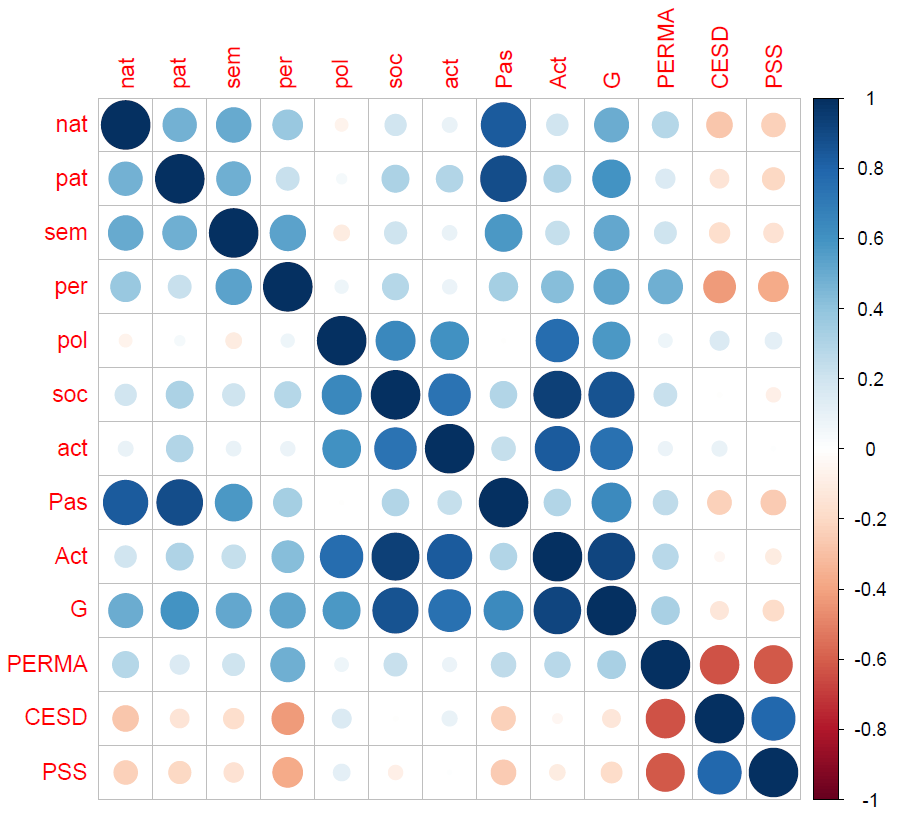 Fig. 1.
Magnitudes of correlations between studied variables.
Table 5 presents the correlation of citizenship behaviors with depression and
perceived stress. All CBQ-30-GV factor scores were significantly and negatively
associated with depression (r = –0.426 to –0.135; p
| Depression | Perceived stress | |
| National identity | –0.275*** | –0.236*** |
| Patriotism | –0.148*** | –0.207*** |
| Semiactive behavior | –0.177*** | –0.346*** |
| Personal activity | –0.426*** | –0.178*** |
| Political activity | 0.152*** | 0.119*** |
| Social activity | –0.009# | –0.087** |
| Activity for change | 0.095** | 0.009# |
| General score | –0.135*** | –0.165*** |
#p
In this study, we discovered that the bifactor structure of the CBQ-30-GV, which comprises seven specific factors and a general factor, exhibited the most favorable and most satisfactory model fit. By contrast, the second-order and third-order factor structures exhibited a poor model fit, thereby not supporting the concept of three higher-order factors (i.e., passive, semiactive, and active). Therefore, each CBQ-30-GV item was identified to contribute to both a specific behavioral dimension and a general citizenship behavior factor. Additionally, the CBQ-30-GV demonstrated adequate internal consistency, with all seven specific and general factor scores exhibiting significant and positive correlations with the PERMA-Profiler scores.
The results of a previous study supported full invariance across gender groups (female vs. male) but not across country groups (Poland vs. Taiwan) (Hung et al., 2025); partial invariance was achieved by relaxing certain item loadings, indicating that Polish and Taiwanese students may interpret some items differently (Hung et al., 2025). The present study further examined the psychometric properties, including the fit of multiple factor structure models, internal consistency and concurrent validity of the CBQ-30-GV among the same Taiwanese young adults in the study of Hung et al. (2025). The present study is the first one to examine multiple psychometric properties of the CBQ-30-GV used for assessing the specific and general dimensions of citizenship behaviors and their associations with depression and perceived stress among Asian people.
Our findings regarding the bifactor structure of the CBQ-30-GV suggest that
citizenship behaviors are inherently complex. Specifically, each citizenship
behavior can be categorized into distinct dimensions, such as feelings of
belonging, national pride, personal activity, political engagement, activity for
change, social relationships, and the continuum between passive and active
participation (Kennedy, 2018; Parker, 2009; Zalewska and Krzywosz-Rynkiewicz, 2011). These distinct citizenship behaviors can be
aggregated into a general citizenship behavior. Therefore, the CBQ-30-GV
represents a valuable tool for policymakers and health-care providers, enabling
them to assess both individuals’ specific dimensions of citizenship behavior and
overall citizenship behaviors. On the other hand, some items (Items 1, 8, and 10)
exhibited low loadings (
Our findings revealed notable variations in participant engagement across different dimensions of citizenship behaviors. Specifically, national identity, semiactive, and personal activity factors received high scores, whereas political activity factors received low scores. National identity refers to an individual’s sense of belonging to a nation and of accepting its historical values (Zalewska and Nosek, 2020). The high scores for the national identity factor observed in this study indicated that the participants demonstrated high levels of national identification and national consciousness. The semiactive factor of the CBQ-30-GV assesses behaviors related to voting and loyalty. Zalewska and Nosek (2020) proposed that voting behavior reflects civic engagement, although it requires less active participation compared with political or social activities. Loyalty refers to everyday behaviors reflecting respect for state institutions, compliance with laws and regulations, and ethical daily conduct (Zalewska and Nosek, 2020). The high scores observed for this factor in this study suggested that the participants exhibited institutional trust and acceptance of social order.
The personal activity factor of the CBQ-30-GV assesses participants’ behaviors related to self-development and learning engagement (Zalewska and Nosek, 2020). The high scores observed in this study indicated that the participants demonstrated strong self-regulation and individualistic values. By contrast, political activity evaluates participants’ intentions of joining a political party, participating in governance, representing a local government, and supporting a political party (Zalewska and Nosek, 2020). The low scores observed for this factor in the present study suggested a lack of interest among the participants in political engagement. Their low political activity and relatively high level of semiactive citizenship may indicate that Taiwanese students—like adolescents in high-HDI (Human Development Index) countries—accept the existing social order and demonstrate a relatively high level of loyalty (respect for state institutions, law, and rules), and do not feel the need to engage in socio-political activities. However, given that youth disengagement from political activities can hinder a nation’s sociopolitical progress, determining the underlying reasons for Taiwanese university students’ low political participation is crucial.
Our findings indicated that both the general citizenship behavior factor and the majority of specific factor scores of the CBQ-30-GV were significantly and negatively associated with depression and perceived stress among university students. However, because of the potential bidirectional nature of the relationship between citizenship behaviors and mental health, causality could not be inferred. Engagement in citizenship behaviors may contribute to building social networks, acquiring societal knowledge, and fostering a sense of self-worth (Lewicka, 2005), which in turn may mitigate loneliness, depression, and perceived stress. Such behaviors may promote democracy and entrepreneurship (Kennedy, 2006; Kennedy, 2018) and enhance societal welfare (Wojciszke, 2015), all of which may enhance individuals’ well-being (Lewicka, 2005; Wojciszke, 2015). Conversely, individuals experiencing depression and high perceived stress may lack the energy or motivation to engage in citizenship behaviors. This complexity necessitates longitudinal studies to investigate the temporal relationships between citizenship behaviors and mental health.
The present study demonstrated that the associations of the political activity and activity for change factor scores with depression and perceived stress were significantly positive or nonsignificant among university students. Similarly, a study on Polish adolescents reported nonsignificant associations between citizenship behaviors within these two domains and subjective well-being (Zalewska and Zawadzka, 2016). These divergent findings may be attributable to the multidimensional nature of citizenship behaviors, as evidenced by our CFA results. Further, sociopolitical uncertainty in Taiwan may have the influences on the associations of the political activity and activity for change factor scores with depression and perceived stress. Taiwan and China are fraught with tension as Taiwan seeks to maintain its autonomy against China’s growing power (Bukhari et al., 2024). A potential collapse of the status quo between Taiwan and China is developing for several reasons such as the weakening power of the United States in the Asia-Pacific Region, the growing capacity of the People’s Liberation Army as well as on Taiwanese sociopolitical factors (Campagnola et al., 2024). Young adults may who engage in political activity and activity for change may face significant pressures and feelings of powerlessness. Despite these findings, the actual reasons underlying why these two factors exhibit different correlations with depression and perceived stress, compared with other factors in the CBQ-30-GV, warrant further investigation.
This study is the first to examine the psychometric properties of the CBQ-30-GV in assessing citizenship behaviors among young adults outside of Poland. However, the present study has several limitations. First, this study recruited participants through online advertisements, primarily through Dcard, a platform widely used by university students in Taiwan but not randomly selected the study sample. Despite the broad reach of Dcard, which has accumulated over 10 million users, its users may not be fully representative of the overall university student population in Taiwan, potentially limiting the generalizability of the findings. Further studies using stratified sampling or multiple recruitment platforms can improve representativeness. On the other hand, university students in Taiwan have a high internet usage rate (over 98%) (Taiwan Network Information Center, 2024), which increases the likelihood that university students encountered study advertisements and be willing to participate in this study. Second, all data were self-reported by the participants, introducing the possibility of single-rater or recall bias, which may have affected the accuracy and reliability of the responses. Further studies employing multi-informant and behavioral measures can reduce single-rater bias. Third, the cross-sectional design of this study precludes any definitive conclusions regarding the temporal relationships of citizenship behaviors with depression and perceived stress. Therefore, longitudinal or experimental studies are required to establish directionality in the observed relationships. Fourth, further studies are needed to investigate contextual moderators (e.g., political engagement climate, civic education exposure).
This study demonstrated that the CBQ-30-GV had a bifactor structure, comprising seven specific factors and a general factor, and exhibited adequate internal consistency and concurrent validity in a sample of university students. These findings support the CBQ-30-GV as a valid and reliable measure for evaluating citizenship behaviors, both specific and general, in this population. Our analysis revealed variations in factor scores across the seven dimensions of the CBQ-30-GV. The majority of CBQ-30-GV factor scores were negatively associated with depression and perceived stress, whereas the factor scores for political activity and activity for change exhibited either positive or nonsignificant associations with depression and perceived stress. Further research into the association of different citizenship behavior dimensions with depression and perceived stress is essential to understand the psychological well-being of young adults.
The datasets generated and analyzed during this study are available from the corresponding authors upon reasonable request.
AEC-C: conceptualization; CFH: writing the manuscript; KLL, BG and ML: conduct the study; AMZ: validation; BO-M: project administration; CYL: statistical analysis; CFY: data curation and Methodology. All authors contributed to editorial changes in the manuscript. All authors read and approved the final manuscript. All authors have participated sufficiently in the work and agreed to be accountable for all aspects of the work.
The study protocol was approved by the Institutional Review Board of Kaohsiung Medical University Hospital (KMUHIRB-E(I)-20240394). All participants provided informed consent to agree to participate in this study. The study was carried out in accordance with the guidelines of the Declaration of Helsinki.
Not applicable.
This study was supported by a grant from Kaohsiung Municipal Siaogang Hospital (Kmhk-113-09).
The authors declare no conflict of interest. Chung-Ying Lin is serving as one of the Editorial Board members of this journal. We declare that Chung-Ying Lin had no involvement in the peer review of this article and has no access to information regarding its peer review. Full responsibility for the editorial process for this article was delegated to Vicente E. Caballo.
Supplementary material associated with this article can be found, in the online version, at https://doi.org/10.31083/BP46509.
References
Publisher’s Note: IMR Press stays neutral with regard to jurisdictional claims in published maps and institutional affiliations.