
 , Zilan Ye 2,†, Xinyi Wu 1, Jianfeng Tan 1,*
1 Department of Psychology, Guangdong Medical University, 523000 Dongguan, Guangdong, China
2 Shenzhen Futian Academy of Educational Sciences, 518000 Shenzhen, Guangdong, China
†These authors contributed equally.
Abstract
Cyberbullying is a pervasive aggressive behavior, and many studies have investigated its mechanisms and influencing factors, such as the dark tetrad and moral disengagement. The present study further investigated the relationships among the dark tetrad (Machiavellianism, narcissism, psychopathy, and sadism), cyberbullying offending, and cybervictimization, with a focus on gender differences.
A total of 566 university students participated in the online survey. A multiple-group structural equation model was used to test the gender differences in the mediating role of moral disengagement in relationships between dark side personality traits and cyberbullying offending and cybervictimization.
The results indicated that gender differences only emerged for narcissism and cybervictimization. More specifically, for males, moral disengagement did not mediate any paths of the dark side personality traits and cyberbullying. For females, moral disengagement mediated the links between (a) Machiavellianism and cyberbullying offending (effect size = 0.064, p = 0.001); (b) sadism and cyberbullying offending (effect size = 0.075, p = 0.001); (c) Machiavellianism and cybervictimization (effect size = 0.030, p = 0.024); (d) sadism and cybervictimization (effect size = 0.035, p = 0.027).
The findings suggest that moral disengagement increases the likelihood that females with dark personality traits engage in cyberbullying, while this association is not observed in males.
Keywords
- dark side personality traits
- cyberbullying offending
- cybervictimization
- moral disengagement
- gender differences
- mediating role
Cyberbullying is defined as the repeated dissemination of hostile or offensive messages through electronic or digital media by individuals or groups against others (Patchin and Hinduja, 2015). Participants of cyberbullying usually include perpetrators (cyberbullying offenders), victims (cybervictimization), bystanders, and individuals who play a dual role (i.e., both a victim and a perpetrator of cyberbullying) (Guo, 2016). With the development of Internet technology, cyberbullying has become a prevalent form of aggressive behavior. This behavior also occurs in emerging adults. For example, previous studies reported that 20%–38.8% of emerging adult participants had experienced at least one form of cybervictimization (e.g., having rumors spread) (Chen and Zhu, 2022; Kowalski et al., 2018). Another study also revealed that university students as emerging adults, are frequently involved in cyberbullying offending and cybervictimization, such as 64.32% of them having suffered from cyberbullying and 25.98% of them engaging in cyberbullying offenses (Huang et al., 2021). Unfortunately, individuals who have experienced cyberbullying often exhibit more psychological problems, such as depression, anxiety, lower self-esteem, psychosocial disorders, and self-harming behaviors (Eyuboglu et al., 2021; Varghese and Pistole, 2017). Cyberbullying experiences have a significant impact on people’s physical and mental health. Consequently, understanding the mechanisms and risk factors associated with cyberbullying behavior is essential to reduce its prevalence and minimize its detrimental effects.
Previous studies have also explored the factors related to cyberbullying behavior from different perspectives, demonstrating that dark side personality traits and moral disengagement significantly influence both cyberbullying offending and cybervictimization (Azami and Taremian, 2021; Giumetti et al., 2022; Sorrentino et al., 2023). Thus, this study aims to further explore the relationship between them.
Previous studies have shown that individuals who report high levels of the dark side personality traits are significantly more likely to perpetrate cyberbullying than individuals with low levels of it (Giumetti et al., 2022; Azami and Taremian, 2021; Gibb and Devereux, 2014). The reason is that current studies defined dark side personality traits as manipulativeness, callousness, and lack of empathy, including Machiavellianism, narcissism, psychopathy, and sadism (Gajda et al., 2023; Paulhus, 2014; Jones and Figueredo, 2013; Paulhus and Williams, 2002). When individuals show characteristics of ruthlessness, low empathy, and low understanding of the pain caused to others, they are more likely to engage in or persist in harmful behaviors such as cyberbullying (Alavi et al., 2023).
More specifically, the main characteristics of Machiavellianism are coldness and manipulation (Christie and Geis, 2013). Individuals with Machiavellianism traits enjoy manipulating and extracting value from others (Paulhus, 2014; Gibb and Devereux, 2014). Individuals with Machiavellianism are more likely to perpetrate cyberbullying as a means to solidify, uphold, or establish their position within the social network (Gibb and Devereux, 2014). Sadism is characterized by gaining pleasure from inflicting cruelty upon others (Paulhus, 2014; Foulkes, 2019). Consequently, individuals with sadistic tendencies are more likely to perpetrate cyberbullying, as they take pleasure in bullying and causing harm to others (Gajda et al., 2023; Brown et al., 2019).
Psychopathy is characterized by high levels of impulsivity and thrill-seeking, coupled with low levels of empathy and anxiety (Paulhus and Williams, 2002). People who score high on psychopathy tend to look for excitement and get immediate pleasure from hurting others (Gibb and Devereux, 2014). The main characteristics of narcissism are grandiosity and insensitivity, followed by impulsivity and manipulation (Paulhus, 2014), as well as a sense of power and dominance (Raskin and Hall, 1979). Gibb and Devereux (2014) propose that individuals with high narcissism are more likely to be perpetrators of cyberbullying due to their belief in being socially invulnerable. When they feel in certain self-threatening situations, they are more likely to engage in cyberbullying to restore their sense of self-worth (Goodboy and Martin, 2015).
In terms of the relationship between dark side personality traits and cybervictimization, some studies have shown that individuals with dark side personality traits are more likely to suffer from cyberbullying (Azami and Taremian, 2021; Gajda et al., 2023). Their confrontational and provocative interpersonal style leads them to engage in negative online interactions, resulting in peer exclusion or targeted attacks. They become victims of cyberbullying as a result of the interpersonal conflicts caused by their negative behaviors. More specifically, previous studies indicated that Machiavellianism, psychopathy, and sadism were all positively correlated with cybervictimization, while narcissism was not significantly correlated with cybervictimization (Gajda et al., 2023; Pineda et al., 2022). However, other studies showed a positive association between narcissism and cybervictimization (Fanti and Henrich, 2014). These findings may occur because narcissistic individuals frequently engage in self-promoting or antagonistic behaviors that irritate others, thereby increasing their risk of being targeted online (Fanti and Henrich, 2014).
Moreover, perpetrating cyberbullying has been shown to be a risk factor for cybervictimization (Azami and Taremian, 2021). The victim may retaliate against the perpetrator after they have cyberbullied others (Gajda et al., 2023). It can be seen that individuals with dark side personality traits who cyberbully others will also face the risk of being retaliated against and become victims. However, there is still a limited amount of research conducted on the relationship between Machiavellianism, psychopathy, sadism, narcissism, and cybervictimization. Therefore, the present study aims to further examine this relationship.
Research has linked moral disengagement, a cognitive mechanism that shapes an individual’s moral behavior, to both cyberbullying offending and cybervictimization. In social cognitive theory, Bandura proposed the mechanism of moral disengagement (Bandura, 2002; Bandura et al., 1996; Locke, 1987), which refers to the production of some specific cognitive tendencies, including eight mechanisms, such as moral justification, euphemistic labeling, etc., to influence individual moral behavior. By activating certain mechanisms in moral disengagement (e.g., moral justification, displacement of responsibility), individuals may define cyberbullying as milder and less harmful or believe that the victim should be condemned, thus believing that cyberbullying is acceptable.
Moreover, moral disengagement is also a predictor of cybervictimization. Engaging in moral disengagement may also make such individuals more likely to become cybervictims. They tend to blame the victim, thinking that the victim is at fault, or justify the bullying behavior, thinking that it is right (Sorrentino et al., 2023), leading them to be judged and bullied. Regarding the relationship between moral disengagement and cybervictimization, many studies have explained the use of moral disengagement mechanisms by victims within the framework of cyberbullying (Jeong et al., 2024; Méndez et al., 2020; Killer et al., 2019). The current study aims to examine whether individuals employing moral disengagement are susceptible to cyberbullying victimization.
However, the question is why some people have a higher level of moral disengagement. To address this, the General Aggression Model (GAM) (Allen et al., 2018; Montagu, 1977) provides a framework for explaining how distal personal factors, such as personality traits, influence internal states (e.g., cognition, affect, arousal) and then produce aggression behavior. Within GAM, dark personality traits are like a distal input factor that leads individuals to aggressive responses. However, GAM alone does not specify the cognitive processes translating personality traits into moral or immoral behavior. Combining GAM with Bandura’s (1996) social cognitive theory of moral disengagement presents a fuller explanation. Cognitive-affective tendencies associated with dark personality traits bias how individuals interpret social cues, making them more likely to justify harmful acts or to externalize responsibility for their behavior. Moral disengagement functions as a proximal cognitive route that bridges the distal influence of dark personality traits and the manifestation of aggressive behavior within the GAM framework. In other words, individuals high in dark personality traits are more likely to activate moral disengagement mechanisms, thereby weakening moral self-regulation and reducing inhibitory control over aggressive impulses. This process enables cyberbullying by rendering morally dubious actions to appear justified, and it may also lead to cybervictimization when individuals engage in morally distorted interactions that incite retaliation or social exclusion. Several studies have confirmed that individuals with higher dark triad traits exhibited greater moral disengagement, which subsequently predicted increased cyberbullying perpetration (Pabian and Vandebosch, 2023) and aggressive online behavior (Bussey et al., 2024).
Additionally, regarding the mediating role of moral disengagement between dark side personality traits and cybervictimization, the mechanisms of attribution of blame and moral justification in moral disengagement come into play. When others criticize and condemn them, individuals often blame the victims or defend the bullies, leading to cyberbullying (Sorrentino et al., 2023). Thus, moral disengagement may mediate the process by which some personality traits (e.g., dark side personalities) lead to cyberbullying offenses or cybervictimization.
Specifically, individuals with Machiavellianism are manipulative and lack empathy (Christie and Geis, 2013), and they are effective at utilizing the interests of others to package their unethical behavior (Maftei et al., 2022), leading them to engage in moral disengagement. Individuals with psychopathy are characterized by emotional impotence, low empathy, and difficulty detecting others’ pain. When they act in ways that hurt others, they lack negative and self-conscious emotions (such as guilt or self-blame), which leads them to moral disengagement (DeLisi et al., 2013). Narcissists think other people are stupid or evil and think it is acceptable to commit harmful acts against such undeserving people, or they think it is acceptable to commit harmful acts for larger reasons (such as loyalty to some idolized entity or group) (Sijtsema et al., 2019), which leads them to engage in moral disengagement. However, since sadism is a newly added trait of the dark tetrad (Paulhus, 2014), research on it provides limited explanations regarding the relationship between sadism and moral disengagement.
Some studies demonstrate that moral disengagement mediates between psychopathy and cyberbullying offending and between sadism and cyberbullying offending (Pabian and Vandebosch, 2023; Nocera et al., 2022; Nocera, 2019). Gajda et al. (2023) examined the mediating role of moral disengagement between the four traits of the dark tetrad and cyberbullying offending but found no mediating relationship. Thus, the mediated role that moral disengagement plays in the relationship between dark side personality traits and cybervictimization is unknown, which is the main purpose of the present study.
The present study will explore gender differences. According to previous studies, males score higher than females on all four dark side personality traits (Faucher et al., 2023; Hayes et al., 2021), and males show higher levels of moral disengagement than females (Francisco et al., 2023). Based on the characteristics of dark side personality traits, higher levels of dark personality among males may show fewer moral emotions (e.g., guilt, empathy) than females (Bussey et al., 2015); thus, males may show more moral disengagement. Meanwhile, some studies have also shown that males are more likely to perpetrate cyberbullying (Vandebosch and Van Cleemput, 2009), and females experience more cybervictimization (Cappadocia et al., 2013). These results may be assumed to be males with a higher level of dark personality showing greater moral disengagement, which in turn leads to more cyberbullying. Because previous models on the mediating role of moral disengagement between dark side personality traits and cyberbullying and cybervictimization have not accounted for gender differences, gender is a factor worth considering, even though a gender difference in each variable does not necessarily mean there are gender differences in how the variables relate to one another.
There are significant associations between dark side personality traits and moral disengagement, moral disengagement and cyberbullying offending, and moral disengagement and cybervictimization. At the same time, a study has shown that moral disengagement partially mediates the relationship between dark side personality traits and cyber aggression (Nocera et al., 2022). But it is not yet known whether moral disengagement plays a role in the relationship between dark side personality traits and cybervictimization, which is also the main purpose of this study.
The research objectives of this study were (1) to examine gender differences in dark personality traits, moral disengagement, cyberbullying offending, and cybervictimization; (2) to establish and test a mediation model in which moral disengagement serves as the mediator between the four dark personality traits and cyberbullying offending, as well as between the traits and cybervictimization; and (3) to examine gender differences in this mediation model.
Participants were recruited through convenience sampling from a population of university students in Guangdong, China via the online survey platform https://www.wjx.cn/. All participants provided informed consent. The inclusion criteria were: (1) living in China; (2) being of Chinese descent; (3) usually access to the internet. The exclusion criteria were: (1) completing the questionnaire within a short period, such as less than two seconds per item (Huang et al., 2011); (2) a traceable pattern in responses (e.g., all items were scored 1 or 2). The final sample included 566 adults (Mean age = 19.23, SD = 2.49, of whom 68% were female [N = 385] and 32% were male [N = 181]). The study was approved by the Ethics Committee of Guangdong Medical University.
Participants provided demographic information, including gender (i.e., sex at birth; 1 = male, 2 = female), age, type of major, and degree (1 = high school or below, 2 = college or above).
The Short Dark Tetrad (SD4) (Paulhus et al., 2020) was used to measure the four dark side personality traits. The scale consists of 28 items divided into four subscales (i.e., Machiavellianism, narcissism, psychopathy, sadism) (7 per trait), which has been validated and developed into a Chinese version (Liu et al., 2023). The respondents were asked to rate the agreement using the 5-point scale, ranging from 1 (strongly disagree) to 5 (strongly agree), resulting in a possible score range of 7 to 35 for each trait. Higher scores indicate a higher level of each dark personality trait. This scale demonstrated a good reliability coefficient. Cronbach’s alpha reliability scores in the scale ranged from 0.75 to 0.78 for Machiavellianism, 0.80 to 0.83 for narcissism, 0.81 to 0.82 for psychopathy, and 0.81 to 0.82 for sadism. Based on the current sample, the Cronbach’s alpha score was 0.80 for Machiavellianism, 0.85 for narcissism, 0.84 for psychopathy, and 0.88 for sadism.
The moral disengagement scale (Bandura et al., 1996) includes 32 items divided into eight subscales (i.e., Moral justification, Euphemistic labeling, Advantageous comparison, Displacement of responsibility, Diffusion of responsibility, Distortion of consequences, Attribution of blame, Dehumanization of victim), resulting in a possible score range of 32 to 96, with higher scores indicating higher levels of moral disengagement. This scale has been validated and widely used in Chinese populations (Wang and Yang, 2010). The respondents rated on a 3-point Likert-type scale ranging from 1 (strongly disagree) to 3 (strongly agree), which scales their degree of acceptance of moral condition. The Cronbach’s alpha reliability coefficient for this scale is 0.82. Based on the current sample, the Cronbach’s a score was 0.90.
The scale of the Cyberbullying and Online Aggression Survey (Hamburger et al., 2011) consists of 18 items and contains two distinct subscales: the Cyberbullying Offending Subscale and the Cybervictimization Subscale. The respondents were asked if they had bullied or been bullied online in the past 30 days, and how often they had participated, with six options for frequency: never, seldom, sometimes, fairly often, often, very often, ranging from 0 point to 5 point. The range of the Cybervictimization subscale is 0–36, and the range of the Cyberbullying Offending subscale is 0–20. Higher values represent more involvement with cyberbullying. This scale demonstrated good reliability coefficient as the Cronbach’s alpha reliability scores for the cyberbullying offending and cybervictimization were 0.76 and 0.74. Based on the current sample, the Cronbach’s alpha score was 0.78 for cyberbullying offending and 0.83 for cybervictimization.
SPSS 26.0 software (Version 26.0, IBM Corp., Armonk, NY, USA) and R 4.3.3 (R
Foundation for Statistical Computing, Vienna, Austria) were used to analyze the
data. Using SPSS 26.0, Pearson correlation analysis was used to analyze the
correlation between variables; the collinearity of the four dark side personality
traits was tested by multi-Col linearity Test; an Independent-sample t
test was used to examine the difference in each variable between male and female
groups. Additionally, using software R 4.3.3, a multiple-group structural
equation model (multiple-group SEM) was used to examine the hypothetical
mediation model (moral disengagement serves as the mediator between the four dark
personality traits and cyberbullying offending, as well as between the traits and
cybervictimization) in gender difference (Model fit: comparative fit index [CFI]
There were 566 participants (Male = 181, Female = 385; Mean age = 19.23, SD = 2.49) in the present study. The descriptive statistics and bivariate correlations for the investigated variables are shown in Table 1. Specifically, cyberbullying perpetrators were 183 and cyberbullying victims were 530, based on the scoring method.
| Variables | Mean | SD | 1 | 2 | 3 | 4 | 5 | 6 | 7 | 8 | 9 |
| 1. Sex | 1.680 | 0.467 | |||||||||
| 2. Age | 19.230 | 2.490 | 0.016 | ||||||||
| 3. Major | 8.450 | 2.478 | –0.050 | 0.004 | |||||||
| 4. Cyberbullying offending | 0.918 | 2.108 | –0.131** | 0.399*** | 0.014 | ||||||
| 5. Cybervictimization | 4.079 | 4.492 | 0.011 | 0.343*** | –0.071 | 0.562*** | |||||
| 6. Moral disengagement | 45.164 | 9.257 | –0.236*** | –0.186*** | 0.0130 | 0.274*** | 0.188*** | ||||
| 7. Machiavellianism | 22.641 | 4.717 | –0.137** | 0.145** | 0.070 | 0.200*** | 0.150*** | 0.346*** | |||
| 8. Narcissism | 19.878 | 5.014 | –0.051 | 0.170*** | –0.001 | 0.166*** | 0.207*** | 0.171*** | 0.424*** | ||
| 9. Psychopathy | 16.174 | 5.204 | –0.219*** | 0.186*** | 0.006 | 0.271*** | 0.313*** | 0.347*** | 0.421*** | 0.487*** | |
| 10. Sadism | 14.685 | 6.011 | –0.328*** | 0.186*** | 0.003 | 0.344*** | 0.277*** | 0.408*** | 0.401*** | 0.378*** | 0.753*** |
Note. **p
Then, before testing the mediation model, the multicollinearity of four dark side personality traits was tested. According to a previous study (Lv et al., 2023), when the variance inflation factor (VIF) is less than 5 and the condition indices (CI) are less than 30, there are no collinearity problems. The result shows that the maximum scores for VIF and CI are 2.631 and 3.402, respectively, in the present study. Thus, there are no collinearity problems in the four dark side personality traits.
As detailed in Table 2, an independent-sample t test was used to
compare gender differences in each variable. The results showed that there were
significant differences in cyberbullying offending (t = 3.017, p
| Male (N = 181) | Female (N = 385) | t | Cohen’s d | |
| Cyberbullying offending | 2.240 |
2.019 |
3.017** | 0.277 |
| Cybervictimization | 4.886 |
4.301 |
–0.268 | 0.024 |
| Moral disengagement | 10.046 |
8.469 |
5.436*** | 0.505 |
| Machiavellianism | 5.123 |
4.453 |
3.274** | 0.287 |
| Narcissism | 5.321 |
4.861 |
1.224 | 0.108 |
| Psychopathy | 5.499 |
4.876 |
5.325*** | 0.469 |
| Sadism | 6.188 |
5.432 |
8.243*** | 0.725 |
Note. **p
A multiple-group SEM was employed to examine the mediated role of moral disengagement and provided a good model fit (CFI = 1.00, TLI = 1.00, SRMR = 0.00, RMSEA = 0.00). As shown in the chi-squared difference test (F = 12.363, p = 0.01), there was a significant difference between the male and female groups in this model.
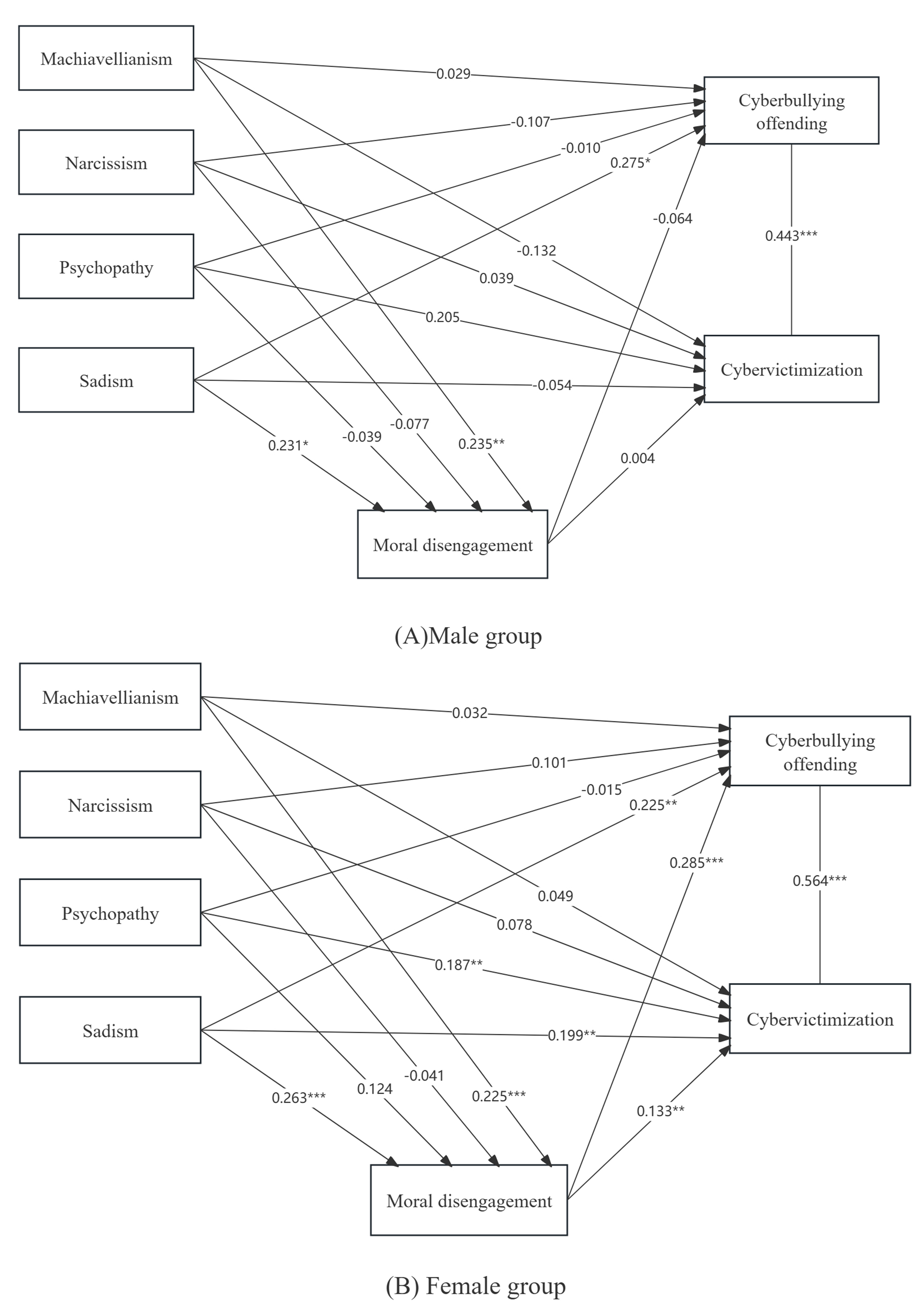
As detailed in Fig. 1A and Table 2, in the male group, Machiavellianism (beta = 0.235, p = 0.003) and sadism (beta = 0.231, p = 0.036) predicted moral disengagement significantly; sadism (beta = 0.275, p = 0.017) predicted perpetration of cyberbullying significantly. Moral disengagement had no significant predictive effect on cyberbullying offending and cybervictimization, and had no mediating effect on the links.
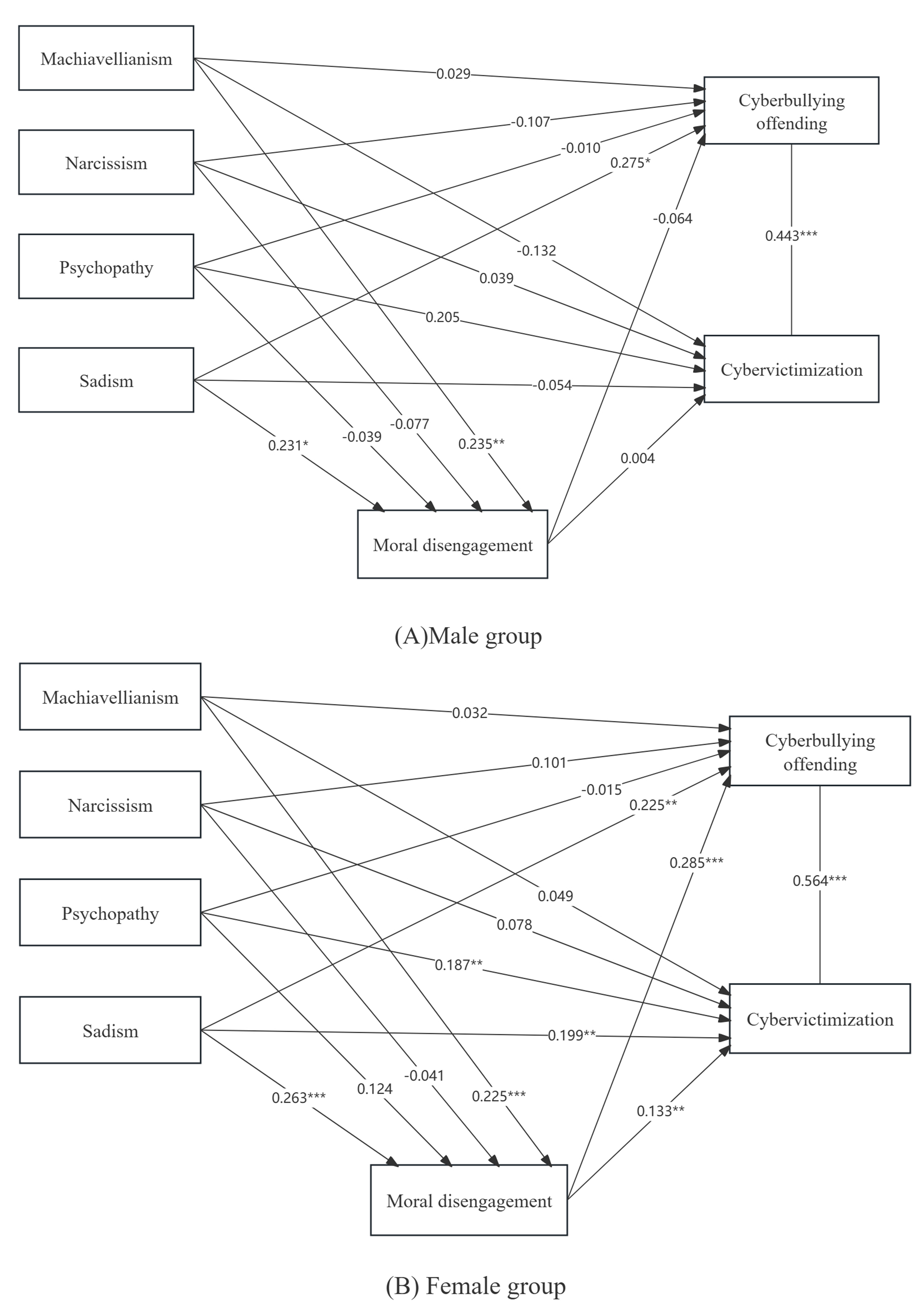 Fig. 1.
Multiple-group SEM. (A) Male group. (B) Female group. Note.
*p
As detailed in Fig. 1B and Table 3, in the female group, Machiavellianism (beta = 0.225, p = 0.000) and sadism (beta = 0.263, p = 0.000) predicted moral disengagement significantly; sadism (beta = 0.225, p = 0.001) predicted cyberbullying offending significantly only; psychopathy (beta = 0.187, p = 0.006) and sadism (beta = 0.199, p = 0.003) predicted cybervictimization significantly. Moral disengagement predicted cyberbullying offending (beta = 0.285, p = 0.000) and cybervictimization (beta = 0.133, p = 0.008) significantly.
| Indirect effects | Effect size | SE | p | Mediation proportion | |||
| Male | Female | Male | Female | Male | Female | Female | |
| Machiavellianism |
–0.015 | 0.064 | 0.018 | 0.019 | 0.418 | 0.001 | 60.0% |
| Narcissism |
0.005 | –0.012 | 0.008 | 0.015 | 0.544 | 0.444 | 23.3% |
| Psychopathy |
0.002 | 0.035 | 0.008 | 0.021 | 0.763 | 0.083 | 267.0% |
| Sadism |
–0.015 | 0.075 | –0.015 | 0.024 | 0.434 | 0.001 | 17.0% |
| Machiavellianism |
0.001 | 0.030 | 0.018 | 0.013 | 0.962 | 0.024 | 92.0% |
| Narcissism |
0.001 | –0.005 | 0.006 | 0.007 | 0.962 | 0.458 | 8.0% |
| Psychopathy |
0.001 | 0.017 | 0.003 | 0.011 | 0.963 | 0.134 | 4.0% |
| Sadism |
0.001 | 0.035 | 0.019 | 0.017 | 0.962 | 0.027 | 15.0% |
Note. MD, moral disengagement.
At the same time, moral disengagement partially mediated the links between Machiavellianism and cyberbullying offending (effect size = 0.064, p = 0.001), sadism and cyberbullying offending (effect size = 0.075, p = 0.001), Machiavellianism and cybervictimization (effect size = 0.030, p = 0.024), and sadism and cybervictimization (effect size = 0.035, p = 0.027).
This study aims to explore gender differences in the relationships between dark side personality traits, moral disengagement, cyberbullying offending, and cybervictimization, while also constructing a mediated role for moral disengagement. The results are as follows. There were no significant gender differences in cybervictimization and narcissism, but there were significant differences in the other dark side personality traits. In the male group, moral disengagement did not mediate all paths. However, in the female group, moral disengagement mediated the relationships between Machiavellianism and cyberbullying offending, sadism and cyberbullying offending, Machiavellianism and cybervictimization, and sadism and cybervictimization.
The first finding showed that there are significant gender differences in Machiavellianism, psychopathy, sadism, moral disengagement, and cyberbullying offending. Men’s scores for these variables were higher than women’s, but there were no significant gender differences in narcissism and cybervictimization. More specifically, Machiavellianism represents tactics and strategies (Christie and Geis, 2013), which has more often been used to describe males. Therefore, compared to females, males tend to exhibit more Machiavellian characteristics. Psychopathy is characterized by impulsiveness, low empathy, a pursuit of excitement, and a lack of responsibility (Paulhus and Williams, 2002), while sadism is characterized by enjoying cruelty, being cold-hearted, and hurting others for pleasure (Paulhus, 2014; Foulkes, 2019). These two dark personality traits have similar core characteristics, which are coldness and lack of empathy. Previous studies have indicated that females have higher levels of empathy and empathy skills than males (Fields et al., 2011), so it is understandable that females may be less likely to enjoy hurting others. Thus, females showed lower scores of psychopathy and sadism than males. In terms of moral disengagement, according to the caring theory (Gilligan, 1982), the socialization of males emphasizes rational decision-making and goal orientation, and they are cultivated as “rational decision-makers”. Their moral judgments rely more on instrumental rationality and tend to be result-oriented. Males tend to use strategies such as “responsibility transfer” or “result justification” to reduce moral guilt. Females are cultivated as “relationship maintainers”, emphasizing empathy and emotional resonance. Their moral decisions rely more on interpersonal harmony rather than individual interests, resulting in females being more sensitive to moral norms and less likely to deviate from morality. At the same time, under traditional gender culture, the moral constraints for males and females are different. In patriarchal cultures, males are regarded as “authority” and “rule-makers”, and their behaviors are more tolerated, with lower moral standards. While the moral standards for females are higher, and they are more strictly required, females perceive it as more difficult to deviate from morality (Hongmei, 2014). Additionally, according to the social theory of gender, females are more likely than males to follow the rules (Ward and Beck, 1990). Committing crimes such as cyberbullying can violate personal and social moral norms, so females are less likely to engage in such behaviors (Zhou et al., 2018). Therefore, males are more likely to have a lower level of moral engagement and engage in cyberbullying offending compared to females. Previous studies have indicated that males and females differ in narcissism and that males score higher than females (Paulhus and Williams, 2002). One possible explanation has to do with agentic characteristics in social cognition. More specifically, males have more agentic characteristics, which are primarily concerned with manipulation, aggression, ambition, and confident tendencies. Agentic characteristics strongly reflect a high level of narcissism (Luchner et al., 2011). Therefore, males are more focused on their improvement and show more narcissism. However, Grijalva et al. (2015) pointed out that it may be because the change in female social roles leads to an increase in female agentic characteristics. Females also show confidence, ambition, and control, which leads to an increase in narcissism. The gender differences in narcissism may gradually decrease over time because of this. Regarding gender differences in cybervictimization, previous research results have been inconsistent. Some studies have shown that males are more likely to be victims (Huang and Chou, 2010); some studies have shown that females are more likely to be victims (Rivers and Noret, 2010); some studies have shown no gender difference (König et al., 2010; Bauman, 2009). This may be because of the anonymity of the network (Barlett et al., 2016). In some cases, the victim is a stranger to the perpetrators (Vandebosch and Van Cleemput, 2008), and the perpetrators are unaware of the victim’s gender and other identifying information, leading to indiscriminate bullying.
The second finding is about the mediation model. In the model of the present study, Machiavellianism and sadism can positively predict moral disengagement, while narcissism and psychopathy cannot positively predict moral disengagement. Vincent Egan et al. (2015) showed that narcissism does not predict moral disengagement, noting that it may be because narcissism is not always an indicator of pathology and risk and may even be adaptive (Ackerman et al., 2011). Unlike other dark side personality traits, narcissism is characterized by being self-centered and very self-focused (Millon and Davis, 1996). This distinctive characteristic of excessive self-focus, coupled with insensitivity and low empathy, can lead the narcissist to pay no attention to the harm suffered by the victim and feel no guilt. Therefore, individuals with narcissism do not need to use moral disengagement to reduce guilt. Regarding psychopathy, which cannot predict moral disengagement, Sijtsema et al. (2019) argued that it may be because they don’t always think their immoral behavior is wrong. As a result, their actions do not cause self-sanctions, such as guilt or shame. As mentioned earlier, Machiavellianism can predict moral disengagement because individuals with this trait are manipulative and lack empathy (Christie and Geis, 2013), and they excel at exploiting the interests of others (e.g., corporate interests, workers’ interests) to disguise their unethical behavior (Maftei et al., 2022). No explanation has been found for the relationship between sadism and moral disengagement, but numerous studies demonstrated that moral disengagement mediates the relationship between sadism and cyberbullying offending (Pabian and Vandebosch, 2023; Nocera, 2019; Nocera et al., 2022).
Additionally, this study found that moral disengagement could partially mediate the links between dark side personality traits and cyberbullying offending, as well as between dark side personality traits and cybervictimization. Specifically, moral disengagement acts as a mediator between Machiavellianism and cyberbullying offending, sadism and cyberbullying offending, Machiavellianism and cybervictimization, and sadism and cybervictimization. Machiavellianism is often closely related to utilitarian moral judgment tendencies, making moral judgments based on one’s own interests, which promotes the cognitive aspect of justification for evasion. To protect their interests, individuals with Machiavellianism usually find excuses to defend their immoral behaviors (Li and Ren, 2018). Individuals with sadism are often cold-hearted and enjoy cruelty, deriving pleasure from the behavior of harming others. They will engage in immoral behaviors to seek this pleasure and promote rationalization in their cognition to reduce moral condemnation (Gajda et al., 2023). Then, moral disengagement makes the moral standards that constrain individuals ineffective, leading to a decrease in their morality and thus making individuals more likely to engage in cyberbullying offending. Additionally, through the mechanism of attribution of blame and moral justification in moral disengagement, individuals tend to blame the victims or defend the bullies while being criticized and condemned by others, becoming victims of cyberbullying (Sorrentino et al., 2023). In summary, Machiavellianism and abuse can further promote cyberbullying and cyberbullying victimization by influencing moral disengagement.
This study also found gender differences in the mediating model. Males had a higher level of moral disengagement than females, but moral disengagement did not mediate all paths for males; it was controversial with some previous studies. However, it can be argued that males committing cyberbullying may not require morally disengaged involvement, unlike females. Moral disengagement looks like a self-defense mechanism, used to help to cope with people’s guilt when they do things they know are wrong (Bandura, 2002; Doramajian and Bukowski, 2015). However, males may treat this cyberattack as a form of entertainment, as a game, and may not be aware of its seriousness (Pornari and Wood, 2010). Thus, they may believe they are doing nothing wrong when committing cyberbullying. Pornari and Wood (2010) have reported that cyberbullying does not activate the need to moralize behavior in the same way as traditional bullying does because of its distance from victims, lack of visibility, and secrecy of perpetrators. Furthermore, anonymity, distance from the victim, and the consequences of harmful behavior cause fewer negative emotions (e.g., guilt, shame, or self-condemnation) and also reduce empathy for the victim. Therefore, males don’t need moral disengagement to alleviate negative emotions and rationalize unethical behavior.
Conversely, research shows females show higher levels of empathy than males (Fields et al., 2011) and have more moral emotions (Paciello et al., 2008; Tangney and Dearing, 2002). Although females may become cyberbullying perpetrators due to the anonymity and stealth of Internet technology, which provide an ideal medium for aggression (Pornari and Wood, 2010), they are likely to experience a greater moral burden and negative emotions; thus, moral disengagement can help them rationalize their behavior and alleviate these feelings. In addition, females focus more on interpersonal relationships and maintaining friendships (Galán et al., 2022) and are more likely to follow rules than males (Ward and Beck, 1990). Cyberbullying can damage positive relationships with peers (Wang et al., 2016), and committing cyberbullying can be a violation of the ethics of the individual and society. Thus, when females engaged in cyberbullying, they tended to rationalize their actions through greater moral disengagement.
Moreover, given that females show higher levels of empathy and more moral emotions, they are more likely to rationalize perpetrators’ behaviors. Based on the theory of moral disengagement mechanisms, attributing blame as one of them can play a role in cybervictimization. Female victims may also come to believe that they are being bullied because they are at fault, like perpetrators who may justify their actions by attributing blame to the victims (Kowalski et al., 2014). This mechanism prompts them to justify and accept cyberbullying as their rightful punishment. These female victims explain perpetrators’ bullying behaviors through self-blame attribution. Therefore, moral disengagement plays a mediating role in cybervictimization for the female group.
When interpreting the findings of this study, it is important to acknowledge several limitations. First, the sample is restricted to emerging adults aged 18–25. Further research will aim to expand the age range of the sample, thereby enabling its application to more diverse age groups. Second, the gender ratio within the sample was not fully balanced; future studies could balance the gender distribution of their samples. Third, as cross-sectional research, it cannot prove causal relationships between variables via the mediator, so longitudinal studies are needed. Fourth, few relevant existing studies (on dark personality traits, moral disengagement, cybervictimization, and cyberbullying) provide references. Finally, only the total score of moral disengagement was used for analysis, and future research could adopt subscales to explore the impact of specific mechanisms.
Despite these limitations, our findings have key implications: First, they support recent research that moral disengagement mediates the links between dark personality traits and both cyberbullying offending and cybervictimization. Second, they enhance theoretical comprehension of the interrelations among dark personality traits, cyberbullying (both offending and victimization), and moral disengagement—particularly the association with cybervictimization—demonstrating that individuals exhibiting high moral disengagement are susceptible to both perpetrating and experiencing cyberbullying. Finally, gender differences exist in the mediation model: female moral disengagement leads to cyberbullying offending, while male moral disengagement has no mediating effect; yet male perpetrators are more common, indicating other influencing factors worth future exploration. Practically, the implementation of different interventions for males and females may help to decrease the occurrence of cyberbullying.
In conclusion, the present study expands the literature on cyberbullying. Our results have increased our understanding of how males and females with dark personality traits engage in cyberbullying offending or cybervictimization through moral disengagement. Future research will benefit from the relationship between moral disengagement and cybervictimization and from how moral disengagement mediates dark personality traits to cyberbullying offending and cybervictimization, as well as from learning more about gender differences. Research on such relationships of these variables can help develop more effective interventions to reduce the occurrence of cyberbullying.
The data that support the findings of this study are available from the corresponding author upon reasonable request.
ZY and JT conceptualized and designed the research framework. JT supervised the entire research process, providing intellectual guidance and oversight. XX and XW conducted the research, including data collection and implementation of the study protocol. ZY performed the initial data analysis, with XX contributing to advanced statistical analyses and validation. All authors contributed to editorial changes in the manuscript. All authors read and approved the final manuscript. All authors have participated sufficiently in the work and agreed to be accountable for all aspects of the work.
This study was carried out in accordance with the guidelines of the Declaration of Helsinki, and the protocol was approved by the Ethics Committee of Guangdong Medical University (approval number: YJYS2023056). All patients or their families/legal guardians gave their informed consent for inclusion before they participated in the study.
We would like to thank all the peer reviewers for their opinions and suggestions. We also appreciate Jinming Ye for kindly proofreading the manuscript to ensure text accuracy and fluency.
Graduated Research Project of School of Humanities and Management in Guangdong Medical University in 2023 “The impact of college students’ adversity experiences and personality traits on cyberbullying behaviors” (grand code: RW2023007).
The authors declare no conflict of interest.
References
Publisher’s Note: IMR Press stays neutral with regard to jurisdictional claims in published maps and institutional affiliations.