

 , Huimian Bian 2, Meng Zhao 2,*
1 Postdoctoral Research Station (Education), Guangzhou University, 510006 Guangzhou, Guangdong, China
2 Department of Psychology, Wuhan Wudong Hospital, 430084 Wuhan, Hubei, China
Abstract
Teacher mental health is a critical determinant of educational quality and student outcomes. Although mindfulness is known to alleviate occupational stress, the mechanisms underlying this relationship, particularly the role of coping self-efficacy (CSE), remain insufficiently explored in the context of China’s public junior high school educational environment.
To examine mechanisms beyond direct effects, we proposed and tested a moderated mediation model based on Social Cognitive and Transactional Stress Theories. Data were collected from 462 teachers in a Chinese public junior high school.
The results revealed that occupational stress mediated the relationship between mindfulness and mental health. CSE served as a significant buffer: the stress-reducing effect of mindfulness was significantly stronger for teachers with high CSE than for those with low CSE. The significant index of moderated mediation confirms that CSE is a pivotal boundary condition.
Our findings challenge the assumption that mindfulness interventions are universally effective. They further advocate for dual-focused programs that synergistically cultivate awareness and strengthen CSE, thereby promoting teacher well-being in Chinese junior high school contexts.
Keywords
- mindfulness
- coping self-efficacy
- occupational stress
- teacher mental health
- moderated mediation
- Chinese educational context
Teacher occupational stress has emerged as a widespread global issue with profound implications for educator well-being, instructional quality, and student outcomes (Dilekçi et al., 2025; Paudel et al., 2022). In China, this issue is particularly pronounced. Junior high school teachers operate within an educational system characterized by intense academic competition, high-stakes testing (Zhongkao), elevated parental expectations, and rigorous administrative evaluations (Jia et al., 2025). Chronic exposure to these stressors contributes to burnout, attrition, and diminished mental health, thereby threatening the stability and quality of the entire educational system (Tran et al., 2024; Ansley et al., 2021).
In seeking solutions to address these challenges, research has increasingly focused on psychological resources that may buffer against stress. Among these, mindfulness—defined as the self-regulation of attention toward present-moment experiences with an attitude of curiosity, openness, and acceptance (Levit-Binnun et al., 2021)—has garnered significant empirical support for its role in mitigating teacher stress. Recent evidence confirms that mindfulness-based interventions (MBIs) can effectively reduce stress and improve overall well-being among educators (Querstret et al., 2020; Taylor et al., 2021). However, a significant theoretical and practical gap remains: the mechanisms through which mindfulness confers these benefits (the mechanism) and the conditions under which these benefits are most pronounced (the boundary condition) are not yet understood. The vast majority of this research has been conducted in Western contexts, and the direct application of these models to China’s collectivist, high-achievement educational environment requires careful empirical validation (Bian and Jiang, 2025).
Notably, while mindfulness may cultivate a non-reactive awareness of stressors, it does not automatically confer the capacity to effectively against them. This limitation underscores the need to complement mindfulness with another key psychological resource: coping self-efficacy (CSE). Defined as an individual’s confidence in their ability to execute specific coping strategies when faced with life challenges (Chesney et al., 2006), CSE addresses the gap left by mindfulness. Rooted in social cognitive theory, CSE represents a foundational belief that determines whether coping skills will be initiated, how much effort will be expended, and how long that effort is sustained in the face of adversity (Eikenhout et al., 2022). We posit that mindfulness and CSE are synergistic constructs within the stress processing pathway. Mindfulness may provide calm, clear-minded awareness to perceive stressors more objectively and with reduced reactivity (primary appraisal), while CSE provides the confident belief in one’s capability to mobilize and deploy effective coping strategies (secondary appraisal).
This study is theoretically grounded in the integration of two seminal frameworks. First, the transactional model of stress provides the core mediation pathway. It proposes that stress arises from a dynamic transaction between the individual and their environment, involving a process of cognitive appraisal. We theorize that mindfulness shapes the primary appraisal, reducing the perceived threat of workplace demands. Subsequently, this reduction in occupational stress leads to improved mental health outcomes. Second, social cognitive theory informs our moderation hypothesis. It emphasizes the role of self-referent beliefs as powerful determinants of behavior and emotional response. We argue that a teacher’s level of CSE critically influences the secondary appraisal stage. Even with high mindfulness, a teacher with low CSE may still feel overwhelmed and unable to manage the demands they clearly perceive, thereby weakening the protective effect of mindfulness on stress.
Despite their theoretical connection, the precise interplay between mindfulness and CSE remains poorly understood and empirically inconsistent. A study treat CSE as an outcome of mindfulness, while others imply it might function as a mediator (Wei et al., 2024). This study explicitly frames CSE as a moderator of the relationship between mindfulness and occupational stress, a novel conceptualization that helps clarify the mechanism and addresses a significant gap identified by recent research (McGee et al., 2020).Therefore, this study aims to test an integrated moderated mediation model within the unique sociocultural context of Chinese junior high schools. Our research questions (RQs) are:
RQ1. Does occupational stress mediate the relationship between mindfulness and mental health among Chinese junior high school teachers?
RQ2. Does CSE moderate the first stage of this mediation model?
RQ3. Is the indirect effect of mindfulness on mental health via occupational stress conditional on the level of CSE?
By answering these questions, we contribute to theorical understanding by integrating Social Cognitive Theory with the Transactional Model of Stress, providing a more nuanced explanation of teacher well-being. From a practical perspective, our findings will inform the design of more precise, effective, and culturally sensitive interventions that not only teach mindfulness skills but also actively build teachers’ confidence in their ability to manage the systemic challenges they encounter daily.
Teaching is widely recognized as a profession with high emotional and cognitive demands, often leading to chronic stress and burnout (Paudel et al., 2022). Within this context, mindfulness—defined as receptive attention to present-moment experiences—functions as a critical psychological resource by promoting cognitive decentering and emotional non-reactivity (Bian and Jiang, 2025; Levit-Binnun et al., 2021). This metacognitive capacity allows teachers to disengage from automatic negative thought patterns, thereby attenuating the perception and impact of occupational stressors (Querstret et al., 2020; Taylor et al., 2021). For example, a mindful teacher may acknowledge feelings of being overwhelmed by workload demands without becoming entangled in cycles of rumination or anxiety. Empirical evidence consistently demonstrates a negative correlation between mindfulness and perceived stress across diverse professional groups, including educators (Kriakous et al., 2021; Hazlett-Stevens, 2020). Thus, we hypothesize:
H1: Mindfulness is negatively associated with occupational stress.
The harmful effects of chronic occupational stress on mental health are well-documented in educational settings (Tran et al., 2024; Ansley et al., 2021). Prolonged exposure to stressors depletes psychological resources, culminating in symptoms of anxiety, depression, and emotional exhaustion, which are core components of burnout and psychological distress (Belinda and Wei, 2024). By mitigating the perceived intensity of occupational stressors, mindfulness is theorized to indirectly promote better mental health outcomes. Consequently, we propose occupational stress as a pivotal mediating mechanism:
H2: Occupational stress is positively associated with poor mental health.
H3: Occupational stress mediates the relationship between mindfulness and mental health.
Theoretical and empirical evidence suggests that mindfulness and CSE constitute distinct yet complementary psychological resources (Eikenhout et al., 2022; McGee et al., 2020). Mindfulness cultivates awareness and nonjudgmental attention to present experiences, whereas CSE reflects an individual’s confidence in their ability to execute effective coping strategies when facing challenges (Chesney et al., 2006). A teacher with high mindfulness may clearly recognize a stressful situation without experiencing immediate emotional dysregulation. However, without adequate CSE, the individual may lack the confidence to apply effective coping strategies, allowing the stressor to persist and contribute to overall occupational stress (Çiçek et al., 2025). Conversely, high CSE enables a mindful teacher to translate their calm awareness into concrete, effective actions, thereby neutralizing stressors more successfully (Rojas et al., 2022). Accordingly, we hypothesize that CSE amplifies the stress-buffering effect of mindfulness:
H4: CSE moderates the relationship between mindfulness and occupational stress, such that the negative relationship is stronger for teachers with high CSE.
Integrating H3 and H4, we propose a moderated mediation model (Hayes, 2018) wherein the strength of the indirect effect of mindfulness on mental health (via occupational stress) is contingent upon the level of CSE. The protective effect of mindfulness is expected to be strongest among teachers who combine mindful awareness with high confidence in their coping abilities.
H5: The indirect effect of mindfulness on mental health through occupational stress is moderated by CSE, such that this indirect effect is stronger for teachers with high CSE.
Following ethical approval from the Institutional Review Board of Wuhan Wudong Hospital (Approval: 230630), data were collected between March and May 2023. Teachers from public junior high schools across five cities of Henan Province, China, were recruited using a convenience sampling method. School principals were contacted first to obtain permission for the study. Teachers were subsequently invited to participate through internal communication channels. Volunteers accessed an online questionnaire hosted on the Qualtrics platform, which began with a detailed information sheet and an electronic informed consent form. Participants were assured of the confidentiality and anonymity of their responses. The survey required approximately 20–25 minutes to complete.
An a priori power analysis was conducted using G*Power (version 3.1.9.7; Heinrich Heine University Düsseldorf, Düsseldorf, Germany) (Faul et al., 2009) for a multiple linear regression model with interaction terms,
consistent with our planned moderated mediation framework. Specifically, the
analysis accounted for five predictors in the most complex regression step. We
set an effect size of f2 = 0.15 (medium, consistent with typical
effect sizes for interaction effects in psychological and medical research),
The inclusion criteria for the study participants were as follows: (1) being a
teacher in mainland China; (2) serving as an in-service subject teachers at the
public junior high school level; and (3) being currently employed. The exclusion
criteria were as follows: (1) educational administrators (e.g., school
principals, deans, or department heads whose primary responsibilities are
administrative rather than teaching); (2) retired teachers; and (3) temporary or
substitute teachers. Initial screening of 485 submitted responses led to the
removal of 23 cases: 15 for being substantially incomplete (
| Characteristics | n | % | |
| Gender | Male | 71 | 15.4 |
| Female | 391 | 84.6 | |
| Age (years) | 21–30 | 160 | 34.7 |
| 31–40 | 111 | 24.0 | |
| 41–50 | 146 | 31.6 | |
| 45 | 9.7 | ||
| Teaching experience (years) | 1–10 | 147 | 31.8 |
| 10–20 | 128 | 27.7 | |
| 20–30 | 159 | 34.4 | |
| 28 | 6.1 |
n, number of samples.
All measures were administered in their previously validated Chinese versions. We proactively implemented both procedural and statistical strategies to minimize the potential for common method variance (CMV), as recommended by Podsakoff et al. (2003). Procedural strategies included ensuring respondent anonymity, reducing evaluation apprehension, and carefully counterbalancing the order of scale items to minimize bias.
The 15-item Mindful Attention Awareness Scale (MAAS) (Brown and Ryan, 2003) was used. This unidimensional scale measures the frequency of mindful states in daily life (e.g., “I find it difficult to stay focused on what’s happening in the present”). Items are rated on a 6-point Likert scale (1 = almost always to 6 = almost never). Higher average scores indicate greater dispositional mindfulness. The Chinese version, developed by Deng et al. (2011), has demonstrated robust psychometric properties in prior research with Chinese samples.
The 46-item Occupational Stress Questionnaire for Primary and Junior High School Teachers (Zhu et al., 2002) was employed. The scale comprises six specific dimensions: Exam Pressure (7 items; e.g., “I feel stressed about my students’ exam rankings”), Student Factors (8 items; e.g., “Managing disruptive students is exhausting”), Self-Development Needs (7 items; e.g., “I feel pressure to pursue further training”), Family Relationships (6 items, e.g., “My family responsibilities interfere with my work”), Workload (9 items; e.g., “I have too much administrative work to do”), and Career Expectations (9 items; e.g., “I am worried about my career progression”). Items are rated on a 5-point frequency scale (1 = never to 5 = always).
The 26-item CSE Scale (CSES) (Chesney et al., 2006) was used. Its established three-factor structure was confirmed in our sample: Problem-Focused Coping (13 items; e.g., “Break an upsetting problem down into smaller parts”), Emotion-Focused Coping (9 items; e.g., “Stop yourself from being upset by unpleasant thoughts”), and Seeking Social Support (4 items; e.g., “Get emotional support from friends and family”). Items are rated on an 11-point scale (0 = cannot do at all to 10 = certainly can do). We followed the scale’s validated scoring protocol and theoretical framework, which considers the factors as correlated but distinct dimensions. Therefore, for the structural model, a latent CSE factor was created, indicated by the three subscale mean scores.
The Symptom Checklist-90 (SCL-90) (Derogatis and Unger, 2010) was employed to assess psychological distress. The scale comprises 90 items across nine primary symptom dimensions: Somatization, Obsessive-Compulsive, Interpersonal Sensitivity, Depression, Anxiety, Hostility, Phobic Anxiety, Paranoid Ideation, and Psychoticism. Participants rated each item based on how the degree of distress experienced in the past week, using a 5-point scale (0 = not at all to 4 = extremely). The Global Severity Index (GSI), calculated as the average of all 90 items, served as the measure of overall psychological distress, with higher scores indicating poorer mental health. The Chinese version, developed by Chen and Li (2003), is widely used and well-validated in both clinical and research settings.
Data analyses were conducted using SPSS 27.0 (IBM Corp., Armonk, NY, USA) and AMOS 27.0 (IBM Corp., Armonk, NY, USA).
Preliminary Analysis: Descriptive statistics (means and standard deviations)
were examined, and univariate normality was assessed by confirming that skewness
and kurtosis values for all scale scores fell within acceptable limits (skewness
CMV: Given the cross-sectional, self-report design, CMV was assessed statistically using Harman’s single-factor test. All items from all scales were entered into an exploratory factor analysis (EFA) using principal axis factoring without rotation.
Measurement Model Validation: Before testing the structural hypotheses, a full CFA was run with all four latent constructs (Mindfulness, Occupational Stress, CSE, Mental Health) to assess the overall fit of the measurement model and to establish convergent and discriminant validity. Convergent validity was confirmed if Average Variance Extracted (AVE) values were above 0.50 and Composite Reliability (CR) was above 0.70. Discriminant validity was assessed using the Fornell-Larcker (1981) criterion: the square root of the AVE for each construct should be greater than its correlations with any other construct.
Multicollinearity Check: Before running regression analyses, the Variance Inflation Factors (VIFs) were checked for all predictor variables in the proposed models. A VIF value greater than 3.3 (or 5, using a more conservative threshold) would indicate problematic multicollinearity (Kock and Lynn, 2012).
Hypotheses Testing: The moderated mediation hypotheses were tested using the
PROCESS Macro for SPSS (Version 4.2, Model 7; The Ohio State University, Columbus, OH, USA) for SPSS. The Ohio State University, Columbus, OH, USA developed by Hayes (2018), with
10,000 bootstrap samples to generate bias-corrected confidence intervals (CIs).
Mindfulness was entered as the independent variable (X), occupational stress as
the mediator (M), mental health (GSI) as the dependent variable (Y), and CSE as
the moderator (W) of the X
Descriptive statistics and zero-order correlations for all study variables are
presented in Table 2. All variables were significantly correlated in the expected
directions (p
| Variable | M | SD | 1 | 2 | 3 | 4 |
| Mindfulness | 2.79 | 0.62 | (0.92) | |||
| Occupational Stress | 2.97 | 0.45 | –0.76** | (0.94) | ||
| CSE | 2.70 | 0.50 | –0.85** | –0.69** | (0.91) | |
| Mental Health (GSI) | 2.45 | 0.45 | –0.88** | 0.83** | –0.78** | (0.96) |
Note: N = 462. CSE, coping self-efficacy; GSI, Global Severity
Index; M, mean; SD, standard deviation. **p
Harman’s single-factor test revealed that the unrotated factor solution extracted multiple factors, with the first factor accounting for 28.7% of the total variance. As this is well below the critical threshold of 50%, we concluded that CMV did not pose a serious threat to the validity of our findings.
Confirmatory factor analysis of the four-factor measurement model demonstrated
excellent fit to the data:
As shown in Table 3, CR for each construct ranged from 0.83 to 0.96, far exceeding the recommended threshold of 0.70, which confirms strong internal consistency. The AVE for each construct ranged from 0.58 to 0.62, exceeding the 0.50 criterion and thereby supporting the convergent validity of the measurement model.
| Construct | CR | AVE | 1 | 2 | 3 | 4 |
| Mindfulness | 0.93 | 0.58 | 0.76 | |||
| Occupational Stress | 0.95 | 0.62 | –0.81 | 0.79 | ||
| CSE | 0.91 | 0.59 | 0.69 | –0.69 | 0.77 | |
| Mental Health (GSI) | 0.96 | 0.61 | –0.80 | 0.83 | –0.77 | 0.78 |
Note: CR, Composite Reliability; AVE, Average Variance Extracted. Square roots of AVEs are on the diagonal in bold. Correlations between constructs are below the diagonal.
For discriminant validity, we applied the Fornell-Larcker criterion, comparing the square roots of the AVEs for each construct (shown in bold on the diagonal in Table 3) with their correlations with other constructs. Most constructs met this criterion, except for three pairs with high correlations: (1) The square root of the AVE for Mindfulness (Construct 1) is 0.76, whereas its correlations with Occupational Stress (Construct 2) is –0.81 (absolute value = 0.81) and with Mental Health (GSI, Construct 4) is –0.80 (absolute value = 0.80), both exceeding 0.76; (2) The square root of the AVE for Occupational Stress (Construct 2) is 0.79, while its correlation with Mental Health (Construct 4) is 0.83, exceeding 0.79; and, (3) The square root of the AVE for Mental Health (Construct 4) is 0.78, while its correlation with Occupational Stress (Construct 2) is 0.83, exceeding 0.78.
To further assess discriminant validity, particularly given the high absolute correlations between certain constructs, we additionally calculated the Heterotrait-Monotrait Ratio (HTMT) of correlations, a more stringent indicator for discriminant validity. All HTMT values ranged from 0.72 to 0.87, remaining below the conservative threshold of 0.90 and the more lenient threshold of 0.95. Specifically, the HTMT values for the highly correlated pairs were well below 0.90, indicating that these constructs are empirically distinct despite their strong bivariate correlations. This supplementary HTMT analysis, combined with the Fornell-Larcker criterion, provides robust evidence for the discriminant validity of the measurement model.
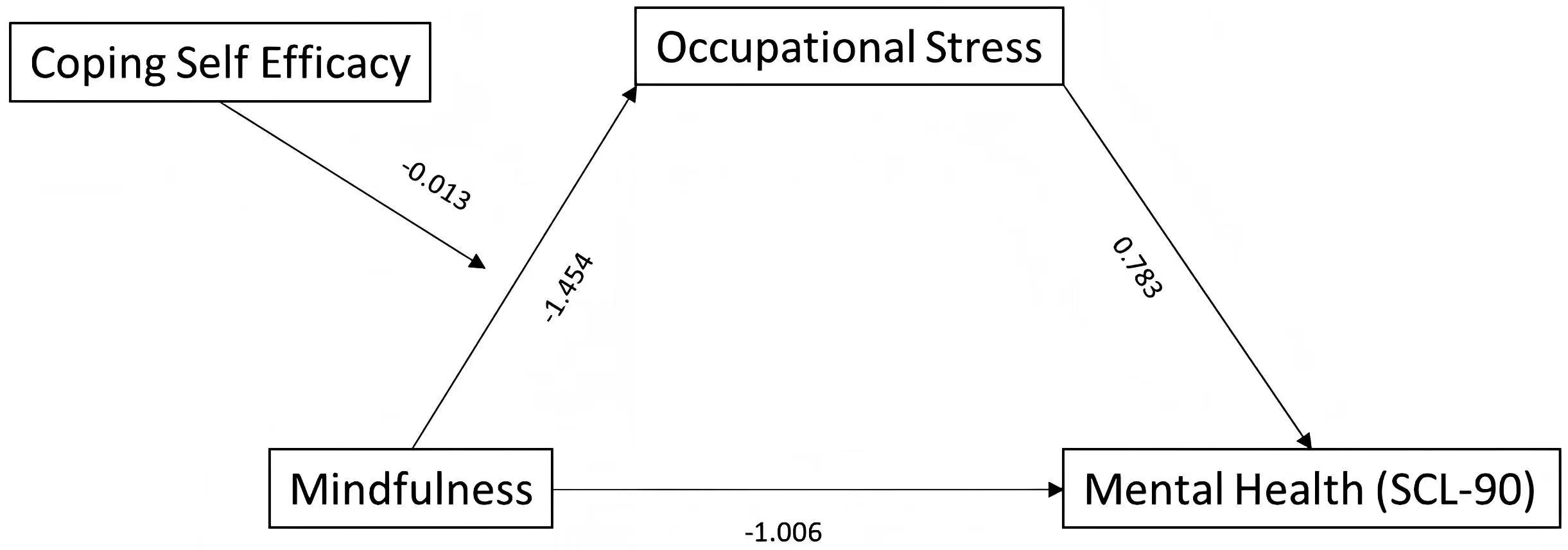
The results of the moderated mediation analysis using PROCESS Model 7 are summarized in Fig. 1 and Table 4.
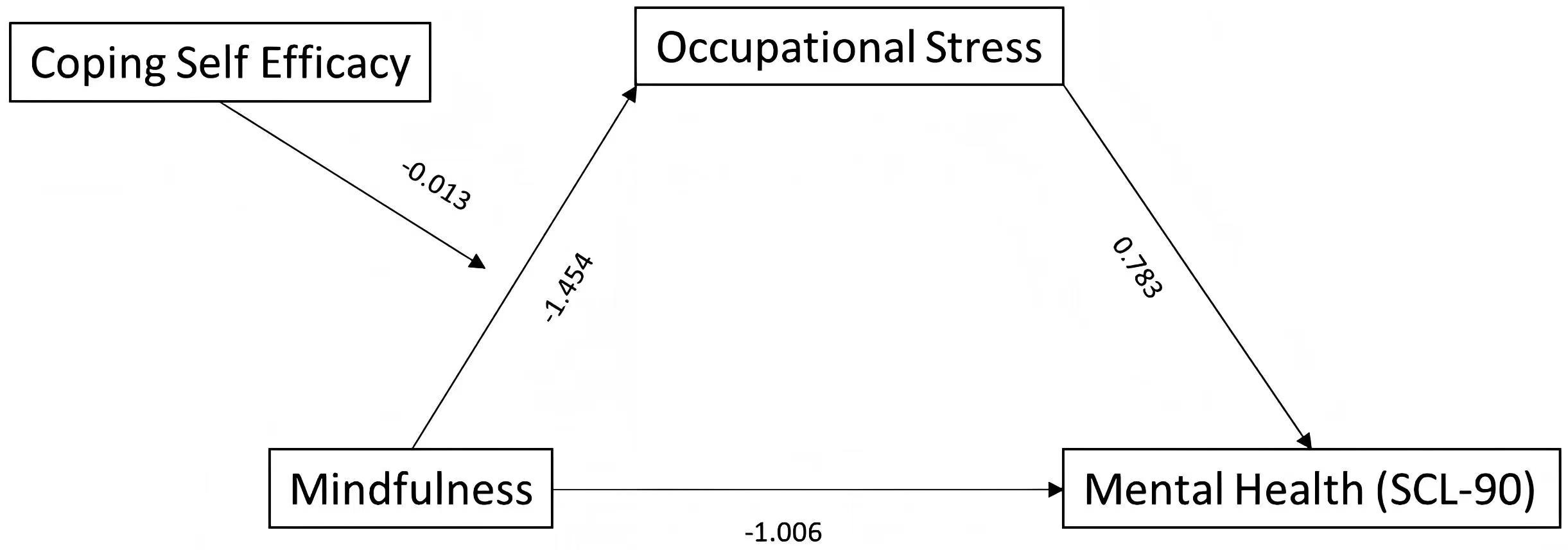 Fig. 1.
Final moderated mediation model with standardized path coefficients. SCL-90, Symptom Checklist-90.
| Outcome Variable: Occupational Stress | ||||
| Predictor | SE | t | p-value | |
| Constant | 3.41 | 0.05 | 68.20 | |
| Mindfulness (X) | –0.75 | 0.04 | –18.75 | |
| CSE, coping self-efficacy; (W) | –0.21 | 0.04 | –5.25 | |
| X * W (Interaction) | –0.14 | 0.03 | –4.67 | |
| Note. R2 = 0.71, F(3, 458) = 374.52, p | ||||
| Outcome Variable: Mental Health | ||||
| Predictor | SE | t | p-value | |
| Constant | 1.65 | 0.04 | 41.25 | |
| Occupational Stress (M) | 0.55 | 0.05 | 11.00 | |
| Mindfulness (X) | –0.38 | 0.05 | –7.60 | |
| Note. R2 = 0.75, F(2, 459) = 688.50, p | ||||
| Conditional Indirect Effects of X on Y through M at values of the Moderator | ||||
| Level of CSE | Effect | Boot SE | Boot LLCI | Boot ULCI |
| Low (–1 SD) | –0.33 | 0.05 | –0.43 | –0.24 |
| Mean | –0.41 | 0.05 | –0.52 | –0.32 |
| High (+1 SD) | –0.50 | 0.06 | –0.62 | –0.39 |
| Index of Moderated Mediation | –0.08 | 0.02 | –0.12 | –0.04 |
| Note. Index of moderated mediation = –0.08, Boot SE = 0.02, 95% Boot CI [–0.12, –0.04]. | ||||
CI, confidence interval; SE, standard error; X, the independent variable; W, the moderator.
Direct and Total Effects: The direct effect of mindfulness on mental health,
controlling for the mediator, was significant (
Simple slope analysis showed that at low level of CSE (W = –1
SD), mindfulness significantly negatively predicted occupational stress
(
The path from mindfulness to occupational
stress was significant and negative (
Supported. The interaction between mindfulness and CSE on
occupational stress was statistically significant (
Supported. The index of moderated mediation was
significant (Index = –0.08, Boot SE = 0.02, 95% Boot CI
[–0.12, –0.04], Bootstrapped p
The present study aimed to clarify the intricate mechanisms linking mindfulness to mental health among Chinese junior high school teachers, a population facing unique and significant occupational stressors. By examining a moderate mediation model, we go beyond simple direct effects to provide a more nuanced understanding of how mindfulness promotes mental health and for whom these benefits are most pronounced. Our findings support the hypothesized model, revealing that occupational stress serves as a key mediator and that CSE serves as a significant moderator, amplifying the entire process.
Our results strongly support the Transactional Model of Stress, indicating that occupational stress serves as a pivotal mechanism linking mindfulness to mental health outcomes. The significant negative association between mindfulness and occupational stress (H1) suggests that teachers who practice mindfulness are less likely to perceive work demands as threatening or overwhelming. This finding aligns with recent intervention research conducted in similar contexts. For example, Bian and Jiang (2025) demonstrated that MBIs significantly reduced occupational stress among Chinese junior high school teachers by fostering cognitive reappraisal and emotional regulation. Similarly, Taylor et al. (2021) found that even brief mindfulness training enabled teachers to reframe stressors and reduce emotional exhaustion. The significant positive association between occupational stress and psychological distress (H2) further corroborates the well-established detrimental impact of chronic stress on teacher well-being, as recently documented by Tran et al. (2024) in their study of burnout among English as a Foreign Language (EFL) teachers. Most importantly, the significant indirect effect (H3) reveals that a substantial portion of mindfulness’s beneficial impact is mediated through a reduction in perceived occupational stress. This mechanistic pathway suggests that mindfulness training benefits teachers primarily by transforming their subjective relationship to job demands themselves, thereby mitigating their stressful impact. This finding is consistent with Querstret et al. (2020), whose meta-analysis highlighted the role of mindfulness in altering stress appraisal processes.
The most novel and significant contribution of this study lies in identifying CSE as a crucial moderator in the mindfulness-stress relationship. The significant interaction effect (H4) demonstrates that the stress-buffering effect of mindfulness is not uniform across all teachers but is significantly stronger among those with high CSE. This finding can be powerfully interpreted through the lens of Social Cognitive Theory and aligns with emerging research across professions. Mindfulness fosters awareness and cognitive space for effective primary appraisal, while CSE enhances confidence in one’s ability to implement effective coping strategies during secondary appraisal. This synergistic effect aligns with Eikenhout et al. (2022), who found among Dutch police officers that CSE strengthened the negative relationship between chronic stressors and burnout. Similarly, Lange and Kayser (2022) showed that self-efficacy mitigated the impact of work-related stress during remote work arrangements. A teacher with both high mindfulness and high CSE can calmly observe challenging situations while confidently applying problem-solving strategies, seeking appropriate support, and regulating emotions effectively, leading to substantially greater stress reduction. Conversely, as Brink et al. (2020) observed in adolescents, high mindfulness without corresponding coping confidence can increase awareness of stressors without providing the capacity to manage them, potentially diminishing the protective effects of mindfulness. Our finding thus clarifies inconsistent results in previous literature by framing CSE not merely as a parallel mediator or outcome but as a critical boundary condition that determines the effectiveness of mindfulness in reducing occupational stress.
Theoretically, this study contributes by integrating two major psychological theories to explain teacher well-being. It demonstrates that the Transactional Model’s appraisal process is shaped by both a mindful disposition (affecting primary appraisal) and self-efficacy beliefs (affecting secondary appraisal). This integrated framework provides a more comprehensive understanding of the psychological resources required to thrive in demanding environments.
The empirical support for the moderated mediation model in this study has significant implications for designing and implementing evidence-based interventions to enhance teacher well-being. The findings challenge the effectiveness of generic, one-size-fits-all mindfulness training programs common in educational settings. Instead, they advocate for the development of dual-focused interventions that are theoretically aligned and pragmatically structured to cultivate mindful awareness and build domain-specific CSE.
The rationale for this integrated approach stems from the core mechanisms identified by our analysis. While mindfulness training alone supports non-judgmental awareness and reduces reactive stress appraisals (primary appraisal), it may provide an incomplete solution. It equips educators with awareness of their stressors but may not fully provide them with the “agentic capacity” or confidence to act effectively on that awareness. CSE becomes critical at this stage, as it directly shapes the secondary appraisal process—the individual’s evaluation of available coping resources. A teacher with high mindfulness but low CSE may accurately perceive a stressful situation yet feel powerless or ineffective in managing it, thereby limiting the potential benefits of mindful observation. Consequently, interventions must be designed to address both components of this psychological sequence. Therefore, effective teacher support programs must be comprehensively designed to include not only foundational mindfulness practices (e.g., focused-attention meditation, body scans, mindful breathing) but also explicit, skill-based modules aimed at enhancing confidence in implementing concrete coping strategies.
By combining mindfulness with efficacy-building activities, interventions can achieve greater effectiveness and sustainability. School administrators and policymakers should recognize that promoting teacher well-being requires investment in comprehensive, multifaceted professional development programs rather than seeking simplistic solutions.
Several limitations should be acknowledged. First, the cross-sectional design
prevents definitive causal inferences. Although our model is theoretically
grounded in stress and social cognitive theories, reverse causality cannot be
excluded. For example, poor mental health may reduce engagement with mindfulness
practices or lower perceived CSE. Future research should employ longitudinal
designs (e.g., 6-month or 1-year follow-ups) to track changes in variables over
time, or experimental designs to establish causal relationships. Second, the use
of self-report measures, although common in psychological research on well-being,
introduces the potential for social desirability bias and CMV. Although Harman’s
single-factor test and HTMT analysis suggested that these issues were not severe,
they still pose a potential threat to internal validity. Future studies could
incorporate multi-method assessments, such as peer ratings of teacher stress,
supervisor evaluations of mindfulness-related behaviors, or physiological
measures, to triangulate self-report data. Third, the sample was drawn from a
single province in China using convenience sampling, which limits the
generalizability of the findings to other regions, such as rural versus urban
areas or eastern versus western China, and to other cultural contexts.
Additionally, while the gender imbalance (84.6% female) reflects the demographic
reality of Chinese junior high school teachers, it may restrict the
generalizability of CSE’s moderating effect across genders. Future research
should strive for geographically diverse, representative samples—ideally
including multi-province data or national surveys—to strengthen external
validity. Fourth, a key limitation concerns the measurement tools. The original
Chinese scales used to assess “Mindfulness”, “Coping Self-Efficacy”, and
“Mental Health” were not specifically developed for public junior high school
teachers. For example, the mindfulness scale does not address teacher-specific
mindfulness contexts, and the CSE scale lacks items tailored to the coping
challenges faced by teachers. This lack of population-specific validation may
introduce response bias, as teachers may find it difficult to relate scale items
to their unique experiences, potentially inflating or deflating scores. While the
scales showed acceptable reliability in the current sample (Cronbach’s
To address these limitations and extend the current findings, several future research directions are proposed. First, as noted, longitudinal or experimental designs are necessary to establish causality. For example, a longitudinal study could examine how changes in mindfulness predict subsequent changes in occupational stress, CSE, and mental health. An experimental design could randomize teachers to a MBI group or a control group to test whether mindfulness training reduces stress and whether this effect is stronger for teachers with high baseline CSE. Second, future studies should develop or adapt measurement scales specifically for public junior high school teachers. For instance, modifying the CSE scale to include items like “I am confident in my ability to cope with student behavioral problems” or “I can effectively manage stress from Zhongkao-related workloads” would improve construct validity and reduce response bias. Validating these population-specific scales across diverse Chinese teacher samples would further strengthen their utility. Third, expanding the range of moderators and mediators could provide a deeper understanding of the model. For example, school climate may moderate the CSE-stress relationship, with high CSE having a greater impact in positive school climates. Similarly, emotional regulation could serve as an additional mediator, as mindfulness may improve emotional regulation, which in turn reduces stress. Exploring these variables would provide a more comprehensive understanding of the pathways to teacher well-being. Fourth, testing the model in diverse teacher populations would help clarify its generalizability. For example, high school teachers face different stressors (e.g., Gaokao pressure) compared with junior high school teachers, which may affect the strength of mediation or moderation effects. Comparing results across career stages, such as early-career versus veteran teachers, could also reveal whether the model’s pathways differ with professional experience. Ultimately, translating these findings into practical applications is crucial. Future research could partner with schools to develop targeted interventions—for example, combining mindfulness training to reduce stress with CSE workshops—and evaluate their effectiveness in reducing teacher burnout and improving mental health. Such applied research would bridge the gap between theory and practice, providing tangible benefits for Chinese public school teachers.
In conclusion, this study provides strong evidence for a moderate mediation model of teacher mental health. Reduced perceptions of occupational stress significantly account for the mental health benefits of mindfulness. This effect is further enhanced when teachers possess high confidence in their coping abilities. This underscores that awareness alone is insufficient; teachers also need the confidence to act. Therefore, efforts to support teacher well-being in junior high school educational systems, such as those in China’s, must adopt a dual-pronged approach: fostering mindful awareness to change the appraisal of stressors, while simultaneously building CSE to empower effective action. Investing in such comprehensive support systems can better safeguard educators’ well-being, which ultimately forms the foundation of a healthy and effective educational system.
The datasets generated and analyzed for this study are not publicly available due to restrictions stated in the ethical approval concerning participant confidentiality. Still, they may be available from the corresponding author upon reasonable request.
HJ and MZ validated the data, reviewed, edited the manuscript. HB designed the research, collected and analyzed the data, and wrote the first draft of the manuscript. All authors contributed to editorial changes in the manuscript. All authors read and approved the final manuscript. All authors have participated sufficiently in the work and agreed to be accountable for all aspects of the work.
The study was carried out in accordance with the guidelines of the Declaration of Helsinki. Ethical approval was obtained from the Institutional Review Board of Wuhan Wudong Hospital (Approval Number: 230630). Prior to the study, written informed consent was obtained from all participants.
Not applicable.
This research received no external funding.
The authors declare no conflict of interest.
During the preparation of this work, the authors used Deepseek V 3.2 in order to check spelling and grammar. After using this tool, the authors reviewed and edited the content as needed and take full responsibility for the content of the publication.
References
Publisher’s Note: IMR Press stays neutral with regard to jurisdictional claims in published maps and institutional affiliations.