
 , Banglin Yang 2,3, Hao Wu 4,*
1 Department of Education, Fujian Polytechnic Normal University, 350300 Fuqing, Fujian, China
2 Now with Department of Applied Social Sciences, The Hong Kong Polytechnic University, Hong Kong, China
3 Faculty of Education, East China Normal University, 200062 Shanghai, China
4 School of International Journalism and Communication, Beijing Foreign Studies University, 100089 Beijing, China
Abstract
Many studies have revealed that risk factors, such as social distancing restrictions, changes in the learning environment, and parent–child conflict, are negatively related to adolescents’ eating disorders. However, the current research focuses on the role of a single factor or a single field of factors, which may lead to overinference.
A three-wave longitudinal design was employed to examine the relationships among cumulative ecological risk, cognitive avoidance, and eating disorders. A total of 1236 Chinese adolescents (Mage = 15.85, SD = 0.61; 55.42% female) completed paper-based questionnaires, including the Cumulative Ecological Risk Questionnaire, Cognitive Avoidance Questionnaire, and Eating Attitudes Test. A parallel-process latent growth model was constructed to investigate the dynamic associations among cumulative ecological risk, cognitive avoidance, and eating disorders over time.
This study demonstrates that (1) cumulative ecological risk has a significant longitudinal effect on eating disorders among Chinese adolescents, both at the intercept and slope levels. (2) Cognitive avoidance partially mediates the link between cumulative ecological risk and eating disorders through multiple pathways at both the intercept and slope levels.
The findings of this research highlight the importance of reducing ecological risks and addressing maladaptive coping strategies (e.g., cognitive avoidance) to prevent eating disorders among adolescents.
Keywords
- cumulative ecological risk
- cognitive avoidance
- eating disorders
- Chinese adolescents
According to a survey, 70% of respondents self-reported varying degrees of loneliness, body shape/weight dissatisfaction, psychological stress, and eating disorders (Schlegl et al., 2020). Research has shown that adolescents are more likely to have eating disorders (Feldman et al., 2023). Eating disorders refer to a group of psychological conditions characterized by abnormal eating patterns, often accompanied by fluctuations in body weight and/or difficulties in social functioning (Treasure et al., 2020). Healthy eating behavior is a necessary condition for individuals to maintain physical and mental health, and eating disorders can lead to cognitive, emotional, and behavioral dysfunction (Barakat et al., 2023; Sepúlveda et al., 2023). Hence, it is necessary to investigate the factors that impact eating disorders among adolescents and the underlying mechanisms of action to provide a practical basis for efforts to address these disorders among adolescents.
Existing research has largely focused on the effects of single risk factors on adolescent mental health or eating disorders, such as poor family dysfunction (Holtom-Viesel and Allan, 2014), interpersonal relationship quality (Pelletier Brochu et al., 2018), and sociocultural aesthetic pressures (Caqueo-Urízar et al., 2011). Notably, individuals typically do not develop within a single risk environment; rather, they experience multiple pressures and challenges from diverse ecosystems. Previous studies have shown that cumulative ecological risk is significantly associated with psychological adaptation problems such as depression, anxiety, internet addiction, and suicide and non-suicidal self-injury (Zhang et al., 2025; Xiong et al., 2024). However, the relationship between cumulative ecological risk and eating disorders remains under systematic investigation. Furthermore, the mediating mechanisms underlying the relationship between these two factors remain unclear. To address this research gap, this study aims to explore the longitudinal relationship between cumulative ecological risk and eating disorders and to examine the mediating role of cognitive avoidance.
According to ecosystem theory, risk factors across various ecological domains (e.g., family, school, and peers) can significantly impact the development of problem behaviors (Wright et al., 2017). The combination of stress and a lack of social outlets drives some adolescents to adopt unhealthy coping mechanisms, such as eating disorders (Branley-Bell and Talbot, 2020; Schneider et al., 2023). However, research on eating disorders has focused largely on isolated risk factors, and only limited attention has been given to the relationship between cumulative ecological risk and eating disorders. For example, Rouleau reported that family conflict is significantly associated with an increased incidence of eating disorders (Rouleau et al., 2023). Another study found that stress is positively correlated with overeating, with anxiety playing important roles (Ioannidis et al., 2022). According to the cumulative risk model, risk factors across different domains tend to occur synergistically, meaning that individuals exposed to one risk factor are more likely to be exposed to additional risk factors in other domains (Evans et al., 2013). Therefore, focusing exclusively on the effects of single risk factors may lead to overgeneralized conclusions (Xu et al., 2024). A more comprehensive approach would involve examining the simultaneous effects of multiple risk factors on adolescent eating disorders, reflecting the complexity of real-world conditions. Therefore, adolescents who face cumulative ecological risk may experience an exacerbation of an eating disorder because of the intersection of multiple risk factors.
The psychological mediation framework posits that external stressful events increase an individual’s risk of developing psychological and behavioral problems by exacerbating that individual’s inherent psychological vulnerabilities (Hatzenbuehler, 2009). This model encompasses two main processes: distal stress and proximal stress. The distal stress process refers to exposure to unmanageable stressful or risky events, such as family conflict, peer rejection, and academic pressure (Mereish et al., 2019). The proximal stress process refers to the development of internalized negative psychological patterns, such as cognitive biases, negative self-evaluations, and avoidant thinking, after prolonged exposure to stressful environments (Tanay et al., 2012). In this study, cumulative ecological risk can be considered a manifestation of the distal stress process, reflecting the multiple risks that adolescents face across multiple ecosystems. On the other hand, cognitive avoidance represents a proximal process that is characterized by the negative cognitive strategies that individuals employ to avoid negative emotional experiences. Therefore, cognitive avoidance may play a mediating role in the relationship between cumulative ecological risk and eating disorders.
Cognitive avoidance involves individuals’ use of avoidance coping strategies, such as thought substitution and thought suppression, to cope with intrusive, negative, and adverse thoughts and to prevent themselves from experiencing negative emotions (Xie et al., 2023). Numerous studies have shown that when individuals chronically attempt to avoid people, places, or thoughts associated with adverse events, these attempts may lead to more frequent and intense psychological distress and increase their risk of developing multiple negative psychosocial adaptations, such as depression, anxiety, and nonsuicidal self-injurious behavior (Ottenbreit and Dobson, 2004; Dickson et al., 2012). On the one hand, as a proximal process, cognitive avoidance can worsen individuals’ eating disorders. According to the emotion regulation theory of abnormal eating behavior, when individuals experience negative emotions, they may alleviate these emotions by engaging in poor eating behavior (Li et al., 2024). For example, when individuals experience fear or anxiety, they may desire to eat even if they are not hungry, or they may have an appetite to cope with stress and relieve negative emotions (Geliebter and Aversa, 2003). Individuals can achieve emotional catharsis by shifting their attention to immediate stimuli through abnormal eating behaviors (Weinbach et al., 2018). In addition, escape theory states that overeating can help individuals escape from the impact of external negative events, thereby alleviating their psychological stress (Nederkoorn et al., 2006). As a result, individuals who frequently use cognitive avoidance are more likely to adopt avoidance strategies to cope with risk factors, thus making it easier for them to adopt unhealthy eating behaviors such as overeating and emotional eating to relieve negative emotions and psychological stress, than are individuals who do not frequently use cognitive avoidance (Palmeira et al., 2018). On the other hand, as a distal stress process, cumulative ecological risk increases individuals’ level of cognitive avoidance. Cumulative ecological risk reflects the low degree of structure and lack of supportive resources in the ecological context in which individuals are located (Li et al., 2016). Specifically, when an individual’s environment has a low level of structure (such as insufficient peer support and a greater amount of parent–child conflict), he or she adopts negative coping strategies to escape the negative emotions and psychological pressure that he or she cannot cope with in real life (Thompson et al., 2016). Empirical studies also highlight the mediating role of cognitive avoidance in the relationship between individual anxiety and binge eating (Rosenbaum and White, 2016). Adolescents who face multiple risk factors, such as parent–child conflict, social isolation, changes in learning styles, and epidemic infections, are more likely to employ cognitive avoidance strategies to alleviate psychological stress and emotional distress, which can affect their eating behaviors and lead to eating disorders.
A review of the literature revealed three significant research limitations. First, although extensive research has investigated the risk and protective factors associated with eating disorders, many of these studies focus on clinical and adult populations (Butryn et al., 2013; Lillis et al., 2011). There is a noticeable gap in the research on nonclinical and adolescent populations, particularly in the Chinese context. Second, prior research on the risk factors associated with eating disorders has often focused on mediating processes related to emotions, stress, or negative self-perceptions. For example, Cruz-Sáez et al. (2020) demonstrated that body image dissatisfaction influences eating disorders through the mediating roles of self-esteem and negative emotions. However, the literature has neglected the potential role of cognitive factors, especially cognitive processing mechanisms, in the development of eating disorders. Therefore, this study further contributes to and expands the understanding of the formation mechanism of the risk of eating disorders from a cognitive perspective. Finally, most existing studies on adolescent eating disorders feature a cross-sectional design, which helps reveal the correlation among variables; however, it is difficult to clarify the causal relationships among and the development trajectory of these variables. Therefore, a longitudinal research design to track psychological and behavioral changes in adolescents at different time points is urgently needed to more accurately identify the risk and protective factors of eating disorders.
In the context of the cumulative risk model and emotion regulation theory of abnormal eating behavior, this study develops a mediation model to investigate the link between cumulative ecological risk and eating disorders among Chinese adolescents, as well as the mediating effect of cognitive avoidance on the relationship between cumulative ecological risk and eating disorders. In addition, latent growth modeling and the latent growth mediation model are used to reveal the dynamic relationships among cumulative ecological risk, cognitive avoidance, and eating disorders in further detail. This method can be used not only to test the initial level and change trend between variables but also to evaluate the impact of potential mediating mechanisms at different time points, thereby providing a more comprehensive and dynamic overview of the psychological path associated with the development of eating disorders (Duncan and Duncan, 2004). Based on this theoretical framework and our empirical evidence, we propose the following hypotheses:
Hypothesis 1: Cumulative ecological risk is significantly and positively associated with both the intercept (initial level) and the slope (development rate) of eating disorders among Chinese adolescents.
Hypothesis 2: Cumulative ecological risk indirectly influences both the intercept and slope of eating disorders through its effect on the intercept and slope of cognitive avoidance.
The adolescents in the present study were recruited from four high schools in Henan Province and Shandong Province. We conducted a three-wave longitudinal study with a 6-month interval between waves. In Wave 1 (W1, October 2022), a total of 1325 students were recruited, including 641 grade 10 students (355 girls, 286 boys) and 684 grade 11 students (379 girls, 305 boys). In Wave 2 (W2, April 2023), 1297 students were retained, including 632 grade 10 students (350 girls, 282 boys) and 665 grade 11 students (367 girls, 298 boys), for an attrition rate of 2.11%. In Wave 3 (W3, October 2023), 1253 students were retained, for an attrition rate of 3.39%, including 613 grade 11 students (337 girls, 276 boys) and 640 grade 12 students (354 girls, 286 boys). After 17 participants with more than 50% missing data were excluded, 1236 valid questionnaires were included in the analyses. The final sample comprised 551 males (44.58%) and 685 females (55.42%), with a mean age of 15.85 years (SD = 0.61). The participants were in grade 11 (n = 603, 48.78%) and grade 12 (n = 633, 51.22%).
Little’s missing completely at random (MCAR) test was conducted to determine
whether the attrition data met the assumption of being missing completely at
random. For the T2 attrition data, the results were as follows: cumulative
ecological risk [
According to Li et al. (2016), screened ecological risk factors for adolescents should have the principles of systematicity, typicality, relevance, uniqueness and feasibility. The ecological risk factors were as follows.
Parental conflict: Parental conflict was assessed via the children’s perception of interparental conflict scale (CPIC), initially developed by Grych and Fincham (1990) and later revised by Zhao and Mo (2006). The scale consists of 18 items rated on a 5-point Likert scale. The following is an example item: “When my parents have conflicts, they yell at each other”. The total score reflects adolescents’ overall perception of parental conflict, with higher scores indicating greater levels of perceived conflict. The scale exhibited high-level internal consistency, with Cronbach’s alpha coefficients of 0.90 (Wave 1), 0.92 (Wave 2), and 0.90 (Wave 3).
Parent–child relationship: Parent–child relationships were measured via the parent–child relationship scale (PCRS), which was developed by Pianta (1992) and revised by Zhang et al. (2011). The scale consists of 16 items, including 3 dimensions: the transformation of intimacy, conflict and attachment. The participants responded to these items on a 5-point Likert scale (e.g., “I feel comfortable and natural expressing my emotions to my father”). The total score reflects adolescents’ parent–child relationships, with higher individual scores indicating better parent–child relationships. The Cronbach’s alpha coefficients were 0.91 (Wave 1), 0.89 (Wave 2), and 0.93 (Wave 3).
Family financial pressure: Family financial pressure was measured via the family financial pressure questionnaire developed by Wang and Zhang (2010). The scale consists of 4 items rated on a 5-point Likert scale. The total score reflects family financial pressure, with higher scores indicating greater levels of financial strain. The following is an example item: “My family cannot afford any extra money for family entertainment”. The Cronbach’s alpha coefficients were 0.93 (Wave 1), 0.86 (Wave 2), and 0.90 (Wave 3), thus indicating the strong internal reliability of the scale.
Friendship quality: endship quality was assessed with the friendship quality questionnaire, initially developed by Parker and Asher (1993) and subsequently revised by Zou et al. (1998). This scale comprises 8 items rated on a 5-point Likert scale. The following is an example item: “I feel understood by my friends”. The total score reflects adolescents’ friendship quality, with higher scores indicating better-quality friendships. In addition, in this study, the Cronbach’s alpha coefficients were 0.88 (Wave 1), 0.94 (Wave 2), and 0.92 (Wave 3).
School adjustment: School adjustment was measured via the school adjustment questionnaire developed by Cui (2008). The scale consists of 17 items divided into 5 dimensions, namely, peer relationships, teacher–student relationships, routine adjustment, academic adjustment, and school emotions and attitudes, which are rated on a 5-point Likert scale. The following is an example item: “I feel depressed at school”. The total score reflects adolescents’ overall school adjustment, with higher scores indicating better adjustment. The Cronbach’s alpha coefficients were 0.91 (Wave 1), 0.90 (Wave 2), and 0.89 (Wave 3).
Study pressure: Study pressure was measured with the study pressure questionnaire designed by Xu et al. (2010), which comprises 11 items categorized into four dimensions: parental pressure, self-pressure, teacher pressure, and social pressure. The participants responded to these items on a 5-point Likert scale (e.g., “I feel frustrated if my exam results are not excellent”). The total score reflects adolescents’ overall study pressure, with higher scores indicating increased levels of study pressure. The internal consistency of this scale in this study was assessed with Cronbach’s alpha coefficients, which were 0.90 (Wave 1), 0.88 (Wave 2), and 0.89 (Wave 3).
This study adopted a modeling strategy that is widely recognized and applied in the literature to construct a cumulative ecological risk index (CERI) (Wade et al., 2015). Each risk variable was first set with a critical value based on the 25th or 75th percentile of its score and then binary coded accordingly (1 indicates risk, and 0 indicates no risk). The binary scores of all risk factors were subsequently summed to obtain the individual CERIs (see Supplementary Tables 1–3).
The CAQ, which was originally developed by Gosselin et al. (2007) and further refined and validated by Xie et al. (2023), was employed in this study. The survey comprises 25 items and encompasses five dimensions: transforming images into thoughts, suppressing thoughts, distracting, substituting thoughts, and avoiding threatening stimuli. The following is an example item: “I tend to avoid things that draw my attention but that I’d rather not think about”. The participants responded to these items on a 5-point Likert scale. The total score reflects adolescents’ overall CA, with higher individual scores indicating higher levels of cognitive avoidance. The Cronbach’s alpha coefficients were 0.92 (Wave 1), 0.91 (Wave 2), and 0.89 (Wave 3), thus indicating the strong internal consistency of the scale.
Eating disorders were assessed via the Eating Attitudes Scale developed by Garner et al. (1982), which features 16 items categorized into three dimensions: dieting, bulimia and food concern, and oral control. The following is an example item: “I vomit after I have eaten”. The participants responded to these items on a 5-point Likert scale. The total score reflects adolescents’ overall eating disorders, with higher individual scores indicating greater degrees of eating disorder. Specifically, adapted for Chinese adolescents, this questionnaire boasts strong reliability and validity, as affirmed by Bi et al. (2024). In addition, in this study, the Cronbach’s alpha coefficients were 0.93 (Wave 1), 0.89 (Wave 2), and 0.93 (Wave 3).
Prior to the start of the study, the study procedures and materials were approved by the Ethical Review Board of East China Normal University (HR number 538-2021). After consent was obtained from the principal, parents, and adolescents themselves, data collection was initiated. Specifically, the principal examiner described in detail the content of the study, the purpose of the study, privacy protection, data storage, and other related matters within the class. The students were emphatically informed that they needed to participate in the data collection process three times at intervals of six months.
First, descriptive statistical and correlation analyses were conducted with the assistance of SPSS 27.0 (IBM Corp, Chicago, IL, USA). Next, given that the three datasets are repeated measures, testing measurement invariance was necessary (Cheung and Rensvold, 2002). Finally, parallel latent growth models (PLGMs) were subsequently tested with the assistance of Mplus 8.0 (Muthén and Muthén, Los Angeles, CA, USA). Additionally, Harman’s single-factor test was employed with the assistance of SPSS 27.0 to measure the degree of common method bias.
Harman’s single-factor test was employed to evaluate potential common method bias in this study. At Wave 1, the results revealed 15 factors whose eigenvalues exceeded 1. The variance explained by the primary factor was 16.84%, which was less than the threshold of 40%. At Wave 2, the analysis revealed that 19 factors had eigenvalues greater than 1, with the first factor explaining 19.49% of the variance. At Wave 3, 22 factors had eigenvalues above 1, and the variance explained by the first factor was 23.85%, which was well below the 40% threshold, suggesting the absence of substantial common method bias in this wave as well. Consequently, these findings suggest the absence of significant common method bias in the dataset utilized in this study.
Table 1 presents the descriptive statistics and correlations among cumulative ecological risk, cognitive avoidance, and eating disorders.
| Variables | M | SD | 1 | 2 | 3 | 4 | 5 | 6 | 7 | 8 | 9 |
| 1. T1 CER | 2.78 | 0.77 | - | ||||||||
| 2. T2 CER | 3.10 | 0.69 | 0.44** | - | |||||||
| 3. T3 CER | 3.16 | 0.71 | 0.30** | 0.35** | - | ||||||
| 4. T1 CA | 2.48 | 0.72 | 0.42** | 0.23** | 0.17** | - | |||||
| 5. T2 CA | 2.60 | 0.65 | 0.31** | 0.27** | 0.20** | 0.55** | - | ||||
| 6. T3 CA | 2.46 | 0.69 | 0.18** | 0.12** | 0.33** | 0.41** | 0.28** | - | |||
| 7. T1 EDs | 2.34 | 0.87 | 0.30** | 0.20** | 0.07* | 0.27** | 0.10* | 0.13** | - | ||
| 8. T2 EDs | 2.70 | 1.04 | 0.22** | 0.19** | 0.15** | 0.22** | 0.17** | 0.10** | 0.33** | - | |
| 9. T3 EDs | 2.76 | 0.96 | 0.15** | 0.16** | 0.17** | 0.20** | 0.13** | 0.25** | 0.18** | 0.26** | - |
Note: CER, cumulative ecological risk; CA, cognitive avoidance; EDs,
eating disorders; T1, Time 1; T2, Time 2; T3, Time 3. *p
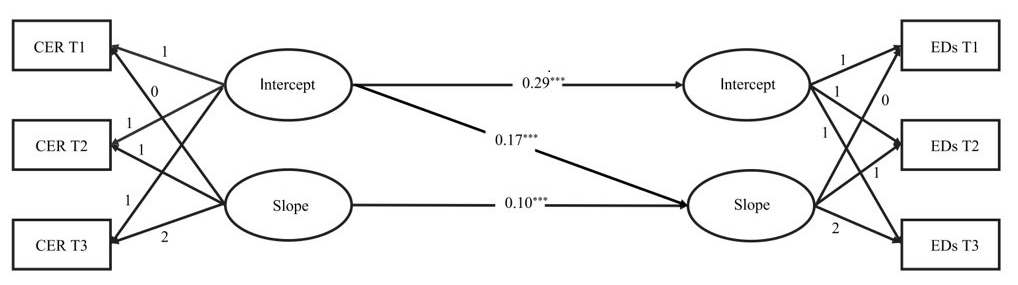
A conditional growth model (Fig. 1) that featured cumulative ecological risk as
the predictor variable and eating disorders as the dependent variable was
constructed to examine whether cumulative ecological risk can predict the initial
level and growth rate of eating disorders. To maintain the clarity and simplicity
of the figure, the paths for control variables (gender, age, school, and class)
are not displayed in the path diagram. The results show that the conditional
model fit well (
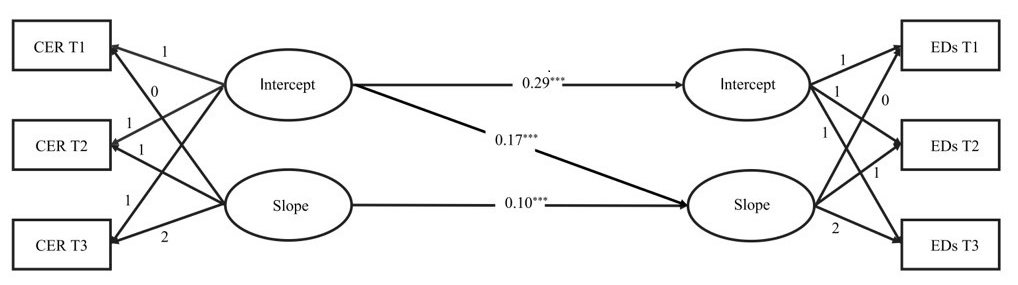 Fig. 1.
Latent growth model for adolescents’ cumulative ecological risk
and eating disorders after controlling for gender, age, school and class. All
parameters in the report are standardized. ***p
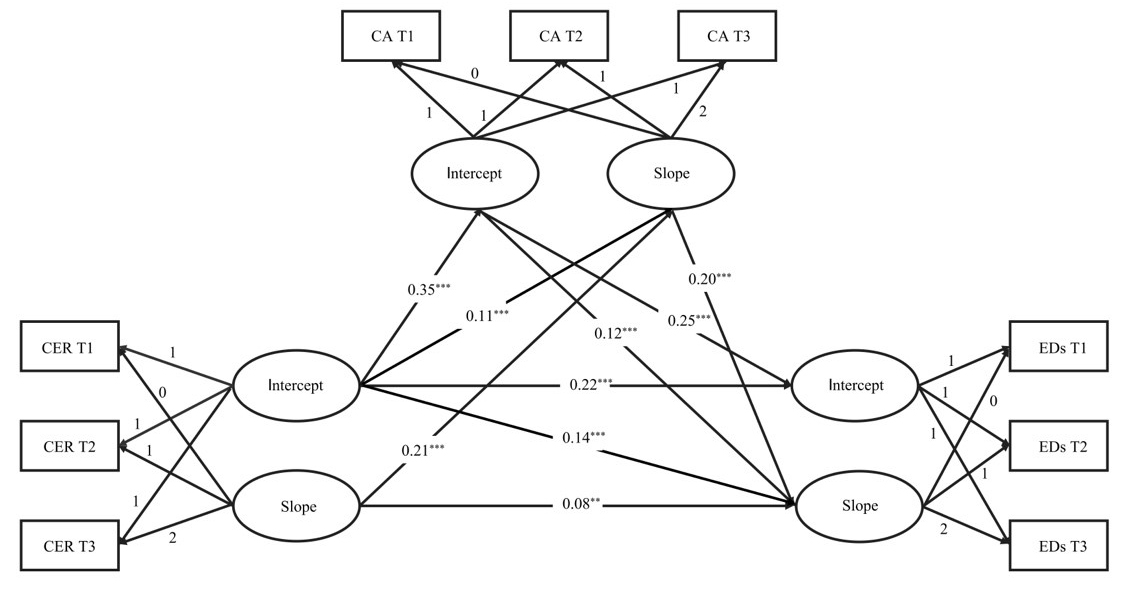
In this study, a latent variable growth mediation model was constructed to test
whether cognitive avoidance plays a longitudinal mediating role in the
relationship between cumulative ecological risk and eating disorders (Fig. 2).
Cumulative ecological risk was used as a predictor variable, cognitive avoidance
was used as a mediating variable, and eating disorders were used as a dependent
variable when gender and age were controlled. The model fit was good
(
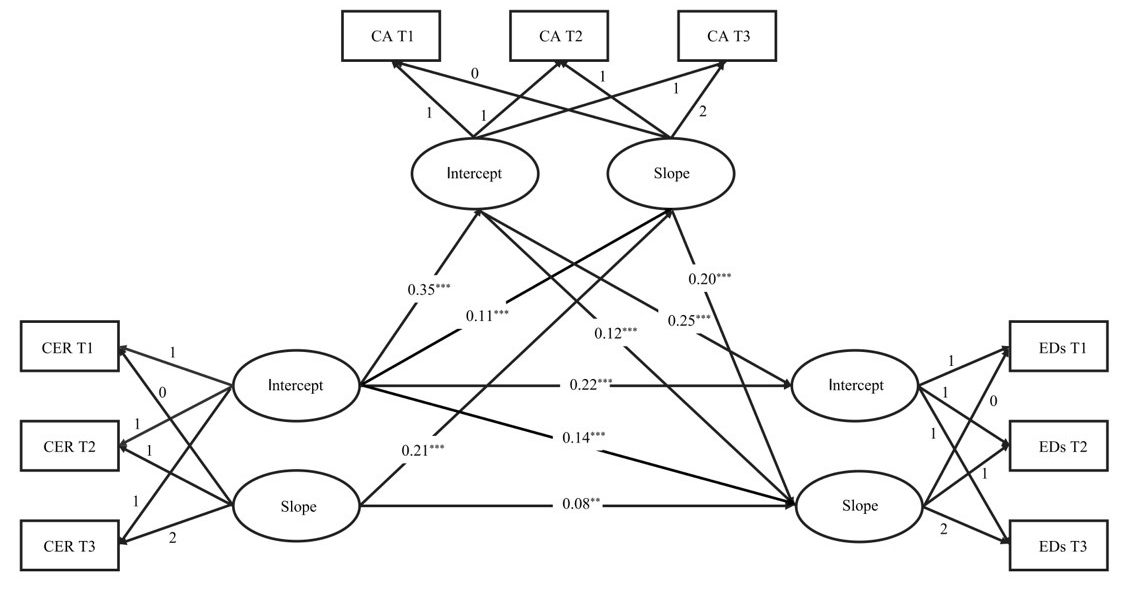 Fig. 2.
Latent growth mediation model for adolescents’ cumulative
ecological risk, cognitive avoidance, and eating disorders after controlling for
gender, age, school and class. All parameters in the report are standardized.
**p
| Indirect Path | Mediating Effect | 95% Bootstrap | p |
| CERI |
0.08 | [0.04, 0.12] | p |
| CERI |
0.02 | [0.01, 0.05] | p |
| CERI |
0.04 | [0.01, 0.07] | p |
| CERs |
0.04 | [0.01, 0.08] | p |
Note: I, intercept; s, slope.
The present study revealed that cumulative ecological risk not only significantly predicts the initial level of adolescent eating disorders (that is, a greater degree of eating problems at the baseline stage) but also significantly predicts their development. That is, the development of an eating disorder is more rapid over time. This finding provides strong support for Hypothesis 1. Meanwhile, this finding is in line with previous research on the relationship between cumulative ecological risk and a range of problem behaviors (Steeger and Gondoli, 2013). Cumulative ecological risk reflects the accumulation of stressors across multiple environmental contexts and is often characterized by a lack of supportive resources and the presence of unstructured socialization processes (Li et al., 2016). Adolescents who experience higher levels of cumulative ecological risk are more likely to face challenges in emotion regulation and behavioral adjustment, thereby increasing their vulnerability to problem behaviors, such as disorders, than other adolescents (Swami et al., 2021). Research suggests that these disruptions, ranging from changes in living habits to increased perceptions of parental conflict, study pressure, social isolation, and a lack of effective supportive resources, can significantly amplify stress and anxiety levels (Evans and Cassells, 2014; Wang et al., 2024). Furthermore, within the Chinese cultural context, the pressure of the Gaokao (National College Entrance Examination) is a significant sociocultural stressor commonly faced by high school students (Liu and Helwig, 2020). As a crucial event that occurs during high school, the Gaokao not only determines a student’s chances of further study but also is considered a crucial milestone influencing his or her future social status and family’s class transition (Liu et al., 2019). Long-term academic competition, parental expectations, and the exam-oriented school environment create a constant high-pressure environment for students (Gu et al., 2017). This constant psychological pressure can significantly increase adolescents’ anxiety, perfectionism, and self-esteem concerns, thereby increasing their likelihood of adopting unhealthy coping strategies (Han, 2024). In this context, some students may resort to diet control or an excessive focus on body image to gain a temporary sense of control and psychological compensation, ultimately putting them at risk for developing eating disorders (Feldman et al., 2023).
The findings indicate that cognitive avoidance plays a partial mediating role in the relationship between cumulative ecological risk and eating disorders through four indirect paths involving both the initial levels and development rates of the variables. In other words, cumulative ecological risk may increase adolescents’ susceptibility to eating disorders by fostering a greater reliance on cognitive avoidance strategies. Notably, from a developmental perspective, intercepts reflect individuals’ initial risk levels, whereas slopes capture the rate at which these processes change over time. Thus, the influence of cognitive avoidance on the development of eating disorders may be driven by dynamic, cumulative processes rather than static baseline differences.
First, cumulative ecological risk is found to be a significant predictor of cognitive avoidance. This result is in line with the previous findings, which indicated that individuals who are exposed to high levels of cumulative ecological risk are more likely to employ maladaptive emotion regulation strategies, such as cognitive avoidance (Yazgan et al., 2021). There are several possible explanations for this relationship. According to one such explanation, adolescents who are exposed to multiple and cumulative risk factors are often subject to intense and frequent negative emotional experiences (Xu et al., 2024). When adolescents encounter such stressors, their natural inclination may be to quickly eliminate or suppress the accompanying negative emotions. Cognitive avoidance, which involves efforts to suppress, ignore, or distract oneself from distressing thoughts and feelings, may emerge as a preferred coping strategy (Dickson et al., 2012). In this way, adolescents resort to cognitive avoidance not only to mitigate immediate emotional discomfort but also to shield themselves from further emotional harm. Although this avoidance may provide short-term relief from distressing situations, it also prevents individuals from fully processing and addressing the underlying issues, ultimately contributing to long-term maladjustment. Another explanation is that cumulative ecological risk erodes adolescents’ coping resources and personal resilience, because of which they feel powerless and out of control (Li et al., 2016). Adolescents may develop a diminished sense of agency or competence when faced with a barrage of stressors across multiple ecological domains, such as family, school, and peer environments. The cumulative nature of these risks can overwhelm adolescents’ coping capacities, making them feel as though they have little control over external events (Lin et al., 2024). This perceived loss of control can intensify negative emotions and foster a sense of helplessness, thereby reinforcing their reliance on cognitive avoidance. In these situations, avoidance becomes a way to “escape” from the perceived threat or insurmountable difficulties. However, such avoidance may foster a maladaptive processing style that focuses on threat, worry, and self-protection (Gosselin et al., 2007).
Cognitive avoidance is also identified as a significant predictor of eating disorders, further supporting the role of this maladaptive coping strategy in the development of disordered eating behaviors (Hosseini Ramaghani et al., 2019). Although cognitive avoidance is effective in providing short-term relief from emotional distress, it ultimately exacerbates emotional suffering and fosters long-term maladjustment (Weineland et al., 2013). Notably, the mechanism underlying this influence is not only reflected at a static level; it is also evident as a dynamic process. This study revealed that adolescents in a high cumulative ecological risk environment tended toward greater levels of cognitive avoidance at an early stage (higher initial level) and that the frequency of use of this avoidance strategy increased faster over time (faster development speed). The accelerated development speed of the cognitive avoidance tendency further exacerbates the symptoms of eating disorders in the time dimension, reflecting the risk-coping-behavior temporal chain. Adolescents who engage in cognitive avoidance are likely to experience increased rumination, anxiety, and emotional suppression, all of which can interfere with healthy emotional processing (Evans et al., 2013). As a result, these adolescents may struggle to engage in positive, rewarding activities that could help alleviate their negative emotional states. Instead, adolescents may turn to maladaptive behaviors to regain a sense of control over their emotions and bodies (Andriopoulos and Kafetsios, 2015). Furthermore, cognitive avoidance contributes to a feedback loop in which the avoidance of negative emotions leads to greater emotional dysregulation and increased reliance on maladaptive coping mechanisms. Research has shown that adolescents who use avoidance strategies tend to experience fewer positive emotions and are less likely to engage in activities that promote psychological well-being than other adolescents (Weineland et al., 2013). This reduction in positive experiences exacerbates emotional distress, thereby increasing the likelihood that adolescents will resort to disordered eating behaviors as a coping mechanism.
This study offers a novel perspective on ways of preventing and intervening in adolescent eating disorders and has practical implications. Cumulative ecological risk was identified as a significant factor influencing the incidence of eating disorders among adolescents. Minimizing the number of high-risk factors across the family, school, and societal domains has become paramount. Creating a structured, supportive environment is pivotal for fostering an ecosystem that bolsters the healthy development of young individuals (Youngblade et al., 2007). For example, parents should teach teenagers to use healthy coping strategies when they face stress (exercise, mindfulness, deep breathing, talking to friends) rather than coping with emotions by dieting or overeating (Godsey, 2013; Raisi et al., 2023). In addition, cognitive avoidance plays an important role in the development of eating disorders. Therefore, in practice, cognitive-behavioral or acceptance-based interventions could be developed to help adolescents identify and modify avoidant thinking patterns, improve emotion regulation, and enhance coping flexibility. Research suggests that the use of acceptance-commitment therapy can effectively help individuals accept the prevailing external context, achieve a balance between themselves and the external context, and reduce the use of avoidance strategies (Milyavskaya et al., 2015). Schools and mental health education components should strengthen counseling services and make use of various counseling therapies to help adolescents use fewer or no cognitive avoidance strategies and help them face the external environment in a positive manner (Dobson and Dobson, 2018). Moreover, incorporating routine school-based mental health screening may help identify adolescents who show elevated cognitive avoidance or early signs of disordered eating, enabling timely and early intervention. Overall, this study provides new and feasible perspectives and ideas for efforts to help adolescents suffering from eating disorders.
This study has several limitations. First, although this study featured a longitudinal design, it still has certain limitations and cannot fully identify the causal relationships among cumulative ecological risk, cognitive avoidance, and eating disorders (Tennant et al., 2022). Future studies can further extend the follow-up time and combine experimental designs (such as intervention studies or natural experiments) to more powerfully verify the causal path between variables (Imai et al., 2013). Second, although Harman’s single-factor test indicated no serious common method variance, the exclusive use of self-report measures may still introduce potential bias (Luthar et al., 2015). Future studies could employ multimethod or psychophysiological measures (e.g., cortisol and heart rate variability) to examine the biological mechanisms linking ecological risk and cognitive avoidance or to explore reciprocal relationships across developmental stages. Third, the data used in this study were obtained from four middle schools in Shandong and Henan Provinces, which may lead the sample to be insufficiently representative in terms of socioeconomic, cultural, and educational backgrounds. Future research should expand the sample range to cover more regions and schools and should include adolescents with different socioeconomic, cultural, and educational backgrounds, further verify the conclusions of this study. Fourth, the CERI may oversimplify the complex nature of ecological risk, as some participants near the cutoff may still experience substantial risk but not be classified as “at risk” (Evans et al., 2013). Therefore, future studies could adopt more nuanced methods, such as latent profile analysis or clustering techniques, which could better capture the multifaceted nature of ecological risk by grouping participants based on similar risk patterns rather than arbitrary cutoffs. Finally, owing to practical constraints, this study did not include all potential risk factors, such as socioeconomic status (SES), body mass index (BMI)/weight status, depression, and anxiety. Future research could include them to further examine the relationships among cumulative ecological risk, cognitive avoidance, and eating disorders.
Based on a longitudinal analysis of three follow-up datasets, this study revealed that cumulative ecological risk significantly predicted the initial level and development speed of eating disorders among adolescents. Moreover, cognitive avoidance played a partial mediating role in the relationship between the two, which was specifically reflected in the four indirect paths involving the initial level and development speed. These findings indicate that a high-ecological-risk environment may prompt adolescents to adopt avoidant coping strategies, thereby exacerbating the development of eating disorders. Therefore, when interventions for adolescents are implemented, attention should be given to the impact of their early living environment on their psychological coping patterns, especially in terms of reducing their level of cognitive avoidance and improving their positive coping ability, to reduce their risk of eating disorders. Future studies should adopt research designs with stronger causal inference capabilities to explore the buffering roles of other possible protective factors (such as emotion regulation ability and social support) in the relationship between ecological risk and mental health problems to provide a more solid theoretical foundation and practical guidance for efforts to promote the mental health of adolescents.
The datasets generated during and analyzed during the current study are available from the corresponding author on reasonable request.
MZ was responsible for the conceptualization, study design, methodology, and investigation. BY and HW contributed to the methodology, formal analysis. All authors contributed to editorial changes in the manuscript. All authors read and approved the final manuscript. All authors have participated sufficiently in the work and agreed to be accountable for all aspects of the work.
All procedures performed in the present study were approved by the Human Research Protection at the East China Normal University (Reference number: HR 538-2021) and in accordance with the ethical standards of the 1964 Helsinki Declaration and its later amendments or comparable ethical standards. Written informed consent was obtained from all the participants prior to the publication of the present study.
Not applicable.
Fujian Province Young and Middle-aged Teacher Education and Research Project (Social Science) General Project (JAS21189) “Research on Forgiveness Psychology of Secondary Vocational Students Based on the Perspective of Positive Youth Development”.
The authors declare no conflict of interest.
Supplementary material associated with this article can be found, in the online version, at https://doi.org/10.31083/BP46809.
References
Publisher’s Note: IMR Press stays neutral with regard to jurisdictional claims in published maps and institutional affiliations.